Senate Republicans release massive economic stimulus bill for coronavirus response #ศาสตร์เกษตรดินปุ๋ย

#ศาสตร์เกษตรดินปุ๋ย : ขอบคุณแหล่งข้อมูล : หนังสือพิมพ์ The Nation

https://www.nationthailand.com/business/30384482?utm_source=category&utm_medium=internal_referral

Senate Republicans release massive economic stimulus bill for coronavirus response

Mar 20. 2020
File photo of Senate Majority Leader Mitch McConnell, centre.

File photo of Senate Majority Leader Mitch McConnell, centre.
By The Washington Post · Jeff Stein, Mike DeBonis, Erica Werner, Paul Kane · NATIONAL, BUSINESS

WASHINGTON – Senate Majority Leader Mitch McConnell, R-Ky., released a massive economic stimulus bill Thursday to fight the coronavirus’s fallout, even as opposition emerged from some key Republicans to one of the central elements of the plan – direct cash payments to many Americans.

Some conservatives expressed opposition to these cash payments entirely, while others warned that GOP leaders were effectively penalizing low-income households by the way they had designed the plan.

President Donald Trump has expressed support for the cash payment approach in recent days, but he has also shifted between numerous ideas amid waves of opposition.

Sen. Lindsey Graham, R-S.C., a close ally of the president’s, was among several GOP senators voicing concern or outright opposition Thursday to the idea of direct payments, even as McConnell unveiled the trillion-dollar stimulus plan that would be the starting point for negotiations with Democrats. McConnell called for those talks to start Friday, and senators said the situation was so dire that they should not recess until they have reached a deal to pass it.

“We are facing the abyss,” said Sen. Marco Rubio, R-Fla. “We are facing circumstances for which there is no playbook.”

A number of economists have predicted that the U.S. economy is plunging into a recession and that the unemployment rate could soar because many Americans are staying home out of fear of catching the virus. Many businesses are struggling to pay their bills and are laying off workers. The travel industry has been hit particularly hard, but more and more companies are now raising the alarm.

The centerpiece of the Senate GOP plan – building on a proposal revealed Wednesday by the Treasury Department – would be hundreds of billions of dollars sent to Americans in the form of checks as a way to flood the country with money in an effort to blunt the dramatic pullback of spending that has resulted from the coronavirus outbreak.

The legislation would provide checks of $1,200 per adult for many families, as well as $500 for every child in those families. Families filing jointly would receive up to $2,400 for the adults. The size of the checks would diminish for those earning more than $75,000 and phase out completely for those earning more than $99,000. The poorest families, those with no federal income tax liability, would see smaller benefits, though the minimum would be set at $600.

Limiting the payment amount for those without federal tax liability was a change from the original White House proposal, and caught some Republicans off-guard, provoking criticism. Sen. Josh Hawley, R-Mo., tweeted: “Relief to families in this emergency shouldn’t be regressive. Lower income families shouldn’t be penalized.”

An early analysis showed the vast majority of middle class people would receive the cash payment, but the percentage doing so falls dramatically toward the bottom of the income distribution. About 22 million people earning under $40,000 a year would see no benefit under the GOP plan, according to an initial analysis by Ernie Tedeschi, a former Obama administration economist.

The precise design of the payments had remained fluid as talks on Capitol Hill continued, with lawmakers racing to finalize the legislation. The emerging opposition to the direct payments underscored that key elements of the plan could be very much subject to change – especially since it still must be negotiated with Democrats in both chambers of Congress.

As the administration tries to get ahead of the cascading impacts of the coronavirus, Trump already shifted course once this week, abandoning for now a proposed payroll tax cut in favor of the direct payments, which he said could have a faster impact. Some of his allies, though, are not convinced.

“Direct payments make sense when an economy is beginning to restart. Makes no sense now, because it’s just money. What I want is income, not one check. I want you to get a check you count on every week, not one week,” Graham told reporters, adding that he was about to speak with newly named White House chief of staff Mark Meadows to share his views.

Senate Appropriations Committee Chairman Richard Shelby, R-Ala., also voiced opposition to direct cash payments.

“I personally think that if we are going to help people, we ought to direct the cash payments maybe as a supplement to unemployment, not to the people that are still working every day,” Shelby said. “You know, just a blanket cash check to everybody in America that’s making up to $75,000, I don’t know the logic of that.”

Often, congressional leaders will try to get broad support for legislation before introducing it, but many are now rushing to complete a bill, given the growing fears about the economy’s downward trajectory.

Still, the newly voiced opposition to cash payments added to uncertainty about how quickly Congress would be able to finalize the giant stimulus plan that all parties agree is needed as the coronavirus overtakes American life and the economy. Democrats were working on their own proposals, which shun corporate loan programs being included by Republicans – such as $50 billion for airlines – suggesting that there will be difficulty in reaching bipartisan agreement.

Meanwhile the crisis is worsening. Confirmed covid-19 cases in the United States rose past 11,000 on Thursday – including two members of the House, Reps. Mario Diaz-Balart, R-Fla., and Ben McAdams, D-Utah, bringing the crisis closer to home for lawmakers.

And the details of the big stimulus package keep changing. Trump himself embraced another idea, saying he supports having the federal government take equity stakes in private companies that receive coronavirus bailout funds.

Trump made the comment in response to a question at a briefing of his coronavirus response team, and suggested that different companies could be treated differently on the basis of past behavior. For example, Trump said that companies that have been using excess cash to buy back their stock in recent years – effectively boosting their stock prices instead of investing in new equipment – might be treated more harshly than others.

“I do, I really do,” Trump said, asked whether he would like to see the federal government take a stake in private companies. The federal government took equity stakes, effectively a type of ownership position, in certain companies that were bailed out during the financial crisis in 2008 and 2009. It’s a way of protecting taxpayer investments in firms and ensuring that taxpayers potentially benefit when a company recovers. But the approach is controversial because it essentially involves partial government ownership of private companies.

Questions about how this would work have grown in recent days as more companies and industries plead with the White House and Congress for large amounts of assistance as their operations have been disrupted in recent weeks.

“People are coming in for money. In some cases, no fault of their own,” Trump said, adding that “in some cases, where they did certain things over the course of the years, including by buying back stock, you know, they bought back stock and they paid a high price for it. … But maybe I view that as a little bit differently than somebody that didn’t and somebody that built plants all over the United States.”

The legislation McConnell released Thursday was based on what he called four “pillars” – payments to small businesses, direct cash payments to individuals, loans to industries decimated by the virus, and a surge in funding to the health-care industry.

The small-business section, which Rubio led, offers loans to small businesses with under 500 employees. The $300 billion for the loans would be made available through lenders certified by the Small Business Administration, such as banks and credit unions, with the maximum loan capped at $10 million. The portion of the loan used by the small businesses to cover their payrolls could be forgiven if firms retain their employees through the end of June 30, 2020. Loans given to firms with tipped employees, such as bars and restaurants, could be forgiven if they are used to provide additional wages to their employees.

The bill also outlines in greater detail the terms for receiving targeted federal help from the federal government, as proposed earlier by the Trump administration. The legislation includes $50 billion in “loans and loan guarantees” for passenger airlines; $8 billion for “cargo air carriers”; and $150 billion for other “eligible businesses,” a category administration officials have suggested could include the hotel and cruise industries. The legislation appears to give the Treasury Department wide authority in determining which businesses qualify for this $150 billion fund.

Democrats have demanded that any firms receiving bailout funding implement reforms such as a $15 minimum wage and an end to stock buybacks. The GOP legislation says that no “officer or employee” of a firm receiving an emergency loan can receive compensation above $425,000 until after March 1, 2022.

“We’re not talking about so-called bailouts for firms that made reckless decisions,” McConnell said. “None of these firms, not corner stores, not pizza parlors, not airlines, brought this on themselves. We’re not talking about a taxpayer-funded cushion for companies that made mistakes. We’re talking about loans which must be repaid.”

Senate Minority Leader Charles Schumer, D-N.Y., has offered his own plan, which skews more toward workers than corporations. And House Democrats, wary of being sidelined as the stimulus bill is negotiated between the White House and Senate Republicans, are trying to assert their power by proposing their own sweeping coronavirus economic rescue package in the coming days.

Schumer and House Speaker Nancy Pelosi, D-Calif., said in a joint statement Thursday that Democrats were “united in our commitment” prioritize worker and health care concerns.

“That means taking bold action to help workers and small businesses first by greatly increasing unemployment insurance and Medicaid, making massive investments to help small businesses survive, expanding paid sick and family leave, and putting money directly into the hands of those who need it most,” they said.

On a conference calls of Democratic lawmakers Thursday, House committee chairs outlined a litany of legislative proposals — though the fine details were far from resolved and Pelosi offered no firm deadline to finalize a unified rescue plan.

On cash payments, for instance, House Ways and Means Chairman Richard Neal, D-Mass., and Financial Services Committee Chairwoman Maxine Waters, D-Calif., have outlined dueling proposals, while other Democrats have focused on beefing up existing safety net programs – such as unemployment insurance and Medicaid – as providing more targeted and effective relief.
White House, Democrats scramble to assemble massive spending packages as coronavirus fallout worsens #ศาสตร์เกษตรดินปุ๋ย

#ศาสตร์เกษตรดินปุ๋ย : ขอบคุณแหล่งข้อมูล : หนังสือพิมพ์ The Nation

https://www.nationthailand.com/business/30384461?utm_source=category&utm_medium=internal_referral

White House, Democrats scramble to assemble massive spending packages as coronavirus fallout worsens

Mar 20. 2020
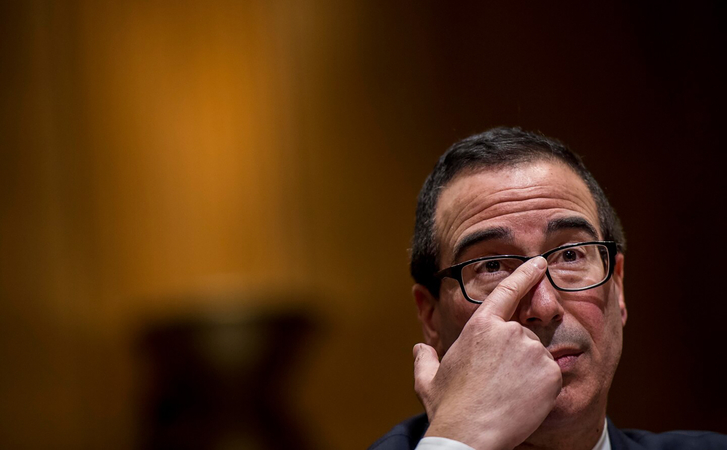
File photo of Treasury Secretary Steven Mnuchin / Syndication Washington Post

File photo of Treasury Secretary Steven Mnuchin / Syndication Washington Post
By The Washington Post · Jeff Stein, Mike DeBonis, Erica Werner · NATIONAL

Treasury Secretary Steven Mnuchin on Thursday said the Trump administration is working on a plan that would send most Americans $1,000 within three weeks and an additional $500 for every child as a way to flood the country with money and try to blunt the coronavirus pandemic’s impact on the U.S. economy.

Mnuchin, speaking on Fox Business, said a second round of payments for the same amount could be sent within the next six weeks if the crisis continued. The White House’s urgency has intensified as economic forecasts have become increasingly gloomy. A J.P. Morgan Chase analyst forecast that the U.S. economy could shrink by 14% between April and June, which would mark the worst quarterly contraction since World War II.

Mnuchin’s comments are part of the rapidly evolving fiscal stimulus plan that the White House and congressional leaders are scrambling to assemble amid growing signs that large parts of the economy are grinding to a halt. House Democrats, meanwhile, are working on their own set of proposals, and negotiations with the White House are expected to begin very soon.

The White House until several days ago had sought to pass a large tax cut measure to try and boost the amount of money people took home, but that idea was panned by lawmakers from both parties and seemed ineffective given an expected spike in unemployment. So this week the White House shifted to a goal of sending cash payments to many Americans, as quickly as possible.

The Treasury Department has estimated that such an approach could cost $500 billion and serve as a large part of their $1 trillion economic rescue package it wants Congress to authorize immediately. They also are proposing helping small businesses obtain funding in a way that avoids mass layoffs, creating an emergency lending facility for airlines, and providing liquidity to another range of firms that have been hammered by cancellations and closures.

But many parts of the White House’s approach remain in flux, and lawmakers from both parties are debating a number of different ideas.

Some Republican senators want to cap the payments to prevent taxpayers who earn over $75,000 annually from receiving the checks, according to two people aware of the GOP’s internal negotiations, who cautioned the talks were fluid and the numbers could change. And some other Republican senators want to substitute enhanced unemployment benefits or small business payroll assistance for at least some of the direct cash assistance Mnuchin has proposed.

Mnuchin and Trump initially suggested the money could reach American taxpayers within two weeks, although Mnuchin on Thursday suggested it would take three.

“Most people, we have their information,” Mnuchin said, suggesting the money could be directly deposited in consumers’ bank accounts.

House Democrats, wary of being sidelined as a potential trillion-dollar stimulus bill is negotiated between the White House and Senate Republicans, are trying to assert their power by proposing their own sweeping coronavirus economic rescue package in the coming days.

But Democrats have their own issues to work through — including how to put their own stamp on what is emerging as the centerpiece of the Republican-led plan being drafted in the Senate that could be unveiled as soon as Thursday: an estimated $500 billion plan to deliver checks directly to Americans over the next 90 days.

Tensions over the shape of the package emerged in a conference call Wednesday of House Democratic leaders and committee chairmen.

House Majority Whip James Clyburn, D-S.C., and Financial Services Committee Chairwoman Maxine Waters, D-Calif., argued for outgunning Republicans on the size of the cash payments, according to three participants on the call.

Waters, for instance, circulated a plan Wednesday calling for $2,000 per adult and $1,000 per child monthly stipend until the crisis abates.

But other Democrats — including Speaker Nancy Pelosi — while not ruling out direct payments, urged a more balanced course. Multiple committee chairmen argued that beefing up existing safety net programs — such as unemployment insurance and Medicaid, as well as small business assistance, would provide more targeted and effective relief.

All Democrats on the call, according to the participants, agreed that any cash payments should be means-tested to exclude the wealthiest Americans, a sentiment the White House appears to share.

In a letter to fellow Democrats late Wednesday, Pelosi alluded to the debate as “ongoing discussions in our Caucus on how to put money quickly in the hands of Americans.”

“Our Chairs are suggesting ways which are structural,” she wrote. “For example, solutions include expanding eligibility for Unemployment Insurance which will expedite financial relief for more people. In terms of helping small businesses, solutions include funds to ensure that workers continue to be paid. Refundable tax credits including the [Earned Income Tax Credit] and the child tax credit continue to be priorities as Members discuss other cash payments in the days ahead.”

But to many Democrats, discussions revolving around esoteric subjects like refundable tax credits are both insufficient in the face of a national crisis and a political loser when compared to the relatively easy-to-grasp concept of a check to every household.

“I think members are really just concerned about, what’s the fastest way to go?” said one House Democrat, who spoke on the condition of anonymity to frankly describe conversations with colleagues.

Regardless of the cash-payments debate, House Democrats are eager to insert themselves in the debate after taking a lead role in shaping the second round of coronavirus pandemic response, which was passed by the Senate and signed by President Trump Wednesday.

House members left Washington after passing the second-round bill early Saturday morning, leaving the Capitol to the Senate this week as House Democrats try to do their business through emails and conference calls. The House’s operations were further thrown into disarray Wednesday after two members announced they had tested positive for covid-19, while several others who came in contract with them chose to self-quarantine.

Schumer and Senate Democrats have released a framework of their own — a $750 billion package that prioritizes a “medical surge,” federal funding for child care and a emergency liquidity for small businesses. Much of the bill is devoted to existing safety net programs — not cash payments.

But payments have backing among Senate Democrats, too — notably, a proposal from Sens. Michael Bennet (Colo.), Cory Booker (N.J.) and Sherrod Brown (Ohio) that would put an immediate $2,000 into the hands of every American adult and child, with more possibly to follow.

As layoffs skyrocket, America’s unemployment safety net is underprepared to help many in need #ศาสตร์เกษตรดินปุ๋ย

#ศาสตร์เกษตรดินปุ๋ย : ขอบคุณแหล่งข้อมูล : หนังสือพิมพ์ The Nation

https://www.nationthailand.com/business/30384464?utm_source=category&utm_medium=internal_referral

As layoffs skyrocket, America’s unemployment safety net is underprepared to help many in need

Mar 20. 2020
Veteran Sean McGuire was laid off Monday from his job as a dishwasher at a restaurant in Portland, Ore. He spent hours trying to apply for unemployment insurance, only to learn that he does not qualify. MUST CREDIT: photo for The Washington Post by Leah Nash.

Veteran Sean McGuire was laid off Monday from his job as a dishwasher at a restaurant in Portland, Ore. He spent hours trying to apply for unemployment insurance, only to learn that he does not qualify. MUST CREDIT: photo for The Washington Post by Leah Nash.
By The Washington Post · Heather Long, Abha Bhattarai · NATIONAL, BUSINESS

WASHINGTON – American workers are getting laid off at an unprecedented pace as the coronavirus outbreak shuts down much of the economy, and the government safety net to help the newly jobless appears ill-equipped to handle the surge in the unemployed.

More than a million workers are expected to lose their jobs by the end of March, economists say, a dramatic turnaround from February when the unemployment rate was near a record low. Ball State University economist Michael Hicks predicts this month could be the worst for layoffs in U.S. history.

The Labor Department reported Thursday that 281,000 people applied for jobless benefits last week, up 33% from the prior week. Economists say it’s only going to get worse. New York restaurateur Danny Meyer’s Union Square Hospitality Group let 2,000 workers go this Wednesday. Pebblebrook Hotel Trust, which oversees 54 hotels, laid off 4,000 employees Tuesday. MGM Resorts and Caesars have begun letting staff go, along with countless smaller restaurants, bars, gyms and coffee shops.

The surge is straining state unemployment offices, which deliver benefits to the jobless so they can buy food and pay rent. On Monday, there were so many people trying to file for unemployment insurance in New York, Oregon and elsewhere that the websites crashed. Newly laid off workers waited hours on poorly staffed phone lines, they said.

As Americans turn to unemployment insurance, some are finding they don’t qualify. Or if they do, the average payment of $385 a week is modest. In some states, there’s a week-long waiting period before the first payment arrives.

“Workers expect unemployment insurance to be there for them in a downturn. A bunch of workers are about to find out that it’s not,” said Martha Gimbel, a labor economist at Schmidt Futures who was formerly at Indeed.com. “This is a real-life nightmare. Every hole we allowed to grow in our social safety net is hitting us all at once.”

Sean McGuire lost his job as a dishwasher at a popular Portland, Ore., brunch spot on Monday. The restaurant owners gave him brisket, onions and an apology. He spent the rest of the day trying to apply for unemployment, only to be turned down.

“I was on hold with the Oregon Department of Labor for over an hour. They were inundated,” said McGuire, a 30-year-old Army veteran who served in Iraq a decade ago. “When I finally spoke to a person, they told me I don’t qualify.”

McGuire moved to Oregon on Jan. 1, but he hasn’t worked long enough in the state to receive benefits. He tried to apply in New York, where he previously worked, but the website crashed. After another long wait on the phone, he was told he had not met the requirements there, either, because he quit a previous job. Most states require at least six months of work to qualify for any benefits. Now he’s worried about paying his $1,200 monthly rent on a short-term Airbnb through June.

Many of the newly jobless haven’t been able to file for unemployment benefits yet because the Web portals in their states are down. The problems are exacerbated by low staffing levels at state unemployment offices that didn’t expect such a surge any time soon. In mere weeks, the pandemic is on track to usher in a magnitude of unemployment that took months to reach during the Great Recession.

In Seattle, Ian Vermeers was laid off from his job at a Regal Cinemas movie theater on Monday. He’s been staying up all night to submit his application online and by phone – to no avail.

“I figured maybe things would get better in the middle of the night, but it’s 8 a.m. now and I still haven’t gotten through,” he said Wednesday. “Every time, I’m immediately hit with, ‘Sorry, our system is not working right now.'”

Many economists are urging Congress to quickly boost funding for state unemployment insurance. The Families First Coronavirus Response Act that President Donald Trump signed Wednesday included $1 billion to help states with administrative costs of processing unemployment insurance, but additional stimulus will be needed to cover more people. Twenty-three states were already running low on money in their unemployment trust funds before the pandemic hit.

Congress also has the power to increase the amount of unemployment dollars laid off workers receive and to extend benefits to self-employed and “gig” workers, as happens during natural disasters. Sixteen states have such restrictive criteria that fewer than 20% of laid off workers in the state are able to get unemployment benefits, according to the left-leaning Center on Budget and Policy Priorities.

“I’m terrified that states aren’t recession-ready anymore,” said Michele Evermore, senior policy analyst at the National Employment Law Project. “States have reduced the amount of benefits and access to benefits in a way that means that very few people can apply for unemployment insurance and receive it.”

Contractors, tipped workers, full-time students and undocumented workers often do not qualify for unemployment benefits, labor advocates said. Waiters and hotel staff who lose jobs are especially vulnerable, because they tend to move jobs frequently and rely on tips – factors that states handle differently. Plus, many states require applicants to prove they are searching for full-time work, although a few states including Texas have begun waiving the requirements.

Shawna, an exotic dancer who spoke on the condition she be identified only by her first name, found out Monday by text message that she would be out of work for at least two weeks. Unlike the bartenders and bouncers who work with her at a gentlemen’s club near Philadelphia, she does not qualify for unemployment insurance because she is a contractor.

She used to make $1,300 in a good week. Now the 31-year-old isn’t sure how she’ll be able to pay her rent or afford food without a steady income.

“The whole system is set up in a really bad way for us,” she said. “We are completely on our own right now.”

So far, the wave of coronavirus-related layoffs has disproportionately hit service workers in typically lower-paying jobs. Many lack adequate savings and say they don’t know where to turn as restaurants, bars, cafes and shops across the country shut their doors indefinitely.

Nellie Hana, a full-time student and line cook at an Olive Garden in Buffalo, New York, said managers this week told kitchen staff they had a choice: They could be laid off and file for unemployment, or they could keep working five hours a week processing to-go orders.

For Hana, unemployment wasn’t an option. Full-time students don’t typically qualify for unemployment benefits. She chose to keep working, even though that means her $600-a-week job will now bring in less than $70 each week.

“I have no choice but to wait this out,” said Hana, 20, who is majoring in media production at SUNY Buffalo State College. “I have student loans and bills to pay. Rent is coming up. Past that, I don’t know how I’m going to eat.”

Rich Jeffers, a spokesman for Olive Garden’s parent company, Darden Restaurants, said the company has not laid off any employees, though many restaurant workers have had their hours reduced to zero, as mayors and governors order dining rooms to close. The company, he said, is providing emergency pay of up to two weeks to affected employees.

For workers, one of the most frustrating aspects is the uncertainty. No one knows how long the pandemic and near-lockdown of the economy will last, and some workers have found themselves in limbo – not technically laid off, but also not getting paid.

Several big companies, such as Marriott International, are furloughing tens of thousands of workers. Halliburton announced furloughs of 3,500 employees at its Houston campus starting next Monday, because of the huge hit to oil prices this month. Furloughs allows workers to keep their health-care benefits, though they have no income coming in.

American Eagle is among a growing number of retailers closing its stores through late March. The company has pledged to pay employees for the hours they are scheduled in coming weeks. But an employee in a New York store said managers recently scrapped the original schedule and created a new one that only includes managers, which means she – and the majority of her co-workers – won’t be paid.

“I’ve worked up to 40 hours a week for more than three years,” said the employee, who spoke on the condition of anonymity because she feared retribution at work. “I’ve never received zero hours. I don’t know what to do.”

American Eagle didn’t return a request for comment.

Workers whose hours are severely reduced are supposed to be eligible for partial unemployment benefits, but state rules vary, and workers often have to file an appeal if an initial claim is denied.

One proposal in the works that could help the unemployed is a move backed by the White House to send $1,000 checks directly to workers, possibly twice. That’s just a small comfort for McGuire, however, who made more washing dishes in Portland.

“If you’re in a major city, that $1,000 doesn’t pay your rent, let alone health care, transportation and food,” he said. “My financial situation is in complete disarray.”

Weaker outlook for Thai economy amid further deterioration #ศาสตร์เกษตรดินปุ๋ย

#ศาสตร์เกษตรดินปุ๋ย : ขอบคุณแหล่งข้อมูล : หนังสือพิมพ์ The Nation

https://www.nationthailand.com/business/30384440?utm_source=category&utm_medium=internal_referral

Weaker outlook for Thai economy amid further deterioration

Mar 20. 2020
By The Nation

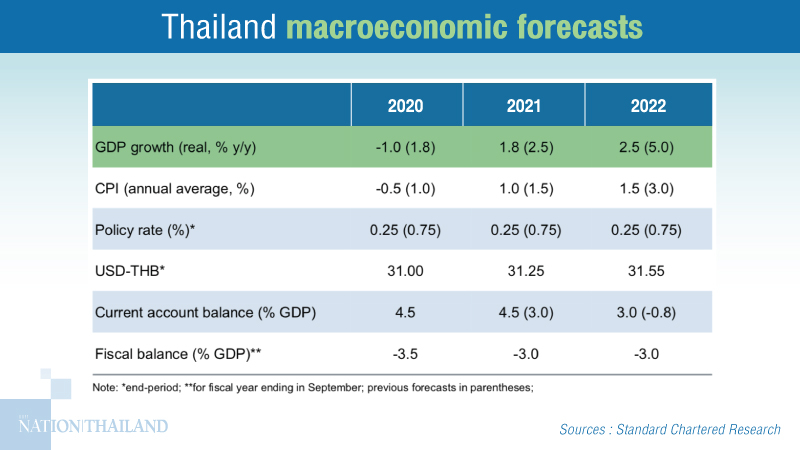
Thailand’s economy shows no signs of a turnaround. The coronavirus outbreak has dealt a further blow to activities, and the consumer confidence index declined in February to the lowest level since April 1999. Domestic financial markets, even bond markets, continue sell off, said Tim Leelahaphan, economist at Standard Chartered Bank (Thai).

“The bank has sharply lower our 2020-22 GDP growth forecasts to reflect the worsening coronavirus outbreak – both globally and domestically – and our recent downward revisions for China, the US and the euro area as we are expecting recessions in the US and euro area).

We now forecast Thai GDP growth at -1.0 per cent this year, versus +1.8 per cent previously, with Q1 growth at -3.0 per cent year on year. We expect a return to positive growth in 2021-22, but at lower levels: 1.8 per cent in 2021, compared to 2.5 per cent previously, and 2.5 per cent in 2022 from the previous projection of 5 per cent,” said Tim.

The bank also lowers  inflation forecasts for the 2020-22 period to reflect economic weakness and low oil prices, expecting average CPI inflation of – 0.5 per cent in 2020 (1.0 per cent previously), 1.0 per cent in 2021 (1.5 per cent previously) and 1.5 per cent in 2022 (3.0 per cent previously).

Tim  expects a substantial current account (C/A) surplus of 4.5 per cent in 2020, but now expects larger surpluses in the subsequent years due to lower imports amid a slowing economy, lower oil prices and a strong expected recovery in inbound tourism.” We revise up our 2021-22 C/A forecasts to 4.5 per cent of GDP (from 3.0 per cent ) and 3.0 per cent (from -0.8 per cent ),” said Tim.

External accounts to remain strong

The timing of the tourism recovery is difficult to predict, but we now expect it to be delayed beyond Q2/2020. The latest data from the Tourism Authority of Thailand (for February) shows that arrivals plunged 44.3 per cent year on year; arrivals from China fell 85.3 per cent. The Songkran (Thai New Year) festivities in April have been called off, and the granting of visas on arrival or visa exemptions for a total of 21 countries has been cancelled until the situation improves. However, the government has said it may consider classifying China as less risky as the rate of new cases there has moderated, according to a Bloomberg report.

Current low oil prices will support the C/A surplus given Thailand’s status as a net commodity importer. In addition, we do not see a large increase in investment-related imports in the foreseeable future. The current government appears to be focused on providing a short-term boost to the economy via private consumption rather than reviving investment, according to the bank.

Fiscal policy needs to step up

We expect fiscal deficit forecasts of -3.5 per cent of GDP for 2020 and -3.0 per cent for both 2021 and 2022. The Cabinet has approved phase one of a Covid-19 stimulus package combining tax benefits, soft loans for businesses and relief measures for households, but without additional spending. These measures are expected to inject about Bt400 bn (2.4 per cent of GDP) into the economy, according to the Fiscal Policy Office (FPO); we think the impact will depend on private-sector take-up of the measures.

While these measures have provided an initial boost to sentiment, they may have a limited impact on private consumption or the economy as a whole. We believe more effective fiscal spending is needed – particularly in the form of public infrastructure investment – before the private sector will respond. A personal income tax cut could be more effective; the Palang Pracharath Party, the biggest party in the government coalition, promised such a cut as part of its election campaign. However, this might not materialise soon, as the Finance Ministry has indicated that it would be reluctant to reduce a steady source of revenue.

Politics: Potential risk

Political noise is rising, even if risk remains low. Students and supporters of the now- defunct Future Forward Party (FFP) have held small protests and gatherings since 21 February, when the Constitutional Court ruled to dissolve the opposition party for violating election laws. The bank does not see a significant risk that this will escalate into street protests at this stage, as coronavirus concerns are likely to deter large gatherings.

Monetary policy

Tim expects the Bank of Thailand (BOT) to deliver a 25 basis point rate cut at its scheduled meeting on March 25, taking the policy rate to a new low of 0.75 per cent. Given recent decisions by other central banks, we do not rule out an intermeeting move prior to March 25, or a deeper cut of 50 basis points . In line with the downgrades to our economic outlook, the bank now sees the policy rate being cut further by 25 basis points each in Q2 and Q3, taking the rate to a record-low 0.25 per cent at end of this year.

However, the BOT faces limitations on its ability to be as dovish or aggressive as other central banks. Further deep cuts without a clear positive impact or the desired market response could risk complicating the BoT’s monetary policy-making ability. Policy rates below 0.5 per cent could create transmission difficulties, with banks unable to match the BOT cut, given their mandatory contribution to the bailout fund as the central has yet to announce an adjustment to the contribution, he said.

At this stage, the Standard Chartered bank expects the central bank to provide assurances that policy will remain accommodative for as long as needed, along with verbal intervention in the FX market, though this is not needed given current under-performance of the baht and liquidity measures. “In this context, we believe fiscal policy needs to do more of the heavy lifting to support the economy and avoid the need for zero or negative interest rates; fiscal stimulus measures announced so far appear to have had limited effectiveness, according the bank.

Australia joins QE club as first recession in 29 years looms #ศาสตร์เกษตรดินปุ๋ย

#ศาสตร์เกษตรดินปุ๋ย : ขอบคุณแหล่งข้อมูล : หนังสือพิมพ์ The Nation

https://www.nationthailand.com/business/30384455?utm_source=category&utm_medium=internal_referral

Australia joins QE club as first recession in 29 years looms

Mar 19. 2020
By Syndication Washington Post, Bloomberg · Michael Heath · BUSINESS, WORLD, ASIA-PACIFIC

Australia’s central bank joined the international fold with the announcement it will enter the government bond market to lower yields, having exhausted its remaining conventional policy ammunition.

Reserve Bank Governor Philip Lowe’s unconventional approach set out Thursday after an emergency meeting differs from his European and U.S. counterparts, who pledged to buy a certain amount of government securities to keep yields down. Instead, he’ll aim to keep three-year government bond yield at 0.25%.

Lowe also cut the cash rate to 0.25%, a level he has nominated as the effective lower bound, noting it wasn’t a coincidence that policy makers in the U.S., New Zealand and the U.K. all eased to the same level. Similarly, in line with other central banks, the RBA governor set out forward guidance by saying he expects to remain on hold for “some years.”

Australia’s economy is spiraling toward its first recession since 1991 and its credit markets are under stress from investors worldwide trying to head for the exits. In a speech after the policy announcement, Lowe didn’t try to sugar coat the months ahead, saying “we are expecting a major hit to economic activity and incomes in Australia that will last for a number of months. We are also expecting significant job losses.”

Qantas Airways on Thursday furloughed most of its 30,000-strong workforce and scrapped all international flights.

The RBA also announced a term funding facility of at least A$90 billion ($50 billion) for the banking system, with particular support for credit to small and medium-sized businesses.

In a complementary program, Australia’s government will invest up to A$15 billion to allow smaller lenders to support consumers and smaller businesses during the coronavirus outbreak, according to a statement from the treasurer. Prime Minister Scott Morrison is also developing a follow-up spending package to expand on the A$17.6 billion program announced last week.

The combined fiscal-monetary salvo aims to keep firms open and workers in jobs.

Australia now finds itself in uncharted territory: The country was a poster-child for its response to the 2008-09 financial crisis and worldwide downturn. It deployed a combination of fiscal and monetary policy that allowed the economy to escape the recession that enveloped most of the developed world, without ever adopting unorthodox monetary policies.

Prime Minister Kevin Rudd’s administration had been in office less than a year when credit markets seized up. The government put together two packages worth more than 4% of GDP and the central bank cut interest rates by 425 basis points. Andrew Charlton was Rudd’s chief economic adviser at the time and ran point on the fiscal stimulus.

“The key feature of the Australian response to the global financial crisis was speed and size,” said Charlton, now director of consultancy AlphaBeta in Sydney. “We wanted to use our fiscal firepower to keep the economy going, not to restart it after it had stalled.”

It’s a similar approach today.

In a speech explaining Thursday’s moves, Lowe said the board expects “the cash rate will remain at its current level for some years, but not forever.” Lowe said he expects that the yield target will be removed before the cash rate is increased, once the economy improves.

In a move to relieve the margin squeeze facing banks, the RBA said it’ll pay lenders 10 basis points on funds deposited with it overnight, rather than the usual 25 basis point discount to the cash rate. It’s trying to avoid the type of stress banks in Japan and Europe have faced in a low-rates world.

By targeting a flat yield curve over three years, the RBA is hoping to put more cash into the pockets of households that tend to have variable mortgage rates. It’s also seeking to lower borrowing costs so businesses will be tempted to expand again once the worst of the virus shutdown passes.

By saying it’ll also buy semi-government securities, the RBA aims to avoid a blow out in yields on state government debt relative to commonwealth bonds. It will make purchases “across the yield curve” to achieve its target and avoid dislocations.

The yield on Australian government three-year bonds tumbled after the policy statement and traded about 16 basis points lower at 0.34% as of 6:38 p.m. in Sydney. The Aussie dollar is trading higher from intra-day lows of 55.10 U.S. cents at 56.68 U.S. cents.

Lowe noted the Australian dollar had come down “a reasonable amount.” “Liquidity is thin, but it hasn’t been to a point where we needed to intervene, but we are prepared to if liquidity conditions deteriorate,” he said in response to a question.

Australia’s credit markets have been stressed and the RBA has been pumping liquidity into the financial system in recent days to help calm them.

Lowe said the timing and strength of the economy’s recovery after the virus depends “in part upon how successful we are, as a nation, in building that bridge to the other side.” Ever the optimist, he pointed out that Australia has “fantastic” fundamentals.

Oil rollercoaster has crude rebounding after drop to 18-year low #ศาสตร์เกษตรดินปุ๋ย

#ศาสตร์เกษตรดินปุ๋ย : ขอบคุณแหล่งข้อมูล : หนังสือพิมพ์ The Nation

https://www.nationthailand.com/business/30384451?utm_source=category&utm_medium=internal_referral

Oil rollercoaster has crude rebounding after drop to 18-year low

Mar 19. 2020
By Syndication Washington, Bloomberg · Sharon Cho, Alex Longley · BUSINESS, US-GLOBAL-MARKETS 

Oil rebounded after plunging to the lowest level in 18 years as policymakers across the globe try to strengthen economies against the impact of the coronavirus pandemic.

Futures rose as much as 18% in New York, the most since December 2008, following a 24% rout in the previous session. Prices have cratered over the past two weeks as major producers hike output in a fight for market share while demand plummets. Signs of stress are already showing in some corners of the world with Canadian oil at a record low and some North Sea fields becoming uneconomic.

The European Central Bank has unleashed an emergency bond-buying program, while the Senate cleared the second major bill responding to the outbreak in an attempt to kickstart the economy. White House economic adviser Larry Kudlow said the government might take equity positions as part of corporate rescues.

Countries are ramping up measures as the global spread of the virus continues to gather pace with the number of confirmed cases in Europe now exceeding China. Italy’s death count has surged to almost 3,000, while the U.K. imposed tighter controls on movement of people including closing all schools.

“We are heading into the most oversupplied market in the history of the oil market,” said DNB Bank senior analyst Helge Andre Martinsen. “We might hit full utilization of global oil inventories in the months to come.”

As the world’s biggest oil producers boost supply, Rep. Sen. Kevin Cramer of North Dakota called on President Donald Trump to ban crude imports from Russia, Saudi Arabia and other OPEC members in response to recent action taken by them to “distort energy markets” when demand is already weak.

The Saudis ordered state-run Aramco to keep output at a record high of 12.3 million barrels a day over the coming months. But in a surprise move Thursday, both Saudi Arabia and Iraq cut the rebates on freight costs they give to customers, effectively lifting prices.

See also: Some Oil in Canada Has Already Tumbled Below $10 a Barrel

The higher supply is increasingly taking its toll on the oil market’s structure. Brent’s six-month timespread is currently at its most bearish since 2009, indicating a big glut. As a result, traders are eying lucrative opportunities from storing oil on tankers and hoping to sell it at a profit later.

With crude’s price weakness getting more entrenched, traders are increasingly trying to assess the impact on U.S. production this year. On Thursday, a barrel of Permian oil was cheaper than a meal at a steakhouse in the region’s Midland heartland, a sign that producers are struggling to cover their operating costs.

Federal Reserve to backstop the U.S. money market industry and support other central banks, its eighth major emergency action this week #ศาสตร์เกษตรดินปุ๋ย

#ศาสตร์เกษตรดินปุ๋ย : ขอบคุณแหล่งข้อมูล : หนังสือพิมพ์ The Nation

https://www.nationthailand.com/business/30384448?utm_source=category&utm_medium=internal_referral

Federal Reserve to backstop the U.S. money market industry and support other central banks, its eighth major emergency action this week

Mar 19. 2020
Fed Chair Jerome Powell

Fed Chair Jerome Powell
By The Washington Post · Heather Long · Updates with early Thursday announcement

The Federal Reserve announced late Wednesday it is establishing a special backstop for money market mutual funds, which typically serve as risk-free places for investors to store cash. Early Thursday, the Fed announced more “swap lines” with other central banks around the world to help ensure they have sufficient U.S. dollars.

By establishing the Money Market Mutual Fund Liquidity Facility, the Fed is reprising another weapon from its 2008 arsenal. During the financial crisis of a dozen years ago, there was great concern that these money market mutual funds would not be able to make investors whole.

In recent weeks, investors have been rushing to pull money out of the market, leading to concerns that a wide range of assets could face a run. The Fed has launched seven emergency actions this week, with the money market liquidity facility announcement occurring at 11:30 p.m. And on Thursday, the Fed extended a move earlier in the week aimed at central banks, pushing the number of Fed interventions to eight.

Under that program, the Fed will make loans to money market mutual funds if they are facing a cash crunch. With this pledge, it’s hoping to assure investors they should have no worries about these funds.

“Money market funds are common investment tools for families, businesses, and a range of companies,” the Fed wrote in a statement. “The MMLF will assist money market funds in meeting demands for redemptions by households and other investors.”

The coronavirus health crisis is threatening to become a financial crisis as well as so many businesses – big and small – are on the verge of failing and looking for loans from banks.

Fed Chair Jerome Powell has pledged to use every “tool” he has to keep credit available and to try to boost the economy during a swift downturn.

This week, the Federal Reserve has slashed interest rates to zero, restarted its bond-buying program known as “quantitative easing,” started buying short-term business loans known as commercial paper, ramped up “swap lines” with foreign central banks to ensure other nations have enough dollars, allowed banks to borrow money from the Fed at a 0.25% interest rate and announced loans for primary dealers of U.S. Treasury bonds.

On Sunday, the Fed had enhanced its U.S. dollar swap lines with Japan, Europe, Canada and the United Kingdom. On Thursday, the Fed extended more swap lines to Australia, Brazil, Mexico, South Korea and other nations, an effort to make sure U.S. dollars continue to flow easily around the world.

The U.S. Treasury had to approve the money market industry support by seeding the Fed $10 billion to get the special fund going.

Japan’s Abe gears up for another big stimulus package #ศาสตร์เกษตรดินปุ๋ย

#ศาสตร์เกษตรดินปุ๋ย : ขอบคุณแหล่งข้อมูล : หนังสือพิมพ์ The Nation

https://www.nationthailand.com/business/30384447?utm_source=category&utm_medium=internal_referral

Japan’s Abe gears up for another big stimulus package

Mar 19. 2020
Shinzo Abe, Japan's prime minister, speaks in the lower house of parliament in Tokyo on Feb. 26, 2020. MUST CREDIT: Bloomberg photo by Kiyoshi Ota.

Shinzo Abe, Japan’s prime minister, speaks in the lower house of parliament in Tokyo on Feb. 26, 2020. MUST CREDIT: Bloomberg photo by Kiyoshi Ota.
By  Syndication Washington Post, Bloomberg · Toru Fujioka · BUSINESS, WORLD, US-GLOBAL-MARKETS, ASIA-PACIFIC 

Prime Minister Shinzo Abe is gearing up for his second big stimulus package in a matter of months as the coronavirus pushes Japan into what could be a deep and prolonged recession.

Abe on Thursday opened a week-long series of evening hearings with business leaders and experts to try to come up with an economic rescue plan for the country. Cash handouts and a cut to the recently raised sales tax are among ideas reportedly being discussed.

“I want to implement bold economic measures to achieve a V-shaped recovery through various measures,” Abe said at the beginning of the first hearing. “To compile those measures, I want to directly hear from everyone about what kind of a policy people are seeking from the government.”

The meetings in Tokyo come as governments pledge more than $1.9 trillion in fiscal support to fight the coronavirus, shore up financial markets and keep businesses from going bankrupt. President Donald Trump has plans for a $1.3 trillion economic rescue package that would add to measures unveiled by a slew of other countries including Canada, the U.K., France and Australia.

For Abe, the stakes are immense. Private sector economists are predicting a prolonged Japanese recession, the prime minister’s approval ratings are slipping and failure to contain the outbreak would likely derail this year’s Tokyo summer Olympics.

How much fresh spending Japan’s debt-burdened government can offer, and how the money should be spent will be the key focuses of the meetings.Cash payments of about 12,000 yen ($110) for each of Japan’s 120 million citizens are one option being considered, according to local media reports.

Those handouts would be less generous than the $1,000 that Trump has suggested giving Americans, but the numbers would still represent an onerous outlay for Japan’s government, which has the developed world’s biggest public debt load.

What’s more, Japan already tried something similar during the global financial crisis, but found that it didn’t pack much stimulus punch because people simply saved the money instead of spending it.

Finance Minister Taro Aso, Japan’s prime minister back then, told reporters Thursday that the cash handouts didn’t end up being very effective. He denied the idea is under consideration now.Nevertheless, Abe faces calls even from within his own inner circle to go far beyond the small-bore measures that have been taken so far: things like interest-free loans for small businesses and subsidies to freelancers whose work has dried up.

Etsuro Honda, an adviser to the prime minister, says the economy will need at least 5 trillion yen in extra spending to get over the virus hit.

Akira Amari, the head of tax policy for Abe’s own party, has called for an extra budget, while a group of junior lawmakers in the party are advocating 30 trillion yen in new stimulus–it’s a pie-in-the-sky figure, but also a signal of the urgency that’s being felt.

Reducing the sales tax that was just raised in October is another idea being floated. Lowering the unpopular levy could be enticing for Abe as a way to try to boost consumer spending and also raise his own flagging support ratings.

But back-pedaling on efforts to shore up government’s finances would come at a steep cost amid growing turbulence in credit markets.

“The perception in the Japanese government bond market could shift rapidly” if the sales tax were cut, Citigroup economists Kiichi Murashima and Katsuhiko Aiba wrote in a report Thursday. “And this, of course, could prompt rating agencies to lower Japan’s sovereign rating.”

Still, with the Bank of Japan’s policy ammunition largely depleted, government spending has become a last bulwark against the crisis.

BOJ Governor Haruhiko Kuroda, speaking in parliament Wednesday, signaled his support for more fiscal support. Bond yields would continue to stay low despite more spending because of the bank’s yield-curve control program, he said.

At the first evening hearing on Thursday, 10 individuals including a freelance music teacher, a taxi driver and students talked about their struggle related to the virus impact, according to a senior Cabinet Office official. Some asked for an expansion of an emergency government lending program and another sought a change in the distribution timing of childcare subsidies, the official said.

European bonds soar as Lagarde pledges no limits to ECB action #ศาสตร์เกษตรดินปุ๋ย

#ศาสตร์เกษตรดินปุ๋ย : ขอบคุณแหล่งข้อมูล : หนังสือพิมพ์ The Nation

https://www.nationthailand.com/business/30384444?utm_source=category&utm_medium=internal_referral

European bonds soar as Lagarde pledges no limits to ECB action

Mar 19. 2020
Christine Lagarde, president of the European Central Bank. speaks during a Bloomberg Television interview on the closing day of the World Economic Forum (WEF) in Davos, Switzerland, on Jan. 24, 2020. MUST CREDIT: Bloomberg photo by Simon Dawson.

Christine Lagarde, president of the European Central Bank. speaks during a Bloomberg Television interview on the closing day of the World Economic Forum (WEF) in Davos, Switzerland, on Jan. 24, 2020. MUST CREDIT: Bloomberg photo by Simon Dawson.
By Syndication Washington Post, Bloomberg · Jana Randow, John Ainger · BUSINESS, US-GLOBAL-MARKETS

European government bonds from Italy to Greece surged after the European Central Bank launched a 750 billion euro ($820 billion) debt-buying program to keep borrowing costs in check as countries prepare to increase spending to counter the impact of the coronavirus.

Yields plummeted, led by a more than 200-basis-point drop for Greece’s five-year bonds, narrowing the gap between the debt of the euro-area’s strongest economies and the more stressed. The region’s corporate debt risk dropped the most since 2016.

The ECB decision in an unscheduled meeting on Wednesday night is the latest in an escalating global response to an outbreak widely seen driving the economy into recession. President Christine Lagarde reinforced the message that policy makers will do all they can, saying there are “no limits to our commitment to the euro.”

“The ECB was forced to react quickly,” Christoph Rieger, head of fixed-rate strategy at Commerzbank, wrote in a note to clients. “The new envelope of 750 billion euros should help bring in spreads more lastingly, but it is questionable whether this will be the turning point of the broader financial market rout.”

European stocks rose, but the euro was down 0.4% at $1.0874 as of 8:30 a.m in London.

European officials are weighing activating a regional bailout fund to help nations with strained public finances. Investors have been pushing up bond yields as they fret about the cost of the massive fiscal response to the pandemic. Italy, which already has a huge debt burden and is the worst-affected by the disease, is especially hard hit.

The ECB last week agreed to pump more liquidity into the financial system and joined other central banks in a bid to ease a funding squeeze. The measures on Wednesday include:

– Buying public and private-sector securities until at least the end of 2020.

– Program will cover all assets eligible under current quantitative-easing program, and will be extended to commercial papers of sufficient credit quality.

– Greek government debt will be included.

– Collateral standards will be eased.

– Program will continue until ECB judges the crisis phase of the pandemic to be over, but not before the end of this year.

– The ECB will consider raising its self-imposed limits on QE holdings, and will increase the size of its programs if needed.

While the package was broadly welcomed, many said more needs to be done, particularly from governments.

“We think we still need further fiscal easing and indications of absorbing private credit risk to stabilize financial markets more durably,” said Ebrahim Rahbari, Citigroup’s global head of currency analysis.

In its statement, the central bank said it “will not tolerate any risks to the smooth transmission of its monetary policy in all jurisdictions of the euro area.”

Venturing into the commercial-paper market is a novelty for the institution. In doing so, policy makers are taking a page out of the Federal Reserve’s book.

The decision to consider raising the limits on QE holdings could be controversial. The caps, set at the start of the program in 2015, are meant to address concerns the central bank would breach European Union law by financing governments.

Lagarde’s predecessor, Mario Draghi, argued last year the Governing Council could loosen standards if economic circumstances warrant it. Taking that step in the immediate future faces one key complication — a German constitutional court ruling on the legality of QE is just weeks away.

“Within the realm of what monetary policy can do, the ECB is now seriously tackling the two key issues facing economic policymakers,” said Holger Schmieding at Berenberg. “Easing the liquidity crunch in the economy and helping governments to finance their response to the health emergency.”

Wednesday’s announcement came hours after French Finance Minister Bruno Le Maire called on the ECB to intervene “quickly and massively” using all its instruments.

If euro-area officials were to activate the region’s bailout fund, that would be a crucial step toward triggering the ECB’s most powerful bond-buying power — Outright Monetary Transactions. That program was designed during the bloc’s debt crisis in 2012 to purchase the debt of specific nations.

It grew out of Draghi’s “whatever it takes” pledge, but has never been used.

Fed starts emergency program to aid money market funds #ศาสตร์เกษตรดินปุ๋ย

#ศาสตร์เกษตรดินปุ๋ย : ขอบคุณแหล่งข้อมูล : หนังสือพิมพ์ The Nation

https://www.nationthailand.com/business/30384442?utm_source=category&utm_medium=internal_referral

Fed starts emergency program to aid money market funds

Mar 19. 2020
By Syndication Washington Post, Bloomberg · Craig Torres, Christopher Condon, Alexandra Harris · BUSINESS, US-GLOBAL-MARKETS

The Federal Reserve late Wednesday said it was launching a program to support money market mutual funds as alarm over the coronavirus continues to cause strains in short-term funding markets.

The Money Market Mutual Fund Liquidity Facility, established under the Fed’s emergency authority, echoes a version that was set up during the global financial crisis. The Treasury Department will provide $10 billion of credit protection.

U.S. Treasury Secretary Steven Mnuchin said in a statement the fund would “enhance the liquidity and smooth functioning of money markets, support the flow of credit to hard working Americans, and help stabilize the broader financial system.”

Earlier Wednesday, the Treasury Department had proposed to temporarily guarantee money market mutual funds with taxpayer dollars as part of its coronavirus stimulus plan, according to a document obtained by Bloomberg News.

“Money market funds are common investment tools for families, businesses, and a range of companies,” the Fed said in its statement. “The MMLF will assist money market funds in meeting demands for redemptions by households and other investors, enhancing overall market functioning and credit provision to the broader economy.”

The Fed’s action comes hours after the European Central Bank’s late-night emergency decision to launch an extra emergency bond-buying program worth 750 billion euros ($820 billion) to calm markets and protect the euro-area economy. Also, at the same time as the Fed announcement, the Reserve Bank of Australia said it was cutting its benchmark rate by a quarter point to 0.25%.

The dramatic late-night step was the central bank’s third emergency lending facility in two days, after the Fed on Tuesday unleashed measures to support the commercial paper market and primary dealers to ensure credit keeps flowing in the U.S. economy. It slashed interest rates nearly to zero on Sunday and said it would buy at least $700 billion in securities to soften the blow from the virus that has Americans hunkered down to avoid infection.

Money market funds essentially provide credit to everything from banks through repurchase agreements to corporations through purchases of commercial paper. They are a critical link the chain of short-term finance where companies borrow and lend outside the formal banking system.

The launch of the Fed’s program to support money-market funds is a “game-changer,” said Priya Misra, global head of interest rates strategy at TD Securities.

The facility “couldn’t come a moment sooner,” she said. “It provides a much-needed outlet to money funds to get liquidity.”

With Wednesday night’s action, the central bank is trying to carve a firebreak around this financing and the vehicle is somewhat complimentary to the Commercial Paper Funding Facility, which also aims to protect non-bank short-term funding.

It will be administered by the Federal Reserve Bank of Boston.

In the U.S., money funds have been under stress as investors have rushed into cash. Households, businesses and other institutions use money funds to park cash they may need in the short term. Reforms to the industry passed in 2016 forced a tiering of investments into funds with differing levels of safety and segregated retail customers from institutional.

Similar steps were taken during the global financial crisis to shore up money funds when a run on them helped cripple credit markets. Under Treasury Secretary Henry Paulson, the department guaranteed more than $3 trillion of fund holdings against losses for almost a year using its Exchange Stabilization Fund.

Money market mutual funds proved a crucial weak spot in 2008 after the industry’s largest fund, the Reserve Primary Fund, suffered losses on debt issued by investment bank Lehman Brothers. When its share price fell below the stable $1 promised to customers, investors began scrambling out of most other money funds, forcing their managers into a fire sale of assets.