In midst of chaos, Nasdaq ETF gets biggest inflow in two decades #ศาสตร์เกษตรดินปุ๋ย

#ศาสตร์เกษตรดินปุ๋ย : ขอบคุณแหล่งข้อมูล : หนังสือพิมพ์ The Nation

https://www.nationthailand.com/business/30384534?utm_source=category&utm_medium=internal_referral

In midst of chaos, Nasdaq ETF gets biggest inflow in two decades

Mar 20. 2020
By Syndication Washington Post, Bloomberg · Claire Ballentine · BUSINESS, TECHNOLOGY, US-GLOBAL-MARKETS

Tech megacaps are luring equity investors back into the stock market at a pace not seen in almost two decades on speculation they have a cash bulwark strong enough to withstand the looming recession.

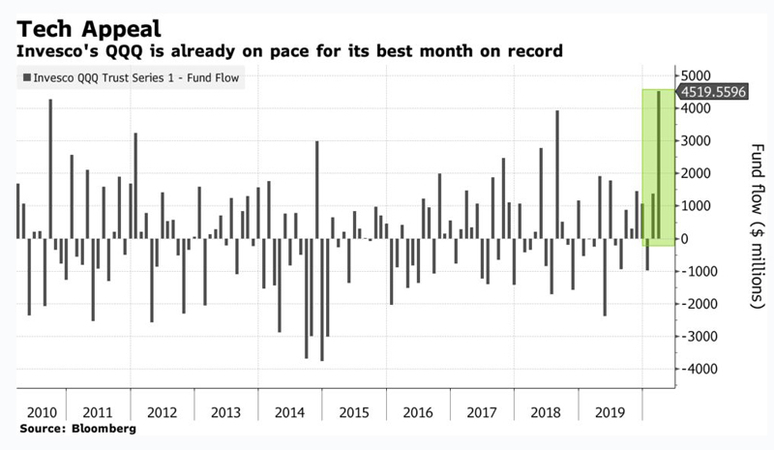
An exchange-traded fund that tracks the Nasdaq 100 Index, the Invesco QQQ Trust Series 1, ticker QQQ, has taken in $4.5 billion so far in March, according to data compiled by Bloomberg. That’s most since 2001. The $78 billion fund rose as much as 2.8% Friday, though it remained lower by more than 12% this month.

Amid the fastest sell-off in history, bets on the FAANG stocks — Facebook, Amazon.com, Apple, Netflix and Google parent Alphabet Inc. — have resumed. The quintet has among the strongest balance sheets in corporate America, an attribute that has demarcated the sell-off’s relative winners from losers. Investors also anticipate the cohort will be able to benefit as consumers turn to its services for work or entertainment during heightened demands for people to stay at home.

The tech giants are also coveted because of their liquidity, growth prospects and outsize influence on the broader market. The five made up a record 30% of the Nasdaq 100 by weighting on Monday. Add Microsoft Corp. and the share tops 40%.

Nancy Tengler, chief investment officer of Laffer Tengler Investments, said she’s been buying tech stocks like Google and Facebook as she increasingly sees the market nearing its bottom.

“I’m cautiously optimistic that a few months from now we will see economic activity resume,” she said. “That’s why we’re starting to buy now. You don’t want to buy after the good news is out. We’re picking away.”

Short interest as a percentage of shares outstanding on QQQ — a rough indicator of bearish bets on the ETF — is currently 3.5%, according to data from IHS Markit Ltd. That’s down from a two-year high of 5.5% on March 2.

“I think tech stocks are a good place to dip your toes back into the water, that makes total sense to me,” said Bob Phillips, managing member of Spectrum Management Group. “It’s their ability to access cash at very favorable borrowing levels and their growth prospects because our economy is going to grow again, and tech will be key component of where that growth will come from.”

U.S. stocks gain in heavy volume; Treasuries climb #ศาสตร์เกษตรดินปุ๋ย

#ศาสตร์เกษตรดินปุ๋ย : ขอบคุณแหล่งข้อมูล : หนังสือพิมพ์ The Nation

https://www.nationthailand.com/business/30384533?utm_source=category&utm_medium=internal_referral

U.S. stocks gain in heavy volume; Treasuries climb

Mar 20. 2020
By Syndication Washington Post, Bloomberg · Claire Ballentine, Todd White · BUSINESS, US-GLOBAL-MARKETS

U.S. stocks gained in a flood of trading caused by expiring options and futures contracts. Treasuries rose and the dollar halted its rally as investors studied unprecedented government measures to shield jobs and economies from the coronavirus pandemic.

The S&P 500 headed for its first two-day advance since mid-February as the Federal Reserve coordinated action with global central banks to beef up dollar liquidity swap line arrangements. Trading was almost double the 30-day average for the time of day. Tech stocks rose as bottom feeders bet on a rebound. Markets gained in Asia and Europe, cutting the weekly drop for stocks worldwide to just under 10%.

The 10-year Treasury yield headed for its lowest closing level since Monday. The dollar weakened against its major peers after vaulting more than 8% in the previous eight sessions. The pound, Australian dollar and South Korean won all leaped versus the greenback. WTI oil slumped after Thursday’s surge.

Investors are weighing a faster pace of coronavirus infections against flickers of optimism that have followed extraordinary government actions, from plans for stimulus and cash handouts to nationalizing companies. Hedge funds, stock exchanges, banks and even brick-and-mortar businesses in the U.S. are lobbying Washington policy makers not to shut markets.

The turmoil across assets does seem to be easing, even after the World Health Organization said that the pace of infections is speeding up. Cases doubled to 200,000 in the 12 days through Thursday, but just one day later the tally already was almost halfway to 300,000.

“We are now starting to lean into risk,” Chad Morganlander, senior portfolio manager at Washington Crossing Advisors, told Bloomberg TV. “The tail of this is going to be potentially somewhat more extended than what the overall market thinks, so we’re not going to get back to business as usual for the next three months, but the policy backdrop across the globe will help soften the blow.”

These are the main moves in markets:

Stocks:

– The S&P 500 Index rose 1.3% at 10:34 a.m. New York time; the Nasdaq Composite added 2.3%.

– The Stoxx Europe 600 Index rose 3%.

– The MSCI Asia Pacific Index surged 3.1%.

Currencies:

– The Bloomberg Dollar Spot Index dipped 1%.

– The euro advanced 0.4% to $1.0732.

– The British pound climbed 3.4% to $1.1877.

– The Japanese yen slipped 0.1% to 110.8 per dollar.

Bonds:

– The yield on 10-year Treasuries dipped 13 basis points to 1.01%.

– Germany’s 10-year yield fell 10 basis points to -0.31%.

– Britain’s 10-year yield decreased 17 basis points to 0.54%.

Commodities:

– Gold gained 1.7% to $1,496.28 an ounce.

– West Texas Intermediate crude fell 5.6% to $23.82 a barrel.

The five days when world economy’s guardians fought virus and market turmoil #ศาสตร์เกษตรดินปุ๋ย

#ศาสตร์เกษตรดินปุ๋ย : ขอบคุณแหล่งข้อมูล : หนังสือพิมพ์ The Nation

https://www.nationthailand.com/business/30384531?utm_source=category&utm_medium=internal_referral

The five days when world economy’s guardians fought virus and market turmoil

Mar 20. 2020
File photo by Syndication Washington Post

File photo by Syndication Washington Post
By Syndication Washington Post, Bloomberg · Enda Curran, Paul Dobson, Zoe Schneeweiss · BUSINESS, WORLD

The guardians of the world economy are in a two-front war. They are having to defend businesses and consumers that suddenly look frighteningly vulnerable to the coronavirus — and contain a rout on financial markets that threatens to make things even worse.

Those battles amid a unique pandemic this week forced political leaders and central bankers into action at a pace that puts even that of the 2008 financial crisis in the shade. Their economies are on course to post historic slumps in output over the coming weeks, a prospect that is panicking investors.

After a week of turbulence, markets showed flickers of optimism Friday. It’s a positive sign, but if investors, executives and the general public can’t be persuaded that there’s light at the end of the tunnel for the U.S. and Europe in the second half of this year, then they risk turning darker scenarios into self-fulfilling prophecies – and pushing the world into a deeper downturn and perhaps even a Depression.

Among monetary policy makers, the state of red-alert began on Sunday night with Jerome Powell chairing an unscheduled Federal Reserve meeting – the first of several that officials would have to convene and sign off in a hurry on new emergency moves.”Monetary policy decisions at midnight,” said Torsten Slok, Deutsche Bank AG’s chief economist, “tells you how serious they are about trying to stabilize things.”

Then on Monday, with stocks still sliding and volatility elevated despite the Fed cutting interest rates, Group of Seven chiefs leapt into the fray — concluding a rare teleconference with a pledge to do “whatever is necessary.”

Exactly what that may be, the world still can’t say for sure.As the week draws to an end, an unprecedented 31 central banks have slashed interest rates — and many of them have gone further and activated the crisis playbook, buying bonds, intervening in currency markets and setting up emergency loan programs for banks and companies. The aim: keep markets functioning and facilitate a recovery when life returns a normal.

—

What Bloomberg’s Economists Say:

“The rush to downgrade forecasts for the first half of the year makes sense. Optimism about the second half is more open to question. Getting to recovery will require swift delivery of a massive stimulus program, and – more important – an outbreak that comes obediently under control. Neither are even close to guaranteed.”

— Tom Orlik, Chief Economist

—

In under a week, the Fed has cut its key interest rate by 100 basis points to near zero, resurrected an emergency financing facility and set up a string of programs that make it a player in the markets for government bonds, mortgage-backed securities, commercial paper and mutual funds. That’s as well as its attempt to supply dollars.

For European Central Bank President Christine Lagarde and colleagues, priorities were a bit different – including a spike in government-bond yields for countries like Italy, where budget deficits are about to explode. Meeting into the Frankfurt night on Thursday, they unveiled a 750 billion euro bond-buying program and declared there are “no limits” on what they would do to protect the euro.

Bank of Japan Governor Haruhiko Kuroda doubled a program of asset purchases and the Reserve Bank of Australia said it would join the QE club for the first time and begin targeting a yield of 0.25% for the three-year bond. It also cut its benchmark interest rate to that level.

Counterparts from South Korea and Poland to Ghana and Canada all cut rates, leaving Morgan Stanley’s measure of the world’s average interest rate close to zero — and less than half of its level of December.

The politicians in charge of budgets – earlier criticized for being slow to realize that their nations were as vulnerable to the pandemic as China – were finally hitting the accelerator too.

They needed to given central banks lack room to do much more and fiscal policy can move faster and be better targeted, helping to fill the widening hole in economic output. They can also afford to too given low borrowing costs and the theory it will save money later if it helps avoid a long recession.

Governments have now lined up a dizzying run of fiscal stimulus measures, already worth more than $3 trillion and rising fast, from tax cuts to new welfare programs and loan guarantees.

President Donald Trump acknowledged the need to “go big,” and is pushing a $1.3 trillion package that will include checks in the mail and bailouts in industries like airlines, where business has ground to a halt.

The details varied, but substantial programs were being rolled out in Paris and London – where Trump’s counterparts, Emmanuel Macron and Boris Johnson, were joining the U.S. president in adopting the language of wartime. German Chancellor Angela Merkel even abandoned a balanced-budget commitment.

The numbers say they’re right to.

“This is likely to be the biggest public sector mobilization in a single week — as a percentage of gross domestic product — since World War II,” said David Mann, chief economist for Standard Chartered Plc. “At least for the U.S. and Europe.”

And if the scale of policy plans evokes such historic comparisons, so does the juddering halt in commerce. JPMorgan Chase & Co. is telling clients to brace for a 40% slump in Chinese output in the first quarter, followed by 14% drop in the U.S. over the subsequent three months – figures not seen for at least a half-century.The full-year estimates don’t look as alarming, because the epidemic is expected to peak and then ebb. Still, JPMorgan’s economists expect world output to shrink 1.1% in 2020, worse than the 0.8% drop posted during the recession year of 2009, though their Wall Street counterparts are a bit more optimistic.

In Australia, which rode out the last crisis without slipping into recession, Goldman Sachs Group Inc. now forecast the sharpest annual GDP contraction since the great depression of the 1920s.

Much will depend on the acquiescence of markets that repeatedly questioned or worked against rescue efforts.

As if economies hitting a wall wasn’t bad enough, traders were beset with other risks. A recently erupted oil-price war drove energy prices down. Work-from-home regimes were sapping liquidity, and giant price swings were forcing liquidations — creating the conditions for a vicious downward spiral.

The week’s first day on equity markets began badly – and ended worse, as Trump’s afternoon warning that virus disruption could last into summer sent the S&P 500 careening into a 12% decline, the worst since 1987. And the whipsaw effect has dominated every day since.

Bonds were scarcely less volatile. They tumbled when governments unveiled plans to spend vast amounts of cash – and rallied when central banks pledged to buy swaths of the resulting debt.

Credit markets were pricing in higher default risks, even as officials were trying to prevent a funding crunch by freeing up space on dealers’ balance sheets. The oil war ensured commodities kept sliding.The situation found ways to get worse. Foreign exchange markets came under strain amid an inexorable rise in demand for the dollar. Some central banks were forced to intervene – and the most powerful among them, the Fed, worked across borders to ensure flows of the world’s reserve currency.

If there’s doubt whether such a broad-based policy salvo will succeed, that’s because none of its components – chiefly, more spending and lower interest rates – amount to a vaccine against a deadly epidemic. Market stress will likely persist until the global rates of infection stabilize.

As the week wore on, there was a few encouraging signs. China, where 80,000 people have been infected, on Thursday reported no new domestic cases for the first time since the start of the crisis. Still, its markets sank.

There’s no parallel for this frenzied pace even in the crisis of 2008 –the benchmark for end-of-the-world sentiment among most people on the markets today. Several months separated that year’s Fed action and the launch of a rescue program for troubled assets. G-20 leaders didn’t really show common resolve until April 2009.

“The only real policy that can win the day against the virus is something that makes it safe for people to return to work,” said Wall Street strategist David Zervos. “Short of this, the virus will just keep winning and the policies will only work to minimize the bloodletting.”

The work-from-home era is creating its own boom market #ศาสตร์เกษตรดินปุ๋ย

#ศาสตร์เกษตรดินปุ๋ย : ขอบคุณแหล่งข้อมูล : หนังสือพิมพ์ The Nation

https://www.nationthailand.com/business/30384529?utm_source=category&utm_medium=internal_referral

The work-from-home era is creating its own boom market

Mar 20. 2020
By Syndication Washington Post, Bloomberg · Matthew Townsend · NATIONAL, BUSINESS 

A few years ago, Marc Rosenberg was trying to figure out what to do with his life after a career marketing toys for the likes of Hasbro Inc. He fancied himself an inventor, but of what?

Rosenberg discovered just what when he stepped into his daughter’s college dorm and saw her roommates on their beds, typing away on laptops. They barely used their desks because they said they were uncomfortable. An idea was born, and after crowdfunding about $500,000, Rosenberg in 2016 launched the Edge Desk, an adjustable pop-up workspace with cushioned seats that now sells for $400.Almost overnight, the pandemic has created a booming work-from-home economy, and Rosenberg’s business jumped eight-fold in the past few weeks.”It’s been crazy,” said Rosenberg, who has just one full-time employee besides himself. “We’re managing the best we can.”

“This is going to be a seismic shift.”

As the U.S., and much of Europe, settles into weeks, if not months, of remote work, capitalism is adapting. Rosenberg said he’s not just selling a lot more desks, but he’s received interest from dozens of potential overseas distributors in Asia and the Middle East. ABC’s “Shark Tank,” a reality-TV contest for entrepreneurs, even reached out, he said, and asked him to apply to be a contestant. The 55-year-old is passing because he wants to focus on his next goal: building a sales team.

“This is going to be a seismic shift,” said Rosenberg, who was quick to point out that his desk comes assembled and can be collapsed for storage under a bed. It’s easy to move around, he continued, and on many days he works from the backyard of his Deerfield, Illinois, home. “So many people are demanding that they want to work where they want to work.”According to Kate Lister, who has been analyzing and consulting companies on remote work for more than a decade, the current, forced work-from-home shift shouldn’t be underestimated. In the U.S., the evolution of telecommuting has been too slow and elitist, she says. It’s often only been a perk for executives and other high-value employees. The Great Recession did push firms to expand remote work to cut costs (think call centers). And over the past few years, more firms have rolled it out to recruit and retain talent in one of the tightest job markets on record, although unemployment is about to swell.

“This is going to be a seismic shift.”

Even with those incentives, only 7% of U.S. firms offer telecommuting and just 3.6% of American workers (5 million employees) spend at least half their labor hours at home, according to recent government data analyzed by Global Workplace Analytics, the consultancy Lister founded and runs. The growth of remote work has been plodding along at about 10% a year-until now when tens of millions of Americans are thrust into setting up home offices on the fly.

“This is the perfect storm,” Lister said. “And once the genie is out of the bottle, it’s not going back in.”

That’s precisely the bet Rousseau Kazi is making as co-founder and chief executive officer of Threads, a collaboration tool that employs topic forums like those found on Reddit to speed project work for remote workforces.

The Facebook Inc. veteran reckons that the pandemic has sped up the move home by as much as a decade. Threads, founded about three years ago and counting Silicon Valley stalwart Sequoia Capital as an investor, had been adding users slowly, but as its waitlist ballooned and demand surged, it decided to scrap a broader launch later this year and instead this week offered up a version to anyone for free through July 1.

“We decided we needed to help this,” said Kazi, who managed teams at Facebook working on projects ranging from mobile applications to search functions. “Our bet is the world is going to become more distributed.”

And the 28-year-old makes a compelling case for why that will happen. Shocks to the system like the virus often cause society to leapfrog. The sharing economy, spearheaded by the likes of Uber and Airbnb, was just getting started when the financial crisis hit. A few years later, society’s view about vacationing in a stranger’s home dramatically shifted. It’s now seen to many as a cheaper-and more fun-way to travel.

“This has taken a trend that’s already happening, just like the sharing economy, and bent the curve,” Kazi said.

What was once just the domain of tech firms is likely to become one of the next in-demand skill sets. Don’t be surprised if “distributed management” – a way to work together through online collaboration – starts popping up on many more LinkedIn bios. Expect an increasing number of companies to describe themselves as “fully distributed,” meaning everyone works remotely most of the time.

Global demand for collaboration tools will increase “exponentially” because of the outbreak, according to Wayne Kurtzman, research director for social, community and collaboration at research firm IDC. A big reason is that so many workers already use similar tools in their personal lives, so once they get the corporate version of video chat, instant messaging or forums, adoption will be quick and relatively seamless. Plus, there’s research showing that distributed teams are more productive, and happier. Kazi said one of his customers cut email traffic in half.

“A lot of the friction and time wasted is gone,” said Kurtzman, who has been involved in collaboration software for more than two decades. “That’s what a lot of companies will start learning.”

To make sure the information being shared remotely is safe, companies will have to spend more on data protection, according to Appsian. The cybersecurity firm expects hackers to be readying attacks because of the increased vulnerabilities created by so many more remote workers.

“Without a doubt, there are a lot of really happy bad guys,” said Greg Wendt, Appsian’s executive director of security.

Slack Technologies Inc., which offers a web-based chat platform, has seen a surge of interest and a massive outpouring of questions from new and existing users, said CEO Stewart Butterfield. Demand for Zoom Video Communications Inc. conferencing software has also jumped, with downloads doubling last week, according to data from Sensor Tower.

Research firm Needham said this week said Zoom is “an exceptional business poised to benefit from the accelerated shift towards work from home,” after initiating coverage with a buy rating on the shares and price target 30% above the stock’s most recent close. Coronavirus “will accelerate the pace of change.”

Meanwhile, back in Deerfield, about 30 miles north of Chicago, Rosenberg was up at 2 a.m. talking to his manufacturing partner in Vietnam. His mind is racing with ideas for where to expand next and new products, like a paintbrush holder that artists can clip onto the desk.

“We are prepared to grow exponentially,” Rosenberg said. “We’re really just getting started.”

Gold up Bt400/baht at close on Friday #ศาสตร์เกษตรดินปุ๋ย

#ศาสตร์เกษตรดินปุ๋ย : ขอบคุณแหล่งข้อมูล : หนังสือพิมพ์ The Nation

https://www.nationthailand.com/business/30384520?utm_source=category&utm_medium=internal_referral

Gold up Bt400/baht at close on Friday

Mar 20. 2020
By The Nation

Gold price rose Bt400 per baht weight at the close of trade on Friday (March 20), the Gold Traders Association reported.

As of 3.44pm, buying price of a gold bar stood at Bt23,100 per baht weight and selling price Bt23,200, while gold ornament was Bt22,679.36 per baht weight to buy with selling price at Bt23,700.

Prices increased from morning trade where a gold bar cost Bt22,700 to buy and Bt22,800 to sell, gold ornaments cost Bt22,285.20 to buy and Bt23,300 to sell.

As of 5.10pm, Gold contracts in COMEX futures to be delivered in April rose by US$30.70 or 2.08 per cent to $1,510 per ounce.

Stimulus measures boost SET by 8% #ศาสตร์เกษตรดินปุ๋ย

#ศาสตร์เกษตรดินปุ๋ย : ขอบคุณแหล่งข้อมูล : หนังสือพิมพ์ The Nation

https://www.nationthailand.com/business/30384518?utm_source=category&utm_medium=internal_referral

Stimulus measures boost SET by 8%

Mar 20. 2020
By The Nation

Fresh stimulus measures announced by governments and central banks hiked the value of stocks in Thailand by almost 8 per cent on Friday (March 20).

Cheered further by the rebounding crude oil price, the Stock Exchange of Thailand (SET) index closed at 1,127.24 for an increase of 83.05 points or 7.95 per cent from Thursday’s end of trading.

Transactions amounted to Bt93.035 billion, with an index high of 1,133.56 and a low of 1,070.05.

Analysts expected the index to rise on Friday to between 1,060 and 1,065 points before falling again because the number of Covid-19 infections and deaths are still rising, especially in Europe and the United States, suppressing the global economy.

But central banks and governments in the US, Europe and elsewhere have announced monetary and fiscal measures to relieve the virus’ impact, which is expected to relax short-term investment.

The price of crude oil price rose after Washington said it would purchase a sizeable amount for the US Strategic Petroleum Reserve, lending positive sentiment to energy stocks and the markets.

As of 5.10pm on Friday, global stocks were trending upward.

The crude price rose by US$1.95 per barrel or 7.73 per cent to $27.17, while gold climbed $30.70 or 2.08 per cent to $1,510 per ounce.

The stocks trading highest on the SET were CPALL, BAM, PTT, GULF, ADVANC, AOT, GPSC, PTTEP, SCC and CPF.

Elsewhere in Asia:

China’s Shanghai SE Composite Index closed at 2,745.62, up 43.49 points or 1.61 per cent.

Shenzhen’s SE Component Index closed at 10,150.12, up 130.27 or 1.3 per cent.

Hong Kong’s Hang Seng Index closed at 22,805.07, up 1,095.94 or 5.05 per cent.

South Korea’s KOSPI Index closed at 1,566.15, up 108.51 or 7.44 per cent.

Taiwan’s TAIEX Index closed at 9,234.09, up 552.75 or 6.37 per cent.

GrabFood commences ‘contactless delivery’ #ศาสตร์เกษตรดินปุ๋ย

#ศาสตร์เกษตรดินปุ๋ย : ขอบคุณแหล่งข้อมูล : หนังสือพิมพ์ The Nation

https://www.nationthailand.com/business/30384505?utm_source=category&utm_medium=internal_referral

GrabFood commences ‘contactless delivery’

Mar 20. 2020
By THE NATION

GrabFood has introduced “contactless delivery” to ensure hygiene and the health of customers, drivers and merchant partners during the Covid-19 crisis.

Its merchant partners have also elevated safety guidelines in food preparation and packaging. Customers are advised to make payments via GrabPay to reduce the transmission risk.

“Grab has been closely monitoring the covid-19 situation and is prepared to enact necessary measures to promote safety standards for everyone involved,” said Tarin Thaniyavarn of Grab Thailand.

Contactless delivery is starting on Friday (March 20), and drivers will be wearing hygienic masks as they follow the customer’s directions via an in-app chat as to where to place their order. They’ll let the customer know when they arrive, place the food order where it’s wanted and wait for the customer to pick it up.

Both parties should maintain a two-metre distance.

If cashless payment isn’t possible, the customer should place the cash in an envelope and put it where the food order was placed.

Customers can be assured that every step of food preparation in all partner restaurants is safe and clean.

US, Britain take action on oil, currencies #ศาสตร์เกษตรดินปุ๋ย

#ศาสตร์เกษตรดินปุ๋ย : ขอบคุณแหล่งข้อมูล : หนังสือพิมพ์ The Nation

https://www.nationthailand.com/business/30384498?utm_source=category&utm_medium=internal_referral

US, Britain take action on oil, currencies

Mar 20. 2020
By The Nation

The price of West Texas Intermediate crude oil price has rebounded after the US announced a purchase for the Strategic Petroleum Reserve, an energy analyst at Thai Oil said on Friday (March 20).

The US said it will buy 30 million barrels by the end of June from manufacturers that have fewer than 5,000 employees for the reserve on the Gulf of Mexico, which has capacity for 77 million barrels.

Bank of England meanwhile will cut the policy interest rate from 0.25 to 0.10 per cent and increase the credit limit by over 200 billion pounds to 645 billion pounds to buy bonds as a quantitative easing measure to mitigate the economic impact of the Covid-19 outbreak.

And the US Federal Reserve is cooperating with the central banks of Australia, Brazil, Mexico, Sweden, South Korea and Singapore to increase the dollar’s liquidity through six-year currency swaps as investors buy up dollars during the global economic recession.

The price of benzene fuel has dropped more than that of Dubai crude oil because the supply in Asia has ebbed due to the economy and Covid-19, even though some Asian refineries have cut production.

The same has happened with diesel fuel despite an increase in supply with refineries in the Middle East resuming operations after annual maintenance.

Gold slides as US lines up fiscal measures to limit Covid-19’s impact on economy #ศาสตร์เกษตรดินปุ๋ย

#ศาสตร์เกษตรดินปุ๋ย : ขอบคุณแหล่งข้อมูล : หนังสือพิมพ์ The Nation

https://www.nationthailand.com/business/30384488?utm_source=category&utm_medium=internal_referral

Gold slides as US lines up fiscal measures to limit Covid-19’s impact on economy

Mar 20. 2020
By The Nation

Gold price dropped by Bt50 per baht weight on Friday morning (March 20), the Gold Traders Association said.

As of 9.24am, buying price of a gold bar was Bt22,700 per baht weight and selling price Bt22,800, while buying price of gold ornaments was Bt22,285.20 per baht weight and selling price Bt23,300.

The prices dropped from Thursday’s close (March 19) when buying price of a gold bar was Bt22,750 and selling price Bt22,850, while buying price of gold ornaments was Bt22,345.84 and selling price Bt23,350.

Gold contracts in COMEX futures to be delivered in April rose by US$1.40 to $1,479.30 per ounce on Thursday’s close as governments and central banks worldwide moved to issue economic stimulus measures to deal with the Covid-19 outbreak.

The White House is considering the sale of 25-year and 50-year bonds to raise funds for various measures to relieve the burden of the American people and business sector affected by the Covid-19 outbreak.

US President Donald Trump has signed the “Families First Coronavirus Response Act” with a limit of US$1 trillion after receiving approval from the US House of Representatives and Senate.

This act has various measures including handing out cash totalling US$500 billion to American people and US$50 billion to support the aviation industry.

In addition, the US government has projects to help unemployed people from the effects of Covid-19, allowing them to test for Covid-19 free, and pay compensation to employees who took sick leave due to Covid-19 infection.

Meanwhile, the US Federal Reserve is cooperating with central banks worldwide to increase the liquidity of the dollar by making a swap agreement.

The agreement between the Fed and central banks of Australia, New Zealand, Brazil, Denmark, Mexico, Norway, Sweden, South Korea, and Singapore have a limit of US$60 billion, except for Denmark, Norway, and New Zealand that have a limit of US$30 billion. The agreement will last for six months.

The Fed’s action came after they made a swap agreement with central banks of Europe, England, Canada, Japan, and Switzerland to prevent tightening of dollar supply after investors flocked to buy dollars amid concerns over a global recession due to the impact of Covid-19.

SET Index rises but limited upside scope #ศาสตร์เกษตรดินปุ๋ย

#ศาสตร์เกษตรดินปุ๋ย : ขอบคุณแหล่งข้อมูล : หนังสือพิมพ์ The Nation

https://www.nationthailand.com/business/30384483?utm_source=category&utm_medium=internal_referral

SET Index rises but limited upside scope

Mar 20. 2020
By The Nation

The Stock Exchange of Thailand (SET) Index rose by 26.13 points, or 2.50 per cent, to 1,070.32 in the morning session on Friday (March 20) after falling at close on Thursday.

A stock analyst at Krungsri Securities explained that the SET Index fell on Thursday by 3.96 points, or 0.38 per cent, to 1,044 with total transaction of Bt62 billion due to uncertainty over the rapid spread of Covid-19 and the decline in crude oil price to its lowest point in 18 years.

“However, we expected the index to rebound due to positive sentiment from the European Central Bank, which announced it would buy assets with a limit of 750 billion euros, and the Thai Ministry of Finance preparing a proposal for additional measures to the Cabinet next week,” the stock analyst said.

“Foreign investors made net sales of Bt3.125 billion in the stock market and Bt6.166 billion in the bond market. There are 15,430 net short TFEX contracts.”

The analyst expected the index on Friday would rise to between 1,060 to 1,065 points before falling again, as the number of infected people and deaths are still rising, especially in Europe and the US, causing the global economy to fall.

“However, central banks and governments around the world, such as the US, Europe, and United Kingdom are taking recourse to monetary and fiscal measures to inject money into the system in order to relieve the Covid-19 impact on the economy, which will help relax short-term investment,” the stock analyst said.

“Besides, the rebounding of crude oil price due to the US move to purchase crude oil for the Strategic Petroleum Reserve would be a positive sentiment for energy stocks and the index.”

The analyst recommended three groups of stocks for investors:

● ICT stocks which are defensive and pay high dividends, such as ADVANC, INTUCH, and DTAC.

● Retail stocks, which benefit from people hoarding products during the Covid-19 situation, such as CPALL and BJC.

● Food stocks, which would benefit from the weakening baht, such as CPF and TU.