$54 billion and counting: U.S., Europe and Asia respond to virus #ศาสตร์เกษตรดินปุ๋ย

#ศาสตร์เกษตรดินปุ๋ย : ขอบคุณแหล่งข้อมูล : หนังสือพิมพ์ The Nation

https://www.nationthailand.com/business/30383455?utm_source=category&utm_medium=internal_referral

$54 billion and counting: U.S., Europe and Asia respond to virus

Mar 06. 2020
File photo/ Syndication Washington Post, Bloomberg

File photo/ Syndication Washington Post, Bloomberg
By Syndication Washington Post, Bloomberg · Michelle Jamrisko, Catherine Bosley · BUSINESS, US-GLOBAL-MARKETS

Governments around the world have opened up the fiscal spigots to fight the spread of the coronavirus outbreak.

More than $54 billion in budget support has already been pledged or is under consideration to counter the virus’s impact, with governments adopting a mix of cash handouts, tax breaks and transfers.

While numerous Asian countries have allotted funds, Europe’s spending is almost entirely confined to Italy, where the outbreak has taken a particularly big toll. The U.S. has earmarked $7.8 billion.

Here’s a look at what’s been announced so far:

China

– Top leaders signaled a “more proactive” fiscal policy, alongside steps already taken by authorities to cushion the economy and support financial markets.

– Among the upcoming measures: more targeted, phased tax cuts; increase in local government special bond quota; more fiscal transfers from central government to local virus-hit regions

Japan

– Prime Minister Shinzo Abe has pledged to take additional economic measures if needed.

– Economic adviser to PM said the government should consider 5 trillion yen ($47 billion) in extra spending toward virus relief.

South Korea

– 11.7 trillion won ($9.9 billion) was allocated in a special budget to aid medical response, businesses, households.

– Tax breaks, rent subsidies announced Feb. 28.

Australia

– Treasurer Josh Frydenberg said the government is preparing to spend billions of Australian dollars to help businesses cope with the virus fallout.

Indonesia

– A stimulus package of 10.3 trillion rupiah ($727 million) includes fiscal incentives, grants to local governments and a boost to social security funds.

– A second, “bigger” tranche is being planned to help middle-income earners.

Thailand

– More than 100 billion baht ($3.2 billion) in special stimulus measures being considered, including soft loans, tax measures to boost stock market and cash handouts.

– The spending would add to just-passed budget that’s expected to spur 640 billion baht in investment.

Singapore

– S$6.4 billion ($4.6 billion) allocated in annual budget toward virus response, support for businesses and consumers.

– Of that, S$800 million is dedicated spending to combat virus, the bulk of which will go to the Health Ministry.

Hong Kong

– HK$120 billion ($15 billion) relief package announced in annual budget.

– Includes HK$10,000 payment to each permanent resident 18 years or older.

Malaysia

– 20 billion ringgit ($4.8 billion) allocated in a special stimulus package

– Spending will focus on aiding businesses, especially tourism. Package also includes lower minimum pension contribution, tax payment extension, infrastructure upgrades.

Italy

– Italy has earmarked 7.5 billion euros.

– Finance Minister Roberto Gualtieri said the stimulus package will be presented next week, with funds to suspend loan payments from virus-hit companies, resources for health and emergency services.

France

– Government wants to lighten social and tax burden for businesses such as restaurants, hotels and bus companies; also loan guarantees for SMEs.

Germany

– Angela Merkel’s ruling coalition has been at odds over the need for stimulus. The head of her parliamentary caucus pushed back against calls to make as much as 50 billion euros available.

– Top officials are due to discuss measures in Berlin on Sunday.

U.S.

– The House passed a $7.8 billion emergency spending bill to fund the response to the outbreak.

Oil hovers below $47 while OPEC waits for Russia on supply deal #ศาสตร์เกษตรดินปุ๋ย

#ศาสตร์เกษตรดินปุ๋ย : ขอบคุณแหล่งข้อมูล : หนังสือพิมพ์ The Nation

https://www.nationthailand.com/business/30383454?utm_source=category&utm_medium=internal_referral

Oil hovers below $47 while OPEC waits for Russia on supply deal

Mar 06. 2020
By Syndication Washington Post, Bloomberg · Catherine Ngai · BUSINESS, US-GLOBAL-MARKETS 

Oil gyrated around $47 a barrel in New York as OPEC ministers laid the groundwork for a large production cut, even as a potential deal remains uncertain given Russia’s opposition.

Crude, which has plunged about 24% so far this year, swung between gains and losses as details of the proposal emerged. Ministers meeting in Vienna first said they were seeking to back a 1.5 million-barrel-a-day reduction, but cautioned that the plan is contingent on Russia’s support, which is so far not evident. Prices initially rallied, but then erased gains after the announcement.

“Prices are drifting lower now, which means there’s no confidence going into the meeting,” said Bob Yawger, director of the futures division at Mizuho Securities USA. “OPEC will need to pull the rabbit out of the hat here by the end of the day tomorrow if they want to support the market.”

The need for the oil cartel to curb supply will be more pressing this year as global markets falter over fears of the coronavirus, or Covid-19, spreading, which is also denting oil demand. Oil producers are struggling against a weakening demand outlook, the likes of which hasn’t been seen in years.

When OPEC released its supply and demand model in early February, it pegged global oil-consumption growth this year at 990,000 barrels a day. Now the group sees growth at just 480,000 barrels a day. Large Wall Street banks and consultancies are even anticipating global oil demand contracting in 2020 for only the fourth time in nearly four decades.

“We have modeled out three likely outcomes of the OPEC+ meeting, and not a single one of them comes close to bridging the supply-demand balance,” Bjørnar Tonhaugen, head of oil markets at Rystad Energy, said in a note. “Even though OPEC+ is already tremendously over-complying on cuts agreed upon in Dec-19, it’s not enough to counter the demand destruction of Covid-19.”

West Texas Intermediate futures for April delivery rose 3 cents to $46.81 a barrel on the New York Mercantile Exchange as of 11:05 a.m. local time. Brent futures for May dropped 5 cents to $51.10 a barrel on the ICE Futures Europe exchange. The premium for Brent over WTI in May traded at $4.07 a barrel.

The Organization of Petroleum Exporting Countries agreed it should cut daily crude output by 1 million barrels in the second quarter, with further curbs of 500,000 barrels coming from non-OPEC allies, according to a statement. But Russian Energy Minister Alexander Novak left Vienna on Wednesday without backing such a proposal, and won’t return to negotiations until Friday.

After the talks on Thursday, Iranian Oil Minister Bijan Namdar Zanganeh conceded there’s no plan B if Russia doesn’t agree.

U.S. stocks fall, bonds surge on coronavirus fears #ศาสตร์เกษตรดินปุ๋ย

#ศาสตร์เกษตรดินปุ๋ย : ขอบคุณแหล่งข้อมูล : หนังสือพิมพ์ The Nation

https://www.nationthailand.com/business/30383453?utm_source=category&utm_medium=internal_referral

U.S. stocks fall, bonds surge on coronavirus fears

Mar 06. 2020
By Syndication Washington Post, Bloomberg · Randall Jensen, Vildana Hajric · BUSINESS, US-GLOBAL-MARKETS

U.S. stocks dropped as volatility sparked by the spread of the coronavirus woes continued to grip financial markets. Treasury yields sank to record lows as haven assets remain in demand.

The S&P 500 fell more than 1.9%, as wild swings pile up. The measure has notched three 4% moves since its February record and two other 3% drops in the most volatile stretch since the week after S&P Global Ratings cut the U.S. debt rating in 2011. Banks led losses.

Sentiment took a hit after more cases of the virus popped up across the U.S., including in New York, and California declared a state of emergency. European shares slid as companies warned the epidemic would hurt results.

The 10-year yield sank to a record 0.93%, while the dollar dropped against the yen and the euro. Gold advanced, and oil edged lower as OPEC debated output cuts to battle the impact of the virus.

“If you think about what market volatility means, it’s lots of people moving at the same time. When you have a 4.5% up day and a 2% down day — what does that mean?” Kathryn Kaminski, chief research strategist at AlphaSimplex Group LLC, said on Bloomberg Television. “It means we don’t know what’s going on.”

Risk assets have whipsawed this week, with traders still on edge amid a rise in virus cases around the world and governments extending quarantines and travel restrictions. An industry association warned the outbreak could cost airlines as much as $113 billion in lost revenue. The S&P 500 has rebounded since the Federal Reserve pledged action on Friday, but it remains about 7.5% below last month’s all-time high.

In Asia, the main equities benchmark headed for a fourth straight gain. Surging Chinese stocks have now erased the last of their declines triggered by the outbreak.

These are the main moves in markets:

Stocks:

— The S&P 500 Index dropped 2% as of 11:35 a.m. New York time.

— The Stoxx Europe 600 Index fell 1.4%.

— The MSCI Asia Pacific Index gained 1.3%.

Currencies:

— The Bloomberg Dollar Spot Index declined 0.2%.

— The euro climbed 0.4% to $1.1179.

— The British pound gained 0.4% to $1.2927.

— The Japanese yen strengthened 0.7% to 106.78 per dollar.

Bonds:

— The yield on 10-year Treasuries sank 12 basis points to 0.93%.

— The yield on two-year Treasuries decreased 12 basis points to 0.57%.

— Germany’s 10-year yield fell three basis points at -0.67%.

Commodities:

— West Texas Intermediate crude fell 0.3% at $46.63 a barrel.

— Gold strengthened 1% to $1,659.80 an ounce.

U.S. services gauge hits one-year high before virus #ศาสตร์เกษตรดินปุ๋ย

#ศาสตร์เกษตรดินปุ๋ย : ขอบคุณแหล่งข้อมูล : หนังสือพิมพ์ The Nation

https://www.nationthailand.com/business/30383436?utm_source=category&utm_medium=internal_referral

U.S. services gauge hits one-year high before virus

Mar 05. 2020
By Syndication Washington Post, Bloomberg · Vince Golle · BUSINESS, US-GLOBAL-MARKETS 

America’s service industries in February enjoyed the fastest growth in a year as orders surged, showing momentum in the biggest part of the economy just as coronavirus concerns started to become more widespread.

The Institute for Supply Management’s non-manufacturing index unexpectedly rose 1.8 points to 57.3, according to data Wednesday. The median forecast in a Bloomberg survey called for a decline to 54.8. The third straight increase capped the longest stretch of gains since 2014. Figures above 50 show expansion.

A gauge of orders increased to the highest level since June 2018 and a measure of employment reached a seven-month high. While the improvement within service industries is at odds with a setback at factories during the same month, the risk for the economy is that the virus causes consumers to shy away from travel, entertainment and dining out.

“Most respondents are concerned about the coronavirus and its supply chain impact,” Anthony Nieves, chair of the group’s non-manufacturing business survey committee, said in a statement. “They also continue to have difficulty with labor resources. They do remain positive about business conditions and the overall economy.”

A separate gauge of service industries from IHS Markit dropped 4 points to 49.4, marking the first time since October 2013 that the measure has shown declining activity.

At the same time, business activity at health care providers is likely to increase amid industry efforts to battle the virus and ramp up production of medical supplies. Construction and real estate firms, meanwhile, are staying busy as home sales heat up.

The ISM report showed 16 non-manufacturing industries reported growth in February, led by accommodation and food services, mining, finance and real estate. Entertainment and recreation and agriculture indicated declining activity.

Nearly 40% reported that orders were higher in February, the most since June 2018. Only 8% reported a decline, the smallest share since April 2018.

“Even in spite of this pandemic threat, they’re still remaining optimistic about business conditions and the overall economy,” Nieves said on a call with reporters. “The only thing that derails this growth in this sector would be something geopolitical or catastrophic. Well, we are on the fringe of something that could develop or evolve into being catastrophic if it spreads beyond what we have right now.”

The ISM’s gauge of services employment increased to 55.6 from 53.1, indicating more firms are adding to their payrolls. Private hiring at service providers in the first two months of the year was the strongest since early 2018, according to data Wednesday from the ADP Research Institute. Official data are due Friday from the Labor Department.

The ISM’s index of business activity among non-manufacturers, which parallels the group’s measure of factory production, eased in February to a still-healthy 57.8 from 60.9. Order backlogs also increased, posting the strongest advance since May 2018.

The nation’s manufacturers, according to the ISM’s February data, experienced the brunt of the initial fallout from the virus. The group’s gauge showed near-stagnant activity as production slumped on the heels of virus-disrupted supply chains in Asia.

While the manufacturing supplier deliveries gauge jumped by the most since June 2018, indicating longer lead times, the same measure for services ticked only slightly higher. Instead, the jump in orders, which was the largest in more than two years, played a bigger role in boosting the ISM non-manufacturing index in February.

Stalled growth set back Thailand’s progress in poverty reduction: WB #ศาสตร์เกษตรดินปุ๋ย

#ศาสตร์เกษตรดินปุ๋ย : ขอบคุณแหล่งข้อมูล : หนังสือพิมพ์ The Nation

https://www.nationthailand.com/business/30383428?utm_source=category&utm_medium=internal_referral

Stalled growth set back Thailand’s progress in poverty reduction: WB

Mar 05. 2020
By THE NATION

Thailand’s poverty on the rise amid slowing economic growth, according to a new World Bank report today (March 5).

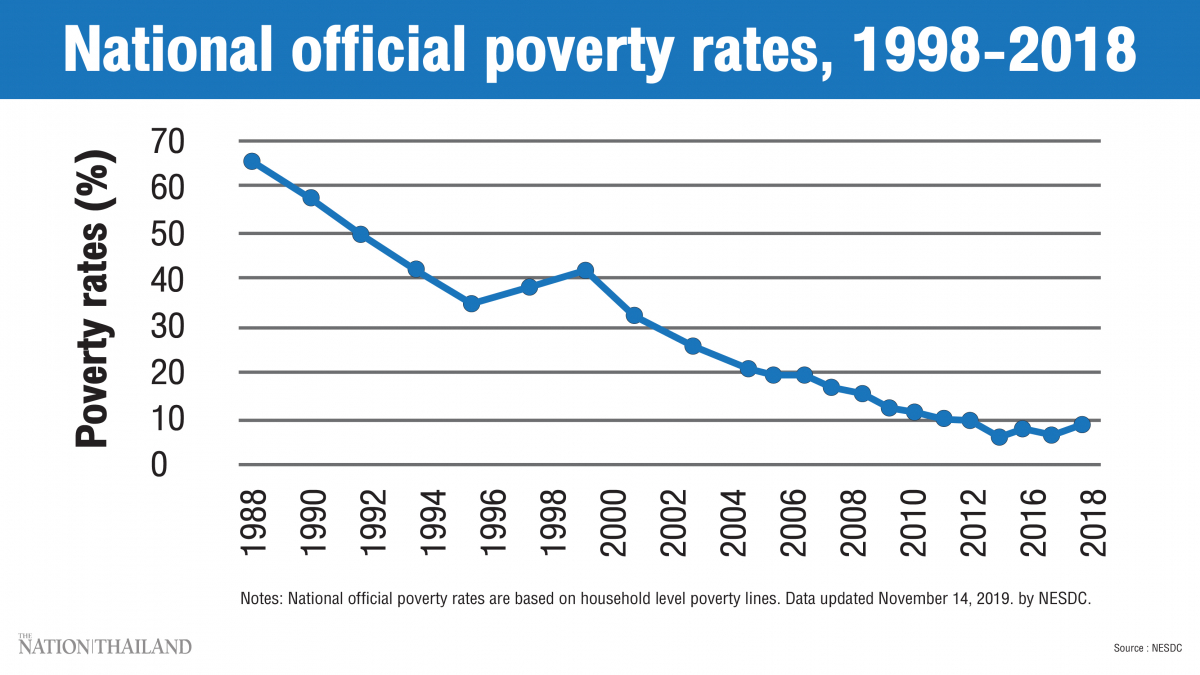
Thailand had successfully reduced poverty over the past three decades from over 65 per cent in 1988 to under 10 per cent in 2018.

However, the growth of household incomes and consumption have stalled nationwide in recent years. This resulted in a reversal in the progress of poverty reduction in Thailand with the number of people living in poverty rising, according to the World Bank report which analyses recent poverty and inequality trends based on official statistics.

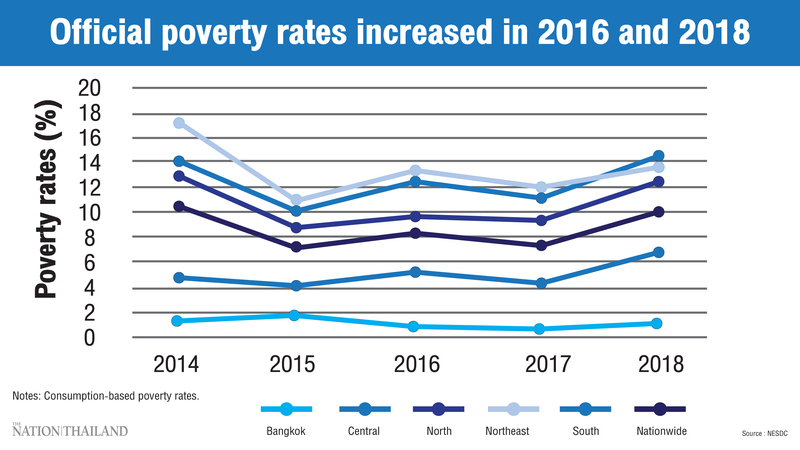
Between 2015 and 2018, the poverty rate in Thailand increased from 7.2 per cent to 9.8 per cent, and the absolute number of people living in poverty rose from 4.85 million to more than 6.7 million.

The increase in poverty in 2018 was widespread – occurring in all regions and in 61 out of 77 provinces. In the Central and Northeast, the number of poor increased by over half a million in each region during the same period. The conflict-affected South became the region with the highest poverty rate for the first time in 2017.

The report finds that the recent increase in poverty coincides with emerging and shifting economic and environmental challenges in the economy.

Over the past few years, Thailand’s growth rate has been lower than other large economies in the developing East Asia and Pacific region. Thailand had one of the lowest GDP growth rates in the region, at 2.7 per cent during the fourth quarter of 2019. Droughts have affected the livelihoods of farmers who are already typically the poorest.

“Recent poverty trends demonstrate that despite Thailand’s level of economic development, households are still vulnerable to shocks and weak economic conditions,” said Birgit Hansl, World Bank Thailand /Country Manager.

“To meet Thailand’s aspiration of achieving high-income status, Thai households will need better protection from income shocks such as ill-health, job-loss and natural disasters. It will be equally important to support the creation of more productive and higher-paying jobs.”

Since official poverty data were first published in 1988, Thailand’s poverty rate has increased in five instances, the most recent in 2018 and 2016 with the previous three instances occurring in 1998, 2000, and 2008 around the time of financial crises. Thailand is the only nation in Asean to experience several increases in poverty since 2000.

While Thailand performs better than its Asean peers on many international indicators of well-being, such as education enrolment among primary school-aged children, access to water, sanitation, and electricity, and has a low international extreme poverty rate based on $1.90/day at 0.03 percent, inequality remains an issue.

The population at the bottom 40 per cent of the income distribution is not sharing as well in prosperity, and in the recent period of 2015-2017, consumption and income growth in this bottom 40 per cent were negative. The reversal in trend among this bottom 40 per cent during this period is related to declines in all forms of labour incomes, including a stagnation in wage growth and declines in farm and business incomes.

“A more nuanced picture of inequity and a better understanding of vulnerability will be needed to guide Thailand’s next steps towards building a more prosperous society for all.” said Judy Yang, World Bank economist and author of the report. “Eliminating persistent pockets of poverty will require growth strategies that take into account short-run risk mitigation and long-run investment needs.”

The report calls for active interventions and investments to help transform Thailand. In the short-term, Thailand will need to reinforce its safety nets. Populations that are vulnerable would need to be better identified and swift action is needed in creating better jobs for households in a rapidly changing economy.

In the longer term, investing equitably in the next generation will be key. The next generation will be smaller due to demographic changes and lower fertility rates. Every child will need to be given a fair shot and be provided the health and education opportunities to reach their full potential. This will help households break out of the generational poverty trap, support an aging population, and boost Thailand’s growth prospects.

KResearch cuts growth forecast to 0.5% due to virus #ศาสตร์เกษตรดินปุ๋ย

#ศาสตร์เกษตรดินปุ๋ย : ขอบคุณแหล่งข้อมูล : หนังสือพิมพ์ The Nation

https://www.nationthailand.com/business/30383410?utm_source=category&utm_medium=internal_referral

KResearch cuts growth forecast to 0.5% due to virus

Mar 05. 2020
By THE NATION
Kasikorn Research Centre (KResearch) says the intensifying global Covid-19 outbreak, including a rapidly increasing number of infected people outside China, complicates any assessment of its impact on the economy.

Assistant managing director Nattaporn Triratanasirikul said that, if China can control the number of infections within the next month or two and the situation elsewhere, particularly in Italy and South Korea, can be contained in the second quarter – and if the number of infections in Thailand does not increase too rapidly in that period – GDP growth is still likely to fall, from KResearch’s previous estimate of 2.7 per cent to 0.5 per cent.

Although this decrease seems significant, she said, the estimate is applied to a fast-changing situation, and if the contagion eases within the first half of the year as is expected, GDP growth could be stronger in the last quarter.

She emphasised that this situation is unlike what happened in 1997 because it has been caused by external shocks, while the 1997 crisis was the result of an imbalance in economic mechanisms and the business sector. It was quite difficult to tackle and slow to return to normalcy.

The tourism sector will likely be the hardest hit by Covid-19, Nattaporn said. Thailand is expected to lose Bt410 billion in tourism revenues, accounting for 2.4 per cent of GDP, while the number of foreign tourist arrivals may decline by 8.3 million, representing a contraction of 20.8 per cent year on year.

Thai exports could see a 5.6-per-cent contraction against KResearch’s prior estimate of minus-1 per cent as the virus’ broader spread further dampens the global economy.

The shrinkage foreseen in exports is also due to weakening demand, while Thailand’s manufacturing sector has been adversely affected by the disruption of supply chains at home and especially in China.

Domestic consumption and investment will likely slow because consumers have been reluctant to spend and travel. This in turn might hurt the Thai retail business, with turnover projected to drop by more than Bt100 billion.

Given this, close attention must be paid to liquidity within the business sector and domestic employment, being critical issues that the public sector must maintain as its top priorities, plus budgetary disbursement and the likelihood that the government will approve additional budget.

Regarding monetary policy, if GDP growth shrinks during the first and second quarters, it is likely the Bank of Thailand will trim its policy rates by at least 0.25-0.5 per cent in of 2020, prompting commercial banks to follow suit.

Although a policy rate cut might not be a panacea for quickly reinvigorating economic activity during this abnormal period, it could help the business and household sectors ease their financial burdens somewhat.

Looking into the second half, if the virus situation improves, economic activity and GDP could resume growth.

Regarding the commercial banking business, a steep decline in economic growth, especially during the first half, might hurt interest and fee income.

Interest income from loans in particular will be the most affected because loans have been hit by additional interest rate cuts. KResearch has revised its 2020 loan growth forecast down to less than 1 per cent (from 3 per cent), which would be lower than the 2.2-per-cent growth reported at the end of 2019.

As a result, allowance for impairment on loans might increase in line with rising NPL ratio from the 2.98 per cent seen at the end of 2019. KResearch will have to monitor the situation under the new accounting standards during the first quarter before assessing their future directions once more.

Nevertheless, the central challenge for Thai commercial banks for now is to assist their customers via various measures in collaboration with the public sector so that they can get through this difficult time.

Meanwhile, the impact of the Covid-19 outbreak on operating results of commercial banks has been acknowledged by investors to a certain extent, and the results will likely be consistent with those of overseas financial institutions.

Markets wrap: Asia to extend global stock rally on stimulus hope #ศาสตร์เกษตรดินปุ๋ย

#ศาสตร์เกษตรดินปุ๋ย : ขอบคุณแหล่งข้อมูล : หนังสือพิมพ์ The Nation

https://www.nationthailand.com/business/30383384?utm_source=category&utm_medium=internal_referral

Markets wrap: Asia to extend global stock rally on stimulus hope

Mar 05. 2020
By  Syndication Washington Post, Bloomberg · Adam Haigh · BUSINESS, US-GLOBAL-MARKETS

Asian stocks looked set to extend a global equity rally after an emergency U.S. spending bill to combat the impact of the coronavirus added to signs of support from policymakers. Treasuries and the yen retreated.

Futures rose in Hong Kong, Japan and Australia, with regional shares set for a fourth day of gains. The S&P 500 index surged more than 4% after Congress authorized nearly $8 billion for virus prevention. The Bank of Canada joined this week’s wave of global central bank stimulus and speculation grew that governments will provide more help as the outbreak claimed more lives. Joe Biden’s surprise surge in Tuesday’s presidential primaries added to bullish sentiment.

In a sign investors see more U.S. stimulus coming, shorter-dated Treasury yields declined as 10-year ones advanced, steepening the curve. Australian bonds opened lower and gold slipped. The yuan strengthened, erasing all losses since the coronavirus outbreak.

“At the moment the market takes this as credible enough, that is to say there is some recovery coming ahead as a result of the current action,” said Ben Emons, managing director of global macro strategy at Medley Global Advisors.

As risk assets recover, traders remain on edge amid a rise in virus cases around the world. The S&P 500 has surged about 6% this week, a rebound that began late Friday when the Federal Reserve pledged support. It remains almost 8% below last month’s all-time high.

Elsewhere, oil fluctuated amid a split between Saudi Arabia and Russia over whether deeper production cuts are required to offset the demand hit from the coronavirus epidemic.

These are the main moves in markets:

– – –

– The S&P 500 index advanced 4.2%.

– Futures on Japan’s Nikkei 225 added 1.4%.

– Hang Seng futures earlier rose 0.7%.

– Futures on Australia’s S&P/ASX 200 index gained 1.8%.

– – –

– The Bloomberg Dollar Spot index increased 0.2%.

– The euro decreased 0.4% to $1.1133.

– The yen fell 0.4% to 107.51 per dollar.

– The offshore yuan rose 0.4% to 6.9226 per dollar.

– – –

– The yield on 10-year Treasuries rose four basis points to 1.04%.

– The yield on two-year Treasuries fell two basis points to 0.68%.

– Australia’s 10-year yield rose eight basis points to 0.8%.

– – –

– West Texas Intermediate crude held at $47.18 a barrel.

– Gold fell 0.3% to $1,636.33 an ounce.

U.S. markets post big gains as Biden’s surge offers coronavirus respite #ศาสตร์เกษตรดินปุ๋ย

#ศาสตร์เกษตรดินปุ๋ย : ขอบคุณแหล่งข้อมูล : หนังสือพิมพ์ The Nation

https://www.nationthailand.com/business/30383382?utm_source=category&utm_medium=internal_referral

U.S. markets post big gains as Biden’s surge offers coronavirus respite

Mar 05. 2020
By The Washington Post · Taylor Telford, Thomas Heath · BUSINESS, US-GLOBAL-MARKETS

U.S. stock markets surged Wednesday after Joe Biden’s Super Tuesday run made him a formidable moderate counterweight to Sen. Bernie Sanders’ economically disruptive proposals in the Democratic presidential race. The Dow Jones industrial average ended the day up nearly 1,200 points, or more than 4.5%.

The rebound comes amid an especially volatile window of trading, with coronavirus panic spawning a brutal sell-off that had erased trillions in value from global markets. On Tuesday, the Federal Reserve delivered its first emergency rate cut since the 2008 financial crisis — bringing the benchmark down 50 basis points. But the central bank’s move seemed to reinforce panic on Tuesday, rather than easing it, sending the three major U.S. indexes down and landing them back in correction territory.

Yet on Wednesday, it became clearer that the former vice president had captured primary wins in 10 states, including Texas, a showing that propelled him to the front of the field. Sanders, I-Vt., may still score the day’s biggest prize, California, where he is leading.

“Bernie Sanders’ socialist program includes lots of proposals to increase taxes and regulations, which would weigh on the economy and corporate earnings,” said Ed Yardeni, president of Yardeni Research. “The market’s sell-off last week on Sanders’ primary victories and rebound on Monday after Biden’s big win in South Carolina and this morning after Super Tuesday suggest that domestic U.S. politics may matter as much as the global health crisis to investors.”

The Dow surged hundreds of points in the final minutes of the session, closing at 27,091, up 1,173 points on the day. The Standard & Poor’s 500-stock index finished up 4.22%, while the tech-heavy Nasdaq composite index closed with a 3.85% gain. Mike Bloomberg’s retreat from the Democratic presidential primary and a report showing unexpected growth in the U.S. service sector added to Wall Street’s feel-good vibe.

“Investors are shifting from the coronavirus to politics, and the market knows how to play politics better than the virus,” said Howard Silverblatt of S&P Dow Jones Indices. “But stocks could turn on a dime if there is a new memo on the coronavirus.”

Health-care stocks roared nearly 6%, leading all 11 market sectors, in response to Biden’s performance. That eased the industry’s worries about Sanders and his Medicare-for-all plan. Cigna and UnitedHealth Group were up more than 10% in afternoon trading. Humana saw a 12.7% spike while Anthem closed in on nearly 14.4%. UnitedHealth, a Dow component and industry barometer, had its best day in a decade. Big Pharma also had a good day, with Pfizer and Johnson & Johnson flying 5%.

“Sanders’ win would be perceived as an increased risk for health insurers since he proposes a free comprehensive national health insurance program for all Americans, potentially leading to the elimination of the existing health insurance system,” said CFRA Research analyst Sel Hardy in a note published Wednesday. “Biden on the other hand, proposes a more moderate change to the private insurance system that will build on the Affordable Care Act, aiming to give more affordable choices on insurance plans, reducing health care costs, and making the healthcare system less complex.”

On Wednesday, the International Monetary Fund announced that it is proposing $50 billion in emergency funding to combat the coronavirus for low-income and emerging market countries. IMF managing director Kristalina Georgieva said the outbreak was a global problem “calling for a global response.”

The World Health Organization said Tuesday that covid-19, the disease caused by the virus, has killed about 3.4% of those diagnosed with the illness — a higher rate than estimated previously. On Wednesday, the number of new coronavirus deaths reported outside China exceeded those reported inside the country — the center of the outbreak — for the first time.

Markets also were rattled as the yield on 10-year Treasury notes sank to an all-time low Tuesday. Bonds are a safe haven for investors in times of turmoil, and bond yields decrease as bond prices increase. Gold, another safe haven, climbed 2.9% Tuesday and has continued to rise, now trading at $1,647 per ounce.

“The 10-year treasury is a great barometer to measure fear,” Wayne Wicker, chief investment officer at Vantagepoint Investment Advisers, wrote in commentary Wednesday. “With a closing yield Tuesday at an all-time low of less than 1%, markets are reflecting a heightened amount of uncertainty related to the coronavirus and macroeconomic implications.”

European markets mirrored U.S. optimism Wednesday, with the benchmark Stoxx 600 index, Germany’s DAX and France’s CAC 40 all up more than 1.4% in midday trading. Britain’s FTSE 100 climbed 1.6%. Asian markets closed to mixed results, with Hong Kong’s Hang Seng closing down 0.25% and Japan’s Nikkei 225 weakly positive.

Fears about the coronavirus presence in the United States has spiked as the death toll reached 11 on Wednesday, and new research has revealed that the virus had probably been spreading undetected in California and Washington for weeks. Americans are beginning to face disruption to their work and travel, and the list of major events canceled in the face of the outbreak grows by the hour. Many grocery stores and pharmacies report being cleaned out of bottled water, disinfectant products and shelf-stable and frozen foods.

Investors are looking forward to ADP payroll numbers and fresh manufacturing data Tuesday to further suss out the damage the coronavirus has done to the global economy. Analysts are predicting global economic growth could slow to the lowest levels since the financial crisis this quarter.

Bidding terms imminent for drilling in Gulf #ศาสตร์เกษตรดินปุ๋ย

#ศาสตร์เกษตรดินปุ๋ย : ขอบคุณแหล่งข้อมูล : หนังสือพิมพ์ The Nation

https://www.nationthailand.com/business/30383369?utm_source=category&utm_medium=internal_referral

Bidding terms imminent for drilling in Gulf

Mar 05. 2020
Energy Minister Sontirat Sontijirawong

Energy Minister Sontirat Sontijirawong
By THE NATION

The Department of Mineral Fuels is expected to announce terms of reference for a new round of bidding for petroleum exploration and production concessions in April, Energy Minister Sontirat Sontijirawong said on Wednesday (March 4).

This 23rd bidding will focus on the Gulf of Thailand.

The department is expected to open bidding for three zones on a production-sharing-contract basis. The bidding is estimated to see investment of at least Bt1.5 billion.

Sontirat said he would meet executives of public and private energy businesses today (March 5) to discuss their possible roles in helping stem the spread of the Covid-19 virus.

These businesses are a key engine for the economy and have raw materials for producing goods such as hand-gels and facemasks, he noted.

Relief for airlines on the way #ศาสตร์เกษตรดินปุ๋ย

#ศาสตร์เกษตรดินปุ๋ย : ขอบคุณแหล่งข้อมูล : หนังสือพิมพ์ The Nation

https://www.nationthailand.com/business/30383371?utm_source=category&utm_medium=internal_referral

Relief for airlines on the way

Mar 05. 2020
All airline executives at the meeting share a common view that it will take one year to 18 months before the situation returns to normal, says Saksayam.

All airline executives at the meeting share a common view that it will take one year to 18 months before the situation returns to normal, says Saksayam.
By THE NATION

The Transport Ministry will finalise relief measures to ease the financial burden of airlines today (March 5), before submitting the package for consideration by the Council of Economic Ministers on Friday , said minister Saksayam Chidchob.

If approved, the measures will come into effect immediately, he added.

He made the remark after a meeting today with executives of 17 airlines who asked for a cut in aviation and office rental fees.

Airliners have suffered declining passenger volume due to the Covid-19 outbreak. A few have announced drastic cost-cutting measures, including slashing monthly pay of their top executives.

The airline executives share a common view that it will take one year to 18 month before the situation would return to normal.

Among the airlines represented in the meeting were Thai AirAsia, Thai Lion Air, Nok Air, Bangkok Airways, and Nook Scoot.

The national carrier Thai Airways International will discuss with Saksayam on the same issue today.