SEC approves rollout of 17 Super Savings Funds for long-term investment #ศาสตร์เกษตรดินปุ๋ย

#ศาสตร์เกษตรดินปุ๋ย : ขอบคุณแหล่งข้อมูล : หนังสือพิมพ์ The Nation

https://www.nationthailand.com/business/30383375?utm_source=category&utm_medium=internal_referral

SEC approves rollout of 17 Super Savings Funds for long-term investment

Mar 05. 2020
By The Nation

The Securities and Exchange Commission has approved the launch of 17 Super Savings Funds (SSF) as of March 4 , SEC Secretary General Ruenvadee Suwanmongkol said on Wednesday, adding that they would be available to investors soon.

Once the Revenue Department publishes  investment conditions and tax incentives of the funds in the Royal Gazette, the Association Investment Management Companies will make an announcement on the terms of investment transaction approved by the SEC, she said.

The SSF mutual fund scheme was initiated by the Finance Ministry to offer investors an alternative for long term savings, and will replace the long-term equity fund(LTF) which expired at the end of last year.

Individual investors in SSFs are eligible to a tax deduction of up to 30 per cent of their annual taxable income, capped at Bt 200,000. Total tax reduction must not exceed Bt 500,000 a year, taking into account the tax deduction under provident fund and other types of retirement mutual funds.

Investment in the SSFs is not limited to equities as it includes bonds and alternative investments. Investors have to hold the investment units for 10 years, but not required to invest every year. However, tax privileges under SSF is lower than that of LTF.

Finance Ministry to table first set of relief measures on Friday #ศาสตร์เกษตรดินปุ๋ย

#ศาสตร์เกษตรดินปุ๋ย : ขอบคุณแหล่งข้อมูล : หนังสือพิมพ์ The Nation

https://www.nationthailand.com/business/30383373?utm_source=category&utm_medium=internal_referral

Finance Ministry to table first set of relief measures on Friday

Mar 04. 2020
Minister Uttama Savanayana

Minister Uttama Savanayana
By THE NATION

The Finance Ministry will propose to the Council of Economic Ministers on Friday a plan to hand out Bt1,000 each to around 10 million low-income earners as part of its first relief package to mitigate the economic impact of the Covid-19 outbreak.

Minister Uttama Savanayana said today (March 4) that the ministry would propose the first set of relief measures to the meeting. If approved, they will be forwarded to the Cabinet on March 10.

He has assured that the measures would be in line with fiscal discipline. If they failed to lift the economy, he still has other options at his disposal , Uttama said.

Under the handout plan, money will be transferred to low income earners and freelancers, totalling more than 10 million. Their monthly salary must not be more than Bt15,000 and will have to register for the give-away.

He added that the handout will be Bt1,000 per person and will be transferred to them via PromptPay channel. He has already assigned the ministry’s permanent secretary to work out details of the transfer process.

Other measures include extension of soft loans by the Government Housing Bank to commercial banks, which will in turn lend to affected businesses. There will also be tax incentives to discourage companies from laying off employees.

However, he insisted that the government would not cut value-added tax.

Tourism and Sports Minister Pipat Ratchakitprakarn said he would propose to the economic ministers’ meeting on Friday that the government allocates Bt5 billion to promote a “Eat, Stay, Travel” campaign, aimed to boost domestic tourism.

The campaign will hand out Bt1,000 each to 5 million eligible Thais, he said, adding that the participation process would be similar to that of the “Eat, Shop, Spend” campaign.

Registrants who have received the money will have to travel to other provinces and stay there for at least one night. They will have to start the journey within three months. If the Cabinet approved the campaign, it could begin next month.

The Joint Standing Committee on Commerce, Industry and Banking, has revised downward its forecast of Thai economic growth this year to between 1.5 per cent and 2 per cent from its previous projection of 2 to 2.5 per cent. The revision was based on assumption that the Covid-19 outbreak worldwide would pass its peak in the middle of this year and economic activities return to normal in the fourth quarter, it said.

Joint panel lowers Thai growth forecast to 1.5-2 % #ศาสตร์เกษตรดินปุ๋ย

#ศาสตร์เกษตรดินปุ๋ย : ขอบคุณแหล่งข้อมูล : หนังสือพิมพ์ The Nation

https://www.nationthailand.com/business/30383359?utm_source=category&utm_medium=internal_referral

Joint panel lowers Thai growth forecast to 1.5-2 %

Mar 04. 2020
The Joint Standing Committee on Commerce, Industry and Banking revises down its GDP growth forecast for 2020 at a meeting today (March 4)

The Joint Standing Committee on Commerce, Industry and Banking revises down its GDP growth forecast for 2020 at a meeting today (March 4)
By THE NATION

The Joint Standing Committee on Commerce, Industry and Banking, has revised downward its forecast of Thai economic growth this year to between 1.5 per cent and 2 per cent from its previous projection of 2 to 2.5 per cent.

The revision was based on assumption that the Covid-19 outbreak worldwide would pass its peak in the middle of this year and economic activities return to normal in the fourth quarter, it said.

While the government is preparing strong measures to revive the economy, the joint committee believes that the results might not be strong enough to offset the board damages already caused by the epidemic, especially in the tourism and industrial supply chain sectors .

The committee has maintained its export forecast this year at minus 2 per cent and zero per cent.

Speaking at a separate event this week , the Monetary Policy Committee (MPC)’s Secretary Titanun Mallikamas said the MPC has been closely monitoring development of the Covid-19 outbreak.

On February 5, the MPC voted unanimously to cut the policy rate by 0.25 of a percentage point from 1.25 per cent to 1 per cent, effective immediately.

The reduction was in line with the MPC’s estimate that Thai economic growth would be lower than its previous forecast, due mainly to the new coronavirus outbreak and drought.

Several banks have already stepped in to offer relief measures to individual and business customers hit by the outbreak impact, especially those in the tourism sector.

The Council of Economic Ministers will hold a meeting this Friday on pressing issues following the impact of the Covid-19 coronavirus on the economy, said National Economic and Social Development Council secretary-general Thosaporn Sirisumphand on Tuesday (March 3).

The Covid-19 outbreak will hit southeast Asian banking sectors through weaker economic growth, slower credit growth and dampened profitability, with banks in tourism-dependent Thailand and China-exposed Singapore likely to be the most affected, according to Fitch Ratings release.

On the global front, on Tuesday (March 3) theUS Federal Reserve trimmed its benchmark rate by 50 basis points to a range of 1 per cent to 1.25 per cent in a bid to protect its economic expansion from the spreading coronavirus.

On March 3, the World Bank Group announced that as Covid-19 has affected more than 60 countries, the bank is making available an initial package of up to $12 billion in immediate support to assist countries coping with the health and economic impacts of the global outbreak.

This financing is designed to help member countries take effective action to respond to and, where possible, lessen the tragic impacts posed by Covid-19, according to its statement.

Singapore, Thai banks likely to be most affected by Covid-19 #ศาสตร์เกษตรดินปุ๋ย

#ศาสตร์เกษตรดินปุ๋ย : ขอบคุณแหล่งข้อมูล : หนังสือพิมพ์ The Nation

https://www.nationthailand.com/business/30383355?utm_source=category&utm_medium=internal_referral

Singapore, Thai banks likely to be most affected by Covid-19

Mar 04. 2020
By THE NATION

The Covid-19 outbreak will hit southeast Asian banking sectors through weaker economic growth, slower credit growth and dampened profitability, with banks in tourism-dependent Thailand and China-exposed Singapore likely to be the most affected, according to Fitch Ratings release today.

However, Singaporean and Thai banks have sufficient loss-absorption buffers to withstand this pressure, although the impact will depend on the extent and duration of the outbreak.

Banks in Singapore and Thailand have announced relief measures, which should alleviate some near-term asset quality and profitability pressures.

For Singapore, the measures include a moratorium on principal repayments for 6-12 months on SME property loans and some retail mortgage loans.

For Thai banks, they include a moratorium on principal for up to one year for tourism-related loans, and relief measures on credit-card and personal-loan debt. Other markets have announced stimulus packages, and Thailand, Indonesia, Malaysia and the Philippines have cut interest rates.

Singaporean banks’ direct exposure to Greater China, which averages 24 per cent of gross loans, is another potential area of stress.

Fitch has outlined scenarios in which China’s GDP growth slows to 5.2-5.7 per cent in 2020, compared with a forecast of 5.9 per cent before the outbreak.

Singaporean banks’ China exposure is mainly lending to top-tier corporations, short-term trade loans or liquidity placements with major Chinese banks, which are typically lower risk, but would still be tested by an economic slowdown in China.

Their exposure to Hong Kong, which forms 13 per cent of gross loans, could also be hit, given the more fragile state of the Hong Kong economy and the exposure being more diverse than in China.

Even before the Covid-19 outbreak, Fitch’s sector outlook for the Singaporean banks was negative, which reflected potential for further asset quality and profitability weakness. Its rating outlook remains stable due to the banks’ sound loss-absorption buffers, with the average common equity Tier 1 (CET1) ratio at 14.4 per cent at end-2019, and their highly stable funding and liquidity buffers, which leave sufficient headroom for ratings to withstand economic challenges.

However, a prolonged outbreak may affect Fitch’s assessment of Singaporean banks’ operating environment, which stands at ‘aa’ with negative outlook, and this may in turn affect the banks’ Viability Ratings (VRs).

Thailand’s dependence on tourism means the SME sector, which accounts for 33 per cent of banks’ portfolios, is likely to be significantly affected by the Covid-19 outbreak.

Fitch’s stable sector outlook already incorporates slower economic growth and subdued earnings, but a further slowdown could affect this assessment.

The impact on non-performing loans (NPLs) should be mitigated by the banks’ high excess provisions, adequate capital buffers with average CET1 ratio of 16.0 per cent at end-2019, and the relief measures.

The rating outlook for Fitch-rated state-owned banks remains positive, mirroring that on the sovereign (BBB+/Positive). However, a more extensive and prolonged outbreak may affect upward rating momentum for the sovereign.

Indonesian banks with significant presence in tourism-dependent Bali are likely to be most affected by Covid-19.

These are mainly the largest banks in the industry, foreign-owned banks and small banks headquartered in Bali, such as local regional development bank, PT Bank Pembangunan Daerah Bali (A(idn)/Stable). Profitability is likely to be affected by lower revenues and higher provisioning, but many of the banks’ IDRs are based on support from higher-rated parents and their VRs are supported by satisfactory earnings and capital buffers. Indonesian banks’ average ROA of around 2.0 per cent and average CET1 ratio of 21.9 per cent at end-2019 were among the highest in the region.

In Vietnam, reduced tourism, disrupted manufacturing supply chains and weaker external demand are likely to put pressure on corporate profitability, and may weigh on banks’ asset quality, although tourism-related sectors are only a small part of Fitch-rated banks’ credit portfolios.

Banks are likely to face slower credit and profit growth rather than take heavy hits to asset quality. However, Vietnam banks have very limited capital to buffer against prolonged weakening in profitability, or to stimulate credit growth if directed by the government.

An economic slowdown would also test the quality of the newly extended consumer loans. The rating outlook for Vietnamese banks is positive, in line with that of the sovereign (BB/Positive), although upward sovereign rating momentum could be affected by an extended outbreak.

Malaysian banks’ credible underwriting standards and sufficient earnings and capital buffers should help to contain any rating impact. However, China is Malaysia’s largest export market, meaning a sharp Chinese slowdown would erode corporate earnings.

The Philippine economy’s exposure to Chinese flows is relatively light and the banking system’s credit exposure to the hospitality sector is also less than 2 per cent of the portfolio. Over the longer term, remittances from key markets, such as Hong Kong, Singapore and the Middle-East, could decrease. However, the domestic economy is starting from a strong position, and rated banks are sufficiently capitalised.

Suspension of GSP to affect exports of 573 Thai products #ศาสตร์เกษตรดินปุ๋ย

#ศาสตร์เกษตรดินปุ๋ย : ขอบคุณแหล่งข้อมูล : หนังสือพิมพ์ The Nation

https://www.nationthailand.com/business/30383342?utm_source=category&utm_medium=internal_referral

Suspension of GSP to affect exports of 573 Thai products

Mar 04. 2020
By The Nation

The US suspension of tariff privileges under the Generalised System of Preferences (GSP), which comes into effect on April 25, will affect 573 Thai products, a Cabinet meeting on March 3 was told, Deputy Government Spokeswoman Rachada Thanadirek said.

The businesses in the listed products will pay 4-5 per cent more taxes, amounting to a total of Bt1.5 billion to Bt1.8 billion and the Commerce Ministry is seeking remedial measures for these businesses.

Rachada added that the government will not import any pig parts from the US as Thailand has a law against the use of red meat accelerator due to food safety issues. Thai people not only eat red meat but also the testicles and organs of pig which are affected by the accelerator.

Fed cuts interest rate half a percentage point, largest emergency cut since the financial crisis #ศาสตร์เกษตรดินปุ๋ย

#ศาสตร์เกษตรดินปุ๋ย : ขอบคุณแหล่งข้อมูล : หนังสือพิมพ์ The Nation

https://www.nationthailand.com/business/30383310?utm_source=category&utm_medium=internal_referral

Fed cuts interest rate half a percentage point, largest emergency cut since the financial crisis

Mar 04. 2020
By The Washington Post · Heather Long · BUSINESS, US-GLOBAL-MARKETS
Adds reaction, market close and coronavirus details
WASHINGTON — The Federal Reserve on Tuesday took the emergency step of cutting the benchmark U.S. interest rate by half a percentage point, an attempt to limit the economic and financial fallout from the coronavirus.
.

https://www.washingtonpost.com/video/business/fed-chair-powell-on-emergency-interest-rate-cut-we-saw-a-risk-to-the-outlook-of-the-economy/2020/03/03/633bdf67-b2f0-4a36-aae1-166edd754494_video.html

https://www.washingtonpost.com/video/c/embed/633bdf67-b2f0-4a36-aae1-166edd754494

The U.S. central bank has not made a cut like this since late 2008, shortly after the collapse of Lehman Brothers. Fed leaders believed it was wise to move quickly as concerns mount about the plunging stock market and a severe economic disruption in every major economy. Recession fears in the U.S. have spiked in the past two weeks.

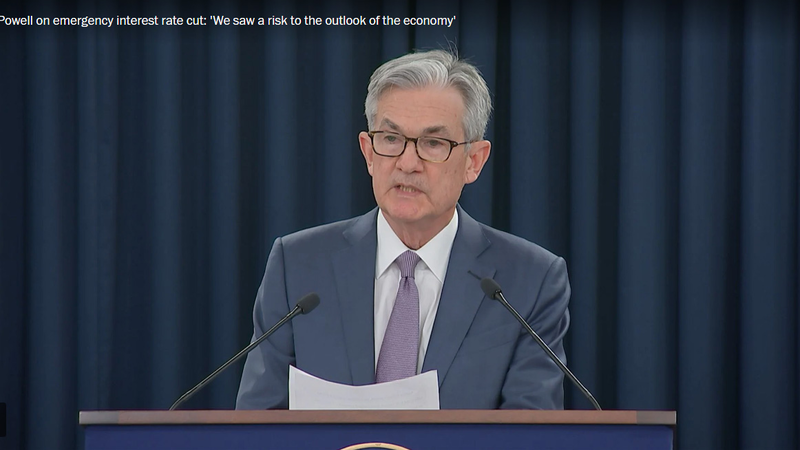
“We saw a risk to the outlook of the economy and we chose to act,” Fed Chairman Jerome Powell said at a news conference shortly after the rate cut announcement.

The economic concerns have picked up. Many U.S. companies initially scrambled to reroute manufacturing supply chains because their China suppliers were shuttered.

But a broader worry has emerged as many U.S. businesses are prohibiting work-related travel, fearful of health risks. And there’s a fear that consumers will pull back on their own expenditures as the virus spreads, schools are shut down and the stock market swings. This kind of sharp pullback could derail what had been steady economic growth, leading companies to cut workers and investments, and creating a drag that is hard to arrest.

The Fed’s action reduced the U.S. interest rate to just below 1.25%, down from about 1.75%. Fed leaders voted unanimously in favor of the rate reduction, and Powell tried to project a sense of calm during the 13-minute news conference. He said repeatedly that the U.S. economic fundamentals still look healthy, but he noted that “sentiment” had shifted. The cut led to a brief stock market rally, but it was short-lived.

The Dow Jones industrial average ended the day down nearly 800 points, and the bond market flashed a warning sign as the yield on the 10-year U.S. Treasury bond fell briefly below 1% for the first time ever.

Economists have warned that the coronavirus is suddenly shaping up to be the biggest risk to the global economy since the financial crisis. Growth this year is expected to slow sharply, even if a recession is avoided. Goldman Sachs has projected that economic growth in the United States could stall in the second quarter, which runs April through June.

The Fed’s move is one of several that policymakers have discussed in recent weeks. Congress is preparing a $7.5 billion emergency funding package to help with the costs of fighting the epidemic. President Donald Trump on Tuesday called for new tax cuts and an even bigger Fed rate cut to stimulate the economy. Treasury Secretary Steven Mnuchin, meanwhile, said they would consider an infrastructure package and regulatory relief for banks, but discussions appeared to be in early stages.

He criticized the Fed for not doing more on Tuesday, but there are limits to what the central bank can achieve, especially with interest rates already low. Also, the economic shock is causing many people to stay home, regardless of how available cheap credit is.

“You are not going to slay a disease by lowering interest rates,” said Bernard Baumohl, chief global economist at the Economic Outlook Group. He compared to the Fed’s cut to “placing a Band-Aid on an arm to cure a headache.”

Powell acknowledged that the Fed can’t come up with a vaccine or fix a broken supply chain that’s disrupted by the outbreak in China, but he believes the rate cut will help protect the economy from a rapid downturn.

“We don’t think we have all the answers, but we do believe our action will provide meaningful support to the economy,” Powell said. “It will support accommodative conditions and avoid a tightening of financial conditions, and it will help boost household and business confidence.”

While some worry that Powell caved to Trump, many economists and investors thought Powell made a mistake by not using his news conference to stress that the Fed would act again, if needed.

“The Fed’s action today is better than nothing, but it’s not quite what the doctor ordered,” said George Selgin, a senior fellow at the Cato Institute and close Fed watcher. “Powell needed to give markets a more certain sense of the Fed’s willingness to move rates further as necessary.”

Powell left the door open to another rate cut, but he stopped far short of promising action. He once again dismissed the idea that the Fed is caving to Trump’s wishes.

“We’re never going to consider any political considerations whatsoever. And it’s very important the public understands that,” Powell said.

Many economists blame the White House and Congress for being slow to respond to the crisis, thereby forcing the Fed to step in with its blunt instruments at a time such as this.

“We need to know the extent of the virus in the U.S. We are not even doing broad-based testing. We don’t know where this is or who has it. The uncertainty is so high right now about the most basic things, and that’s weighing on the economy,” said Julia Coronado, a former Fed economist and founder of Marcopolicy Perspectives.

In contrast to Trump, Mnuchin praised the Fed’s action on Tuesday, telling Congress, “They did the right thing getting ahead of this. . . . I applaud the Fed on this move.”

Earlier Tuesday morning, global finance ministers held a call to discuss the economic unrest, but they stopped short of announcing any joint steps. In the 2008 financial crisis, G-7 finance ministers announced “urgent and exceptional action” to bail out the banks. Shortly after the Tuesday call, however, the Fed made its announcement.

The Fed’s move followed Australia’s central bank, which cut interest rates to their lowest level ever. Trump had demanded that the Fed follow suit.

“Australia’s Central Bank cut interest rates and state it will most likely further ease in order to make up for China’s coronavirus situation and slowdown. They reduced to 0.5%, a record low. Other countries are doing the same thing, if not more so. Our Federal Reserve has us paying higher rates that many others, when we should be paying less,” Trump tweeted. The Fed “should ease and cut rate big.”

Lowering interest rates makes it even cheaper to borrow money, but it does not address the root cause of the current concern in financial markets.

Trump also called for a one-year reduction in payroll taxes, which would be an immediate boost to the paychecks of working Americans if approved by Congress. Payroll taxes are used to fund Social Security and Medicare and have been reduced in past times of economic trouble, including after the most recent financial crisis.

While Democrats have been highly critical of the 2017 GOP tax cuts, some Democratic lawmakers might be open to payroll tax cuts. About 75% of U.S. taxpayers do get assessed the payroll tax, according to the nonpartisan Tax Policy Center. Americans pay payroll taxes on income up to $137,700, so a cut would not have an impact on any income above that level.

Still, House Majority Leader Steny Hoyer, D-Md., dismissed Trump’s call for a payroll tax cut when asked about it Tuesday.

“I don’t think tax cuts are the answer to every problem,” Hoyer told reporters.

But he left the door open to some sort of fiscal stimulus in the future if the economy falls deeper into peril due to the virus’ spread.

“That may or may not be what we would do,” he said of a potential stimulus, saying Congress would remain “focused on . . . trying to keep the economy stable and growing and keep people employed.”

The 10-year U.S. Treasury yield hit an all-time low. Here’s why that’s worrisome #ศาสตร์เกษตรดินปุ๋ย

#ศาสตร์เกษตรดินปุ๋ย : ขอบคุณแหล่งข้อมูล : หนังสือพิมพ์ The Nation

https://www.nationthailand.com/business/30383309?utm_source=category&utm_medium=internal_referral

The 10-year U.S. Treasury yield hit an all-time low. Here’s why that’s worrisome

Mar 04. 2020
By The Washington Post · Heather Long · BUSINESS, HEALTH
 The U.S. bond market flashed an unprecedented sign of worry on Tuesday that has never been seen before. Not even during the Great Recession.

For roughly more than an hour on Tuesday, the yield on the 10-year U.S. Treasury bond fell below 1%. In plain speak what that means is that investors in America and around the world are willing to hand the U.S. Treasury their money for a decade in exchange for an anemic amount of return — 0.91 percent at the record low. To put it another way, that’s only a tad better than the interest most Americans are currently getting on their savings accounts, yet buying a bond requires tying up your money for years.

This is telling us something big. It means there’s a lot of concern that the global health and economic situation is going to get worse before it gets better. And it means the Trump administration and Congress is going to have to play a bigger role.

Here are the three key takeaways:

1. There’s still a lot of concern about the economy from the coronavirus. The coronavirus is quickly morphing into the biggest threat to the global economy since the 2008 financial crisis. No one really knows how many people are going to get the coronavirus, how deadly it will be or how many places will be impacted. The news is changing daily, and uncertainty tends to drive markets down and undermine confidence. When investors are scared, they run into the arms of the 10-year U.S. Treasury bond, and they don’t demand much in return.

Supply chains have already been disrupted. People are canceling flights and cruises. The big question is whether the coronavirus will also cause American consumers to pull back sharply on spending, which is the main driver of the U.S. economy. If a lot of Americans stay home, restaurants, stores, theaters, conference venues and more will suffer. Tuesday’s 10-year Treasury bond milestone is a signal that there’s still a lot of fear that this situation could get a lot worse than economists initially expected.

The move was also likely driven by the Federal Reserve, which took the highly unusual step of doing an emergency interest rate cut Tuesday. The Fed lowered the benchmark U.S. rate to just under 1.25%, down from about 1.75%. The move was meant to reassure investors and consumers that the Fed would do what’s needed to support the economy, but bond investors think that won’t be enough. Interest rates are likely to go lower. J.P. Morgan now predicts a 50% chance that U.S. interest rates return to zero this year.

2. Wall Street is shouting at the White House and Congress to get their act together. When the yield fell below 1%, a number of experts tweeted that this was a clear call for the White House and Congress to take more decisive action — likely even more than the $7.5 billion emergency funding package that’s already in the works.

Economists have pointed out for days that a Fed rate cut can only go so far. It doesn’t matter how low interest rates go. If Americans are worried about catching the coronavirus, they aren’t going to leave their homes to spend a lot of money. What the nation really needs is assurance the federal government has a handle on the situation and is taking steps to contain the virus, including widespread testing.

Here’s how Julia Coronado, a former Fed economist and founder of Macropolicy Perspectives described it to me today: “We need to know the extent of the virus in the U.S. We are not even doing broad-based testing. We don’t know where this is or who has it. The uncertainty is so high right now about the most basic things and that’s weighing on the economy.”

Another major area of concern is that about a quarter of U.S. workers have no paid sick leave, and in the service sector, including fast food and hospitality companies, that figure rises to nearly half of the workforce. Access to paid sick leave allows people to take time off without losing money — and research has shown it tends to make flu rates plummet when people are encouraged to stay home, as The Washington Post’s Christopher Ingraham points out.

3. There’s big demand for “safe” U.S. assets. The movements of the 10-year U.S. Treasury bond are also telling us something about the global economy. Investors around the world tend to run to U.S. government bonds any time there is a crisis because U.S. assets are easily tradable and the U.S. government is widely viewed as unlikely to default.

While there is a real risk of a global recession — or even a U.S. one — if the situation worsens, the United States is widely viewed as one of the last or least likely to fall. That’s mainly because the U.S. economy was in pretty good shape at the start of the year. Unemployment remains at a half-century low with most people who want a job able to get one. Wages had been rising and confidence was high. That gives the U.S. more of a cushion heading into this time of turbulence than Europe and parts of Asia, which were already struggling to revive their economies even before the coronavirus hit.

“If you’re looking for a port in the storm, the U.S. is still the safe haven,” said Lindsey Piegza, chief economist for Stifel Financial. “We are continuing to see those capital flows come into the US, which is exacerbating downward pressure on bond yields.”

Markets wrap: Treasuries crack 1 percent; Asia stocks set for declines, yen and gold surge #ศาสตร์เกษตรดินปุ๋ย

#ศาสตร์เกษตรดินปุ๋ย : ขอบคุณแหล่งข้อมูล : หนังสือพิมพ์ The Nation

https://www.nationthailand.com/business/30383308?utm_source=category&utm_medium=internal_referral

Markets wrap: Treasuries crack 1 percent; Asia stocks set for declines, yen and gold surge

Mar 04. 2020
By Syndication Washington Post, Bloomberg · Adam Haigh · NATIONAL, BUSINESS, US-GLOBAL-MARKETS 

Stocks in Asia are set to resume declines after an emergency Federal Reserve rate cut sent Treasuries surging and U.S. shares slumping on concern it won’t be enough to cushion the economic hit from the spreading coronavirus. The yen and gold surged.

Futures pointed lower in Japan, Hong Kong and Australia, with regional shares poised to snuff out two days of gains. The S&P 500 index fell almost 3% following the Fed’s 50 basis-point rate cut and comments from Chairman Jerome Powell that the virus outbreak will weigh on activity “for some time.” The two-year Treasury yield sank below 0.65%, while the 10-year plunged below 1% for the first time and the dollar retreated. Australian bonds opened higher.

“We are worried that there’s going to be a massive disruption of the economy,” Jim Bianco, president and founder of Bianco Research, told Bloomberg TV in New York. “That’s what is driving these markets. Now hopefully that doesn’t happen and the Fed can reverse” it.

Treasury yields at all-time lows and expectations the Fed may act again as soon as this month show markets remain extremely cautious about the economy’s prospects to weather the hit. The OECD said the world economy faces its “greatest danger” since the 2008 financial crisis. Still, some are suggesting stocks look better value following the recent tumble.

“We saw a massive re-pricing of risk assets and with the repricing it’s made equities a better and more attractive risk-reward for us,” Anna Han, equity strategist at Wells Fargo Securities, told Bloomberg TV. “However, we are very eyes wide open and we absolutely don’t think that the worst is over.”

Elsewhere, oil advanced for a second day after an OPEC+ committee recommended a larger supply cut to offset lost demand from the spread of the virus.

These are the main moves in markets:

– – –

-The S&P 500 index dropped 2.8% on Tuesday.

– Futures on Japan’s Nikkei 225 declined 0.9%.

– Hang Seng futures retreated 0.9%.

– Futures on Australia’s S&P/ASX 200 index fell 1.3%.

– – –

– The yield on 10-year Treasuries fell 17 basis points to 1%.

– Australia’s 10-year dropped seven basis points to 0.72%.

– – –

– The yen rose 1.1% to 107.13 per dollar.

– The offshore yuan rose 0.2% to 6.9486 per dollar.

– The euro rose 0.4% to $1.1179.

– – –

– West Texas Intermediate crude rose 1.2% to $47.31 a barrel.

– Gold climbed 3% to $1,637.76 an ounce.

Dow plunged despite Fed’s emergency rate cut to stem coronavirus panic #ศาสตร์เกษตรดินปุ๋ย

#ศาสตร์เกษตรดินปุ๋ย : ขอบคุณแหล่งข้อมูล : หนังสือพิมพ์ The Nation

https://www.nationthailand.com/business/30383307?utm_source=category&utm_medium=internal_referral

Dow plunged despite Fed’s emergency rate cut to stem coronavirus panic

Mar 04. 2020
By The Washington Post · Rachel Siegel, Thomas Heath · BUSINESS, US-GLOBAL-MARKETS

U.S. stocks plummeted Tuesday after the Federal Reserve’s emergency rate cut failed to bring calm, extending the mayhem that has defined the markets for days over growing concerns the coronavirus will blunt economic growth.

The Dow Jones industrial average sank nearly 3%, or close to 800 points, and the yield on the U.S. 10-year Treasury bond – a foundation of global finance – briefly fell below 1%, before recovering slightly, as investors fled equities for the safety of bonds. Investors are worried that the spreading outbreak will upend the global economy and end the decade-long expansion.

The Standard & Poor’s 500 and Nasdaq composite were off more than 3% by midafternoon. Ten of the 11 S&P stock market sectors were in negative territory, and so was nearly every one of the 30 Dow stocks.

Stocks twisted and turned most of the day, despite the central bank announcing it would slash the benchmark U.S. interest rate by half a percentage point.

“The Fed went a little early,” said Jamie Cox, managing partner of Harris Financial Group. “Everybody knew the Fed was going to lower interest rates, but they left markets with a lot more questions than answers. That’s why the early-morning bounce was quickly sold.”

The Fed, whose leaders were unanimous in their decision to bring the rate to just below 1.25%, had not taken such an emergency step since 2008. The announcement came after the Group of Seven failed to offer a specific course to combat the economic fallout from the outbreak, which has upended global supply chains since the first cases emerged in Wuhan, China, in December.

Speaking at an 11 a.m. news conference, Fed Chair Jerome Powell said the central bank took action to help counter the economic risks that have emerged in recent weeks. He said the Fed is in active discussions with other central banks and that any future changes to monetary policy would come based on the best information available at that time.

“We do recognize the rate cut will not reduce the rate of infection. It won’t fix the broken supply chain. We get that . . . but we do believe our action will provide a meaningful boost to the economy,” Powell said.

But his comments did little to settle markets.

“In times of crisis, the Federal Reserve should just let the policy decision stand on its own,” Cox said. “It’s too easy for those comments to be misconstrued.”

The Fed has been under increasing pressure to take action to quell the anxiety that has roiled global markets for days and filtered down to consumers, who are clearing store shelves of water, disinfectant and shelf-stable food in anticipation of quarantines and shortages. But interest rates were already at low levels, and economists worry that any further reductions will give the central bank less leeway in the event of a downturn.

“The Fed’s rate cut is a psychological palliative but I have severe doubts it will make a difference to economic growth going forward,” said Daniel P. Wiener, chairman of Adviser Investments. “The rate cut is not going to drive consumers out of their homes and into the malls if they fear contagion.”

Vanguard Group, the mutual fund giant with more than $6 trillion under management, called the Fed cut “premature, given the lack of data suggesting a significant drag on the economy.”

“Today’s announcement could send the wrong signal to market participants, including individual investors who are concerned with recent market volatility,” according to a statement from Roger Aliaga-Diaz, Vanguard’s chief economist for the Americas.

The 10-year Treasury yield’s new record low beneath 1% rattled markets.

“Two things are driving the 10-year bond yield lower,” said Luke Tilley, chief economist at Wilmington Trust. “First is the Federal Reserve decision to reduce interest rates. Also is the growing concerns about future economic growth and inflation, which are sharply lower the past week because of the coronavirus.”

Dropping bond yields, which decrease as bond prices increase, “means the U.S. Treasury is the safe haven of choice for investors concerned about economic growth and equities,” Tilley said.

Early Tuesday, before the rate cut, President Donald Trump blasted Powell for not doing enough to boost the economy. Even after the announcement, Trump called for further measures.

“The Federal Reserve is cutting but must further ease and, most importantly, come into line with other countries/competitors,” Trump tweeted. “We are not playing on a level field. Not fair to USA. It is finally time for the Federal Reserve to LEAD. More easing and cutting!”

The whirlwind day came just after Wall Street staged an explosive rally, shaking off its worst week since the 2008 financial crisis. The Dow surged nearly 1,300 points, closing up 5.1%, its largest percentage gain since March 2009. And the three major indexes all exited correction territory, which marks a 10% reversal from recent highs.

European markets climbed, with Britain’s FTSE 100, Germany’s DAX and France’s CAC posting gains of roughly 1%. In Asia, Japan’s Nikkei fell 1.2% and Hong Kong’s Hang Seng finished essentially flat.

Arturo Bris, professor of finance and lead of the IMD World Competitiveness Center at the IMD business school in Lausanne, Switzerland, said that markets and companies could emerge from the current crisis better prepared for the next one, to “prevent the overreaction and panic we’re in now – and help keep markets and economies stable even during the unthinkable.”

Though the outbreak is serious, it “is not the end of the world,” he said. “In addition to making preparations for a pandemic, they also need to be planning for what comes after a pandemic, when things return to normal.”

The coronavirus has caused a rupture in global supply chains, particularly for goods manufactured and produced in China, where economic activity has largely stalled. And the longer fears swirl around its spread, shaky consumer confidence could push Americans to rein in their spending. The world economy is now expected to have its worst year of growth since 2009, according to numerous forecasts. And Goldman Sachs is predicting no growth in the second quarter, which would be the worst quarter the country has experienced in six years.

“Stocks are likely to continue reacting to ebbs and flows in the news cycle, and it is too early to tell if Monday’s 1,300 point rally in the Dow means a bottom is in place for stocks,” said David Bahnsen, chief investment officer of The Bahnsen Group, based in Newport Beach, Calif., with over $2.25 billion in assets under management. “Economic damage has certainly been done, but how severe and for how long, remains to be seen.”

In the United States, the number of confirmed cases surged past 100 in 15 states, with six people dead. There are at least 18 confirmed cases of coronavirus in Washington state, with evidence suggesting the virus may have spread undetected there for weeks.

Roughly 70 countries have reported incidences of the virus, and new countries are added to the list each day. In South Korea, the number of confirmed cases exceeded 5,000, the highest outside China. Government officials were placed on 24-hour alert, and health tests expanded in virus-hit areas. China, the epicenter of the outbreak and still the worst-hit country, announced its lowest number of new cases since late January.


Economic ministers council to hold Friday meeting on Covid-19 #ศาสตร์เกษตรดินปุ๋ย

#ศาสตร์เกษตรดินปุ๋ย : ขอบคุณแหล่งข้อมูล : หนังสือพิมพ์ The Nation

https://www.nationthailand.com/business/30383280?utm_source=category&utm_medium=internal_referral

Economic ministers council to hold Friday meeting on Covid-19

Mar 04. 2020
By THE NATION

The Council of Economic Ministers will hold a meeting this Friday on pressing issues following the impact of the Covid-19 coronavirus on the economy, said National Economic and Social Development Council secretary-general Thosaporn Sirisumphand on Tuesday (March 3).

The economic think-tanks will also attend the meeting to propose relief measures.

Public Health Ministry representatives too will join the meeting to provide updated information on the situation.