Here’s why the dollar stands alone as the key currency haven #ศาสตร์เกษตรดินปุ๋ย

#ศาสตร์เกษตรดินปุ๋ย : ขอบคุณแหล่งข้อมูล : หนังสือพิมพ์ The Nation

https://www.nationthailand.com/business/30383205?utm_source=category&utm_medium=internal_referral

Here’s why the dollar stands alone as the key currency haven

Mar 02. 2020
Stacks of dollar bills move through a machine at the Bureau of Engraving and Printing in Washington, D.C., on Nov. 15, 2017. MUST CREDIT: Bloomberg photo by Andrew Harrer.

Stacks of dollar bills move through a machine at the Bureau of Engraving and Printing in Washington, D.C., on Nov. 15, 2017. MUST CREDIT: Bloomberg photo by Andrew Harrer.
By Syndication Washington Post, Bloomberg · Masaki Kondo, Ruth Carson · BUSINESS, US-GLOBAL-MARKETS

The haven status of the dollar and the yen came under question in February, with both wobbling as the coronavirus outbreak threatens the two economies.

While the yen rebounded in the last week of the month, showing its historic correlation with market volatility, the dollar has continued to weaken. A closer look at some of the fundamentals though suggest that the greenback should reign as haven supreme if the virus-driven risk aversion turns into panic.

Here’s a look at four key factors:

— Foreign-exchange reserves: The dollar’s haven status is most evident in the foreign-exchange holdings of global reserve managers, among the most conservative investors in the world. The greenback accounted for 62% of total holdings, compared with 20% for the euro and just 6% for the yen, according to the latest data from the International Monetary Fund.

“If risk aversion turns into market panic, the dollar will live up to its safe haven status again,” Georgette Boele, a senior foreign-exchange strategist at ABN Amro Bank NV in Amsterdam, wrote in a note Thursday. “At times of panic, cash in a liquid currency or U.S. Treasuries are the most sought after investments.”

— Liquidity: The extensive use of the dollar in everything from international trade to commodity pricing to foreign-exchange transactions shows the greenback is a must-have currency not only for investors but also for businesses and official entities.

The dollar’s share in global foreign-exchange turnover is more than five times the yen’s and almost three times the euro, according to data from the Bank for International Settlements.

The U.S. currency also offers the most liquid bond market in the world, meaning that currency holders have no difficulty in parking their cash.

— Net international investment position: One factor in favor of the yen is Japan’s position as the world’s biggest creditor, helping the currency rally whenever Japanese investors liquidate overseas holding and repatriate the cash. The U.S. is at the other end of the scale, according to data from the IMF, meaning there’s little impact from repatriation flows.

Still, Japan’s position as the world’s most indebted developed nation means its net international investment position can’t be chalked up as a clear victory for the yen.

“We have never regarded the yen as a safe asset,” Makoto Noji, chief currency and foreign bond strategist for SMBC Nikko Securities Inc. in Tokyo, wrote in a research note. “Given Japan’s fiscal deficits and the lack of measures to finance its debt as population ages, its currency can’t be seen as a haven.”

— Yield differential: Another key factor in favor of the U.S. currency is that Treasuries are seen as the world’s best risk-free asset and yet still yield more than their European and Japanese counterparts. Even after its fall to record lows, the yield on the 10-year Treasury benchmark is well over one percentage point above these peers.

The Bloomberg Dollar Spot Index has risen 2% so far in 2020, after a 0.9% loss last year.

Should we worry as the market’s ‘fear gauge’ nears its highest level since the Great Recession? #ศาสตร์เกษตรดินปุ๋ย

#ศาสตร์เกษตรดินปุ๋ย : ขอบคุณแหล่งข้อมูล : หนังสือพิมพ์ The Nation

https://www.nationthailand.com/business/30383202?utm_source=category&utm_medium=internal_referral

Should we worry as the market’s ‘fear gauge’ nears its highest level since the Great Recession?

Mar 02. 2020
Photo by: The Washington Post — The Washington Post

Photo by: The Washington Post — The Washington Post
By The Washington Post · Andrew Van Dam · BUSINESS, PERSONAL-FINANCE, US-GLOBAL-MARKETS 

An index pundits love to call Wall Street’s “fear gauge” is flashing red. Should we panic?

The long answer is full of nuance and numbers. The short answer? Fasten your seat belts. No matter how this ends, we may be in for some turbulence.

At one point in Friday’s hectic trading, the Cboe Volatility Index, better known as the VIX, was higher than it had been at the close of any trading day since the Great Recession. It recovered slightly, but remained at a four-year high when markets closed.

The VIX is called a fear index because it measures how much investors expect the Standard & Poor 500, a widely watched index of U.S. stocks, to fluctuate in the coming month. It helps folks gauge risk and, with the help of related investment vehicles, to hedge against sudden swings in their portfolio. The S&P 500 includes big tech companies like Apple and Microsoft as well as corporate heavyweights such as Berkshire Hathaway, Johnson & Johnson and Home Depot.

The S&P 500 ended Friday 12.8% below the all-time high it hit on Feb. 19, less than two weeks earlier. At that time, investors expected steady sailing – the VIX indicated markets would move a modest 4.2% in the next 30 days.

But since it set that record, the S&P 500 has defied those expectations in the worst sort of way. Investors were spooked by the rapid global spread of the novel coronavirus – and governments’ willingness to pursue aggressive containment strategies that could hamstring economic activity. It’s the worst week the S&P 500 has seen since the global financial crisis.

As the virus spread, the VIX soared. Its latest reading indicates traders expect the S&P 500 to rise or fall 11.6% in the coming 30 days. That’s about equal to the market’s movement since Feb. 19 – but the swing could be in either direction, encompassing everything from a complete recovery to a full-fledged bear market. On Wall Street, a bear market is one that has fallen 20% or more.

Because the VIX forecasts the range of the change in the S&P 500, rather than the direction, it doesn’t feel quite right to call the VIX a fear gauge. After all, people certainly fear a 11.6% drop, but do they fear an equally likely 11.6% gain?

The VIX, as launched in 1993 and updated in 2003, is calculated using data from some of the million-plus S&P 500 option contracts that change hands each day on Cboe, a vast market formerly known as the Chicago Board Options Exchange. By looking at how traders value the opportunity to buy or sell the S&P 500 at a given level 30 days down the road, analysts are able to determine how far the index is expected to swing over that time.

Stock-market volatility tends to spike, then dissipate quickly. According to a 2011 analysis by widely cited volatility expert and University of Rochester economist William Schwert, volatility spikes often precedes rising unemployment, but the relationship doesn’t hold for all times and places. Schwert’s analysis was published in the journal European Financial Management.

A separate measure, called the Economic Policy Uncertainty Index, analyzes media coverage to estimate policy uncertainty in the United States. That index just hit its highest level since Brexit in the summer of 2016. The academics who created that measure have found that when it rises, GDP and job growth tend to slow.

One note of caution: Investors shouldn’t fear short-term volatility for its own sake – especially if they’re the patient, buy-and-hold types who tend to prosper in the long run. It may make it more interesting – and risky – for hyperactive investors, but the perils of day trading are widely understood.

It may, however, pose systemwide risks we don’t completely understand. Much of the today’s financial system was built in the recent era of relatively stable markets, according to The Economist. We don’t quite know how Wall Street’s squirming heap of algorithms will behave when things get erratic.

For example, some bots may be set to pile into the stock market when it looks like a safe bet and volatility is low. But then the inverse would also be true – they’d abandon the market en masse when volatility and risk rise. This could, of course, totally tank stock prices.

Euro-zone factories suffer supply disruptions from coronavirus #ศาสตร์เกษตรดินปุ๋ย

#ศาสตร์เกษตรดินปุ๋ย : ขอบคุณแหล่งข้อมูล : หนังสือพิมพ์ The Nation

https://www.nationthailand.com/business/30383201?utm_source=category&utm_medium=internal_referral

Euro-zone factories suffer supply disruptions from coronavirus

Mar 02. 2020
By Syndication Washington Post, Bloomberg · Piotr Skolimowski · BUSINESS, WORLD, EUROPE 

Euro-area factories saw the first clear signs of the coronavirus hitting their business in February, with widespread delivery delays and steep declines in foreign orders.

The epidemic, which has spread to the European continent after emerging in China late last year, is threatening to halt a much-awaited gradual recovery in manufacturing. It could also test the ability of the European Central Bank and euro-area governments to respond with fiscal stimulus.

An IHS Markit survey showed that lead times for the delivery of inputs lengthened for the first time in a year, mainly as a result of factory closures in China. To meet orders, companies reduced inventories at the pace rarely seen over the past decade. They also pulled back from buying.

“The concern is that coronavirus-related delays in shipments threaten to constrain production in the coming months,” said Chris Williamson, an economist at IHS Markit. That could prolong “a downturn that already extends to over a year.”

The virus-related disruptions come just as the euro area’s factory downturn was starting to ease. While still indicating contraction, IHS Markit’s Purchasing Managers’ Index for manufacturing rose to the highest level in a year. At 49.2, it was slightly above an initial estimate.

In February, investment-goods producers saw the weakest performance; consumer goods grew modestly. Output continued to fall in Germany but reached its highest level in more than a year. The situation worsened in France and Italy.

With the spread of the coronavirus showing no signs of abating, Bundesbank President Jens Weidmann said on Friday the outbreak will almost certainly weigh down growth in Europe’s largest economy. Yet he also echoed comments from ECB President Christine Lagarde that no monetary-policy response was needed for now.

Workers returning to factories in China could help ease supply constraints, according to IHS Markit. But manufacturers remain vulnerable as they face deflationary pressures from weak sales and stiff competition.

“Any further spreading of the COVID-19 epidemic risks driving increased risk aversion and a reduction of spending by both businesses and consumers,” said Williamson.

U.S. stocks signal volatility, global markets stabilize on heels of worst week since Great Recession #ศาสตร์เกษตรดินปุ๋ย

#ศาสตร์เกษตรดินปุ๋ย : ขอบคุณแหล่งข้อมูล : หนังสือพิมพ์ The Nation

https://www.nationthailand.com/business/30383200?utm_source=category&utm_medium=internal_referral

U.S. stocks signal volatility, global markets stabilize on heels of worst week since Great Recession

Mar 02. 2020
By The Washington Post · Rachel Siegel, Thomas Heath · BUSINESS, US-GLOBAL-MARKETS

It looks like the start of another messy week for stocks. The Dow Jones industrial average jumped 200 points at Monday’s open after its futures swung wildly overnight on expectations that central banks might calm global markets that have tanked over the economic implications of the coronavirus.

Coming off Wall Street’s worst week since the 2008 financial crisis, the Dow remained volatile Monday after seven straight sessions of losses. The Standard & Poor’s 500 and Nasdaq composite also bounced higher in early trading. Both were up less than 1 percent in the morning.

The gains were welcome news after last week, when all three indexes dropped into correction territory. A correction is a 10 percent reversal from recent highs. The Dow shed 12.36 percent, the S&P 500 erased 11.49 percent and the Nasdaq lost 10.54 percent over last week.

“It’s just uncertainty,” said Simeon Hyman, global investment strategist at ProShares. “Investors don’t know what the ultimate impact of the coronavirus will be. But if history is a guide, this will eventually pass and markets will recover.”

Japan’s Nikkei, which plunged last week as officials declared a state of emergency in the northern island of Hokkaido and schools closed through early April, was up roughly 1 percent. The markets were no doubt lifted by remarks from Bank of Japan Gov. Haruhiko Kuroda, who said the central bank “will monitor developments carefully, and strive to stabilize markets and offer sufficient liquidity via market operations and asset purchases.”

“Even though no one knows for sure how far this decline will go, Friday’s market action pointed to the likelihood of a near-term reflex rally, as many of the ‘loose hands’ may have been shaken free,” said Sam Stovall of CFRA Research.

Hong Kong’s Heng Seng was up roughly 0.6 percent and the Shanghai composite was 3.15 percent in the green.

European markets also entered corrections last week. They were only slightly steadier on Monday, with Britain’s FTSE 100 gaining 0.44 percent. Germany’s DAX was trading down 0.80 percent.

As last week’s sell-off fueled anxiety that coronavirus could trigger a recession, central banks around the world faced calls to find emergency salves, even when it wasn’t clear that their traditional methods for staving off an economic downturn would be a match for the flu-like virus. Wall Street traders are now predicting at least three rate cuts this year, including one reduction when the Federal Reserve meets next on March 18. Interest rates are currently just below 1.75 percent, a low level by historical standards, but higher than the rates in much of the rest of the world.

On Monday, President Donald Trump criticized the Federal Reserve for being “slow to act” and continued his attacks on Fed Chair Jerome H. Powell.

“As usual, Jay Powell and the Federal Reserve are slow to act,” Trump tweeted. “Germany and others are pumping money into their economies. Other Central Banks are much more aggressive. The U.S. should have, for all of the right reasons, the lowest Rate. We don’t, putting us at a competitive disadvantage. We should be leading, not following!”

On Friday, Powell said the central bank would act if the economy takes a toll from coronavirus.

“The fundamentals of the U.S. economy remain strong. However, the coronavirus poses evolving risks to economic activity,” Powell said. “The Fed is closely monitoring developments and their implications for the economic outlook. We will use our tools and act as appropriate to support the economy.”

There were concerns that last week’s Wall Street rout could push consumers to pull back on their spending and for companies to put a pause on hiring. Consumer spending has propped up not just the U.S. economy but also the global economy for a decade. Yet with painful memories of the 2008 financial crisis fresh in many Americans’ minds, fear around coronavirus could prompt shoppers to rein it in.

“Declining consumer confidence, potentially severe retail traffic declines and temporary store closures are evolving risk factors that depend on uncertain variables like the geographic spread of the virus and the timing of containment [or] eradication solutions,” analysts at Cowen wrote Monday morning.

That threat to consumer confidence, coupled with coronavirus’ blow to the manufacturing and production of toys, medical equipment, auto parts and smartphones from China, has the business community on high alert and has raised the chance of a recession, economists say.

Two deaths were reported over the weekend in the U.S., and a genetic analysis suggested that the coronavirus has probably been spreading undetected for about six weeks in Washington state. The U.S. Food and Drug Administration on Saturday took steps to sharply expand testing. Meanwhile, cases continue to rise in South Korea, Italy and Iran.

“It is no longer possible to absolutely prevent new cases coming in,” Brendan Murphy, Australia’s Chief Medical Officer, told reporters on Monday. British Prime Minister Boris Johnson said the day before that he expected the outbreak to “spread a bit more” in Britain, where there are 39 confirmed cases.

The global death toll has passed 3,000, and South Korea said Monday it had confirmed 599 new cases, far higher than the daily tally reported in China. Italy now has more than 1,600 confirmed cases, while Iran surpassed 1,500, with 66 deaths.

Recession fears grow as Wall Street investors predict wild week for stocks #ศาสตร์เกษตรดินปุ๋ย

#ศาสตร์เกษตรดินปุ๋ย : ขอบคุณแหล่งข้อมูล : หนังสือพิมพ์ The Nation

https://www.nationthailand.com/business/30383185?utm_source=category&utm_medium=internal_referral

Recession fears grow as Wall Street investors predict wild week for stocks

Mar 02. 2020
By The Washington Post · Heather Long, Jena McGregor · BUSINESS, US-GLOBAL-MARKETS

Paul Shank lost about $20,000 last week after coronavirus fears caused the biggest weekly decline for U.S. stocks since the financial crisis. His wife Susan asked him multiple times a day if it was wise to keep any of their money in equities.

“To watch 10% of your stock portfolio disappear in a week is pretty scary,” said Paul Shank, a retiree in Albuquerque, New Mexico. “To us, it’s a lot of money.”

The last time Americans saw such sweeping and shockingly fast market losses was during the Great Recession, and those memories are still fresh in many people’s minds. Last week, the Dow industrial average plunged 12.4%, or 3,583 points, as investors’ fears and uncertainty about the potential economic fallout from the coronavirus built to a new crescendo.

There’s growing concern that the steep market losses and mounting death toll will trigger broader alarm, prompting American consumers to rein in their spending, beyond just canceling vacations and cruises. For a decade, consumer spending propped up not just the U.S. economy but the global economy, keeping factories around the world humming and giving U.S. business owners optimism.

But the momentum of fear is a powerful force — in the markets and the broader economy. About half of Americans have money invested in the stock market, often in a retirement plan that baby boomers are now tapping, and even those without market exposure are often influenced by big drops.

Coronavirus has also caused significant supply chain disruptions of toys, medical equipment, auto parts and smartphones from China, none of which will be easy to smooth out, even if the virus ebbs within a month or two. The twin blows to consumer confidence and supply chains have significantly raised the chance of a recession, according to economists.

“The odds of a recession are roughly a coin toss, and that’s exceptionally high,” said Edward Al-Hussainy, an analyst at Columbia Threadneedle Investments. “Conferences are getting canceled. Corporations are asking people to work from home. Schools are getting closed. That is a massive hit to demand.”

In discussions with a dozen families and financial advisers across the country, nearly all said that nerves were high, but most of the fear is concentrated in the markets.

Calls to Schwab Intelligent Portfolios service team were up all week, spiking more than 115% on Thursday and Friday compared with a typical day. Schwab declined to say how many investors were selling stocks.

Some financial advisers said their clients were inquiring about whether they should think about buying stocks, which were widely viewed as overpriced at the start of 2020. More often, callers were looking for reassurance.

After many dinner table discussions, the Shanks are staying in the market for now. The couple currently has a modest amount of their portfolio in stocks with the rest in bonds and other lower risk investments. But, like many Americans, they are watching the situation closely.

“It’s just a scary time. At some point it will scare me enough that I’ll pull out,” Paul said.

Financial adviser Jamie Cox of Richmond, Virginia, was flooded with calls and said nearly everyone had the same question: Is this a repeat of the financial crisis?

It’s a delicate question to answer. One likely scenario is that the coronavirus will be a short-lived crisis that has a health impact similar to the flu, and an economic impact that slows growth for the first half of the year and then causes a big rebound in the latter half.

“History has to provide some guidance,” said Bernard Baumohl, chief global economist at The Economic Outlook Group. “We’ve gone through influenza and other diseases that involved thousands of people in the United States. They have never reached a level of magnitude where it precipitated a recession.”

J.P. Morgan has been telling clients growth will slow to 1.25% in the first half of 2020, but most of the depressed sales will be made up later. Cox has a similar view.

“I’m telling people that this is not anywhere close to being indicative of a 2008 scenario. This is a demand and supply shock that is very temporary in a very strong economy,” said Cox, a financial adviser at Harris Financial Group.

But there is a chance that the coronavirus spirals into something more sinister and long-lasting. The coronavirus, which first emerged in China, has now spread to 60 countries at a rapid clip. With many parts of China, South Korea, Japan and Italy in a virtual standstill, the public health crisis is increasingly hurting the global economy, which could impede recovery.

That’s why experts such as analyst Al-Hussainy and economist Sung Won Sohn of SS Economics say the chance of a recession is growing.

Like many in the financial industry, Al-Hussainy is watching consumer confidence, key to figuring out whether fear and uncertainty will lead to an economic downturn. The widely watched University of Michigan Survey of Consumers, released Friday, showed that many Americans still feel positively about the economy, but nearly 20% of those surveyed last Monday and Tuesday mentioned concerns about the coronavirus and the steep drop in the stock market.

“The virus is in the U.S. now. What happens to the number of cases and fatalities from here is likely to drive sentiment as Main Street grapples with what it all means,” said Peter Atwater, president of Financial Insyghts.

Consumer confidence has wavered in past stock market declines, such as the end of 2018 when the market fell nearly 20%. But confidence rebounded quickly as the market climbed again. Beyond stocks, another key driver of sentiment — and spending — is how secure people feel in their jobs. So far, job growth remains strong, but many are watching the travel and restaurant industries for signs of furloughs and layoffs.

The fear of infection is already spurring some families to make tough choices. Geraldine Caul has been trying to cancel a Royal Caribbean cruise for her and three family members this spring to Spain, France and Italy. A Royal Caribbean staff member told her she would lose half her money if she canceled.

The family is concerned about the coronavirus spread in Italy. But they’re also worried about possibly being quarantined on their return and losing a month’s pay. Caul’s brother-in-law works for a major hotel chain.

“They’ve been told a minimum of four weeks quarantine, when they come back and no pay,” said Caul, a retiree in Davenport, Florida, near Orlando.

Professional money managers said they felt like psychologists in recent days. They constantly stress to clients to get a good financial plan — often a mix of stock and bond investments and some emergency savings — and to stick with it, whether the market goes up or down. But investors still have innate human instincts to flee trouble, especially with markets swooning so sharply over the past week.

“Mike Tyson had a good quote, ‘Everyone has a plan until they get punched in the mouth,’ ” said Robert DeHollander, a financial planner in Greenville, South Carolina, who lost count of how many calls he’s been getting from clients. “You can talk about risk tolerance all day long, but you don’t really know how you feel about it until moments like this.”

Sixty-nine percent of Americans surveyed by Morning Consult last week said they were concerned about the impact of the coronavirus on the economy — up from 55% who said the same in a survey conducted Feb. 7-9.

“These things start getting you nervous, and I’m not usually a nervous guy,” said Gary Firestone, 74, of Fort Myers, Florida.

Firestone, who ran his own ad agency for four decades and still retains a few clients, said he was nervous enough, after seeing the markets tumble, that he called his financial advisers to ask whether it was time to get out of any investments. He can still recall the sting of the most recent financial crisis, especially its roughly 30% hit to his investments that took a long time to recover. Now, he’s got more at stake, as he’s closer to retirement.

“You see less of a distance you have for potential returns. Can I afford to lose that now when I don’t have that many years to catch up? That’s what brings on the fear,” he said.

Fed ready to cut rates despite doubt that it can offset virus effect #ศาสตร์เกษตรดินปุ๋ย

#ศาสตร์เกษตรดินปุ๋ย : ขอบคุณแหล่งข้อมูล : หนังสือพิมพ์ The Nation

https://www.nationthailand.com/business/30383184?utm_source=category&utm_medium=internal_referral

Fed ready to cut rates despite doubt that it can offset virus effect

Mar 02. 2020
Fed Chairman Jerome Powell/ file photo by Syndication Washington Post, Bloomberg

Fed Chairman Jerome Powell/ file photo by Syndication Washington Post, Bloomberg
By Syndication Washington Post, Bloomberg · Rich Miller · BUSINESS, US-GLOBAL-MARKETS

The Federal Reserve is now prepared to reduce interest rates this month even though it recognizes that monetary policy cannot completely shelter a U.S. economy increasingly threatened by the coronavirus.

Fed Chairman Jerome Powell opened the door to a rate-cut at the Fed’s March 17 and 18 meeting by issuing a rare statement Friday pledging to “act as appropriate” to support the economy.

He was pushed into making that assurance by spectacular losses in U.S. stocks as investors turned fearful that the spreading virus would significantly damage the American and global economies.

Traders and a string of Wall Street banks now expect the Fed to lower rates in the coming weeks. Goldman Sachs economists said on Sunday that the Fed may even act before its official gathering and perhaps in coordination with other central banks.

In doubt though is how much effect rate cuts will actually have amid a health emergency that threatens to reduce both supply and demand in the economy. No matter what the Fed does, factories can’t churn out goods if they can’t get needed materials from abroad. Consumers are also unlikely to spend if scared to leave their homes.

But cheaper credit can still help drive an economic rebound and restore confidence once the virus is controlled. And while it doesn’t like to be depicted as racing to the rescue of markets, the Fed can limit the damage from tighter financial conditions on the economy.

“Monetary policy certainly can’t meaningfully affect how the virus spreads,” former Fed Governor Laurence Meyer said. “But that doesn’t mean you do nothing. You still do what you can.”

Powell’s intervention 90 minutes before the stock market’s close on Friday marked a sharp pivot from the previous message of policy makers that it was way too soon to judge the economic impact of the China-borne epidemic. It also called into question the Fed’s hopes that it could hold policy steady in 2020 after cutting rates three times last year.

– – –

Driving the rethink was the worst week for U.S. stocks since the 2008 financial crisis.

“They didn’t want to have a continued free-fall,” said Peter Hooper, a former Fed official who is now global head of economic research for Deutsche Bank. “They know that the one thing that monetary policy can do is to give risk assets a bit of a lift.”

Stock prices bounced up in the wake of the Powell statement. The S&P 500 index ended 0.8% lower on Friday, rallying back in the final 15 minutes of trading from losses that topped 3%. For the week, the index lost 11%. But in the wake of a series of worrying virus-related headlines on Saturday, investors are on edge again.

Hooper expects the Fed to cut rates by a quarter-percentage point in March and April. His counterparts at Bank of America predict a half-point cut this month.

Those at Goldman Sachs Group see reductions totaling 50 basis points by March 18 and a total of 100 basis through June.

They also see cuts coming, perhaps in tandem, from the euro area, Canada and the U.K. among others. Central banks last delivered coordinated rate cuts in 2008.

“Global central bankers are intensely focused on the downside risks from the virus,” the Goldman economists said in a report. “We suspect that they view the impact of a coordinated move on confidence as greater than the sum of the impacts of each individual move.”

The U.S.’s first fatality from the coronavirus was a man in his 50s, Washington state health officials said on Saturday. President Donald Trump, briefing reporters at the White House after the news, renewed his public attacks on the central bank and said it was “about time” the Fed acted like a “leader” and lowered rates.

In trying to figure out what to do, policymakers are pondering the same imponderables that investors are. Their initial thought was that the contagion would be contained mostly to China and that the impact on the U.S. economy would be small and fleeting.

– – –

That assumption was thrown into question as the virus spread from China to the rest of the world, with the Centers for Disease Control and Prevention saying it’s not a question of if but when it affects the U.S.”We’re going to get infections here and there for quite a while,” said former International Monetary Fund chief economist Olivier Blanchard, who is now with the Peterson Institute for International Economics in Washington. “The economic cost may be large.”

In a report released Friday, Goldman Sachs economists led by Jan Hatzius said they anticipate the virus will inflict a “short-lived global contraction” on the world economy that stops short of an outright recession.

Such concern will have mounted over the weekend with news Saturday that Chinese manufacturing activity contracted sharply in February with an official gauge hitting a record low.

– – –

Blanchard questioned though how much good a Fed rate cut would do in the face of what he called “an unusual supply shock,” where factories are forced to curtail production because they can’t get parts from abroad.”Decreasing the policy rate by 25 basis points in that context doesn’t feel quite useful,” Blanchard said.

What’s more important, he said, is ensuring that credit keeps flowing to small and medium-size companies that may face a liquidity squeeze due to supply chain disruptions from the virus.

Fed officials seem alert to the importance of maintaining the supply of credit.

“The first way I’m going to think about this is whether or not lending behavior is adversely influenced,” Chicago Fed President Charles Evans said on Friday in laying out his thinking on the potential for looser monetary policy.

– – –

With rates at a target range of 1.5% to 1.75%, Fed officials reckon that monetary policy is already accommodative and providing support to the economy.

Some of the dangers the committee was worried about last year have also diminished with the signing of a phase one U.S.-China trade and ebbing risks of the U.K. crashing out of the European Union.All things equal, Fed watchers says the central bank would probably prefer to stay on the sidelines during a U.S. election year.

Biden seeks to consolidate Democrats with momentum of South Carolina victory #ศาสตร์เกษตรดินปุ๋ย

#ศาสตร์เกษตรดินปุ๋ย : ขอบคุณแหล่งข้อมูล : หนังสือพิมพ์ The Nation

https://www.nationthailand.com/business/30383179?utm_source=category&utm_medium=internal_referral

Biden seeks to consolidate Democrats with momentum of South Carolina victory

Mar 02. 2020
Former vice president Joe Biden smiles onstage after being declared the winner of the South Carolina primary on Saturday, Feb. 29, 2020. MUST CREDIT: Photo for The Washington Post by Luke Sharrett

Former vice president Joe Biden smiles onstage after being declared the winner of the South Carolina primary on Saturday, Feb. 29, 2020. MUST CREDIT: Photo for The Washington Post by Luke Sharrett
By The Washington Post · Robert Costa · NATIONAL, POLITICS · Mar 02, 2020 – 10:17 AM

Former vice president Joe Biden moved aggressively Sunday to capitalize on his dramatic South Carolina victory, welcoming a round of key endorsements and insisting in television interviews that he alone can unite his anxious party and stave off the ascent of Sen. Bernie Sanders, I-Vt.

Biden’s newfound confidence came as like-minded contenders confronted pleas to drop out and back him ahead of this week’s primary elections — and as Democratic operatives deliberated over the timing and nature of those decisions.

A significant boost for Biden came Sunday evening, when former South Bend, Indiana, mayor Pete Buttigieg — one of his rivals for moderate votes — ended his campaign with a speech that, while not an endorsement, echoed Biden’s arguments for consolidating behind him.

Several influential Democrats from Super Tuesday states also gave Biden a lift on Sunday as they announced their support, including former senator Barbara Boxer of California. In Virginia, Rep. Jennifer Wexton — who won her suburban district in 2018, turning the seat blue for the first time in 38 years — endorsed Biden, calling him a “steady, empathetic leader.”

Wexton’s nod came after other prominent Virginia Democrats such as Sen. Tim Kaine, former governor Terry McAuliffe and Rep. Bobby Scott endorsed Biden — a reflection of the urgency in the party’s establishment to counter the rise of Sanders, a self-described democratic socialist.

Biden’s efforts are rooted in his campaign’s belief that he needs to use the burst of momentum and attention from South Carolina to rally Democrats to his side before Tuesday’s elections, when 14 states and one territory will vote to award 34% of the convention delegates. Biden has lagged behind rivals in organizing and fundraising for months.

Biden attempted to make up for past deficiencies with a round-robin set of television appearances in which he contrasted his centrist approach with Sanders’ pitch for a federal overhaul, which centers on a move toward a single-payer health-care system.

“People aren’t looking for a revolution,” Biden said on CNN’s “State of the Union.” “They’re looking for results.”

On NBC’s “Meet the Press,” the former vice president boasted of the gains already seen by his campaign, which has struggled since its start to keep pace with better-financed candidates.

“A lot of supporters stepped up the last 24 hours; we raised over $5 million,” Biden said.

While Saturday’s South Carolina’s primary was a thunderclap — Biden decisively won the contest, in which African American voters had a significant say for the first time this election season — it provided a crucial affirmation of his candidacy rather than a guarantee of coming success. Sanders is polling strongly in many Super Tuesday battlegrounds, and former New York mayor Mike Bloomberg has spent hundreds of millions of dollars on advertising in those states.

“This race is a long way from being over and is as competitive as ever,” said Shelia Huggins, a member of the Democratic National Committee fromNorth Carolina, which votes Tuesday. “Joe is still in the game. But Democratic voters here and everywhere are more strategic than decided at this point. Everyone wants to beat Trump. What they’re debating is just how much change they want to see.”

Sens. Elizabeth Warren of Massachusetts and Amy Klobuchar of Minnesota, and Rep. Tulsi Gabbard of Hawaii remained in the Democratic race on Sunday night. But throughout the day, there was pressure on Buttigieg and Klobuchar, in particular, to consider ending their bids after they struggled in South Carolina and the Nevada caucuses to expand their appeal among minority voters. Liberal investor Tom Steyer dropped out of the contest late Saturday.

Those conversations — a flurry of phone calls and meetings — rippled with political calculations as top Democrats mapped out the brutal stretch ahead.

For many Biden allies, Bloomberg — the billionaire centrist whose name will appear on ballots for the first time Tuesday — remains the biggest headache, and they are hopeful that he may soon decide to bow out. On Sunday, they passed around a clip from MSNBC in which David Plouffe, Barack Obama’s 2008 campaign manager, said, “The reality is Bloomberg needed Biden to lose South Carolina to have any chance.”

“Bloomberg is the one in focus because he has the resources to go on indefinitely and compete and divide the center-left vote with Biden,” said David Axelrod, a senior adviser in the Obama White House.

Although Biden’s campaign would welcome a narrowed field, several allies are also informally telling allies of Klobuchar and Warren to consider staying in the race until Tuesday night, to deny Sanders a major delegate haul in the Super Tuesday states of Minnesota and Massachusetts, according to three people briefed on the talks who requested anonymity to speak frankly.

In the process that Democrats use to pick nominees, delegates are awarded proportionally to any candidate who hits a threshold of 15% of the vote. Those rules put a premium on candidates who have broad support to win statewide, which determines a portion of the delegates, and also win individual congressional or state senate districts, which account for the rest. And the setup benefits campaigns that can pinpoint the areas where they can either win a few extra delegates — or potentially deny an opponent from doing so.

Fourteen states and one U.S. territory will hold nominating contests Tuesday, to award about one-third of the 1,991 delegates needed to clinch the nomination. Tuesday’s states also include Arkansas, Maine, Utah, Oklahoma and Colorado.

After winning 60% of the African American vote in South Carolina, Biden’s Super Tuesday outlook is best in states where those voters represent a high percentage of the Democratic electorate, such as Alabama.

“Once things start settling, you’ll see that Joe Biden will overwhelmingly take more delegates,” Frank Love, the Arkansas state House minority leader, predicted Sunday, as Biden’s wife, Jill, campaigned in North Little Rock. The core reason, he added, was that Biden was the partner of “the greatest president of our generation” and is ready to defeat President Donald Trump and pick up that Obama legacy.

Sanders’ campaign aides say he is ready to make gains with younger, more liberal African American voters in states such as North Carolina and have argued that South Carolina is older and more moderate than most of the states voting on Tuesday.

“Wait until you see what happens in other states,” said Sanders deputy campaign manager Ari Rabin-Havt. “Transmuting a population, one state’s population to every state in the country, is a mistake.”

Bloomberg has attempted to make inroads with African American voters but has encountered continued problems over his past support of stop-and-frisk, a police strategy that opponents say is a form of racial profiling. Before announcing his candidacy, he apologized for defending the practice.

As Bloomberg spoke Sunday in Selma, Alabama, at Brown Chapel AME Church, about 10 people stood and silently turned their backs to him. They returned to their seats after the former mayor stepped away from the podium. The incident caused a stir in the church, but Bloomberg continued his remarks without interruption. Other attendees continued to listen, some cheering and applauding.

Biden and Sanders are now running near polar opposite campaigns. The once-ailing Biden operation is trying to ride the wave of momentum and attention as he reminds voters of his work alongside Obama and warns them of the perils of backing Sanders.

“I have gotten major, major things done. I’m able to cross the aisle and get things done. And so I think it’s about who can not only win, bring along a Senate and keep a House, the House of Representatives, but who can then get something done,” Biden said on CNN.

He said on ABC’s “This Week” that, while it would be difficult, he could “make up a lot of ground in California” by Tuesday. “Super Tuesday is not the end; it’s only the beginning,” he said.

Sanders, meanwhile, is roaring before thousands at rallies and is counting on his grass-roots organizing in states such as California and Texas, which he has been building since his insurgent 2016 campaign.

Sanders raised $46.5 million in February, his presidential campaign said Sunday, a huge sum that could help sustain him in a lengthy battle for the nomination. The senator from Vermont won nominating contests in Nevada and New Hampshire last month before placing a distant second in South Carolina.

Sanders, who has sharply criticized Biden for his past backing of military intervention in Iraq and his support of free trade, attacked Biden on Sunday as an ally of the wealthy and centrist Democratic establishment that he is trying to overhaul.

Speaking at a rally in San Jose on Sunday, Sanders said: “At a time when the American people are sick and tired of endless wars, of the terrible death rate we have seen from these wars, the trillions of dollars we have spent on these wars, please do not forget Joe Biden voted for the war in Iraq.”

“We’ve got to be honest,” Sanders told the crowd. “Which campaign can beat Trump?” His supporters chanted, “Bernie! Bernie!”

Most national Democrats treaded carefully as they approached the candidates and senior aides to struggling campaigns, knowing that the decision to drop out is deeply personal as well as political. With Obama on the sidelines and former nominee Hillary Clinton also quiet, there was also open debate about who, if anyone, had enough political capital to force an exit.

Former Democratic National Committee chairman Howard Dean, recalling his past presidential campaign, said the process can be painful for candidates who “feel they owe it to their supporters, many of whom put their whole lives on hold, to carry on.”

And in interviews with more than a dozen operatives, lawmakers and campaign aides, who spoke on the condition of anonymity to speak frankly, it was clear that House Speaker Nancy Pelosi, D-Calif., and Obama, among others, are reluctant to do anything at this point that would seem heavy-handed.

Biden, in the ABC interview, dismissed the notion that Obama’s lack of endorsement leaves him vulnerable.

“No, it isn’t hurting me, and I don’t think it’s time,” Biden said. “He and I have talked about this in the very beginning. I have to earn this on my own.”

Warren showed no signs of relenting. Her campaign announced that she raised $29.3 million last month, more than doubling her January haul thanks to a boost from her well-reviewed debate turn in Nevada — and the campaign increased its advertising spending in Super Tuesday states to $2.4 million. A pro-Warren super PAC is also spending millions.

Klobuchar’s aides and confidants said she was campaigning hard ahead of Super Tuesday and felt good about her chances in her home state.

“I want to go everywhere,” Klobuchar told a Utah television station on Sunday.

Buttigieg on Sunday met with former president Jimmy Carter near Carter’s home in Plains, Georgia. Carter, who has been friendly with the 38-year-old Democrat, told reporters, “He doesn’t know what he’s going to do after South Carolina.”

Buttigieg replied, “Every day, we’ll do the math.”

Hours later, Buttigieg dropped out before a rapturous crowd in South Bend that chanted “2024! 2024!”

“The truth is that the path has narrowed to a close for our candidacy, if not for our cause,” he said.

Business sentiment plunges to lowest level in a decade #ศาสตร์เกษตรดินปุ๋ย

#ศาสตร์เกษตรดินปุ๋ย : ขอบคุณแหล่งข้อมูล : หนังสือพิมพ์ The Nation

https://www.nationthailand.com/business/30383172?utm_source=category&utm_medium=internal_referral

Business sentiment plunges to lowest level in a decade

Mar 02. 2020
By The Nation

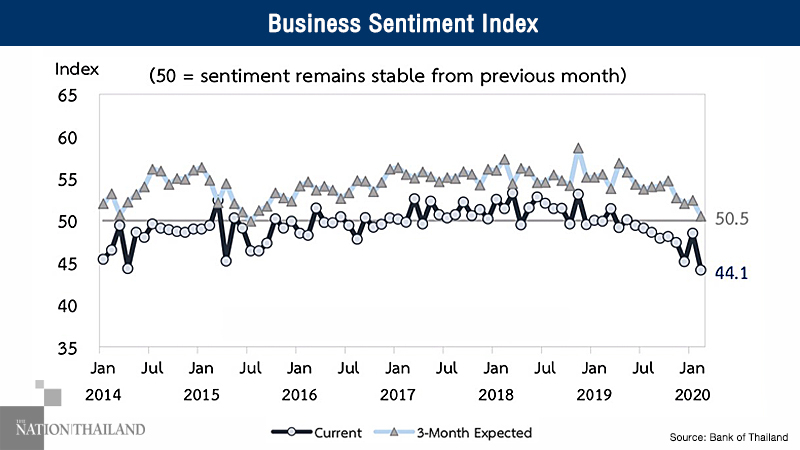
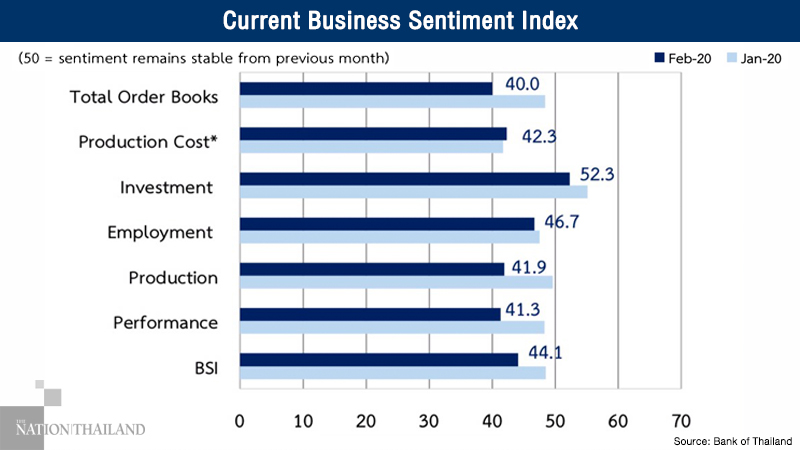
The Business Sentiment Index (BSI) significantly declined in February from 48.5 in the previous month to 44.1, the lowest level since the severe floods in 2011, the Bank of Thailand reported today (March 2).

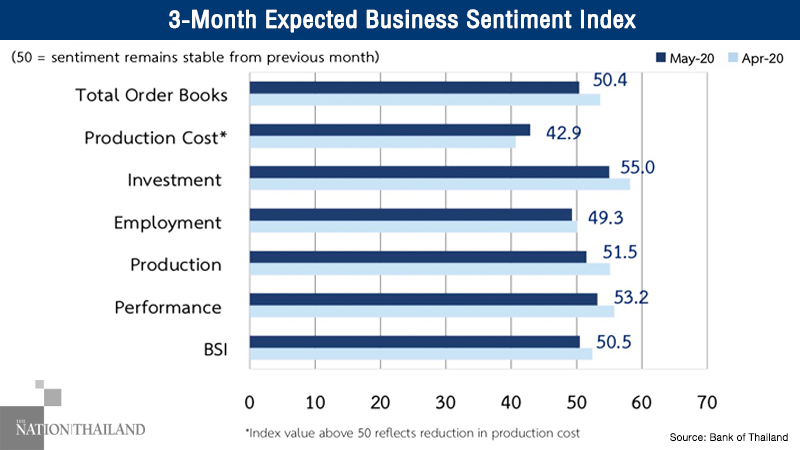
The deteriorating confidence was common among respondents in both manufacturing and non- manufacturing sectors, as well as in almost all sub-indices, especially order books, production and performance, while the three-month expected BSI decreased from the previous month to 50.5 due mainly to concern over the Covid-19 coronavirus.

The central bank said most respondents in the manufacturing sector were much less confident in their order books, production and performance, especially those in electronics and electrical appliance sectors. Their production sub-index dipped due to an insufficient inventory level of raw materials, which were primarily sourced from China. As a result, their performance sub-index also plunged.

The continuous deterioration of order books and performance sentiment resulted in an increasing number of respondents seeing worsening liquidity conditions, reflected in the liquidity sentiment index which decreased from last month and remained below the 50 threshold for five consecutive months. Nevertheless, most respondents, either from small, medium or large businesses, still received sufficient credit from financial institutions.

Meanwhile, weaker confidence in the non-manufacturing sector was mainly driven by tourism-related sectors. Both transportation and hotel and restaurant sectors showed a pessimistic view of both foreign and domestic bookings because of the Covid-19 situation. Consequently, the service volume sub-index also dropped sharply.

The transportation sector was highly concerned about the depressed state of expected bookings and the electrical appliance sectors expected foreign orders to drop. In addition, the expected automotive sector production sub-index plunged as raw material shortage was likely to get more severe if the virus situation did not improve, the central bank added.

Domestic factors such as weak purchasing power and intense competition were still among the top business constraints, which made it more difficult to adjust prices. As a result, the expected inflation in the next 12 months would be stable at 1.6 per cent.

Last week, central bank senior director Don Nakornthab warned that economic growth might experience its slowest pace this year, or could grow below 1 per cent from 2.4 per cent last year. He cited the impacts from Covid-19, the annual budget delay and severe drought. He was also concerned about labour markets as large numbers of people working in tourism-related industries were hardest hit by the decline in the number of tourists, who were concerned about the coronarvirus spreading globally.

The government has pledged to launch additional stimulus packages to shore up the economy, but the stock index has also plummeted, moving closer to its lowest level in five years.

Food business, franchising growing in Thailand #ศาสตร์เกษตรดินปุ๋ย

#ศาสตร์เกษตรดินปุ๋ย : ขอบคุณแหล่งข้อมูล : หนังสือพิมพ์ The Nation

https://www.nationthailand.com/business/30383171?utm_source=category&utm_medium=internal_referral

Food business, franchising growing in Thailand

Mar 02. 2020
By The Nation

With the Covid-19 outbreak dealing a heavy blow to the food shop and restaurant segment, SMEs and Thai entrepreneurs must create new business models to expand their client base, said Boonprasert Pupan, president of Franchise and Licence Association at the SME D Bank seminar titled ‘Deep analysis of Food business in 2020’.

In addition to improving efficiency of the food delivery service, better storefront management will help boost turnover, he said

“According to last year’s data, the delivery business was worth a total of Bt35 billion. It is growing rapidly and the popularity of food- ordering applications has led to market expansion of operators.

Boonprasert Pupan

Boonprasert Pupan

” It creates opportunities and challenges that require entrepreneurs to adjust their business plans. It also encourages the consolidation of operators within the business chain while franchise purchasing is another option favoured by SMEs, ” Boonprasert said.

He attributed the rapid rise of the franchise business to its new approach and drive for fast success by the operators. The economic value of franchise businesses in Thailand reached Bt300 billion last year with an average growth rate of 10 per cent per year. About 15,000 – 20,000 are interested in entering the franchise business. Growth in market and players will continue for both Thai and foreign franchises as competition intensifies.

The franchise business in Thailand is also popular in the world market, such as massaman curry, tom yum goong, spa and, especially Thai boxing. Foreign investors from over 130 countries have applied for licences but ” these are just business, not branding, so imitations would increase. “If Thai boxing can be a franchise business, it will be able to expand internationally save the cost of opening a new branch,” he said.

Among foreign interest in Thai franchising, food accounts for 60-70 per cent, education 20 per cent. Others are Thai spa and massages, car care business, Muay Thai, and waste recycling etc.

The franchise business in Thailand comprises 10 main categories: food, beverage, snack, education, Thai spa and massage, car care, retail, real estate, service, and logistics.

Bubble milk tea has attracted much interest recently.

Krabi aims to woo more tourists from Europe as visitor arrivals dwindle #ศาสตร์เกษตรดินปุ๋ย

#ศาสตร์เกษตรดินปุ๋ย : ขอบคุณแหล่งข้อมูล : หนังสือพิมพ์ The Nation

https://www.nationthailand.com/business/30383162?utm_source=category&utm_medium=internal_referral

Krabi aims to woo more tourists from Europe as visitor arrivals dwindle

Mar 02. 2020
By THE NATION
The Tourism Council of Krabi and related parties are discussing a plan to woo tourists from six European markets after a sharp decline in visitors to the island amid the Covid-19 outbreak.

Council president Ekawit Pinyotamanotai said that among the six targeted countries are Albania, Montenegro, Romania, and Serbia.

According to him, tour agencies in those countries have said that most tourists there are not much worried about the virus, but actually concerned about the shortage of flights to Thailand from March.

He added that the hotel sector in Krabi has been hit by the impact from the outbreak.

Krabi has enforced stringent measures to tackle the spread of the virus, screening travellers at key locations including piers.