Baht climbs out of nine-month low against US dollar #ศาสตร์เกษตรดินปุ๋ย

#ศาสตร์เกษตรดินปุ๋ย : ขอบคุณแหล่งข้อมูล : หนังสือพิมพ์ The Nation

https://www.nationthailand.com/business/30383152?utm_source=category&utm_medium=internal_referral

Baht climbs out of nine-month low against US dollar

Mar 02. 2020
By The Nation

The baht rebounded from a nine-month low, hovering at around Bt31.33 per to the US dollar in Monday (March 2) morning trade

Last week ,Kasikorn Research Centre said the baht had rebounded later in the week, having recouped losses during early to mid-week, after the Thai currency weakened in line with other regional currencies amid growing concerns about the Covid-19 outbreak outside China.

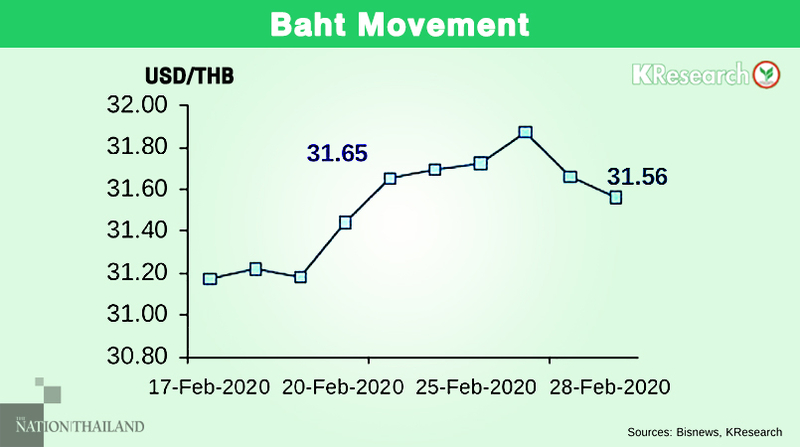
The baht also fell on net foreign selling orders for Thai stocks and bonds. The baht’s rebound was partly due to position adjustments after it hit a nine-month low of Bt31.93/dollar during the week. On Friday (February 28), the baht closed at Bt31.56/USD, versus Bt31.65/USD on February 21.

During the week of March 2-6, KBank expects the baht to move within a range of Bt31.40-31.90/USD.

Key factors to be monitored closely are the Covid-19 situation, the US economic data to be released during the week including February non-farm payrolls and ADP Employment Report, January Factory Orders and Construction Spending, plus the US Fed’s Beige Book. In addition, other factors that warrant close monitoring include Thailand’s February consumer price index, the meetings of the Malaysian and Australian monetary policy committees, plus February manufacturing and services purchase managers index of the US, China, Japan and the euro zone, added Kasikorn Research Centre.

Gig workers face the spread of the new coronavirus with no safety net #ศาสตร์เกษตรดินปุ๋ย

#ศาสตร์เกษตรดินปุ๋ย : ขอบคุณแหล่งข้อมูล : หนังสือพิมพ์ The Nation

https://www.nationthailand.com/business/30383116?utm_source=category&utm_medium=internal_referral

Gig workers face the spread of the new coronavirus with no safety net

Mar 01. 2020
File Photo/Syndication Washington Post

File Photo/Syndication Washington Post
By The Washington Post · Nitasha Tiku · NATIONAL, BUSINESS, HEALTH 

SAN FRANCISCO – Some workers here who provide on-demand rides and delivery services, but are independent contractors without many protections, are bracing for the spread of the novel coronavirus.

Drivers have been scrubbing down their cars “inch by inch” between rides at local airport parking lots, according Edan Alva, who drives full-time for Lyft in the Bay Area.

Alva said the company has not communicated with drivers yet about the novel coronavirus, despite the risk of infection. “No support, no advice, no guidance regarding what we do if we suspect any indicators of the problem,” said Alva, who added that he has been spraying his car with Lysol twice a day.

Lyft spokeswoman Alexandra LaManna said there is no indication of a unique risk to Lyft drivers and that the company is monitoring the situation.

Meanwhile, Uber sent an in-app message to U.S. drivers Friday with guidance on how to protect themselves and others, guidance that included standard advice from health officials, such as staying home if they feel sick and washing their hands frequently. Uber also urged drivers to clean and disinfect frequently touched surfaces in their vehicles.

As coronavirus spreads globally, prompting some companies to instruct employees to stop traveling or to work remotely, one of the most vulnerable groups is likely to be tens of thousands of gig workers like Alva.

“With the gig economy specifically, it’s full of low-income, independent contractors who don’t have very good health insurance,” said Alex Rosenblat, the author of “Uberland: How Algorithms Are Rewriting the Rules of Work” and research lead for the nonprofit organization Data & Society. “They’re not going to have better protections than anyone else, but they may have higher risk.”

App-using companies such as Uber, Lyft, the grocery delivery service Instacart and the food delivery service DoorDash have classified the workers who deliver meals or transport passengers as independent contractors. This classification has saved the companies the cost of providing health insurance and other benefits to the people who make their service possible. Independent contractors also do not have the right to unionize.

But as cases of the new coronavirus appear, gig workers find themselves with few health protections but with a potentially higher risk of coming into contact with infected people.

In China, food delivery drivers became heroes to residents in lockdown during the outbreak, the New York Times reported. Authorities in Wuhan eventually instituted “contactless delivery” to reduce health risks.

Coronavirus fears have prompted some U.S. drivers to reject rides at airports with Asian passengers, according to Bloomberg News. At the same time, drivers are also worried about missing income if they stop driving or cancel rides.

The disease could potentially spread more quickly if sick people go to work because they can’t afford to stay home. And it’s not just gig workers. Only 46 percent of service workers received sick-leave benefits in 2017, according to the U.S. Bureau of Labor Statistics, compared with 93 percent of workers in management, business and finance.

The health risks posed by the new coronavirus could possibly prompt policy changes as companies think about liability issues if a driver or passenger is infected, Rosenblat said. For instance, drivers have no tool to report potentially infected passengers, she said, and it is unclear whether the algorithms that match drivers and passengers are factoring in health risks.

Although Lyft cites a lack of unique risk to its drivers, “in accordance with the Centers for Disease Control’s guidance to prepare for further spread of the virus, we have established an internal task force to ensure we are prepared to take action if needed,” Lyft’s LaManna said.

Uber said it always works to help ensure the safety of everyone using its platform. “We have formed a dedicated global team of Uber operations, security and safety executives, guided by the advice of a consulting public health expert, to respond as needed in each market where we operate around the world,” said Andrew Hasbun, Uber’s head of safety communications, in a statement. “We remain in close contact with local public health organizations and will continue to follow their recommendations.”

Instacart spokeswoman Natalia Montalvo said in a statement that the company is working with local and national authorities to monitor the situation. “We’re adhering to recommendations from public health officials to ensure we’re operating safely with minimal disruption to our service, while also taking the appropriate precautionary measures to keep teams, shoppers and customers safe,” Montalvo said.

DoorDash did not immediately respond to a request for comment.

The independent-contractor classification is being challenged in California. This week, a judge in San Diego issued the first court decision under California’s new AB5 law, ruling that Instacart is likely to have misclassified grocery shoppers as contractors when they should be employees.

On Saturday, Silicon Valley Rising, a labor advocacy campaign led by the community organizing group Working Partnerships USA, urged tech companies to include contractors and gig workers in their response plans. The campaign also asked companies to provide protective equipment, healthcare coverage, sick leave, and to ensure that workers who take sick leave are not stigmatized when they return.

“Cafeteria workers, janitors, security officers, shuttle drivers, and people working in the gig economy frequently interact with large numbers of people in the course of their jobs,” Silicon Valley Rising wrote in a statement posted on Twitter. “It is critical that companies partner with workers and unions to mitigate risks and protect public health.”

Menlo Park resident Vanessa Bain, a gig worker for the grocery-delivery app Instacart, says concerns around coronavirus are part of a larger conversation about why misclassifying employees as contractors can be harmful. Not having health insurance for workers who encounter hundreds of people in the course of their regular work could be a public health risk, she says.

“We deliver to people’s homes when they’re sick all the time,” says Bain, who has also operated a grassroots campaign to win Instacart workers more rights. She is covered by MediCal, a low-cost state health insurance, but protections are limited. So Bain no longer takes orders that contain supplies like Kleenex and Sudafed.

“I can’t afford to get sick,” she says.

Lyft drivers Alva and Carlos Ramos are also labor organizers through Gig Workers Rising, a group that partners with the Teamsters union but does not take funding from the union. Both drivers say the spread of coronavirus is a real-world example of why drivers need protections such as sick days, health insurance, disability, death benefits and minimum wage.

“Right now, it’s kind of a balancing act between putting ourselves at risk and being able to keep the lights on,” Ramos said.

Alva said that when he had the flu in January, he did not go to the doctor because every visit costs him $100 until he hits his high deductible, and that amount of money is hard to come by since he lost his 10-year job as a contractor for PayPal working on global security operations, which involved analyzing risks to the company such as extreme weather patterns, political instability and fraud.

To make ends meet, Alva had to work while he was sick. He suspects that other drivers are in the same position. “If we catch it, other people are likely to catch it from us because we are not likely to go to the doctor,” he said.

Chiang Mai airport sees 40 per cent drop in passenger numbers #ศาสตร์เกษตรดินปุ๋ย

#ศาสตร์เกษตรดินปุ๋ย : ขอบคุณแหล่งข้อมูล : หนังสือพิมพ์ The Nation

https://www.nationthailand.com/business/30383083?utm_source=category&utm_medium=internal_referral

Chiang Mai airport sees 40 per cent drop in passenger numbers

Feb 29. 2020
By THE NATION

Passenger numbers at Chiang Mai International Airport are expected to plunge 40 per cent year on year to 3.5 million in the first six months of this year if the outbreak of Covid-19 drags on until the middle of the year, according to a senior airport official.

Chiang Mai airport deputy director Thananrat Prasertsri said late last week that flights to the airport during January 1 to February 25 dropped 24 per cent year on year to 190 flights and passenger numbers fell 40 per cent year on year to 22,000 daily.

Meanwhile, the airport is expanding service areas to improve its services.

In the last two years, the airport has catered to 11 million passengers against its capacity to serve 8 million per year.

Last year the airport served 220 daily flights carrying 11.34 million passengers in total.

Public, private sectors step up vigilance as Covid-19 labelled ‘a dangerous contagious disease’ #ศาสตร์เกษตรดินปุ๋ย

#ศาสตร์เกษตรดินปุ๋ย : ขอบคุณแหล่งข้อมูล : หนังสือพิมพ์ The Nation

https://www.nationthailand.com/business/30383077?utm_source=category&utm_medium=internal_referral

Public, private sectors step up vigilance as Covid-19 labelled ‘a dangerous contagious disease’

Feb 29. 2020
By THE NATION

Covid-19 has been labelled a dangerous contagious disease and will take effect on Sunday (March 1), according to a Public Health Ministry announcement in the Royal Gazette on Saturday.

The gazetted move will facilitate health officers to work more effectively in monitoring, preventing and containing the disease.

The National Communicable Disease Committee on February 24 declared this disease as a dangerous contagious disease.

Thailand had announced 13 dangerous contagious diseases in the past – plague, smallpox, Congo Haemorrhaegic Fever, West Nile Fever, Yellow Fever, Lassa Fever, Nipah virus disease, Marburg virus disease, Ebola, Hendra virus infection, Severe Acute Respiratory Syndrome (SARS), Middle Eastern Respiratory Disease (MERS), and extensively drug-resistant tuberculosis (XDR-TB).

All private and public parties in Thailand have been on alert in containing the spread of the virus. The latest measures include prohibiting staff from overseas trips and promoting conference calls for meetings instead of going to meet outsiders face to face.

For example, all agencies under the Ministry of Agriculture will cancel or postpone all overseas travel until further notice, even to countries with no or low level of infection.

In case the travel was already approved by a superior and cannot be cancelled, postponed, or the travel is of utmost importance to the department’s operation, officials must stay in quarantine for 14 days when they return to Thailand.

Banks have also stepped up preventive measures. Kasikornbank has installed thermoscan cameras at the entrances to its four main Bangkok branches – Rat Burana, Phahon Yothin, Chaeng Watthana and Silom – and at the KBTG Building, and will bar entry to anyone with body temperature of 37.5 degrees Celsius or higher.

Telecom operators have also stringently adopted measures to ensure safety of staff and customers. For instance, True Corp has stepped up hygiene measures at 580 customer service shops and True Coffee outlets nationwide in a bid to help stop the spread of the Covid-19 virus.

It is providing alcohol-based gel for washing hands and is sanitising premises on an hourly basis. All staff members dealing with customers wear protective masks.

Advanced Info Service (AIS) announced on Friday (February 28) that, in a bid to contain the spread of the Covid-19 virus, it has asked employees to forego overseas travel, whether for personal or business purposes.

The aviation industry is already feeling the pinch from the outbreak. Bangkok Airways Plc(BA) will impose stringent cost-reduction measures, including cutting the salaries of high-ranking executives in response to the global economic slowdown and the impact of the Covid-19 virus. The measures will be in effect from Sunday “until further notice”.

Thai Airways Internationalhad earlier also announced a reduction of between 15 and 25 per cent in salaries and other perks for executives, from the president down, to trim costs due to the virus outbreak. The measures will take effect from March 1 and last for six months.

Passenger numbers at Chiang Mai International Airport are expected to plunge 40 per cent year on year to 3.5 million in the first six months of this year if the outbreak of Covid-19 drags on until the middle of the year, according to Chiang Mai airport deputy director Thananrat Prasertsri.

One more Covid-19 infected person was found in Thailand on Saturday (February 29), the Ministry of Public Health told a press conference. The latest infected patient is a Thai man aged 21, who has been exposed to foreign tourists.

Trump officials discuss tax cuts, other emergency measures in hopes of tackling coronavirus fallout #ศาสตร์เกษตรดินปุ๋ย

#ศาสตร์เกษตรดินปุ๋ย : ขอบคุณแหล่งข้อมูล : หนังสือพิมพ์ The Nation

https://www.nationthailand.com/business/30383069?utm_source=category&utm_medium=internal_referral

Trump officials discuss tax cuts, other emergency measures in hopes of tackling coronavirus fallout

Feb 29. 2020
File Photo/ Syndication Washington Post

File Photo/ Syndication Washington Post
By The Washington Post · Jeff Stein, Ashley Parker · NATIONAL, BUSINESS, HEALTH, POLITICS 

WASHINGTON – Trump administration officials are holding preliminary conversations about economic responses to the coronavirus, as the stock market fell sharply again on Friday amid international fears about the outbreak, according to five people with knowledge of the planning.

Among the options being considered are pursuing a targeted tax cut package, these people said. They have also discussed whether the White House should lean even harder on the Federal Reserve to cut interest rates, though the central bank on Friday afternoon said it would step in if necessary.

No decisions at the White House have been reached on these options and officials stressed conversations remained preliminary and extremely fluid.

Vice President Mike Pence’s office is involved in the discussion of possible responses, two people said.

These ideas would not be designed to stop the spread of the coronavirus, but they would seek to arrest the economic fears spreading through the economy. And some of the ideas would need cooperation from Congress or the Fed, as the White House has limited powers to unilaterally rewrite tax policy or direct the central bank to act.

Asked about potential tax cuts options, one senior administration official said numerous ideas are being discussed and that the talks were “very preliminary.”

The people spoke on the condition of anonymity to discuss internal planning. White House officials are expected to present President Donald Trump a menu of options at a later point.

White House economic adviser Larry Kudlow, a member of the coronavirus task force assembled by the White House, told reporters Friday there were many internal meetings but that no “precipitous” actions are imminent.

“There is nothing definite I can report. There’s a lot of conversations in and out of the Oval Office,” Kudlow said when asked about a potential White House response. “I was with [Trump] the other day talking about one thing or another. We are dealing with this almost a day at a time, and we have no precipitous actions right now.”

According to a pool report, Kudlow added: “I just don’t think anybody ought to panic right now. We’re going to stay the course on our policies.”

A White House spokesman declined to comment further.

Trump has been alarmed by turbulence in global economic markets, The Washington Post reported earlier this week. On Friday, the Dow Jones industrial average opened by falling an additional 1,000 points – or nearly 4 percent – after already being repeatedly clobbered throughout the week. Some experts fear the coronavirus outbreak will lead to a prolonged economic impact, and worry that federal policymakers have limited measures to respond at their disposal.

Fed Chair Jerome Powell said in a statement Friday that the central bank will “act as appropriate” to help the U.S. economy. “The Federal Reserve is closely monitoring developments and their implications for the economic outlook,” the statement said. “We will use our tools and act as appropriate to support the economy.”

Trump has frequently attacked the Fed during his presidency, and at his news conference on coronavirus on Wednesday again maligned the central bank for not doing enough to cut interest rates. Trump can call on the Fed to lower interest rates but there is not precedent for him ordering them to do so, so his powers could be limited. Congressional lawmakers have also begun discussing a multibillion-dollar supplemental aid package to help respond to the outbreak, and those discussions are expected to continue into the weekend.

Sen. Charles Grassley, R-Iowa, chairman of the Senate Finance Committee, said there are no plans as of now to prepare a tax cut to respond to the coronavirus threat.

“At this point, the coronavirus has not had a broad impact on the U.S. economy and its effects have been limited. However, Chairman Grassley and the Senate Finance Committee stand ready to consider appropriate tax relief responses if that becomes necessary and the extent of the problem can be determined,” Michael Zona, a Grassley spokesman, said in a statement.

The options for the White House are limited. Historically, most administrations have found it difficult to instill confidence in troubled investors, and this case may present a particularly vexing challenge, said Chris Rupkey, chief financial economist at MUFG.

“They’re really stuck here in terms of trying to find a fix for the plunging stock market,” Rupkey said. “It’s very difficult to stem a panic like this has become. Everyone is just waiting for the next shoe to drop.”

As stock markets tumble because of coronavirus, this time feels different #ศาสตร์เกษตรดินปุ๋ย

#ศาสตร์เกษตรดินปุ๋ย : ขอบคุณแหล่งข้อมูล : หนังสือพิมพ์ The Nation

https://www.nationthailand.com/business/30383066?utm_source=category&utm_medium=internal_referral

As stock markets tumble because of coronavirus, this time feels different

Feb 29. 2020
Federal Reserve Chairman Jerome Powell issues an unusual statement vowing to

Federal Reserve Chairman Jerome Powell issues an unusual statement vowing to “act as appropriate” to defend the U.S. economy from the outbreak.
By The Washington Post · David J. Lynch · BUSINESS, PERSONAL-FINANCE, US-GLOBAL-MARKETS

The stock market fell for the seventh straight day Friday, with the Dow Jones industrial average losing 357 points, or 1.4 percent, to close at 25,409. Only by staging a late rally in the final 15 minutes of trading was the Dow able to avert its third daily loss this week of more than 1,000 points.

The sustained selloff, driven by fears of global economic damage from the spreading coronavirus, prompted both the Federal Reserve and the White House to hunt for possible remedies, eyeing tools they have used during past crises to calm the public.

The traditional tactics, however, may not work against a financial panic driven by a global health scare that lacks precedent or antidote.

A sign of the crisis-fighting difficulties ahead came in the afternoon, when Federal Reserve Chairman Jerome Powell issued an unusual statement vowing to “act as appropriate” to defend the U.S. economy from the outbreak. Many analysts interpreted the statement as a pledge to cut interest rates, a signal that often heartens investors. But this time, the selloff continued.

After a week that shaved more than $4 trillion from global stock values, Powell’s effort was among a series of steps meant to reassure frazzled investors. Nothing, so far, appears to be working.

“The fundamentals of the U.S. economy remain strong,” Powell said. “However, the coronavirus poses evolving risks to economic activity. The Federal Reserve is closely monitoring developments and their implications for the economic outlook. We will use our tools and act as appropriate to support the economy.”

Evercore ISI, an investment firm, told clients Friday that it now expects the Fed to cut rates by a half-percentage point at its mid-March meeting, something few expected just one week ago.

Meanwhile, White House officials held meetings of their own Friday, considering potential tax cut packages that they hope might boost consumer confidence. This comes after several days of unsuccessful efforts by President Donald Trump and his economic team to cajole people to buy stocks and drive prices higher.


The Fed and White House deliberations illustrate how policymakers are searching for ways to arrest the sudden selloff, which some analysts say raises the possibility of a recession later this year.

Typically, the Fed responds to economic trouble by lowering interest rates to make credit easier to obtain. It also can offer loans to banks or buy large quantities of U.S. Treasury securities,effectively adding money to the financial system and making it easier for some corporate borrowers to get cash. The White House and Congress, meanwhile, can approve new spending or tax cuts to flood the economy with money.

But the best remedy for the coronavirus – which has sickened more than 83,000 people worldwide and killed nearly 3,000 – could lie beyond Washington’s immediate powers.

“Central banks don’t make vaccines,” said David Kotok, chairman of Cumberland Advisors.

The renewed selling intensified calls for the Fed to rescue the economy from an unforeseen shock. The medical emergency already has disrupted global production networks, curtailed air travel and hobbled economies in Asia, Europe and the Middle East. With medical experts urging Americans to prepare for serious disruptions in their daily lives, pleas for early action are coming from Wall Street and some former members of the Fed’s rate-setting committee.

“The Fed can’t fix broken supply chains or calm concerns about health and safety. But the Fed can ensure that liquidity conditions remain supportive, so firms can get funding through the disruption. It can also provide support to financial markets,” said Nathan Sheets, chief economist for PGIM Fixed Income. “More generally, the message that the Fed is attentive and ‘on the case’ has tended to help soothe the economy and the markets during past episodes.”

By Friday, surveys of investors showed there was a nearly unanimous belief that the Fed would cut rates by at least a quarter-percentage-point at its March 17-18 meeting. That represents a sharp and sudden change from one week ago, when just 11 percent expected Fed action, according to the CME Group.

The shift comes as Capital Economics told clients that the continued spread of the disease in the United States, which has seen roughly 60 cases so far, “could be enough to tip the economy into a mild recession.”

It’s uncertain, though, how effective cutting interest rates might be. Economists call episodes like the epidemic or the Sept. 11, 2001, terrorist attacks an “exogenous shock,” meaning an unpredictable development that arises from outside the economy or financial system yet has significant economic consequences.

The Fed normally acts only after assessing voluminous data on business and consumer activity, using sophisticated computer models that forecast the future by comparing current conditions to what’s happened in the past. There is no recent precedent for the coronavirus outbreak for the Fed to use in its models.

Recessions can occur after the Fed has begun raising interest rates to head off incipient inflation, or after warning signs such as widespread layoffs or falling equipment orders. As the economy gradually deteriorates, the Fed can cut rates to encourage more spending. The White House and lawmakers, meanwhile, often support more spending or tax cuts to boost the economy.

The coronavirus, which first emerged in China and has now spread to countries including South Korea, Japan, Italy, Iran, Brazil and the United States, poses a unique challenge. In this case, the virus materialized with no warning and, after initially appearing to be confined to China, swept into roughly 60 countries.

Trump, who has been criticized for a delayed and uncertain response to the crisis, so far has given no hint of plans for any economic stimulus, but his aides are looking at a range of options.

China stands as a cautionary tale. The Chinese government’s aggressive measures to fight the crisis, which included imposing quarantines over an area that is home to perhaps 60 million people, chilled both supply and demand.

China’s virus-fighting campaign prevented employees from leaving their homes and working on assembly lines, thus depressing the supply of goods. And it kept people from patronizing restaurants, movies or retail stores, thereby cutting demand.

If the United States suffers a serious outbreak and people stay home, fearing possible contagion, cutting interest rates would probably do little to persuade them to return to work or go out to shop or dine. “This is a very tough one for the Fed to deal with,” said Dean Baker, senior economist at the Center for Economic and Policy Research.

The Fed has a long history of fighting financial and economic downturns, including the 1987 stock market plunge known as Black Monday and the Russian debt default more than a decade later. In 2008, after the collapse of the housing bubble, the Fed dropped interest rates to zero and held them there for years in a bid to resuscitate the U.S. economy.

The Fed moved quickly in the wake of the Sept. 11, 2001, terrorist attacks to try and limit the economic fallout. Six days later, with financial markets closed and smoke still curling from the World Trade Center rubble, then-Fed Chairman Alan Greenspan cut the benchmark U.S. lending rate by half a percentage point. The central bank also pumped $102 billion into the financial system to grease the gears of the economy and ease an anticipated slowdown, according to a subsequent study by the Federal Reserve Bank of St. Louis.

Until Friday, Fed officials had been cautious in their public comments. Richard Clarida, the Fed’s vice chairman, said earlier this week that the upheaval in China could reverberate through the global economy. “But it is still too soon to even speculate about either the size or the persistence of these effects, or whether they will lead to a material change in the outlook,” he said in a speech to an economists conference in Washington.

For the past three years, the Fed has helped investors shrug off Trump’s serial trade wars, cutting interest rates three times last year as inflation remained low.

Between Election Day in 2016 and Feb. 12 of this year, the Dow Jones industrial average rose by 61 percent. In four days this week, it surrendered one-third of that gain as investors puzzled over what the virus will mean for corporate earnings.

By itself, this week’s historic stock market meltdown – erasing nearly two years’ worth of gains and incurring the fastest 10-plus-percent drop in history – highlights the current peril.

Economists are struggling to assess the extent of the calamity amid conflicting information about the virulence of the illness, the likely public reaction if it spreads in the United States, and the potential response from the Fed or the Trump administration. To some, the profound uncertainty recalls the financial crash that hit the United States and Europe more than a decade ago.

“Forecasting in this environment feels eerily reminiscent of the crises – the ground keeps shifting beneath me as I try to gain my footing,” Diane Swonk, chief economist at Grant Thornton, tweeted Thursday.

The cloudy outlook shows no signs of clearing anytime soon. On Friday, Fitch Solutions, a risk analysis firm, said it was revising down its forecasts for several European economies, including Germany, after already having lowered its Asian estimates.

One day earlier, Fitch said South Korea would grow by just 1.7 percent this year, down from its 2.2 percent original forecast. And that estimate could go lower, the firm said, citing the risk that “the outbreak will not be controlled by June.”

Americans are canceling their domestic travel over coronavirus fears #ศาสตร์เกษตรดินปุ๋ย

#ศาสตร์เกษตรดินปุ๋ย : ขอบคุณแหล่งข้อมูล : หนังสือพิมพ์ The Nation

https://www.nationthailand.com/business/30383064?utm_source=category&utm_medium=internal_referral

Americans are canceling their domestic travel over coronavirus fears

Feb 29. 2020
File Photo/ Syndication Washington Post, Bloomberg

File Photo/ Syndication Washington Post, Bloomberg
By The Washington Post · Abha Bhattarai · NATIONAL, BUSINESS, FEATURES, HEALTH, TRAVEL

Major companies are beginning to cancel conferences and travel plans within the United States due to the coronavirus, which analysts warn will have cascading impacts on the country’s hotels, airlines and convention centers.

International travel – particularly to Asia – has so far been the hardest hit part of the industry, though analysts say that could soon change as fears of the coronavirus spread to Europe and North America. Hotels around the country have begun reporting a rise in group cancellations. Airlines, meanwhile, are doing away with cancellation fees as jittery travelers rethink their plans.

“The cancellations are starting to move toward North America,” said Scott Solombrino, executive director of the Global Business Travel Association, which estimates that the slowdown in global travel has already cost American businesses $7 billion this year. “Obviously the concern is that this will have a long-term impact on the U.S. economy.”

Analysts said wide-scale cancellations – which so far have been concentrated in large cities such as New York, Washington and Los Angeles – are starting to hit smaller U.S. cities, as companies change their internal travel policies.

Workday called off a sales conference in Orlando, Florida, next week, while Facebook is canceling its F8 developer conference scheduled for early May in San Jose, California. Amazon this week told employees to put off “nonessential travel” in the United States, though it did not offer details on what types of trips would qualify. (Jeff Bezos, the founder and chief executive of Amazon, owns The Washington Post.)

Mounting cancellations, analysts said, are likely to have ripple effects throughout the economy, particularly for upscale hotels that rely on group bookings for about one-third of their sales, according to Jan Freitag, senior vice president of lodging insights for STR, a hospitality research firm.

“The most noticeable impact so far has been in group travel, with large conferences around the world being canceled,” he said. “These large group conferences take years and years to plan. If they don’t happen now, there is a good chance they won’t happen at all.”

Executives at Marriott International, the world’s largest hotel chain, said this week that group bookings in the United States have started to take a hit. The Bethesda, Maryland-based hospitality giant said much of the impact so far has been concentrated in Asia, where it has 800 hotels.

“To date, we have not yet seen a significant impact in the U.S., and our first quarter is off to a solid start, but the situation is fluid,” Leeny Oberg, Marriott’s chief financial officer, told CNBC on Wednesday. “We have seen a handful of citywide cancellations.”

Booking Holdings, which owns Priceline, Booking.com and Kayak, said this week that it expects hotel room bookings to fell as much as 10 percent this quarter because of the coronavirus.

Shares of hotel companies and airlines plunged this week, as coronavirus-related fears led global markets to post their worst weekly losses since the Great Recession. Shares of Marriott and InterContinental Hotels Group fell about 9 percent apiece, while American Airlines and Jet Blue posted declines of more than 20 percent. Expedia Group, meanwhile, posted a 13 percent drop in share price.

“Every day we think we could be near a bottom, and every day we are not,” Helane Becker, an airline industry analyst for Cowen, wrote in a note to clients this week. “The virus has spread, and the question is how much do people change their travel plans.”

Hosteling International USA, which oversees nearly 50 properties around the country, said group cancellations are on the rise. Individual travelers, though, are “so far going strong,” spokeswoman Netanya Trimboli said.

The company is taking extra precautions by training employees on how to properly clean surfaces and encouraging them to stay home if they feel sick. New signs at its hostels remind guests to wash their hands and cough into their elbows.

Other hotels also report stalling demand, as Americans put off travel plans. But analysts say the largest impact on the hospitality market could come from a slowdown of Chinese visitors, who last year contributed $34 billion to the U.S. economy, according to Philadelphia-based Tourism Economics. Chinese visitors typically spend about $6,000 and spend an average of 15 nights in a hotel while in the United States, the firm said. It expects the number of Chinese travelers to the United States to drop by 25 percent this year.

“Right now there’s a lot of uncertainty,” said Adam Sacks, president of Tourism Economics. “It’s shaping up to be very similar to SARS, when we saw very severe impacts.”

This time, he said, could be worse: Visits from China to the U.S. have grown nearly 13-fold since 2002, making a possible coronavirus outbreak much more devastating to the U.S. economy than the SARS epidemic was in 2003.

“Reservations are at a standstill,” said Kim Lee, who handles sales at Arc The.Hotel, a boutique property in a Washington, District of Columbia, neighborhood, where multiple groups have canceled reservations in recent weeks. “We’ve seen a real decline.”

Brutal week in global credit markets may just mark the beginning #ศาสตร์เกษตรดินปุ๋ย

#ศาสตร์เกษตรดินปุ๋ย : ขอบคุณแหล่งข้อมูล : หนังสือพิมพ์ The Nation

https://www.nationthailand.com/business/30383059?utm_source=category&utm_medium=internal_referral

Brutal week in global credit markets may just mark the beginning

Feb 29. 2020
By Syndication Washington Post, Bloomberg · Claire Boston, Tasos Vossos, Priscila Azevedo Rocha · BUSINESS, US-GLOBAL-MARKETS 

Fears about the coronavirus hammered credit markets across the globe this week and shut out almost all borrowers looking for fresh cash in the U.S. and Europe.

There’s plenty of hope but few signs that next week will be any better.

Wall Street debt bankers sat idle for a fifth straight day as corporate borrowers waited out the global market volatility. Bausch Health Cos. delayed an $8 billion debt refinancing, and other junk-rated companies in the U.S. and Europe pulled offerings that had been announced before the sell-off.

With the World Health Organization raising the global risk of the coronavirus to “very high”, fear of global economic fallout sent risk premiums surging. For U.S. investment-grade bonds, yields relative to Treasuries jumped 17 basis points, putting them on pace for the biggest weekly increase since 2011. Euro high-grade spreads widened the most since March 2015, while Asian dollar bonds were on track for the worst week since 2014.

The credit-market stall has left investor cash piling up and corporate borrowers ready to tap into yields that — even after the selloff — remain well below historical averages. The outlook has become so uncertain that a Bloomberg survey of Wall Street bond dealers suggested they expected either another week of zero issuance or a deluge of as much as $50 billion in sales.

“At some point you have got to buy this,” said Andrew Feltus, a money manager at Amundi Pioneer Asset Management in Boston. “It is either the end of the world or everything has been put on sale pretty aggressively.”

Many investors are bracing for rocky months ahead as they price in the potential for a significant blow to the global economy from a virus that continued to spread. It also comes at a time when companies, particularly in Europe, are usually readying for a March bond-sale deluge.

“Fear is spreading faster than the virus,” said Gordon Shannon, a London-based portfolio manager at TwentyFour Asset Management, which oversees 17.4 billion pounds ($22 billion). “Spread levels can go a lot wider.”

European bankers are estimating just 10 billion euros ($11 billion) of new corporate and sovereign debt may come next week, according to a Bloomberg survey. That’s far cry from an average of 46 billion euros a week to start the year.

The turmoil put an increasing number of planned junk-bond sales on ice. Fugro, a geological data provider pulled a planned 500 million euro bond sale Friday, citing market conditions. Minimax Viking and NorthRiver Midstream both yanked U.S. loan offerings earlier in the week.

Bausch, the drugmaker once known as Valeant Pharmaceuticals, put the brakes on a $5.14 billion loan it had been marketing and a $3.25 billion bond offering that was originally expected to be announced this week, according to people familiar with the matter who asked not to be identified because they’re not authorized to speak publicly.

“Primary will be quiet for a while — I doubt issuers will come to the market until risk sentiment stabilizes,” said Tim Winstone, a portfolio manager at Janus Henderson Group Plc.

The U.S. investment-grade company bond market faces its first week without a sale since July 2018, a rarity outside of summer lulls and holiday shutdowns. Europe has only seen two company deals this week totaling less than 1 billion euros. That compares with 20 billion euros of issuance from financial and non-financial companies in the equivalent week last year, according to data compiled by Bloomberg.

Still, if issuers do bring forward deals, they may find willing buyers. This week’s limited number of syndicated bond sales in Europe all found reasonable demand. Global bond funds had a 60th week of net inflows, with investment-grade funds pulling in $11.8 billion, according to a Bank of America note, citing EPFR Global data.

Investors in the U.S. felt more jittery. They pulled $283.5 million from the biggest leveraged loan exchange-traded fund, the most on record. Funds that buy up U.S. high-yield bonds saw their worst weekly outflow since 2018, according to data compiled by Refinitiv Lipper.

“Certain issuers and tenors can still work in this type of market with a bit of new-issue premium,” said Tom Moulds, a senior portfolio manager at BlueBay Asset Management. “I think next week you will certainly see some issuers trying to come to the market.”

Investors have been avoiding riskier debt. Funds that buy U.S. high-yield bonds saw their worst weekly outflow since 2018, according to data compiled by Refinitiv Lipper. And funds that buy leveraged loans had withdrawals of $952 million in the week ended Feb. 26.

Week of Turmoil

In Asia, where companies have continued to issue debt, spreads on Asian dollar bonds widened 5 to 10 basis points Friday, according to traders, as a sell-off that started last week intensified. JPMorgan Private bank advised clients to take profit on borrowers with weaker structures and longer duration, according to Anne Zhang, the firm’s head of Asia fixed income.

“The markets are in a state of panic,” said Ek Pon Tay, portfolio manager for emerging-market fixed income at BNP Paribas Asset Management.

Global markets, Wall Street drag out week-long free fall as coronavirus crisis worsens #ศาสตร์เกษตรดินปุ๋ย

#ศาสตร์เกษตรดินปุ๋ย : ขอบคุณแหล่งข้อมูล : หนังสือพิมพ์ The Nation

https://www.nationthailand.com/business/30383050?utm_source=category&utm_medium=internal_referral

Global markets, Wall Street drag out week-long free fall as coronavirus crisis worsens

Feb 29. 2020
By The Washington Post · Thomas Heath, Rachel Siegel · BUSINESS, US-GLOBAL-MARKETS

Coronavirus panic tightened its grip on global markets Friday as the escalating outbreak drove stocks to their worst weekly loss since the 2008 financial crisis and prompted the Federal Reserve to take the unusual step of issuing a statement to reassure Americans.

The Dow Jones industrial average plunged 1,000 points in the morning, swinging widely throughout the session. It closed down 357 points, or 1.4 percent. The Standard & Poor’s 500 index shed 0.8 percent while the Nasdaq rallied to end flat.

The 10-year Treasury yield, a key marker in global finance, also hit a record low Friday, a sign that investors are fleeing equities for the safety of bonds. The Cboe Volatility Index, known as the VIX, surged to its highest level since the Great Recession, signalling to investors that more volatility is ahead.

Friday’s finish capped a blistering week on Wall Street. All three major U.S. indexes finished in correction, which signals a 10 percent reversal from recent highs and heightens investor worries of a runaway slide. The Dow and the S&P 500 had their worst weeks since the financial crisis, according to S&P Dow Jones indices.

The Dow plunged 12 percent for the week. with American Express and Boeing among the biggest losers, shedding 20 percent and 17 percent, respectively. The S&P 500 lost 11.5 percent over the five days, while Nasdaq fell 10 percent.

All 11 S&P 500 stock market sectors are in a correction, which means that equity investors have no place to hide from the carnage. Energy and technology were among the worst hit.

Since Feb. 19, U.S. stocks have lost nearly $3.6 trillion in value.

As stocks nose-dived this week, calls have grown from prominent investors for the Federal Reserve to cut interest rates, a move that usually calms markets. Wall Street traders are now betting on at least three rate cuts this year, including one rate reduction when the Fed meets next on March 18. Interest rates are currently just below 1.75 percent, a low level by historical standards, but higher than the rates in many other parts of the world.

Fed Chair Jerome Powell gave no hints about a possible rate cut but said the Fed would take action if the economy takes a hit from the coronavirus.

“The fundamentals of the U.S. economy remain strong. However, the coronavirus poses evolving risks to economic activity,” Powell said. “The Fed is closely monitoring developments and their implications for the economic outlook. We will use our tools and act as appropriate to support the economy.”

Some investors were glad to see the end of February after the stomach-churning slides of the past several days.

“Investors had a love-hate relationship with risk in the month of February,” said Kristina Hooper, chief market strategist at Invesco. “The first several weeks of the month saw investors embracing stocks. Then as worries grew about the coronavirus outbreak, market participants spent the past six trading days in panic mode. I suspect it will take reassurances from the Fed to stabilize markets.”

Global markets also took a beating. In Japan, the Nikkei tumbled 3.7 percent as officials declared a state of emergency in the northern island of Hokkaido and doubts were cast about this summer’s Tokyo Olympics. Hong Kong’s Hang Seng dived 2.5 percent, and the Shanghai composite skidded 3.7 percent.

European markets were in the same boat, into correction for the week.


The travel sector was slammed: British Airways owner IAG tumbled more than 9 percent after it said it would cancel some flights to coronavirus-hit countries such as Italy and South Korea.

Oil prices took a dive as the global futures market broke below $50 per barrel, a closely watched number that signals whether oil companies and oil producing countries can make profits. West Texas Intermediate, the U.S. oil gauge, was selling below $45 per barrel. Brent Crude prices were just under $50. The energy sector was down 20 percent on the week and nearly 25 percent on the year. “Energy is the main killer,” said Howard Silverblatt of S&P Dow Jones indices. “It’s devastating.”

Oil suppliers are hoping for a boost in demand from possible supply cuts at a March 5-6 meeting by the Organization of the Petroleum Exporting Countries (OPEC) and allies like Russia, a group known as OPEC+.

Experts said the panic caused by the coronavirus needs to play itself out. There are many unknowns, they said.

“The lights went out on the stock market in February,” said Chris Rupkey of MUFG Bank. “Wall Street can panic, but until main street panics, we are not going to get a recession. If the broader economy doesn’t take a hit, companies don’t lay off people and consumers don’t stop buying homes and cars, then this sell-off is too far ahead of itself.”

The outbreak has upended daily routines and business operations around the world. Next week’s Geneva Motor Show, a major event for the world’s struggling auto industry, was canceled as Swiss officials said gatherings of more than 1,000 people had been banned through mid-March. The Port of Baltimore reduced its hours of operation after port officials said the coronavirus’ posed “significant and unprecedented” disruptions to the global supply chain.

“If the virus spreads quite a bit, the market will work through a bad quarter or two of bad economic activity,” said Scott Wren of Wells Fargo Investment Institute. “It’s all about whether people are going to be out there spending or if they are going to be home hiding.”

This week’s swift Wall Street sell-off erased one-third of stocks’ gains since President Donald Trump’s 2016 election. And while public health officials scramble to contain what appears to be inevitable spread in the United States, the government finds itself battling an economic emergency that could threaten the nation’s record economic expansion.

Jared Bernstein, a senior fellow at the left-leaning Center On Budget and Policy Priorities, said the stock market’s decline was not a concern for a big chunk of the population.

“Such a sharp market correction is, of course, a big deal,” Bernstein said. “For the half of households who don’t own stocks, what matters much more is the economic impact of the virus on their jobs and incomes. There are millions of workers who don’t get paid if they can’t go to work.”

Markets wrap: Virus fear drops stocks to four-month low; bonds jump #ศาสตร์เกษตรดินปุ๋ย

#ศาสตร์เกษตรดินปุ๋ย : ขอบคุณแหล่งข้อมูล : หนังสือพิมพ์ The Nation

https://www.nationthailand.com/business/30383048?utm_source=category&utm_medium=internal_referral

Markets wrap: Virus fear drops stocks to four-month low; bonds jump

Feb 29. 2020
File Photo/ Getty Images

File Photo/ Getty Images
By Syndication Washington Post, Bloomberg · Jeremy Herron, Vildana Hajric · BUSINESS, PERSONAL-FINANCE

Fear over the economic fallout from the spreading coronavirus continued to rattle global markets, sending U.S. equities to a seventh straight loss and sparking demand for safe assets from Treasuries to the yen.

The S&P 500 fell 0.8% Friday, rallying back in the final 15 minutes of trading from losses that topped 3%. The index is mired in its longest slide since 2016 and plunged 11% in the five days for the worst week since October 2008. The Dow Jones Industrial Average sank to the lowest since June. The Cboe Volatility index hit the highest in two years. The Nasdaq indexes ended higher.

Treasury yields plunged to all-time lows, with the two-year sinking 15 basis points to 0.90%. Crude hit $45 a barrel, while gold tumbled the most intraday since June 2013. European shares sank to the lowest since August.

Battered bulls got a boost when Federal Reserve Chairman Jerome Powell said the central bank is monitoring the virus and will act as appropriate, adding that the “fundamentals of the economy remain strong.” Bank of America strategists now expect the Fed to cut rates by 50 basis points at its March meeting. White House Economic Adivser Larry Kudlow suggested investors “buy the dip.”

Banks led the sell-off, with JPMorgan sinking 4%, as travel restrictions took hold and trading floors scrambled for contingency plans if offices are required to close. Airlines tumbled after Lufthansa curbed short-haul flights and United pared back travel in Asia.

U.S. equity markets shuddered as the World Health Organization raised its global risk level for the virus and a White House official suggested some schools could close. More major companies warned that disruptions could upend sales and profit forecasts. Germany said it will intensify border checks and Switzerland banned large events, leading to the Geneva car show being canceled. Iran and South Korea revealed more infections while the first cases appeared in Mexico and Nigeria, Africa’s most populous country.

“Investors are selling stocks first and asking questions later,” Keith Lerner, SunTrust’s chief market strategist, wrote in a note. “We are seeing signs of pure liquidation. ‘Get me out at any cost’ seems to be the prevailing mood. There is little doubt the coronavirus will continue to weigh on the global economy, and the U.S. will not be immune. There is much we do not know. However, it is also premature to suggest the base case for the U.S. economy is recession.”

Downgrades to the global outlook keep rolling in and money markets now see three Federal Reserve interest-rate cuts this year. Bank of America predicted that the global economy will see its weakest year since the financial crisis as the virus damages demand in China and beyond.

“Asset prices diverged significantly from growth in the past year, in part because of central bank policy, but also because passive investment’s main signal is price action,” reckons James McCormick, global head of desk strategy at NatWest Markets. “The COVID-19 escalation runs a real risk of virtuous cycle turning to a vicious one. Either way, given where growth estimates are heading for the next few months, I’d expect more downside.”

These are the main moves in markets:

– – –

– The S&P 500 index fell 0.8% as of 4 p.m. New York time.

– The Nasdaq 100 index rose 0.3%.

– The Dow slid 1.4%.

– The Stoxx Europe 600 index decreased 3.5%.

– Germany’s DAX index slid 3.9%.

– The MSCI Asia Pacific index dropped 2.6%.

– – –

– The Bloomberg Dollar Spot index rose 0.2%.

– The euro fell less than 0.1% to $1.10.

– The British pound dipped 1% to $1.2760.

– The Japanese yen strengthened 1.28% to 108.20 per dollar.

– – –

– The yield on 10-year Treasuries declined nine basis points to 1.17%.

– The yield on two-year Treasuries decreased 13 basis points to 0.93%.

– Germany’s 10-year yield decreased five basis points to -0.60%.

– – –

– West Texas Intermediate crude sank 5% to $44.73 a barrel.

– Gold futures decreased 3.4% to $1,586 an ounce.

– Bloomberg’s commodity index sank 2%.