As stock markets tumble because of coronavirus, this time feels different #ศาสตร์เกษตรดินปุ๋ย

#ศาสตร์เกษตรดินปุ๋ย : ขอบคุณแหล่งข้อมูล : หนังสือพิมพ์ The Nation

https://www.nationthailand.com/business/30383046?utm_source=category&utm_medium=internal_referral

As stock markets tumble because of coronavirus, this time feels different

Feb 28. 2020
By The Washington Post · David J. Lynch

The coronavirus panic that sent stock markets tumbling this week has triggered calls for the federal government to intervene, relying on traditional playbooks that the Federal Reserve, Congress and the White House have used in numerous previous crises.

This time, though, the usual approach might not work.

Typically, the Fed responds to economic trouble by lowering interest rates to make credit easier to obtain. It also can offer loans to banks via the “discount window” or buy large quantities of U.S. Treasury securities to offset any general tightening in financial conditions. Congress, meanwhile, can approve new spending or tax cuts to flood the economy with money.

But the best remedy for the coronavirus – which has sickened more than 83,000 people worldwide and killed nearly 3,000 – could lie beyond Washington’s immediate powers.

“Central banks don’t make vaccines,” said David Kotok, chairman of Cumberland Advisors.

The stock market plunged again on Friday, with the Dow Jones Industrial Average sinking an additional 1,000 points or nearly 4% on top of its week-long decline.

The renewed selling intensified calls for the Fed to rescue the economy from an unforeseen shock. The medical emergency already has disrupted global production networks, curtailed air travel and hobbled economies in Asia, Europe and the Middle East. With medical experts urging Americans to prepare for serious disruptions in their daily lives, pleas for early action are coming from Wall Street and some former members of the Fed’s rate-setting committee.

“The Fed can’t fix broken supply chains or calm concerns about health and safety. But the Fed can ensure that liquidity conditions remain supportive, so firms can get funding through the disruption. It can also provide support to financial markets,” said Nathan Sheets, chief economist for PGIM Fixed Income. “More generally, the message that the Fed is attentive and ‘on the case’ has tended to help soothe the economy and the markets during past episodes.”

On Friday, investors were pricing in a 100% likelihood that the Fed will cut rates by at least a quarter percentage point at its March 18 meeting. That represented a sharp and sudden change from one week ago, when just 11% expected Fed action, according to the CME Group.

But this time, the Fed’s classic crisis-fighting tools may not be as effective. Economists call episodes like the epidemic or the Sept. 11, 2001, terrorist attacks an “exogenous shock,” meaning an unpredictable development that arises from outside the economy or financial system yet has significant economic consequences.

The Fed normally acts only after assessing voluminous data on business and consumer activity, using sophisticated computer models that forecast the future by comparing current conditions to what’s happened in the past.

Recessions typically occur after the Fed has begun raising interest rates to head off incipient inflation or after warning signs such as widespread layoffs or falling equipment orders. Likewise, as the economy gradually deteriorates, officials in the White House or on Capitol Hill can make plans to ramp up government spending or to cut taxes.

The coronavirus, which first emerged in China and has now spread to countries including South Korea, Japan, Italy, Iran, Brazil and the United States, poses a unique challenge. In this case, the virus emerged with no warning and, after initially appearing to be confined to China, swept multiple countries – with perhaps more to follow.

President Trump, who has been criticized for a delayed and uncertain response to the crisis, so far has given no hint of plans for any economic stimulus.

China stands as a cautionary tale. The Chinese government’s aggressive measures to fight the crisis, which included imposing quarantines over an area that is home to perhaps 60 million people, chilled both supply and demand.

China’s virus-fighting campaign prevented employees from leaving their homes and working on assembly lines, thus depressing the supply of goods. And it kept people from patronizing restaurants, movies or retail stores, thereby cutting demand.

If the United States suffers a serious outbreak and people stay home fearing possible contagion, cutting interest rates would probably do little to convince them to return to work or go out to shop or dine. “This is a very tough one for the Fed to deal with,” said Dean Baker, senior economist at the Center for Economic and Policy Research.

The Fed has a long history of fighting financial and economic downturns, including the 1987 stock market plunge known as Black Monday and the Russian debt default more than a decade later. In 2008, following the collapse of the housing bubble, the Fed dropped interest rates to zero and held them there for years in a bid to resuscitate the U.S. economy.

The Fed moved quickly in the wake of 9/11 to make sure that the casualties did not include the U.S. economy.

Six days later, with financial markets closed and smoke still curling from the World Trade Center rubble, then-Fed chairman Alan Greenspan cut the benchmark U.S. lending rate by half a percentage point. The central bank also pumped $102 billion into the financial system to grease the gears of the economy and ease an anticipated slowdown, according to a subsequent study by the Federal Reserve Bank of St. Louis.

In the case of the coronavirus, Fed officials have been cautious thus far in their public comments. Richard Clarida, the Fed’s vice chairman, said earlier this week that the upheaval in China could reverberate through the global economy. “But it is still too soon to even speculate about either the size or the persistence of these effects, or whether they will lead to a material change in the outlook,” he said in a speech to an economists conference in Washington.

For the past three years, the Fed has helped investors shrug off Trump’s serial trade wars; his verbal attacks on companies such as Harley-Davidson, Boeing and Amazon; and even his impeachment by House Democrats. (Jeff Bezos, Amazon’s owner, owns The Washington Post.) The Fed cut interest rates three times last year and was expected to stand pat this year.

Between Election Day in 2016 and Feb. 12 of this year, the Dow Jones industrial average rose by 61%. In four days this week, it surrendered one-third of that gain as investors puzzled over what the virus will mean for corporate earnings.

By itself, this week’s historic stock market meltdown – erasing nearly two years’ worth of gains and incurring the fastest 10-plus-percent drop in history – highlights the current peril.

Economists are struggling to assess the extent of the calamity amid conflicting information about the virulence of the illness, the likely public reaction if it spreads in the United States, and the potential response from the Fed or the Trump administration. To some, the profound uncertainty recalls the financial crash that hit the United States and Europe more than a decade ago.

“Forecasting in this environment feels eerily reminiscent of the crises – the ground keeps shifting beneath me as I try to gain my footing,” Diane Swonk, chief economist at Grant Thornton, tweeted on Thursday.

The cloudy outlook shows no signs of clearing any time soon. On Friday, Fitch Solutions, a country risk analysis firm, said it was revising down its forecasts for several European economies, including Germany, after already having lowered its Asian estimates.

One day earlier, Fitch said South Korea would grow by just 1.7% growth this year, down from its 2.2% original forecast. And that estimate could go lower, the firm said, citing the risk that “the outbreak will not be controlled by June.”

U.S. stock rout deepens, bonds rally on virus fear #ศาสตร์เกษตรดินปุ๋ย

#ศาสตร์เกษตรดินปุ๋ย : ขอบคุณแหล่งข้อมูล : หนังสือพิมพ์ The Nation

https://www.nationthailand.com/business/30383045?utm_source=category&utm_medium=internal_referral

U.S. stock rout deepens, bonds rally on virus fear

Feb 28. 2020
By Syndication The Washington Post, Bloomberg · Vildana Hajric, Jeremy Herron 

Fear over the economic fallout from the spreading coronavirus tightened its grip on global markets, sending U.S. equities to a seventh straight loss and sparking demand for safe assets from Treasuries to the yen.

The S&P 500 plunged more than 2.5% Friday and is now down 14% from its record. The index is mired in its longest slump in over three years and careening toward its worst week since the financial crisis. Treasury yields sank to all-time lows, with the two-year tumbling through 1% and 30-year rates under 1.7%. Crude slid toward $45 a barrel, while gold lost 1%. European shares headed for August lows and Asian equites fell more than 3%.

The sell-off picked up steam after a White House official suggested the virus could force some schools to close and more companies warned that disruptions could upend sales and profit forecasts. Germany quarantined about 1,000 people and Switzerland banned large events, leading to the Geneva car show being canceled. Iran and South Korea revealed more infections while the first cases appeared in Mexico and Nigeria, Africa’s most populous country.

That’s all put shares worldwide on course for the worst week since the 2008 crisis, down around 10%. With the likes of Citigroup saying they want to see markets “closer to panic” before going all-in on global equities, the dip buyers who have helped make this bull market the longest on record are nowhere to be seen.

“Investors are selling stocks first and asking questions later,” Keith Lerner, SunTrust’s chief market strategist, wrote in a note. “We are seeing signs of pure liquidation. ‘Get me out at any cost’ seems to be the prevailing mood. There is little doubt the coronavirus will continue to weigh on the global economy, and the U.S. will not be immune. There is much we do not know. However, it is also premature to suggest the base case for the U.S. economy is recession.”

Downgrades to the global outlook keep rolling in and money markets now see three Federal Reserve interest-rate cuts this year. Bank of America predicted that the global economy will see its weakest year since the financial crisis as the virus damages demand in China and beyond.

“Asset prices diverged significantly from growth in the past year, in part because of central bank policy, but also because passive investment’s main signal is price action,” reckons James McCormick, global head of desk strategy at NatWest Markets. “The COVID-19 escalation runs a real risk of virtuous cycle turning to a vicious one. Either way, given where growth estimates are heading for the next few months, I’d expect more downside.”

Amid the hunt for havens, the yen is on course for its biggest weekly gain since mid-2016, though gold was set for a decline after a multi-month rally.

Elsewhere, New Zealand’s dollar fell 1% Friday as the country reported its first case of the virus and investors bet on policy easing from the central bank. Turkish stocks plunged as tensions between Ankara and Moscow soared.

These are the main moves in markets:

Stocks:

– The S&P 500 Index fell 2.7% as of 9:31 a.m. New York time.

– The Nasdaq 100 Index sank 2.3%%.

– The Stoxx Europe 600 Index decreased 3.5%.

– Germany’s DAX Index sank 3.9%.

– The MSCI Asia Pacific Index sank 2.5%.

Currencies:

– The Bloomberg Dollar Spot Index rose 0.3%.

– The euro fell 0.3% to $1.0973.

– The British pound dipped 0.1% to $1.2871.

– The Japanese yen strengthened 0.9% to 108.66 per dollar.

Bonds:

– The yield on 10-year Treasuries declined four basis points to 1.22%.

– The yield on two-year Treasuries decreased eight basis points to 0.98%.

– Germany’s 10-year yield decreased five basis points to -0.60%.

– Britain’s 10-year yield dipped four basis points to 0.434%.

Commodities:

– West Texas Intermediate crude sank 3.4% to $45.47 a barrel.

– Iron ore decreased 1.5% to $82.35 per metric ton.

– LME copper declined 0.7% to $5,577.50 per metric ton.

– LME aluminum dipped 0.4% to $1,683 per metric ton.

– Gold decreased 1.3% to $1,622.91 an ounce.

– – –

Bloomberg’s Sam Potter, Cormac Mullen, Anchalee Worrachate, Gregor Stuart Hunter and Adam Haigh contributed.

Exporters allowed to keep more cash off-shore #ศาสตร์เกษตรดินปุ๋ย

#ศาสตร์เกษตรดินปุ๋ย : ขอบคุณแหล่งข้อมูล : หนังสือพิมพ์ The Nation

https://www.nationthailand.com/business/30383035?utm_source=category&utm_medium=internal_referral

Exporters allowed to keep more cash off-shore

Feb 28. 2020
Vachira Arromdee, Assistant Governor/Financial Markets Operations Group

Vachira Arromdee, Assistant Governor/Financial Markets Operations Group
By The Nation

The Bank of Thailand has allowed exporters to park more money aboard as a measure to tame strengthening of the baht against the currencies of Thailand’s trade partners and help exporters better manage foreign exchange risks.

Vachira Arromdee, Assistant Governor/Financial Markets Operations Group, announced on Friday (February 28) that the Ministry of Finance and the Bank of Thailand had relaxed foreign exchange regulations to increase the threshold for proceeds that do not need to be repatriated to US$1,000,000 from the current threshold of $200,000. The relaxation includes not only export proceeds but also other incomes.

Those with export proceeds exceeding or equal to the new threshold of $ 1,000,000, will be allowed to use the revenues to offset foreign currency expenses, without having to repatriate the funds. Exporters can simply register with the BOT and provide necessary documentation to commercial banks, without prior approval from the the central bank.

The above relaxation will help businesses reduce fund transfer costs and manage foreign exchange risks more efficiently, especially for exporters as the new threshold accounts for approximately 80 per cent of all exports. In addition, the relaxation will also promote capital flow balance and lessen pressure on the Thai baht. These relaxations will be effective from March 2, 2020, Vachira added.

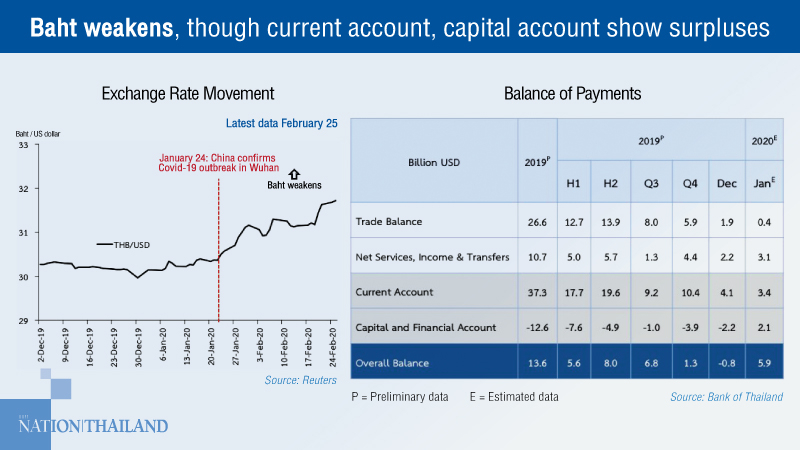
The announcement came as the baht exchange rate remains relatively strong despite its recent retreat against the US dollar after it had appreciated by 8 per cent against the greenback last year.

The weighted- average interbank exchange rate of the baht was Bt 31.636 a dollar at the close today (February 28), according to central bank data.

Thai economy continued on a downward trend in January #ศาสตร์เกษตรดินปุ๋ย

#ศาสตร์เกษตรดินปุ๋ย : ขอบคุณแหล่งข้อมูล : หนังสือพิมพ์ The Nation

https://www.nationthailand.com/business/30383028?utm_source=category&utm_medium=internal_referral

Thai economy continued on a downward trend in January

Feb 28. 2020
By The Nation

The Thai economy continued on a path of deceleration in January, contracting from the previous month in the value of merchandise exports excluding gold, manufacturing production, private investment indicators, and public spending, said Bank of Thailand today (February 28).

Private consumption indicators expanded at a slower pace. However, farm income accelerated whereas the tourism sector expanded at a rate close to the previous month, according to the central bank.

The value of merchandise exports expanded by 3.5 per cent from the same period last year. Excluding gold, exports value growth remained negative at 1.3 per cent. The continued contraction was attributed to lower exports of 1) petroleum-related products such as chemical and petrochemical products, partly due to the slowdown in trading partners’ demand; 2) agricultural products, especially rice, as a result of price competition from rival producers and supply affected by the drought; and 3) electronic products which turned into contraction from the high base effect last year. However, exports of electrical appliances and hard disk drive continued to expand, thanks to the relocation of production base to Thailand in the previous periods. Also, exports of agro-manufacturing products continued to expand, including sugar.

Private investment indicators continued to deteriorate from the same period last year. The slowdown in domestic and external demand, the low capacity utilisation rate, and the fragile business sentiment had led to delay in business investment. This was reflected by the continued contraction of investment in machinery and equipment from domestic machinery sales, and the number of newly registered motor vehicles, as well as import of capital goods which turned into contraction. In addition, investment in construction contracted from both permitted construction area and construction material sales.

Public spending, excluding transfers, continued to contract from both current and capital expenditures. Current expenditures contracted from purchases on goods and services and compensation of civil servants, partly due to the high base effect last year. Capital expenditures of central government continued to contract as a result of the delayed enactment of the FY2020 budget. Meanwhile, state enterprises’ capital expenditures also contracted due to lack of budget disbursement to energy-related and transportation agencies.

Private consumption indicators expanded at a slower pace from the same period last year, consistent with softening household income and consumer confidence, together with financial institutions’ tightening of credit standards after credit quality deteriorated. Although farm income expanded well in this month, the outlook for this year was likely to be subdued because of drought. The deceleration in private consumption indicators was in spending on services although spending on non-durable goods slightly improved from sales of consumer goods after declining in previous periods. Spending on durable goods contracted to a lesser extent, partly due to benefits offered in new car purchases. Consistently, manufacturing production contracted in line with softer domestic and external demand.

The value of merchandise imports was unchanged from the same period last year. However, excluding gold, imports value expanded by 1.4 per cent. This was attributable to the expansion in imports of 1) fuel, both in terms of price and quantity; and 2) consumer goods such as air conditioner and garment. Nevertheless, imports of raw materials and intermediate goods as well as capital goods excluding aircraft, ships, floating structures, and locomotive, contracted in line with the contraction of merchandise exports, manufacturing production, and private investment indicators.

The number of foreign tourist arrivals expanded 2.5 per cent , close to the previous month , mainly from higher arrivals of Malaysian, Russian and Hong Kong tourists during the Chinese New Year holiday, which came earlier than in the previous year. However, the number of Chinese tourists contracted due to the Chinese government’s ban on outbound group tours since January 24, 2020 in wake of the Covid-19 outbreak in the country.

Headline inflation stood at 1.05 per cent, accelerating from the previous month on the back of an increase in energy prices, partly due to the low base effect from domestic retail petroleum prices last year. Meanwhile, core inflation slightly decreased. The current account registered a smaller surplus from the trade balance, standing at $3.4 billion compared with $4.1 bilion in December. The overall capital and financial accounts registered a surplus from both the asset and the liability positions. The former was due to the withdrawal of deposit abroad by the Foreign Investment Fund (FIF) while the latter was mainly a result of foreign direct investment, especially in real estate business, and the short-term loan of Thai Other Depository Corporations (ODCs).

Covid-19 expected to hit event-organising business in 2020 #ศาสตร์เกษตรดินปุ๋ย

#ศาสตร์เกษตรดินปุ๋ย : ขอบคุณแหล่งข้อมูล : หนังสือพิมพ์ The Nation

https://www.nationthailand.com/business/30383008?utm_source=category&utm_medium=internal_referral

Covid-19 expected to hit event-organising business in 2020

Feb 28. 2020
File photo

File photo
By THE NATION

The event organising business this year is expected to drop 5 per cent from the current market value of between Bt13 billion and Bt14 billion as a result of the Covid-19 outbreak, Kreingkarn Kanjanapokin, co-chief executive officer of major event organiser Index Creative Village, said on Thursday (February 27).

He added that most events were being rescheduled for the second half of the year from the originally planned second quarter. This might lead to a situation of events getting crammed in the venues late this year, which might force some to be cancelled due to lack of enough venues to serve them all.

Index Creative has targeted revenue growth this year of between 6 and 10 per cent to Bt1.9 billion, as it has backlog of events worth Bt900 million.

Time for picking up stocks with potential at lower prices, say analysts #ศาสตร์เกษตรดินปุ๋ย

#ศาสตร์เกษตรดินปุ๋ย : ขอบคุณแหล่งข้อมูล : หนังสือพิมพ์ The Nation

https://www.nationthailand.com/business/30382995?utm_source=category&utm_medium=internal_referral

Time for picking up stocks with potential at lower prices, say analysts

Feb 28. 2020
By The Nation

Declining share prices amid sell-off in the Stock Exchange of Thailand, triggered by the Covid-19 outbreak, offers a good opportunity for investors to pick up stocks with rise potential at cheaper prices, say market analysts.

Kuntra Ladavalya Na Ayudhya, executive director of Finansia Syrus Securities, said at the seminar hosted by Krungthepturakij newspaper on Thursday (February 27) that share sell-off by investors due to mounting concerns of the Covid-19 outbreak , had led to the SET index falling 13 to 14 per cent from early this year to about 1,366 on February 26 – its lowest level in five years ago. Investors should start buying stocks with potential to rise, he suggested. The government is expected to launch a new economic stimulus package after the censure debate.

“If we look at 10-year statistic, whenever the index fell more than 8 per cent in 10 days, it made a v-shape rebound,” he said.  Kuntra advises buy of SISB share at Bt 12 per share. The SISB international school operator is expected to make a profit of B284 million this year, up from 220 million last year due to rising numbers of students and it is less impacted by the coronavirus epidemic. The expansion of school facility in Thonburi could accommodate another 4,000 students. He also suggested buy of RBF at Bt 5.50 a share which largely depends on domestic sales of food additives, and CHG at Bt3 a share as it will benefit from rising number of patients with Thais making up the majority.

MTC price at Bt65 a share is also recommended as it will benefit from lower financial cost after the central bank cut its policy rate while EA, a clean energy operator, is also a good buy at Bt 60 a share.

Padermpob Songkroh, authorised director at Yuanta Securities (Thailand), suggested share of BAM at a fair price of Bt30 as the asset management firm may buy assets at lower prices during the coronavirus outbreak. When the coronavirus outbreak is contained, investors should look at TOP with fair price at Bt62 and KCE at Bt26. STEC will benefit from government infrastructure projects and budget disbursement which is expected to start in April after several months of delay. TASCO will benefit from government projects, decreasing oil prices and its fair price should be Bt27, he added.

Kavee Chukitkasem, deputy managing director at Kasikorn Securities said he had not recommended any stocks to investors in the past two years, due to weak economic fundamentals,lower investment, weak consumption, ageing society and low competitiveness of Thai industries. But when the index is down 20 per cent from the previous high of 1,850, prices are cheap and present a good chance to buy. Investment is expected to yield positive returns in the next three years. Investors should look at firms with strong fundamentals. He suggested BDMS at Bt28 a share. BDMS’ acquisition of BH hospital will increase the number its internal patients, given BH’s client base. Next is MINT,a hotel chain at Bt45 a share as it is expected to rebound in the

long term. He also likes AOT, the state airports operator, at a fair price of Bt 75 a share, due to expected growth in tourist arrivals . CPALL at Bt80/share is an attractive buy due to its network of convenient stores and large number of warehouses and well-managed logistics. The company has a large cash flow, and if it could win the bid for Tesco, its cash flow will rise but in short run, it will be under pressure from borrowing cost, he said. Next is ADVANCE with fair price at Bt226, because the mobile phone operator needs not to invest much in 5G network, it will have more cash for dividend payment , he added.

Pichai Lertsupongkit, senior vice president at Thanachart Securities, said short sell and forced sell had sent the market down sharply . He predicted that the Bank of Thailand will cut benchmark rate again on March 25 when the Monetary Policy Committee convenes and the government will implement more economic stimulus package.

If the Covid-19 outbreak persists, investors should look at SEAFCO with fair price at Bt8 a piece. It will benefit from government project, offer high dividend payment and low P/E at 10 times. He recommended COM7 at Bt32 a share as it will benefit from 5G projects and it has not yet impacted by the coronavirus. He also suggested PTTEP with fair price at Bt 152 a share, it will benefits from rising oil prices and its share had dropped sharply. AOT at Bt80 will benefit from tourism growth and MINT at Bt42 a share as lower interest rate will cut its financial cost, he added.

Economic damage spreads as Europe confronts coronavirus #ศาสตร์เกษตรดินปุ๋ย

#ศาสตร์เกษตรดินปุ๋ย : ขอบคุณแหล่งข้อมูล : หนังสือพิมพ์ The Nation

https://www.nationthailand.com/business/30382969?utm_source=category&utm_medium=internal_referral

Economic damage spreads as Europe confronts coronavirus

Feb 28. 2020
By The Washington Post · David J. Lynch, Jeanne Whalen

In London, Hammerson, an operator of premium retail outlets in Amsterdam, Prague and Milan, is suffering the loss of free-spending Chinese tourists trapped at home by the coronavirus.

In Copenhagen and Marseille, Maersk and CMA CGM, a pair of major cargo shippers, are watching orders on their Asian routes evaporate, casualties of Chinese factories that are still operating well below capacity.

And in Stuttgart, automaker Daimler, which employs nearly 174,000 German workers, warned the epidemic could mean “significant adverse effects on production, the procurement market and the supply chain.”

The coronavirus, which has killed nearly 2,800 people worldwide and all but paralyzed China for the past month, now is targeting Europe’s $19 trillion economy. With countries such as China, Italy and Japan that account for 30% of global output already feeling the ailment’s effects, the danger of more severe global turmoil is mounting.

“The economic effects of a severe pandemic could be as bad as those of the global financial crisis” of 2008, Capital Economics, a London-based research consultancy, warned clients on Wednesday.

Along with disrupting major industries and turning trading screens red, the uncontrolled outbreak could also shake European politics by boosting nationalist sentiment.

European Union officials earlier this week rejected calls to suspend the 1985 Schengen agreement, which eliminated border checks in a 26-country region, saying such closures would do little to curb the epidemic.

But with nationalist parties gaining strength in countries such as Germany and Italy, the border-jumping coronavirus threatens to merge with economic worries to create a more potent anti-globalization force. French Finance Minister Bruno Le Maire last week complained of an “over-dependence” on Chinese industrial suppliers, echoing the views of Peter Navarro, one of President Donald Trump’s closest advisers.

“The political consequences are possibly more daunting than the economic ones,” said Douglas Rediker, chairman of International Capital Strategies. “The integration of Europe, deeper, wider, broader – which was already being questioned – this runs the risk that the economics and politics feed off each other and you end up being less cohesive.”

The epidemic’s economic fallout is quickly accumulating.

Cancellations are pouring in at the Acampora Travel agency in central Venice, just a few minutes’ walk from Piazza San Marco, the city’s famed central square.

On Wednesday morning, two groups from Mauritius backed out of tours they had planned for the end of March and early April, citing Italy’s growing coronavirus outbreak. The Mauritian travelers feared getting stuck in a 14-day quarantine after returning home, said Georgia, an Acampora travel agent who would give only her first name.

“We’ve had a lot of cancellations, and for us it’s a terrible moment,” she said. “It seems like someone wants to kill all of the tourist industry and economy.”

Indeed, an Italian hotel association two days earlier had pleaded via tweet for “urgent intervention” on a national scale, “before the long wave of cancellations turns into a tsunami, forcing many companies to reduce their staff or even to close their doors.”

The coronavirus has been a fearful challenge everywhere. In China, the interruption of normal factory operations came just as the country hoped to shake off the effects of a two-year trade war with the United States. In South Korea, site of the largest Asian outbreak outside of China, a cluster of nearly 1,300 cases is slowing an economy that was beginning to accelerate.

But the virus poses special challenges for the European Union, which is already preoccupied with Brexit, the United Kingdom’s departure from the E.U., and the threat of a tariff war with Trump.

Indeed, after a decade of financial crisis and anemic economic growth, a fatal epidemic is the last thing Europe needs.

Even before the coronavirus – and its associated illness, covid-19 – established a foothold in Italy, the continent’s major economies were expected to grow just a bit more than 1% this year. Now the outbreak’s inevitable disruption to the tourism, manufacturing and retail industries threatens to tip the European Union into outright recession.

“Things are going to get pretty bad in Europe,” said Adam Posen, president of the Peterson Institute for International Economics.

In recent days, the virus that originated in the Chinese city of Wuhan, before spreading to South Korea, the Philippines, Japan, Iran, Afghanistan and Bahrain, became a European problem.

A swath of northern Italy, responsible for about 30% of the country’s economy, is under lockdown after authorities reported more than 280 cases and 11 deaths.

France reported the first death of a French citizen. Elsewhere, Spain confirmed at least eight new cases in the past 24 hours and new infections were reported in Germany, Greece, France, Croatia, Austria and Switzerland.

Disruption quickly rippled across the borderless European economy. The French national rail line SNCF said some of its Milan-bound trains are stopping at the border with Italy, where Italian crews are replacing French personnel, according to French media reports.

In Prague, airport authorities said travelers arriving from Italy would be herded through designated gates. And the E.U. Parliament advised staff who had recently traveled to China or Italy to stay home for at least 14 days, believed to be the incubation period for the virus.

Some financial markets in Europe have lost more ground so far this year than in the United States. The blue-chip Euro Stoxx 50 has dropped more than 7% compared with a loss on the Dow Jones industrial average of about 5.5%.

Since Jan. 20, the disease has stripped $4 trillion from the value of global stock markets.

In Europe, the most visible economic damage is hitting the tourist sector, just as Americans are preparing for spring travel.

Tourism is big business in Europe, home to celebrated attractions such as the Eiffel Tower, the Sistine Chapel and the Prado Museum. The tourism sector accounts for 3.9% of Europe’s GDP and nearly 12 million jobs, according to the E.U. Among the fastest-growing sources of tourist revenue has been China. Chinese tourists in 2018 spent a total of 22 million nights in European hotels, almost five times as many as a decade earlier.

The virus is affecting some of Europe’s most popular destinations, including Milan, Venice and top ski resorts. Coronavirus fears already led organizers to cancel a major technology industry conference in Barcelona this week and to end Venice’s popular Carnival season two days early.

More troubling scenes appeared on the Spanish resort island of Tenerife, where 1,000 people were quarantined in a beachfront hotel after a tourist tested positive for coronavirus, according to Spanish authorities and the island’s hotel association, Ashotel. The visitor came from Italy’s Lombardy region, according to Spanish media reports.

The hotel association pleaded for “calm and tranquility,” insisting the island has “a first-level health service” that follows established protocols. Sky News posted footage of hotel guests gazing listlessly from their balconies while police with protective masks – some wearing them, some allowing them to dangle around their necks – stood watch outside.

“It is increasingly possible that we will see a sustained disruption in global trade, cross-border travel, and global supply chains,” Tony Roth, chief investment officer at Wilmington Trust, wrote in a note to clients. “The cancellation of large gatherings in Europe, including the Milan fashion show and the Venice Carnival celebration, foreshadow a longer lasting economic hit to companies in virtually every industry.”

The risk of recession in Europe or Japan, he added, “has dramatically risen.”

The European Central Bank is poorly armed for the battle against this unexpected economic shock. Its key interest rate already is negative, meaning the ECB charges banks for holding their excess deposits. Monetary authorities also already resumed their asset purchase program last fall, buying 20 million euros of bonds each month to stimulate the sagging economy.

“Monetary policy in the euro zone is exhausted,” said David Kotok, chairman of Cumberland Advisors, an investment firm in Sarasota, Fla. “They’re going to have a recession.”

ECB officials for years have tried to cajole European political leaders – especially in Germany – into stimulating the moribund economy with big spending projects. German Chancellor Angela Merkel, with an eye on the country’s constitutional debt limit, has long resisted such fiscal stimulus.

But this week, the German finance minister is reportedly preparing to ease the so-called debt brake to help local government finances. On Wednesday, ECB President Christine Lagarde welcomed the move, saying “any fiscal measures intended to support the economy are certainly very welcome, particularly under present circumstances.”

Still, there are concerns about the perennially unstable Italian government’s capacity to deal with the virus, which comes as Germany is enduring a rocky political transition from Merkel’s 15-year chancellorship.

“The coronavirus, like any epidemic, is a stress test for governance and societies,” said Posen.

Europe also may soon face the same dilemma that China confronted as its epidemic swelled. Restrictions on large gatherings, including on public transit systems, entertainment venues and workplaces, inevitably depress business activity.

“I get the sense we’re heading into a new phase here,” said economist Stephanie Segal, a senior fellow at the Center for Strategic and International Studies. “The containment measures themselves do have an economic impact.”

Segal said the problem for policymakers may get tougher over time. If the economic hit is long-lasting, losses will spread from factories and offices into the financial sector. An interruption in the normal flow of credit is what distinguishes a standard economic recession from the sort of crisis that swept the globe in 2008.

“So far, Euroland banks are not facing a credit squeeze or liquidity demand in the wake of lockdown and quarantine policies – first in China and now in Europe as well,” economist Carl Weinberg of High Frequency Economics wrote this week. “We do not know if this will last.”

Oil claws back some losses on OPEC+ pledge to reach consensus #ศาสตร์เกษตรดินปุ๋ย

#ศาสตร์เกษตรดินปุ๋ย : ขอบคุณแหล่งข้อมูล : หนังสือพิมพ์ The Nation

https://www.nationthailand.com/business/30382984?utm_source=category&utm_medium=internal_referral

Oil claws back some losses on OPEC+ pledge to reach consensus

Feb 28. 2020
By Syndication Washington Post, Bloomberg · Jackie Davalos, Alex Longley, Ann Koh · BUSINESS, US-GLOBAL-MARKETS 

Oil eased its downward dive as investors weighed reassurance from OPEC’s top official that the group will stabilize markets with fears that a coronavirus will wreak havoc on economic growth.

Futures recovered about half of their 5.9% slide in New York in a brief reprieve from their sell-off after Secretary-General Mohammad Barkindo said the group and its allies are showing a “renewed commitment” to reaching an agreement next week that will stabilize oil markets. The S&P 500 and Dow Jones Industrial Average indexes pared declines after sinking as much as 10% from all-time highs set this month as the coronavirus spread outside of China.

“The fast-evolving impacts of the virus mean the challenge is akin to catching a falling knife,” Bill Farren-Price, a director at consultant RS Energy Group, now part of Enverus, said in an email. “Agree too-small a cut and risk undermining credibility, or over-tighten the market and boost oil prices just at the time when the global economy is flirting with a downturn.”

Oil has fallen more than 22% this year as the virus hit a market already awash with supply. Investors are assessing whether the Organization for Petroleum Exporting Countries and its allies will be able to agree on deeper output cuts at a meeting in Vienna next week. Saudi Arabia is reducing March crude supply to China by 500,000 barrels a day due to lower demand, Reuters reported, citing people familiar.

Oil could fall below $30 a barrel if OPEC+ fails to agree a production cut, Standard Chartered analysts Emily Ashford and Paul Horsnell wrote in a report. Russia has so far resisted pressure from Saudi Arabia for an OPEC+ agreement to cut production further as the virus hits demand.

West Texas Intermediate futures fell 3.1% to $47.21 a barrel as of 1:01 p.m. local time on the New York Mercantile Exchange, while Brent lost 2.5% to $52.12 on ICE Futures Europe.

Though prices have fallen, not all indicators are showing weakness. The April Brent contract, which will expire on Friday, is trading at a premium of about 50 cents to May, indicating supply tightness in the North Sea. That’s despite a nosedive in so-called time-spreads further down the futures curve, with the closely-watched December 2020-2021 differential at the weakest in more than a year on Thursday, highlighting the market’s demand concerns.

Evans says premature to consider Fed action on virus scare #ศาสตร์เกษตรดินปุ๋ย

#ศาสตร์เกษตรดินปุ๋ย : ขอบคุณแหล่งข้อมูล : หนังสือพิมพ์ The Nation

https://www.nationthailand.com/business/30382982?utm_source=category&utm_medium=internal_referral

Evans says premature to consider Fed action on virus scare

Feb 28. 2020
By  Syndication Washington Post, Bloomberg · Eric Martin, Matthew Boesler · BUSINESS, US-GLOBAL-MARKETS 

It may take several months to judge the impact of the coronavirus outbreak on the U.S. economy, said Federal Reserve Bank of Chicago President Charles Evans, though policymakers are watching the situation carefully.

“I think it would be premature, until we have more data and have an idea of what the forecast is, to think about monetary policy action,” Evans told reporters Thursday after an event in Mexico City. “But we’re monitoring it very closely, and if we see something that does require adjustment, I’m confident we’ll give that all the consideration it needs.”

The U.S. stock market continued to tumble Thursday, extending declines for a sixth session, amid worries about the economic impact of the coronavirus outbreak. The S&P 500 has dropped around 10% since Feb. 19. The yield on 10-year Treasury securities briefly fell to a new record low of 1.24%.

Investors are rushing into bets that Federal Reserve officials will be forced to cut interest rates when they next gather in Washington for their March 17-18 meeting. Chances of quarter-point reductions at each of their next three meetings — in March, April and June — are now seen to be above 50%, according to futures contracts linked to their benchmark federal funds rate.

Evans told reporters the Fed has the capacity to respond if necessary, adding that it would take a few months to have an idea of what the appropriate response would be.

“If circumstances required some additional accommodation, we have that capacity. The first way I’m going to think about this is whether or not lending behavior is adversely influenced,” Evans said. “After several months, and having a better idea of how this is going to transpire through this year, I think we will be better positioned to think about what the implications might be for monetary policy.”

Fed No. 2 Richard Clarida said on Tuesday that it was “still too soon to even speculate” about the size or persistence of any effects on the U.S. outlook and that the central bank had monetary policy in a good place.

Evans echoed that sentiment.

“I think that our monetary policy is pretty well positioned for the risks that we have seen coming,” he told reporters. “I would say that this was not on my radar screen when we made three rate cuts last year, but I certainly feel better about the positioning of policy with any type of additional risk that we might be facing.”

U.S. markets drop into correction territory, extending brutal week of losses #ศาสตร์เกษตรดินปุ๋ย

#ศาสตร์เกษตรดินปุ๋ย : ขอบคุณแหล่งข้อมูล : หนังสือพิมพ์ The Nation

https://www.nationthailand.com/business/30382980?utm_source=category&utm_medium=internal_referral

U.S. markets drop into correction territory, extending brutal week of losses

Feb 28. 2020
By The Washington Post · David J. Lynch, Rachel Siegel, Thomas Heath · BUSINESS

The Dow Jones industrial average plunged nearly 1,200 points on Thursday, capping its worst four days since the 2008 financial crisis, as investors concluded global efforts to contain the spread of the coronavirus were failing.

The Dow closed at 25,767 on Thursday, down 4.4 percent. The Standard & Poor’s 500 and the tech-rich Nasdaq also dove. The Dow is now nearly 13 percent off its recent high. Its 10-day plunge is the swiftest dive by the blue chips since 2011.

“Every day we think we could be near a bottom, and every day we are not,” Helane Becker, an analyst at the financial services firm Cowen, wrote in a note Thursday.

In a blink, Wall Street’s free-fall this week erased one-third of stocks’ gain since President Donald Trump’s November 2016 election. Amid mounting criticism of the administration’s handling of the epidemic, the president suddenly finds himself battling a medical, economic and political emergency.

The health challenge was underscored by confirmation in California of the first U.S. case that could not be linked to travel to China or to contact with a known coronavirus patient. On the economic front, Facebook canceled its largest annual developer conference while manufacturers worried about Chinese suppliers that have not yet resumed normal production. Tesla’s stock price fell 13 percent Thursday alone.

But even as the life-or-death stakes and the financial toll loomed, political considerations were inescapable. In crowded rallies and White House events, the soaring stock market has been a staple of Trump’s re-election pitch to voters. “Highest Stock Market in history, By Far!” the president tweeted just eight days ago.

On Monday, after a 1,032-point drop in the Dow Jones industrial average, Trump – a billionaire real estate executive who prides himself on his financial acumen – doubled down, tweeting: “Stock Market starting to look very good to me!”

It has continued falling ever since, and now after a brutal four-day stretch, the market looks anything but good. Some Wall Street veterans said the virus was an external shock that had awakened investors to a sobering outlook. “We were operating in never-never land for some time,” said Dan Alpert, managing partner of Westwood Capital, a Manhattan-based investment bank.

The market reaction came one day after the president sought to reassure the nation at a White House press conference with members of his coronavirus task force, but was assailed for what critics said was a contradictory message.

“He staked his presidency on containing the virus,” said David Kotok, chairman of Cumberland Advisors. “The markets have repudiated him with a 1,000-point drop on the heels of a 1,000-point drop.”

The epidemic, which has spread from its origins in China to Japan, South Korea, Italy, Iran, the U.S., and numerous other countries, seems certain to put a sizable dent in global growth. Earlier this week, Capital Economics in London warned that the economic consequences of the spread of the coronavirus to multiple continents “could be as bad as those of the global financial crisis.”

The U.S. economy will average just 1.25 percent growth over the first half of the year, as the virus disrupts supply chains and keeps workers and shoppers on the sidelines, economist Michael Feroli of JPMorgan Chase Bank wrote in a note to clients on Thursday. That would be roughly half the pace of last year.

Whatever the danger to the U.S. economy, Europe seems to be in even worse shape. The continent’s major economies were expected to grow by little more than 1 percent before the virus forced Italy to lockdown northern territories that are responsible for almost one-third of the country’s production.

Now, recession looms as a genuine risk for Germany and Italy. After a decade of chronic weak growth and financial crises, European Central Bank officials have all but emptied their tool kit, leaving them with little ability to reverse the decline.


And in the U.S. on Thursday, the three major fell into correction territory, a 10 percent reversal from a recent high that signals something is amiss to numbers-obsessed Wall Street. The speed of the declines was startling, with the Dow Jones industrial average tumbling from its all-time peak in only 10 sessions. The blue chip index lost more than 3,200 points this week and had its worst point drop in history on Thursday.

“The Dow’s four-day decline this week is 11.13 percent, the worst since October 2008, when the blue chips fell 15 percent in four days,” said Howard Silverblatt of S&P Dow Jones Indices. The S&P has lost 12.04 percent in the last six sessions, which is also the fastest decline to correction since 2011.

It’s unclear when the uncertainty over the global public health crisis will end, which is a major reason why Wall Street investors remain on edge.

“A 10 percent correction doesn’t mean anything to Joe Q. Public,” said Kenny Polcari of SlateStone Wealth. “But to Wall Street, which marks everything by numbers, it suggests a turning point in market psyche.”

Polcari said the good news about the panic-driven correction is that it suggests an emotional response and may be only temporary.

“A slower decline based on crumbling market fundamentals, which is not the case so far, would be more worrisome,” Polcari said.

Analysts expected the market to rebound strongly after a worldwide plunge Monday. But coronavirus cases have continued to pop up around the world, squashing rallies. The extreme volatility could persist until there are signs that the outbreak is under control, analysts say, despite warnings from health officials that community spread in the U.S. appears inevitable.

European stocks also entered correction territory on Thursday. The Pan-European Stoxx 600 fell 4 percent. Britain’s FTSE dropped 3.5 percent, and Germany’s DAX fell 3.2 percent. In Italy – the country with Europe’s weakest economic growth in 2019 – Prime Minister Giuseppe Conte this week said the economic blow could be “very strong.”

From an economic standpoint, much of the focus had been on coronavirus’s repercussions for global supply chains, which rely heavily on manufacturing and production from Chinese factories. But now that public health officials are bracing for the outbreak to spread in the United States, experts worry about an additional threat to the economy. Daily routines and consumer spending could grind to a halt if schools are closed, large gatherings are canceled and businesses close their doors.

“This is a surprise,” said Michael Farr, president of Farr, Miller & Washington. “This is something that the 30-year-old cohort of money managers and analysts haven’t seen before. This supply chain disruption is going to affect all economies, and markets are still trying to figure it out. ”

Oil prices also continued to drop. West Texas Intermediate, the U.S. benchmark, drifted below $47, a new 53-week low. The yield on the benchmark 10-year Treasury note hit a new low, reflecting the anticipation that a slowdown is on the horizon.


Goldman Sachs said in a note Thursday that the virus would slow economic activity across the planet. The financial services giant predicts no earnings growth this year and modest earnings growth in 2021.

“Our reduced profit forecasts reflect the severe decline in Chinese economic activity in [the first three months of 2020], lower end-demand for U.S. exporters, disruption to the supply chain for many U.S. firms, a slowdown in U.S. economic activity, and elevated business uncertainty,” Goldman Sachs strategist David Kostin wrote in a note.

The outbreak has been met with inconsistent messaging from the Trump administration. Trump, concerned about the stock market, is urging aides not to discuss the outbreak in ways that could rattle the economy further. Late Monday, top White House economic adviser Larry Kudlow said that investors should consider “buying these dips” in the market.

When the coronavirus outbreak first surfaced in the Chinese city of Wuhan, analysts initially sized up any potential hit to the global economy based on the 2002 SARS outbreak. But in the nearly 20 years since, the Chinese economy has become four times larger substantially more intertwined with global production networks.


Coronavirus’ rapid spread continues to raise the specter of a global pandemic. South Korea announced 505 new cases on Thursday, bringing its total to 1,766, including a U.S. soldier stationed on the peninsula. Iran reported 245 confirmed cases and a death toll of 26. Religious pilgrimages in Saudi Arabia have been halted, and Tokyo’s plans to host the 2020 Olympics hang in the balance.

Even so, Trump struck an optimistic tone Wednesday evening during a White House news conference. Trump said the risk to America was “very low” and that the outbreak would swiftly be contained. Trump announced Vice President Pence will lead the administration’s response to the outbreak. And on Thursday, his comments remained upbeat, even after the steep stock market drop.

“I think it’s an incredible achievement what our country’s done,” Trump he told reporters at the White House, predicting eventually the virus would disappear.