Baht continues to slide amid increasing worries about Covid-19 #ศาสตร์เกษตรดินปุ๋ย

#ศาสตร์เกษตรดินปุ๋ย : ขอบคุณแหล่งข้อมูล : หนังสือพิมพ์ The Nation

https://www.nationthailand.com/business/30382717?utm_source=category&utm_medium=internal_referral

Baht continues to slide amid increasing worries about Covid-19

Feb 24. 2020
By The Nation

The baht continued to weaken, trading at 31.70 to the US dollar in Monday morning trade, amid concerns over the coronavirus spreading outside China.

Kasikorn Research Centre said that the baht had weakened along with the yuan and other regional currencies amid concerns about the Covid-19 outbreak, after there was an increase in Covid-19 infections outside China.

SET plunges along with Asian stocks due to concerns over Covid-19

In addition, the baht fell on technical selling orders after it broke the Bt31.50/dollar level. Signs of a weak economic outlook, as well as net foreign selling orders for Thai stocks and bonds pressured the baht sentiment, while the US dollar rose on positive views on the US economy, according to the latest Federal Open Market Committee minutes.

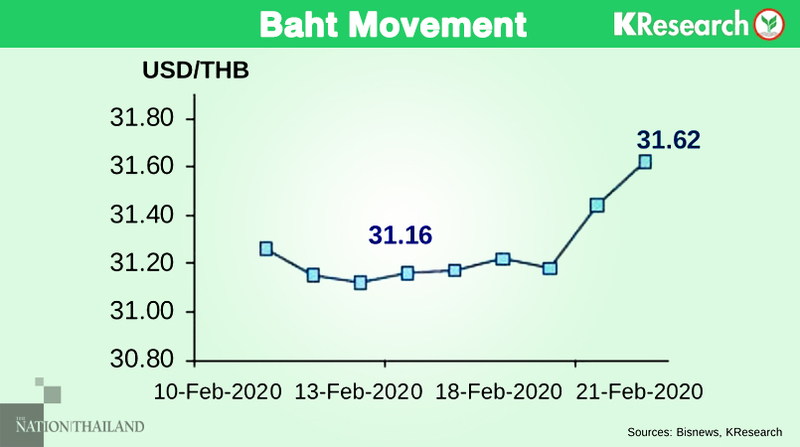
On Friday, the baht had closed at 31.62/dollar, having hit an eight-and-a-half-month low of Bt31.69/USD, versus Bt31.16/dollar reported on February 14.

During February 24-28, KBank expects the baht to move within a range of Bt31.40 to Bt32/dollar. Key factors to be monitored closely are Thai export data for January, the Bank of Thailand’s monthly economic report and the Covid-19 outbreak situation, said Kasikorn Research Centre.

Meanwhile, the US economic data to be released during the week include February consumer sentiment surveys, plus February durable goods orders, new home sales, pending home sales, personal spending-income, and PCE/Core PCE price indices, fourth quarter 2019 GDP report (second release) and December house price data, the research house added.

Bill Gates-led fund invests in making lithium mining more sustainable #ศาสตร์เกษตรดินปุ๋ย

#ศาสตร์เกษตรดินปุ๋ย : ขอบคุณแหล่งข้อมูล : หนังสือพิมพ์ The Nation

https://www.nationthailand.com/business/30382694?utm_source=category&utm_medium=internal_referral

Bill Gates-led fund invests in making lithium mining more sustainable

Feb 23. 2020
Bill Gates/ File Photo by Syndication Washington Post, Bloomberg

Bill Gates/ File Photo by Syndication Washington Post, Bloomberg
By Syndication Washington Post, Bloomberg · Akshat Rathi · BUSINESS, TECHNOLOGY, US-GLOBAL-MARKETS

Breakthrough Energy Ventures, helmed by Bill Gates, and MIT’s The Engine fund are leading an investment round of $20 million for Lilac Solutions, a U.S. startup aimed at making the extraction of lithium less water-intensive and more sustainable.

As the world looks to cut carbon emissions, people are increasingly turning to lithium-ion batteries for solutions such as powering electric vehicles or storing renewable energy. While there’s enough lithium available to meet today’s demand, BloombergNEF expects the market could see a shortfall as soon as 2023 as demand for the metal grows fourfold over the next decade.

About 75% of the world’s lithium is trapped in underground deposits of briny water that contain a mixture of salts. The typical way to recover lithium is to pump the water to the surface into miles-long salt ponds and let the water evaporate. What remains is then treated with chemicals, processed, washed, and filtered to leave behind the lithium.

BNEF estimates that each ton of lithium extracted from brine requires 70,000 liters of fresh water. Making matters worse, much of lithium mining happens in regions that are already water-stressed. In Chile’s Atacama Desert, for example, mining activity is wrecking the ecosystem and straining local communities.

Evaporation pond extraction is also quite slow: It can take up to two years for brine to yield usable lithium. And the process is able to recover only about 50% of the lithium present in the brine. All that raises the upfront capital cost and slows down the pace at which new mines can be started.

Lilac Solutions, based in Oakland, California, is a one of a handful of startups deploying technologies that could drastically cut water use, lower capital expenditure, and make lithium-extraction more energy efficient. Instead of waiting for the sun to heat evaporation ponds, Lilac uses ion-exchange beads that are able to selectively remove lithium and leave behind magnesium, calcium, boron, and other unwanted minerals. Once the beads are saturated, they’re treated with an acid to extract the lithium and can then be used again.

The process does away with the need for large evaporation ponds and is able to return the lithium-depleted brine back underground, according to the company. It also cuts down the amount of time needed to extract lithium from brine to mere hours. And the beads are selective enough to recover about 90% of lithium in brines.

Other companies have tried to build these ion-exchange beads in the past, but they were either not selective enough at picking lithium out of the mixture of minerals or fell apart after just a few cycles, said Chief Executive Officer David Snydacker. The Lilac beads are the product of an obsession with lithium-ion batteries that started during his PhD research at Northwestern University.

Lilac’s process also cuts energy use and thus greenhouse-gas emissions. Breakthrough Energy Ventures looks to invest in startups that are each capable of cutting emissions by 500 million metric tons annually. The fund’s investors include Jeff Bezos, founder of Amazon.com Inc., and Jack Ma, co-founder of Alibaba Group Holding. Michael Bloomberg, the founder and majority owner of Bloomberg LP, is a backer of Breakthrough.

The new round of funding will allow Snydacker to create a manufacturing line in California. The company intends to partner with existing mines rather than open its own; the first pilot using Lilac’s technology will start in Argentina later this year, in partnership with mining company Lake Resources. If it works, Snydacker hopes to deploy the technology to extract lithium from unconventional sources, such as oil fields and geothermal power plants, which both produce copious amounts of brine.

Lilac’s competition is growing. Other startups in the space such as Rincon Ltd., Tenova, Adionics, and Summit Nanotech are all launching pilot plants. Some use ion-exchange technology like Lilac others use either nano-filtration (essentially filters small enough to separate charged atoms) or solvent extraction (chemicals that have affinity for lithium).

The demand for lithium is growing rapidly, according to BNEF metals analyst Sharon Mustri. “The main challenge for these startups is to scale up,” she said.

For Canada’s Trudeau, the $15.5 billion Teck mine decision is a lose-lose situation #ศาสตร์เกษตรดินปุ๋ย

#ศาสตร์เกษตรดินปุ๋ย : ขอบคุณแหล่งข้อมูล : หนังสือพิมพ์ The Nation

https://www.nationthailand.com/business/30382689?utm_source=category&utm_medium=internal_referral

For Canada’s Trudeau, the $15.5 billion Teck mine decision is a lose-lose situation

Feb 23. 2020
File Photo by Syndication Washington Post, Bloomberg

File Photo by Syndication Washington Post, Bloomberg
By Special To The Washington Post · Amanda Coletta · WORLD, SCIENCE-ENVIRONMENT

TORONTO – For as long as he’s been prime minister, Justin Trudeau has insisted that supporting Canada’s struggling oil and gas sector, tackling climate change and mending the country’s relationship with its indigenous people go “hand in hand.”

His Liberal government would put a price on carbon emissions, giving him the “social license” for energy projects such as pipelines, which would quiet opposition to the carbon tax.

Now, at the start of Trudeau’s second term, looms a decision that’s testing his commitments both to fighting climate change and to developing Canada’s potentially lucrative oil sands.

By the end of the month, Trudeau’s cabinet is expected to approve or reject Teck Resources’ $15.5 billion Frontier mine proposal for northern Alberta – a 71,600-acre project projected to pump 260,000 barrels of bitumen per day and emit 4.1 megatons of emissions per year for the next four decades.

A federal-provincial review panel found last year that the project would have “significant adverse environmental effects,” including the “irreversible” destruction of peatland, impacts on indigenous groups, harm to the wood buffalo and the loss of habitat for at-risk species until at least 2181.

But the panel concluded that the economic benefits – 7,000 jobs during construction, 2,500 jobs during the life of the mine and $52 billion in government coffers – “justified” the environmental effects, and that it was in the public interest.

The decision now belongs to Trudeau – and it could be a political minefield.

Give the project the green light, and he’ll be labeled a hypocrite on climate change – again (his government bought the Trans Mountain pipeline in 2018, and approved an expansion last year). Trudeau campaigned on a pledge to get Canada to net zero emissions by 2050. (The country is on track to miss its 2030 target under the Paris accord.)

“If the government is indeed serious in its intention to be a climate leader, it has to address the elephant in the room, which is the continued expansion of the oil and gas sector,” said Caroline Brouillette, a climate change researcher with the environmental group Équiterre. “That means saying no to Teck.”

But nix the mine, and Trudeau risks raising more opposition in the oil-rich provinces of Alberta and Saskatchewan, which completely shut out his Liberals in last year’s federal election, and where struggles in the oil patch have fueled resentment and alienation.

Ratcheting up the stakes, Alberta Premier Jason Kenney has threatened a “swift and serious” reaction if Ottawa gives the project a thumbs-down, and he predicted western alienation would bubble over – leaving nothing short of national unity on the line.

“An arbitrary rejection of the Teck Frontier project at the 11th hour would be yet another signal that the Trudeau Liberals have abandoned our province in our time of need,” Christine Myatt, a spokeswoman for the United Conservative premier, wrote in an email.

The bombast belies an awkward fact: Even if the project is approved, it might never get built.

Teck chief executive Don Lindsay said last month that the mine’s construction is dependent on “three Ps”: pipelines, a suitable partner and oil prices high enough to warrant the investment.

Teck based its proposal on oil prices of $95 a barrel – far higher than where global benchmark prices have been since 2014.

The company said last week it will be forced to take an $855 million impairment charge if the project is not approved. It took a $688 million write-down in the quarter on its Fort Hills mine, which already is in production, because of “lower market expectations” for crude oil prices.

Chris Stannell, a spokesman for Teck, said in an email that the company is evaluating “improvements to project technology and other operational improvements” that it believes will make the Frontier project “technically feasible and commercially viable.”

“A lot of the rhetoric is promising people that this project is right there, it’s ready to go and all we need is Prime Minister Trudeau,” said Andrew Leach, an energy economist at the University of Alberta. “Even if he said yes, at a minimum, this project is years away, and it would need a big rebound in oil prices.”

Several oil sands projects that have been approved have yet to be built, Leach notes.

“Right now, the market is saying no,” he said. “So it would not just be the government.”

The slump in oil prices means the promised economic benefits are more modest than they were when Teck made its proposal, Leach said. He said the government should take that into account.

Chris Severson-Baker, the Alberta director for the Pembina Institute, an environmental think tank, says one reason so much is being read into the Teck decision is that the Trudeau government hasn’t produced a clear plan for how it is going to meet its carbon emission targets.

“That puts a lot of pressure on this one project,” he said.

A spokeswoman for Canada’s environment ministry did not respond to a request for comment.

The federal-provincial panel acknowledged that the Frontier mine might “make it more difficult” for Canada to achieve its domestic and international greenhouse gas emissions commitments, but it did not take that into account when making its recommendation.

Teck Resources says the mine would have a lower emissions intensity than roughly half of all oil refined in the United States. It has promised to get to net zero emissions by 2050 across all of its mining operations; it owns or has interests in 13 facilities in Canada, the United States, Chile and Peru.

Tim McMillan, chief executive of the Canadian Association of Petroleum Producers, said he gives the federal government “full credit” for working since the election to “bridge east and west.” Failing to approve the project, he said, would have a “concerning” effect on those efforts and also discourage foreign investment.

The Frontier mine faces opposition from some indigenous groups, who say they have not been sufficiently consulted.

Trudeau is under pressure to resolve several indigenous-led, anti-pipeline blockades that have for more than two weeks paralyzed Canada’s railway system, bringing the movement of people and freight to a virtual standstill.

The blockades were set up in solidarity with some members of the Wet’suwet’en Nation in British Columbia who oppose the construction of a natural gas pipeline there.

“This is the first government that has put its political capital on the line to push through significant environmental policies,” Leach said. “But on the other hand, they’ve also been the first government that’s really taken it on the chin in terms of the pipeline fight.”

The project is dividing Trudeau’s caucus, as well as the broader Canadian public.

Nearly half of all Canadians support the construction of the mine, according to a survey from the Angus Reid Institute; 40 percent are opposed. Support is highest in the prairie provinces. Opposition is rooted in Quebec, British Columbia and Ontario – key political battlegrounds.

“It certainly makes things, politically, quite tricky for the Trudeau government as it tries to navigate both politically and from a policy perspective,” said Shachi Kurl, the institute’s executive director. “The country is divided along regional lines and people are divided along political lines. …

“The numbers really underscore the challenge and the difficulty of trying to approach a middle way.”

China cuts tariffs on additional US goods #ศาสตร์เกษตรดินปุ๋ย

#ศาสตร์เกษตรดินปุ๋ย : ขอบคุณแหล่งข้อมูล : หนังสือพิมพ์ The Nation

https://www.nationthailand.com/business/30382630?utm_source=category&utm_medium=internal_referral

China cuts tariffs on additional US goods

Feb 22. 2020
A US cargo ship docks at the Qingdao Port, Shandong province. [Photo by Yu Shaoyue/For China Daily]

A US cargo ship docks at the Qingdao Port, Shandong province. [Photo by Yu Shaoyue/For China Daily]
By Chen Jia | China Daily | Updated: 2020-02-22 06:57

China announced the first set of exclusion lists on the second batch of United States imports, which are subject to additional tariff exemptions, effective from Feb 28, according to a statement from the Customs Tariff Commission of the State Council on Friday.

The commission unveiled two tariff exclusion lists, comprising 65 items in total, including noninvasive ventilators, spectrographs, genetic sequencing machines as well as parts for automatic aircraft navigation systems and semiconductors. The lists were released on the commission’s website.

All items on the two lists will enjoy exclusion of additional tariffs for a year through Feb 27, 2021. It means the items will not be subject to additional tariffs imposed by China on US products as countermeasures to US Section 301 measures, the statement said.

For the 55 items on the first list, tariffs that have already been levied on enterprises can be refunded. The affected enterprises can apply for refunds within six months from Friday, it said.

For the 10 items on the second list, they enjoy tariff exclusions but are not eligible for refunds, according to the commission.

“In the next step, the Customs Tariff Commission of the State Council will continue to work on the exclusion of additional tariffs on US products, and the lists of subsequent batches will be released in due course,” the statement said.

Some of the listed US products, such as noninvasive ventilators, are much-needed medical instruments to treat patients infected with the novel coronavirus.

Under current conditions, to include certain goods used in epidemic control and prevention on the exemption list will ease temporary supply shortages, said Xu Qiyuan, head of the research department at the China Finance 40 Forum and a researcher at the Chinese Academy of Social Sciences.

Due to the epidemic, imports of medical apparatus and instruments may increase. In the short term, China’s imports from the US are likely to rise, Xu said.

He told China Daily that the tariff exemptions could also send a signal of goodwill, and help improve trade relations between the two countries.

Other than medical supplies, some imports on the first list include primary and intermediate products, as well as spare parts, which can reduce production costs for Chinese enterprises and cement supply chains between Chinese and US companies. It will also help stabilize global supply chains, Xu added.

Wei Jianguo, former vice-minister of commerce, said the impact of the virus outbreak on production is temporary, and output in some regions, such as Zhejiang province, is gradually recovering.

Although foreign trade may be affected in the short run, the country’s countermeasures will support an economic rebound later and ease difficulties facing companies, especially small and medium-sized firms, Wei said.

On Tuesday, the commission issued a statement that China will accept applications from local companies, starting March 2, for the exemption of additional tariffs on 696 items of US imports.

Stocks post weekly decline amid hunt for safety #ศาสตร์เกษตรดินปุ๋ย

#ศาสตร์เกษตรดินปุ๋ย : ขอบคุณแหล่งข้อมูล : หนังสือพิมพ์ The Nation

https://www.nationthailand.com/business/30382605?utm_source=category&utm_medium=internal_referral

Stocks post weekly decline amid hunt for safety

Feb 22. 2020
By Syndication Washington Post, Bloomberg · Vildana Hajric · BUSINESS 

U.S. stocks sank, gold surged and Treasury yields tumbled as investors took a defensive stance amid renewed concern about the economic impact of the coronavirus as it spreads outside of China.

Tech companies were particularly hard hit, sending the Nasdaq 100 down almost 2%. The S&P 500 Index posted its first weekly decline since January. The yield on 30-year Treasuries fell to a record low amid data showing U.S. business activity shrank for the first time since 2013 as the virus hit supply chains.

Investors were put on alert this week by a spike in infections outside China and a slew of fresh warnings by companies over the potential impact the deadly respiratory virus may have on business. The growing concerns reignited appetite for assets seen as havens from the turmoil and reversed stock gains that had sent the S&P 500 Index to a record high Wednesday.

“Investors have suddenly got cold feet and are running for the exits,” said Chris Rupkey, chief financial economist for MUFG Union Bank. “Bond yields and stock prices are back in sync today as the plunging markets mean the economic outlook is not looking as good this year as many thought.”

The Stoxx Europe 600 Index slumped, with automakers among the worst performers, after equities in Korea and Hong Kong dropped more than 1%. Crude oil fell after hitting the highest in almost four weeks.

Elsewhere, the yen strengthened, recouping some if its biggest two-day decline since 2017. The dollar slumped after a four-day winning streak. The euro strengthened after data showed economic activity in the common-currency area sped up unexpectedly.

These are the main moves in markets:

Stocks

– The S&P 500 Index dropped 1.1% at the close of trading in New York, leaving it down 1.3% this week.

– The Nasdaq 100 fell 1.9% Friday and 1.8% for the week.

– The Stoxx Europe 600 Index fell 0.5%.

– The MSCI Asia Pacific Index fell 0.5%.

Currencies

– The Bloomberg Dollar Spot Index fell 0.3%.

– The euro rose 0.6% to $1.0848.

– The British pound advanced 0.6% to $1.296.

– The Japanese yen strengthened 0.5% to 111.59 per dollar.

Bonds

– The yield on 10-year Treasuries declined five basis points to 1.47%.

– The yield on 30-year Treasuries fell five basis points to 1.91%

– Germany’s 10-year yield rose one basis point to -0.43%.

– Britain’s 10-year yield was little changed at 0.57%.

Commodities

– West Texas Intermediate crude sank 0.8% to $53.34 a barrel.

– Gold strengthened 1.5% to $1,644.38 an ounce.

As Treasury bonds hit historic low, tale of two markets and an uncertain U.S. economy emerges #ศาสตร์เกษตรดินปุ๋ย

#ศาสตร์เกษตรดินปุ๋ย : ขอบคุณแหล่งข้อมูล : หนังสือพิมพ์ The Nation

https://www.nationthailand.com/business/30382604?utm_source=category&utm_medium=internal_referral

As Treasury bonds hit historic low, tale of two markets and an uncertain U.S. economy emerges

Feb 22. 2020
Treasury
Photo by: The Washington Post — The Washington Post

Treasury Photo by: The Washington Post — The Washington Post
By The Washington Post · Peter Whoriskey · NATIONAL, BUSINESS, US-GLOBAL-MARKETS 

MARKETS-ANALYSIS: The yields of U.S. Treasury bonds, a fundamental marker of the U.S. economy, ticked Friday to a historic low. This is usually a sign that investors are uncommonly nervous.

But what exactly the new low foretells for the U.S. economy has divided the world into two remarkably contrary camps: those who see the new lows as another sign of relative U.S. strength, and those who see it as an unmistakable augury of tough economic times ahead, and possibly, recession.

Maybe most perplexing, massive market wagers have been made in support of both views: The optimists have pushed the stock market ever higher, while the pessimists have driven bond yields ever lower.

As a result, for those who look to the stock and bond markets for clues to the U.S. economy, the picture it presents alternates between exuberance and, increasingly, deep gloom.

“It’s getting so the dissonance between the bond market and stock market is deafening,” said Diane Swonk, chief economist at Grant Thornton.

On one side of the divide is the enthusiasm of the stock market. Though it dipped on Friday, the S&P 500 average is up 20 percent from its close a year ago. The troubles caused by the coronavirus, and the disruptions at countless Chinese factories, appears to have had little effect on these investors.

“We should be very calm about the U.S. side of the story which is actually looking pretty good,” National Economic Council Director Larry Kudlow said Friday on CNBC. “On the other hand, the Chinese side of the story is very difficult – it’s a human tragedy.”

In this view, the unusually low bond yields can be taken as a sign of U.S. strength. They dropped not because of any weakness in the U.S. economy, but because investors in the overseas economies most affected by the coronavirus are looking for safe investments – and for that they turn to U.S. Treasury bonds.

“I just think, in general, I would be very careful to put too much emphasis on what bond rates are doing,” Kudlow said. “I think you have a lot of mood swings here and I don’t think it affects the fundamentals.. . . I think the fundamentals of this economy are very solid, all right? Very solid.

In a speech earlier this month, Federal Reserve vice chair Randal Quarles said: “There is much to be encouraged by in the nation’s current economic performance even as some notable risks require careful monitoring.”

Many analysts agree. A panel of economists known as the Blue Chip Economic Indicators forecast panel, for example, predicted two weeks ago that the economy would continue to grow at roughly two percent.

“This is hardly exuberant,” according to the panel’s report, which also named the coronavirus epidemic as a risk. But “there is little evidence in these numbers of any expectation of disruptive shocks.”

But to other economists, the historic levels in bond yields reflect just one more potential fault line in a U.S. economy that has had a good run since the last recession, but one that won’t last forever. In this view, the economic effects of the coronavirus could be the shock that exposes any economic weaknesses.

“I know there are economists out there saying there is no chance of a recession,” Swonk said. “But I know that hubris is your enemy late in the business cycle.”

Indeed, economists, while noting how hard it can be to predict a downturn, pointed to several signs of stress in the economy that may be leading indicators of a recession.

Stock prices are relatively high, and have surged in recent months. Measured in terms of the ratio of price to earnings of stock in the S&P 500, they have risen substantially in recent years.

Corporate debt, too, has jumped. Since 2012, the amount of long-term debt at industrial companies on the S&P index has more than doubled, to $4 trillion, according to Howard Silverblatt of S&P Global.

Finally, Mark Zandi, chief economist at Moody’s Analytics, noted the occurrence of a longstanding indicator of imminent recession: the “inverted yield curve.” These occur when the interest rates on short-term bonds are higher than the interest rates paid by long-term bonds.

“It’s historically been a fool-proof leading indicator of recession,” Zandi said. “What it means is that people are so worried about the near-term future that they are piling into long-term investments – and it’s been inverted over the last week or so.”

Complicating all of these forecasts, the good and the bad, are the uncertain effects of the coronavirus on China and other major trading partners.

U.S. policymakers have at times dismissed the epidemic as a problem in China, not here. But more recently, some have acknowledged it could damage U.S. growth outlooks. Federal Reserve Board Chair Jerome Powell said this week there will “very likely be some effects on the United States” from the epidemic, which has closed thousands of Chinese factories supplying American companies.

Earlier this week, for example, Apple warned that it expects to fall short of revenue goals in the current quarter because of the coronavirus outbreak.

In a statement to investors, Apple said that while factories in China were reopening, restarting iPhone production in the country was moving along more slowly than expected.

“Work is starting to resume around the country, but we are experiencing a slower return to normal conditions than we had anticipated,” the company said. “These iPhone supply shortages will temporarily affect revenues worldwide.”

Chinese demand for Apple products has also slumped, the company said.

Swonk and others have said the threat of coronavirus has been too quickly dismissed by some observers, in part because the economies proved relatively resilient during the SARS outbreak in 2003.

“Back in 2003, China was more of an island. Now it’s integrated into every economy in the world. It’s pivotal in the supply,” Swonk said. “The nature of the coronavirus is not something you can put in a traditional [economic] model. There are nonlinear implications.”

—-

Peter Whoriskey is a staff writer for The Washington Post whose investigative work focuses on American business and the economy. Previously, he worked at the Miami Herald, where he contributed to the paper’s coverage of Hurricane Andrew, which was awarded a Pulitzer Prize for public service.

Fed’s Brainard calls for new strategy to boost inflation #ศาสตร์เกษตรดินปุ๋ย

#ศาสตร์เกษตรดินปุ๋ย : ขอบคุณแหล่งข้อมูล : หนังสือพิมพ์ The Nation

https://www.nationthailand.com/business/30382600?utm_source=category&utm_medium=internal_referral

Fed’s Brainard calls for new strategy to boost inflation

Feb 22. 2020
By Syndication Washington Post, Bloomberg · Rich Miller, Craig Torres · BUSINESS, US-GLOBAL-MARKETS 
Federal Reserve Governor Lael Brainard on Friday called for the adoption of new strategies by the central bank to achieve its 2% inflation goal and fight off future recessions.

The Fed should seek above-target price gains to make up for past inflation shortfalls and should cap Treasury debt yields if it’s forced to lower short-term rates as far as they can go in a downturn, she said in a speech in New York.

“Today’s low-inflation, low interest-rate environment requires not only new recession-fighting tools but also a new strategy to address the persistent undershooting of the inflation target — and the risk to inflation expectations — well before a downturn,” she said.

To that end, monetary “policy may have to remain accommodative for a long time” to make up for past inflation shortfalls, she added.The Fed is engaged in an in-depth review of its policies and practices that is aimed at finding ways to cope with a new normal of subdued inflation and low interest rates. The review is expected to be completed by the middle of this year.In publicly staking where she thinks her fellow policy makers should go, Brainard acknowledged that the changes she was proposing may not be sufficient to fully offset future economic contractions.

“In addition to a forceful response from monetary policy, robust countercyclical fiscal policy is vital,” she said in the speech to be delivered to a University of Chicago-sponsored monetary forum.

Brainard, who was appointed to the Fed in 2014, said the Fed should pre-commit before a recession that it will keep short-term interest rates at their lowest level until full employment and 2% inflation is achieved.”This forward guidance could be reinforced by interest rate caps on short-term Treasury securities over the same horizon,” she said.

The Fed though also needs to shift strategy well before a downturn to combat the risk that an extended period of below-target price gains has led to a decline in inflation expectations, Brainard said.

She called for the central bank’s policy-making Federal Open Market Committee to adopt a “flexible inflation averaging approach” that would aim to ensure that price gains average 2% over time.

“Following several years when inflation has remained in the range of 1.5% to 2%, the committee could target inflation outcomes in a range of 2% to 2.5% for a period to achieve inflation outcomes of 2%, on average, overall,” she said.

Under such an approach, the FOMC would make it clear that it would accommodate rather than offset modest upward pressures to inflation – a strategy that Brainard dubbed as “opportunistic reflation.”Since the Fed adopted its 2% price target in 2012, the personal consumption expenditures price index has on average risen 1.4%.

Fed officials left interest rates unchanged in a range of 1.5% to 1.75% at their Jan. 28-29 gathering and said the setting was “appropriate” to sustain the U.S. economic expansion and achieve the central bank’s goals of maximum employment and stable prices.

The current setting is less than half the 500 basis points in rate cuts that the Fed has made to fight past recessions.

Gold pops as virus concerns ignite global stampede into havens #ศาสตร์เกษตรดินปุ๋ย

#ศาสตร์เกษตรดินปุ๋ย : ขอบคุณแหล่งข้อมูล : หนังสือพิมพ์ The Nation

https://www.nationthailand.com/business/30382597?utm_source=category&utm_medium=internal_referral

Gold pops as virus concerns ignite global stampede into havens

Feb 22. 2020
By Syndication Washington Post, Bloomberg · Ranjeetha Pakiam, Elena Mazneva · BUSINESS

The stars have aligned for gold, as concerns that the coronavirus outbreak may damage growth, hurt risk assets and add to pressures for easier monetary policy trigger a global hunt for havens.

Bullion headed for the biggest weekly gain in more than six months as prices hit a seven-year high. With bond yields in retreat and real U.S. interest rates sinking further into negative territory, gold-backed exchange-traded funds have posted a record run of inflows.

“Gold is in the midst of its perfect storm,” said Ole Hansen, head of commodity strategy at Saxo Bank.

Spot gold climbed as much as 1.1% on Friday to $1,636.57 an ounce, the highest since February 2013. The metal extended this year’s gains to almost 8%.

Prices for the traditional haven hit records in other currencies including euros and Australian and Canadian dollars. Holdings in bullion-backed ETFs rose for 22 consecutive sessions to Thursday, the longest ever run, according to data compiled by Bloomberg.

This run of inflows “certainly gives an indication about concerns around the global economy,” Andrew Jamieson, global head of ETF product at Citigroup in London, said in an interview with Bloomberg TV.

U.S. government bond markets saw a rush of buying Thursday that piled up bets on rate cuts, supporting gold. The Commonwealth Bank of Australia expects the Federal Reserve to ease twice in the second half as the virus threatens the global economy.

Fresh data out of Japan and South Korea on Friday showed how the coronavirus outbreak is taking a toll on economic activity, adding further support to havens.

While there are lots of factors supporting gold, Saxo Bank’s Hansen noted the metal’s 14-day relative strength index is back in overbought territory.

Still, lower U.S. yields and weaker equities could push prices further toward $1,750 an ounce even if the coronavirus is contained during the first quarter, according to Goldman Sachs.

If the outbreak stretches beyond that, “we see substantially more upside from here — toward $1,850 an ounce, depending on the magnitude of the global monetary policy response,” the bank said in a note Friday.

Other precious metals also gained Friday. Palladium has jumped about 12% this week after hitting a record $2,849.61 an ounce on Wednesday.

Stronger demand and constrained supply will widen the deficit in the palladium market to 1.3 million ounces this year, keeping prices high, according to Australia & New Zealand Banking Group.

Dollar has no equal for investors sheltering from outbreak #ศาสตร์เกษตรดินปุ๋ย

#ศาสตร์เกษตรดินปุ๋ย : ขอบคุณแหล่งข้อมูล : หนังสือพิมพ์ The Nation

https://www.nationthailand.com/business/30382596?utm_source=category&utm_medium=internal_referral

Dollar has no equal for investors sheltering from outbreak

Feb 22. 2020
File Photo by Syndication Washington Post, Bloomberg

File Photo by Syndication Washington Post, Bloomberg
By  Syndication Washington Post, Bloomberg · Susanne Barton · BUSINESS, US-GLOBAL-MARKETS 

Currency traders seeking shelter as the spreading coronavirus roils financial markets just can’t get enough of the teflon dollar.

The greenback has gained versus some 30 major world currencies in the past month, coinciding with mounting concern over the outbreak’s economic impact. The yen and the Swiss franc, two traditional haven currencies, have proven no match.

The dollar’s appreciation is confounding the year-end consensus that overseas economies were set to strengthen and lure cash from the U.S. The deadly illness has upended that narrative, and yield-hungry investors are also shunning negative rates in Asia and Europe. And with no end in sight for the outbreak, momentum appears to be in the greenback’s favor.

“U.S. growth is more insulated from the virus-related demand hit to” Asia and Europe, Columbia Threadneedle’s Ed Al-Hussainy said in an email. Rate differentials also make “the dollar an exceptionally attractive safe-haven play.”

With coronavirus worries rising, the senior interest rates and currency analyst said the asset manager reduced exposure to emerging-market currencies and closed long-euro and sterling positions versus the dollar.

The dollar’s strength is a boon for international investors repatriating proceeds from American holdings, but it’s a potential drag for U.S. companies with earnings abroad.

The greenback touched a 10-month high of 112.23 yen Thursday amid worries that the ripple effects from the deadly illness could push Japan into recession. U.S. growth remains solid. Data Thursday showed a regional Federal Reserve manufacturing index surged this month to the highest level in three years. That contrast could mean further weakness for the yen — usually a go-to currency in times of uncertainty.

Makoto Noji, chief strategist for SMBC Nikko Securities in Tokyo, sees the yen potentially dropping toward 115 per dollar, a level last seen in 2017, should U.S. and Japanese growth continue to diverge.

For Momtchil Pojarliev, head of currencies at BNP Paribas Asset Management, the yen has cheapened enough. He bought some Thursday on the view that its haven characteristics will reassert themselves should the virus’s impact start showing up in economic data.

He’s still bullish the dollar versus other major currencies, though, because it’s “the clear safe-haven” and the virus “will have big implications for growth.”

There are other oases: Gold reached a seven-year high Friday, while 10-year Treasury yields fell as low as 1.47%, the lowest since September. The Swiss franc has weakened 1.6% this year, while the yen is down 3%.

“The market is starting to better discern between the currencies/assets it wants to hold in this virus-nervous world,” Alan Ruskin, chief international strategist at Deutsche Bank AG, said in an email. “In FX-land, the U.S. dollar is top.”

U.S. business gauge tumbles to lowest since 2013 on virus #ศาสตร์เกษตรดินปุ๋ย

#ศาสตร์เกษตรดินปุ๋ย : ขอบคุณแหล่งข้อมูล : หนังสือพิมพ์ The Nation

https://www.nationthailand.com/business/30382594?utm_source=category&utm_medium=internal_referral

U.S. business gauge tumbles to lowest since 2013 on virus

Feb 22. 2020
A pedestrian wearing a face mask walks along a street in the Flushing Chinatown neighborhood in the borough of Queens in New York on Feb. 5, 2020. MUST CREDIT: Bloomberg photo by Stephanie Keith.

A pedestrian wearing a face mask walks along a street in the Flushing Chinatown neighborhood in the borough of Queens in New York on Feb. 5, 2020. MUST CREDIT: Bloomberg photo by Stephanie Keith.
By Syndication Washington Post, Bloomberg · Katia Dmitrieva · BUSINESS, US-GLOBAL-MARKETS

U.S. business activity shrank in February for the first time since 2013 as the coronavirus hit supply chains and made firms hesitant to place orders, a warning sign that the outbreak is starting to dent the world’s largest economy.

The IHS Markit purchasing managers’ index measuring composite output at factories and service providers fell by 3.7 points to 49.6, the lowest level since October 2013, when the U.S. government shut down, according to preliminary figures released Friday. Readings below 50 indicate contraction.

The 30-year Treasury yield touched a record low and U.S. stocks extended declines in the minutes following the release. The S&P 500 index was on track to record its first weekly drop this month.

It’s the first major piece of U.S. economic data to show a sizable hit from the coronavirus. Economists see the virus as generally cutting more into Asian countries’ growth. Similar indexes in Japan and Australia also weakened, likely cementing the disease’s economic impact as a key topic at this weekend’s meeting of Group of 20 finance chiefs.

The deterioration “was in part linked to the coronavirus outbreak, manifesting itself in weakened demand across sectors such as travel and tourism, as well as via falling exports and supply chain disruptions,” IHS Markit economist Chris Williamson said in a statement.

The epidemic has so far killed more than 2,200 people, mostly in China, and infected more than 75,000. The spread is accelerating outside of China, whose adjustments to the number of cases have raised questions about the reliability of the data.

The stumble in the IHS Markit survey was led by service providers, whose new orders registered the first contraction in data going back to 2009, while the manufacturing PMI fell to a six-month low of 50.8. Companies in both sectors noted reluctance among clients to place orders amid the global virus scare.

White House economic adviser Larry Kudlow said Friday that the virus is only hitting the U.S. economy in a “small way.”

“So far, it does not look like — whether it be supply chain or other problems — that the U.S. economy is getting hurt in any significant way. In a small way yes, in a significant way no,” Kudlow said in an interview on CNBC He said it does not seem to be a “major blow.”

The Markit composite index showed new exports contracted for a second month and hiring slowed.

The main focus of the economic pain is in Asia, where numerous reports indicate the impact, at least in the short term, could be severe. Manufacturing in Japan shrank the most in seven years in February, according to a report Friday, while early export orders for South Korea showed a slump in Chinese demand.

In China itself, car sales sank 92% in the first half of February, and the Commerce Ministry said trade and inbound investment would take an increasing hit.

Europe showed a bit more resilience to fallout from the virus. The PMI for both euro-area manufacturing and services edged higher this month, defying expectations for a decline. However, business sentiment dipped slightly, and there was a stronger decline in export orders. If the virus impact continues to build, that weakness could intensify, hurting European business.

In the U.S., companies also expressed concern about a wider economic slowdown and the 2020 presidential election, which could result in a Democratic victor who takes policy in a different direction from Donald Trump. At the same time, firms were optimistic that the slump would be temporary, according to the report.