Trade helps U.S. economy grow 2.1% while consumption slows #ศาสตร์เกษตรดินปุ๋ย

#ศาสตร์เกษตรดินปุ๋ย : ขอบคุณแหล่งข้อมูล : หนังสือพิมพ์ The Nation

https://www.nationthailand.com/business/30381327?utm_source=category&utm_medium=internal_referral

Trade helps U.S. economy grow 2.1% while consumption slows

Jan 31. 2020
By Syndication Washington Post, Bloomberg · Reade Pickert · BUSINESS
U.S. consumer spending moderated and business investment continued to deteriorate at the end of 2019, while a smaller trade deficit and more home construction helped keep economic growth steady.

Gross domestic product expanded at a 2.1% annualized rate in the October-December period for a second straight quarter, according to Commerce Department data Thursday. The median forecast in a Bloomberg survey of economists called for 2% growth.

Consumer spending decelerated to a 1.8% pace, below projections and the weakest since the first quarter, while a key gauge of prices watched by the Federal Reserve rose less than expected. Nonresidential business investment declined for a third straight period, the longest stretch since the last recession.

Bigger cutbacks in business investment remain a risk if they translate into weaker job gains and slower consumer spending. The suspension of production for Boeing’s 737 Max, for one, is set to weigh on the economy at least through the first half.

Nonetheless, healthy job creation, cheap borrowing costs and signs of stabilization in global manufacturing after trade agreements between the U.S. and its biggest trading partners should support the economy as President Donald Trump seeks re-election.

Even so, full-year GDP grew 2.3% in 2019, the slowest of Trump’s presidency and below his promised target of 3%. Economists expect growth to further moderate in 2020, as the waning effects of tax cuts and cooling wage gains make achieving that goal difficult in the late-stage expansion.

“The consumer is starting to pull back a bit,” said Kevin Cummins, senior U.S. economist at NatWest Markets.

While the Fed has signaled it will hold rates steady barring a major shift in the outlook, further weakness in inflation could spur the Fed to lower interest rates this year after three reductions in 2019, Cummins said.

A closely watched gauge of underlying demand grew at the slowest rate of the year. So-called final sales to domestic purchasers, which exclude the volatile trade and inventories components of GDP, expanded 1.6% in the fourth quarter. Excluding government purchases, final sales advanced just 1.4%, the weakest in four years.

Slower consumption growth is consistent with the message from central bank policymakers. The Fed, in a statement Wednesday at the conclusion of a two-day policy meeting, softened its characterization of household spending growth to “moderate” from “strong” as “business fixed investment and exports remain weak.”

Nonresidential business investment declined an annualized 1.5% after falling at a 2.3% pace in the previous three months. Spending on structures and equipment weakened, particularly in the slumping energy sector, and trade uncertainty continued to weigh on companies.

“The outlook for the business investment side of things is pretty dark,” Cummins said.

Meanwhile, the autoworkers’ strike at General Motors represented a drag on fourth-quarter growth. Motor vehicle output subtracted 0.81 percentage point from GDP, the most since late 2015, following the largest boost since 2009. GDP excluding auto production climbed 3% in the fourth quarter after 1.3% in the previous period.

At the same time, a pickup in home building helped soften the blow. Residential construction outlays increased at a 5.8% rate, the strongest in two years and following a 4.6% advance in the third quarter.

A narrowing in the trade deficit — largely due to a sharp drop in imports amid the U.S.-China trade war — gave a significant boost to the main GDP number. Net exports added 1.48 percentage points to growth, the most since 2009. That helped to offset a 1.09 percentage point drag from inventories.

Meanwhile, the Fed’s preferred underlying inflation measure, the personal consumption expenditures price index excluding food and energy, rose at a 1.3% annualized pace in the quarter, well below policy makers’ 2% objective.

A separate Labor Department report out Thursday showed initial filings for unemployment benefits fell by 7,000 to 216,000 in the week ended Jan. 25. The four-week average, a less volatile measure, decreased to 214,500. The historically-low figure suggests a solid labor market.

The fourth-quarter GDP figures will be revised in February and March as additional source data are compiled.
What happens to ‘remainers’ after Brexit? #ศาสตร์เกษตรดินปุ๋ย

#ศาสตร์เกษตรดินปุ๋ย : ขอบคุณแหล่งข้อมูล : หนังสือพิมพ์ The Nation

https://www.nationthailand.com/business/30381326?utm_source=category&utm_medium=internal_referral

What happens to ‘remainers’ after Brexit?

Jan 31. 2020
By The Washington Post · William Booth, Karla Adam, Michael Birnbaum
LONDON – During the psychodrama of Brexit, Britain has been tearing itself apart – politically, emotionally – between “Leavers” and “Remainers.”


The Leavers won, by just a little bit in the 2016 referendum, but big time in December’s general election. And as a result, Britain exits the European Union on Friday.

The Remainers, meanwhile, are like a defeated, shattered army, its university-educated, city-dwelling, europhile troops wondering what to do next, whether to resist or submit, to head for the Chiltern Hills outside Oxford or hunker down in the garden flats of Islington North.

Their leaders have been sacked, their “People’s Vote” websites are going dark, and their invitations to hold forth on TV political affairs shows evaporating.

Gone, gone is all hope that any parliamentary maneuvers could block Brexit. That is so 2019.

The withdrawal bill is now law, both in Britain and in Brussels.

There’s no getting around the fact that Prime Minister Boris Johnson, the cheer-leading Brexiteer, now has a 80-seat majority in the House of Commons. Pundits say Johnson will rule for five years, maybe ten.

Dashed, too, is any hope of a second referendum to reverse Brexit. Parliament and the government would have to agree to stage such plebiscite, and there is absolutely no will.

So, there are no more lawsuits to file, no more marches to attend. Instead, there are very sad dinner parties planned.

As victor, Johnson is planning a “healing” speech on Friday night. And a light show at Whitehall, stressing the unity of the United Kingdom. Down the road in Parliament Square, thousands of ardent Brexit-supporters will gather to party hearty – and cheer pre-recorded bongs of Big Ben.

Paul Bernal, an ardent foe of Brexit and law professor at the Univerisity of East Anglia, tweeted, “Let the Brexiters have their bong. Let them have their festival. Let them have their coin. Let them have their blue passports (even if the old ones were really black). If that matters to them, let them enjoy them. But. Fight like hell to protect our rights and mitigate the harm.”

In the fading last light, Will Hutton, an Oxford political economist and top Remainer, urged his followers on Twitter to “light a candle at 11pm on January 31st as we leave the EU. By yourself or with friends. One day we will be back.”

But, truly, will they?

Hutton said his Remainer friends “feel very emotional about this right now. It’s a very charged atmosphere. They think it is all unbelievable.”

They talk of living in a waking nightmare.

Hutton and his comrades in the grassroots say they will keep fighting the good fight. Not to block Brexit – impossible – but to try as hard as they might to keep Britain as closely aligned with the European Union as possible, on future trade deals, citizen’s rights, climate change, defense and foreign policy.

And then, maybe, someday to return.

Like when?

Hutton imagined it would take years, maybe decades.

At present there is no major mainstream politician who will wave the European Union flag.

The Remain leadership has been annihilated.

Jo Swinson, who led the Liberal Democrats, the one party to stake its future on reversing Brexit in the December elections, was herself voted out of office, and her party’s numbers in the House of Commons seats were cut in half, to 11.

The opposition Labour Party was also beaten like drum in the elections, and its flummoxed leader Jeremy Corbyn – who could never make up his mind on Brexit – is now on the way out. His replacement may either support Brexit, as many Labour voters do, or just want to avoid the topic all together.

Andrew Adonis, a British politician and leading anti-Brexit campaigner, said he felt “unutterable sadness” about the imminent departure, but added, in the words of Winston Churchill, it may be only the “end of the beginning,” not the “beginning of the end.”

That might be wishful thinking, but he reckoned that Friday’s exit could be the “high point of Brexit” and everything to come will be downhill, because so far “we’ve committed the action without any consequences.” And now come the consequences.

“Most of us who opposed Brexit haven’t changed our minds,” Adonis said, adding that while he accepted Brexit was happening, he still didn’t regard the decision as “fully legitimate.”

“I don’t think this issue has been democratically resolved,” he said. “If all the fears turn out to be realized, in the future I and many of my associates in the remain campaign will return to call for another referendum.”

Diehard Remainers believe they “won the argument” – but lost the war.

Since the 2016 Brexit referendum, with its 52%-48% result favoring “leave,” polls show. a slight shift in favor of “remain.” A poll this month found 52% of people would opt to stay in the E.U., and 48% would vote to leave.

Pollsters say this is more about changing demographics than about people changing their mind. Some older leavers have died, and younger people (the future) are overwhelming pro-E.U.

Doire Finn, 24, managed the Northern Ireland branch of the “Our Future Our Choice” campaign, a U.K.-wide movement for a second referendum.

“I am upset we are leaving on Friday as we, particularly young people in Northern Ireland, will lose out on so much,” said Finn.

“We need to keep momentum with young people who are engaged and encourage them to actively participate,” she said. “In the transition period, we need to make sure our rights aren’t eroded. So, that’s where the energy is going now.”

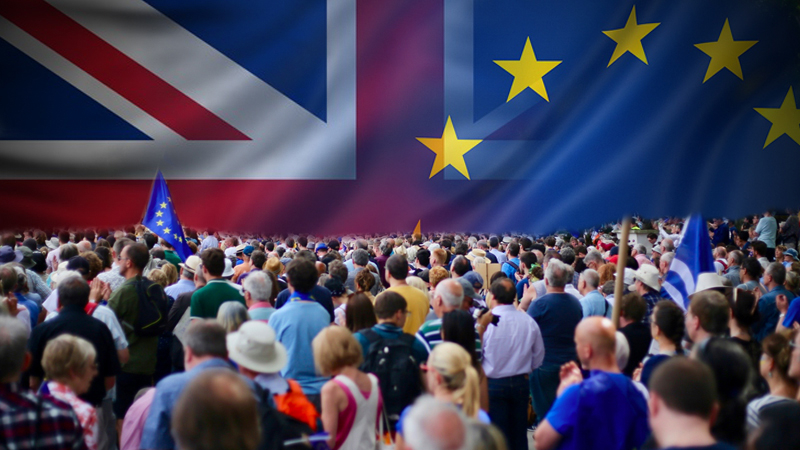
Those who voted against Brexit didn’t go gently into that good night. There were huge anti-Brexit rallies last year, with a million people on the streets of London, demanding a fresh Brexit vote with the option to remain in the European Union. These were some of the biggest protests in Britain’s history. Where do these people go?

The resistance showed itself in various forms.

There were groups like “Led By Donkeys,” a political campaign group that became something of a national phenomena. Four dads in their 40s began sneaking out in the middle of the night with buckets of wallpaper paste. Their aim was to hold leading Brexiteers to account by taking tweets and quotes from politicians and plastering them on giant billboards for the world to see.

Pictures of their billboards went viral.

One of their signs was a quote from the arch-Brexiteer David Davis, which was held aloft by thousands of anti-Brexiteers during a massive rally last March. The quote read: “If a democracy cannot change its mind, it ceases to be a democracy.”

“It showed a real hunger for that accountability,” said Ben Stewart, 45, one of the Donkey activists. He noted the signs were funny, too. “We tried to put humor at the center of it. These were dark times, if you’re a progressive internationalist, and hopefully we made people laugh and help them get through this and maybe contributed a little bit to holding power to account.”

Stewart said that although he was bummed about Brexit Day, “there’s much still to fight for.” He said his group would continue campaigning in 2020. “Our future relationship with Europe has not yet been defined,” he said. “And there’s still a role for groups like us to hold them to account.”

In the European capital of Brussels, many policymakers appear to be struck by grief that Brexit is really happening. Some of the most passionate voices in favor of Britain’s remaining a member of the club have come from non-Brits there, where for decades, whip-smart British diplomats helped guide discussions and shape the direction of the union.

No ceremonies are planned in Brussels to mark the big day on Friday. But on Wednesday, as lawmakers gathered in the European Parliament to give the final approval to Britain’s departure deal, one person after another spoke in passionate tones about close relations with Britain.

“Only in the agony of parting do we look into the depth of love,” said European Commission President Ursula von der Leyen, quoting George Eliot. “We will always love you, and we will never be far.”

Manfred Weber, the German leader of the center-right European People’s Party bloc in the parliament, said that some of his first discussions about the European Union took place over pints of Guinness in London when he was in college.

He said he hoped Britain would someday return.

“To the colleagues who will leave us, I tell you, I hope our work in the next years will make Europe so strong, so attractive, that your children and grandchildren will want to be part of the European Union once again,” he said.

After the vote, lawmakers joined hands to sing Auld Lang Syne and bid Britain a fond farewell.

Actual tears were shed.

Banks in concerted drive to offset virus impact on clients #ศาสตร์เกษตรดินปุ๋ย

#ศาสตร์เกษตรดินปุ๋ย : ขอบคุณแหล่งข้อมูล : หนังสือพิมพ์ The Nation

https://www.nationthailand.com/business/30381320?utm_source=category&utm_medium=internal_referral

Banks in concerted drive to offset virus impact on clients

Jan 30. 2020
Payong Srivanich

Payong Srivanich
By THE NATION

Several banks have launched urgent measures to cushion the impact of coronavirus crisis on their clients.

Krungthai Bank announced on Thursday (January 30) a loan programme to offset the pressure on its corporate customers in the tourism and export sector, especially companies that ship their products to China.

Under the campaign, customers in the hotel and export businesses, are offered a grace period on repayment of the loan principle for a maximum of 12 months.

Payong Srivanich, the bank’s president said the board was aware of the hardship of its clients in the tourism and export sectors.

On the same day (January 30), Government Housing Bank (GH Bank) announced an allocation of Bt1 billion for an emergency loan programme in support of existing clients affected by the novel coronavirus crisis.

Under the campaign, it will slash interest rate on current borrowing to 0.01 per cent for six months. This will lead to lower monthly installment payment as a result of the rate cut.

Eligible borrowers under the new programme must be existing customers of the bank before January 30.

They must also prove that their incomes have been affected by the virus outbreak, such as tour guides, hotel staff, or businesses selling products to Chinese tourists. Loan application period is set from January 30 to March 31 at GH Bank branches nationwide.

The bank wanted to provide relief to customers, said GH Bank President Chatchai Sirilai.

On January 29, Siam Commercial Bank (SCB) said it was offering a six-month grace period on repayment of the loan principal to existing customers in the hotel business. If the crisis prolongs, SCB said it would introduce further measures.

On the same day (January 29), Kasikornbank (KBank) announced its offering of a 12-month grace period on repayment of the loan principle to its existing clients of small and medium-sized enterprises (SMEs) in the tourism sector.

Meanwhile, the Bank of Thailand (BOT) on Thursday (January 30) urged financial institutions to provide assistance to clients affected by the crisis.

GH Bank follows lead on loans to clients amid virus outbreak #ศาสตร์เกษตรดินปุ๋ย

#ศาสตร์เกษตรดินปุ๋ย : ขอบคุณแหล่งข้อมูล : หนังสือพิมพ์ The Nation

https://www.nationthailand.com/business/30381313?utm_source=category&utm_medium=internal_referral

GH Bank follows lead on loans to clients amid virus outbreak

Jan 30. 2020
Chatchai Sirilai

Chatchai Sirilai
By THE NATION

Government Housing Bank (GH Bank) has allocated a budget of Bt1 billion for an emergency loan programme in support of existing clients affected by the novel coronavirus crisis.

Under the campaign, it will lower the interest rate on current borrowing to 0.01 per cent for six months. This will lead to lower installment payment as a result of the rate cut.

Eligible borrowers under the new programme must be existing customers of the bank before January 30. They must also prove that their incomes have been affected by the virus outbreak, such as tour guides, hotel staff, or businesses selling products to Chinese tourists.

Loan application period is set from January 30 to March 31 at GH Bank branches nationwide.

The bank wants to provide relief to customers, said president Chatchai Sirilai.

Other banks have also introduced relief measures amid the coronavirus crisis. On January 29 Siam Commercial Bank (SCB) announced its offering of a six-month grace period for repayment of the loan principal amount to existing customers in the hotel business, If the crisis prolongs, SCB said it would introduce further measures.

On the same day Kasikornbank (KBank) announced its offering a 12-month grace period on repayment of the loan principle amount to its existing small and medium-sized enterprises (SMEs) customers in the tourism sector as a measure to ease their financial burden amid impacts from the coronavirus crisis.

The Bank of Thailand (BOT) on Thursday (January 30) urged financial institutions to provide assistance to affected clients.

Baht hits lowest level in seven months amid virus worries #ศาสตร์เกษตรดินปุ๋ย

#ศาสตร์เกษตรดินปุ๋ย : ขอบคุณแหล่งข้อมูล : หนังสือพิมพ์ The Nation

https://www.nationthailand.com/business/30381297?utm_source=category&utm_medium=internal_referral

Baht hits lowest level in seven months amid virus worries

Jan 30. 2020
By The Nation

The baht depreciated to its lowest level in seven months on Thursday morning (January 30), touching Bt31.17 to the US dollar, down from Wednesday’s close of Bt31, Kangana Chockpisansin, senior analyst at Kasikorn Research Centre, said.

nvestors are worried about the impact of China’s virus outbreak, leading to sales of the baht.

The research house said that other currencies in the Asian region also had weakened along with the baht. Sales of Thai shares by foreign investors are also attributed to the weakening of the baht, Kasikorn Research said, predicting the baht would move in a range of Bt31 to 31.20 against the greenback.

The impact of the coronavirus outbreak is seen as cutting into Thailand’s current account surplus which in recent years had resulted in a relatively large surplus and pushed up the baht. This had caused concern among exporters who blamed the stronger baht for the slump in exports.

U.S. stocks struggle near Record; Treasuries rally #ศาสตร์เกษตรดินปุ๋ย

#ศาสตร์เกษตรดินปุ๋ย : ขอบคุณแหล่งข้อมูล : หนังสือพิมพ์ The Nation

https://www.nationthailand.com/business/30381277?utm_source=category&utm_medium=internal_referral

U.S. stocks struggle near Record; Treasuries rally

Jan 30. 2020
By Syndication Washington Post, Bloomberg · Rita Nazareth · BUSINESS, US-GLOBAL-MARKETS

U.S. stocks struggled Wednesday near record highs on speculation that a recent rally outpaced the risks to global economic growth. Bonds climbed.

The S&P 500 Index wiped out an early advance after Federal Reserve Chairman Jerome Powell said that uncertainties about the outlook remain – including those around trade policy and the coronavirus. Treasuries extended gains after he noted that the committee revised its language about inflation to clarify that policy makers aren’t comfortable with it below 2%.

In a highly anticipated decision, the Fed kept its key interest rate unchanged and continued to signal policy would stay on hold for the time being. As the earnings season continued to roll in Apple’s strong results sent the iPhone maker to a record while General Electric’s outlook topped Wall Street’s estimates. Boeing rallied on news that the planemaker burned less cash than expected.

– – –

Some other corporate highlights:

– McDonald’s sales in its home market beat expectations.

– Mastercard, Dow Inc. and T. Rowe Price reported better-than-estimated results.

– AT&T topped earnings estimates as cost cuts helped offset steep TV-subscriber losses and higher spending on its media business.

– EBay, Advanced Micro Devices and Xilinx gave lackluster guidance.

Elsewhere, oil fell after a government report showed the biggest jump in U.S. crude stockpiles since November. The European Parliament approved Prime Minister Boris Johnson’s Brexit deal, clearing the way for the U.K. to leave the EU on Jan. 31 with an agreement that, for the time being, will avoid a chaotic rupture.

– – –

Here are some events to watch out for this week:

– Samsung Electronics, International Paper, Unilever and Shell report on Thursday, followed by South Korean chip maker SK Hynix, Chevron, Caterpillar and Exxon Mobil all on Friday.

– The Bank of England meeting on Thursday is highly anticipated after a series of dovish comments raised speculation policy makers could lower interest rates.

– The U.S. reports fourth-quarter GDP on Thursday.

-The U.K. is scheduled to leave the European Union on Friday.

– – –

These are some of the main moves in markets:

Stocks

– The S&P 500 fell 0.1% as of 4 p.m. Eastern time. It closed at 3273.40, down 0.09 %. Nasdaq closed at 9275.16, up 0.06 % and Dow Jones Industrial Average closed at 28734.45, up 0.04 %.

– The Stoxx Europe 600 Index climbed 0.4%.

– The MSCI Emerging Market Index dipped 0.5%.

Currencies

– The Bloomberg Dollar Spot Index was little changed.

– The euro dipped 0.1% to $1.1006.

– The Japanese yen strengthened 0.1% to 109.06 per dollar.

Bonds

– The yield on 10-year Treasuries dipped seven basis points, to 1.59%.

– Germany’s 10-year yield fell four basis points, to -0.38%.

– Britain’s 10-year yield decreased four basis points, to 0.516%.

Commodities

– The Bloomberg Commodity Index dipped 0.6%.

– West Texas Intermediate crude dipped 0.6% to $53.15 a barrel.

– Gold rose 0.4% to $1,582 an ounce.

Federal Reserve leaves interest rates unchanged as U.S. economy continues at a slow and steady pace #ศาสตร์เกษตรดินปุ๋ย

#ศาสตร์เกษตรดินปุ๋ย : ขอบคุณแหล่งข้อมูล : หนังสือพิมพ์ The Nation

https://www.nationthailand.com/business/30381266?utm_source=category&utm_medium=internal_referral

Federal Reserve leaves interest rates unchanged as U.S. economy continues at a slow and steady pace

Jan 30. 2020
Fed assets
Photo by: Heather Long — The Washington Post

Fed assets Photo by: Heather Long — The Washington Post
By The Washington Post · Heather Long 

The Federal Reserve left interest rates unchanged Wednesday, a widely expected move as the U.S. economy continues to grow at a slow and steady pace.

The interest rate remains in a range of 1.5 to 1.75%, a low level by historical standards that is meant to give a modest boost to the economy by encouraging more lending and home buying. The Fed lowered interest rates three times last year, taking the rate down from a post-recession high of nearly 2.5%.

Interest rates are at an “appropriate” level the Fed concluded, but it said it will “monitor” ongoing issues at home and abroad.

Fed officials have been closely monitoring the impact of the trade war on the economy and there are new concerns about the deadly coronavirus in China and what that might mean to global supply chains, among other things.

Fears of a U.S. recession this year have largely faded since the Fed began cutting rates in July. Trump’s partial trade deal with China has also helped calm anxieties on Wall Street and among business leaders. On top of that, the Fed has been buying a substantial amount Treasury Bills since September, which some argue has propped up the stock market. The S&P 500 stock market index has risen about 10% since the Fed made a special announcement in October that it would buy more T-bills. Fed leaders insist these are merely technical adjustment to the central bank’s plumbing.

The Fed painted a mostly upbeat picture of the U.S. economy in a statement Wednesday, saying the economy is growing at a “moderate rate,” and the job market remains “strong.” But the Fed notably downgraded the language it uses to describe consumer spending, which accounts for 70% of the economy.

“Household spending has been rising at a moderate pace,” the Fed said Wednesday. Last year the Fed describe consumer spending as “strong.”

Fed leaders do not anticipate moving interest rates up or down at all in 2020, but Wall Street is currently predicting at least one cut, likely in July or September. Fed Chair Powell has said it would take a “material reassessment” of the economy’s health for the central bank to alter rates.

“The Fed is on standby, rather than on hold, which is a subtle but important difference,” said Axel Weber, chair of UBS bank and former head of Germany’s central bank, at the World Economic Forum last week.

Beyond interest rates, many investors are paying close attention to the Powell’s plans for the Fed’s balance sheet.

By 2017, the Fed held about $4.5 trillion in assets – mostly U.S. government bonds and mortgage-backed securities – as part of its efforts to stimulate the economy and keep interest rates low. But the Fed shed roughly $700 billion from mid-2017 through mid-2019. Banks grew worried that there was not enough liquidity in the system, especially cash “reserves” on hand at the Fed.

Since September, the Fed has bought about $400 billion worth of short-term Treasury bills to ensure there is enough money in the system to keep overnight borrowing rates for banks where the Fed wants them. Powell has indicated the central bank will continue pumping liquidity into the system “at least” through the second quarter, but he has not given much clarity around how many reserves he thinks the system needs or how the Fed will ween the market off this additional safety net.

“Our Treasury bill purchases should not be confused with the large-scale asset purchase programs that we deployed after the financial crisis,” Powell said in October.

The Fed’s statement Wednesday did not provide any clarify on plans for the balance sheet.

“This is tricky terrain for Powell and if mishandled could be disruptive,” wrote Krishna Guha, vice chair of Evercore ISI research in a note to clients this week.

Panel mulls darker outlook due to virus #ศาสตร์เกษตรดินปุ๋ย

#ศาสตร์เกษตรดินปุ๋ย : ขอบคุณแหล่งข้อมูล : หนังสือพิมพ์ The Nation

https://www.nationthailand.com/business/30381234?utm_source=category&utm_medium=internal_referral

Panel mulls darker outlook due to virus

Jan 30. 2020
Kalin Sarasin

Kalin Sarasin
By THE NATION

The Joint Standing Committee on Commerce, Industry and Banking has considered lowering its forecast for economic growth this year due to the impact of the coronavirus, Thai Chamber of Commerce president Kalin Sarasin said this week.

The forecast currently stands at 2.5-3 per cent.

But Kalin believes Chinese travellers will be back to Thailand once the virus outbreak that originated in central Wuhan is contained.

Speaking at a separate event on Wednesday (January 29), Deputy Prime Minister Somkid Jatusripitak said he wants the Finance Ministry to seek measures to encourage Thais to travel to offset the plunge in Chinese visitors due to the outbreak. He said it was one possible way of cushioning the blow to the Thai economy.

The Council of the Economic Ministers will discuss the virus’ impact on tourism on January 31, said Kobsak Pootrakool, deputy secretary-general for political affairs to the prime minister.

They will also consider a private-sector proposal that tourism-related businesses be allowed to postpone their tax payment by six months, he said.

Thanawat Phonvichai, president of the University of the Thai Chamber of Commerce, earlier predictedthat the coronavirus outbreak, if it continues into March, could cost the Thai tourism industry between Bt80 billion and Bt100 billion, or between 0.5 and 0.7 percentage points of national GDP.

He based his calculation on one million Chinese arrivals in Thailand per month, each person spending on average Bt50,000.

The virus has collapsed arrival numbers since the Chinese government banned overseas group tours and is hurting airlines, hotels and resorts and souvenir sales.

Economy shrinks in larger number of states, Fed gauge shows #ศาสตร์เกษตรดินปุ๋ย

#ศาสตร์เกษตรดินปุ๋ย : ขอบคุณแหล่งข้อมูล : หนังสือพิมพ์ The Nation

https://www.nationthailand.com/business/30381258?utm_source=category&utm_medium=internal_referral

Economy shrinks in larger number of states, Fed gauge shows

Jan 30. 2020
By Syndication Washington Post, Bloomberg · Alex Tanzi 
Economic activity shrank in eight . states and was stagnant in three others during the fourth quarter, according to the latest data from the Federal Reserve Bank of Philadelphia.

West Virginia’s economy contracted the most, while a decline in neighboring Pennsylvania was among the worst in the nation, based on state coincident economic indexes released by the regional Fed bank on Wednesday. While gauges increased in 39 states, a measure of economic activity for the nation as a whole fell to 62 at the end of the fourth quarter, the lowest reading since 2010.

A faltering economic outlook in Pennsylvania may play a role in President Donald Trump’s re-election bid. While employment increased in the Keystone State over the past three months, the unemployment rate increased significantly and average hours worked in manufacturing decreased.

Economies in Delaware, Iowa, Montana, Missouri, Oklahoma, and Vermont also declined compared with three months earlier. The three-month diffusion index now shows the greatest number of states contracting since the recession.

Nonetheless, the state-level figures are more volatile than national data, and single events, such as hurricanes, plant shutdowns, or temporary swings in demand for a particular product, can have outsize effects on those economies. The longest-running expansion on record is not expected to end soon, according to the consensus of economists surveyed by Bloomberg.

The coincident indexes combine four state-level indicators to summarize current economic conditions with a single statistic. The four state-level variables are payroll employment, average hours worked in manufacturing by production workers, the unemployment rate, and inflation-adjusted wages and salaries.

Trump signs USMCA, sealing political win with bipartisan deal #ศาสตร์เกษตรดินปุ๋ย

#ศาสตร์เกษตรดินปุ๋ย : ขอบคุณแหล่งข้อมูล : หนังสือพิมพ์ The Nation

https://www.nationthailand.com/business/30381253?utm_source=category&utm_medium=internal_referral

Trump signs USMCA, sealing political win with bipartisan deal

Jan 30. 2020
President Donald Trump signs the U.S.-Mexico-Canada Agreement (USMCA) on the South Lawn of the White House in Washington on Jan. 29, 2020. MUST CREDIT: Bloomberg photo by Andrew Harrer.

President Donald Trump signs the U.S.-Mexico-Canada Agreement (USMCA) on the South Lawn of the White House in Washington on Jan. 29, 2020. MUST CREDIT: Bloomberg photo by Andrew Harrer.
By Syndication Washington Post, Bloomberg · Justin Sink, Jordan Fabian 

President Donald Trump signed into law a new trade pact with Canada and Mexico on Wednesday, sealing a political victory that will help neutralize Democratic attacks on his economic record.

The U.S.-Mexico-Canada Agreement, or USMCA, delivers on one of Trump’s core campaign promises: to replace the Clinton-era North American Free Trade agreement that the president said has drained the U.S. of jobs.

“We are finally ending the NAFTA nightmare,” Trump said Wednesday at a signing ceremony on the White House South Lawn. He then read through an extensive list of Republican lawmakers, thanking them for their help passing the deal.

The trade accord marks a rare moment of bipartisanship, but the two sides aren’t sharing the glory. The White House attendance list for the event included 71 Republican lawmakers but no Democrats, who say they weren’t invited. Rep. Collin Peterson, the only remaining Democrat to vote against both articles of impeachment against Trump, said through a spokesman that he was invited but couldn’t attend. A White House spokesman didn’t immediately respond to questions on the invitations.

Democrats have taken aim at Trump’s economic policies — including tax cuts that benefited corporations and the wealthy — but attacking his approach to trade has proved more complicated as they compete for votes in swing states that have seen manufacturing jobs disappear.

Trump is scheduled to travel Thursday to Michigan and Iowa — where he’s expected to tout the agreement just as Democrats try to win over voters in next week’s Iowa caucuses.

The White House was able to garner bipartisan support for the USMCA by adding labor safeguards and altering protections for drug patents. The pact provides expanded access for U.S. agricultural exports, new rules of origin for auto parts and additional protections for internet companies.

White House aides argue that the deal shows that Trump is continuing to get work done despite the ongoing Senate impeachment trial over his efforts to pressure Ukraine to investigate former Vice President Joe Biden, a chief 2020 rival for the White House.

“He’s talked about USMCA, and he talked about the pro-growth initiatives and the economy that has boomed under him. So he keeps working — that’s fine,” White House Press Secretary Stephanie Grisham said in an interview with Fox News last Friday. “They’ll continue to scream impeachment — that’s fine.”

The new trade provisions are projected to add about 0.35% to the economy after six years. But the accord’s passage has had a more immediate effect on investors, easing concerns that Trump could disrupt the economy by pulling out of Nafta without a new deal in place.

Since Dec. 10 — when House Speaker Nancy Pelosi announced that she had struck a deal with the White House to pass the USMCA — the S&P 500 Index has gained about 4.6% and the Dow Jones Industrial Average has improved more than 3%. Markets were also bolstered during that period by a “phase one” trade deal with China.

Speaking before the signing, Pelosi said Democrats only agreed to support the deal after the White House caved to their demands for greater protections for American workers and the environment.

“What the president is signing is quite different than what the president sent us,” Pelosi said at a press conference on Capitol Hill.

House Ways and Means Chairman Richard Neal, D-Mass., said “the only reason the president is having the signing is because of the work House Democrats” did to improve labor and environmental protections.

A record 56% of Americans approve of Trump’s handling of the economy, according to a Washington Post and ABC News poll released this week. That’s a 10 percentage point improvement from September. And optimism about the economy appears to be off-setting the political damage from impeachment. The president’s overall approval rating matched his record high of 44% in the same survey.At the same time, just 5% of Americans say they disapprove of the USMCA, according to a Monmouth University poll released Tuesday.

Those trends — along with bipartisan congressional support for the pact — have effectively made USMCA a non-issue in the Democratic primaries.

Sen. Bernie Sanders of Vermont was the only Democratic presidential candidate to oppose the deal. He said it was an improvement over NAFTA but fell short of adequately protecting American jobs: “It is not going to stop outsourcing, it is not going to stop corporations from moving to Mexico.”

Sen. Elizabeth Warren, a Massachusetts Democrat, initially joined Sanders in criticizing the deal. During a 2018 speech on foreign policy at American University in Washington, she said the agreement, as written, wouldn’t halt outsourcing, raise wages or create jobs. But in January, she announced she would vote for it. Her campaign said the revised deal dropped a provision that would make it harder to bring down prescription drug prices, and offered stronger labor standards and more certainty for farmers.

Sen. Amy Klobuchar of Minnesota, who is running as a centrist alternative to the progressive Sanders, said in December she would vote for the pact. A day later, her moderate rival, Joe Biden, joined in support, emphasizing the elimination of loopholes for drug companies and strengthening enforcement for labor and environmental standards.

“What I’ve seen change is that the vast majority of the labor movement supported it,” Biden told reporters in Los Angeles.

Trump is looking to press his advantage on the campaign trail Thursday. The president will speak first at a Michigan auto parts facility in Macomb County, where the largest employers are three major automakers — General Motors, Fiat Chrysler Automobiles and Ford. During Trump’s last visit to Michigan in December, he touted USMCA as “great for the automobile business.”

Later Thursday, the president will head to Iowa before that state’s first-in-the-nation presidential caucuses. He is expected to tout the trade deal’s benefits for farmers in the region.

While companies across the country could benefit from the pact, many of the advantages appear clustered in swing states that could prove pivotal in November’s presidential election.

Stricter rules for auto manufacturing are intended to bolster production in the U.S. as well as the use of American steel and aluminum, which could help states including Michigan and Pennsylvania.

According to the administration, the deal would create 76,000 auto jobs and result in $34 billion in new automotive manufacturing investments. It also opens Canada’s market to U.S. dairy producers, an important issue for Wisconsin, and is expected to create 176,000 new jobs.

The president’s victory tour begins with Wednesday’s ceremony at the White House, but his signature won’t finalize the agreement. Canada still must ratify the deal, and Prime Minister Justin Trudeau — who lost his parliamentary majority in October elections — may need to broker deals with his political rivals to ensure passage.