Steady U.S. GDP could mask weakening consumption #ศาสตร์เกษตรดินปุ๋ย

#ศาสตร์เกษตรดินปุ๋ย : ขอบคุณแหล่งข้อมูล : หนังสือพิมพ์ The Nation

https://www.nationthailand.com/business/30381246?utm_source=category&utm_medium=internal_referral

Steady U.S. GDP could mask weakening consumption

Jan 30. 2020
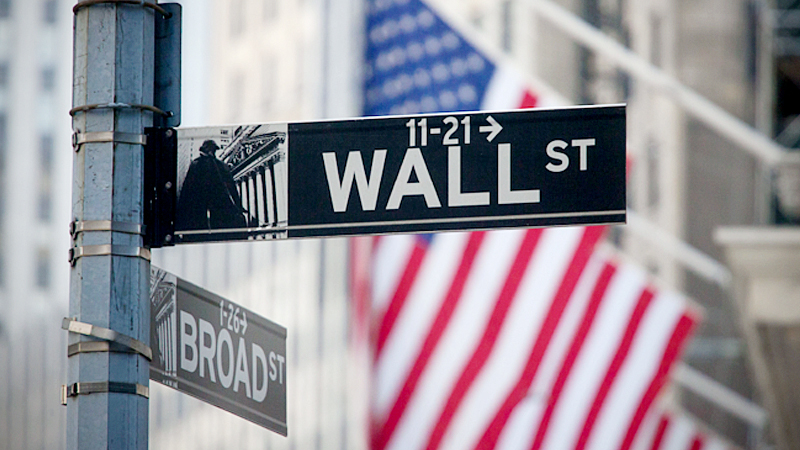
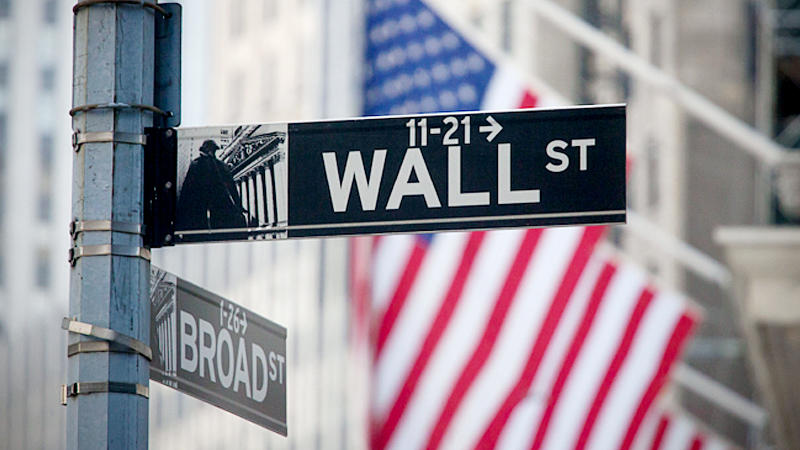
File Photo
By Syndication Washington Post, Bloomberg · Reade Pickert, Max Reyes 
On the surface, U.S. economic growth last quarter is projected to look decent and little changed from the prior period. But the main figure could mask a misfire in the economy’s chief engine: the consumer.

Gross domestic product probably climbed at an annualized 2.1% rate for a second straight quarter, according to the median forecast in a Bloomberg survey of economists before the Commerce Department’s report on Thursday. However, the principal sources of fuel for the top-line number — a narrower trade deficit, driven almost entirely by a drop in imports, and stronger residential investment — likely helped offset a pullback in personal consumption.

Household spending, coming off the best consecutive quarters since late-2014 to early 2015, kept economic growth on pace last year through stiff headwinds including a corporate investment slowdown, the U.S.-China trade war and the grounding of Boeing Co.’s 737 Max plane. But in the fourth quarter, economists forecast personal consumption rose just 2%, down from 3.2% in the third quarter and 4.6% in the second.

A downshift in spending is in line with economists’ expectations for a moderating growth picture that makes achieving President Donald Trump’s goal of 3% economic growth more challenging ahead of the November election. Year-over-year GDP growth is forecast to slow to 1.8% in the fourth quarter of 2020, down from 2.3% in 2019 and 2.5% in 2018.

While still a solid pace, the question of 2020 becomes: “Can the consumer continue to sustain the expansion while we’re in this soft patch of business spending?” said Brett Ryan, senior U.S. economist at Deutsche Bank. “The fourth-quarter GDP data may call that into question.”

Consumer spending, which accounts for about 70% of GDP, is always an important driver of growth, but two consecutive quarters of falling business investment have shifted the responsibility of keeping the expansion afloat squarely on the back of American shoppers.

While consumers and the economy had the benefit of three Federal Reserve rate cuts in 2019, the central bank’s policy makers are seen keeping borrowing costs steady at their meeting Wednesday and the rest of the year. Still, traders are increasingly projecting an interest-rate cut this year given the quickly spreading coronavirus in China that has the potential to disrupt demand.

A healthy labor market — characterized by the lowest unemployment rate in a half century and rising participation — and elevated consumer sentiment should underpin spending in the months ahead, but the waning effects of tax cuts along with moderate wage gains may limit consumption.

At the same time, while consumer spending on goods and services may have cooled in the fourth quarter, Americans were busy buying homes. After more than a year of weighing on growth, a housing rebound is expected to soften the blow from another quarter of lackluster nonresidential investment.

Meanwhile, net exports could add 1.7 percentage points to GDP, offsetting a drag from inventories, according to Citigroup analysts. The outsize contribution would be the most since 2009.

Like the overall GDP reading, the strength stems more from the figure’s accounting than actual strength in the underlying fundamentals. Exports have increased slightly but remain broadly unchanged while imports have sharply dropped.

Offsetting a weaker consumer are “lower imports, which is generally not a wonderful sign in terms of the vitality of the domestic economy,” said Joshua Shapiro, chief U.S. economist at Maria Fiorini Ramirez Inc. “When the economy is strong and demand is strong, imports tend to grow, not shrink.”

The severity of the pullback, however, probably reflects American companies trying to get ahead of some of the tariffs earlier in the year. Leading up to the Sept. 1 U.S. tariffs on Chinese consumer goods, America saw a boost in imports. Those figures have dropped more than 4% since then.

Still, some of last year’s headwinds, might now be turning into tailwinds, David Solomon, chief executive officer at Goldman Sachs, said during a panel at the World Economic Forum in Davos, Switzerland. “Stage 1 of the China deal obviously is a big one.”

The partial trade agreement signed earlier this month has the potential to stimulate corporate investment once again and shift some of the heavy lifting away from consumers.

All in all, despite the variety of headwinds the economy faced last year, “we continue to see economic growth chug along,” said Sarah House, senior economist at Wells Fargo. “Consumers are still in pretty good shape.”
Trump signs USMCA deal, revamping North American trade rules #ศาสตร์เกษตรดินปุ๋ย

#ศาสตร์เกษตรดินปุ๋ย : ขอบคุณแหล่งข้อมูล : หนังสือพิมพ์ The Nation

https://www.nationthailand.com/business/30381244?utm_source=category&utm_medium=internal_referral

Trump signs USMCA deal, revamping North American trade rules

Jan 30. 2020
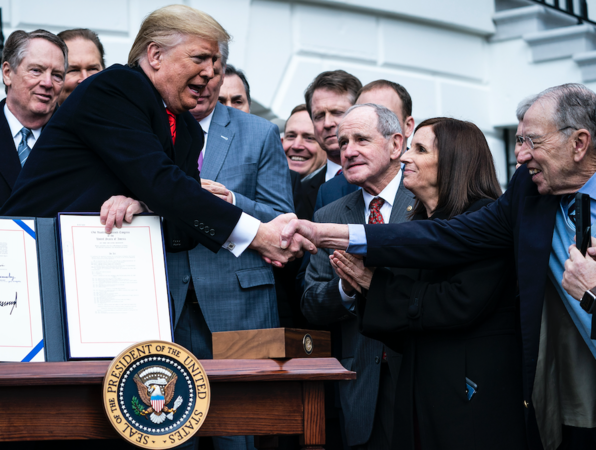
President Donald Trump participates in a signing ceremony for the United States-Mexico-Canada Trade Agreement at the White House on Wednesday, Jan 29, 2020. MUST CREDIT: Washington Post photo by Jabin Botsford
By The Washington Post · Jeff Stein 
WASHINGTON – President Donald Trump signed a revamped trade agreement with Canada and Mexico into law on Wednesday, achieving his pledge to rework the North American Free Trade Agreement even as he contends with the Senate impeachment trial.

The revised treaty, called the U.S.-Mexico-Canada Agreement (USMCA), creates new environmental and labor standards for the countries, while also giving farmers greater access to Canadian markets and ensuring car companies have to use a higher share of parts within North America in their production, among other changes.

Mexico has already ratified the deal, and Canada is expected to formally approve it very soon.

Trump was able to win congressional support for the deal because of substantive changes he made to win support from Democrats and labor unions. But no Democratic lawmakers were present at the signing ceremony. U.S. Trade Representative Robert Lighthizer had told lawmakers he wanted Democrats to be included at the event but was unsuccessful in doing so, according to two people familiar with the talks granted anonymity to share private conversations. A spokesman for USTR did not immediately respond to request to comment.

At the ceremony, Trump hailed the “momentous, historic, and joyous occasion” and said the deal would eliminate outsourcing to keep jobs in America. Vice President Mike Pence and Jared Kushner, an adviser and the president’s son-in-law, were among those in attendance. Dozens of Republican lawmakers also attended.

Trump also called the original NAFTA a “catastrophe” and said revamping the deal was the reason he ran for president and abandoned the “beautiful, simple life of luxury I lived” as a private businessman and celebrity.

“This is a cutting edge, state-of-the-art agreement that protects and defends the people of our country,” Trump said.

Bipartisan majorities in Congress approved the trade deal by wide margins, with the package sailing through the Senate by an 89 to 10 vote margin. Democrats touted a series of changes they helped secure in the pact to beef up its labor and environmental protections in months of talks with Lighthizer.

“This is a celebration of what Democrats were able to secure,” said Rep. Rosa DeLauro, D-Conn., a longtime free trade skeptic who endorsed the deal, in a press call on Wednesday. “We secured positive changes on environmental standards, labor standards, and access to medicine.”

It is unclear if the trade deal will reverse decades of damage to America’s industrial sector. U.S. factory payrolls dropped by close to 6 million after the original 1994 NAFTA and the entrance of China in 2001 to the World Trade Organization. The USMCA is likely to only add 50,000 of these jobs, the International Trade Commission has found.

The agreement also scrapped the original NAFTA’s Investor-State Dispute Settlement system, which gave corporations extensive authority to sue foreign governments forced to comply with business-friendly panels.

“That’s a dramatic change,” said Lori Wallach, a trade expert at Public Citizen, a left-leaning advocacy organization.

The revised North American trade came just weeks after Trump signed a partial trade deal with China, and White House officials have said the hardball tactics that the president has used to extract changes from U.S. trade partners have proven effective.

The North America deal was supported by the AFL-CIO, one of the largest unions in the country, as well as leading business groups such as the U.S. Chamber of Commerce and Business Roundtable. Other union groups, such as International Association of Machinists and Aerospace Workers, opposed it. The United Food and Commercial Workers International Union also criticized the agreement for not including “country-of-origin labeling” intended to ensure food safety and prevent foreign companies from skirting food production standards.

Many of the nation’s leading environmental organizations, including the Sierra Club and the League of Conservation Voters, also blasted the agreement as failing to ignore climate change and helping “corporate polluters.”

The vast majority of the Democratic caucus, as well as most of the leading Democratic presidential candidates, backed the effort. Sen. Bernie Sanders, I-Vt., voted against the package, citing the opposition of environmental groups and the Machinists Union.

Two banks offer grace periods on loan repayment #ศาสตร์เกษตรดินปุ๋ย

#ศาสตร์เกษตรดินปุ๋ย : ขอบคุณแหล่งข้อมูล : หนังสือพิมพ์ The Nation

https://www.nationthailand.com/business/30381238?utm_source=category&utm_medium=internal_referral

Two banks offer grace periods on loan repayment

Jan 29. 2020
Predee Daochai

Predee Daochai
By THE NATION

Kasikornbank (KBank) has offered a 12-month grace period on repayment of the loan principle amount to its existing small and medium-sized enterprises (SMEs) customers in the tourism sector as a measure to ease their financial burden amid impacts from the coronavirus crisis.

The bank is surveying impacts of the virus outbreak on its corporate customers, said president Predee Daochai in a statement on Wednesday (January 29).

Earlier, Siam Commercial Bank (SCB) said it was offering a six-month grace period for repayment of the loan principal amount to existing customers in the hotel business affected by the coronavirus outbreak.

If the crisis prolongs, SCB said it would introduce further measures in support of clients, said president Sarut Ruttanaporn.

Thanawat Phonvichai, president of the University of the Thai Chamber of Commerce, predicted that the problem, if prolonged until March, could cost the Thai tourism industry between Bt80 billion to Bt100 billion this year.

His estimate was based on the usual number of Chinese tourist arrivals in Thailand of around one million a month with average spending of Bt50,000 each.

Stocks shake off virus dread in busy earnings week #ศาสตร์เกษตรดินปุ๋ย

#ศาสตร์เกษตรดินปุ๋ย : ขอบคุณแหล่งข้อมูล : หนังสือพิมพ์ The Nation

https://www.nationthailand.com/business/30381212?utm_source=category&utm_medium=internal_referral

Stocks shake off virus dread in busy earnings week

Jan 29. 2020
By Syndication Washington Post, Bloomberg · Rita Nazareth, Vildana Hajric 

U.S. stocks climbed the most since October on speculation that efforts to contain the coronavirus will prevent a major economic fallout.

The S&P 500 Index rebounded from its worst sell-off in four months, with technology shares leading the charge. Some of the companies that suffered the biggest losses during the latest equity rout, such as chipmakers, casino operators and airlines, advanced on Tuesday. Demand for havens cooled, sending Treasuries and gold lower. After the close of regular trading, Starbucks Corp. reported earnings that beat analyst estimates.

Stocks Turnaround Got Few Cheering With Uncertainty Running High

Equities rallied after a slide that wiped about $1.5 trillion off the value of world stocks since Jan. 20. As it’s too early to assess the full impact of the deadly virus, traders digested some positive readings on U.S. consumer confidence and home prices. With earnings continuing to roll in, investors will be looking for signs of how the disease is affecting operations in China.

“We kind of stall a little bit on the Chinese recovery, but we have a lot of other things going in favor of a global recovery anyway,” Stephen Auth, chief investment officer of equities at Federated Investors, told Bloomberg TV. “We still think that’s coming.”

– – –

Some corporate highlights:

– PulteGroup Inc. climbed after reporting better-than-expected quarterly orders.

– Lockheed Martin Corp. rose on sales that beat the highest estimate.

– Acceleron Pharma Inc. surged on mid-stage results for its medicine aimed at treating a type of lung and heart disorder.

– 3M Co. sank after revealing it had received a grand jury subpoena in an environmental probe and saying it would cut 1,500 jobs.

– Harley-Davidson Inc. slid after quarterly profit missed estimates.

– Pfizer Inc. tumbled as a drop in sales overshadowed the company’s projections for a better-than-feared 2020.

– – –

Here are some events to watch out for this week:

– Wednesday brings reports from GE, Boeing and Facebook; Samsung Electronics, International Paper, Unilever and Shell report on Thursday, followed by South Korean chip maker SK Hynix, Chevron, Caterpillar and Exxon Mobil all on Friday.

– Federal Reserve policy makers on Wednesday are expected to open 2020 the same way they closed 2019, by holding rates steady.

– Goldman Sachs will hold its first-ever Investor Day on Wednesday.

– The Bank of England meeting on Thursday is highly anticipated after a series of dovish comments raised speculation policy makers could lower interest rates.

– The U.S. reports fourth-quarter GDP Thursday.

– The U.K. is scheduled to leave the European Union Friday.

– – –

These are the main moves in markets:

Stocks

– The S&P 500 climbed 1% as of 4 p.m. New York time.

– The Stoxx Europe 600 Index rose 0.8%.

– The MSCI Emerging Market Index was little changed.

Currencies

– The Bloomberg Dollar Spot Index decreased 0.1%.

– The euro was unchanged at $1.1019.

– The Japanese yen weakened 0.2% to 109.14 per dollar.

Bonds

– The yield on 10-year Treasuries rose four basis points, to 1.65%.

– Germany’s 10-year yield climbed four basis points, to -0.34%.

– Britain’s 10-year yield jumped four basis points, to 0.552%.

Commodities

– The Bloomberg Commodity Index advanced 0.1%.

– West Texas Intermediate crude rose to $53.48 a barrel.

– Gold decreased 0.5%, to $1,575.80 an ounce.

S. Korea’s consumer sentiment sharply improves for Jan. #ศาสตร์เกษตรดินปุ๋ย

#ศาสตร์เกษตรดินปุ๋ย : ขอบคุณแหล่งข้อมูล : หนังสือพิมพ์ The Nation

https://www.nationthailand.com/business/30381206?utm_source=category&utm_medium=internal_referral

S. Korea’s consumer sentiment sharply improves for Jan.

Jan 29. 2020
(Yonhap)

(Yonhap)
By The Korea Herald/ANN

South Korea’s consumer sentiment improved sharply from a month earlier in January, central bank data showed Wednesday, amid outlooks that the country’s economic conditions will improve down the road.

The composite consumer sentiment index came to 104.2 for the month, up from 100.5 for the previous month, according to the data from the Bank of Korea.

The reading marks the highest since June 2018, as well as the largest on-month gain since September 2019, when the index jumped 4.6 points from a month earlier but still fell short of the benchmark 100 at 97.0.

A reading above 100 means optimists outnumber pessimists, while a reading below the benchmark means the opposite.

Local consumers apparently saw future improvements in conditions for their own livelihoods and the country’s economy.

The index measuring their sentiment toward their current economic conditions came to 93 in January, up 1 point from a month earlier.

The index on their livelihood in the future, on the other hand, jumped 3 points to 97, with the index on their outlook for their future income also adding 3 points from a month earlier to 101.

The index for their sentiment toward current economic conditions came to 78, up 4 points from a month earlier. The index for their outlook on economic conditions six months from now came to 87, compared with 82 registered in December, according to the BOK.

The central bank has forecast the local economy to grow 2.3 percent this year, accelerating from last year’s 2 percent expansion in 2019 that marked the slowest on-year growth in a decade. (Yonhap)

Bt100 bn new investment seen in latest tax, loan measures #ศาสตร์เกษตรดินปุ๋ย

#ศาสตร์เกษตรดินปุ๋ย : ขอบคุณแหล่งข้อมูล : หนังสือพิมพ์ The Nation

https://www.nationthailand.com/business/30381191?utm_source=category&utm_medium=internal_referral

Bt100 bn new investment seen in latest tax, loan measures

Jan 28. 2020
Lavaron Sangsnit

Lavaron Sangsnit
By THE NATION

The Cabinet on Tuesday (January 28) approved the new tax and loan measures proposed by the Finance Ministry, expected to attract new investment of up to Bt110 billion this year, said Finance Ministry’s spokesman Lavaron Sangsnit.

Leading the measures is the incentive of tax deduction, allowing companies to deduct expense of their investment in machinery at 2.5 times of the actual cost. It covers investments from January 1 to December 31, 2020.

The second is the exemption of tariffs on 146 items of imported machinery. They must be new machinery to be used for the business of the importer, and not imported for sales or be used in household. This will come into effect from the date the ministry announces the regulations until the end of this year.

Another one is the Bt5 billion loans from the Export-Import Bank of Thailand for the purchases of new machinery and improvement of existing items. It offers a fixed annual interest rate of 2 per cent during first two years, and 4 per cent during the following three years.

Maximum lending is set at Bt100 million per borrower, available until December 31,2020.

State banks have also offered loans with low interest rates for investment in certain ventures, as the New-S-Curve businesses in the Eastern Economic Corridor. The S-Curve businesses range from robotics to medical hub.

He added that the ministry has estimated that these new measures will lead to Bt110 billion in new investment this year.

TAT meets private sector to explore ways to assist operators hurt by virus outbreak #ศาสตร์เกษตรดินปุ๋ย

#ศาสตร์เกษตรดินปุ๋ย : ขอบคุณแหล่งข้อมูล : หนังสือพิมพ์ The Nation

https://www.nationthailand.com/business/30381175?utm_source=category&utm_medium=internal_referral

TAT meets private sector to explore ways to assist operators hurt by virus outbreak

Jan 28. 2020
By THE NATION

The Tourism Authority of Thailand will hold a meeting with the private sector on Tuesday (January 28) to seek remedial measures for those in the tourism sector affected by the coronavirus outbreak, Minister of Tourism and Sports Pipat Ratchakitprakarn said.

The results of the meeting will be placed before the council of economic ministers on January 31.

He will also report the impact of the virus outbreak to Cabinet today. The ministry has already convened a meeting with tourism business operators on Monday on the situation.

TAT governor Yutthasak Supasorn said that the authority will revise the plan to be presented to the economic ministers council on January 31 by focusing on how to remedy affected private parties, a change from the previous focus on boosting tourism.

It will also focus on how to draw tourists from other countries to offset the loss of Chinese tourists.

He added that the number of Chinese arrivals to Thailand is 800,000 on average per month.

Increase in revenue, cost reduction critical for THAI: Thaworn #ศาสตร์เกษตรดินปุ๋ย

#ศาสตร์เกษตรดินปุ๋ย : ขอบคุณแหล่งข้อมูล : หนังสือพิมพ์ The Nation

https://www.nationthailand.com/business/30381166?utm_source=category&utm_medium=internal_referral

Increase in revenue, cost reduction critical for THAI: Thaworn

Jan 28. 2020
By The Nation

Deputy Transport Minister Thaworn Senneam discussed the open sky policy and emphasised the importance of increasing revenue and reduction of expenses for Thai Airways International Pcl (THAI) to turnaround its fortunes and become a sustainable operation in the future.

Thaworn, Jua Ratchasri, assistant secretary at the Ministry of Transport, along with other officials visited THAI’s headquarters to follow up on policy implementation and take stock of the situation.

Thaworn also looked at operational problems and obstacles faced by THAI in improving its financial results and becoming one of the world’s leading airlines. He followed up on the ministry’s policy, such as turnaround plan and business plan, acquisition plan for 38 aircraft, company management and structure, the U-Tapao aircraft maintenance centre, plans to boost revenue and operating results. Additional policies were also presented, such as human resource management, managing company property to extract maximum benefit, manage and improve sales and marketing between THAI and Thai Smile.

THAI president Sumeth Damrongchaitham said they were acting on the policies issued by the Transport Minister, which will be used in resolving accumulated financial losses and achieving longstanding profitability. He said progress was being made on some of the projects.

THAI is reconsidering its long-term plan for 2019-26 to acquire 38 aircraft. THAI’s board of directors approved the plan to acquire the aircraft to replace 17 aircraft that will be decommissioned, which must be suitable for the financial situation and altered conditions. The management will study aircraft types and present the results to the board in February 2020. The company will present information on the number of aircraft, acquisition methods and investment sources for consideration of the board at their meeting in March. This plan will help the company to grow continuously and not be a financial burden. It will be presented to the Ministry of Transport by March 31.

Regarding the Maintenance, Repair, and Overhaul Centre (MRO), THAI has sent information on bidding to investors. The deadline for submission of proposals is March 6, to enter into the negotiation process, conclude the selection results and draft the Public

Private Partnership Agreement (PPPA) that would be submitted to the Office of the Attorney-General and the Eastern Economic Corridor (EEC) Policy Committee. After that it will be proposed to the Cabinet in August. The company expects to sign the PPPA with the bid winner by the end of August. It is expected that the new MRO centre at U-Tapao will be operational by April 2023.

Meanwhile, negotiations are going on between the THAI and Rolls Royce over demand for damages. THAI is seeking compensation from Rolls Royce for the period THAI’s aircraft was not operational as they were awaiting spare parts, resulting in damages and lost business opportunities.

The company is working on increasing revenue according to the Middle Turnaround Plan (2020-24) through innovation and digital technology, implementing modern technology in various projects such as TG Digital Technology, sales development plan and boosting of ancillary revenue in order to improve online sales.

THAI is in the process of implementing cost reduction and cost control as well as organisational restructuring.

Today is more evidence for bitcoin’s claim to being a safe haven #ศาสตร์เกษตรดินปุ๋ย

#ศาสตร์เกษตรดินปุ๋ย : ขอบคุณแหล่งข้อมูล : หนังสือพิมพ์ The Nation

https://www.nationthailand.com/business/30381152?utm_source=category&utm_medium=internal_referral

Today is more evidence for bitcoin’s claim to being a safe haven

Jan 28. 2020
File Photo: Getty Images

File Photo: Getty Images
By Syndication Washington Post, Bloomberg · Brandon Kochkodin

Bitcoin’s claim for being digital gold appears to have another piece of evidence in its corner.

In a day where global stocks plunged on concerns over the impact of the deadly coronavirus, the largest cryptocurrency gained as much as 3.5% while gold rose as much as 1.1%.

Of course one day of trading does not a safe haven make. Critics of the assertion, or some would say mantra, that bitcoin is a digital analogue to the precious metal could rightly point to a falling short-term correlation between the two assets throughout the fourth quarter of 2019. As bitcoin’s price fell from more than $12,000 a coin last summer to less than $7,000 in the fall, gold rallied by about 20%.

But since the beginning of the new year, the two assets 60-day correlation has flipped from negative to positive. The correlation coeffecient now stands at 0.21, up from a low of negative 0.15 in December, and above the trailing one-year daily average.

Don’t care for statistical analysis? Well then take a look at how the cryptocurrency performed on another tumultuous day this year. Bitcoin and gold moved in tandem in the hours after Iran retaliated with a missile strike against the U.S. for the killing of General Qassem Soleimani.

Stocks tumble around the world on virus jitters, bonds rise #ศาสตร์เกษตรดินปุ๋ย

#ศาสตร์เกษตรดินปุ๋ย : ขอบคุณแหล่งข้อมูล : หนังสือพิมพ์ The Nation

https://www.nationthailand.com/business/30381151?utm_source=category&utm_medium=internal_referral

Stocks tumble around the world on virus jitters, bonds rise

Jan 28. 2020
By Syndication Washington Post, Bloomberg News · Rita Nazareth, Vildana Hajric 

Stocks slumped and bonds rallied as concern over the impact of a deadly virus that originated in China rattled global markets.

The S&P 500 Index fell the most in almost four months, the Dow Jones Industrial Average erased its 2020 gain and the Nasdaq-100 Index had the biggest drop since August. Chipmakers, cruise lines and casino operators were among the hardest hit as investors fled companies with close links to China. A gauge of U.S. equity volatility surged above its one-year average. European and emerging-market shares slid to the lowest since mid-December.

China’s financial markets will remain closed until Feb. 3 after authorities extended the Lunar New Year break by three days as they grapple with the virus crisis. Assets that track the country’s largest stocks took a nosedive, with the iShares MSCI China ETF and Invesco China Technology ETF dropping more than 3.5%. China-based Alibaba Group Holding Ltd. and Yum China Holdings Inc. also slid. The offshore yuan sank, breaching key technical levels.

The flight to safety, which comes ahead of this week’s Federal Reserve meeting, saw volumes in Treasury futures jump to double their regular levels in Asia. The yield on 10-year U.S. bonds dropped to the lowest since October, while the dollar rose. The Swiss franc, the Japanese yen and gold paced gains in haven assets. Oil slipped to a more than three-month low, copper had its longest slump since 2014 and iron ore tumbled.

Fears that China has failed to contain the pneumonia-like virus – which has killed at least 80 people and infected more than 2,700 – roiled markets at the start of a week jam-packed with corporate earnings. The outbreak has shattered a calm in markets that hasn’t seen a 1% up-or-down move in the S&P 500 since early October.

“This is now a sell first, ask questions later situation,” said Alec Young, managing director of global markets research at FTSE Russell. “Markets hate uncertainty, and the coronavirus is the ultimate uncertainty – no one knows how badly it will impact the global economy. China is the biggest driver of global growth, so this couldn’t have started in a worse place.”

As global shares sell off, JPMorgan Chase & Co. strategists say this could end up a buying opportunity. They retained a constructive view on world equities, adding that in the past, the more stocks have fallen on similar fears, the more they have rebounded later. Both the S&P 500 and MSCI All-Country World Index surged to records this month as 2020 started on a jubilant note amid optimism over the U.S.-China trade deal.

“We thought the markets were overdue for a pullback,” Lori Calvasina, head of U.S. equity strategy at RBC Capital Markets, told Bloomberg TV. “Valuations are extremely stretched right now and positioning is extremely euphoric. We’ve said that if the right catalyst came along, markets would be ripe for a pullback.”

Here are some events to watch out for this week:

– – –

– Tech giants Apple, SAP, Facebook, Samsung and South Korean chip maker SK Hynix announce earnings, as do Boeing, International Paper, GE, United Technologies, Lockheed Martin, Caterpillar, Unilever, Exxon Mobil, Shell and Chevron.

– Fed policy makers are expected to open 2020 the same way they closed 2019 – by holding interest rates steady Wednesday.

– Goldman Sachs will hold its first-ever Investor Day on Wednesday.

– The BOE meeting is highly anticipated Thursday after a series of dovish comments raised speculation policy makers could lower interest rates.

– The U.S. reports fourth-quarter GDP Thursday.

– The U.K. is scheduled to leave the European Union on Friday.

– – –

These are some of the main moves in markets:

Stocks

– The S&P 500 slid 1.6% as of 4 p.m. New York time.

– The Stoxx Europe 600 Index sank 2.3%.

– The MSCI Emerging Market Index fell 1.5%.

Currencies

– The Bloomberg Dollar Spot Index rose 0.2%.

– The euro was little changed at $1.102.

– The Japanese yen appreciated 0.4% to 108.88 per dollar.

Bonds

– The yield on 10-year Treasuries slid nine basis points, to 1.60%.

– Germany’s 10-year yield dipped five basis points, to -0.39%.

– Britain’s 10-year yield declined five basis points, to 0.508%.

Commodities

– The Bloomberg Commodity Index decreased 1.4%.

– West Texas Intermediate crude dipped to $53.14 a barrel.

– Gold rose 0.3%, to $1,583.70 an ounce.