Thai tourism faces up to Bt100 bn loss from fear of virus #ศาสตร์เกษตรดินปุ๋ย

#ศาสตร์เกษตรดินปุ๋ย : ขอบคุณแหล่งข้อมูล : หนังสือพิมพ์ The Nation

https://www.nationthailand.com/business/30381145?utm_source=category&utm_medium=internal_referral

Thai tourism faces up to Bt100 bn loss from fear of virus

Jan 28. 2020
Thanawat, left

Thanawat, left
By THE NATION

The coronavirus outbreak, if prolonged until March, could cost the Thai tourism industry between Bt80 billion to Bt100 billion or between 0.5 percentage point and 0.7 percentage point of the country’s GDP, said Thanawat Phonvichai, president of the University of the Thai Chamber of Commerce.

He added that his estimate on the loss was based on the number of Chinese arrivals in Thailand of around one million per month with approximate spending of Bt50,000 per head.

The virus has resulted in a decline in the number of Chinese arrivals as China recently banned overseas group tours. This will hurt airline, hotels and resort businesses as well as the sales of souvenir.

When coupled with other negative factors, it will result in the growth of Thai GDP lower than 2.5 per cent this year, he added.

Thai Airways International president Sumeth Damrongchaitham said that the outbreak had affected THAI operations to a certain extent as the carrier operates few routes to China.

Investors advised to hold onto cash , amid deadly virus outbreak #ศาสตร์เกษตรดินปุ๋ย

#ศาสตร์เกษตรดินปุ๋ย : ขอบคุณแหล่งข้อมูล : หนังสือพิมพ์ The Nation

https://www.nationthailand.com/business/30381150?utm_source=category&utm_medium=internal_referral

Investors advised to hold onto cash , amid deadly virus outbreak

Jan 28. 2020
By The Nation

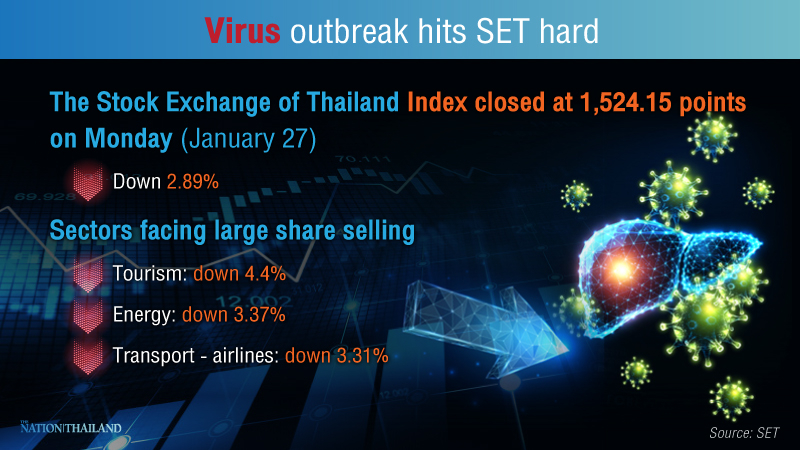
The Stock Exchange of Thailand (SET) Index plunged on Monday (January 27), closing at 1,524.15 or down 2.89 per cent from the end of trade last week amid investors’ concerns over impact of the coronavirus outbreak.

Yuanta Securities (Thailand)’s managing director Padermpob Songkroh said:” holding onto cash is the most practical thing to do in the present situation. Also, investors should follow reports on the coronavirus development from the World Health Organisation (WHO). There are many uncertainties regarding the economic direction”.

“Stocks in the electronics sector are the least affected at the moment,” he added.

Meanwhile, Asia Plus Securities said concerns about the economic situation caused the baht to appreciate to Bt30.63 per US dollar on Monday, the highest level in two and a half months.

However, the baht had weakened recently in line with other currencies in the region, due to economic concerns, outbreak of the virus and geopolitical tensions. The Japanese yen appreciated by 1 per cent on Monday, seen as a   safe haven currency by investors.

Weakening of the baht proved positive to stocks relying on exports, such as  food and agriculture, due to higher revenues in dollar term.

Stocks in this group include STA, TU, CPF, KSL, and GFPT.

Stocks of electronic component exporters and power companies also reaped  benefits from the weakened baht, including DELTA, HANA, KCE, and SVI.

For power plant stocks, the weakened baht led to an increase in revenues from  electricity sales as some price calculation formulas are tied to the currency exchange rates.

However, if the baht become weaker at the end of this quarter than the end of the fourth quarter last year, losses will occur from exchange fluctuation.

KGI Securities estimated that the index could fall to its lowest point in mid-February, referring to statistics of the SARS’ outbreak 17 years ago.

“We recommend buying low-risk stocks with high earning stability and outstanding dividends stocks instead of global cyclical stocks,” it said.

Three sectors have been hit hardest by outbreak of the virus: tourism, energy, transportation and airlines with their stocks down by 4.41 per cent 3.37 per cent and 3.31, respectively on Monday.

Meanwhile, Kobsidthi Silpachai, head of capital markets research at Kasikorn Bank said impact on the financial market depended on how fast the virus outbreak could be contained. Many investors pointed to the SARS outbreak in 2002 as a guide, which lasted several months.

The baht was down about 0.4 per cent against US dollar on Monday as investors worried that the virus outbreak could cut into Thai tourism revenue and current account surplus. He said there were many unknown factors that could derail the Thai economy. “Tourism is the last hope beside government spending ,” he said in referring to the delay in the passage of the government budget for fiscal 2020, slow recovery of exports and impact of the virus outbreak on tourism.

Japan retailers take hit from virus at home and abroad #ศาสตร์เกษตรดินปุ๋ย

#ศาสตร์เกษตรดินปุ๋ย : ขอบคุณแหล่งข้อมูล : หนังสือพิมพ์ The Nation

https://www.nationthailand.com/business/30381148?utm_source=category&utm_medium=internal_referral

Japan retailers take hit from virus at home and abroad

Jan 27. 2020
By Syndication Washinton Post, Bloomberg · Lisa Du 

For already-suffering Japanese retailers, the rapidly spreading novel coronavirus could further dent business by keeping away one of their few growing groups of patrons: Chinese shoppers.

China’s efforts to control the coronavirus have led to a ban on all tour groups heading overseas, and shut down transportation in multiple large Chinese cities. Limiting the movement of would-be Chinese customers adds to headaches for Japanese consumer goods companies already hit by a political spat with South Korea. An unseasonably warm winter and an increase in sales tax have also dampened domestic consumption.

“We think that consumption was probably weak in the first place,” said Jefferies analyst Michael Allen, citing the weather and weak winter bonuses. “This just adds to and compounds the issue.”

Faced by an aging population at home, Japan’s consumer goods firms have been expanding overseas – with China a bright spot in that expansion. China is not only home to new, growing markets for stores, but also provides a steady stream of tourists visiting Japan and boosting domestic sales.

The shutdown of major Chinese cities during the usually lucrative Lunar New Year holiday could also affect Japanese businesses that have a footprint in China. Companies such as Fast Retailing Co.’s Uniqlo, cosmetics giant Shiseido Co. and Muji owner Ryohin Keikaku Co. have all built up Chinese operations that make up a sizable proportion of sales.

Shares of Japanese retailers, cosmetics makers and operators of hotels and tourist attractions fell across the board in Tokyo on Monday, the first trading session since the tour ban was announced. The benchmark Topix index fell 1.6%, the biggest daily slide since October.

Fast Retailing closed down 5.7% in Tokyo on Monday, the biggest drop in 18 months, while Shiseido fell 5.5%. Both firms got almost 20% of revenue from China in their most recent fiscal year, according to Bloomberg data, figures which don’t account for goods sold in Japan to Chinese tourists.

Tokyo Disney Resort operator Oriental Land Co., a key beneficiary of the surge in inbound tourism, plunged 7.8%, its worst decline in five years. In addition to the chill surrounding tourism, it was also hit by a local media report that it will announce a profit drop due to bad weather in 2019. Its largest shareholder, train operator Keisei Electric Railway Co., slumped 6.2%.

It’s not yet clear how long the coronavirus’ impact will last, and it’s likely to be a temporary hit that Japanese retailers can bounce back from, Allen said. Some retailers such as drugstores could even benefit from the coronavirus as people scramble to buy masks and medicine.

About 50 of Uniqlo’s 750 shops in mainland China were temporarily closed as of Monday morning, a Fast Retailing spokeswoman said. A Shiseido spokesman said the company wasn’t sure of the extent of the impact of travel restrictions within China on its business, but was aware that many shops carrying the company’s goods were closed in Wuhan.

Aeon Co., Japan’s largest supermarket operator, expects sales from Wuhan area stores to be halved due to the impact of the virus, according to spokesman Makoto Sueyoshi. Aeon closed the three malls it operates in Wuhan, but its five general supermarkets continued to operate on a limited basis to sell daily goods and food. Furniture retailer Nitori Holdings Co. temporarily closed seven stores in Wuhan, and shortened some store hours in other areas including Shanghai and Suzhou, spokeswoman Haruna Muramatsu said.

Coronavirus Seen Hitting Japan’s Economy Harder Than SARS

In Tokyo’s hubs over the weekend, the most immediate impact was seen in bulk-buying of face masks. Overseas shoppers were seen buying masks in bulk in the tourist hotspot of Asakusa, while a post office in Shinjuku was filled with tourists sending masks overseas. Nonetheless, Shibuya’s iconic Scramble Crossing seemed as crowded with visitors as ever.

“People will come back,” said Allen. “The main uncertainty is how long this will last, and markets hate uncertainty.”

_ _ _

With assistance from Bloomberg’s Ayaka Maki, Shingo Kawamoto, Kurt Schussler and Isabel Reynolds.

Global stock markets shudder as coronavirus spreads #ศาสตร์เกษตรดินปุ๋ย

#ศาสตร์เกษตรดินปุ๋ย : ขอบคุณแหล่งข้อมูล : หนังสือพิมพ์ The Nation

https://www.nationthailand.com/business/30381147?utm_source=category&utm_medium=internal_referral

Global stock markets shudder as coronavirus spreads

Jan 27. 2020
By The Washington Post · Rachel Siegel

THE NATION

Global markets took a sharp downturn on Monday as investors grew increasingly anxious about the swift spread of the coronavirus beyond China.

The Dow plunged 450 points, or about 1.5%. Standard & Poor 500 and Nasdaq futures were also down significantly, 1.5% and 2%, respectively.

“Stock markets are selling off this morning on fears that the coronavirus might be harder to contain than previous viral outbreaks,” said Ed Yardeni, president of Yardeni Research. “If the current outbreak turns into a pandemic that significantly disrupts global commerce, the impact would be bad news for the global economy and corporate earnings.”

Even as China has moved to sequester its residents during one of the year’s busiest travel seasons – Beijing has extended the quarantine to more than 50 million people – the mayor whose city, Wuhan, is the epicenter of the outbreak said 5 million people had already managed to leave.

So far, the coronavirus has infected at least 2,800 people in China and killed 81. Health officials say the virus has the potential to be more deadly than the 2002-2003 SARS outbreak, which killed nearly 800 people and infected more than 8,000.

Separate from public health concerns, the economic impact of coronavirus “will be significant,” wrote Michael Farr, president of Farr, Miller & Washington, a D.C. investment firm, in an analyst note. Travel is Asia has already slowed dramatically. And there’s concern that supply chains could be disrupted if, for example, the delivery of auto parts or manufacturing grind to a halt.

“In the global economic fabric, China will cause a measurable slowdown,” Farr said, cautioning that it’s still too early to grasp the virus’ precise impact on global GDP.

There have been five confirmed cases in the United States: two in California and one each in Washington state, Arizona and Illinois. Infections have also been confirmed in Canada, France, South Korea, Japan, Nepal, Thailand, Singapore, Vietnam and Taiwan.

Brad McMillan, chief investment officer at Commonwealth Financial Network, wrote in an analyst note that SARS hit growth in China hard before passing relatively quickly. Most of the damage came from consumers staying in and not spending, so growth picked up once shoppers’ routines returned to normal.

But even while China’s economy, which depends heavily on consumer spending, could suffer, the U.S. is likely to avoid a major blow.

“Over the course of a year, SARS was a nonissue for U.S. investors,” McMillan wrote. “Even if this new disease proves to be much worse than it looks at the moment, here in the U.S. the damage will be limited – and should pass quickly.”

European markets were all in the red Monday, with the FTSE 100 and the DAX trading down more than 2%. Many Asian markets were closed for the Lunar New Year, but the Japanese Nikkei 225 was trading 2% in the red.

Boeing shares were also down 1.5% off reports that a plane had crashed in central Afghanistan. Reuters reported that three Afghan officials said the plane was operated by Afghanistan’s state-owned Ariana Afghan Airlines, but the company’s acting chief executive denied those reports.

Digital finance trends to look out for in 2020 #ศาสตร์เกษตรดินปุ๋ย

#ศาสตร์เกษตรดินปุ๋ย : ขอบคุณแหล่งข้อมูล : หนังสือพิมพ์ The Nation

https://www.nationthailand.com/business/30381134?utm_source=category&utm_medium=internal_referral

Digital finance trends to look out for in 2020

Jan 27. 2020
Worachat Luxkanalode, Thailand country head of Grab Financial Group

Worachat Luxkanalode, Thailand country head of Grab Financial Group
By THE NATION

Financial innovations have been on the radar of both business communities and consumers in recent years, due to their significant growth and increasingly essential roles in different aspects of daily lives, from making payments to business planning.

Grab Financial Group, the financial arm of Grab, Southeast Asia’s leading “Everyday Everything App”, expects 2020 to be an exciting year in digital finance, with innovations from fintech companies at the forefront.

These are the three trends to look out for this year.

1 Mobile wallet: an accelerator for the cashless journey

According to the Bank of Thailand, between 2014 and 2018, financial transactions via mobile devices and the internet saw an annual increase of 116 per cent. Grab Financial Group forecasts that mobile banking usage will continue to grow, with e-wallet among the most-used platforms.

E-wallets have already become a vital part of Thailand’s national payment infrastructure and a popular alternative to cash for everyday spending, both online and at physical retail outlets. In addition, users can enjoy a wide array of privileges such as special discounts and reward points. These perks can also act as strong motivators for a higher adoption of cashless payments.

Worachat Luxkanalode, Thailand country head of Grab Financial Group, said, “In 2020, mobile wallet usage will not only cover domestic spending but will also expand internationally. We expect to see more banks within the region collaborating on connecting payment infrastructure to enable faster, more convenient, and secure cross-border transactions, while partnerships between banks and technology providers will play an essential role in propelling the development of e-wallet services in Thailand.”

2 Digital nano-finance: an alternative for more inclusive access to personal loans

Digital lending is among the most highly-anticipated financial services in the past few years, as this innovation allows financial institutions to use alternative data to more accurately assess the credit of borrowers, particularly the underbanked, such as temporary workers and freelancers.

2020 will be the year of digital lending execution, given the increasing technological readiness and supportive regulatory environment in Thailand. Financial institutions will be able to answer the needs of more varied customer segments. Players with more comprehensive and predictive credit scoring models and resources dedicated to delivering seamless customer journey will most likely come out tops in this competitive climate.

Grab Financial Group has piloted the Nano-lending programme for driver-partners in the later part of 2019. Worachat added, “Along with the rise of digital lending, we expect to see another trend emerging: utilising technology for debt collection. By digitising the collection process, lenders can benefit from improved efficiency whereas borrowers will be able to select customised instalment repayment methods that match their ability to pay.”

3 Comprehensive financial solutions for businesses: a key to unlocking MSMEs’ potential

Access to funding is one of the primary barriers for micro-entrepreneurs. This customer segment often lacks official financial statements and therefore overlooked by large financial institutions. As a result, currently available SME solutions are usually designed for medium-sized enterprises which automatically exclude micro-entrepreneurs from opportunities in expanding their businesses.

Worachat stated: “Fintech companies have the capacity and the expertise to fulfill the needs of this entrepreneur segment. These technology providers have both digital customer insights and agile business operations that allow them to create optimal financial solutions as well as related value-added services, such as payment systems, sales tracking, and marketing campaigns.”

With 93 per cent of small and medium-sized business owners in Thailand expressing an interest in using more comprehensive financial services, MSME solutions are likely to experience high growth in 2020. This advancement can also contribute to the development of a national database with a more in-depth perspective of micro-entrepreneurs in the future.

2020 will be a highly dynamic year for digital finance businesses, with fintech and small to large non-bank players looking to capitalise on emerging opportunities from the more flexible regulatory framework and the rising demands from micro-entrepreneurs and the underbanked. “Technology is an immensely powerful tool in responding to different financial needs. This year, with our commitment to providing more inclusive solutions, Grab Financial Group will continue to deliver innovative products and services to uplift the livelihoods of both our partners and users, along with driving Thailand’s economy,” concluded Worachat.

Somkid pushes for start of 5G service #ศาสตร์เกษตรดินปุ๋ย

#ศาสตร์เกษตรดินปุ๋ย : ขอบคุณแหล่งข้อมูล : หนังสือพิมพ์ The Nation

https://www.nationthailand.com/business/30381132?utm_source=category&utm_medium=internal_referral

Somkid pushes for start of 5G service

Jan 27. 2020
Deputy PM Somkid Jatusripitak, right, at NBTC

Deputy PM Somkid Jatusripitak, right, at NBTC
By THE NATION

Deputy Prime Minister Somkid Jatusripitak on Monday (January 27) pushed for the start of 5G service, urging state and private spectrum bidders to hasten the process for the benefits of society and the economy.

Somkid made the remark during his visit to the National Broadcasting and Telecommunications Commission (NBTC) headquarters on Pahonyothin Road for a briefing on the development of the new technology.

Accompaning Somkid were Minister of Digital Economy and Society Puttipong Punnakanta, and executives of private and state telecom operators.

The NBTC will hold an auction of four spectrum bands on February 16 for the 5G wireless broadband service. As of January 27,five companieshad picked up the bid documents.

Somkid said 5G could help drive the country’s competitiveness and efficiency in the industrial sector as well as attract foreign investment.

NBTC must ensure the public has easy access to the service, he added.

Thailand, Laos target big jump in bilateral trade #ศาสตร์เกษตรดินปุ๋ย

#ศาสตร์เกษตรดินปุ๋ย : ขอบคุณแหล่งข้อมูล : หนังสือพิมพ์ The Nation

https://www.nationthailand.com/business/30381105?utm_source=category&utm_medium=internal_referral

Thailand, Laos target big jump in bilateral trade

Jan 27. 2020
By The Nation
Thailand and Laos will hold negotiations late next month with the goal of giving a big boost to bilateral trade next year.

Auramon Supthaweethum, director-general of Thailand’s Trade Negotiations Department, revealed that on February 25-26 there will be a meeting of the Thai-Laos cooperation plan at the ministerial level. There will also be a meeting between the Ministry of Commerce of Thailand and the Ministry of Industry and Trade of Laos in Bangkok with the goal of promoting cooperation in trade and investment.

They aim to nearly double bilateral trade from the 2016 figure of $5.9 billion to around $11 billion by 2021, she said.

In 2018, bilateral trade amounted to $6.73 billion, increasing by 9.21 per cent over 2017 with Thailand enjoying a trade surplus. Thai exports to Laos amounted to $4.12 billion and Thai imports from Laos were valued at $2.61 billion.

Laos is Thailand’s 21st biggest partner in the world market and eighth largest trading partner in Asean. Exports included refined oil, cars, equipment and components, livestock products, iron, steel, chemicals and cosmetics, soaps, etc while major imports were fuel (electricity), metal ore, electrical machinery and components, electrical appliances, vegetables, fruits, cement, etc.

Meanwhile, the third meeting of the Thai-Maldives Joint Trade Committee (JTC) at the ministerial level will also be held. The Maldives is Thailand’s 84th largest trading partner in the world market and the fifth in South Asia behind India, Pakistan, Bangladesh and Sri Lanka. The meeting aims to promote investment and reduce trade barriers, especially in tourism. The Maldives has many tourists visiting each year, resulting in tourism investment, especially in the service sector, hotels, restaurants, spas, etc. Therefore, there is a need for construction equipment, furniture, various machinery including personnel who will help service training and premium products for tourists, she said.

“This is an opportunity for Thailand to expand further in accordance with the policy of Jurin Laksanawisit, Deputy Prime Minister and Minister of Commerce,” she added.

Trade between Thailand and Maldives during the first 11 months of 2019 (January to November) was valued at $170.28 million. Thai exports accounted for $108.60 million. Exports included motorcycles and components, plastic products, clothes, furniture, machinery and mechanical components. Thailand’s imports totalled $61.69 million, including products such as fresh, chilled, frozen, processed and semi-processed aquatic animals, metal products, textile products and publications etc.

“Maldives is a tourist destination that many tourists want to visit. Therefore, the restaurant, spa, and hotel service businesses are likely to grow. It is an opportunity for Thailand which has potential in this field to invest and open the market for premium products,” said Auramon.

Auramon said the 12th Thailand-India JTC Meeting is expected to take place in March in New Delhi while the Thailand-South Africa JTC meeting at senior officer level will be held on February 18 in Pretoria.

Water management a make-or-break challenge for industrial corridors #ศาสตร์เกษตรดินปุ๋ย

#ศาสตร์เกษตรดินปุ๋ย : ขอบคุณแหล่งข้อมูล : หนังสือพิมพ์ The Nation

https://www.nationthailand.com/business/30381083?utm_source=category&utm_medium=internal_referral

Water management a make-or-break challenge for industrial corridors

Jan 27. 2020
By The Nation

The Eastern Economic Corridor (EEC) currently has enough water for its needs but as people, labour and industrial activity gather pace the demand is seen spiking.

To ensure preparedness, the government has urged sufficient water management to support future growth by looking at the number of reservoirs in the eastern region in order to increase water storage. The government should be campaigning for factories in the EEC area to use technology to improve efficiency of water use and encourage various industrial estates improve their wastewater treatment systems to be able to recycle 50 per cent of water, experts said. That process, combined with the expansion of existing reservoirs, is seen as supplying the EEC area with sufficient water in the future

Jareeporn Jarukornsakul, group chief executive officer at WHA Corp Pcl, recently said that after buying four industrial estates — logistics, industrial business group, electricity and public utility, and digital business — WHA sees an opportunity for managing public utility in the estate. However, the heart of public utility is water; the firm that manages water and recycles waste has potential to make a lot of profit. She added that a water crisis was possible in the future and hence new technology for water recycling is needed.

“The company’s water business has expanded to serve customers in various factories. It expanded overseas, investing in water companies in Vietnam to produce more than 330 million cubic metres per year and we plan to expand in more businesses. In terms of wastewater treatment, we have coordinated with other estates that lack water management. At the moment, there are more than 70 estates in Thailand, with many sub-estates, for whom it is not worthwhile to manage themselves. We, therefore, go into service in these areas,” said Jareeporn.

Rojana Industrial Park manager Pakin Chonrattanahiran said that even before setting up the industrial estate, Rojana had designed and prepared well-water reserves to meet the needs of every plant and to be able to supply water for at least half a year without rains. It is confident that Rojana’s industrial estates in the eastern region and Ayutthaya province will survive the drought.

However, in order to build confidence for investors who will invest in the EEC in the future, the government should create more reservoirs and expand the current ones in the eastern region. Since the great flood of 2011 to the current drought, investor confidence has been affected as water is an important factor for industry. The government should have clear water management strategies — from drought to floods — including publicising for foreign investors. This will help build confidence among foreigners to invest in the EEC.

Viboon Kromadit, executive director and chief marketing officer at Amata Corp Pcl, said that all companies have shown concern after the drought hit the eastern region. Two Amata industrial estates — Amata City Chonburi and Amata City Rayong — have back-up measures to deal with the drought for more than 10 years, he said.

Amata has improved the wastewater management system in both industrial estates to recycle all the wastewater from the factories within the industrial estate so that 50 per cent can be recycled, resulting in a significant reduction in water usage, along with reserve ponds with a total capacity of more than 50 million cubic metres. When combined with 50 per cent of recycled water, Amata Industrial Estate is able to handle drought for more than a year and six months, and the estate will no longer be affected by current or future disasters, he said.

“Amata Industrial Estate uses 30 million cubic metres of water each year. Of these, 15 million cubic metres can be recycled which, combined with the Amata Reservoir’s 50 million cubic metres reservoir, helps build confidence in the operators that the industrial estate will not be affected by drought,” said Viboon.

Prasit Boondoungprasert, director of CPF, revealed that the severe and ongoing drought was affecting the overall economy of the country. “The company is aware of the importance of water resources, which are the key to the production of agriculture and industry. Water is managed with prudence to maximise benefits throughout the entire production chain according to eco-efficiency guidelines, which help to balance business growth and preserve the ecosystem by reducing the environmental impact at the same time towards the goal of reducing the use of natural water,” he said.

CPF aims to reduce the amount of water used per unit of production by 25 per cent in 2020 and 30 per cent in 2025 and has three sustainable water management ways: assessing water shortage risks on a regular basis according to the principles of Aqueduct, an international water risk assessment agency; reuse of water; distribution of treated water from livestock farms and food processing plants to communities and farmers around the factory to alleviate water shortages, he said.

In 2018 the company had 28 million cubic metres of treated and reused water, accounting for 18 per cent of the total volume of water use.

Trairat Udomsriyo, executive vice president at CP Intertrade, which produces the Khaotrachat rice brand, showed some concern as the drought crisis has affected the overall economy of the country. Many sectors have experienced various problems, especially the Thai agricultural sector. There is not enough water for agriculture while also lacking water for consumption which is the worst drought warning signal in the past decade, Trairat said.

As a private sector, whose business is agricultural products, Trairat said they were concerned about the current drought crisis, so the upstream material development team ​​has closely monitored the situation and assessed it together with a network of member farmers under the Upstream Raw Materials Development Project. The project aims to help rice farmers grow rice correctly according to GAP standards, which has a network of more than 13,108 farmers, covering an area of ​​301,322 rai in the northern, central and eastern regions and coordinating closely to find ways and solutions to the drought.

As for farming, 10 per cent of the farmers under the company’s project have to stop planting for one planting season. The company has found a way to deal with the situation through the concept of “Turning drought crisis into opportunity”.

“Throughout the period, farmers have to stop planting for one season and use the opportunity to adjust the level of land [laser land levelling], joining the project with the Department of Rice. Adjusting the area of ​​the rice field to be levelled will enable farmers to reduce water use in the next planting season by up to 50 per cent,” Trairat said.

Study on smart city in EEC close to completion #ศาสตร์เกษตรดินปุ๋ย

#ศาสตร์เกษตรดินปุ๋ย : ขอบคุณแหล่งข้อมูล : หนังสือพิมพ์ The Nation

https://www.nationthailand.com/business/30381066?utm_source=category&utm_medium=internal_referral

Study on smart city in EEC close to completion

Jan 27. 2020
Photo credit: EEC

Photo credit: EEC
By THE NATION

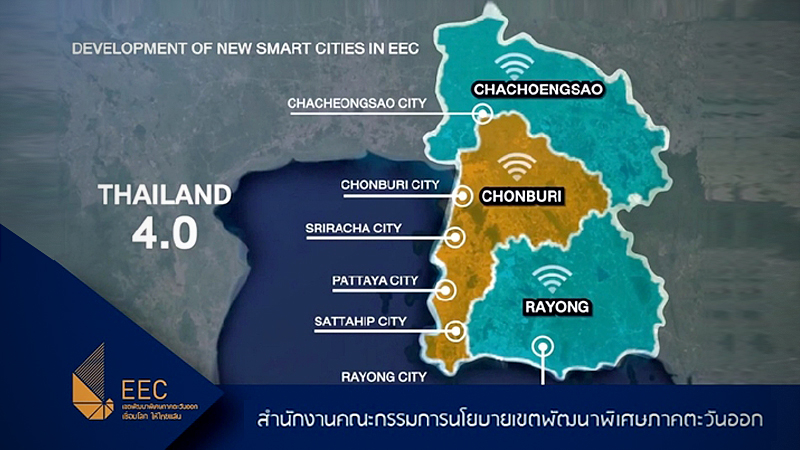
The Office of the Eastern Economic Corridor (EEC) is close to finishing the study on developing the “smart city” project in Chachoengsao province.

The office secretary-general, Kanit Sangsubhan, said that a group of private investors from China are keen to bid for the contract to develop the smart city in the province where they want to develop a financial centre.

He added that the development of the smart city will be on a Public-Private Partnership basis.

Recently Deputy Prime Minister Somkid Jatusripitak urged the EEC office to accelerate the development of mega-projects in the corridor as part of the government’s policy to lift the softening economy.

Wuhan virus expected to hit Thai and Asian tourism hard #ศาสตร์เกษตรดินปุ๋ย

#ศาสตร์เกษตรดินปุ๋ย : ขอบคุณแหล่งข้อมูล : หนังสือพิมพ์ The Nation

https://www.nationthailand.com/business/30381104?utm_source=category&utm_medium=internal_referral

Wuhan virus expected to hit Thai and Asian tourism hard

Jan 27. 2020
File Photo/Nationphoto

File Photo/Nationphoto
By The Nation

The outbreak of the Wuhan virus may cost Thai and Asian tourism industries Bt100 billion in lost income, an economist has warned.

Preliminary estimates of the impact on tourism and related businesses in Thailand and other Asian nations are at around Bt80 billion to Bt100 billion, if the spread of the virus is contained by early March, Anusorn Tamajai, director of Economic and Business Research Centre at Rangsit University, said.

He warned that the impact could be more severe than that of SARS 17 years ago.

If the virus is not controlled by March, then the cost could be even higher, he said.

The Thai economy could expand by just 1.8 to 2.4 per cent in the first and second quarters, he said.

Asian economies this year may not recover to the average 6 per cent growth as expected and China’s growth may fall below 5.8 per cent.

The number of Chinese tourists are expected to drop by 1 to 2 million and foreign arrivals could be down by at least 2 per cent.

The Chinese government has already imposed travel restriction measures on Wuhan and other cities suspected of having cases of the new coronavirus infections.

The Thai government is targeting 41.8 million tourists this year with estimated revenue of Bt2.2 trillion, which will make Thailand one of the top six countries in terms of income from tourism.

The UN World Tourism Organisation had forecast that Asia’s tourism industry would expand by 7 per cent this year. However, the impact of the new coronavirus could slow growth to below 5 per cent, said Anusorn.

Speaking on a related issued, he said he did not agree with the Tourism and Sports Ministry’s proposal to offer cash handouts to foreign tourists. The government should instead allocate a budget to develop tourism sites and clean up air pollution, or PM 2.5 dust particles, he said.