International issues to influence baht rate this week #ศาสตร์เกษตรดินปุ๋ย

#ศาสตร์เกษตรดินปุ๋ย : ขอบคุณแหล่งข้อมูล : หนังสือพิมพ์ The Nation

https://www.nationthailand.com/business/30380477?utm_source=category&utm_medium=internal_referral

International issues to influence baht rate this week

Jan 13. 2020
The Bank of Thailand will hold a press conference tomorrow on the monetary policy and baht exchange rate situation, amid concerns of the baht remaining strong.

The Bank of Thailand will hold a press conference tomorrow on the monetary policy and baht exchange rate situation, amid concerns of the baht remaining strong.
By The Nation

The next round of US-China trade negotiations, the Middle East situation and key economic data will affect the baht’s value this week, says Kasikornbank (KBank).

The Bank of Thailand will hold a press conference tomorrow on the monetary policy and baht exchange rate situation, amid concerns of the baht remaining strong.

Last week, the baht moved within a tight range early in the week before hitting a one-month low of Bt30.37 to the US dollar in line with weak regional currencies amid concerns over rising tensions in the Middle East, after Iran attacked US troops in Iraq in response to the US airstrike on January 3, according to KBank report.

However, the baht pared losses somewhat later in the week, as US announced economic sanctions instead of military actions against Iran, which helped calm market concerns over the situation in the Middle East.

Meanwhile, the market shifted its focus to preparations for the signing of the first phase of the US-China trade deal around mid-January.

On Friday (January 10), the baht closed at Bt30.23 to the dollar, versus Bt30.15/USD reported on Friday (January 3).

During the week January 13-17, KBank expects the baht will move within a range of Bt30.00-30.40/USD. Key factors to be monitored closely include signals for subsequent phases of the US-China trade talks, issues surrounding Brexit and the situation in the Middle East. The US economic data to be released during the week include consumer price index, producer price index, retail sales, housing starts, and industrial production data for December 2019, plus the NAHB Housing Market Index, NY Fed Empire State Manufacturing survey, Philly Fed Business Outlook survey and Preliminary Consumer Sentiment survey for January 2020. In addition, market participants may monitor China’s fourth-quarter GDP report for 2019 and December 2019 economic data.

Telework use is rising, but civil servants are restricted #ศาสตร์เกษตรดินปุ๋ย

#ศาสตร์เกษตรดินปุ๋ย : ขอบคุณแหล่งข้อมูล : หนังสือพิมพ์ The Nation

https://www.nationthailand.com/business/30380463?utm_source=category&utm_medium=internal_referral

Telework use is rising, but civil servants are restricted

Jan 13. 2020
By The Washington Post · Lisa Rein 

Telework use is rising, but civil servants are restricted. WASHINGTON = About a quarter of workers at U.S. companies now dial into meetings, consult with clients and do a multitude of other tasks from their laptops at home, as employers seek to cut real estate costs and keep their staffs content in a red-hot job market.

The federal government, though, is calling its employees back to the office.

After a big push toward telework in the Obama administration, President Donald Trump’s government is scaling it back at multiple agencies on the theory that a fanny in the seat prevents the kind of slacking off that can happen when no one’s watching.

The about-face began at the Agriculture Department in 2018, after Secretary Sonny Perdue was angry to discover that an employee he needed to meet with was working from home, according to three administration officials. In response, he slashed by half a robust program used by tens of thousands of employees.

A USDA spokesperson, who acknowledged the program had been dialed back, said the Perdue story was “inaccurate” but would not elaborate.

The Education and Interior departments and the Environmental Protection Agency, as well as parts of Commerce and Health and Human Services departments, soon followed.

The Department of Veterans Affairs, where telework is popular in the benefits division, is pushing for restrictions in contract talks. The Social Security Administration abruptly canceled a 6-year-old pilot program for 12,000 operations employees in November, citing “increased wait times and unacceptable delays” to customer service.

Trump’s war on telework represents a milestone in how his administration is changing the culture of the federal government as it seeks more accountability from employees – and moves to weaken their unions. Employees are chafing at their lost freedom, but the managers reining them in say that, in the long run, taxpayers benefit. Overall, data on productivity is inconclusive, workplace experts say.

“Agencies have been digging deep to say, ‘The way of work in our agency – is it achieving mission, service and stewardship objectives?’ Particularly when it comes to service, we have to ask the question, ‘What is the best modality for delivering service?’ ” Margaret Weichert, deputy director for management at the Office of Management and Budget, said in an interview. “Telework is not proving the most effective way of delivering.”

Employees report they are more productive at home and suspect the administration of other motives. Scaling back telework is “a subtle way of getting rid of old-timers,” said Uylaine Barringer, 69, a compliance assistance coordinator for the EPA’s hazardous waste program in Chicago.

Barringer lives on three acres in the small town of Princeton, Illinois, 120 miles from the city, where she also cares for retired Chicago police horses.

For years she worked four 10-hour days each week – home two days, trekking downtown two others and taking off Fridays, which she reserved for grooming the horses and seeing the veterinarian, as well as for her own medical appointments after surviving cancer.

But last summer, the EPA scaled back telework to two days a month for employees with her schedule. She made the difficult decision to move up her planned retirement by a year, to Jan. 20. It will cost her several hundred dollars a month in pension credits. “It’s a job that I really enjoy,” she said. “I know the program inside and out. But it wasn’t tenable.”

– – –

The Census Bureau’s American Time Use Survey found that 24 percent of private-sector employees teleworked at least some of the time in 2018, a steadily growing share despite retreats in recent years by companies such as Yahoo and IBM.

Alexander Alonso, chief knowledge officer for the Society for Human Resource Management, which tracks workplace trends, said the option to work from home is a “huge” tool in recruiting and maintaining talent.

In the government, though, “I think they want to discourage federal employment and make it less attractive,” said Rep. Gerald Connolly, D-Va., co-sponsor of a 2010 law that prods agencies to allow telework to save on energy and commuting costs. “It’s sort of a Neanderthal move by the administration.”

Working from home has grown steadily in the past decade and is a go-to alternative on snow days.

About 43 percent of the 2.1 million civil servants were eligible for one or more days a week of remote work in fiscal 2017, the last year for which data is available from the Office of Personnel Management. That’s down from 44 percent in fiscal 2015. An OPM spokesperson said telework has remained stable in the Trump administration, but the agency’s annual report to Congress notes that agencies have trouble collecting accurate data.

By private-sector standards, the recent federal retreat would hinder the government’s ability to participate in a knowledge-based economy in which collaboration among far-flung employees is now the norm. Some technology companies have abandoned the bricks-and-mortar office altogether.

The backtrack has upended child-care schedules, raised commuting costs and led some like Barringer to quit because their office is too far to drive to daily. It also could make the government less competitive in recruiting and keeping employees. And with many federal offices redesigned to fit fewer people, it’s unclear if there’s room for them now.

The rollback comes as the White House advances a crackdown on federal employee unions after a successful court battle last year over a series of executive orders. They give management an upper hand in collective bargaining and limit union duties on the job.

Agencies are reopening and renegotiating contracts that in the Obama era had renewed automatically. Restricting telework is a high priority.

“It’s doctrinal. It’s punitive,” said David Cann, director of field services and education at the American Federation of Government Employees, the largest union.

“When Trump came in, federal employees understood they were the ‘swamp’ to this administration and it would be tough on them,” Cann said. “But we have yet to hear from any agency that telework is imparting any harm.”

Some agencies have continued to support telework, including the Patent and Trademark Office and the Defense Department, where a third of the 366,000 civilians eligible used the option in fiscal 2017, the last year data was collected.

The General Services Administration, which shrunk its Washington headquarters during a 2013 renovation, continues to shed leased office space and requires employees to reserve desks when they come in.

GSA “relies on telework to attract and retain a talented workforce,” a spokesperson said in an email, touting the agency’s continuity of operations during a disaster or bad weather. About 85 percent of GSA employees telework multiple days a week.

– – –

Those on either side of the divide have little data to back up their case, workplace experts say. Most research does not account for whether employees were strong or weak performers to begin with, skewing results. Studies tend to lump multiple jobs together.

The Government Accountability Office found similar obstacles in a 2016 report that found few quantifiable results from expanding telework. Agencies could not back up their claims that it benefited them.

Today they do not back up claims that it’s hurting them, but they appear to be changing course based on a gut feeling that productivity is suffering.

At the USDA, where multiple days a week of remote work were common, employees now must show up at the office four days a week.

“USDA’s telework policy is designed to be responsible to the taxpayers and responsive to the customers who depend on our services,” a spokesperson said in a statement, citing “longstanding concerns about the previous policy.” In cases where offices do not have enough space to accommodate employees, supervisors can approve more work from home.

Social Security set off a furor in the fall when Commissioner Andrew Saul canceled a popular telework pilot program that let employees work remotely up to three days a week.

Spokesman Mark Hinkle said the program had “little or no controls to ensure” that it was properly evaluated and that front-line employees were needed in the office to stanch growing wait times and delays to service.

“Given our current service challenges and lack of data on [the policy’s] impact on public service, now is not the time to experiment with working at home,” Hinkle said in an email.

But employees and unions, backed by Democratic lawmakers, mounted a successful campaign on Capitol Hill to restore the program, blaming management for failing to track its effectiveness.

“If you’re data driven, why would you come back years later and say, ‘We’re not gauging if we’re successful in this pilot?’ ” asked James Muhammad-Mason, a debt specialist in the Chicago office who worked from home one day a week.

He said he was more focused that day and not distracted by “office banter.”

“The real reason they took it away? ‘Federal employees are lazy. Why would you let them work more from home?’ ” Muhammad-Mason said, mocking a popular attack on government workers. “If you have a problem with certain employees, you need to address it.”

The pushback worked. The spending deal that Trump signed in December requires the agency to come up with a plan within 60 days to reinstate the program.

The Education Department, where 94 percent of the workforce was eligible for multiple telework days a week, surveyed employees last summer, nine months after slashing telework to one day a week.

The results were universally negative, according to a copy of the survey obtained by The Washington Post.

Sick leave and vacation requests grew. A majority of employees reported no increased productivity, collaboration or communication with colleagues when they returned to the office – the stated reason telework was cut. And two-thirds of employees said they were considering leaving.

The department acknowledged that “a significant number of employees and managers are still adjusting to the change.” But Secretary Betsy DeVos decided to continue the agency’s “efforts to achieve the intended outcomes of improved collaboration and productivity” and limit working from home.

Ministry vows to help tap domestic and overseas markets for Thai fruit #ศาสตร์เกษตรดินปุ๋ย

#ศาสตร์เกษตรดินปุ๋ย : ขอบคุณแหล่งข้อมูล : หนังสือพิมพ์ The Nation

https://www.nationthailand.com/business/30380453?utm_source=category&utm_medium=internal_referral

Ministry vows to help tap domestic and overseas markets for Thai fruit

Jan 13. 2020
File Photo: Thai fruits; durian, mangosteen, longkong, mango  and rambutan.

File Photo: Thai fruits; durian, mangosteen, longkong, mango and rambutan.
By The Nation

The Commerce Ministry is getting ready for this year’s fruit harvest and has pledged to help Thai farmers sell their farm products both in the domestic and export markets.

Despite the shadow of a drought, a large fruit output is expected this year, said Whichai Phochanakij, director-general of the Internal Trade Department.

The department will facilitate trade in Thai fruits such as durian, mangosteen, longan, longkong, lychee and rambutan with a budget of Bt396 million, he said.

The department will match major buyers with 20,000 farmers and will collaborate with retailers, department stores and Blue Flag chain stores to sell at least 50,000 tonnes of fruit.

The department would hold promotion sales of fruit in both the domestic and overseas markets, aiming to sell more than 20,000 tonnes of fruit, he noted.

They would also arrange total loans of Bt1.5 billion at 3 per cent interest to provide liquidity to traders for six months. Another 3 per cent interest subsidy would be allocated to support funding for upgrading their factories and facilitating organic farm certification, he said. Each trader could get a loan of up to Bt10 million.

The department will also help farmers to select middlemen from China who come to Thailand to buy fruits for sale later in the Chinese market.

The farmers and labourers would be trained in post-harvest handling to maintain the high quality of farm products and reduce losses.

Middlemen from China found cheating farmers as in the previous years will be put on the blacklist.

The department will also collaborate with four airliners to allow each passenger to take up to 20 kilograms of fruit on board without fee, he added.

How U.S. sanctions are paralyzing the Iranian economy #ศาสตร์เกษตรดินปุ๋ย

#ศาสตร์เกษตรดินปุ๋ย : ขอบคุณแหล่งข้อมูล : หนังสือพิมพ์ The Nation

https://www.nationthailand.com/business/30380441?utm_source=category&utm_medium=internal_referral

How U.S. sanctions are paralyzing the Iranian economy

Jan 12. 2020
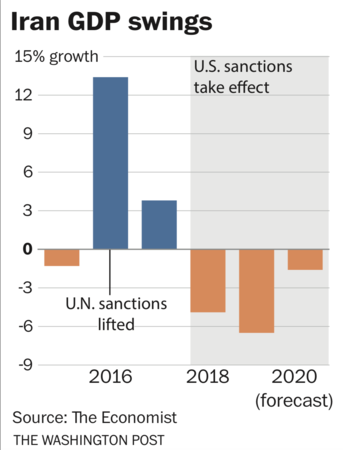
Iran GDP swings
Photo by: The Washington Post — The Washington Post

Iran GDP swings Photo by: The Washington Post — The Washington Post
By The Washington Post · Rick Noack, Armand Emamdjomeh, Joe Fox 

The Trump administration announced more sanctions Friday on Iran, marking the latest move in a series of financial U.S. punishments that have left the Iranian economy reeling and its citizens under extreme pressure.

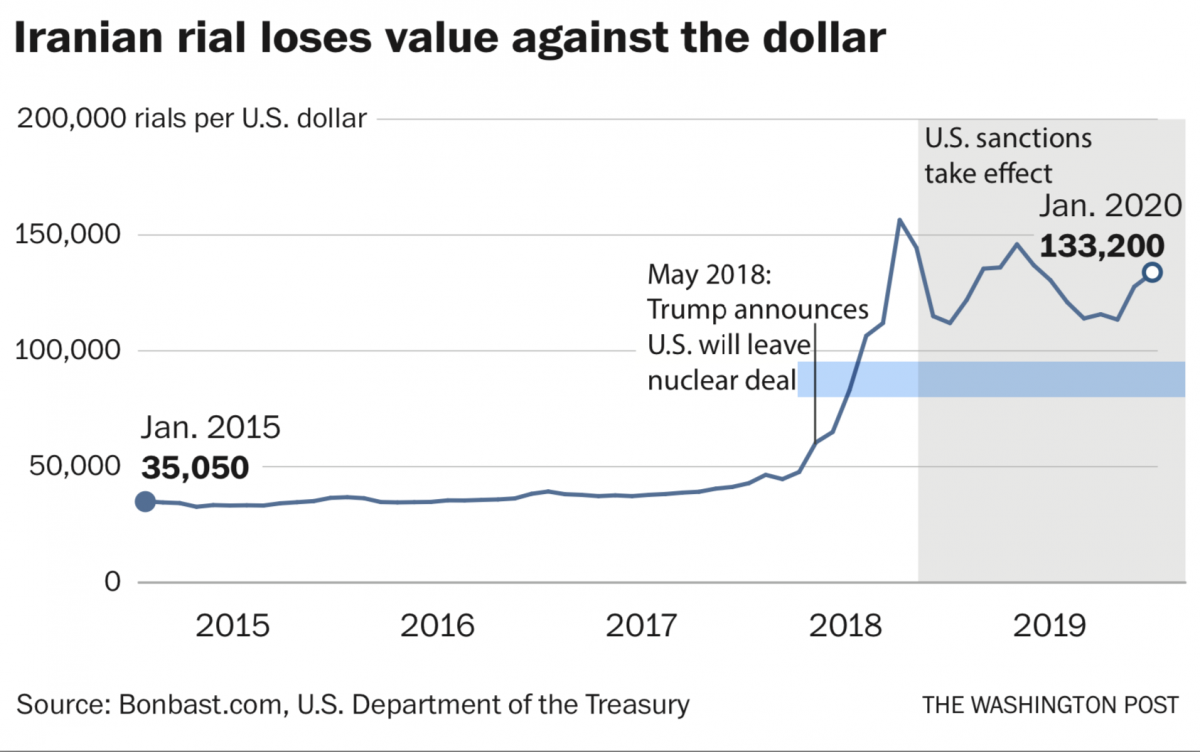
         ranian rial loses value against the dollar Photo by: The Washington Post — The Washington Post

ranian rial loses value against the dollar Photo by: The Washington Post — The Washington Post

+++The latest U.S. sanctions will target Iran’s metal industries, as well as eight senior military and national security officials. The new penalties came after the U.S. killing of a top Iranian commander in Baghdad last week, which triggered retaliatory Iranian strikes Wednesday on bases housing U.S. military personnel in Iraq.

Within three years, cautious hopefulness on improving U.S.-Iranian relations has turned into escalating hostility – with ordinary Iranians saying they once again will bear the brunt of a U.S. return to sanctions.

“Every single day, as soon as people open their eyes, they face a dark and vague future,” wrote Iranian musician Mehdi Rajabian, 30, an independent protest artist and frequent critic of the Iranian regime, in a text message in response to the latest U.S. sanctions announced on Friday.

When the Iran nuclear deal was reached in 2015, then-President Barack Obama welcomed it as being “not built on trust,” but rather “on verification.” The agreement – one of his signature foreign policy achievements – was implemented in early 2016.

Suddenly and largely unconstrained by international sanctions, foreign companies flocked into the country. Whereas Iran’s real gross domestic product growth rate stood at -1.3% in 2015, it surged to +13.4% in 2016.

But President Donald Trump’s election in November 2016 and his new policy directives upended that. Iran’s real GDP growth rate tumbled.

Throughout his campaign, Trump had argued the United States should leave the Iran agreement, calling it a “terrible one for the United States and the world. It does nothing but make Iran rich and will lead to catastrophe,” he tweeted in 2015.

On May 8, 2018, Trump followed through, announcing that the United States would abandon the deal. “It didn’t bring calm, it didn’t bring peace, and it never will,” he said. Trump’s supporters argued that Iran had deceived the international community and that it continued to destabilize the Middle East undeterred, via proxies in Yemen, Lebanon, Syria and other parts of the region.

Other Western parties to the deal – Germany, France and Britain – countered that stopping Iran’s regional interference was never its aim and that their own intelligence suggested Iran was in compliance with the agreement. All signatories apart from the U.S. stuck to the agreement. Europe announced it would establish a mechanism to shield companies willing to continue trading with Iran from reinstated U.S. sanctions.

Once key U.S. sanctions were reinstated by November 2018, however, the Europeans’ announcement had little impact. The Iranian rial continued to rapidly lose value against the dollar.

The Trump administration’s threat to also impose sanctions on countries that purchased Iranian oil hit Iran especially hard. Iran’s oil exports plummeted after the sanctions took effect.

Initially, the United States agreed to grant some of Iran’s customers a six-month waiver, meaning they could continue to import Iranian oil without fear of U.S. sanctions. In the following months, Iranian oil exports began to increase as a result of the exemptions.

Once the waivers expired in May 2019, Iranian exports fell to new lows.

There have been signs of recent frustration between Tehran and the European Union, too. Iranian officials have blamed their European counterparts for supposedly being too slow in implementing measures to shield companies from U.S. sanctions.

In response to the U.S. killing of Maj. Gen. Qasem Soleimani, commander of Iran’s elite Quds Force, Tehran doubled down by announcing on Sunday that it was suspending its commitments under the nuclear deal.

For now, the European Union has resisted U.S. pressure to declare the nuclear deal dead, saying instead that it will “spare no effort” to keep it alive.

A key question, however, is whether additional sanctions would even have a significant impact. Analysts say existing U.S. sanctions have left little leeway for Iran, which saw the cost of basic goods skyrocket over the past year.

Over the course of one year, the price of beef and veal has risen from the equivalent of $5.20 per kilogram to $7.70, and the cost of milk has gone up from $0.3 per liter to $0.5.

Iranian government leaders “keep telling us to be strong and endure the pressures, but we can already hear the sound of our bones breaking,” Shiva Keshavarz, a 22-year-old accountant, told the Associated Press last summer.

Since then, living conditions have only gotten harsher for many Iranians, who “struggle to survive,” wrote Rajabian, the musician.

U.S. hospital bankruptcies leave sick and injured nowhere to go #ศาสตร์เกษตรดินปุ๋ย

#ศาสตร์เกษตรดินปุ๋ย : ขอบคุณแหล่งข้อมูล : หนังสือพิมพ์ The Nation

https://www.nationthailand.com/business/30380432?utm_source=category&utm_medium=internal_referral

U.S. hospital bankruptcies leave sick and injured nowhere to go

Jan 12. 2020
Photographer: Cory Clark/NurPhoto via Getty Images
By Syndication Washington Post, Bloomberg · Lauren Coleman-Lochner, Jeremy Hill 

Hospital bankruptcies leave sick and injured nowhere to go. A quiet crisis is unfolding for U.S. hospitals, with bankruptcies and closures threatening to leave some of the country’s most vulnerable citizens without care.

As a gauge of distress in the health-care sector has soared, at least 30 hospitals entered bankruptcy in 2019, according to data compiled by Bloomberg. They range from Hahnemann University Hospital in downtown Philadelphia to De Queen Medical Center in rural Sevier County, Arkansas and Americore Health LLC, a company built on preserving rural hospitals.

There’s more distress to come. Already this week, the bankrupt owner of St. Vincent Medical Center in Los Angeles said it plans to shut the facility after a failed sale attempt.

The pressures on the sector are as tangled as the health-care system itself.

Americans are fleeing rural areas in favor of urban centers, reducing the demand for hospital services in already struggling communities. In both cities and towns, many hospitals that care for impoverished citizens often rely heavily on government payments that reimburse less than private insurers and may fail to cover rising costs.

The American Hospital Association, an industry group, calculated that payments from Medicare and Medicaid, the federal programs for the elderly and poor, lagged costs by $76.6 billion in 2018. Hospitals are also losing key income as more profitable procedures move to lower-cost outpatient centers.

If that weren’t enough, with both Republicans and Democrats making a political football out of health care ahead of the 2020 presidential election, significant policy change could be near.

“How are you supposed to craft a business plan if you don’t know if you’re going to have an America with Medicare for all, or a complete repeal of the Affordable Care Act, or a million options in the middle?” said Sam Maizel, a partner with the Dentons US law firm who focuses on health-care restructuring. “If you knew Elizabeth Warren was going to get elected, you’d be writing a very different business plan.”

Even before the election, the current system is being challenged, according to Georgetown University health-care policy professor Edwin Park. The Trump administration is trying to tighten eligibility rules for Medicaid, while a rule proposed late last year could also cut billions of dollars in supplemental payments to hospitals, he said. In a closely watched case, a district judge in Fort Worth, Texas is weighing whether Obamacare can survive after an appeals court ruled that its broad mandate requiring people to have health insurance was unconstitutional.

The usual playbook for managing distress doesn’t readily apply. Shutting down a hospital isn’t the same as boarding up a storefront. Hospitals are not only major employers, their closures often leave the most vulnerable patients bereft. Bankruptcy judges tend to push back on approving hospital closings in ways they wouldn’t for a retailer, said Andrew Sherman, head of restructuring at law firm Sills Cummis & Gross.

In May, a 25-bed hospital in Sevier County, Arkansas shut down after sliding into such financial disrepair that a receiver was appointed, local newspaper The De Queen Bee reported. For many of the county’s 17,000 residents, the hospital’s emergency room provided the only such services within an hour’s drive, court papers show. In suburban Chicago, Westlake Hospital was losing more than $1 million a month before it commenced a liquidation bankruptcy in August, sapping that community of about 550 jobs and 230 hospital beds.

“In a typical restructuring you’re dealing with widgets,” Sherman said. “In a health-care restructuring you’re dealing with people’s lives.”

In many rural areas, the population just isn’t large enough to justify keeping the lights on, according to Bloomberg Intelligence analyst Mike Holland. Morgan Stanley analysts led by Vikram Malhotra in 2018 found that 8% of U.S. hospitals were at risk of closing and another 10% were considered weak. AHA statistics released Tuesday show the number of U.S. hospitals fell by 64 to 6,146 in 2018, the most recent year available.

There’s little reason to believe the situation has improved. The Polsinelli TrBK Health Care Services Distress Index, which tracks bankruptcy filings in the health-care sector, had nearly quadrupled as of the third quarter. The index uses 2010 as its benchmark year.

“Most of the cases we see, you’re struggling to survive on a cash basis to try to get to a sale process,” Sherman said. “People need to understand that these hospitals will continue to falter. Communities are going to have to inject more money if they want to maintain health care.”

Some of the more recent closings are the result of large health systems weeding out weaker facilities. That’s the case with hospitals run by Community Health Systems Inc. and its spin-off, Quorum Health Corp.

Quorum’s revenues have been falling since it separated from Community Health in 2016. After bleak third-quarter results, the company said it would ask lenders to modify its debt agreements and reiterated a warning that it may not be able to stay afloat. Its shares and bonds plunged in the aftermath.

Late last year, KKR & Co. offered to take the company private at $1 a share in a deal that may help it refinance and stave off deeper distress.

Community Health, meanwhile, has piled up about $5 billion in losses in recent years as it labors under more than $13.5 billion in debt. A concentration of rural hospitals dependent on Medicare and Medicaid hurts Community Health, BI’s Holland said. Expanded insurance coverage under the 2010 Affordable Care Act, or Obamacare, also means more people are getting care earlier and not ending up in the company’s hospitals, he said, or are being directed to lower-cost outpatient facilities.

“It’s a problem now for hospitals to have sufficient inpatient revenues,” said Eileen Appelbaum, co-director of the Center for Economic and Policy Research.

A representative for Community Health said in a statement that factors including its recent refinancing, asset sales and a program to increase margins have positioned the company to continue to improve its operating performance.

A representative from Quorum didn’t respond to a request seeking comment, while KKR declined to comment.

While rural hospitals are most at risk of failing, the controversial shutdown of Philadelphia’s Hahnemann University Hospital could invite more disruption in urban centers, Appelbaum said.

Private-equity investor Joel Freedman bought Hahnemann in early 2018, but failed to revitalize the money-losing hospital and shut it after a trip through bankruptcy. Excluded from the filing, however, was its prime real estate in the heart of the city, which was separated into another entity.

Freedman didn’t respond to requests for comment.

Despite the successful 2006 acquisition of HCA Healthcare Inc. by a consortium that included Bain Capital LP and KKR, private equity has found it isn’t easy to make money running hospitals, Appelbaum said. The Hahnemann case may provide a new template, she said, calling the transaction “proof of concept” that if a hospital isn’t profitable, you can shutter it and sell the real estate.

“Hahnemann is a safety-net hospital in a gentrifying area,” Appelbaum said. “Probably every major city in America has safety-net hospitals in gentrifying areas, where the real estate is so much more valuable than the hospital to the private-equity company.”

UTCC set to lower Thai economic, export growth projections #ศาสตร์เกษตรดินปุ๋ย

#ศาสตร์เกษตรดินปุ๋ย : ขอบคุณแหล่งข้อมูล : หนังสือพิมพ์ The Nation

https://www.nationthailand.com/business/30380399?utm_source=category&utm_medium=internal_referral

UTCC set to lower Thai economic, export growth projections

Jan 11. 2020
 Thanavath Phonvichai,  left

Thanavath Phonvichai, left
By THE NATION

The University of Thai Chamber of Commerce (UTCC) will revise downward its forecast of the country’s economic growth this year from the previous prediction of 3.1 per cent, due to a number of emerging negative factors, said Thanavath Phonvichai, director of Centre of Economic and Business Forecasting on Friday (January 10).

UTCC will also lower export growth forecast from 1.8 per cent for 2020, he added.

The drought is expected to cause an economic contraction of 0.03 per cent, totalling Bt8 billion to Bt10 billion.

An escalation of the US-Iran conflict could spike crude price to between US$75-80 per barrel from around US$65 per barrel, he said. A price hike of Bt1 per litre in all fuel types would mean that Thai consumers will have to shoulder an additional living cost of Bt2.1 billion monthly.

Regarding the strengthening baht, he said its appropriate value should be Bt31 per US dollar.

On January 7, Ghanyapad Tantipipatpong, chairwoman of Thai National Shippers’ Council said the council expected zero or a 1 per cent growth in Thai exports this year from 2019.

The forecast was based on the assumption of the average baht value at Bt30.5 per US dollar. The baht was at Bt30.17 per US dollar as of January 6.

If the Thai currency strengthens beyond that level, exports this year may contract by 5 per cent, she said.

Women outnumber men in the American workforce, for only the second time in history #ศาสตร์เกษตรดินปุ๋ย

#ศาสตร์เกษตรดินปุ๋ย : ขอบคุณแหล่งข้อมูล : หนังสือพิมพ์ The Nation

https://www.nationthailand.com/business/30380400?utm_source=category&utm_medium=internal_referral

Women outnumber men in the American workforce, for only the second time in history

Jan 11. 2020
Photo by: The Washington Post — The Washington Post

Photo by: The Washington Post — The Washington Post
By The Washington Post · Rachel Siegel

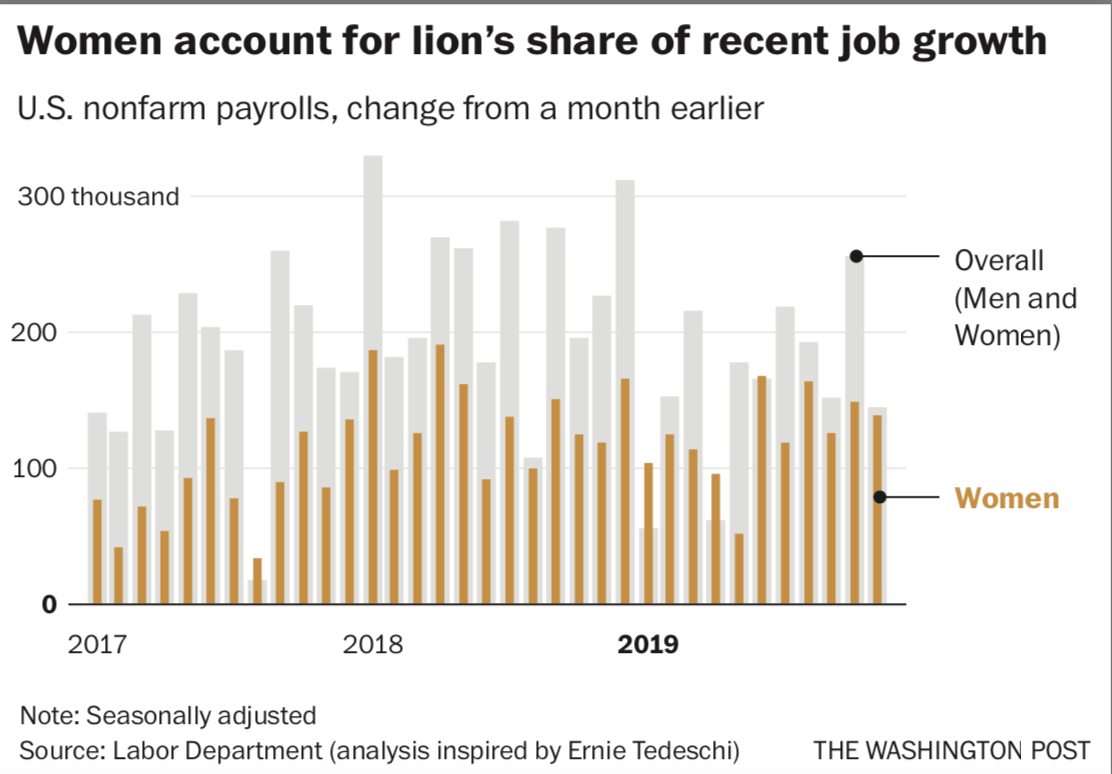
Women outnumber men in the American workforce, for only the second time in history.

Photo by: The Washington Post — The Washington Post

Photo by: The Washington Post — The Washington Post

For just the second time in history, women outnumbered men as the majority of the U.S. paid workforce, buoyed by fast job growth in healthcare and education over the past year, as well as the ongoing tight-labor market.

At first glance, the shift is tiny and easy to miss: Women worked 50.04 percent of payroll jobs in December, up from 49.99 percent the prior month. But the figure reflects a larger, ongoing trend. Of the 145,000 jobs picked up in December throughout the economy, women won most of them – 139,000, according to Labor Department data.

“Why is today a milestone? It’s a milestone because it’s really heralding the future and not just telling us where we are today,” said Betsey Stevenson, a professor of public policy and economics at the University of Michigan and an Obama administration economic adviser.

Indeed, women’s share of the workforce has been growing steadily for the past few years. Zooming out, looking at all workers, including farm workers and those self-employed, men still outnumber women. But women have been joining the workforce at a faster pace than men since 2018. Economists say this narrowing in the gender gap comes as women have been getting college degrees in larger numbers than men, which has radiated out to the job market as they reach higher ranks in the office.

“As women get into more senior positions, it creates more space to hire more women and brings more equality into management decisions,” Stevenson said. “It’s one of those things that’s self-reinforcing and keeps on going.”

Industries that have long attracted larger numbers of women, like education and healthcare, are growing at a much faster pace than male-dominated industries like manufacturing and construction. At the same time, with the unemployment rate hovering at a 50-year-low, just 3.5 percent, all workers have more leverage than ever to to negotiate their own work schedules and salaries, which is often a top priority for parents.

The first time the share of women in the workforce crossed over 50 percent was back in early 2010 in the aftermath of the Great Recession, which was a time of tremendous volatility in the labor market. Men were losing jobs at a much greater pace, as industries like manufacturing and construction struggled. That left more women working while men hoped to return.

Now, there’s a more permanent dynamic in play. Women are dominating sectors that are growing the fastest. Health care in particular was one of a few sectors that added more jobs in 2019 than 2018, Stevenson said. Also, jobs in education and health services outnumber jobs in male-dominated goods production sectors; mining, construction, transportation and warehousing saw a slow down in hiring last year. And women still dominate service sector jobs, which is 84 percent of non-farm payroll jobs in the country.

A big difference between now and ten 10 years ago is that women today are getting a boost from technology that has opened the door to jobs that used to be considered men-only. Julia Pollak, labor economist at ZipRecruiter, pointed to transportation jobs: For decades, cab drivers were almost exclusively male. But apps and other platforms help bring women into the driver’s seat.

“Women who might have felt less safe as taxi drivers before, waiting around for some man to wave them down, now have the protection of an app where people can be identified if something goes wrong,” Pollak said.

Plus telecommuting and parental leave policies are becoming more common in the private sector, as employees are competing to hire and keep talent in this hot jobs market.

Stacey Ferguson, 42, worked in corporate law and government for 10 years before she left to start her own digital marketing company in 2012. A year and a half ago, she took a marketing job that allowed her to work remotely full-time. Ferguson, who has three kids and lives in suburban Maryland, said her entire team works out of the office, which helps cement a culture where “everyone is in the same boat.”

That’s a stark shift from her time practicing law which wasn’t as family friendly, she said. Plus, cultural norms around working from home have drastically changed over the years.

“The biggest thing is the mindset,” Ferguson said. “Trying to work remotely ten years ago was received very differently than it is now…There’s just a general loosening of the typical corporate guidelines and restrictions.”

Liz Cook just nabbed a full-time job in November, working as a data analyst for The Mom Project, which helps women workers find jobs. Cook left her job as a prosecutor in 2011 to spend more time with her children. And until recently, she’d had trouble getting back into the workforce with the gap on her resume, despite having a law degree.

“Perhaps [employers] are more willing to overlook gaps in resumes, or there’s a cultural shift and they’re more willing to bring moms or women in,” said, Cook, 36, who needed to return to work to pay off student loans.

The data on women in the workforce was tucked into an otherwise steady jobs report, as the unemployment rate remained at a strong 3.5 percent, unchanged from November and at a 50-year low. The Department of Labor data showed gains in retail and health care, while mining jobs slipped. Manufacturing jobs, which analysts have been closely monitoring during Trump’s protracted trade war, changed little in December.

The December jobs report continued a 10-year streak of strong labor market growth since the Great Recession. President Trump’s Director of the National Economic Council touted the continued strong jobs numbers, acknowledging the growth of women in the workforce.

“This stuff will translate in the election, I’m surprised the Democrats are so pessimistic painting a picture of a deep recession,” Kudlow said in an interview. “The key point here is 3.5 percent unemployment continues, and that is a very low number historically and shows you still have a healthy economy and healthy job market.”

Average hourly earnings rose by a mere 0.1 percent in December, meaning over the past year, wage growth is at 2.9 percent.

Economists say wages are not growing as fast as they should be, especially for those who aren’t seeing a boost from state and local minimum wage increases. Many businesses are still pulling back on investment and say Trump’s truce with China does little to assuage their anxiety. Plus, Democratic leaders and presidential hopefuls caution that Trump’s economic and trade agenda could eventually stymie the growth.

Diane Swonk, chief economist for the accounting firm Grant Thornton, said the disappointing wage growth reflects “an economy where you can get a job, but it’s harder to get a raise.” Swonk said it’s possible wage growth figures for the start of 2020 could be ever harsher because wages for 2019 peaked in February.

Analysts have also been concerned about transportation and warehousing, with transportation in particular affected by the economy’s manufacturing slowdown. But those numbers didn’t change all that much.

Average monthly jobs gains for all of last year were 176,000, compared to 223,000 in 2018. But Mark Hamrick, senior economic analyst for Bankrate, said the decrease shouldn’t come as a surprise. December’s figures didn’t reveal “anything that rocked our world,” he said.

“Expansions don’t last forever, and this one probably is getting a little long-toothed, but it’s not on life support,” Hamrick said.

Analysts predicted around 150,000 new jobs for the month and forecast a steady unemployment rate of 3.5 percent. Those estimates were significantly less than the 256,000 jobs added in November, although those figures also accounted for thousands of General Motors workers who returned to the workforce after a lengthy strike.

The jobs figures come as President Trump touts the economy’s strength as one of his administration’s top achievements. In 2019, the unemployment rate in particular hit lows not seen 50 years. The Dow Jones industrial average has gained about 45 percent since Trump took office, and fears of a recession have largely faded. The Federal Reserve cut interest rates three times last year, helping to sustain an 11-year-old economic expansion. And last month, the United States and China reached a “phase one” trade deal that is set to be signed on Jan. 15.

Stocks fall, dollar declines ,bonds rise after jobs report #ศาสตร์เกษตรดินปุ๋ย

#ศาสตร์เกษตรดินปุ๋ย : ขอบคุณแหล่งข้อมูล : หนังสือพิมพ์ The Nation

https://www.nationthailand.com/business/30380398?utm_source=category&utm_medium=internal_referral

Stocks fall, dollar declines ,bonds rise after jobs report

Jan 11. 2020
File Photo/Getty Images

File Photo/Getty Images
By Syndication Washington Post, Bloomberg · Randall Jensen, Sarah Ponczek 

U.S. stocks fell from records, while Treasuries rose after the latest jobs report delivered mixed signals on the strength of the economy. The dollar declined versus major currencies.

The S&P 500 dropped for the first time in three days after hiring data fell short of estimates and wage growth was the weakest in more than a year. The benchmark still notched a weekly advance as the situation in the Middle East held a tenuous calm. Boeing Corp. slumped, helping to pull down the Dow Jones Industrial Average.

Treasuries pushed higher as the wage figures erased any inflation worries. Futures traders maintained the amount of easing they expect from the Federal Reserve.

The jobs data ultimately did little to alter investor views on the strength of the economy or the Fed’s next step. With stocks near all-time highs, markets continue to look past the flare-up in tensions with Iran and focus on the potential for a pickup in global economic growth.

“This is the opposite of a game-changer. It’s very consistent with everyone’s views going into this report, the Fed stays on hold and the economy is slowing down,” said Nela Richardson, an investment strategist at Edward Jones. “We’re consistent on the overall view the Fed stays pat on short-term rates this year. If anything, this report tilts the Fed a little bit towards being more accommodative, not less.”

Elsewhere, European shares rose, while bonds in the region advanced. Gold gained, while West Texas oil dropped below $60 a barrel.

These are moves in major markets:

Stocks

–The S&P 500 Index fell 0.3% as of 4 p.m. New York time.

–The Dow Jones Industrial Average dropped 0.5%.

–The Stoxx Europe 600 index fell 0.1%.

–Germany’s DAX index gained 0.3%.

Currencies

–The Bloomberg Dollar Spot index fell 0.1%.

–The British pound dropped 0.1% at $1.3059.

–The euro rose 0.1% at $1.1112.

–The Japanese yen was little changed at 109.50 per dollar.

Bonds

–The yield on 10-year Treasuries fell three basis points to 1.82%.

–Britain’s 10-year yield fell five basis points to 0.773%.

–Germany’s 10-year yield declined two basis points to -0.198%.

Commodities

–West Texas Intermediate crude dropped 0.9% to $59.05 a barrel.

–Gold rose rose 0.4% at $1,560.30 an ounce.

Trump administration publishes efficiency standards for big equipment #ศาสตร์เกษตรดินปุ๋ย

#ศาสตร์เกษตรดินปุ๋ย : ขอบคุณแหล่งข้อมูล : หนังสือพิมพ์ The Nation

https://www.nationthailand.com/business/30380394?utm_source=category&utm_medium=internal_referral

Trump administration publishes efficiency standards for big equipment

Jan 11. 2020
By The Washington Post · Steven Mufson 
After three years and a lawsuit, Trump administration publishes efficiency standards for big equipment. The Energy Department set new efficiency standards Friday for big equipment such as commercial boilers and portable air conditioners after trying to block them for nearly three years.

The energy standards, finalized under the Obama administration in December 2016, will save consumers and businesses about $8.4 billion and cut carbon dioxide emissions by nearly 100 million tons over 30 years, according to DOE’s own estimates. That is the equivalent of taking 21 million cars off the road for a year.

But the Trump administration had opposed the energy efficiency standards and only published them in the Federal Register now in order to comply with a unanimous ruling by the U.S. Court of Appeals for the Ninth Circuit last October.

The publication “of these overdue standards is an important victory,” Lauren Urbanek, a senior energy policy expert at the Natural Resources Defense Council, said. “It’s a heartening development in a period filled with strong advocacy for energy efficiency in the face of an administration senselessly devoted to moving backwards.”

The Energy Department has been responsible for establishing energy efficiency standards for household appliances and industrial equipment since 1987.

On Friday, the department published efficiency standards for commercial boilers for multi-story buildings; uninterruptible power supplies such as the battery backup systems used to keep electronic devices running when the power goes out; air compressors used in equipment such as industrial paint sprayers or the machines that pump air into car tires; and portable air conditioners.

When the Trump administration blocked this group of standards, the NRDC, four other environmental groups, 12 states and two cities sued.

“There certainly wasn’t any technical reason to hold these up,” Urbanek said. “They had gone through the stakeholder process, they had gotten public comments. From our perspective the only thing we could see holding these up was the ideological reaction to regulation even when it’s common sense regulation.”

The litigation focused largely on the meaning of the word “will,” which the Energy Department said meant “may” and left the agency discretion not to publish the standards.

But the appeals court said “the word ‘will’ like the word ‘shall,’ is a mandatory term.”

It said “the rule’s use of the word ‘will’ unambiguously imposes a mandatory duty that constrains whatever discretion the Secretary might otherwise have possessed.”

The court cited a rule regarding the correction of errors in energy conservation standards and said that the rule “imposed upon DOE a non-discretionary duty to publish the standards in the Federal Register, and its refusal to do so violated the rule.”

The Trump administration has sought to block new energy efficiency standards for a wide array of products. The Appliance Standards Awareness Project said that as of November 2019 the Energy Department had missed legal deadlines for 19 products and more are due this month.

Urbanek said that “DOE is also moving in entirely the wrong direction” with these other appliances, notably the recent issuing of a rule to allow sales of inefficient incandescent and halogen lightbulbs. Stricter standards were to go into effect Jan. 1.

Economy adds 145,000 jobs in December as unemployment rate remains at 3.5% #ศาสตร์เกษตรดินปุ๋ย

#ศาสตร์เกษตรดินปุ๋ย : ขอบคุณแหล่งข้อมูล : หนังสือพิมพ์ The Nation

https://www.nationthailand.com/business/30380381?utm_source=category&utm_medium=internal_referral

Economy adds 145,000 jobs in December as unemployment rate remains at 3.5%

Jan 11. 2020
File Photo

File Photo
By  The Washington Post · Rachel Siegel 

The United States added 145,000 jobs in December as the unemployment rate remained at 3.5%, offering the latest snapshot of a tight labor market going into a new decade and election year.

Friday’s report from the Department of Labor showed gains in retail and health care, while mining jobs slipped. Manufacturing jobs, which analysts have been closely monitoring during Trump’s protracted trade war, changed little in December.

At the peak of the holiday season, retail added 41,000 jobs despite continued waves of store closures. Just in the past week, Pier 1 Imports said it would close up to 450 stores after a 13% drop in quarterly sales, and Macy’s said it would close 29 stores within weeks.

Average hourly earnings rose by a mere 0.1% in December, meaning over the past year, wage growth is at 2.9%.

Economists say wages are not growing as fast as they should be, especially for those who aren’t seeing a boost from state and local minimum wage increases. Many businesses are still pulling back on investment and say Trump’s truce with China does little to assuage their anxiety. Plus, Democratic leaders and presidential hopefuls caution that Trump’s economic and trade agenda could eventually stymie the growth.

Diane Swonk, chief economist for the accounting firm Grant Thornton, said the disappointing wage growth reflects “an economy where you can get a job, but it’s harder to get a raise.” Swonk said it’s possible wage growth figures for the start of 2020 could be ever harsher because wages for 2019 peaked in February.

Analysts were also concerned about transportation and warehousing, with transportation in particular affected by the economy’s manufacturing slowdown. But those numbers didn’t change all that much.

Average monthly jobs gains for all of last year were 176,000, compared to 223,000 in 2018. But Mark Hamrick, senior economic analyst for Bankrate, said the decrease shouldn’t come as a surprise and that December’s figures didn’t reveal “anything that rocked our world.”

“Expansions don’t last forever, and this one probably is getting a little long toothed, but it’s not on life support,” Hamrick said.

Analysts predicted around 150,000 new jobs for the month and forecast a steady unemployment rate of 3.5%. Those estimates were significantly less than the 256,000 jobs added in November, although those figures also accounted for thousands of General Motors workers who returned to the workforce after a lengthy strike.

The jobs figures come as President Trump touts the economy’s strength as one of his administration’s top achievements. In 2019, the unemployment rate in particular hit lows not seen 50 years. The Dow Jones industrial average has gained about 45% since Trump took office, and fears of a recession have largely faded. The Federal Reserve cut interest rates three times last year, helping to sustain an 11-year-old economic expansion. And last month, the United States and China reached a “phase one” trade deal that is set to be signed on Jan. 15.