China denies reports Shanghai-London stock connect is halted #ศาสตร์เกษตรดินปุ๋ย

#ศาสตร์เกษตรดินปุ๋ย : ขอบคุณแหล่งข้อมูล : หนังสือพิมพ์ The Nation

https://www.nationthailand.com/business/30380109?utm_source=category&utm_medium=internal_referral

China denies reports Shanghai-London stock connect is halted

Jan 04. 2020
File Photo: One person said that Britain's stance on the pro-democracy protests in Hong Kong was one of the issues that prompted the move.

File Photo: One person said that Britain’s stance on the pro-democracy protests in Hong Kong was one of the issues that prompted the move.
By Syndication Washington Post, Bloomberg · No Author 

China denied reports that a tie-up between the Shanghai and London stock exchanges has been halted.

The operation of a stock link between the two exchanges has been normal since June, the China Securities Regulatory Commission said in a media briefing on Friday. The regulator has noticed some companies delaying issuance of global depositary receipts and respects their freedom to decide a time based on financing needs and market conditions, spokesman Chang Depeng said.

“Shanghai London Stock Connect is an important initiative in China’s financial opening, it is instrumental in expanding cross-border investing and funding channels bilaterally,” he said. “Since June 2019, the link has been operating normally.”

The Chinese government temporarily suspended the Shanghai-London Stock Connect program on political grounds, people familiar with the matter previously told Bloomberg. One person said that Britain’s stance on the pro-democracy protests in Hong Kong was one of the issues that prompted the move. Reuters had previously reported the decision.

“It’s good that the government will keep developing the scheme as it’s a positive step for financial markets in both countries,” Linus Yip, First Shanghai Securities strategist, said by phone. “The Shanghai-London stock connect needs to overcome lots of difficulties, including the long distance and time zone differences.”

The link between the Shanghai and London exchanges was created to allow companies listed on one venue to issue shares on the other. It has so far underwhelmed with just a single Chinese company listing in London and no U.K. companies coming to the Shanghai bourse.

Brokerage Huatai Securities Co. was the first Chinese company to sell global depositary receipts in London last June. Its GDRs fell 1.7% in London as of 9:59 a.m. local time. The stock tumbled as much as 11% on Thursday, the biggest decline since their listing. SDIC Power Holdings Co. in December postponed its plan to sell GDRs because of “market conditions.”


SET could break 1,600 in Q1, reach 1,700 this year: analysts #ศาสตร์เกษตรดินปุ๋ย

#ศาสตร์เกษตรดินปุ๋ย : ขอบคุณแหล่งข้อมูล : หนังสือพิมพ์ The Nation

https://www.nationthailand.com/business/30380104?utm_source=category&utm_medium=internal_referral

SET could break 1,600 in Q1, reach 1,700 this year: analysts

Jan 04. 2020
The benchmark index broke the 1,600 barrier in the morning session, reaching a high of 1,604.43 before retreating in afternoon trading.

The benchmark index broke the 1,600 barrier in the morning session, reaching a high of 1,604.43 before retreating in afternoon trading.
By The Nation

The Stock Exchange of Thailand Index barely changed on Friday (January 3), closing at 1,594.97, down 0.85 point or 0.05 per cent after surging on January 2, the first trading day of 2020.

The benchmark index broke the 1,600 barrier in the morning session, reaching a high of 1,604.43 before retreating in afternoon trading.

Regional markets were boosted by news of the US-China trade deal, to be signed on January 15, and Wall Street’s record-high closings on January 2. However, market sentiments were then dampened by news of rising tensions in the Middle East after a US government announcement that the US air strike had killed Qasem Soleimani, head of the Islamic Revolutionary Guards Corps (IRGC) Quds Force, the alleged architect of Tehran’s proxy conflicts in the Middle East.

Apichat Poobunjirdkul, senior strategist at Tisco Securities Co, remains optimistic of Thai equities, citing rising oil prices resulting from a cut in Opec production. The US air strike also caused global oil prices jumped over 4 per cent on Friday.

However, investors should closely follow the situation in the Middle East, he said, adding that if the conflicts between the United States and Iran  escalated, it would adversely affect the global economy and equity markets.

Tisco predicted the SET index breaking 1,600 in the first quarter this year and could reach 1,700 in the course of 2020. Profits of Thai listed firms are expected to expand 8 per cent year on year, he said. Return from investment in Thai equity last year averaged at just 1 per cent, compared with 25 per cent in developed markets (MSCI DM Index), and 15 per cent in emerging market (MSCI EM Index).

The low return of Thai equity last year was mainly caused by two consecutive years of falling profits of listed firms, and volatile crude prices affecting performance of the energy sector. Higher reserve requirement for pensioners, stricter accounting standards and issue of political stability all contributed to the lacklustre Thai corporate performance, he said.

For this year, Tisco is “cautiously optimistic” about Thai equities given the many positive factors, including a easing in US-China trade tensions, low interest rates and the start of central banks’ injection in the economies.

On the other hand, potential risks to the Thai economy this year include a new round of trade negotiation between US and China, the US presidential election, Thai political situation , new accounting standards, and the outflows of  long term equity funds from the Thai stock market, he added.

Oil prices spike, Dow futures dive after U.S. airstrike kills Iran’s top military leader #ศาสตร์เกษตรดินปุ๋ย

#ศาสตร์เกษตรดินปุ๋ย : ขอบคุณแหล่งข้อมูล : หนังสือพิมพ์ The Nation

https://www.nationthailand.com/business/30380105?utm_source=category&utm_medium=internal_referral

Oil prices spike, Dow futures dive after U.S. airstrike kills Iran’s top military leader

Jan 03. 2020
By The Washington Post · Taylor Telford, Thomas Heath 

Crude oil prices spiked 4% Friday after Iran’s top military commander was killed in an airstrike ordered by President Donald Trump, an abrupt escalation of Middle East tensions with serious implications for global oil supplies and economic growth.

Brent crude surged more than $2.50 a barrel, to $68.96, in its biggest jump since Saudi oil fields came under attack in September. West Texas Intermediate hit $63.72 a barrel, an eight-month high. Oil company stocks also climbed, with Shell up 1.4% and BP up 1.9% in Europe.

The news dampened Wall Street’s euphoric start to 2020, with the Dow Jones industrial average falling more than 340 points at the opening bell. Gold, a safe haven for investors in tumultuous times, jumped 1.5% to $1,551 an ounce, a four-month high.

Sam Stovall, president of CFRA Research, said history suggests that the shock to the markets will be temporary as investors await the consequences from the airstrike.

“Equity and commodity markets have been roiled by a variety of unanticipated military actions over the past 30 years. Surprisingly, the effects have dissipated fairly quickly as investors concluded that they would not result in a global recession,” Stovall wrote in a note to investors Friday. “Indeed the S&P 500 fell an average 1.6% on the day of the event, and was lower by an average 5.4% at the bottom. Yet the bottom was put in place an average of 17 calendar days after the event, and the S&P 500 recouped all that it lost an average of 45 days later.”

About a fifth of the world’s oil supply passes through the narrow Strait of Hormuz, off the southern coast of Iran. The strait is 21 miles wide at its narrowest spot, deemed “the world’s most important choke point,” by the U.S. Energy Information Administration. The quantity of oil ferried through the strait is double that of total U.S. oil production. If the route were shuttered because of threats of attacks, it would be a devastating blow to the global economy.

“While there is no immediate, direct impact on oil supply from Iran or any other country, events such as this have the effect of raising the geopolitical risk premium in oil prices,” said Pavel Molchanov, an oil analyst with Raymond James. “We will need to watch how Iran responds, and whether its response might lead to an actual supply disruption.”

Oil tankers and installations could be prime targets for a retaliatory attack, Jeffrey Halley, an Asia-Pacific analyst with OANDA, wrote in commentary Friday. Two oil tankers in the Persian Gulf were crippled by attacks in June, and drone strikes on state-owned Saudi Aramco in September temporarily took 5.7 million barrels of crude out of daily circulation, or 6% of worldwide consumption, and caused the biggest daily jump in oil prices since 1988. The U.S. blamed Iran for both attacks.

U.S.-Iran tensions have been building since 2018, when President Trump pulled out of the 2015 nuclear deal and reinstated sanctions aimed at strengthening the stranglehold on the country’s oil exports. The sanctions have devastated Iran’s economy, Iran’s President Hassan Rouhani has said, costing the country $200 billion in revenues. Inflation is rampant at roughly 40%, and citizens are struggling with rising prices and food shortages.

Iran’s Oil minister has accused the U.S. of imposing the sanctions to gain market clout as it enjoys a shale boom that has helped it become one of the world’s top oil producers.

Maj. Gen. Qasem Soleimani, Iran’s Quds force commander, was killed in an airstrike Thursday on a road near the Baghdad airport. Among the five who died in the convoy were Jamal Jaafar Ibrahimi, a powerful Iraqi militia leader better known as Abu Mahdi al-Muhandis, as well as Soleimani’s son-in-law, according to a militia official in Iraq.

The attack comes a week after hundreds of pro-Iranian demonstrators stormed the U.S. Embassy in Baghdad, chanting “Death to America,” barricading U.S. diplomats inside.

Defense Secretary Mark Esper said the Pentagon had taken “decisive defensive action” against Soleimani, the revered military figure who had close links to a network of armed groups backed by Iran across the Middle East and, according to the United States, bore responsibility for hundreds of American deaths.

Iran’s defense minister, Amir Hatami, said that the strike by the “arrogant U.S.” would be met with a “crushing” response. Foreign Minister Javad Zarif called the strike an “act of international terrorism” and said in a tweet the United States “bears responsibility for all consequences of its rogue adventurism.”

Positive factors push SET index past 1600 in morning trade #ศาสตร์เกษตรดินปุ๋ย

#ศาสตร์เกษตรดินปุ๋ย : ขอบคุณแหล่งข้อมูล : หนังสือพิมพ์ The Nation

https://www.nationthailand.com/business/30380091?utm_source=category&utm_medium=internal_referral

Positive factors push SET index past 1600 in morning trade

Jan 03. 2020
By The Nation

The Stock Exchange of Thailand Index surged past 1,600 in morning trading today (January 3) before receding in the afternoon session.

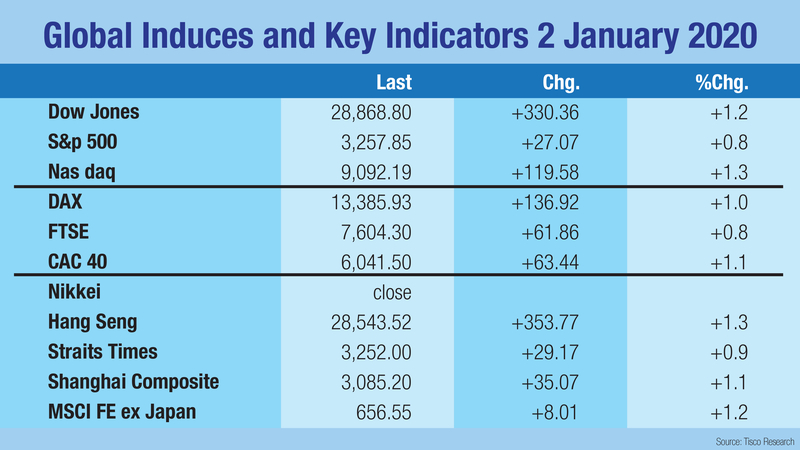
The SET surge was generally attributed to the more than 1 per cent jump in US equities with the Dow Jones and Nasdaq closing at record highs yesterday (January 2) on their first trading day of 2020.

Meanwhile, tensions in the Middle East between the United States and Iran pushed up world crude prices. In Thailand, investors are now less concerned about the strengthening baht after the Thai currency moved back to Bt30 / dollar from Bt29 in the New Year period.

Analysts at Tisco Research today forecast that the SET index may face new resistance barrier at 1610-1620 while lower bound is estimated at 1590. Rising oil prices make shares of HANA, PTTEP, TOP, IRPC and SPRC attractive, said Tisco Market Insight report.

They also suggested investors look for investment opportunities in shares of ADVANC, INTUCH, AP,QH, LH , BBL, KKP, SCB, MAJOR, SCC, TTW and TVO, which usually pay high dividends to shareholders.

Thai jewellers urged to explore US market #ศาสตร์เกษตรดินปุ๋ย

#ศาสตร์เกษตรดินปุ๋ย : ขอบคุณแหล่งข้อมูล : หนังสือพิมพ์ The Nation

https://www.nationthailand.com/business/30380083?utm_source=category&utm_medium=internal_referral

Thai jewellers urged to explore US market

Jan 03. 2020
By The Nation

The Department of International Trade Promotion (DITP) has urged Thai exporters to cash in on the demand for engagement rings in the US.

The department’s suggestion follows a survey that found young couples who are going to be married still preferring rings.

The department urged entrepreneurs to study the market and make products to meet the needs in order to boost exports.

The department’s director-general, Somdet Susomboon, said that he had received a report on the market for engagement jewellery in the United States from the Office of International Trade Promotion in Chicago, United States. The report pointed to the demand for gems and jewellery for married couples, which is useful information for Thai manufacturers and exporters in product planning to penetrate this consumer market, especially “engagement rings” that still have high demanded.

Usasri Kheorayab, director of the Thai Trade Centre in Chicago, added that the survey results showed more than 70 per cent of the fiances surveyed said they had to see the actual ring before buying, and 4 out of 10 people would buy an engagement ring 1-2 months before the day of the actual engagement. Diamond rings were the most popular, preferred by 86 per cent, followed by other types of gemstones such as Moissanite, Sapphire and Morganite (10 per cent), coloured diamonds (3 per cent), while1 per cent did not want any precious stones.

The metal choices were: white gold (54 per cent), pink gold (14 per cent), platinum (13 per cent), gold (13 per cent), and silver (7 per cent). The most popular gemstones patterns are: circular (47 per cent), princess patterns (14 per cent), oval patterns (14 per cent), square shape rounded edge (9 per cent), and 5 per cent prefer teardrop shape.

About 50 per cent of engagement ring sizes will be around 1-2 carats.

The average price of an engagement ring in 2019 was on average US$5,900, but 7 out of 10 fiancés will spend between $1,000-$4,000 on their engagement rings because they want to stay within their budget. The average price of engagement rings divided by different regions of the United States were: the mid-Atlantic region $7,500, New England area $6,900, Southwest region $5,600, West region $5,500, Southeast region $5,400 and In the middle of the country, $5,300.

“I want to ask the gems and jewellery entrepreneurs to study this information and use it in planning the production of engagement rings to meet the needs of young women in the United States, which will not only increase the opportunity to export to the US market but will help export gems and jewellery penetrating the United States market as a whole as well as increase exports,” Usasri said.

Singapore’s economy grew 0.7% in 2019, down from 3.1% in 2018: Flash data #ศาสตร์เกษตรดินปุ๋ย

#ศาสตร์เกษตรดินปุ๋ย : ขอบคุณแหล่งข้อมูล : หนังสือพิมพ์ The Nation

https://www.nationthailand.com/business/30380079?utm_source=category&utm_medium=internal_referral

Singapore’s economy grew 0.7% in 2019, down from 3.1% in 2018: Flash data

Jan 03. 2020
Pedestrians in the Central Business District, on Nov 4, 2019. Singapore's economic growth for the full year is projected to be between 0.5 per cent and 1 per cent.ST PHOTO: ONG WEE JIN

Pedestrians in the Central Business District, on Nov 4, 2019. Singapore’s economic growth for the full year is projected to be between 0.5 per cent and 1 per cent.ST PHOTO: ONG WEE JIN
By The Straits Times/ANN

SINGAPORE – Singapore’s economy grew by 0.7 per cent year on year in 2019, based on flash estimates released by the Ministry of Trade and Industry (MTI) on Thursday (Jan 2).

This was better than the 0.6 per cent growth forecast by analysts polled by Bloomberg, although it was far below the 3.1 per cent expansion in 2018.

It is also Singapore’s slowest economic growth since 2009, when the economy expanded 0.1 per cent year on year.

The ministry had projected economic growth for 2019 to be between 0.5 per cent and 1 per cent.

In the fourth quarter, the economy expanded by 0.8 per cent year on year, compared with the revised 0.7 per cent in the previous quarter. This is similar to what private-sector economists had predicted.

On a quarter-on-quarter seasonally adjusted annualised basis, the economy expanded at a slower pace of 0.1 per cent compared with the 2.4 per cent growth in the third quarter.

Ms Selena Ling, head of treasury research and strategy at OCBC Bank, said that the figures confirm that the Singapore economy bottomed in the second quarter of 2019.

While noting that growth in 2019 was the weakest in a decade, she said there are positives to take away from a “glass half-full perspective”.

“We avoided a technical recession, which was one of the fears after the (soft second quarter figures), and we avoided a full-year recession, so the worst-case scenarios did not come true,” Ms Ling added.

Maybank Kim Eng senior economist Chua Hak Bin highlighted that the estimates for the manufacturing sector suggest that the Government expects December’s factory output to remain in contraction territory.

The manufacturing sector contracted by 2.1 per cent in the fourth quarter, continuing the 0.9 per cent decline in the third quarter.

This was due to output declines in the electronics, chemicals and transport engineering clusters, which more than offset expansions in the precision engineering, biomedical manufacturing and general manufacturing clusters, the MTI said.

But Dr Chua said that the sector could see some recovery and possibly bounce back into expansion territory in December, which could lead to a slight uptick in overall economic growth.

“Manufacturing should emerge from its recession in 2020, which will be a big plus to the overall economy,” he added.

The construction sector grew by 2.1 per cent year on year in the fourth quarter, slightly slower than the 2.4 per cent in the previous quarter, on the back of public sector construction activities.

The services-producing industries expanded 1.4 per cent, compared with 0.9 per cent in the third quarter, supported by the likes of the finance and insurance sector, as well as the business services sector.

Ms Ling said the services and construction sectors are likely to be the bright spots for 2020.

“The resilient domestic labour market, which contributes to consumer confidence and private consumption, coupled with public sector spending on infrastructure projects including education, health and social services, remain key supporting pillars for the Singapore economy,” she said.

“The 2020 growth prognosis remains attendant on the external risks and global economic environment, but the stars are aligning towards a more supportive recovery story,” Ms Ling said, noting that phase one of the United States-China deal will be signed later in January and recent policy measures announced by China to address its economic slowdown and other challenges.

“The US-China phase one trade deal has already provided some uplift to market sentiments,” she added, but cautioned that the overall impact of the trade negotiations will still be dependent on the later phases, and the trade agreement is likely to be a “protracted process” given how talks have progressed since 2018.

The MTI will release the final growth figures for the fourth quarter and the whole of 2019 – including performance by sectors, sources of growth, inflation, employment and productivity – in February.

https://www.straitstimes.com/business/economy/singapores-economy-grows-07-in-2019-flash-data

Experts weigh in on China’s central bank move to cut reserve requirement #ศาสตร์เกษตรดินปุ๋ย

#ศาสตร์เกษตรดินปุ๋ย : ขอบคุณแหล่งข้อมูล : หนังสือพิมพ์ The Nation

https://www.nationthailand.com/business/30380078?utm_source=category&utm_medium=internal_referral

Experts weigh in on China’s central bank move to cut reserve requirement

Jan 03. 2020
Headquarters of the People's Bank of China (PBOC), the central bank, is pictured in Beijing, Sept 28, 2018. [Photo/VCG]

Headquarters of the People’s Bank of China (PBOC), the central bank, is pictured in Beijing, Sept 28, 2018. [Photo/VCG]
By China Daily/ANN

The People’s Bank of China (PBOC), China’s central bank, decided on Wednesday to cut the reserve requirement ratio (RRR) for financial institutions by 50 basis points from Jan 6 to spur the real economy.

The move will cut the cash that lenders must hold as reserves, releasing about 800 billion yuan ($114.6 billion) of long-term liquidity to bolster the economy and reduce social financing costs.

Let’s take a look what experts say about it.

Lyu Suiqi, professor at the School of Economics Peking University

The move marks the central bank’s policy direction in countercyclical adjustment. As a measure to keep employment, the financial sector, foreign trade, foreign and domestic investments, and expectations stable, it highlights the confidence and ability of the Chinese government.

The RRR cut can keep market liquidity at a reasonably ample level and further optimize liquidity structure. In terms of the direction of monetary policy, Lyu said the central bank will stick to prudent monetary policy, and avoid a flood-like stimulus.

Zeng Gang, deputy director-general of the National Institution for Finance and Development

The medium- and long-term capital brought by the RRR cut, on the one hand, could reduce banks’ cost of debt, encourage them to put more funds in capital with higher yield, and correspondingly reduce the cost of capital. On the other hand, long-term funds could, to some extent, promote banks’ medium- and long-term loan growth.

More than 120 billion yuan in long-term funds is expected to be unlocked for small and medium-sized lenders, which will build up their capacity to support the targeted enterprises, said the central bank. Zeng said the country is increasing support for small, micro and private businesses, optimizing their supply structure to ensure supply and demand is matched.

Li Qilin, chief analyst at Yuekai Securities

Presently, it’s not obvious to see lending rates move downward, due in part to the higher cost of debt, which leads to banks being unwilling to cut their lending rates.

The RRR cut is equivalent to providing low-cost debt for banks. It plays an important role in reducing the cost of capital, and then reduces the financing cost of the real economy. Furthermore, it could dredge up monetary policy transmission channels, motivate the vitality of market players, and further make sure the market forces will play a decisive role in the allocation of resources.

Wen Bin, chief analyst at China Minsheng Bank

The move was in line with market expectations as the maturity of 600 billion yuan of reverse repos in January, coupled with tax payments and higher cash demand during the Spring Festival, will put strains on liquidity.

Wen expected the reduction to lead to lower pricing of the new loan prime rate (LPR) to be announced later this month, with the one-year LPR at 4.1 percent and the above-five-year LPR at 4.75 percent. Noting the move will shore up market confidence, Wen said there is still room for further RRR cuts.

Lou Feipeng, senior economist at Postal Savings Bank of China

The first reserve ratio cut in 2020 aims to reduce social financing costs by providing capital for the early issuance of local government bonds that will strengthen infrastructure construction. As the cut was made at the start of the year, commercial banks are able to lend more to companies and receive profits earlier.

“The reserve ratio cut is a countercyclical measure to stabilize growth and a reflection of the flexibility of monetary policy,” Lou said.

Ming Ming, vice-director of CITIC Securities Institute

Considering this year’s Spring Festival comes earlier than usual, market liquidity is coming under pressure with higher cash demand. The reserve ratio cut could create a stable capital interest rate and embody the flexibility of prudent monetary policy, Ming said.

Central bank sees some hope on cloudy horizon #ศาสตร์เกษตรดินปุ๋ย

#ศาสตร์เกษตรดินปุ๋ย : ขอบคุณแหล่งข้อมูล : หนังสือพิมพ์ The Nation

https://www.nationthailand.com/business/30380077?utm_source=category&utm_medium=internal_referral

Central bank sees some hope on cloudy horizon

Jan 03. 2020
Central bank governor Veerathai Santiprabhob chaired  the Bank of Thailand’s Monetary Policy Committee final meeting of 2019 on December 18. File Photo

Central bank governor Veerathai Santiprabhob chaired the Bank of Thailand’s Monetary Policy Committee final meeting of 2019 on December 18. File Photo
By The Nation

Thai economic growth this year could exceed the baseline prediction of 2.8 per cent, the central bank believes. Minutes of the Bank of Thailand’s Monetary Policy Committee final meeting of 2019 on December 18, released on Thursday (January 2), included a unanimous vote to keep the policy rate unchanged at 1.25 per cent per annum.

The committee released a statement saying it was possible the economy would outperform the baseline projection.

It cited higher-than-projected growth among trading-partner economies where additional government stimuli were applied, trade tensions had improved and electronics sectors had shown faster- and better-than-expected recoveries, and higher-than-expected domestic demand as a result of public infrastructure investment and public-private collaboration, which it said can incentivise the private sector to invest more and more quickly.

It also noted there was potential for additional government stimulus measures here.

However, the committee warned that downside risks remained for headline and core-inflation in line with risks to economic growth.

The economy was expected to expand by 2.5 per cent in 2019 and is seen growing 2.8 per cent in 2020, in both cases below its potential and less than previously assessed.

Merchandise exports are projected to recover more slowly than expected due to sluggish global trade volume stemming from trade tensions and structural changes in the Thai export economy.

Public expenditure and private investment will also expand more slowly than previously forecast, the committee said.

However, private consumption in 2019 should turn out to have been better than estimated thanks to short-term economic stimuli.

In 2020, nonetheless, consumption is projected to slow in tandem with lower growth in household income and drought.

In 2021, the economy is expected to continue gaining traction as postponed public-private partnership (PPP) and public investment projects finally get started.

The committee believes private investment will expand at a lower rate than previously assessed due to export contraction, profitability and business confidence in investment deteriorating further and PPP projects on hold.

But it said private investment will be supported by export recovery and continuing infrastructure investment projects, including in the 5G network.

Public expenditure will expand more slowly than forecast as government agencies struggle to meet carry-over budget obligations under the new Budget Procedure Act, and also due to prolonged delays in state-owned enterprise investment and a reduction this year in their investment budgets.

Headline inflation for 2019 and 2020 is projected to be below target due mainly to supply-side factors.

These include lower-than-expected energy price recently and lowered projections for crude oil prices in the period ahead, and a coming minimum-wage hike also lower than expected.

Core inflation will remain low, in line with decelerating demand-pull inflationary pressures. But headline inflation is seen increasing from 0.7 per cent in 2019 to 0.8 per cent in 2020.

Core inflation is projected to increase from 0.5 per cent in 2019 to 0.7 per cent in 2020 in line with optimism for economic recovery and the minimum-wage hike.

Headline inflation is likely to return to target during the second half of 2021, the committee believes. The target for 2020 is in a range of 1-3 per cent.

SET index up 16 points, nearing 1,600, on first trading day of 2020 #ศาสตร์เกษตรดินปุ๋ย

#ศาสตร์เกษตรดินปุ๋ย : ขอบคุณแหล่งข้อมูล : หนังสือพิมพ์ The Nation

https://www.nationthailand.com/business/30380074?utm_source=category&utm_medium=internal_referral

SET index up 16 points, nearing 1,600, on first trading day of 2020

Jan 02. 2020
By The Nation

The Stock Exchange of Thailand Index closed at 1,595.82 on Thursday (January 2), up 15.98 points or 1.01 per cent rise.

The turnover for the first trading day of 2020 was Bt54.5 billion.

The exchange peaked on Thursday slightly higher than its close at 1,597.92, edging towards the watershed 1,600 level.

Credit: set.or.th

Credit: set.or.th

Analysts credited the robust action in the Thai and other Asian equity markets to easing of trade tensions between the United States and China.

US President Donald Trump tweeted on Tuesday that the first phase of the US-China trade pact would be signed on January 15, after which negotiations would begin on the second phase. He also said he would visit China but gave no hint of when.

On its last trading day of 2019, the SET index closed at 1,579.84, up 1.62 points, which Tisco Research credited largely to inflow from the long-term equity fund and retirement mutual fund.

Major markets in Asia also rose on Thursday. China’s Shanghai Stock Exchange Composite Index rose 1.15 per cent and Hong Kong’s Hang Seng was up 1.25 per cent.

But South Korea’s Kospi dropped 1.02 per cent. Japan’s Nikkei remains closed for extended holidays.

Baht weakens after hitting Bt29/dollar #ศาสตร์เกษตรดินปุ๋ย

#ศาสตร์เกษตรดินปุ๋ย : ขอบคุณแหล่งข้อมูล : หนังสือพิมพ์ The Nation

https://www.nationthailand.com/business/30380065?utm_source=category&utm_medium=internal_referral

Baht weakens after hitting Bt29/dollar

Jan 02. 2020
The Thai currency moved down to Bt 30.18/dollar this morning (December 2) after the weighted-average interbank exchange rate strengthened to Bt30.121 a dollar on December 30, a day before the New Year holidays, assistant governor of the Bank of Thailand Vachira Arromdee says.

The Thai currency moved down to Bt 30.18/dollar this morning (December 2) after the weighted-average interbank exchange rate strengthened to Bt30.121 a dollar on December 30, a day before the New Year holidays, assistant governor of the Bank of Thailand Vachira Arromdee says.
By The Nation

The baht has retreated after passing the Bt30 mark to Bt29 level against the US dollar in the New Year period.

The Thai currency moved down to Bt 30.18/dollar this morning (December 2) after the weighted-average interbank exchange rate strengthened to Bt30.121 a dollar on December 30, a day before the New Year holidays, assistant governor of the Bank of Thailand Vachira Arromdee said today (January 2).

The depreciation today, she said, was mainly driven by the return of market liquidity but warned that the baht has been highly volatile as the market adjusts to a new equilibrium between market forces of buying and selling US dollar.

The central bank will closely monitor the exchange rate market, she said.

“Participants should wait for market adjustment to settle in before making transactions,” she added.

The baht, in spot market, surged past the Bt30/dollar level to over Bt29 on December 31 and January 1.

Strengthening of the baht had put much pressure on the Thai economy last year, said Tisco Research. It also forecast growth of Thai gross domestic product at just 2.6 per cent in 2020, up from 2.5 per cent estimated for 2019.