Headline inflation up 0.87% in December #ศาสตร์เกษตรดินปุ๋ย

#ศาสตร์เกษตรดินปุ๋ย : ขอบคุณแหล่งข้อมูล : หนังสือพิมพ์ The Nation

https://www.nationthailand.com/business/30380056?utm_source=category&utm_medium=internal_referral

Headline inflation up 0.87% in December

Jan 02. 2020
By THE NATION
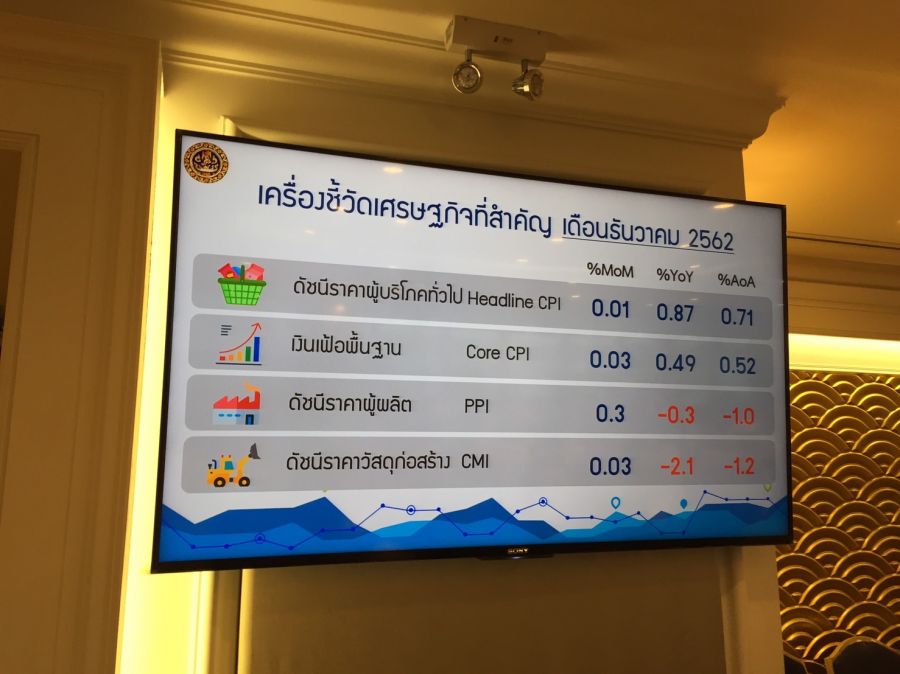
The consumer price index (CPI), commonly referred to as headline inflation, stood at 102.62 as December drew to a close, a 0.87-per-cent increase from the same month last year, the Commerce Ministry reported on Thursday (January 2).

“The CPI rose for the five consecutive months since its last slowdown in August,” said Pimchanok Vonkorpon, director-general of the ministry’s Trade Policy and Strategy Office.

“The key factor in the December rise was a hike in fresh food prices and a minimal decrease in energy prices – the least in the eight months.”

With the prices of fresh food and energy excluded from the calculation, core inflation expanded by 0.49 per cent, she said.

The average increase in core inflation for all of 2019 was 0.52 per cent and in headline inflation 0.71 per cent.

“These numbers are still within the ministry’s expectation of 0.7-1 per cent,” Pimchanok said. “The office estimates inflation rate for 2020 to be in the range of 0.4-1.2 per cent, for an average of 0.8 per cent.”

Govt prepares launch of new support measures next year #ศาสตร์เกษตรดินปุ๋ย

#ศาสตร์เกษตรดินปุ๋ย : ขอบคุณแหล่งข้อมูล : หนังสือพิมพ์ The Nation

https://www.nationthailand.com/business/30380028?utm_source=category&utm_medium=internal_referral

Govt prepares launch of new support measures next year

Dec 31. 2019
Government spokeswoman Narumon Pinyosinwat

Government spokeswoman Narumon Pinyosinwat
By THE NATION

The government is reviewing measures launched this year in support of farmers, the elderly and low-income earners, aimed at introducing new packages that can better solve their problems in 2020.

Government spokeswoman Narumon Pinyosinwat said on Tuesday (December 31) that Prime Minister Prayut Chan-o-cha had asked related state agencies to prepare new support measures for farmers in consistence with its BCG policy [bio-economy, circular economy, green economy].

The government will gather information of local and export markets to draw up separate plans for the production of farm produce. Technology will be deployed to lower costs.

The premier also instructed related agencies to examine the state welfare card scheme ahead of a new round of registration next year, to ensure that it will only be issued to eligible persons. There are 14.6 million card holders nationwide.

The government will also consider launching new programmes to create jobs for the elderly and measures to encourage their kin to take care of them. There are 11.35 million Thais over 60 in age.

She added that the government next year would focus more on helping Small and Medium-sized Enterprises (SMEs), particularly in upgrading their knowledge and widen their accessibility to loans.

Moreover, it will seek ways to upgrade the living standards of labourers and help solve the prevalent problem of informal loans. There are around 14.6 million labourers in Thailand.

Former Nissan head Carlos Ghosn, facing trial in Japan, has flown to Lebanon #ศาสตร์เกษตรดินปุ๋ย

#ศาสตร์เกษตรดินปุ๋ย : ขอบคุณแหล่งข้อมูล : หนังสือพิมพ์ The Nation

https://www.nationthailand.com/business/30380021?utm_source=category&utm_medium=internal_referral

Former Nissan head Carlos Ghosn, facing trial in Japan, has flown to Lebanon

Dec 31. 2019
Carlos Ghosn, former chairman of Nissan Motor Co., sits in a vehicle as he leaves his lawyer's office in Tokyo on March 6, 2019. MUST CREDIT: Bloomberg photo by Takaaki Iwabu.

Carlos Ghosn, former chairman of Nissan Motor Co., sits in a vehicle as he leaves his lawyer’s office in Tokyo on March 6, 2019. MUST CREDIT: Bloomberg photo by Takaaki Iwabu.
By Syndication Washington Post, Bloomberg News · Ania Nussbaum, Kae Inoue

Carlos Ghosn, the executive whose shocking arrest in Japan ended a more than two-decade run overseeing two of the world’s largest automakers, left the country where he’s awaited trial and is now in Lebanon, according to people familiar with the matter.

The former head of Nissan Motor Co. and Renault SA arrived in Beirut early this week, according to one of the people, who asked not to be identified ahead of the release of a public statement. The person said he fled Japan, where he has been under house arrest since April.

Ghosn was facing trial in Japan for alleged financial misconduct at Nissan. Japanese prosecutors and the U.S. Securities and Exchange Commission both claim he and Nissan violated pay-disclosure rules by being compensated $140 million more than the company reported to shareholders.

Ghosn’s arrival in Lebanon, where he has citizenship, marks a stunning development in a saga that started with his arrest in November 2018. The 65-year-old has denied wrongdoing, saying he’s been the victim of a conspiracy by Nissan executives and Japanese government officials to prevent him from further integrating the company with Renault.

Ghosn fled Japan because he doesn’t believe he will get a fair trial in the country, said one of the people familiar with the matter. Ghosn’s attorney in Japan didn’t immediately respond to a phone call seeking comment.

Ghosn, a globetrotter who for years was a regular at events frequented by the rich and famous – including the World Economic Forum in Davos, Switzerland – was released on bail in April under the condition that he live at a registered address and not leave Japan.

The strict terms of his release were designed to prevent him from absconding. He wasn’t permitted to spend more than one night away from his house without a judge’s permission. A video camera was trained on his front door, allowing the Tokyo prosecutor’s office to keep tabs on visitors. And at the end of each month, Ghosn was required to provide a list of everyone he’d met.

Around town, the former executive was tailed by unmarked sedans. At parks or restaurants, men would get out of the cars and follow him on foot.

History shows beating a criminal charge in Japan is exceedingly difficult. The courts have a nearly 100% conviction rate. Prosecutors there enjoy a range of procedural advantages unavailable to Western counterparts. In many cases, the prosecution can introduce evidence obtained without a proper warrant.

Japan has extradition treaties with the U.S. and South Korea, according to the foreign ministry’s website.

The Lebanese newspaper L’Orient-Le Jour reported earlier on Ghosn’s arrival in Beirut, the capital of his parents’ homeland. It said the newspaper al-Joumhouriya first carried the news, reporting that Ghosn arrived on a private jet from Turkey.

Ghosn also faces breach-of-trust charges related to transactions that transferred personal investment losses to Nissan, and that moved money from a dealership in Oman into a company he controls in Lebanon.

Trading a dove for two hawks: The Fed’s 2020 voters #ศาสตร์เกษตรดินปุ๋ย

#ศาสตร์เกษตรดินปุ๋ย : ขอบคุณแหล่งข้อมูล : หนังสือพิมพ์ The Nation

https://www.nationthailand.com/business/30380019?utm_source=category&utm_medium=internal_referral

Trading a dove for two hawks: The Fed’s 2020 voters

Dec 31. 2019
Photographer: Bloomberg Daybreak

Photographer: Bloomberg Daybreak
By Syndication Washington Post, Bloomberg · Alister Bull

Federal Reserve projections show no interest-rate changes next year but the annual rotation among voters could still influence policy as incoming members include an outspoken dove while two hawks depart.

Minneapolis Fed chief Neel Kashkari, who called vocally for rate cuts during 2019, is the clear dove among the four new voters. He joins alongside Robert Kaplan from Dallas, Philadelphia’s Patrick Harker and Loretta Mester from Cleveland. Interest-rate forecasts by Fed officials next year showed 13 expected no change and four penciled in a quarter percentage-point hike, according to the summary of economic projections updated on Dec. 11 — showing a fairly high degree of unity as the country heads into a U.S. presidential election year.

They replace Kansas City Fed President Esther George and Boston’s Eric Rosengren, hawks who both dissented against all three rate cuts this year. The others departing are dove James Bullard from St. Louis, who wanted a half-point rather than quarter-point cut in September, and Chicago’s Charles Evans, who also supported easier monetary policy to ensure the Fed lifts inflation to its 2% target on a sustainable basis.

The yearly voter rotation among regional Fed presidents can foreshadow looming splits over policy that generate dissents, depending on who gets the vote and how strongly they disagree with their colleagues. But it generally won’t dictate the path of policy. That’s because Fed Chairman Jerome Powell can probably count on the support of the Board of Governors, plus New York Fed President John Williams, who also wields a permanent FOMC vote. That means Powell has six votes against the four in the hands of the remaining regional Fed chiefs, in the rare event that all four voted the same way against him.

Here’s what the four new voters have recently said about their outlooks.

– Mester (somewhat hawkish):

The Cleveland Fed president is probably the most hawkish of the four, though her recent comments that policy is now in a “good spot” following three cuts don’t show any current pressure for a change. That said, the PhD economist and long-time Fed insider said she hadn’t favored cutting rates three times. As a result, she may start pushing for tighter policy if inflation picks up with unemployment at a 50-year low.

– Kashkari (dove):

Minneapolis Fed chief Neel Kashkari was an outspoken advocate for cutting rates last year when inflation failed to pick up as expected. He’s argued the central bank should commit to not raising rates again until core inflation rises back to 2% on a sustained basis. The remarks suggest Kashkari won’t be pushing to raise rates any time soon, and will make the case for allowing inflation to run above 2% without the Fed hitting the policy breaks — in order to demonstrate its commitment to achieving that target on a sustainable basis.

– Kaplan (centrist):

The Dallas Fed chief sees a sluggish economy in 2020, so things would have to deteriorate for him to back easing policy further. He’d been open to easing earlier in 2019 after the yield curve inverted. But he told Bloomberg Television on Dec. 18 that with the curve sloping upward, Fed policy is probably in the right place. Nor did he sound worried about inflation, saying the pricing power of businesses has been eroded by technology and he expects inflation to be “muted for some period of time.” He has never dissented since joining the Fed in 2015.

– Harker (centrist with hawkish bent):

Philadelphia’s Harker spoke out several times against the Fed’s rate cuts this year, which he said were unwarranted because the economy appeared to be weathering uncertainty caused by trade tension between the U.S. and China. That could signal he’d favor raising rates sooner rather than later to stay ahead of inflation amid very low unemployment. He has never dissented at an FOMC meeting since joining the Fed in 2015.

Commodities clinch best year since 2016 as trade worries ebb #ศาสตร์เกษตรดินปุ๋ย

#ศาสตร์เกษตรดินปุ๋ย : ขอบคุณแหล่งข้อมูล : หนังสือพิมพ์ The Nation

https://www.nationthailand.com/business/30380017?utm_source=category&utm_medium=internal_referral

Commodities clinch best year since 2016 as trade worries ebb

Dec 31. 2019
 Wheat is trading at the highest since 2018 and soybeans are set for the biggest monthly advance since 2016. (File Photo)

Wheat is trading at the highest since 2018 and soybeans are set for the biggest monthly advance since 2016. (File Photo)
By Syndication Washington Post, Bloomberg · Jake Lloyd-Smith 

Commodities are set for the best annual performance since 2016, with crude to copper posting annual gains.

The Bloomberg Commodity Spot Index has hit the highest since November 2018 as trade tensions ebb, a risk-on mood sweeps markets, and the dollar eases. The gauge is now up 11% in 2019.

Commodities are benefiting from an end-of-year surge as the outlook for 2020 appears, at least at present, to be more promising than conditions that prevailed for much of this year. The U.S.-China phase-one pact — expected to be formally concluded next month — hinges on the Asian nation increasing purchases of farm goods. In addition, prospects for a deal have helped spur restocking by raw-materials users, according to Oversea-Chinese Banking Corp.

“Renewed optimism from the U.S.-China trade deal is driving demand expectations higher,” said Howie Lee, an economist at the Singapore-based lender. “Stockpiles are low going into 2020 and, with the expected pickup in demand, a lot of industry players find themselves short of inventories.”

Raw materials have also enjoyed a tailwind from a weaker U.S. currency, with the Bloomberg Dollar Spot Index retreating 1.8% this month to the lowest level since July. After three interest rate cuts this year, the U.S. Federal Reserve is expected to hold monetary policy steady over 2020.

Concerns among investors about the possibility of the onset of a U.S. recession — which hurt commodities earlier this year — have eased. This month, bond manager Jeffrey Gundlach said the odds of a recession by the end of next year have dropped to 35%. In September, he had predicted 75%.

Conditions in China, the top raw-material user, are picking up too. The nation’s economic performance improved in December for the first time in eight months, according to earliest-available indicators compiled by Bloomberg.

The advance in raw materials has been broad-based. Crude in New York has risen to the highest since September, with prices up 37% this year as the OPEC+ group of producers presses on with supply curbs.

In base metals, copper has surged far above $6,000 a ton as global stockpiles sink and the macro-economic outlook brightens. Wheat is trading at the highest since 2018 and soybeans are set for the biggest monthly advance since 2016.

There have been gains in precious metals too, including traditional haven gold, which has climbed in December even as the risk-on mood prevails and equity markets set records. Bullion on the spot markethas risen 3.5% this month to about $1,515 an ounce as of 9:39 a.m. in New York.

With Trump’s farm bailout came surprising profits, but little help for the neediest #ศาสตร์เกษตรดินปุ๋ย

#ศาสตร์เกษตรดินปุ๋ย : ขอบคุณแหล่งข้อมูล : หนังสือพิมพ์ The Nation

https://www.nationthailand.com/business/30380015?utm_source=category&utm_medium=internal_referral

With Trump’s farm bailout came surprising profits, but little help for the neediest

Dec 31. 2019
Photo by: The Washington Post — The Washington Post
File Size: 1.03 Mb

Photo by: The Washington Post — The Washington Post File Size: 1.03 Mb
By The Washington Post · Andrew Van Dam, Laris Karklis

In 2019, the farm belt felt about as hospitable as the asteroid belt. Record rainfall turned fields to sludge and made it nigh-on impossible to plant corn and soybeans until long after the typical window had passed. President Donald Trump’s long-running trade war cut off farmers’ access to China’s enormous market. Across the farm sector, commodity prices remained in the doldrums.

Yet the Agriculture Department now estimates 2019 was farmers’ most profitable in five years. What happened?

Three words: Market Facilitation Program. Or, as it’s more commonly known, the farm bailout.

Without government assistance, U.S. farm income would have fallen about $5 billion from its already-low 2018 level. So the $14.5 billion in bailout funding announced so far represents a substantial reversal of fortune. About three-quarters of the funding already has been distributed.

“If you look at the prices, the weather and the trade imbalances, you’d expect the farm sector to be in a terrible spot,” Montana State University economist Eric Belasco said. “It’s not.”

That’s the sector overall, however – the total income earned by all 2 million farms and ranches in the United States. The top-line figure obscures profound differences.

Most farmers benefited from the bailout, Belasco said, but because bailout money is distributed based on acreage and not farmer’s need, about half of the money (47 percent) went to the largest 10 percent of operations. The numbers come from an analysis by Belasco and his colleague, Vincent Smith. (Both men are also affiliated with the right-leaning American Enterprise Institute.)

The disparity runs too deep to be solved by a government bailout, Belasco said. According to 2018 data, more than 70 percent of farm households had a high level of financial risk in 2018. But of those that qualify as very large (median income $756,000), only 25 percent fit into that same category.

“The philosophical question is: Should we have trade aid for farmers who are at a low risk of losing their farm?” Belasco asked. “Most other safety-net programs are income-adjusted,” he added later. “Farm policy doesn’t do that at all.”

Indeed, the past two years have been marked by a sharp rise in bankruptcies in the nation’s deepest farm country. A quarter of the nation’s farms sit in super agriculture-dependent areas – places where more than 1 in 7 people live on farms. Among them, the rate of farm-specific bankruptcies (Chapter 12) has more than tripled since 2015.

But farms’ stress doesn’t just show up in family-farm bankruptcies. Some farmers don’t meet the requirements for Chapter 12, and many others in farm country depend on farms for their livelihood even if they don’t grow much themselves. Across the board – whether it’s the liquidation of Chapter 7 or the restructuring of Chapters 11 and 13 – bankruptcies in these farming-dependent areas are rising faster than in the rest of the nation.

“Farmers as a whole keep expecting their farm income to be better than what it turns out to be,” said Robert Dinterman, an agricultural economist at Ohio State University who constructed the farm-bankruptcy database we analyzed in this story. So, he added, “each year farmers are digging themselves in a larger and larger hole – they’re accumulating more debt than they’re able to pay off.”

“I don’t think there’s any reason to think there’s going to be any relief in the future,” Dinterman said. Only a dramatic new round of government payments or an emphatic resolution to Trump’s ongoing trade wars could change in the industry’s trajectory, he said.

Overall, the growth in farm debts has outstripped farmers’ stagnant equity stakes, leaving them at higher risk of insolvency than they have seen at any point since the end of the Great Recession. It’s compounded by an unwelcome mix of lackluster prices for corn and soybeans on the open market and low yields caused by extreme weather.

“I’ve never met anyone that could think of a worse time for planting conditions,” said Todd Hultman, a market analyst with the data firm DTN and a regular on the farm-show circuit. “In the modern era, this has been by far the worst planting season for corn and soybeans.”

“It usually takes more than one bad year to get farmers to declare bankruptcies,” said Carrie Litkowski, who leads the USDA team that estimates farm income. She added that “it seems like a lot of farmers might be saying every year, ‘I’ll just hold out for one more year.’ They’re just hoping for a turnaround.”

Ohio State University Farm Income Enhancement Chair Ani Katchova said the shift in income sources may surprise farmers. “Farmers are getting a little bit less from cash receipts and a little bit more from government payments,” she said.

Even with help from the federal government, U.S. farm profits are only two-thirds of the inflation-adjusted $136.6 billion farmers pocketed in 2013, the best year in recent memory. This year’s total is almost directly in line with average profits since 2000, adjusted for inflation. The bailout alone can’t make up for the collective hammering farmers took from four straight subpar years.

“Ag policy has this long history of mixing politics with ad hoc disaster programs,” Montana State’s Belasco said. “These programs continue in spite of efforts to formalize disaster relief through programs like crop insurance.”

According to Belasco, 7 in 10 assistance dollars have gone to farmers growing corn and soybeans. The relentless rain that delayed planting of both crops this spring has been compounded by early winter weather. Farmers, especially in the northern reaches of the farm belt, may not be able to harvest their snowed-in corn crops until next year.

“They all cringe at the thought of having corn stand in the fields over winter where it just becomes raccoon feed and deer feed,” Hultman said. “The longer it’s out there, the worse it’s going to be.”

According to University of Illinois economist Scott Irwin, the bailout payments have “fully compensated” farmers for the damage from the trade war with China. But it’s possible that the trade war dynamics may soon reverse for farmers.

Under a new deal reached earlier this month, chief U.S. trade negotiator Robert E. Lighthizer expects China to purchase $40 billion to $50 billion in agricultural products. That goal seems “difficult to achieve,” according to Peterson Institute for International Economics senior fellow Chad Bown. It would far exceed the $24 billion baseline set in 2017, and it’s not clear which agricultural products the U.S. would sell to make up the difference.

“If the trade deal is signed and it’s real, I think we’re going to be looking at a China-driven miniboom in the ag sector,” Irwin said. He then clarified that if the United States somehow really did sell as much as $50 billion in agricultural commodities to China, that miniboom would upgrade to a “full-scale boom.”

“I don’t even know how we’d get to that number,” Irwin said.

According to OSU’s Katchova, who recently chaired a panel that reviewed the USDA’s income forecasts and estimates in extraordinary detail, the USDA’s estimates are typically accurate this late in the year.

“An individual farmer may experience a harder year with lower farm income, but on average, across all farmers, farm income is expected to increase for this year,” she said.

“These are not great times,” Katchova said, “but they’re now becoming average times.”

U.S. stocks fall in light trading; bonds, dollar drop #ศาสตร์เกษตรดินปุ๋ย

#ศาสตร์เกษตรดินปุ๋ย : ขอบคุณแหล่งข้อมูล : หนังสือพิมพ์ The Nation

https://www.nationthailand.com/business/30380014?utm_source=category&utm_medium=internal_referral

U.S. stocks fall in light trading; bonds, dollar drop

Dec 31. 2019
The benchmark is still headed for its best year since 2013.(File Photo)

The benchmark is still headed for its best year since 2013.(File Photo)
By Syndication Washington Post, Bloomberg · Randall Jensen, Claire Ballentine

U.S. stocks fell in light trading on the penultimate day of a blockbuster year for markets. Treasuries and the dollar declined.

The S&P 500 fell the most in more than three weeks amid the countdown to the New Year’s Day holiday Wednesday. Tech shares paced losses, with Facebook, Amazon and Google’s parent company among the biggest decliners. The benchmark is still headed for its best year since 2013.

Ten-year Treasury yields pared earlier gains to trade around 1.88%, while the dollar fell for a third straight session as the yen and the pound strengthened.

“This whole week’s going to be slow, so I wouldn’t attribute any day’s movements or any movements this week to anything in particular,” said Jeff Mills, chief investment officer at Bryn Mawr Trust. “The market is in an interesting spot, we’ve run up quite a bit, technically the market is overbought.”

Investors are acting with caution in thin pre-holiday trading at the end of a year that’s propelled global equity benchmarks to record highs. And with the Federal Reserve apparently on hold and U.S. trade trade talks seemingly far from a new breakthrough, traders may remain reluctant to jump back into risk markets.

Elsewhere, West Texas crude turned lower following a report that Iran detained a fuel tanker.

– – –

Here are some events to watch for this week:

– China’s official manufacturing PMI is due Tuesday, and the Caixin version comes Thursday.

– Most global markets will be closed Wednesday. U.S. fixed-income markets also close early at 2 p.m. EST Tuesday.

– World leaders including China’s Xi Jinping and North Korea’s Kim Jong Un are set to deliver New Year addresses.

– Federal Open Market Committee minutes will be released Friday.

– U.S. ISM manufacturing is also due Friday. The Institute for Supply Management’s PMI is forecast to show a contraction for a fifth straight month.

– – –

These are some of the moves in major markets:

Stocks

– The S&P 500 Index fell 0.6%, the most since Dec. 3, as of 4 p.m. New York time.

– The Stoxx Europe 600 Index declined 0.9%.

– The MSCI Asia Pacific Index was little changed.

Currencies

– The Bloomberg Dollar Spot Index dipped 0.2%.

– The British pound rose 0.3%.

– The euro climbed 0.2%, to $1.1203.

– The Japanese yen strengthened 0.6%, to 108.82 per dollar.

Bonds

– The yield on 10-year Treasuries rose two basis points, to 1.90%.

– Germany’s 10-year yield climbed seven basis points, to -0.19%.

– Britain’s 10-year yield jumped 11 basis points, to 0.867%.

Commodities

– West Texas Intermediate crude fell 0.3%, to $61.54 a barrel.

– Gold climbed 0.3%, to $1,515.45 an ounce.

Exports likely to fare better in December #ศาสตร์เกษตรดินปุ๋ย

#ศาสตร์เกษตรดินปุ๋ย : ขอบคุณแหล่งข้อมูล : หนังสือพิมพ์ The Nation

https://www.nationthailand.com/business/30380005?utm_source=category&utm_medium=internal_referral

Exports likely to fare better in December

Dec 30. 2019
Pornpen Sodsrichai, Bank of Thailand's Director, Economic Analysis Office

Pornpen Sodsrichai, Bank of Thailand’s Director, Economic Analysis Office
By THE NATION

Total Thai export in December is expected to post a lower contraction rate than November, which stood at minus 7.7 per cent from the previous month (October), said Pornpen Sodsrichai, Bank of Thailand’s Director, Economic Analysis Office, on Monday (December 30).

Value of Thai export has declined 3.4 per cent year on year over the past 11 months.

The central bank expected the Thai economy to grow 2.5 per cent this year.

Next year, it estimated an economic expansion of 2.8 per cent, based on an assumption that export will grow 0.5 per cent in line with an expected improvement of the global economy.

Thai economy stays on downtrend in November #ศาสตร์เกษตรดินปุ๋ย

#ศาสตร์เกษตรดินปุ๋ย : ขอบคุณแหล่งข้อมูล : หนังสือพิมพ์ The Nation

https://www.nationthailand.com/business/30380004?utm_source=category&utm_medium=internal_referral

Thai economy stays on downtrend in November

Dec 30. 2019
By THE NATION

The Thai economy stayed on a path of deceleration in November, according to a Bank of Thailand report today (December 30).

The value of merchandise exports continued to contract, mainly due to the economic slowdown of trading partners, consistent with deterioration in merchandise imports, manufacturing production and private investment indicators.

Public spending also contracted from both current and capital expenditures as private consumption indicators edged up amid the government’s economic stimulus measures.

However, the tourism sector continued its expansion during the month.

On the stability front, headline inflation edged up from the previous month on the back of higher core inflation and lower contraction in energy prices.

The seasonally adjusted unemployment rate slightly increased while the number of employed persons was unchanged. The current account remained in surplus while the capital and financial accounts posted a deficit from the asset position.

Details of economic conditions in November:

The value of merchandise exports, excluding gold, contracted by 7.7 per cent from the same period last year.

The contraction of exports in almost all categories was due to 1) the economic slowdown of trading partners; 2) the non-obvious recovery in electronic cycle; and 3) the contraction of global crude oil prices, coupled with the temporary maintenance shutdown of some oil refineries, leading to the contraction of petroleum-related products exports, both in terms of prices and quantity.

Additionally, structural changes in production and global trade as a result of trade tensions caused some Thai export items being replaced by Chinese products in the Asean market.

However, exports of agro-manufacturing products continued to expand. As a consequence of the merchandise exports contraction, manufacturing production continued to decline.

The value of merchandise imports contracted by 13.9 per cent from the same period last year, excluding gold while imports value contracted by 15.4 per cent.

The contraction of imports in almost all categories, consistent with softening economic activities, was attributable to 1) imports of raw materials and intermediate goods especially in crude oil, partly due to the maintenance shutdown of some oil refineries; 2) imports of capital goods mainly from turbo-jets and telecommunication equipment; and 3) imports of consumer goods particularly in fishery products due to the high base effect last year.

Private investment indicators continued to deteriorate from the same period last year as a result of weak domestic and external demands and the low rate of capacity utilisation in the manufacturing sector, causing businesses to delay investment.

Consequently, investment in machinery and equipment continued to contract from imports of capital goods, domestic machinery sales, and the number of newly-registered motor vehicles.

Meanwhile, investment in construction declined from permitted construction area for residential purposes, consistent with subdued activities in the real estate sector. However, the permitted construction area for manufacturing purposes continued to grow while the permitted construction area for commercial and other purposes expanded in November.

Public spending, excluding transfers, contracted from both current and capital expenditures. Current expenditures contracted due to purchases of goods and services from disbursement of some national security authorities.

Meanwhile, central government’s capital expenditures continued to contract as the FY2020 budget has yet to be enforced. State enterprises’ capital expenditures contracted slightly, mainly among energy-related agencies.

Private consumption indicators expanded at a slightly higher pace from the same period last year but continued to be on a decelerating trend relative to the first half of the year, in line with softening non-farm income and consumer confidence, together with financial institutions’ tightening of credit standards for auto-leasing loans after a deterioration in credit quality. Meanwhile, the government’s economic stimulus measures continued to support households’ purchasing power to a certain extent.

In November, spending on non-durable goods and services decelerated, after accelerating in the previous month due to the government’s economic stimulus measures. Nevertheless, spending on semi-durable and durable goods continued to contract, especially in vehicle sales.

The number of foreign tourist arrivals continued to expand at 5.9 per cent compared with the same period last year from 1) the exemption of the visa on arrival fee, encouraging more visitors from China, India, and Taiwan; 2) the recovery of the Russian economy and an increase in airline route from Russia to Thailand, supporting more Russian tourists; and 3) the continued expansion of other Asian tourists from Laos and Japan etc.

The number of foreign tourist grew at a slower pace from the previous month while the low base effect from the tour boat incident in Phuket last year fades out.

On the stability front, headline inflation stood at 0.21 per cent, accelerating from last month on the back of lower contraction in energy prices due to higher domestic retail petroleum prices from the previous month, and a slightly increase in core inflation.

The seasonally-adjusted unemployment rate slightly increased while the number of employed persons was unchanged. The current account remained in surplus. The overall capital and financial accounts registered a deficit from the asset position as a result of Thai Direct Investment (TDI) especially in equity, and portfolio investment in debt securities of Thai investors.

Banks, electricity agencies work to ensure smooth NY celebrations #ศาสตร์เกษตรดินปุ๋ย

#ศาสตร์เกษตรดินปุ๋ย : ขอบคุณแหล่งข้อมูล : หนังสือพิมพ์ The Nation

https://www.nationthailand.com/business/30380001?utm_source=category&utm_medium=internal_referral

Banks, electricity agencies work to ensure smooth NY celebrations

Dec 30. 2019
By THE NATION

Banks and state electricity agencies have prepared to ensure that New Year celebrations will not be disrupted.

Thai Bankers’ Association chairman Predee Daochai said association members and related parties, including the National Interbank Transaction Management and Exchange, have prepared to ensure that digital banking services and related systems have sufficient capacity to cater to the expected rise in transactions during the celebration period.

He added that all related parties have monitored the situation before New Year will continue to do so after that.

He believes that next year all banks will continue to boost their digital banking services as more people prefer to carry out banking transactions online.

Meanwhile, Roengchai Khongthong, Electricity Generating Authority of Thailand (Egat) deputy governor, Transmission System, said Egat, together with the Metropolitan Electricity Authority and the Provincial Electricity Authority, are prepared to deal with any situation this New Year.

He spoke in his capacity as chairman of the committee tasked to improve electricity-system reliability of the three state electricity agencies.

Three of them have also prepared backup plans for any emergency and have staff ready to solve any service disruption on a 24-hour basis, he added.