The baht opened at 36.58 to the US dollar on Wednesday, strengthening from Tuesday’s close of 36.61.
The currency is expected to move between 36.50 and 36.70 during the day, predicted Krungthai Bank market strategist Poon Panichpibool.
Poon said the dollar might remain stable or even weaken if the market jumps into a risk-on state.
He believes the baht will not weaken past its resistance level of 36.70-36.80 if foreign investors purchase risky Thai assets again.
However, the baht could fluctuate and fail to strengthen because the market is ready to slide back into a risk-off state due to concerns over economic slowdown and worse-than-expected performance by listed companies, Poon said.
Also, investors believe the US Federal Reserve may push the interest rate up by a fair bit, he said.
Moreover, the energy crisis in Europe is a concerning factor in the short term.
Poon advised close monitoring of this situation because the euro might weaken further and cause the dollar to strengthen if Russia halts or decreases the amount of energy sent to Europe.
He also advised investors to use hedging tools such as options to manage risks in a highly volatile currency market.
Thai businesses operating in Myanmar have been advised to seek funding sources in Thailand or other countries after the Central Bank of Myanmar (CBM) suspended loan repayment in foreign currencies.
The Department of International Trade Promotion (DITP) director-general Phusit Rattanakul Seriroengrit said on Tuesday that CBM asked commercial banks across the country on July 13 to suspend loan repayments in foreign currencies to shore up the weakening kyat.
This move would affect foreign companies who operate in Myanmar as they can no longer repay debts with foreign currencies, he added.
“Thai businesses who operate in Myanmar and borrow in foreign currencies must seek funding sources in Thailand or other countries to prevent defaulting on their debt repayments,” he said.
Phusit Rattanakul Seriroengrit
He added that DITP’s international trade office in Yangon is cooperating with commercial banks in Thailand to grant loans for Thai businesses in Myanmar.
Thailand will target a whopping 2.38 trillion baht in revenue from tourists next year – or 80 per cent of the 3 trillion baht earned pre-Covid in 2019.
The bait for foreign tourists will be “reunions” in Thailand as well as “meaningful travel” (eco trips focused on sustainability), TAT governor Yuthasak Supasorn said on Monday.
Yuthasak was launching the “Visit Thailand Year 2022-2023: Amazing New Chapters” campaign aimed at luring back foreigners after two years at home during Covid.
The campaign is designed to restore Thailand to the top five nations with highest revenue from foreign tourists, Yuthasak said. The Kingdom ranked fourth on the list before Covid struck, the governor added.
TAT expects revenue from both domestic and foreign tourists to total between 1.25 trillion and 2.38 trillion baht in 2023, with a median of 1.73 trillion baht.
The TAT forecasts full recovery to pre-Covid levels in 2024.
Yuthasak expects between 11 million and 30 million foreign tourists to visit Thailand next year, generating revenue of 580 billion-1.5 trillion baht.
“But if the Chinese government allows its citizens to travel outside the country, the number of foreign arrivals will definitely reach 30 million next year,“ he added.
He said the TAT is targeting high-spending tourists from all regions throughout the year.
Thailand will tap new markets such as Saudi Arabia, Qatar, Oman and other Middle East countries, while targeting new cities in current markets such as the United States.
TAT expects foreign tourists to spend less money next year due to inflation and Russia’s war in Ukraine. It forecasts average spending of 50,000-54,000 baht per trip, compared with 77,000 baht in the first quarter this year.
However, Yuthasak said the weaker baht would boost foreign tourists’ spending power and encourage them to visit Thailand.
Tourist arrivals so far this year total 2.7 million but that figure is expected to rise to 10 million by year-end, the governor said.
However, the TAT has lowered its forecast of revenue from foreign tourists in 2022 from Bt1.5 trillion to Bt1.2 trillion as the global economic downturn has affected spending.
Meanwhile trips by tourists from nearby countries such as Malaysia lasted an average of only two days, compared with the average 10-14 days for tourists from further afield.
“So, the number of foreign tourists will hit the target in 2022 but the revenue goal of Bt1.5 trillion will not be met,” Yuthasak said.
The TAT forecasts 117 million-135 million domestic travellers next year, generating between 670 billion to 880 billion in revenue from an average of 4,200-4,800 baht per trip. The campaign “Thais can visit amazing Thailand 365 Days” is being launched to boost domestic travel.
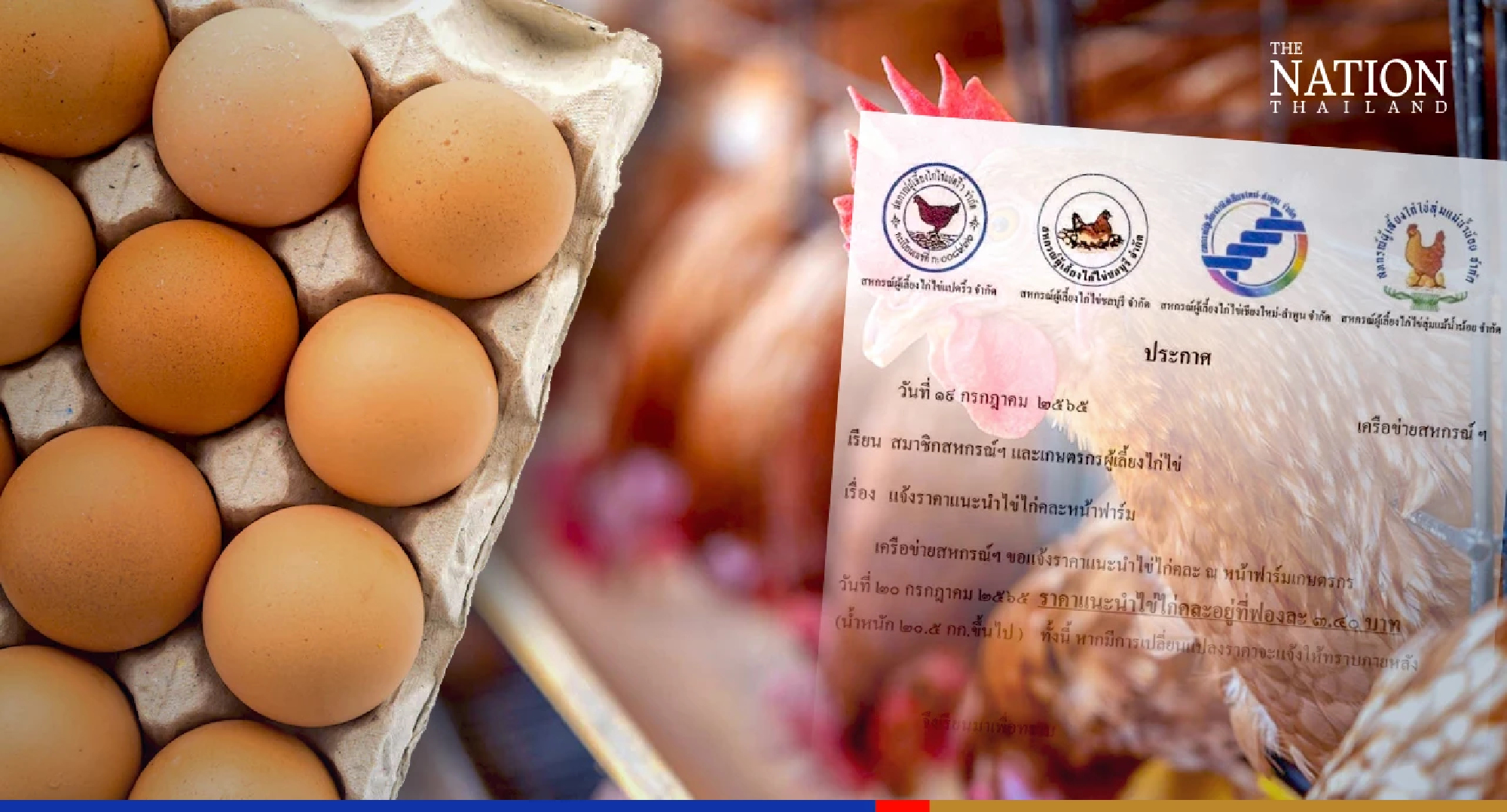
The price of assorted eggs at farms will be increased by 10-20 satang apiece to 3.40 baht apiece from Wednesday, Thailand’s Layer Farmer Association said on Tuesday.
Meanwhile the association president, Manoch Chutubtim, has informed layer poultry farmers nationwide via Line application that farmers are suffering from rising production cost, such as animal feed, labour and electricity, since the beginning of this year.
He said the price of eggs is currently volatile due to conflict between related government agencies and retailers.
“Hence, farmers must adjust their methods of raising laying hens to coincide with the raising period,” he said.
Manoch Chutubtim
He also expected the price of eggs to rise next week depending on the market mechanism.
According to the website www.rachakaikai.com, the price of eggs as of Tuesday are as follow:
The baht opened at 36.68 to the US dollar on Tuesday, weakening from Monday’s close of 36.60.
The currency is expected to move between 36.60 and 36.75 during the day, predicted Krungthai Bank market strategist Poon Panichpibool.
He reckoned that the baht is likely to fluctuate and weaken to test its resistance level from 36.70 to 36.80 to the greenback, which is strengthening due to concerns over economic slowdown and worse-than-expected performance of listed companies.
Also, investors believe the US Federal Reserve may push the interest rate up by a fair bit.
Poon also warned investors to beware of China enforcing strict lockdown measures and investors’ concerns about the Covid-19 situation in Thailand. He said these factors may affect foreign transactions in the short term.
He advised investors to use hedging tools such as options to manage risks in a highly volatile currency market.
Flights in and out of Thailand should gradually rise and arrive at pre-pandemic levels by the fourth quarter of this year, the Aeronautical Radio of Thailand (AeroThai) said on Sunday.
Nopasit Chakphitak, AeroThai president, said the increase in flights should start this month, thanks to the government’s move to ease Covid-related restrictions and entry measures on July 1.
He said July should see 1,437 flights taking off and landing daily, compared to 1,374 in June. He added that the daily flights should rise to 1,480 during the July 13-17 and July 28-31 long holidays.
“We expect to see good signs of recovery in July and August,” he said.
However, he said there will be more domestic flights than international ones because each country’s Covid-19 situation and travel restrictions are different.
“If the government’s plan to reopen the country goes smoothly, then Thailand should see 430,000 flights this year, up 41 per cent compared to last year,” he added.
Meanwhile, the Civil Aviation Authority of Thailand sees three scenarios in the recovery of the country’s aviation industry:
• If the Covid-19 situation improves and vaccines are widely distributed, the number of local and international passengers should reach 68.26 million and 30.68 million, respectively.
• If Asian countries like China, India, South Korea and Japan continue maintaining travel restrictions, the number of domestic and international passengers this year will come in at 58.95 million and 22.50 million, respectively.
• If the Covid-19 pandemic continues, but some potential markets show signs of recovery, then the number of domestic and international passengers this year will come in at 58.95 million and 15.53 million, respectively.
The baht opened at 36.58 to the US dollar on Monday, strengthening from Friday’s close of 36.61.
The Thai currency is expected to move between 36.50 and 36.70 against the greenback during the day and between 36.30 and 36.90 during the week, Krungthai market strategist Poon Panichpibool predicted.
Poon believes the baht might reach its weakest point, but should not pass 37 to the dollar unless China reinforces new lockdown measures.
The weakening of the baht may also slow down because foreign investors are buying Thai stocks during the dip and some are speculating that the baht will strengthen as the tourism sector’s recovery is better than expected.
Poon expects the dollar to strengthen at the beginning of the week, especially if the market is disappointed with business reports and shifts to a risk-off state.
However, the dollar might fluctuate and weaken if the European Central Bank increases the interest rate and the Purchasing Managers’ Index is worse than expected.
The Nong Khai Chamber of Commerce is urging the government to improve border trade as consumer behaviour in Laos has changed a lot after the Covid-19 crisis.
Duangjai Sukkasemsin, the chamber’s vice president, said border trade was buzzing before the crisis as many Laotians came across to purchase consumer goods. She said wealthy Laotians also travelled across to take flights to Bangkok and then to other countries.
“But travel restrictions imposed during the Covid-19 crisis has caused the border trade to drop by more than 60 per cent,” she said.
She said consumer behaviour has transformed after the Covid-19 crisis, as most Laotians only go to Udon Thani to see the doctor, refuel their vehicles or purchase necessities.
Duangjai added that very few Laotians are coming across to Nong Khai to purchase necessities as markets, shopping malls and supermarkets in Vientiane are far more convenient and the prices are the same if not lower than in Thailand.
“Foreign investors have introduced big changes in Laos, with many 4- to 5-star hotels being built in Vientiane,” she said.
She added that now travellers preferred to put up in Vientiane as hotels are cheaper there and they can take the China-Laos high-speed railway to continue their journey.
“Soon Thais will be crossing the Mekong River to go shopping in Vientiane instead,” she added.
Duangjai Sukkasemsin
She explained that the China-Laos railway has been a boon for investors, and believes Laos will benefit from a surge in tourists once China reopens.
Also, she said, plans to develop a rail-and-road link between Laos, Vietnam and China will transform Laos from a land-locked country to a land-linked economy.
Hence, she said, the government should reform border trade in the upper Northeast by doing such things as boosting the competitiveness of small and medium enterprises and establishing special economic zones to attract investment.
With revenue of 1 trillion baht thanks to rising global energy prices, the national oil and gas conglomerate PTT Public Co Ltd is topping the list of Thailand’s highest earners in 2021.
Creden Data, a company insight and data analytics service provider, recently named the top 10 Thai companies in terms of revenue earned in the 2021 fiscal year:
Creden Data said PTT, its subsidiaries and Thai Oil have benefited from rising energy prices globally, while the three gold and jewellery companies were in the top 5 thanks to the value of gold still being widely accepted in financial markets worldwide as a foundation for the capitalistic economic system.
The baht opened at 36.58 to the US dollar on Friday, strengthening from its previous close of 36.62.
The currency is expected to move between 36.45 and 36.70 during the day, Krungthai Bank market strategist Poon Panichpibool predicted.
Poon said the baht was likely to fluctuate and weaken as the dollar advanced and amid investors’ concerns that China might enforce more lockdown measures.
However, if information on China’s economy is better than expected and supports the market to open to more risks, the weakening of currencies in Emerging Asia might slow down.
He added that the baht’s new resistance level is 36.70 to the dollar.
Poon suggested investors beware of volatility before the US inflation information is revealed later in the day as it might affect investors’ opinion of the US Federal Reserve’s direction.
He believes investors’ uncertainty over the Fed’s plans is likely to spark a fluctuating market.
He advised investors to use hedging tools such as options to manage risks in the highly volatile currency market.



 Phusit Rattanakul Seriroengrit
 Manoch Chutubtim



 Duangjai Sukkasemsin

 SootinClaimon.Com