Moody’s boosts Thai banking outlook from stable to positive

ศาสตร์เกษตรดินปุ๋ย : ขอบคุณแหล่งข้อมูล : หนังสือพิมพ์ The Nation

https://www.nationthailand.com/business/30377942

Moody’s boosts Thai banking outlook from stable to positive

Oct 31. 2019
By THE NATION

1,499 Viewed

Following the change in outlook on Thailand’s Baa1 sovereign rating to positive from stable, Moody’s Investors Service has changed its outlook for the Thai banking system to positive from stable.

The change reflects Moody’s view that any upgrade of the sovereign rating will translate into stronger government capacity to provide support for banks.

Despite the boost in outlook, Moody’s points out that several challenges remain for Thai banking.

Specifically, Moody’s expects the operating environment for Thai banks will deteriorate over the next 12-18 months as weak export growth and tourist arrivals will weigh on the country’s economic growth.

The formation of new non-performing loans among small and medium-sized enterprises will accelerate as the financial health of these borrowers, particularly those in export-related sectors, weakens along with the broader economy.

Yet any deterioration of asset quality in the next 12-18 months will be mild and mitigated by the banks’ strong loss-absorbing buffers.

Capitalisation, funding and liquidity will all remain strong. Loan to deposit ratios should remain below at 100 per cent at most banks, while funding will continue to be underpinned by the predominance of retail deposits.

A further increase in credit costs, which have weighed on profitability in recent years, is unlikely despite growing asset risks because banks have already built significant reserves against loan losses. Net interest margins (NIMs) will also be broadly stable.

In view of the positive outlook, Moody’s could upgrade the ratings of a number of Thai banks as it has upgraded the sovereign rating, to incorporate larger rating uplifts for government support.

Central bank analyses keys to slowing economy

ศาสตร์เกษตรดินปุ๋ย : ขอบคุณแหล่งข้อมูล : หนังสือพิมพ์ The Nation

https://www.nationthailand.com/business/30377941

Central bank analyses keys to slowing economy

Oct 31. 2019
 Don Nakornthab, senior director of the bank’s Economic and Policy Department.

Don Nakornthab, senior director of the bank’s Economic and Policy Department.
By The Nation

1,764 Viewed

The Bank of Thailand blames the sluggish global economy primarily for continued deceleration of the national economy in September and the overall third quarter.

It announced on Thursday (October 31) that the value of merchandise exports continues to contract, as it has among Thailand’s trading partners.

Manufacturing production and private investment indicators deteriorated. Private-consumption indicators expanded at a pace similar to the previous month, though public spending rebounded from capital expenditures.

The tourism sector also continued to expand, thanks chiefly to an increase in the number of Chinese and Indian tourists, said the central bank.

The value of merchandise exports dropped by 1.5 per cent from the same period last year. Excluding gold, their value continued to contract for the 11th consecutive month at 3.3 percent.

This the bank blamed on slow economies among trading partners, a continued downturn in the electronic cycle and the contraction of global crude oil prices.

The value of exports expanded in some categories, including automotive and auto parts, agro-manufacturing products and electrical appliances, due to the low base effect and the benefits of substituting exports to the US and China, as well as the relocation of production bases to Thailand, said Don Nakornthab, senior director of the bank’s Economic and Policy Department.

Private-investment indicators continued to deteriorate from the same period last year. Investment in machinery and equipment continued to decrease from imports of capital goods, domestic machinery sales and the number of motor vehicles newly registered for investment.

Don said this partly indicated that businesses had sufficient production capacity to accommodate future demand.

Meanwhile, investment in construction declined in almost every aspect, consistent with subdued construction and real estate activities, he said.

Private-consumption indicators moderately expanded at a similar pace compared with the previous month, even though the government launched economic stimulus measures this month to supply purchasing power.

Spending on services and semi-durable goods grew at a faster pace, offsetting softer growth of spending on non-durable goods and further contraction in spending on durable goods due to lower domestic vehicle sales.

Softened spending was in line with weakening fundamental factors, from continued contraction in non-farm income, lower consumer confidence and financial institutions’ tightening of credit standards for auto-leasing loans after credit quality deteriorated.

Manufacturing production consistently contracted following softer domestic and external demand.

Public spending, excluding transfers, slightly rebounded due to the central government’s capital expenditures for transportation projects. However, current expenditures fell from purchases on goods and services. Also, state enterprises’ capital expenditures contracted from the disbursement of the Mass Rapid Transit Authority of Thailand and PTT Public Co Ltd, Don noted.

The value of merchandise imports contracted by 4.5 per cent from the same period last year. Excluding gold, the value of merchandise imports declined 3.5 per cent due to the contraction of imports of raw materials and intermediate goods, particularly electronic parts, consistent with lower production and exports, and crude oil which contracted in both price and volume partly due to an oil refinery shut-down for maintenance, and a drop in imports of capital goods excluding aircraft, ships, floating structures and locomotive, particularly in telecommunication equipment and machinery and electric generating sets, in line with private investment indicators.

Nonetheless, imports of consumer goods rebounded, partly due to the low base effect, he said.

The number of foreign tourist arrivals accelerated to 10.1 percent compared with the same period last year. This was driven by 1) the low base effect from the tour boat incident in Phuket; 2) the exemption of the visa on arrival fee, encouraging more visitors from China, India, and Taiwan; and 3) the political unrest in Hong Kong, persuading some tourists to shift their destination to Thailand. Moreover, tourists from other Asian countries continued to grow such as Laos, Japan, and South Korea, he said.

Federal Reserve cuts interest rate for third time this year in effort to boost U.S. economy

ศาสตร์เกษตรดินปุ๋ย : ขอบคุณแหล่งข้อมูล : หนังสือพิมพ์ The Nation

https://www.nationthailand.com/business/30377913

Federal Reserve cuts interest rate for third time this year in effort to boost U.S. economy

Oct 31. 2019

“Household spending continues to be strong and solid consumer confidence. In contrast, business investment and exports remain weak, and manufacturing output has declined over the past year,” Fed Chair Jerome Powell says.
By The Washington Post · Heather Long · BUSINESS, US-GLOBAL-MARKETS

529 Viewed

The Federal Reserve reduced the benchmark U.S. interest rate for the third time this year Wednesday in an effort to boost the economy as the trade war and a global slowdown threaten to drag the U.S. economy down.

But it also signaled that its campaign of rate cuts has come to an end, with Fed Chair Jerome Powell telling reporters that the current stance was “appropriate.”

Fed leaders have stressed that they do not see a recession on the horizon. Instead, they have sought to portray these rate reductions as “insurance” cuts that are meant to give the economy extra protection in a world of rising uncertainty.

The central bank lowered the benchmark interest rate a quarter of a percentage point to a range of 1.5 percent to 1.75 percent. The move should trigger mortgage, auto and personal loan rates to fall, making it cheaper to borrow money. Home prices and home sales have ticked up since the Fed began lowering rates in late July.

“Weakness in global growth and trade developments have weighed on the economy and posed ongoing risks,” Powell said.

He suggested that, if the economy continues at the pace the Fed now forecasts, the central bank could stand pat and not cut rates further.

“We see the current stance of monetary policy as likely to remain appropriate as long as incoming information about the economy remains broadly consistent with our outlook,” Powell said. “If developments emerge that cause a material reassessment of our outlook, we would respond accordingly. Policy is not on a pre-set course.”

President Donald Trump and Wall Street are looking for signals of how much more the Fed will lower rates heading into the presidential election, but Powell suggested on Wednesday that it was pausing for the foreseeable future.

“This is the clearest signal we’ve gotten that the time for action is over for the Fed,” said Mike Loewengart, vice president of investment strategy at E*Trade.

Fed leaders signaled Wednesday that they are going to wait and see what happens to the economy and trade talks before they commit to another cut. All summer, Powell stressed that the Fed would “act as appropriate to sustain the expansion,” but that phrase was scrapped from the statement announcing the latest decision.

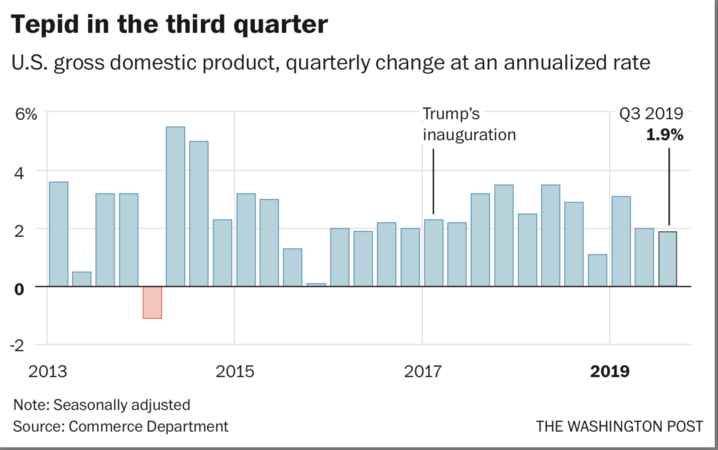
The U.S. economy is growing at a “moderate” pace, and hiring remains strong, the Fed said, but business investment is weak, and “uncertainties about this outlook remain.” Growth in the third quarter slipped to 1.9 percent, the Commerce Department reported Wednesday, one of the slowest paces in recent years.

“Although household spending has been rising at a strong pace, business fixed investment and exports remain weak,” the Fed wrote in the statement.

Fed leaders anticipated that growth would cool this year and next to around 2 percent, a level they considered the long-run trend pace for the economy. The rate cuts are meant to prevent growth from slipping much below that pace. There is concern that businesses have slashed spending in recent months and that they could turn around and cut workers next, but so far hiring has remained solid.

Trump has repeatedly bashed the Fed, even labeling them “boneheads,” for not cutting interest rates more. Trump tweeted five times about the Fed’s September rate cut and this week’s in an attempt to jawbone the Fed for more stimulus ahead of the presidential election, but the president’s efforts were noticeably less than the 43 times he tweeted or retweeted about the Fed before the September interest rate decision.

The president blames the Fed for raising interest rates four times last year – to a level close to 2.5 percent – which Trump argues caused companies to pull back on spending. After the Fed’s move Wednesday, U.S. interest rates are now at the same level as they were in spring 2018.

Most business leaders say trade uncertainty has caused them to scale back investment as they wait and see what happens with talks between the world’s two largest economies. But the stock market remains very high, the unemployment rate is low, and the housing market in some parts of the country has shown new signs of life, offering a mixed picture of the economy’s broader performance.

NBTC expects good response to auction of spectrum bandwidths

ศาสตร์เกษตรดินปุ๋ย : ขอบคุณแหล่งข้อมูล : หนังสือพิมพ์ The Nation

https://www.nationthailand.com/business/30377905

NBTC expects good response to auction of spectrum bandwidths

Oct 31. 2019
By THE NATION

865 Viewed

The National Broadcasting and Telecommunications Commission (NBTC) expects all licences for the 2,600MHz spectrum band as well as those for the 26GHz band to be grabbed up during the upcoming auction of licences, NBTC secretary-general Takorn Tantasith said on October 30.

The NBTC will call bids for 56 licences of four spectrum bands on February 16. Apart from the 2,600MHz and 26GHz bandwidths, the other spectra up for auction will be the remaining 700MHz and 1800MHz bandwidths.

Takorn added that potential bidders may not be interested in bidding for the remaining 1800MHz and 700MHz bandwidths, given that many acquired these licences in previous auctions.

The watchdog will auction 19 licences of the 2,600MHz band, each containing 10MHz bandwidth, for Bt1.862 billion each. Also, 27 licences for the 26GHz band, each containing 100MHz bandwidth, will be up for sale at Bt300 million each, while the seven remaining licences of 1,800MHz band, each containing 5MHz, will go for Bt12.486 billion each. Licences for 700MHz band, which is divided into three blocks of 5MHz each, are priced at Bt8.792 billion each.

The bid winners will be required to pay 10 per cent of the licence fee upfront in the first year and another 15 per cent annually from the fifth to the 10th year. This should give them breathing room in the second and fourth year to start the 5G business.

NBTC will hold public hearings on the auction rules over the next two months and will invite bids in January, with the aim of granting licences by March 2020. Winners are expected to introduce the 5G service within July 2020.

Oil-price revision coming next as power strategy revised

ศาสตร์เกษตรดินปุ๋ย : ขอบคุณแหล่งข้อมูล : หนังสือพิมพ์ The Nation

https://www.nationthailand.com/business/30377895

Oil-price revision coming next as power strategy revised

Oct 31. 2019
By THE NATION

968 Viewed

The Energy Policy and Planning Office will hasten to complete a study by next month on restructuring the oil price, its director-general said on Wednesday (October 30).

Wattanapong Kurovat said the formula used for calculating the price might have to be revised.

The office expects to complete a revision of the Power Development Plan (PDP 2018) in the next three months, he said, and little change is likely regarding the details of contributions from the major power plants – unless the Electricity Generating Authority believes it can commence operations at its Surat Thani plant earlier than the forecast 2027.

The PDP revision is expected to maintain a 20-per-cent contribution from renewable-energy plants, but they might be allowed to sell power to the national grid earlier than previously planned, Wattanapong said.

The contribution from solar panels on the rooftops of private homes might be lowered from the current projection of 10,000 megawatts per year.

Wattanapong was speaking at a seminar on the Energy Ministry’s “smart grid” master plan, the preparation phase for which took place in 2015-2016 and the short-term development phase is ongoing from 2017-2021.

A medium-term phase is set for 2022-2031 and a long-term phase for 2032-2036.

The master plan approved by the Cabinet in 2015 lays out guidelines for state electricity agencies and the private sector to invest in the scheme.

U.S. slowdown deepens as economic growth slips to 1.9% pace in third quarter

ศาสตร์เกษตรดินปุ๋ย : ขอบคุณแหล่งข้อมูล : หนังสือพิมพ์ The Nation

https://www.nationthailand.com/business/30377909

U.S. slowdown deepens as economic growth slips to 1.9% pace in third quarter

Oct 30. 2019
By The Washington Post · Heather Long, Andrew Van Dam · NATIONAL, BUSINESS

1,093 Viewed

WASHINGTON – The U.S. economy cooled over the summer, growing at a 1.9% annualized pace from July through September, the latest sign that the slowdown is deepening.

Ryan Seitl, from left, and Tyler Conen listen to CEO Sachin Shivaram at the Wisconsin Aluminum Foundry in Manitowoc, Wisconsin, on Oct. 16, 2019. The company has seen orders collapse during an emerging recession in the manufacturing sector. MUST CREDIT: Photo for The Washington Post by Lianne Milton Photo by: Lianne Milton — The Washington Post Location: Manitowoc United States

Ryan Seitl, from left, and Tyler Conen listen to CEO Sachin Shivaram at the Wisconsin Aluminum Foundry in Manitowoc, Wisconsin, on Oct. 16, 2019. The company has seen orders collapse during an emerging recession in the manufacturing sector. MUST CREDIT: Photo for The Washington Post by Lianne Milton Photo by: Lianne Milton — The Washington Post Location: Manitowoc United States

The data, released Wednesday morning by the Commerce Department, came as economists anticipated slightly weaker growth following President Donald Trump’s decision to dramatically expand his trade war with China in early August. That decision spooked business leaders and deterred them from making major investments during a period of so much uncertainty.
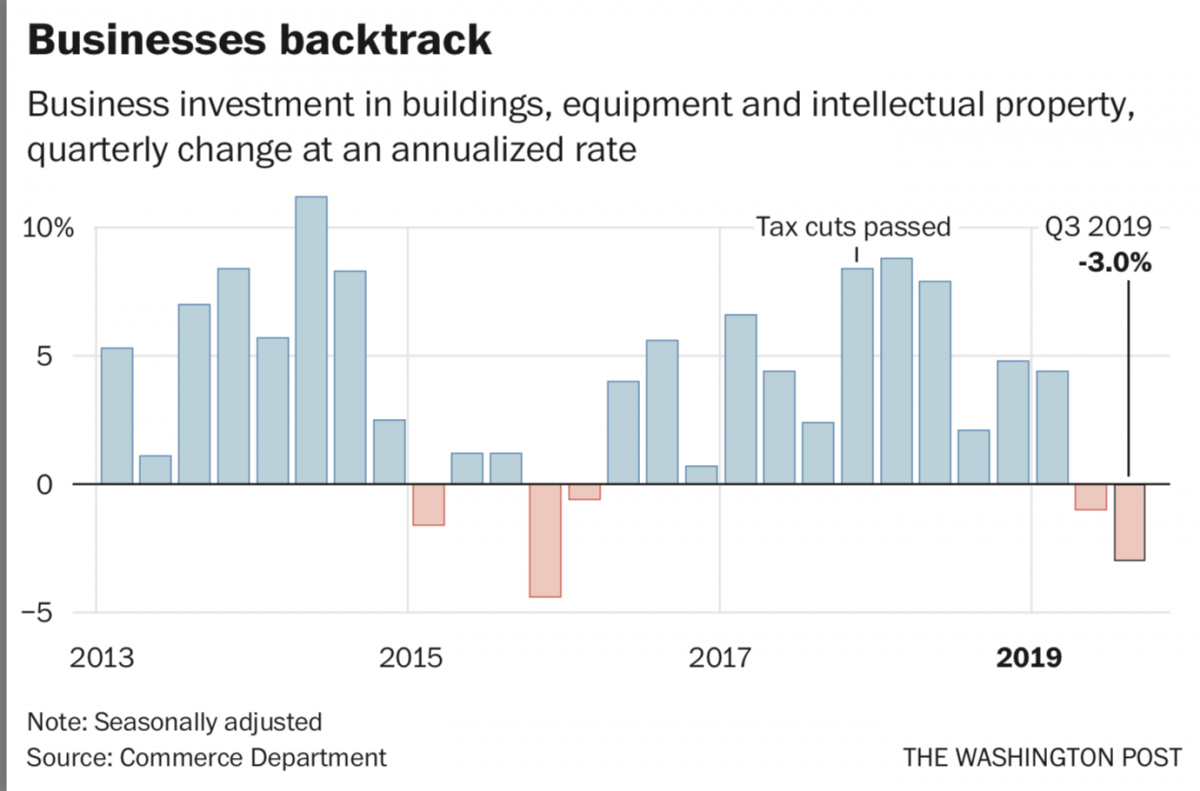
Consumer spending continues to power the economy, but business investment has now contracted for six straight months, falling 3% in the third quarter, the biggest drop since the end of 2015. A number of companies have said they are pulling back because of economic uncertainty, particularly related to whether trade rules will be shifting with China and other countries. Spending on both structures and equipment was deeply negative.

Slow growth abroad and problems at big employers such as Boeing and General Motors also were a drag on growth. Tens of thousands of workers went on strike at GM in September, halting most production at the company. And Boeing, the U.S.’s largest exporter, remains under pressure after two fatal crashes of its 737 Max jets in the past year.
After revving to 2.9% growth in 2018, the U.S. economy appears to be settling into the slower pace that it notched during the final year of the Obama administration. Trump vowed during his presidential campaign that he could boost the economy to around 4% growth, a level not seen in years. He has also promised at least 3% growth a year, an annual pace he has yet to achieve.

But the consensus view is that the economy is shifting to a lower gear. Still, the sustained pace suggests it is unlikely to dive into a recession anytime soon, unless there is a major shock or the trade war worsens significantly. Low unemployment, rising wages, and high stock prices have helped fuel consumer spending. Higher federal government spending also provided some lift to growth, helping offset the business investment decline.

“The consumer is still the main engine of economic growth, plus federal government spending. The nation just capped off a year of nearly a trillion-dollar deficit. Not surprisingly, all this federal spending is showing up in the GDP numbers,” said Stuart Hoffman, senior economic adviser at PNC Financial Services Group.

After a weak second quarter, White House officials predicted a big rebound in the second half of 2019. White House officials believe they are close to big breakthroughs in two separate trade efforts, one with China and another with Canada and Mexico. But most economists predict more subdued growth is here to stay.

“As the benefits of fiscal stimulus fade and trade policy uncertainty and slowing global demand remain headwinds to business investment, U.S. GDP growth should continue to moderate in coming quarters,” wrote Sam Bullard, chief economist at Wells Fargo, in a note to clients. “That said, we view recession in the near-term as still unlikely.”

Trump’s economic agenda has resulted in tax cuts, deregulation, trade fights, and spending increases. He and top aides have said this approach would lead to a major acceleration in economic growth, which had slowed markedly during President Barack Obama’s last year in office. The unemployment rate has fallen since Trump’s election from 4.7% to 3.5%, consumer confidence and spending are strong, and the stock market reached a new all-time high this week.

But other measurements of the economy have shown weakness.

Many business leaders and economists believe Trump’s strategy helped fuel new business investment through most of last year, but concerns about trade fights with China and Europe have led many companies to pull back, especially in the past six months. The July through September period marks marks the second time since Trump took office that quarterly growth has fallen below 2%.

“The capital spending numbers were awful, and a bit worst than we expected, with structures investment — oil rigs, offices, factories, commercial premises — plunging 15.3%,” said Ian Shepherdson chief economist at Pantheon Macroeconomics.

Trump has continued to celebrate any good economic news, including the stock market record this week, and blame any weak numbers on Democrats and the Federal Reserve, the institution he says choked growth by keeping the cost of borrowing too high. The Fed is widely expected to make a modest cut to interest rates at 2pm on Wednesday.

“The Greatest Economy in American History!” Trump tweeted Wednesday morning, less than an hour before the Commerce Department’s report on economic growth. On Tuesday he tweeted that “The Fed doesn’t have a clue! We have unlimited potential, only held back by the Federal Reserve. But we are winning anyway!”

Trump was far more critical of slower growth when Obama was president. In May of 2012, he tweeted, “Q1 GDP has just been revised down to 1.9%. The economy is in deep trouble.”

The U.S. economy is in the midst of its 11th straight year of growth, making this the longest expansion in the nation’s history.

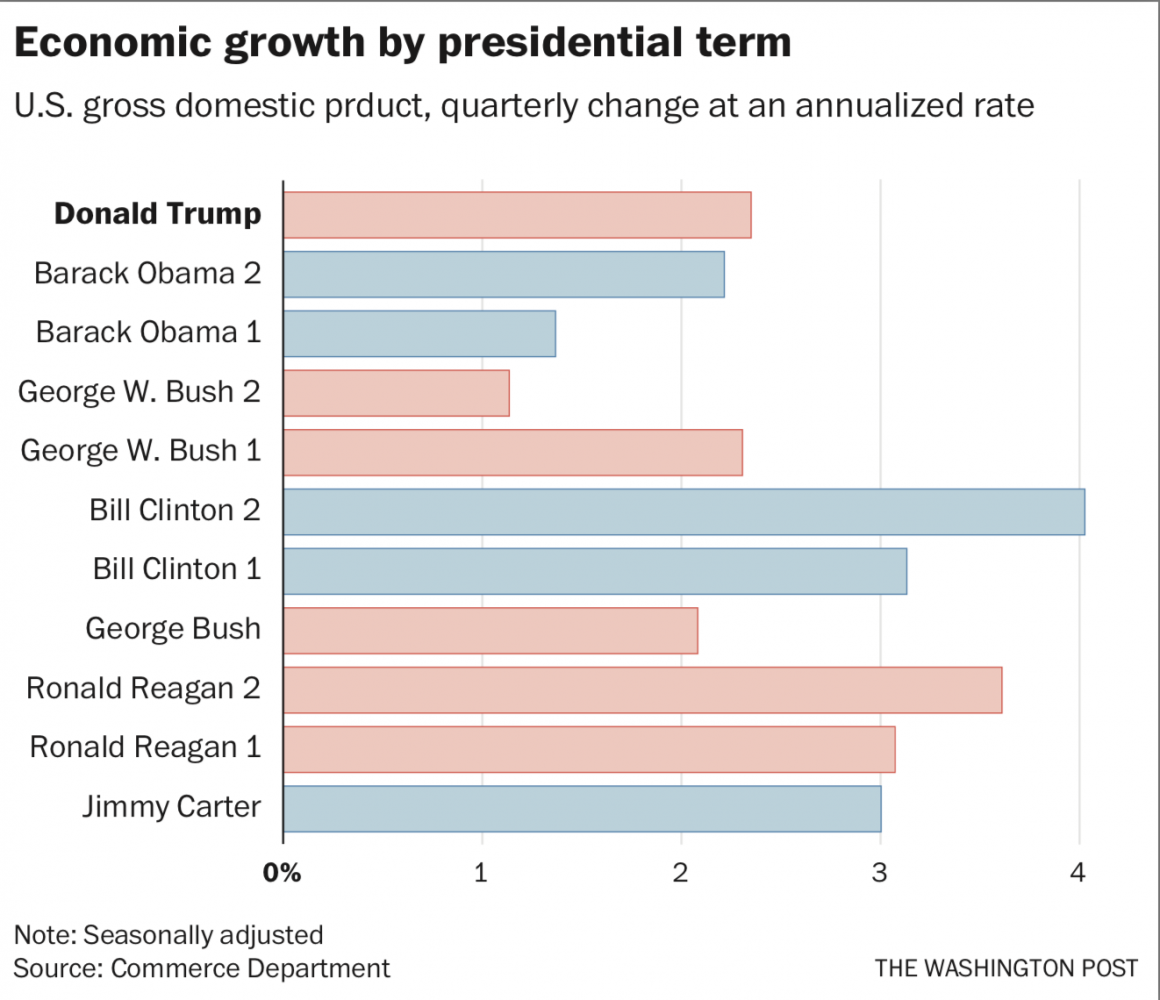
During Trump’s term in office, the economy has grown at an annual pace of around 2.35%, after accounting for the effects of inflation and other factors. If that pace were to continue, it would edge past George W. Bush’s first term and Obama’s second to become the fastest term of growth since Bill Clinton’s presidency.

But Trump’s claim that the growth is the best in U.S. history is not accurate. In the recent past, Clinton and Ronald Reagan each oversaw two terms of growth above 3% a year. Growth of at least 2% has been the norm for decades — the U.S. typically hits that mark in two out of every three quarters.

“An economy growing at 1.9% is in line with the long-term trend growth of the United States. If you’re an economist or Wall Streeter, you are fine with that. However, if you are a politician that promised sustained growth over 3%, this level of growth is a political recession,” said Joseph Brusuelas, chief economist at audit firm RSM.


Digital path the only way forward: PM

ศาสตร์เกษตรดินปุ๋ย : ขอบคุณแหล่งข้อมูล : หนังสือพิมพ์ The Nation

https://www.nationthailand.com/business/30377885

Digital path the only way forward: PM

Oct 30. 2019
PM General Prayut Chan-o cha

PM General Prayut Chan-o cha
By THE NATION

1,261 Viewed

The government will focus more on harnessing Big Data to draw up budget plans in order to effectively solve the country’s problems and respond to what Thais really want, Prime Minister General Prayut Chan-o cha said today (October 30).

During his speech at an event looking at the readiness of state agencies to promote the digital government, the premier said that as the next step, state agencies would have to use their massive digital data to analyse what people want and identify their urgent needs. The information would allow for the drawing up of coherent spending plans.

He has also informed the Office of the Civil Service Commission that any future recruitment of new state officials in the future would have to be in line with the government’s plan to embrace the digital age. New officials must therefore have skills in digital technology . Civil servants should be prepared to deal with the flow of information that would come via the upcoming 5G networks.

Noting that the government has continued to promote the adoption of digital technology by state agencies over the past five years, Prayut said that the efforts had paid off as Thailand’s ranking in the World Bank’s Ease of Doing Business 2020 list has edged up from 27th to 21st this year, out of 190 countries surveyed.

Cabinet nods to draft on land reclamation for rail project

ศาสตร์เกษตรดินปุ๋ย : ขอบคุณแหล่งข้อมูล : หนังสือพิมพ์ The Nation

https://www.nationthailand.com/business/30377861

Cabinet nods to draft on land reclamation for rail project

Oct 30. 2019
By THE NATION

929 Viewed

The Cabinet on Tuesday (October 29) approved the draft of a royal decree to identify land plots that will be reclaimed for the construction of the high speed train project linking the three major international airports, said Deputy government spokesperson Traisulee Traisoranakul.

The decree covers land plots in Ladkrabang of Bangkok, Bangpli of Samut Prakarn, Chacheongsao district in Chacheongsao as well as Sriracha, Banglamoong and Sattahip districts in ChonBuri. Land plots in Ban Chang district of Rayong will also be reclaimed.

The Charoen Pokphand-led consortium and the State Railway of Thailand last week signed a contract for the development of a high-speed railway linking Don Mueang Airport in Bangkok, Suvarnabhumi in Samut Prakan and U-tapao in Rayong.

The SRT will survey the affected land plots within 60 days.

Chinese companies flock to BOI amid trade war

ศาสตร์เกษตรดินปุ๋ย : ขอบคุณแหล่งข้อมูล : หนังสือพิมพ์ The Nation

https://www.nationthailand.com/business/30377858

Chinese companies flock to BOI amid trade war

Oct 30. 2019
By THE NATION

976 Viewed

The number of applications from China’s companies seeking Board of Investment (BOI)’s tax privileges surged by 100 per cent year on year in the first nine months to Bt45 billion, said BoI secretary-general Duangjai Asawachintachit.

Most of these projects come with an investment of Bt6 billion to Bt10 billion each, with the majority in the fields of rubber-processing and tyre manufacturing.

She said the surge in BOI applications was mainly due to the on-going US-China trade war, forcing Chinese companies to relocate their production bases to countries in Southeast Asia, particularly Thailand.

However, BOI has kept its target of Bt750 bn on the total value of projects applying for tax privileges this year.

It will be more aggressive next year in wooing foreign investment with the focus on Asian investors.

She expects more foreign companies to invest in Thailand following the Kingdom’s rise in ranking, from 27th to 21st, in the World Bank’s Ease of Doing Business 2020 list, out of 190 countries surveyed.

Academics urge govt to boost labour rights protection in response to GSP suspension

ศาสตร์เกษตรดินปุ๋ย : ขอบคุณแหล่งข้อมูล : หนังสือพิมพ์ The Nation

https://www.nationthailand.com/business/30377865

Academics urge govt to boost labour rights protection in response to GSP suspension

Oct 30. 2019
By Wichit Chaitrong
The Nation

1,144 Viewed

Academics say Thailand has not been adequately protecting workers’ rights – both Thai and foreign – and though there is some improvement, existing laws and regulations still limit their rights.

Their comments came after the US Trade Representative (USTR) announced last week that President Donald Trump was suspending trade preferences worth $1.3 billion in trade preferences for Thailand under the Generalised System of Preferences (GSP) based on its failure to adequately provide internationally recognised worker rights.

The USTR said that “despite six years of engagement, Thailand has yet to take steps to provide internationally recognised worker rights in a number of important areas identified in a 2015 petition from the American Federation of Labour and Congress of Industrial Organisations, such as providing protections for freedom of association and collective bargaining. GSP eligibility will be revoked effective six months from today for approximately one-third of Thailand’s GSP trade, which totalled $4.4 billion in 2018”.

Key issues are freedom to organise and to bargain with employers, said Assoc Prof Lae Dilokvidhyarat, economic lecturer at Chulalongkorn University.

Ad-hoc panel formed as GSP suspension looms

“For about 25 years, Thailand’s labour movements have been campaigning for the ratifying of two key labour conventions, namely Freedom of Association and Protection of the Right to Organise Convention , 1948 [No 87] and Right to Organise and Collective Bargaining Convention, 1949 [No 98],” Lae added.

The existing law allows the existence of labour unions if they are registered with the authorities. Lae said that while some people have speculated that the US is retaliating after Thailand announced a ban on glyphosate, a weed-control chemical, he said that is not the case. Labour issues in Thailand have long been closely monitored by the US and other related international organisations, he added.

The junta-backed government made some progress in resolving the human-trafficking problem, which led the US last year to promote Thailand from the Tier 2 Watch List to the Tier 2 level of US Trafficking in Persons Report.

The previous government also worked on solving fishing practices that led to the European Union removing Thailand from the list of “warned countries” – a so-called yellow-card – in January as recognition of its progress in tackling illegal, unreported and unregulated (IUU) fishing. However, Lae said, the overall situation of human rights in Thailand still needs to be improved.

This is because the government often uses “national security” as the reason to justify its actions. However, Lae said the government should not take such a narrow view on national security, but also consider economic and human security.

Some people, especially Labour Minister MR Chatu Mongol Sonakul, also fear that ratifying the two conventions would give more rights to foreign workers. However, Lae said he does not agree with this. “All workers should be given equal rights, be they Thai or foreigners,” Lae added.

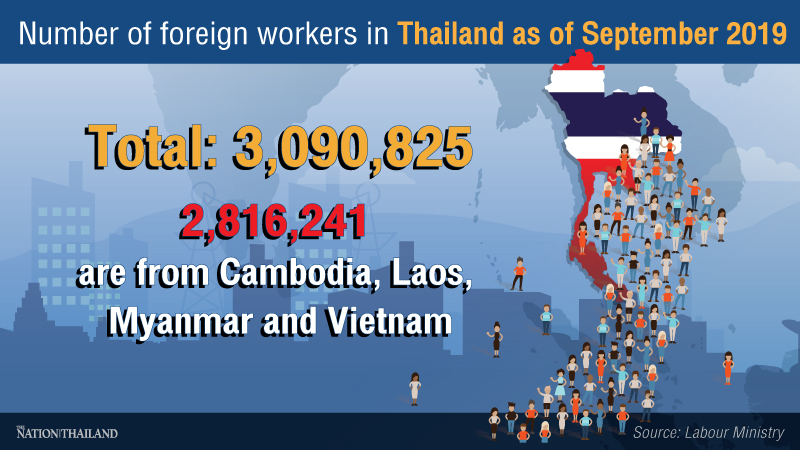
Thais should not forget that 3 million foreign workers contribute to Thailand’s exports and its gross domestic product. Also, he said, Thai businesses make a lot of money from these industries. Some people confuse the interest of employers with national security, which is not the case, he pointed out. They should also ask what conditions these workers face, such as having to go offshore for many months on fishing trawlers or ask how they make a contribution to the local economy. “Since they live in Thailand, they spend a large part of their earnings here,” he argued.

Yongyuth Chalamwong, research director at the Thailand Development Research Institute (TDRI), shared similar views, saying that Thailand needs to think about economic security and image of protecting human rights recognised by the international community. About 90 per cent of countries have ratified the two conventions.

The former junta-backed government had set up a committee to study the pros and cons of the ratification of the two conventions and found that the economic benefits outstrip concerns about national security. Things have changed a lot since the influx of foreign workers. Now they register with the authorities and can be monitored. So, concerns that they may be spying for foreign governments is not a serious issue, he said.

Tarit Sorat, vice president of the Employers’ Confederation of Thai Trade and Industry, however, said businesses, especially exporters, are not very concerned about losing tax privileges under the GSP program. The European Union has completely removed tax privileges since 2015 because Thailand has now reached the upper-income status. What is of concern, he said, is the strengthening of the baht. However, he said, that since the US is a key market for Thailand, it should be very careful when it deals with the US government.