Globalisation is shield against disaster, says IMF official

ศาสตร์เกษตรดินปุ๋ย : ขอบคุณแหล่งข้อมูล : หนังสือพิมพ์ The Nation

https://www.nationthailand.com/business/30377796

Globalisation is shield against disaster, says IMF official

Oct 28. 2019
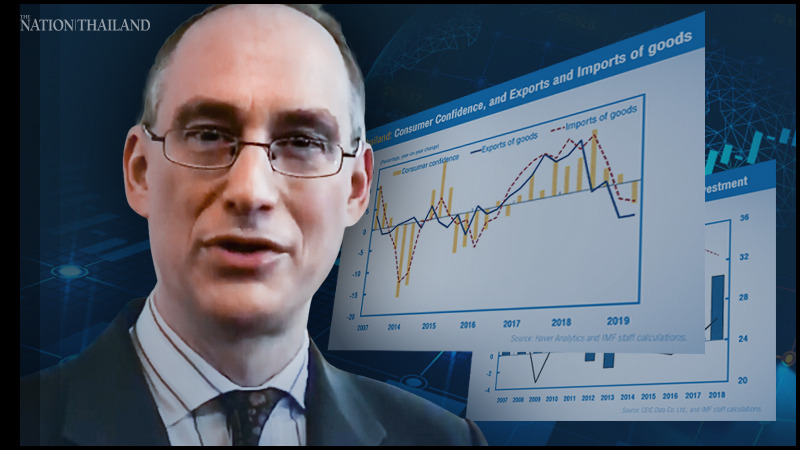
Jonathan Ostry, deputy director for Asia-Pacific at the IMF

Jonathan Ostry, deputy director for Asia-Pacific at the IMF
By Wichit Chaitrong

The Nation

897 Viewed

Amid a growing backlash against globalisation, fund managers argue that the wise stance is to brace for economic fragmentation, but an International Money Fund executive has risen to the defence of globalisation.

Jonathan Ostry, deputy director for Asia-Pacific at the IMF, expressed concern about the rising backlash.

IMF calls for further easing of monetary policy, more govt spending amid slow growth

The world and Asia benefit enormously from global integration, which has lifted billions of people out of poverty and will continue to deliver income and wealth, he said.

Others have signalled concern over shifting sentiments.

The United States-China trade conflict is expected to continue for a significant period, and talk of a possible deal coming up could turn out to be merely a truce, said Jean-Louis Nakamura, chief investment officer for Asia-Pacific and chief executive at the Hong Kong Lombard Odier Group.

He said the US and China, the world’s largest economies, were using trade as a tool in their race for technological superiority.

Even if they strike a deal, he said, it would be unlikely to restore the global economy to its former state, noting that  US tariffs average 22 per cent of Chinese goods’ value compared to 5 per cent 15 months ago.

But with politics in the West becoming increasingly isolationist and conservative, fewer Westerners favour globalisation, Nakamura said.

Substantial losses of manufacturing jobs are widely seen as helping win the US presidency for Donald Trump and for a majority of Britons voting to pull the UK out of the European Union, he noted.

Previously, it was commonly accepted that, even with domestic factories moving to China and other developing countries, developed economies would continue to thrive thanks to more jobs in the service sector.

That was possible to some extent, Nakamura said, but Western labourers have been forced to tolerate low pay in less productive jobs amid competition from robotics and artificial intelligence. Unemployment in the US is at an historic low, but wages remain low, and their less productive jobs leave workers with less bargaining power to fight for wage hikes.

Demographic changes are also having an impact on globalisation. Millennials demand quick delivery of goods purchased online, so the supply chain has to be in their country or nearby. Concern over environmental harm adds to their insistence that their purchases not be shipped a long distance, Nakamura said.

He pointed out that corporate chief executives at a recent Business Roundtable in the US vowed to keep in mind the interests of business, workers, the government and non-governmental organisations alike, in sharp contrast to the prevailing attitude of the 1990s, when the focus was entirely on maximising profits for corporate shareholders.

Nakamura, however, was optimistic about the future of the Thai economy, crediting the relatively good infrastructure able to attract foreign indirect investment.

Uncertainty over the global economy demands unconventional measures to prevent a slide into a crippling recession, he said.

Many policymakers understand the issues and support government spending projects, while central banks have started reducing key policy rates.

Yet some policymakers remain reluctant, he said. The US Federal Reserve may need to start buying equities of listed companies, like the Bank of Japan did in the past to rescue the stock market.

Amid increasing uncertainty, investors should think carefully about their strategies, he said.

KBank Private Banking’s establishment of a risk-based asset-allocation fund promises to shield investors from the shock of negative returns on their investments.

Siriporn Suwannagarn, managing director and financial advisory head at KBank Private Banking, called it “a boring fund model”, but said it’s shown desirable returns.

In separate interview, Ostry of the IMF expressed concern about the backlash against globalisation, insisting it “makes the pie larger”, while any move towards fragmentation does the opposite and also fails to address public discontent at not sharing in the wealth.

“What you don’t want to do is throw the baby out with the bathwater,” he said.

When a country becomes deeply integrated with the global economy and embraces the “fourth industrial revolution” represented by technology, workers need new skills and knowledge to benefit and a social safety net is put in place to support people still searching for jobs.

Governments should confront the issue of the benefits not being broadly shared, Ostry said. “They should take steps to ensure the winnings will be better shared in the future than they were in the past.”

Trade tensions between the US and China and between Japan and South Korea have been “extraordinarily costly for the world and the participants”, he said. The cost goes beyond those of high tariffs and counter-tariffs to affect confidence in the financial markets and slow productivity due to all the uncertainty. “It is killing the animal spirits that drive investment in these countries and the world,” Ostry said.

Conflicting parties should tackle head-on fundamental issues such as the protection of intellectual property rights, technology transfer and trade subsidies via the multi-lateral, rule-based system under the World Trade Organisation, he suggested.

Every country could do more to facilitate the free movement of goods, labour and capital and they should be more open to foreign direct investment, he said. “It not just about the US and China – every country has a stake in the system. Even small countries can lead by example.”

US trade move seen having limited effect on Thai exports

ศาสตร์เกษตรดินปุ๋ย : ขอบคุณแหล่งข้อมูล : หนังสือพิมพ์ The Nation

https://www.nationthailand.com/business/30377793

US trade move seen having limited effect on Thai exports

Oct 27. 2019
Pimchanok Vonkorpon, director-general of the Commerce Ministry’s Trade Policy and Strategy Office

Pimchanok Vonkorpon, director-general of the Commerce Ministry’s Trade Policy and Strategy Office
By The Nation

1,421 Viewed

Pimchanok Vonkorpon, director-general of the Commerce Ministry’s Trade Policy and Strategy Office, believes the United States’ decision to reduce tariffs on various products beginning last Friday (October 25) will have a minimal effect on Thai imports.

She put the figure at 0.01 per cent following Washington’s decision to suspend its Generalised System of Preferences (GSP) on some imported goods. Thailand exports just 355 of the 573 products on the list with a combined value of $1.28 billion, she noted. These include processed seafood, pasta, beans, fruit jams, juices, soy sauces, chemical products, household tools, electric motors, steel, musical instruments and fishing gear.

Suspension of the GSP will raise Thailand’s export budgets to $50.33 million in accord with its Most Favoured Nation status, Pimchanok said. She calculated that the higher tariffs would result in $28.8 million-$32.8 million in lost value, representing 0.01 per cent of total export value.

The focus of Thai exports to the US will shift to markets with the potential to expand, such as clothing, spare auto parts, furniture, utensils and household tools. But Pimchanok warned that the US move will increase competition for Thailand, so it’s crucial that exporters ensure high quality and secure bonds with trading allies to preserve their market share.

Coping with the challenges of Asia’s rapid urban population growth

ศาสตร์เกษตรดินปุ๋ย : ขอบคุณแหล่งข้อมูล : หนังสือพิมพ์ The Nation

https://www.nationthailand.com/business/30377791

Coping with the challenges of Asia’s rapid urban population growth

Oct 27. 2019
By The Nation

1,561 Viewed

The urban population has been growing rapidly in Asia, according to a report by the Asian Development Bank (ADB). The report comes as Bangkok fights the adverse effects of rising harmful toxic air with prevalent PM2.5, particles or droplets in the air that are two and half microns or less in diameter.

According to the ADB report, looking at the average growth rates of urban population from 1970 to 2017, developing Asia’s urban population grew 3.4 per cent, compared to 2.6 per cent for other developing economies and 1 per cent for developed economies. The highest growth rate is in East Asia at 3.7 per cent followed by Southeast Asia at 3.6 per cent and South Asia at 3.3 per cent.

The urban population from 1970 to 2050 rose from 0.4 billion people in 1970 to 1.8 billion people, up five fold in 2017. From 2017 onwards, the urban population in developing Asia is projected to reach 3 billion, up by 70 per cent by 2050.

Many cities are expanding beyond their administrative boundaries. The “natural cities” capture actual urban footprint using nighttime lights satellite imagery.

A total of 1,459 natural cities are identified in developing Asia, hosting 34.7 per cent of the population on 2.3 per cent of land area and some cities have connected to form city clusters such as Delhi-Chandigarh in India, Shanghai-Nanjing and Guangzhou-Huizhou in China. In Thailand, Bangkok has expanded beyond the capital and it now covers the nearby provinces of Samut Prakarn, Pathum Thani, Nonthaburi and Nakhon Pathom and Samut Sakhon, said Hideaki Iwasaki, the bank’s country director for Thailand.

The report found that 28 city clusters in developing Asia have a population of 10 million or more.

Asian cities benefit from size, a so-called “agglomeration economies”.

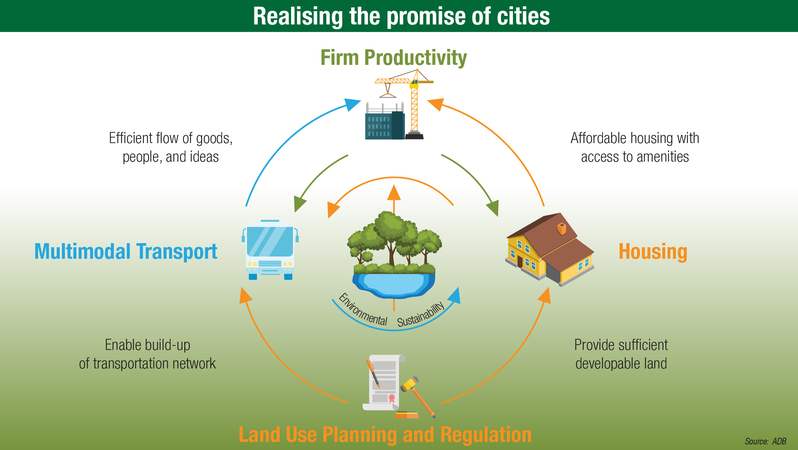
Workers and entrepreneurs who live in big cities will obtain many benefits such as the workers can receive higher wages while the entrepreneurs can host more innovative firms, but they also face hindrances such as traffic congestion in many cities and the high cost of housing. Bangkok and other large cities also face rising air pollution due largely to traffic congestion resulting in vehicle emissions of toxic gases that threaten environmental sustainability.

ABD has provided solutions to this problem for cities and urban systems by building multi-modal public transport systems, which connect between urban areas and cities, providing affordable housing, planning on land usage and regulations including economics to maintain environmental sustainability.

TCEB bidding for 18 conventions by 2026

ศาสตร์เกษตรดินปุ๋ย : ขอบคุณแหล่งข้อมูล : หนังสือพิมพ์ The Nation

https://www.nationthailand.com/business/30377775

TCEB bidding for 18 conventions by 2026

Oct 26. 2019
Chiruit Isarangkun na Ayuthaya

Chiruit Isarangkun na Ayuthaya
By The Nation

973 Viewed

The Thailand Convention and Exhibition Bureau (TCEB) is working with several partners to win bids that would bring 18 national conventions to Thailand between 2020-26, expecting them to generate up to Bt2.5 billion revenue for the country.

TCEB president Chiruit Isarangkun na Ayuthaya said that in 2020, TCEB will organise six conventions, seven conventions in 2021, four conventions in 2022 and one convention in 2026, covering many businesses such as medical industry, aviation and education.

“We expect that 30,100 MICE travellers from other countries will attend these conventions and generate revenue of Bt2.54 billion,” he said.

He said Thailand has the potential to be a destination for world class national conventions with professional personnel from associations, organisations and educational institutions including support from the government.

According to the International Congress and Convention Association report, Thailand was the largest MICE organiser in Asean for three years, from 2016 to 2018, hosting 174, 171 and 193 conventions in those three years respectively.

Thailand was ranked as the fourth biggest organiser in Asia, following Japan at 492 conventions, China at 449 and South Korea at 273 conventions.

Chiruit added that the company expects the number of MICE travellers in the domestic and international markets in 2020 to reach 37.7 million and generate revenue of Bt232.70 billion. The international market would account for 1.38 million people, generating revenue of Bt105.60 billion while 36.39 people would come from the domestic market, generating Bt127.10 billion revenue.

Egat prepares to shut down Mae Moh coal mine in Lampang

ศาสตร์เกษตรดินปุ๋ย : ขอบคุณแหล่งข้อมูล : หนังสือพิมพ์ The Nation

https://www.nationthailand.com/business/30377770

Egat prepares to shut down Mae Moh coal mine in Lampang

Oct 26. 2019
By THE NATION

1,604 Viewed

The Electricity Generating Authority of Thailand (Egat) has drawn up a plan to shut down the Mae Moh coal mine in Lampang province as the mine’s lifespan will end in the next 30 years, Egat deputy governor for fuel Tawatchai Jakpaisal has said.

Coal supply from the mine has been dwindling.

The state agency has earmarked some revenue from the coal sales to support the mine closure plan and for creating new jobs for villagers working at the mine.

It will also undertake reforestation of the mine, which occupies 40,000 rai.

He added that the reforestation would create a small water reservoir in the location where a floating storage could be installed to generate electricity.

Egat has already decommissioned units 1 to 3 of the electricity generating units, while 4 to 7 of the units were replaced by the RP1 unit, which has a capacity of 655 megawatts and started operation early this year.

Units 8 to 9 will retire in 2025. Egat is conducting a public hearing on the plan to build the RP2 plant to replace them. The new plant will have a capacity of 650MW.

Units 10 to 13 will be decommissioned after 2025 as it was estimated that the coal supply in the mine will not be enough to feed them.

The Mae Moh power plant has a total capacity of 2,400MW. The new units, which were built or will be built to replace the retired ones, will be decommissioned at the same time the mine runs out of supply.

IMF calls for further easing of monetary policy, more govt spending amid slow growth

ศาสตร์เกษตรดินปุ๋ย : ขอบคุณแหล่งข้อมูล : หนังสือพิมพ์ The Nation

https://www.nationthailand.com/business/30377752

IMF calls for further easing of monetary policy, more govt spending amid slow growth

Oct 26. 2019
By Wichit Chaitrong

The Nation

893 Viewed

The IMF has urged the Thai government to spend more and suggested the Bank of Thailand should further ease its monetary policy amid an economic slowdown while the Finance Ministry is calling for the central bank to cut rate again.

Jonathan Ostry, deputy director Asia and Pacific Department of International Monetary Fund, said in Bangkok today (October 25) that after two consecutive years of sustained expansion, growth is expected to moderate to 2.9 per cent this year and 3 per cent next year, reflecting weaker external demand. Expansionary monetary and fiscal policies are desirable to mitigate the slowdown, he told the Thai press.The IMF has cut its projection of Thai growth by 0.6 percentage point and 0.5 percentage point for this year and next year  from its previous forecast.

“We think there is fiscal space in Thailand to provide support to the economy in this period of slowdown in growth. And in a more structural sense, to accelerate the buildup of infrastructure and also crowd in private investment which will help support demand going into the medium term,” he said.

“In IMF’s recent assessment for Thailand, we came to the conclusion that there was scope on both sides of the monetary policy and fiscal policy for more vigorous and pro-active response [to cyclical slowdown]”, he said.

He said the central bank has more scope to ease monetary policy without threatening inflation or financial stability objective.

The Thai economy and that of other developing Asia Pacific countries have been adversely impacted by the US-China trade war which has also dampened  confidence in the global economy. The slowdown in China and uncertainty of Brexit have also impacted on Asia and the Pacific region.

Public investment will not only boost public demand in the short term but it will also draw in private investment, Ostry noted.

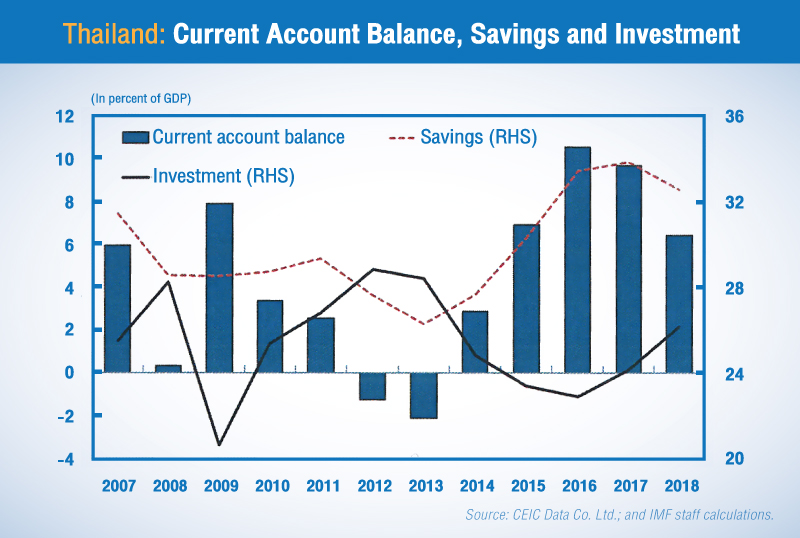
He said accelerating public investment in infrastructures would also help to alleviate upward pressure on baht’s value. He pointed out that Thailand has a larger current account surplus than it should from the point of views of people’s welfare.

The large surplus reflects a wide gap between savings and investment. He said Thailand should also reform its pension fund system as the  social safety net is underfunded, resulting in only a small fraction of retirees having access to the pension fund, similar to some countries in the region where only 22 per cent of retirees are covered by pension fund.


The baht

The value of the baht has been driven by both current account and capital account.

Capital account is not something that can be directly linked to domestic measures. One option is to close the country completely from foreign capital  flows but Thailand will not do so as it benefits greatly through integration with the  global financial system, Ostry said.

The way to look at the problem is to find whether there are domestic distortions in policy setting that draws in capital flows which put upward pressure on the value of the baht, he added. Thai exporters have complained about the strengthening of the baht which has appreciated about 7 per cent against the US dollar this year.

Meanwhile, Lavaron Sangsnit, director general of the Fiscal Policy Office, said separately that the government has fully implemented fiscal expansion measures as it is running a fiscal deficit and has launched a series of economic stimulating packages. “What is needed most is an easing of monetary policy,” said Lavaron.

He said an acceleration of infrastructure investment will occur next year as many contracts have been signed but it will take time for actual investment to kick off. Some analysts predict the central bank will again lower rate by 25 basis points to 1.25 per cent before the end of this year,following a previous cut of 25 basis points.

Power agencies told to step up on planning of strategies

ศาสตร์เกษตรดินปุ๋ย : ขอบคุณแหล่งข้อมูล : หนังสือพิมพ์ The Nation

https://www.nationthailand.com/business/30377712

Power agencies told to step up on planning of strategies

Oct 25. 2019
Energy Minister Sontirat Sontijirawong

Energy Minister Sontirat Sontijirawong
By THE NATION

885 Viewed

Energy Minister Sontirat Sontijirawong has told state energy agencies to hasten the drafting process of their operational strategies, focusing on boosting the grassroot economy.

The state units were told to draw up plans for periods of three months, six months and 12 months.

The strategies must be aligned with the 2021 fiscal budget plans of the respective energy agencies which are due for submission to the government in January next year.

They must also be in line with the government’s new policies, including the promotion of B10 diesel and community power plants.

The Oil Fund Committee recently resolved to raise the subsidy for B10 diesel to Bt1.80 per litre from Bt0.95 per litre.

The resolution, effective October 1, lowered the price of B10 diesel to Bt22.99 per litre or Bt2 less than B7 diesel per litre.

The ministry aims to boost the consumption of B10 diesel to 57 million litre per day within the second quarter of next year.

It plans to have B10 diesel on sale at all fuel stations across the country by March next year.

Sontirat also assigned the ministry’s permanent- secretary Kulit Sirisombat to head the project for Big Data development and the deployment of advanced technologies such as Artificial Intelligence (AI) to help boost the ministry’s operational efficiency.

Kulit, who is also chairman of the Electricity Generating Authority of Thailand (Egat), said Egat board members will meet on the restructuring of the state power agency on October 28.

The board will also consider ways to set up a new company for electricity trading business.

The new company will focus on purchasing power from renewable energy sources as well as electricity from neighbouring countries.

CP group seals deal on high-speed airport rail

ศาสตร์เกษตรดินปุ๋ย : ขอบคุณแหล่งข้อมูล : หนังสือพิมพ์ The Nation

https://www.nationthailand.com/business/30377719

CP group seals deal on high-speed airport rail

Oct 24. 2019
The CP-led group and the SRT sign the contract for the high speed train project. Seen in the picture are SRT acting gover Worawut Mala, left, front row, and CP group chairman of the executive board Suphachai Chearavanont, right front row. PM Prayut Chan-o-cha presides over the contract signing ceremony.

The CP-led group and the SRT sign the contract for the high speed train project. Seen in the picture are SRT acting gover Worawut Mala, left, front row, and CP group chairman of the executive board Suphachai Chearavanont, right front row. PM Prayut Chan-o-cha presides over the contract signing ceremony.
By THE NATION

1,551 Viewed

The Charoen Pokphand-led consortium and the State Railway of Thailand today (October 24) signed the contract for the development of a high-speed railway linking three international airports, presided over by Prime Minister Prayut Chan-o-cha at Government House.

The high-speed network will connect Don Mueang Airport in Bangkok, Suvarnabhumi in Samut Prakan and U-tapao in Rayong.

CP consortium made the lowest bid for the project. Others in the group are Bangkok Expressway and Metro Plc, China Railway Construction Corp, Ch Karnchang Plc and Italian-Thai Development Plc.

The Eastern Economic Corridor Policy Committee today also signed a MoU with the SRT in support of the project’s development.

Suphachai Chearavanont, chairman of CP’s executive board said the rail route is 220 kilometre in length and the train can travel at the maximum speed of 250 km per hour. The construction of the project is expected to kick off in the next 12 months and be completed within five years.

SRT acting governor Worawut Mala said the signing marked another milestone of the country’s transportation infrastructure development, which is developed under the Public-Private Partnership Net Cost basis. The project is valued Bt224.544 billion and all asset will be handed back to the state at the end of the 50-year contract.

Eastern High-Speed Rail Linking Three Airports Co Ltd, a company set up by the CP consortium for the project, signed the deal with the SRT on its behalf.

The high-speed rail is expected to be up and running in 2023. It is estimated to create 16,000 jobs in the construction period and another 100,000 jobs in the next five years.

Deputy Prime Minister Anutin Charnvirakul said, following the signing,that the state agency would now undertake several processes, including train procurement and the hiring of consultants for various tasks.

The initial steps in preparation for construction, such as moving public utilities along the route, will take two years, he said.

Anutin said he hopes all parties involved would focus on getting the job done and not on gains or losses from the contract.

Govt borrows Bt348 bn to cover fiscal 2019 deficit

ศาสตร์เกษตรดินปุ๋ย : ขอบคุณแหล่งข้อมูล : หนังสือพิมพ์ The Nation

https://www.nationthailand.com/business/30377708

Govt borrows Bt348 bn to cover fiscal 2019 deficit

Oct 24. 2019
By The Nation

1,783 Viewed

The government collected Bt2.56 trillion in net revenue in fiscal 2019 ending in September, a 1-per-cent and Bt26.12-billion increase over the previous year, the director-general of the Fiscal Policy Office announced on Thursday (October 24).

Lavaron Sangsnit, who is also spokesperson for the Ministry of Finance, said the amount was 0.5 per cent and Bt13.06 billion more than targeted.

The Revenue Department separately collected Bt9.14 billion (up 0.5 per cent), the Customs Department Bt8.52 billion (8.5 per cent), state-owned enterprises Bt1.15 billion (0.7 per cent) and other agencies Bt46.01 billion (32.4 per cent).

The amounts were all close to those forecast by the ministry in June for the purpose of revenue monitoring.

Lavaron said continuous economic growth and close monitoring by the ministry resulted in net revenue collection for fiscal 2019 falling in line with targets.

“This will strengthen the government’s fiscal balance and foster economic growth in the coming years,” he noted.

He said the government had received Bt2.53 trillion in cash revenue and disbursed Bt3.04 trillion, financing the deficit by borrowing Bt348.97 billion.

Treasury reserves at the end of September stood at Bt512.95 billion.

DITP to promote Thai fruit to Chinese consumers

ศาสตร์เกษตรดินปุ๋ย : ขอบคุณแหล่งข้อมูล : หนังสือพิมพ์ The Nation

https://www.nationthailand.com/business/30377698

DITP to promote Thai fruit to Chinese consumers

Oct 24. 2019
By The Nation

1,296 Viewed

The Department of International Trade Promotion (DITP) is launching a series of new campaigns aimed at increasing the export of Thai fruit to 11 cities in China.

Acting director-general Somdet Susomboon revealed that the department was all set to promote Thai fruit in Nanning, Pingxiang, Qingdao, Shanghai, Beijing, Wuhan, Shenzhen, Chengdu, Xiamen, Kunming and Hong Kong. The first event, which will feature both tasting and fruit carving demonstrations, will be part of the Nanning Fruit Festival in Hang Yang department store this weekend (October 25-26) and will focus on young coconuts, coconut products, pomelo and longan.

The value of fruit exports to China from January to September stood at $1.968 billion, an increase of 90.62 per cent over the same period last year.

“Our department is confident that these fairs will help increase Thailand’s share of the fruit market while encouraging Chinese consumers to explore Thai fruit more,” Somdet said.