Economist pessimistic about second half outlook

ศาสตร์เกษตรดินปุ๋ย : ขอบคุณแหล่งข้อมูล : หนังสือพิมพ์ The Nation

https://www.nationthailand.com/business/30375682

Economist pessimistic about second half outlook

Sep 01. 2019
By The Nation

1,245 Viewed

Productivity in the agricultural sector will continue to decline during the third and fourth quarters of this year due to the flooding caused by tropical storm Podul, according to Rangsit University’s Economic and Business Research Centre – Institute of Economics.

Asst Prof Anusorn Tamajai, the Centre’s director, said that agricultural productivity has already shrunk by 1.1 per cent in the second quarter and the flooding will drive up prices of crops and food during the remaining part of the year.

“The economic impact and the quality of life of the people as a result of floods and droughts are much higher than they should be and this reflects the country’s failed water management policy,” he said. “With the increasingly harsh effects of global warming, nature is warning us that we must help to better protect the environment. The government must also have serious environmental policies. Easing the environmental standards to attract foreign investment without considering the long-term impacts will turn out to be a big burden to society in the future.”

He added that measures designed to help those suffering may be hampered by the decentralized administrative structure of the country.

“The less decentralized fiscal power means that local government organizations are therefore slower to respond to the suffering of people in areas affected by natural disasters. They are less efficient and there are inadequate equipment and tools,” he added. “A public assistance budget should be allocated. Repairing roads and public buildings of the government may have to wait for the 2020 budget, which will be approved late and will be available in February next year.”

Asst Prof Anusorn noted that the Thai economy continued to face many tough internal factors.

“The impact of the trade war has become stronger, and it is beginning to affect consumer products. The US and China have raised taxes as announced on September 1, covering products worth US$187 billion (made up of US-imposed tax on $112 billion worth of goods and China’s tit-for-tat tax on $75 billion),” he said.

“There are concerns about the employment in the Thai export sector and the impact on the trade partners of Thailand that rely heavily on exports to China. As a result, these Thai trading partners including South Korea, Japan, Vietnam, Australia and Hong Kong have been ordering fewer intermediate products and raw materials from Thailand,’ he said, adding that these countries account for 25-26 per cent of Thailand’s total export value.

Free passage on four airlines for fruit

ศาสตร์เกษตรดินปุ๋ย : ขอบคุณแหล่งข้อมูล : หนังสือพิมพ์ The Nation

https://www.nationthailand.com/business/30375660

Free passage on four airlines for fruit

Aug 31. 2019
By The Nation

953 Viewed

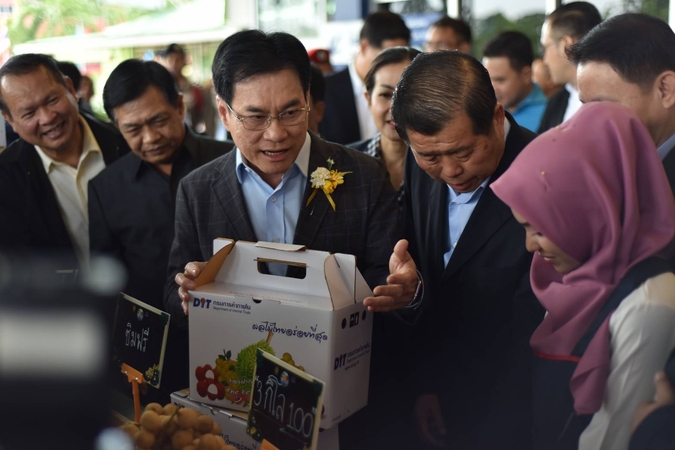
Deputy Prime Minister and Commerce Minister Jurin Luxanavisit said on Saturday he had arranged for people departing Songkhla to carry up to 20 kilograms of fruit for free aboard four airlines.

“We are collaborating with Air Asia, Nok Air, Bangkok Airways and Thai Smile as well as Thailand Post Plc to package and allow transportation of the fruit in nationwide,”he said. “It’s another way to support the sale of fruit and improve prices.”

This policy reduces costs for passengers taking fruit overseas from anywhere from Bt300 to Bt3,600 per trip, he said.

The ministry also promotes exports, Jurin said, with “commerce ambassadors” touting the merits of Thai fruit abroad.

Samut Prakan of interest to Taiwanese investors: TECO

ศาสตร์เกษตรดินปุ๋ย : ขอบคุณแหล่งข้อมูล : หนังสือพิมพ์ The Nation

https://www.nationthailand.com/business/30375653

Samut Prakan of interest to Taiwanese investors: TECO

Aug 31. 2019
By The Nation

650 Viewed

The Taipei Economic and Cultural Office in Thailand (TECO) has signed a memorandum of understanding with Phraeksa municipality in Samut Prakarn province that will see it provide knowledge and help in the management of public services, the local economy, education, and tourism.

The MOU also aims to increase Taiwanese investment in the province, TECO’s representative Dr Chen-Yuan Tung said on Friday.

He added that tourists from Taiwan are interested in visiting Thailand and this provides an opportunity to promote both investment and tourism between the two countries.

“Samut Prakarn province has an international airport and is a gateway to the Eastern Economic Corridor, which should encourage Taiwanese investors to expand their interests in this area,” he said.

Govt planning e-wallet to boost domestic tourism

ศาสตร์เกษตรดินปุ๋ย : ขอบคุณแหล่งข้อมูล : หนังสือพิมพ์ The Nation

https://www.nationthailand.com/business/30375642

Govt planning e-wallet to boost domestic tourism

Aug 31. 2019
By The Nation

654 Viewed

Finance Minister Uttama Savanayana said on August 30 that the government will launch an e-wallet app next month as part of efforts to boost domestic tourism.

All Thai nationals, aged 18 onwards, who register for the e-wallet will get a Bt1,000 credit that they can spend on travelling. This is part of the government stimulus package.

Thai travellers who top up their wallet to spend on travel-related expenses such as hotel or transport, will get 15 per cent of their money back, though this will be limited to Bt4,500 per person.

The Comptroller General Department has opened registration for shops and food vendors, and Uttama expects some 130,000 shops to apply.

Holders of state-welfare cards are also eligible for the Bt1,000 subsidy provided they use the money outside their hometowns.

BOT to keep close eye on unemployment rate

ศาสตร์เกษตรดินปุ๋ย : ขอบคุณแหล่งข้อมูล : หนังสือพิมพ์ The Nation

https://www.nationthailand.com/business/30375641

BOT to keep close eye on unemployment rate

Aug 31. 2019
By THE NATION

652 Viewed

The Bank of Thailand (BOT) will keep a close watch on unemployment, especially since it expects economic growth to be less than 3 per cent this year due to external negative factors, its senior director Don Nakornthab said on August 30.

The unemployment rate in July was 1.1 per cent, compared to 0.9 per cent in June.

The bank is keeping a close eye on the situation because unemployment can affect domestic consumption and people’s ability to repay their debts.

Krungthai, BBL, TMB top mobile banking woes

ศาสตร์เกษตรดินปุ๋ย : ขอบคุณแหล่งข้อมูล : หนังสือพิมพ์ The Nation

https://www.nationthailand.com/business/30375646

Krungthai, BBL, TMB top mobile banking woes

Aug 30. 2019
Siritida

Siritida
By The Nation

668 Viewed

The Bank of Thailand has assessed the quality of electronic banking services in the second quarter of this year as part of its efforts to protect consumer interest and to ensure bank clients will be updated with the latest  information timely in the event of a system failure, said Siritida Panomwon Na Ayudhya, assistance governor, on Friday.

Statistics provided by the payment system and financial technology group of the central bank are as follows:

In mobile banking services, state-owned Krungthai Bank (KTB) experienced 7 times of system failure; Bangkok Bank (BBL) 5 times; TMB 4 times; CIMB Thai and Thanachart,  2 times each;  and Tisco 1 time.

In internet banking, BBL and KTB had 2 rounds of system error each while TMB and Thanachart reported 1 time each.

For ATM and CDM(cash deposit machine), Krungsri and TMB  suffered two glitch each compared to 1 time each at  BBL, KTB, Thanachart and Thai Credit Retail.

For system trouble at bank branch, KTB, TMB and Thanachart all experienced 1 time each.

SET companies see 17 per cent combined drop in first half profit

ศาสตร์เกษตรดินปุ๋ย : ขอบคุณแหล่งข้อมูล : หนังสือพิมพ์ The Nation

https://www.nationthailand.com/business/30375630

SET companies see 17 per cent combined drop in first half profit

Aug 30. 2019
Manpong

Manpong
By THE NATION

338 Viewed

The companies listed in the Stock Exchange of Thailand (SET) saw their combined net profit in the first half of this year drop 17 per cent year on year to Bt373 billion.

According to Manpong Senanarong, the SET senior executive vice president, 679 out of 712 listed companies reported financial performance in the first half to the SET. Of the total, 501 posted net profit.

These profitable companies showed total sale revenue of Bt5.534 trillion, up 1.5 per cent year on year, but their core operating profit dipped 21.5 per cent year on year to Bt424.068 billion and their net profit dropped 17.1 per cent year on year to Bt373.170 billion.

For the second quarter they posted total sales revenue of Bt2.781 trillion, down 0.8 per cent year on year, and net profit of Bt164.713 billion, down 20.7 per cent year on year.

Their softening first half performance was attributed to the impact of the prolonged US-China trade war,

Their core operating profit margin in the first half fell to 7.7 per cent from 9.9 per cent over the same period last year, while their net profit margin slid to 6.7 per cent from 7.9 per cent. This caused them to put a higher demand on revolving funds.

Thai economy has minor July expansion, overall performance remains lacklustre: BOT

ศาสตร์เกษตรดินปุ๋ย : ขอบคุณแหล่งข้อมูล : หนังสือพิมพ์ The Nation

https://www.nationthailand.com/business/30375624

Thai economy has minor July expansion, overall performance remains lacklustre: BOT

Aug 30. 2019
By The Nation

680 Viewed

In July 2019, the Thai economy expanded at a slightly higher pace than in the previous month, according to the Bank of Thailand at a press conference on Friday.

The BOT said that private consumption indicators improved on the back of spending on durable and semi-durable goods, although overall private consumption continued to be on a decelerating trend relative to the first half of this year. Public spending rebounded from central government expenditures, while capital expenditures of state enterprises continued to contract.

Private investment indicators were flat. On the external front, the value of merchandise exports slightly expanded, owing mainly to gold exports. Excluding gold, export value growth remained negative, consistent with the decrease in manufacturing production. The tourism sector expanded at a higher rate due to an increase in the number of Chinese and Indian tourists, the former partly due to the low base effect from the tour boat incident in Phuket last year.

On the stability front, headline inflation edged higher mainly on the back of the increase in fresh food prices, while core inflation decelerated. The seasonally adjusted unemployment rate increased from the previous month. The current account registered a surplus, attributed mainly to the trade balance. The capital and financial accounts posted a surplus on both the assets and the liabilities positions.

BOT added that private consumption indicators expanded at a higher rate from the same period of last year on the back of spending on durable goods, attributed to the increase in the number of newly registered motorcycles and the number of commercial car sales, as well as on the spending on semi-durable goods, attributed to the retail sales of semi-durable goods and garment imports. Meanwhile, spending on non-durable goods and services moderated and remained unchanged, respectively. Overall, private consumption expanded at a softer pace compared to the first half of this year, partly due to weakening supporting factors, consistent with the continual deterioration of consumer confidence. Non-farm income turned into contraction as the number of employed persons decreased. Farm income expanded at a softer pace mainly from agricultural prices, particularly fruits, while agricultural production was unchanged.

Public spending, excluding transfers, rebounded from the same period last year from both current and capital expenditures of the central government. Current spending slightly increased mainly from compensation of civil servants as a result of an increase in pension disbursement. Capital spending increased from disbursement of the Department of Highways and the Royal Thai Police. However, capital spending of state enterprises continued to decrease from lower disbursement of PTT Public Co Ltd and the Mass Rapid Transit Authority of Thailand.

The value of merchandise exports expanded by 3.8 per cent from the same period last year, which was the first positive growth in 8 months. However, the value of merchandise exports excluding gold continued to contract at 1.7 per cent. The continued contraction can be attributed to weaker global demand as a result of slower economic growth in a number of major trading economies, the trade conflict between the US and China, the continued downturn in the electronic cycle and the contraction of global crude oil prices.

The contraction was mainly due to the decrease in exports of petroleum-related products from both prices and export volume, as well as of electronic products, especially hard disk drives, integrated circuits, printed circuit boards and cellular phones. However, hard disk drive exports showed a recovery sign supported by the relocation of the production base from Malaysia. However, exports in several categories continued to expand, partly due to the substitution of Chinese goods in the US market, such as television sets, refrigerators, car tyres, canned fish and garments. In addition, exports of air-conditioners continued to expand on the back of warmer than usual temperatures, particularly in Europe and Australia. Moreover, exports of fruit to China continued to expand, despite China’s economic slowdown.

The value of merchandise imports expanded by 0.9 per cent from the same period last year, and excluding gold, the value of merchandise imports expanded by 4.2 per cent. The expansion was attributable to an increase in three factors. First, the increase in imports of raw and intermediate goods excluding fuel, particularly steels and electronic parts, while imports of crude oil contracted from both prices and volume partly due to the continual shutdown of oil refineries for maintenance from the previous month. Second, the increase in imports of capital goods excluding aircrafts, ships, floating structures, and locomotives, particularly steam turbine and machinery for sugar production. Third, an increase in imports of consumer goods, especially non-durable goods accelerated this month partly due to the low base effect of some goods, such as jewellery and electrical appliances.

The number of Chinese tourists rebounded from the low base effect as a result of the tour boat incident in Phuket last year, while the number of Indian tourists benefited from the exemption of the visa on arrival fee. However, the number of tourists from Europe decreased, particularly the number of Russian tourists following an economic slowdown.

Private investment indicators, on net, were unchanged from the same period last year. Investment in machinery and equipment slightly expanded. Meanwhile, investment in construction contracted from the continual decline in permitted construction area, except for areas for manufacturing purposes which expanded. Moreover, construction material sales contracted following the contraction of concrete pile sales, consistent with the slowdown in the real estate sector. After seasonal adjustment, private investment indicators were unchanged from the previous month.

On the stability front, headline inflation edged higher to 0.98 per cent from 0.87 per cent last month, due mainly to an increase in fresh food prices, coupled with a smaller contraction in energy prices following an increase in domestic retail petroleum prices as a result of a rise in global crude oil prices. Meanwhile, core inflation decelerated from the previous month, reflecting a slowdown in domestic demand. The seasonally-adjusted unemployment rate increased from last month. The current account registered a surplus due mainly to an increase in the trade surplus. The overall capital and financial accounts registered a surplus from both the assets and liabilities positions.


Govt to use blockchain, big data so welfare cards go to those in need

ศาสตร์เกษตรดินปุ๋ย : ขอบคุณแหล่งข้อมูล : หนังสือพิมพ์ The Nation

https://www.nationthailand.com/business/30375619

Govt to use blockchain, big data so welfare cards go to those in need

Aug 30. 2019
Uttama

Uttama
By Wichit Chaitrong
The Nation

672 Viewed

Finance Minister Uttama Savanayana said on Friday that the ministry would use blockchain technology and big data to manage welfare cards, which currently cover 14.5 million people.

His comment comes as many observers suspect the welfare cards programme benefits a number of undeserved rich people. Prime Minister General Prayut Chan-o-cha also recently urged high income people to give up their welfare cards.

Uttama said updated data will help the government decide who will be eligible in the next round to receive cash handouts under the programme.

The superior data system, to be implemented this year, will also help the government design better measures to support the poor, the minister said.

The scope of big data will cover public healthcare services, he said.

Qatar eyes increased investment in Thailand

ศาสตร์เกษตรดินปุ๋ย : ขอบคุณแหล่งข้อมูล : หนังสือพิมพ์ The Nation

https://www.nationthailand.com/business/30375611

Qatar eyes increased investment in Thailand

Aug 30. 2019
Somkid Jatusripitak

Somkid Jatusripitak
By The Nation

486 Viewed

Qatar is interested in expanding its investment in Thailand to increase the trade value of US$3.9 billion (Bt119.2 billion) witnessed last year by the two countries, Deputy Prime Minister Somkid Jatusripitak said after meeting Qatari Deputy Prime Minister and Foreign Affairs Minister Sheikh Mohammed bin Abdulrahman bin Jassim Al-Thani on Thursday.

Somkid said Qatar wants to expand investment in Thailand’s energy, medical care, aviation, and tourism sectors by collaborating with both the public and private sectors.

Qatar also has a sovereign wealth fund of more than $338 billion to expand investment overseas, including in Thailand, Somkid added.

“We have assigned the Board of Investment to collaborate with Qatar to promote investment in the Eastern Economic Corridor and other projects that meet the demand of Qatari investors who see Thailand as a gateway to other Asean countries, especially the CLMV [Cambodia, Laos, Myanmar, Vietnam] bloc,” he said.