Trade board to meet central bank to discuss impact of stronger baht

ศาสตร์เกษตรดินปุ๋ย : ขอบคุณแหล่งข้อมูล : หนังสือพิมพ์ The Nation

https://www.nationthailand.com/business/30374367

Trade board to meet central bank to discuss impact of stronger baht

Aug 07. 2019
By Somluck Srimalee
The Nation
453 Viewed

Officials from the Board of Trade will meet with the Bank of Thailand (BOT) on August 8 to discuss the baht’s appreciation against the US dollar and yuan and its impact on the country’s exports, the board’s vice chairman, Sanan Angubolkul, told The Nation on Tuesday (August 6).

“Since early this year the baht has appreciated by up to 5 per cent against the US dollar, which has led to a drop in the country’s exports in the first half of this year. But now, with the yuan depreciating against the dollar and the baht, it will directly impact our exports to other countries as well in the rest of this year if the BOT does not do anything to manage the country’s currency,” he said.

He added that the depreciation of the yuan will make China’s products cheaper. This will lead to most importers asking Thai exporters for discounted price to compete with China’s products. This would affect new orders in the rest of this year, especially from customers in Europe.

“Normally, our production cost is already higher than that of China. When our currency also becomes stronger than the yuan, that will make our products less competitive than ones from China,” Sanan said.

Meanwhile, original equipment manufacturers or OEMs will also be impacted by the yuan’s depreciation as several industries in Thailand have got orders to make products under OEM, like China’s manufacturing, such as consumer products, home appliances, household products etc.

OEM orders may move from Thailand to China as the cost of production in China will be cheaper than in Thailand, if the government or the BOT do not do anything to manage the country’s currency, he said.

“At the meeting on August 8, we will provide information to the BOT and urge it to consider ways to support the country’s industry and exporters,” he said.

However, the depreciation of the yuan will benefit importers of products and machinery from China as they can buy at a lower price, he added.

FETCO offers to help boost Thailand’s presence among global investors

ศาสตร์เกษตรดินปุ๋ย : ขอบคุณแหล่งข้อมูล : หนังสือพิมพ์ The Nation

https://www.nationthailand.com/business/30374361

FETCO offers to help boost Thailand’s presence among global investors

Aug 07. 2019

“Currently, the government does not have an official channel especially designated to communicating with global investors. FETCO is ready to help the government establish this medium with its network of global investors,” said Paiboon Nalinthrangkurn, chairman of FETCO.

“Currently, the government does not have an official channel especially designated to communicating with global investors. FETCO is ready to help the government establish this medium with its network of global investors,” said Paiboon Nalinthrangkurn, chairman of FETCO.
By PHUWIT LIMVIPHUWAT
THE NATION
355 Viewed

The Federation of Thai Capital Market Organisation (FETCO) is ready to act as a medium between global investors and the Thai government to help improve the state’s relations with investors and attract more foreign investment into the Kingdom.

FETCO chairman Paiboon Nalinthrangkurn will meet Finance Minister Uttama Savanayana on Wednesday to discuss how the government can use the stock market to boost the country’s presence at a global level.

“We have analysed the government’s immediate economic policies and identified the ones that can be supported by the stock market,” Paiboon said earlier on Tuesday.

He said one way the government can achieve its aim to boost Thailand’s role globally is by improving its relations with investors. The government currently does not have an official channel for communicating with global investors, he said, adding that FETCO is ready to help establish this medium with its network of global investors.

This will boost the transparency of Thailand’s stock market for global investors and draw in more foreign investments over time, he explained.

Secondly, the government also aims to promote long-term savings through Thailand’s stock market, Paiboon said. In order to achieve this, he said, FETCO will propose some adjustments to the long-term fund (LTF), which will offer tax-reduction benefits and set it to lapse at the end of the year.

For instance, he said, the new form of LTF will allow investors to deduct up to 30 per cent of their total annual income from the original 15 per cent.

Moreover, the new LTF will also require that investors spend a fraction of their capital on sustainable equities such as the Thailand Future Fund and equities that are environmentally friendly.

This way, the new LTF will be able to draw in more investors and at the same time, promote sustainable investments, he said.

Dropping yuan will affect baht, Thai exports: economists

ศาสตร์เกษตรดินปุ๋ย : ขอบคุณแหล่งข้อมูล : หนังสือพิมพ์ The Nation

https://www.nationthailand.com/business/30374354

Dropping yuan will affect baht, Thai exports: economists

Aug 07. 2019
By Somluck Srimalee,
Phuwit Limviphuwat
The Nation
1,329 Viewed

The depreciation of the Chinese yuan will affect the baht and Thailand’s export values for the rest of the year, which will force the Bank of Thailand to come up with measures to manage the currency, economists say.

“The baht will fluctuate and even depreciate when foreign investors take their money out in response to the Bank of Thailand’s move to bring down the balance in non-resident accounts from Bt300 million to Bt200 million per person. However, the currency should appreciate again as Thailand is a safe haven for investors due to its high-foreign currency reserve and a public debt that is only 40 per cent of the gross domestic product,” Dr Somchai Pakapaswiwat, an economist and independent academic, told The Nation on Tuesday.

However, he said, when the baht appreciates against the US dollar, it will also rise against the Chinese yuan, which will have a direct impact on Thai exports, because Chinese products will become cheaper.

“China may also dump its products in the Thai market, especially if Chinese goods work out to be cheaper than local products,” Somchai said.

He added that since the trade war has now become a currency war, it will have an adverse effect on all countries, which is why the South Korean won has also dropped against the greenback.

Somchai believes the central bank may launch other measures to manage the baht, especially since it is appreciating over currencies from countries that are direct export competitors.

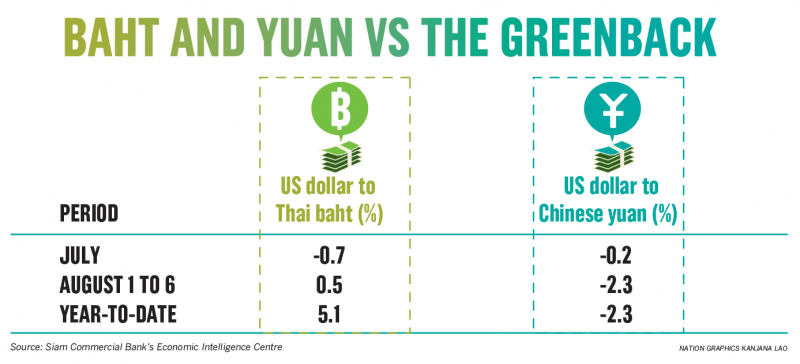
Research by the Siam Commercial Bank’s Economic Intelligence Centre shows that the baht has risen 5.1 per cent against the dollar since January 1, while the yuan has dropped 2.3 per cent.

“Recent events in the US-China trade war will definitely have negative ramifications on Thai exports,” said Supant Mongkolsuthree, chairman of the Federation of Thai Industries.

He added that labelling China as a currency manipulator may lead to a further escalation in the ongoing trade war and set off risks such as the tariff impact spilling over to Thailand, a slowdown in the global economy and currency volatility.

Currently, most Thai exporters use the US dollar as the currency for cross-border trading, Supant said. Hence, he said, to reduce risks induced from volatile currencies, we must promote the use of local currencies in cross-border trade.


Recent tensions between the US and China will likely contribute to a hardening of positions from both sides, said Martin Petch, vice president of Moody’s Sovereign Risk Group.

“It also increases the likelihood of US tariffs on Chinese products to rise beyond current levels, followed by further retaliatory measures by China,” he continued. “Unless negotiations between the US and China resume rapidly, this latest development is likely to create negative spill-over effects in both China, the US and globally, and particularly in Asia.”

Furthermore, he cautioned, market expectations of further yuan devaluation may force other currencies to drop, particularly those with strong trading ties to China.

Meanwhile, the Thai National Shipping Council’s chairman Ghanyapad Tantipipatpong said the private sector was worried about the yuan depreciation, but had yet to evaluate its impacts on Thai exports.

She added that preliminary estimates show that a weaker yuan will increase the price of goods exported from Thailand by 10 per cent.

She added that the council will monitor the export market in the last quarter to see if the yuan depreciation has had any impact.

The council’s vice chairman Visit Limlurcha agreed that a weaker yuan will automatically make Thai export products, especially electronics, more expensive.

Ghanyapad also said the council wants related state agencies to stop the baht from getting any stronger, because if the baht appreciates beyond the Bt30 to a US dollar mark, it will have an adverse impact in the export market.

The council has also drawn up a strategy for the government, and one of its recommendations is for the Commerce Ministry to set up a war room to closely monitor the export situation and enhance the sector.

Moreover, the ministry should look for new promising export markets and hold off on increasing the daily minimum wage.

Funds inflows after yuan slide expected to further pressure baht

ศาสตร์เกษตรดินปุ๋ย : ขอบคุณแหล่งข้อมูล : หนังสือพิมพ์ The Nation

https://www.nationthailand.com/business/30374365

Funds inflows after yuan slide expected to further pressure baht

Aug 07. 2019
By Wichit ChaitrongThe Nation

1,040 Viewed

The depreciation of the yuan will put more pressure on the baht, as foreign investors will divert more money into the Thai bond market, say economists, warning of an unpredictable future.

The depreciation of the yuan against the baht and the US dollar is a major concern for Thailand, Thai Bond Market Association president Tada Phutthitada said on Tuesday.

After the US Treasury Department denounced China as a currency manipulator, foreign capital inflows into long-term Thai government bonds (maturity over one year) increased by Bt31 million against selling of short-term bonds worth Bt 409 million while net inflows in August month-to-date was worth Bt 4.7 billion. Net inflows into the bond market last year and in 2017 totalled Bt134.3 billion and Bt 222.9 billion respectively.

“Investors consider Thai bonds a safe haven for assets, so they entered the market over the past few days after the US Federal Reserve cut its key rate and the US-China trade war worsened with US denouncing China as a currency manipulator,” said Tada.

“Foreign investors have recently poured their money into several bond maturities, causing a flat yield curve that we did not foresee,” he said.

They expect global interest rates to go down while the Bank of Thailand will keep its policy rate unchanged.

As seen recently, it is unusual for the long-term bond rate to be lower than the policy rate — currently at 1.75 per cent, he said, referring to the yield curve of two-year, five-year and 10-year bonds at 1.63 per cent, 1.62 per cent and 1.67 per cent respectively in afternoon trading on Tuesday.

Capital inflows have pressured the baht after the yuan’s depreciation. The baht was up 8 per cent against the yuan year-to-date, Kobsidthi Silpachai, head of capital markets research at Kasikornbank, said. The baht was the strongest currency against the yuan in the region, ahead of the Japanese yen which rose against the yuan by 5.7 per cent, he said.

The stronger baht would hit Thailand’s exports, already suffering from the global economic slowdown, he warned.

It could also hurt the tourism industry as last year 38 million tourists visited Thailand, and they shored up domestic consumption amid rising household debt that is eroding Thai consumers’ purchasing power. Among the foreign tourists, about 10 million were from China. The weakening of the yuan would affect their travel plans too, as well as Thai tourism and related services, he said.

The baht appreciated on Tuesday morning by about  5 satang to Bt30.72 to the dollar following the US announcement. The baht has risen against the dollar by about 5 per cent since early this year, largely driven by the large current account surplus over several years, estimated to be 6.7 per cent of GDP this year, Kobsidthi added.

Meanwhile, Teerana Bhongmakapat, former dean at Chulalongkorn’s Economics Faculty, said that the Thai economy will face high risk of uncertainty as it is hard to predict what will happen next after US President Donald Trump’s latest actions. The global markets now do not reflect economic fundamentals but their volatility has been fuelled by the heightened tensions from geopolitical conflicts between the world’s two largest economies, the US and China, he said. Given such a background, the baht’s misalignment with regional currencies could widen, moving far away from economic fundamentals, he warned.

“Looking into the future, it is an unknown territory,” Teerana warned.

Although China’s yuan has weakened, passing the 7 yuan to the dollar barrier, Teerana did not believe that China’s authorities had intervened in the market in order to weaken it.

“I think China actually has been trying to stabilise the currency. The yuan was hit by foreign speculators who are taking profit from the fall in the value of the Chinese currency,” he said. Some hedge funds recently made a loud noise about the slowdown in growth in China and the impact of the trade war. The latest US action, accusing China of being a currency manipulator, seems to validate their reasons for selling the yuan, he said.

Teerana believed that capital outflows, slower economic growth in China and the impact of the trade war are major factors for the weakening yuan.

The Stock Exchange of Thailand Index yesterday rose 0.33 per cent, closing at 1,671.48. Investors may have been encouraged by news that the new government will implement economic stimulus package this month, said Kobsidthi.

SET names Chaiyawat as chair of board of governors

ศาสตร์เกษตรดินปุ๋ย : ขอบคุณแหล่งข้อมูล : หนังสือพิมพ์ The Nation

https://www.nationthailand.com/business/30374363

SET names Chaiyawat as chair of board of governors

Aug 06. 2019

Chaiyawat

Chaiyawat
By THE NATION216 Viewed

The Stock Exchange of Thailand (SET)’s board of governors resolved to appoint Chaiyawat Wibuilswasdi as chairman of the board from Tuesday onwards until his tenure is completed as SET governor.

SET’s executive vice president Rongrak Phanapavudhikul said the Securities and Exchange Act, which went into effect from April 17, requires the Securities and Exchange Commission (SEC) and SET’s broker members to appoint or elect new SET governors within 120 days from the effective date of the act or within August 14.

In connection, at an extraordinary meeting of broker members on June 26, four governors were elected as SET’s governors and on August 1, another six governors were appointed by the SEC. All 10 governors have a three-year tenure with effect from August 5 onwards.

Presently, SET’s board consists of 11 governors with Chaiyawat as chairman, Pattera Dilokrungthirapop as vice chairperson, while other governors are Kitipong Urapeepatanapong, Charamporn Jotikasthira, Thiti Tantikulanan, Norachet Sangruji, Paiboon Nalinthrangkurn, Voravan Tarapoom, Seree Nonthasoot and Sopawadee Lertmanaschai, including Pakorn Peetathawatchai who also serves as president.

Cabinet gets ready to tackle volatility on global front

ศาสตร์เกษตรดินปุ๋ย : ขอบคุณแหล่งข้อมูล : หนังสือพิมพ์ The Nation

https://www.nationthailand.com/business/30374360

Cabinet gets ready to tackle volatility on global front

Aug 06. 2019

Somkid

Somkid
By THE NATION253 Viewed

The Cabinet on Tuesday discussed how Thailand will deal with the volatile global economy, especially escalating trade wars, the depreciation of the Chinese yuan and the intensifying anti-government protest in Hong Kong.

Deputy Prime Minister Somkid Jatusripitak said all ministers were willing to join forces to steer the country through this situation.

He has also ordered relevant agencies including the Finance Ministry, the Bank of Thailand and the Stock Exchange of Thailand to closely monitor the situation for developments.

In a related matter, Thailand’s exports in June fell 2.15 per cent year on year to US$21.409 billion (Bt658.19 billion), representing a continual contraction over the past four months, the Thai National Shippers’ Council said. Imports in the same month stood at $18.197 billion, also showing a 9.4 per cent contraction, the council’s chairman Ghanyapad Tantipipatpong said.

In the first half of this year, the value of Thai exports fell 2.9 per cent year on year to $122.971 billion, due mainly to the global trade wars.

The export situation has been further affected by the prolonged anti-government protests in Hong Kong, which has affected the Hong Kong domestic consumption as well as the order of goods from Thailand.

The drought in Thailand could also affect the supply of farm products, which might lower exports in the third quarter. In June, the export of products in the farming sector and industrial agricultural sector contracted 7.5 per cent year on year. The only products registering continued growth include rice, beverages and rubber. Segments experiencing a drop in exports are frozen and processed chicken, sugar, fresh fruit and vegetables.

Most of Thailand’s exporters felt the pinch from trade wars in June. For the third month, exports to China contracted, this time by 14.9 per cent, while exports to the US dropped 2.14 per cent, European Union 7.71 per cent, Japan 1.95 per cent and CLMV (Cambodia, Laos, Myanmar and Vietnam) 9.31 per cent.

Thai, Malaysia stock indices rise despite escalating US-China tensions

ศาสตร์เกษตรดินปุ๋ย : ขอบคุณแหล่งข้อมูล : หนังสือพิมพ์ The Nation

https://www.nationthailand.com/business/30374359

Thai, Malaysia stock indices rise despite escalating US-China tensions

Aug 06. 2019
By Somluck Srimalee
The Nation
222 Viewed

The Stock Exchange of Thailand (SET) and the Bursa Malaysia index closed higher on Tuesday, while other markets in Asia dropped.

SET closed on Tuesday at 1,671.48 or up 5.49 points from Monday with a trade value Bt70.43 billion, including net sales by foreign investors of Bt3.41 billion.

The Bursa Malaysia index also rebounded from a drop in Tuesday morning, closing at 1,611.79, up 1.38 points or 0.09 per cent from Monday.

Meanwhile, stock markets in other Asian countries dropped as investors have continued being concerned about the escalating US-China trade tensions. The People’s Bank of China released a statement on its website on Monday, saying that the drop in the value of the yuan against the US dollar was “influenced by the unilateralism and the protectionist measures”, as well as the expectation of more US tariffs on Chinese goods.

However, US President Donald Trump attacked China on Twitter on Tuesday, calling it a currency manipulator.

The Hong Kong Hang Seng closed at 25,976.24, dropping 175.08 or 0.67 per cent from Monday.

Japan’s Nikkei closed at 20,585.31, dropping 134.98 or 0.65 per cent from Monday’s close.

The Singapore FTSE Straits Times Index closed at 3,170.47, down 24.04 points or 0.75 per cent from Monday, while the China Shanghai Index closed at 2,909.62, dropping 46.04 points or 1.56 per cent from Monday.

Cabinet approves Bt3.2 trillion in expenditure for fiscal 2020

ศาสตร์เกษตรดินปุ๋ย : ขอบคุณแหล่งข้อมูล : หนังสือพิมพ์ The Nation

https://www.nationthailand.com/business/30374358

Cabinet approves Bt3.2 trillion in expenditure for fiscal 2020

Aug 06. 2019

Narumon

Narumon
By THE NATION584 Viewed

The Cabinet has given the greenlight to an expenditure of Bt3.2 trillion for fiscal 2020, setting the deficit at Bt469 billion and readying Bt1 billion for economic stimuli in the second half.

Dechapiwat Na Songkhla, director of the Budget Bureau, said the Cabinet has approved expenditures for the next fiscal year at Bt3.2 trillion, with Bt2.731 trillion calculated in revenue and Bt469 billion in deficit, which is 4.2 per cent higher than the previous year. Public debt stands at 42 per cent of GDP, while foreign debt is at 3 per cent.

“Government agencies can start submitting their requests to the Budget Bureau from August 9 onwards,” he said. “The requests will then be passed on to the House of Representatives, which will meet from October 17 onwards. It is estimated that the budget disbursement will start in late January or early February.”

The Fiscal 2020 Act estimates that the Thai economy will grow by 3 to 4 per cent in 2020, and that in the last quarter of this year, there will be approximately Bt1 billion available for contract-bound projects, and can be injected into the economy to help maintain a steady growth towards the end of the year.

Narumon Phinyosinwat, from the PM’s Office, said the key components of the fiscal 2020 budget are: current spending is Bt2.39 trillion or 74.7 per cent of the total budget; debt payment stands at Bt62.7095 billion or 2 per cent; and capital spending is Bt650 billion, representing 20.5 per cent.

“Although fiscal 2020 has Bt19 billion in deficit compared to last year, the government still has other sources of income to repay the debts and keep the economy afloat, such as infrastructure mutual fund and public-private partnerships projects. Hence, the prime minister has been able to confirm that there is nothing to worry about regarding the fiscal year,” Narumon said.

Gem and jewellery exports reach $7.24 billion, up 15%

ศาสตร์เกษตรดินปุ๋ย : ขอบคุณแหล่งข้อมูล : หนังสือพิมพ์ The Nation

https://www.nationthailand.com/business/30374355

Gem and jewellery exports reach $7.24 billion, up 15%

Aug 06. 2019
By THE NATION313 Viewed

The kingdom’s overall gem and jewellery exports hit US$7.24 billion in the first six months of this year, up 15 per cent compared to the same period last year, the Gem and Jewellery Institute of Thailand announced.

The key driving factor was gold exports, which increased by 40 per cent over the period as exporters wanted to benefit from the price gap, while people purchased more of the metal for safety reasons.

The institute also projected a good trend in the second half of this year. The trade war between China and the US is being seen as another positive factor for the export of gems and jewellery products from Thailand as they will replace those from China.

Institute director Duangkamol Jiambutr said Thailand’s exports in the first half touched $7.244 billion, up 15.21 per cent compared to the same period in 2018, or about Bt228.68 billion, up 15.37 per cent in baht terms if sales in the same period last year were compared. Excluding gold, which is a product with fluctuating prices, gem and jewellery exports however were $3.84 billion, down 0.44 per cent compared to the same first-half period last year, or at Bt121.43 billion, down 0.31 per cent.

Individual exporters wanted make a profit from the price gap after a significant increase in gold prices on the world market. The tariff battle between the United States and China as well as the conflict between the US and Mexico and Canada led to greater demand for gold on the global market for personal security reasons, she said.

Thailand’s gems and jewellery exports to India posted the highest growth, which increased by 95.14 per cent in the first six months of this year compared to the same period last year. Exports to Asean were the second highest, after an increase of exports to Singapore, Vietnam and Cambodia, all of which were up by 96.12 per cent, 56.37 per cent, and 44.11 per cent, respectively.

However, the kingdom’s gems and jewellery exports to Hong Kong and the European Union dropped 7.57 per cent and 13.06 per cent, respectively, in the first half, compared to the same period last year, and were also down to a host of other markets – by 3.50 per cent to the US, 1.48 per cent to the Middle East, 1.48 per cent to Japan, 9.89 per cent to the Pacific Islands, 27.83 per cent to Russia, and 78.85 per cent to the Commonwealth of Independent States.

SET performance depends on govt stimulus policies: market experts

ศาสตร์เกษตรดินปุ๋ย : ขอบคุณแหล่งข้อมูล : หนังสือพิมพ์ The Nation

https://www.nationthailand.com/business/30374353

SET performance depends on govt stimulus policies: market experts

Aug 06. 2019

Paiboon Nalinthrangkurn, chairman of the Federation of Thai Capital Market Organisation.

Paiboon Nalinthrangkurn, chairman of the Federation of Thai Capital Market Organisation.
By PHUWIT LIMVIPHUWAT
THE NATION
398 Viewed

The performance of the Thai stock market for the rest of the year will hinge on the effectiveness of the new government’s economic stimuli and whether these policies can stir up investors’ sentiments that have been hit adversely by the US-China trade war, market experts predict.

Investors hope the government will have effective measures to stimulate the economy after exports, public investment, tourism and consumer spending have been disappointing in the first half of this year,” said Peerapong Jirasevijinda, chief executive officer of BBL Asset Management.

A survey conducted by the Federation of Thai Capital Market Organisation (FETCO) revealed that investors’ sentiment for the next three months remains positive.

However, the trade war escalated further last week after US President Donald Trump announced on August 1 that he will raise tariffs by 10 per cent on US$300 billion (Bt9.22 trillion) worth of Chinese goods. The yuan also depreciated by 7 per cent on Monday in response to the US denouncing China for allegedly manipulating the currency earlier in the day.

“The recent escalation of the trade war has worsened investors’ sentiment, leading to net outflows witnessed in the Stock Exchange of Thailand [SET],” said Paiboon Nalinthrangkurn, chairman of FETCO.

In July, the SET saw a net inflow of $652 million, but from August 1 to 5 it saw a net outflow of $260 million, reflecting the change in investors’ sentiment after the recent trade war-related events, Paiboon said.

Even so, Paiboon expects the dampening of investors’ sentiments to be temporary as markets will become more bullish as Trump looks to conclude or at least reach a temporary settlement in the US-China trade conflict to boost his popularity, as US presidential elections approach.

He also said that the US Federal Reserve is now more likely to reduce its interest rate as Trump is threatening to implement further tariffs on China, which will likely draw a retaliatory action. The European Central Bank and the Central Bank of Japan are also likely to lower their interest rates, he said.

He added that the worsening trade war has also led to an increased liquidity in the global stock market and boosted the inflow in the Thai bond market, as investors see it as a safe haven.

In July, the Thai bond market saw a net outflow of $811 million, but from August 1 to 5, it saw a net inflow of $186 million, according to FETCO.

Given the high liquidity in the global stock market, Paiboon said that it is up to the government to stimulate the economy effectively in the next five months and improve sentiments so more investment can be drawn into the Thai stock market.

In order to do this, the government will have to target consumer spending in the grassroots economy and continue investments in mega projects such as the Eastern Economic Corridor, Peerapong said.