SET slumps under weight of Bangkok blasts, US-China trade war

ศาสตร์เกษตรดินปุ๋ย : ขอบคุณแหล่งข้อมูล : หนังสือพิมพ์ The Nation

https://www.nationthailand.com/business/30374138

SET slumps under weight of Bangkok blasts, US-China trade war
Aug 02. 2019
By The Nation

1,631 Viewed

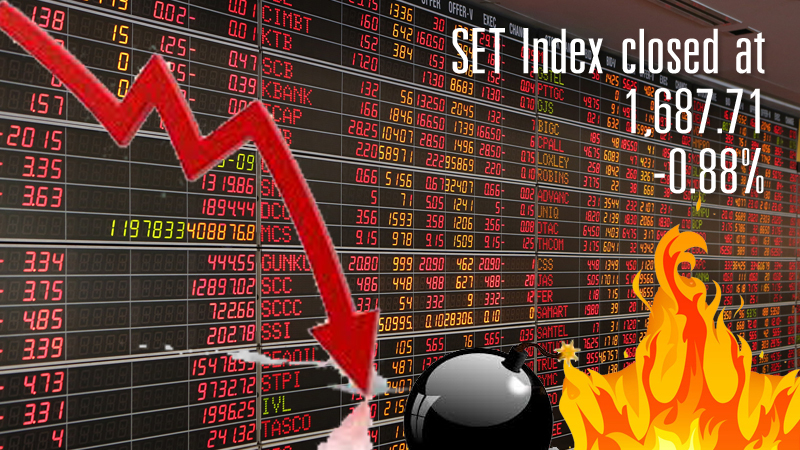
The Stock Exchange of Thailand Index was down almost 1 per cent on Friday (August 2) amid fears of an escalating trade war and a series of small blasts in Bangkok

The SET Index closed on Friday at 1,684.71, shedding 15.04 points or down 0.88 per cent from the previous day.

SET President Pakorn Peetathawatchai on Friday afternoon attributed the 20 points drop, or 1.6 per cent, mostly to external factors such as US imposing more tariffs on US$300 billion worth of imports from China and the Fed lowering its interest rate below market expectation. He said the blasts would have only a short-term effect on the market.

Pakorn said that the current SET Index drop was mainly due to investors being disappointed at the Fed’s rate cut. The Fed cut its policy rate by 25 basis points, half of the market expectation. President Donald Trump on Thursday declared that the US would levy 10 per cent tariff on imports from China valued at $300 billion, which also dented investor confidence, he said.

He said the scale of the SET drop is manageable and relatively small compared with other markets in the region. The SET Index had fallen in afternoon trading by 1.6 per cent when he spoke to the press.

Other Asian markets were also hit hard due to fears of the escalating trade war between the US and China as well as the trade dispute between Japan and South Korea. Japan’s Nikkei closed sharply, sliding 2.1 per cent, Hong Kong’s Hang Seng plunged 2.35 per cent, Shanghai fell by 1.4 per cent and Taiwan’s Taiex dropped by 1.7 per cent.

Pakorn said the market’s slide provided a window of opportunity for investors to buy many stocks which have been underpinned by sound fundamentals. Investors, however, should take risks into account before deciding on an investment. There is also a good chance to buy long term equity funds at this moment, he added.

Finance Minister Uttama Sayanayana also played down the impact of the small explosions in the capital, saying it would have only a short-term impact on the financial markets.

Uttama said he was confident the bombings would not affect investor confidence, as the authorities would be able to control the situation. He added that the one cause of the SET’s decline in morning trade was the ongoing trade war between major countries.

He said the ministry would soon launch stimulus measures for the second half of the year to take care of the farm sector and respond to the volatile global economy.
Trump’s China tariff escalation to further shrink Thai exports

ศาสตร์เกษตรดินปุ๋ย : ขอบคุณแหล่งข้อมูล : หนังสือพิมพ์ The Nation

https://www.nationthailand.com/business/30374134

Trump’s China tariff escalation to further shrink Thai exports

Aug 02. 2019
By PHUWIT LIMVIPHUWAT
THE NATION

1,246 Viewed

US President Donald Trump’s imposition of a 10 per cent tariff on an additional US$300 billion in Chinese imports will cause Thai exports to contract even further in 2019, economists warn.

“Thailand’s exports have been falling since January. The announcement by President Trump to increase tariffs on Chinese goods in September will cause Thai exports to bottom out even deeper in the fourth quarter of this year,” said Yunyong Thaicharoen, first executive vice president and head of Siam Commercial Bank’s Economic Intelligence Centre (EIC).

On Thursday, Trump announced through Twitter that the US will impose a 10 per cent tariff on the additional $300 billion worth of Chinese goods as China did not follow through on its prior agreement to purchase more US agricultural goods.

Thailand has felt the collateral damage of the superpower trade spat as the Kingdom is located in the supply chain affected by Trump’s tariffs. For instance, Thailand exports electronic parts to China that are developed further before being shipped to the US.

In the first half of 2019, Thai exports declined by 2.9 per cent year on year, dropping by US$4 billion, according to the Commerce Ministry.

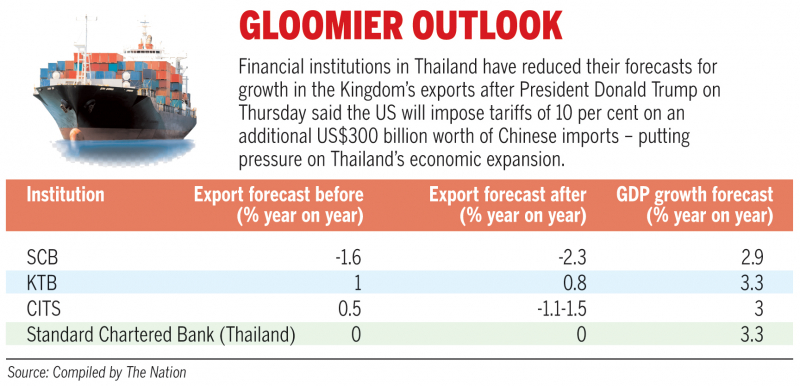
The EIC predicted in July that as a result of the trade war, exports will contract by 1.6 per cent year on year in 2019. This marks a significant reduction in exports given last year’s solid 6.7 per cent growth, making it the lowest level since 2016.

However, Yunyong said, the new rounds of tariffs will have both direct and indirect impacts on Thailand’s economy, leading the EIC to reduce its export forecast in 2019 from a 1.6 per cent year-on-year contraction to a 2.3 per cent year-on-year contraction.

This has also led the centre to reducing its GDP forecast from 3.1 per cent year-on-year growth to 2.9 per cent.

Products such as fruits and processed food will be particularly impacted by this round of tariffs, he said. This is because the new round of tariffs will damage consumer sentiment in China, leading to a drop in demand for Thai agricultural products.

In the first six months of this year, exports of agricultural products declined by 2.58 per cent year on year, shedding $3 billion in value, according to the Commerce Ministry.

“Finally, the increase in tariffs will cause the global economy to slow down further, making it likely that the US Federal Reserves will lower interest rates at least once more in 2019,” Yunyong said. “This will lead to more capital inflows to emerging markets which will in turn, put pressure on the baht to strengthen even further as Thailand is seen as a safe haven for global investors.”

The strengthening baht will dampen exports of agricultural products even further as Thai goods will become less competitive in terms of pricing, he said.

Mana Nimitvanich, first vice president of the Krungthai Bank’s Global Business Development and Strategy Group, said: “The global economic slowdown which will result from the tariff hike to be implemented in September will not only cause Thai exports to China to drop, but Thai exports to various countries around the world may also take a hit from this trade tension escalation.”

To cope with the incoming negative impacts of the recent trade war escalation, the Thai government will need to play a more active role in helping exporters maintain their current markets through pricing strategies and set up road shows as well as business matching events to help exporters find new markets, suggested Aat Pisanwanich, director of the University of the Thai Chamber of Commerce’s Centre for International Trade Studies (CITS).

For example, agricultural goods should not be more than 3 to 5 per cent more expensive than their competitors despite their higher quality, he said. This is because pricing is still the key competitive advantage for these types of products especially when being exported.

Meanwhile, Thailand will need to hold more roadshows and business matching events abroad to help exporters find new business partners and start to diversify their markets. This will help mitigate risks from the reduction of Thailand’s shipments to China, he said.

Tim Leelahaphan, an economist from Standard Chartered Bank, said: “The worsening trade war situation and its impacts on Thailand justifies the necessity for the Bt100 billion short-term economic stimulus measures from the government.”

Given the current situation, he said, the best exports can do this year is to keep growth at zero per cent.

Pompeo defends US President’s new tariffs on China

ศาสตร์เกษตรดินปุ๋ย : ขอบคุณแหล่งข้อมูล : หนังสือพิมพ์ The Nation

https://www.nationthailand.com/business/30374108

Pompeo defends US President’s new tariffs on China

Aug 02. 2019
US Secretary of State Mike Pompeo stated:

US Secretary of State Mike Pompeo stated: “The first thing China has to do to avert tariffs is to come back to the agreement we had on the table.” -Photo by The Nation
By PHUWIT LIMVIPHUWAT
THE NATION

919 Viewed

US Secretary of State Mike Pompeo suggested that China should act according to the trade agreement established earlier this year as a first step in preventing President Donald Trump from imposing an additional 10-per-cent tariff on US$300 billion worth of Chinese goods.

During trade talks between the two countries earlier this year, China agreed to increase its purchase of US agricultural produce such as soybeans and pork to offset the trade imbalance between the two countries.

However, President Trump claimed via Twitter that China did not follow through on the agreement to increase purchases of US agricultural products in large quantities and said that as a result, the US will impose an additional 10-per-cent tariff on US$300 billion worth of Chinese goods.

In May, the US imposed a 25-per-cent tariff on US$250 billion worth of Chinese goods. The new round of tariffs will be imposed on a separate group of products including shoes, apparel and electronic gadgets.

Pompeo stated that China should first come back to the agreement they had on the table as a first step to lower the tariffs imposed on their exports, referring to their agreement for China to increase purchases of agricultural products.

He was speaking to the press during his visit in Bangkok earlier today on the US economic engagement in the Indo-Pacific region.

He added that further talks between the two countries would be held in Washington in September and that the US would continue its commitment to promoting free trade in the region.

“China has for decades been taking advantage of trade from the US and that has to stop,” he said. “President Trump’s head-on approach to solve this issue has been effective and we are working hard to make sure that China starts trading freely not only with the US but also with its neighbours in Asia.”

Pompeo also commented on the US sanctions on Iran, stating that the US is ready to impose sanctions on any Asian countries or companies that are importing oil from Iran.

“We must absolutely prevent Iran from acquiring the resources necessary to build their nuclear programme and we are ready to increase sanctions on any countries or companies importing Iran’s oil,” he stated.

Amid the increasing protectionism between the US and various countries, Pompeo stated that the US is committed to promoting free trade in the Indo-Pacific region, stressing that US investments from private businesses in the region have no political agenda.

Markets shocked as new tariffs on Chinese goods imposed

ศาสตร์เกษตรดินปุ๋ย : ขอบคุณแหล่งข้อมูล : หนังสือพิมพ์ The Nation

https://www.nationthailand.com/business/30374099

Markets shocked as new tariffs on Chinese goods imposed

Aug 02. 2019
By The Nation

198 Viewed

US President Donald Trump announced on Thursday via Twitter that the US government would impose additional tariffs of 10 per cent on Chinese goods with effect from September 1.

His announcement came after latest round of trade talks failed to solve the trade dispute between the two countries. Markets reacted negatively to the news as investors feared the tariffs hike and prolonged conflicts would further weaken the global economy. The Dow Jones share index fell sharply, sliding about 1%, Japan’s Nikkei index dropped about 2 per cent in this morning’s trading, the Hang Seng index in Hong Kong plunged by more than 2 per cent, the Shenzhen composite of China also dropped 2 per cent while South Korea’s Kospi was down 1 per cent and Taiwan’s Taiex slightly more than 1 per cent. Thailand’s SET fell more than 1 per cent in this morning’s trading.

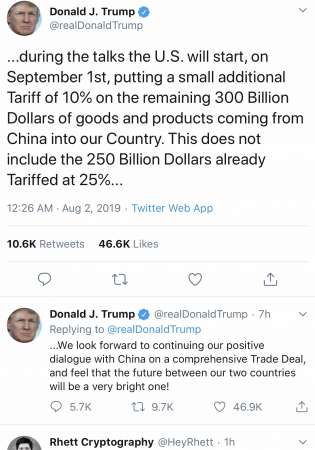
Trump’s tweet read: “During the talks the U.S. will start, on September 1st, putting a small additional Tariff of 10% on the remaining 300 Billion Dollars of goods and products coming from China into our Country. This does not include the 250 Billion Dollars already Tariffed at 25%…

“We look forward to continuing our positive dialogue with China on a comprehensive Trade Deal, and feel that the future between our two countries will be a very bright one.”

Jurin seeks easing of regulations from China for Thai exports

ศาสตร์เกษตรดินปุ๋ย : ขอบคุณแหล่งข้อมูล : หนังสือพิมพ์ The Nation

https://www.nationthailand.com/business/30374078

Jurin seeks easing of regulations from China for Thai exports

Aug 01. 2019
Jurin Laksanawisit (Photo: ThaiVisa News)

Jurin Laksanawisit (Photo: ThaiVisa News)
By THE NATION

456 Viewed

Commerce Minister Jurin Laksanawisit has appealed to authorities in China to relax new regulations on the import of fruits from Thailand.

Jurin has asked Thailand’s Minister for the Office of Commercial Affairs in Beijing to negotiate with China’s Ministry of Agriculture.

Jurin, who is also leader of the Democrat Party, will take part in the 8th Regional Comprehensive Economic Partnership (RCEP) meeting being held from Thursday (August 1) to Saturday in Beijing.

It is Jurin’s first international meeting since taking the reins at the Commerce Ministry. Thailand, as chair of Asean Economic Ministers this year, will also chair the RCEP meeting in which 16 Asian countries will take part. The meeting assumes added significance as the grouping tries to deal with differences before coming to an agreement.

Jurin said Asean leaders are focused on reaching conclusions at this RCEP meeting and it is one of 13 economic missions targeted by Asean to be completed within this year. Major topics to be discussed under RCEP are the opening of markets for goods, services, investments, and intellectual property, as well as financial appendix. The meeting for senior officers of Asean will be held in October, and for ministers in September and October.

Jurin said he has discussed with Chiyawan Chongvatana, Thailand’s Minister for the Office of Commercial Affairs in Beijing, about the country’s export situation with China, especially for agricultural products and fruits such as durian and longan. China has tightened regulations for import of fruits from Thailand, forcing all Thai fruit exporters to have packaging plant certification or Good Manufacturing Practice and the need to buy from the orchards that are certified as having Good Agriculture Practices. They are also required to have an exporter registration number from Thailand’s Department of Agriculture (DOA).

“We have received complaints from most exporters who have been impacted by such regulations, as many of them have no certification, and need to wait for the DOA to issue the certification. Many exporters have delayed their purchases, which will have a negative impact on the lives of farmers,” said Jurin.

“I have already ordered the Minister for the Office of Commercial Affairs in Beijing to negotiate with the central office for Chinese Customs to postpone such regulations as Thai exporters cannot find certification as identified and that it would impact Thailand’s export sector,” he said.

Saksyam signals boards of state transport enterprises to resign, giving his deputies greater say

ศาสตร์เกษตรดินปุ๋ย : ขอบคุณแหล่งข้อมูล : หนังสือพิมพ์ The Nation

https://www.nationthailand.com/business/30374076

Saksyam signals boards of state transport enterprises to resign, giving his deputies greater say

Aug 01. 2019
Transport Minister Saksyam Chidchob, left,  poses on Thursday with his deputies Athirat Rattanaset, centre, and Thavorn Senniam during a trial run of a newly launched underground train in a short trip from Sanam Chai to Tha Phra station.

Transport Minister Saksyam Chidchob, left, poses on Thursday with his deputies Athirat Rattanaset, centre, and Thavorn Senniam during a trial run of a newly launched underground train in a short trip from Sanam Chai to Tha Phra station.
By THE NATION

490 Viewed

Transport Minister Saksyam Chidchob has assigned his deputy Athirat Rattanaset to oversee water transportation while the other Deputy Transport Minister, Thaworn Senniam, has been assigned oversight of air transportation departments.

Saksyam said the boards of departments under the new leaders should be ready to resign as they were appointed by the previous government. He said it was up to the deputy ministers to decide if the board members should be reappointed.

He said the operations of the ministry and related agencies should follow the same policy, especially the urgent plan to help stimulate economic activity. Both the administrative section and operative officers should have the same goal and collaborate with departments.

Fifteen state enterprises come under the Transport Ministry: State Railway of Thailand, Electrified Train Co, Mass Rapid Transit Authority of Thailand, Port Authority of Thailand, Expressway Authority of Thailand, The Transport Co, Bangkok Mass Transit Authority, Thai Airways, Airports of Thailand, Thai Smile Airways, Civil Aviation Training Centre, Aeronautical Radio of Thailand, Civil Aviation Authority of Thailand, Suvarnabhumi Airport Hotel, and Thai-Amadeus Southeast Asia Co.

The process of appointing new boards will take two months. Until then, the old boards will continue with the task of completing their mission.

Some member of the old board have already started to respond to the changes by heading for the exit, such as Nattachat Jarujinda, the chairman of the Bangkok Mass Transit Authority, who sent in his resignation letter on June 1.

Authorities monitoring situation after US Fed cuts rate

ศาสตร์เกษตรดินปุ๋ย : ขอบคุณแหล่งข้อมูล : หนังสือพิมพ์ The Nation

https://www.nationthailand.com/business/30374058

Authorities monitoring situation after US Fed cuts rate

Aug 01. 2019
By THE NATION

298 Viewed

The government and the Bank of Thailand will keep a close watch on the situation after the US Federal Reserve cut its benchmark rate by a quarter of a percentage point on Wednesday, deputy secretary-general to the Prime Minister for Political Affairs, Kobsak Pootrakool, said on Thursday.

He said the US rate cut would trigger funds inflows to Thailand and the rate cut would put pressure on the local policy rate direction.

He added that the central bank had to keep a closer watch on the situation.

Energy Ministry seeks Bt3 billion budget to boost startups

ศาสตร์เกษตรดินปุ๋ย : ขอบคุณแหล่งข้อมูล : หนังสือพิมพ์ The Nation

https://www.nationthailand.com/business/30374044

Energy Ministry seeks Bt3 billion budget to boost startups

Aug 01. 2019
Sontirat Sontijirawong

Sontirat Sontijirawong
By The Nation

342 Viewed

The Energy Ministry is set to revise the Power Development Plan for 2018-2037 with the aim of boosting start-up businesses, Energy Minister Sontirat Sontijirawong said.

Speaking at a seminar on the direction of the energy industry hosted on Wednesday by the Thansettakit newspaper, Sontirat said that the PDP revision is in line with such future energy plans as the energy conservation system while also providing an opportunity for start-ups in the energy business to join the development.

The ministry is also open to more opinions on the revision. Sontiwat said that the new plan will not affect ongoing construction like a new powerplant in the west of Thailand for which a deal has already been finalised.

According to the news report from ministry of energy, the ministry is seeking funding to support start-ups with a budget of Bt3 billion.

Sontirat assured participants that the revision would offer investment opportunities for the private sector and on a community basis with the establishment of a community power plant.

Communities will be able to buy back shares from the investment, which will focus on renewable power plants. He also instructed related state agencies to map out zones for the establishment of community power plants and keep them within reach of the transmission network.

Sontirat also asked the Energy Conservation Fund, which will be financing this move, to revise its criteria for seeking funding to support the promotion of this community power plant development and come up with a proposal for his consideration next week. The fund has a budget of Bt12 billion.

The minister said the PDP revision must also be in line with Thailand’s policy of becoming Asean’s power hub. If all plans are achieved, the price of electricity in Thailand will drop to less than Bt3.576 per unit – a target that should be achieved in the next 20 years as set down in the current PDP.

He added that though he cannot specify when the PDP revision will be completed, as it requires the opinion of many parties, he could promise that the review will not affect existing projects.

Related  Topics : Ministry sets sights on boosting access to electricity

Thai, Myanmar bankers take part in bilateral meet

ศาสตร์เกษตรดินปุ๋ย : ขอบคุณแหล่งข้อมูล : หนังสือพิมพ์ The Nation

https://www.nationthailand.com/business/30374031

Thai, Myanmar bankers take part in bilateral meet

Aug 01. 2019
Photo by BOT

Photo by BOT
By The Nation

45 Viewed

Veerathai Santiprabhob, Governor of the Bank of Thailand (BOT), and U Kyaw Kyaw Maung, Governor of the Central Bank of Myanmar along with high-level delegations from each institute participated in the Bilateral Meeting on July 30, 2019 at the Central Bank of Myanmar, Nay Pyi Taw.

The meeting aimed to strengthen banking and financial cooperation including the promotion of local currency usage, banking cooperation, and cross border payment and settlement. These would further enhance financial integration and support the sustainable economic growth of both countries.

Veerathai Santiprabhob and the BOT’s delegation also paid a courtesy call on the Union Minister for Planning and Finance U Soe Win at his ministry in Nay Pyi Taw. They discussed and exchanged views on financial cooperation, including the potential for using financial technology to facilitate settlement of trade and investment between Thailand and Myanmar, as well as workers’ remittances.

More cuts to US base rate coming in October, Morgan Stanley predicts

ศาสตร์เกษตรดินปุ๋ย : ขอบคุณแหล่งข้อมูล : หนังสือพิมพ์ The Nation

https://www.nationthailand.com/business/30374028

More cuts to US base rate coming in October, Morgan Stanley predicts

Aug 01. 2019
Photo by Morgan Stanley

Photo by Morgan Stanley
By The Nation

87 Viewed

Morgan Stanley on Thursday said that it expects the US Federal Open Market Committee or the Fed to again cut the interest rate in October this year after it delivered a 25 basis-point cut to the funds rate on Wednesday.

At its July meeting, the Fed voted to cut the federal funds rate target range by 25 basis points, to 2.00 per cent-2.25 per cent. Committee members Esther George and Eric Rosengren dissented, confirming some resistance from regional FRB presidents to cutting rates at this stage of the business cycle.

The minimal size of the cut, the dissents, and Fed chairman Jerome Powell’s press conference comments disappointed markets, undercutting investment bank Morgan Stanley’s expectations, according to a statement released on Thursday.

Powell’s statement that the cut was “in the nature of a mid-cycle adjustment to policy” provided little dovish guidance for future policy moves, said the research statement.

“We expect a follow-up cut of 25 base points this year, and we judge October as the most likely timing,” the Morgan Stanley research paper said.

In the near term, the pricing of future Fed policy beyond another 25 point rate cut will hinge more on the evolution of more domestic, service sector data, than on global growth data, associated risks emanating from global trade, and their consequent impact on US manufacturing. Morgan Stanley suggested that investors exit all nominal and real rate positions that they had predicated on their previous understanding of the Fed’s reaction function.

“In TIPS, we stay neutral on break-evens, given Powell’s expectation of a ‘delayed’ move toward 2 per cent inflation. We exit our 5s30s real rates steepener. We also put some context on the Fed’s early end to balance sheet normalisation and what it means for real yields and break-evens,” said the research. “We see a muted impact on real yields, and mild support for breakeven tightening (not widening), given that the Fed buys lower duration in TIPS vs outstanding nominals.”

The early end to balance sheet normalization could alleviate some of the funding pressure Morgan Stanley expects to see, but they still expect over US$150 billion (Bt4.16 trillion) of T-bill issuances in August, said the report. “Further, we reiterate our view that POMOs will begin in the fourth quarter of this year as reserves will dip below $1.3 trillion in October and approach $1.2 trillion by December. Lastly, we project that EFFR-IOER will be in the 8-10 basis point range by the September meeting.

“Fed hawkishness may give the USD a bid, but we argue for caution. USD strength exacerbates the issues that concern the Fed the most – global growth, trade and inflation. The more cautious the Fed is on rate cuts, the higher the probability that financial conditions tighten, making future rate cuts more likely. We thus argue that the higher the USD rally, the bigger the subsequent USD decline.”