Lazada, Shopee lead the pack in e-commerce race

ศาสตร์เกษตรดินปุ๋ย : ขอบคุณแหล่งข้อมูล : หนังสือพิมพ์ The Nation

https://www.nationthailand.com/business/30373927

Lazada, Shopee lead the pack in e-commerce race

Jul 31. 2019
By THE NATION

872 Viewed

Giant online platforms Lazada and Shopee are riding high in Thailand’s e-commerce market, cashing in on the growth potential of Thai consumers’ shift towards digital-related activities.

Krungthep Turakij newspaper reported that Lazada and Shopee have now gained a combined share of between 80 and 90 per cent of the e-market  in Thailand.

According to the Electronic Transactions Development Agency (ETDA), under the Ministry of Digital Economy and Society, the market value of Thailand’s e-commerce is worth more than Bt3 trillion a year and expected to see a significant growth of 20 per cent this year.

Thanawat Malabuppha, president of Thailand e-Commerce Association, and CEO & co-founder at Priceza, said there were more than 20 million online shoppers in Thailand in the first six months of this year with more than 50 million products on sales on online platforms. It will increase to  about 62 million products by the end of this year.

“This reflects the fact that the number of individual on-line sellers have been increasing  continuously. For this year, the number of online product sellers is expected to increase by 29 per cent,” said Thanawat.

Pawoot Pongvitayapanu, director of Thai e-Commerce Association, also said that Lazada and Shopee have taken a combined market share of between 80 per cent and 90 per cent in Thailand’s e-commerce market, using Thailand as their strategic battlefield”.

He said that the e-commerce market will become even more competitive as all social networks, especially Facebook, become channels for selling products online.

“Based on the association’s market information, we can say that social media has become the platform for online trading, enjoying significant growth and now accounting for nearly 50 per cent of Thailand’s e-commerce market,” said Pawoot.

Lazada was registered as a company involved in e-commerce business in Thailand in 2012. The company posted total sales revenue of about Bt1.62 billion in 2014.  Last year, the company earned Bt8.16 billion in sales revenue in the first quarter, up from Bt1.75 billion for the first quarter of the previous year. The company also posted accumulated losses of  more than Bt2.6 billion in the first quarter of 2018.

Lazada is now the number one e-commerce player in Thailand and Southeast Asia, having about 44.1 million users per month  in Thailand alone. The company aims to increase the number of users on its e-commerce platform in the region to about 300 million by 2030. It recently changed its logo to be more colorful, as well as launched a  brand campaign entitled “Go Where Your Heart Beats” as a starting point to begin a new round in the e-commerce battlefield.

Pierre Poignant, chief executive officer at Lazada Group, said during  an  interview with Krungthep Turakij newspaper that the e-commerce market in the Southeast Asia , including Thailand, is changing continuously, driven by individual consumers spending more time on their smart phones.

“In the past, consumers usually focused on promotions and discount campaigns in buying products online. Today, consumers focus on product quality as well as the experience in the buying process and the  post-sales service,” said Poignant.

“We have seen plenty of opportunities  in Southeast Asia, which will see a skyrocketing  growth in the next five years. According to researches  by Google and Temasek, the digital economy market in Southeast Asia will reach US$240 billion in total value in 2025.

“We (Lazada) don’t want to be just an online shopping platform, but a lifestyle destination for individual consumers in the digital era, relying on the company’s strengths in infrastructure, logistics network, technology, service, and a world-class online platform,” said Poignant.

He said that Lazada has a policy to continuously invest in its infrastructure to maintain market leadership. We will add more investment allocated to all dimensions of the online shopping business, including new services and solutions both for sellers and buyers. As the provider of online platform service, we need to provide the best shopping experience, not only online, but also offline concurrently.

“We also bring the know-how and technology of Alibaba for adjustment to the development of new services in the market, such as data analytics and information management, so that all traders will have a better understanding of customers’ behaviour. It also include analysis works for demand, market trend and supply chain. The company has also accelerated  the development of turnkey e-payment service to support its Lazada Wallet online payment platform, which is being launched into the market.

“One of our key strategies is ‘Shoppertainment’, which is a mixture of entertainment and lifestyle to raise good shopping experience to individual buyers, together with the increase of capability to individual traders to help promote their brand and online store ,” said Poignant.

Meanwhile, Shopee, a online shopping company under SEA Limited, which is registered in the New York stock market, and the owner of ROV online game, is engaged in a  neck-to-neck competition with Lazada in the Thailand’s E-commerce market.

However, the total sales revenue of Shopee is still below Bt1 billion level as the company applied the loss-leader strategy to attract greater number of shoppers, which has reached about 31.19 million.    More than 95 per cent of shopping transactions at Shopee are made on smart phones. There are more than 100,000 online stores selling over 10 million products available on Shopee E-marketplace.

Maneerat Anulomsombat, CEO of SEA (Thailand), said that Shopee enjoyed strong growth last year, which is expected to continue this year.

“We want Shopee to be either number one or second in Thailand’s E-commerce market and to become an integrated online shopping application, focusing on good experience for both sellers and buyers who are not just making a shopping transaction, but participate in providing products and services along the way, together with e-payment service for customers,” she said.

Maneerat said that based on the analysis by Google and Temasek, the e-commerce market in Southeast Asia region showed an average growth of 62 per cent over the past three years, creating more than $100 billion or about Bt3.1 trillion in total sales. Growth is expected to continue in the next the next five years.

“Currently, the proportion of e-commerce to total retail sales in Thailand stands at only 3-5 per cent. In other growth markets, such as the US, the proportion of e-commerce to total retail sales is between 15 per cent and 20 per cent. This means that the online shopping market in Thailand has much room for  growth,” she said.

“We believe that Shopee now understands the shopping behaviour of Thai consumers. We would like both sellers and buyers at Shopee to have a ‘sense of belonging’, and to be part of our platform,” said Maneerat.

Maneerat said that one of the key strategies applied by Shopee is to speed up the expansion of its customers base, both vertically and horizontally.

“We will focus on ‘integrated function’ for our products and organisation, with the adding of lifestyle and entertainment dimensions. We will cater to our individual customers beyond an ordinary e-commerce platform, bringing fun activities and mini-games to attract new customers into our eco-system platform,” she said.

Maneerat said that Shopee recorded 158.5 million gross orders in the third quarter of last year.

Shopee will focus on the recruitment of new offline merchants into our e-commerce system via ‘Shopee University’, a programme to develop the capabilities of  online stores as well as small-scale businesses, being held annually by Shopee in particular markets, such as  Vietnam, Indonesia, Singapore, and Thailand, she said.

“The key factor to success in  the competitive market is to increase our capability to serve any requirement and lifestyle of today’s consumers at 360-degree. We want to become a ‘multi-purposed platform’ that offers diversified one-stop-shopping services in one application, such as e-marketplace, e-wallet, as well as food search and delivery,” said Maneerat.
Prayut takes the helm of economic team

ศาสตร์เกษตรดินปุ๋ย : ขอบคุณแหล่งข้อมูล : หนังสือพิมพ์ The Nation

https://www.nationthailand.com/business/30373925

Prayut takes the helm of economic team

Jul 31. 2019
By NAKARIN SRILERT
THE NATION

879 Viewed

Planning to start work next week, the council of economic ministers will put forward a short-term economic stimulus package.

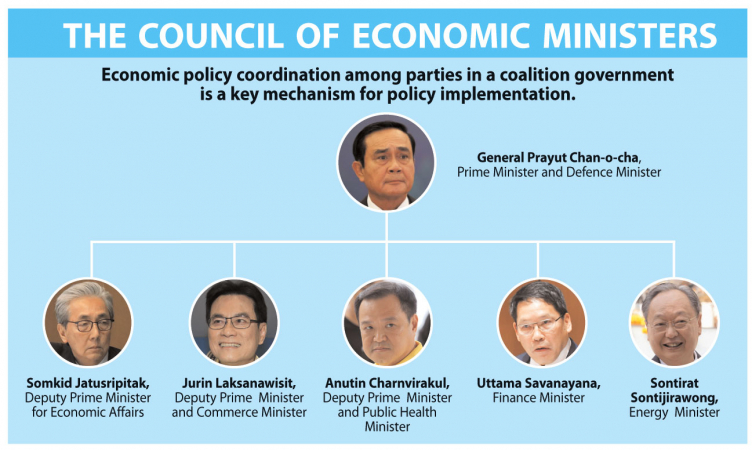
“We agree to a council of economic ministers chaired by the Prime Minister and it is a consensus among deputy prime ministers to work together to screen and put forward economic policies,” Prime Minister General Prayut Chan-o-cha said after the first Cabinet meeting yesterday.

He said the council will address the issue of policy coordination since different deputy prime ministers oversee different ministries, the problems of policy coordination may occur .

He said the Finance Ministry is currently considering a short-term economic stimulus package, aimed at boosting domestic consumption, tourism, accelerating budget disbursement by state agencies and state-owned enterprises.

The package will fall in line with government outlays for fiscal 2020, focusing on accelerating public investment in both large and small projects. Public spending will also come under a five-year plan, which will be submitted for Cabinet approval shortly.

Government spokesperson Naruemon Pinyasinwan said the council of economic ministers will be chaired by Prime Minister Prayut with three Deputy Prime Ministers – Somkid Jatusripitak, Jurin Laksanawisit and Anutin Charnvirakul acting as vice chairmen.

Ministers from 11 ministries would serve as committee members including Finance Minister Uttama Savanayana, Transport Minister Saksayam Chidchob and Energy Minister Sontirat Sontijirawong.

Assigned by the Cabinet, the council of economic ministers have the authorities to screen policies concerning economic affairs such as trade, investment, tax, fiscal, tourism, logistics and energy, agriculture, education and technology, she said.

It also has the authority to make policy recommendations for the Cabinet approval. It could invite ministers, state officials or other committee to provide information.

Sontirat said the council will be a key mechanism for the coalition government working on economic issues. It plans to hold the first meeting next Monday. The council of economic ministers was initiated in 1980s during the tenure of the late Prime Minister Prem Tinsulanonda.

Meanwhile, Dechapiwat Na Songkhla , director of Budget Bureau said the Finance Ministry, Bank of Thailand, National Economic and Social Development Council and Budget Bureau will meet on August 2 to discuss the framework of the budget for FY2020. The total expenditures is estimated at Bt3.2 trillion with a deficit of Bt450 billion.

The draft budget bill will be submitted to the Cabinet for approval on August 6. The government plans to continue to run a budget deficit as it wants to boost infrastructure investment, stimulate local consumption amid the ongoing slide in exports .

Many research houses have downgraded their economic growth projection from around 4 per cent to 3 per cent this year.

BOT to roll out new standards for granting bank loans by yearend

ศาสตร์เกษตรดินปุ๋ย : ขอบคุณแหล่งข้อมูล : หนังสือพิมพ์ The Nation

https://www.nationthailand.com/business/30373926

BOT to roll out new standards for granting bank loans by yearend

Jul 31. 2019
Photo: The Phuket News

Photo: The Phuket News
By THE NATION

731 Viewed

The Bank of Thailand (BOT) plans to issue Debt Service Ratio (DSR) regulation to control the debt burden of people and ensure low-income earners are not overburdened.

Ronadol Numnonda, deputy governor of BOT’s Financial Institutions Stability, said that by yearend the central bank will launch DSR regulations for commercial banks and financial institutions to use as a standard for lending. At present, the lending criteria varies from bank to bank and this may lead to future debt problems.

“The purpose of the regulations is to urge commercial banks and financial institutions to consider risk factors thoroughly before granting loans,” he said. “For instance, we need to consider whether or not the borrowers can repay, and if they have adequate net income to support themselves and their family. This will prevent people from building their debt burden, which will affect their savings and livelihood on a long-term basis. If implemented correctly, DSR can essentially reduce the number of non-performing loans [NPL] of banks and financial institutions.”

Furthermore, DSR regulations will provide more clarity on what can be counted as income, expenses and debt. This will also make it easier for people to apply for a loan, especially the low-income earners who have no collateral.

Meanwhile, Kiatnakin Bank said the group who need to prevent their household debt from spiking are those who earn less than Bt30,000 per month, new graduates and retirees.

Philip Chen Chong Tan, Kiatnakin Bank’s president, said he agrees with the BOT’s policy of ensuring loans are given out responsibly, adding that banks and financial institutions should be especially careful when granting loans to the above three groups, as they have a tendency to be spendthrifts.

“During a preliminary discussion between BOT, Thai Bankers’ Association and commercial banks, it was agreed that DSR for those earning less than Bt30,000 per month will be 70 per cent, which means they must maintain their debts at a level where they can pay off their loan with a maximum of 70 per cent of their income, while reserving the remaining 30 per cent for their monthly expenses. This rate, however, has to be adjusted in the future,” he said.

Thailand seeks stronger ties with Russia

ศาสตร์เกษตรดินปุ๋ย : ขอบคุณแหล่งข้อมูล : หนังสือพิมพ์ The Nation

https://www.nationthailand.com/business/30373919

Thailand seeks stronger ties with Russia

Jul 30. 2019
Don Pramudwinai, the Foreign Minister of Thailand

Don Pramudwinai, the Foreign Minister of Thailand
By SOMLUCK SRIMALEE
THE NATION

448 Viewed

Thai Foreign Minister Don Pramudwinai will hold talks with his Russian counterpart Sergey Viktorovich Lavrov on Wednesday (July 31) during the latter’s official visit to Thailand.

Both countries are happy with the cooperation and improved relations seen in the last four years, having agreed to the result of the 7th Session of the Joint Thai – Russian Commission on Bilateral Cooperation for creating a practical framework for the near future.

Don will ask Russia to raise the import volume of Thai agricultural produce and food items. It will also seek an easing of the country’s strict verification process on the remaining Thai seafood and meat products.

He will also invite Russian investment in the Eastern Economic Corridor (EEC) project and S-Curve industry.

Russian support is also sought for the FTA negotiations between Thailand and Eurasian Economic Union.

According to The Federation of Thai Industries report, Russian businessmen had been invited to explore investment opportunity in the EEC, specially in the petrochemicals, energy, pharmaceuticals, digital logistics,and cyber security system sectors.

Moody’s, Fitch update outlook on Thai banks

ศาสตร์เกษตรดินปุ๋ย : ขอบคุณแหล่งข้อมูล : หนังสือพิมพ์ The Nation

https://www.nationthailand.com/business/30373916

Moody’s, Fitch update outlook on Thai banks

Jul 30. 2019
By THE NATION

531 Viewed

Moody’s Investor Services has affirmed the long-term local and foreign currency deposit ratings of KasikornBank (Kbank), Krung Thai Bank (KTB) and Siam Commercial Bank (SCB) at Baa1, and those of CIMB Thai Plc (CIMBT) and Standard Chartered Bank(Thai) Plc or SCBT at Baa2.

It has also affirmed the long-term foreign currency deposit ratings of Bangkok Bank Plc (BBL), Bank of Ayudhya (BAY), Government Housing Bank (GHB), and United Overseas Bank (Thai) or UOBT at Baa1.

At the same time, Moody’s has upgraded TMB Bank (TMB)’s long-term foreign currency deposit rating to Baa1 from Baa2.

Further, Moody’s affirmed the long-term foreign currency senior unsecured programme rating of BBL, Export-Import Bank of Thailand (EXIMT), KBank, KTB and SCB at (P)Baa1, and the long-term foreign currency senior unsecured rating of EXIMT at Baa1 while the long-term foreign currency senior unsecured programme rating of TMB was upgraded to (P)Baa1 from (P)Baa2.

Moody’s has also upgraded the Baseline Credit Assessments (BCA) and adjusted BCAs of BBL, KBank and SCB to baa1 from baa2, and those of KTB and TMB to baa3 from ba1.

The BCA and adjusted BCA of UOBT were upgraded to baa3 and a3 from ba1 and baa1 respectively. The BCAs and adjusted BCAs of these six banks were upgraded because they maintained good financial fundamentals despite the challenging credit cycle in Thailand. For SCBT, Moody’s affirmed the adjusted BCA at baa2. The BCAs and adjusted BCAs of BAY, CIMBT, EXIMT, and GHB were unaffected by today’s rating actions.

The long-term counterparty risk ratings (CRR) and counterparty risk assessment (CRA) of BBL, KBank and SCB were upgraded to A3 and A3(cr) from Baa1 and Baa1(cr) respectively. It affirmed the long-term CRR and CRA of KTB, SCBT and TMB at Baa1 and Baa1(cr) respectively.

Moody’s also upgraded the long-term CRR and CRA of UOBT to A2 and A2(cr) from A3 and A3(cr) respectively. The CRRs and CRAs of BAY, CIMBT, EXIMT, and GHB were unaffected by today’s (July 30) rating actions.

Moody’s changed the outlook on the long-term ratings of nine of the 11 Thai banks — with the exception of SCBT and TMB — to positive from stable. The outlook on the long-term ratings of SCBT is maintained at stable, while that of TMB is maintained at positive.

The changes in outlooks on the nine Thai banks follow Moody’s affirmation of Thailand’s Baa1 sovereign rating, and change in the outlook for the sovereign’s rating to positive from stable on 25 July 25, 2019.

Meanwhile, Fitch Ratings rated Thai banks’ asset quality stable with further growth in capital.

The first-half financial results of listed Thai banks were stable, with trends in asset quality and profitability broadly supportive of credit growth, Fitch Ratings says.

Loan growth fell short of estimates, reflecting continued subdued business sentiment and consumer confidence. However, profitability and stability of returns are expected for the remainder of 2019, with a continued gradual buildup of capital to guard against downside risks as well as upcoming regulatory measures, such as IFRS9 implementation in 2020.

Credit growth for Thai banks was much lower than expected at 1 per cent for the first half of this year, reflecting a lack of demand and conservative underwriting. While expected to improve, it will likely trail Fitch’s full-year forecast of 7 per cent given the current trends, with increased preservation of capital as a result.

Anemic retail lending saw growth falling to 3.1 per cent for the first half , down from 7.8 per cent year on year due to slowing auto sales and the Bank of Thailand’s (BOT) tightening of loan-to-value measures on mortgages that became effective in April. Corporate lending also encountered pressure, with mounting delays of approval for new infrastructure projects.

The country’s GDP is expected to fall to 3.3 per cent this year from 4.1 per cent in 2018 before moderating to 3.5 per cent in 2020. Continued infrastructure project delays and lower investment by export-oriented firms remain downside risks, as does further escalation of the trade war.

Listed Thai banks’ asset quality has been stable with an impaired loan ratio of 3.7 per cent as of June 30, 2019. More of the same is expected for the rest of the year. Downside risks could come from small to medium enterprise (SME), residential mortgage and auto loans segments, which have relatively high debt levels and a reduced capacity to withstand shocks. However, we do not expect a substantial increase in asset quality risk under current economic conditions, aided by the BOT’s recent macro-prudential regulations and the banks’ high loan loss reserves, with allowances at 152 per cent of impaired loans.

Core net interest margins are expected to be stable in the near term. Market expectations are for interest rates to be little changed while the low levels of credit growth should not pressure banks’ liquidity given the system’s liquidity coverage ratio stood at 173 per cent as of May 2019. We expect earnings trends going forward to be driven by fee income and credit costs.

Return on assets for listed banks was 1.3 per cent as of June 31, down just 2 bps year on year but aided by a substantial decline in provisioning expense amid solid capital buffers and the expectation of credit improvement.

At the same time, lower credit provisions helped offset higher employment costs, investment in operations and IT and the significant reduction in non-interest income, pressured by lower insurance premiums due to regulatory changes.

Hence, expenses as a percentage of income rose to 46.2 per cent versus 44.3 per cent year on year and are expected to remain elevated in the near term.

NBTC seeks band recall for 5G service

ศาสตร์เกษตรดินปุ๋ย : ขอบคุณแหล่งข้อมูล : หนังสือพิมพ์ The Nation

https://www.nationthailand.com/business/30373915

NBTC seeks band recall for 5G service

Jul 30. 2019
Takorn

Takorn
By THE NATION

389 Viewed

The National Broadcasting and Telecommunications Commission (NBTC) will propose to the board a partial recall of satellite spectrum band 3400-3700MHz, for reallocation to provide 5G service.

The band is currently occupied by Thaicom, the operator of Thaicom satellites.

NBTC secretary-general Takorn Tantasith said today (July 30) that he would ask the board to recall the band from the Digital Economy and Society Ministry, which granted it to Thaicom for the company’s satellite services.

He added that the recall would not affect Thaicom’s operations as it would have sufficient bandwidth left on this band to continue services.

The NBTC plans to hold two multi-band auctions as part of its 5G development policy. The first will consist of higher frequency bands, such as 26-28 GHz, followed by the middle bands (averaging 2600 MHz) and the lower 700 MHz band.

For the second auction, middle bands of 3400–3600 MHz and 1800 MHz will be released at the same time.

Stronger baht, US-China war still affecting border trade

ศาสตร์เกษตรดินปุ๋ย : ขอบคุณแหล่งข้อมูล : หนังสือพิมพ์ The Nation

https://www.nationthailand.com/business/30373906

 Stronger baht, US-China war still affecting border trade

Jul 30. 2019
Adul Chotinisakorn

Adul Chotinisakorn
By The Nation

639 Viewed

Trade along the borders of Thailand in the first half of this year was worth Bt686 billion, up 1.16 per cent from the same period last year, director general of the Commerce Ministry’s Foreign Trade Department, Adul Chotinisakorn, said on Tuesday.

“We are continuing to boost border trade so it can achieve the Bt1.6-trillion target by the end of the year,” he said.

However, he added that exports accounted for Bt381.7 billion of the total trade, which was 0.98 per cent less from the same period last year, while imports accounted for Bt304.73 billion, recording a 3.97 per cent rise from the same period of last year.

The top three countries involved in border trade this year are Malaysia, where transactions in first half valued Bt271.6 billion or 2.43 per cent less from the same period last year, followed by Myanmar worth Bt102.2 billion and Laos worth Bt99.39 billion.

Thailand’s exports have dropped due to the appreciation of the baht and the US-China trade war, Adul said.

However, he said he is confident that border trade will achieve the Bt1.6-trillion target by the end of this year thanks mainly to his department’s policy to promote trade in southern border provinces.

The department is also revising its business plan for 2020-2022 by aiming for an average 15-per-cent growth per annum, he said.

Thai exports forecast to contract 0.64 per cent for year

ศาสตร์เกษตรดินปุ๋ย : ขอบคุณแหล่งข้อมูล : หนังสือพิมพ์ The Nation

https://www.nationthailand.com/business/30373885

Thai exports forecast to contract 0.64 per cent for year

Jul 30. 2019
Ath

Ath
By THE NATION

581 Viewed

Thailand’s exports this year could contract 0.64 per cent, the first contraction in four years, according to the Centre for International Trade Studies at the University of the Thai Chamber of Commerce.

The centre director Ath Pisalvanich said today (Tuesday) that the export value was expected to reach about US$251.338 billion (Bt3.956 trillion) this year.

However, exports in the second half are expected to expand 1.6 per cent year on year to $128.367 billion, driven by the government’s support.

The factors to be monitored in the second half include such risks as the trend of a declining global economy, the US-China trade war, the trending appreciation of the baht and the volatile global price of oil.

Details of commuter fare reductions to be set within a month: Transport Minister

ศาสตร์เกษตรดินปุ๋ย : ขอบคุณแหล่งข้อมูล : หนังสือพิมพ์ The Nation

https://www.nationthailand.com/business/30373843

Details of commuter fare reductions to be set within a month: Transport Minister

Jul 30. 2019
By THE NATION

678 Viewed

The Transport Ministry has vowed that details of the government’s policy to reduce fares for commuters using all means of transport will become clear within one month.

Transport Minister Saksayam Chidchob said that he and all transport state agencies would convene on July 30 to finalise policy details.

He has already instructed the state agencies to within one month conclude a study of how the burden of transport costs could be reduced for people.

He assured that the reduction of overall transport fares would not affect the state budget or the concession contracts of the existing operators. The ministry will not only lower fares for the mass transit system, but also all other fares for means of transport, he said.

He added that the government might within this year run a pilot project lowering the fares of the Bang Yai-Tao Poon Purple Line and the Airport Rail Link route. The ministry needs to first negotiate with all related parties before making a final decision.

HCM City solicits investment in infrastructure

ศาสตร์เกษตรดินปุ๋ย : ขอบคุณแหล่งข้อมูล : หนังสือพิมพ์ The Nation

https://www.nationthailand.com/business/30373847

HCM City solicits investment in infrastructure

Jul 29. 2019
By Vietnam News
Ho Chi Minh CityN

599 Viewed

Ho Chi Minh City authorities have called on local and foreign businessmen to invest in the city’s infrastructure.

The burgeoning metropolitan area with 13 million inhabitants is facing problems caused by rapid urban development and is struggling with climate-related problems, said Le Thanh Phong, head of the Investment and Trade Promotion Centre’s investment promotion division.

“The demand for urban infrastructure is forecast to grow as a result of the rapid urbanisation,” he told the Infrastructure Vietnam Summit that wrapped up on July 26 in HCM City. “Traffic problems and flooding have hindered social and economic development.”

The city is soliciting investment of $53 billion (Bt1.6 trillion) in 210 projects, mostly in infrastructure, according to the official.

The city requires $42 billion for 85 transport infrastructure projects, including 55 roads and bridges, seven for waterway transport, eight in railways, and 15 road works.

It also needs $4.9 billion for 36 urban technical infrastructure projects, including drainage systems and wastewater treatment plants.

It plans to develop a satellite city in four areas to help reduce population pressure and stress on infrastructure in the city centre.

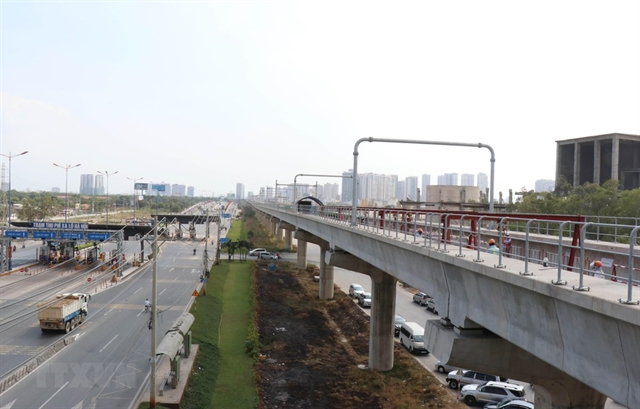
Nguyen Quoc Hien, director of the project preparation investment unit under the Management Authority for Urban Railways, said as a metro and an economic hub HCM City urgently needed to build an urban railway system.

Under a master plan approved by the government, the city would develop an urban railway system with a length of 220 kilometres at a cost of $26 billion, including eight metro lines, one tramway line and two monorail lines, he said. “The 220km urban railway system is modest compared to the city’s rapid economic growth and urbanisation.”

“Three of the metro lines have received funding commitments but they account for only 10 per cent of the total cost and the remaining 90 per cent investment has yet to be tied up,” he said.

KPMG Legal Limited director Tran Duy Binh said lengthy procedures and multiple approvals were among the key irritants faced by foreign investors.

It was also difficult and time-consuming to find an appropriate local partner, he added.

As of last month investors from 106 countries and territories had invested more than $45 billion in numerous sectors in the city.