A leading academic has urged the Bank of Thailand (BOT) to delay any policy rate rise until the last quarter, warning that a hasty decision could trigger economic slowdown.
Montree Socatiyanurak, director of the National Institute of Development Administration (Nida)’s advanced management programme, said the BOT’s Monetary Policy Committee (MPB) was caught in a dilemma. The MPB must decide whether to raise the rate to halt the baht’s slide, or retain the current rate to facilitate exports but at the cost of higher costs for energy imports.
Montree said the Thai economy is growing sluggishly at 1 to 1.5 per cent due to external uncertainties plus rising domestic inflation, manufacturing costs and consumer goods prices, as well as the possible interest rate rise.
On June 8, the MPC voted 4:3 to retain the current policy rate of 0.50 per cent per annum. However, the fact that three MPC members voted for 0.25 per cent rise led to expectation of rate hikes in the second half of this year to combat high inflation.
Montree said inflation rose from 5 per cent early this year to 7.1 per cent in May – the highest in 13 years – driven mainly by higher prices for energy and food.
He said economic growth accounted for only 2 per cent of inflation, with about 7 per cent coming from rising costs in the business sector.
Since inflation was being driven by costs rather than economic growth, raising the policy rate would not do much to contain it, Montree added.
The MPC has to consider various economic impacts before making its policy rate decision, said Montree.
Raising the policy rate would not bring down energy and food prices, but it would support the weakening baht, which has fallen to Bt35 per dollar. And this would help Thailand pay for oil imports.
However, retaining the policy rate would lead to further baht depreciation, meaning Thailand would have to exchange more baht for dollars to buy oil – affecting the country’s current account balance.
Leaving the policy rate untouched would also hit the baht as foreign investors would move their money to the US where yields are higher after the policy rate was raised by 0.75 percentage points last Wednesday.
A weak baht would, however, help exports and tourism as foreign visitors would have more money to spend in the Kingdom.
“So, the MPC will have to consider several factors and get the timing right,” Montree said.
He warned that hiking the rate too soon would cause bank interest rates to rise across the board, adding pressure to people with high household debts.
He added that to prevent economic slowdown, policy rate hikes should be delayed until the last quarter when tourism will have recovered, incomes will be higher and the business sector will have more liquidity.
Thailand launched its bid for Phuket to host the global 2028 Specialised Expo in Paris on Sunday, a government spokeswoman said.
AThai team led by Public Health Minister Anutin Charnvirakul is showcasing the southern island as the ideal venue for the expo under the theme “Future of Life: Living in Harmony, Sharing Prosperity”.
Thailand is competing with four other countries – the US, Argentina, Serbia and Spain – to host the expo.
Specialised Expos are meant to respond to a specific challenge facing humanity and usually take place in the interval between two World Expos.
Team Thailand will give the three-day presentation until Tuesday at the headquarters of the Bureau of International Exposition (BIE), the inter-governmental organisation in charge of organising non-commercial international expos.
BIE officials will survey Phuket in July and again at a later date.
The winning bid will be announced in June next year.
If Phuket is selected as the venue, Thailand would have four years to prepare for the expo, to be held from March 20 to June 17, 2028.
TCEB estimates the expo would draw 4.93 million visitors, including 2.66 million foreign tourists, to Phuket.
The Public Health Ministry wants the expo to serve as a showcase for Phuket’s advanced medical tourism industry.
Forty-one foreign companies have been allowed to conduct businesses in Thailand under the Foreign Business Act, Sinit Lertkrai, the deputy commerce minister, said on Friday.
“These foreign companies have invested over 18.69 billion baht in Thailand and generated up to 753 jobs for local people,” he said. “Most of these companies are from Singapore, Japan and Cayman Islands.”
Sinit said that allowing more foreign companies to invest in Thailand will help promote knowledge and technology transfer, especially in the areas of petroleum rig control, multiverse platform operation, coronary angioplasty, enterprise software development, data and predictive analytics, and integrated circuit manufacturing.
Sinit added that 12 foreign companies have been approved to invest in the Eastern Economic Corridor (EEC), or 29 per cent of all approved foreign companies in May. These companies have invested 15.16 billion baht in the EEC, accounting for 81 per cent of total foreign investment. Most of these companies are from Japan, Singapore and the Netherlands, while businesses in the EEC that received foreign investments include data collection and processing services, electronic component installation, digital camera and lens manufacturing.
The Commerce Ministry expects more foreign companies to apply for investment in Thailand in the rest of the year due to the improving Covid-19 situation and the easing of restrictions for foreign arrivals, which will help restore confidence among foreign investors.
The Energy Policy and Planning Office (EPPO) has endorsed measures to help cushion the impact of rising petrol and gas prices resulting from the ongoing Russia-Ukraine war, Energy Ministry permanent-secretary Kulit Sombatsiri said on Thursday.
The ministry will seek a green light for the relief measures when the Cabinet convenes next week, the senior official said.
“The price of diesel oil will be maintained at no more than 35 baht per litre until the end of June,” he said.
The EPPO meeting, chaired by Energy Minister Supattanapong Punmeechaow, also agreed to continue subsidising cooking gas for low-income earners for three more months until the end of September.
The Department of Energy Business has also been tasked with calling on petroleum giant PTT to extend a discount on liquified petroleum gas (LPG) to small food vendors and eatery owners until the end of September, Kulit added.
He said EPPO had agreed with the proposed measure to ease the impact of the high price of natural gas for vehicles (NGV).
The Energy Ministry will ask PTT to retain the NGV retail price at 15.59 baht per kilogram, while keeping the price at 13.62 baht per kilo for taxi drivers in Greater Bangkok until September 15.
The baht opened at 35.05 to the US dollar on Friday, strengthening from Thursday’s close of 35.16.
The currency is expected to move between 34.95 and 35.20 on Friday, predicted Krungthai Bank market strategist Poon Panichpibool.
He added that a weakening dollar and mass sale of gold may make the baht fluctuate and strengthen.
However, he said, the value of the baht may weaken if foreign investors sell Thai assets, especially stocks, due to concerns and confusion over Thai monetary policies.
Some investors also expect the Monetary Policy Committee (MPC) to hold an urgent meeting to increase the interest rates even though there has been no indication of that happening.
Poon also believes the Bank of Japan’s moves to ease monetary policies may weaken the yen and baht.
If the baht does weaken, he said it will be limited to between 35.10 and 35.20 to the dollar, allowing exporters to sell their dollars.
He advised speculators to watch the baht’s direction closely as there may be some factors that cause the baht to weaken to test the resistance level of 35.50.
However, he does not expect this to happen unless a lockdown is widely enforced in China, forcing investors to dump assets in emerging Asia markets.
Poon advised investors to use hedging tools like options to manage their risks in the highly volatile currency market.
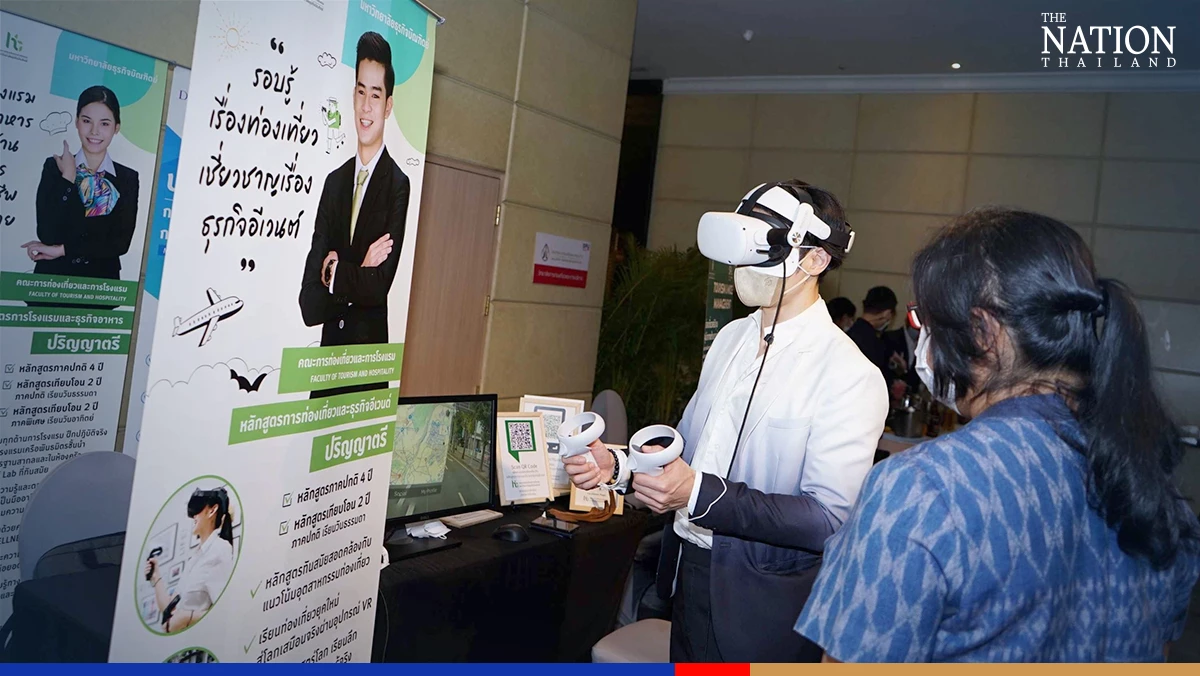
The nationwide educational institution network is being expanded to improve the quality of MICE workforce so as to elevate Thailand’s position in the conference and exhibition organising industry.
The idea has been initiated by Thailand Convention & Exhibition Bureau (Public Organization), or TCEB, which is confident that the MICE (Meetings, Incentives, Conferences, Exhibitions) industry will be the key factor in boosting the country’s tourism after its reopening.
Supawan Teerarat, senior vice president – MICE Capability and Innovation of TCEB, disclosed that before the pandemic, MICE tourism was one of the major sources pf income for the country. Although the number of business purpose visitors is only around 1.2-1.5 million when compared to the overall foreign tourists, the group average spending per person is quite high. So they generate economic value worth more than 200 billion baht.
As the country is reopening, many events, conferences, and exhibitions can be organised. However, to be able to attract and pitch more global events and expositions to exhibit in Thailand, Supanwan said that the country was required to accelerate integration of collaborations to expedite MICE capability enhancement through an education network.
She added that the objectives of this collaboration were to drive regional MICE, distribute quality MICE workforce and create a competitive advantage of MICE in all regions across Thailand. Activities are organised to bolster content development and create jobs and occupations for the new generation of MICE workforce nationwide. “The TCEB has formulated the strategy to expedite regional MICE and established TCEB regional offices to promote MICE nationwide. Currently, the development of MICE capability through the education network in all regions has been formed with educational institutions across Thailand,” said Supawan
At present, MICE courses have been added to the curriculum in 136 institutions, comprising 87 tertiary education institutions and 49 vocational schools. Subjects under MICE Major are offered in 33 institutions, all of which can produce more than 50,000 MICE students in tertiary and vocational education institutions each year in average. Moreover, TCEB has further developed the capability of educational institutions by transforming them into MICE Business Centres, which will help to expedite the distribution of MICE across the nation.
Supawan insisted that establishing an education network was a vital mechanism, as it enables MICE to tap into other regions, as well as all other sectors in each district. The education network also collaborates and bolsters marketing, as well as synergises the development of capability in all dimensions, generating income, creating jobs and efficiently driving the local economy through MICE events held in the region.
According to the survey “Meetings Outlook: 2022 Spring Edition” conducted by MPI (Meetings Professional International), it was found that the Covid-19 pandemic has caused people to realise the importance of face-to-face events. About 64 per cent commented that businesses would probably resume their growth from 2023 onwards. For this reason, event budget will increase, as well as employment volume. Employment rate in the MICE industry also has a tendency to rise. Survey results indicated that more than half of the respondents had encountered problems related to recruiting qualified employees compared with the latest quarter, proving that MICE has begun to thrive again.
To push Thailand to the forefront of the MICE industry, TCEB has accelerated the development of MICE capability in three areas: Content development, connection development and career development, to serve international MICE markets.
“We prioritised producing a high-performing workforce in line with the demands of business premises. TCEB has also accelerated the production of the occupational-level workforce in regard to feeding occupational graduates into the quality MICE job market to support the economy, promote employment, as well as circulate revenue from MICE activities and employment to other regions,” said Supawan
Assistant Professor Niwat Keawpradab, president of Prince of Songkla University, speaking on the institution network Southern MICE Academic Cluster (SMAC), disclosed that the university has always supported outcome-based teaching and learning, especially an active learning approach and experiential learning.
“Students can participate and undergo training to gain actual experience from the industry. They can also use this knowledge as their research studies to expand their insight in relevance with compulsory skill development for MICE personnel in the new normal era,” said Dr.Niwat.
Ariya Banomyong, co-chief rxecutive officer, CMO Pcl, revealed that the current situation inside and outside the country had gradually improved. People have resumed their routine activities and begun to travel, emphasising that all countries are unlocking themselves from previous circumstances.
As one of Thailand’s biggest events organisers, Ariya said that the Thai MICE industry has the potential and opportunity to grow like other countries whether it is Dubai or Singapore. However, Thailand has seldom held events of a regional level recently even though businesspeople and travellers in Business Event category have always had Thailand in their mind. Hence, now is the most suitable time for Thailand to contribute towards restoring the local economy through MICE industry, be they hotels, accommodation, travelling, restaurants or shopping centres. Thai MICE had a market value of up to 230 billion baht in 2019 and is foreseen to increase to 420 billion baht in 2027, based on the average yearly growth of 11.63 per cent from 2021 to 2027.
“What the CMO Pcl will do can be either Homegrown Event or Business Event delivered under the CMO brand. So to speak, our conferences have not only featured hundreds of globally renowned speakers, but also attracted visitors from other countries, as the conferences held by our company could make neighbouring countries want to join too. Besides providing knowledge, the conference is able to encourage the Thai economy through the MICE industry,” said Ariya.
He added that the country’s infrastructure and facilities are already advanced and competitive while Thai-style hospitality and management are second to none. However, the nation misses the opportunity to host some global expositions due to a lack of creativity. Therefore, educating and training the young workforce could be one of the sustainable solutions.
Supawan said that TCEB has targeted the development of MICE capabilities, in terms of education. TCEB has provided support through the establishment of training division and MICE occupation test division at 10 MICE educational network centres nationwide.
Additionally, TCEB has developed MICE Career Platform and successfully done employment matching for more than 1,000 jobs. A MICE Student Chapter has also been created for grooming 5,000 young MICE entrepreneurs by 2023.
Thailand’s inflation rate in May jumped to its highest in 13 years just as the rates in several Asean countries are rising.
The Trade Policy and Strategy Office (TPSO) reported that Thai inflation in May was 7.10 per cent, the highest in 13 years.
And the rate is generally rising: it was 3.23 per cent in January, 5.28 per cent in February, 5.73 per cent in March, and 4.65 per cent in April before jumping to 7.10 per cent in May.
The TPSO sees Thailand’s inflation rate moving in the same direction as that of several other countries.
It pointed out that high inflation is caused by increasing energy and food prices, especially high fuel prices.
Meanwhile, the producer price index (PPI) in May grew by 13.3 per cent for all product types.
The TPSO said this was because of high energy prices, shipping costs, imported material prices, a weakening baht and other manufacturing costs, while demand in Thailand and abroad is still high.
The PPI for construction material is also up as the sector grew by 6.5 per cent, but now the growth rate is slowing down, the office said.
The consumer confidence index dropped from 45.7 in the previous month to 44.7 because external risks have affected the economic situation, negatively affecting the price of oil, fuel and consumer goods, while some government subsidy schemes have ended despite Covid-19 still spreading, even though at a slower rate.
The TPSO expected inflation to continue to rise in the next few months as the energy price is unlikely to come down. The high inflation rate will inevitably hit consumers’ pockets as their expenses will rise and purchasing power will decrease.
The office mentioned that the Commerce Ministry is trying to prevent manufacturers from raising product prices but the actual prices have already increased.
It advised all sectors to keep a close eye on and prepare for higher inflation.
The baht opened at 34.85 to the US dollar on Thursday, strengthening from Wednesday’s close of 35.02.
The currency is expected to move in a range between 34.70 and 34.90 on Thursday, predicted Krungthai Bank market strategist Poon Panichpibool.
Poon said the baht is likely to fluctuate during the day. It strengthened as the dollar declined because it was “sold on fact”, he said, after the US Federal Reserve did not signal that it would go in for a heavy interest rate increase or adjust its economic projection downwards.
Mass gold sales also provided support to the baht, Poon said.
Still, he believed the baht won’t strengthen beyond 34.70 to 34.80 as this is the level importers are waiting for to purchase the greenback.
If the market shows increased concern about US inflation, the Fed might be influenced to raise rates again, Poon said.
However, he feels the Fed will not increase the rate heavily until its meeting in July.
Poon advised investors to use hedging tools such as options to manage risks in the highly volatile currency market.
Thailand’s ranking by the World Competitiveness Centre fell from 28 last year to 33 this year mainly because of the impact from the Covid-19 pandemic.
The centre, under the International Institute for Management Development (IMD), announced its World Competitiveness Ranking 2022 list of 63 countries, which saw Thailand’s ranking slump.
Theeranan Srihong, president of the Thailand Management Association’s (TMA) Centre for Competitiveness, said on Wednesday that the country’s rankings on all four factors fell, resulting in poorer overall competitiveness.
Threeranan said Thailand’s economic performance fell from 21 in 2021 to 34 this year, plunging 13 places. Government efficiency also dropped, by 11 places from 20 to 31, while business efficiency fell nine ranks, from 21 to 30. Infrastructure took a slight hit, declining by one rank from 43 to 44.
“The ranking this year reflects our country’s fragile economic fundamentals. We depend too much on external factors and our productivity has been continually low,” Threeranan noted.
He said the fall in government efficiency by 11 ranks showed the lack of confidence in government policy to revamp the economic structure, besides lack of confidence in the government’s ability to support the public and economic sectors in a way that they become stronger.
Both state and private economic sectors would need added “agility” and resilience in responding to the fluctuating global economic situation for Thailand to remain competitive, Theeranan said.
The TMA would hold its Thailand Competitiveness Conference 2022 titled “Thailand: Fit for the Future” on July 7 to present ideas on how Thai businesses should adjust and adapt to remain competitive globally, he added.
The IMD meanwhile ranked Singapore 3rd (from 5th last year), Malaysia 32nd (from 25th), Indonesia 44th (from 37th) and the Philippines 48th (from 52nd) in competitiveness.
It ranked Denmark, Switzerland, Singapore, Sweden and Hong Kong as the top 5 most competitive countries globally.
The baht opened at 35.05 to the US dollar on Wednesday, its lowest level in five years and three months, weakening from Tuesday’s close of 34.98.
The currency is expected to move in the range of 34.95 and 35.20 on Wednesday, Krungthai Bank market strategist Poon Panichpibool predicted.
Poon said the baht might fluctuate heavily until the US Federal Reserve’s key meeting on the interest rate.
He explained that the baht has weakened because the dollar advanced due to signs that the Fed would increase the rate.
Investors and analysts expected the Fed to increase the rate by 0.75 per cent in June and July, which might cause investors to “sell on fact”, Poon said, adding that the dollar could head lower if the Fed does not signal a big rate increase or voices concern about the economy.
As the baht weakens past the 35 mark, it might force worried business operators, especially exporters, to purchase the dollar, which would cause the Thai currency to fluctuate between 35.10 and 35.15, he said.
The weakening might be limited because exporters’ “selling power” and the Bank of Thailand, which could move to control the currency’s volatility, Poon said.
With Thai bond yields increasing recently, some foreign investors might be interested in purchasing these bonds again, which would also limit the weakening of the baht, Poon believed.
He felt the baht will not weaken easily to the new resistance level of 35.50 or test the 36 mark if the market does not significantly close to risks of Emerging Asia assets, which would occur only if the lockdown is widely enforced in China.
Poon advised investors to use hedging tools such as options to manage risks in the highly volatile currency market.


 BIE officials will survey Phuket in July and again at a later date.
 TCEB estimates the expo would draw 4.93 million visitors, including 2.66 million foreign tourists, to Phuket.








 SootinClaimon.Com