Terms for tax waiver on savings account interest to be announced

ศาสตร์เกษตรดินปุ๋ย : ขอบคุณแหล่งข้อมูล : หนังสือพิมพ์ The Nation

http://www.nationmultimedia.com/detail/Economy/30368383

x

Terms for tax waiver on savings account interest to be announced

Economy April 26, 2019 01:00

By   THE NATION

THE REVENUE Department will announce conditions for tax waiver on interest earned from savings accounts next week, while asking banks to disclose information on all savings accounts.

Pinsai Suraswadi, principal advisor on strategic tax administration and revenue spokesman, said that based on yesterday discussion between the department, Thai Bankers’ Association (TBA) and Bank of Thailand on amending the announcement on tax collection from interest earned from savings accounts,

Depositors who do not want to disclose their information to the Revenue Department must clearly confirm with banks, otherwise banks will assume that the depositors choose to disclose their interest information directly to the Revenue Department. The amended announcement will be made public next week.

With regard to depositors who do not disclose information, banks are required to deduct tax on interest earned from their savings deposits, even if it amounts to no more than Bt20,000 per year.

“ Those who prefer banks to send their information to Revenue Department need to do nothing as banks will forward the data to the department on their behalf. Once inspected and confirmed that the annual interest amounts to less than Bt20,000 per year, the tax waiver will apply,” he said.

The move will facilitate savings account owners, of which about 99 per cent or about 85 million earn interest of no more than Bt20,000 per year and are exempted form tax . These savings account owners do not need to ask the banks to send their interest information to the department as stated in the previous announcement which aimed to solve tax avoidance of savings account owners who earn interest of more than Bt20,000 per year.

Chuleeporn Nuamtanong, deputy secretary-general of the TBA, said that the Revenue Department will grant privileges to depositors who earn no more than Bt20,000 per year in combined interest . They will be tax exempt and disclosure of interest information does not contradict with the law as banks will send information of interest earned from savings accounts only to the department, not of all bank account owners.

Meanwhile, banks will adjust their work system and send information by electronics within May 15 this year.

“Now, depositors may have several accounts and banks will not know whether the customer earn interest of less than Bt20,000 (per year) and will be tax exempted.

But if all banks send information to the Revenue Department, it can identify those earning more than more than Bt20,000 per year from their savings accounts so that banks will be able to deduct tax on interest correctly,” Chuleeporn said.

Thailand gears up to become Asean hub for non-woven fabrics with ANDTEX2019

ศาสตร์เกษตรดินปุ๋ย : ขอบคุณแหล่งข้อมูล : หนังสือพิมพ์ The Nation

http://www.nationmultimedia.com/detail/Economy/30368356

Thailand gears up to become Asean hub for non-woven fabrics with ANDTEX2019

Economy April 25, 2019 15:41

By The Nation

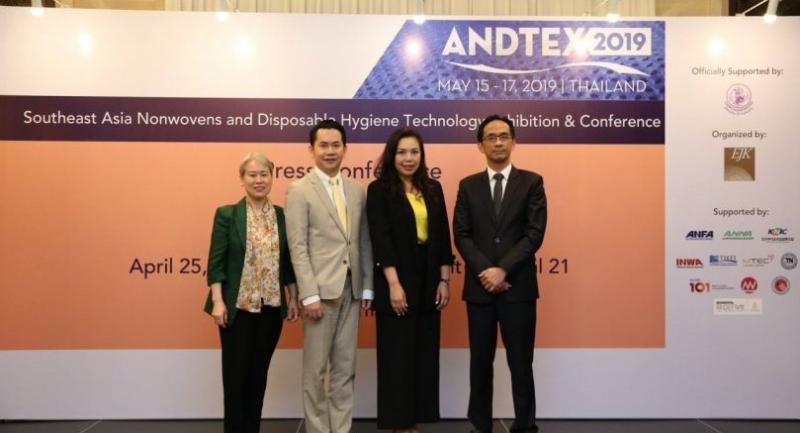
EJ Krause and Associates Inc, a worldwide leader in exhibitions and conference management, is set to organise “ANDTEX 2019” – an exhibition on non-woven and disposable hygiene technology – which will be joined by 200 exhibitors from 14 countries.

ANDTEX 2019 will be supported locally by the Industry Ministry, Thailand Convention & Exhibition Bureau, the Thailand Textile Institute, Thai Manmade Fibre Industries Association, National Metal and Materials Technology Centre, the Centre of Excellence in Textile and Chulalongkorn University.

The event will also get international support from Asia Non-woven Fabrics Association, All Nippon Non-wovens Associations, Korea Non-woven Industry Cooperative, Indonesian Non-wovens Association, Taiwan Non-wovens Fabrics Industry Association and Hong Kong Non-wovens Association.

The exhibition will be held from May 15 to 17 at the Bangkok International Trade and Exhibition Centre.

Myanmar economy to rebound

ศาสตร์เกษตรดินปุ๋ย : ขอบคุณแหล่งข้อมูล : หนังสือพิมพ์ The Nation

http://www.nationmultimedia.com/detail/Economy/30368309

Beck
Beck

Myanmar economy to rebound

Economy April 25, 2019 01:00

By KHINE KYAW
THE NATION
YANGON

DESPITE Myanmar’s economic growth having declined to 6.2 per cent last year from 6.8 per cent in 2017 , the nation remains resilient and is expected to return to growth of 6.5 per cent this year and 6.6 per cent next year, according to WB economists.

Andrew Mason, World Bank’s acting chief economist for East Asia and the Pacific, told a tele-press conference on Wednesday that the economic outlook for Myanmar would remain favourable, similar to other smaller economies in the region.

“Myanmar is facing some important challenges in terms of infrastructure investment, human capital and gaps in some of the basic services,” he said.

“This will require more government revenues. So, raising revenue and spending it better is an important piece of the puzzle.”

Mason also stressed the importance of improving the investment climate. He urged to reform the economy in a way to attract local and foreign investment. To him, strengthening the business environment will lead to productivity growth, which largely influences the nation’s economy.

He urged investment in human capital for long-term growth, and to invest more in basic things such as nutrition, health and education.

“That will be important for moving Myanmar from a lower-middle income economy over time to a more sophisticated upper-middle income economy,” he said.

According to Mason, another key driver of Myanmar’s growth would be the financing of infrastructure projects. He reinforced the importance of infrastructure and connectivity.

“This is something that is very important in Myanmar and other lower-middle income countries in the region. But the selection of projects is very, very important,” he said.

“We absolutely support further investment in infrastructure for creating more inclusive growth in Myanmar, but it is important to share benefits and to ensure these are high quality investments.”

Hans Anand Beck, lead economist at World Bank Myanmar, echoed Mason’s view.

He recommended transparent processes for licensing and opening to domestic and foreign investment.

“Carefully-managed process of liberalisation, like what we saw in the insurance and telecom sectors here, is critical,” he said.

Beck urged the government to promote domestic investment in practical services, and to remove some of the barriers to companies in trading. He recommended liberalisation in more sectors where the competition could bring down costs.

“For example, logistics service is an important area that should be further liberalised. But, some of the systematic changes that the government is making across the business environment would be helpful to the growth of all sectors,” he said.

Flexible rates

According to Beck, allowing flexibility in interest rates, removing cross-cutting barriers, collecting revenues and delivering basic services such as health, infrastructure and education, are keys to the sustainability of Myanmar’s growth. He pointed out the nation’s low income from taxation, compared to similar economies in the region.

“As the economy is growing, the GDP [gross domestic product] is also growing. Tax is not growing as fast as it should. So, there are many ways the government is reviewing the tax incentives system and looking at the exemption,” he said.

“On the spending side, moving money between spending items and sectors is really important. Myanmar has been moving money towards health and education but should be doing a bit more of that.”

Aside from the basic needs, Myanmar should spend more on the power sector, due to the rising demand for electricity over the next three to five years, Beck said. He urged more flexibility in budget allocation and to consider advancing procurements so that all contracts are ready to go as the budget is implemented.

Beck also called for empowerment and support of small and medium-sized enterprises.

“The government should help connect small and medium-sized enterprises to trade opportunities. Most of them are operating domestically, and their access to finance, skilled labour, and human capital investment is critical,” he said.

“In Myanmar, the government has put in place a range of positive moves. The things that caused downturns have now stabilised again as we have seen the stabilisation of the kyat and reduced inflationary pressures. It helps Myanmar to pick up again,” said the economist.

“Manufacturing and transport services for instance are improving, and telecom is one of them. We do understand that there is an increase in innovations among the telecom operators.

“They are also adding to their investments to ensure better services in a competitive environment. It may be an important contribution to [Myanmar’s] GDP.”

New transfer pricing rules head in the right direction

ศาสตร์เกษตรดินปุ๋ย : ขอบคุณแหล่งข้อมูล : หนังสือพิมพ์ The Nation

http://www.nationmultimedia.com/detail/Economy/30368310

x

New transfer pricing rules head in the right direction

Economy April 25, 2019 01:00

By SPECIAL TO THE NATION

IN OPEN markets, the “market price” is determined by external market forces as contracting parties aim to protect their best interests.

Common management control, however, hinders market forces from operating fully when related companies deal with each other. The price between related companies, the so-called “transfer price”, tends to deviate from the market price for the same transaction under the same situation.

This means it’s extremely difficult for multinational enterprises (MNEs) to pay the correct amount of tax, and/or for the Revenue Department to stop MNEs from manipulating their transfer prices to pay less tax. Clear rules are therefore needed for taxpayers and Revenue officers alike to follow.

The evolution of Thailand’s transfer pricing rules can be divided into three eras: pre-2002, 2002-2018, and post-2018.

Before 2002, general income tax provisions required that the transfer prices of MNEs must not be below the market price on the sales side and vice-versa on the purchase side. However, neither the definition of market price nor guidelines on how to compare transactions and situations under third-party dealings were provided.

This left too much room for interpretation. It led not only to conflicts between taxpayers and revenue officers, but also disparities in the definitions used among different Revenue officers. For instance, one officer may take the average of the prices, while another would use the most common price, to determine the market price.

The transfer pricing situation improved slightly in 2002 after transfer pricing guidelines, the Departmental Instruction Paw 113/2545 (Paw 113), were introduced to provide more clarity when determining transfer prices.

Paw 113 offered an internationally accepted “arm’s length principle” – where a transfer price must be set to equal the market price for the same transaction under the same situation. The definition of the market price, and guidance on determining if transactions were comparable, were also provided.

To prove their innocence, taxpayers could prepare a transfer pricing report containing information on the company, the industry, the functions it was responsible for, risks assumed and assets employed, along with one or more benchmarking studies.

We began to see more transfer pricing cases being resolved between taxpayers and the Revenue Department as a result. But the outdated income-tax law still restricted the arm’s length principle from being implemented properly. For example, the Revenue officer had the power to increase the selling price of a seller, but not to reduce the cost of goods sold by the buyer. The same profit was taxed twice.

On November 21, 2018, Thailand introduced specific transfer pricing provisions to unlock the restrictions imposed by the general income-tax provisions. Following the above example, the Revenue officer can now increase, as well as reduce, the transfer price to arrive at the arm’s length price. The same profit is only taxed once.

Also, the law makes mandatory the reporting of annual transfer pricing. This forces taxpayers to regularly review their transfer pricing practices, thereby helping to prevent taxpayers from manipulating their transfer prices. It also allows Revenue officers to monitor compliance more effectively and efficiently.

A clearer set of transfer pricing rules should separate those taxpayers trying to pay the correct tax amount from those avoiding tax. Meanwhile, the administration by Revenue officers should be more consistent than in the past.

Thailand is heading in the right direction on transfer pricing. But complying with the rules and documentation requirements can put heavy burdens on taxpayers. Let’s hope that the Revenue Department will be able to come up with guidelines that are as clear and practical as possible to allow taxpayers to comply efficiently with the regulations.

Contributed by PEERAPAT POSHYANONDA, partner and PANACHAI ANONTANUT, director, tax & legal services, PwC Thailand.

Politics hangs over growth view

ศาสตร์เกษตรดินปุ๋ย : ขอบคุณแหล่งข้อมูล : หนังสือพิมพ์ The Nation

http://www.nationmultimedia.com/detail/Economy/30368312

Politics hangs over growth view

Economy April 25, 2019 01:00

By WICHIT CHAITRONG
THE NATION

DELAYS to the formation of a new government could hurt the economy amid a global slowdown, warns the World Bank, which is projecting 3.8 per cent expansion in the country’s economy this year – down from the 4.1 per cent posted for 2018.

The multilateral lender estimates growth will edge up to 3.9 per cent next year.

Thailand’s growth rate is expected to be lower than regional average as expansion in developing East Asia and the Pacific is projected to soften to 6 per cent in 2019 and 2020, down from 6.3 per cent in 2018, the World Bank said in a report.

The world economy is expected to expand 2.7 and 2.8 per cent for this year and the next, respectively, decelerating from 3 per cent last year.

“Don’t pay much too much attention to Thailand’s slower growth compared with its peers in the Asia-Pacific region. The Thai economy has recovered over the past two years,” said Kiatipon Ariyapruchya, senior country economist for Thailand.

Still, the World Bank expressed concerns over the possibility of further delays in the formation of a new government after the inconclusive outcome of the general election in March, and these doubts might affect investment confidence.

The bank said that the near-term growth projections assume that the government will deliver on its planned public infrastructure projects, with the pace scheduled to accelerate in 2019 and pick up further in 2020 as those related to the Eastern Economic Corridor (EEC) are implemented.

Failure to implement the state-backed projects in a timely fashion or to increase the public investment disbursement rates pose the largest domestic risk to growth, according to the World Bank report, which was released yesterday.

“The political risk surrounding the long-awaited elections recently held on March 24 remains substantial,” the report said.

“The transition to a new government may take longer than expected, potentially affecting the continuity of government programmes and delaying public and private investment decisions.”

The bank warned that the global slowdown would affect the economies of Thailand and its neighbours. The softening growth in East Asia and the Pacific this year and the next largely reflects the global headwinds and a gradual policy-guided slowdown in China, said the report, titled Managing Headwinds, which is the bank’s April 2019 economic update for East Asia and the Pacific.

The World Bank said the region’s economies had weathered the financial-market volatility of 2018 relatively well, largely due to effective policy frameworks and strong fundamentals, including diversified economies, flexible exchange rates and solid policy buffers. Domestic demand remained strong in much of the region, it added.

Andrew Mason, the World Bank’s acting chief economist for the East Asian and Pacific region, warned of downside risks to growth due to further deceleration in advanced economies, the possibility of a faster-than-expected slowdown in China, and unresolved trade tensions.

Mason suggested that in the short term, countries will need to focus on managing global headwinds, including by strengthening buffers.

In the medium term, a renewed focus on structural reforms, including efforts to raise investment and boost human capital will be needed, he said. “To increase resilience to shocks and promote greater economic security, it will be important to continue strengthening social insurance and social assistance,” he said.

While China has been rebalancing its economy, shifting from export-led growth to domestic consumption-led growth, this creates both challenges and opportunities for Thailand and other countries, Mason said.

China is expected to import less intermediate goods in favour of more finished products, he added.

Don Nakornthab, senior director at the Bank of Thailand’s economic and policy department, said that the slowdown in global trade worried him the most. Thailand experienced a contraction of export growth in the first quarter this year, following a slowdown in the latter months of last year, said Don, referring to a 1.64 per cent drop in exports from January to March, compared with the year-earlier period.

“The export decline was more than the Bank of Thailand had expected,” he said. “Usually, it takes about 12 months before Thailand’s exports start to recover. So far, we have not yet reached half way.”

He also shared the World Bank’s concerns over a delay in the establishment of a new government. This may take place in June, but if it is delayed until September, it would affect the investment climate in the public and private sectors and consumer confidence.

PM calls for more domestic spending as ministry readies stimulus measures

ศาสตร์เกษตรดินปุ๋ย : ขอบคุณแหล่งข้อมูล : หนังสือพิมพ์ The Nation

http://www.nationmultimedia.com/detail/Economy/30368319

PM calls for more domestic spending as ministry readies stimulus measures

Economy April 25, 2019 01:00

By The Nation

3,886 Viewed

The government has yet to finalise details of its measures to stimulate the economy, including the plan to hand out Bt1,500 for people to travel to second-tier cities, Prime Minister Prayut Chan-o-cha said yesterday.

He said the government and related agencies were studying the plans and nothing has been concluded, adding that the authorities need to take many factors into account.

The PM also said people with spending capacity should spend, because if people stop spending, everything will ground to a halt, admitting that the government needed to introduce measures that would encourage domestic spending.

In a related matter, the Finance Ministry will reportedly propose economic stimulus measures worth over Bt22 billion on April 30.

Among the measures planned, about Bt 7 billion will be added to the state welfare cards for three specific groups. Of the three, parents will be given Bt500 per child for the purchase of school uniforms, learning tools, textbooks and sportswear; registered farmers will receive Bt1,000 each to buy fertiliser; while 100,000 registered disabled persons will be given an additional Bt200 to Bt300 per month from May to September.

The state already provides subsidies worth Bt600 to Bt800 per month through these cards.

The other two measures will involve tourism.

One project is to promote tourism in secondary cities, aiming to give 10 million people, aged 18 or older, Bt1,500 each to spend in secondary cities.

Those who register for this travel subsidy will first have to use a debit card in a government blue flag shop in any of the 55 secondary cities to prove their identities through an electronic data capture system.

Once their identities are proven, Krungthai Bank will transfer Bt1,500 to their bank accounts for spending. Another tourism promotion measure will be the extension of tax-deduction measures, which ended in December last year.

The measure will offer tax |deduction for spending of not more than Bt15,000 per person in both main and secondary cities nationwide.

The ministry also plans to offer a measure to prop up the property market by offering tax benefits to buyers, while another will be to reduce the tax on books throughout the year. As for business, the ministry will propose a tax deduction of 1.5 to 2 times the expense for shops using the point of sale system as a means to encourage shops to enter the electronic payment system.

Also, in order to promote the future workforce for Thailand’s 10 targeted industries, the ministry will also propose the setting up of a Student Loan Fund to fund students who want to study in these related fields.

TCEB working on long-haul contacts

ศาสตร์เกษตรดินปุ๋ย : ขอบคุณแหล่งข้อมูล : หนังสือพิมพ์ The Nation

http://www.nationmultimedia.com/detail/Economy/30368294

TCEB working on long-haul contacts

Economy April 24, 2019 16:17

By The Nation

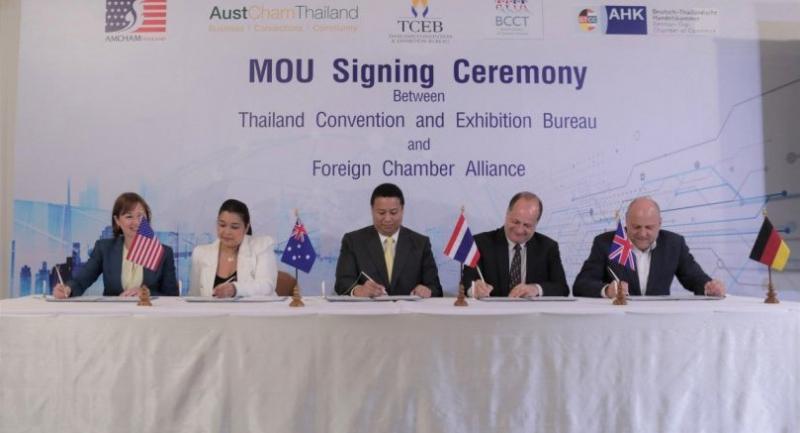
Thailand Convention and Exhibition Bureau (TCEB) is leveraging the development of the Thai MICE business in long haul markets in collaboration with foreign chambers of commerce representing Australia, UK, USA and Germany.

TCEB works to attract countries to hold events in Thailand through work with the Foreign Chamber Alliance (FCA).

​Chiruit Isarangkun na Ayuthaya, president of the TCEB, said: “The four chambers of commerce representing our main target countries, which are Australia, UK, USA and Germany, is considered another step of TCEB in altering our role to leverage MICE by serving as a business partner who joins hands with foreign organisations to promote the development of Thai MICE in international markets.

​“The FCA has more than 20,000 members that include business owners, investors, entrepreneurs from business, industrial and service sectors, such as Minor Hotels Group, AccorHotels Group, Marriott Hotels Group, convention centres business, as well as oil, mining, pharmaceutical, automobile and other industries.

“These are considered high potential business groups for the propelling of national economy and are included among the S-curve targeted industries that Thai government has eyed to encourage in line with the 4.0 policy. For this reason, this is a lucrative opportunity for us to collaborate to develop and raise the competitiveness of Thai MICE.”

Asia-Pacific economies to slow, Thailand’s growth rate lower than regional average: World Bank projection

ศาสตร์เกษตรดินปุ๋ย : ขอบคุณแหล่งข้อมูล : หนังสือพิมพ์ The Nation

http://www.nationmultimedia.com/detail/Economy/30368260

Asia-Pacific economies to slow, Thailand’s growth rate lower than regional average: World Bank projection

Economy April 24, 2019 10:59

By The Nation

5,342 Viewed

Economic growth in developing East Asia and the Pacific is projected to soften to 6 per cent in 2019 and 2020, down from 6.3 per cent in 2018, largely reflecting global headwinds and a gradual policy-guided slowdown in China, the World Bank said on Wednesday.

The Bank said that the region’s economies had weathered the financial-market volatility of 2018 relatively well largely due to effective policy frameworks and strong fundamentals, including diversified economies, flexible exchange rates and solid policy buffers. Domestic demand has remained strong in much of the region, it added.

Andrew Mason, World Bank acting chief economist for the East Asia and Pacific region, warned of downside risks to growth due to further deceleration in advanced economies, the possibility of a faster-than-expected slowdown in China, and unresolved trade tensions.

Thailand’s growth rate is expected to be slower than the regional average.

The Bank projected Thailand’s economic growth rate at 3.8 per cent this year and 3.9 per cent next year, down slightly from 4.1 per cent in 2018.

New orders push up industry confidence

ศาสตร์เกษตรดินปุ๋ย : ขอบคุณแหล่งข้อมูล : หนังสือพิมพ์ The Nation

http://www.nationmultimedia.com/detail/Economy/30368207

New orders push up industry confidence

Breaking News April 24, 2019 01:00

By The Nation

11,151 Viewed

The industry confidence index in March rose to 96.3 from 95.6 in February, thanks to a rise in the value of new orders in auto, construction, printing and food sectors, the Federation of Thai Industries chairman, Supant Mongkolsuthree, said yesterday.

The survey covered 1,207 firms from a combined 45 industries nationwide.

This is the third month showing a rise in the confidence index, reflecting increasing domestic consumption after a promotion campaign by producers that boosted production orders in auto, construction, printing and food sectors. Most producers also speeded up production before the long weekend in April this year.

However, most industry owners have continuing concerns about the country’s politics after the election, amid uncertainty over who will form

 the government.

“Most of them need to know when we will have the new government from the election in this period of slower global economic growth, as they also want to know about the policy to drive the country’s economic growth. If we have a

new government as soon as possible, that will boost the country’s economic growth,” Supant said.

With the political uncertainty, the industry confidence index for the next three months, which was forecast in March this year, was down to 104.2 from the 105.4 forecast in February this year. Most industries are concerned about the country’s politics, the dip in the global economy and the trend to increased minimum wages.

Meanwhile, March this year showed record high car production, achieving 198,821 units, which is the highest in 68 months. About 52.23 per cent of total March production, or 103,838 units, were for export, with the remaining 94,983 units or about 47.77 per cent, for the domestic market.

The export volume recorded 117,708 units, the highest in 18 months, up 8.5 per cent, or 103,164 units from the same month last year.

The value of Thailand’s food exports in the first quarter this year was Bt275.119 billion, up 0.47 per cent annually in baht terms, or US$8.708 billion, up 0.92 per cent annually in US dollar terms.

The value last year was Bt1.148 trillion, up 1.43 per cent annually or $35.822 billion, up 7.05 per cent annually, according to yesterday’s release from Federation of Thai Industries.

The country’s food exports since 2015 through last year had risen every year with an average annual growth rate of 3 per cent.

MOU SIGNING SET, Shenzhen bourse help boost Thai, Chinese SMEs

ศาสตร์เกษตรดินปุ๋ย : ขอบคุณแหล่งข้อมูล : หนังสือพิมพ์ The Nation

http://www.nationmultimedia.com/detail/Economy/30368212

MOU SIGNING  SET, Shenzhen bourse help  boost Thai, Chinese SMEs

Economy April 24, 2019 01:00

By The Nation

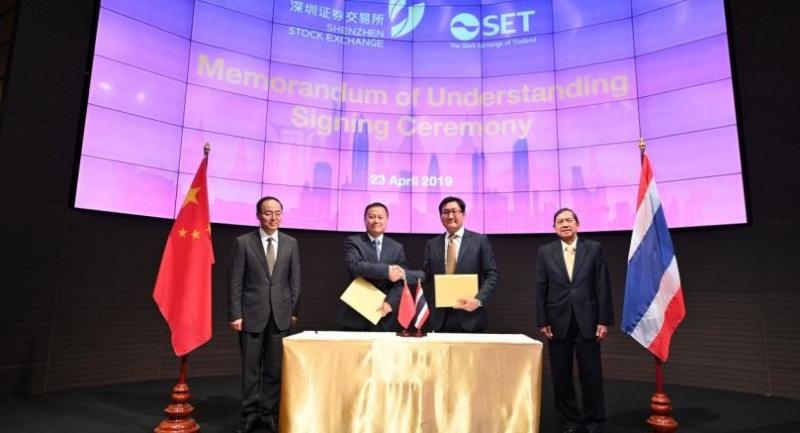
The Stock Exchange of Thailand (SET) yesterday signed a memorandum of understanding (MoU) with Shenzhen Stock Exchange (SZSE) to expand business opportunities for Thai and Chinese small and medium-sized enterprises (SMEs) and broaden opportunities in investment as well as promoting cross-border collaboration among the two countries.

 SET president Pakorn Peetathawatchai said that under this memorandum, SET and SZSE will provide information on SMEs as well as financial markets of the two countries via an online portal; enhance the “ChiNext-mai Alliance” network which aims to facilitate the communication and cooperation between companies listed on Market for Alternative Investment (MAI) and ChiNext Market; and arrange business matchings and physical roadshows to promote Thai and Chinese securities’ growth potential in both countries.

The agreement also embraces cooperation for cross-border product development such as exchange-traded funds (ETFs), depositary receipts (DRs), and indices including green finance products, among others.