European leaders and scientists warned Friday that the omicron variant could become dominant in some countries startlingly soon, overtaking the delta variant, which has remained the most common version of the virus globally for months.
“We expect it to overtake delta within days, not weeks,” Nicola Sturgeon, the first minister of Scotland, said Friday about the spread of omicron there.
That echoes the latest update from the U.K. Health Security Agency, which has high confidence that omicron has a growth advantage over delta and estimates that, spreading at its current rate, it will become dominant in Britain by mid-December, with more than a million infections by the end of the month.
In Denmark, too, omicron on its current trajectory could become dominant by “the end of next week,” said Mads Albertsen, a professor at Aalborg University.
The sense is that Britain and Denmark aren’t standouts. Rather, they are tracking and modeling the spread especially carefully, and what they’re reporting may reflect what’s emerging elsewhere in Europe. And since so often during the pandemic Europe has served as a preview of what’s to come in the United States, U.S. officials are watching closely, as well.
Epidemiologists already know omicron has spread rapidly in South Africa – the earliest sample of the variant identified there was from the first week of November, and it was dominant within a month.
But South Africa had fairly low levels of the coronavirus when omicron emerged, meaning it didn’t take much for the new variant to prevail. Also, only a quarter of people in South Africa have been fully vaccinated. Europe offers a truer test of whether omicron can beat out delta in places where the majority of people are vaccinated.
“The speed of it is surprising,” said Linda Bauld, a professor at the University of Edinburgh. “If it can overcome delta in Scotland and the U.K., then it will do elsewhere.”
Key questions remain open, including about the severity of illness it causes and the extent to which extent vaccines will continue to provide protection.
WHO Director General Tedros Adhanom Ghebreyesus warned against drawing “firm conclusions” at this point.
Anthony S. Fauci, America’s top infectious-disease expert, said earlier this week that, based on preliminary data, the omicron variant may cause less severe illness than earlier variants of the virus.
But many countries in Europe aren’t waiting to find out more. They have been reintroducing or adopting a range of control measures – from travel restrictions and mask requirements to limited lockdowns and vaccine mandates.
Some experts worry that even if the variant causes less severe illness, its rapid growth may overburden hospitals that were already strained by the continent’s latest wave of delta cases.
“While hopeful, we are not certain any reduction [in the severity of illness] would be enough to keep the total number of hospitalizations from going up substantially – beyond our capacity to absorb them,” Rowland Kao, a University of Edinburgh professor, told the Science Media Center.
Neil Ferguson, an epidemiologist at Imperial College London whose models have shaped government policy in Britain and the United States, told the Guardian that the omicron variant “could very substantially overwhelm the NHS, getting up to peak levels of admissions of 10,000 people per day.”
Sturgeon warned of a “potential tsunami of infections” and urged Scots to defer their Christmas parties.
The suspected proportion of omicron among all coronavirus infections in Scotland surged from 2% Sunday to more than 15% Friday, suggesting that cases are doubling every two to three days.
“What we are seeing in the data just now is perhaps the fastest exponential growth that we have seen in this pandemic so far,” Sturgeon said.
Albertson in Denmark said that new restrictions announced Wednesday – which include longer school vacations over Christmas and nightlife curbs – could delay, slightly, the point omicron surpasses delta there.
“It will come very fast in most countries now,” he said.
Though Europe has gone much further than the United States in imposing new restrictions in recent weeks, European governments have sought to avoid measures as rigid or as wide-ranging as last winter.
Bauld, the University of Edinburgh professor, said restrictions are important to give more people time to receive their booster shots and to avoid hospitals being overwhelmed.
Despite uncertainty over how much omicron reduces vaccine effectiveness, Bauld said her advice remains unchanged: “Anybody who’s had any vaccines is hugely better off than people who have had no vaccines.”
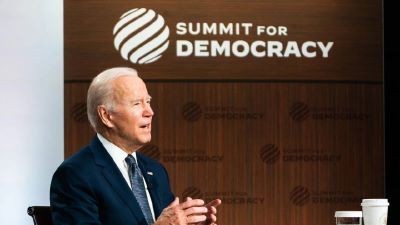
WASHINGTON – For two days last week, President Joe Biden gathered, virtually, representatives of more than 100 countries for what was billed as a “Summit for Democracy.” The goal was to rally nations in the face of rising authoritarianism around the world. “Democracy needs champions,” the president said.
The administration, seeking to show global leadership, released a list of initiatives designed to strengthen and encourage democracies overseas – efforts to strengthen a free press, to fight corruption, to support democratic reformers, to defend free and fair elections.
The summit drew some criticism, in part for who was and who wasn’t invited. But the most persistent questions focused on whether the United States, at a time when democracy is threatened at home, could stand as a beacon for the rest of the world in this most important undertaking.
“One of the ironies here is it’s never been more important that the United States lead the world in promoting democracy,” said Nathaniel Persily, a professor at Stanford University Law School. “But it’s also the case that the United States is more hobbled in its capacity to do so. It’s difficult to say, ‘Be more like us’ in the wake of the Jan. 6 insurrection.”
Freedom House does annual surveys of nations around the world, measuring the health of democracy country by country. Over the past decade, the United States’ score, on a scale of 0 to 100 has gone from 94 to 83 and now ranks 53rd globally in the state of its democracy.
“Compared to many other countries, we’re doing pretty well still,” said Michael J. Abramowitz, president of Freedom House. He cited a robust U.S. media and strong protections for the media, along with a strong rule of law and an independent judiciary. “But we have been declining,” he said.
The nation is deeply divided and those divisions have affected the state of democratic institutions. In an era of polarized voting and the drop in ticket-splitting, Republicans enjoy structural advantages in the Senate and the electoral college. Increasingly, the majority of the population can be ruled by a minority of the population.
The number of competitive House districts shrinks with every decennial redistricting, thanks to gerrymandering and the geographic sorting of the population, often leaving it to the political wings of the two parties to pick their House members and to set the tone and agendas.
The executive branch is ill-prepared for many crises, anticipated or not, as the coronavirus pandemic has shown. It is further constrained by a personnel process, in conjunction with the Senate’s role confirmation responsibilities, that has left this and other administrations with gaping holes in departments and agencies well in a president’s term.
The Supreme Court is in danger of being seen as reflective of the country’s political divisions rather than independent of them, to the point that there is more talk than ever on the left about whether changes should be made to its structure.
Biden was able to offer the democracy summit little in the way of concrete reassurances for repairing America’s democratic institutions. With Republicans implacably opposed, Biden’s support for a Democratic-sponsored national voting rights bill is stuck in the Senate, unable to move forward unless there is a change in the filibuster rules, which isn’t likely anytime soon. In the states, Republican-controlled legislatures have enacted restrictions on voting laws.
“It’s true that the administration can’t deliver on its own the things that need to be done to fix U.S. democracy,” Abramowitz said. “So the inability to agree across the political aisles makes it hard for Biden to propose new things the U.S. can do. He is handicapped by the inherent gridlock and polarization in our country, and he’s been unable to break that.”
Does that negate the value of a democracy summit? No, said Timothy Snyder, a Yale University historian. “I personally think there’s tremendous value in it,” he said. “It’s important to name democracy as an aspiration. We’ve spent too long imagining that democracy is the normal state of affairs, that democracy is something everybody wants.”
The Russians, he said, present democracy as a joke. The Chinese present it as a mess. Both U.S. adversaries are effective in undermining a system of government that too often is taken for granted. “My basic background point is that democracy is always a struggle,” Snyder added. “It’s never the status quo. The idea that the people should rule is always a radical idea and one you have to make sacrifices for or it will erode.”
In Snyder’s view, the United States should not shrink from acknowledging that its democracy is imperfect, or that it can learn from others. “The approach should not be democracy promotion but the approach should be every teacher is a student,” he said. “. . . The people who are against democracy have been cooperating quite well, learning from one another. But the people who are for democracy are behind on this.”
Here in the United States, threats to the integrity of the electoral process are growing, as a recent article in the Atlantic highlighted. Former president Donald Trump continues to falsely claim the 2020 election was rigged and stolen. He badgers Republicans to do something, and Republican legislators in some key states have responded by seeking to make it easier, if there is a repeat of the 2020 results, to turn the administration of elections over to partisan politicians and to make it possible to challenge the certification of results and potentially overturn the next election.
To Snyder and others, the clear and present danger is the prospect that Trump could lose the popular vote in 2024 by an even bigger margin than in 2020, lose in the electoral college and yet still be installed as president. “If we just kind of let this keep rolling downhill and following gravity, the most likely thing is the guy who loses will be installed,” he said. “If we don’t name the risk, we’re going to make [that outcome] much more likely.”
Persily noted that roughly a third of the population believes that the last election was marred by fraud and that Biden is therefore an illegitimate president. But he speculated that it is possible that in a year, if Democrats lose the House, the Senate or both, many of their voters will see voter suppression as the principal reason.
“It is extremely difficult to build trust in political institutions,” Persily said. “Once you lose it, there are very few examples of building it back. We are at a critical period right now where the population is losing confidence in the basic fairness of the election infrastructure. Unless leaders stop sending signals that the process is rigged, we’re going to be in this situation for a long time.”
Many Americans spend little time thinking or worrying about issues of democracy. Some see these kinds of warnings as alarmist or question the credibility of those who sound them. After all, Trump tried to overturn the election and failed, though not before an attack on the Capitol by a Trump-inspired mob.
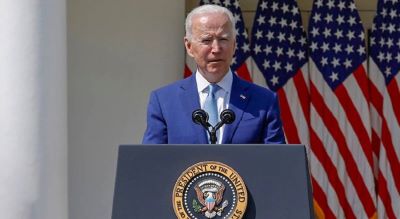
Given the former president’s relentless campaign of untruths and his seeming desire to run in 2024, there’s no guarantee that the system will hold the next time around. As Biden put it when opening the democracy summit, “Here in the United States, we know as well as anyone that renewing our democracy and strengthening our democratic institutions requires constant effort.”
MAYFIELD, Ky. – A desperate search and rescue operation unfolded Saturday across six states mauled the previous evening by rare late-season tornadoes that may have left more than 70 people dead.
More than 30 separate tornadoes moved with devastating power and speed through an area stretching from Mississippi in the south to Illinois in the north.As they swept through the region over several hours, the twisters killed dozens, including workers in a candle factory in a flattened Kentucky town, lakeside vacationers in Tennessee and a nursing home resident in Arkansas.
While the stream of tornadoes battered dozens of communities, none suffered morethan this town of about 10,000 people in southwestern Kentucky, not far from a sweeping bend in the Mississippi River marking the border with Missouri. As the wind stiffened into the high 70 mph range, some employees stuck in the disintegrating Mayfield Consumer Products candle factory took to Facebook to make a video plea for help.
“This has been the most devastating tornado event in our state’s history,” Kentucky Gov. Andy Beshear, D, told reporters Saturday at a late-morning news conference, calling the scale of damage “indescribable.”
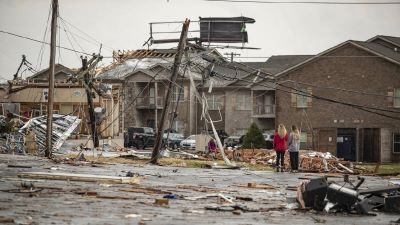
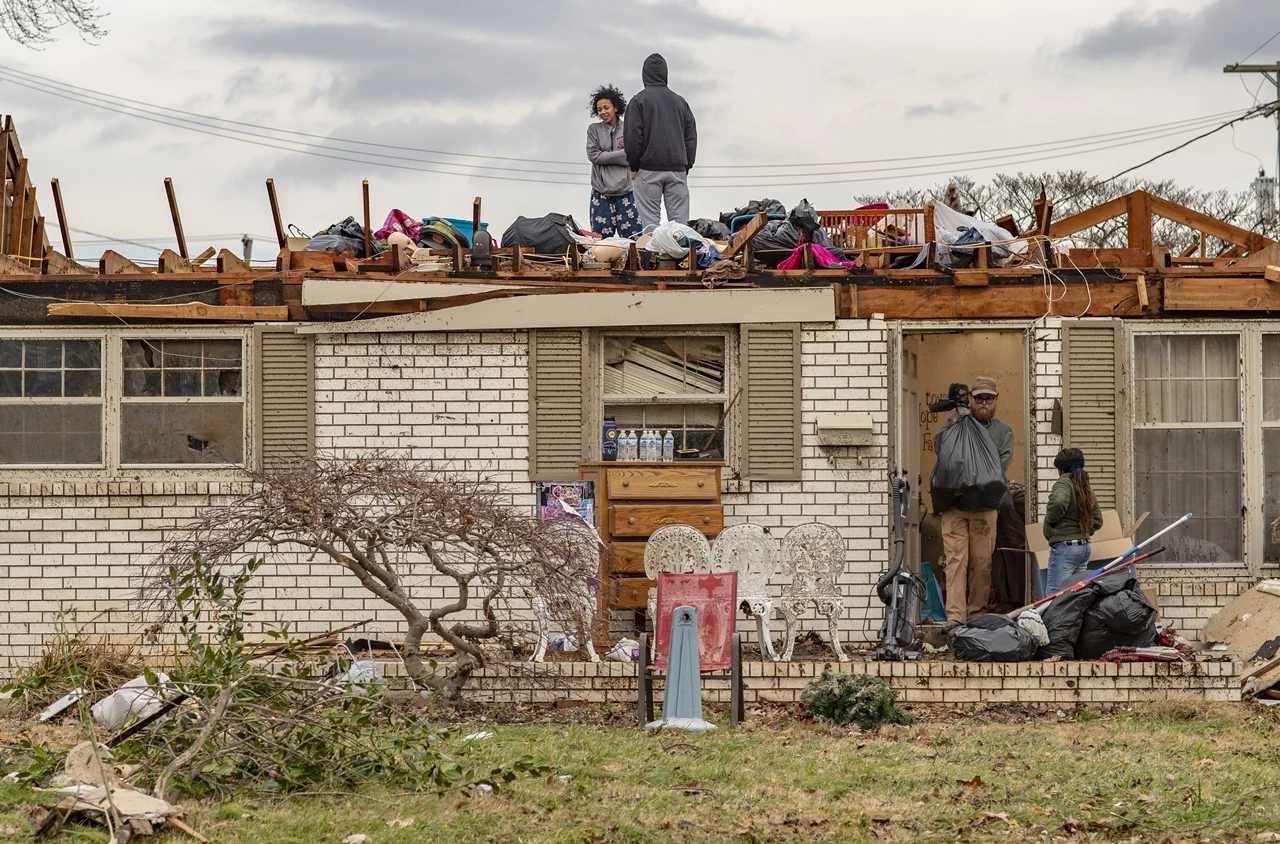
“The level of devastation is unlike anything I’ve ever seen,” he continued. “You see parts of industrial buildings’ roofs or sidings in trees, if trees are lucky enough to stand. Huge metal poles bent in half, if not broken. Buildings that are no longer there. Huge trucks that have been picked up and thrown. And sadly, far too many homes that people were likely in, entirely devastated.”
Beshear spoke with President Joe Biden early Saturday to outline the scope of the damage and the federal assistance necessary to help speed the recovery. Biden later declared a federal emergency for Kentucky, freeing up FEMA assistance and federally subsidized aid, calling the tornado “an unimaginable tragedy.”
The tornadoes that swept through parts of the Midwest and Tennessee River Valley on Friday night and into early Saturday likely may be recorded as the worst on record in the United States during December. Peak tornado season in the region is usually late spring through early summer.
The tornadoes were triggered by a powerful low-pressure system, which lifted from the Southern Great Plains into the Great Lakes. The low-pressure intensified as the polar jet stream, the high-altitude current along which storms track, plunged into the central United States ahead of a blast of record-setting warm air.
The unusual combination – the polar cold meeting the unseasonably hot – created unstable air over Arkansas Friday evening that generated numerous thunderstorms. Those rotating storm systems eventually evolved into tornadoes.
The National Weather Service received 37 reports of tornadoes on Friday in six states. The most destructive tornado, or series of tornadoes, carved an approximately 250-mile path through northeast Arkansas, southeast Missouri, northwest Tennessee and into western Kentucky.
“Last night was one of the most shocking weather events in my 40 years as a meteorologist – a violent tornado (in December!) drawing comparisons to the deadliest and longest-tracking tornado in U.S. history,” tweeted Jeff Masters, a meteorologist and expert on extreme weather.
The longest paths on record top 200 miles – but with some caveats. A 235-mile track in March 1953 is the modern record, according to data from the Storm Prediction Center. Since none of these tornadoes have occurred since 1971, it is possible they were actually tornado “families,” rather than a single sustained event.
The 219-mile-long Tri-State Tornado of March 1925 is widely considered to be the longest tornado path. The deadliest tornado in U.S. history, that tornado killed 695 people as it rumbled through Missouri, Illinois and Indiana in the dark of night.
This event’s path could exceed that in length. But Rick Smith, a meteorologist at the Weather Service office in Norman, Okla., tweeted that the quad-state tornado was more likely multiple twisters rather than just one. On-the-ground surveys to sort this out may be “a complex process that could take some time,” Smith wrote.
Kentucky authorities on Saturday were unable to say how many people had died at the candle factory because rescue operations were still underway. But Beshear said about 40 people were rescued from the facility and that about 110 were believed to have been inside at the time.
Authorities described massive damage to the plant, and dangerous conditions – including toppled metal drums leaking corrosive chemicals – that complicated rescue efforts.
“We had to at times crawl over casualties to get to victims” who were still alive, Mayfield Fire Chief Jeremy Creason told reporters. As first responders worked throughout the night to reach people amid the debris, Creason said, there was also “a steady flow of walking wounded” in addition to rescues.
Mayfield officials said both the city’s main fire station and police station were in the direct path of the tornado on Friday, and they had to extricate first responders from the destroyed stations before they could move to rescue other tornado victims.
Beshear said the casualties from the storm’s path will likely span about 10 counties. While Mayfield was severely hit, state officials said Dawson Springs, about 70 miles to the northeast, was also devastated.
Ryan Mitchum is usually the one standing outside on the porch to watch storms roll into western Kentucky. This time, though, he knew something awful was on its way.
For days, communities along the Kentucky-Tennessee border were warned that strong tornadoes were possible. A local news channel pleaded with residents to take the forecast seriously. ” ‘Don’t take this as a joke,’ they told us,” Mitchum said.
Mitchum hunkered down with his girlfriend in their hallway. But a gust shook the house so violently that the couple moved into a closet. The house, about a 10-minute drive from Mayfield, swayed but survived the storm.
On Saturday morning, Mitchum drove through his hometown, stunned by its ruins.
“It was like a movie scene,” he said. “I don’t think anybody expected it to be as bad as it was.”
Mitchum recorded his tour from his truck as he drove through debris-laden streets and what was the historic downtown.
“Mayfield’s wiped,” he said.
Cars and trucks had been launched into fields. His great-grandparents’ home was flattened. Their donkey was killed.
The downtown buildings left standing had their windows completely blown out and their window-frames left dangling. Businesses were destroyed, he said, and there was nothing left of a lower-income community behind the town’s main boulevard.
“Mayfield needs some prayers,” he said in the video. Mitchum’s Facebook video was shared widely, and his phone was flooded with messages from people sending addresses, asking for help to check on loved ones.
In Edwardsville, Ill., one tornado caved in part of an Amazon distribution warehouse, leaving people inside stranded and at least two dead, authorities said.
About a dozen agencies responded to the scene, about 20 miles northeast of St. Louis. Excavators and rescuers were seen entering the site early Saturday morning.
The Edwardsville Fire Department confirmed at least two fatalities. “One individual was transported by air medical from the scene,” said a fire department official, who spoke on the condition of anonymity because they were not authorized to comment on the operation.
“It’s obviously a large area to try to clear,” the official said, adding that about 30 people were transported by bus from the scene.
Clayton Cope, a 29-year-old maintenance worker known for his kindness, was one of the people killed inside the Amazon warehouse. Tributes honoring Cope flooded across social media, with his loved ones reminiscing about his fun personality.
In one post, Rachel Cope, his sister, described him as her “biggest idol” and recounted the times when the two siblings would search for Christmas presents to ruin their surprises and annoyed each other “till we couldn’t stand it.”
“He’s the reason I’m into video games and anything that I enjoy because I just wanted to be like him,” his sister wrote on Facebook. “I loved him and looked up to him so much, and I genuinely don’t know what I’ll do without him.”
Around 40 workers at the Amazon warehouse were briefly sent to a Pontoon Beach Police Department office, which was being used as a gathering and recovery point, said Rich Schardan, a department assistant chief. None required medical care. People were given access to chaplains, food and drink.
“Our thoughts, prayers, and deepest sympathies are with the victims, their loved ones, and everyone impacted,” said Amazon spokesman Richard Rocha in a statement, adding that the company was assessing the situation. “This is a devastating tragedy for our Amazon family and our focus is on supporting our employees and partners.”
(Amazon founder Jeff Bezos owns The Washington Post.)
In Arkansas, Gov. Asa Hutchinson, R, arrived Saturday morning to the shredded ruins of a nursing home in the town of Monette, where one of the state’s two tornado deaths occurred.
Hutchinson and other state officials stepped over rubble strewn with pink insulation, which had been ripped from the walls by the storm.
“It’s total destruction,” Hutchinson told reporters. “Makes you grateful there wasn’t a greater loss of life.”
Shortly before 9 p.m. Friday, the roof of the 86-bed nursing home collapsed, trapping scores of residents inside. One person was found dead and five were injured.
Survivors were evacuated to a local school as active storms remained in the area, said Rachel Bunch, executive director of the Arkansas Health Care Association.
Hutchinson and other officials touring the damage by helicopter said the use of warning sirens helped lessen the loss of life, alerting towns and communities 15 to 25 minutes before the tornado struck.
Hutchinson said about 20,000 Arkansas residents remain without power. He told reporters that he planned to travel next to the town of Leachville, where a second fatality occurred at a Dollar General store.
“We may have to do a lot of debris removal. We have a lot of homes that have been significantly damaged, if not totally destroyed,” he said.
Bob Blankenship, the mayor of Monette, told reporters the tornado was the most powerful to strike the town since 1984.
At least three people were killed in Tennessee after a tornado swept through the state, according to emergency officials in Lake and Obion counties, where search and rescue operations are underway.
Two died at Cypress Point, a collection of cabins that people use for weekend getaways on the banks of Reelfoot Lake, said Jack Mauldin, director of the Lake County Emergency Management Agency. A third adult is missing in Lake County.
Mauldin said Tiptonville, the county seat, was largely undamaged as the tornado wove along its outer edge toward the lake.
“It just destroyed whatever it touched,” Mauldin said. “There was only one tornado here, but it was on the ground an awfully long time.”
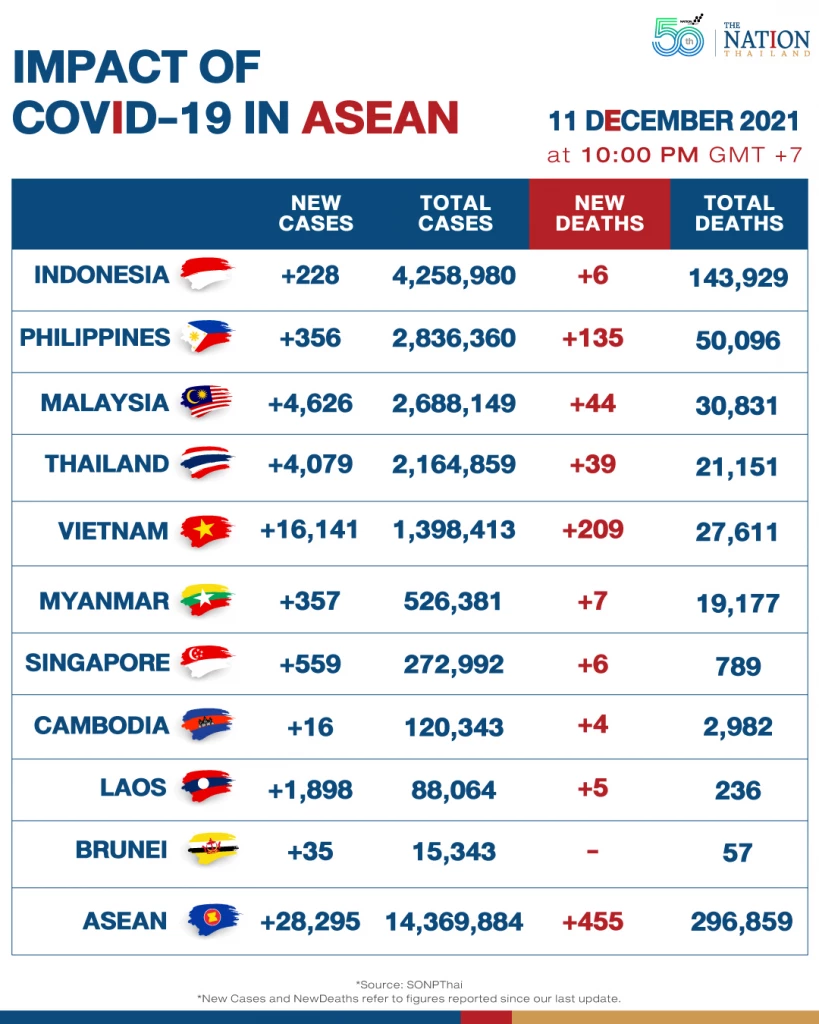
The number of Covid-19 cases crossed 14.36 million across Southeast Asia, with 28,295 new cases reported on Saturday (December 11). New deaths are at 455, bringing accumulated Covid-19 deaths in Asean to 296,859.
Supplies of AstraZeneca’s antibody drug for the treatment of Covid-19 are expected to arrive by the end of the year, after Singapore signed a new purchase agreement with the drugmaker.
Known as Evusheld, the drug cocktail is a combination of two “long” antibodies – which take longer to metabolise in the body and can provide longer-lasting protection for up to a year, compared with monoclonal antibodies.
A total of 298 new Covid-19 Variants of Concern (VOC) cases were reported between November 19 and December 8 this year, says Malaysian Health Ministry.
Its director-general Tan Sri Dr Noor Hisham Abdullah in the ministry’s daily Covid-19 update on Saturday (December 11) said the variants comprise Delta (B.1.617.2), Beta (B.1.1351), and one case of Omicron (B.1.1.529).
The Biden administration on Friday banned U.S. investment in a Chinese company that it said supports Chinas use of repressive surveillance technology, calling the move part of a broad effort to unite democracies against authoritarian states.
The sanction adds the facial recognition company SenseTime to a list of 59 Chinese companies in which U.S. citizens and entities are prohibited from investing. The Biden administration widened that list this summer to include firms that it said support China’s military and state surveillance, building on a Trump administration effort.
The administration announced the move alongside new sanctions on individuals it said were responsible for repression and human rights abuses in Bangladesh, Myanmar and North Korea. It also announced a partnership with other democracies to tighten export controls on technology that can be used for repression.
The measures “send a message that democracies around the world will act against those who abuse the power of the state to inflict suffering and repression,” Deputy Secretary of the Treasury Wally Adeyemo said in a statement.
The Treasury Department, which oversees the investment prohibition list, said SenseTime “has developed facial recognition programs that can determine a target’s ethnicity, with a particular focus on identifying ethnic Uyghurs,” a persecuted Muslim minority population in China.
It added that China has used digital surveillance technology to track Uyghurs’ movements and activities and to “create a police state in the Xinjiang region.”
Scholars estimate that Chinese authorities have detained more than 1 million Uyghurs in centers and reeducation camps for periods ranging from weeks to years. The United States has labeled the campaign a genocide. The United Kingdom pressed China in January to allow United Nations rights inspectors to visit the region, while the European Parliament has condemned China for using forced labor in Xinjiang.
The sanction against SenseTime will complicate the company’s preparations to list its shares on the Hong Kong Stock Exchange through an initial public offering. SenseTime didn’t immediately respond to a request for comment.
SenseTime is one of China’s largest artificial intelligence companies, pairing cameras and software algorithms for uses that include identity verification and monitoring whether a driver is drowsy or distracted.
The Trump administration began raising alarms about the company in 2019, adding it to an export blacklist for what the administration called its support of China’s high-tech surveillance of Uyghurs and other minority groups in Xinjiang.
That blacklist, called the Entity List, requires U.S. companies to receive a government license before exporting technology to the targeted companies.
The new sanction adds SenseTime to the separate Chinese Military-Industrial Complex Companies List, which prohibits U.S. individuals from buying or selling any publicly traded securities in the companies. Existing investors have one year to divest after a company is placed on the list.
In 2018, several U.S. venture-capital funds invested in SenseTime, including Tiger Global Management and Glade Brook Capital Partners, according to market data provider Pitchbook. Those investors didn’t immediately respond to requests to comment Friday.
SenseTime joins two other Chinese companies already included on the prohibited investment list for allegedly aiding repressive state surveillance – Hangzhou Hikvision Digital Technology and Huawei Technologies.
The Washington Post last year reported that Huawei had tested facial recognition software that could send automated “Uyghur alarms” to government authorities when camera systems identified members of the oppressed minority group. Huawei at the time said the work was “simply a test and it has not seen real-world application.”
Cameras made by Hikvision have been deployed throughout Xinjiang to monitor Uyghurs in internment camps, according to the Uyghur Human Rights Project, an advocacy group in Washington, D.C.
The Treasury Department also added two officials from the Xinjiang region — Shohrat Zakir and Erken Tuniyaz — to a sanctions list for their role in “serious human rights abuse.” Zakir was chairman of the Xinjiang Uyghur Autonomous Region until 2021; Tuniyaz now serves as the acting chairman.
“During their tenures, more than one million Uyghurs and members of other predominantly Muslim ethnic minority groups have been detained in Xinjiang,” the Treasury Department said.
The Biden administration on Friday was wrapping up a two-day “Summit for Democracy,” a virtual gathering aimed at rallying the democracies of the world against the forces of authoritarianism.
As the summit came to a close, the White House said the United States and seven allied democracies have agreed to develop a voluntary, nonbinding code of conduct “to use export control tools to prevent the proliferation of software and other technologies used to enable serious human rights abuses.”
The other participating countries are Australia, Denmark, Norway, Canada, France, the Netherlands and the United Kingdom, according to a brief statement announcing the agreement.
The second-largest school district in the United States is facing mounting woes over its coronavirus vaccine mandate, recently terminating hundreds of employees who refused to comply and vowing to put thousands of students into online classes.
Board members of Los Angeles Unified School District – which has one of the strictest vaccine mandates in the nation – voted Tuesday to terminate 496 employees who failed to get vaccinated ahead of the deadline.
“We care deeply about all of our employees,” interim superintendent Megan Reilly said in a statement following the board’s decision. “Parting ways with individuals who choose not to be vaccinated is an extremely difficult, but necessary decision to ensure the safety of all in our school communities.”
In addition, some 34,000 students are also in violation of the requirements, according to the Los Angeles Times. Per the district’s vaccination policy, students 12 and older must be fully vaccinated – or receive an exemption – by the start of the second semester in January. Those who fail to do so will not be allowed on school campuses and will be referred to an online independent study program.
President Joe Biden has called on state governors to impose coronavirus vaccine mandates for all teachers and staffers, as school districts across the country – as well as many colleges and universities – have been requiring the shots in an effort to slow virus spread.
Such requirements are established at the state level. Oregon, Puerto Rico, Washington state and D.C. are requiring teachers to get vaccinated, and several other states are requiring teachers to get the shots or undergo routine testing. However, in most states, these requirements are now being decided at the local level.
In early September, Los Angeles became the largest school district to take things a step further, requiring the vaccine for eligible students. Many are looking to what happens in Los Angeles as a potential indicator of what is to come in other districts across the United States as the nation continues to try and dig out of the pandemic.
Michael Petrilli, president of the Thomas B. Fordham Institute, a conservative education think tank, said if there is significant pushback from employees or students, other districts may pump the brakes on their own vaccine mandates.
At a school board meeting on Tuesday, parents and students spoke out against the vaccine mandate and the alternative for those who are unvaccinated – remote learning.
“Students have the choice of vaccinating or being removed from their friends, robotics classes, sports teams, clubs, plays, other extracurriculars and their magnet programs,” one parent told board members. “This is coercion.”
One student said she works hard in school but does not like learning online “and it hurts to hear that I won’t be here to finish my next three years in high school like regular students.”
School board members could not immediately be reached for comment on the mandate.
Experts say, as an incentive, the school district’s vaccine program appears to be working. Nearly 99% of employees and 85% of students 12 and older have been vaccinated, the district said. But, education observers note, it’s complicated balancing the need to protect the health of students while also protecting their education.
If Los Angeles follows through with forcing unvaccinated students into online learning, they may suffer, Petrilli said. “There’s too much focus on covid and not as much on academic achievement,” he said.
Emerging research has shown that throughout the pandemic, the less in-person instruction students had, the worse the students performed academically, said Robin Lake, director of the Center on Reinventing Public Education, a nonpartisan research and policy group. She said this was particularly true of lower-income students and students of color, who tended to remain in virtual classes longer than their peers because schools in urban areas often stayed closed longer.
“The bottom line is that the kids who are already more likely to be behind academically fell further behind during the pandemic, in part because they were in virtual learning longer than other kids,” Lake said.
However, Lake said, that was not always the case. She said there are some examples of school districts that offered high-quality virtual instruction early on in the pandemic and some students thrived in that environment. In addition, she said, some school districts offered in-person instruction in small groups with tutors or aides to ensure that the students were learning the material while also containing potential outbreaks of covid-19.
In situations in which students are learning online, Lake said, “we owe them really, really high-quality virtual instruction.”
But Petrilli said that might be “wishful thinking,” arguing that while online learning technology shows promise for the future, it may never been sufficient for the typical student, much less a lower-performing one who needs special attention.
“I think we have to be worried that kids who are told they can’t come to school will get the education they need to succeed,” Petrilli added.
The Los Angeles Board of Education on Thursday named Alberto Carvalho as the new superintendent in Los Angeles. Carvalho was the former superintendent in Miami-Dade, where he has sparred with Florida Gov. Ron DeSantis, R, over mask mandates in schools – with DeSantis banning such requirements and Carvalho standing firm that masks protect students and teachers.
Following Thursday’s announcement, LAUSD board president Kelly Gonez said in a statement that he “brings the deep experience we need as an educator and leader of a large urban district to manage L.A. Unified’s ongoing response to and recovery from the COVID-19 pandemic.”
Coronavirus cases, driven almost entirely by the delta variant, continue to surge across the United States, defying previous patterns, causing military medical backup to be called into action and creating large case loads in some highly vaccinated states.
Cases in Colorado rose by 4% in the past week, according to a Washington Post analysis. Hospitalizations in Michigan and New Mexico jumped by 4% and 9%, respectively. Michigan has more hospitalizations per 100,000 residents than any other state. And in New York, where hospitalizations have shot up by more than a third since Thanksgiving, Gov. Kathy Hochul, D, introduced a mask mandate Friday for all indoor public places in New York that do not require proof of full vaccination. The requirement starts Monday and will be reevaluated Jan. 15.
Photo Credit: Photo for The Washington Post by Jenn Ackerman
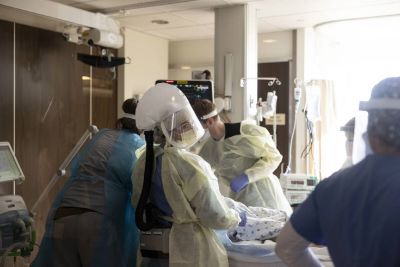
Several hospitals in New Mexico are operating under crisis standards because of staffing and capacity shortages, according to local news reports. In early November, more than half of the patients admitted to San Juan Regional Medical Center in Farmington, N.M., had covid-19, the hospital said in a statement. On Nov. 3, the hospital declared crisis standards of care, which allowed the institution to request aid from the state and federal governments as resources ran short.
In other parts of the country, such as Minnesota, the surge has been sustained for months instead of spiking and then sinking, creating enduring pressures on hospital infrastructure and staff.
“We are seeing the toll here after you have worked for four solid months, 12 hours a day, it’s like being on the front lines of a war,” said Michael Osterholm, director of the Center for Infectious Disease Research and Policy at the University of Minnesota. The reasons for the different shapes of surges mystify epidemiologists.
“Why are we in the fourth month of surge? I can’t explain it for the life of me,” Osterholm said.
Three teams of military medics from the Air Force, Army and Navy joined health-care providers in Colorado, Michigan and New Mexico this week to help treat covid-19 patients, the U.S. Army North said in a statement.
“We continually work with our local, state, and federal partners to assess COVID-19 response needs to ensure we are providing the right type of support, in the right place, at the right time,” said Lt. Gen. John R. Evans Jr., a U.S. Army North commander.
The Air Force sent a 15-person monoclonal antibody infusion team to Denver, the Army sent 20 medical personnel to Saginaw, Mich., and the Navy deployed a 20-person medical team to Farmington, N.M. The teams, which include doctors, nurses and respiratory technicians, have been mobilized in response to requests from the Federal Emergency Management Agency, according to the statement.
Nine other teams of military medics are working in Colorado, Michigan, Minnesota, Montana and New Mexico.
Los Angeles is experiencing a surge that appears to be related to family gatherings around Thanksgiving, officials said. And in Vermont, which for many months had some of the lowest case rates in the country, Middlebury College shut down in-person classes to quell a campus outbreak. The college reverted to remote teaching for the rest of the fall semester and canceled all indoor events, limiting informal indoor gatherings to six people.
The surge is driven by the delta variant, which accounts for about 99.9% of U.S. covid cases as of the week ended Dec. 4, according to a report released Friday by the Centers for Disease Control and Prevention – even as the omicron variant, which was discovered last month, continues to capture attention.
The most recent numbers also reflect a change in the correlations between vaccination rates and case rates. Before the delta variant hit, states with higher vaccination rates had significantly lower rates of cases, hospitalization and death than states with low vaccination rates. Now, during the delta surge, some highly vaccinated places, including New Hampshire, Vermont and Colorado, are experiencing above-average case rates. But the power of vaccines is clear: Highly vaccinated states still have significantly lower death rates than places with low levels of vaccination, a Washington Post analysis found.
Osterholm said that based on preliminary data from South Africa and Britain, he expects delta’s dominance to wane rapidly as omicron takes hold. While the emergence of the new variant in the United States has in many cases been linked to individual events, such as an anime convention in New York City or international travel, those distinct experiences will soon be lost in widespread community transmission, Osterholm said.
“I think in three to four weeks, it could be dominant,” Osterholm said. The speed of transmission, he said, is reminiscent the H1N1 influenza pandemic, which was identified in March 2009 in Mexico, showed up in April in San Diego, and 30 days later was confirmed in 142 countries.
In the week from Dec. 1, when the first case of omicron was reported in the United States, a total of 22 states identified at least one variant case, including some indications of community transmission, according to CDC data.
“Among 43 cases with initial follow-up, one hospitalization and no deaths were reported,” the CDC said.
More than half of those cases were in people between 18 and 39 and about one-third reported international travel, according to CDC Director Rochelle Walensky, who spoke at a White House briefing Friday.
Nearly 80% – or 34 of the individuals – were fully vaccinated. And about a third of them received a booster dose, though some had only recently received the additional shot. Preliminary data shows that booster shots could help control omicron by raising antibody levels.
But booster shots continue to provoke controversy around the world as hundreds of millions of people have yet to receive their first shots. More than 50 million Americans have received booster shots. Anthony Fauci, the nation’s leading infectious-disease expert, said in a Washington Post Live interview this week that, based on preliminary data, “the booster shot could be the answer to the challenge that we’re facing with the omicron.” He also said additional shots might provide longer-term benefits by broadening “the breadth and perhaps even the durability of protection” by inducing what is known as the affinity maturation of the immune response.
But a World Health Organization advisory group resisted the idea of a broad-based global rollout of boosters. In a media briefing Thursday, Alejandro Cravioto, the Strategic Advisory Group of Experts (SAGE) chair, reiterated the concern that amid widespread disparity in access, the priority should be on getting first doses into arms.
The WHO has previously endorsed boosters or third doses for those who are immunocompromised. Johnson & Johnson also announced Thursday that the WHO has recommended that people who were initially immunized with its product get a booster.
At Friday’s White House briefing, Walensky urged parents to get their children vaccinated.
“I know some parents want to ‘wait and see’,” she said. “I want to reiterate that vaccination is the best way to protect your kids from covid-19 and the best way to protect your entire family.”
European leaders and scientists warned Friday that the omicron variant could become dominant in some countries startlingly soon, overtaking the delta variant that has remained the most common version of the virus globally for months.
“We expect it to overtake delta within days, not weeks,” Nicola Sturgeon, the First Minister of Scotland, said Friday about the spread of omicron there.
That echoes the latest update from the U.K. Health Security Agency, which has high confidence that omicron has a growth advantage over delta and estimates that, spreading at its current rate, it will become dominant throughout Britain by mid-December, with more than a million infections by the end of the month.
In Denmark, too, omicron on its current trajectory could become dominant by “the end of next week,” said Mads Albertsen, a professor at Aalborg University.
The sense is that Britain and Denmark aren’t standouts. Rather, they are tracking and modeling the spread especially carefully, and what they’re reporting may reflect what’s emerging elsewhere in Europe. And since so often during the pandemic Europe has served as a preview of what’s to come in the United States, U.S. officials are watching closely, as well.
Epidemiologists already know omicron has spread rapidly in South Africa – the earliest sample of the variant identified there was from the first week of November, and it was dominant within a month.
But South Africa had fairly low levels of coronavirus when omicron emerged, meaning it didn’t take much for the new variant to prevail. Also, only a quarter of people in South Africa have been fully vaccinated. Europe offers a truer test of whether omicron can beat out delta in places where the majority of people are vaccinated.
The latest sobering reports suggest omicron indeed spreads more easily, possibly in relation to a suite of mutations to its “spike protein.”
Key questions remain open, including about the severity of illness it causes and the extent to which extent vaccines will continue to provide protection.
Anthony Fauci, America’s top infectious-disease expert, said earlier this week that, based on preliminary data, the omicron variant may cause less severe illness than earlier variants of the virus.
WHO Director General Tedros Adhanom Ghebreyesus warned this week against drawing “firm conclusions.”
But many countries in Europe aren’t waiting to find out more. They have been reintroducing or adopting a range of control measures – from travel restrictions and mask requirements to limited lockdowns and vaccine mandates.
Sturgeon warned of a “potential tsunami of infections” and urged Scots to defer their Christmas parties.
The suspected proportion of omicron among all coronavirus infections in Scotland surged from 2% on Sunday to more than 15% on Friday, suggesting that cases are doubling every two to three days.
“What we are seeing in the data just now is perhaps the fastest exponential growth that we have seen in this pandemic so far,” Sturgeon said.
“The speed of it is surprising,” said Linda Bauld, a professor at the University of Edinburgh. “If it can overcome delta in Scotland and the U.K., then it will do elsewhere.”
“It will come very fast in most countries now,” agreed Albertsen in Denmark.
He added that new Danish restrictions announced Wednesday – which include longer school vacations over Christmas and nightlife curbs – could slightly delay the point omicron surpasses delta.
Some European experts worry that even if the variant causes less severe illness, its rapid growth may overburden hospitals that were already strained by the continent’s latest wave in delta cases.
“While hopeful, we are not certain any reduction (in the severity of illness) would be enough to keep the total number of hospitalisations from going up substantially – beyond our capacity to absorb them,” Rowland Kao, a University of Edinburgh professor, told the Science Media Centre.
Neil Ferguson, an epidemiologist at Imperial College London whose models have shaped government policy in Britain and the United States, told the Guardian that the omicron variant “could very substantially overwhelm the NHS, getting up to peak levels of admissions of 10,000 people per day.”
Though Europe has gone much further than the United States in imposing new restrictions in recent weeks, European governments have generally sought to avoid any measures as rigid or as wide-ranging as last winter.
University of Edinburgh professor Bauld said some restrictions are important to give more people time to receive their booster shots and to avoid hospitals being overwhelmed.
Despite uncertainty over how much omicron reduces vaccine effectiveness, Bauld said her advice remains unchanged: “Anybody who’s had any vaccines is hugely better off than people who have had no vaccines.”
President Joe Biden faces a dilemma as the United States prepares for European security negotiations with Moscow amid the threat of a new Ukraine invasion: How much should Washington accommodate Russian President Vladimir Putin – and would any plausible concessions be enough for him to stand down?
Those questions will be top of mind for U.S. officials and their European allies, who are in the early stages of organizing talks with the Russians on the myriad complaints Putin has made about Ukraine, NATO and a European security environment he says is overly threatening to Moscow.
Putin’s demands, and whether to make any concessions, are already testing the unity of the 30-country NATO alliance.
Some leaders, including Biden, believe that talking to the Russians and possibly making accommodations to address Putin’s concerns are worth staving off a renewed war in Europe that could be far more deadly than Russia’s initial 2014 operation in Ukraine. Other officials contend privately that Putin will never be satisfied short of bringing Kyiv firmly back into Russia’s orbit and that he shouldn’t be rewarded for his intimidating behavior with any compromises.
State Department spokesman Ned Price on Thursday emphasized that even at the height of the Cold War, talks played a critical role in increasing transparency and reducing tensions.
“If the Russian Federation doesn’t have an understanding about what NATO is, what it is not, what it seeks to do, what it doesn’t seek to do, dialogue can help with that,” Price said. “What this is not is an effort to discuss borders, to discuss Ukraine without Ukraine. We’re not going to do anything with Ukraine without Ukraine, our partner.”
Putin’s high-stakes brinkmanship by massing troops near the border with Ukraine has left the United States and its allies guessing about what the Russian president really wants or is prepared to do – a state of affairs that the former KGB lieutenant colonel has been known to relish.
“It all comes down to where Putin’s head is and what he feels is good enough to take back to the Kremlin. There is no one on this planet other than Putin who knows the answer to that question,” said Andrea Kendall-Taylor, a Russia analyst at the Center for a New American Security. “So, the point is, we try. We really try to go through this diplomatic process. We put in a good-faith effort.”
In the days since Biden’s call with Putin on Tuesday, Moscow has further escalated its rhetoric on Ukraine and continued its shipments of materiel to locations near the Ukrainian border.
On Thursday, Putin resurfaced rhetoric that Moscow used in the run-up to its 2014 invasion of Ukraine, suggesting that a “genocide” was targeting Russians in Ukraine’s eastern Donbas region. The same day, the Conflict Intelligence Team, a group that monitors the Russian military, spotted howitzers, main battle tanks and a Buk antiaircraft system on Russian trains not far from Ukraine.
Having established leverage over the West with the buildup, Putin and his top advisers have articulated a range of demands. During the call with Biden, Putin said Russia wants legally binding guarantees that NATO will not expand eastward to include Ukraine or deploy offensive weapons systems in countries bordering Russia, according to a Kremlin readout of the call. Putin has also said the United States and its allies are ignoring the Kremlin’s red lines by flying strategic bombers near Russia.
The White House has suggested that a U.S. guarantee excluding Ukraine from NATO is a nonstarter.
The United States and its allies theoretically could strike a deal limiting certain exercises or weaponry near Russia’s borders, but it is unclear if that would satisfy Putin. Some analysts have expressed worry that the Russian leader is making demands that he knows Washington will reject, possibly as a pretext for military action once he is spurned.
“I don’t see us giving them anything that would suffice relative to their demands, and what troubles me is they know that,” said Michael Kofman, a Russian military analyst at the Virginia-based research group CNA. “They also can’t just back down from this level of crisis without tangible gains.”
The standoff comes as Secretary of State Antony Blinken arrives in the British city of Liverpool for a meeting of the Group of Seven leading industrial democracies. On Saturday morning, Blinken is scheduled to discuss Russia’s threat to Ukraine with his counterparts from Canada, France, Germany, Italy, Japan and Britain.
“We’re watching it closely. And we’re working with our partners to be very clear that when Russia’s behavior crosses boundaries that are expected of responsible nations, that there will be costs to that,” said Erica Barks-Ruggles, a senior official in the State Department’s Bureau of International Organization Affairs.
The United States has been working to build leverage of its own, rallying European allies to agree on a package of harsh economic measures that would be leveled against Russia if Putin were to proceed with an offensive.
Biden laid out some of those consequences during his video meeting with Putin, according to the White House, which has said it would reach for punishments harsher than those meted out after the 2014 invasion.
The Biden administration has said the talks with Russia on NATO activities in Europe will be paired with a drive to reinvigorate the 2015 Minsk agreement, a pact brokered by France and Germany that laid out a path to ending the conflict between Ukrainian forces and Russian-backed separatists in the Donbas region.
Still, Putin’s escalating rhetoric this year on Ukraine has given many the impression that he ultimately will accept nothing short of a Kyiv back under Russia’s influence, which at a minimum would mean an end to Zelensky’s pro-Western government and U.S. support for Ukraine.
In a treatise in July, Putin accused Ukraine of becoming a vassal state manipulated and controlled by the West to undermine Moscow. He said true sovereignty for the nation is possible only in partnership with Russia, and he called Russians and Ukrainians one people.
“The Kremlin increasingly views Ukraine as a Western aircraft carrier parked just across from Rostov . . . in southern Russia,” Eugene Rumer and Andrew S. Weiss, Russia analysts at the Carnegie Endowment for International Peace, wrote last month. “Ukraine is now one of the largest recipients of U.S. military assistance, a fact that surely is not lost on anyone in the Russian national security establishment.”
Putin sees bringing Ukraine back under Kremlin influence as his single most important piece of unfinished business as he contemplates his legacy, Rumer and Weiss argued.
That desire could complicate any future talks.
“If those are his demands and those are his interests, if it is really about those more maximalist things, I don’t think there is anything we, in a principled way, could give that would alleviate his concerns,” Kendall-Taylor said. “So that puts us back to the point where we started. The threat of military force is still really there.”
The United States has recorded an average of about 120,000 daily new cases this week, an increase of nearly 40 percent compared to a week before, according to the U.S. CDC.
Key COVID-19 indicators in the United States have been on the rise this week with daily new cases marking a nearly 40 percent increase. Health agencies and experts have urged the public to get a booster dose to better protect themselves from infection.
The United States has recorded an average of about 120,000 daily new cases this week, an increase of nearly 40 percent compared to a week before, according to data updated by the U.S. Centers for Disease Control and Prevention (CDC) on Friday.
Currently, two variants, Omicron and Delta, are classified as “Variants of Concern” in the United States. Delta remains the predominant variant in the United States, causing over 99 percent of all the infection cases in the country.
The Omicron variant currently accounts for less than 0.1 percent of variants circulating in the United States, according to the CDC.
COVID-19 hospitalizations increased about 40 percent compared to last month.
A staff worker talks with a woman outside a mobile vaccine clinic in New York, the United States, Dec. 7, 2021.(Xinhua/Wang Ying)
The country currently averages about 7,500 daily hospital admissions, a 15.9 percent increase from the prior week, according to the CDC.
An average of about 1,000 daily deaths were reported this week in the country, an increase of 27.8 percent compared with the previous week.
The CDC urges everyone ages 18 years and over to get a COVID-19 booster dose.
The U.S. Food and Drug Administration (FDA) on Thursday authorized the booster shot of the Pfizer-BioNTech COVID-19 vaccine to individuals 16 and 17 years of age.
On Nov. 19, the FDA authorized the use of the Pfizer-BioNTech booster for all individuals 18 years of age and older after completion of primary vaccination with any FDA-authorized or approved COVID-19 vaccine. The new move on Thursday has expanded the age group eligible for the booster dose.
“As people gather indoors with family and friends for the holidays, we can’t let up on all the preventive public health measures that we have been taking during the pandemic,” said Acting FDA Commissioner Janet Woodcock on Thursday.
With both the Delta and Omicron variants continuing to spread, vaccination remains the best protection against COVID-19, Woodcock said.
About 201.2 million people, or 60.6 percent of the total U.S. population, have been fully vaccinated as of Friday. About 51.7 million booster doses in fully vaccinated people have been reported, according to CDC data.



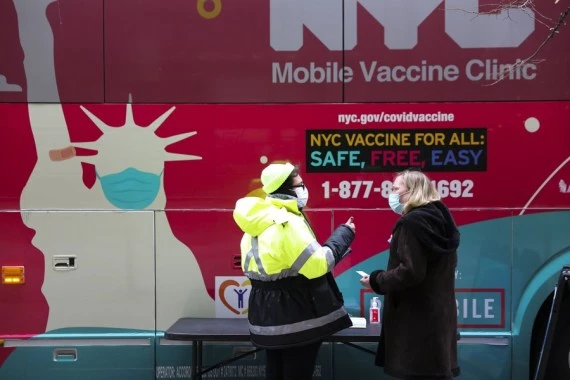 A staff worker talks with a woman outside a mobile vaccine clinic in New York, the United States, Dec. 7, 2021.(Xinhua/Wang Ying)
