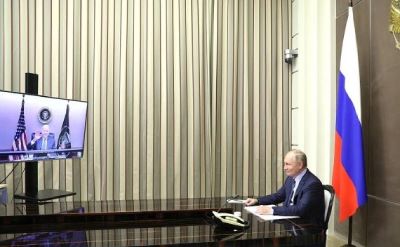
The summit ended with little progress, as Russian analysts and officials had forecast, expecting that there will be “controlled confrontation” between the two sides.
Putin
No breakthrough was achieved after Russian President Vladimir Putin and his U.S. counterpart, Joe Biden, met via video link on Tuesday, which touched upon such topics as the situation in Ukraine, the Iran nuclear deal, and bilateral ties between the two countries.
The meeting marked the second talks in six months between the two leaders, the Kremlin said in a statement after the two-hour virtual conversation.
The summit ended with little progress, as Russian analysts and officials had forecast, expecting that there will be “controlled confrontation” between the two sides.
On the situation in Ukraine, Biden threatened to take “strong economic and other measures” together with U.S. allies against Moscow should Russia invaded Ukraine as the West alleged.
In response, Putin criticized the North Atlantic Treaty Organization (NATO) for shifting its responsibility onto Moscow, stressing that it is NATO that is attempting to “conquer Ukrainian territory” and is building up military potential near the Russian borders.
Putin asked Biden for a “reliable, legally fixed” guarantee that NATO will not expand in the eastern direction and not deploy offensive weapons near Russia, but Biden “made no concessions” regarding Ukraine’s possible NATO membership, according to U.S. National Security Advisor Jake Sullivan.
“There were no breakthroughs,” Kremlin aide Yuri Ushakov said after the summit, adding that it could take more than one year for ties to thaw since so many problems have accumulated.
“The contradictions between the countries are intractable,” said Sergei Kislitsyn, head of the Center for Strategic Planning Studies at the Institute of World Economy and International Relations, Russian Academy of Sciences.
“I can’t quite picture where there will be breakthroughs. After all, any simple moves in the framework of bilateral ties, including the extension of the New Strategic Arms Reduction Treaty, have already taken place,” he said.
CONTROLLED CONFRONTATION
Although analysts did not anticipate better Russian-U.S. relations, they agree that the two countries are trying to confine confrontation to a relatively narrow range as both sides can’t afford a direct military conflict.
The Kremlin called the Putin-Biden meeting “sincere and business-like” and the presidents agreed to continue dialogue and necessary contacts.
“The very fact that the negotiations between the leaders actually took place means that Washington is still more inclined towards dialogue than confrontation,” said Andrei Kortunov, Director General of the Russian International Affairs Council.
Biden needs some kind of agreements with Putin to show that he is able to resolve issues as his approval ratings are plummeting over domestic affairs in the United States, said Yuri Rogulev, director of the Franklin D. Roosevelt Foundation for U.S. Studies at the Moscow State University.
Nikita Danyuk, deputy director of the Institute for Strategic Studies and Predictions of RUDN University, forecast that there will be “controlled confrontation” between Russia and the United States.
Negotiations on Ukraine, strategic stability and global security will continue, but sanctions pressure will also continue with Russia being defamed, he said.
The number of Covid-19 cases crossed 14.28 million across Southeast Asia, with 26,211 new cases reported on Wednesday (December 8). New deaths are at 538, bringing accumulated Covid-19 deaths in Asean to 295,531.
Cambodia on Monday began to vaccinate five-year-old children with China’s Sinovac COVID-19 vaccine as the vaccination for the population aged six years and older was completed. Ministry of Health said five-year-old children in Cambodia will receive two doses of the Sinovac vaccine and the gap between the first and second shot is 28 days.
Meanwhile, Vietnam reported 14,599 new Covid-19 cases on Wednesday, including 14,595 locally transmitted and four imported, according to its Ministry of Health. Most of the community cases were reported in southern localities, including 1,475 in Ho Chi Minh City, 874 in Tay Ninh province, and 781 in Soc Trang province. As of Wednesday, the country has registered nearly 1.35 million locally transmitted Covid-19 cases since the start of the current wave in late April.
Olaf Scholz took over as chancellor of Germany and is under immediate pressure to tackle a brutal Covid-19 outbreak and a raft of geopolitical challenges including tensions with Russia.
The Social Democrat was sworn in on Wednesday, ending Angela Merkel’s 16-year tenure and becoming the country’s ninth chancellor since World War II.
The 63-year-old, Merkel’s vice chancellor for the past four years, represents renewal at the top – but not too much. Voters awarded him a narrow victory in the Sept. 26 election, seeing in him much of what they liked about Merkel – a steady hand and competent, if not charismatic, leadership.
The soft-spoken former finance minister will preside over his inaugural cabinet meeting this evening. After Merkel asserted Germany’s status as the paramount power broker in the European Union and one of the leading countries in the West, Scholz will have to learn how to apply Germany’s leverage amid threats on Europe’s eastern frontier and the ascendancy of China as a superpower.
He’ll also have to deal with mounting pressure from the U.S. over the controversial Nord Stream 2 gas pipeline connecting Russia with Germany’s north coast. The U.S. will push its European ally to agree to stop the almost-completed project if Russian President Vladimir Putin invades Ukraine, according to documents seen by Bloomberg and people familiar with the plans.
“Clearly Russia has the ability to blackmail Germany and Europe,” Marcel Fratzscher, president of Germany’s DIW economic research institute, said Wednesday in a Bloomberg TV interview. “My hunch at the moment is this pipeline will not take off, that it will be blocked permanently.”
Scholz has already demonstrated domestic political prowess, deftly assembling a government with two other parties with sharply diverging policies – the Greens and the pro-business Free Democrats.
The coalition, which holds 416 of the Bundestag’s 736 seats, was forged more quickly and seamlessly than most political observers in Berlin expected. In the lower house of parliament on Wednesday, Scholz received 395 of the 707 votes cast, clearing the final hurdle.
The 177-page coalition accord bears the fingerprints of each party. The SPD secured a minimum-wage increase to 12 euros ($13.50) an hour and pension guarantees; the Greens brought the country’s coal-exit date forward to 2030; and the FDP won out on a promise not to raise taxes and to preserve constitutional debt limits.
But political fights are baked in. The Greens have vowed to push Germany to the forefront of the battle against climate change, with billions in investments to expand renewable resources on the path to carbon neutrality by 2045. The FDP has assured its base that it’ll keep government spending and debt in check.
Christian Lindner, the FDP chairman who will be Scholz’s finance minister, already sounded a warning on Tuesday, saying the government is observing inflation – or “monetary devaluation” – very closely and will factor it into fiscal decisions.
Robert Habeck, the incoming Green vice chancellor who oversees climate policy, said his party will stick to the ambitious pledges secured in the accord.
“There will be differences. There will be conflict. But we are fully aligned when it comes to goals,” Ricarda Lang, a deputy leader of the Greens, said in a Bloomberg TV interview.
The foremost challenge for the entire coalition will be tackling the pandemic. There has been an unprecedented surge in infections in recent weeks in Germany, which has lagged western European peers in vaccination rates.
Scholz has called for a national effort to administer 30 million shots by year-end in a bid to prevent hospitals being overwhelmed by Covid patients. He has also backed a general vaccine mandate that is expected to go to a vote in the lower house of parliament before the end of the year.
A onetime SPD activist and lawyer who became a staunch defender of the labor-market overhaul under Gerhard Schroeder, Scholz brushed past setbacks to become labor minister in Merkel’s first “grand” coalition with the SPD. Returning to his hometown Hamburg, he won a state election and governed the city from 2011 to 2018.
He’s now based in Potsdam outside Berlin, where he won a direct seat for the Bundestag this year. His wife, Britta Ernst, is the education minister for the eastern state of Brandenburg.
Scholz, whom many in Germany had written off as recently as the summer, staged a surprise comeback victory in the September vote. His direct opponents, CDU Chairman Armin Laschet and Greens’ Co-leader Annalena Baerbock, stumbled in their bids to win over voters.
The new ruling coalition, a formation never tried at the federal level, will have Germany’s first cabinet staffed half by women (excluding the chancellor himself).
Baerbock will be the first female foreign minister, while the SPD’s Christine Lambrecht will be defense minister. Nancy Faeser, an SPD leader from the western state of Hesse, will take over the interior ministry – another first.
European Central Bank President Christine Lagarde said she’s sure that Scholz and his government will “continue to work hard to advance European integration.”
“I have always admired how Angela Merkel steered Germany through many crises,” Lagarde was quoted as saying Wednesday by the Handelsblatt newspaper. “I am sure that Olaf Scholz will work just as calmly, thoroughly and in a focused way on the huge tasks that he and his government have before them.”
The World Health Organization said the omicron variant of the coronavirus may change the course of the pandemic. It called on countries to vaccinate as fast as possible and keep measures in place to protect people from infection.
“We can prevent omicron becoming a global crisis,” WHO Director General Tedros Adhanom Ghebreyesus said at a briefing on Wednesday. “This virus is changing, but our collective resolve must not.”
The organization also said while there’s early evidence that omicron is milder than the delta strain, it’s too early to be definitive.
“Certain features of omicron, including its global spread and large number of mutations, suggest it could have a major impact on the course of the pandemic,” Tedros said.
Asked about a new study from Pfizer and BioNTech on how their vaccine works against omicron, Kate O’Brien, director of immunization and vaccines, said the WHO is aware and will look at the findings.
“We are still in a delta pandemic, so vaccinate with existing vaccines continues to be the top priority,” she said.
Earlier on Wednesday, Pfizer and BioNTech said initial laboratory studies show a third dose of their vaccine may be needed to neutralize the omicron variant, an analysis that will accelerate booster-shot drives around the world.
The WHO has been pushing for countries to hold off on boosters to make more vaccines available to poorer countries where inoculation rates are low. But governments may be less likely to do that if evidence from tests continues to show that third shots are needed to protect against omicron.
The variant has now spread to 57 countries, and it appears to be more transmissible than previous virus strains. Mike Ryan, executive director of the WHO’s emergencies program, said while omicron appears to have higher transmissibility than delta, “that does not mean the virus is unstoppable.”
LONDON — Britain is obsessed by a Christmas party, which either did or did not happen at 10 Downing Street last year, in the middle of a strict coronavirus lockdown, as the hospitals filled with the sick and dying.
The official spokesman for the prime minister says there was no holiday party, that no rules were broken, despite a scoop by the Mirror, a British tabloid, saying that yes, Virginia, there was a party, with guests “knocking back glasses of wine during a Christmas quiz and a Secret Santa while the rest of the country was forced to stay at home.”
Now there’s leaked video, not of the alleged party itself, but of a mock news conference staged by a communications aide to Boris Johnson, about the party, four days after the alleged festivities. That aide resigned on Wednesday.
The story has become a scandal in part because it plays into assertions that Johnson and his government cannot be trusted and that there is one set of rules for the people and another for the rulers. The British take their very merry holiday parties very seriously, and to learn that 10 Downing Street – the prime minister’s official residence and office, the British version of the White House – might have been whooping it up as the rest of the country was told to hunker down really grates.
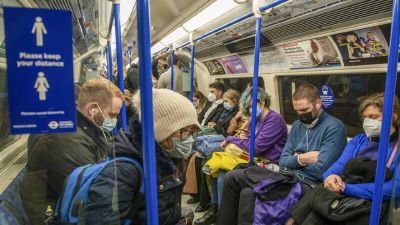
The revelations coincided with Johnson’s announcement of new restrictions to curb the spread of the omicron variant. Starting next week, people in England are being asked to return to working from home when they can, wear face masks in public and show National Health Service passes – documenting that they’ve been vaccinated or recently tested negative – to enter nightclubs and other crowded venues.
Johnson opened a particularly boisterous session of Prime Minister’s Questions in the House of Commons on Wednesday with an apology. “I understand and share the anger up and down the country at seeing Number 10 staff seeming to make light of lockdown measures, and I can understand how infuriating it must be to think that people who have been setting the rules have not been following the rules because I was also furious to see that clip,” he said.
But the prime minister added that he had been “repeatedly assured” that there was no party and that no covid rules had been broken.
He announced that he had asked his cabinet secretary to investigate and promised, “It goes without saying that if those rules were broken, then there will be disciplinary action for all those involved.”
That hardly settled the matter.
Douglas Ross, a leader of the Scottish Conservative Party, suggested that if Johnson was misleading Parliament, he should resign. “If the prime minister knew about this party last December, knew about this party last week, and was still denying it, then that is the most serious allegation,” Ross said.
The leader of the opposition Labour Party, Keir Starmer, told the prime minister his apology “raises more questions than answers.”
Starmer charged that “millions of people” who followed the rules last Christmas “now think the prime minister was taking them for fools, that they were lied to.”
The Labour lawmaker said Johnson’s staff, “knew there was a party, they knew it was against the rules, they knew they couldn’t admit it, and they thought it was funny. It is obvious what happened.”
Johnson’s critics hammered away on their assertion that 10 Downing Street was partying while ordinary people were denied visits to nursing homes and to see sick relatives in hospitals.
“It’s one rule for them and another for the rest of us,” David Lammy, the Labour Party’s point person on foreign affairs, told the BBC on Wednesday morning.
Meanwhile, Health Secretary Sajid Javid canceled a scheduled BBC appearance after the video footage was leaked.
Javid would have been expected to mark the anniversary of Britain becoming the first country in the West to administer coronavirus vaccines outside of clinical trials. He also would have been expected to urge people to get their initial vaccinations or booster shots, amid concerns about the new omicron variant.
The Christmas party affair has attracted the attention of London’s Metropolitan Police, which is reviewing the footage in relation to “alleged breaches” of covid-19 regulations at the time.
On Dec. 18, 2020, a Friday, the day many British media outlets have been claiming the party took place, gatherings in London were banned. The official guidance stated, “You must not have a work Christmas lunch or party where that is a primarily social activity.”
The following day, Johnson announced a further tightening of rules, effectively canceling Christmas for millions.
Thousands of people were fined for violations on gatherings over the course of last year, according to figures from the National Police Chiefs’ Council and reported by the BBC. Between March 2020 and January 2021, police issued 2,982 fines in England to those participating in gatherings inside a house or indoor space; there were 250 fines issued in England to those hosting a gathering of more than 30 people.
The leaked video clip, obtained by ITV news, shows a mock news conference staged by Allegra Stratton, then a top spokesperson for the prime minister, answering questions lobbed at her by fellow staffers, in a practice round as they prepared for the real deal.
The clip is not definitive proof, but it is damning – as it appears to suggest that staffers knew all about the party and were cracking jokes about it.
Asked whether there was such a fete, Stratton replies in the clip: “This fictional party was a business meeting – and it was not socially distanced.”
Pressed for an answer in the rehearsal by Johnson’s top aide, who was playing the role of a journalist, Stratton says, “I went home.” Everyone laughs.
Asked whether the prime minister would condone such a party, Stratton asks the room: “What’s the answer?”
Finally, another aide jokes that “it wasn’t a party; it was cheese and wine” and Stratton laughs and asks: “Is cheese and wine all right?”
Late on Wednesday, Stratton gave a tearful statement as she resigned from the government. Most recently, she was in charge of publicity for the global climate summit in Glasgow, Scotland, last month.
“My remarks seemed to make light of the rules, rules that everyone were doing everything to obey. That was never my intention. I will regret those remarks for the rest of my days,” Stratton said. “I understand the anger and frustration that people feel. To all of you who lost loved ones and endured intolerable loneliness and who struggled with your businesses, I am truly sorry.”
The images from the mock news conference were plastered across the British papers on Wednesday.
“A Sick Joke” ran a front-page headline in the Daily Mail; the Metro newspaper scolded the “No. 10 Party Clowns.”
“It’s disgusting,” Rivka Gottlieb, who lost her father in the first lockdown, told the BBC. “It shows the utter contempt they hold the British public in,” she said.
During the first lockdown, in 2020, Dominic Cummings, then Johnson’s top aide, flouted strict rules and damaged public trust in the government’s handling of the pandemic. He drove six hours north, to shelter at his family farm, after he and his wife were infected with the virus. Later, he drove to a nearby castle, known for sightseeing, to test his eyesight, he claimed.
Cummings weighed in on Twitter on Wednesday, suggesting that the internal inquiry the prime minister ordered also look at parties held at Johnson’s apartment, including on the day Cummings was forced out.
While the number of Omicron cases is expected to rise in the United States, the most recent data show that more than 99 percent of coronavirus samples that have been genetically sequenced showed the Delta variant, and it is too early to know whether Omicron will become dominant against Delta or not.
The Omicron variant of COVID-19 has spread to at least 19 U.S. states, seemingly less severe than Delta, and it will take more time to get a fuller picture of it, top U.S. health officials said on Tuesday.
“It’s too early to be able to determine the precise severity of disease but inklings that we are getting, and we must remember these are still in the form of anecdotal … but it appears that with the cases that are seen, we are not seeing a very severe profile of disease,” said Anthony Fauci, chief medical advisor to the U.S. president, during a White House briefing.
“In fact, it might be and I underscore might be, less severe as shown by the ratio of hospitalizations per number of new cases,” added the top infectious doctor.
Photo taken on May 19, 2021 shows Rochelle Walensky, director of the U.S. Centers for Disease Control and Prevention (CDC), testifying during a Senate Appropriations subcommittee hearing on Review of the FY 2022 Budget Blueprint for the CDC in Washington, D.C., the United States. (Jim Lo Scalzo/Pool via Xinhua)
In addition, Fauci noted that the virus also appears more transmissible, saying that “real-world evidence is accumulating rapidly, literally on a daily basis, to allow us to determine increase in cases, possible increase in reproductive number and the rapid replacement of Delta by Omicron in certain situations.”
He cautioned that the results that are in so far may have been influenced by the relative youth of the patients in South Africa who contracted the new strain of the coronavirus. This could potentially have masked the variant’s severity, since younger people tend not to display as serious symptoms from COVID-19 as older patients.
Also on Tuesday, the U.S. Centers for Disease Control and Prevention (CDC) Director Rochelle Walensky said that the Omicron variant has been found in 50 countries and at least 19 states across the United States, after it prompted global travel restrictions and fresh vaccine mandates since its discovery in southern Africa last month.
“While we are still working to understand the severity of Omicron as well as how it responds to therapeutics and vaccines, we anticipate that all of the same measures will at least, in part, provide some protection against Omicron,” said Walensky, stressing again her call to get vaccinated.
While the number of Omicron cases is expected to rise in the United States, the most recent data show that more than 99 percent of coronavirus samples that have been genetically sequenced showed the Delta variant, she said, adding that it is too early to know whether Omicron will become dominant against Delta or not.
White House COVID-19 Response Coordinator Jeff Zients said that vaccinations have surged with roughly 12.5 million shots administered over the last week, 7 million of which were booster shots.
“That’s the highest weekly total number of shots since May,” he said. “So we’re now vaccinating people in numbers we haven’t seen since the spring.”
As of Tuesday afternoon, 236,363,835 people had received at least one dose of COVID-19 vaccine, making up 71.2 percent of the whole U.S. population; fully vaccinated people stood at 199,687,439, accounting for 60.1 percent of the total. A total of 47,866,620 people, 24 percent of the fully vaccinated group, had received booster shots, according to the CDC.
The leaders mainly focused on the internal crisis in Ukraine during their second talks in six months.
Russian President Vladimir Putin and his U.S. counterpart Joe Biden discussed the Ukrainian crisis, bilateral relations and the Iran nuclear deal as they met via video link on Tuesday.
The leaders mainly focused on the internal crisis in Ukraine during their second talks in six months, the Kremlin said in a statement.
Putin, using specific examples, explained to Biden “the destructive policy” of the Ukrainian authorities and expressed his “serious concern about Kiev’s provocative actions against Donbass.”
According to the Kremlin, Biden emphasized the allegedly “threatening” nature of the movements of Russian troops near the Ukrainian borders and outlined sanctions that the United States and its allies would be ready to apply in the event of a further escalation of the situation.
President Joe Biden “voiced the deep concerns” of the United States and its European allies about “Russias escalation of forces surrounding Ukraine and made clear that the U.S. and our Allies would respond with strong economic and other measures in the event of military escalation,” the White House said.
U.S. President Joe Biden and Russian President Vladimir Putin Tuesday held a video call on a range of bilateral issues as well as the Ukrainian crisis and the Iran nuclear deal.
Biden “voiced the deep concerns” of the United States and its European allies about “Russia’s escalation of forces surrounding Ukraine and made clear that the U.S. and our Allies would respond with strong economic and other measures in the event of military escalation,” the White House said in a readout after the meeting.
Biden “reiterated his support for Ukraine’s sovereignty and territorial integrity and called for de-escalation and a return to diplomacy,” the readout said.
“The two presidents tasked their teams to follow up, and the U.S. will do so in close coordination with allies and partners,” it said.
The presidents also discussed the U.S.-Russia dialogue on Strategic Stability, a separate dialogue on ransomware, as well as joint work on regional issues such as Iran, said the readout.
The leaders mainly focused on the internal crisis in Ukraine during their second talks in six months, the Kremlin said in a statement.
Putin, using specific examples, explained to Biden “the destructive policy” of the Ukrainian authorities and expressed his “serious concern about Kiev’s provocative actions against Donbass.”
Putin stressed that it is the North Atlantic Treaty Organization (NATO) that is making dangerous attempts to “conquer Ukrainian territory” and is building up its military potential near the Russian borders.
Putin asked Biden for the guarantee that NATO will not expand in the eastern direction and not deploy offensive weapons near Russia.
To create conditions for mending bilateral ties, Putin offered Biden to lift all the accumulated restrictions on the functioning of Russian and U.S. diplomatic missions.
Biden and Putin held their first face-to-face meetings in a summit in Geneva in June and spoke via phone in July.
The operation to roll out Covid booster shots to all adults in the U.K. is struggling to pick up speed even as the omicron variant spreads rapidly across the country.
Fewer U.K. adults received a third shot of vaccine on Saturday than they did seven days earlier, on Nov. 27, the day when Prime Minister Boris Johnson called for an increase in the pace of the rollout.
Speaking on Tuesday, Johnson said that the nation’s program was “the fastest in Europe”, and that the U.K. had “done more boosters than any comparable country.” The current six-month wait between second and third shots is set to be slashed in half next week in a bid accelerate the program, Johnson said.
Britons aged between 40 and 49 currently have to wait until six months after their second dose to book a booster shot. Johnson was bullish on the impact of allowing that age group, consisting of 7 million people, to book appointments sooner.
“That will lead to a big uptick in the program,” Johnson told broadcasters.
Johnson on Tuesday told his cabinet that it’s still “too early” to draw conclusions on the new omicron variant, but said that “early indications were that it was more transmissible than Delta,” according to a readout of the meeting from his office.
The U.K.’s Health Security Agency said Tuesday that it had detected 101 extra omicron cases over the past 24 hours, taking the total to 437.
Neil Ferguson, an epidemiologist at Imperial College London who advises the U.K. government, told the Times newspaper that omicron infections may be doubling every three days, or even faster.
Regulators authorized booster shots for 18-39-year-olds last month, when the government said that they would be made available to all adults by the end of January. Those aged between 30 and 39 should be invited before Christmas, and 18-29-year-olds in January, according to a person with knowledge of the situation, who didn’t want to be identified because the timings haven’t been shared publicly.
A spokesperson for the NHS said 99 million doses have been delivered in the vaccination campaign so far, including more than 17 million top-ups in England.
The debate over the speed of the U.K.’s rollout comes as data show it is ahead of many other countries with its booster drive. The U.K. has already delivered 30 booster doses per 100 people, more than double the proportion in the U.S. and the European Union, according to Our World in Data.
Data show that 464,616 boosters were administered on Dec. 4, down from 465,111 the Saturday before. While the weekly figure rose slightly to 2.68 million from 2.56 million, there is still some way to go to meet the U.K. target of 3.5 million shots per week.
Johnson has said the U.K. government will wait for guidance on the omicron strain ahead of a review of pandemic rules next week. Until then, the prime minister has given Britons the green light to go ahead with festive events such as staff Christmas parties.
The U.K. reported 51,459 cases of Covid-19 on Monday, up from 30,305 a month earlier.
The U.S. and European allies are weighing sanctions targeting Russias biggest banks and the countrys ability to convert rubles for dollars and other foreign currencies should President Vladimir Putin invade Ukraine, according to people familiar with the matter.
The sanctions — including against some of Russia’s largest banks and the Russian Direct Investment Fund — are among the options that President Joe Biden may spell out when he speaks with Putin on Tuesday, according to the people. The U.S. could also restrict the ability of investors to buy Russian debt on the secondary market, they said.
The options were described by two people familiar with the matter who asked not to be identified discussing private deliberations. The most drastic option would be to bar Russia’s access to the Swift financial payments system, but that would wreak havoc on ordinary citizens so officials are more inclined to go after Russia’s ability to convert rubles into dollars, euros or British pounds, the people said.
Germany’s new government also hinted for the first time that an escalation of the Ukraine crisis may also affect the fate of Nord Stream 2, a pipeline that is to carry gas from Russia and has been a longtime priority for Putin as well as Berlin.
The Biden-Putin call comes with tensions high over what U.S. intelligence has told allies could be a plan to invade Ukraine with as many as 175,000 troops in the coming year. Russia has denied plans to go to war but has also said U.S. and European nations should scale back their support for Ukraine, establishing de facto “red lines” that include barring the former Soviet republic from joining the NATO alliance.
Russian financial markets showed little reaction to the sanctions threats Tuesday, with investors still seeing the risk that Russia would actually invade Ukraine and trigger them as low.
Kremlin spokesman Dmitry Peskov declined to comment on the reports, saying the “emotional statements” of recent days wouldn’t affect the talks.
“It’s obvious that if the presidents are having this conversation, they intend to discuss the issues and not drive things into a dead end,” Peskov told reporters Tuesday.
It’s not clear how much detail Biden will share with Putin on the possible sanctions that would follow an invasion, and most of the actions would be contingent on agreement from allies.
On Monday, Biden took part in a call with the leaders of France, Germany, the U.K. and Italy in which they “discussed their shared concern about the Russian military build-up on Ukraine’s borders and Russia’s increasingly harsh rhetoric,” the White House said in a statement.
“The leaders underscored their support for Ukraine’s sovereignty and territorial integrity,” according to the statement, which was released on Monday evening.
Incoming German Chancellor Olaf Scholz Tuesday called the situation on the Ukrainian border “serious.” At the same press conference, future Vice Chancellor Robert Habeck said that as part of the ongoing regulatory review process for the Nord Stream 2 pipeline, authorities “will surely also discuss how the political situation in Ukraine and Europe’s ability to deescalate can be brought together.” Habeck’s Green Party has long opposed the pipeline.
Overall, the measures Biden is considering are part of an American effort to claw back some of the leverage Putin has amassed over Ukraine and, more broadly, the U.S. and its European allies. The Russian leader has made clear that he’s willing to invade Ukraine — his forces did so in 2014 — to protect what he sees as vital national security interests, and he has shown a willingness to tamper with energy markets by threatening to cut supplies to Europe.
“The reason Putin has so much leverage is he’s clearly willing to pay the price,” Matthew Rojansky, director of the Kennan Institute at the Wilson Center in Washington, said of past U.S. moves to sanction Russia that had little effect. “But we’ve got loads more ammunition, there’s lots of stuff we could do. It’s just that no one has ever believed we would go to those lengths.”
Biden’s Tuesday call with Putin, which will be the pair’s fourth conversation since the American president took office in January, is also meant to provide a way to defuse tensions that have crested again after an earlier Russian troop buildup in the spring first raised fears of war.
“The goal here is signal lots of action up front so you don’t have to do it, but making sure the threat is credible,” Rojansky said.
A senior Biden administration official, speaking to reporters on Monday, made clear that the U.S. doesn’t want to commit its troops to Ukraine in the event of a Russian invasion. At the same time, the official said the U.S. would help Ukraine and send more forces and capabilities to NATO allies bordering Russia. The official also declined to detail the steps the U.S. would take if there’s a Russian invasion.
The call will help determine whether Biden’s desire for a functioning relationship with Russia is possible or whether the dynamic will just ricochet from crisis to crisis — including cyberattacks, the potential invasion of Ukraine and continuing disputes over Russia’s provision of energy to Europe.
Last week, Biden previewed his interest in taking a tougher approach, saying, “What I am doing is putting together what I believe to be will be the most comprehensive and meaningful set of initiatives to make it very, very difficult for Mr. Putin to go ahead and do what people are worried he may do.”
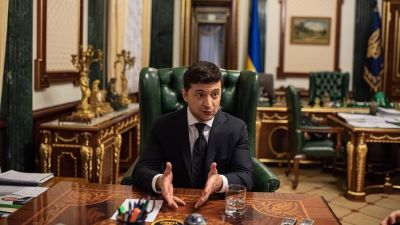
Ukrainian President Volodymyr Zelenskiy said in a tweet Monday that he had spoken with U.S. Secretary of State Antony Blinken and they “agreed to continue joint & concerted action.”
Blinken tweeted that he assured the Ukrainian president that “U.S. support for Ukraine is unwavering” and “there will be serious consequences for any escalation from Russia.”
From the Biden administration’s view, a more positive turn of events could see the U.S. having a stable relationship with Russia — one where the two nations’ embassies and consulates are fully staffed, and where Russia helps bring Iran around to the idea of rejoining the 2015 deal that put limits on its nuclear program. The U.S. could also play some role in getting Moscow and Kyiv to finally adhere to the 2015 Minsk agreements that were meant to bring the Ukraine conflict to an end.
“None of us seeks a confrontation or a crisis,” Under Secretary of State Victoria Nuland will tell the Senate Foreign Relations Committee on Tuesday, according to a copy of her prepared remarks. “Diplomacy remains the best route to settle the conflict in the Donbas and address other grievances.”
She was referring to Ukraine’s eastern Donbas region, where separatists supported by Moscow have been carrying out an insurgency that has killed more than 13,000 people.
For Putin, the goal is partly the exchange with Biden itself: He gains legitimacy and international sway the more he interacts with the U.S. leader, demonstrating Russia’s continued prowess on the global stage. It’s a strategy that has worked for him, evidenced by the four conversations he’s had with Biden since January, more than most world leaders.
Russia has played up the significance of the encounter, with Kremlin spokesman Peskov saying it will be the equivalent of an in-person meeting and more substantial than a simple telephone call. State television Tuesday showed a countdown clock to the session.
But Putin’s main demand — binding guarantees from the U.S. and its allies that NATO won’t expand further east and won’t deploy weapons there that Russia considers a threat — isn’t likely to get very far with Biden. The U.S. president over the weekend rejected the Kremlin’s “red lines” over Ukraine as out of hand.
Still, with tensions along the Ukraine-Russia border soaring, any high-level talks are helpful, said Rachel Ellehuus, a senior fellow at the Center for Strategic and International Studies in Washington.
“Biden will have to offer Putin some sort of an off-ramp to deescalate the situation,” Ellehuus said. On the decision to engage, she said, “It keeps people talking and avoids the worse consequence which is military confrontation.”
The deliberations underscore just how intertwined Russia’s role as an energy supplier to Europe is with its security posture toward Ukraine, which has transit agreements for Russian gas. Energy is also a potential source of leverage: Continued Russian aggression could reshape the fate of the completed but not yet operational Nord Stream 2 pipeline, which the Biden administration hasn’t tried to stop even though it opposes the project.
“I think Nord Stream 2 is very much on the table,” said Steven Pifer, a research fellow at Stanford University’s Center for International Security and Cooperation. Biden still has options to impose broader sanctions, he said. “There are things that you can do to greatly ratchet up the pain.”
One crucial result of the call will be a better understanding of what exactly Putin wants. While U.S. officials say the intelligence suggests Putin is planning for a major ground invasion of Ukraine, they say the administration doesn’t know with confidence what the Russian leader is planning — and don’t believe he’s made any final decision.
That uncertainty is a tactic Putin has used for a long time.
A key challenge for Biden is one of force posture — he will have to persuade Putin that stepped up economic pressure would bring the sort of pain that previous sanctions regimes haven’t, while essentially conceding that the use of U.S. forces isn’t really on the table.
“It’s Russian roulette, Putin-style — who will blink first?” said Oksana Antonenko, director at Control Risks in London.

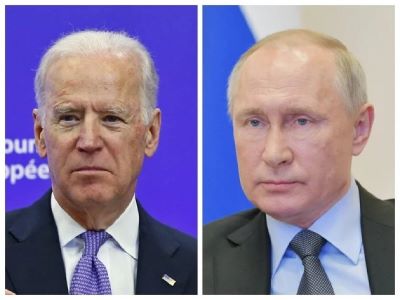
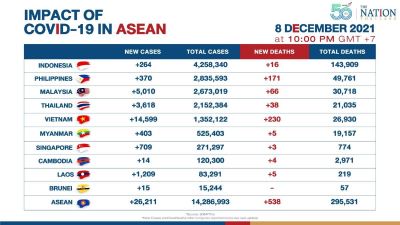
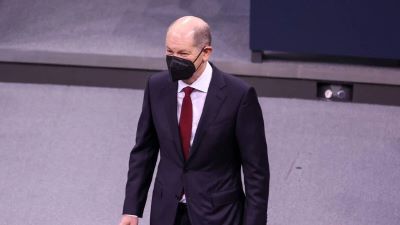
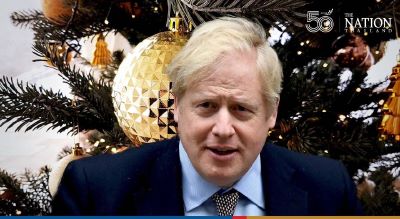
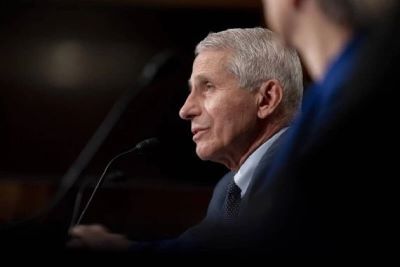
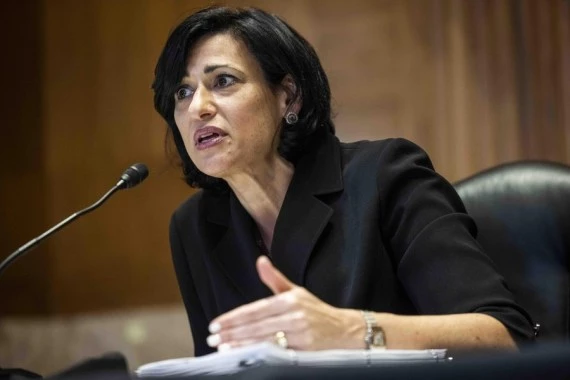 Photo taken on May 19, 2021 shows Rochelle Walensky, director of the U.S. Centers for Disease Control and Prevention (CDC), testifying during a Senate Appropriations subcommittee hearing on Review of the FY 2022 Budget Blueprint for the CDC in Washington, D.C., the United States. (Jim Lo Scalzo/Pool via Xinhua)