Two planes carrying some 600 passengers from South Africa landed in the Netherlands with 61 people infected with the coronavirus – including some cases believed to be the new omicron variant – Dutch health authorities said Saturday after halting flights from several southern African countries over fears of the new omicron variant of the virus.
Passengers were tested at the airport, and those with infections will be isolated at a hotel, a regional Dutch health agency said.
“In a number of the tested persons the omicron variant is presumed to have been found,” the Netherlands Institute for Health said in a statement. An institute spokesperson said it was “almost certain” the cases were of the omicron variant, but only additional testing would allow for complete certainty, Reuters reported.
Omicron, a variant of the novel coronavirus that some scientists fear could be more transmissible than the delta variant, was labeled a “variant of concern” by the World Health Organization on Friday. It was first detected in the southern region of Africa, where cases have started rising again in recent days.
A new round of countries on Saturday rushed to ban or curb travel from there in a bid to stem the spread of the just-discovered variant, which has raised concern about the global trajectory of the pandemic. The United States, the European Union and Britain swiftly imposed travel restrictions on South Africa and its neighbors including Zimbabwe and Botswana, though the variant has also been identified in Belgium, Hong Kong and Israel.
Amsterdam’s Schiphol Airport, where the two Friday flights landed, saw over 71 million passengers in 2019, making it one of the busiest and most connected travel hubs in the world.
Despite a mask mandate by the Dutch airline KLM, which operated the flights from South Africa, many passengers did not wear face coverings, said New York Times reporter Stephanie Nolen, who was aboard one of the planes. Passengers were stuck on the airport tarmac for about four hours before being sent to be swabbed, tweeted Nolen, who later said she tested negative.
A KLM spokesperson told Reuters that passengers had shown proof of vaccination or a pre-flight negative test before boarding flights in Cape Town or Johannesburg.
“It goes too far to say we are surprised” by the high number of cases, the airline spokesperson said. “But we don’t have an explanation.”
News of the omicron variant emerged as the Dutch government was preparing to begin stricter partial lockdown measures beginning this weekend. On Thursday, the country of some 17.5 million reported a seven-day rolling average of more than 20,000 infections.
Starting Sunday, many businesses have been ordered closed between 5 p.m. and 5 a.m., a move that Dutch Prime Minister Mark Rutte said means the country will be “effectively closed” from the evening through the early morning.
The Dutch government was the first in Western Europe to return to partial lockdown when it announced restrictions on shops and restaurants earlier this month. Rutte said Friday that his government was tightening measures because there had been minimal change in people’s behavior, citing traffic data.
A dozen protesters demonstrated peacefully in The Hague after Friday’s announcement, Agence France-Presse reported. But other recent anti-lockdown rallies in the Netherlands involved what the mayor of Rotterdam called an “orgy of violence,” with protesters throwing stones and police firing warning shots.
About 74% of the Dutch population has been fully vaccinated, and booster shots are being offered to vulnerable people, including the elderly and care workers.
CALAIS, France – If everything goes according to Ashkan Rahmonis plan, someday soon the 21-year old Iranian will crawl out of his tent near an abandoned railway track and put on a life jacket.
He will climb across the dunes carrying an inflatable dinghy with dozens of others. They will rush toward the French shores of the English Channel near Dunkirk in the cover of darkness.
If they succeed, the next time they touch land will be in England.
More than 30,000 migrants have attempted to cross the Channel by sea this year, around three times more than 2020, as authorities have clamped down on other routes, including crossings by train and cargo trucks. Successful crossings have encouraged a growing number of migrants to attempt the journey via the Dover Strait.
But with temperatures now near the freezing point on many nights, Rahmoni and others in migrant encampments along the Channel sense they could be stuck all winter unless they attempt to cross soon.
Rahmoni has spent the last days trying to imagine it – and trying to forget about the two men who slept in his tent before he moved in. On Wednesday morning, the pair had embarked on the perilous journey from France to England. Their phones have been dead since.
Later that day, a fisherman spotted lifeless bodies and a capsized inflatable boat in the Dover Strait. Over the next hours, rescuers pulled 27 dead or dying people out of the water – 17 men, seven women and three minors.
It was the worst migrant tragedy in the English Channel in years. Only one victim, a 24-year old Kurdish woman from Iraq who wanted to join her husband-to-be in Britain, has so far been identified.
Rahmoni said he is certain the men who slept in his tent were on the boat, too. Yet he said he has no doubts that he will attempt the same – the last leg of a journey for which his uncle has already paid around $3,400 to smugglers.
“I’m afraid,” he said, speaking at a migrant camp near Dunkirk on Saturday. “What can I do?”
The last time he spoke to his family was about 20 days ago. Without a phone, he may not get another chance to talk them before he attempts to cross.
In the wake of Wednesday’s tragedy, France and Britain have sparred over who is to blame and how more deaths can be prevented. The British want joint police patrols on French soil and the immediate return of migrants who make it across the Channel.
On Sunday, European interior ministers plan to meet in Calais to discuss options. But notably absent will be British Home Secretary Priti Patel, whose invitation was pulled by the French after Prime Minister Boris Johnson tweeted a letter to French President Emmanuel Macron that rehashed many of the proposals the French had already rejected.
The French say they are fighting Britain’s battles, and they say other countries need to take responsibility for having allowed smuggling networks fester for too long.
“When you have two police officers in a car and 30, 40 or 50 migrants who are leaving, the balance of power isn’t in the police’s favor,” agreed François Guennoc, president of L’Auberge des Migrants aid group in Calais. “They have no other choice than to let the boat go.”
– – –
Across the Channel in the English port of Dover, the skies Saturday were the same battleship gray, the sea state queasy with chop. Locals on the dockside said it was a quiet day. Few would attempt the crossing from France, because of strong winds and sea height.
At Tug Haven in the Dover port, where the migrants rescued by Britain’s Border Force or Royal Lifeboats are first taken, the pontoons were quiet – though there was evidence of the deflated rafts gathered in past operations.
The lights of Calais – 25 miles across the Channel – are visible at night.
But looks are deceiving. Currents are always there, and wind and waves can kick up in minutes, in one of the busiest shipping lanes in the world.
Kim Bryan, a member of the activist group Channel Rescue, said the threat by the British home secretary to deploy U.K. Border Force patrol boats to “push back” migrant rafts would be challenged in the courts as a violation of maritime law and human rights protections.
Bryan’s group and news organizations have posted video of the Border Force in the Channel practicing to deploy jet skies to encircle a raft and stop its voyage.
Activists point out that the number of asylum applications are down in Britain – even as the number of people detained in the Channel crossing has tripled.
They say fewer migrants try to illegally board trucks that arrive via ferry or tunnel – the traditional route for illegal crossings – but now take to the sea.
Maddie Harris, a member of the group Humans for Rights Network, said the migrants have often described “an absolutely terrifying journey” across the Channel.
A few miles away from Dover on the English coast, Juliette Walford also looked out to sea, alert to illegal crossings.
She told Sky News, “I think we feel slightly invaded, I think we feel quite scared because there is no regulations.
“I would like to see a proper secure process; if these people are running from war, then we need to help them, but there are a lot of migrants that are not running from war.”
On the French side, French police officers on Saturday patrolled the Escardines Beach near a World War II-era military installation. After 30 minutes, the French police patrol had already moved on.
A 67-year-old local resident, Marie Mikolajczak, has seen large groups of migrants in swimming vests pass by her little village.
“What really breaks my heart is to see the women and children,” she said, describing one moment when she spotted a child wearing two different kinds of shoes on each foot.
French and British aid groups claim the French government has worsened migrants’ living conditions in and around Calais. Every few days, officers confiscate migrants’ belongings, including sleeping bags and tents. There are no toilets, and no showers.
That strategy has so far failed to deter migrants. In some cases, the police tactics have made migrants only more determined to cross to England.
– – –
Rahmoni, the 21-year old Iranian student, said Britain was always his final destination. He traveled overland to France. In Iran, Rahmoni said he faced persecution as a member of the Kurdish minority.
He arrived at the camp near Dunkirk in mid-November. While most migrants here are young men and many have a Kurdish background, there are some families, too.
Near Rahmoni’s tent, a family from Iraq was walking down a muddy road on Saturday, uncertain about where to go next.
The couple had come to France with their sons, 7 and 12 years old. They are uncertain if or when they would be able to try the Channel crossing. The father soon asked questions about other places in Europe the family could go to.
Guennoc, of L’Auberge des Migrants, said many migrants are in Calais because their asylum applications in Europe have been rejected, or because they may risk being deported back to the country where they first entered the European Union if they do apply for asylum in France.
“People aren’t in Calais because they are dreaming of the El Dorado,” said Guennoc, referring to remarks by France’s interior minister who spoke of the “El Dorado of England.”
“They’re here because it’s in a way their last chance,” Guennoc said.
One day after they had mourned the deaths of at least 27 people in the English Channel, locals, activists and migrants assembled in central Calais to mourn another victim on Friday night.
Authorities had discovered a decomposing body at a nearby beach.
About 100 people stood silently in a circle, as the wind extinguished the memorial candles and tore at a banner that listed more than 300 migrants who are believed to have died trying to cross the English Channel over the past two decades. Some people cried. Others stared at the banner with blank eyes and exhaustion.
Masmos, a 30-year-old Sudanese migrant who gave only one name, said he had come to the commemoration because he would like others to be there for him, too, if he dies trying to reach England.
CAPE TOWN, South Africa – Across a world of vaccine haves and have-nots, the omicron variant sends a warning on how the virus can evolve and spread without more aggressive measures to expand vaccinations, a top South African scientist said Saturday.
“Until we vaccinate enough people we’re going to have this happen over and over again,” said Glenda Gray, head the South African Medical Research Council, as global health agencies rushed to understand more about the new variant just days after it was first identified in South Africa.
Her comments underscored one of the major challenges facing global efforts to curb the pandemic: the contrasts between wealthy nations with plentiful vaccines – and even booster shots – and many poorer regions struggling to get vaccines and unable to fully distribute them.
In an opinion piece in the Guardian, former British prime minister Gordon Brown – now an ambassador with the World Health Organization – took aim at the developed world for failing to deliver donated doses it had promised.
“Despite the repeated warnings of health leaders, our failure to put vaccines into the arms of people in the developing world is now coming back to haunt us,” Brown wrote.
The Geneva-based WHO has led a program to help distribute vaccines to nations in need, but significant hurdles remain in transporting the vaccines and having them reach remote areas.
Just 6% of Africa’s 1.2 billion people are vaccinated – compared with about 59% in the United States – largely because many places in Africa have struggled to find supplies snatched up by Western governments.
South Africa’s slowing vaccination program also is largely due to a reluctance by its population to get the jab, driven by apathy and the feeling that “things aren’t so bad,” said Gray.
More than 35% of the country is vaccinated, according to South Africa’s Department of Health. That’s roughly half of the 67% target the country set for 2021. (Data from Johns Hopkins University puts South Africa’s vaccine rate at about 29% with at least one dose.)Earlier this month, the South African government said it would delay the delivery of Pfizer and Johnson & Johnson vaccines because fewer people were being vaccinated.
“Our problem in South Africa is that until we tackle the elephant in the room, which is the low vaccine coverage, we are never going to get ahead of the variants,” said Gray.
She noted, too, it was hard to know where the variant might have first emerged.
“These cases could start anywhere, especially in areas with low vaccine coverage. We know that Africa has low vaccine coverage, so it will start in countries in the world where there is no vaccine coverage,” she said in an interview with The Washington Post. “That said, there are a lot of countries that are having huge outbreaks at the moment.”
“Wherever it came from, it started to propagate here, so people were alerted to it,” she added.
The WHO said the first confirmed omicron infection came from a specimen collected Nov. 9. As a result, the travel measures have probably come too late to stop the international spread, said Jeffrey V. Lazarus, a health systems and policy professor at the Barcelona Institute for Global Health.
“Travel restrictions give a false sense of security,” he said, adding that it would be wiser to include strong safeguards for those traveling by air.
Gray also slammed the decision by a growing number of nations, including the United States and the European Union, to close their borders to travel from southern Africa.
“It doesn’t stop transmission,” Gray said. “The problem is what we are not saying: thatSouth Africa does not have good vaccine coverage, and the reason we have this problem is because we have not vaccinated enough people in the country.”
South Africa’s International Relations and Cooperation Ministry urged countries to reconsider travel bans, pointing out the damage caused to families and the travel and tourism industries.
The bans are “akin to punishing South Africa for its advanced genomic sequencing and the ability to detect new variants quicker,” the ministry said in a statement. “Excellent science should be applauded and not punished.”
Among the eight countries that have been targeted with travel restrictions, none has vaccinated even one-third of its population – and in Malawi, the immunization rate is in the single digits, according to Our World in Data.
Kristalina Georgieva, the managing director of the International Monetary Fund, said on Twitter that the failure to help vaccinate southern Africa “left us all exposed to risk.”
“Omicron is an urgent reminder of why we need to do even more to vaccinate the world,” she said.
On social media, some public health experts were quick to point out connections between variants and vaccine inequities.
Kizzmekia Corbett, a viral immunologist at the Harvard T.H. Chan School of Public Health, tweeted: “By the time you detect one variant another is already circulating under the radar.” And with “low vaccine uptake, inequitable vaccine access we will be chasing variants endlessly.”
Madhukar Pai, an epidemiologist at McGill University in Montreal, wrote: “If you are double or triple vaccinated and are worried about #Omicron, spare a thought for the 3+ billion people who are still waiting for their first dose. Do more than spare a thought. Advocate for vaccine equity!”
When President Joe Biden came into office, he had three overriding priorities: The first was to tame the coronavirus pandemic and deal with its effects on the economy.
The second was to persuade Congress to enact the most sweeping domestic policy initiatives in generations. The third was to unify the country the best he could.
The first was a challenge, the second a gamble, and the third, given a recalcitrant Republican Party, always a long shot. As December approaches, none of these goals has been fully accomplished, and that shapes the political environment heading into next year’s midterm elections, which could dramatically affect his presidency.
The pandemic continues, with new infections rising again, nearing 100,000 per day. A few months ago, Southern states were the hot spots. Today, the northern tier of the country is being hit hardest. Vaccines continue to reduce the number of hospitalizations and deaths, but that is little comfort. More Americans have died of covid-19 so far in 2021 than in the entirety of 2020.
Now a new variant, named omicron, has been discovered in South Africa. Its transmissibility and potency are not yet known, but the World Health Organization described it Friday as a “variant of concern.” News of its existence badly rattled the stock markets Friday (leading to the biggest one-day drop this year), amid fears of another setback to economies around the world. As the variant is studied, the Biden administration announced new restrictions on flights to the United States from South Africa and seven other countries, and New York Gov. Kathy Hochul, a Democrat, declared a state of emergency in her state.
Biden’s hope to vaccinate the overwhelming majority of the population has fallen short, leaving a patchwork of vaccinated and unvaccinated states and regions within states. Political divisions over the president’s policies, particularly his vaccine requirement for many companies, are worse than ever.
Biden’s team has not been able to overcome this resistance, other than doggedly repeating the value of the vaccines, which, given the political divisions, might be the best hope he has of getting the message through. But it leaves holes in the protective shield that vaccines were supposed to create. The administration also wobbled on who should receive booster shots, although many Americans who wanted them decided they would seek them even without formal authorization.
After a premature claim by the president in July that the pandemic was mostly behind us and that people would soon have their freedom back, the delta variant struck hard. Now reality has taken hold.
People are having to learn to live with the pandemic and all the uncertainty that comes with it; so, too, is the Biden administration. As a result, there will be no mission-accomplished statements coming from the White House any time soon, and 2022 will become the third year of dealing with this pandemic.
Given the fact that Democrats hold power in the House and Senate by the narrowest of margins, Biden has made notable progress on his legislative agenda, having persuaded Congress to pass the $1.9 trillion stimulus package and the $1.2 trillion bipartisan infrastructure bill. But one last, big piece, the nearly $2 trillion initiative that includes spending on social programs and climate action is in the balance, still being held hostage principally by Sen. Joe Manchin III, D-W.Va.
Biden’s gamble, that he could leverage slender majorities in Congress to enact transformative legislation and that passage in turn would produce political benefits, has not yet paid off. So far, he has received little political credit from voters for what he’s managed to do. The programs are popular, but perceptions of his leadership nonetheless have taken a hit.
The stimulus package poured money into the economy and in some cases directly into the bank accounts of millions of Americans. The spending has aided in the overall recovery, with unemployment dropping to 4.6% and many small businesses posting “help wanted” signs in a search for adequate staffing. Labor force participation is up. Many states and cities are flush with cash.
But the recovery has triggered a rise in inflation – the worst in three decades. Gasoline, home-heating oil and natural gas prices are up, as are prices for many goods. The price hikes are driven by rising demand among consumers, supply chain issues that have made some products scarce and the demand for energy around the world as nations try to bring their economies back after the shutdowns of 2020.
It is this inflation that is costing Biden politically at this moment, and just as the president was premature in his claims about the pandemic, his administration was slow to acknowledge what people were feeling and therefore begin to act. He has since moved to unjam the ports and to open the spigot on the Strategic Petroleum Reserve. Some economic statistics continue to show positive signs. But the shocks to the global economy from the pandemic could continue if one country after another is forced to impose new restrictions to deal with the latest wave of cases or the new variant.
Money from the infrastructure package will help to modernize the country, but the spending will not be felt immediately. Most of that money will be spent after next year’s elections. For 2022, Biden will have to hope that voters see signs announcing construction coming soon on a bridge or airport or road near them.
Passage of the infrastructure bill fulfilled a pledge by the president to seek cross-party support whenever possible, which is part of his political DNA. But he has not been able to do much beyond that to narrow the gulf between the parties in Congress. Republicans have shown no interest in working with him.
But it’s worse than just that. Many Republicans, including former president Donald Trump, are calling for the House Republicans who dared to vote for an infrastructure bill to be punished, claiming they had helped give the president a victory. It is one more measure of the state of the GOP.
Biden has become almost as polarizing a president as Trump, at least in how he is seen by those who identify with either of the two major parties. The Gallup organization’s tracking of presidential approval shows Biden with the approval of 90% of Democrats but just 6% of Republicans – a gap of 84 points. That’s only a few points better than the peak of Trump’s polarization in the fall of 2020.
Many Democrats claim the big problem for the White House is the absence of clear and effective messaging. There is truth in that assertion: Biden and his advisers have not found the best ways to explain and sell what they are doing. This might be a solvable problem, particularly if the social and climate bill is approved. The administration will need to move quickly to build back the president’s standing as the Republicans have found for now their talking points for next year: immigration, crime, education and inflation.
Beyond that, however, is the likely reality that there is no imminent return to pre-pandemic normalcy. There are efforts to do so, with in-classroom teaching, sports stadiums filled with spectators, and families and friends reunited for Thanksgiving this past week. But insecurities continue, and the spillover affects all politicians, starting with the president.
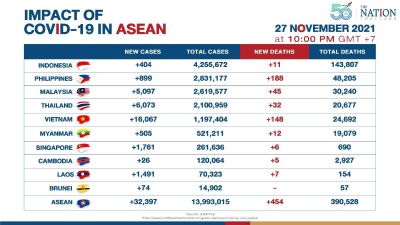
Southeast Asia saw an increase in new Covid-19 cases and related deaths on Saturday (November 27), collated data showed.
Asean countries reported 32,397 infections and 454 deaths on Saturday compared to 29,185 and 425 respectively on Friday.
– Malaysia has banned travel to and from seven African countries in order to prevent the spread of new omicron coronavirus variant. Malaysian who have returned from such countries must undergo quarantine once arriving in the country.
– Philippines has banned the entry of people travelling from South Africa, Botswana, Namibia, and their neighbouring countries immediately until December 15.
A northern Virginia child was the first in the state to die of an inflammatory syndrome associated with covid-19, state health officials said Friday.
The child, who was between the ages of 10 to 19, lived in the Prince William health district, which includes Prince William County as well as the cities of Manassas and Manassas Park.
More than 5,526 cases of the rare but serious illness – which is known as multisystem inflammatory syndrome in children (MIS-C) – had been reported nationwide as of Nov. 1. Just 48 of those patients have died.
Virginia health data shows 111 cases of the illness have been reported within the state. Maryland has reported between 100 and 149 cases, according to the U.S. Centers for Disease Control and Prevention, while the District of Columbia has reported between 25 and 49.
The syndrome appears to have some similarities with Kawasaki disease and can cause problems with a child’s heart, lungs, kidneys and other organs. Symptoms include ongoing fever and stomach pain, vomiting and lightheadedness.
“We are devastated by this sad news, and our hearts go out to the family and friends of this child,” Virginia Health Commissioner M. Norman Oliver said in a statement.
He urged families to get vaccinated if they have not done so already and to wear masks during the holiday season.
A new, possibly more infectious coronavirus variant, with an unusual number of mutations, had scientists sounding the alarm Friday and countries including the United States moving to impose travel restrictions as the world feared another setback on the long road out of the pandemic.
Senior Biden administration officials announced that starting Monday, travel to the United States will be restricted from South Africa and seven other countries – Botswana, Eswatini, Lesotho, Malawi, Mozambique, Namibia and Zimbabwe. The new policy, which does not affect U.S. citizens and permanent residents, was enacted “out of an abundance of caution,” officials said, as scientists work to learn more about the new variant.
This latest variant arrives nearly two years after the first ominous warnings about a novel coronavirus emerged from China. Now, even as the world grows increasingly weary of measures to contain the virus, this new threat is casting a shadow across holiday celebrations.
On Friday, the World Health Organization declared the mutation-laden virus a “variant of concern” after a full-day review by the group’s scientists and dubbed it the “omicron” variant, named for a Greek letter.
“This variant has a large number of mutations, some of which are concerning,” the WHO said in a statement Friday. “Preliminary evidence suggests an increased risk of reinfection with this variant, as compared to other” variants of concern.
In many ways, the virus is acting exactly as global health experts have warned it might – creating new and potentially more dangerous variants, first detected in under-vaccinated parts of the world. Still, major questions remain about omicron’s origins, transmissibility, whether it might make people sicker and whether it might be able to evade vaccines or therapeutics.
“It’s early to know the effectiveness of current vaccines against the new variant,” said Bruce Gellin, a vaccine expert and chief of global public health strategy at the Rockefeller Foundation.
Scientists in South Africa convened a news conference Thursday and said they had linked omicron to an exponential rise of infections in the country. Cases have also been identified in Belgium, Botswana, Hong Kong, Israel and other countries.
Financial markets plummeted amid news of the variant, with the Dow Jones industrial average delivering its worst day of 2021 with a 905-point plunge. By the time trading stopped at 1 p.m. because of the holiday weekend, the Dow had shed about 2.5%, the S&P 500 had erased 2.3% and the tech-heavy Nasdaq had declined 2.2%.
The World Trade Organization postponed its first ministerial meeting in four years because of the deteriorating health situation, Reuters reported.
Britain, Canada, France, Israel and Japan began to ban or order quarantines for air passengers arriving from the southern African region. European Union countries agreed Friday to ban air travel from seven southern African countries.
“Our view is very clear,” Dana Spinant, deputy chief spokeswoman for the European Commission, said at a news conference. “We need to act very fast, we need to be vigilant, and we need to take all measures that are appropriate at this stage to prevent this virus from entering Europe.”
Chief among experts’ concerns is whether coronavirus vaccines will prove less powerful against omicron – and whether they could be adapted to target the new variant.
In a statement, Pfizer and BioNTech said the companies expect to have data within two weeks that will provide more information on whether omicron may require an adjustment to the companies’ coronavirus vaccine.
Pfizer and BioNTech have been working to adapt their mRNA vaccine “within 6 weeks and ship initial batches within 100 days in the event of an escape variant.” The companies have begun clinical trials to test their vaccine against other variants that could provide blueprint studies for regulators if a variant-specific vaccine is needed.
Moderna, maker of another mRNA coronavirus vaccine, said Friday it was “working rapidly” to test the ability of its vaccine to neutralize the omicron variant and that it expected to have data “in the coming weeks.” It also plans to advance an omicron-specific booster candidate, according to a company statement.
The omicron variant, Moderna said, carries a combination of mutations that pose a “significant potential risk” to both natural and vaccine-induced immunity.
Gellin said U.S. regulators have “not yet mapped the process they would use to make adjustments to coronavirus vaccines.” But small clinical trials would probably be needed to ensure that changes had the effect desired.
The Food and Drug Administration is familiar with updating vaccines, Gellin said, and has a long track record of approving flu vaccines to “match” the viruses in circulation every year.
“There is no reason why future boosters should not be updated to match the most common strain” of the coronavirus, said John Brownstein, chief innovation officer at Boston Children’s Hospital.
Africa began ramping up its monitoring of variants several months ago, made wary by the delta variant’s destructive sweep across India and the continent’s low vaccination rates, which some officials blamed on “vaccine hoarding” by wealthier countries. In South Africa, just 25% of the population is vaccinated, and officials said the vast majority of people hospitalized continue to be unvaccinated.
Biden administration officials said Friday the United States has shipped more than 275 million doses of coronavirus vaccine to 110 countries, including 93.9 million for Africa, and 13.3 million to the newly restricted countries, and that it has worked to boost vaccine manufacturing in South Africa.
Top South African health officials said they began exploring the possibility of a new variant when they discovered a fast-growing cluster of cases in the nation’s populous Gauteng province. The officials said they wanted to announce the new variant to help prevent further spread – and scientists around the world noted that the variant was detected far more quickly than the delta variant, which was idenified in India and quickly spread around the world.
But South African health officials decried the world’s reaction as unjustified, saying South Africa should not be “punished” for making this discovery, particularly because the variant’s origin remains unknown.
“This kind of knee-jerk reaction, really does not make sense,” said Joe Phaahla, South Africa’s health minister. “Many of these countries that are coming with this draconian reaction are battling their own fourth wave.”
“The world should provide support to South Africa and Africa and not discriminate or isolate it!” tweeted Tulio De Oliveira, director of South Africa’s Center for Epidemic Response & Innovation, calling on philanthropists to help. “By protecting its poor and oppressed population we will protect the world,” De Oliveira wrote.
The European Center for Disease Prevention and Control offered a new threat assessment Friday noting the distinct possibility that the new variant will spread.
Even before the latest variant emerged, Europe was applying new lockdowns and travel restrictions for unvaccinated residents in an attempt to contain a surge in coronavirus cases. Reported deaths in Europe reached nearly 4,200 a day last week – twice the number since the end of September, according to the World Health Organization, which counts 53 countries as part of its European region. Covid-19 cases fueled by the delta variant have been surging in some U.S. states, too, including Michigan and Minnesota.
As scientists study the newly emerged variant, they are left fearful because of the number of mutations present in the variant and their location, sparking concerns it could be more resistant to vaccines and therapeutics, more transmissible or cause more serious illness in more people.
“We just don’t know,” said Brownstein, who emphasized the importance of waiting for research.
“Those mutations are worrisome,” said Albert Ko, an infectious-disease epidemiologist at the Yale School of Public Health, who said they may compromise treatments known as monoclonal antibodies. “That’s the proof that has to be done,” said Ko, who pointed out that multiple mutations can also cripple a virus, making it less fit.
“Not all mutations are good for the virus,” Ko said.
Massimo Ciccozzi, head of the molecular epidemiology unit at the Rome-based University Campus Bio-Medico, described omicron as “a greatest hits compilation of all mutations from other variants, within one lineage.”
Ciccozzi, who speculated that the package of mutations may be due to long-term treatment of a single immunocompromised patient, noted one bright spot. Unlike delta, omicron is detectable through the normal procedures used with other variants.
“The molecular test detects it,” Ciccozzi said. “Which is very important because it just won’t go unnoticed.”
Susan Hopkins, chief medical adviser to Britain’s Health and Security Agency, told BBC Radio that South Africa had a very low level of cases at one point and then “in a shorter period than two weeks, they have more than doubled their epidemiology picture.”
Britain maintains a world-class system of laboratories to detect and study the genomes of coronavirus variants and modeling groups that forecast potential spread. The southern African strain has not been found in Britain.
Israel imposed a travel ban covering most of Africa after the detection of the new variant.
“We are currently on the verge of a state of emergency,” Israeli Prime Minister Naftali Bennett said.
In Japan, travelers arriving from six African countries will need to quarantine at designated accommodation facilities for 10 days beginning Saturday, rather than quarantining at home, Chief Cabinet Secretary Hirokazu Matsuno announced Friday evening.
India on Thursday alerted all states to the new variant, advising them to test and screen everyone traveling from and transiting through the “at-risk” countries of South Africa, Botswana and Hong Kong. India earlier this month had opened its borders to vaccinated international travelers after more than a year and a half.
“What’s interesting is the policies,” said Ko, the Yale epidemiologist, noting how the coronavirus has consistently beaten global responses. “Are any of these policies going to help?”
KYIV, Ukraine — Ukrainian President Volodymyr Zelensky asserted Friday that a group of Russians and Ukrainians planned to attempt a coup in Ukraine next month and that the plotters tried to enlist the help of the countrys richest man, Rinat Akhmetov.
Zelensky, speaking at a “press marathon” for local and international media, said that audio recordings, obtained by Ukraine’s security services, caught plotters discussing their plans and mentioning Akhmetov’s name.
Akhmetov was not involved in the purported coup plot, however, Zelensky said.
The president offered no other details, leaving many questions about his motives for making the allegations public and what possible actions authorities have taken.
Akhmetov, a mining and steel tycoon, also owns media holdings, which in recent weeks have increased their criticism of Zelensky and his administration.
A statement attributed to Akhmetov called Zelensky’s claims “an absolute lie.” Kremlin spokesman Dmitry Peskov denied any Russian role in an alleged plot.
“Russia never engages in such things. There have never been such plans,” Peskov said.
Zelensky’s comments also come against a backdrop of rising tensions between Kyiv and Moscow.
Western and Ukrainian officials say that they have observed a buildup of Russian forces on the country’s border with Ukraine.
The reasons for the buildup are unclear, but U.S. and other officials say that it could be preparation for an invasion or an escalation in the seven-year-old conflict in eastern Ukraine with anti-Kyiv insurgents, backed by Moscow, according to Western officials and independent researchers.
Speaking in Nantucket, Mass., President Joe Biden told reporters that he would “in all probability” have talks with Zelensky and Russian President Vladimir Putin over the deepening tensions.
“I believe [Akhmetov] is being dragged into the war against Ukraine,” Zelensky said. “This will be a big mistake, because it is impossible to fight against the people, against the president elected by the people of Ukraine.”
Zelensky said the alleged coup was being planned for Dec. 1 or 2. He gave no further details.
Ukrainian media in recent weeks have commented on growing tensions between Zelensky and Akhmetov. Zelensky has launched a “de-oligarchization”campaign to reduce the political influence of Ukraine’s richest people, who control key sections of the economy.
“I am outraged by the spread of this lie, no matter what the president’s motives are,” Akhmetov was quoted as saying. “My position has been and will be explicit and definite: an independent, democratic, and united Ukraine with the Crimea and my home region, Donbas.”
Donbas is part of the breakaway region in eastern Ukraine. The Crimean Peninsula was annexed by Russia from Ukraine in 2014.
The Ukrainian president said his country was prepared for any scenario in the volatile east.
“We are in full control of our borders and ready if there will be an escalation,” Zelensky said.
He added, however, that the number of Russian forces was smaller than during a buildup in spring this year, an episode that also caused concern about a possible Russian offensive.
Zelensky said Ukraine had received promises of support “in public and not in public” from its Western partners if Russia were to take military action, but he did not provide details.
He said that the risk of escalation or invasion from Russia was always present and that Ukraine had observed a sharp rise in aggressive comments coming from Russia, which he said was worrying.
“When Russia says it is defending its borders, it is very dangerous,” Zelensky said.
NANTUCKET, Mass. – The United States will restrict travel from South Africa and seven other countries starting Monday, as President Joe Biden and his administration cautiously responded to a wave of global anxiety over the new omicron coronavirus variant.
The travel policy was implemented out of “an abundance of caution in light of a new coronavirus variant circulating in Southern Africa,” a senior Biden administration official said in announcing it. Other regions and countries, including the European Union, Britain, Japan and Israel, also set restrictions for air travelers arriving from southern Africa.
The restrictions will apply to travelers from South Africa, Botswana, Zimbabwe, Namibia, Lesotho, Eswatini, Mozambique and Malawi. They do not apply to American citizens and lawful permanent residents, the official said.
Biden was briefed by his chief medical adviser, Anthony Fauci, and others Friday on the variant. Biden said in a statement that the restrictions were “a precautionary measure until we have more information,” and again urged Americans to get vaccinated and get booster shots.
“If you have not gotten vaccinated, or have not taken your children to get vaccinated, now is the time,” Biden said.
“We don’t know a lot about the variant, except that it is of great concern. It seems to spread rapidly, and I spent about a half-hour this morning with my covid team, led by Dr. Fauci, and so, that was the decision we made,” Biden later told reporters. He also said his staff recommended waiting until Monday rather than immediately instating the ban.
Since late Wednesday, senior administration officials have been on a flurry of calls to review preliminary reports out of South Africa and to begin planning for various scenarios, said one of those officials said, who spoke on the condition of anonymity to describe private conversations.
The White House arranged a meeting Friday between U.S. and South African doctors to learn more about the variant that is spreading in that region, Fauci said in an interview on CNN “New Day.”
“We want to find out scientist-to-scientist exactly what is going on,” Fauci said of the meeting.
The calls have included health officials in South Africa and representatives of the various vaccine manufacturers. But the administration official said it will likely be two weeks before health officials have a full picture of the vaccines’ efficacy against the new variant.
Fauci said the new variant has “some mutations” that “are raising some concern,” including “with regard to possibly transmissibility increase and possibly evasion of immune response.”
On Friday, the stock market tumbled, with the Dow Jones falling more than 900 points on concerns about the new variant, its worst day of the year thus far at the close. The S&P 500 was also down by more than 2.2% at the close.
Biden told reporters the market activity was “expected” and typical after bad coronavirus news and that he was “not at all” worried about the drop.
The World Health Organization announced the official name of the variant, in line with protocols, and labeled it a “variant of concern” in a statement Friday morning. The WHO said it was first alerted to the variant by South Africa on Wednesday.
The new variant is emerging as Biden is struggling with low poll numbers but optimistic that the country is emerging from the pandemic. The president traveled to Nantucket with his family, a longtime tradition, to celebrate Thanksgiving and showcase how much has improved in American life over this time last year. He skipped the trip in 2020 because of pandemic restrictions.
On Thursday, Biden sought to project confidence about the fight against the pandemic when he called in to NBC’s broadcast of the Macy’s Thanksgiving Day Parade. “My message is, after two years, you’re back. America is back. There’s nothing we’re unable to overcome,” Biden told host Al Roker.
Biden in his Friday statement said the new variant underscored the need for other countries to do more to increase global vaccinations, including by waiving intellectual property restrictions that hamper production.
Fauci said scientists are trying to determine whether the current vaccines work against the new variant. “Once you test it, you’ll know for sure whether it does or does not evade the antibodies that we make, for example, against the virus through a vaccine” or after infection, he said.
Fauci said that determining whether the variant can evade the vaccines is a key piece of data he’d like to have before recommending further action. “You’re prepared to do everything you need to do to protect the American public but you want to make sure there’s a basis for doing that, and that’s what we’re doing right now,” Fauci said.
U.S. officials have started planning for various scenarios depending on how effective the vaccines are, and they remain confident in their ability to handle any outcome. But the senior administration official warned against drawing any immediate conclusions, saying only a limited amount of data is available at this point.
“The main message right now is get boosted,” the official said. “It can only help with a new variant.”
SEATTLE – As the holiday shopping season kicks off this weekend, consumers will find prices higher than theyve been in months.
That’s particularly true at Amazon, which has raised prices faster than rivals, according to Profitero, an e-commerce data analytics company that tracks more that 20,000 popular items across several large online retailers. Amazon’s prices on those items grew 7.5% in October, compared with the same month a year ago.
Walmart’s prices in comparison grew 3.1% and Target’s grew 3.6% for the same items over that period.
Amazon – the dominant online retailer with more than 41% of e-commerce, according to eMarketer – also plays a huge role in influencing prices across the Web. The phenomenon, which economists have dubbed the “Amazon Effect,” happens because rivals tend to follow Amazon’s lead to match each other on online pricing.
Retailers with brick-and-mortar stores are matching their online pricing to physical shelves, too, Harvard Business School economist Albert Cavallo said, homogenizing prices – low or high – across the board.
“Online competition is a force for price uniformity, and therefore also inflation equalization,” Cavallo said. And as retailers get better at bringing online pricing, with its frequent swings, to their physical stores, the Amazon Effect becomes an even greater force.
That matters because consumer prices grew 6.2% in October compared to a year ago, according to the Bureau of Labor Statistics. The spike, the largest annual inflation increase in 30 years, is driven by soaring energy prices and ongoing supply-chain backlogs.
Retailers – including Amazon – are struggling with the global supply-chain crunch and a domestic labor shortage that have pushed up costs. Amazon said last month it plans to spend an extra $4 billion during the fourth quarter to lure seasonal workers with richer paychecks and benefits and to ensure that packages arrive at its warehouses. The company is hiring 150,000 seasonal workers. In the third quarter, the company spent $18.5 billion on fulfillment costs.
“We’re doing everything we can,” finance chief Brian Olsavsky said on a call last month with analysts. “The issue is, it’s costly.”
(Amazon founder Jeff Bezos owns The Washington Post.)
Amazon spokesman Patrick Graham acknowledged the pressure that increased manufacturing and supply-chain costs puts on pricing.
“Customers come to Amazon to find low prices, and we strive to deliver by matching the lowest price from across relevant competitors every day,” Graham said. “In spite of increased manufacturing and supply-chain costs, Amazon continues to offer customers the best possible value and selection, not only during the holiday season but throughout the year.”
Amazon has long used algorithms that scrape other retail websites to ensure its merchandise matches or beats the competition. The company doesn’t always try to beat rivals, particularly on items such as large packages of toilet paper that can be more costly to ship. An 18-roll package of Charmin Ultra Strong, for example, was recently available on Amazon for $31.03, while Target offered the product for $18.79.
Amazon’s Graham disputed that the company doesn’t always try to beat rivals, and said that the Charmin toilet paper on its site was sold by a third-party merchant who sets its own prices.
“Amazon seeks to always meet or beat the best price offered at other retailers on the products we sell ourselves, and our systems continually benchmark prices in other stores to make sure we are delivering on this promise,” Graham said after publication of this article. “If we find an isolated error where we offer a product at a higher price than other major retailers, we quickly investigate and take action to ensure our price meets or beats the lowest price elsewhere.”
The majority of products offered through Amazon’s marketplace come from third-party sellers, and Amazon pressures them to keep prices competitive. D.C. Attorney General Karl A. Racine filed an antitrust suit in May alleging that Amazon prevents sellers from offering their products at lower prices or on better terms on any other online platforms, including their own websites, and that prohibition results in “artificially high” prices across e-commerce sales. Amazon has said that sellers are responsible for the prices they offer on its marketplace.
One way Amazon keeps prices from third-party sellers low is through the “buy box” – the crucial piece of digital real estate on product pages that customers use to add items to their shopping carts. The buy box is often a boon for sellers, since studies have shown that shoppers regularly purchase items Amazon’s algorithms elevate there.
There’s also plenty of competition. Product categories like ear buds with several third-party sellers fighting one another for sales are less prone to inflationary pressure, said Juozas Kaziukenas, CEO of the e-commerce research firm Marketplace Pulse.
“The marketplace protects against rising prices because it dynamically shifts sales to the most competitive offers,” Kaziukenas said. “On Amazon, it matters less if products X and Z are getting more expensive. Because on Amazon there are also Y, T, U, etcetera products that didn’t get more expensive. Consumers will pick those.”
Amazon’s prices rose in part because it started with lower prices, Profitero President Sarah Hofstetter said. Even with the price increases on Amazon, Profitero found that Walmart’s prices on the 20,000 items are 4% more than Amazon’s prices, and Target’s prices are 15% more expensive.
Target and Walmart did not immediately respond to a request for comment.
Across the board, however, prices are higher on some of those items. Take the Bose portable home speaker, an item that sold for $399 on Amazon, Walmart and Target sites last weekend. Profitero found that the average price for the speaker from July to October this year jumped 9% on Amazon compared to the same period a year ago. The price on the device jumped 3% at Target and 2.8% at Walmart.
Meanwhile, large consumer-goods companies are struggling to fill the orders placed by Amazon and other retailers – leading to price spikes in categories such as grocery and pet products.
CommerceIQ, a consultant for consumer-product brands including Johnson & Johnson, Kellogg’s and Nestle, tracks the orders Amazon places for items from its 4,000 clients to sell on its site. CommerceIQ said those clients’ ability to meet orders has dipped since spring.
Amazon is “ordering more, but vendors are less able to fill them,” said Guru Hariharan, CommerceIQ’s chief executive.