“For the first time in two decades, extreme poverty is on the rise. Last year, around 120 million people fell into poverty as the COVID-19 pandemic wreaked havoc on economies and societies,” Guterres said.
UN Secretary-General Antonio Guterres on Sunday called for transformative, inclusive, and sustainable recovery from COVID-19 to end poverty and create a world of justice, dignity and opportunity for all.
“Poverty is a moral indictment of our times. For the first time in two decades, extreme poverty is on the rise. Last year, around 120 million people fell into poverty as the COVID-19 pandemic wreaked havoc on economies and societies,” he said in a message for the International Day for the Eradication of Poverty, which falls on Oct. 17.
“A lopsided recovery is further deepening inequalities between the Global North and South. Solidarity is missing in action — just when we need it most,” he said.
Vaccine inequality is allowing variants to develop and run wild, condemning the world to millions more deaths, and prolonging an economic slowdown that could cost trillions of dollars. There is a need to end this outrage, tackle debt distress and ensure recovery investment in countries with the greatest need, he said.
The world needs a three-pronged approach to global recovery, said Guterres.
First, the recovery must be transformative instead of going back to the endemic structural disadvantages and inequalities that perpetuated poverty even before the pandemic.
“We need stronger political will and partnerships to achieve universal social protection by 2030 and invest in job re-skilling for the growing green economy. And we must invest in quality jobs in the care economy, which will promote greater equality and ensure everyone receives the dignified care they deserve,” he said.
Second, the recovery must be inclusive, because an uneven recovery is leaving much of humanity behind, increasing the vulnerability of already marginalized groups, and pushing the Sustainable Development Goals ever further out of reach, Guterres said.
Third, the recovery must be sustainable to build a resilient, decarbonized and net-zero world, he said.
Clinton, 75, was admitted Tuesday evening to the University of California Irvine Medical Center in Orange County for a urological infection that spread to his bloodstream, according to his aide.
Former U.S. President Bill Clinton was released Sunday from a Southern California hospital where he had been treated multiple days for a non-coronavirus-related infection.
“President Clinton was discharged from UC Irvine Medical Center today. His fever and white blood cell count are normalized, and he will return home to New York to finish his course of antibiotics,” said Dr. Alpesh N. Amin, chairman of the Department of Medicine at the University of California, Irvine, who had been overseeing the team of doctors treating Clinton, in a statement shared by the former president’s spokesperson Angel Urena on Twitter.
“On behalf of everyone at UC Irvine Medical Center, we were honored to have treated him and will continue to monitor his progress,” Amin added.
Clinton, 75, was admitted Tuesday evening to the University of California Irvine Medical Center in Orange County for a urological infection that spread to his bloodstream, according to his aide.
The former U.S. president was in Southern California for a private reception and dinner for the nonprofit Clinton Foundation. After meeting with friends in Orange County on Tuesday, he reported feeling fatigued, an aide to the former U.S. president was quoted as saying by The Los Angeles Times.
Clinton is flying to New York with his wife, former U.S. Secretary of State Hillary Clinton, and his daughter, Chelsea, reported the newspaper.
Clinton, a member of the Democratic Party, served as the 42nd U.S. president from 1993 to 2001.
Former president Bill Clinton was discharged from the hospital Sunday, his medical team confirmed, nearly a week after he was admitted for an infection of the bloodstream, a condition known as sepsis.
Clinton, 75, was admitted to the University of California at Irvine Medical Center on Tuesday “to receive treatment for a non-Covid-related infection,” his spokesman, Angel Ureña, said in a statement Thursday.
On Sunday, Clinton’s fever and white blood cell count were normalized, Alpesh N. Amin, chair of the hospital’s department of medicine, said in a statement. Clinton will return home to New York to finish his course of antibiotics, added Amin, who had been overseeing the team of doctors treating the former president.
“On behalf of everyone at UC Irvine Medical Center, we were honored to have treated him and will continue to monitor his progress,” Amin said.
Clinton was diagnosed with a urological infection that morphed into an infection of the bloodstream, or sepsis, according to a Clinton aide who spoke on the condition of anonymity to discuss the former president’s medical status. However, Clinton was never in septic shock, a far more serious and life-threatening condition, the aide said.
On Friday, Ureña said all of Clinton’s health indicators were “trending in the right direction” and that his white blood count had decreased significantly. On Saturday, the spokesman noted that Clinton would remain hospitalized overnight again to continue to receive intravenous antibiotics.
“He is in great spirits and has been spending time with family, catching up with friends and watching college football,” Ureña said in a statement Saturday. “He is deeply grateful for the excellent care he continues to receive and thankful to the many well-wishers who have sent kind words to him and his family. He’s looking forward to getting home very soon.”
Clinton’s wife, former first lady and former secretary of state Hillary Clinton, was photographed visiting UC Irvine Medical Center several days this week.
Bill Clinton was in California earlier last week for an event related to his nonprofit Clinton Foundation and was taken to the hospital Tuesday after reporting that he was not feeling well, according to CNN chief medical correspondent Sanjay Gupta.
The issue was not related to the coronavirus or to his heart, Gupta reported after interviews with Clinton’s doctors. Clinton underwent heart bypass surgery in 2004 and had stents placed in 2010.
President Joe Biden, during a visit to a Connecticut child-care center Friday, said that he had been “exchanging calls” on the situation and that Clinton seemed “to be really doing well.”
Biden spoke with Clinton by phone Friday afternoon, according to deputy White House press secretary Karine Jean-Pierre.
“He’s doing fine. He really is,” Biden said Friday. “He’s not in any serious condition.”
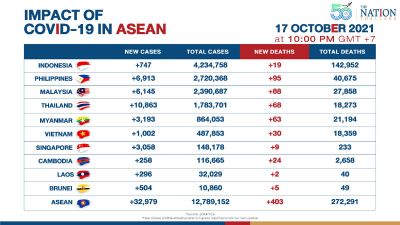
The number of Covid-19 cases crossed 12.78 million across Southeast Asia, with 32,979 new cases reported on Sunday (October 17), lower than Saturday’s tally at 35,620. New deaths are at 403, decreasing from Saturday’s number of 526. Total Covid-19 deaths in Asean are now at 272,291.
Fully vaccinated travellers entering Malaysia will begin serving a reduced quarantine period of seven days from Monday (October 18). Meanwhile, those who are not vaccinated or have yet to complete their Covid-19 vaccine doses should undergo a quarantine period of 10 days. Individuals returning from high-risk infection areas are also allowed to reduce their period of quarantine to 7 days, provided that they have been fully vaccinated.
Brunei Health Ministry announced that they are starting to administer the third dose of Covid-19 vaccine for frontliners, providing additional protection for those at higher risk of infection. Brunei previously announced that Covid-19 vaccines from Pfizer BioNTech, Moderna, AstraZeneca, China’s Sinopharm, and Johnson and Johnson would be administered in the country.
So far, over 339,000 individuals had received the first doses of the Covid-19 vaccine under the National Vaccination Program, which is 74.9 percent of the total population, while 224,028 individuals had completed the second doses of the vaccine, which is 49.4 percent of the total population.
President Joe Bidens chief medical adviser said he expects U.S. regulators to consider whether people who got the one-dose Johnson & Johnson vaccine should get an mRNA shot against covid-19 as a booster.
“If you boost people who have originally received J&J with either Moderna or Pfizer, the level of antibodies that you induce in them is much higher than if you boost them with the original J&J,” Anthony Fauci said on ABC’s “This Week” on Sunday.
“But the data of boosting the J&J first dose with a J&J second dose is based on clinical data,” he said. “So what’s going to happen is that the FDA is going to look at all those data, look at the comparison, and make a determination of what they will authorize.”
A so-called mix-and-match booster has been discussed among scientists and government experts, though no timeline has been released for when it might be officially considered. The issue is complicated by safety, supply and concern about confusing public messaging.
Food and Drug Administration experts recommended a second Johnson & Johnson shot for people 18 and older last week. They also backed a third dose of the Moderna Inc. shot – which unlike J&J uses mRNA technology – for people at high risk of contracting covid-19. The recommendations require backing by the FDA and the Centers for Disease Control and Prevention, which could come as soon as this week.
The Pfizer Inc.-BioNTech SE vaccine, also based on mRNA technology, was cleared for boosters in September. More than 10 million third shots have been given in the U.S.
Fauci said the individual choice of which booster to get would depend on several factors, including the risk of myocarditis, a heart inflammation that some evidence suggests is a risk for young men who get mRNA vaccines.
“I believe there’s going to be a degree of flexibility of what a person who got the J&J originally can do, either with J&J or with the mix-and-match from other products,” Fauci said on “Fox News Sunday.”
Fauci also said that people could safely enjoy gathering during the U.S. holiday season if vaccinated – a message to some 66 million eligible people in the country who haven’t been inoculated.
“When you do that, there’s no reason at all why you can’t enjoy the holidays in a family way, the way we’ve traditionally done it all along,” he said on “This Week.”
International travelers who are fully vaccinated with mixed doses of approved coronavirus vaccines will be allowed into the United States, the Centers for Disease Control and Prevention said in recently updated guidance.
The White House said U.S. travel restrictions will be lifted Nov. 8 for fully vaccinated international travelers, a policy that will in part require foreign travelers to show proof of vaccination before boarding a flight. According to a Friday update to CDC guidance, individuals will be considered fully vaccinated if they receive vaccines approved by the Food and Drug Administration or by the World Health Organization – including combinations of such shots.
That means international travelers will be considered fully vaccinated two weeks after they receive an FDA- or WHO-approved single-dose vaccine, such as the Johnson & Johnson shot, or “any combination of two doses of an FDA approved/authorized or WHO emergency use listed COVID-19 two-dose series,” such as the Oxford-AstraZeneca vaccine.
While the CDC said it has not recommended mixing and matching vaccines, it acknowledged that “use of such strategies (including mixing of mRNA, adenoviral, and mRNA plus adenoviral products) is increasingly common in many countries outside of the United States.”
Rep. Brian Higgins, D-N.Y., whose district along the Canadian border includes Niagara Falls and Buffalo, said the CDC’s guidance was updated after he wrote a letter to CDC Director Rochelle Walensky requesting a clarification on its policies.
“Clarity is needed on which vaccines the United States will accept when the border reopens to all fully vaccinated Canadians,” Higgins wrote Thursday. “Nearly four million Canadians, equivalent to ten percent of their fully vaccinated population, have received mixed doses of the available mRNA COVID19 vaccines – this includes the AstraZeneca vaccine.”
In an interview Sunday, Higgins told The Washington Post that his office communicated with the CDC before sending the letter, and that the agency indicated that it was “working on it.”
Higgins welcomed the “long-overdue” update but criticized the rollout of the federal government’s travel rules.
“This border should have been open months ago,” he said, adding that “both sides of the border have been hurt economically and have been hurt emotionally and have been hurt in terms of quality of life.”
He said the guidance clarifying which vaccines will be allowed is “helpful, but again these are stand-alone issues that have confused people.”
“It was inevitable that the border was going to open at some point,” Higgins said. “All of these issues should have been anticipated and discussed and finalized so both the U.S. and Canadian governments and public health officials can speak with one, clear, concise message. That’s still not happening.”
He also criticized the testing requirements for travelers coming into the United States.
Higgins’s office said he would “continue to seek answers to questions related to what the screening process will look like and will advocate for the removal of arduous testing requirements which he views as redundant for the vaccinated and an obstacle to the mutually beneficial binational exchange between Canada and the United States.”
The CDC’s website notes that fully vaccinated air travelers coming into the United States from abroad will be required to have a negative coronavirus test result before boarding a flight into the United States. Those traveling by land do not need to provide a negative test.
Anthony J. Santella, professor of health administration and policy at the University of New Haven in Connecticut, said the CDC’s guidance allowing mixed vaccine doses “is a smart thing to do if you want to open your doors again.”
“If we’re really serious about being okay with domestic and international travel, we have to be willing to accept that not every country does the same thing and has the same kind of vaccination policy,” he said.
Santella said the CDC’s guidance suggests that U.S. officials are “choosing to accept that these vaccines largely work and that we’ll err on the side of ‘If you’re vaccinated, regardless of what vaccine it is, you’re welcome here,’ and to let science continue to take its course.”
The updated guidance comes as a U.S. coronavirus surge wanes, though public health experts are bracing for the possibility of a “twindemic” of covid and the flu season.
More than 59,000 people in the United States are hospitalized for treatment of covid-19, according to data tracked by The Washington Post, with coronavirus-related hospitalizations falling 7.5% in the past week. There were more than 100,000 new coronavirus cases reported Friday, with new daily reported cases dropping more than 13% in the past week.
Haiti on Sunday became the center of an international crisis as officials in the beleaguered Caribbean nation sought to liberate 17 missionaries and family members, most of them Americans, taken captive a day earlier by a street gang known for mass kidnappings and ransoming religious groups.
The kidnappings Saturday escalated the convergence of challenges in a country that analysts increasingly describe as a failed state sitting less than 700 miles off the Florida coast. A succession of U.S. administrations has failed to stop its slide into chaos, and the abductions – part of a surge in kidnappings this year by armed gangs that rule large swaths of the country – ramped up pressure on the fragile and bitterly divided interim government that stepped in after the still-unsolved assassination in July of President Jovenel Moïse.
Haitians from all walks of life have been swept up in the lucrative ransom racket, in which victims are held for days or longer as captors, families and authorities negotiate their release. Abductions of fuel trucks and their drivers have caused power and fuel shortages nationwide, and shipping contractors have refused to send drivers through key national arteries due to the inability of the police to secure key roads that are controlled by or infested with gangs.
“This shows us that no matter who you are, or where you are in Haiti, you are never safe,” said Pierre Espérance, director of Haiti’s National Human Rights Defense Network.
Ohio-based Christian Aid Ministries requested “urgent prayer” for the seven women, five men and children who were abducted. The group included 16 U.S. citizens and one Canadian citizen, the organization said in a statement on its website Sunday.
“We are seeking God’s direction for a resolution, and authorities are seeking ways to help,” the organization said. “Join us in praying for those who are being held hostage, the kidnappers, and the families, friends, and churches of those affected.”
A voice on an audio recording described as a “prayer alert” from Christian Aid Ministries and obtained by The Washington Post said the missionaries were seized while returning from a visit to an orphanage and were being held by an armed gang. They included organization staff and family members, according to the recording and a person familiar with the abduction.
The voice said the field director’s family and one other man stayed at the organization’s Haitian base in Titanyen, around 12 miles north of Port-au-Prince. All other staff who were on the visit to the orphanage were abducted.
“The mission field director and the American embassy are working to see what can be done,” the voice said. It later added: “Pray that the gang members will come to repentance and faith in Jesus Christ.” Messages left for Christian Aid Ministries were not returned.
Organizations that monitor kidnappings in Haiti said the missionaries were abducted by a much-feared gang known as 400 Mawozo, which is known for targeting religious groups and controls parts of Ganthier, the town east of Port-au-Prince where the group was seized. In recent months, its members have increasingly engaged in mass kidnappings from buses and cars.
Haitian officials declined to discuss negotiations to free the kidnapped missionaries. Groups that follow kidnappings in Haiti believe they are being held in Croix-des-Bouquets just east of the capital.
Authorities sought to negotiate with Joly “Yonyon” Germine, a jailed gang member considered to be the second-in-command of 400 Mawozo.
The gang in April kidnapped five priests and two nuns, some of them French nationals. All eventually were released. Catholic universities and schools closed in protest. The prime minister at the time, Joseph Jouthe, resigned shortly afterward, following a surge of other gang crimes – including an attack on an orphanage in which children were sexually assaulted.
The Catholic clerics, held for three weeks along with other victims, suffered harsh conditions during their captivity, including a lack of food or poor quality meals. They were not tortured or beaten, Espérance said, but two suffered medical complications from lack of access to their prescription medications.
It is common in Haiti for kidnappers to wait 24 to 72 hours before issuing ransom demands, which typically start high before being negotiated down. Though kidnapped victims have been killed, they are far more frequently set free, traumatized but without permanent physical damage, after ransoms are paid.
“Sometimes they start by asking for a million, but then accept $10,000 or $20,000,” Espérance said. “There is no fixed amount.”
Gédéon Jean, director of the Center for Analysis and Research in Human Rights in Port-au-Prince, said he had received information from authorities that Saturday’s captives included 16 Americans and one Canadian. A person familiar with the abduction, who spoke on the condition of anonymity to describe the ongoing crisis, said the abducted might also have included two Haitian nationals.
“The modus operandi is they take entire cars and buses,” Jean said. “Then they ask for a price to release everybody.”
Christian Aid Ministries’ American staff members returned to their Haiti base in 2020 after being gone for nine months because of political unrest, the group says on its website.
The person familiar with the matter said that one of the abducted Americans posted a call for help in a WhatsApp group as the kidnapping was occurring.
“Please pray for us!! We are being held hostage, they kidnapped our driver. Pray pray pray. We don’t know where they are taking us,” the message read.
Several Haitian government officials acknowledged that reports were “circulating” but could not immediately confirm the kidnappings. The U.S. State Department declined to detail its involvement.
“The welfare and safety of U.S. citizens abroad is one of the highest priorities of the Department of State,” the department said in a statement. “We are aware of these reports and have nothing additional to offer at this time.”
Haiti has the highest per capita kidnapping rate in the world. Recorded abductions this year have spiked sixfold over the same period last year.
Criminals have nabbed doctors on their way to work, preachers delivering sermons, busloads of people in transit – even police on patrol. Port-au-Prince is now suffering more kidnappings than vastly larger Bogotá, Mexico City and São Paulo combined, according to the consulting firm Control Risks.
Haiti, saddled with endemic poverty and violence, has experienced waves of kidnappings before. But as armed gangs allegedly linked to politicians and private business interests have taken control of roads and communities, analysts say, the current wave is by far the worst in Haiti’s history.
During the first six months of 2021, there were at least 395 kidnappings, compared with 88 during the same period last year, according to the Center for Analysis and Research in Human Rights in Port-au-Prince. After the assassination in July of President Jovenel Moïse – who was accused of being in league with the very gang members who use kidnappings as a source of revenue and control – abductions dropped briefly. But they surged to 73 in August and 117 in September, according to the center.
The nation is reeling from a power vacuum following the assassination of Moïse and the August earthquake that killed more than 2,200 people and left tens of thousands of Haitians homeless across the southern part of the country.
Christian Aid Ministries, based in Millersburg, Ohio, was founded in 1981 as a “channel for Amish, Mennonite, and other conservative Anabaptist groups and individuals to minister to physical and spiritual needs around the world,” according to its website.
The group has more than 100 field staff and several centers in Haiti, Romania, Ukraine, Kenya, Liberia, Nicaragua, Israel, Moldova, Greece and the United States, according to its 2020 annual report. It said it was active in 126 countries and seven territories offering “aid, literature, or teaching” that year.
The group says its work includes anti-poverty projects such as providing food, housing and school assistance, helping victims in crisis, setting up health clinics, and spreading Christian teachings by supporting local churches and evangelizing on billboards.
One program in Haiti provided textbooks, school supplies, meals and Bible training for some 9,340 students at 52 schools in Haiti, according to the website.
“The Haiti School Program helps Haitian children like Elmeus attend school and learn to read and write, better equipping them for the future,” the group wrote in a call for donations on the website on Oct. 12, four days before the abductions.
In 2019, an employee of Christian Aid Ministries was accused of sexually abusing minors while in Haiti. The organization said two of its managers knew the employee had previously confessed to a history of sexually assaulting minors in the United States, but still allowed him to work in Haiti.
Christian Aid Ministries reached a settlement with victims in May 2020. The group said it provided over $420,000 in assistance and restitution to victims who came forward in previous months.
There is no known connection between the abuse allegations and the abductions.
Widlore Mérancourt in Port-au-Prince, Jennifer Hassan in London and Miriam Berger, Claire Parker and Missy Ryan in Washington contributed to this report.
MOSCOW – Unshaven and puffy faced, with tubes in his nose, a patient in a hospitals coronavirus “red zone” recorded a desperate message for Russians.
“Iturned my life and my health into a disaster,” said Innokenty Sheremet, 55, who is from the Ural Mountain region city of Yekaterinburg and came down with covid-19 after forgoing vaccination.
“I turned into an infirm old man,” he continued, describing “terrible pain from any movement.” Many employees at his TV news agency also became infected. Sheremet survived, but his news service collapsed.
In Russia, a “fourth wave” of coronavirus is setting records in daily infection and death numbers, according to official statistics.
But the truth is far worse, say independent demographers and data analysts who are challenging the pandemic data issued by President Vladimir Putin’s government and who, in turn, are facing retribution from authorities. At least three top researchers have been dismissed or have resigned from their posts in government or at state universities amid pressurefrom bosses.
Russia’s official statistics showed 221,313 pandemic-related deaths by mid-October, but the independent demographer Alexey Raksha calculated that excess mortality – seen by analysts as the most reliable indicator of coronavirus deaths – has reached around 750,000. Raksha’s calculation used figures maintained by Rosstat, Russia’s statistical agency. Meanwhile, a report in the Moscow Times estimated the figure at about 660,000.
Russian independent analysts say officials manipulated statistics and underplayed the crisis, most likely for political reasons – claims that have been made about governments in other countries, including China and Turkey. Critics alleging data manipulation by governments say the practice is an obstacle to a full global reckoning of the pandemic’s reach.
The Russian Ministry of Health and Rospotrebnadzor, the government agency that publishes daily coronavirus numbers, did not respond to requests for comment on allegations of low counts. Russian official statistics exclude many deaths of patients with the coronavirus where doctors judge another major factor was to blame, such as heart failure.
“The data for (Russia) is absolutely unreliable,” said Alexei Kouprianov, an independent analyst and biologist who last year organized a community of experts on social media, Watching Covid. He was fired from the St. Petersburg campus of the Higher School of Economics in September 2020.
As Putin’s government tightens political control in the country, the handling of the pandemic has largely been left to the regions. The pandemic has exposed fragilities in a system in which regional officials conceal problems for fear of losing their posts and critics – even analytical experts – are sidelined.
Before the pandemic, life expectancy in Russia was 73 years, whereas it was 84 in countries including Australia, Italy and Spain, and its spending on health care was 5.6 percent of GDP compared with 16.8 percent in the United States and more than 10 percent in Japan and much of Europe, according the Organization for Economic Cooperation and Development.
Russian authorities say their handling of the pandemic has been better than the performance of many Western countries. But with 43 million Russians fully vaccinated by Oct. 14, according to the Health Ministry, about 30 percent of the 144.4 million population, Russia’s vaccination rate is one of the world’s lowest, according to data from the Britain-based Global Change Data Lab. Russia’s rate compares with 56 percent in the United States, 65 percent in Britain and 72 percent in Canada.
Recently, official Russian rhetoric has shifted. Kremlin spokesman Dmitry Peskov said Oct. 11 that mortality rates were high because of the “unacceptably low level of vaccination,” adding that “all conditions have been provided to citizens to save their lives by getting inoculated.”
Since Russian parliamentary elections last month, officials and state media have amplified warnings about the dangers of the coronavirus. The daily coronavirus death toll hit a record 1,002 on Friday, and the country surpassed 33,000 daily infection cases, according to state-approved figures.
“Actually, excess mortality now is more than 2,000 people each day on average,” claimed the demographer Raksha, who was fired by the official statistical agency Rosstat last year for exposing alleged undercounting of daily deaths by the reporting agency Rospotrebnadzor.
“Hospitals are overloaded,” said Andrei Konoval, the head of the independent Union of Medical Workers. Ambulance drivers were ordered to work 24-hours shifts in Yekaterinburg, the independent Znak media reported. Russian Health Minister Mikhail Murashko on Thursday called on retired doctors to return to work.
Denis Protsenko, a pro-Kremlin chief of one of Moscow’s main covid-19 hospitals, sounded the alarm Friday, calling the situation “close to critical.”
“Guys, the coronavirus is not a joke or a fiction. It is surprising that in the second year of the pandemic, people still need to be convinced of this,” he said, calling on medical colleagues to “start talking in a frank and unadorned way to our compatriots.”
Raksha said he thinks that inaccurate statistics sent a message to Russians that the pandemic had been beaten and therefore left space for covid conspiracy disinformation and anti-vaccination propaganda to flood Russian social media.
“In Russia, the covid dissidents won,” he said.
Kouprianov said covid dissidents targeting the Watching Covid social media page often cited official statistics to argue that “nothing special is happening.”
Raksha says he never uses Russia’s official daily statistics on infections and deaths, and “I don’t recommend anyone to do it.” In Russia, a regional official typically “just draws a line by hand to flatten the curve,” he said. “They are just making up numbers, literally.”
One of his prized possessions is a Soviet statistical yearbook from 1987, one of only 100 copies from the period in 1974 to 1988 when demographic statistics were kept secret. He sees a parallel now: The few Russians who follow the social media pages of reliable independent analysts can find a more accurate picture.
Another independent data expert, Alexander Dragan, monitors regional coronavirus surges by tracking searches on Yandex, Russia’s search engine, and on Google. The correlation with excess mortality has been striking, he said.
Tatiana Mikhailova an economist and expert in data analysis, formerly of the prestigious Russian Presidential Academy of National Economy and Public Administration, discovered a pattern in many Russian regions’ reporting on daily cases. Instead of the familiar pandemic curve,the overall case numbers swung wildly in regional reports. Numbers for the main city in region went up one day and the rest of the region’s numbers went down – as if the city and the wider region were taking turns in experiencing surges.
“I discovered this strange pattern in many regions that basically told me that the official statistics are lying,” she said. “They just underreport the cases that they have so as not to show the growth of cases.”
After she published her graphs, the academy blocked her from giving interviews, and she resigned rather than be silenced.
“If you are working on issues that are critical for society, you have to speak to the press because you have to make your results known to the public,” Mikhailova said. “I think it’s your duty as a scientist.”
Doctors are afraid to speak out about the crisis, said Semyon Galperin, the head of the Doctors’ Defense League, an independent association. He said the crisis was sharpened by Russian health system reforms under which more than half the nation’s hospitals and clinics shut down between 2000 and 2015 and thousands of medical workers left the profession.
“The result of these reforms is a broken system,” he said. Unreliable information about the pandemic and vaccines made it worse, he added.
“We don’t know what is going on. Nobody can say what the exact situation is,” he said. “Nobody trusts anyone anymore.
The Denver Art Museum is preparing to return four antiquities to Cambodia following a news media collaboration that reported the pieces are linked to a man charged with trafficking looted artifacts.
The four antiquities to be returned came to the museum through Douglas Latchford, who in 2019 was indicted by U.S. prosecutors after decades of alleged trafficking in looted artifacts from the Khmer Empire, which flourished in Southeast Asia a thousand years ago.
The Washington Post, the International Consortium of Investigative Journalists and other media organizations in the Pandora Papers collaboration began contacting museum officials about pieces in their collection linked to Latchford in June and followed up with a letter in September. The museum removed the four artifacts from its collection after receiving the letter from the news organizations seeking comment about the items.
“The museum is now working with the government to return the pieces to Cambodia,” museum spokesperson Kristy Bassuener said in an email.
The media collaboration reported that 10 museums around the world held at least 43 relics that passed through the hands of Latchford or those of his associates identified by prosecutors.
The four relics from Denver are of “extraordinary cultural significance,” said Bradley Gordon, one of the lawyers representing the Cambodian Ministry of Culture and Fine Arts.
Gordon is part of a team the ministry assembled to track down pieces looted from Cambodia during the decades of tumult around a civil war and the genocidal regime of Pol Pot.
While the Cambodian officials said they welcomed the Denver announcement, the protracted negotiations over the four pieces reflect the general reluctance of museums to return Khmer artifacts that Cambodian officials assert were stolen from the country.
As far back as nine years ago, the Latchford pieces at the Denver museum were highlighted by a blog devoted to looted antiquities. Latchford had not been indicted at that point, but the blog, Chasing Aphrodite, noted that prosecutors had linked him to other allegedly looted pieces.
After Latchford was indicted in 2019, officials with the Denver Art Museum contacted Cambodian officials about the four pieces but, according to Gordon, the museum “did not agree” to return them. Cambodian officials also requested ownership records for all of the museum’s Khmer Empire relics.
“To date, we received no response to our request for these records,” Gordon said.
The decision by the Denver museum was earlier reported by the Colorado Sun, and that is where Cambodian officials learned of the announcement, Gordon said.
One of the four relics to be returned – a prehistoric bell – likely belongs to a set of 12 that had been looted from a province north of the capital, Phnom Penh, experts say. According to the Cambodian team’s research, Latchford likely owned at least half of the stolen set, Gordon said.
“When you put them together, they made different sounds, and it is believed that they were used to call warriors to battle,” said Gordon. “Now they are spread around the world, which means it’s impossible for musicologists to study them.”
Another one of the relics to be returned is a sandstone Prajnaparamita, the goddess of transcendent wisdom – one of the antiquities named in the Pandora Papers investigation. According to a 2019 indictment, Latchford gave the museum documents with conflicting ownership history at the time of the relic’s acquisition in 2000. One document stated that Latchford had purchased the piece from a man identified in the indictment as the “false collector.” Another document showed that Latchford had been in possession of the relic five years earlier.
According to an archived page on the museum’s website, the Prajnaparamita had been purchased in honor of the late Emma Bunker, a scholar who co-authored three books with Latchford.
The two other relics that will be returned include a sun god and a lintel with carvings of the Hindu gods Vishnu and Brahma. Both relics were published in one of Latchford’s books – a technique that prosecutors said he used to give looted items an air of legitimacy to ease their sales.
Other museums said that, as needed, they continue to investigate the ownership histories of the objects in their collections that have Latchford links. The Metropolitan Museum of Art, for example, holds 12 pieces directly linked to him. In 2013, it returned two pieces to Cambodian officials.
“The Met has long been reviewing objects that came into the collection via Douglas Latchford and his associates,” the Met said in a statement, noting the previous return and ongoing research. “As we continue our research, we will continue this approach, as is appropriate.”
Hunger is on the rise, so too are undernourishment and obesity. The economic impacts of COVID-19 have made a bad situation even worse. The pandemic has left an additional 140 million people unable to access the food they need, the UN chief noted.
UN Secretary-General Antonio Guterres on Saturday encouraged change in actions toward sustainable food systems on the occasion of World Food Day, which falls on Oct. 16.
In a video message, Guterres said World Food Day is not only a reminder of the importance of food to every person on the planet, but also a call to action to achieve food security around the world.
Today, almost 40 percent of humanity — 3 billion people — cannot afford a healthy diet, he said.
Hunger is on the rise, so too are undernourishment and obesity. The economic impacts of COVID-19 have made a bad situation even worse. The pandemic has left an additional 140 million people unable to access the food they need, he noted.
“At the same time, the way we produce, consume and waste food is taking a heavy toll on our planet. It is putting historic pressure on our natural resources, climate and natural environment — and costing us trillions of dollars a year,” said Guterres. “As this year’s theme makes clear, the power to change is in our hands.”
The theme for this year’s World Food Day is “Our actions are our future.”
Last month, the world gathered for the UN Food Systems Summit. Countries made bold commitments to transform food systems: to make healthy diets more affordable and accessible, and to make food systems more efficient, resilient and sustainable at every step, from production and processing, to marketing, transportation and delivery, he said.
“We can all change how we consume food, and make healthier choices — for ourselves, and our planet. In our food systems, there is hope. On this World Food Day, join us as we commit to take transformative action to deliver on the Sustainable Development Goals through food systems that deliver better nutrition, a better environment and a better life for every person,” he said.
A mother feeds her malnourished child at Al-Sabeen hospital in Sanaa, Yemen, Oct. 21, 2020. Some 20 million people in Yemen are food insecure, including nearly 10 million people in acute food insecurity. (Photo by Mohammed Mohammed/Xinhua)



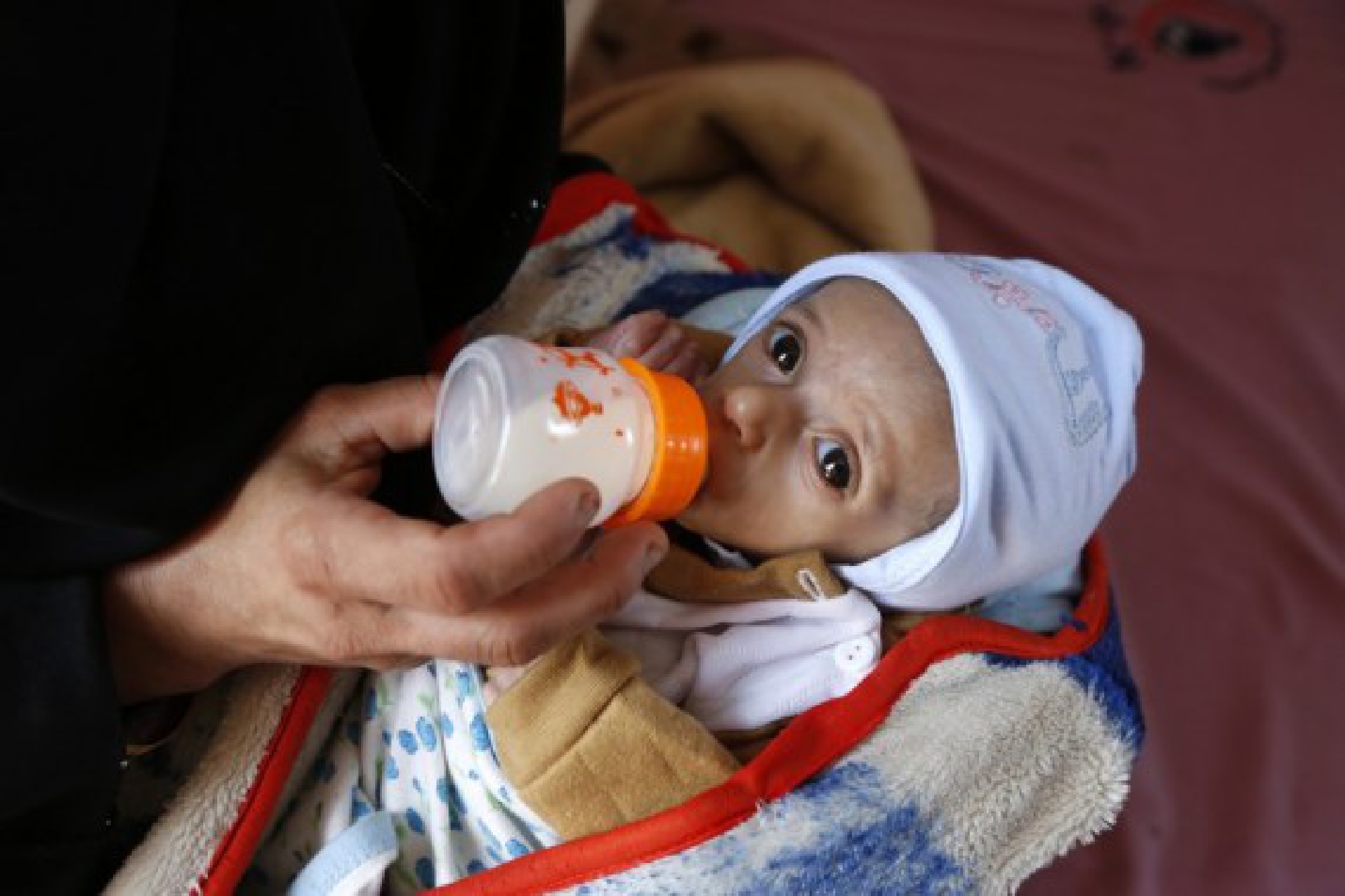 A mother feeds her malnourished child at Al-Sabeen hospital in Sanaa, Yemen, Oct. 21, 2020. Some 20 million people in Yemen are food insecure, including nearly 10 million people in acute food insecurity. (Photo by Mohammed Mohammed/Xinhua)
