“Anticipatory, short-term action must be based on longer-term resilience-building efforts to speed up progress and maximize efforts, and move towards more efficient, inclusive, sustainable and resilient agrifood systems,” Anna Ricoy, FAO Disaster Risk Management Officer in the region, said in a statement.
Agriculture is one of the sectors hardest hit by climate-related disasters in Latin America and the Caribbean, the United Nations Food and Agriculture Organization (FAO) warned on Wednesday, which marked International Day for Disaster Risk Reduction.
Anticipatory, short-term action must be based on longer-term resilience-building efforts to speed up progress and maximize efforts, and move towards more efficient, inclusive, sustainable and resilient agrifood systems,” Anna Ricoy, FAO Disaster Risk Management Officer in the region, said in a statement.
According to the FAO, producers in the least developed, and low- and middle-income countries absorbed 26 percent of the global impact caused by the medium- and large-scale disasters that occurred from 2008 to 2018.
That’s why the FAO said it has supported the governments of Paraguay, Colombia, Bolivia, El Salvador, Guatemala, Honduras and Saint Vincent and the Grenadines to implement anticipatory actions, or measures taken before a disaster occurs, with a focus on small producers, women, youth and indigenous peoples.
For every U.S. dollar invested in preventive action, households can obtain a return of up to 7 U.S. dollars in averted disasters, along with additional benefits that improve their long-term resilience, said the FAO.
With that in mind, the FAO assists regional projects that support climate change adaptation and mitigation, and helps countries access climate financing from the Green Climate Fund, the Global Environment Fund and other sources.
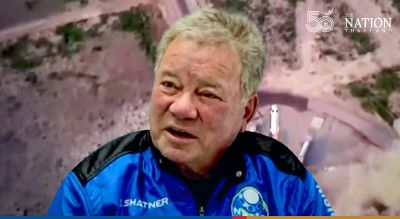
William Shatner, who as Capt. James T. Kirk on the TV series “Star Trek” flew the USS Enterprise around the galaxy, on Wednesday reached the edge of space on a more modest quest, on a far less capable spacecraft but in a mission that had the distinct advantage of being real.
Shatner and three other passengers lifted off at 10:49 a.m. Eastern time from a launch site in West Texas owned and operated by Jeff Bezos’ Blue Origin space company. The launch was the venture’s second human spaceflight mission, and it came three months after Bezos himself flew to space on his company’s New Shepard rocket.
Lasting just more than 10 minutes, the autonomous vehicle, named for Alan Shepard, the first American to reach space, climbed to a height of about 66 miles, four miles beyond one measurement of what is generally considered the edge of space. Aloft and free-floating above the Earth, the crew took in views of the planet below and the dark skies beyond while they floated in weightlessness for a few minutes.
The capsule then touched down under parachutes in the desert as the company celebrated what appeared to be another successful mission. Shatner, 90, became the oldest person to have visited space.
After the mission, an emotional and philosophical Shatner rhapsodized about the experience to Bezos, who greeted the crew at the landing site and opened the spacecraft’s hatch. (Bezos owns The Washington Post.)
Shatner compared tearing through the blue sky on the rocket to whipping a comfortable blanket off in the morning. “And you’re staring into blackness,” he said. “That’s the thing.”
The line of the atmosphere, “which is keeping us alive, is thinner than your skin,” he said. “It’s a sliver. It’s immeasurably small when you think in terms of the universe.”
The contrast of the bright colorful Earth and the inky vastness above was a metaphor for life and death, he said. “What you have given me is the most profound experience I can imagine,” he told Bezos. “I’m so filled with emotion about what just happened. It’s extraordinary. I hope I never recover from this. I hope I maintain what I feel now. I don’t want to lose it.”
The launch became part of a historic year in which the number of private astronauts who have reached space outnumber those sent to space by NASA, the start of a new dynamic that is beginning to open up space to ordinary people.
Shatner’s flight was the sixth human spaceflight mission this year carrying civilian astronauts who have not received government training. Earlier this year, Richard Branson’s Virgin Galactic flew its space plane to the edge of space twice – once, in May, with a pair of pilots, and the second time, in July, with Branson himself, three other passengers and two pilots.
Less than two weeks after Branson’s flight, Blue Origin flew Bezos and three others to the edge of space. Last month, Elon Musk’s SpaceX flew the so-called Inspiration4 mission, which carried a crew of four amateur astronauts into orbit, where they stayed for three days inside the Dragon spacecraft.
And earlier this month, Russian actress Yulia Peresild and producer-director Klim Shipenko lifted off on a Russian rocket to shoot scenes for a film while aboard the International Space Station.
If all goes to plan, there could be as many as nine flights this year with amateur astronauts on board. Virgin Galactic has said it’s planning one more, as is Blue Origin, and Japanese billionaire Yusaku Maezawa and an assistant, who would document the flight, are scheduled to fly on the Russian Soyuz to the space station. (More private astronaut missions are scheduled for next year, and Axiom Space plans to fly a crew of four to the space station on a SpaceX rocket.)
With the completion of Shatner’s flight, 21 private citizens have been to space so far this year. (Virgin Galactic pilot Dave Mackay has been twice.) And more than a dozen other private astronauts could reach space by the end of the year, bringing the total to more than 30, depending on how many fill the seats of future flights and if they go off on schedule.
NASA, by contrast, planned just two human spaceflight missions this year on SpaceX’s Crew Dragon spacecraft. It flew a crew of four in April and has another flight scheduled for Oct. 30 that will also carry a four-member crew to the space station.
“I think, in 50 years, we’ll look back at this year and go, ‘This was the beginning of actually the public’s movement into space and the opening up of the space frontier,’ ” Chris Boshuizen, one of the passengers on Wednesday’s flight, told Fox Business Network this week. “So I think it’s a really exciting time to be doing this with this crew.”
On Blue Origin’s second spaceflight mission, Shatner was joined by Audrey Powers, who oversees the New Shepard program as vice president of mission and flight operations and was a former flight controller at NASA. Also on the flight were two paying customers: Boshuizen, the co-founder of Planet, which deploys Earth observation satellites, and Glen de Vries, the co-founder of Medidata Solutions, which uses technology to help pharmaceutical and biotech companies.
It’s unclear how much they paid. Blue Origin is selling seats on its first flights to people who participated in an auction for a seat on the first flight before beginning regular ticket sales. (Virgin Galactic charges $450,000 for a seat on its suborbital space tourism flights.)
The flight comes as Blue Origin has faced allegations that its culture is toxic and its leadership is out of touch. Some women complained to The Post that they were subjected to condescending remarks that at times verged on harassment.
The company has said it takes all claims of harassment very seriously, investigates them and fires people when appropriate. It also said that the safety of the New Shepard system is rigorously tested and safe.
“Safety has always been our top priority,” Powers told “CBS This Morning” this week.
A former company official, who spoke on the condition of anonymity for fear of reprisal, was very critical of the company’s culture and leadership. But the person agreed that Blue Origin has thoroughly tested the system. “I would fly on it in a heartbeat,” the person said.
Before the flight, Shatner said he was is looking forward to the flight, joking in a video clip posted by Boshuizen on Twitter on Tuesday that “I’m so ready, I’m thinking of jumping out of the capsule at apogee. That’s how ready I am.”
In another clip posted by Blue Origin, Shatner said he couldn’t wait to see Earth from above, “to see this gem, this warm, loving, nourishing planet.”
“I plan to be looking out the window with my nose pressed against the window,” he said. “The only thing I don’t want to see is a little gremlin looking back at me.”
COPENHAGEN, N.Y. – On a good day, a fair wind blows off Lake Ontario, the long-distance transmission lines of New York state are not clogged up and yet another heat wave hasnt pushed the urban utilities to their limits.
On such a day, power from the two big wind turbines in Vaughn Moser’s hayfield in this little village join the great flow of electricity from upstate as it courses through the bottleneck west of Albany and then heads south, where some portion of it feeds what is currently the country’s largest electric vehicle charging station, on the edge of Brooklyn’s Bedford-Stuyvesant neighborhood.
There, at an installation opened earlier this year by a car-sharing company called Revel, on the site of the old Pfizer pharmaceutical headquarters, this carbon-free power can help juice up a whole fleet of sleek vehicles that aim to leave the internal combustion engine behind.
But that’s on a good day. Even now – before this state and the country’s grand ambitions for an electric future are fully in motion – there are too many bad ones.
Seventy-four times last year, the wind across Upstate New York dropped so low that for stretches of eight hours or more barely any electricity was produced. Nearly half the year, the main transmission line feeding the metropolitan area was at full capacity, so that no more power could be fed into it. Congestion struck other, smaller lines, too, and when that happened some of the wind turbine blades upstate fell still.
And in New York City this summer, the utility Con Edison appealed to customers to cut back on their electricity usage during the strain of five separate heat waves, while Tropical Storms Elsa, Henri and Ida cut power to thousands.
Converting the nation’s fleet of automobiles and trucks to electric power is a critical piece of the battle against climate change. The Biden administration wants to see them account for half of all sales by 2030, and New York state has enacted a ban on the sale of internal combustion cars and trucks starting in 2035.
But making America’s cars go electric is no longer primarily a story about building the cars. Against this ambitious backdrop, America’s electric grid will be sorely challenged by the need to deliver clean power to those cars. Today, though, it barely functions in times of ordinary stress, and fails altogether too often for comfort, as widespread blackouts in California, Texas, Louisiana and elsewhere have shown.
“We got to talk about the grid,” said Gil Quiniones, head of a state agency called the New York Power Authority. “Otherwise we’ll be caught flat-footed.”
By 2030, according to one study, the nation will need to invest as much as $125 billion in the grid to allow it to handle electric vehicles. The current infrastructure bill before Congress puts about $5 billion toward transmission line construction and upgrades.
Even in this progressive, wealthy state, where policymakers are spending billions on climate change initiatives and the governor has announced plans for two big new transmission lines feeding the New York metropolitan area, the challenge is enormous. By 2050, the state projects, electric cars, trucks and buses will use 14 percent of New York’s total output. That’s equivalent to half of all the electricity used in New York City in 2019 – so it’s like powering a new city of four million people. Overall demand could grow by as much as 50 percent.
Three places, hundreds of miles apart, tell the story of the grid in New York, and by extension in the country as a whole:
In the hard-hit dairy country of upstate Lewis County, wind power has been an economic lifeline, but its room for expansion is severely limited. Other renewables face similar limits.
In a control room in East Greenbush, outside Albany, the agency that oversees New York’s grid must manage the flow of electricity through transmission lines that without significant rebuilding will be totally inadequate in connecting upstate to the big metropolitan area.
And in New York City, stressed utility equipment will need expensive upgrades – and perhaps a totally new model of energy production – if they are to handle an eventual 2 million electric vehicles.
All in all, it shows how the country’s 20th-century point-to-point grid, delivering energy over long distances, will not be adequate to serve this century’s needs.
“The grid of the future isn’t going to be a grid at all,” said Shuli Goodman, executive director of a Linux Foundation project called LF Energy. “It will be more like the Internet,” she said, with power generation happening all over the place.
“Something,” she said, “like a forest.”
– Lewis County, N.Y.
It’s been 20 years since the first wind farm was built in Lewis County, and since then more have followed, bringing a steady income stream to the small dairy farmers whose land hosts the towering white turbines. Theirs has been a life of struggle, squeezed on price by their larger competitors, selling milk through a co-op to the big yellow Kraft Heinz factory in Lowville that goes through a reported 20 million pounds a month to make string cheese and cream cheese.
Vaughn Moser’s parents were able to retire from farming when the turbines came. With four kids, ages 3 to 11, he keeps plenty busy making ends meet: tending about 250 head of cattle (beef and dairy), running 10,000 taps on maple trees to make syrup, operating a lumber mill and making furniture in his spare time.
In a year when the dairy co-op is dumping milk because there’s too much for the market to use, he’s glad to see the turbine blades churning, grabbing electricity from the wind and sending it away down the wires. “It’s going where it’s needed, and that’s okay,” he said. “Everything gets bigger and needs more power.”
Government officials speak with similar confidence about the role of wind power and its renewable cousin, solar, in powering a low-emissions electric grid that could undergird an electric vehicle future. Without a renewable source of electricity, electric vehicles will still contribute to climate change – where fossil fuels are burned at power plants rather than in tailpipe emissions.
New York has adopted what it calls the 70-30 goal: 70 percent carbon-free power by 2030. The Biden administration has spelled out similar, longer-term goals for the nation as a whole.
Officials have been depending on wind to be a big part of that. Earlier this year, then-Gov. Andrew M. Cuomo, D, boasted, “We are proposing the largest wind programs in the nation and advancing our green manufacturing capacity and the jobs that go with it.”
In August, the Energy Department reported that 2020 had seen record-high levels of new land-based wind farm installations nationwide. “These reports contain such terrific news,” Energy Secretary Jennifer Granholm said. “They underscore both the progress made and the capacity for much more affordable wind power to come.”
But in New York and nationally, wind will have trouble meeting the expectations.
Lewis County and adjoining Jefferson County encompass the Tug Hill Plateau, a high forested region west of the Adirondacks. It’s the best location for onshore wind farms in the entire state. Turbines stretch out along the eastern escarpment of the plateau, just where the winds off Lake Ontario pick up speed as they flow down into the fertile Black River Valley.
This fall, the Roaring Brook wind farm, with the latest in European turbine blades mounted to each of 20 250-foot-tall towers, goes into operation. It strides across 5,000 mostly forested acres on the eastern escarpment of the plateau.
All that power doesn’t amount to much. Wind contributes about 3 percent of the output in New York.
Two proposed wind farms for Tug Hill could still get through the planning process and become operational.
“And that’s probably about it for this region,” said Jason Du Terroil, director of East Coast development for Avangrid, which will operate Roaring Brook. “The rest of New York, the topography doesn’t really lend itself to wind. Up and down the East Coast, it’s more difficult to site wind farms.”
Nationally, wind accounts for about 8.4 percent of power production, and the U.S. Energy Information Administration expects some growth of onshore wind in the years ahead, especially in the Midwest.
Additional growth will occur offshore, at least for the East Coast. Stronger, steadier winds and more powerful turbines in the waters from Martha’s Vineyard to Virginia could reach a capacity of 20 to 30 gigawatts by 2030, according to an American Wind Energy Association report.
New York’s share of that, probably nine gigawatts, would not be sufficient to replace all its fossil-fuel-powered generation plants, which in 2020 had a capacity of 26 gigawatts.
Solar energy is growing nationally, especially in the South and Southwest, but a combination of terrain and weather will limit its impact in the Northeast. It takes up too much room, for one thing.
Moser points out that he can plant his crops right up to the bases of the wind turbines standing in his fields. “To see good farmland covered with solar, it’s disappointing,” he said.
But wind farms aren’t welcome everywhere. Wind has meant money for Lewis County, though it still has the second-lowest median household income of New York’s 62 counties after the Bronx. Elsewhere – up near the Thousand Islands along the St. Lawrence River, for instance – wealthy part-time residents have had the means to fight off proposed wind farms.
And even in Lewis County, Roaring Brook met opposition. The Tug Hill Land Trust, a private nonprofit, objected to its placement on forest land, instead of farmers’ fields, said Linda Garrett, the executive director of the group. She cited concerns about water pollution and the loss of a wilderness feeling in the state’s third-largest forest. Avangrid has cut more than 10 miles of roads through the tract to connect the turbines.
“If you’re cutting down trees to put up windmills to fight climate change, it doesn’t make sense to me,” she said. “It would be a lot easier to swallow if it was a community project, with community benefits.”
Currently, 57 proposed wind projects in New York – on land and at sea – are awaiting a green light. Approval depends on there being enough transmission capacity to handle their output. Some have been in the queue since 2012.
If every project eventually won approval, and moved toward operation over the next decade, the capacity would be about 30 gigawatts, enough in theory to replace the fossil fuel plants.
But every project won’t win approval. A new study of selected U.S. regions by the Lawrence Berkeley National Laboratory found that fewer than a quarter of all proposed projects actually make it to commercial operation.
Nuclear power is expected to decline from 20 percent of national output in 2019 to 12 percent in 2050, according to a projection by the U.S. Energy Information Administration. There are no nuclear proposals in New York’s plans. Earlier this year, the state shut down an old nuclear plant at Indian Point, on the Hudson. Its capacity was picked up by two new gas-fired plants.
“Getting to 70 percent in nine years is going to be a big push,” said Cullen Howe, a grid specialist with the Natural Resources Defense Council. “It’s going to be a heavy lift. There’s no question about it. Is it technically feasible? Yeah, I think it is.”
But generating all that power will be one thing. Even assuming the goal can be met, that clean power still has to make its way to where the electric cars will be.
– East Greenbush, N.Y.
The electricity generated in Moser’s hayfield heads about nine miles to the northwest, where it joins the New York grid at a substation in East Watertown. There it falls under the control of the state’s Independent System Operator and enters a transmission line that shows up as a thin yellow connector on a dauntingly complicated and huge schematic screen that dominates the ISO control room in a tightly secured building in East Greenbush, just across the Hudson from Albany. The line interconnects with other lines in magenta, blue, red, green and orange, each representing a different level of voltage.
The ISO operators like to talk about what they call the state’s Tale of Two Grids: on one side, the rural north and Rust Belt west, and on the other, the Hudson Valley, New York City metropolitan area and Long Island. Both produce nearly the same amount of electricity – about 65,000 gigawatt-hours in 2020 – but one has plenty of renewable power and the other does not. One has vast rural stretches; the other does not. They operate like two nearly separate systems.
“When the system’s running well, there’s not a lot to do,” said Richard Dewey, president of the New York ISO. “It’s, like, 95 percent boredom and 5 percent hysteria.”
One main transmission line connects the two grids, carrying power from the north and west to where it’s needed downstate, which uses about two-thirds of the state’s overall energy. Running roughly between Utica and Albany, that line is called the Central East Constraint, and it is congested about half the year, meaning no more power can flow along it.
And at least 11 pockets within the two regions have their own local constraints: high-tension lines that don’t have enough capacity even today.
It is not a problem specific to New York state. Similar constraints exist in Texas, California, Maryland, Illinois and elsewhere. Across the country, long-distance transmission lines can only carry so much electricity, just the way a pipe can only carry so much water. When they’re at full capacity, they can’t carry any more, even if a downstream customer – a local utility, for instance – is trying to obtain some.
The limits of these constraints will become even more significant as the nation moves to send more clean energy across long distances. It’s much easier to cut back on wind and solar generation in what are called curtailments than it is to dial down a traditional power plant or hydroelectric dam, and easier to bring them back on again, so renewables always take the brunt of curtailment orders.
By 2030, a study suggests, the potential output of renewables in some of the smaller pockets in New York could face curtailments of as much as 63 percent without improvements in transmission. This would make it virtually impossible for the state to meet the 2030 goal.
Keeping energy flowing from upstate to downstate is critical to the state’s goals. Last year, 90 percent of the electricity produced upstate was zero-emission, a little bit of it from the Moser farm but the bulk from nuclear plants and the Niagara Hydroelectric Power Station. Downstate, by contrast, 77 percent of the electricity was from fossil fuels.
To meet its needs, New York state is planning to spend $1.2 billion on upgrades, and Gov. Kathy Hochul (D) announced on Sept. 20 a plan to spend $11 billion on a new transmission line skirting the Catskills, as well as another line that would bring hydropower straight down from Quebec. At the national level, the federal infrastructure bill includes $5 billion to address congestion.
Even with the improvements, Dewey said, meeting the state’s emissions target by getting cleaner power downstate “is going to be a stretch.”
In New York and across the country, engineers also expect to enhance lines on existing rights of way. A technology called dynamic line rating, which uses sensors to provide much greater visibility into conditions on transmission lines, could allow them to carry significantly more power, without new construction.
A different workaround to the transmission problem involves numerous new small but local power generators. Hochul announced a plan in September to build vast numbers of rooftop installations.
The panels would be installed where the demand is – predominantly in and around New York City.
– New York City
The main transmission line from upstate to New York City comes right down the Hudson Valley, with secondary lines providing some backup. Electricity imported from Connecticut, Massachusetts and New Jersey can also feed the metropolitan area.
At substations around the region, the voltage is stepped down and the power is distributed on local lines – strung on familiar poles in parts of the outer boroughs and Westchester County, but underground in Manhattan.
Moshe Cohen, the CEO of a start-up called Gravity, hoped this year that at the end of one of these lines would be what he needed to get his electric taxi vehicle company up and running – quickly, and at scale.
He approached major parking garage operators about setting up 50 fast chargers, which can replenish a car in as little as 20 minutes but gulp huge amounts of electricity.
Building out the equipment for such a site would be possible. “This is what we do for a living,” said Patrick McHugh, vice president of engineering and planning for Con Edison. “It’s nothing that we haven’t done.”
But it would take years. If you plugged in 50 cars at once to 50 chargers, it would draw as much electricity as a high-rise office building for as long as the cars were being refueled.
“We face some very tight constraints,” Cohen said.
The plan didn’t work out. Instead Gravity is going with reduced, scattered charging sites around the city.
But that was a plan for only 50 cars. As the country turns toward electric vehicles, New York City is expected to have 2 million of them on the streets by 2040, according to the New York Power Authority.
Con Ed does not intend to be the obstacle to the electric vehicle future. “This is coming,” McHugh said. “We’re working to be ahead of that.”
But Gil Quiniones, head of the New York Power Authority, has a less optimistic view. He lives in the West Village of Manhattan, and there’s a big UPS depot just around the corner on Greenwich Street.
“What if Amazon and FedEx and UPS say, ‘We’re going to go electric,’ ” he said. “Con Ed is going to be scrambling.”
As CEO of the Power Authority – a state agency established by Gov. Franklin D. Roosevelt in 1931 – Quiniones has had an up-close look at what ails the power grid.
The heat is a big headache for Con Ed and the utilities nationwide that distribute electricity up and down every street. Block by block, transformers and substations can overheat, from both the air temperature and the heavy burdens placed upon them by the demand from air conditioning. Heat pushes the system on a grand scale to its limits, but also neighborhood by neighborhood, even house by house.
In June, July, August and September, Con Ed urged customers to conserve power so the system wouldn’t crash.
As recently as the summer of 2019, Con Ed had to sever power to 50,000 customers in Brooklyn and Queens to keep its system from crashing in the face of 100-degree heat.
A crucial component as electric vehicles become more prevalent will be the ability to spread demand over 24 hours.
“You don’t want everybody charging when it’s 96 degrees at 2 p.m. That’ll crash the system,” Quiniones said.
McHugh said that Con Ed expects the move to electric cars to be gradual, much the way the adoption of home air conditioners was in the 1970s and 1980s. “It will slowly build up,” he said, “and we’ll monitor that accordingly.”
To power a city’s worth of electric vehicles, New York by the 2030s will have to call on a wide array of resources. New or enhanced transmission lines, for instance, will carry more juice from the renewable producers of western New York down to the metropolis – likely even some from Moser’s hayfield, unless it’s needed closer to home.
But at the same time, a dramatic transformation of the grid will be necessary, experts say. Rooftop solar panels will need to be sprouting everywhere. Enthusiasts believe that microgrids could one day be powered by long-elusive hydrogen fuel, or small, next-generation nuclear reactors. All these sources would be local but deeply interconnected, supporting each other.
“We have the technology to do it,” Howe said. “The question is, do we have the will?”
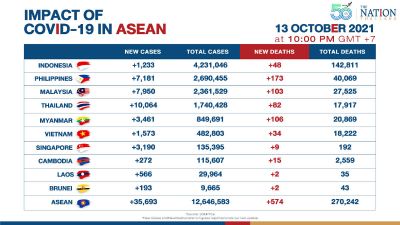
The number of Covid-19 cases crossed 12.64 million across Southeast Asia, with 35,693 new cases reported on Wednesday (October 13), higher than Tuesday’s tally at 35,025. New deaths are at 574, decreasing from Tuesday’s number of 610. Total Covid-19 deaths in Asean are now at 270,242.
Cambodia has cancelled the annual three-day Water Festival for the second consecutive year to prevent the spread of Covid-19, Interior Minister Sar Kheng said on Monday. The festival was scheduled to take place from November 18 to 20. Kheng, who is also a deputy prime minister, renewed his call on the public to continue caution as the Covid-19 was still raging across the kingdom.
Meanwhile, Vietnam is gearing up to host the Southeast Asian (SEA) Games 31 next year after the Southeast Asian Games Federation has decided to postpone this year’s games from November 21 to December 2 to April or May next year. The federation is considering using Japan’s model of organizing the 2020 Olympics Games and Paralympics Games during Covid-19 situation, as well as the organization of World Cup qualifying rounds in each continent to ensure the safety of the next SEA Games.
WASHINGTON – The White House announced late Tuesday that it will ease pandemic-related restrictions on overland border crossings from Canada and Mexico for foreign nationals.
Starting in early November, people engaged in nonessential travel who provide proof of coronavirus vaccination may enter the United States for reasons such as tourism or visiting family, according to White House officials. In January, all travelers across the land border, including those traveling for reasons deemed essential, must be vaccinated.
The move is a mostly noncontroversial – though some critics would say long overdue – easing of a policy put in place as the United States and other nations sought to safeguard their populations during a global pandemic.
As conditions have improved, along with the availability of vaccines and mitigation measures, business leaders, lawmakers and mayors of border towns have pressured the federal government to ease travel restrictions.
Last month, the White House announced that it will relax air travel restrictions on foreign travelers who have been fully vaccinated starting in November. This week’s announcement brings requirements for people crossing by land in line with those flying into the country.
The new travel protocols will have no bearing on border crossers who enter the United States illegally, and the administration will continue to use the emergency public health authority known as Title 42 to rapidly return or “expel” those migrants, the officials said.
In contrast, travelers who enter the country lawfully at U.S. border crossings and other ports of entry pass quickly and are not held for prolonged periods in detention cells and other crowded settings where the virus is more likely to spread, the officials said.
The Biden administration has come under renewed pressure from immigrant advocates and others to end the Title 42 expulsions, which generally prevent migrants from requesting asylum or another form of humanitarian refuge. Since March 2020, when the Trump administration began using Title 42, authorities have expelled more than 1 million border crossers.
“The Title 42 restrictions are really about protecting the migrants themselves, the DHS workforce and local communities,” one official said. “There’s a strong public health basis, for the moment, for continuing with the Title 42 restrictions.”
Illegal border crossings have soared this year to the highest levels in at least two decades, and critics of the policy say the Biden administration is using it as a border control tool that deprives vulnerable migrants of a legal right to seek asylum.
Taiwans top military leadership warned China that the closer its aircraft and ships get to the island the harder Taipei will respond, raising the stakes for further escalation with Beijing.
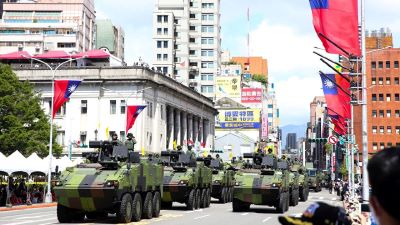
Taiwan will take tougher measures to fend off Chinese military sorties should they get too close to the Taiwanese mainland, according to a report by the island’s defense ministry sent to legislators and seen by Bloomberg News. Defense Minister Chiu Kuo-cheng is scheduled to present the report in a speech to lawmakers Thursday.
“In response to the intrusions by Chinese Communist military aircraft and ships into our air defense identification zone, we will adhere to the principle of ‘the closer they get to the island, the stronger we will hit back,'” the report said.
The warning comes as China intensifies its military pressure on the government of President Tsai Ing-wen. Nearly 150 People’s Liberation Army aircraft flew into Taiwan’s self-declared ADIZ over four days around China’s National Day holiday.
Chinese state media has dismissed the idea of Taiwan retaliating, warning that any attack on People’s Liberation Army Air Force planes would be met by force, or even an invasion.
“If Taiwan fires, it would mean that the Chinese mainland will launch a destructive retaliation,” the Communist Party-backed tabloid Global Times wrote in an editorial last month. “Even a war to liberate the Taiwan island will start. In this context, the Taiwan military will never dare to fire at a PLA aircraft on such a mission.”
Taiwan’s military will adopt a multi-pronged approach that utilizes aircraft, ships and its air-defense systems to counter Chinese military incursions, the report said, increasing the flexibility of the island’s threat response and helping avoid overly burdening military personnel.
Speaking to lawmakers last week, Chiu described the current state of relations across the Taiwan Strait as the most severe he’d seen in his 40-year military career. He warned China will have “full capacity” to attack Taiwan by 2025.
“We hope for an easing of cross-strait ties and won’t act rashly, but don’t assume that Taiwanese people will bow to pressure,” Taiwan’s Mainland Affairs Council said in statement Wednesday. “Cross-strait should respect each other, and solve the problem with practical dialogue.”
Over the weekend, Chinese president Xi Jinping reiterated his goal of bringing the self-ruled island under Beijing’s control. A day later, Tsai said that her government would do its utmost to maintain the status quo in its relations with China amid a “complex regional landscape.”
“Through gray zone activities, military threats and information manipulation, authoritarian regimes aim to erode our citizens’ confidence in democratic institutions,” Tsai said in a video message posted to Twitter on Wednesday. “Taiwan stands on the front line of this assault and we have been working diligently to combat such coercion.”
In a statement last week, Pentagon spokesman John Supple stressed the U.S. had an “abiding interest” in the peace and stability of the Indo-Pacific, including in the Taiwan Strait. “The United States will continue to support a peaceful resolution of cross-strait issues, consistent with the wishes and best interests of the people on both sides,” Supple said.
The World Health Organization on Wednesday named 26 scientists to a new advisory body devoted to understanding the origins of covid-19 and other future outbreaks, marking a change in approach for the worlds top global health body to one of the most politically sensitive issues of a pandemic that has killed more than 4.8 million people.
The group, which includes scientists from the United States and China as well as 24 other nations, and will be formalized after a brief period of public consultation, is set to consider not only the big, unresolved question of the novel coronavirus virus – how did it first infect humans? – but also set up a framework for future outbreaks involving other pathogens so similar big questions aren’t left unresolved again.
“It’s a real opportunity right now to get rid of all the noise, all the politics surrounding this and focus on what we know, what we don’t know and what, urgently, we need to all focus our attention on,” Maria Van Kerkhove, head of the WHO’s emerging disease and zoonosis unit, said in an interview.
Escaping that noise will prove difficult, however, especially as China has repeatedly said it considers any investigation into the origins of covid-19 on its soil completed. This new group, dubbed the Scientific Advisory Group for the Origins of Novel Pathogens (SAGO), will also face a politicized environment from countries in the West, including the United States.
“If you believe that SAGO will answer the question, what was the origins of SARS-CoV-2, then you are sadly mistaken because there is there’s little to no chance of them gaining access to information or on the ground investigation as far as China is concerned,” said Lawrence Gostin, professor of global health law at the Georgetown University
The renewed impetus to investigate the pandemic’s origins comes more than six months after the conclusion of a joint WHO-China mission on the subject. That study, which saw a group of international scientists visit sites at the virus’ known epicenter in Wuhan, China, became mired in controversy for its inconclusive results.
After the scientists labeled the possibility of a leak from a laboratory in Wuhan as “very unlikely” and not worthy of further investigation, WHO Director General Tedros Adhanom Ghebreyesus said that the assessment on this theory was not “extensive enough” and, in unusually direct criticism of Beijing, that he expected “future collaborative studies to include more timely and comprehensive data sharing.”
WHO officials are adamant that the SAGO will not function as a repeat of the discredited mission to Wuhan. “It’s an advisory group. We set up these advisory groups all the time,” Van Kerkhove said. “It is not about the next mission.”
Several proposed members of the SAGO group were on the previous 10-person WHO mission to China, including Dutch virologist Marion Koopmans. Chinese scientist Yungui Yang of the Beijing Institute of Genomics at the Chinese Academy of Sciences was also a group leader for China on that mission. Chinese scientist Yungui Yang of the Beijing Institute of Genomics at the Chinese Academy of Sciences was also a group leader for China on that mission.
However, the majority of SAGO names were not on the previous mission. Inger Damon, the director of the division of high consequence pathogens and pathology at the U.S. Centers for Disease Control and Prevention, is the only American listed.
SAGO membership is not yet finalized and the WHO are seeking public comment on the names released on Wednesday. “We are very pleased with the calibre of experts selected for SAGO from around the world, and look forward to working with them to make the world safer,” Tedros said in a statement.
Van Kerkhove said that the mission could advise the WHO and that it needs to arrange a mission to a member state. Some SAGO members, as experts in their respective fields, may also travel on that mission.
“What we’re hopeful of is that there will be additional missions to China and potentially elsewhere,” said Van Kerkhove.
More than 700 experts in their field applied for a place on the SAGO team, WHO officials said, with the scientists chosen not only for their ability but also with a nod toward diversity in gender, ethnicity and place of residence. Member states were not asked to nominate names and their preferences were not considered in the selection process.
Those in the group will serve, unpaid, for two-year terms, with the possibility of having their time on body extended.
The aim is for the team to meet once a week, with outside experts receiving some invites, though all meetings will be confidential. SAGO will be a permanent fixture for WHO and ready to step in when there are other, post-covid, outbreaks.
“I would have loved for SAGO to have existed when MERS emerged in 2012,” Van Kerkhove said, referring to the first known cases of Middle East respiratory syndrome, a disease that has killed roughly 800 people.
“I think the biggest value will not be for covid at all,” said Gostin. “I think the biggest value will be [for WHO to have] an expert standing committee rigorously vetted for any conflicts with a global charge to investigate novel pathogens. This will not be the last one.”
Even so, much of the initial work will inevitably be on following up from loose threads in the previous WHO-China mission or looking at new evidence that has emerged since. Van Kerkhove pointed to new data that had come out about SARS-like coronavirus in bats in the region and studies of the animals sold in markets in Wuhan before the outbreak.
Whether China will allow more access for investigators, however, remains unclear. Pressure from Chinese officials and researchers helped lead the WHO-China mission to Wuhan helped lead to its vague and inconclusive findings.
Van Kerkhove said that member states like China had been briefed on SAGO, but that the WHO had no power to force a member state to open its borders to an investigative team. “Our member states have not given us that mandate to be able to go into any country that we want. So we have to negotiate with countries,” she said. “There should be no ambiguity about that.”
A new French study has dismissed a cave in Mojiang County, southwest Chinas Yunnan Province as an origin of SARS-CoV-2, the virus that causes COVID-19.
The study, published online on the journal Environmental Research in late September, also rebuts lab-leak speculations that link the virus to several miners working in the county in 2012.
A retrospective analysis of their clinical reports showed that the miners had displayed symptoms very different from those shown by COVID-19 patients, Sputnik news agency reported.
ADVERTISEMENT
“One must also wonder why a virus which killed more than 5 million and infected more than 200 million in 18 months did not cause any illness in 7 years from 2012 to 2019,” the study read.
“Dismissing the Mojiang mine theory leaves the laboratory leak narrative without any scientific support thus making it simply an opinion-based narrative,” it added.
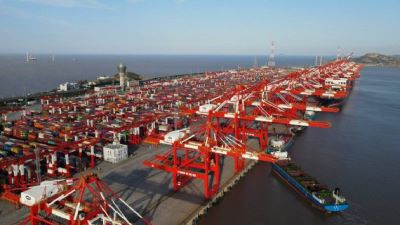
Over the past decades, mega-projects built across China and world-leading developments have propelled the countrys drive to strengthen its transportation network and key infrastructure for the economy.
The world’s second-largest economy has its backbone on an “enormous, interconnected and comprehensive transportation system,” according to Minister of Transport Li Xiaopeng.
China now leads the world in technology for railways at high altitudes and in extremely low temperatures and is a global player in high-speed and heavy-haul railways, said the white paper titled “Sustainable Development of Transport in China.” The State Council Information Office released the report last December.
ADVERTISEMENT
It listed examples such as the Harbin-Dalian High-speed Railway, the world’s first high-speed rail line operating at low temperatures in winter. It also listed the Datong-Qinhuangdao Heavy-haul Railway, which ranks top globally in terms of annual transport volume, and the Beijing-Guangzhou High-speed Railway, the longest high-speed rail line in the world.
Aerial photo taken on Dec. 9, 2020 shows a view of Honghe Bridge of Hezhou-Gaolan Port Highway on the Pearl River estuary in south China
Boasting eight of the ten highest bridges and seven of the ten longest cable-stayed bridges worldwide, China also tops the world in the total length and number of highway bridges and tunnels in service and under construction, the document said.
The number of highway bridges in China reached around 912,800 by the end of 2020, and the total length surpassed 66.28 million linear meters.
China announced the opening of the Hong Kong-Zhuhai-Macao Bridge in October 2018, which is the world’s longest cross-sea bridge. The 55-km-long bridge connects China’s southern mainland province of Guangdong with the country’s two special administrative regions of Hong Kong and Macao.
According to the white paper, China had 238 certified civil airports throughout the country.
Hailed as the “new gateway” to China, Beijing’s new Daxing International Airport has seen its total passenger throughput exceed 10 million a year after it began functioning. The airport was built in less than five years and officially opened to flights on Sept. 25, 2019.
In addition to its capacity of building large airports, core technologies in improving massive estuaries and lengthy waterways have given China around 127,000 km of navigable inland waterways, sending it to the front ranks of the world, noted the white paper.
The large-scale transportation network has supported a leap in the composite national strength, Li said, noting that China is now “running at full steam” on the journey towards a country with a strong transportation system.
Giving priority to transport in its future plans, China will shift its focus from speed and scale to quality and efficiency, from independent initiatives to integrated multimodal development, and from traditional drivers to innovative forces, said the white paper.
Underlining the goal of building up significant strength in transport by 2035, “our country will build a modern comprehensive transport system that is safe, convenient, efficient, green and economical, equipped with world-class facilities, technology, management, and services,” the white paper said.
Aerial photo taken on Aug. 31, 2021 shows a high-speed railway under construction and an expressway in Gaoling Township of Du
The United Nations Childrens Fund (UNICEF) on Tuesday called on the public to attend to the psychological well-being of adolescents at a theme campaign held in Beijing.
Titled “Stronger Mind, Strong You,” the campaign was launched in the wake of World Mental Health Day which fell on Oct. 10, aiming to start conversations among adolescents over mental health issues and reduce related stigmas.
Thirteen percent of adolescents worldwide are estimated to be living with mental disorders, according to the UNICEF publication “The State of the World’s Children 2021.”
ADVERTISEMENT
Representatives from the Chinese government and UN organizations, experts, sports celebrities and young people attended the event co-hosted by UNICEF China and China’s national center for mental health.
Participants called on the public to raise awareness over the potential risks of mental health issues for adolescents and to pool wisdom on how to tackle the risks.
“Despite growing awareness of the impact of mental health conditions, stigma is preventing children and young people from seeking treatment and limiting their opportunities to grow, learn and thrive,” said Cynthia McCaffrey, UNICEF representative to China.
She added that parents, other caregivers, teachers and public figures need to create an environment where young people feel that it is safe to talk about their mental health.
The campaign is part of UNICEF’s effort to empower adolescents and young people through peer support to develop skills to help each other and reject stigma.