LatAm leaders express solidarity with Haiti following devastating earthquake
Haitian authorities have confirmed that the earthquake, which originated about 12 km from the southern town of Saint Louis du Sud, has killed 304 people and wounded 1,800 others.
Several Latin American country leaders on Saturday expressed their solidarity with the people of Haiti after a devastating earthquake there has left at least 304 people dead and more than 1,800 others wounded.
ADVERTISEMENTx
The Argentinean government expressed its “deep regret” for the human and material losses caused by the earthquake and expressed its “willingness to collaborate” with the Caribbean island country.
Venezuelan Foreign Minister Jorge Arreaza said on Twitter that his government will provide “logistical support and necessary supplies” to help the Haitian people.
Peruvian President Pedro Castillo said on Twitter, “I express my total solidarity with the people of Haiti after the devastating earthquake that occurred today. As a government in the region, we will be attentive in providing support to the nation in order to advance in unity and fraternal integration.”
Uruguay and Costa Rica also expressed their willingness to help the Haitian people.
Bolivian President Luis Arce on Twitter expressed the Bolivian people’s condolences “for the victims and wishes of recovery for the injured,” saying, “We are with you, Haitian brothers.”
The Brazilian government expressed firm commitment to providing humanitarian aid to Haiti, adding that no members of the Brazilian community in the quake-hit country were affected by the earthquake.
Mexican President Andres Manuel Lopez Obrador voiced his condolences to the people of Haiti and said that his government “is already preparing immediate aid through the National Coordination of Civil Protection and the Ministry of Foreign Relations, the Secretariat of the Navy, and the Ministry of National Defense.”
Haitian authorities have confirmed that the earthquake, which originated about 12 km from the southern town of Saint Louis du Sud, has killed 304 people and wounded 1,800 others.
Haitian Prime Minister Ariel Henry went to the department of Grand’Anse to see the damage and said that his government has mobilized resources to help victims.
7.2-magnitude earthquake in Haiti leaves 304 people dead
A 7.2-magnitude earthquake in Haiti has killed 304 people, wounded more than 1,800 others and caused a landslide, which has blocked a national highway, Haitian authorities said Saturday.
National Highway 7, which connects the southern cities of Les Cayes and Jeremie, has been blocked by the landslide, said the country’s Civil Protection Directorate.
ADVERTISEMENTx
“An operation is being carried out to restore traffic circulation,” said the agency, praising efforts by rescue teams and residents to pull a large number of people from the rubble of collapsed buildings.
Haitian Prime Minister Ariel Henry went to the department of Grand’Anse to see the damage and said that his government has mobilized resources to help victims.
The earthquake originated about 12 km from the southern town of Saint Louis du Sud.
Photo taken with a mobile device shows members of the Cuban Medical Brigade helping an injured person after an earthquake in Jeremie, Haiti, Aug. 14, 2021.
Photo taken with a mobile device shows members of the Cuban Medical Brigade helping injured people after an earthquake in Jeremie, Haiti, Aug. 14, 2021.
Photo taken with a mobile device shows members of the Cuban Medical Brigade helping an injured person after an earthquake in Jeremie, Haiti, Aug. 14, 2021.
Southeast Asia reported 99,662 new Covid-19 cases and 2,541 deaths on Saturday, collated data showed.
The numbers in Asean countries were lower than 102,319 and 2,699 respectively on Friday.
The Hanoi Medical University will on Sunday start the first phase of clinical trials of Covid-19 vaccine ARCT-154, an mRNA vaccine developed by US company Arcturus Therapeutics Inc, which transferred the technology to a company in Vietnam.
According to the ministry, ARCT-154 is a self-amplifying mRNA vaccine designed to act against coronavirus variants, including the delta.
The clinical trials will be carried out in three phases with the participation of 21,000 volunteers, including 100 in phase one, 300 in phase two and 20,600 in phase three.
ADVERTISEMENTx
Cambodia on Saturday announced that another 65 cases of the coronavirus delta variant were detected in Cambodia from August 11-13, reaching 22 of the Kingdom’s 25 capital and provinces and bringing the total to 494.
Among the latest 65 cases were 36 community transmissions, 17 migrant workers, four airline passengers, four medical workers and four civil servants.
Biden administration scrambled as its orderly withdrawal from Afghanistan unraveled
WASHINGTON – By the middle of the week, as cities across Afghanistan were falling like dominoes to the Taliban and U.S. diplomats appeared increasingly at risk, President Joe Bidens plan for an orderly end to the United States longest war was quickly falling apart.
On Wednesday evening, Biden convened his top advisers to assess the ominous turn of events. One by one, in the cramped Situation Room in the White House basement, national security adviser Jake Sullivan, Defense Secretary Lloyd Austin and Secretary of State Antony Blinken outlined the administration’s options for ensuring the security of U.S. personnel. Biden asked them to return with recommendations.
When the aides reconvened early the next morning, things had gotten worse. The Taliban was taking control of more and more of Afghanistan’s 34 provincial capitals, most of them seized without a major fight, and the militants were bearing down on Kabul, the national capital. After being briefed by Sullivan and Austin, Biden gave the order to activate a plan deploying troops to secure the Kabul airport and create an evacuation route for Americans on the ground.
ADVERTISEMENTx
Blinken called Kabul, where the U.S. Embassy’s top diplomat was already presiding over packing and document destruction, and told him most embassy personnel would move to the airport. At U.S. Central Command in Tampa, military leaders ordered intensified airstrikes on militants driving toward Kabul, hoping to slow their advance as U.S. personnel and their allies scrambled to get out.
The urgency bordering on panic laid bare how the president’s strategy for ending the 20-year U.S. military effort – leaving Afghan forces to hold off the Taliban for months as negotiators redoubled efforts to hammer out a peace deal – has undergone a rapid dismantling.
The lightening collapse is rooted in misplaced assumptions – including a failure to account for how the U.S. departure would catalyze a crisis of confidence in Afghan leaders and security forcers, enabling the Taliban blitz – from the moment Biden announced the withdrawal this spring. It is equally the product of two decades of miscalculations about transforming Afghanistan and overly optimistic assessments of progress that have plagued the war from its start.
After receiving a video briefing from aides while at Camp David on Saturday, Biden issued a statement defending the administration’s response, saying an endless U.S. presence in another country’s civil conflict was unacceptable.
“One more year, or five more years, of U.S. military presence would not have made a difference if the Afghan military cannot or will not hold its own country,” he said.
ADVERTISEMENT
Laurel Miller, who served as a top official for Afghanistan during the Obama and Trump administrations, said a swift Taliban takeover was among the scenarios that analysts in and outside of government had warned could occur after a U.S. withdrawal, even though few expected it to happen so fast.
“My takeaway is that they priced this into the decision,” she said of the Biden administration. “It’s regrettable, but it was priced in as a tolerable outcome.”
The disintegration of the hoped-for withdrawal scenario has left the administration racing to protect U.S. diplomats and struggling to respond to criticism from Republicans and advocates alike. It has also deepened questions about how Biden will reconcile his realpolitik, including the abandonment of women and human rights defenders, with promises to restore core values to U.S. foreign policy.
This account of how the Biden administration has grappled in recent weeks with the unraveling of its Afghanistan plans is based on interviews with more than a dozen current and former officials, some of whom spoke on the condition of anonymity to describe internal deliberations.
Officials say the administration, despite a decision to send 4,000 troops back to Afghanistan to help evacuate embassy staffers and Afghan allies, is not contemplating a reversal of its withdrawal decision, as some former military leaders have advocated, or an extension of the Aug. 31 deadline for ending air support to Afghan forces.
ADVERTISEMENT
For some critics, including those with deep experience in Afghanistan, the situation is not only disheartening but also offers a troubling message as the Biden administration seeks to turn around the United States’ global image after four years of erratic foreign policy under President Donald Trump.
“If Trump undermined the confidence of the world, Biden’s actions, pulling out and leaving a mess in Afghanistan, may simply be chapter two in undercutting fundamental assumptions about America,” said Ronald Neumann, a former U.S. ambassador to Afghanistan who serves as the president of the American Academy of Diplomacy.
– – –
The administration’s decision to withdraw, announced in April, was guided by Biden’s conviction, dating back more than a decade, that the military mission in Afghanistan had little chance of success. The former senator initially supported the wars in Afghanistan and Iraq, but by the time he became Barack Obama’s vice president in 2009, he saw the Afghanistan project as futile.
After trillions of dollars and more than 2,000 U.S. combat deaths, as well as the deaths of tens of thousands of Afghan civilians, Biden thought the United States had little chance of transforming a largely tribal, undeveloped nation. For all their differences, Biden’s instincts coincided with those of Trump, whose desire to withdraw was repeatedly deflected by his top security aides.
As a candidate in early 2020, Biden was asked whether the United States had a responsibility to Afghan women and girls in light of a possible Taliban takeover. “No, I don’t!” Biden said. “Do I bear responsibility? Zero responsibility.”
“The idea of us being able to use our armed forces to solve every single internal problem that exists in the world is just not within our capacity,” he continued. “The question is, is America’s vital self-interest at stake or the self-interest of one of our allies at stake?”
As the war approached its 20th anniversary, the public seemed to agree. A recent poll by the Chicago Council on Global Affairs shows that 70 percent of Americans back withdrawing from Afghanistan, though support is stronger among Democrats than Republicans.
Months before Biden unveiled his withdrawal decision, Gen. Austin “Scott” Miller, then the top commander of U.S. and NATO forces in Afghanistan, warned that a rapid government collapse was not just possible but was the most likely result of a quick exit, according to one person familiar with his analysis.
In weeks of intensive deliberations in Washington, Austin and Gen. Mark. A. Milley, the chairman of the Joint Chiefs of Staff, privately advised Biden against a full withdrawal, officials said.
“It came down to where the assessment they were receiving from the military in Afghanistan did not support the preferred policy decision that the administration and certainly the State Department wished to pursue,” one of the officials said. “The bottom line was that DOD was not the loudest voice in the room when it came to stating their candid assessment of likely outcomes.”
But a senior U.S. official involved in White House deliberations defended the process and the Pentagon’s part in it.
“First of all, the military voice was heard,” the official said. “It was heard, it was loud, it was clear, and it was in writing and verbally, and it was unambiguous.”
The official said that no senior U.S. leader predicted that a collapse of the Afghan state could come in August. Generals did warn, however, that they were concerned that a collapse could occur before the end of the year, two officials said.
Once the decision was made, Pentagon leaders, especially cautious after years of civil-military strains under Trump, pivoted to executing Biden’s plan. Concerned about the safety of military personnel, commanders felt the need to quickly pull out the remaining 2,500 U.S. troops, four officials said.
In justifying the decision, Biden’s aides argued that the president’s hands were tied by Trump’s February 202 agreement with the Taliban, which committed the United States to withdrawing in 2021. If Washington reneged, they argued, the Taliban would resume attacks on American troops.
By July, as the Taliban intensified its march across rural Afghanistan and captured successive district centers, U.S. officials expected that local forces would block the militants from seizing provincial capitals, whose survival was seen as a key indicator of Afghan government strength, according to people familiar with Biden administration deliberations.
When the Taliban began taking some of the country’s more lightly defended provincial capitals in early August, officials recalculated to assume that Afghan forces, bolstered by two decades of foreign training and support, would prevent the Taliban from commandeering the country’s more strategic cities.
But when the fighters rolled into the northern city of Kunduz the following week, making it the first major provincial capital to fall, U.S. officials realized that their scenarios were illusory.
“Kunduz was a wake-up call,” one military official said.
The Pentagon swung into action with plans it had rehearsed months before, just in case, said one senior defense official. Austin also instituted a daily synchronization meeting with senior defense officials on the crisis and spoke separately numerous times per day with the top officer overseeing the region, Marine Corps Gen. Kenneth “Frank” McKenzie, and the senior officer on the ground, Rear Adm. Peter Vasely.
The negotiated capitulations illustrated the extent to which the U.S. withdrawal had set in motion a crisis of confidence among local political and military leaders that, in some cases, led to an unwillingness to fight.
“What we’re seeing is a tsunami of individual decisions to abandon the Afghan government, and all of those individual decisions have added up to a collapse,” Laurel Miller said.
One intelligence official said some provincial Afghan officials probably cut deals with the Taliban weeks ago. Current and former officials have resisted claims that intelligence agencies failed to forecast the government’s potential quick fall. Privately, some have expressed dismay at Biden’s withdrawal decision, made, they said, despite numerous warnings of a likely unraveling of government forces.
As conditions worsened, officials briefly debated keeping Bagram air base, the country’s most significant military airfield, open longer than initially planned to facilitate airstrikes in support of Afghan forces, four officials said. It was ultimately decided to shut the base down as planned in early July.
Eventually, the military revised its intelligence assessment of Kabul’s fate. Although it had said the city might fall as soon as six months after the withdrawal of troops was complete, it updated that to say it could come within 90 days. That was quickly revised to say it could come even sooner, perhaps within weeks.
– – –
At the State Department, where many diplomats had worked on Afghanistan or served in Kabul, the mood in the past few days has been grim as televisions in the background displayed images of Taliban triumphs. One official described the emotions as “wrenching.”
Senior officials canvassed the department for volunteers to serve on several crisis task forces, including one dedicated to processing asylum applications and another to support embassy operations in Kabul.
Weeks earlier, Biden had authorized the pre-positioning in the region of thousands of troops who could go into Afghanistan, and he began receiving daily battlefield assessments and updates on contingency planning for the evacuation.
At the same time, the president approved the provision of close air support through the end of August and the sustainment of contractors at Kabul’s airport to keep the Afghan air force flying.
In early August, even before the major Taliban push began, the White House convened a tabletop exercise on the planning for an emergency exit. At the embassy in Kabul, the Emergency Action Committee had taken evacuation plans off the shelf and was refining them, virtually on a day-to-day basis, officials said.
Senior U.S. officials continued to hold talks with Taliban representatives in Doha, the Qatari capital, where on-and-off peace consultations have taken place for several months. They warned Taliban representatives that a violent takeover and the imposition of the harsh rule that had characterized the militants’ government in the late 1990s would not be accepted by the United States or the global community. They said the group would again be international pariahs if it did not halt its offensive.
U.S. envoy Zalmay Khalilzad and other diplomats repeated that messagein a massive gathering in recent days in Doha, where representatives from neighboring countries, as well as China and Russia met with Taliban and Afghan government negotiators. On Thursday evening, the countries released a communique reiterating those warnings and called for an end to violence and a political settlement.
By Friday morning, however, the entire exercise seemed irrelevant in light of what was happening on the ground.
Abdullah Abdullah, the Afghan government’s chief negotiator, returned to Kabul to try to convince President Ashraf Ghani that it was over and that he needed to fashion some kind of deal to offer the militants that would preserve at least the possibility of non-Taliban participation in a new or transition government.
As the Taliban continued to draw nearer to Kabul, Khalilzad told the militants it was not in their interest to seize the capital immediately. Thousands of U.S. troops were already landing there and would fight if they had to, Khalilzad warned, according to people familiar with the discussions. If the militants would delay the move on Kabul, he told them, they would be in a much better position to achieve their fundamental goals.
The Biden administration, however, has less and less ability to shape events as the Taliban grip grows stronger.
Carter Malkasian, who served as a senior Pentagon adviser and has written several books on Afghanistan, said that the United States can really focus only on blunting the Taliban’s momentum.
“We can try slow them down from crashing right into Kabul, and try to use our remaining leverage to prevent atrocities,” he said.
Published : August 15, 2021
By : The Washington Post · Missy Ryan, Karen DeYoung, Dan Lamothe, Anne Gearan
At least 304 dead in Haiti in wake of 7.2-magnitude earthquake
PORT AU PRINCE, Haiti – A massive 7.2-magnitude earthquake struck Haiti on Saturday morning, killing hundreds of people and shaking buildings from the neighboring Dominican Republic to Jamaica and Cuba, as the international community confronted the prospect of a major escalation in the humanitarian crisis already facing one of the hemispheres most deeply troubled nations.
Saturday’s quake was stronger, though centered farther from the capital, than the devastating 2010 temblor that killed more than 220,000, prompting foreign governments and aid agencies to prepare for large numbers of dead, wounded and homeless. Officials and witnesses reported heavy damage and fatalities dozens of miles from the epicenter, 7.2 miles northeast of Saint-Louis du Sud, where the quake struck at 8:29 a.m. Haiti’s civil protection office reported at least 304 people had died – with most in the hardest hit southern and western areas – with hundreds more missing and 1,800 wounded. The death toll is expected to rise amid reports that some neighborhoods had been razed.
Government officials, relief agencies and representatives from the United Nations are still assessing the damage, including via reconnaissance flights over the southern and western parts of the country, as a wave of aftershocks continued to hit Haiti. But the sheer force of the temblor and a climbing death toll suggest a devastating new tragedy in the Western Hemisphere’s poorest nation, which has lurched from crisis to crisis for years.
The disaster struck about a month after the assassination of the president, leaving a hobbled interim government in charge of a country so wracked by gang violence and a collapsing rule of law that observers have dubbed it the Somalia of the Caribbean.
Now, 11 years after the devastating 2010 earthquake, Haitians are again dealing with crushed bodies, collapsed buildings and overwhelmed hospitals.
“The needs are enormous,” Prime Minister Ariel Henry told the Associated Press, adding that he would wait to request international assistance until damage had been assessed. “We must take care of the injured and fractured, but also provide food, aid, temporary shelter and psychological support.”
ADVERTISEMENTx
At least 304 dead in Haiti in wake of 7.2-magnitude earthquake
At least three urban areas in the southern region – Jeremie, Les Cayes and Baradères – sustained major damage, with fears of even broader damage in villages and towns closer to the epicenter. Although high call traffic had jammed lines earlier in the day, cellular phone infrastructure in the area remained operational.
Ralph Simon, a radio station owner in Jeremie, a city of 30,000 in southwest Haiti, said many homes and buildings had been leveled or damaged, including a church. He said he saw two corpses in the rubble of a church. “The impact of this is huge,” he said. “I was still in bed with my children and my wife. My wife had a heart attack, and I had to save her life . . . There’s damage to houses. People are crying.”
Images on social media and witnesses portrayed scenes of devastation from collapsed structures, with officials saying residents were pouring into ill-equipped hospitals, bringing the injured in cars and beds of pickup trucks. Neighbors aided rescue workers, trying to lift rubble and knock down walls to reach people.
Preliminary disaster modeling from the U.S. Geological Survey (USGS) predicted hundreds of millions of dollars in damage and thousands of fatalities.
ADVERTISEMENT
Silvera Guillaume, civil protection coordinator in the coastal city of Les Cayes, said the community’s resources are being overwhelmed.
“It’s a dire situation, people died. There are people right now under the rubble,” Guillaume said. “We deployed first responders to go and remove rubble, but we do not have enough first responders.”
Améthyste Arcélius, administrator of Immaculate Conception Hospital – the largest in Les Cayes – said that its facilities cannot cope with the wounded and that it is in “desperate” need of personnel and medicines.
“There are lots of victims,” Arcélius said. “The hospital needs emergency drugs, health professionals of all categories. Lots of people are coming. The hospital is flooded with victims. We are issuing a call for help.”
At 8:29 a.m., Jabin Phontus, a 23-year-old agronomy student, said he felt his family home in Les Cayes begin to quake.
ADVERTISEMENT
“I could see the walls breaking, it was scary,” he said by phone. “I took my sister and ran.”
His mother and brother also escaped their five-room home as it crumbled, leaving them scraped by falling debris.
“The house is partially destroyed, some walls are still up, but we can’t sleep inside,” he said. “We don’t know where to go now.We are seeking shelter. A lot of houses in the neighborhood are destroyed.”
As he spoke, he said a group of people near him were “trying to break down a wall to get to someone inside” a house.
In Baradères, closer to the epicenter, former mayor Pascal Calixte said that some neighborhoods were “90 percent” destroyed.
“Everybody is panicked,” Calixte said. “There is a lot of damage. The church is destroyed. Today is market day. But we had landslides and rocks killed some people who were coming to sell their things. In some areas, 90% of the houses were destroyed.”
Among the fatalities was Jean Gabriel Fortuné, an influential politician and former mayor of Les Cayes. He and least one other person died when the hotel he owned and lived in, Le Manguier, caved in, according to Duples Plymouth, a communications aide for Fortuné.
Foreign governments have begun to respond to the crisis. The White House said President Joe Biden had been briefed on the situation and had authorized an immediate response, naming U.S. Agency for International Development Administrator Samantha Power as the senior U.S. official to coordinate the effort.
Haiti became an center for charities and nongovernmental organizations in the aftermath of the 2010 earthquake. But many organizations have left, particularly in recent years as the country has descended into violence. Those remaining are scrambling to respond.
Christy Delafield, spokesperson for the charity Mercy Corps, said the group is moving to mobilize a team to the area, but relief workers face logistical challenges. The main road to the area runs through gang-filled territories just south of Port-au-Prince, leaving aid groups to focus on access by air.
But the regional airport in Les Cayes is a rural airstrip with limited capacity and is already overwhelmed.
“We saw a similar situation with Hurricane Dorian” that struck the Bahamas in 2019, Delafield said. “There isn’t a lot of capacity in that area to handle assistance.”
Muhamed Bizimana, assistant country director for Care Haiti, said his organization was also facing logistical challenges, and was having to rely on “local staff” for assessments in the hardest-hit areas, given the risks of traveling over land through gang-controlled regions south of Port-au-Prince.
“We’re exploring maritime transport,” he said.
Shelters for untold numbers of those experiencing homelessness – especially in denser urban areas in the south and west – remain an immediate priority, he said.
But longer term, the quake has the potential to worsen a hunger crisis in the country. He said he had received reports of crops in the south destroyed by landslides in the aftermath of the earthquake.
“This has not been a good year for Haiti,” Bizimana said. “It’s one crisis after another.”
In a statement, Leila Bourahla, Haiti’s country director of Save the Children, said its staff on the ground saw “horrific devastation.”
“Dozens of collapsed houses, numerous injured people and fatalities,” Bourahla said. “While it will take days to assess the full scale of the damage, it is clear that this is a massive humanitarian emergency.”
The reported magnitude from the USGS was greater than the catastrophic 7.0-magnitude earthquake that hit seven miles west of Port-au-Prince in 2010, which resulted in more than 220,000 casualties. The quake on Saturday struck farther away from the densely populated capital. But USGS noted that people in the most heavily-hit areas largely reside in poorly constructed dwellings that are vulnerable to earthquake shaking.
The earthquake is set to deepen a humanitarian crisis in a country battling hunger, poverty and violence that never fully recovered from the 2010 quake. After the devastation of Hurricane Matthew in 2016, 1.4 million Haitians required humanitarian assistance.
U.N. agencies report 46% of the population is already experiencing acute or severe food insecurity – among the highest in the world. Aid agencies face massive hurdles to transport aid south of the capital, given the open gang warfare on National Road 2 – the nation’s major western and southern artery.
Until last month, Haiti was one of a small number of countries in the world that had yet to roll out a coronavirus vaccination campaign – and the only country in the Americas. Meanwhile, coronavirus cases have surged as thousands fleeing violence have packed into overcrowded shelters around the capital.
Haiti also entered a new period of political instability in the aftermath of the assassination of President Jovenel Moïse in July.
Jose Luis Fernandez, the United Nations Food and Agriculture Organization representative in Haiti, said southern portions of the country were already facing “severe and acute” food shortages.
The earthquake “will worsen the food insecurity situation in the country, especially in areas of the south. There are pictures of many roads and bridges that have been destroyed. This is going to disrupt the flow of food.”
Haiti reeled from the quake even as the nation looked to the east with trepidation, with Tropical Storm Grace bearing down on the island nation. The storm, with maximum sustained winds of 45 mph, was poised to arrive sometime Monday, running a risk of heavy rainfall.
Published : August 15, 2021
By : The Washington Post · Widlore Merancourt, Anthony Faiola
Minneapolis police to curb minor traffic stops, long cited by critics as a means of racial profiling
An air freshener dangling on the rearview mirror or driving with expired tabs will no longer be reasons for the Minneapolis Police Department to stop motorists, Mayor Jacob Frey, a Democrat, announced Friday.
Additionally, the City Attorney’s Office will no longer pursue tickets against motorists cited for driving on an expired license if the sole reason for the suspension was a failure to pay fines and fees and not “egregious driving behavior” or criminal activity.
City Attorney Jim Rowader and his deputy in the Criminal Division, Mary Ellen Heng, told The Washington Post in a statement Friday that the changes will help to address racial inequities in traffic stops “while not compromising public safety.”
The city’s announcement comes several months after 20-year-old Daunte Wright was pulled over in the nearby suburb of Brooklyn Center for expired license tabs and fatally shot by a police officer. Wright’s death heightened scrutiny of pretextual stops, a practice that allows police to stop motorists for minor but legal reasons to investigate an unrelated suspicion of criminal activity, according to Mary Moriarty, a former Hennepin County public defender.
Wright was hardly the first incident. Racial justice advocates say police targeting of Black motorists for minor traffic violations has been a rampant problem in the Minneapolis metro area for decades.
The interactions, they said, stoked residents’ mistrust and fear of police after some stops turned deadly, like in the high-profile shooting in 2016 of Philando Castile in the St. Paul suburb of Falcon Heights. The St. Anthony police officer who killed Castile said he initially stopped him for a broken taillight.
ADVERTISEMENTx
Among justice reform advocates, reaction to the news was generally positive. “I think it is an important and long overdue change that we have been advocating for,” Nekima Levy-Armstrong, a Minneapolis-based civil rights lawyer, told The Post in a text message.
Reached by phone Friday, Valerie Castile, Philando’s mother who became an advocate for families whose loved ones have been shot by police, similarly welcomed the news.
“I’m really happy that they’re finally starting to get the picture,” Castile told The Post. “We’ve been talking about this forever: about how Black people are targeted but no one thought it was targeting.”
Still, Castile said police need to eliminate pretextual stops from traffic enforcement altogether.
When Philando Castile was killed at 32, he had been cited dozens of times for a string of minor infractions like improperly displaying a license plate; eventually, nearly all of the infractions were dismissed. At the time, his record raised questions about racial profiling in traffic enforcement.
ADVERTISEMENT
Castile recalled how she had been on the verge of marching down to police station and “cursing them out about messing with him,” but could not have imagined her son would die during a traffic stop.
“I never thought that would be his death sentence,” Castile said.
Moriarty, the former public defender, said the new policy is a “first step,” but still leaves plenty of room for officers to make a pretextual stop. Police must articulate a legal reason to pull someone over, but the stated violation, or the pretext of the stop, doesn’t have to be the actual reason, Moriarty said.
If an officer suspect’s a Black driver of having drugs but has no probable cause to stop them, they could stop the driver over a minor violation like improperly signaling a turn or having an air freshener hanging from the rearview mirror, he said.
“If a cop really wants to pull you over, they’re going to find a reason to do it,” Moriarty said. The stops, she said, then give police a chance to go on “fishing expeditions” and ask for consent to search the vehicle.
ADVERTISEMENT
“If they have legal basis, they can already search the car,” Moriarty noted. “When police ask for consent to search, it’s because they don’t have a legal basis to do that.” She called the practice coercive and said many community members comply even if they know they can refuse because they fear adverse consequences from telling an officer “no.”
In 2021 alone, Black drivers accounted for more than half all minor traffic violation stops despite accounting for less than 20% of the population, according to MPD data. Earlier this year news channel KARE11 analyzed the city data and found that, when adjusted for population size, Black drivers were searched at a rate 29 times higher than Whites.
The City Attorney’s office said drivers will still be held accountable for speeding, running red lights and other traffic infractions, and that if minor violations are discovered after more major infractions, they “can and should be added to the citation.”
It was unclear Friday what the MPD rank-and-file’s reaction was to the changes. Minneapolis Police Federation President Sgt. Sherral Schmidt did not respond to request for Friday. A spokesman for MPD declined to offer a comment from Chief Medaria Arradondo; Arradondo did not immediately respond Friday to an email directly seeking comment.
News of the policy changes first emerged Thursday when a memo from Arradondo to the department rank-and-file was leaked to local media. Much of the language from Addarondo’s email mirrored that of Mayor Frey’s Friday budget address.
In addressing the changes, Arradondo said they recognize “the continued importance of examining how we can better utilize time, resources and operational effectiveness,” reported the Minneapolis Star-Tribune, which obtained a copy of the memo.
Ex-Philadelphia homicide detectives arrested, accused of lying in wrongful conviction
Three former Philadelphia homicide detectives, who built a murder case that wrongly convicted a 20-year-old man and kept him in prison for 25 years, were arrested Friday on charges of perjury and false statements, in a rare attempt by authorities to hold police accountable for actions which lead to false arrests and wrongful convictions.
The detectives said that Anthony Wright had confessed to the rape and murder of his 77-year-old neighbor Louise Talley in 1991, and that they found the bloody clothes he wore during the killing in his bedroom. But Wright denied confessing, and DNA testing in 2013 showed that another man, a career criminal who lived near the victim, had raped and likely murdered her, prosecutors said in court papers. It also showed that the clothes the detectives claimed they found were actually worn by the victim, not Wright, court records state.
Still, Philadelphia prosecutors insisted on retrying Wright in 2016. And that is when the actions of homicide Detectives Manuel Santiago, Martin Devlin and Frank Jastrzembski began to unravel, according to a Philadelphia County grand jury’s detailed presentment Friday.
At the retrial, two of the detectives testified they had not been told about the results of the new DNA testing. One claimed he’d found the victim’s sweatshirt in Wright’s room. And Santiago and Devlin testified that “Wright freely and willingly admitted to killing Mrs. Talley during questioning at the Philadelphia Police Department’s Homicide Division,” the grand jury found, claiming that Devlin had transcribed by hand all of the questions and answers in the interrogation.
But Devlin was unable to demonstrate his note-taking ability for the jury in the retrial, while Wright testified that he spent hours handcuffed to a chair, denying involvement and crying for his mother, according to the grand jury’s report. The jury acquitted Wright of rape and murder charges in less than an hour. Following his release, most of the jurors met with Wright the next day to wish him well.
ADVERTISEMENTx
In 2018, the city of Philadelphia agreed to pay a $9.85 million settlement to Wright. The lead prosecutor in the retrial, Carlos Vega, ran for district attorney in the Democratic primary against incumbent Larry Krasner in May, and was soundly defeated.
Krasner’s Conviction Integrity Unit, led by Patricia Cummings, has exonerated 21 wrongly convicted men since Krasner took office in 2018, mostly Black men convicted of murder. Cummings’ unit has also been focused on seeking accountability both in the Philadelphia police and in prior prosecutors’ administrations, such as the era of Lynne Abraham, who was the district attorney from 1991 to 2010 and earned the nickname the “Queen of Death” for frequently seeking the death penalty. Her office sought death for Wright.
A study released last year by the National Registry of Exonerations found that out of 2,400 exonerations since 1989, 54% of the defendants were victimized by official misconduct, with police involved in 34% of cases and prosecutors in 30% of the cases. But the study found that only 4% of prosecutors involved in wrongful convictions were disciplined, and police officers were disciplined in 19% of cases.
Maurice J. Possley, senior researcher at the exonerations registry and a former reporter for the Chicago Tribune, said that “the prosecution of police and other officials for criminal misconduct during cases which result in exonerations is still a relatively rare event. The misconduct frequently has occurred in the distant past. As difficult as it is to prove an exoneration, it is also so difficult to prove beyond a reasonable doubt that criminal conduct occurred.”
Sometimes, officers are disciplined internally after a case is reversed, often for witness tampering, fabricating evidence or concealing exculpatory evidence and committing perjury at trial. “There were very, very few instances of criminal charges being brought against officers,” Possley said.
ADVERTISEMENT
The officers’ conduct at the original trial in 1993 was arguably beyond the statute of limitations, Krasner said at a Friday news conference. But in addition to their testimony in the 2016 retrial, they also gave sworn depositions during Wright’s civil suit in 2017.
Again, Devlin was asked to transcribe Wright’s alleged confession as an attorney read it to him, and was only able to write one sentence, the grand jury wrote. Santiago was asked if it was true that Wright had gone from “a guy that had absolutely no problems cooperating with you, hopped in the car, went downtown … to a guy who gave you this detailed statement confessing to a murder and rape, correct?”
“That is correct,” Santiago said, according to testimony included in the grand jury’s report.
Wright told the grand jury he was kept handcuffed in a small room for hours, threatened with having his eyes pulled out by Santiago and Devlin, and then handed a confession to sign so he “could go home.” He said he never had the victim’s clothes in his home.
Even after DNA seemingly cleared him, Wright was retried. Attorney Peter Neufeld of the Innocence Project, who represented Wright, said it was “the only DNA exoneration in the country where the prosecutor elected to retry the case despite overwhelming evidence of innocence.” Prosecutors simply changed their theory of the case to add the second suspect, who had since died.
ADVERTISEMENT
The grand jury wrote that they sought to hold Santiago, Devlin and Jastrzembski “accountable for lying under oath to condemn an innocent man and cover up their wrongdoing, and for perverting the integrity of the law.”
“These charges are an indication that a Philadelphia jury,” Krasner said, “in this case a grand jury, can carefully look at evidence and can understand that the law must apply equally to people, whether they are in law enforcement, or supposed to be served by law enforcement.”
Wright told the Philadelphia Inquirer on Friday, “This will mean everything to me if those guys individually can be held accountable for what they did to me. And their name is on so many people’s paperwork that were wronged.”
The three former detectives surrendered Friday afternoon to face multiple counts each of perjury and false swearing for false testimony, Jane Roh of the district attorney’s office said. Records for the officers hadn’t been entered into the Philadelphia County courts system computer Friday night, so it could not be determined if they had retained attorneys.
Family of D.C. officer who died by suicide after Capitol riot files lawsuit against alleged attacker
WASHINGTON – The lawyer for a District of Columbia police officer who fatally shot himself nine days after he was injured confronting rioters at the Capitol on Jan. 6 says a group of cybersleuths has identified one of his attackers.
Ablow to Officer Jeffrey Smith’s head captured on video shows the 12-year veteran being knocked to the ground, apparently unconscious, according to a lawsuit Smith’s family filed Friday against the alleged attacker. The lawsuit includes a report from a doctor who evaluated the case for Smith’s estate saying a traumatic brain injury led the officer to take his own life.
The family attorney, David Weber, said he turned the name of the potential attacker over to District police, which a department spokesman confirmed.
That spokesman, Dustin Sternbeck, said the agency is “reviewing the information.” A spokeswoman for the FBI, which is leading the investigation into the assault on the Capitol, declined to comment.
The Washington Post is not identifying the man named in the lawsuit because The Post could not independently verify his identity and he has not been charged with a crime.
Reached Friday, the man declined to comment. He would not say if he had been to the Capitol on Jan. 6. Social media accounts that appear to be connected to him share conspiracy theories about the election and covid-19 vaccinations.
ADVERTISEMENTx
The HuffPost first reported the sleuthing group Deep State Dogs, whose members scour the Internet trying to identify people involved in the riot, had identified a person possibly involved in the attack on Smith with the help computer images.
“Officer Smith’s family has suffered terribly as they mourned amid uncertainty and doubt,” said Forrest Rogers, a spokesperson for Deep State Dogs.
Rogers said about a dozen people devoted themselves to identifying Smith’s attackers.
Most of that time went toward finding Smith in the crowd, he said, which they did for the first time on Thursday. After that, he said, they quickly identified the man with the help of open-sourced facial recognition software and reviews of photos and videos in which “he wore a distinctive jacket.”
Weber’s law firm filed a lawsuit in U.S. District Court in Washington claiming wrongful death and assault and battery against one named person and one identified as John Doe. Weber, who is also a forensics professor at Salisbury University in Maryland, said investigators should have worked harder on Smith’s case.
ADVERTISEMENT
“It shouldn’t take a forensics professor on summer break to do the government’s work,” he said.
The lawsuit contains an affidavit from Jonathan L. Arden, one of two doctors who examined the case on behalf of the estate, who concluded the injuries suffered at the Capitol was a “precipitating event that caused that caused the death of Officer Smith.”
Smith, 35, shot himself on Jan. 15 while driving his Ford Mustang along with George Washington Memorial Parkway near a scenic overlook on the Potomac River. It was the day after he had been ordered back to work by the Police and Fire Clinic, the first stop for most injured or sick officers seeking treatment.
Capitol Police Officer Howard Liebengood, 51, had taken his life three days after the riot. Two other District officers also took their own lives in July. Their families have not spoken publicly.
Relatives of Smith and Liebengood have said they believe the riot led to the suicides and are pushing for their deaths to be recognized as having occurred in the line of duty.
ADVERTISEMENT
Earlier this month, relatives of Smith and Liebengood were invited to the White House as Biden awarded the Congressional Gold Medal to officers on the Capitol and D.C. forces who responded to the insurrection. Their participation helped elevate their cause to be included among the list of law enforcement casualties.
Smith’s attorney has filed a petition with the District Police and Firefighters Retirement and Relief Board, and he said the new details learned from the video bolster his argument. A line-of-duty death designation would allow his spouse to claim enhanced benefits. That petition is pending.
A therapist who counseled many of the District officers who responded to the riot and led group sessions for hundreds has said she fears many suffered long-term head injuries that have gone undiagnosed.
In interviews with The Post, Erin Smith, the officer’s wife, has said her husband became isolated and distraught after returning from the Capitol, refused to walk his dog or go out. She said he couldn’t sleep and she would wake to find him crying.
On his police injury form the night of the riot, Smith wrote: “Hit with flying object in face shield and helmet.” He added that he “began feeling pain in my neck and face.”
Weber said the video found by Deep State Dogs for the first time shows how Smith was injured, and he said it is far more severe than the officer had recalled. He said Smith was not struck by a pole, as he thought, but with a much heavier object the lawyer described as either a crowbar or a heavy walking stick.
Weber said he believes Smith was singled out for attack because the face shield on his helmet was up, exposing his face. Weber said one person passed the stick or crowbar to the second person, who has not yet been identified, who struck Smith in the face. He said the man who hit Smith was wearing padded motorcycle clothing, which the attorney believes was makeshift protective armor.
“You can see Jeff go down,” Weber said, adding the officer disappears in the unruly crowd.
He said a Capitol Police officer dragged Smith to safety.
If you or someone you know needs help, call the National Suicide Prevention Lifeline at 800-273-TALK (8255). You can also text a crisis counselor by messaging the Crisis Text Line at 741741.
Published : August 14, 2021
By : The Washington Post · Peter Hermann, Rachel Weiner
Extra doses of coronavirus vaccine are coming for immunocompromised people. Heres what that means.
The Food and Drug Administration on Thursday approved extra doses of coronavirus vaccine for immunocompromised people in the United States, and the Centers for Disease Control and Prevention followed up with its own approval on Friday.
The decision will provide millions of Americans who may have a less-powerful response to coronavirus vaccines an option to boost their bodies’ defenses against covid-19, the disease caused by the virus, as the more contagious delta variant drives up infections.
The move could mean additional shots will be available for this vulnerable population as soon as this weekend.
Here’s what you need to know.
– – –
What does it mean to be immunocompromised?
The CDC has estimated that about 3% of U.S. adults – or about 7 million people – are immunocompromised, meaning they have conditions or are taking medications that weaken their immune systems.
ADVERTISEMENTx
What conditions can compromise the immune system?
The FDA said the doses would be for certain patients, specifically organ transplant recipients and others with similar levels of immune-system impairment. The agency did not give further details. According to the CDC, the immunocompromised population is broad, including transplant patients taking certain drugs to prevent rejection of new organs and people with HIV/AIDS, rheumatoid arthritis, certain types of cancer and individuals with inherited diseases that affect their immune system. The group can also encompass people who take corticosteroids or other immune-weakening medicines for a prolonged period.
The National Institute of Allergy and Infectious Diseases also lists hundreds of types of primary immune deficiency diseases.
– – –
How does this relate to the coronavirus?
ADVERTISEMENT
Having a weakened immune system puts people at greater risk of getting severely ill from covid-19, according to the CDC.
“Immunocompromised individuals are vulnerable,” Anthony S. Fauci, director of the National Institute of Allergy and Infectious Diseases, told reporters last week. “It is extremely important for us to move to get those individuals their boosters.”
– – –
How does the United States compare with other countries?
Israel began offering a third dose of the Pfizer-BioNTech vaccine last month to people older than 60 and to severely immunocompromised adults.
ADVERTISEMENT
Germany will start offering vaccine booster shots to immunocompromised people starting in September and to the very elderly, nursing home residents and people who have received the AstraZeneca or Johnson & Johnson vaccines, its health ministry has said.
French President Emmanuel Macron said the country was working on rolling out third doses for its elderly and vulnerable in September. The United Kingdom also announced plans for booster shots later this year for people older than 70, nursing homes residents and people who are immunosuppressed or vulnerable.
People in Sweden will be offered a booster shot in 2022, the nation’s health authority said this month, while high-risk groups could get a third shot as soon as this fall.
Health authorities in the United Arab Emirates said this month the country would extend booster shots to all fully vaccinated individuals in the Gulf Arab state. The UAE has approved five types of coronavirus vaccines, and in June began offering boosters to people inoculated with vaccines developed by China’s Sinopharm.
Chile also began administering booster doses this week to people inoculated with China’s Sinovac coronavirus vaccine. Almost 70% of Chile’s population has been fully vaccinated, predominantly with the Sinovac shot, but authorities said studies had shown that a booster was necessary to shore up immunity.
Cambodia will begin offering a booster shot, switching between the AstraZeneca and Chinese coronavirus vaccines, prioritizing front-line workers.
– – –
Have we learned the lessons from these countries’ experiences?
While Israel was among the first nations to vaccinate most of its population, a recent increase in cases there has raised concerns that immunocompromised people could be less protected.
Israeli Prime Minister Naftali Bennett had said his nation’s drive to give third doses would provide vital information to the rest of the world on combating the delta variant. The government has yet to decide on whether to administer third shots to the general adult population.
Meanwhile, the World Health Organization has called for a moratorium on booster shots, pointing to the billions of people in poorer countries who have yet to receive a first dose of the vaccine. WHO officials said they do not necessarily oppose giving additional doses to certain populations not protected by standard doses.
– – –
What does the announcement mean for people who are not immunocompromised?
Fauci said Thursday on ABC’s “Good Morning America” that decisions were still being made about booster shots for the wider population. But he noted that, “no vaccine is going to last forever.”
Speaking to “CBS This Morning,” also on Thursday, Fauci said: “Apart from the immune-compromised, we don’t feel we need to give boosters right now.”
But he added that in the future, it would be “preferable that you go with the same brand,” when it comes to vaccine booster shots, but that “there will be guidance when that time occurs.”
– – –
How long do coronavirus vaccines last?
Moderna said in August its coronavirus shot was about 93% effective four to six months after full vaccination, showing hardly any change from the 94% efficacy reported in its original clinical trial. The company warned in a statement, however, that it must “remain vigilant” amid the delta variant threat.
The Johnson & Johnson coronavirus vaccine was 66.3% effective in clinical trials. In July, the company said data showed that “the durability of the immune response lasted through at least eight months, the length of time evaluated to date.”
AstraZeneca has said it is looking into how long the vaccine’s protection lasts and if a booster dose would be needed, after showing more than 70% efficacy in clinical trials.
The Pfizer-BioNTech vaccine was 95% effective based on evidence from clinical trials, and the company recently said its vaccine remains robustly protective six months after vaccination, but cautioned that boosters would soon be needed.
This is real: Fear and hope in an Arkansas pediatric ICU
LITTLE ROCK, Ark. – It had started on July 1 when she could no longer smell her uncles cologne.
Caia Alexx Morris, 13, had been sitting on the couch texting friends, and as other family members joked about the overpowering scent, it hit her that she had no idea what they were talking about. She had no other symptoms at the time. But two days later, she was diagnosed with covid-19 and on a ventilator, and has been in intensive care ever since.
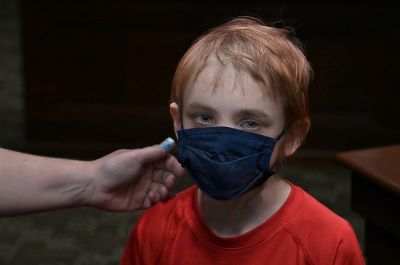
Orion Bethel, 10, traveled to the state Capitol Aug. 5. to urge lawmakers to allow schools to impose mask mandates so that kids like him with health conditions would be able to return. Washington Post photo by Michael S. Williamson
“Thirty-four days,” her mother Angela Morris reflected last week while at Caia’s bedside at Arkansas Children’s Hospital. 816 hours. 48,960 minutes. And counting. “This is a nightmare.”
Outside Room No. 5 on the third floor, where Caia lay with a stuffed frog in one hand and a stuffed seal in the other, a crowd of doctors, nurses, respiratory therapists and other specialists buzzed around her and other sick children. The hospital had started the day with 23 covid patients, 10 in intensive care. Five of those were on ventilators and three were on heart-and-lung bypass machines of last resort. It wouldn’t be long before more sick kids were on the way.
“You always have times when you cry,” Shonda Grappe, a pediatric intensive care nurse, said a few hours into her shift. “Everyone is feeling this.”
ADVERTISEMENTx
The hyper-contagious delta variant has changed much of what we thought we knew about the coronavirus and children – that kids might get infected, but they were extremely unlikely to become seriously ill. Today, as delta infections mount, some front line doctors suggest children are being hospitalized at higher rates and with more serious illnesses because of the new variant – a still-unproven hypothesis. What is indisputable is that in a swath of low-vaccination states stretching from Florida, South Carolina and Texas, up to Indiana and Missouri, the first large wave of pediatric cases is hitting hard – overwhelming hospitals, dominating political debates over mask and vaccine mandates and throwing school reopening plans into disarray.
Linda Young, a respiratory therapist at the hospital for nearly 37 years, said these latest children with covid appear to be progressing to respiratory distress much faster and in less predictable patterns: “I have never seen anything like this.” Even healthy children are being hospitalized, she said, something she had not seen in previous waves.
Amid the delta-fueled coronavirus surge, the American Academy of Pediatrics reported a nearly sevenfold increase in new child covid infections in one month: In the first week of July, there were 12,000 cases nationwide. By the first week of August, the number had grown to 96,000 – representing about 15% of all new infections.
As of Thursday, 1,785 children with suspected or confirmed covid-19 cases were hospitalized across the country, according to a Washington Post analysis. Florida leads the country in child hospitalizations – with 247 children with covid-19 admitted last week, a rate of 35 new admissions a day.
Doctors at major children’s hospitals say nearly all of their patients are unvaccinated. They are either under age 12 and not yet eligible for the coronavirus shots, or teens who put off the vaccine.
While those numbers are still a fraction of adult hospitalizations – and children’s deaths remain rare – they represent the highest rate of new pediatric admissions of any point in the pandemic. And there is growing evidence that even mild or asymptomatic infections in children could lead to long-haul illness, just as in adults.
In a letter this week to acting Food and Drug Administration Commissioner Janet Woodcock, the pediatricians’ group urged federal authorities to approve the shots for younger kids as soon as possible: “In our view, the rise of the delta variant changes the risk-benefit analysis.”
Combined with a highly unusual spike in the number of children admitted with respiratory syncytial virus (RSV), a flu-like illness that usually strikes in the winter, and parainfluenza viruses – and in some cases, co-infections with covid-19 – many children’s hospitals are overwhelmed.
“After many months of zero or few pediatric covid cases, we are seeing infants, children, and teens with covid pouring back into the hospital, more and more each day . . . I worry that we will run out of beds and staff,” Heather Haq, a pediatrician for Texas Children’s Hospital in Houston, tweeted recently.
Michael Smit, a pediatric infectious-disease expert at Children’s Hospital Los Angeles, said he fears things may get even worse over the next few months with vaccines for 5- to 11-year-olds delayed until later in the year.
“We have months more to go,” he warned. “We’re in a real danger period between now and then.”
– – –
Most respiratory viruses like the flu hit the very old and the very young with equal vengeance. SARS-CoV-2 has always been different. There have been about 400 children in the United States who have died from the virus, compared with more than 600,000 adults – and we still haven’t figured out exactly why.
The delta variant, which now represents about 97% of U.S. cases, seems almost like another virus than the one that spread from central China last year. Studies suggest it has a shorter incubation period – three to four days, instead of five to six – and that it may result in higher viral loads, which may explain its super transmissibility.
Whether it leads to more severe disease is a matter of intense debate. Doctors and nurses on the front lines report that infected children appear to be sicker than earlier in the pandemic. And several studies, including a report based on data from Scotland, suggested the variant doubles the risk of hospitalization regardless of a patient’s age. But the evidence is still mostly anecdotal and some contend co-infections with other viruses, and the larger number of stricken kids may account for what doctors are seeing.
Mark Williams, dean of the College of Public Health at the University of Arkansas for Medical Sciences, said that even the first signs of illness look distinct – “more like a typical cold or pneumonia,” than they did a year ago. These include a sore throat, for example, or runny nose, as opposed to a rash or stomach pains which doctors saw more of before.
“The delta variant is acting very, very differently with respect to kids,” agreed Rick Barr, chief clinical officer at Arkansas Children’s, who said the illness appears to have more of a respiratory impact.
At Barr’s hospital last week, the pediatric intensive care unit was a frantic rush of activity. A boy who was admitted the night before had worsened and needed to be intubated. A new patient arrived to take the second-to-last open bed – a school-age girl with signs of MIS-C, the life-threatening inflammatory syndrome that often appears two to six weeks after a covid infection.
“It’s exhausting and nonstop,” said nurse Brittany Rowell. “These kids are the strongest people I’ve ever met.”
Fortunately, Barr said, most children are recovering after being treated with the anti-viral drug remdesivir, steroids, respiratory support and blood thinners – the same protocols developed through trial and error on adults.
The picture of what’s going on with children is muddy in part because the rising number of delta infections has coincided with a surge in other cold-like viruses as vacations, camps and swim teams resumed this summer, said James Versalovic, pathologist in chief at Texas Children’s Hospital. He and other doctors said they are seeing more children co-infected with covid-19 and another virus, which may be making their cases worse.
He said about 10 percent of all children who test positive for the coronavirus and seek treatment at the health care system’s network of 100 primary and urgent care centers or hospitals are being hospitalized.
“We don’t have firm evidence that disease is more severe now than it was a year ago,” he said. “But we do know it’s different.”
As a result of the uncertainty surrounding the delta variant, said Chris Beyrer, an epidemiologist at the Johns Hopkins Bloomberg School of Public Health, “people who have not been immunized, hesitant or reluctant, really now need to do a rethink.”
As of July 7, according to the AAP, 6.4 million children had been fully vaccinated, representing 36% of 16- to 17-year-olds and nearly a quarter of 12- to 15-year-olds – with teens having the lowest rates among all eligible age groups.
“Delta has changed a lot of things,” Beyrer said. “But what has not changed is that our best protection is immunization.”
– Orion
Outside Caia’s window at Arkansas Children’s to the north is a majestic view of the state capitol, where on Aug. 5, another child was slumped in his mother’s arms.
Orion Bethel, age 10 – two years too young to get a vaccine – had traveled more than two hours from his home in Batesville, Ark., about 95 miles northwest of the state capital, to listen to grown-ups argue about the pandemic. Orion is desperate to join his peers in a real classroom and had signed up to testify about what that would take.
The rising fifth-grader, who is tiny for his age with blond hair with pink streaks, has a pulmonary disease, among other conditions, that requires daily treatment. “I have a lot of health problems,” he explained to a reporter, “and I shouldn’t go back without masks.”
The special legislative hearing – during which about half of the lawmakers and audience members wore face coverings – had been convened at the urging of Arkansas Gov. Asa Hutchinson, R, who had signed into law a ban on mask mandates back in April.
Now, with the delta variant surging and hospitalizations hitting records in his state, Hutchinson called his support of the bill an “error.” He was urging lawmakers to create an exception for schools, where millions of children are set to return in person this month.
For hours, emotional parents marched to the stage. One young mother accused lawmakers of being “irresponsible” for stripping layers of protection when children were getting sick in record numbers. But another questioned the evidence for the existence of the coronavirus as “Internet junk science.”
Jared Beavers, a pediatrician and parent to two elementary schoolchildren too young for the vaccine, described how hospitals were so besieged that doctors “are triaging as much as we can” – and that is before school starts.
“Going back to school without the protections of a mask . . . I think it could lead to an absolute disaster,” he said, adding, “deaths are not the only bad thing that we see in relation to this virus.”
That message has been gaining traction in a state where many have flouted mask mandates, denied the pandemic exists and embraced debunked vaccine conspiracy theories. Arkansas has one of the lowest coronavirus vaccination rates in the country for both adults and children, making masking all the more important, according to public health experts and others who testified that day.
But those numbers have inched up in recent weeks as fears of the delta variant have grown. In Arkansas, 19% of children ages 12 to 17 have been fully vaccinated (much lower than the national average), up from 14.9% on July 21, with one-third having gotten at least one dose.
Orion never got the chance to speak that day. Lawmakers abruptly concluded the hearing, voting down the exception for the mask mandate ban. Afterward, he and his mother Kameron, a 39-year-old nurse, wandered the room trying to find anyone who would listen.
Arkansas state Rep. David Hillman, a Republican who represents District 13, smiled and leaned in maskless to hear Orion tell him about his respiratory disorder – he needs a ventilator-like machine to keep him breathing at night – and expressed sympathy when Orion lifted up his shirt to show the feeding tube in his stomach.
But Hillman was unwavering that masks should not be mandated. He said he felt the issue was about personal liberty: “I don’t want kids to get sick. But if some kids don’t need a mask, we shouldn’t make them wear a mask.”
Kameron said she was furious at the legislative vote and blamed it on politics. “This is so messed up,” she said.
Later, the Little Rock mayor and school officials from several districts said they would institute mask mandates anyway. And that same week, an Arkansas judge temporarily blocked the state from enforcing the ban.
– Sawyer
Sarah Wilson of Conway, Ark., got the notification late Sunday, July 18, that a child in her 15-year-old’s youth group had tested positive for the coronavirus. By Wednesday, when she returned home from work, she found her usually energetic son, Sawyer, lying flat on his back in bed, instead of playing bass or video games.
“It hurts to move,” he complained. He had only a low-grade fever of 100 degrees and no other symptoms, but the next day, when she took him to the pediatrician, Sawyer’s blood oxygen levels were so low the staff immediately put him in an ambulance to Arkansas Children’s.
One of the first questions the doctors asked was about vaccines. It appeared he was infected just three days after receiving his first shot.
Sarah and her husband Jarrett, essential workers who set up shelters and warming stations for the homeless, had been vaccinated in March. But given that Sawyer wasn’t going out much, and that clearance for children’s shots had happened so quickly, they hadn’t been in a huge hurry for their son. A survey released this week by the Kaiser Family Foundation found that half of American parents had made similar “wait-and-see” decisions for their kids because of concerns about possible side effects, such as the rare heart issue documented in some teens. Many of these same parents were inoculated themselves.
“Maybe the first one did do something to protect him a little. I’m not sure,” Sarah said. “The medical staff – they were really wishing he had made it to the second shot.”
At the hospital, Sawyer’s breathing was touch-and-go – it would be fine for a while and then crash if he moved a certain way or went to sleep – and he was moved to intensive care. Sarah was terrified, and she wrote prayers and scripture passages all over his room.
“When you go through deep waters, I will be with you. When you go through rivers of difficulty, you will not drown. Isaiah 43:2”
“God – guide the hands of those who take care of Sawyer. Amen.”
With Sawyer asleep most of the time, Sarah’s thoughts drifted. She heard the governor invoke the number of covid patients at the children’s hospital during a news conference, and “I remember thinking Sawyer was in that statistic.” She recalled one night when the respiratory therapist had to run out of her son’s room because “there was a baby crashing next door.” She remembered waking up one morning with a start to find the number of children on ventilators had doubled.
Seven days after Sawyer was admitted, doctors told Sarah he was strong enough to go home. She said she knew he was feeling better when “he started shooting video for Instagram, saying, ‘Boys, it’s time to go home,’ and taking pictures of the scars of all his IVs and bruising.” Later, though, he turned uncharacteristically quiet.
“Just in asking him simple things like, ‘How are you feeling?’ he doesn’t even want to acknowledge what happened,” she explained. “He’s not being rebellious. It was the scariest time.”
Days later, as Sarah nursed Sawyer back to health at home, she got the news that she, her husband and her 10-year-old son Paxton had all tested positive for the coronavirus. For Jarrett, it felt like a sinus infection. Sarah threw up for days. Paxton had the worst of it with a fever, nausea, headaches and nonstop coughing.
“I worry there’s nothing to protect him [since he was ineligible for a vaccine], so “his dad and I are in a scary place right now,” Sarah said.
As Arkansas lawmakers debated mask mandates Aug. 5, the Wilson family followed along while quarantined at home and miserably sick. One of the breaking news updates that afternoon was about the state’s third pediatric coronavirus death – an 11-year-old girl from West Memphis near the Tennessee border.
– Jordyn
Jordyn Franklin had been counting the days until the start of school. She was not just a good student but a great one, and picked up countless awards for the top grades in math (her favorite subject), science, spelling and numerous other subjects over the years. The rising sixth-grader from West Memphis loved rapper Megan Thee Stallion and singer Queen Naija, and aspired to be a judge one day.
On Friday, July 30, she seemed to have a sinus infection so her mother called the pediatrician’s office, which couldn’t see Jordyn until Monday. She didn’t eat much over the weekend and her family recalled “she wasn’t 100 percent,” but she also didn’t have obvious signs of being very ill.
But as they were getting ready to leave for the doctor’s appointment, the 11-year-old slumped over on the couch and said she “felt like she was on fire,” her aunt, Kirsten Clark, said. Jordyn’s mother called 911, and an ambulance took her to the nearest hospital.
Clark waited outside the emergency room with Jordyn’s 10-year-old brother Jaydon. She remembers only snippets of what the doctor told her when he came out to talk to them: “Could not get her stabilized on the ride . . . Ten minutes with no oxygen . . . Coded her three times . . . Did everything we could . . . Going to let the parents spend some last moments with her in there.”
Clark said most of her family, including her own teenage son, had not been vaccinated even though they are conscientious mask wearers. She said she expected everyone would get the shots now.
“This is real,” she said. “To people who just don’t believe it, this is real. Jordyn always wanted to be famous – YouTubing famous, not this way.”
On Friday night, one week to the day after Jordyn started feeling ill, family and friends held a vigil in her honor at Jackson-Wonder Elementary School, where she had spent so many happy years. The mayor came, the fire chief, too, and they brought a firetruck. The town released balloons into the air in her favorite color – purple, three of them with her initials.
Jordyn’s mother, Caylenn Franklin, wailed into the night. “I did everything I could baby, I’m so sorry baby,” she said. “I love you, I miss you.”
– Caia
Caia and her mother, Angela, had known no one who had gotten sick from the coronavirus in their little town of Sidney, Ark., population 179.
For a long time, it seemed as if the pandemic had skipped over them, except that Caia was in virtual school and passed the time drawing Japanese-style manga characters and writing poems. Besides, there were more practical concerns, such as making enough money to get by.
Caia’s dad had died from non-Hodgkin’s lymphoma when she was 1. That’s how Caia and her mother came to be living with Angela’s mom, her brother-in-law and his three children. There wasn’t a lot of space, Angela says – she and Caia had to share a bed – but she was grateful for the support.
Angela had been working at a chicken farm where she picked eggs. She liked that she could work at her own pace, but at $6 an hour, it wasn’t enough for them to have their own place.
In the hospital, Caia’s condition deteriorated very quickly. While on the ventilator, she suffered kidney failure and was put on dialysis. At one point, she spiked a 106-degree fever, her blood pressure plummeted and the team treating her had to bring a crash cart.
In the middle of it all, Angela made a decision to get a coronavirus vaccine herself and posted a selfie on Facebook showing her rolled-up sleeve. The reaction was more emotional than she expected. Many strangers praised her bravery. But, she recounted, “all these evil people were saying I deserved to be on the ventilator. Some even called the hospital room.”
She does not regret sharing the decision. “I just don’t think any parent should be in my situation right now,” she said. “I want people to get the vaccine.”
On Friday, what seemed like a miracle happened – Caia squeezed Angela’s hand. It was followed by coughs, a movement in her eyebrows and other signs she was aware of what was going on around her.
“Angela Morris is <halo emoji> feeling blessed,” she posted on Facebook.
“It’s OK baby,” Angela told Caia while holding her hand. “It’s going to be OK.”
By Sunday, doctors were able to take Caia off the ventilator, and she was finally breathing on her own. It was Day 37.

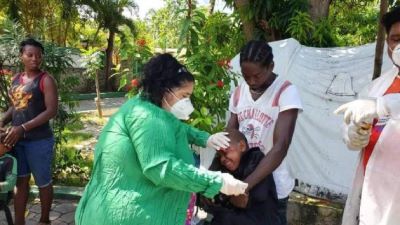
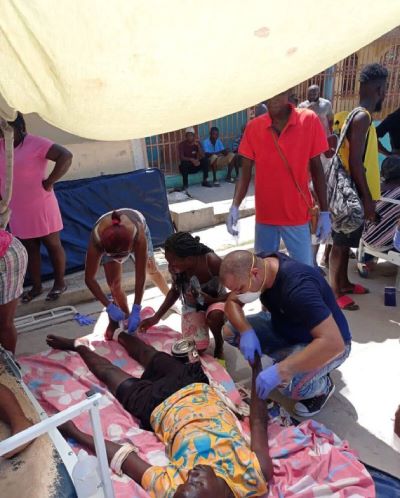
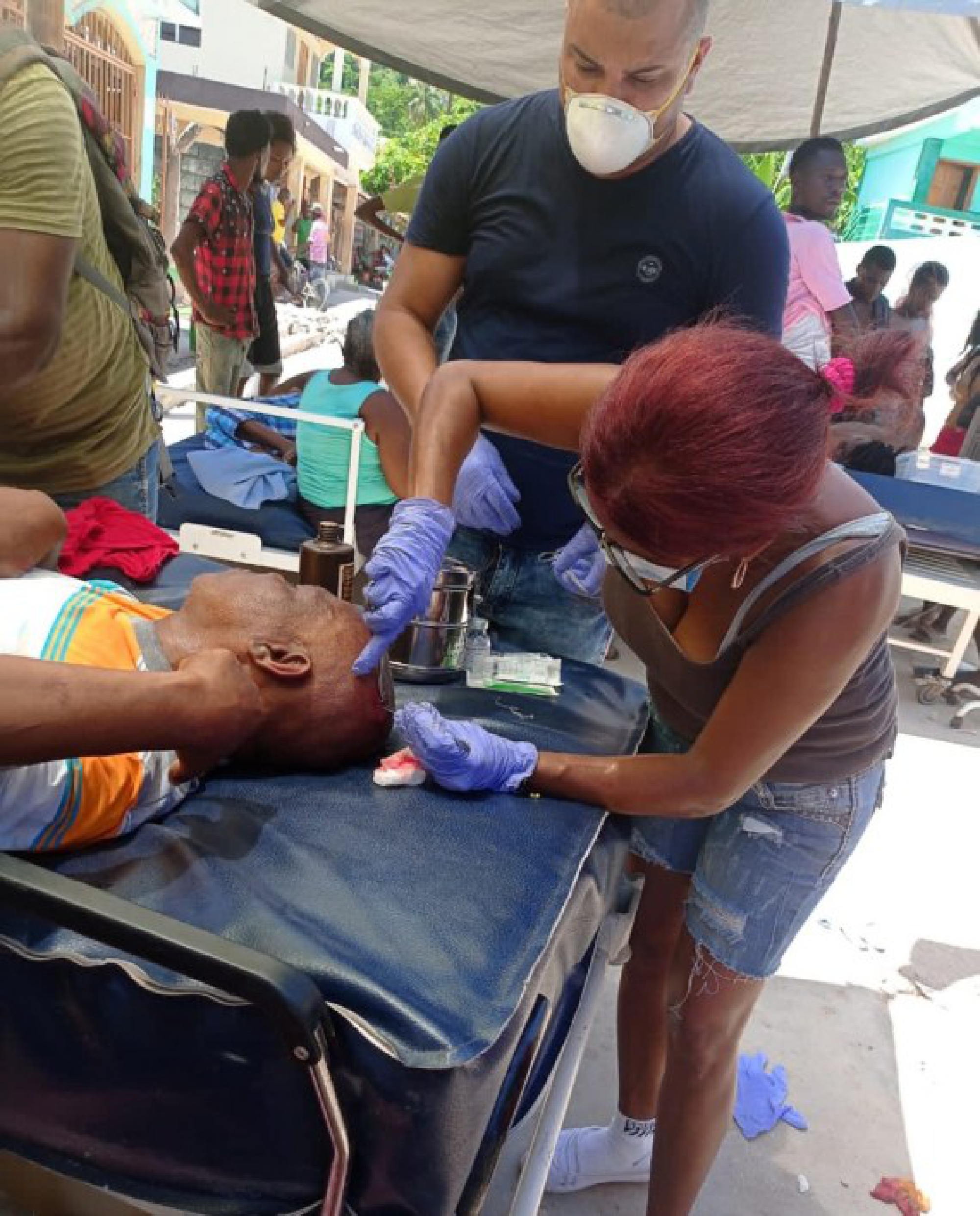 Photo taken with a mobile device shows members of the Cuban Medical Brigade helping an injured person after an earthquake in Jeremie, Haiti, Aug. 14, 2021.
 Photo taken with a mobile device shows members of the Cuban Medical Brigade helping injured people after an earthquake in Jeremie, Haiti, Aug. 14, 2021.
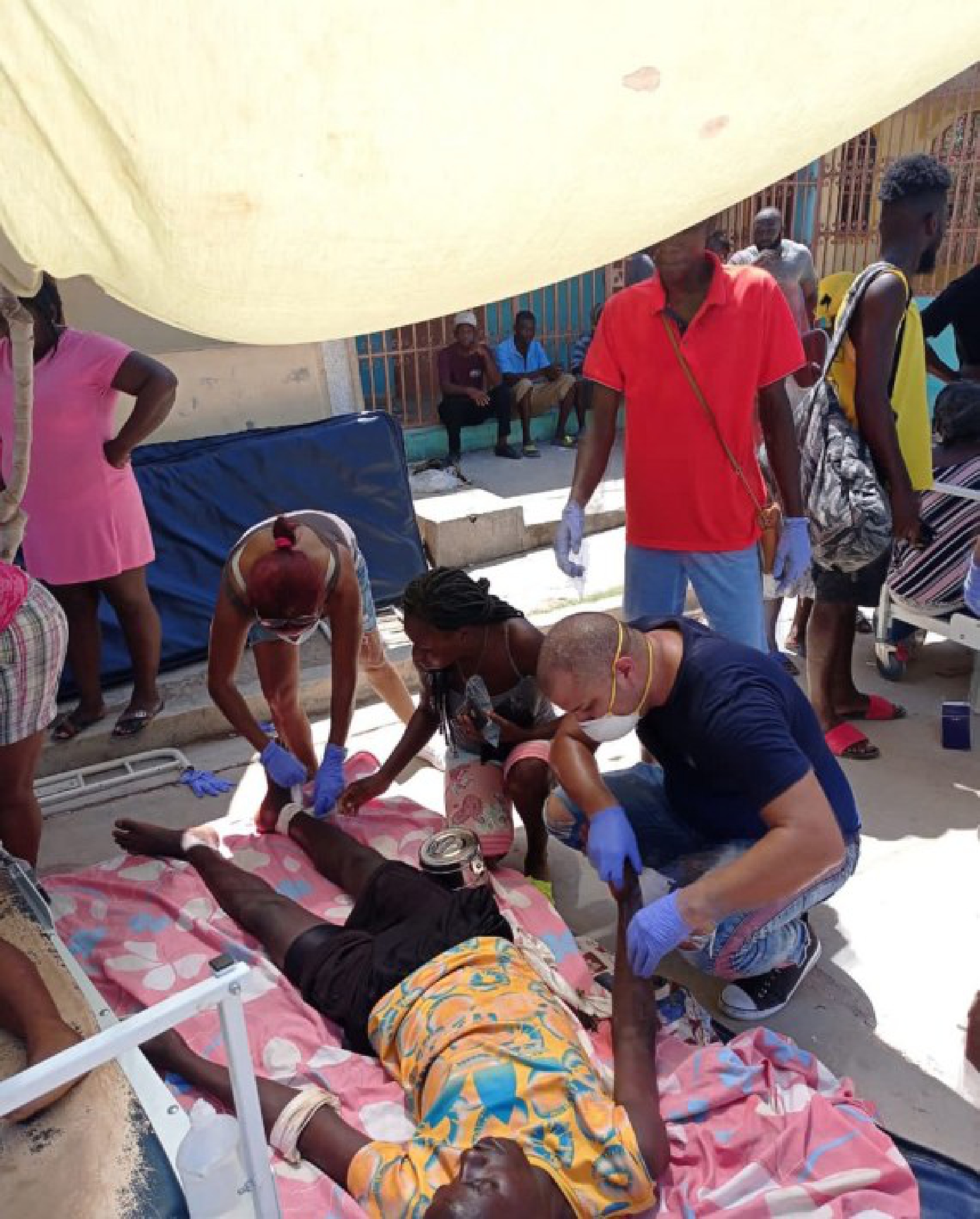 Photo taken with a mobile device shows members of the Cuban Medical Brigade helping an injured person after an earthquake in Jeremie, Haiti, Aug. 14, 2021.
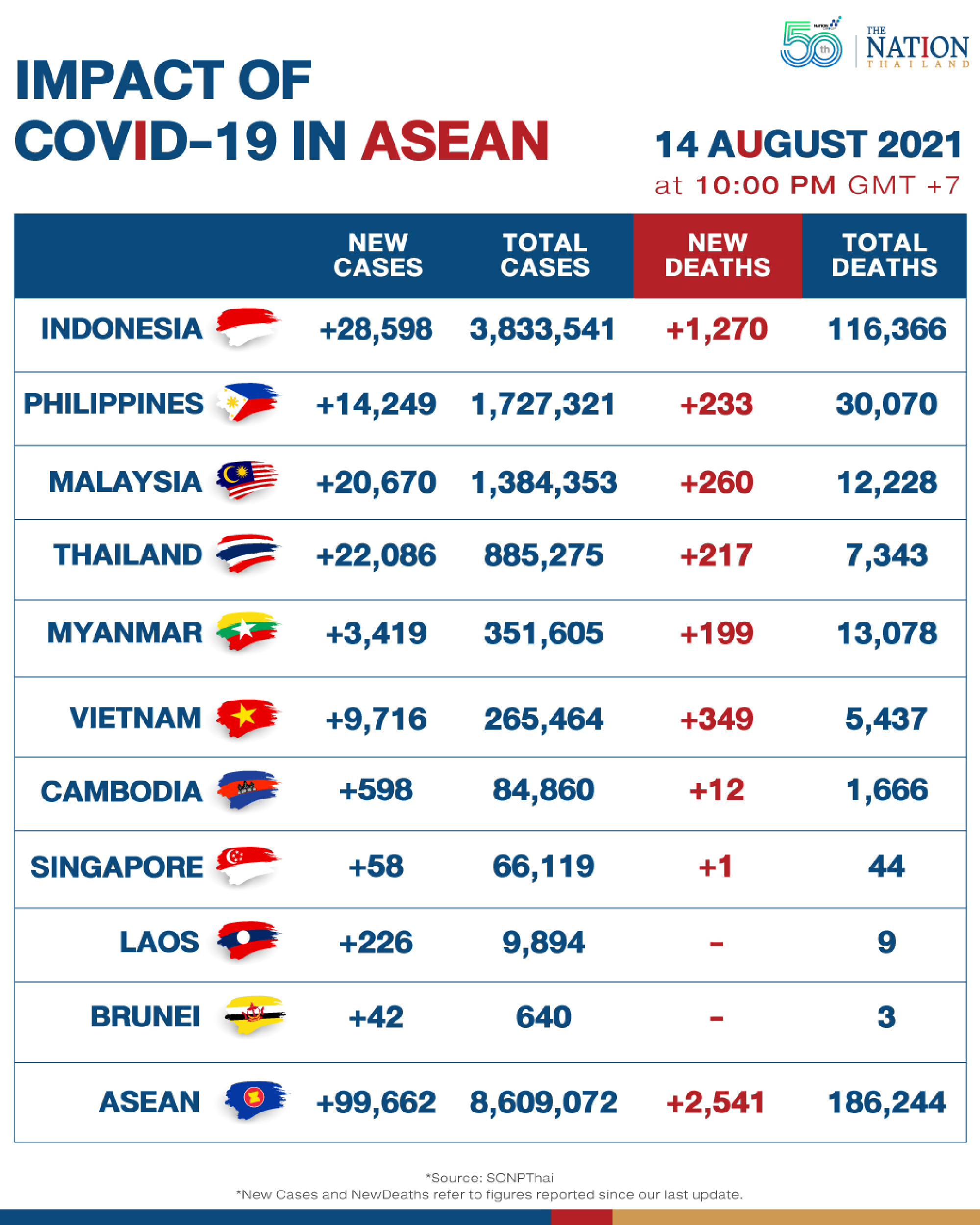 Asean reports close to 100,000 new Covid cases

 At least 304 dead in Haiti in wake of 7.2-magnitude earthquake