At least 14 injured in shooting in Austins 6th Street entertainment district
At least 14 people were injured in a shooting early Saturday in downtown Austin that unfolded as crowds filled the citys popular entertainment district, police said.
Authorities said there were no deaths, but two people were in critical condition. Twelve people were in stable condition. One male suspect was in custody, and another remained at large Saturday evening, the Austin Police Department said. The motive is unclear, interim police chief Joseph Chacon said before the arrest Saturday afternoon.
The first report of gunfire came about 1:24 a.m. near the 400 block of East Sixth Street, an area filled with bars and live music venues. Police said the shooter or shooters appear to have started firing randomly into the crowd, and that “a large crowd of people began to disperse.”
Authorities told the Austin American-Statesman that tens of thousands of people may have been in the area at the time, meaning the estimated crowd was close to “pre-pandemic” levels.
“It was very difficult to contain the scene, it was very difficult for EMS to make their way into this crowd,” Chacon told reporters. “And because of the nature of the injuries, officers had to go ahead and use their police vehicles to put some of these shooting victims into their vehicles and transport them themselves.”
Medics with Austin-Travis County Emergency Medical Services responded to what was described by authorities as an “active attack.” Ten people were brought to hospitals by police and medics. Another three people took themselves to hospitals, police said.
Chacon said that police are reviewing officers’ body-camera video and that of business surveillance cameras to determine what happened early Saturday. In a news release, the department thanked the U.S. Marshals Lone Star Fugitive Task Force “for assisting with the arrest of this suspect” who was in custody Saturday.
The chaotic scene was captured on social media, including one video from KXAN that shows police officers carrying one of the injured victims toward medics.
The shooting is the latest in what data shows to be an increased level of gun violence during the coronavirus pandemic. Gun violence killed nearly 20,000 Americans in 2020, according to data from the Gun Violence Archive, which was more than any other year in at least two decades. Some officials have worried that a rise in violent crime this summer could bring about safety concerns as Americans emerge back into society.
Austin Mayor Steve Adler, a Democrat, thanked local authorities for their efforts and noted that the shooting reflected the increased violence nationwide.
“The uptick in gun violence locally is part of a disturbing rise in gun violence across the country as we exit the pandemic,” he tweeted.
The Austin shooting was one of several shootings nationwide late Friday and early Saturday. In Savannah, Ga., one person was killed and eight others were injured, including a 2-year-old and 13-year-old, late Friday. Police there are still investigating and no arrests have been made.
A 29-year-old woman was killed and another 10 people were injured in a shooting on Chicago’s South Side early Saturday. The injured victims, who are between ages 23 and 46, are in fair to good condition, police said. No arrests have been made.
Biden asks G-7 to take a tougher line on China, but not all allies are enthusiastic
CARBIS BAY, England – President Joe Biden is asking leaders of other wealthy democracies to make a unified front against Chinas use of forced labor, arguing Saturday that a stronger line is a moral and practical imperative.
The Group of Seven economic club also agreed on a joint alternative to heavy-handed Chinese economic expansion tactics that can leave poorer nations saddled with debt, though China’s trillion-dollar infrastructure program has a vast head start.
Countering China is fast becoming a central element of Biden’s foreign policy, despite extensive trade ties and hopes for cooperation to combat climate change and other priorities.
But some of the leaders Biden is seeing for the annual G-7 session are less eager to prod Beijing over its labor practices. It appeared unlikely that Biden could persuade them to fully back his proposal to call out China for its use of forced labor, including of the Uyghur ethnic and religious minority.
A senior U.S. official who spoke with reporters following a morning session largely devoted to China described like-mindedness about concerns over Chinese behavior but a difference of opinion about how to respond.
He listed Britain, Canada and France as having quickly backed Biden’s view, but it was not immediately clear where the others stood.
“There is a little differentiation, I think I would say, within – within, I think, the spectrum of how hard they would push on some of these issues,” said the official, who spoke on the condition of anonymity because he was not authorized to describe the conversation on the record.
The official predicted that a joint statement from the seven leaders would address the issue in some form. That statement is to be issued Sunday and is still in the works, the official said.
A European official familiar with the discussion said the group aired ways they could cooperate with China in some areas, such as climate change, while competing in other realms and contesting Chinese behavior where required.
Britain and Italy are co-chairs of a major international climate conference later this year and seek China’s help to meet targets.
Earlier, another U.S. official had said that Biden was “pressing his fellow leaders for concrete action on forced labor to make clear to the world that we believe these practices are an affront to human dignity and an egregious example of China’s unfair economic competition.”
” . . . [I]t’s an expression of our shared values to make clear what we won’t tolerate as the United States and as a G-7. So we think it’s critical to call out the use of forced labor in Xinjiang and to take concrete actions to ensure that global supply chains are free from the use of forced labor,” said that official, who also addressed reporters on condition of anonymity.
“And the point is to send a wake-up call that the G-7 is serious about defending human rights and that we need to work together to eradicate forced labor from our products.”
Germany, which exports millions of cars to China annually, is among allies skeptical of a hard stance against China that could backfire. Japan, a close neighbor and trading partner of China, has also been wary. Prime Minister Yoshihide Suga told Biden as much when they met at the White House in April. And Italy signed a 2019 memorandum of understanding with China to join its “Belt and Road Initiative,” the sprawling infrastructure development project that the G-7 is now attempting to blunt.
The White House issued a fact sheet Saturday about what it said was a G-7 agreement to offer other nations clearer alternatives to Chinese offers of road and other infrastructure development that come with a hitch.
The “Build Back Better for the World” infrastructure development plan is “a values-driven, high-standard, and transparent infrastructure partnership led by major democracies,” the White House said. It proposes millions in partnership with private industry to offer nations in Africa, Asia and elsewhere options to say no to China’s trillion-dollar Belt and Road program. The Chinese initiative is a top priority for Chinese President Xi Jinping.
China is not a member of the G-7, which is meeting this year for the first time since 2019 because of the coronavirus pandemic.
Competition with China is one subtext to the three-day G-7 session here, where Biden is meeting with the leaders of Britain, France, Germany, Italy, Canada and Japan. Biden, making his first foreign trip as president, will see many of the same leaders again next week for a summit of NATO nations. He ends his trip with a leader-to-leader meeting with Russian President Vladimir Putin.
The White House announced Saturday that the Putin meeting, which takes place Wednesday in Geneva, will include a larger working session and a smaller one, but will not include a joint news conference by the two leaders.
The format is important because of recent history. President Donald Trump dismissed aides and even a note taker from some sessions with Putin, raising alarm about what was discussed. His deferential performance during a news conference with Putin at a summit in Helsinki in 2018 was widely considered a low moment in his presidency.
“We expect this meeting to be candid and straightforward and a solo press conference is the appropriate format to clearly communicate with the free press the topics that were raised in the meeting – both in terms of areas where we may agree and in areas where we have significant concerns,” a White House statement said.
Biden held a friendly meeting with French President Emmanuel Macron on the sidelines of the G-7’s second day of meetings. Reporters saw the two sitting outdoors in the sunshine, the windy beach and aquamarine sea behind them.
It was their first formal meeting, although they have been getting to know one another at the summit and earlier, over the phone. Macron was elected shortly after Biden left office as vice president.
“We’re, as we say in – back in the States, ‘We’re on the same page,'” Biden said.
Macron had made an effort to use friendly persuasion to change President Donald Trump’s mind about leaving the Paris climate accord and the Iran nuclear deal, to no avail.
Macron seemed relieved by Biden’s moves to reverse those decisions and the general mood of cooperation Biden has sought to project.
He cited the challenges of the coronavirus pandemic and climate change, said that “for all these issues, what we need is cooperation. And I think it’s great to have the U.S. president part of the club and very willing to cooperate.”
Biden then offered a plug for the traditional alliances Trump disdained, including the European Union, the common market from which G-7 host Britain has withdrawn.
“I think we can do a lot, too. We – the United States, I’ve said before – we’re back,” Biden said. “The U.S. is back. We feel very, very strongly about the cohesion of NATO. And I, for one, think that the European Union is an incredibly strong and vibrant entity that has a lot to do with the ability of Western Europe to not only handle its economic issues, but provide the backbone and the support for NATO,” Biden said. “And so I – we’re – very supportive. Very supportive.”
Reporters then asked whether Biden has succeeded here in reassuring allies that his slogan “America is back” is true.
ADVERTISEMENT
Biden, sunglasses in hand, gestured to Macron and said, “Ask him.”
“Yeah. Definitely,” Macron replied.
Published : June 13, 2021
By : The Washington Post · Ashley Parker, Anne Gearan
Jury awards $15 million in landmark case over embryos, eggs destroyed in fertility clinic tank failure
The devastating news landed in the inboxes of the fertility clinic patients early one morning in March 2018.
Atank storing frozen human embryos and eggs at Pacific Fertility Center in San Francisco had failed, potentially destroying the precious cells that scores of people hoped would one day bring them biological children. Some might still be viable, the clinic told them in the alert, but the full extent of the damage was unclear.
On Thursday, after more than three years of litigation in federal court, a jury in California awarded five of the patients who lost embryos and eggs a combined $15 million in damages – a historic verdict that could have far reaching consequences for the loosely regulated U.S. fertility industry.
Jurors found that the storage tank maker, Chart Industries, knew about a defect in its equipment that prevented accurate temperature monitoring but neglected to recall the units or warn the public about the problem. When the part malfunctioned in the Pacific Fertility Center tank, more than 3,500 frozen eggs and embryos prematurely thawed, according to plaintiffs’ attorneys. Jurors held Chart 90 percent responsible and Pacific Fertility Center 10 percent responsible for the failure.
The verdict appears to mark the first time a jury has awarded damages in a case involving the destruction of eggs and embryos, according to experts in family law. The outcome could serve as a bellwether not just for the hundreds of other plaintiffs with claims pending against Chart and the fertility clinic but for others whose dreams of becoming parents were dashed by similar errors, they said.
“This is a landmark case,” said Naomi Cahn, director of the University of Virginia’s Family Law Center. “In the past, many of these cases have settled, but here, we have a definitive jury verdict, holding the tank manufacturer primarily responsible, but with the clinic also responsible.”
In court papers, attorneys said that the eggs and embryos lost represented the only chance for some of the patients to conceive children. Adam Wolf, a lead attorney for the plaintiffs, said many of them were still struggling with the grief three years later.
“This is the material that helps people have children and start a family. When eggs and embryos are destroyed, it fundamentally alters people’s lives,” he said in an interview. “It should be a wake-up call for fertility clinics across the country that their mistakes can prove very costly.”
Representatives from Pacific Fertility Center and Chart didn’t immediately respond to messages seeking comment Friday.
Pacific Fertility Center was one of two clinics that in March 2018 separately reported problems in liquid-nitrogen tanks where thousands of eggs and embryos were kept. More than 4,000 eggs and embryos were lost at the University Hospitals Fertility Clinic in Cleveland, affecting hundreds of patients. More than 150 families settled claims with the clinic in 2019 but other lawsuits are ongoing.
Other accidents and mishaps have plagued fertility clinics around the country in recent years. In some cases, clinics have used the wrong sperm or embryos, leaving patients to discover later that they aren’t a child’s biological parents.
The lead plaintiff in the lawsuit against Pacific Fertility Center and Chart had her eggs retrieved and frozen in October 2016 and was paying to have them stored at the center, according to court records. She, like others in the lawsuit, was identified only by her initials to protect her privacy.
ADVERTISEMENT
According to the lawsuit, she and other patients received an email from the center on March 11, 2018, about a week after the error was discovered, notifying them of “a very unfortunate incident.” The message described how storage tank No. 4 had lost liquid nitrogen for a brief period, which may have resulted in the loss of some eggs.
The lawsuit says that the tank systems made by Chart had for years “been failing in large numbers due to a defect that rendered the controllers unable to reliably detect changes in temperature and liquid nitrogen levels or sound alarms.”
The complaint alleged negligence, product liability, and other claims. Hundreds of would-be parents who stored eggs and embryos at the clinic eventually joined the case. A judge rejected a request to certify the lawsuit as a class action but allowed the litigation to proceed otherwise.
In court testimony, plaintiffs described how the trauma of losing eggs made them feel helpless.
“It’s really painful to be at a baby shower celebrating someone else’s family being built and knowing inside you’ll never get that,” one plaintiff told jurors. “So you start to pull back. You start to isolate.”
Experts said the verdict could bring closer scrutiny to the multibillion-dollar industry of fertility clinics and equipment manufacturers that has thrived as reproductive technologies have advanced and more Americans have turned to fertility treatments.
No government agency directly oversees assisted reproduction in the United States, and the only federal law that touches the process primarily regulates the manner in which clinics can advertise their pregnancy success rates. Private groups such as the American Society for Reproductive Medicine set industry standards for facilities that opt in, but the recommendations are voluntary and the organizations have no real enforcement power. At the state level, most assisted reproduction laws are limited to embryonic stem cell research, with little regulating the fertility industry’s procedures or practices.
“There is no licensure requirement, there’s no monitoring regime, no data registry for adverse events like this one,” said Dov Fox, director of the Center for Health Law Policy & Bioethics at the University of San Diego. “There’s no system of warnings or disclosures or any other measures to track reproductive facilities or hold the specialists accountable.”
Fox noted that the freezer units that store eggs and embryos were developed decades ago to hold livestock semen for breeding. Regulations have hardly evolved since, he said. “These tanks specifically, they’re not regulated any better than kitchen appliances or farm tools,” he said.
Policymakers may be reluctant to start crafting new rules after years of light-touch oversight. But the size and unprecedented nature of Thursday’s jury award may catch their attention.
“After a couple decades of very little action,” Fox said, “it could be the thing that alerts policymakers to the need for change.”
YouTube suspends Ron Johnson for a week after GOP senator touts questionable drugs to fight covid-19
YouTube has suspended Sen. Ron Johnson from uploading videos for one week after the Wisconsin Republicans account shared a clip in which he touted the supposed benefits of hydroxychloroquine and another drug in fighting covid-19.
According to Fox News Channel, a YouTube spokesperson said the video was in violation of Google’s policy against medical misinformation.
“We removed the video in accordance with our COVID-19 medical misinformation policies, which don’t allow content that encourages people to use Hydroxychloroquine or Ivermectin to treat or prevent the virus,” the spokesperson said, according to Fox News.
YouTube did not immediately respond to a request for comment from The Washington Post.
For months, former president Donald Trump had promoted hydroxychloroquine as a “game changer” for covid-19 and said he had taken the drug himself. But federal regulators have said it should be used only for hospitalized patients or in clinical trials, because of possible side effects, including serious heart-rhythm issues.
Last June, a study published in the New England Journal of Medicine found that hydroxychloroquine did not prevent healthy people exposed to someone with covid-19 from getting the disease. It showed that the drug was no more effective than a placebo – in this case, a vitamin – in protecting people exposed to covid-19.
In a statement Friday afternoon, Johnson denounced what he described as YouTube’s “Covid censorship” and said the company has “accumulated too much unaccountable power.”
“Big Tech and mainstream media believe they are smarter than medical doctors who have devoted their lives to science and use their skills to save lives,” Johnson said. “They have decided there is only one medical viewpoint allowed and it is the viewpoint dictated by government agencies. How many lives will be lost as a result? How many lives could have been saved with a free exchange of medical ideas? Government-sanctioned censorship of ideas and speech should concern us all.”
Johnson spokeswoman Alexa Henning said the video in question was a virtual event hosted by the Milwaukee Press Club.
A full video of the event posted by the press club remained on YouTube until Friday evening, when it was also removed with a message saying it had violated YouTube’s community guidelines.
At one point during the interview, Johnson mentioned his support for hydroxychloroquine and ivermectin, an anti-parasite drug that some have touted on social media as something that could end the pandemic despite insufficient evidence that it works as a treatment for covid-19 – as well as the sometimes dangerous consequences when people take the animal version.
“Whether it’s hydroxychloroquine, whether it’s ivermectin, whether it’s multi-drug treatments for early treatment of covid, I think that is one of the real blunders of the previous administration and the current administration and our health agencies in completely ignoring – actually, not only ignoring, but working against robust research, robustly exploring the use of cheap, generic drugs that can be repurposed for early treatment of covid,” Johnson said during the event.
Johnson’s hydroxychloroquine and ivermectin claims are just the latest instance of the senator dispensing false or questionable information about covid-19 and downplaying the seriousness of the pandemic.
Last year, he suggested it would not be worth shutting down the economy even if 3.4 percent of the U.S. population – or more than 11 million people – might die of covid-19. In April, he said he was “getting highly suspicious” of the push to vaccinate as many people as possible against covid.
Johnson, who was elected as a tea party darling in 2010 and has since become a hard-right Trump loyalist, has also been embroiled in plenty of controversy unrelated to covid-19 in recent months. He has tried to downplay the severity of the Jan. 6 insurrection at the Capitol, which left five people dead and injured scores of police officers. At one Capitol Hill hearing about the insurrection, Johnson tried to distance Trump supporters from the riot and suggested without evidence that “antifa or other leftist agitators” had been among the rioters.
In March, Johnson intentionally delayed the passage of Biden’s coronavirus relief bill by forcing Senate aides to read aloud all 628 pages of the bill’s text. That same month, he appeared on a conservative news radio show to say that he had “never felt threatened” by Capitol rioters – but that he might have been scared if they had been Black Lives Matter or antifa protesters. His remarks prompted Democrats and some anti-Trump Republicans to call on him to step down.
ADVERTISEMENT
Johnson, whose second term is ending in 2022, had originally promised he would not serve a third term but has lately said he would consider running again.
Published : June 12, 2021
By : The Washington Post · Felicia Sonmez, Amy B Wang
Gottfried Böhm, Pritzker-winning architect who sculpted in concrete, dies at 101
Gottfried Böhm, a third-generation architect who helped rebuild his native Germany in the decades after World War II, designing jewellike churches and light-filled civic centers en route to winning the Pritzker Prize, architectures top honor, died June 9 at his home in Cologne, Germany. He was 101.
His son Paul, a fellow architect, confirmed the death but did not give a precise cause.
Böhm, who trained as a sculptor as well as an architect, often modeled his buildings out of clay or Plasticine, designing structures that rose like concrete mountains over a forest or town. Best known for monumental buildings such as the Neviges pilgrimage church and Bensberg City Hall, both built in Germany in the late 1960s, he also designed glass-and-steel theaters, office towers and apartment buildings.
In 1986 he was awarded the Pritzker Architecture Prize, often described as the Nobel Prize for architecture. “His highly evocative handiwork combines much that we have inherited from our ancestors with much that we have but newly acquired – an uncanny and exhilarating marriage,” the citation said.
Indeed, Böhm often spoke of linking the present and the past in his work, designing buildings that sat atop ruins, incorporated the structure of a neighboring 19th-century pub or evoked the medieval architecture of a nearby castle. He focused less on honing a particular style than on making sure each building made sense for its environment, whether on a rural hillside or in a bustling city center.
“New buildings should fit naturally into their surroundings, both architecturally and historically, without denying or prettifying the concerns of our time,” he said in his Pritzker acceptance speech. “You cannot just quote from history and above all you cannot take it out of context, in however humorous a fashion. On the contrary, history has a natural continuity that must be respected.”
In a phone interview, Paul Böhm said that his father had initially resisted becoming an architect, yearning to become a sculptor instead of following his father and paternal grandfather into the family business. History’s “natural continuity” apparently won out, although in a sense the elder Böhm never stopped sculpting. “His buildings have always been sculptures in some way,” Paul said.
Böhm kept going into the office even after he turned 100, working out of a building that his father, a church architect named Dominikus, had built in 1928, and that three of his four sons occupied after following him into the profession. As a boy, Böhm sat in the office sketching church windows.
He ultimately designed more than 60 churches and had projects worldwide, including in Taiwan and Brazil. But he spent most of his career working in Germany, where he designed a five-story Potsdam theater with curved, cantilevered roofs; a glass pyramid-shaped public library in Ulm; and a new city center in Bergisch Gladbach, which included a multipurpose performance hall with walls clad in terra-cotta tiles.
“He’s an individual expressionist, the kind of architect left over from the 1920s,” Philip Johnson, who received the inaugural Pritzker Prize in 1979, told the Christian Science Monitor after Böhm won the honor.
Böhm’s most revered building was the Mary, Queen of Peace pilgrimage church in Neviges, consecrated in 1968 and variously known as the Mariendom and Wallfahrtsdom. Along with a concrete chapel designed by Le Corbusier in Ronchamp, France, the church is often cited as one of the most important religious buildings of the postwar period.
ADVERTISEMENT
Built on a hilltop where an image of the Virgin Mary had drawn pilgrims since the late 17th century, the church’s concrete exterior was strikingly geometric, topped by jagged cubes and pyramids with angles that suggested the tiled roofline of the surrounding town. Inside, the church opened up like a concrete cave, illuminated by narrow skylights and windows high above the floor.
Arthur Drexler, architecture director at the Museum of Modern Art in New York, once described the church as “a brooding apparition, a ghost from the medieval past inexplicably materialized in the midst of a bourgeois townscape.”
Böhm, who also designed door handles and vibrant stained glass windows for the building, had a rather more uplifting vision for the space. In an interview last year, he told the German broadcaster DW that he had built the church as a vast tent for the “wandering people of God.”
Gottfried Leo Böhm was born in Offenbach am Main, near Frankfurt, on Jan. 23, 1920. He was drafted into the German army during World War II and wounded during the Russia campaign in 1942, according to the New York Times. Four years later, he graduated from what is now the Technical University of Munich.
For his first independent building as an architect, he designed a chapel built on the ruins of St. Kolumba, a Catholic parish church in Cologne that was destroyed during the war. Consecrated in 1950, the building became known as Madonna of the Ruins, after a sculpture of Mary and Jesus that had survived the bombing. The chapel is now part of the Kolumba art museum.
After a few years of working with his father, Böhm sought fresh ideas during a months-long tour in the United States, where he worked with Cajetan Baumann, a Franciscan friar and architect, and met Bauhaus architects Walter Gropius and Ludwig Mies van der Rohe. He took over his family firm after his father died in 1955, and collaborated for decades with his wife, architect Elisabeth (Haggenmüller) Böhm.
They married in 1948, and she died in 2012. In addition to his son Paul, survivors include three other sons, Stephan, Peter and Markus; a brother; five grandchildren; and two great-grandchildren.
Although Böhm was part of a group of architects who helped rebuild Cologne after World War II, he came to believe that as much damage was inflicted by the postwar construction boom as by the war itself. New highways were carved through the city and old buildings were torn down, replaced by structures that were sometimes nice to look at but, in his view, did little to promote a sense of community.
“I think the future of architects doesn’t lie so much in continuing to fill up the landscape as in bringing back life and order to our cities and towns,” he declared in the catalogue of a 1986 exhibit of his sketches. In his Pritzker acceptance speech, he quoted advice his wife had given their children: “Our generation has built a lot, but your generation will have to work hard to heal all that.”
Republicans aim to exploit Democratic discord on Israel
WASHINGTON – House Democrats are trying to move past the angry exchanges this week over a tweet by Rep. Ilhan Omar, D-Minn., that highlighted intraparty tensions over Israel and led to accusations of bigotry, but some tensions lingered Friday, and Republicans are seeking ways to exploit the divide.
The discord comes at a precarious time for House Democrats, whose slim majority requires them to be unified to get their priorities passed, including a massive infrastructure package and an expansion of the social safety net.
Liberal Democrats, already wary that these major legislative efforts will be watered down to attract Republican votes in the Senate, were furious that a group of Jewish Democrats publicly rebuked Omar over her tweet that grouped the actions of the United States and Israel with Hamas and the Taliban. Omar later clarified that she was not suggesting there was a moral equivalency between the democratic countries and the terrorist groups.
But feelings remained raw on Friday even as both sides sought to ease the tensions, according to Democratic aides who spoke on the condition of anonymity to describe internal party dynamics.
Now Republicans are looking to press the issue and possibly force a vote on whether Omar should be allowed to stay on the House Foreign Affairs Committee. As a precursor to that decision, a group of Republicans who voted with Democrats to remove Rep. Marjorie Taylor Greene, R-Ga., from her committees because of her extremist views released a letter Friday calling on Democratic leaders to remove Omar from the panel.
“We consider anything less to be a form of complicity,” the Republicans wrote.
While tensions have simmered since Thursday, liberal Democrats privately worry that Republicans will force a vote, through what is known as a privileged resolution, to strip Omar of her committee assignments – and that some of the Democrats who rebuked her could join the opposition, given how quickly they released the strongly worded statement against the Minnesota congresswoman.
Republican leadership did not respond to a request for comment Friday on whether they would introduce such a resolution next week when the House reconvenes for the month, but Democrats are already warning them of potential consequences if they try.
“Republicans have more exposure than we do, so the chance for a tit-for-tat is possible, especially since they are the ones having the antisemitism problem,” a senior Democratic aide said, referencing Greene’s recent comments likening coronavirus rules on mask-wearing to branding Jewish people during the Holocaust. The aide, like others, spoke on the condition of anonymity to discuss private party strategy and conversations.
Democratic leadership does not support removing Omar from the foreign affairs panel – something GOP lawmakers have called for since she was given the assignment as a freshman in 2019.
Democratic aides to two Jewish members who signed the statement in opposition to Omar’s tweet said it’s extremely unlikely any of them would vote to remove Omar, especially if it were a move brought on by Republicans.
“We welcome Republicans to introduce a resolution, because then they’ll be embarrassed to see Democrats sticking together and holding the line,” one aide said.
Rep. Brad Sherman, D-Calif., one of the signers of the statement criticizing Omar, was less unequivocal when asked if he would support a vote to remove her.
“We have people serving on committees that supported an insurrection – let’s deal with that first,” Sherman said in an interview, referring to GOP lawmakers who voted against certifying the 2020 election. “I’m not calling for her to be removed from committees.”
However, some members are informally discussing how they would vote if a censure motion were to be brought up instead. Democrats can afford to lose only four votes to pass or sink legislation or resolutions given their slim majority.
The conflict began over a tweet Omar wrote related to her questioning Secretary of State Antony Blinken at a hearing about how victims of crimes by the Israeli or Afghan governments can find justice.
ADVERTISEMENT
“We must have the same level of accountability and justice for all victims of crimes against humanity,” she tweeted with a video of her question to Blinken. “We have seen unthinkable atrocities committed by the U.S., Hamas, Israel, Afghanistan, and the Taliban.”
Several Jewish Democrats began to text among themselves, expressing their displeasure with Omar’s tweet, which jump-started conversations about releasing a statement to make their displeasure known in a bid to prevent Omar from making similar statements in the future, according to three Democratic aides. The 12 Democrats, led by Rep. Bradley Schneider of Illinois, released a joint statement late Wednesday denouncing Omar’s tweet as “offensive,” “misguided” and giving “cover to terrorist groups.”
Several Democratic congresswomen of color rose to Omar’s defense, calling the statement “Islamophobic,” and in one case, “anti-Blackness,” and railed against their colleagues for directing more animosity her way.
As tensions grew, Democratic leadership stepped in and began to coordinate with Omar about releasing a clarification in an effort to defuse the situation, said two aides. After she put out her statement Thursday afternoon, the full Democratic leadership team released a rare joint statement of their own that said equating the United States and Israel with terrorist organizations “foments prejudice,” but that they welcomed Omar’s clarification.
That angered some of Omar’s allies, who felt it unfairly targeted the congresswoman.
“Freedom of speech doesn’t exist for Muslim women in Congress. The benefit of the doubt doesn’t exist for Muslim women in Congress,” Rep. Rashida Tlaib, D-Mich., the lone Palestinian American member of Congress, wrote on Twitter. “House Democratic leadership should be ashamed of its relentless, exclusive tone policing of Congresswomen of color.”
House Speaker Nancy Pelosi, D-Calif., sought to de-escalate the situation further late Friday, saying she did not believe any action needed to be taken against Omar and that she did not believe the issue would further divide Democrats.
“I think that she clarified her remarks and that was – and we accepted that,” she told reporters in San Francisco. “And she has a point that she wants to make, and she has a right to make that point. There was some unease about how it was interpreted. She made her clarification.”
Some aides to liberal lawmakers privately mused that Pelosi, given her tight majority, cannot afford to irritate Omar, Tlaib, Rep. Alexandria Ocasio-Cortez, D-N.Y., and other members of “The Squad” of liberal lawmakers of color.
Realizing there is strength in numbers, liberals last month threatened to sink a bill providing funding for security improvements at the Capitol because it would direct funding to the Capitol Police following the Jan. 6 attack by a pro-Trump mob. After three liberal members voted “present” rather than voting to reject the bill, the $1.9 billion legislation passed on a 213-to-212 vote.
But the liberals do not want to gain a reputation as the Democratic version of the conservative Freedom Caucus, which often bucked its leadership when Republicans controlled the chamber and prevented the passage of party priorities, according to three aides to liberal Democrats.
“People are rightly furious,” said another House aide to a liberal lawmaker. “But the best way to heal and unify is, in the future, have direct conversations and make sure we have each others’ backs going forward and not let Republicans pick us apart because of this stuff.”
Aides for some of the Jewish members who released a statement Wednesday evening said that some in the group are content with Omar’s clarification and leadership’s joint statement backing up their denouncement. But others still remain somewhat unsettled by the backlash from liberals who derided them for singling out Omar.
A senior Democratic aide for a liberal lawmaker said there have been high-level conversations between lawmakers and staff about the situation and how the various sides experienced it. The aide said they’ve told their counterparts that “when our caucus pick up on incendiary talking points, we’re mainstreaming the vilification that leads to death threats to Rep. Omar and her team.”
The aide added that what happened wasn’t an isolated event but rather a symptom of a larger debate within the caucus of how to support marginalized groups. The prevailing sentiment among liberal members is disappointment, the aide said.
Even as tempers eased in Congress, outside groups were still angry with how Omar was treated. In a joint statement Friday, more than 50 national liberal organizations said that “the repeated targeting of Rep. Omar is rooted in sexism, racism, and anti-Muslim bigotry.”
“It is no surprise that Rep. Omar’s opponents would seize on any opportunity to once again attack one of Congress’s leading progressive voices. The true shame is that many in her own party would buy in to such bad faith attacks,” they wrote.
Sherman, for one, rejected the idea that they couldn’t disagree publicly with Omar because she is the target of abuse.
“I think we all recognize that Omar is subject to invective and personal hatred,” the California Democrat said. “Since I issued my statement, maybe a dozen have called for my painful dismemberment or death, but I’m well aware that being the first Somali American in Congress, that what Omar faces every day is what I have once a month. . . . That doesn’t mean I can’t disagree with her on public policy, but it means I’m aware of the terrible things that are thrown her way every day.”
Published : June 12, 2021
By : The Washington Post · Colby Itkowitz, Marianna Sotomayor
Justice Department watchdog to probe Trump-era leak investigations, including secret subpoenas for records from Congress and journalists
WASHINGTON – The Justice Departments internal watchdog announced Friday that he would review how officials sought the data of reporters, lawmakers and others as part of an aggressive crackdown on leaks during the Trump administration – a day after it was revealed the department years ago had secretly obtained the data of two congressmen well known for their criticism of President Donald Trump.
The announcement from Justice Department Inspector General Michael Horowitz came amid growing furor in Congress, where leaders pressed the department to reveal more about its secret 2018 move to subpoena Apple for lawmakers’ data and demanded that attorneys general in the Trump administration come answer questions on Capitol Hill.
A spokesman for President Joe Biden, meanwhile, blasted the Trump Justice Department’s move to seek lawmakers’ data, saying it “clearly fits within an appalling trend that represents the opposite of how authority should be used.”
“President Biden is absolutely committed to the independence of the Department of Justice, and – having served as a Senator for decades – to respecting the all-important rights of Congress as a co-equal branch of government,” the spokesman, Andrew Bates, said in a statement.
Horowitz announced that his review would “examine the Department’s compliance with applicable DOJ policies and procedures, and whether any such uses, or the investigations, were based upon improper considerations.”
While Democrats had called for such an inquiry, the inspector general’s examination is likely to be limited. Horowitz cannot compel the cooperation of former Justice Department officials, and almost all of the political appointees involved are now out of government. Democrats noted that Biden’s Justice Department also has questions it needs to answer – and current personnel that might need to be held accountable.
“The Committee has been in communication with DOJ, and we have made our position clear. The Department has a very short window to make a clean break from the Trump era on this matter,” House Judiciary Committee Chairman Jerrold Nadler, D-N.Y., said in a statement Friday, questioning also whether “the corruption may run deeper than has already been reported.”
“We expect the Department to provide a full accounting of these cases, and we expect the Attorney General to hold the relevant personnel accountable for their conduct,” Nadler said. “If the Department does not make substantial progress towards these two goals, then we on the Judiciary Committee will have no choice but to step in and do the work ourselves.”
The Justice Department has for weeks been facing criticism after it disclosed to three media organizations – The Washington Post, CNN and the New York Times – that officials had, largely during the Trump administration, secretly sought non-content phone and email records of reporters to advance leak investigations. Biden and Attorney General Merrick Garland both vowed to discontinue the practice, though they have not answered repeated requests for information on what happened in the past administration and on their watch. Negotiations over Times reporters’ records went on in secret for months into the Biden administration.
The controversy reached a new pinnacle when it was reported Thursday night that the Justice Department in February 2018 secretly subpoenaed Apple for the data of two California Democrats on the House Intelligence Committee, Reps. Adam B. Schiff and Eric Swalwell, as well as the data of their current and former staffers and family members.
An Intelligence Committee official, who like others spoke on the condition of anonymity because the matter remains politically sensitive, said Thursday night that Apple in May had notified at least 12 people connected to the panel of subpoenas for their data and that one minor was among them. Swalwell and Schiff were regular fixtures on cable news during the Trump administration’s early years, when Democrats were in the minority and Republicans were running the Intelligence Committee’s investigation of Russian interference in the 2016 election.
Apple spokesman Fred Sainz said in an emailed statement the company received the subpoena on Feb. 6, 2018. The subpoena, which provided no context into the nature of the investigation, sought customer or subscriber account information for 73 phone numbers and 36 email addresses, he said.
Apple regularly challenges warrants, subpoenas and nondisclosure orders, and has a policy of notifying customers about government data requests as soon as it can, Sainz said.
“In this case, the subpoena, which was issued by a federal grand jury and included a nondisclosure order signed by a federal magistrate judge, provided no information on the nature of the investigation and it would have been virtually impossible for Apple to understand the intent of the desired information without digging through users’ accounts,” Sainz said. “Consistent with the request, Apple limited the information it provided to account subscriber information and did not provide any content such as emails or pictures.”
The nondisclosure order was extended three times. The company notified customers about the data requests on May 5, after the Justice Department did not extend the order for a fourth time.
Late Friday, Microsoft acknowledged that it, too, received a subpoena related to a personal email account of a congressional staffer. The company did not name the aide, or the lawmaker for whom he or she worked.
ADVERTISEMENT
The government only sought metadata such as access logs, which indicate when someone has signed into their account. Like Apple, Microsoft did not provide the contents of emails.
“In this case, we were prevented from notifying the customer for more than two years because of a gag order,” the company said in a statement.
When the nondisclosure order expired, the company said it notified the aide then, and briefed the representative’s staff.
Many questions remain about the move – chief among them, what leak was being investigated and on what basis, and who at the Justice Department approved the subpoenas. In February 2018, Jeff Sessions was attorney general, though a person familiar with the matter said he has told people he did not recall approving a subpoena for lawmakers’ data in a leak case. Sessions was recused from many Russia-related matters, including special counsel Robert Mueller III’s investigation of the Kremlin’s interference in the 2016 election.
A person close to Rod Rosenstein, Sessions’s deputy attorney general, said he, too, has told people he did not recall hearing about the subpoena until news of it broke publicly. Two other people said William Barr – Trump’s second attorney general – also has told people he did not remember being informed of any subpoenas for lawmakers’ data during his time leading the department.
On Friday, Senate Democratic leaders demanded that Barr and Sessions testify about the matter on Capitol Hill. Barr declined to comment on whether he would, referring questions to the Justice Department. Sessions did not respond to a message forwarded to him by a representative.
Senate Majority Leader Charles Schumer, D-N.Y., and Senate Judiciary Committee Chairman Richard Durbin, D-Ill., said in a statement that if Barr and Sessions did not voluntarily testify, they would be subpoenaed to appear before Durbin’s committee. Such a move would require the support of at least one Republican on the panel.
“The revelation that the Trump Justice Department secretly subpoenaed metadata of House Intelligence Committee Members and staff and their families, including a minor, is shocking,” Schumer and Durbin said. “This appalling politicization of the Department of Justice by Donald Trump and his sycophants must be investigated immediately by both the DOJ Inspector General and Congress.”
Democrats also called on Horowitz to investigate, and on Friday a Justice Department official said Deputy Attorney General Lisa Monaco – at Garland’s direction – referred the matter to the inspector general’s office.
Some Democrats welcomed the move, while asserting it was not enough. Inspector-general investigations can take many months and give officials an excuse to duck questions from reporters or others. A Justice Department spokesman declined to comment for this article, citing the inspector general’s investigation.
Such an investigation “is an important step. But it cannot be a substitute for congressional oversight,” Rep. Joe Neguse, D-Colo.. said on Twitter. “The House Judiciary Committee should subpoena Jeff Sessions & Bill Barr.”
Congressional investigations, though, also can be limited. The Trump administration repeatedly stymied House Democrats’ efforts to subpoena witnesses and documents as part of its investigations surrounding the then-president, dragging lawmakers to court to enforce their summons.
Both Sessions and Barr had waged a vigorous crackdown on leaks of classified information. In August 2017, Sessions held a news conference to boast that the department had more than tripled the number of leak investigations compared with the number that were ongoing at the end of the Obama administration. Behind the scenes, the department’s national security division and the deputy attorney general’s office were meeting regularly – at times biweekly – to discuss the progress of such cases.
Though other Trump-appointed political leaders have left, the head of the national security division, John Demers, has remained on in the Biden administration.
The leak cases being investigated were eclectic, according to people familiar with the matter.
One had to do with reporting on the military. Others related to media disclosures about possible ties between the Trump campaign and Russia, the people said. At least one case seemed to be focused on former FBI director James Comey, whom Trump considered a political foe, and news reporting in 2017 about a classified document thought to be a Russian intelligence product.
Two people familiar with the matter said that, when Sessions was attorney general, officials began to explore whether current or former staffers on the House Intelligence Committee were providing classified information to reporters.
Leak cases are notoriously difficult, and some came to believe that investigation – as well as others – were likely to go nowhere, people familiar with the matter said. But Barr, two of the people said, believed the cases were languishing in part because the national security division was not willing to push aggressively to bring charges or formally close the cases.
Early that year, Barr tapped a federal prosecutor in New Jersey – Osmar Benvenuto – to assist in the leak investigations, hopeful he could push them forward, one way or the other. Benvenuto, two people familiar with the matter said, came recommended by Craig Carpenito, then the New Jersey U.S. attorney.
A friend who spoke with Benvenuto at the time said the prosecutor – who records show registered to vote as a Democrat – expressed some reservations about the assignment but also felt it was important to have objective eyes on such sensitive matters.
“Though he had real concerns about going down, he had a real sense of obligation,” the friend said, speaking on the condition of anonymity to detail a private conversation. The friend said he warned Benvenuto to make clear to whoever his supervisors were that if he were to take the job, he would do it “the right way.”
With Benvenuto around, investigators pushed for an interview with a former Intelligence Committee staffer they had come to suspect, according to two people with the matter. They ultimately did not bring any charges. Schiff said Thursday that he had been informed in May the matter in which his data was sought was closed.
Benvenuto did not return an email seeking comment, and a Justice Department spokesman declined to make him available.
Pursuing a congressional staffer for a possible leak is not unheard of. The Justice Department in the Trump administration, for example, charged a former staff member of the Senate Intelligence Committee, James Wolfe, with making false statements to the FBI during an investigation of the leak of classified information. In that investigation, the Justice Department seized phone and email records of a New York Times reporter, Ali Watkins, who had previously been in a romantic relationship with Wolfe.
Sen. Charles Grassley, R-Iowa, the ranking Republican on the Senate Judiciary Committee, asserted in a statement that it was too early to render judgment on whether the Trump administration’s effort to investigate leakers amounted to an abuse of power. The department – either publicly, in court or in private negotiations – has previously defended its efforts to obtain records of Post, Times and CNN reporters as running according to policy.
“Investigations into Members of Congress and staff are nothing new, especially for classified leaks,” Grassley said. “The Justice Department has specific procedures for such sensitive investigations, and the inspector general is already working to determine if they were followed.”
Published : June 12, 2021
By : The Washington Post · Matt Zapotosky, Felicia Sonmez, Karoun Demirjian
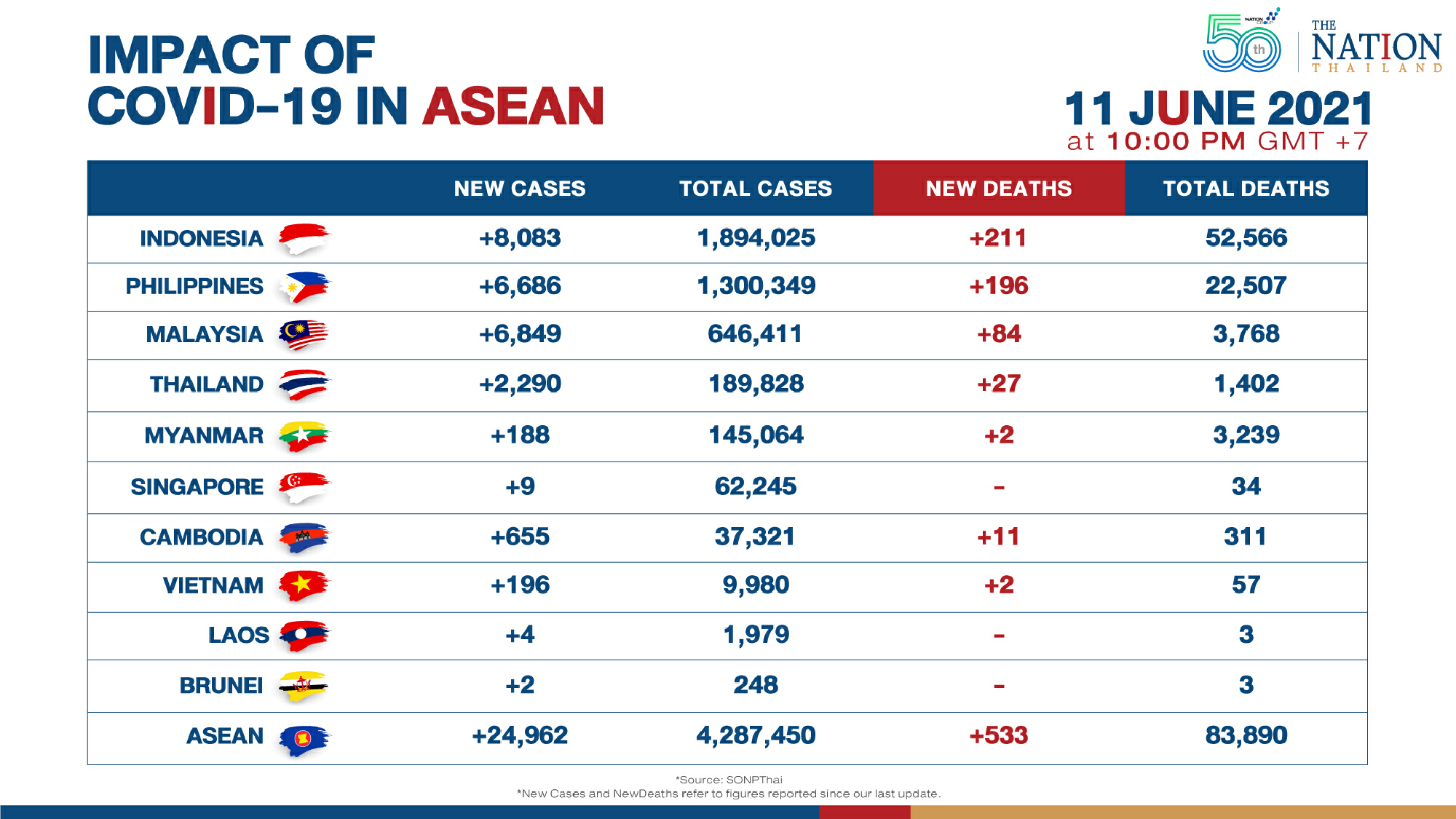
Southeast Asia reported an increase in deaths on Friday though the number of new Covid-19 cases fell slightly, collated data showed.
There were 24,962 new cases, lower than Thursday’s 25,181, while 533 patients died, up from Thursday’s 464.
Total Covid-19 cases crossed 4.28 million across Asean and deaths rose to 83,890.
Indonesia reported 8,083 new cases and 193 deaths on Friday, driving cumulative cases in the country to 1,894,025 and total deaths to 52,566.
The Jakarta authority said that the city had to utilise 400,000 doses of AstraZeneca vaccine before June 30 or they would expire.
Malaysia reported 6,849 new cases and 84 deaths on Friday, taking cumulative cases in the country to 649,411 and 3,768 deaths.
The Malaysian government plans to extend the lockdown for another two weeks, from June 15 to 28, if the number of new infections exceeded 5,000 per day.
Deaths, number of new Covid-19 cases edge higher in Asean
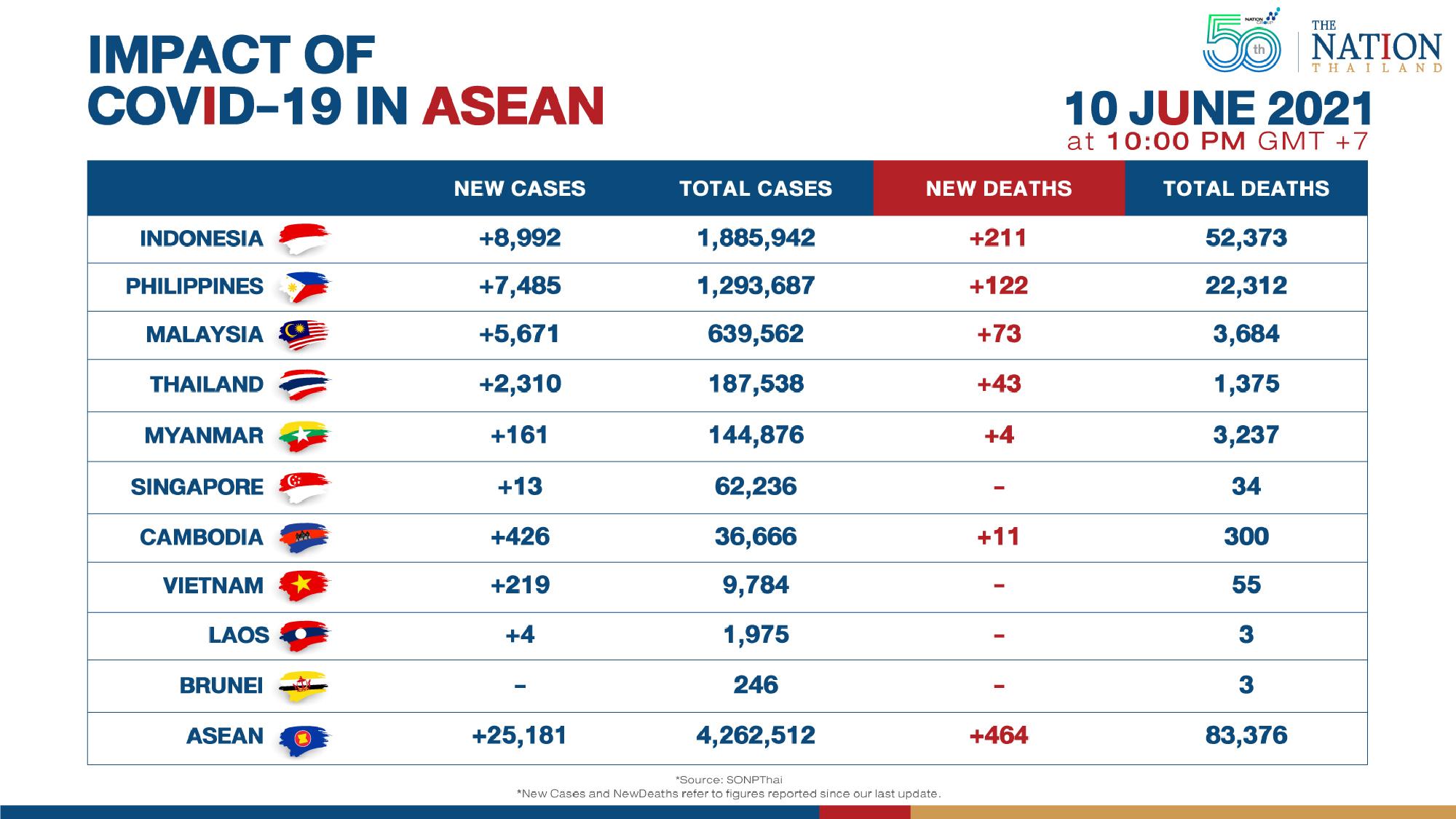
Southeast Asia saw an increase in new Covid-19 cases and deaths on Thursday, collated data showed.
There were 25,181 new cases on Thursday, higher than Wednesday’s 23,385, while 464 people have died, up from Wednesday’s 422.
The total number of Covid-19 cases in Asean crossed 4.26 million and deaths rose to 83,376.
Indonesia reported 8,892 new cases and 211 deaths on Thursday, as cumulative cases in the country increased to 1,885,942 patients and deaths to 52,373.
National carrier Garuda Indonesia announced the reduction of its fleet by nearly two-thirds, from 142 to 53 aircraft, due to the impact of the Covid-19 outbreak on travel.
Malaysia reported 5,671 new cases and 73 deaths on Thursday, driving cumulative cases in the country up to 639,562 and deaths to 3,684.
Malaysian authorities reported that during the nine days of the total lockdown (June 1-9), 268 factories were inspected, 59 factories were ordered shut for not following disease control measures, while 75 others have been issued a warning.
Japan risks another Covid surge with or without Olympics
The number of people seriously ill with Covid-19 in Tokyo could surge in the coming weeks, peaking as the Olympics are underway, even without thousands of participants streaming into the capital.
Anew analysis shows severe coronavirus cases could rise to a level that would require another state of emergency by early August in Tokyo, despite progress in vaccinating the elderly — if current restrictions in Japan’s urban areas are lifted as scheduled on June 20. The disease modeling from Kyoto University professor Hiroshi Nishiura was presented to government officials at a coronavirus advisory board meeting on Wednesday.
With the Olympics set to start in under two months, many people have focused on the risk posed by tens of thousands of overseas athletes and support staff arriving in Japan, which has been effectively closed to visitors since the beginning of the pandemic. Experts now are zeroing in on domestic factors that could contribute to an uptick in cases that would coincide with the games.
“There are four consecutive holidays right before the Olympics, summer vacation, and Obon holiday,” when people traditionally travel home to visit the graves of their ancestors, said Haruka Sakamoto, a public health researcher at the University of Tokyo. “It’s easy to imagine that more and more people will think: ‘if the Olympics can be held, it’s OK for us to travel.'”
And that may cause an increase in the number of people infected, Sakamoto said. Nishiura’s analysis notes that the spread of virus variants already in Japan would also contribute to the uptick.
John Coates, the International Olympic Committee’s vice president, said in May that the games will be held even if Tokyo is under a state of emergency.
The current state of emergency in parts of Japan has led to some of the most severe policies to date, such as asking restaurants to not serve alcohol. The number of new infections has dropped, with Tokyo’s seven day moving average of new cases falling by about half in the last month. It’s not clear what restrictions will remain in place when the emergency status is lifted.
On Thursday, the Tokyo Metropolitan Government’s Covid monitoring panel warned that the decline in the number of new coronavirus cases could stop in two weeks as the movement of people picks up after emergency measures are eased, according to TBS.
Japan has seen upticks in cases after previous emergency restrictions were eased. When the first such measure ended in May 2020, cases spiked at the end of July. Epidemiologists also pointed to the fact that people were likely to retreat indoors to air conditioned rooms in the height of summer, creating conditions where the virus spreads more easily.
It would be difficult to determine if an increase in cases would be due to the Olympics or other factors. But a jump in infections would strain the medical system, especially if they occur in younger people — many of whom do not yet qualify for vaccination in Japan and are more likely to seek critical care if their symptoms turn serious, said Sakamoto.
Japan’s vaccination program, which got off to a slow start, has picked up speed in recent weeks. Over 20 million doses have now been administered in the country of 126 million people. Currently, enough shots have been given to cover 7.7% of the population, according to Bloomberg’s vaccine tracker. Japan’s vaccine coverage is still the lowest among the world’s most developed nations.
Nishiura’s model estimates that the prevalence of severe cases will be much lower than they would have been if no vaccinations were being given. Still, Tokyo’s critical care capacity would not have enough beds. The model does not take into account vaccination rates among those younger than 65, a group that is expected to gain more access to vaccination in the coming weeks.
Published : June 11, 2021
By : Syndication Washington Post, Bloomberg · Lisa Du