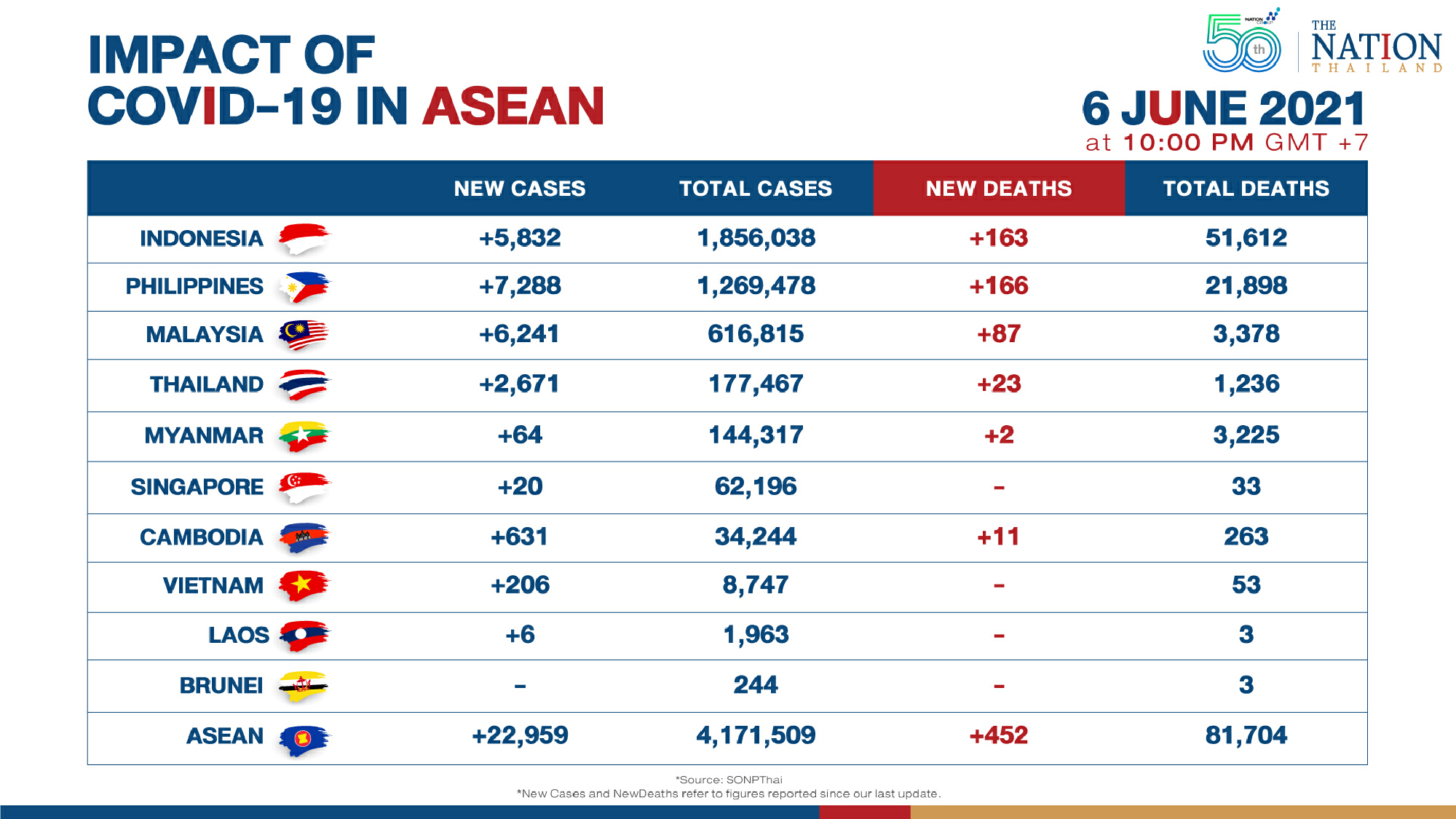
The number of Covid-19 cases in Southeast Asia crossed 4.21 million, with 20,286 new cases reported on Tuesday, lower than Monday’s tally of 22,206. New deaths were 404, increasing from Monday’s 382.
Covid-19 deaths in Asean now stand at 82,490.
Indonesia reported 6,294 new cases and 189 additional deaths, driving the cumulative cases in that country to 1,869,325 patients and 51,992 deaths, topping Asean charts in all categories.
Indonesian medical experts are concerned that the number of infections will increase rapidly after many people visited their hometowns to celebrate Ramadan.
Meanwhile, the Vietnamese government urged people to donate to its Covid-19 vaccine fund so more vaccines can be procured for its people. It aimed to secure 150 million doses within this year for 70 per cent of its population, which will require at least $1.1 billion (THB34.3 billion), while the current budget allotted for vaccine procurement is only $630 million.
The country’s Finance Ministry said that as of Tuesday more than 231,000 people and organisations have donated $321 million.
Biden, Johnson to rally G-7 for vaccine push after U.S. hoarding
President Joe Bidens first overseas trip as president will focus on bolstering the availability of Western coronavirus vaccines abroad — a bid to both counter China and calm tensions with allies whove been at odds with the U.S. over its hoarding of shots and intellectual property rights.
Biden departs Wednesday for the Group of Seven summit in the U.K., leaving the U.S., where the pandemic is receding, to discuss how the world’s richest democracies can help the rest of the world snuff out the virus. Both Biden and U.K. Prime Minister Boris Johnson aim to rally the G-7 behind a plan to make more shots available to low-income countries.
Biden and Johnson will meet for the first time on Thursday, before the G-7.
The summit will be a show of unity after the group’s members spent much of the year at odds over vaccines. Biden riled Europe by continuing Trump-era policies that directed almost all early U.S. vaccine production into American arms, and by throwing his support behind a push from lower-income countries to waive certain patent protections for the shots.
While the G-7 countries are sure to agree on the need for more shots, the specifics of what they’ll propose or how it will be funded remains unclear. Johnson has called for a goal of vaccinating the world by the end of 2022, while Biden has said the U.S. would be an “arsenal” of vaccines for the rest of the globe but has so far committed just 25 million doses of the American government’s stockpile.
“The U.S. is headed into the G-7 in a position of strength,” Jeff Zients, Biden’s Covid-19 response coordinator, said in a statement. About 47% of the U.S. population is vaccinated, according to the Bloomberg Covid-10 Tracker, and cases are falling while the economy is recovering.
“The president will use this momentum to rally the world’s democracies around solving this crisis globally, with America leading the way to create the arsenal of vaccines that will be critical in our global fight against Covid-19,” Zients said.
Biden aides have previewed his European trip as focused on “three C’s” — Covid-19, China and climate change. After the G-7, Biden will attend NATO and European Union summits in Brussels before meeting Russian President Vladimir Putin in Geneva.
At the G-7, “he will join with his fellow leaders to lay out a plan to end the Covid-19 pandemic with further specific commitments toward that end,” National Security Adviser Jake Sullivan said Monday.
Vaccine makers have already pledged to make more than a billion doses available this year to low- and middle-income countries. But wealthy nations gobbled up early supplies, and it’s not yet clear how doses will be distributed going forward.
Some countries are receiving doses through Covax, a World Health Organization initiative that relies in part on donations, while others have ordered directly from manufacturers or are receiving shipments from the U.S. or other wealthy nations.
“I would like to see the largest contribution we can out of the G-7, because I think the doses are going to be available,” said Thomas Bollyky, director of the Global Health Program at the Council on Foreign Relations. “The big issue is really going to be the allocation — where do these doses go?”
ADVERTISEMENT
Vaccine access has been a thorny issue for Biden, who carried on facets of President Donald Trump’s “America First” approach to combating the pandemic while also pledging to re-establish the U.S. as a leader on the global stage. Trump and Biden both used wartime powers that gave priority to U.S. government orders for shots, meaning that the first hundreds of millions of doses made on U.S. soil went to Americans.
But the U.S. has also backed efforts at the World Trade Organization to waive intellectual property protections for vaccines, a proposal from lower-income countries in order to make it cheaper for them to manufacture shots themselves.
The waiver is opposed by European leaders, who urged Biden to instead share doses immediately from his country’s own stockpile to help satisfy global demand.
Discussion over the waiver looks poised to languish at the consensus-based WTO.
“It’s going nowhere, which is of course what the Europeans wanted — and, if you wanted to be cynical, maybe the Biden administration knew that was going to happen from the beginning,” said Jacob Kirkegaard, a senior fellow at the German Marshall Fund.
That has relegated the simmering issue to a “footnote” in international talks, which instead will focus on how to steer a coming wave of production and who should pay for it, he added.
“In some ways, the road map in terms of production capacity is clear — there’s going to be a lot of production capacity in a few months that’s ready to supply the world, because both the U.S. and Europe will be done by then,” he said. “How do you get out of that situation, where essentially the rich are vaccinated but the rest are not?”
Biden has said that the world’s democracies should lead a push to boost supply and to share it on the basis of need, while criticizing China and Russia for a transactional brand of vaccine diplomacy.
Only recently have U.S.-made vaccines begun leaving the country. Moderna Inc. and Pfizer Inc. have begun directly exporting U.S.-made doses, in addition to Biden’s announcement that the U.S. government would donate a first tranche of 25 million shots to an assortment of allies and lower-income countries.
Biden has pledged to donate a total of 80 million doses before the end of the month, though that depends on the availability of AstraZeneca Plc shots, manufactured in the U.S. but not approved for use in the country, that are undergoing a safety review.
And Biden has only begun donating U.S. shots as domestic demand plunged: The country’s daily vaccination rate has fallen by two-thirds since mid-April.
Published : June 09, 2021
By : Syndication Washington Post, Bloomberg · Josh Wingrove
Man accused of trying to breach deck on Delta flight yelled, We need to land this plane, FBI says
The FBI said Tuesday that a man accused of trying to enter the flight deck of a Delta Air Lines plane last week rushed to the front of the aircraft, banged on the door to the flight deck and repeatedly yelled: “We need to land this plane!”
Aflight attendant and passengers intervened to subdue the man Friday afternoon, and the flight from Los Angeles to Nashville, Tenn., was diverted to Albuquerque. The man, Asiel Christian Norton, 43, was taken into custody and charged in U.S. District Court for New Mexico with interfering with a member of a flight crew.
Norton appeared in court Tuesday for a brief hearing conducted remotely from a detention center. Norton said he understood the charge and was ordered held until another hearing later this week.
It is not clear from an FBI affidavit in support of the charge what prompted the alleged outburst. A flight attendant who led the efforts to subdue him told an FBI agent that Norton had not been served alcohol on the flight and did not appear to be drunk.
A lawyer for Norton was not listed in court records. A spokesman for the U.S. attorney’s office in New Mexico did not know Norton’s hometown.
According to the affidavit, Norton went to the front of the plane after the crew finished its first round of service. He then began banging on the flight deck door of the plane, a 737 with 162 passengers onboard. A flight attendant tried to intervene, but Norton pushed him away, according to court records. The flight attendant told the FBI he then grabbed Norton’s wrist and tried to pin him to the ground.
A person sitting in the front row got up to help, attempting to use a belt to tie Norton’s hands, authorities said. Crew members and passengers eventually were able to carry him to the back of the plane.
The flight attendant was “visibly shaken” during the interview with the FBI agent, according to the affidavit. No one was hurt in the incident, Delta said.
Senate approves sprawling $250 billion bill to curtail Chinas economic and military ambitions
WASHINGTON – The Senate voted on Tuesday to adopt a roughly $250 billion bill to counter Chinas growing economic and military prowess, hoping that major investments in science – and fresh punishments targeting Beijing – might give the United States a lasting edge.
In a chamber often racked by partisan division, Democrats and Republicans found rare accord over the sprawling measure, known as the United States Innovation and Competition Act, as lawmakers warned that Washington risked ceding the country’s technological leadership to one of its foremost geopolitical adversaries.
The proposal commits billions of dollars in federal funds across a wide array of research areas. It pours more than $50 billion in immediate funding into U.S. businesses that manufacture the sort of ultrasmall, in-demand computer chips that power consumer and military devices, which many companies currently source from China. And it paves the way for the next generation of space exploration at a time when Washington and Beijing are increasingly setting their eyes on the stars.
With it, lawmakers also approved a host of proposals that seek to limit China’s economic aspirations and curb its political influence. The bill opens the door for new sanctions targeting Beijing over its human rights practices, commissions a new study about the origin of the coronavirus and calls for a diplomatic boycott of the upcoming 2022 Winter Olympics. It even authorizes $300 million specifically to counter the political influence of the Chinese Communist Party.
“I have watched China take advantage of us in ways legal and illegal over the years,” said Senate Majority Leader Charles Schumer, D-N.Y., the lead author of the bill, during an interview before its passage. “The number one thing China was doing to take advantage of us . . . was investing heavily in research and science. And if we didn’t do something about it, they would become the number one economy in the world.”
The bill still must be adopted by the House, where some Democrats have raised early concerns with the Senate’s approach. Its passage comes on the same day the White House stood up a new task force to address potential disruptions in the U.S. supply chain, seeking to further boost U.S. manufacturing of key medicine and technology at a time when many of those products and materials are made in countries including China.
For some experts, the new burst of activity invoked the specter of the Cold War, when the United States spent once-unfathomable sums to counter the growing reach of the Soviet Union. Decades later, some lawmakers have shied away from the same comparison with Beijing, even as they authorized massive investments to better position U.S. businesses against their Chinese counterparts.
“This is not about a zero-sum relationship or resurrecting a Cold War mentality,” said Democratic Sen. Robert Menendez, D-N.J., the chairman of the Senate Foreign Relations Committee, in a speech earlier in the debate. He said the bill “encourages healthy and fair economic competition, promotes global security and stability, and strengthens human rights around the world.”
The Senate’s effort also marks an evolution from the economic confrontations between the United States and China under President Donald Trump. During the last administration, the White House waged a trade war against Beijing, imposing massive tariffs in a tit for tat that analysts say caused deep damage to some parts of the U.S. economy. Democrats led by President Joe Biden have tried to dial back Trump’s approach and rhetoric, even as they increasingly have come to share in some of Trump’s alarm about Beijing’s rise.
“The underlying anxiety about China is similar,” said Scott Kennedy, the senior adviser and trustee chair in Chinese business and economics at the Center for Strategic and International Studies. But he said it had “broadened” beyond a trade dispute into a more ideological clash between China’s authoritarian communist system and “free-market democracies and the liberal international order.”
Lawmakers adopted the bill, led by Schumer and Republican Sen. Todd Young of Indiana, on a bipartisan vote. The Biden administration earlier this month said it supported passage of the research-focused elements of the bill, describing them as “major investments in our long-term economic resilience and competitiveness.”
Democrats stressed their work on the legislation shows how the two parties can find common ground on a wide array of economic issues, perhaps setting the state for progress in debates including major upgrades to U.S. infrastructure. But it was not without incident, after a small group of Republicans led by Sen. Ron Johnson of Wisconsin upended lawmakers’ efforts to pass the bill swiftly – at one point holding up the chamber’s work for days to lament the way in which the legislation had been crafted.
Lawmakers authorized the lion’s share of the money under the new legislation, totaling $190 billion, for a major rethinking of federal science, technology and research spending. They created a new technology division within the National Science Foundation to focus on emerging areas including artificial intelligence. The Senate also gave a green light to $10 billion for the Commerce Department to invest in new “technology” hubs, so that other regions and cities across the country can attract the same sort of economic opportunities as Silicon Valley.
“There will be millions of Americans in good-paying jobs because of the investments we’re making in the next 10 years,” Schumer said. “There will be new industries starting, and hopefully, not just in New York City and in San Francisco and in Austin, but also smaller places.”
Many of the federal science investments reflect an implicit attempt to battle back China, relying on new federal spending to keep pace with a country that some analysts say is investing more than 2 percent of its gross domestic product annually in research and development. To justify the expense, lawmakers cited economic as well as national security concerns, stressing that the United States cannot afford to allow Beijing to dominate emerging fields – and serve in some cases as the foremost supplier of sensitive tech equipment.
“This is an opportunity for the United States to strike a below. . . answering the unfair competition we’re seeing from communist China,” said Sen. Roger Wicker, R-Miss., who helped prepare the measure.
ADVERTISEMENT
The concern has been particularly acute around computer chips, which Sen. Maria Cantwell, D-Wash., the chairwoman of the chamber’s Commerce Committee, described in the days leading up to the vote as the “oil of the 21st century. A wide array of U.S. businesses, from tech giants like Apple and Samsung to automakers such as General Motors, are struggling to navigate a global shortage in semiconductors that has threatened delays in manufacturing.
The roughly $53 billion included in the Senate’s bill may not immediately ease the supply crunch, experts say. But like much of the spending authorized this week, it aims to deliver longer-term improvements – including new financing, for example, so that chipmakers can produce more semiconductors domestically and stave off shortages in the future.
“This is a long-term solution,” said Andy Halataei, the executive vice president of government affairs at the Information Technology Industry Council, a Washington-based trade group that counts Intel and other tech giants as members. “When the bill is signed into law, we’re definitely talking about years of construction and building facilities.”
The chip funding still troubled some lawmakers: Sen. Bernie Sanders, I-Vt., criticized the measure because the money did not come with significant strings attached. He sought to prohibit companies from taking federal aid to subsidize their manufacturing, then purchasing back stock or padding their executives’ pay, though Sanders did not prevail in pushing for his amendment.
The broad nature of the bill also opened the door for lawmakers to push some of their pet projects, raising alarms among both parties. Senators secured earlier in the debate a prohibition on the sale of shark fins, for example, and a provision requiring online merchants to reveal the country of origin behind the goods they sell – except in the case of cooked king crab. At one point, a trio of Republican senators even tried to ban research on human-animal hybrids, though the effort ultimately faltered.
In the version that passed the Senate, lawmakers did leave intact a $10 billion authorization for two lunar lander contracts, a provision that could benefit Blue Origin, the space company founded by Amazon founder Jeff Bezos, who owns The Washington Post. Cantwell, whose committee oversees NASA and helped craft the bill, spearheaded the spending as part of a bipartisan amendment adopted earlier in the debate. Her efforts ignited a controversy because Blue Origin is based in her home state.
Sanders sought to strip the funding, describing it as a “Bezos bailout,” but his efforts ultimately did not succeed. Cantwell, however, defended the provision on Tuesday by stressing NASA needs to invest in “many kinds of systems” to ensure its missions succeed. Earlier this month, Blue Origin praised lawmakers for their approach, noting in a statement: “Continued competition will safeguard America’s space industrial base and get America back to the Moon as quickly as possible.”
Lawmakers also included a host of provisions that take more explicit aim with China in a move that risks ratcheting up bilateral tensions in the years after Trump openly sparred with Beijing. The Senate bill officially designated China the “greatest geopolitical and geoeconomic challenge” to U.S. foreign policy, and it committed an additional $15 billion to countering that threat – including combating Chinese influence and disinformation online.
For some Republicans, the provisions still did not go far enough: Sen. Marco Rubio of Florida, for example, said lawmakers needed to do more to make sure technologies funded by the U.S. government did not ultimately land in Chinese hands. Some of his attempts to toughen enforcement ultimately failed.
“What if a year from now we find out – you’re going to read an article two years from now, whenever – that says, ‘The Chinese have stolen a quarter – 25, 30 percent – of the [intellectual property] developed by the money that’s put forward in the bill that was passed.’ We’re all going to feel pretty stupid around here,” Rubio said in a speech.
Yet some liberals thought the bill was too strong, prompting more than 65 groups to raise alarms about the “Cold War mentality” of the bill, which they say could feed “racism, violence, xenophobia, and white nationalism.” Some House Democrats have echoed those concerns, raising the potential that the bill may change further as debate proceeds.
But Senate Democrats have labored to downplay concerns that the measure is anti-China, and Schumer in particular stressed it reflected a belief Congress should “build ourselves up rather than just tear them down.”
“It’s aimed mainly at having America progress economically,” he said. “But the threat of China or another country . . . leading in science is a real threat to the country, and we should deal with it not by being angry at them but by doing the right thing for ourselves.”
Steady drop in new Covid-19 cases and deaths in Asean
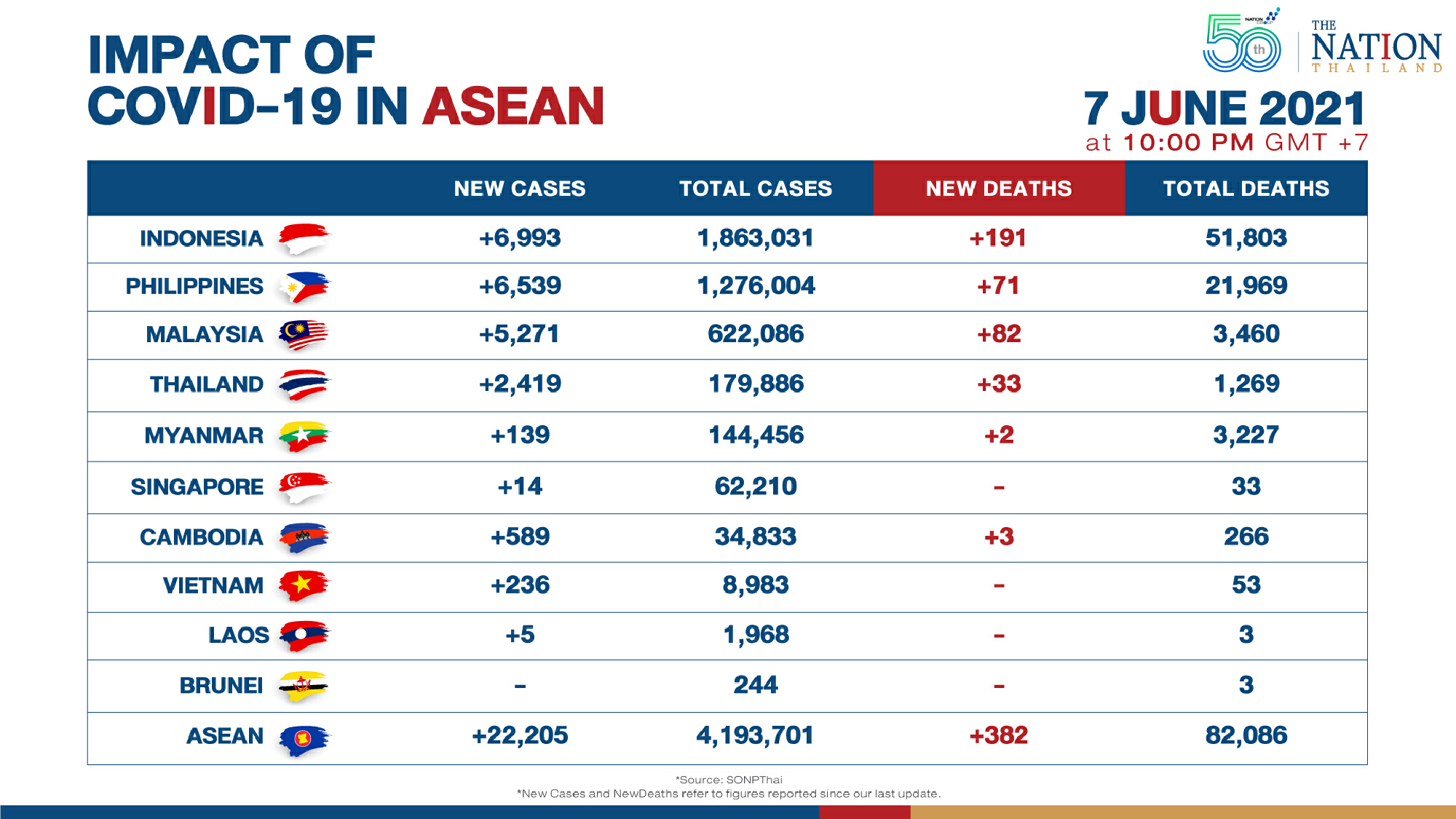
New Covid-19 cases and related deaths in Southeast Asia fell for the second successive day, collated data shows.
Asean reported 22,205 new cases on Monday, lower than Sunday’s 22,959, while 382 people died, down from Sunday’s 452.
The total number of Covid-19 cases crossed 4.19 million across the region and the death toll rose to 82,086.
Indonesia reported 6,993 new cases and 191 deaths on Monday, bringing cumulative cases in the country to 1,863,031 and the death toll to 51,803.
Indonesia’s Ministry of Public Health expressed concern that tardiness in testing people residing in remote areas could hamper the government’s efforts to contain the outbreak.
Cambodia reported 589 new cases and three deaths on Monday, bringing cumulative cases in the country to 34,833 and total deaths to 266.
The governor of Phnom Penh said that the city would not reinstate curfew measures because people are now more aware of the situation and are following disease control measures.
Bezos announces hell be on first crewed spaceflight of Blue Origin rocket
A couple of weeks after Jeff Bezos officially steps down as CEO of Amazon, hell leap into something more mythic: riding to the edge of space aboard one of his own rockets, alongside his brother, in a flight that would fulfill a lifelong dream.
The plan is that Bezos, his brother, Mark, and the winner of an online auction for Blue Origin’s nonprofit foundation will be on the New Shepard on July 20 when it lifts off for a suborbital flight, the first time the spacecraft will carry passengers. The date is the anniversary of Neil Armstrong and Buzz Aldrin’s Apollo 11 moon landing in 1969.
The flight will mark a significant milestone for Blue Origin, which lags behind Elon Musk’s SpaceX in the competition for billions of dollars in NASA and Pentagon contracts and which flies a more powerful rocket capable of taking people and supplies into orbit.
It will also mark a moment when the long promised arrival of space tourism seems to be drawing closer and a major transition for Bezos, inevitably raising questions about the risk to him and to Amazon. Space travel remains a dangerous undertaking, though the requirements for future private passengers are nowhere near what the public is accustomed to connecting with space travel.
“Ever since I was five years old, I’ve dreamed of traveling to space,” Bezos said in an Instagram post Monday. “On July 20, I will take that journey with my brother. The greatest adventure, with my best friend. #Gradatim Ferociter.”
Graditum ferociter is Blue Origin’s motto, a Latin phrase that Bezos translates to mean “step by step, ferociously.”
Unlike NASA astronauts, Bezos and his fellow passengers won’t undergo any of the rigorous training that for so long has characterized space travel. Blue Origin warns that passengers must climb seven flights of stairs to reach the capsule and that they must also be able to sit for 90 minutes without access to a bathroom. But with all functions of the flight commanded by computers, the passengers won’t be called on to take the controls.
The flight would make Bezos the first of the billionaire “space barons” to go to space. Neither Musk nor Virgin Galactic’s Richard Branson have ridden on their companies’ rockets. (Bezos owns The Washington Post.)
Bezos has long been fascinated with space. An avid science fiction reader and big “Star Trek” fan as a child, he has called watching the Apollo 11 moon landing a “seminal” moment for him, even though he was just five years old at the time. He even chose “Goddard” as the middle name for one of his sons after Robert Goddard, the founder of modern rocketry.
Blue Origin, based outside Seattle, has successfully flown its New Shepard rocket and spacecraft to space 15 times, without passengers. Last month, Branson’s Virgin Galactic completed its third human spaceflight, and Branson, who will turn 71 on July 18, has said he hopes to fly later this year. In an interview with The Washington Post after the flight, he said he was actively preparing for the mission.
“One good thing about covid is it enabled me to get as fit as I’ve felt since I was in my 20s,” he said. “It’s great to be able to really work on getting your body fit for spaceflight, and I’m going to enjoy every single minute of it.”
On Twitter Monday, Branson congratulated Bezos and said the two companies “are opening up access to Space – how extraordinary!”
Bezos founded Blue Origin in 2000 and in recent years has said it is “the most important work I’m doing.” The goal of the company is to build the infrastructure to give humanity access to space more routinely and reliably and to allow for “millions of people living and working in space.”
He has said that his “singular focus is people in space. I want people in space.”
The New Shepard is named for Alan Shepard, who became the first American to go to space in 1961. Like that first suborbital flight, New Shepard shoots straight up, flying past 60 miles to reach the edge of space before falling back to Earth. The flight takes about 10 minutes in all, with a few minutes of weightlessness in space.
As many as six people can fit inside the New Shepard crew cabin, each with their own seat and window – the largest window ever flown to space. The spacecraft, which launches from a site outside Van Horn, Texas, is outfitted with handrails to assist during the few minutes of weightless. Once in space, the spacecraft will use its thrusters to rotate, so passengers get 360-degree views that the company says “will change how you see the world.”
Blue Origin has not yet said how much it would charge for individual tickets. Virgin Galactic had charged as much as $250,000 before closing sales. When Virgin Galactic restarts sales later this year, some analysts have predicted the price will be closer to $500,000.
While some have derided space tourism flights for the rich, Bezos has defended them, saying they are a good way for the company to practice flying and that a lot of new technologies have grown out of entertainment – such as how video games helped boost computing power.
“Tourism often leads to new technologies,” he said during a forum at The Post in 2016. “And then those new technologies often circle back around and get used in very important, utilitarian ways.”
In rules for the online auction now underway to chose the third member of the crew, which is set to culminate Saturday, Blue Origin said passengers must be able to endure three times the force of gravity for two minutes during the ascent, and five-and-a-half times the force of gravity for a few seconds during descent.
Participants must also be between 5 feet and 6-feet-4-inches tall and weigh between 110 and 223 pounds.
To earn a license from the Federal Aviation Administration, Blue Origin must show how it protects people and property on the ground. But the safety of the passengers is governed by an “informed consent” standard, similar to skydiving and bungee jumping: Passengers simply need to acknowledge the considerable risks of the venture before blasting off.
Musk, who has often been critical of Blue Origin’s progress, did not comment immediately on Bezos’s plans. SpaceX recently beat out Blue Origin for a major NASA contract to develop a spacecraft capable of landing astronauts on the moon. Blue Origin, which had teamed up with Lockheed Martin, Northrop Grumman and Draper, is protesting the award through the Government Accountability Office.
In a statement to The Post about that contract, Musk said Blue Origin’s bid, which was twice that of SpaceX, was “way too high.”
He added that Bezos “needs to run BO full-time for it to be successful,” Musk wrote. “Frankly, I hope he does.”
The auction for the third seat on the Blue Origin flight is intended to raise money for Club for the Future, the company’s nonprofit, which is geared toward encouraging students to pursue careers in science, technology engineering and math.
On July 5, Bezos will step down as chief executive of Amazon (he will stay on as executive chairman). Amazon spokesman Drew Herdener did not respond to a question about whether Bezos had sought permission from Amazon’s board for the flight.
Bezos has used billions in Amazon shares to fund Blue Origin ventures.
“I wasn’t even expecting him to say that he was going to be on the first flight,” Bezos’s brother Mark said in the Instagram video. “What a remarkable opportunity, not only to have this adventure but to do it with my best friend.”
Bezos announces hell be on first crewed spaceflight of Blue Origin rocket
Published : June 08, 2021
By : The Washington Post · Christian Davenport, Taylor Telford
Trains crash in Pakistan, killing at least 32, as rescuers try to free survivors
Two trains collided in southern Pakistan on Monday, killing at least 32 passengers and leaving rescuers scrambling to free survivors from the wreckage, authorities said.
The crash occurred before dawn when one express train derailed and was struck by another 65 to 69 seconds later, said a Pakistan railway spokesman, Tariq Asad. “There was no time for the [second] train to avoid the incident.”
Ashraf Ali, 38, and his brother survived the crash. “It was a shock when the train started derailing, we heard a loud bang,” he said. “I heard cries and screaming.”
Ali and his brother sustained minor injures and managed to escape the wreckage, but many passengers are still believed to be trapped. Local rescue teams are at the scene and the Pakistani military has sent troops to help recovery and relief efforts, the armed forces’ media wing said in a statement.
“This is the worst train collision since 2005,” said Asad, the railway spokesman. Deadly train accidents are common in Pakistan, where the country’s extensive railway system has suffered from government neglect for years.
Pakistan’s federal ministry for railways ordered inquiry into accident, demanding a report be completed within 24 hours, according to a tweet.
At least 32 people had died and about 80 were injured in Monday’s crash, the railways ministry said in a statement.
Between 15 and 20 people remained trapped in the wreckage of the derailed train, as authorities sought heavy machinery to aid in the rescue, Ghotki police chief Umar Tufail told the Associated Press.
Images posted to social media after the crash appeared to show one train – the Millat Express – on its side as people tended to wounded passengers lying in furrows of dirt. Officials identified the other train as the Sir Syed Express.
The Millat Express was headed from Karachi to the city of Sargodha when it derailed, fell across the track, and was struck by the Sir Syed Express, which was traveling in the opposite direction, a spokesperson for Pakistan Railways told the Dawn newspaper.
The incident had led to the derailment of more than a dozen train cars and left six to eight “completely destroyed,” Abdullah told Pakistani television station Geo News, according to Dawn.
In a tweet, Prime Minister Imran Khan said he was “shocked by the horrific train accident” and was ordering a “comprehensive investigation.”
Last year, 22 people died when a passenger train crashed into a bus carrying Sikh pilgrims in eastern Pakistan. In 2019, a massive train fire killed at least 73.
The country’s worst rail disaster occurred in 1990, when a packed passenger train plowed into a standing freight train, killing 210 people.
Published : June 08, 2021
By : The Washington Post · Haq Nawaz Khan, Michael E. Miller
India to give free vaccines to citizens over 18 in covid fight
India has fast-tracked vaccine procurement and will provide free shots to citizens above 18 years, Prime Minister Narendra Modi said in an address to the nation on Monday.
The South Asian nation faces the challenge of vaccinating its large adult population as it emerges from a devastating second virus wave, with a critical shortage of inoculations leading some centers to close down as the country struggled to ramp up domestic production and procure doses internationally.
Modi’s speech came against the backdrop of a near breakdown in health infrastructure over the last two months, with major Indian cities running out of oxygen and hospitals flooded with patients, while crematoriums struggled to keep pace with the number of those who died of covid-19. His administration has come under intense criticism over its handling of the second wave and the vaccination rollout and its popularity ratings have fallen from 75% in 2019 to 51% this year, according the Local Circle polling company.
While experts are worried about the slow rollout, state politicians have blamed the federal government for forcing them to compete against each other to procure vaccines, with the country’s top court criticizing Modi’s policy as “arbitrary and irrational.”
The South Asian nation has administrated 232 million doses since the beginning of the world’s biggest vaccination drive that began on Jan. 16, with 3.4% now fully immunized. At this pace, it will take another 22 months to cover 75% of the population, according to Bloomberg Vaccination Tracker.
While the federal government gives free vaccines to those over 45 and front-line workers, state governments and private hospitals have until now been left to inoculate people from 18 to 45 years for a fee.
The government has said over 2 billion doses will be available by December — enough to vaccinate the adult population — but there is no indication the main vaccine manufacturers in India will be able to ramp up production to meet that goal, nor whether India will be able to purchase doses from overseas to make up the shortfall.
Modi last addressed the nation on April 20, when he urged states to avoid lockdowns even as the country was heading toward record daily infections of more than 414,000. Soaring new cases and a spike in daily deaths forced both India’s financial and political capitals to impose restrictions on movement, as citizens took to social media in a desperate search for oxygen and lifesaving medicines.
The wave has been steadily declining since the peak on May 7, and New Delhi and Mumbai have began to ease their lockdowns on Monday as India reported 100,636 new infections and 2,427 deaths.
Published : June 08, 2021
By : Syndication Washington Post, Bloomberg · Bibhudatta Pradhan
Despite pandemic, level of carbon dioxide in the atmosphere hits historic levels
Economies worldwide nearly ground to a halt over the 15 months of the coronavirus pandemic, leading to a startling drop in global greenhouse gas emissions.
But that did little to slow the steady accumulation of carbon dioxide in the atmosphere, which reached the highest levels since accurate measurements began 63 years ago, scientists said Monday.
“Fossil fuel burning is really at the heart of this. If we don’t tackle fossil fuel burning, the problem is not going to go away,” Ralph Keeling, a geochemist at the Scripps Institution of Oceanography, said in an interview, adding that the world ultimately will have to make emissions cuts that are “much larger and sustained” than anything that happened during the pandemic.
Scientists from Scripps and the National Oceanic and Atmospheric Administration said on Monday that levels of atmospheric carbon dioxide peaked in May, reaching a monthly average of nearly 419 parts per million.
That represents an increase from the May 2020 mean of 417 parts per million, and it marks the highest level since measurements began 63 years ago at the NOAA observatory in Mauna Loa, Hawaii. Twice in 2021, daily levels recorded at the observatory have exceeded 420 parts per million, researchers said.
“It’s not significant in the sense that we are surprised. It was fully expected,” Pieter Tans, a senior scientist with NOAA’s Global Monitoring Laboratory, said in an interview. “It’s significant in that it shows we are still fully on the wrong track.”
Tans noted that humans continue to add about 40 billion metric tons of carbon dioxide pollution to the atmosphere each year, and that avoiding catastrophic changes to the climate will require reducing that number to zero as quickly as possible.
“The fact that CO2 concentrations at Mauna Loa data are already so high and are keep going up so fast is disturbing but not surprising because the emissions of CO2 continue to be incredibly high,” said Corinne Le Quéré, research professor of climate change science at the University of East Anglia. “The concentrations of CO2 in the atmosphere will stop rising when the emissions approach zero.”
Carbon dioxide, a key greenhouse gas, traps heat from the planet’s surface that would otherwise escape into space. Much of the carbon dioxide breaks down after about 100 years, but the current global rate of emissions is enough to offset that rate and further increase the atmospheric concentration of the gas, causing the planet to warm steadily.
The highest monthly mean levels of carbon dioxide typically occur each May, just before plants in the Northern Hemisphere start to remove large amounts of CO2 from the atmosphere during the growing season. In the northern fall, winter and early spring, plants and soil give off CO2, causing levels to rise.
Even as international borders closed and global economic activity took a massive hit throughout much of 2020, researchers have found that human-caused emissions rebounded fairly quickly after decreasing sharply early in the pandemic.
In 2020, primary energy demand decreased nearly 4 percent, and global energy-related carbon dioxide emissions fell by 5.8 percent, according to the International Energy Agency – the largest annual percentage decline since World War II.
In absolute terms, the decline in emissions of almost 2 billion tons of CO2 is “without precedent in human history,” the IEA said. “Broadly speaking, this is the equivalent of removing all of the European Union’s emissions from the global total.” The agency said that demand for fossil fuels was hardest hit in 2020 – especially oil, which plunged 8.6 percent, and coal, which dropped by 4 percent.
But in the broader sense, the pandemic could prove to be little more than a blip in the world’s efforts to combat climate change.
Energy-related carbon dioxide emissions during 2020 dropped to about the same level of global emissions that prevailed in 2012 – not nearly low enough to change the world’s current trajectory. That reality offers the latest evidence of the stubbornness of human-related emissions, and the difficulty the world faces in making the kind of far-reaching, long-lasting cuts necessary to slow Earth’s warming and avoid the most catastrophic effects of climate change.
Already, the IEA has said it expects global carbon emissions to surge this year as parts of the world rebound from the coronavirus pandemic. The group projected in April that emissions are on track to reach the second-largest annual rise on record.
Global energy demand is already set to surpass 2019 levels, alongside continued growth in alternative energies, the Paris-based organization found.
As levels of atmospheric carbon dioxide continue to surge, leaders around the world face mounting pressure to commit to more aggressive, more urgent plans to reduce greenhouse gas pollution. Some countries have begun to outline more ambitious targets ahead of a key U.N. climate conference in the fall. Among them is the United States, which under President Biden has vowed to cut its overall emissions in half by the end of the decade.
Still, analyses by the United Nations and other organizations have found that a grim gap remains between the world’s current path and the significant shifts needed keep Earth’s warming to “well below” 2 degrees Celsius (3.6 Fahrenheit) above preindustrial levels – a central goal of the Paris agreement. In short, the existing promises aren’t enough, and most countries have not lived up to the inadequate promises they have made.
Keeling said he is optimistic that major changes lie ahead as renewable energy and other technologies take root and multiply. But they won’t happen overnight. “I do expect we will see significant changes in the years ahead. The political will has shifted,” he said. “What we need to do is see a sustained move toward moving away from fossil fuels.”
Tans also holds out hope that the world will be able to put itself on a better path. The science of how to do that exists, he said, but what remains unclear is whether societies can muster the kind of action that has yet to materialize.
“The goals so far are themselves insufficient, even after having been beefed up,” he said. “We’re running out of time. The longer we wait, the harder it gets.”
Published : June 08, 2021
By : The Washington Post · Brady Dennis, Steven Mufson
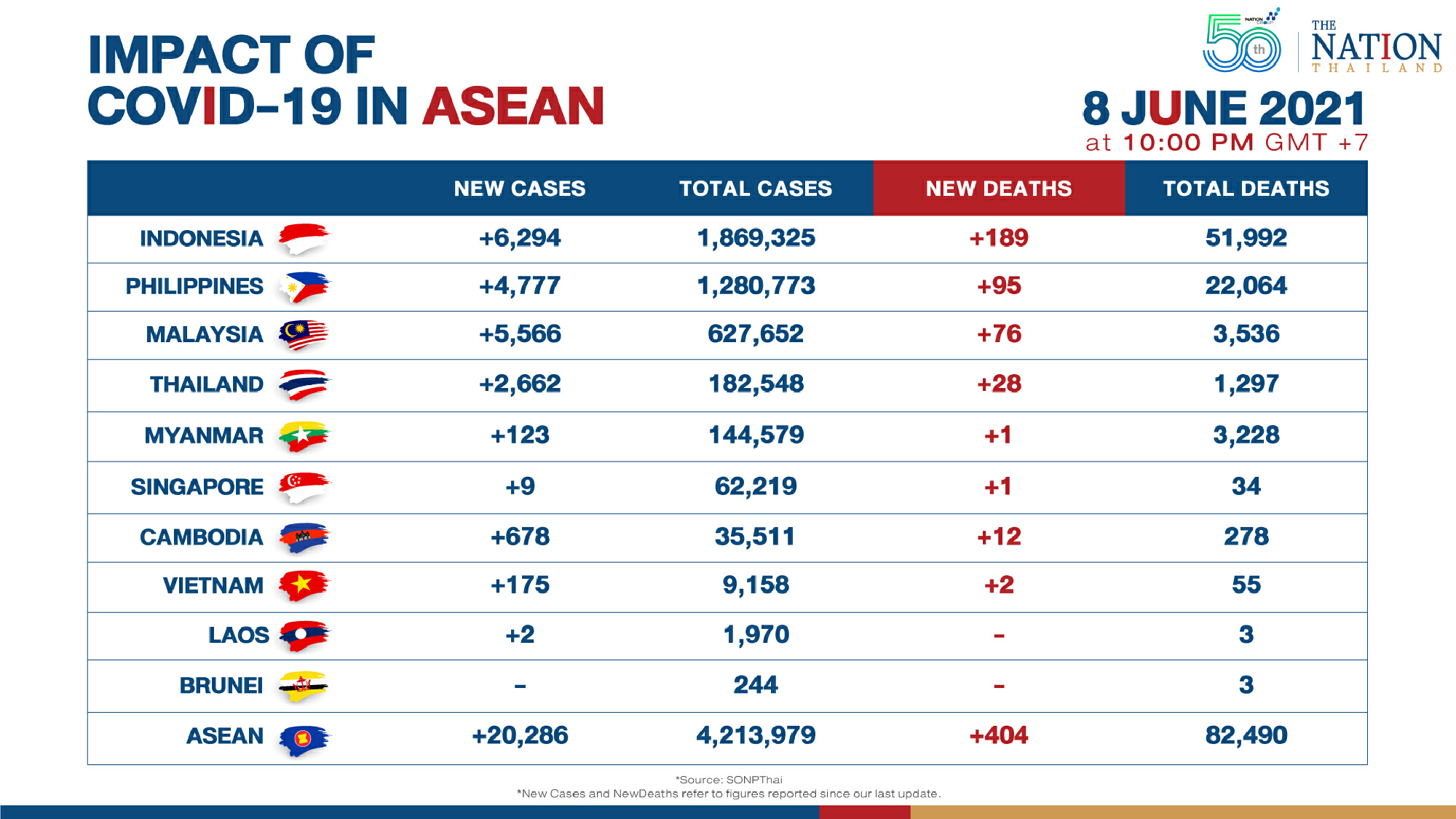
Southeast Asia reported the least number of new Covid-19 cases and deaths in five days on Sunday, collated data shows.
There were 22,959 new cases on Sunday, lower than Saturday’s 24,729, while 452 people died, compared to Saturday’s 508.
The number of Covid-19 cases in Asean crossed 4.17 million, while total deaths rose to 81,704.
Malaysia reported 6,241 new cases and 87 deaths on Sunday, bringing cumulative cases in the country to 616,815 and the death toll to 3,378.
The government has revoked the two-hour limit for people to buy consumer products to prevent crowding at stores, but still urged people to buy only essential items during the outbreak.
Singapore reported 20 new cases on Sunday, bringing cumulative cases in the country to 62,196. So far, 61,635 people have been cured and discharged. Sales of air-conditioners in Singapore have soared 2-3 times after the World Health Organization said that the Covid-19 virus could spread via airborne transmission.



 Bezos announces hell be on first crewed spaceflight of Blue Origin rocket