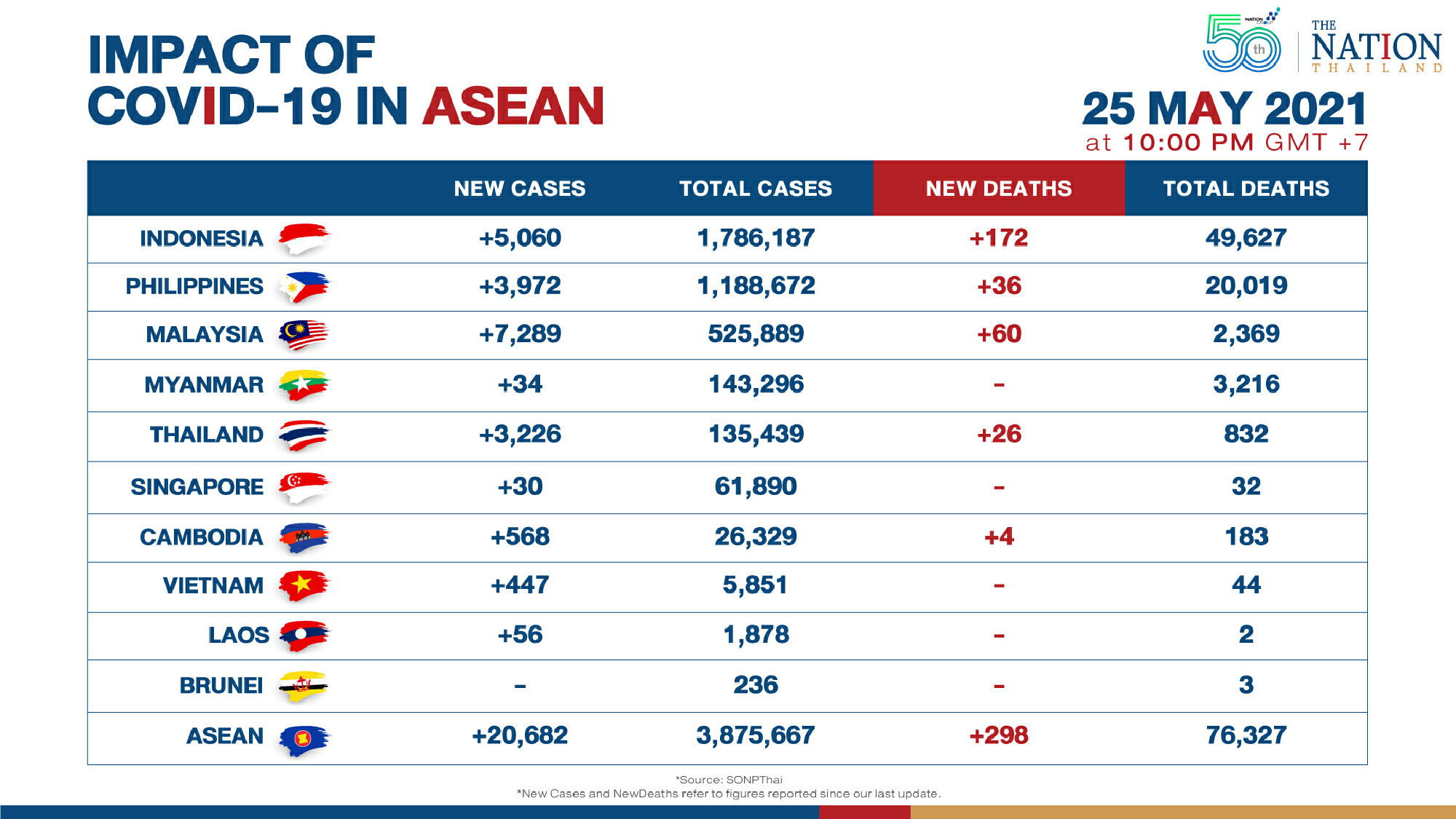
The number of Covid-19 cases in Southeast Asia crossed 3.87 million, with 20,682 new cases reported on Tuesday, slightly lower than Monday’s tally of 20,931.
The number of new deaths was 298, increasing from Monday’s 262.
Covid-19 deaths in Asean now stand at 76,327.
Indonesia reported 5,060 new cases and 172 deaths on Tuesday, pushing the cumulative cases in that country to 1,786,187 patients and 49,627 deaths. So far, 1,642,074 people have been cured and discharged.
Indonesian police meanwhile arrested four suspects for allegedly stealing 1,000 doses of vaccine from a prison in northern Sumatra and selling them in Jakarta for approximately THB520 per dose.
Malaysia reported a new high of 7,289 infections on Tuesday and 60 deaths, bringing the cumulative cases in the neighbouring country to 525,889 and 2,369 deaths.
Twelve patients in Kedah and Perlis states, which share a border with Thailand, are reported to have been infected with the South African strain of Covid-19.
U.S. warns against Japan travel, sowing new doubt about Olympics
The U.S. said Americans should avoid traveling to Japan, with much of the country under a state of emergency over a Covid-19 outbreak that has sown doubts about Tokyos plans to host the Olympics in less than two months.
The State Department raised its travel advisory to level four on Monday, putting Japan in a category with a broad swath of nations from Latin America to Europe that Americans are urged to avoid due to coronavirus concerns.
The action — which comes despite far lower infection rates in Japan than the U.S. — is a fresh blow to a country struggling to convince its own public and the international community that it’s ready to host the Summer Olympics beginning on July 23, following their delay in 2020.
Chief Cabinet Secretary Katsunobu Kato told reporters in Tokyo on Tuesday the U.S. had informed Japan that its decision wasn’t connected to the Olympics, and was based on indicators of infection rates over the preceding 28 days.
Japan is set to extend a state of emergency that covers Tokyo and most of the country’s urban areas, according to the Yomiuri newspaper and other media, meaning it may not be lifted until about a month before the Olympics begin.
The Japanese government is facing opposition at home over hosting the games amid worries the sports extravaganza could turn into a Covid-19 superspreader event. Nearly 60% of respondents in a Yomiuri poll this month said the Olympics should be called off.
“Cancellation of the Olympics would likely have a lasting effect. It could dent business and consumer sentiment, both of which are critical for economic recovery,” wrote Bloomberg Economics’ Yuki Masujima.
The U.S. announcement comes as infections drop in most parts of Japan. On May 23, the country recorded about 39 new cases per million people, compared with about 76 in the U.S., according to Our World in Data.
The move is also largely symbolic, as Japan currently bans most inbound travel, including from the U.S. About 600 people entered Japan from the U.S. in April, down 99.6% on the same period in 2019.
A heavyweight in Japan’s ruling party, Toshihiro Nikai, told reporters the country needs to decide soon whether it can hold the games in July given the current virus situation, according to broadcaster FNN.
The level 4 advisory is the highest issued by the U.S. State Department, alerting traveling Americans there is a greater likelihood of life-threatening risks and that the government may only be able to provide limited assistance. More than 100 other nations are under similar advisories, including France, Germany, Russia, Malaysia and Mexico.
The latest Covid-19 wave in Japan has largely been driven by more infectious strains from abroad, adding to concerns about inviting thousands of overseas participants, including athletes and officials. Some competitors have expressed safety concerns, with the U.S. track and field team canceling pre-Olympics training in the country.
The U.S. Olympic & Paralympic Committee said Monday that American athletes won’t be at undue risk if they compete this summer in Tokyo. While mercurial North Korea has said it would skip the Tokyo Olympics due to coronavirus concerns, no other country has formally pulled out.
“We feel confident that the current mitigation practices in place for athletes and staff by both the USOPC and the Tokyo Organizing Committee, coupled with the testing before travel, on arrival in Japan, and during Games time, will allow for safe participation of Team USA athletes this summer,” the committee said in a statement.
Initially, 600,000 fans from abroad had been projected to attend as well, but organizers ruled out that possibility in March. They are set to decide soon if even local spectators would be allowed to watch the competitions in person. They already have reduced the number of officials and others expected to attend from overseas to about 78,000, not including athletes.
Japan’s slow progress on vaccinations means restrictions on bars, restaurants and large gatherings are about its only means of preventing the spread of infections. Just over 3% of the island nation’s population has been inoculated, the lowest among the 37 members of the Organization for Economic Cooperation and Development, according to Bloomberg’s vaccine tracker. That compares with more than 40% in the U.S. and in the U.K.
Japan began its immunization effort with health-care workers after the Pfizer Inc.-BioNTech SE vaccine was approved in February. The companies also donated vaccine for use by Olympic athletes and delegations, though immunizations aren’t required.
Progress at getting the virus under control in Japan has been hindered by medical regulations, with local safety trials required before vaccines could be approved.
Japan last week finally approved vaccines developed by Moderna Inc. and AstraZeneca Plc, and the pace of inoculation has picked up to almost 500,000 doses administered daily. That’s still behind the one million goal set by Suga.
Published : May 26, 2021
By : Syndication Washington Post, Bloomberg · David Wainer, Isabel Reynolds
Over 200 people injured after careless operator drives one Malaysian train into another
A train crash that injured more than 200 people in Kuala Lumpur was the result of an operators “carelessness,” a Malaysian official said on Tuesday.
The incident occurred in the country’s capital on Monday evening when two light-rail trains collided head-on, leaving dozens of passengers bloody and dazed. One of the trains was empty, while the other one was carrying 213 people.
Malaysian Transport Minister Wee Ka Siong set up a task force to investigate the crash and on Tuesday said the early signs pointed to human error.
“Preliminary investigations indicate that the accident was the result of carelessness of the [operator] who drove [the empty train] in the wrong direction,” he said at a news conference.
The crash left 47 people severely hurt and another 166 with minor injuries, police said on Monday. 64 victims were still receiving hospital treatment on Tuesday afternoon, with six of them in critical condition, according to the Malay Mail.
Monday’s collision was the first major accident in the metro system’s 23 years of operation, Wee said.
The crash occurred in a tunnel not far from the city’s iconic Petronas Towers, twin skyscrapers that are among the tallest buildings in the world.
The empty train had experienced a malfunction that required a conductor to drive it away for repairs, Wee said. But instead of driving south, the conductor mistakenly drove north, into the path of the train full of passengers, he added.
The train full of people had been sitting at the station for at least 10 minutes when the doors closed and it started moving, passengers told local media. But after a few seconds, there was a powerful jolt that shattered windows and sent people flying.
Images posted to social media shortly after the collision show stunned passengers lying on the floor amid broken glass and smears of blood.
“We had only moved for a few seconds when the crash happened and the impact was so strong that I suffered injuries to my head, left leg and chest,” Afiq Luqman Mohamad Baharudin told the Bernama news agency.
“I heard a loud bang and the impact sent me flying several meters from where I was standing,” another injured passenger, R. Anand Raj, told the New Straits Times from a hospital.
“I could hear people crying and saw several people trying to help those on the floor to stand,” he said, adding that it was about 15 minutes before the stunned passengers realized they had struck another train.
Train service resumed with reduced capacity Tuesday morning.
American journalist is detained by Myanmar regime while trying to leave country
Myanmars military junta detained an American journalist on Monday as he was trying to leave the country, the mans employer said, as the regime steps up a crackdown that has already forced many media workers to flee.
Danny Fenster, the managing editor of Frontier Myanmar magazine, was seized at Yangon International Airport as he tried to board a flight to Kuala Lumpur and was taken to Insein Prison, the company said in a statement late Monday. The prison is notorious for its poor conditions and has been used by Myanmar’s military government to hold scores of political prisoners.
“We do not know why Danny was detained and have not been able to contact him since this morning. We are concerned for his well-being and call for his immediate release,” the statement added.
Fenster, 37, is the fourth foreign journalist detained in Myanmar since the military seized power in a coup in February, deposing the civilian government led by Aung San Suu Kyi.
The military government routinely publishes lists of “wanted” journalists, accusing them of affecting “state stability,” and has detained more than 70 journalists in total, according to media watchdogs.
Some 4,000 other people have been detained by the authorities in recent months, according to human rights advocates, as the junta has escalated a crackdown on those resisting the coup.
“We have been in contact with both the State Department and Embassy, along with local officials. While we are encouraged by the communication, we remain very concerned for Danny’s well-being,” Fenster’s brother, Bryan, said in an email to The Washington Post. “Danny is a passionate journalist who cares deeply about the principles and integrity of his vocation.”
Earlier this month, Japanese freelance journalist Yuki Kitazumi was released and deported to Japan after spending several weeks in Insein Prison. State broadcaster MRTV said it was releasing him “in order to reconcile with Japan and improve our relationship.” He was accused under an amended law put in place after the Feb. 1 coup, which punishes anyone accused of spreading fake news or criticizing the coup with up to three years in prison.
Arriving back in Japan, he said many Myanmar prisoners were being tortured inside Insein Prison, deprived of meals and beaten for noncooperation, but he said he was able to escape this treatment as a foreigner.
A spokeswoman for the U.S. Embassy in Myanmar did not immediately respond to a request for comment on Tuesday. According to the Associated Press, the embassy said it was not able to provide details of the incident, citing privacy considerations.
Press watchdogs including Pen America and the Committee to Protect Journalists have condemned Fenster’s detention and called for his immediate release and that of other journalists held in Myanmar. In a statement, the Foreign Correspondents’ Club of Thailand pointed out that Fenster had worked for Myanmar Now before joining Frontier Myanmar, both outlets that have “produced courageous reporting of exceptional quality in recent years.”
“The arrests of journalists, and the violence used by security forces on anyone caught trying to report or record their actions, constitute an extraordinary attack on freedom of expression in Myanmar, and should be widely condemned,” the statement added.
Get ready for big political fights over carbon accounting
Weve learned a number of new terms over the course of the pandemic: R number, variants, herd immunity, mRNA and so on. These concepts are often foreign and complicated, but they help both policymakers and the person on the street make sense of the crisis. When faced with an existential challenge, we all learned a little bit of scientific jargon.
That’s something we’ll have to do as we tackle climate change, too. Consider the claim Prime Minister Scott Morrison made in April that Australia had reduced its emissions by 19% in 2019 compared with 2005 levels. It was an attempt to burnish his country’s coal-stained image at a climate summit convened by U.S. President Joe Biden.
Turns out, it was a neat accounting trick. “Australia has made minimal progress towards net zero and its emissions trends are among the worst in the developed world,” a new study from the Australia Institute concluded. It found that the reduction claim is only possible if you include the land-use sector, which involves forests, agriculture and other related emissions. Without it, Australia’s emissions from fossil-fuel use and industry increased by 6% in 2018, relative to 2005.
“In a net-zero world, we know that the elephant in the room for most countries is fossil fuels,” said Pep Canadell, chief research scientist at CSIRO’s climate science center. “You cannot leave cutting emissions from the energy sector to the last minute. It’s a multitrillion-dollar problem that you change over decades.”
It’s not that emissions from land use don’t matter. The most recent analysis from Global Carbon Project shows that, globally, the sector added 6.5 billion tons of emissions in 2019. That’s nearly one-fifth the emissions from fossil-fuel use in that year.
“But it’s important to distinguish, because we have huge uncertainties in emissions from land use,” said Canadell. Unlike accounting for the burning of fossil fuels, emissions from agriculture and forests are hard to measure, and often these measurements rely on methods that grant emissions reduction based on avoiding a hypothetical polluting activity.
These accounting methods aren’t just a matter of government one-upmanship. These land-use emissions are going to be crucial to the upcoming negotiations at COP26 in Glasgow in November. Countries will have to find a way to agree on rules surrounding Article 6 of the Paris Agreement that will create a new carbon market to help public and private entities to trade offsets. The goal of the market is to reduce emissions, but without clear accounting and strict regulations there’s a big risk of greenwashing.
Consider the most common type of carbon offset available on the voluntary markets today: avoided deforestation. It works on the principle that, in a bid to meet climate goals, the world will have to avoid cutting down forests. And because many people depend on the forests for their livelihoods, perhaps it’s possible to pay those people to find alternatives that will help preserve forest.
To measure whether deforestation has been avoided, project developers have to assume a certain baseline rate of deforestation, say 1% per year. After the project launches, if the rate of deforestation falls to 0.5%, then the project developer can create offsets based on the 0.5% of emissions avoided because some trees weren’t cut down. Companies can then purchase these offsets to reduce emissions from their carbon balance sheets.
But these voluntary markets often fail. Without strict regulations, sellers can manipulate baselines to create as many credits as possible. That suits buyers for whom a large volume of credits is available at cheap prices. Neither party is incentivized to actually cut emissions, even though that’s the premise that brought them together.
Even if the offset did in fact cut emissions, there’s also the risk of double counting. A company gets to delete emissions from their own accounts and the country in which the offset project exists also cancels the same amount of emissions from its national inventories. This is not just theory. One of the reasons Article 6 negotiations have failed at previous COP meetings is reportedly because Brazil objected to the phrase “double counting” appearing in the rulebook governing the new carbon market.
As the world gets more serious about tackling climate change, get ready for more carbon accounting fights couched in technical language we’ll all have to get more familiar with.
Published : May 26, 2021
By : Syndication Washington Post, Bloomberg · Akshat Rathi
Lifelong space enthusiast becomes latest civilian to buy his way into space
Hes sky-dived or base-jumped some 3,000 times. An avid cyclist, he hang glides, white-water kayaks and flies jets in airshows. Now John Shoffner is preparing to go to space.
As the latest wealthy entrepreneur to book passage to the International Space Station, Shoffner is scheduled to fly alongside veteran NASA astronaut Peggy Whitson in the second half of next year.
The flight would mark the second mission arranged by Axiom Space, a Houston-based company that is training private citizens to become astronauts and flying them to the space station on SpaceX rockets and spacecraft.
The company hopes to fly private missions about every six or seven months, and is working toward its first flight in January, when three billionaires, who are paying $55 million each, will spend about a week on the station. They’ll be accompanied by former NASA astronaut Michael Lopez-Alegria.
Axiom would not disclose what Shoffner has paid.
That flight is one of several private astronaut missions coming to fruition in the months ahead. Jared Isaacman, the billionaire entrepreneur who founded Shift4 Payments, is funding an all-civilian flight to space that would raise money for St. Jude Children’s Research Hospital. Instead of flying to the station, the SpaceX Dragon capsule would stay in orbit for a few days before coming back to Earth.
After that, Russia is planning to fly two civilian missions to the space station. First, a Russian actress and director would launch to the station in October to film scenes for a movie. Then, in December, Japanese billionaire Yusaku Maezawa and his production assistant Yozo Hirano are scheduled to fly to the station, where they would film segments for Maezawa’s YouTube channel. Maezawa has also chartered a flight on SpaceX’s Starship spacecraft that would orbit the moon.
It is unclear who might join Whitson and Shoffner on their mission. An Axiom spokesman said that would be revealed at a later date. But recently, the Discovery Channel announced it was hosting a competition for a seat on a future Axiom mission to the space station. Former NASA administrator Jim Bridenstine also said last year that Tom Cruise was working with the company to shoot scenes for a movie on the station.
Shoffner said he is a lifelong space fan who dreamed of being an astronaut when he was a kid and got his pilot’s license when he was 17. Now, he flies in airshows and also races sports cars.
He founded Dura-Line Corp. and developed materials and methods for the placement of fiber-optic cable, with operations in more than a dozen countries.
When the opportunity to go to space came along, he jumped at it.
“My activities in life have, I think, prepared me for this mentally and physically. I’m ready to go.”
As a NASA astronaut, Whitson broke all sorts of records. She spent 665 days in space, more than any other American; she was the first female commander of the International Space Station and the first woman to serve as chief astronaut; and the first person to hold that position who hadn’t served in the military.
.
She completed 10 spacewalks, more than any other female astronaut. And when she retired in 2018, she figured she had spent enough time in space. “I wasn’t sure I would ever get to fly again,” she said
Nearly one-third of new Covid-19 cases in Asean reported in Malaysia
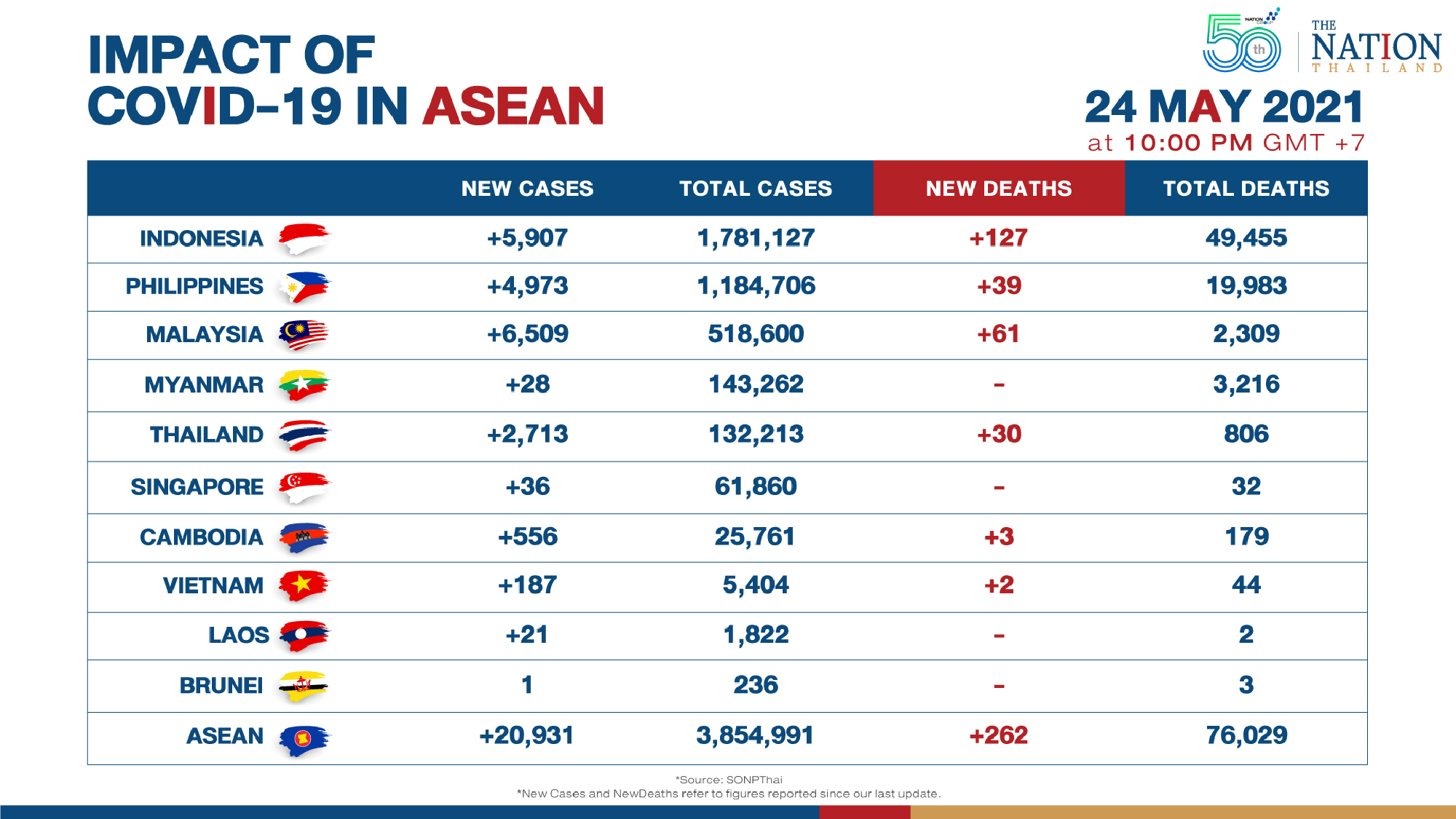
The number of Covid-19 cases and deaths in Southeast Asia on Monday saw a slight increase over the previous day, as per collated data.
Asean reported 20,931 new cases on Monday, slightly higher than Sunday’s 19,462, while 262 people died, up from the previous day’s 237.
Total cases in the region since the outbreak rose to 3.85 million, while deaths are now at 76,029.
Malaysia reported 6,509 infections, nearly one-third of total cases in the region, and a record single-day death toll of 61. Cumulative cases in the country rose to 518,600 and 2,309 patients have died.
The Malaysian Ministry of Labour has ordered construction sites to reduce labourers to not more than 60 per cent, while local authorities have been told to adjust working hours depending on the outbreak situation.
Cambodia reported 556 new cases and three deaths on Monday, as cumulative cases in the country increased to 25,761 patients and 179 deaths. So far, 18,359 people have been cured and discharged.
The governor of Phnom Penh said he was considering bringing back curfew measures if the number of infections continued to rise and people still ignored disease control measures.
As hurricane season looms, Biden doubles funding to prepare for extreme weather
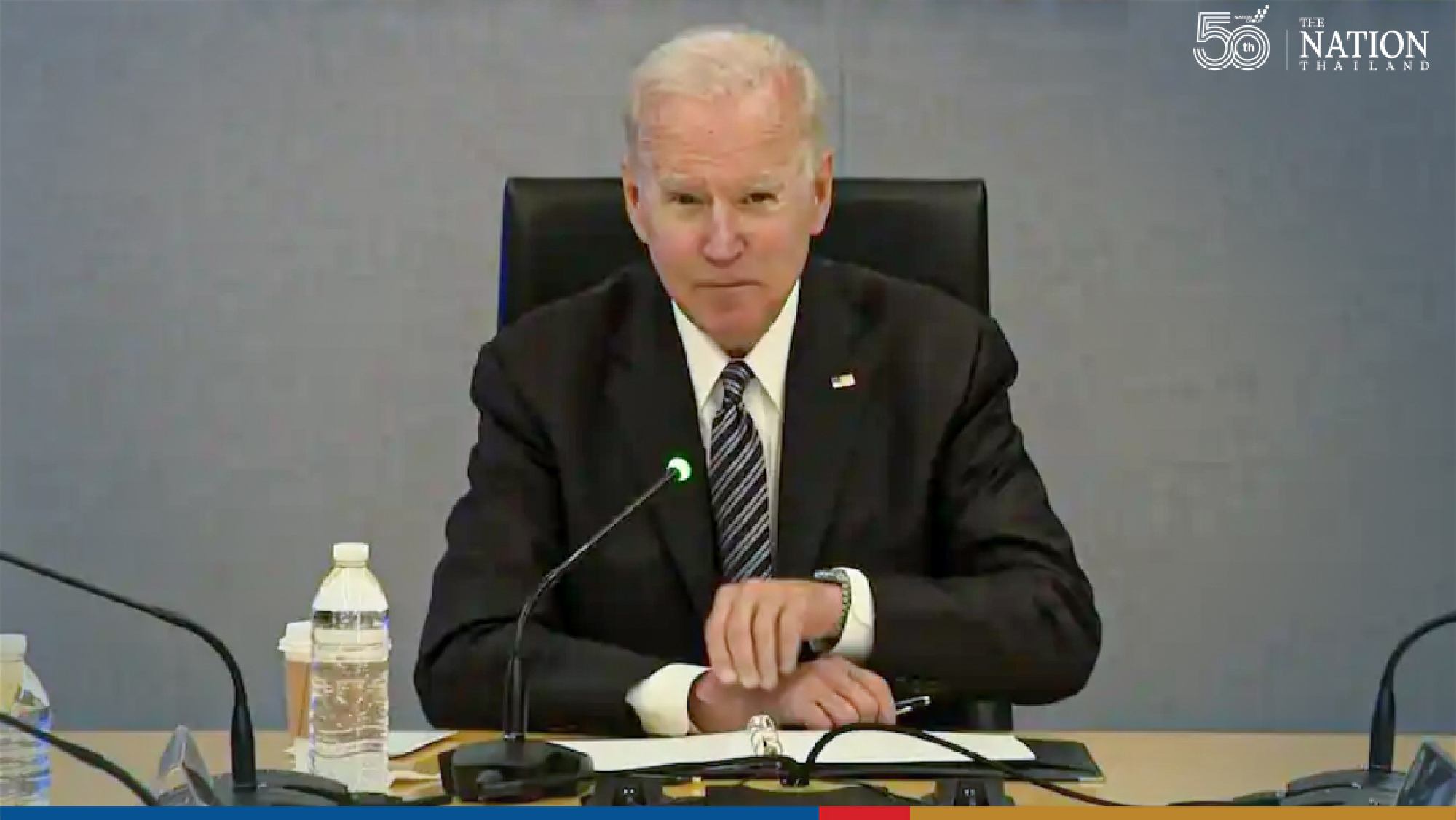
WASHINGTON – President Joe Biden will announce Monday afternoon that hes doubling the amount of money the U.S. government will spend helping communities prepare for extreme weather events, while launching a new effort at NASA to collect more sophisticated climate data.
While the $1 billion in funding is a fraction of what taxpayers spend each year on disasters, it underscores a broader effort to account for the damage wrought by climate change, and curb it. Last week the president signed an executive order instructing federal agencies to identify and disclose the perils a warming world poses to federal programs, assets and liabilities, while also requiring federal suppliers to reveal their own climate-related risks.
The president will make the announcement during a visit to the Federal Emergency Management Agency’s headquarters Monday afternoon, where he will receive a briefing on this year’s outlook for the Atlantic hurricane season.
The Building Resilient Infrastructure and Communities (BRIC) program helps communities prepare in advance for hurricanes, wildfires and other natural disasters. The administration will target roughly 40% of the additional money to disadvantaged areas.
In a phone interview Monday, White House National Climate Adviser Gina McCarthy said that Biden’s actions will help convey to Americans how the climate has already changed and what the United States must do to respond to it.
“That’s really going to make this climate issue real and relevant to people,” she said. “We just have to prepare for this, and the president is a realist. This is the world we’re living in.”
Monday’s hurricane briefing, McCarthy said, marked a sharp departure from how President Donald Trump approached extreme weather events. In a 2019 incident known as “Sharpiegate,” Trump and his deputies pressured the National Oceanic and Atmospheric Administration to contradict its own experts and say the path of Hurricane Dorian would severely impact Alabama. He also repeatedly questioned the link between rising temperatures and more frequent and intense wildfires.
“This meeting is not just sitting around talking about policies. It’s all about listening to what science tells us, and how we can be prepared for those real-world impacts,” McCarthy said. “It’s telling people what they need to hear about what’s happening in their world, but also responding with a robust whole-of-government approach.”
Last week, NOAA said it expects another hectic season – one that will come on the heels of the busiest such season on record in 2020.
The past year saw a startling 30 named storms, including a half-dozen major hurricanes, surpassing a record set in 2005. A dozen tropical storms and hurricanes made landfall in the United States during the past year. Five of those made landfall in Louisiana, leaving multibillion dollar disasters and plenty of heartache in their wake.
But emergency officials will probably have little time to catch their breath. NOAA’s outlook last week said a 60% chance exists for an above-average storm season this year, with a 70% probability of 13 to 20 named storms.
The administration will also start developing a new NASA mission concept for an Earth System Observatory, which will deploy advanced technology in space so scientists and policymakers can better understand the interactions between Earth’s atmosphere, land, ocean and ice.
McCarthy said the initiative “brings together a lot of streams of evidence that will allow better predictions and ones that are more localized.”
“In the big picture, I think understanding and preparing for extremes is the core of the climate challenge,” said Stanford University Professor Chris Field, who chairs the school’s Woods Institute for the Environment, in an email. “Extreme events are always the sharp end of the climate spear. But they are also super challenging to understand and forecast.”
Field, who has co-chaired the Intergovernmental Panel on Climate Change working group on managing the risks of extreme weather events, noted that current climate models are better at predicting average conditions than extreme events.
“If we want to understand where things are headed with climate-change impacts, understanding and forecasting extreme events is where we need to go,” he said, adding that one of the complications is that some climate-related events, such as wildfires, have multiple causes.
2020 not only marked a record hurricane season, it also saw a startling number of billion-dollar disasters, according to a NOAA report released early this year. That research found that such catastrophes in the United States alone amounted to $95 billion from 22 separate billion-dollar events. The previous record for billion-dollar disasters was 16 in 2011 and in 2017.
Severe wildfires raged in the West, burning millions of acres and entire neighborhoods.
The year marked the most severe wildfire season across the West to date, with California logging five of its six biggest wildfires in state history. Hurricanes and tropical storms battered parts of the Gulf Coast.
In addition, 2020 essentially tied 2016 as the hottest year on record, according to scientists. It also capped the hottest decade in recorded history.
Published : May 25, 2021
By : The Washington Post · Juliet Eilperin, Brady Dennis
India braces for second hurricane-strength storm in 10 days
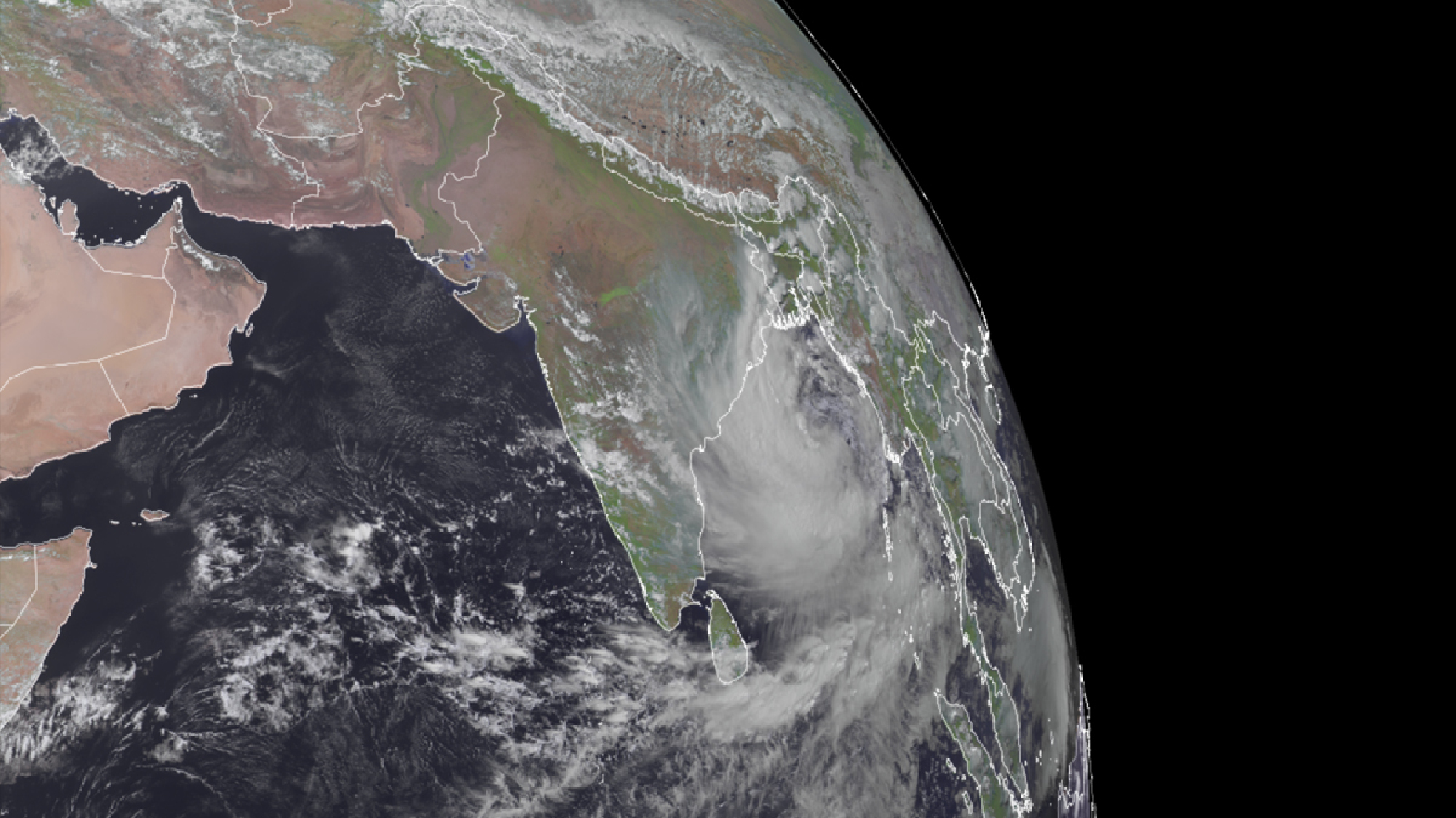
For the second time in 10 days, India is set to be slammed by a powerful cyclone, or a hurricane-equivalent storm, bringing the risk of damaging winds, storm surge and heavy inland rainfall. The system, known as Yaas, is currently only a tropical storm as it swirls over the Bay of Bengal. But it is expected to intensify into a high-end Category 1-strength tempest before its midweek landfall along Indias northeast coast.
The anticipated landfall comes just nine days after Gujarat, India, was slammed by Extremely Severe Cyclonic Storm Tauktae, which made landfall last Monday Eastern time as a high-end Category 3-equivalent storm with 125 mph winds. Its landfall coincided with a report of the nation’s deadliest day of the covid-19 pandemic, a staggering 4,329 deaths recorded.
At least 86 people were killed by the storm, which caused an estimated $2.1 billion in damage, according to RMSI, a global catastrophe risk management consultancy.
Now a new system is brewing, not in the Arabian Sea but rather to the east of India. Tropical Storm Yaas had winds of 40 mph early Monday Eastern time, making it a borderline tropical storm. But it is set to intensify steadily over the coming days, and it should wrap into a solid hurricane-strength cyclone by late Tuesday as landfall nears. It was located about 400 miles away from its imminent landfall location early Monday, moving north-northwest at about 4 mph.
The India Meteorological Department has hoisted rainfall and wind warnings for the states of Odisha and West Bengal. Local authorities have been working to ensure the safety of oxygen generation plants amid the ongoing covid-19 crisis.
On satellite, the storm had a robust shield of cloud cover spiraling into it from the west, but bare ocean could be seen through gaps in low-level clouds east of the center. That’s usually a sign of dry air, but in this case, the environment surrounding Yaas is saturated, save for a narrow strip of dry air east of the storm at 30,000 feet. As such, it looks like Yaas’s lopsided appearance isn’t so much an indicator of obstacles impeding Yaas’s development as it is a symptom of the storm’s gradual maturation.
While sea surface temperatures are warm and sufficiently toasty to support a strong cyclone, a change of wind speed and/or direction with height, known as wind shear, is working to disrupt Yaas’s circulation. That effect is being somewhat counteracted by effective northerly outflow, or the evacuation of air exiting the storm at high altitudes, which allows the system to ingest more air and strengthen.
Together, the effects roughly balance out, meaning Yaas will probably strengthen right up to the point of landfall. The Joint Typhoon Warning Center is calling for Yaas to be a 90 mph Category 1-equivalent storm with gusts to 115 mph as it moves ashore overnight Tuesday into early Wednesday.
Right now, it’s looking like the states of Odisha and West Bengal are at greatest risk for a direct strike from Yaas; computer models are in good agreement regarding the anticipated track of the storm. Winds gusting over 80 mph are likely where the storm makes landfall, with perhaps a 3- to 6-foot storm surge east of the center.
Atop the increase in sea level, large waves could exacerbate flooding concerns in coastal areas.
“Tidal waves of height 2 to 4 meters above astronomical tide are likely to inundate low lying coastal areas of . . . Parganas, Medinipur, Balasore, Bhadrak, Kendrapara and Jagatsinghpur Districts around the time of landfall,” the India Meteorological Department wrote.
If the storm comes ashore where currently simulated, it could pose a surge problem for cities such as Haldia and Kolkata. They are situated on the Hooghly River, which opens to a bay at the coastline. An onshore southerly flow could push water into the bay and inundate some coastal areas.
The surge is unlikely to reach Kolkata, but high water downstream may back up the Hooghly River, which will simultaneously be working to drain heavy rainfall. A broad 3 to 6 inches of rain is likely east of the center, with 6 to 12 inches possible west of the circulation.
The two cities are among many in the region largely dependent on fishing and marine commerce. Offshore waves could top 60 feet during the height of the storm, prompting a stern warning to mariners.
“The fishermen are advised not to venture into central Bay of Bengal during 24th – 25th May and into north Bay of Bengal and along and off north Andhra Pradesh-Odisha-West Bengal-Bangladesh coasts from 24th – 26th May,” cautioned the India Meteorological Department.
The storm should dissipate by late Wednesday or early Thursday as it drifts inland to the northwest, bringing some rain showers to the high terrain of northern India to close out the workweek.
Cancer patients, other ill Gazans await Israels permission to leave for treatments
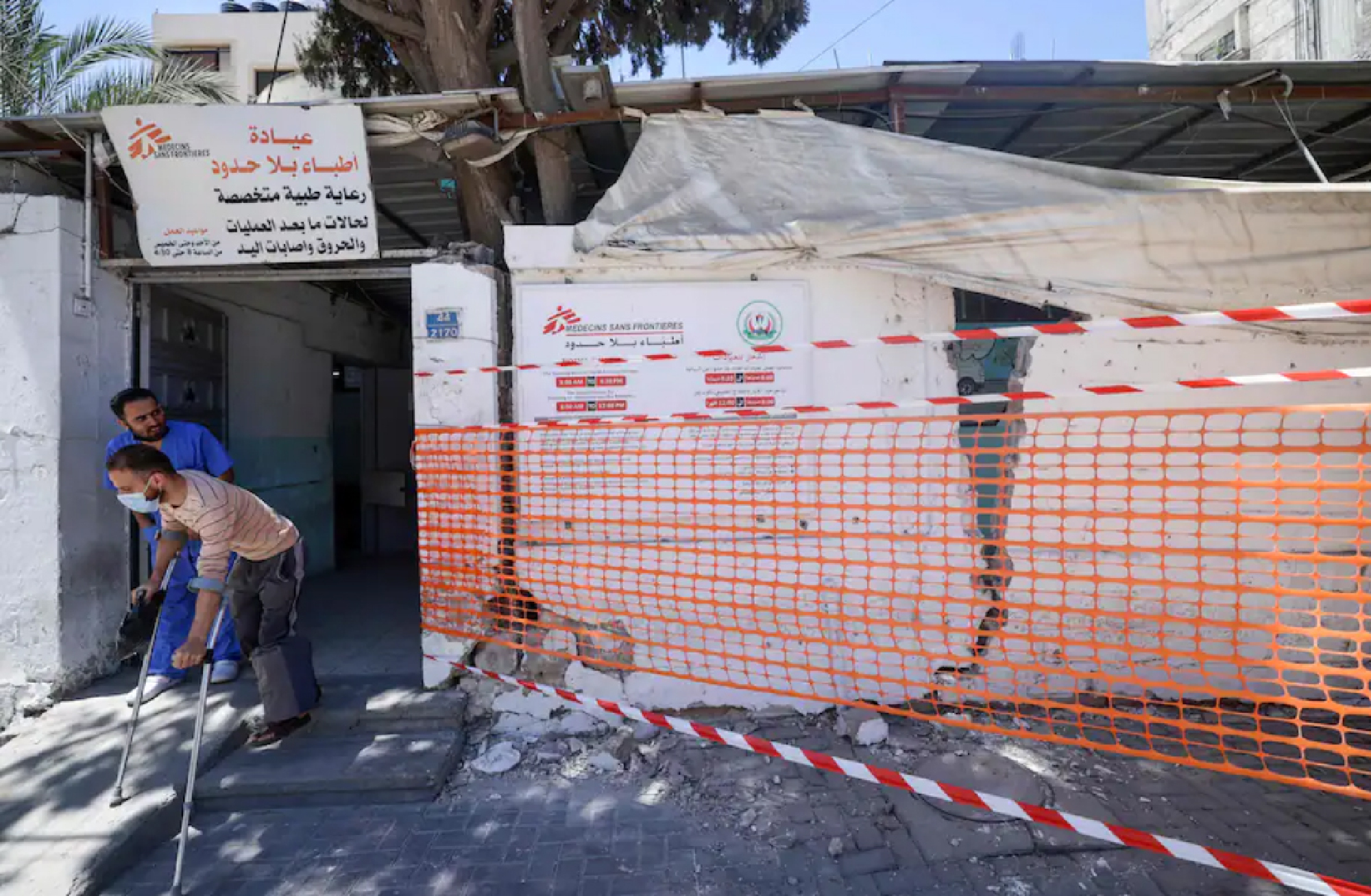
GAZA CITY, Gaza – As the Gaza Strip slowly re-connected with the outside world after an 11-day battle between Israel and Hamas, patients with urgent medical needs were still waiting Monday for Israels permission to leave the enclave for surgeries, transplants or cancer treatments that were interrupted by the fighting and unavailable in Gaza.
Physicians, families and advocates urged that border crossings be reopened for medical cases before the most vulnerable patients become critically ill or die.
Late Monday, the Israeli military said that patients with permits for medical treatments would be allowed to cross into Israel beginning Tuesday morning as part of the resumption of normal border operations, including the passage of humanitarian teams, medical equipment, food and fuel.
On the fourth day after a cease-fire ended the near-constant rocket launches into Israel and Israel’s retaliatory bombardment, more supplies of fuel and medical equipment entered Gaza through checkpoints in Israel and Egypt.
At least seven workers from humanitarian and aid groups, who had been blocked from entering, also arrived in Gaza on Sunday, according to the Association of International Development Agencies, an umbrella group of agencies in Jerusalem. But many of the groups are waiting for border openings to become more predictable before sending larger teams or specialists, the group said, to prevent their staff from being stranded inside the enclave.
No medical patients have been allowed to leave through the Erez Crossing into Israel during the limited hours that Israeli officials have opened to checkpoint to journalists or diplomats. That means many patients who missed critical appointments over the last two weeks still do not know when they will be able to reach their doctors.
The Gaza Health Ministry office that facilitates outside medical care was crowded Sunday with patients and families trying book new appointments and secure their exit permits.
Hussein Najjar, a fisherman from southern Gaza, said his 61-year-old mother has grown weak and depressed since missing her regular chemotherapy treatment in East Jerusalem’s Augusta Victoria Hospital for colorectal and lung cancer.
“Even if we get an appointment today, we don’t know when the crossing will be open and she will be able to go,” Najjar said. “She’s looking for a way to survive, and we can’t find it.”
The family situation was made even more difficult when Najjar’s boat was destroyed along with several others when an Israeli missile struck a harbor during the bombardment, he said. His family of seven, including his father and ailing mother, are surviving on a monthly donation of about $50 a month from Oxfam International, he said.
Gaza’s impoverished health system cannot provide many of the treatments needed by the most serious medical cases. There are no radiation treatment facilities in Gaza, for example, leaving cancer patients to seek that and other basic therapies in hospitals outside the enclave.
The Health Ministry said it makes appointments and processes exit permits for about 100 patients a day, 90% f them for hospitals in the West Bank and the rest for facilities in Israel, Jordan and Egypt.
They system is cumbersome at best, according to Mazin Hindi, the physician who runs the outside referral program. When there is a military escalation, it fails entirely, he said. Patients who need lifesaving treatments or surgeries can wait weeks for Israeli authorities to give the green light, sometimes not before it is too late.
“It’s very difficult on a human level,” Hindi said. “I feel like the patient in front of me is like my own mother, my own wife, my own child, and there is nothing I can do. I am helpless at times like this.”
The latest disruption is only the latest in an inefficient treatment network that often fails patients, according to Eman Shanan, an advocate for women cancer patients. Between Israeli restrictions, the lack of financial support from Hamas and the Palestinian Authority and the personal cost of transportation, many patients face hurdles to treatment that are sometimes insurmountable.
Covid-19 only made the situation worse, Shanan said. Cancer patients, who are often immune-compromised, were scared to travel for months. Seventeen thyroid patients she works with have not had treatment in more than a year because quarantine requirements in Egypt and Jordan meant they would be potentially apart from their young children for weeks.
“The war just made it worse,” said Shanan, head of the Gaza-based Aid and Hope Program for Cancer Patient Care. “Nobody is caring about cancer patients.”
Published : May 25, 2021
By : The Washington Post · Steven Hendrix, Hazem Balousha