India has deadliest day for any country since pandemic began #SootinClaimon.Com

#SootinClaimon.Com : ขอบคุณแหล่งข้อมูล : หนังสือพิมพ์ The Nation.

https://www.nationthailand.com/international/40001078

India has deadliest day for any country since pandemic began


NEW DELHI – For a doctor, it was another 18-hour day trying to rescue patients who could not be saved. For a crematorium official, it was one more procession of victims. For the family of a young academic, it was a time to mourn their second loss to the virus this month.

India has deadliest day for any country since pandemic began

India reported more than 4,500 deaths from covid-19 on Wednesday for the prior 24 hours, the highest single-day death toll in any country since the pandemic began and a grim marker of the scale of the outbreak ravaging this nation of 1.3 billion people.

The previous high for daily fatalities in the pandemic – 4,400 – occurred in the United States on Jan. 20, according to data from The Washington Post.

While the official statistics on covid-19 deaths in India are devastating, they do not capture the full scope of the calamity. Crematorium figures, obituaries and death certificates have repeatedly indicated higher numbers of deaths in this wave of infections than are reflected in the data from local and national authorities.

Deaths from covid-19, the illness caused by the novel coronavirus, lag infections by several weeks, and there are now signs that after an exponential rise, the surge in India appears to be moderating. The country has reported fewer than 300,000 new infections each day this week, still a large number but lower than the record-shattering figure of more than 414,000 daily cases recorded earlier this month.

In New Delhi, India’s capital, the number of new cases has fallen sharply after more than a month of lockdown measures. The slowing growth rate has helped ease the immense pressure on the city’s hospitals, which were turning away patients and grappling with shortages of oxygen earlier in May.

Yet the situation remains dire, notably in rural areas where the majority of Indians live and where health care is scarce. In India’s vast hinterland, scores of people are dying with covid-19 symptoms without being tested. Hundreds of bodies have been found floating in the Ganges River or buried in shallow graves near its banks.

Sanjeev Goyal, a civil servant at India’s Defense Ministry, lost his 23-year-old wife Nidhi Goyal, a teacher, to the virus in April. The family found her a hospital bed in Delhi after a frantic search, but when her condition turned critical, no ventilator was available, Goyal said. She was six months pregnant.

Goyal returned to his small ancestral village in the state of Bihar to immerse his wife’s ashes according to tradition. The number of people complaining of fever, coughs and sore throats in the village is now on the rise, he said. But officially there are no coronavirus cases because “not even a single person has been tested.”

He blames the Delhi authorities for forcing him to search for a ventilator and criticized a lack of preparation by the government for the second wave. “I will carry this pain for the rest of my life that I couldn’t see her face properly one last time,” said Goyal.

Indian Prime Minister Narendra Modi last addressed the nation on the coronavirus crisis on April 20. In recent days, he has talked about the need to help rural and remote areas combat the pandemic.

“The challenge is huge, but our morale is even bigger,” he told local officials on Tuesday. “With spirit and resolve, we will take the country out of this crisis.”

As India seeks to contain the current deadly wave of cases, it is also grappling with a faltering vaccination program. The number of doses administered in the country has tumbled over the past six weeks amid supply shortages and an abrupt change in procurement policy.

Epidemiologists believe that while the rate of growth of new cases appears to be decreasing, the actual toll of the current wave is far larger than official statistics indicate. Experts say the true number of deaths could be anywhere from two to eight times the government figures.

Shahid Jameel, a virologist and professor at Ashoka University, noted recently that under normal circumstances, India’s death rate is about 27,600 a day. If the official figures of about 4,000 covid-19 deaths a day were accurate, he said, they would represent a 15% increase – not enough to overwhelm crematoriums or to generate the harrowing scenes witnessed across the country in recent weeks.

The country would not “see this kind of mayhem” unless the number of bodies at crematoriums had doubled, Jameel told the Indian Express newspaper.

The country’s death toll reflects not just the rampant spread of the virus but also the strain on a chronically weak health-care system. Covid-19 patients have died at home because hospitals were full, as well as inside hospitals because ventilators were unavailable. Hospitals often have run out of supplemental oxygen, with fatal consequences.

India’s Health Ministry reports the prior day’s fatalities each morning. For some, Tuesday’s more than 4,500 deaths were part of a now familiar routine.

Mayur Rathod, a doctor overseeing the treatment of covid-19 patients at Saroj Hospital in Delhi, began the day at 8 a.m. He often does not stop until the wee hours of the next morning. He updates the availability of hospital beds every two hours, checks stocks of supplemental oxygen and medicines, and submits death reports to a government website. The hospital reported three deaths on Tuesday and seven on Monday.

“We are mentally exhausted,” Rathod said. “It is depressing to see patients dying in front of our eyes.”

About 500 miles away in the central Indian city of Bhopal, Mamtesh Sharma, an official at one of the city’s crematoriums, began the grim process of performing the final rites for dozens of covid-19 patients. For more than a month, he has spent 14 hours a day surrounded by the dead.

On Tuesday, his crematorium handled more than 30 covid-19 victims, including a prominent doctor and a wealthy businessman. In normal times, such funerals would draw crowds of friends and relatives. Instead, four people accompanied the bodies and left quickly, Sharma said. What he has seen in the past five weeks will haunt him for the rest of his life, he said.

Back in Delhi, later in the afternoon, about a dozen people gathered at a cemetery to bury Nabila Sadiq, a beloved 38-year-old professor of women’s studies at Jamia Millia Islamia University. Sadiq wrote on Twitter about her illness, which she said began with “chills and a choked throat” on April 25. Early this month, her condition worsened. “Any icu bed leads? For myself,” she wrote.

Sadiq’s 76-year-old mother was also hospitalized with covid-19, said Farid Khan, a businessman who assisted the family in its search for medical care. Her mother died 10 days ago, and Sadiq died late Monday, Khan said. She is survived by her father and brother.

The situation in India is “unimaginable,” Khan said. “Just pray for whatever we can salvage.”

Published : May 20, 2021

By : The Washington Post · Joanna Slater
Asean sees over 19,700 new Covid cases #SootinClaimon.Com

#SootinClaimon.Com : ขอบคุณแหล่งข้อมูล : หนังสือพิมพ์ The Nation.

https://www.nationthailand.com/international/40001077

Asean sees over 19,700 new Covid cases


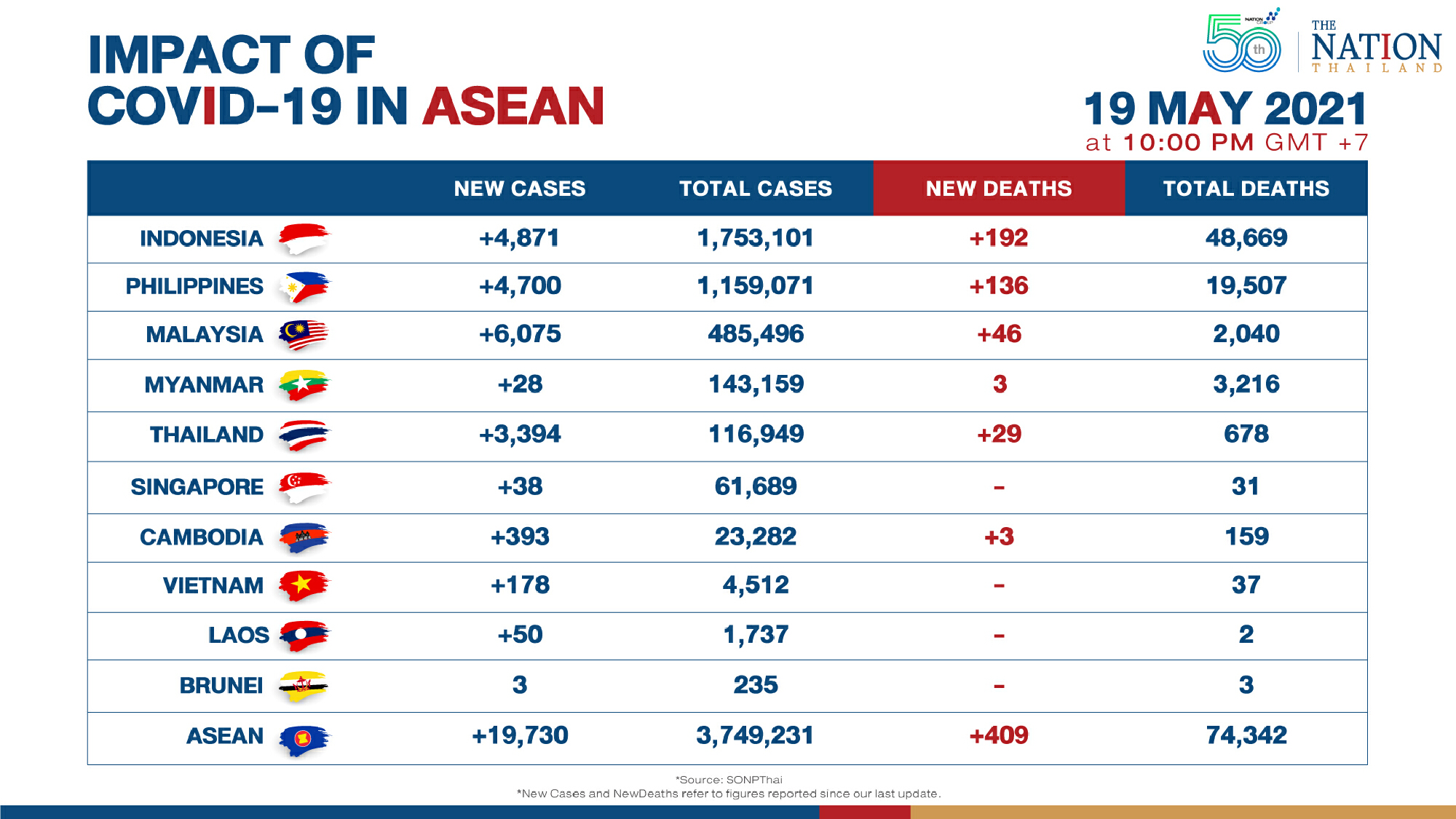
The number of Covid-19 cases crossed 3.74 million in Southeast Asia, with 19,730 new cases reported on Wednesday, higher than Tuesday’s 16,629.

Asean sees over 19,700 new Covid cases

New deaths were reported to be 409, increasing from Tuesday’s 366.

Total Covid-19 deaths across Asean are now 74,342.

Malaysia reported a new high of 6,075 new infections, pushing its cumulative cases to 485,496 patients. With 46 deaths on Wednesday, the total number of deaths in Malaysia stands at 2,040.

The country’s Public Health Ministry has urged people to go into voluntary lockdown to limit the spread of infections, recommending that residents venture out for groceries only once per week and shop online more.

Cambodia reported 393 new infections and three deaths on Wednesday, bringing cumulative cases in the neighbouring country to 23,282 patients and a total of 159 deaths. So far 14,955 people have been cured and discharged from hospitals. The government has done away with control zones in Phnom Penh, but rumours are circulating that people in the city have to pay for vaccines.

Published : May 20, 2021

By : THE NATION

Bidens warning to Israel shakes up diplomacy, politics #SootinClaimon.Com

#SootinClaimon.Com : ขอบคุณแหล่งข้อมูล : หนังสือพิมพ์ The Nation.

https://www.nationthailand.com/international/40001076

Bidens warning to Israel shakes up diplomacy, politics


WINDSOR, Conn. – President Joe Bidens unusually blunt demand Wednesday that Israel de-escalate its military attack on Gaza is creating a rare rift between the two countries and dismaying some of Israels supporters in the United States, while heartening Democrats who have increasingly pushed for a tougher U.S. stance against Israel.

Bidens warning to Israel shakes up diplomacy, politics

Biden for days had hesitated to publicly confront Prime Minister Benjamin Netanyahu, and his demand for “a significant de-escalation today on the path to a cease-fire” shook up the worlds of politics and diplomacy. It was the clearest evidence yet of a rapidly changing political dynamic, at least among Democrats, that is far less accepting of actions Israel says it is taking in self-defense.

The White House has told Netanyahu in recent days that the ground is shifting in the U.S., even among some lawmakers who have long been supportive of Israel, two people familiar with aspects of the message said, speaking on the condition of anonymity to discuss private conversations. That shift was the backdrop for Wednesday’s call, the fourth between the two leaders since hostilities began.

Netanyahu, however, vowed Wednesday to continue with the 10-day military offensive “until its aim is met,” meaning until more Hamas targets are destroyed. That public defiance underlined his disconnect with Biden, which is all the more notable because Netanyahu, whose own domestic political position is precarious, closely embraced former president Donald Trump.

After a visit to military headquarters, Netanyahu said that he “greatly appreciates the support of the American president” but that Israel would push ahead “to return the calm and security to you, citizens of Israel,” The Associated Press reported.

Biden has no direct authority to impose a cease-fire on Israel, but the stern White House message was unmistakable: If Netanyahu carries the conflict much further, he risks losing significant backing in Washington.

Washington and Jerusalem have differed before, often on the issue of Jewish settlements in the West Bank. But a posture of unshakable solidarity has been far more common in the history of the two countries, and the United States holds leverage as the Jewish state’s most important ally and chief diplomatic defender on the world stage.

The three-sentence account of the Biden-Netanyahu call released by the White House Wednesday omitted the usual language about Israel’s right to defend itself. After noting a “detailed discussion” between the leaders, the statement said, “The President conveyed to the Prime Minister that he expected a significant de-escalation today on the path to a cease fire.”

That sharp tone caught the attention of figures including Rep. Mark Pocan, D-Wis., who has helped lead the push for a stricter policy toward Israel. “Waiting and hoping,” he said in a text message to The Washington Post on Wednesday when asked for his reaction.

Rep. Ro Khanna, D-Calif., another critic of the Biden strategy in recent days, welcomed the statement more explicitly. “It is encouraging that President Biden is beginning to demand an end to the violence,” said Khanna, who had previously called on Biden to give Netanyahu a deadline for ending the military assault on the Gaza Strip.

Republicans, however, saw an opportunity to draw a sharp line between themselves and Biden on support for Israel, which remains a popular cause among Orthodox Jews, evangelical Christians and military hawks, even while liberal Jews have grown more critical of Israel.

“Biden is calling for Israel to de-escalate while the terrorist group Hamas is still firing rockets at Israeli citizens,” former South Carolina governor Nikki Haley tweeted. “It would be unacceptable if one of our allies called for de-escalation if Washington DC were targeted by rockets.”

Haley, who served as U.S. ambassador to the United Nations under Trump and is seen as a potential presidential candidate, added, “We must stand with Israel against terrorism.”

Meanwhile, a group of Republican senators held a news conference accusing Biden of bowing to pressure from his party’s left wing and working against a longtime U.S. ally.

“Today he said he expects a significant de-escalation from Israel,” said Sen. Tom Cotton, R-Ark. “What he needs to say is that he expects Iran and Hamas to stop terrorizing the people of Israel.”

Sen. Jerry Moran, R-Kan., added that it is “shocking to me to see how much the administration has changed over time in regard to support for Israel.”

Biden’s repeated calls to Netanyahu are a reflection of how much the Middle East crisis has seized his attention in recent days, despite his earlier determination to avoid getting entangled in the region’s long-running hostilities.

The conflict overshadowed his message at the Wednesday commencement ceremony of the U.S. Coast Guard Academy, where he emphasized the need to stand up to China and protect freedom of navigation on the seas.

Decades of rules on international navigation have been challenged, Biden told the 240 cadets, “both by the rapid advance of technology and the disruptive actions of nations like China and Russia.”

Biden added, “Long-standing basic maritime principles like freedom of navigation are a bedrock of global economic and global security. When nations try to game the system or tip in rules in their favor, it throws everything off balance.”

But the president’s shift in tone and message on the Middle East drew far more attention.

Until Wednesday, the Biden administration had publicly backed Netanyahu while applying quiet pressure behind the scenes to end the conflict quickly and reduce civilian casualties. Administration officials initially believed that public criticism would backfire, and that Israel was unlikely to yield until its military had destroyed more Hamas targets.

But the tactics shifted as the fighting stretched into a second week, while pressure mounted from Democrats who argued that the White House was giving approval to Netanyahu at the expense of civilians, and that the issue involved basic civil rights.

At the same time, Biden and his aides were disappointed that Israel did not release more public information about its targeting Saturday of a high-rise building in Gaza City that housed an Associated Press office and other media outlets.

Israeli officials said the building also contained Hamas militants, adding that they had shared intelligence information corroborating that assertion with the United States. But the lack of public evidence left the Biden administration appearing to disagree with the strike, which critics have suggested was an attempt to limit news coverage of the hostilities.

Biden’s new demands of Israel come after he has found himself increasingly at odds with fellow Democrats over his previously unwavering public support for Israel.

That Democratic criticism is part of a broader shift in the party’s thinking about the U.S.-Israel relationship. The changes have been evident not only among a newer generation of liberal lawmakers but also to a lesser extent among centrist and veteran members of Congress.

Among the most forceful voices is Rep. Rashida Tlaib, D-Mich., a frequent critic of Israel who spoke with Biden on Tuesday. A Palestinian American, Tlaib is among the Democrats who have expressed skepticism that the building housing The Associated Press was a legitimate military target.

In private, Biden officials have drawn attention to a weekend statement from Senate Foreign Relations Committee Chair Robert Menendez, D-N.J., who often is in his party’s more hawkish camp when it comes to foreign affairs.

“I am deeply troubled by reports of Israeli military actions that resulted in the death of innocent civilians in Gaza as well as Israeli targeting of buildings housing international media outlets,” Menendez said.

Biden’s call for de-escalation came a day after he faced protests over his administration’s handling of the Israel-Gaza conflict during a visit to a Ford auto plant in Dearborn, Mich., which has a large Arab American community.

House Speaker Nancy Pelosi, D-Calif., has also spoken out, saying that “after more than a week of hostilities, it has become even more apparent that a cease-fire is necessary.”

Israeli political analyst Daniel Levy said Netanyahu is betting that Biden will not use all the leverage he has over Israel, which he called “so far a reasonable bet.”


“Biden is in part responding to the shifting domestic political dynamics inside America” and in part to concerns that the crisis risks damaging his mantle as a defender of human rights after the Trump years, said Levy, founder of the Middle East Project.

“This is also two allies sizing each other up under a new administration,” he added, and in the shadow of ongoing nuclear negotiations with Iran that Biden embraces and Israel opposes.

A former senior U.S. official familiar with efforts to end past Israel-Hamas conflicts said Biden’s statement offers Netanyahu more “wiggle room” than it might first appear.

“The strikes have been so intense that Israel can scale back just a little and say it is de-escalating,” said the former official, who spoke on the condition of anonymity to discuss the sensitivities of the ongoing diplomacy.

“Bibi has a couple more days, I would think,” he added, using Netanyahu’s nickname. “But if this lasts more than a couple more days? I don’t know the extent to which the Israelis have internalized how different the political environment is here in the U.S.”

In the past, Israeli officials might have mobilized a large bipartisan outpouring of support that would complicate the response from the White House, the official said, but doing so appears far harder now.

The Palestinian death toll in Gaza stood at 219, including at least 63 children, local health officials said Wednesday. In the West Bank, at least 19 Palestinians have been killed since Friday, officials there said. The death toll in Israel stood at 12, including two children, after police said two Thai workers were killed Tuesday by rockets fired from Gaza.

Also Wednesday, the Palestinian ambassador to the United Nations challenged the Biden administration to show results from its diplomatic efforts after the United States continued to block U.N. Security Council action on the ground that it would interfere with attempts to negotiate a cease-fire.

Published : May 20, 2021

By : The Washington Post · Anne Gearan, Sean Sullivan

Iran to start oil exports from port skirting troubled strait #SootinClaimon.Com

#SootinClaimon.Com : ขอบคุณแหล่งข้อมูล : หนังสือพิมพ์ The Nation.

https://www.nationthailand.com/international/40001074

Iran to start oil exports from port skirting troubled strait


Iran said it will soon export oil from a new port that allows it to bypass the Strait of Hormuz, as nuclear talks between Tehran and other world powers show signs of progress.

Iran to start oil exports from port skirting troubled strait

State-controlled National Iranian Oil Co. will start shipping crude from the Jask terminal on the Gulf of Oman coast next month, according to a statement. NIOC is already pumping oil into a 1,000-kilometer (620-mile) pipeline connecting Jask with the southwestern energy hub of Goreh, Managing Director Masoud Karbasian said.

The pipeline will be officially opened by President Hassan Rouhani in the near future, Karbasian said, without giving a timeframe or stating how much oil will initially be exported.

Iran is under strict U.S. sanctions that effectively bar it from selling oil. Yet it has increased exports this year, often disguising the origin of the shipments. Refiners in China are the main buyers. Some flows get passed off as Malaysian and Omani crude after ship-to-ship transfers.

Most of Iran’s energy exports currently have to be sent through the Strait of Hormuz, a narrow channel and a shipping flashpoint in recent years.

World powers are trying to broker an agreement between Iran and the U.S. to revive a 2015 nuclear accord, which restricted Tehran’s atomic activities in return for sanctions relief. Former U.S. President Donald Trump abandoned the deal in 2018 and imposed tougher penalties on the Islamic Republic, which responded by significantly increasing uranium enrichment.

Abbas Araghchi, Iran’s deputy foreign minister and chief negotiator in Vienna, where talks are being held, said on Wednesday there had been “good progress.”

Published : May 20, 2021

By : Syndication Washington Post, Bloomberg · Arsalan Shahla

Canadian consumer prices climb at fastest pace in a decade #SootinClaimon.Com

#SootinClaimon.Com : ขอบคุณแหล่งข้อมูล : หนังสือพิมพ์ The Nation.

https://www.nationthailand.com/international/40001073

Canadian consumer prices climb at fastest pace in a decade


Consumer prices in Canada climbed at the fastest rate in a decade, outpacing estimates and potentially fueling concerns that the country — much of which is still in lockdown — is entering a period of persistent inflation.

Canadian consumer prices climb at fastest pace in a decade

Annual inflation accelerated to 3.4% in April, compared with 2.2% in March, Statistics Canada reported Wednesday in Ottawa. That exceeded economist predictions of a 3.2% annual pace. On a monthly basis, inflation rose 0.5% versus the 0.2% economists were expecting.

The annual reading — the highest since May 2011 — may raise worries that price pressures could be stronger than predicted by the Bank of Canada, which has been cautioning against over-reacting to an inflation spike it expects will be only transitory. If inflation proves more durable, however, that could force the central bank to bring forward interest rate increases that investors aren’t anticipating until later next year.

Core inflation — often seen as a better measure of underlying price pressures — rose to 2.1% from 1.9% in March. That’s the highest since 2012.

Higher gasoline prices were the biggest upward contributer to annual inflation. They were up 62.5% in April compared with the same time last year, when prices plunged to an 11-year low in the early weeks of the pandemic, the report said. On a monthly basis, shelter prices were the biggest upward contributer due to higher building costs and strong demand for single family homes.

The annual consumer price index reading is distorted because the year-ago period used as comparison coincided with broad demand and price declines at the beginning of the Covid-19 pandemic, a phenomenon known as the base effect.

A similar phenomenon also drove inflation higher in the U.S. last month to an annual 4.2% pace. Unlike in the U.S., inflation in Canada may be rising at a slower pace because much of the country was still in some form of a Covid-related shutdown last month, stunting demand for goods and services. Recent gains in the Canadian dollar also may have dampened inflation pressures.

“Base effects and higher commodity prices have done most of the damage, similar to what was seen in the U.S. CPI release last week, although that also had a boost from the US economic reopening,” Simon Harvey, a senior foreign exchange analyst at Monex Canada, said by email.

Canada’s dollar fell after the report, trading 0.3% lower at C$1.2101 per U.S. dollar at 9:01 a.m. in Toronto trading. Yields on Canadian government five-year bonds were little changed at 0.95%.

Bank of Canada Governor Tiff Macklem had predicted that inflation would rise to about 3% because of these base effects, but he also said he believes that underlying price pressures remain depressed because of continued slack in the economy. In its latest forecasts released last month, the central bank forecast inflation to average 2.9% in the second quarter before returning near its 2% target by the end of the year.

“BoC members have already stated that they’d look through the short-term overshoot in inflation, meaning there is a high bar for CPI to clear before markets start to speculate on changing expectations of normalization,” Harvey said.

Published : May 20, 2021

By : Syndication Washington Post, Bloomberg · Shelly Hagan

Johnson & Johnson documented contamination risks at Baltimore plant months before vaccine was ruined #SootinClaimon.Com

#SootinClaimon.Com : ขอบคุณแหล่งข้อมูล : หนังสือพิมพ์ The Nation.

https://www.nationthailand.com/international/40001072

Johnson & Johnson documented contamination risks at Baltimore plant months before vaccine was ruined


WASHINGTON – Johnson & Johnson documented contamination risks at a Baltimore biodefense plant in June 2020, seven months before a contamination problem ruined 15 million doses of coronavirus vaccine and derailed Johnson & Johnsons domestic vaccine production, according to documents disclosed Wednesday by a House panel investigating the incident.

Johnson & Johnson documented contamination risks at Baltimore plant months before vaccine was ruined

The disclosures by a House subcommittee on Wednesday raise questions about oversight by Johnson & Johnson as well as the Trump administration, which the newly released records show also knew of production risks at the Emergent BioSolutions facility.

The House Oversight select subcommittee on the coronavirus crisis, which is investigating the manufacturing failures by Emergent BioSolutions, released a staff report as part of a hearing Wednesday in which Emergent BioSolutions executives were scheduled to testify.

The report documented in new detail Emergent’s persistent problems with contamination, unsanitary conditions, mold, poor training and insufficient attention to procedures.

While Emergent has received most of the blame for the manufacturing crisis, the documents show that Johnson & Johnson was aware of risks of contamination at the plant. It conducted a virtual audit of the facility over multiple days in June 2020. The audit report cited mold, inadequate gowning and wipe-down procedures, and “deficient” contamination-control measures.

“The site virus contamination control strategy is deficient,” the Johnson & Johnson audit report said. “There is not a formal Bayview contamination control strategy for the site.”

Johnson & Johnson did not immediately respond to a request for comment Wednesday.

The New York Times previously disclosed that Johnson & Johnson made negative findings in the June 2020 audit, but the full document released by the committee contains previously unreported details.

Johnson & Johnson relied on Emergent as its only domestic manufacturer of coronavirus vaccine. The manufacturing shutdown at Emergent, triggered by a cross-contamination incident with the AstraZeneca vaccine in March and a subsequent Food and Drug Administration inspection that found a multitude of problems, has cut off supply in the United States of the single-shot vaccine.

Another report in June 2020 performed for the Trump administration by a consultant said Emergent’s vaccine operations were put at significant risk by the need to rapidly add new workers and cited a lower-level risk associated with Emergent’s “outdated” facilities.

The panel also released a detailed report by Emergent on how Johnson & Johnson discovered the contamination incident that ruined a huge amount of vaccine. The cross-contamination with a viral vector for AstraZeneca vaccine, which was being made in the same plant, was detected by Johnson & Johnson on March 5 in a batch of vaccine manufactured between Jan. 19 and Feb. 21, according to Emergent’s report.

Emergent said the most probable route of contamination was during preparation of a growth media for the Johnson & Johnson vaccine, which came into contact with the “waste path” from an area used to make AstraZeneca vaccine.

Rep. James Clyburn, D-S.C., chairman of the select subcommittee on the coronavirus crisis, and Rep. Carolyn Maloney, D-N.Y., chairwoman of the House Committee on Oversight and Reform, launched an investigation April 19 and invited Emergent’s CEO, Robert Kramer, and founder and executive chairman, Fuad El-Hibri, to testify.

“We have questions about why Emergent failed to take action to fix the manufacturing problems plaguing its plant-even after the company was warned that its poor practices led to a very real risk of contamination,” Clyburn said in prepared opening remarks the virtual hearing.

He added later during questioning of Kramer, “We are trying to find some accountability for what we consider some egregious failures.”

Clyburn and Maloney questioned why the company awarded top executives with bonuses in 2020, given the documented problems. “I have serious concerns that Emergent executives . . . appear to have wasted taxpayer dollars while lining their own pockets,” Maloney said.

Kramer told the committee that Emergent was working with the FDA to get operations back on track.

“We have implemented an array of corrective steps,” he said, including removing AstraZeneca production from the plant. “I apologize for the failure of our controls and I give you my personal assurance that I will take every step that is needed to resume production safely.”

Kramer emphasized the high difficulty of manufacturing new vaccines in a matter of months. In attempting to make early batches of AstraZeneca vaccine in 2020, Kramer testified, Emergent had to make 80 changes in the production steps to correct problems, some of which resulted in spoiled batches.

Batches that do not meet specifications are fairly common in vaccine production, specialists have told The Washington Post, though cross-contamination of two vaccines ruining as much as 15 million doses is rare.

Emergent suspended production of the vaccine at the plant on April 19 at the request of the FDA and still lacks FDA manufacturing certification that would allow production to resume.

About 100 million doses made at the plant before the shutdown also are awaiting clearance by the FDA, Kramer said Wednesday.

An FDA inspection report last month cited unsanitary conditions at the plant and a lack of adherence to basic protocols intended to prevent contamination of the vaccine.

Weeks before, in January and February, Kramer sold $10 million of company stock, a move that has been cited in a shareholder lawsuit filed this month contending the company misled investors by not publicly disclosing problems at the facility. Emergent stock has lost more than half its value since February.

The Biden administration stopped shipping doses to states this week as new supplies ran dry. The 10 million shots administered in the United States to date have been imported from a Johnson & Johnson plant in the Netherlands.

In her questioning of Kramer, Maloney expressed outrage over the chain of events surrounding Emergent’s response to 2020 audits and inspections finding contamination risks, and she asked whether the government got its money’s worth from the company.

“Yes or no? Have we been able to use vaccine?” she demanded of Kramer.

“None of the vaccine that we have manufactured have been made available to the U.S.,” Kramer said.

“But you have been able to sell stock. Were you aware of problems at the facility at the time you went out and sold your stock?” she said. “Instead of thinking of ways of addressing the company’s contamination, you were thinking about ways to enrich yourself.”

Kramer said later in his testimony that sales of his shares were made automatically, under a previously scheduled stock trading plan.

As a federal contractor specializing in biodefense and emergency response, Emergent’s 2020 financial success was fueled in large part by a burst of federal spending to fight the coronavirus pandemic.

It received $628 million in a May 2020 federal contract from the Trump administration to upgrade and reserve capacity for government priorities. It also signed vaccine manufacturing agreements with Johnson & Johnson and AstraZeneca as those companies raced to develop and produce vaccines to fulfill government orders.

Two months before the Trump administration awarded the upgrade contract, an FDA inspector had found that employees at Emergent had not been properly trained, records were not adequately secured, established testing procedures were not being followed, and a measure intended to “prevent contamination or mix-ups” was deficient.

The staff report released Wednesday also raised questions about the role of a senior Trump official who oversaw $650 million in vaccine-related government contract awards for Emergent. Former assistant secretary of health and human services Robert Kadlec had previously served as a consultant for Emergent from 2012 to 2015, earning at least $360,000 in fees, the staff report said.

“Multiple inspections and audits conducted in 2020 warned of serious quality control issues at Emergent’s Bayview facility,” the committee staff report stated. “However, documents show that Dr. Kadlec, then-Assistant Secretary for Preparedness and Response, requested in August 2020 that Emergent’s contract receive a ‘priority rating.’ “

Kadlec determined that Emergent, a biodefense contractor for the government for years, had the experience and capacity to handle the job.

“This conclusion raises questions regarding whether Dr. Kadlec’s office performed sufficient diligence before awarding the contract to Emergent,” the staff report said.

Kadlec said in an interview Wednesday morning that his previous work as a consultant for Emergent did not influence his reviews of its 2020 contacts for the coronavirus vaccine. He said officials from President Donald Trump’s Operation Warp Speed were involved in decision-making.

The Trump administration weighed the risks raised in the 2020 inspection reports about Emergent but had no alternatives for contract manufacturing of vaccines at the time, especially on an emergency basis, he said. Emergent is one of three Centers for Innovation in Advanced Development and Manufacturing designated by the government to respond to pandemic and biological and chemical threats. Ultimately, Merck emerged as willing to make the Johnson & Johnson vaccine, Kadlec said, a deal initiated in the Trump administration and completed by the Biden administration. That vaccine production is expected to begin later this year.

Kadlec added that the Trump administration knew there were risks associated with manufacturing the AstraZeneca vaccine and the Johnson & Johnson vaccine in the same Emergent plant.

“This was the best bad choice that we had,” Kadlec said. “We didn’t have a lot of good choices at the time.”

Published : May 20, 2021

By : The Washington Post · Christopher Rowland

E.U. to reopen borders to travelers with accepted vaccines #SootinClaimon.Com

#SootinClaimon.Com : ขอบคุณแหล่งข้อมูล : หนังสือพิมพ์ The Nation.

https://www.nationthailand.com/international/40001071

E.U. to reopen borders to travelers with accepted vaccines


BRUSSELS – The European Union has agreed to open its borders to vaccinated Americans and others, after more than a year in which travel into the bloc has been severely restricted, a spokesman said Wednesday.

E.U. to reopen borders to travelers with accepted vaccines

The decision represents a formal turning point away from the eerie, economy-sapping status quo of the coronavirus pandemic, when major cities in the 27-nation bloc have been empty of tourists.

Officials said the reopening could take effect within days of final approval, which is expected this week or next and is not in doubt after ambassadors agreed to the plan on Wednesday.

“Today, E.U. ambassadors agreed to update the approach to travel from outside the European Union,” European Commission spokesman Christian Wigand told reporters. The European Council “now recommends that member states ease some restrictions, in particular for those vaccinated with an E.U.-authorized vaccine.”

That means all the coronavirus vaccines available in the United States would allow travel, but vaccines manufactured in Russia and China would not be. The E.U. guidance is not binding, so some countries could choose to be more or less restrictive than the bloc as a whole.

Another matter that still needs to be sorted out: Some E.U. countries currently require quarantines of all new arrivals, regardless of vaccination status. Belgium and France, for instance, require seven days. But European policymakers are working on a plan to sweep away those rules. A full proposal is expected as soon as Friday, though it could take several weeks to implement.

Britain, which is no longer a member of the European Union, has a separate set of rules, with no special treatment yet for vaccinated travelers. A traffic-light system sets out requirements based on the risk presented by different countries. Americans can travel there, but they must quarantine for at least five days.

Europe’s vaccination campaign has lagged behind those of the United States and Britain, though it has picked up speed recently. Some officials have been reluctant to grant privileges to vaccinated foreigners that were unavailable to large portions of their own unvaccinated populations. But that worry is diminishing by the day – the E.U. pace is now faster than that in the United States.

One-third of E.U. residents have received at least one dose of a vaccine, compared with 48% of U.S. residents. The E.U. percentage is where the United States was six weeks ago.

Within the European Union, Mediterranean countries have pushed hardest to find a way to reopen. Greece, Italy and Spain depend heavily on tourism, and that saw their economies contract more than their northern neighbors during the pandemic.

Greece decided it could not wait and last month opened to Americans and residents of dozens of other countries even while lockdown restrictions limited its appeal as a destination.

Some people in tourist-dependent countries now say the coordinated E.U. plan is welcome, but it may come somewhat late, making it hard to salvage the initial months of the travel season.

“The actual expectations so far are pretty low” that 2021 will resemble something normal, said Luigi Panella, 47, a limousine driver who deals mostly with British and American clients along Italy’s Amalfi Coast.

Massimo Pasqualetti, 45, who co-operates a food and wine tour group in Tuscany, said interest in his company is beginning to pick up; it is 10% of what it used to be. Across Tuscany, he said he’s starting to notice the first trickle of tourists.

“A month ago, we saw nothing. Nothing was moving,” Pasqualetti said. “But we are suddenly more optimistic than before.”

He said that his income collapsed last year, and that the business survived only because he and his partner began offering online-based cooking classes: everybody in their own kitchen, around the world, cooking Tuscan ragu and pasta.

“Our aim, this whole time, has been, ‘Let’s survive, let’s survive,’ ” he said. “I think we are going to survive.”

As part of the same decision on Wednesday, the European Union plans to expand a list of countries deemed to have the pandemic under sufficient control, such that people can travel from there regardless of their vaccination status. The new criteria for the list would still be tight enough that it would exclude the United States, though the country could conceivably make the cut sometime in June if cases continue to decline at their current pace.

The European Union will also implement what it is calling an emergency brake – an automatic halt to travel from countries where cases are spiking, in an effort to hold back more dangerous variants of the coronavirus.

E.U. countries are separately trying to streamline travel inside the bloc, which is stymied by a patchwork of rules about quarantines, tests and vaccines. Progress on what are officially known as “green certificates,” but informally understood as covid-19 passports, could be announced as soon as Friday. The goal is for Europeans to be able to prove that they are vaccinated, have a recent negative coronavirus test or have recently had the disease and probably will not spread it. E.U. officials hope that the program will be operational by mid-June, and that it will reduce quarantining and testing requirements.

Because individual countries will still be able to set their own rules about what they require from aspiring visitors, it is possible that some of the more cautious ones will still ask vaccinated travelers to quarantine. But those kinds of rules will probably start dropping away as the European Union adapts its rules to diminishing fears that vaccinated travelers could still spread the virus.

Wednesday’s decision “gradually opens safe travel from and to the EU,” tweeted Ylva Johansson, the top E.U. official charged with home affairs.

Published : May 20, 2021

By : The Washington Post · Michael Birnbaum, Chico Harlan

Stocks mixed; yields rise on Fed minutes #SootinClaimon.Com

#SootinClaimon.Com : ขอบคุณแหล่งข้อมูล : หนังสือพิมพ์ The Nation.

https://www.nationthailand.com/international/40001070

Stocks mixed; yields rise on Fed minutes


U.S. stocks closed mixed and Treasury yields rose as minutes showed Federal Reserve officials were cautiously optimistic about the U.S. recovery at their April meeting, with some signaling theyd be open “at some point” to discussing scaling back the central banks massive bond purchases.

Stocks mixed; yields rise on Fed minutes

The S&P 500 fell for a third day, and 10-year Treasury yields jumped to session highs following the release. Energy and raw-material stocks fell the most as commodities prices tumbled amid mounting concern about inflation and potential curbs on monetary stimulus. The Nasdaq 100 notched a small advance, boosted by late-day gains in tech stocks including Facebook Inc. and Alphabet Inc.

“We saw 10-year yields rise pretty sharply, clearly an upward move after the minutes were released — it looks like it all comes down to minor changes in wording on tapering,” said Collin Martin, fixed-income strategist at Schwab Center for Financial Research. “There might be a few participants who are getting a little eager to start the discussion, which might be more than the markets were expecting. For anyone waiting for the taper, this could be a hint it’s coming sooner rather than later.”

Cryptocurrency-exposed shares including Coinbase Global Inc., Marathon Digital Holdings Inc. and Riot Blockchain Inc. each fell more than 5% after Bitcoin touched its lowest level since January before bouncing back. Tesla Inc. fell to a two-month low after data showed a slowdown in China sales. Target Corp. rallied to a record high after predicting a more profitable year as quarterly sales soared.

At its worst moment, Bitcoin dropped about 30% to within a whisker of $30,000. It pared that decline to about 8% by 4 p.m. New York time. Other cryptocurrencies held double-digit percentage losses, pressured in part by a Tuesday statement from the People’s Bank of China reiterating that digital tokens can’t be used as a form of payment.

“Tactically, it seems a bit overdone as fundamentals have changed modestly,” Mike Bailey, director of research at FBB Capital Partners, said of the crypto rout. “However, this type of volatility is a reminder that the asset class is pure. This type of move could flush out some of the casual crypto investors, since we haven’t seen this type of downward volatility in some time.”

Stocks have lost steam in recent sessions, with pricier sectors such as technology tumbling on worries about inflation and a covid-19 resurgence in some countries. While policymakers have signaled they intend to maintain an accommodative stance for some time to come, traders will parse the Fed’s minutes for clues about the outlook. The Bloomberg Commodity Index, which touched a nine-year high last week, fell for a second day as oil, copper, soybeans and almost every other futures contract linked to industrial and agricultural staples retreated.

These are some of the main moves in markets:

Stocks

– The S&P 500 fell 0.3% as of 4:04 p.m. EDT

– The Nasdaq 100 rose 0.2%

– The Dow Jones industrial average fell 0.5%

– The MSCI World index fell 0.7%

Currencies

– The Bloomberg Dollar Spot Index rose 0.5%

– The euro fell 0.4% to $1.2176

– The British pound fell 0.5% to $1.4118

– The Japanese yen fell 0.3% to 109.22 per dollar

Bonds

– The yield on 10-year Treasurys advanced four basis points to 1.68%

– Germany’s 10-year yield was little changed at -0.11%

– Britain’s 10-year yield declined two basis points to 0.85%

Commodities

– West Texas Intermediate crude fell 3.1% to $63 a barrel

– Gold futures rose 0.2% to $1,871 an ounce

Published : May 20, 2021

By : Syndication Washington Post, Bloomberg · Richard Richtmyer, Claire Ballentine

Cryptocurrencies crash in sell-off #SootinClaimon.Com

#SootinClaimon.Com : ขอบคุณแหล่งข้อมูล : หนังสือพิมพ์ The Nation.

https://www.nationthailand.com/international/40001069

Cryptocurrencies crash in sell-off


Cryptocurrency investors woke up to grim news Wednesday: A sell-off sent prices crashing across the board, wiping more than half a trillion dollars off the market.

Cryptocurrencies crash in sell-off

Bitcoin, the most popular and valuable token, fell by more than 20% in early morning trading before recovering some of its losses. It sank below price levels not seen since January. Many other top tokens followed suit. Dogecoin investors, who had enjoyed astronomical growth this year, seeing their holdings skyrocket by roughly 10,000%, were hit especially hard. The meme-inspired cryptocurrency tumbled by more than 30%.

Coinbase, one of the largest cryptocurrency exchanges in the world, reported service disruptions Wednesday morning. An error screen displayed when users went to the homepage. Customers reported that they were unable to log in, see their balances or trade their tokens, the company said.

“We’re seeing some issues on Coinbase and Coinbase Pro and we’re aware some features may not be functioning completely normal,” the company said in tweets from its support account. “We sincerely apologize for any trouble caused by this issue, and we thank you for your patience with us today.”

The crypto market is known for its extreme volatility. Individual tokens can dive or catapult in a single hour, and longtime investors have gone through cycles of upswings and downturns. But the market has roared since the coronavirus pandemic first gripped the world. Hordes of new investors have thrown their money into digital currencies, drawn by the allure of sudden price spikes and life-changing winnings. Regulators, too, have taken notice, concerned with the dangers posed to novice investors and the potential for price manipulation.

“What is causing this violent sell-off? Take your pick!” said David Bahnsen, chief investment officer of the Bahnsen Group, a wealth management firm. Bahnsen pointed to a confluence of factors and negative headlines that may have triggered the massive sell-off. One possible factor was billionaire executive Elon Musk saying that his company Tesla would no longer accept bitcoin as payment for its vehicles and that the company may have already sold its bitcoin holdings. Another factor could be the renewed fears of ransom-taking criminals using cryptocurrency to carry out their plans. What’s more, Chinese officials signaled that they would crackdown on financial institutions that offer services tied to cryptocurrencies, Bahnsen said, deflating the whole concept.

“But at the end of the day, it drops like this for the same reason it previously skyrocketed the way it did – it is primarily held by rank speculators who lack a thesis for ownership rooted in fundamentals or reality or some definition of value. Speculation cuts both ways, and reflects weak hands when things turn south.”

Stock traders were also reeling on Wednesday, as all the three major indexes on Wall Street dropped – continuing a slump this month after record-shattering growth.

“Stocks and cryptocurrencies have been showing signs of froth over the past few months and were due for a pullback,” said Richard Saperstein, chief investment officer of Treasury Partners, a wealth management firm.

The mood on some trading forums reflected a mix of resilience and frustration. “I firmly believe this. I’ll repeat it: you haven’t earned anything and you haven’t lost anything until you sell,” said one user on Reddit. Another wrote: “I Bought The Dip: And Other Affirmations You Can Say to Center Yourself Right Now.”

As of Wednesday afternoon, bitcoin stood at roughly $38,000, its value cut from a high of about $65,000 in April.

Many of the most valuable tokens by market capitalization remained down by double digits well into afternoon trading.

After appearing to trigger several market-moving events this month, sending prices diving, Musk took to Twitter once again Wednesday to deliver commentary on cryptocurrency. His latest post was a rallying cry of sorts, using the emoji for “diamond hands” – a visual phrase common among online traders to show one’s unwavering commitment to holding a position, even as the market twists and turns drastically.

Earlier this week, Musk clarified that his electric-car company did not sell its bitcoin holdings, which Musk appeared to suggest over the weekend, rattling investors.

The outsize power of celebrity billionaires and influencers to steer the market has drawn scorn from committed investors and from regulators worried about manipulation. While U.S. financial officials have only begun to contemplate a new regulatory regime to oversee cryptocurrency, other governments, including China, have taken an antagonistic approach.

Published : May 20, 2021

By : The Washington Post · Hamza Shaban

Drone companies are preparing to deliver covid-19 vaccines in rural U.S. #SootinClaimon.Com

#SootinClaimon.Com : ขอบคุณแหล่งข้อมูล : หนังสือพิมพ์ The Nation.

https://www.nationthailand.com/international/40001068

Drone companies are preparing to deliver covid-19 vaccines in rural U.S.


While more than one-third of Americans are fully vaccinated against covid-19, there are still millions of people who have yet to receive a single dose.

Drone companies are preparing to deliver covid-19 vaccines in rural U.S.

Reasons for not getting a shot vary – some don’t want one at all, while others say they’ll wait a bit longer to decide. And then, there are people who want to get vaccinated but are in too remote of an area to get to a typical vaccination site.

They include people working on oil rigs in the Gulf of Mexico or living in rural areas miles from the nearest doctor’s office or pharmacy. Drone companies are positioning themselves to deliver refrigerated medical products to those people. If the plans don’t pan out in time to combat the coronavirus crisis, then they hope to be set up to assist swiftly in the world’s next big health scare.

Saskatoon, Canada-based Draganfly and San Francisco-based Volansi are among the firms operating drones in the United States right now with medical delivery partnerships.

Draganfly has been around since the 1990s and will begin test flights with coronavirus vaccines in Texas next month with Coldchain Technology Services, a healthcare supply chain management company. Volansi, founded in 2015, has been running drones carrying other refrigerated medicines and vaccines with Merck in North Carolina since October.

Drones tend to be faster and cheaper at handling smaller payloads to remote locations than either trucks or helicopters, according to Wayne Williams, executive director at Coldchain, which is headquartered in Spring Branch, Texas.

“If I have to get a life-saving vaccine to somewhere that’s about (300 miles) from here, I have to find a courier, get them on the road, and it can take up to seven hours to get it delivered. If I put the package on a drone, I’m still able to track it, and it gets there sooner for a lot less money,” Williams said.

Last week, Coldchain announced plans to spend $750,000 on Draganfly’s equipment to ship medical supplies and covid vaccines on an experimental basis to nearby locations.

Unmanned aerial vehicles are shaping up to assist during the pandemic in other ways, too. Draganfly developed a system that can measure people’s vital signs such as heart rate and blood pressure from a drone. Drones from the Chinese manufacturer DJI have been used to monitor social distancing in Elizabeth, N.J., over the past year. Meanwhile, more than a few firms have announced disinfecting drones to spray potentially contaminated zones from above.

Drones aren’t transporting covid vaccines in the U.S. yet. But Coldchain wants to change that.

The company will work with the Federal Aviation Administration this summer to obtain approval for delivery routes in Texas. This comes after the FAA issued new drone rules in December in a step toward enabling widespread commercial deliveries. Phase two for Coldchain will be to fly the drones further, out of their line of sight, to trained EMS workers.

Coldchain has already developed 12-inch, cube-shaped, thermal containers to be carried by Draganfly’s drones.

The company’s temperature-controlled boxes can hold roughly 600 to 1,5000 vials of vaccines, depending on the provider. And it was constructed to maintain the super-low temperatures required by Pfizer for 48 hours, and Moderna for at least 72 hours, Williams said. Johnson and Johnson’s one-dose vaccine can be kept at slightly higher temperatures, between 36 and 46 degrees Fahrenheit, which the container can maintain for roughly 96 hours, Williams added.

The packages have data collection devices that will alert Coldchain to variations in vaccine temperatures, the company says. Once the drone makes it to a dropoff site, the recipients can use a smartphone code outside the container to determine the payload’s internal temperature.

Draganfly offers a range of drones customized for specific jobs across education, law enforcement and agriculture. Coldchain says it plans to start vaccine deliveries in Texas with the firm’s medium-range drones capable of flying roughly 372 miles roundtrip on a charge.

Draganfly is not the only startup transporting medical supplies in the U.S. amid the pandemic. In October, Concord, Calif.-based Volansi began its commercial healthcare flights around Wilson, N.C., where the company distributes pneumonia and hepatitis vaccines in partnership with the pharmaceutical giant Merck.

Volansi hasn’t transported coronavirus vaccines, though “our payload boxes are designed specifically to carry covid-vaccine types,” said Hannan Parvizian, the company’s CEO.

Germany’s Wingcopter is also racing to distribute covid-19 vaccines, while San Francisco’s Zipline started dropping off Oxford-AstraZeneca vaccines in Ghana earlier this year. Walmart partnered with Zipline in September for on-demand medical supply delivery.

Draganfly says what makes its plan with Coldchain different is that they have covid-19 vaccine customers ready to receive deliveries if testing pans out this summer.

Even if covid vaccine delivery takes off in the United States, the small air vehicles would help only so much. More than 37 percent of Americans already are vaccinated, and studies have shown that about a quarter of people who haven’t gotten a shot don’t want to get vaccinated at all. It’s also late in the pandemic. The CDC has eased its guidance on wearing face masks indoors and cities across the nation have dropped other pandemic-related restrictions.

Drone companies say they’re laying the groundwork today so that they can work more swiftly during future health care crises.

“This won’t be the last vaccine that needs to be distributed,” said Cameron Chell, CEO of Draganfly. “But next time as a society, we’re going to respond much quicker.”

Published : May 20, 2021

By : The Washington Post · Dalvin Brown