Russia roils agricultural markets on Putin’s push to curb food prices
InternationalDec 12. 2020Customers choose fresh bread at the Neglinnaya Plaza shopping center in Moscow on Feb. 19, 2015. MUST CREDIT: Bloomberg photo by Andrey Rudakov.
By Syndication Washington Post, Bloomberg · Anatoly Medetsky, Megan Durisin
Russia is rattling agriculture markets once again with the threat of government intervention as President Vladimir Putin and his prime minister rail about food-price inflation in one of the world’s biggest exporters of wheat and sunflower oil.
This week, Putin expressed surprise at sharp price increases for staples like bread and sunflower oil, and told the government to develop a plan for curbing them. Prime Minister Mikhail Mishustin jumped in Thursday, saying food producers, exporters and retailers should stop taking advantage of consumers. Officials are already considering a wheat export tax in addition to the earlier proposal to set a grain shipment quota for a few months next year, according to an export lobby group.
“Don’t profit off of the people,” Mishustin said during televised comments at a cabinet meeting. “It’s unacceptable in this difficult situation. It’s necessary to take drastic measures and set straight the way prices are formed.”
He didn’t elaborate, but Russia has a history of disrupting the wheat market by implementing restrictions or duties. The country imposed an export tax in 2007 to combat rising food costs — helping push global wheat prices to a record — and a ban in 2010 after a poor crop, curbing supplies and helping propel prices to two-year highs.
It wasn’t clear immediately how the wheat export tax would affect shipments. The earlier proposal for a grain quota this season was loose enough for normal trade. Russia already is stepping in on oilseed markets, with the prime minister setting export taxes from January on commodities including sunflower seeds, used to make sunflower oil. Draft regulations to contain food prices are due for submission Monday.
Food inflation in Russia accelerated to 5.8% in November, the highest year-over-year gain since mid-2019. A United Nations global price gauge is at a six-year high as robust grain demand in China and tightening supply stoke prices. The U.S. Department of Agriculture cut its outlook for global wheat stockpiles on Thursday.
Benchmark futures for wheat — where Russia leads global exports — rallied in the wake of Putin’s comments, although the government hasn’t indicated any sales limits. Domestic prices are near a record high, and local bakers and meat producers asked the government for an export tax last month.
The agriculture ministry has proposed a quota from mid-February, with volumes high enough to keep trade flowing. A weak ruble helped accelerate wheat exports this year, making Russian supplies more competitive.
“The comments from Putin create a bit of uncertainty around the subject,” Matt Ammermann, a commodity risk manager at StoneX, said by email. “The market is sensitive to the potential ‘what ifs’ right now.”
Russia reaped a near-record wheat harvest, and the proposed quota is relatively relaxed, giving little immediate concern for supply, said Carlos Mera, a senior analyst at Rabobank International. Still, the fact that Putin and Mishustin are talking about this means the potential for intervention can’t be discounted.
“The situation seems quite fluid,” he said. “It’s all speculation at the moment.”
Supreme Court dismisses bid to overturn the presidential election results, blocking Trump’s legal path
InternationalDec 12. 2020Justices Neil Gorsuch and John Roberts are pictured at the top steps of the Supreme Court in June 2017. MUST CREDIT: Washington Post photo by Ricky Carioti
By The Washington Post · Robert Barnes
WASHINGTON – The Supreme Court on Friday dismissed a long-shot bid by President Donald Trump and the state of Texas to overturn the results in four states won by Democrat Joe Biden, blocking the president’s legal path to reverse his reelection loss.
The court’s unsigned order was short: “Texas has not demonstrated a judicially cognizable interest in the manner in which another state conducts its elections. All other pending motions are dismissed as moot.”
Justices Samuel Alito Jr. and Clarence Thomas said they did not believe the court had the authority to simply reject a state’s filing, a position they have taken in the past. But they said they would not have allowed Texas more than that.
“I would . . . grant the motion to file the bill of complaint but would not grant other relief, and I express no view on any other issue,” Alito wrote in a statement joined by Thomas.
Taking into account an earlier case from Pennsylvania, it means that in two cases to reach the court – where conservatives hold a 6 to 3 majority – no justice has expressed support for the drastic idea of throwing out election results.
Trump, who has appointed three of the court’s nine members, has long viewed the Supreme Court as something of an ace-in-the-hole, and Friday called for the justices to display “courage” and rescue him in post-election litigation.
After Justice Ruth Bader Ginsburg died in September, Trump said filling the seat was essential because of the possibility of litigation that might otherwise end in a tie. Justice Amy Coney Barrett was confirmed in a party-line vote by the Republican-controlled Senate to replace Ginsburg.
In a case earlier this week, the court turned down a request from Republican congressional candidates to overturn the results in Pennsylvania in a one-sentence order. Barrett took part in the case, but neither she nor fellow Trump appointees Neil Gorsuch or Brett Kavanaugh noted their objection.
Trump has refused to acknowledge defeat, instead embarking on a noisy campaign to discredit the election. He has made unproven charges of corruption and a rigged election in states he lost and unsubstantiated claims of illegal voting, votes switched by computer software and rampant fraud.
None have come close to being proven, and Attorney General William Barr said U.S. attorneys and FBI agents running down specific complaints and information “have not seen fraud on a scale that could have effected a different outcome in the election.”
Legal efforts by Trump and his allies filed in states he lost have been stunningly unsuccessful – one minor win compared to more than 50 losses in state and federal courts at both the trial and appellate level.
In one case that reached the U.S. Court of Appeals for the 3rd Circuit, the comeuppance was delivered by a judge Trump had nominated.
“Free, fair elections are the lifeblood of our democracy. Charges of unfairness are serious,” wrote Judge Stephanos Bibas. “But calling an election unfair does not make it so. Charges require specific allegations and then proof.”
Lawsuits continue around the country, but the Texas case was the one Trump and his allies had pinned their hopes upon.
The election results have been certified in each state, and the Electoral College is scheduled to meet Monday. Biden has 306 electoral votes, exactly the number Trump had when he was elected in 2016. But while Trump lost the popular vote then, Biden has a margin of more than 7 million votes.
Texas, led by Trump partisan Attorney General Ken Paxton, a Republican, tried to maneuver around the lower court losses by filing directly with the Supreme Court. States suing other states are allowed to ask the court to take up the case, although the court sometimes does not grant permission.
Trump tweeted that it was the “big one” that “everyone has been waiting for.”
Texas charged that actions by state officials in Pennsylvania, Georgia, Michigan and Wisconsin violated the Constitution, and diluted the impact of Texas voters.
Its major complaint was that state officials and courts in those states had changed election procedures to make it easier to vote by mail or other methods. It said that violated the Constitution’s direction that “the legislature” of each state set voting procedures.
It asked the justices to block those states from casting their combined 62 electoral votes for Biden and order the state legislatures, all Republican-controlled, to appoint either new electors or none at all. That would require the court to set aside the results in those states, which Biden won by a combined 300,000 votes.
Trump asked to intervene in the suit and 17 attorneys general from states where Trump won joined in – even when their own states had voting procedures altered by state officials or courts. A majority of House Republicans urged the Supreme Court to take the case.
The targeted states responded in blistering briefs, with Pennsylvania Attorney General Josh Shapiro calling the Texas suit a “seditious abuse of the judicial process.”
Wisconsin Attorney General Joshua Kaul, a Democrat, said agreeing to the Texas request would thrust the court into the political sphere in a way never imagined.
“If Texas’s theory of injury were accepted , it would be too easy to reframe virtually any election or voting rights dispute as implicating injuries to a state and thereby invoke this court’s original jurisdiction,” he wrote.
“New York or California could sue Texas or Alabama in this court over their felon-disenfranchisement policies. Garden-variety election disputes would soon come to the court in droves.”
The states said Texas’s claims were hypocritical and cynical. Although Texas said in a filing that it “does not ask this court to reelect President Trump,” the suit does not ask the court to discount the votes in any state Trump won where state officials and courts altered voting procedures because of the coronavirus pandemic.
Among those states are Texas itself, where the governor made changes.
Amid protests, D.C. police face perception they’ve chosen sides
InternationalDec 12. 2020A MAGA hat burns outside of BLM Plaza in Washington D.C. on Nov. 14. MUST CREDIT: Photo for The Washington Post by Evelyn Hockstein
By The Washington Post · Marissa J. Lang, Peter Hermann
WASHINGTON — The tension and violence at last month’s “Million MAGA March” has cast a long shadow, with ideologically opposed groups facing off again Saturday in the nation’s capital as police try to walk a line somewhere in between.
Washington D.C. protesters who have spent months calling for criminal justice reform say they were outnumbered and violently attacked by Proud Boys and other far-right agitators while police stood by on Nov. 14. At least three suffered knife wounds.
Republican members of Congress, meanwhile, accused the District’s liberal leadership of allowing D.C. protesters to harass and set fire to the property of supporters of President Donald Trump.
As these two dissonant sides meet again, police in the role of peacekeepers will be forced to contend with the growing perception that officers have chosen sides.
District officials say police did their best to minimize harm in a delicate and difficult situation. But officers’ behavior at the November rally – posing for photos with Trump supporters, standing back as demonstrators in Make America Great Again garb vandalized Black Lives Matter signs, standing back as arguments escalated to physical conflict – has prompted many to question the role personal politics play in policing.
When Trump’s most fervent supporters gather Saturday, urging him to continue his fight to overturn the results of the election he lost, D.C. activists will not be waiting along Pennsylvania Avenue to meet them.
Instead, protesters will gather in Black Lives Matter Plaza, ready to defend what they see as theirs: the fence on which signs and memorials have been hung, the pavement that bears the slogan “Black lives matter,” the very city itself and the people who live there.
Officials expect a smaller crowd than the thousands who converged days after Democrat Joe Biden was declared the victor of a bitterly fought presidential race. But the threat of an unpredictable and potentially violent day looms.
Police have said they stood back as Trump’s supporters destroyed signs because authorities do not believe it is illegal to tear them down and officers thought stepping in might exacerbate tensions. Roger Mitchell Jr., the city’s interim deputy mayor for public safety and justice, conceded in an interview that the optics were poor.
“I can absolutely see how people would see it as taking sides,” he said. “I’m not supportive of any law enforcement officer taking sides. . . . Their job is to be neutral and be there to protect whoever is there, whatever their political affiliation is.”
Pro-Trump rallies this weekend are expected to draw thousands of his most ardent supporters to the nation’s capital.
Events are scheduled to begin about 9 a.m. Saturday with a prayer rally at the Capitol. Other pro-Trump demonstrations will convene about noon near the Washington Monument and in Freedom Plaza. Demonstrators are again planning to march to the Supreme Court, where speakers will address the crowd from the marble steps. Among those invited to speak is Trump’s recently pardoned former national security adviser, Michael Flynn, who twice pleaded guilty to lying about his contacts with Russia’s ambassador during special counsel Robert Mueller III’s probe of 2016 election interference.
A Trump supporter is forced out of Black Lives Matter Plaza by demonstrators on Nov. 14 in Washington D.C. MUST CREDIT: Photo for The Washington Post by Evelyn Hockstein
A National Park Service permit issued Friday indicates organizers of the March for Trump, likely the largest of the rallies, expect about 15,000 attendees. Another “Million MAGA March” rally will convene at the National Sylvan Theater on the Mall, with about 500 people expected, according to a separate Park Service permit.
The Proud Boys – a male-chauvinist organization the FBI has deemed an extremist group with ties to white nationalism – plans to return to D.C. this weekend. Counterprotesters say at least three D.C. activists were stabbed in violent clashes with men wearing the Proud Boys’ signature gold-and-black uniform last month.
These incidents, along with more than six months of tense encounters with police, have convinced many D.C. protesters that police will not protect them, so they have been preparing to protect themselves.
Rotating shifts of anti-Trump demonstrators plan to patrol Black Lives Matter Plaza through the weekend, looking for attempts to tear down signs or vandalize protest murals. Dance protests and live music are scheduled alongside anti-Trump and anti-fascism rallies.
But D.C. police shut down the plaza early Friday, effectively evicting anti-Trump demonstrators and uprooting an ongoing peace vigil. D.C. activists noted on social media that the street slated to host their protest was closed on the same day the Park Service issued permits allowing Trump supporters to gather.
Dustin Sternbeck, a police spokesman, said police closed streets in the area of Black Lives Matter Plaza “to ensure public safety is maintained.” The police department did not respond to concerns from activists about their demonstration space being blocked.
Activists have warned about anti-Trump protesters being a possible target of violence Saturday and offered alternatives to showing up in person, including donating cash and supplies to protesters and lobbying the city to enforce its mask mandate. Street medics, who volunteer at rallies to care for injured demonstrators, have for weeks been recruiting reinforcements.
Congressional Republicans, meanwhile, have accused the District’s Democratic leadership of allowing Trump’s supporters to be bloodied in scuffles last month with counterprotesters over Trump flags and MAGA hats, which anti-Trump protesters later burned.
The group behind the March for Trump has deemed Black Lives Matter Plaza a “no-go zone” and discouraged supporters from venturing far from its rally point along Pennsylvania Avenue.
At a briefing with D.C. Council members this week, interim city administrator Kevin Donahue said he hopes protesters “get out of town as fast as possible.”
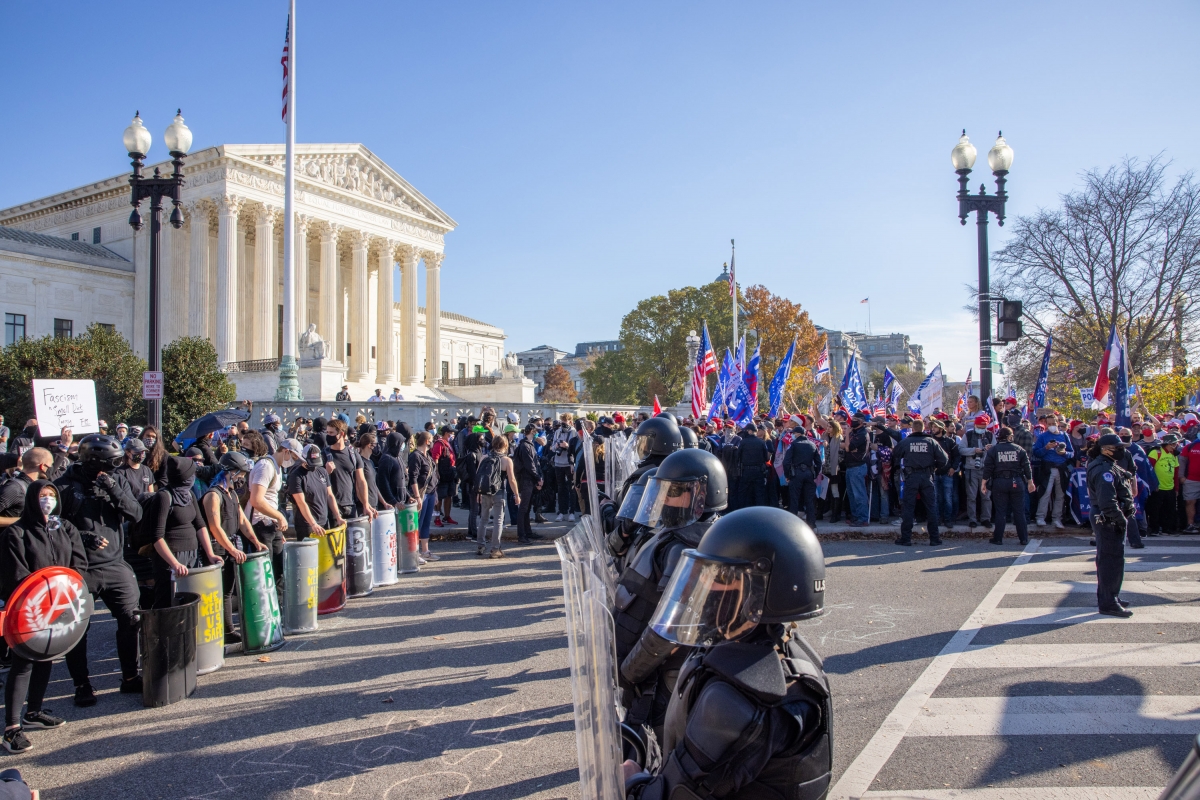
Last month’s rally brought two discordant views of America onto a crash course in the nation’s capital, with Trump supporters insisting without evidence the election had been stolen. They waved flags and chanted profanity-laden slogans from Freedom Plaza to the steps of the Supreme Court, where a small crowd of counterprotesters waited, wearing all black and using bicycles and homemade shields to create a barricade.
Violence between the two groups later broke out five blocks east of the White House. The groups charged each other as they approached the same intersection, brawling for several minutes before police cleared the area.
In the melee, a D.C. fire official said, a man in his 20s was stabbed in the back and taken to a hospital with serious injuries. Street fights continued into the night.
“Anytime there is violence in this city, that’s not a win,” Mitchell said.
Nearly two dozen people were arrested during the November rally, including several on gun charges, according to D.C. police, who said four officers also were injured.
D.C. activists said at least two additional counterprotesters were assaulted, including one who was wearing body armor and said his vest stopped a blade from penetrating his skin. Another received four stitches to close a knife wound in the arm, protesters said.
The demonstrators did not file police reports, and officers did not make arrests.
Dub, a 25-year-old street medic who declined to give a full name, out of fear of being targeted by the Proud Boys, said a woman came to medics seeking treatment for a cut on her neck after she said she was caught in a Proud Boys attack.
“I’m worried about the next one,” Dub said of Saturday’s protests. “I don’t want to see my people get harmed again.”
D.C. Police Chief Peter Newsham said last month that officers followed every big group of roving demonstrators and tried to intercede before factions collided. He said there were people on both sides determined to fight.
Washington D.C. police face counterprotesters as Trump supporters amass outside the Supreme Court on Nov. 14. MUST CREDIT: Photo for The Washington Post by Evelyn Hockstein
“The police department was put directly into the middle of it,” Newsham said, adding that the main goal of police is “to prevent violence . . . without choosing sides.”
But police actions during the demonstrations led many protesters to assume officers had done just that.
Trump supporters waving flags bearing a thin blue line, a pro-police symbol that critics have long claimed also stands for white supremacy and opposition to the Black Lives Matter movement, cheered officers as they passed. Several lined up for photos with officers, who smiled and flashed thumbs-up gestures for the camera.
“This is a volatile time,” Mitchell said. “I’m hearing more and more politicalization of policing, and our law enforcement is in the middle. We want them to act accordingly to maintain the civil rights of our community, and when they don’t, they need to be held accountable. When there is a perception that there is a side being taken, then our job is to mitigate that perception.”
Outside the Supreme Court, where thousands of Trump supporters faced off last month with a small crowd of black-clad counterprotesters, Proud Boys members tried to leap over metal barricades assembled to separate the groups. They were pushed back by police as the crowd chanted an expletive at counterprotesters. Moments later, officers in riot gear arrived and stood with shields up, facing the anti-Trump demonstrators.
– – –
As more officers with crowd-control munitions converged, counterprotesters glanced up from peeling clementines and drinking water on the curb of Maryland Avenue.
“This is disgusting,” said Jen Nick, 28, a Navy veteran who stood on the front line with a contingent of veterans donning “Vets for BLM” T-shirts. Looking at the row of officers, she said it seemed police were doing little to protect D.C. counterprotesters from the largely out-of-town crowd.
The administration of D.C. Mayor Muriel Bowser, D, declined to allow Newsham or other police officials to be interviewed for this report. Newsham is soon leaving the department to become police chief in Prince William County, Va.
Chuck Wexler, executive director of the Police Executive Research Forum, which advises law enforcement agencies on best practices, said it is not enough for officers at protests to have good intentions – they also need to be aware of the optics of their actions.
“We are living in an age where reality matters, but so does appearance,” Wexler said. “It’s hard when some group is trying to react favorably to the police. But I think police chiefs are aware that the appearance of fairness is as important as the reality.”
While many of the confrontations that happened last month did not culminate in violence, activists said being confronted by dozens of barefaced Trump supporters in the midst of a national surge of coronavirus cases made them feel unsafe.
Dozens of D.C. police officers have tested positive for the coronavirus in the weeks since the November rally. As of Thursday, 74 remained in quarantine. Police have declined to draw a direct link between demonstrations and the spike in infections among officers.
– – –
Harry’s Bar, a pub in the Hotel Harrington that has become known as a meeting point for Trump supporters and Proud Boys, was slapped with a fine for violating the mayor’s order mandating mask use and banning large crowds – the bar’s second offense since October.
D.C. police said officers will not be enforcing mask rules this weekend or issuing fines to those who flout the mandate or social distancing guidelines.
D.C. Council members and their staffs have received hundreds of messages from constituents ahead of Saturday’s rallies, urging the city to do more to enforce coronavirus restrictions. Chairman Phil Mendelson, D, encouraged residents concerned about the spread of germs at the demonstrations to “protect themselves from the dangers of this potential superspreader event by staying away from it.”
“Regardless of one’s views about the ideology of the rally, we have to be careful to respect the First Amendment right to demonstrate,” Mendelson said in an emailed statement.
Organizers with Women for America First, the pro-Trump group behind the rally at Freedom Plaza that also led the only permitted march on Nov. 14, sought to distance themselves from the violence that erupted.
“We hope everyone is peaceful and respects the right of all Americans to peacefully protest and have their voices heard,” said group spokesman Chris Barron.
InternationalDec 12. 2020Sen. Doug Jones is pictured at a news conference in August 2019. MUST CREDIT: Photo by Elijah Nouvelage for The Washington Post
By The Washington Post · Devlin Barrett, Matt Zapotosky, Matt Viser
WASHINGTON – President-elect Joe Biden’s search for the next attorney general is increasingly focused on Sen. Doug Jones, D-Ala., and former deputy attorney general Sally Yates, according to people familiar with the discussions, who said that appeals court Judge Merrick Garland remains a serious contender.
Jones, who lost his reelection bid in November, is the favorite at this stage, but Biden and his inner circle continue to debate the nomination, these people said, speaking on the condition of anonymity to describe internal discussions.
It is increasingly unlikely, these people said, that former Massachusetts governor Deval Patrick will be selected to become the nation’s top law enforcement official. People familiar with the discussions said in recent days that the discussions of the three other candidates has increasingly shifted toward the likelihood of confirmation in the Senate, which is currently controlled by Republicans. On that question, Jones is viewed as having an edge over Yates, according to the people familiar with the discussions.
With Jones’s stock on the rise, some civil rights leaders have privately expressed some reservations to members of Biden’s inner circle in recent days about whether his record on criminal justice reform and civil rights is sufficient. As a U.S. attorney in Alabama in the Clinton administration, Jones famously prosecuted members of the Ku Klux Klan who bombed a black church in Birmingham in 1963, killing four girls. The case had been stymied by then-FBI Director J. Edgar Hoover, but was resuscitated in 1971 and then again in 1993 at the urging of civil rights leaders.
House Majority Whip James Clyburn, D-S.C., recently cited that case in praising Jones to the website Cheddar.
“Decades they walked around free after bombing that church and killing those four Black girls. [Jones] prosecuted them and got them convicted,” Clyburn said. “You don’t have to be Black to do right by Black people.”
But – publicly and privately in conversations with those close to Biden – some civil rights leaders have suggested the case does not, by itself, demonstrate the kind of proven track record on civil rights and criminal justice reform they would like to see in an attorney general.
“I would never look at one case for anyone to determine the full measure of their record on civil rights or criminal justice reform,” said Sherrilyn Ifill, president and director-counsel of the NAACP Legal Defense and Educational Fund. “I think if you’re looking at the full measure of their record, it’s legitimate to ask how broad that record is in the matters that are of most interest to activists and communities of color around the country.”
As a senator, Jones sponsored voting rights legislation and co-sponsored the bipartisan criminal justice reform First Step Act. He also successfully passed legislation calling for the release of records about unsolved criminal civil rights cases, and he struck a deal to permanently renew annual federal funding for historically Black colleges and universities.
Some civil rights leaders have privately expressed concern that Jones voted to proceed on a Republican police reform bill, led by Sen. Tim Scott, R-S.C., that Democrats and the civil rights community saw as too weak. Jones was only one of two Senate Democrats to break with his party, along with Joe Manchin III, W. Va. Jones’s vote, though, was only procedural. He told WBUR at the time he would not vote to pass it “as is” but wanted to bring the bill to the floor for debate, where “the American people would have seen the flaws” in it.
Asked about the possibility of a Jones nomination, one civil rights leader speaking on condition of anonymity said: “Nobody’s going to be jumping up and down with enthusiasm,” but added, “I don’t know if people would be jumping up and down with opposition either.”
A spokeswoman for Jones declined to comment.
Several civil rights leaders have publicly expressed a preference for a Black attorney general. Marc Morial, president and CEO of the National Urban League, said that – in addition to scrutinizing the attorney general pick – he was focused on the entire slate of senior officials that Biden will pick to run the Justice Department.
“I’ve made that point privately, repeatedly, that the attorney general is crucial, but the team is crucial,” he said.
To that end, people familiar with the discussions said the incoming administration has increasingly focused in recent days on finding Black candidates to nominate for other Justice Department jobs, as it appears likely that Biden’s attorney general pick will be White.
Ifill has publicly expressed support for Yates, and other civil rights leaders have seemed to give her a tacit endorsement – noting that familiarity with the inner workings of the Justice Department were important criteria to them. That would not seem to apply to Jones or the other person still under consideration, Garland, as both of their experience in the Justice Department was from long ago.
Yates has more recent and extensive history on civil rights and criminal justice reform. As the Justice Department’s No. 2 official at the end of the Obama administration, she ordered the shutdown of private prisons under the Justice Department’s control, pushed for ending the use of solitary confinement and helped implement sentencing reform. She was also generally viewed inside the building as an advocate for prosecuting police officers who committed misconduct.
According to people familiar with the matter, when a dispute erupted among the department’s Civil Rights Division and federal prosecutors in New York about whether to bring charges against the officer involved in the death of Eric Garner, Yates sided with the Civil Rights Division, which wanted to proceed with a case. Ultimately, though, Attorney General Loretta Lynch gave the green light to proceed so late in her tenure that the case fell to the next administration, and officials under Attorney General William P. Barr closed it without bringing any charges.
Yates, though, also has detractors, and her confirmation could be a bruising fight. Senate Republicans have scrutinized Yates and others’ supervision of the FBI’s probe of President Trump’s 2016 campaign – recently calling her to testify publicly about the matter – and Trump has attacked her as having “zero credibility.”
A new issue emerged this week that could complicate the confirmation process for whichever candidate Biden chooses – the disclosure of a two-year investigation of the incoming president’s son, Hunter Biden, into whether he paid taxes on China-related business dealings. Already, some Republicans are calling for a special prosecutor to be appointed to handle the investigation.
Robert Mintz, a former federal prosecutor now in private practice, called the Hunter Biden case “the first big test” of President-elect Biden’s pledge to reestablish the independence of the Department of Justice.” Mintz said the next attorney general will face “the daunting task of how to manage a highly politically charged investigation of an immediate member of the president’s family while attempting to maintain the appearance of autonomy and lack of political influence in the decision-making.”
U.S. covid-19 relief talks hit snag over lawsuit protections
InternationalDec 12. 2020Senate Majority Leader Mitch McConnell, R-Ky., second from left, at the U.S. Capitol in Washington on Dec. 10. 2020. MUST CREDIT: Bloomberg photo by Al Drago.
By Syndication Washington Post, Bloomberg · Erik Wasson, Laura Litvan
Bipartisan talks on a nearly trillion-dollar pandemic relief bill in Congress are hung up on differences between Republicans and Democrats on shielding companies from virus-related lawsuits, raising doubts about a deal and risking dragging negotiations past next week.
While Republicans and Democrats are closer than ever to agreeing on a price tag for a stimulus measure — coalescing around a $900 billion figure — there’s no sign they can get a deal anytime soon.
Senate Majority Leader Mitch McConnell is urging lawmakers to drop aid for state and local governments and liability protections, and to proceed with a smaller bill without either. That pitch continues to be rejected by House Speaker Nancy Pelosi and other top Democrats who are open to a pause in liability lawsuits in exchange for the $160 billion in state aid floated by a bipartisan group of negotiators.
A group of Republican and Democratic senators trying to forge a compromise was able to agree to a formula for distributing state and local aid on Thursday, but talks have bogged down on liability.
“It’s pretty difficult,” Senator Mitt Romney, a Utah Republican and member of the group, said Thursday evening. “We’ve got a week left to be able to resolve all the issues,” and it’s a “very broad area,” he said.
U.S. equity futures sank on the news that the negotiations have faltered.
The continued struggles spurred renewed calls by Senate Republican leaders to move on from the group’s efforts and pass a small bill without either state aid or lawsuit protections.
Sen. John Thune of South Dakota, the chamber’s No. 2 Republican, said the group of Republican and Democratic senators likely cannot produce a solution to limiting liability of employers in connection with Covid-19 infections that would satisfy Republicans. Democrats probably won’t like it, either, he added.
“My sense is that they’re not going to get there on the liability language,” he said at the Capitol. “They’re just not going to be able to thread the needle.”
At the same time, the Senate has yet to pass a one-week stopgap spending bill needed to keep the federal government running beyond Friday night, when current funding runs out. Lawmakers plan to attach any covid-19 relief deal to a comprehensive spending bill they’re working on separately to provide appropriations from Dec. 18 into 2021.
One reason for the holdup on the stopgap bill is an attempt by progressive Sen. Bernie Sanders of Vermont and conservative Sen. Josh Hawley of Missouri to attach provisions granting most Americans $1,200 stimulus checks.
The bipartisan plan doesn’t have stimulus checks, while a $916 billion relief proposal by Treasury Secretary Steven Mnuchin provides $600 to individuals and children and leaves out $300 a week in supplemental jobless benefits.
Sanders and Hawley told reporters Thursday even if they allow the stopgap to clear the Senate Friday, they would make other attempts at brinkmanship to get the direct payments in the bill next week.
The bipartisan group is discussing an enhanced pause in covid-19 lawsuits, combined with a process for developing a liability standard in the future along with a standard that would apply now, according to a person familiar with the talks. A pause would give states some time to write liability laws in 2021.
A bipartisan meeting of senators engaged on the liability language met late Thursday and Republicans rejected the latest offer by Democrats, according to a Senate aide familiar with the discussions. The plan includes a temporary freeze on lawsuits, an enhanced ability for companies to defend themselves if their actions are found to have caused harm, and a fund to reimburse employers for judgments against them if they are determined to have acted under the best available covid safety guidance.
A key goal of Democrats was to keep actions under state law while and allowing state legislatures time to further craft their own liability shields. Republicans rejected that, the aide said, adding the more discussions are planned for Friday.
Sen. John Cornyn of Texas, another member of McConnell’s team, said the bipartisan group’s approach on liability falls far short of what Republican leaders want — which is to ensure that lawsuits against employers are tried in federal and not state courts.
“The reason why we need a federal standard is because there will be inevitable cherry-picking and venue-shopping — and then you start certifying class actions in those states that don’t have liability protection,” Cornyn said, adding that the gang’s ideas are too tilted toward plaintiff lawyers. “Basically, that will be the standard in the country.”
Endgame Possibilities
Amid all the disagreements, lawmakers are starting to talk about missing the Dec. 18 deadline and negotiating after Christmas. It’s the latest delay in talks that have gone on since July.
While Mnuchin has been on calls with lawmakers, one player who hasn’t stepped up is President Donald Trump — leaving the possibility he could use his influence over Senate Republicans to seal a deal.
With the clock ticking down, the drama could yet increase. Should closed-door talks fail to produce a package, each chamber of Congress could attempt to resolve the differences on the floor, attaching competing stimulus proposals to the Dec. 18 funding bill and daring the other body to vote it down.
Hong Kong’s Jimmy Lai charged with collusion under security law
InternationalDec 12. 2020Jimmy Lai, second left, is led away from his residence by law enforcement officials in Hong Kong on Aug. 10. MUST CREDIT: Bloomberg photo by Paul Yeung.
By Syndication Washington Post, Bloomberg · Iain Marlow, Felix Tam
Hong Kong media tycoon and prominent pro-democracy activist Jimmy Lai is being charged with foreign collusion under the city’s sweeping national security law, a move likely to prompt further international criticism of China’s political crackdown on the former British colony.
The charges were reported by local media on Friday and appeared to later be confirmed by police in a statement that didn’t specifically mention Lai by name, as per the force’s typical practice.
“After in-depth investigation by National Security Department of Hong Kong Police, a 73-year-old man was charged with an additional offense of ‘collusion with a foreign country or with external elements to endanger national security,'” the police said, adding the case “will be mentioned” at the West Kowloon Magistracy on Saturday morning.
In early December, Lai, the 73-year-old founder of Next Digital Ltd. and owner of the pro-democracy Apple Daily newspaper, was denied bail on new charges relating to his dramatic August arrest under Hong Kong’s controversial new security measures.
The formal charges under the national security law, which Beijing forced on the city in late June after bypassing the local legislature, could prompt further criticism from the U.S. and the U.K., which have both criticized the law as an erosion of Hong Kong’s freedoms.
Chinese and Hong Kong officials have defended the law as necessary to restore stability to the Asian financial hub after it was rocked by sometimes-violent protests throughout 2019.
Shares of Next Digital climbed 18% in afternoon trading after the reports Lai was to be charged. Hong Kong residents have piled into shares of the company to show support for Lai, including a more than 1,100% surge in two days after his arrest in August that propelled the stock to a seven-year high.
Lai is a prominent critic of Beijing and Hong Kong’s authorities, while his Apple Daily newspaper has vigorously championed the city’s protest movement. In an interview with Bloomberg TV in late May, he called on U.S. President Donald Trump to hammer Hong Kong’s economy to punish authorities for their imposition of the national security law.
“Our only salvation is for President Donald Trump to impose sanctions,” he said at the time, adding that the most impactful initial move would be to freeze the bank accounts of top Chinese officials. “We are very hopeful that by the weekend he will impose very draconian sanctions on China.”
His arrest and a dramatic police raid on the Apple Daily’s newsroom in August prompted an outcry from foreign governments including the U.K., which said the law was being used to crack down on press freedoms in the former British colony.
U.K. Prime Minister Boris Johnson’s spokesman, James Slack, said at the time that Lai’s arrest was “further evidence that the national security law is being used as a pretext to silence opposition.”
A group of western envoys wrote an open letter in November condemning the erosion of media freedoms in the Asian financial hub, a situation they said had been worsened by Beijing’s imposition of the “vaguely defined” national security law.
Yellen gets a shot to throw Treasury’s clout into climate fight
InternationalDec 12. 2020Janet Yellen, former chair of the U.S. Federal Reserve, speaks during the American Economic Association and Allied Social Science Association Annual Meeting in Atlanta on Jan. 4, 2019. MUST CREDIT: Bloomberg photo by Elijah Nouvelage.
By Syndication Washington Post, Bloomberg · Saleha Mohsin, Jennifer A. Dlouhy
Janet Yellen has promised to make fighting climate change a priority as Treasury secretary, spurring hope among activists she will put the issue at the center of U.S. economic policy for the first time.
Yellen, President-elect Joe Biden’s nominee to lead the Treasury Department, has already endorsed a tax on carbon dioxide emissions and urged countries to set up independent councils that can pursue aggressive climate policies without political interference.
Advocates are appealing for her to go even further if confirmed, seizing her role as one of the most powerful people in finance to wield fiscal policy in the campaign against global warming. Some have outlined plans for how Yellen could trigger tighter regulation of oil and gas company finances under the Dodd-Frank Act — even going so far as to require them to sell off fossil fuel assets.
“Yellen will have the power to help move trillions of dollars out of fossil fuels and trillions more into renewables,” said Jamie Henn, director of the non-profit advocacy group Fossil Free Media. “She could do more for the Green New Deal than nearly any other cabinet position.”
Yellen declined to be interviewed for this article. Biden’s transition team said the incoming administration intends to turn the threat of climate change into a way to bolster the economy and create jobs.
Yellen’s Treasury Department is expected to play a central role in that effort by helping shape stimulus spending to pull the U.S. out of recession and fulfill Biden’s promise to invest as much as $2 trillion on clean energy.
Both Biden and Yellen’s ambitions for big clean-energy spending could be constrained by Congress, where Republicans will hold at least 50 seats in the Senate. Conservatives have assailed congressional Democrats’ ambitions for a wave of spending to propel clean power and energy efficiency, including through expanded tax cuts and investments, as a socialist wish list.
Yellen’s interest in addressing climate change dates to her time in the Clinton administration, when she was the head of the Council of Economic Advisers. And she doesn’t mince words about the threat.
“It will have absolutely devastating consequences for humanity if we don’t address it, and time is running out to take the steps that are necessary,” she said in an October interview with Bloomberg News.
Climate change is already affecting energy investments, raising the risk that oil, gas and coal reserves will lose value or be barred from development as governments clamp down on the greenhouse gas emissions generated by burning fossil fuels. Even non-energy investments in commercial buildings and real estate are at greater peril with the encroachment of rising seas and more intense storms fueled by climate change.
Yellen “understands the critical links between the country’s economic health and climate change,” said Andrew Steer, president of the World Resources Institute. As Treasury chief, “Yellen would have strong authority to bring climate risks and opportunities more centrally into U.S. economic and financial systems.”
Progressive Democrats argue that enlisting the Treasury Department in the battle against climate change is consistent with Biden’s plan to take a whole-of-government approach to the issue.
“The private sector won’t take this seriously unless the government takes a stand,” said Rhiana Gunn-Wright of the Roosevelt Institute.
Critics of the approach say Congress — not the Treasury Department — should take the lead in addressing climate change and the financial risks it poses.
“Significant new policy, like that addressing climate, shouldn’t be set by financial policy or any other statute that was never intended to address such a major issue,” said Kyle Isakower, a senior vice president at the American Council for Capital Formation, a free-market think tank. With legislation specifically designed to address the risks of climate change, “financial policy can play an appropriate role.”
Any aggressive moves would invite conflict with the U.S. oil and gas industry, which is already bracing for the Biden administration to tighten environmental mandates on drilling and block development on federal lands.
Some options, such as greater capital holding requirements for banks that have fossil investments, are “a terrible idea,” said Norbert Michel, director of Heritage Foundation’s Center for Data Analysis.
“If we are going to talk about a climate disaster where the Earth burns up, a bank holding an extra 2% capital or not lending to certain companies isn’t going to change that,” Michel said.
The Treasury Department can have global influence by charting new climate finance strategies through the Group of 20, the International Monetary Fund and the World Bank. Financing can be directed toward emissions-lowering projects overseas, with the Treasury encouraging the phaseout of fossil fuels subsidies as well as increased funding focused on closing coal plants.
Yellen in October joined former Bank of England Governor Mark Carney in urging governments to establish climate change councils empowered to confront the problem. The G30 Working Group led by Yellen and Carney emphasized that the scale of the challenge “means that carbon prices alone are not enough,” and must be buttressed by investments in low-carbon infrastructure and clean energy research.
Yellen can start by simply addressing the issue — making the case to American workers and businesses that climate policies “can spur economic growth, ensure strong employment and resilient financial markets,” Duke University’s Tim Profeta and former White House officials Joseph Aldy and Himamauli Das wrote in a 24-page memo for the Biden-Harris transition.
“The secretary of the Treasury and the Treasury Department are crucial to the success of the administration’s efforts to move the U.S. and global economy to a low-carbon trajectory and to protect the economy from climate change shocks,” the three wrote in their blueprint for the agency.
Activists say one key platform Yellen will have is as head of the Financial Stability Oversight Council, which brings together the Fed, Securities and Exchange Commission, the Commodity Futures Trading Commission and other agencies. The panel can direct individual agencies and regulators to better address specific risks, such as global warming.
FSOC is “supposed to be a mechanism to force financial regulators to do their job” and address “emerging risks” and get “the entire financial system to focus on those, to regulate them better,” said Graham Steele, director of Stanford University’s Corporations and Society Initiative.
As Treasury chief, Yellen could push the council to develop recommendations for climate-focused financial regulatory reform and regulations. She also could encourage the FSOC to label oil and gas companies as non-bank systemically important financial institutions, or SIFIs, a designation that would trigger enhanced regulation and supervision by the Fed.
The Dodd-Frank Act requires the Fed to craft “enhanced prudential standards” for any designated non-bank SIFIs, and the council has the authority to recommend what the standards should be.
Applying such a designation could allow the Fed to require stress testing on the oil and gas industry — with company portfolios evaluated under scenarios involving strict greenhouse gas emissions limits or rapid global temperature change. The Fed could use the findings to set capital limits and restrict fossil fuel investments on the basis of their prospective risks to financial security.
The idea has gotten a boost from corporate watchdogs and environmental activists, including the Evergreen Action group founded by former aides to Washington State Governor Jay Inslee’s presidential campaign.
“The Treasury Department has the power to disentangle our financial system from fossil fuel investments which put us all at risk, make substantive green investments and stabilize our financial system,” Evergreen Action said in a policy memo.
The Federal Reserve Bank is taking steps to address the issue, with a Federal Reserve Bank of San Francisco conference last year, and in November, the Fed’s first-ever declaration that climate change poses a risk to financial stability.
Yellen, a former Fed chair who understands that governments and companies prefer certainty, said in the Bloomberg News interview that a “predictable path” is the best course.
It’s “not saying we need to tear down every power plant that still uses coal,” she said. “But when new power plants are built the incentives need to be there to do something that’s emits fewer greenhouse gases.”
China sends sanctioned official to AmCham dinner in Beijing
InternationalDec 12. 2020A worker lowers a Chinese national flag in front of Tiananmen Gate in Beijing on Nov. 9, 2014. MUST CREDIT: Bloomberg photo by Tomohiro Ohsumi.
By Syndication Washington Post, Bloomberg
Beijing sent a top official sanctioned by the U.S. to an AmCham China dinner, in a show of defiance that could feed criticism of the business group in Washington.
The Chinese government was represented at the annual American Chamber of Commerce event Thursday in Beijing by Wang Chen, a member of the Communist Party’s Politburo. Wang is also vice chairman of the National People’s Congress and among the 14 officials sanctioned by the U.S. on Monday over the body’s role in constraining freedoms in Hong Kong.
China often designates a representative with an economically focused portfolio, such as Vice Premier Hu Chunhua, the guest at last year’s dinner. Wang spent much of his career in various propaganda roles, including a stint as editor-in-chief of the People’s Daily, the party’s top mouthpiece.
“Other developments this week involved political considerations, of which we’re not a part,” AmCham China Chairman Greg Gilligan said in an e-mailed statement, referring to the tit-for-tat sanctions imposed on officials from both countries. “We are an independent organization that aims to be a commercial bridge on behalf of our members between the U.S. and China.”
The group’s members include some of the best known corporations in America, such as Walmart and the Coca-Cola.
A spokesperson for the U.S. Embassy declined to comment on Wang’s attendance, adding that no one from the embassy attended the event due to last-minute Covid-testing requirements.
Wang said Beijing would continue to create a favorable business environment for foreign companies and “treat all enterprises registered in China equally,” according to a report by state-run China Central Television. He said he hoped that AmCham could play an active role in facilitating two countries “re-launching dialogue, returning to normal tracks and rebuilding mutual trust.”
The move demonstrated how American executives operating in the world’s second largest economy have little say over what political figures they are required to deal with. The Trump administration has sanctioned dozens of Chinese officials in recent months, including two Politburo members, over their alleged roles in crackdowns on human rights in Hong Kong and the predominately Muslim region of Xinjiang.
Chinese Foreign Ministry spokeswoman Hua Chunying said Wang appeared at AmCham’s invitation and praised the group’s commitment to cooperation between the two countries. “This just shows that the so-called sanctions by the U.S. are unpopular and will not be supported by all sectors of the U.S.,” Hua told a regular news briefing Friday in Beijing.
The appearance by such an official at an AmCham event could feed criticism in Washington that the U.S. business community hasn’t sufficiently defended broader American interests while pursuing access to the Chinese market. Earlier this week, China censored a professor’s speech boasting about “‘China’s old friends’ on Wall Street, who had access and control over the D.C. politicians” after the remarks went viral in the U.S.
Wang made no mention of sanctions during his speech and the tone of his remarks was “totally friendly” said Henry Wang, president of the Center for China and Globalization. He added said sending a Politburo member “shows the high level of importance” with which China treats the event.
“We believe that fostering better communication between the people of our two countries is needed now more than ever,” said AmCham’s Gilligan.
Bond market’s great reflation trade upended by Fed intervention
InternationalDec 12. 2020The Federal Reserve building in Washington, D.C., U.S., on Dec. 1, 2020. MUST CREDIT: Bloomberg photo by Stefani Reynolds.
By Syndication Washington Post, Bloomberg · Vivien Lou Chen
The Federal Reserve is casting a long shadow over the world’s biggest bond market, derailing a classic recovery trade and underscoring how an era of central-bank intervention will reverberate for some time to come.
The mere hint that the Fed may take additional steps to hold down long-term rates is causing Treasury traders to scale back so-called steepener bets — a tried-and-true strategy that has generated big profits over the years as economic rebounds pushed yields higher. Barclays is keeping a lid on the size of its positions. Incapital is using options, rather than actual bonds, for a hedged — and more cautious — riff on the trade. And Nick Maroutsos of Janus Henderson Investors says some “could get flattened” by the wager.
It’s the latest example of how the Fed’s outsized presence in markets, which began with the 2008 financial crisis and shows no signs of ending, is distorting traditional trading strategies: It’s squelching volatility, adding fuel to a record-setting advance in stocks, leaving credit markets priced to perfection, and curbing Treasury yields at levels that no longer fully reflect market sentiment or investors’ belief in the economy.
Were it not for Fed policymakers frequently affirming that they’ll do whatever it takes to bolster the economy — comments that accentuate the commitment they made this summer to keep rates low for as long as they can — the 10-year yield would likely already have bounced back above 1%. Perhaps, well above it, some say. Instead, it’s edged lower every time it’s come close to that level since March, dragged down by traders worried the Fed could adjust its bond purchases as soon as next week’s meeting. Policymakers have said a hard cap on yields remains in their toolbox.
“It’s hard for a trader to have any conviction, when you are just one announcement away from the Fed crushing your trade,” said Patrick Leary, senior trader and chief market strategist for Incapital, a Chicago-based underwriter and distributor of corporate bonds. “You don’t want to put it all out there or ride a trade for too long.”
For months, investors have been trained to buy bonds on price dips, given the perceived readiness of the Fed to prevent an alarming increase in rates. Even when last week delivered one of the biggest daily spikes of 2020, 10-year Treasury yields failed to breach 1%. They’re now at about 0.9% — despite similar-maturity breakeven rates continuing to rise as stock and metals markets price in reflation. The yield curve from 2 to 10 years, after touching a three-year high above 80 basis points on Dec. 4, has also retreated.
Higher yields are a double-edged sword for the Fed. On the one hand, they can signal greater confidence in the recovery and, indeed, officials might even welcome them if they’re accompanied by rising inflation expectations. But the flip side is that rates that climb too much also raise long-term borrowing costs, which is one of the last things the economy needs with the pandemic raging and millions still out of work.
With market expectations for Fed action tamping down yields, traditional signals sent by those rates have become less reliable for interpreting investor sentiment. What’s more, low rates have diminished the returns from bonds that many investors count on to offset any equities losses, forcing them to seek new hedges.
“The Fed’s manipulation of the bond market is good in theory, but producing multiple reactions with unintended consequences,” said Larry Milstein, senior managing director and head of government debt trading at R.W. Pressprich & Co. in New York. “The Fed is the 800-pound gorilla in the room, and there’s a risk that it could step in at any time and flatten the curve.”
Speculation is rife that the central bank will either offer guidance on or adjust its bond-buying program as soon as its meeting on Dec. 15-16. The majority view is that it will ultimately shift its purchases — now totaling about $80 billion a month in Treasuries — more to longer maturities, if needed, to support economic bright spots such as housing as the pandemic rages on.
It’s certainly been a year in which the Fed has dug deep. From the initial rate cuts and emergency aid programs of March to its decision to place inflation at the heart of its monetary policy, the central bank has taken a proactive approach, with officials reiterating their sensitivity to markets. Fed Chair Jerome Powell has repeated that he’s “not even thinking about thinking about raising rates,” Richard Clarida — his deputy — has said yield-curve control is still part of the Fed’s tool kit, and Randal Quarles, vice chair for supervision, opened the door to unending quantitative-easing to support Treasury trading.
Still, that’s not stopped the likes of Bank of America Corp. and Societe Generale SA from recommending steepeners this year on expectations that stimulus by both the government and central bank will bolster the economy and boost yields. But Goldman Sachs Group Inc. has shifted to a more nuanced view, targeting a steeper curve via forward contracts instead of spot positions.
At Barclays, Kevin Walter — co-head of global Treasuries trading — says he’s holding a small position in bear steepeners when he would ordinarily have a bigger one to reflect his view that the economy is on the right track, given prospects for a vaccine and fiscal stimulus.
“One thing holding me back is the possibility that, as soon as this next FOMC meeting, the Fed could be extending WAM,” or the weighted average maturity, of its purchases.
If that happens, it would cause longer maturities to outperform, creating an opportunity to put on more bear-steepener trades from a better level, he says. Even so, he sees a policy shift by the Fed as more likely next quarter.
Maroutsos at Janus, which managed about $350 billion as of September, says he “tip-toed” into a mild steepener earlier this year, and refrained from adding more in the Absolute Return strategies he helps oversee, partly because he viewed it as a crowded trade that could unwind “fast and violently.”
“We weren’t firm believers the curve would steepen anyway, and it’s been hard for us to get on board,” he said. “There are too many extenuating circumstances that could result in that trade being hurt,” such as renewed lockdowns and the prospect that a fiscal package doesn’t get passed.
Many traders began paring steepener bets last month as they reassessed the potential for more support from the Fed.
Leary of Incapital says he pulled back on the popular trade to take profits in early November, when the 10-year Treasury yield approached 1%, and positioned instead for more flattening. He’s now expressing his optimistic views on the economy via a synthetic trade that mimics the steepener — buying puts on 10-year options and calls on 2-year options, which have built-in stop outs “if I get it wrong.” He sees the 10-year yield falling to as low as 0.65% to 0.75% if the Fed tweaks its bond buying this month.
The Treasury’s decision not to extend some emergency Fed lending programs past year-end increased expectations that policy makers will act soon. Yet recently, somewhat more optimistic comments about the economy from Powell seem to have removed some of that urgency.
Even if the central bank doesn’t act next week, the U.S. faces a tough stretch ahead with the pandemic. All else equal, that should bolster demand for Treasuries, lowering yields — and make steepeners a riskier place to be through at least the year-end.
Caution toward steepeners has “definitely been a topic of conversation” among portfolio managers at Insight Investment, which oversees about $945 billion, says Jamie Anderson, head of U.S. trading, adding that the Fed can’t be blamed for putting the economy above traders.
The steepener is “definitely a position that everyone loves,” Anderson says, but there’s a lot at stake over the next few weeks. “You could ultimately be right, but the events before you get there could be extreme and everyone has a limit somewhere.”
EU approves $2.2 trillion stimulus plan backed by joint debt
InternationalDec 12. 2020Ursula von der Leyen, president of the European Commission, speaks during a news conference in Brussels Dec. 11, 2020. MUST CREDIT: Bloomberg photo by Geert Vanden Wijngaert.
By Syndication Washington Post, Bloomberg · Viktoria Dendrinou, Katharina Rosskopf, Andra Timu
European Union leaders meeting in Brussels resolved a standoff with two eastern member states that had threatened to delay a historic $2.2 trillion budget and stimulus package just as the latest wave of coronavirus infections ravages the continent’s economies.
A deal was agreed on Thursday with Hungary and Poland, which had angrily protested a mechanism tying funding to upholding democratic norms. The agreement paves the way for the EU to put into effect not just its seven-year budget but a 750 billion-euro ($909 billion) pandemic relief package that will be financed by joint debt.
The leaders also agreed to more aggressive cuts in greenhouse gas emissions over the next decade, paving the way for Europe to become the world’s first climate-neutral continent. The bloc will cut pollution by at least 55% by 2030, up from 40% previously.
“The agreement will help us provide a strong economic response to the crisis while preserving the rule of law,” European Commission President Ursula von der Leyen told reporters Friday morning after the all-night meeting, adding that the stimulus is a key component to the EU’s climate ambitions. “Today’s agreement puts us on a clear path toward climate neutrality in 2050.”
The German-brokered compromise on the budget offers reassurances over how the new conditions will be applied, but the rule-of-law provision will remain in place. The dispute was the culmination of years of clashes between Brussels and the two countries over everything from political meddling in the judiciary to LGBTQ rights.
Under the compromise, the conditionality will only kick in from Jan. 1 and relate to commitments under the new budget. Penalties, meanwhile, will only be enacted after the European Court of Justice has had its say, which could take months.
In truth, Hungarian Prime Minister Viktor Orban and Polish counterpart Mateusz Morawiecki had backed themselves into a corner by repeatedly decrying the linkage between EU financing and democratic standards. That mechanism, agreed on in the summer between the European Parliament and Germany — which holds the bloc’s rotating presidency — was supported by the rest of the EU, in particular states like the Netherlands that want more scrutiny over how cash is spent.
Morawiecki said he had no choice but to drop the veto, as in such a scenario “we could have ended up with a rule-of-law mechanism but without the money.”
Dutch Prime Minister Mark Rutte called the rule-of-law provision “historic.” The reaction was mixed in Budapest and Warsaw.
Gergely Gulyas, Hungary’s minister in charge of the premier’s office, said the deal prevents the budget being used for “political attacks” and includes all guarantees that Hungary and Poland requested. But the junior coalition party of Poland’s hardline justice minister, Zbigniew Ziobro, questioned whether the agreement will allow his country to remain “sovereign.”
Swedish Prime Minister Stefan Lofven said that the declaration that allowed for the agreement didn’t change the original rule-of-law mechanism that had been agreed by member states.
“There’s no compromise on the content, no compromise on the text,” Lofven told reporters in Brussels before the start of the summit. “We declared things we needed to declare.”
There was a lot at stake for Hungary and Poland. The pair are the biggest net beneficiaries of EU cash, helping their economies close the gap on their richer neighbors to the west, and are in line for at least 180 billion euros from this spending package.
Had they gone ahead with their vetoes, the EU would have switched to an emergency budget from 2021. That would have seen funding plunge in almost all areas and potentially put Poland and Hungary at the back of the line for even the limited development aid that would be available.
Investors cheered the deal, with the zloty and the forint among top performers against the euro on Thursday, marking a third day of gains.

 Customers choose fresh bread at the Neglinnaya Plaza shopping center in Moscow on Feb. 19, 2015. MUST CREDIT: Bloomberg photo by Andrey Rudakov.
  Justices Neil Gorsuch and John Roberts are pictured at the top steps of the Supreme Court in June 2017. MUST CREDIT: Washington Post photo by Ricky Carioti
  A MAGA hat burns outside of BLM Plaza in Washington D.C. on Nov. 14. MUST CREDIT: Photo for The Washington Post by Evelyn Hockstein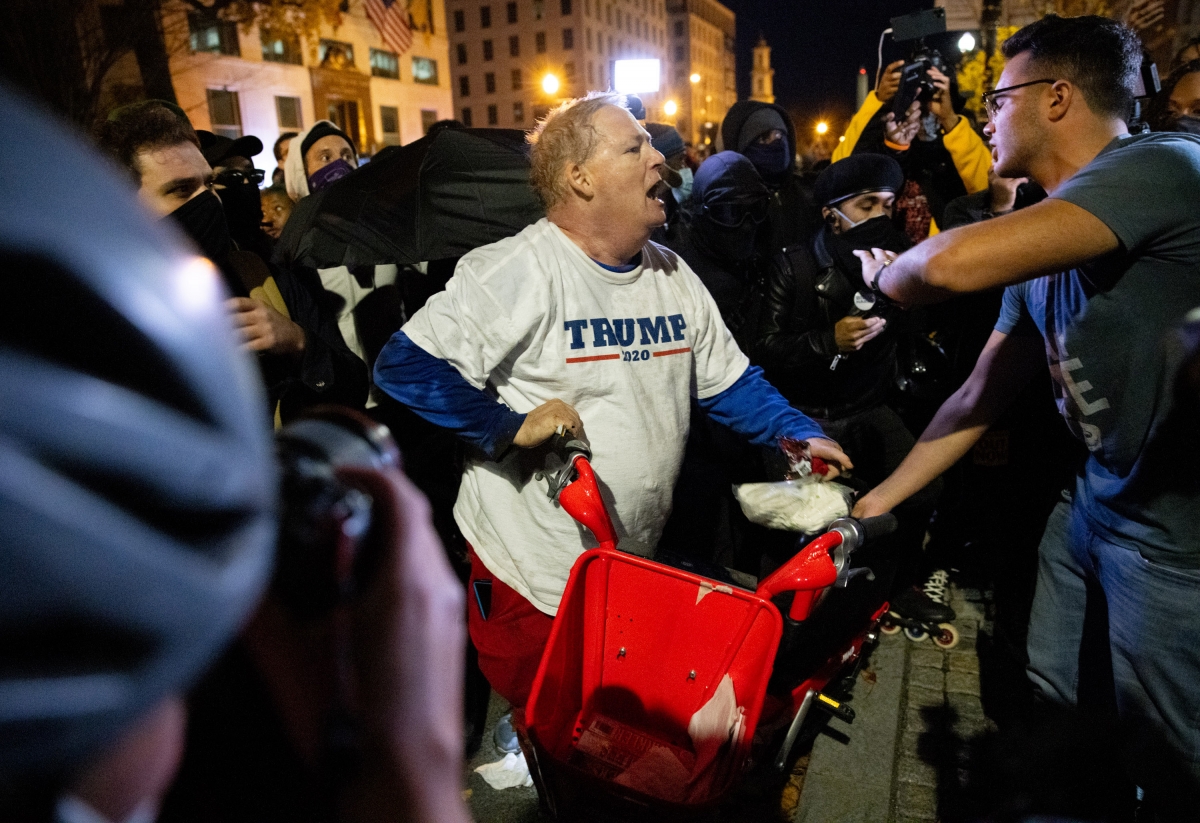
 Sen. Doug Jones is pictured at a news conference in August 2019. MUST CREDIT: Photo by Elijah Nouvelage for The Washington Post
  Senate Majority Leader Mitch McConnell, R-Ky., second from left, at the U.S. Capitol in Washington on Dec. 10. 2020. MUST CREDIT: Bloomberg photo by Al Drago.
  Jimmy Lai, second left, is led away from his residence by law enforcement officials in Hong Kong on Aug. 10. MUST CREDIT: Bloomberg photo by Paul Yeung.
  Janet Yellen, former chair of the U.S. Federal Reserve, speaks during the American Economic Association and Allied Social Science Association Annual Meeting in Atlanta on Jan. 4, 2019. MUST CREDIT: Bloomberg photo by Elijah Nouvelage.
  A worker lowers a Chinese national flag in front of Tiananmen Gate in Beijing on Nov. 9, 2014. MUST CREDIT: Bloomberg photo by Tomohiro Ohsumi.
  The Federal Reserve building in Washington, D.C., U.S., on Dec. 1, 2020. MUST CREDIT: Bloomberg photo by Stefani Reynolds.
  Ursula von der Leyen, president of the European Commission, speaks during a news conference in Brussels Dec. 11, 2020. MUST CREDIT: Bloomberg photo by Geert Vanden Wijngaert.
  SootinClaimon.Com