Disney+ to get flood of new shows as subscriptions soar
InternationalDec 12. 2020The Disney+ logo on a smartphone on Nov. 18, 2020. MUST CREDIT: Bloomberg photo by Gabby Jones.
By Syndication Washington Post, Bloomberg · Christopher Palmeri
Walt Disney shares are poised to hit an all-time high after it issued a bold forecast for its new streaming services, projecting a Netflix-like trajectory that could bring the company as many as 350 million subscribers worldwide by 2024 thanks to an onslaught of programming from Marvel, Star Wars and Pixar.
In a presentation to investors Thursday, the world’s largest entertainment company outlined plans for dozens of new movies and TV shows from those major brands, with an eye toward becoming a streaming behemoth in four years. The company expects its program spending to reach $14 billion to $16 billion annually by then.
Disney+, the entertainment giant’s flagship streaming platform, also is getting a price hike. The U.S. monthly rate will climb $1 to $8 in a move that executives telegraphed earlier this year. In Europe, the price will rise 29% to 9 euros ($11) a month, although there it is getting additional content aimed at adults.
Shares of Disney rose as much as 8.6% to $168 in premarket trading Friday. If that holds in New York trading, it would mark an all-time high for the stock, which has about doubled since March on the strength of the streaming business.
“The enormous success of Disney+ inspired us to be even more ambitious,” Executive Chairman Bob Iger said at the event. “Our pipeline is much more robust than we initially anticipated,” he said, adding that the Disney+ cadence should soon hit 100 new titles per year.
Disney, like other Hollywood studios, is reorienting its film and TV business toward home entertainment, and has leapfrogged many competitors with its fast subscriber growth. Yet with its new subscriber goals — including hopes for as many as 260 million Disney+ customers — the company would surpass where industry pioneer Netflix Inc. is today.
As part of the presentation, Chief Executive Officer Bob Chapek said Disney+ has soared past 86.8 million subscribers in a little over a year. The company closed the last quarter with almost 74 million.
Disney executives, including new distribution head Kareem Daniel, outlined aggressive plans to stock the Disney+ service with new programming to keep the subscriber pipeline growing over the next few years. The Covid-19 pandemic forced many Hollywood studios to slow production this year.
Future plans include 10 series from the Marvel division, 10 Star Wars TV series, and another 15 programs from Disney live action, Disney animation and Pixar.
The programming slate also includes feature-length films, such as the Disney animation picture “Raya and the Last Dragon,” which will debut on Disney+ — at an extra charge — the same time as in theaters.
Chapek said that 80% of projects are now headed to streaming, rather than the big screen. But the company’s biggest films will be saved for theaters exclusively at first. That includes movies such as “Black Widow,” a Marvel film slated for May.
“Netflix may be forced to raise its content spending substantially (vs. $14 billion in 2019) after Disney unveiled an ambitious streaming strategy, which targets as many as 260 million Disney+ users in 2024. While Netflix’s investment thesis is still intact amid a global shift to streaming, greater competition from Disney and higher spending may drag on free cash flow,” Bloomberg Intelligence media analyst Geetha Ranganathan wrote.
While Disney is sending several films, including a live-action “Pinocchio” starring Tom Hanks, directly to its streaming service, theater owners may breathe a sigh of relief that many pictures — such as an upcoming Indiana Jones feature with Harrison Ford and a new Star Wars, which will be directed by Patty Jenkins — will still go to cinemas.
As the longtime king of the box office, Disney has been careful not to alienate theater chains — even as it sends more movies directly to streaming. Warner Bros. shook up Hollywood last week with its decision to make its entire 2021 slate of 17 movies available on HBO Max the same day they open in theaters. The decision angered many in the industry, including “Tenet” director Christopher Nolan, who said the studio doesn’t “understand what they’re losing.”
Hulu, the more adult-oriented streaming service, has added 2.2 million subscribers since the last quarter, and now has 38.8 million, according to the company. ESPN+ now counts 11.5 million, up 1.2 million from early October.
Executives at the presentation also announced that ESPN and ABC will become the home for the Southeastern Conference’s top football and basketball games under a 10-year deal starting in 2024, featuring teams like Alabama and Auburn. The company will pay in the low $300 million range each year on top of previous commitments, or more than six times what CBS currently pays, Sports Business Daily reports, citing unidentified people.
Disney executives also said they will launch the Star service in Europe in February and in Latin America in June. In Europe, it will be integrated with Disney+ and include R-rated content. It will be a stand-alone service in Latin America and feature live sports.
“We’re definitely still in launch mode as it relates to Disney+ — we’re still going into new markets,” Chief Financial Officer Christine McCarthy said. “And this is where we are at this point in time. This is a minimum amount of content that you will be seeing.”
Here’s what happened when a Georgia lawmaker scrutinized the Trump campaign’s list of allegedly illegal votes
InternationalDec 11. 2020President Trump speaks during a rally he held in Valdosta, Ga., on Dec. 5, 2020. MUST CREDIT: Washington Post photo by Jabin Botsford
By The Washington Post · Michelle Ye Hee Lee
When Georgia state Rep. Bee Nguyen, a Democrat, reviewed a list of voters who President Donald Trump’s campaign claimed cast illegal ballots in the state, three names caught her eye: two friends and a constituent.
For days, Nguyen pored over public records, spoke with voters by phone and even knocked on doors in person to vet the Trump list. She found that it included dozens of voters who were eligible to vote in Georgia – along with their full names and home addresses.
On Thursday, when a data analyst who compiled the list told a panel of state lawmakers that it proved thousands of voters cast ballots in Georgia who should not have, Nguyen was ready.
“I do want to share with you some of the things that I found that appeared to be incorrect to me,” the two-term lawmaker told Matt Braynard, whose research has been cited in numerous suits filed by Trump and his allies, several of which have been tossed out of the courts.
Nguyen’s 10-minute dissection of the data offered a rare real-time fact-check of the unsubstantiated claims of widespread fraud that the president’s allies have promoted in state hearings around the country, largely before friendly Republican audiences.
“If you are going to take the names of voters in the state of Georgia and publish their first, middle and last name, their home address, and accuse them of committing a felony, at the very minimum there should have been an attempt to contact these voters,” she said in an interview after the hearing. “There was no such attempt.”
Braynard said in an email to The Washington Post that he “appreciated her feedback and look forward to getting her records that are questionable. I was happy to make a statement and happy to hear feedback and questions.”
The episode shows how quickly the allegations by Trump and his supporters have fallen apart under scrutiny – particularly in courts, which have consistently rejected the assertions that rampant irregularities tainted the vote.
Yet in Georgia and elsewhere, many state Republicans have given Trump a platform to air the claims, holding legislative hearings on election integrity that have largely been used to recycle conspiracy theories and unsubstantiated allegations.
The president’s lawyer, Rudy Giuliani, appeared via video at the Georgia House’s investigative hearing into the election on Thursday, a day after being discharged from the hospital due to a coronavirus infection. During his testimony, Giuliani reiterated several claims that state election officials have repeatedly debunked since Election Day.
Giuliani called out several Black election workers in Fulton County, alleging that they were “passing around USB ports as if they were vials of heroin or cocaine.” He also referred to some election workers by name while questioning their actions – despite repeated pleas from state election officials to protect the safety of election workers.
The president’s legal team also questioned the security of the voting machines used in Georgia, repeating a widely debunked conspiracy theory.
At one point, as the lawyers played a video of an election official in Coffee County, Ga., Giuliani was heard saying off-camera: “This is really good stuff,” adding: “We should try to get this on Newsmax, on OAN,” referring to conservative media outlets.
House Governmental Affairs Committee Chairman Shaw Blackmon, a Republican, did not offer an opportunity for lawmakers to question Giuliani.
The forum was sharply criticized by officials with the secretary of state’s office, who have defended the integrity of the election and denounced efforts to undermine public faith in the outcome.
“Giving oxygen to this continued disinformation is leading to a continuing erosion of people’s belief in our elections and our processes,” Gabriel Sterling, Georgia’s voting information systems manager, said during a news conference Thursday afternoon.
Georgia certified its election results for the second time this week after a second recount of presidential ballots reaffirmed Joe Biden’s narrow victory in the state.
But the legal challenges have not abated.
The Republican National Committee on Tuesday filed a lawsuit claiming that some poll watchers could not observe the vote counting as closely in person as they had hoped, and challenging the use of ballot drop boxes, which were installed at the direction of election officials in Georgia.
In another lawsuit filed in recent days, the Trump campaign and Georgia Republican Party Chairman David Shafer alleged systemic irregularities and requested that the court decertify the election and prevent the state’s electors from casting their votes for Biden when the electoral college meets on Monday.
Legal experts said the court challenges have little hope of success.
“It seems, in any event, to be much ado about nothing,” said John Powers, a Georgia analyst at the voting rights group Lawyers’ Committee for Civil Rights Under Law. “It’s not clear what the end game is here, but it’s never been clear to me that there is a discernible end game.”
The Trump campaign’s 1,585-page lawsuit relies heavily on data analysis by Braynard, who worked on the Trump campaign in 2016 and who has led an outside effort to analyze voter records and other databases in search of signs that ballots may have been cast illegally.
“When just combining my findings alone, the number of ballots that are strongly indicated as illegally cast surpasses the margin of victory in the presidential election, thus making it impossible to know who the deserved winner is in Georgia,” Braynard said during the hearing.
He provided lists of voters’ personal information to back up his claim that there were thousands of individuals who had voted but were registered in another state. He said the lists showed voters who used a post office address to mask their true residences and that others voted in two states.
During the hearing Thursday, Nguyen countered Braynard’s analysis with her own research, based on a sampling of the exhibits included in the lawsuit.
Of the first 10 names on the list that were allegedly out-of-state voters, Nguyen said she found eight who were longtime Georgia residents and property owners by using public records.
Dozens of voters who the campaign suggested used P.O. boxes to vote illegally were actually residents of a single condominium building that had a mail center on the first floor – including Republicans and Democrats, she said.
“I wanted to do the research because these are real-life people and we cannot just be alleging that they are committing voter fraud and that they are committing a felony and not do our due diligence,” Nguyen said later.
Nguyen, who in 2017 filled the state legislative seat vacated by Stacey Abrams when she ran for governor, said the voters she contacted said they were not aware that their names and addresses were made public in the lawsuit.
After she presented her findings during the hearing, Braynard thanked Nguyen for her research.
“I actually want to thank you for helping to raise issues to help better validate data,” he said. “It’s only with strong scrutiny that we’re able to be completely confident in our findings.”
China’s transportation officials are recommending flight attendants wear disposable diapers and avoid restrooms at all costs on flights serving countries with high rates of coronavirus cases, according to documents from the Civil Aviation Administration of China (CAAC).
The recommendation to employ diapers and avoid in-flight bathrooms altogether applies on flights to and from countries with infection rates exceeding 500 cases per million people. The United States’ coronavirus case rate exceeds that limit as of Dec. 10, at more than 660 cases per million.
The guidance is part of a lengthy document detailing technical guidelines for preventing the spread of the coronavirus on planes, which also states that flight and cabin crew should, on lower-risk flights, designate their own private lavatory and sanitize it before and after every use. The document was issued on Nov. 25, according to CNN.
The advice to wear a diaper falls under a section covering recommended personal protective equipment.
“Personal protective equipment for cabin crew: surgical masks, double-layer disposable gloves, goggles, disposable nonwoven hat, disposable gown, disposable shoe covers. Flight attendants are advised to wear diapers,” the CAAC states. “Avoid using restrooms unless under special circumstances to decrease risk of infection.”
Studies in recent months have suggested that plane cabins are lower-risk coronavirus environments than previously thought when passengers wears masks. But doctors have also signaled that lavatories on long-haul flights are at a substantial risk of being contaminated with the coronavirus. According to reporting by The Washington Post, Boeing is developing airplane lavatories that can sanitize themselves in under three seconds.
David Freedman, an infectious-disease expert at the University of Alabama at Birmingham who frequently reviews travel-related covid-19 studies, told The Washington Post that passengers should avoid airplane bathrooms when possible. He says of the risks associated with long-haul flights: “Longer flights have more of a chance for bathrooms to become contaminated.” On shorter flights, more passengers are likely to skip the plane bathroom altogether.
Long trips, like 15-hour journeys between the United States and China, also introduce more exposure to others, doctors say. A recent study by New Zealand health officials found that an infected man on an 18-hour flight to the country spread the coronavirus to at least four other passengers, although the mode of transmission has not been verified.
Disturbed by the impact of trash on the planet, a couple opens a ‘zero waste’ store
InternationalDec 11. 2020Nora Heidenhain, 22 months, embraces the leg of her mother, Sharayah Heidenhain, as Teresa Bruno rings up her purchase at Mason & Greens. MUST CREDIT: Washington Post photo by Matt McClain
By The Washington Post · Jessica Wolfrom
Justin and Anna Marino’s journey to a zero-waste lifestyle began over pork sausages in Germany.
Anna, who had been looking into the health benefits of a vegan diet, told her husband that when they returned home from vacation, meat would be officially off the menu.
But eschewing animal products was just the beginning. Soon after, their attention turned to trash.
“It was kind of like a slow-moving coup on my part,” said Anna, 32, a former seller on the website Etsy, who started researching the meat industry and the zero-waste movement. Even though they were only a family of four – the couple have two children, ages 6 and 3 – they knew they needed to change their lives.
Paper towels and single-use napkins were the first to go. Then went the plastic. “We were generating about one or two tall kitchen trash bags full of garbage per week,” said Justin. “We would take it out to the curb and, you know, out of sight, out of mind, right? You don’t think about it. But then when you start thinking about it, that’s when things start changing.”
But as they traded traditional products for more eco-friendly items, they quickly realized that their reliance on online shopping was another problem.
“It almost defeats the purpose,” said Justin, 43, who previously worked in cybersecurity. “I’m ordering something to save the planet, but in order for it to get here, it’s creating a pretty nasty carbon footprint. . . . And so, we were like, well, there needs to be a store around here.”
Enter Mason & Greens, the Washington D.C. region’s first zero-waste store. The couple flung open the shop’s French doors in Old Town Alexandria, Va., in March, just as the coronavirus was exploding across the country.
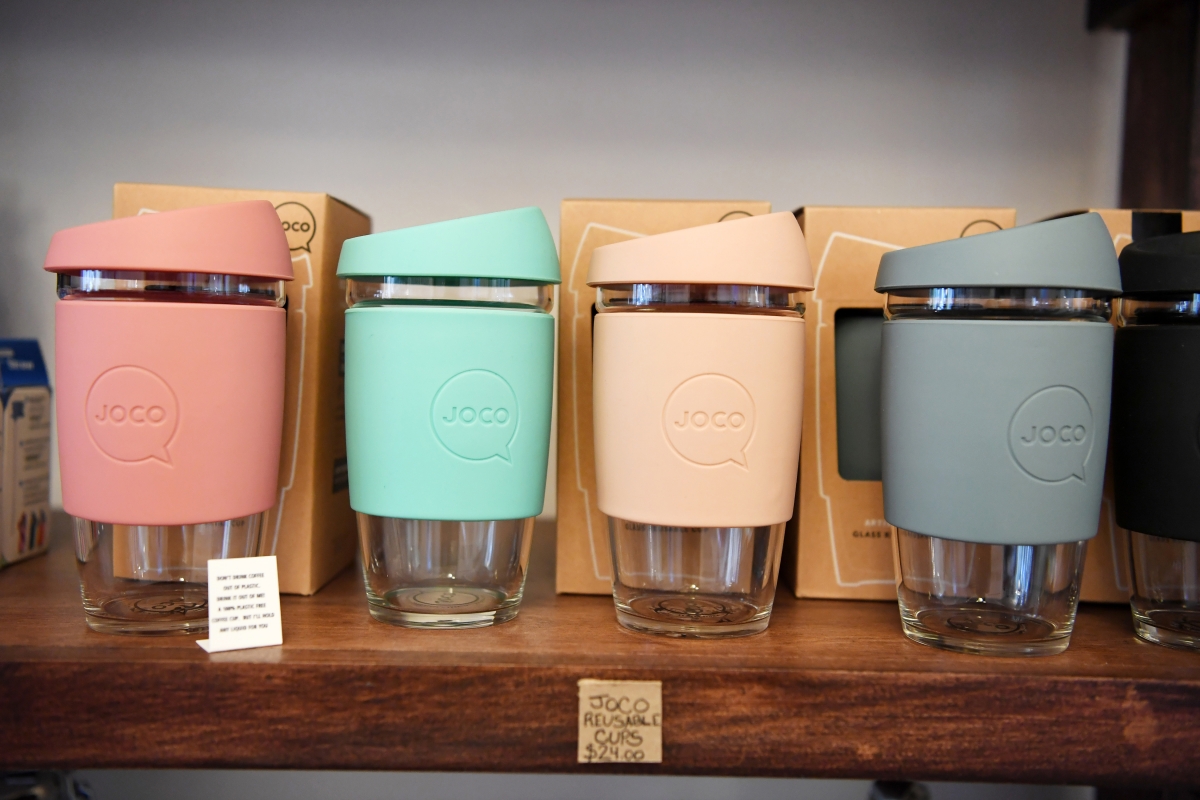
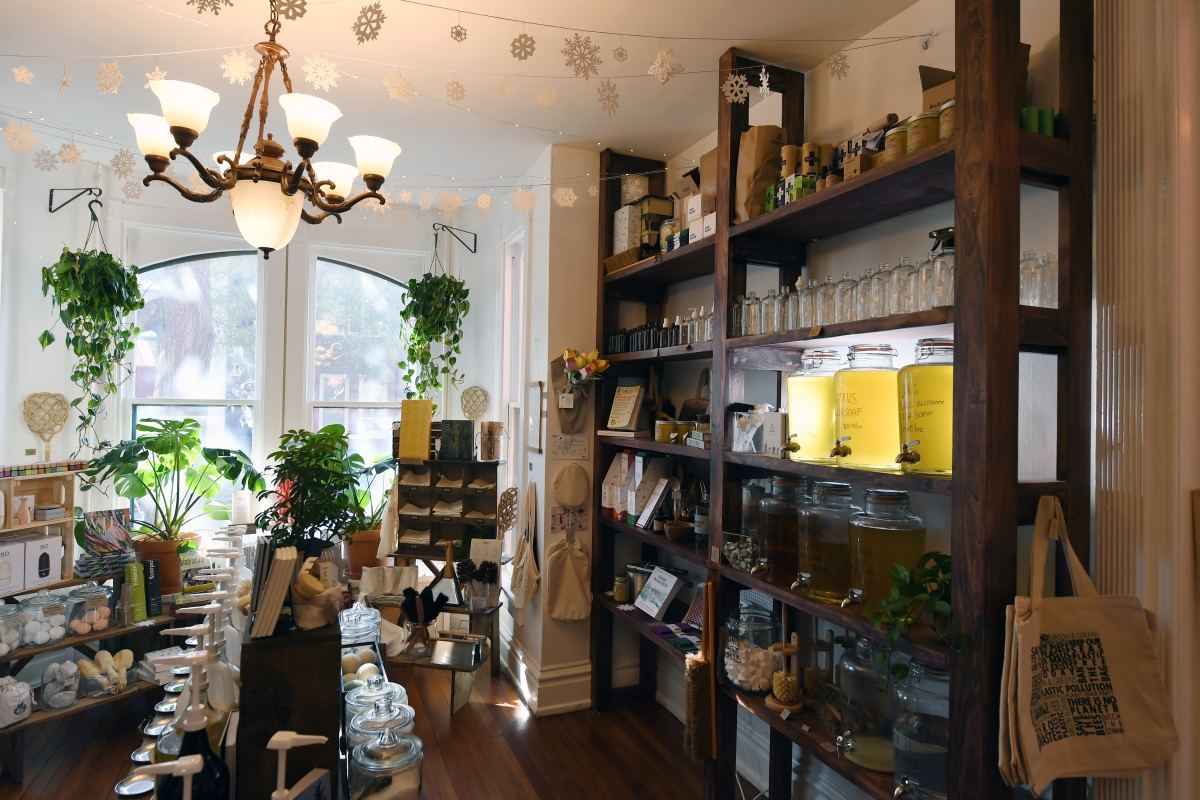
The airy shop is equal parts organic grocer and minimalist boutique, selling items such as package-free shampoo bars, organic produce and drip-irrigated olive oil. Hanging plants and shelves lined with stainless steel containers and books titled “All You Need Is Less” offer shoppers a glimpse into the world of low-waste living.
Glass travel coffee mugs are among the many reusable items at Mason & Greens. MUST CREDIT: Washington Post photo by Matt McClain
Although the zero-waste movement, which looks to minimize garbage through reducing consumption, reusing materials and recycling residual waste, has been around for decades, it’s finding new prominence as concern about the environmental impact of trash – particularly plastic pollution – continues to grow.
“You know it’s a movement when you don’t know everything that’s going on,” said Gary Liss, vice president of Zero Waste USA, a nonprofit organization dedicated to reducing waste, who described the growing interest in low-waste living as a sea change in the relationship between people and things.
Americans throw away about five pounds of trash per person per day, according to the Environmental Protection Agency – 12 percent of which is plastics.
Although plastics have greatly enhanced daily life – extending the shelf life of food and improving medical care – they’ve grown ubiquitous, used to make products such as clothes as well as cars.
Some plastics are recyclable, but scientists estimate that up to 91 percent of plastic is never recycled, leaving the rest to burn in incinerators, clog landfills or degrade in the oceans. Scientists have even found microplastics in air, water and food.
“If we fail to act, by 2050, there will be more plastics in our oceans than fish,” said Sander Defruyt, who leads the New Plastics Economy initiative at the Ellen MacArthur Foundation, referencing a 2016 report.
The coronavirus pandemic has only increased reliance on disposable plastics. Billions of masks and gloves made from plastics and used by health-care workers, first responders and essential workers are being discarded every month, studies show.
Some retailers have been requiring customers to use plastic bags instead of reusable bags and have replaced bulk offerings with individually packaged goods. Multiple states rolled back bans on plastic bags to cope with heightened concerns around hygiene – all while greasy takeout containers, single-use shopping bags and packaging materials overflow trash bins across the country.
The plastics industry maintains that plastics in respirator valves, personal protective equipment, vaccine syringes and food packaging have been critical during the pandemic.
“Society has a plastic waste problem, not a plastic problem,” Joshua Baca, vice president of plastics for the American Chemistry Council, said in a statement.
As scientists have learned more about covid-19, the disease caused by the coronavirus, they’ve found that transmission is largely person-to-person and not through surfaces, although some studies found that the virus can live for prolonged periods on plastic surfaces.
“We’re conditioned that plastic is clean and that plastic is what everyone needs to use to make things sanitary,” said Justin, who expressed concern about the potential health effects of chemicals in plastics as they degrade.
“Ultimately, I think that the sort of paradox here is that these things that we think are sanitary and clean may possibly be leaching chemicals into the products that we consume . . . and then passing that load of chemicals when you’re done onto the planet,” he said.
Mason & Greens, which is based in part on the bulk model, makes a point of avoiding plastics at nearly every turn. Beans and grains come in gravity dispensers. Produce is package-free. Pomberry Kombucha and pinot noir stream from a tap. The spices are self-serve.
Customers aren’t required to bring their own bags or refillable containers, but the couple said many customers do. The shop employs a tare system that logs the weight of an empty container and then calculates the price of products by the ounce.
Bulk containers of dish soap and other items are displayed at Mason & Greens. MUST CREDIT: Washington Post photo by Matt McClain
Pricing products this way reduces waste by allowing customers to purchase only what they need and in reusable containers, the couple said.
The couple welcomes newcomers into their waste-free world, but Anna routinely castigates vendors for their packaging practices – she is not above shaming suppliers who send items wrapped in plastic. “Everybody gets an email,” she said. “I have to go through so much to get a product into the store that’s zero-waste or low-waste.”
But living a waste-free life might soon become easier. As consumers demand more sustainable options, brands large and small are shifting to make sustainability central to their strategy. Major companies such as Unilever have pledged to halve the use of virgin plastics in packaging by 2025. Walmart, Target, CVS and other retailers are working to develop an environmentally friendly alternative to the plastic bag. And other companies are starting circular delivery services – an updated version of the 1950s milkman – where groceries and goods are packaged in reusable containers that are returned empty.
Max Cameron’s California-based zero-waste shop, Wild Minimalist, grew exponentially in April and May as customers stockpiled eco-friendly cleaning products and reusable food storage containers.
Business was brisk because the pandemic accelerated the e-commerce model, upon which Wild Minimalist depends, although Cameron also has a brick-and-mortar store in San Rafael. Millennials, who now wield hefty purchasing power, are acutely aware of the climate crisis – and that combination has made them Wild Minimalist customers, Cameron said.
“The change that we expected to see take place over a period of five years has happened in a period of three months,” he said of the pandemic’s effect on his business. “We’re basically riding that wave right now.”
Although Cameron acknowledges that shipping products all over the nation has environmental costs, he said the shop uses only recyclable or compostable packaging and tries to reuse shipping materials whenever possible.
In an ideal world, he said, “you want to see people bicycling to their zero-waste store every time they need something. . . . On the other hand, we’re in this economic climate right now where traditional retail is not where it’s at.”
Despite the challenges of brick and mortar right now, Mason & Greens is also growing. The Marinos opened their shop just days before Gov. Ralph Northam, D, issued Virginia’s first stay-at-home order, forcing them to lean on online shopping more than they had planned.
Business has been extraordinary, they said. The store opened for in-person shopping in June and has been “in the black” since they started, Justin said. The couple plans to open a second location, in D.C., sometime next year.
Mason & Greens owners Justin and Anna Marino at their store in Alexandria, Va. MUST CREDIT: Washington Post photo by Matt McClain
For customers who previously had to hopscotch among farmers markets, grocery stores and retailers to reduce their waste, Mason & Greens offers one-stop shopping.
“For me, living our values frees my mind,” said Daniela Ochoa González, 39, a D.C. resident and founder of an environmental consulting firm who is teaching her school-age children to live zero-waste lifestyles.
González said the shop’s bulk shopping model encourages her kids to touch, smell and explore. “It’s like a little school lab,” she said. “They can actually see what a grain looks like, quinoa looks like, what flour looks like.”
While bloggers Bea Johnson, the author of “Zero Waste Home,” and Lauren Singer, who famously fit all the waste she produced over four years into a 16-ounce Mason jar, have attracted devotees, adhering to a trash-free lifestyle can feel impossible.
“Basically, it’s unreasonable,” Cameron said. “It’s not true, first of all. There’s always upstream waste.”
The movement can also feel inaccessible to those without disposable income. González acknowledges that zero-waste shopping can cost more, but she sees it as an investment in her children’s future.
Although the Marinos say a Ziploc bag or plastic toothbrush may always be cheaper than their stainless-steel or bamboo alternatives, they view the benefits of reusable products as far outweighing the cost – and in the long run, they say, reusable products may even be less expensive because customers won’t have to replace items as frequently.
“We don’t sell products that will be trash in a week,” Anna said.
Even still, accessibility was important to the Marinos, who say their prices are competitive with those of major retailers. “You cannot make any progress with environmental issues if it’s not economical,” Justin said.
The Marinos hope Mason & Greens will have a ripple effect beyond its walls. Today, they estimate they fill a single trash bag about once every two weeks – which is pretty good, said Anna, if you consider they have seven employees and are open seven days a week.
“I think what we’re doing here in Old Town is that we’re actually opening up people to this new way of life,” said Anna, who hopes their shop can inspire others to do more good with less.
China’s soybean deal signals early jump into 2021 U.S. market
InternationalDec 11. 2020Sacks of soybeans sit in a wholesale grains market in Shanghai on June 16, 2020. MUST CREDIT: Bloomberg photo by Qilai Shen.
By Syndication Washington Post, Bloomberg · Michael Hirtzer, Kim Chipman
China, the world’s top soybean importer, is getting an early jump on purchases from the U.S. for next year.
The Asian nation bought 126,000 metric tons for shipping after Sept. 1, the start of the next marketing year, U.S. Department of Agriculture data showed Thursday. That’s the earliest for a forward purchase since 2016 and confirms a Bloomberg report from Dec. 7.
Dry weather has threatened yield prospects in South America, potentially limiting available supplies from the harvest beginning in February. That may have prompted the earlier-than-usual deal for U.S. soybeans that won’t be planted until April. China’s imports rose to a record in November from a year earlier on demand for feed to bolster the domestic hog herd.
Soybean futures for March delivery rose 1.3% to $11.7825 a bushel at 10:03 a.m. on the Chicago Board of Trade after reaching $11.81, the highest for a most-active contract in more than a week. A monthly USDA report due at 11 a.m. may show tightening global inventory, according to a Bloomberg survey of analysts.
On Thursday, Brazil’s soybean-crop estimate was reduced by 0.4% to 134.5 million tons by state-run agriculture agency Conab. That was less than analysts expected and compared with 124.8 million in the latest season.
“The South American crop we already know will be a late crop, so China stepping into the market early shouldn’t be at all surprising.” Kevin Ross, chairman of the National Corn Growers Association and an Iowa farmer of soybeans, corn and cattle, said in a telephone interview. “They are covering their needs a little quicker.”
Wheat futures for March delivery rose 2.6% to $5.9825 a bushel in Chicago after reaching $5.99, the highest since Nov. 30.
USDA data confirmed a bulk cargo of U.S. white wheat was sold to China, and futures have climbed amid speculation that more deals loom.
U.S. crackdown on Facebook gets thumbs up from EU’s Vestager
InternationalDec 11. 2020Margrethe Vestager, competition commissioner of the European Commission, during an interview in her office in Brussels on Feb. 25, 2020. MUST CREDIT: Bloomberg photo by Geert Vanden Wijngaert.
By Syndication Washington Post, Bloomberg · Aoife White
Margrethe Vestager, the European Union’s antitrust chief and scourge of tech giants, gave her seal of approval to U.S. antitrust action against Facebook Inc.
She told lawmakers in Brussels that the U.S. lawsuit shows how technology superpowers are increasingly facing tougher scrutiny around the world. Minutes after she spoke Thursday, German regulators started a fresh antitrust probe into Facebook’s Oculus virtual-reality headsets.
“It’s a sign that the debate on tech dominance has been shifting over the last couple of years,” Vestager said of the U.S. antitrust move in an online meeting with EU lawmakers. “You see that in almost every jurisdiction. You see it in Canada and Australia” as well as the recent U.S. case against Google.
The U.K. Competition and Markets Authority this week even proposed a specialist tech regulator with enhanced power to block deals.
European regulators are planning tougher rules on so-called internet gatekeepers next week that “will enable us to be so much quicker” in moving against companies that violate potential new rules for how they treat smaller rivals, she said.
Vestager, who has slapped Alphabet Inc.’s Google with huge fines, said the complaints filed by the U.S. Federal Trade Commission and state attorneys general took a different approach from the EU. She said her probes into advertising are “not as advanced.”
Germany’s antitrust authority, known as the Bundeskartellamt, opened an investigation Thursday into Facebook because using Oculus’ latest virtual-reality Quest 2 glasses requires a Facebook account. Oculus was previously operated separately from Facebook, it said, and existing Oculus accounts can no longer be used for the new hardware.
“We intend to examine whether and to what extent this tying arrangement will affect competition,” the authority’s president Andreas Mundt said in an emailed press release.
Oculus devices are not currently sold in Germany, a Facebook spokesperson said. The company “will cooperate fully with the Bundeskartellamt and are confident we can demonstrate there is no basis to the investigation.”
U.S. inflation measure rose by more than forecast in November
InternationalDec 11. 2020Trucks pull shipping containers through the West Basin Container Terminal at the Port of Los Angeles in San Pedro, Calif., on Nov. 20, 2020. MUST CREDIT: Bloomberg photo by Bing Guan.
By Syndication Washington Post, Bloomberg · Reade Pickert
A measure of prices paid by U.S. consumers rose in November by more than forecast as costs of transportation services and apparel accelerated, though inflationary pressures elsewhere remained subdued as the pandemic continues to curb activity.
The consumer price index rose 0.2% from the prior month after no change in October, Labor Department data showed Thursday. Compared with a year earlier, the gauge rose 1.2%. The core index, which excludes volatile food and energy costs, also advanced 0.2% from the prior month and increased 1.6% from a year earlier.
The median forecast in a Bloomberg survey of economists called for a 0.1% gain in both the CPI and core measure.
While services costs picked up last month by the most since July, a broadening of inflation will likely take time as the nation awaits the distribution of Covid-19 vaccines. Currently, merchants have limited leeway to charge customers more as unemployment remains elevated and a surge in infections prompts some states and cities to reimpose restrictions on business.
The report showed the cost of transportation services jumped 1.8%, the most in four months. Airfares rose 3.5% after a 6.3% increase a month earlier, and motor vehicle insurance advanced 1.1% in November. Lodging away from home was 3.9% more expensive than in October, the largest gain since 2005.
InternationalDec 11. 2020Chocolate Santa Claus figures produced by Lindt & Spruengli on display inside a department store in Berlin on Dec. 6, 2017. MUST CREDIT: Bloomberg photo by Krisztian Bocsi.
By Syndication Washington Post, Bloomberg · Corinne Gretler
As the coronavirus pandemic leads to the collapse of one retailer after another, Swiss chocolatier Lindt & Spruengli has been gaining U.S. market share and rival Laederach is opening its biggest store yet in New York.
Chocolate has emerged as one product that consumers won’t do without in trying times. The U.S. market for it expanded at unusually fast double-digit rates in June and July and it was still higher than pre-covid growth levels in September, according to Sanford C. Bernstein, which cited Nielsen data.
Laederach is opening a 2,500 square-foot shop on 5th Avenue in New York Thursday near Rockefeller Center. The family-owned brand is known in Switzerland for plates of fresh chocolates that have a shelf life of just a few weeks.
The plans to open a big brick-and-mortar store stand out after the pandemic led to bankruptcies of retailers like Brooks Brothers and J.C. Penney. Consumers looking to treat themselves to affordable luxuries have turned to chocolate, according to Bernstein analyst Bruno Monteyne.
Laederach entered the U.S. a year ago, betting it will soon become one of its biggest markets outside Switzerland.
“We don’t have any doubts that after the pandemic sales will come back and grow again as they have been,” Chief Executive Officer Johannes Laederach said in a phone interview. “As a family-owned business, we can think long-term.”
Laederach doesn’t publish regular financial details, but had revenue of 120 million Swiss francs ($135 million) in 2016 and sales growth of about 14% at the end of February. The company sells its products in 15 countries, including Germany, Singapore, and Canada. The chain also plans to open a store in Washington D.C. in February.
Lindt, known for its Lindor balls, has also done well in Europe lately, with average value growth of 25% in the second half. That may bode well for the Christmas season, after chocolate makers faced a weak Easter period earlier in the pandemic.
Shares of the chocolatier traded 0.4% higher at 12:38 p.m. in Zurich.
The number of new unemployment claims rose sharply to 853,000 last week, an increase of 137,000 from the week before, another sign of the toll the pandemic is taking on the labor market.
The number of claims leapt over 800,000 for the first time since the week ending Oct. 10, when they came in at 842,000.
A large spike in coronavirus cases in the United States, particularly since October, has rattled large parts of the economy. There are now more than 1 million new cases of coronavirus each week in the United States, and the country shattered a record on Wednesday with more than 3,000 deaths from the disease. Hospitals in many parts of the country are overwhelmed and some state and local jurisdictions are imposing fresh restrictions to try and curb the spike.
A bipartisan group of lawmakers is trying to reach a deal on a new relief package but those talks have so far failed to produce a consensus plan.
The new burst of jobless claims was slightly larger than the last two big jumps, for that October week, when they rose about 75,000 and in early August, when claims rose 133,000, making it the largest jump in claims since millions began flooding the system at the pandemic’s outset in March.
An additional 427,600 claims were filed for Pandemic Unemployment Assistance, the program for gig and self-employed workers, according to data released Thursday by the Department of Labor.
Economists have been warning for months about coming damage to the economy if Congress failed to authorize another stimulus package to help prop up struggling businesses and households. The labor market has in general fared better than the most dire projections during the pandemic’s early months, but has been flashing warning signs for weeks.
The 245,000 jobs added in November were the lowest number added since the recovery began in May, and a sign that December’s report could go into the negative. The number of unemployment claims is another concerning data point.
The number of people claiming benefits in all the programs was just over 19 million, although officials have warned that tally may be inflated due to data processing issues compounded by the United States’ patchwork unemployment system.
ECB Boosts Crisis Stimulus With More Bond-Buying, Bank Loans
InternationalDec 11. 2020The European Central Bank (ECB) headquarters stands on the bank of the River Main in Frankfurt, Germany, on April 28, 2020. MUST CREDIT: Bloomberg photo by Alex Kraus.
By Syndication Washington Post, Bloomberg · Piotr Skolimowski
The European Central Bank escalated its efforts to shield the euro zone from a possible double-dip recession with another burst of monetary stimulus to lock in low interest rates at least until the pandemic crisis is over.
Policymakers increased and extended emergency bond purchases, and approved more long-term loans on cheap terms for another year. The euro jumped.
Highlights:
– The Pandemic Emergency Purchase Program was increased by 500 billion euros ($606 billion) to 1.85 trillion euros, and extended it by nine months to at least the end of March 2022. Reinvestments will be made until at least the end of 2023.
– An older bond-buying program will continue to run at a monthly pace of 20 billion euros until shortly before interest rates rise.
– Favorable terms on the ECB’s TLTRO-III bank lending program will be extended by 12 months to June 2022, and the ECB will make three new offers under the program next year. Total amount banks can borrow raised to 55% of banks’ stock of eligible loans, from 50%.
– Four additional pandemic emergency longer-term refinancing operations (PELTROs) will be offered in 2021 “to provide an effective liquidity backstop.”
– The easing of collateral rules announced earlier this year will be extended to June 2022. It will reassess the measures before the end date.
– Interest rates remained unchanged, with the deposit rate at -0.5%.
“All these steps are real central-bank engineering — something Lagarde called ‘recalibration’ at the October meeting — but no actual stepping up of monetary stimulus,” said Carsten Brzeski, chief economist at ING Germany. “Instead, the ECB’s main aim is to extend the current level of monetary accommodation.”
The decision came as European Union leaders moved closer to resolving a dispute over a 1.8 trillion-euro joint fiscal package that would put the region on a firmer footing for 2021.
The ECB aims to keep financial conditions loose in the face of mounting debt burdens as governments pump fiscal aid to companies and households. The economy is almost certainly shrinking again, with many shops and restaurants restaurants forced to close to to contain infections.
Also in the background is the risk of a no-deal Brexit. British Prime Minister Boris Johnson and European Commission President Ursula von der Leyen, who held talks over dinner on Wednesday, agreed to give both sides until Sunday to try to bridge their differences.
The euro’s recent surge against the dollar is another headwind for the ECB, putting downward pressure on inflation by making imports cheaper. The single currency rose 0.4% to an intra-day high of $1.2126 following the decision, while German bonds erased gains.
“For me, the last euro downside risk of the year has passed,” said Jordan Rochester, a foreign exchange strategist at Nomura.
Central bankers have been signaling a new round of stimulus for weeks, stressing the need to keep support measures running at least until an economic recovery is entrenched. Covid-19 vaccines are only just being rolled out, and the economic scars from the pandemic will last well past the end of the health emergency.
Chief economist Philip Lane has also stressed the need to get inflation, which is currently below zero, back on its pre-pandemic path toward the goal of just-under 2% as soon as possible.
The Governing Council repeated its pledge to keep stimulus in place until it “judges that the coronavirus crisis phase is over.”

 The Disney+ logo on a smartphone on Nov. 18, 2020. MUST CREDIT: Bloomberg photo by Gabby Jones.
  President Trump speaks during a rally he held in Valdosta, Ga., on Dec. 5, 2020. MUST CREDIT: Washington Post photo by Jabin Botsford
 Nora Heidenhain, 22 months, embraces the leg of her mother, Sharayah Heidenhain, as Teresa Bruno rings up her purchase at Mason & Greens. MUST CREDIT: Washington Post photo by Matt McClain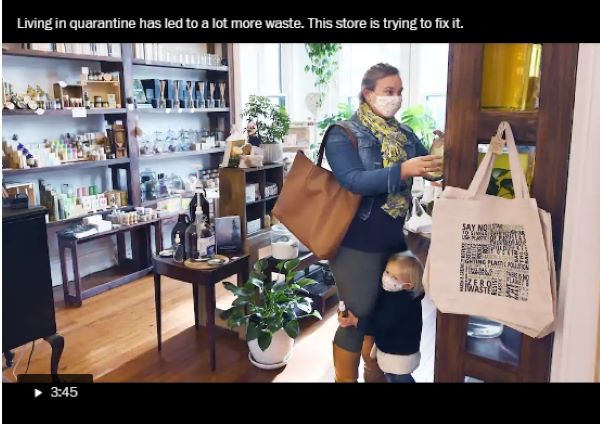

 Sacks of soybeans sit in a wholesale grains market in Shanghai on June 16, 2020. MUST CREDIT: Bloomberg photo by Qilai Shen.
  Margrethe Vestager, competition commissioner of the European Commission, during an interview in her office in Brussels on Feb. 25, 2020. MUST CREDIT: Bloomberg photo by Geert Vanden Wijngaert.
  Trucks pull shipping containers through the West Basin Container Terminal at the Port of Los Angeles in San Pedro, Calif., on Nov. 20, 2020. MUST CREDIT: Bloomberg photo by Bing Guan.
  Chocolate Santa Claus figures produced by Lindt & Spruengli on display inside a department store in Berlin on Dec. 6, 2017. MUST CREDIT: Bloomberg photo by Krisztian Bocsi.
 The European Central Bank (ECB) headquarters stands on the bank of the River Main in Frankfurt, Germany, on April 28, 2020. MUST CREDIT: Bloomberg photo by Alex Kraus.
  SootinClaimon.Com