The record-shattering 2020 Atlantic hurricane season is over, but the scars it left remain #SootinClaimon.Com

#SootinClaimon.Com : ขอบคุณแหล่งข้อมูล : หนังสือพิมพ์ The Nation.

The record-shattering 2020 Atlantic hurricane season is over, but the scars it left remain (nationthailand.com)

The record-shattering 2020 Atlantic hurricane season is over, but the scars it left remain

InternationalDec 01. 2020

By The Washington Post · Matthew Cappucci

After six months of fury, tens of billions of dollars in damage, hundreds of fatalities and 30 named storms, the jam-packed and record-filled 2020 Atlantic hurricane season is, on paper at least, coming to an end. The season is defined as a stretch from June 1 to Nov. 30, and while Mother Nature doesn’t respect calendars, tropical activity has largely flatlined. Only one unnamed system is present near Madeira Island in the far northeast Atlantic, while the remainder of the ocean basin is virtually silent.

The season was the busiest on record in the Atlantic, with 30 named storms. At least half a dozen of them are expected to be billion-dollar disasters when the damage is finally tabulated, while hundreds died in the barrage of tempests, particularly in Central America.

Forecasters had been calling for an “extremely active” hurricane season as early as late July into August, when it became apparent that atmospheric and oceanic conditions would line up to crank out an assembly line of storms. But no one expected the season to be this hyperactive, with 2020 becoming the fifth consecutive above-average season in a row in terms of storm activity.

Here’s how the 2020 Atlantic hurricane season stacks up overall:

– 30 named storms. The average is 12; no prior season had produced more than 28. The Greek Alphabet was tapped into for storm naming for only the second time on record, and was utilized beginning more than seven weeks ahead of the previous record pace seen during 2005.

– Thirteen hurricanes, and six major hurricanes. More than a dozen of this year’s systems reached hurricane strength, with sustained winds of 74 mph or greater. A typical year sees closer to six hurricanes, with only one or two Category 3 or greater “major” hurricanes. Only 2005 had more hurricanes in a season, with 15 forming.

– Most U.S. landfalls on record. Twelve named storms made landfall on U.S. soil, including five in Louisiana. Two of those landfalls were within 15 miles of each other.

– Ten rapidly-intensifying storms. Rapid intensification describes a tropical storm or hurricane that strengthens by 35 mph or more in 24 hours. Ten storms did this, tying a record set in 1995. Several storms intensified at rates unprecedented for the time of year or location.

– Latest-forming Category 5 on record. Hurricane Iota became a Category 5 storm in the western Caribbean on November 16. Iota marked only the second time on record that a Category 5 had formed in the Atlantic in November, the only other occasion being the Cuba Hurricane of 1932.

– 73% more “active” than normal. A season’s activity isn’t measured by just the number of them that formed. There’s also a measure called ACE, or Accumulated Cyclone Energy, which incorporates the intensity and longevity of each of a season’s tropical storms and hurricanes. This season has racked nearly 180 ACE units to date, compared to an average of 104.

– The 2020 season also featured two double-whammies, one of which appears entirely unprecedented in roughly 150 years of Atlantic hurricane bookkeeping.

– Hurricanes Eta and Iota both struck near Puerto Cabezas, Nicaragua only fifteen miles apart and within a span of two weeks, bringing Category 4 impacts to the coast and feet of rain to parts of Central America.

– Similarly, Category 4 Hurricane Laura ravaged Lake Charles, Louisiana in late August, while Delta then brought winds of near 100 mph barely six weeks later in early October.

Meteorologists across the industry were tasked with keeping track of frequent, simultaneous storms spinning across the ocean in rapid succession. Nowhere was this truer than at the National Hurricane Center in Miami, where forecasters issued hundreds of advisories covering every storm, all while working in a coronavirus-restricted environment.

“It was a remarkable season, certainly the busiest season in terms of impacts and number of storms since I’ve been there,” said Michael Brennan, branch chief of the Hurricane Center’s hurricane specialist unit, who started there in 2008. “Basically everybody along the entire East and Gulf coast got affected in some way. There were watches and warnings up from Texas to Maine,” he said in an interview.

He described the season as “relentless.”

Among the most challenging elements, he said, was the number of storms that developed and intensified as they neared shore. That, coupled with the high frequency of rapid intensification that characterized storms this season, made forecasting and warning vulnerable coastal residents difficult.

“Fourteen storms required watches and warnings on the first advisory we issued,” explained Brennan. “Right off the bat we had to tell people they could have hazardous conditions.”

He contrasted this season’s storms to Hurricane Irma, which spent more than a week in 2017 barreling westwards across the open Atlantic nearing peak strength before lashing the Windward Islands.

“We had a lot of [rapid intensification] near land in the watch/warning timeframe,” said Brennan. “You look at something like [Hurricane] Delta, those types of rapid fluctuations in intensity are difficult to even observe and make sense of in real time. Trying to forecast them is really tough.”

Hurricane intensity forecasts still lag behind track forecasts in their accuracy.

While the storms may have dissipated, the damage they left behind remain etched in the landscape in peoples’ lives. Steve Bowen, a meteorologist and the head of disaster insight at Aon, says that the damage could tally in the tens of billions of dollars.

“From an economic loss perspective, the 2020 Atlantic Hurricane Season was costly, very impactful, and will require a multi-year recovery effort in several hard-hit areas,” wrote Bowen in an email. “Preliminary estimates show $41 billion in tropical cyclone losses across the entire Atlantic basin; of which $37 billion occurred on the U.S. mainland.”

Despite the costly price tag, it could have been a lot worse.

“This [year’s damage cost is] much lower than peak years in 2017 ($307 billion) and 2005 ($238 billion),” Bowen wrote, alluding to seasons that included Harvey, Irma, Maria, Katrina, Rita and Wilma, for example.

“It’s hard for most of us to associate the 2020 Atlantic season with the word ‘lucky’, but given the record-setting volume of landfalls, most major coastal U.S. metro areas came away generally unscathed,” Bowen said.

Not everyone was so lucky though. In Lake Charles, Louisiana, piles of debris still line city streets, with blue tarps covering roofs pried from homes during the twin tempests. Ben Terry, a meteorologist at KPLC-TV, says his community is still working to heal.

“It was unbelievable,” said Terry, reminiscing on the season in an interview. “[Hurricane] Laura was something that you just really couldn’t imagine, and then Delta [hit] just six weeks later as we were getting into recovery.”

Terry’s home was destroyed by Hurricane Laura, while the 400-foot tower at his television station collapsed and crushed part of the studio. Following the storm, he was forced to stay with a friend and work out of an affiliated station and studio in Baton Rouge, returning home shortly before Delta struck the beleaguered community.

“It made it very tough,” said Terry. “It would have been very easy just to pack up and leave when you lose everything and your house. But when you’re a meteorologist, you’re on TV, you have to be strong and tell the public you’ll get through this. And at the end of the day, you have to deal with the same thing everyone else is dealing with.”

Encountering Delta just over a month after Laura was an unwelcome dose of déjà vu for Terry and Lake Charles. He found himself asking “is this real?”

“Delta was coming in as a stronger storm, and it was surreal to think this could possibly happen again,” recalled Terry. “It was like, “this can’t happen, the track’s going to change,” and ultimately it came ashore thirteen miles east of where Laura made landfall.”

The road to recovery for Lake Charles will be long and arduous, coming as parts of Central America are reeling from their back-to-back storms and several Caribbean Islands pick up the pieces of their communities as well.

Four French police officers charged with brutal beating of Black music producer #SootinClaimon.Com

#SootinClaimon.Com : ขอบคุณแหล่งข้อมูล : หนังสือพิมพ์ The Nation.

Four French police officers charged with brutal beating of Black music producer (nationthailand.com)

Four French police officers charged with brutal beating of Black music producer

InternationalDec 01. 2020

By The Washington Post
James McAuley

PARIS – Four French police officers were charged Monday with assaulting a Black music producer last week, an episode captured on video footage that has stunned the French public and shaken the government.

Michel Zecler, the 41-year-old music producer, claims that the officers repeatedly insulted him as they beat him and that they also used a clear racial epithet while they did so. The officers denied that charge during their interrogation, Paris prosecutor Rémy Heitz told reporters Sunday.

The footage of Zecler, first released Thursday by the French news outlet Loopsider, stunned a nation that was already debating a controversial provision in a new security law that would ban recording police on active duty. The release of the footage followed an earlier incident Thursday in which a Paris police officer was shown on camera beating Afghan refugees as authorities cleared out a migrant camp in central Paris.

President Emmanuel Macron said in a Facebook post Friday that the images of Zecler’s beating “shame us,” and he urged the French government to devise new protocols that would “reaffirm the link of confidence that should naturally exist between the French and those who protect them.”

“I want to understand why I have been assaulted by people who were wearing a police uniform. I want justice actually, because I believe in the justice of my country,” Zecler said in an interview with the Associated Press. He added that he suffered injuries to his head, legs and forearms.

Three of the officers involved in the incident have been charged with “intentional violence by a person in public authority,” as well with falsifying statements that documented the incident. The fourth officer has been charged only with “intentional violence.” Two of the four have been granted conditional release.

Amid mounting criticism from the public in the wake of these incidents, the French government appeared willing to change the controversial provision that would ban filming police, in theory to protect them from harm.

Prime Minister Jean Castex said Friday that the provision, still pending approval from the French Senate, would be revised.

Lawmakers request new GAO studies on pandemic’s effect on the aviation industry #SootinClaimon.Com

#SootinClaimon.Com : ขอบคุณแหล่งข้อมูล : หนังสือพิมพ์ The Nation.

Lawmakers request new GAO studies on pandemic’s effect on the aviation industry (nationthailand.com)

Lawmakers request new GAO studies on pandemic’s effect on the aviation industry

InternationalDec 01. 2020

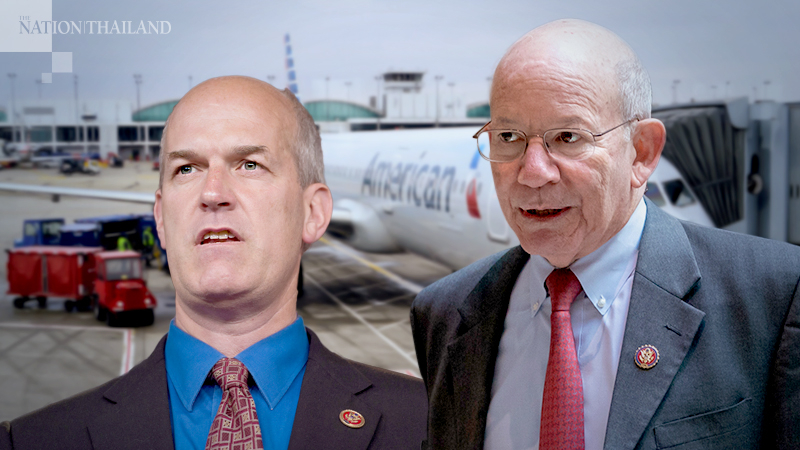
Left: Rick Larsen, Wash, Right: Peter A. DeFazio

Left: Rick Larsen, Wash, Right: Peter A. DeFazio

By The Washington Post
Lori Aratani

Two top Democrats on the House Committee on Transportation and Infrastructure have requested that the Government Accountability Office conduct studies examining the risk of air travel during a public health crisis.

Reps. Peter A. DeFazio, Ore., chairman of the committee, and Rick Larsen, Wash., chairman of the aviation subcommittee, said the work is needed to better understand how disease can spread through air travel and what strategies can be put in place to control that spread.

The aviation industry has been among the hardest-hit by the pandemic, which has grounded tens of thousands of flights and reduced passenger traffic to a trickle. The International Air Transport Association recently estimated that airlines will suffer a net loss of $118.5 billion in 2020, up from a previous estimate of $84.2 billion.

DeFazio and Larsen said that they are aware of the pandemic’s effect on the industry but that the risks of air travel at such a time cannot be ignored.

“Unfortunately, these losses do not negate the fact that air travel, more than any other mode of transportation, has the greatest potential to carry this disease from one part of the world to another,” they wrote in a letter this month to Gene Dorado, comptroller of the United States. The pair said that until a vaccine is widely available, “reducing the spread of COVID-19 through air travel and revitalizing the U.S. airline industry will depend in large part on a better understanding of how diseases, particularly those that are airborne, spread through air travel and identifying technologies and practices that can help mitigate disease transmission.”

The lawmakers requested that the GAO conduct three studies: one that examines research by government, academics and the airline industry on disease transmission via air travel; another that looks at the roles and responsibilities of local, state and federal authorities as well as those of airports, airlines and their contractors; and a third that assesses the measures the industry has put in place in response to the coronavirus.

“This report should provide lessons learned by aviation regulators and stakeholders that could assist with preparedness planning; identify successful disease mitigation strategies, including operational practices and technologies; and recommend any changes to current laws, regulation, and industry practices,” the lawmakers said.

DeFazio and Larsen have asked that the first study be completed within nine months.

The three reports will expand on previous GAO work assessing whether the aviation industry is prepared to deal with a global disease outbreak. In 2015, the GAO issued a report calling on the Transportation Department to take the lead in developing a national plan for dealing with an outbreak, but such a plan was never developed, in part because agencies could not agree on which one should take the lead.

Australia heat wave breaks records in Sydney, escalates fire danger across wide area #SootinClaimon.Com

#SootinClaimon.Com : ขอบคุณแหล่งข้อมูล : หนังสือพิมพ์ The Nation.

Australia heat wave breaks records in Sydney, escalates fire danger across wide area (nationthailand.com)

Australia heat wave breaks records in Sydney, escalates fire danger across wide area

InternationalDec 01. 2020

By The Washington Post
Andrew Freedman

In a development ominously similar to the events that led to 2019-2020′s devastating wildfires, millions of Australians are sweltering through a record-shattering heat wave that has set off hundreds of wildfires in New South Wales, Victoria and Queensland.

The heat has been more notable than the bush fires at this point, with Sydney seeing back-to-back days with temperatures exceeding 104 degrees (40 Celsius) over the weekend, a feat that had not been accomplished before during November in 160 years of record-keeping.

Sydney also saw its hottest November night on record, with the temperature dropping to just 77.5 degrees (25.3 Celsius) on Sunday. In the afternoon, the temperature reached 108.7 degrees (42.6 Celsius) as fire danger reached extreme levels in southeastern New South Wales.

Typically, Australia’s hottest weather comes during January, which is the height of the summer in the Southern Hemisphere.

The ongoing heat wave is forecast to continue through at least midweek across New South Wales and Queensland, according to Dean Narramore, a meteorologist at the Australian Bureau of Meteorology.

Narramore said the heat is expected to peak in southeastern Queensland and northeastern New South Wales on Wednesday, with temperatures up to 32 degrees (18 Celsius) above average for this time of year. Temperatures in inland areas are expected to soar above 113 degrees (45 Celsius).

“While bursts of heat and heat waves are normal for this time of year, what’s making this burst of heat exceptional is temperatures up to 18 degrees above average and many locations breaking records,” Narramore said in a video posted on the bureau’s website.

Numerous additional temperature records are still expected to fall during this event.

A few locations set spring records over the weekend, including Andamooka in South Australia, which reached 118.4 degrees (48 Celsius), according to Ben Domensino of the private Australian weather company Weatherzone.

Heat waves like this one can rapidly dry out vegetation, elevating wildfire risk.

Australia saw massive bush fires last year, but that does not preclude big fires from occurring this season. Shane Fitzsimmons, New South Wales’s Commissioner of Resilience and the former Rural Fire Service commissioner, told the Sydney Morning Herald that most of the state is still prone to bush fires.

“We’ve still got more than 90% of the state that’s susceptible to fire,” he said. Of the heat wave and smattering of wildfires, Fitzsimmons added: “It was an ominous weekend, an ominous sign for the weeks and months ahead.”

Last season’s bush fires were so severe they lofted particles high into the stratosphere, with smoke circling the globe several times. Studies have likened the blazes to simulating the mushroom cloud effects of a nuclear blast.

Heat waves and more severe and longer-lasting wildfires are two of the expected consequences for Australia of human-caused climate change. A recent report from the BOM found that Australia’s climate has warmed an average of 2.6 degrees (1.44 Celsius) since 1910, “leading to an increase in the frequency of extreme heat events.”

That report also found that there has been an uptick in “extreme fire weather,” which refers to days when high winds, hot temperatures and dry conditions overlap, as well as a lengthening of the fire season. This is especially the case in southern Australia, the report found.

Japan and South Korea see surge of suicides among young women, raising new questions about pandemic stress #SootinClaimon.Com

#SootinClaimon.Com : ขอบคุณแหล่งข้อมูล : หนังสือพิมพ์ The Nation.

Japan and South Korea see surge of suicides among young women, raising new questions about pandemic stress (nationthailand.com)

Japan and South Korea see surge of suicides among young women, raising new questions about pandemic stress

InternationalNov 30. 2020

By The Washington Post · Simon Denyer, Akiko Kashiwagi · WORLD, HEALTH, ASIA-PACIFIC, HEALTH-NEWS

TOKYO – Suicide rates among young women have increased notably in Japan and South Korea, raising possible links to the prolonged coronavirus pandemic as it amplifies stress levels, worsens economic woes and aggravates feelings of loneliness and isolation.

No comprehensive global studies are yet available on whether the pandemic has caused higher suicide numbers or how it may have affected different age groups and genders.

But Japan and South Korea are among the few countries to issue current data on suicides, with most countries taking a year or two to issue their numbers. Experts worry that the emerging trends in the two countries could be an early warning for the rest of the world as the pandemic and lockdowns take a toll on mental health.

Research conducted by the U.S. Centers for Disease Control and Prevention in the summer found that 1 in 10 respondents had seriously considered suicide the previous month, twice the rate observed in 2018. The rate among those 18-24 years old in the survey was 1 in 4, the CDC reported. There is also some evidence that the rate of suicides among U.S. military personnel has risen.

In Britain, a study issued in October by British Journal of Psychiatry found that thoughts of suicide had increased during the first six weeks of lockdown, with women and young adults the worst affected.

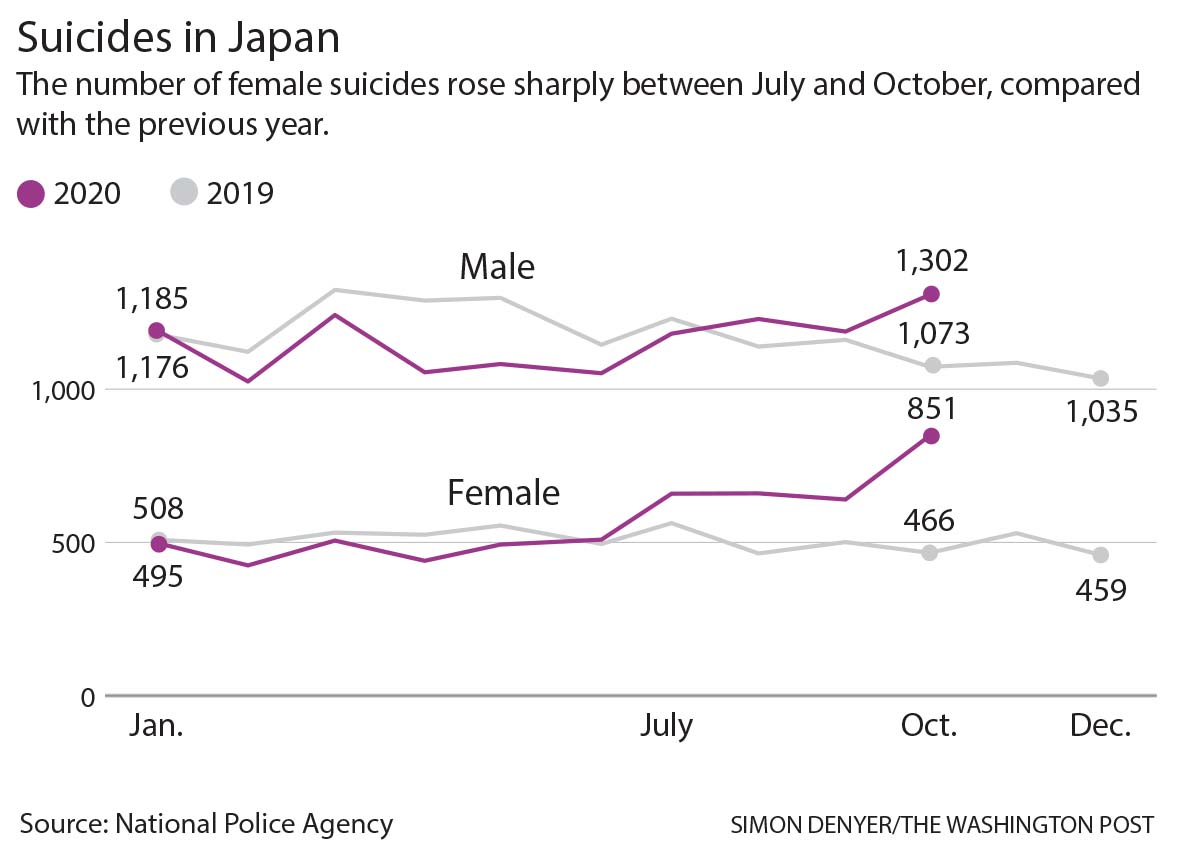
The total number of suicides in Japan rose to 2,153 in October, the highest monthly count in more than five years, with the greater increase among women, according to government statistics. Between July and October, at least 2,810 Japanese women took their own lives, nearly 41 percent more than the 1,994 who died by suicide in the same period last year, the reports showed. Preliminary data by age group shows the sharpest rises in people younger than 29.

Japan already has the highest rate of suicide among the Group of Seven industrialized nations – just ahead of the United States – and is the only country among the seven where suicide is the leading cause of death among 15- to 34-year-olds, the Ministry of Health reported.

South Korea has a higher suicide rate than Japan, with deaths by suicide peaking at nearly 16,000 in 2011, the highest per capita rate among industrialized nations. While the overall numbers show a decline in suicides this year, there has been a 43 percent increase in suicides by women in their 20s in the first half of 2020 compared with the same period last year.

In Japan, teenagers and young women have flooded suicide helplines and have called for help on Twitter and in online forums, according to social service groups.

Yuki Nishimura of the Japanese Association of Mental Health Services said the chance of a caller’s getting through to its hotline is only about 40 percent, and although it is adding counselors, demand also is rising rapidly.

Jiro Ito, the head of OVA, a nonprofit group trying to prevent suicide, said the people reaching his group’s helpline tend to have one thing in common: loneliness.

“Under coronavirus, we have less communication and fewer chances to talk to people,” he said.

“If you have a family, you spend more time with them, and if you have a good relationship with your family, you’d be happy,” he continued. “But you don’t have a good relationship, and you’re shut off from the outside world, that would only add to your sense of loneliness and stress.”

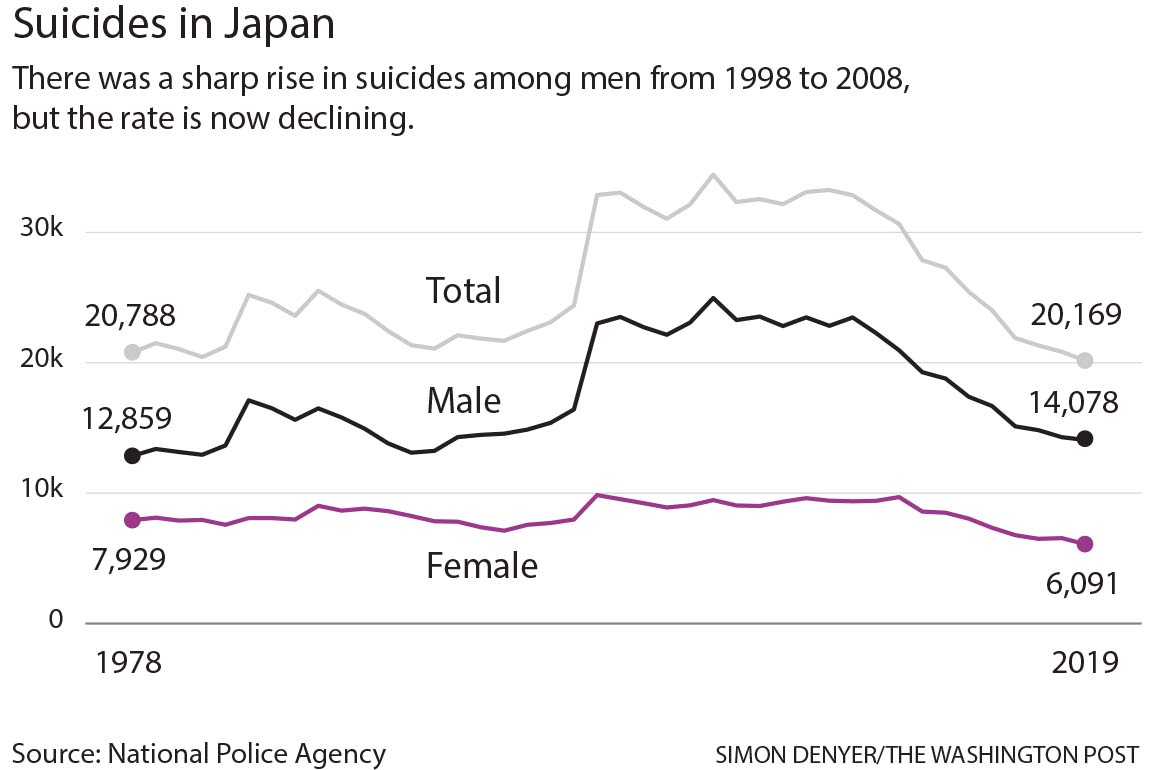
Men accounted for 70 percent of the 20,169 suicides in Japan last year.

Historically, suicide was seen in Japan as a way to escape shame and dishonor, while seeking psychological help was stigmatized. There was a rise in suicides among middle-aged men in the late 1990s as the bursting of Japan’s economic bubble caused a rise in unemployment, but the rate fell back as the economy recovered in the past decade.

Waseda University professor Michiko Ueda, who studies suicidology and suicide prevention, said that the cause of the rise in female suicides this year is not yet clear but economic factors are likely to have played a role.

“The industries that have been particularly hit by covid have been in the travel, retail, food and restaurant businesses,” she said, noting they tend to employ many women, often in contract positions. “A lot of women have lost their jobs or have experienced a large decline in income.”

Japan never imposed the sweeping lockdowns seen in many other parts of the world, largely relying on mask-wearing, hand-washing and avoidance of indoor crowding to keep the virus relatively under control.

Still, schools across the country were closed between March and May, and most people worked from home during a state of emergency in April and May.

Although the streets and commuter trains are busier now, life is far from being back to normal. Many people are struggling to keep their businesses afloat, some are still working from home or socializing less often, and universities have switched to online learning.

Ironically, there was a sharp drop in suicides during the state of emergency, something that is not unheard of. “During a period of crisis, people tend to think about their own survival, so they don’t think about killing themselves,” Ueda said.

But as the summer arrived and people went back to a “semi-normal life,” the stresses seemed to return. Ueno said her surveys of Twitter traffic and online forums showed levels of psychological distress rising from July.

The Bond Project, another nonprofit organization working to help young women, conducted a survey in June of nearly 1,000 people who had contacted the program for help in the past. About 3 in 4 gave responses that included feeling unmotivated or wanting to “disappear and die.”

Others said they were lonely or could not sleep.

“Many of those who reach us say they have no place to go when they’re told to stay home,” said Jun Tachibana of Bond Project. “Many are having problems with their family, friends or boyfriends. I worry they may be feeling more lonely.”

In South Korea, suicides in the capital, Seoul, have increased by 4.8 percent in the first half of the year, also led by young women.

The city’s suicide prevention hotline has logged a record number of calls since the pandemic began, said Joo Ji-young, deputy head of the Seoul Suicide Prevention Center, while the number of people admitted to emergency rooms for attempted suicide nationally rose 10 percent in the first eight months of the year, the Health Ministry said. Women in their 20s accounted for a third of those attempts.

“An inevitable side effect of social distancing is the alienating ‘psychological distance’ between people,” Joo said.

The Korea Suicide Prevention Center’s director, Paik Jong-woo, said a lack of human connection is a threat to everyone’s mental health, “but women are often faced with extra burdens of greater job insecurity compared to men, and of caring for school-aged children at home.”

But a separate factor that could be fueling the rise in suicides in Japan and South Korea: a number of celebrities, including actors and K-pop stars, have taken their own lives in both countries in the past year. Celebrity suicides often fuel despair among ordinary people, and tend to push suicide rates higher, experts say.

Biden to name Tanden as budget chief, Rouse to economic council #SootinClaimon.Com

#SootinClaimon.Com : ขอบคุณแหล่งข้อมูล : หนังสือพิมพ์ The Nation.

Biden to name Tanden as budget chief, Rouse to economic council (nationthailand.com)

Biden to name Tanden as budget chief, Rouse to economic council

InternationalNov 30. 2020Neera Tanden, president and chief executive officer of the Center for American Progress, speaks at a conference in 2019. MUST CREDIT: Bloomberg photo by Patrick T. FallonNeera Tanden, president and chief executive officer of the Center for American Progress, speaks at a conference in 2019. MUST CREDIT: Bloomberg photo by Patrick T. Fallon 

By Syndication Washington Post, Bloomberg · Jennifer Epstein, Saleha Mohsin · NATIONAL, BUSINESS, POLITICS, WHITEHOUSE

President-elect Joe Biden is turning to longtime Democratic policy staffer Neera Tanden to lead the Office of Management and Budget and Cecilia Rouse to head the Council of Economic Advisers, said people familiar with the process.

Biden will also nominate Adewale Adeyemo to be deputy treasury secretary as part of a slate of economic-team appointments he plans to make this week, the people said.

The Biden transition team declined to comment.

The choices show Biden turning to experienced Washington hands as he begins building his economic team. He’s selected Janet Yellen, the former Federal Reserve chairman, as his nominee for treasury secretary, Bloomberg News reported last week.

Tanden, who leads the the Center for American Progress, a liberal think-tank, worked on the Obama administration’s health-care policies and was a close adviser to Hillary Clinton.

Rouse worked in the Obama administration as a member of the CEA and is dean of Princeton University’s school of public and international affairs.

Authors Information:

The energy project Trump can’t stop seeks ways to finish the job #SootinClaimon.Com

#SootinClaimon.Com : ขอบคุณแหล่งข้อมูล : หนังสือพิมพ์ The Nation.

The energy project Trump can’t stop seeks ways to finish the job (nationthailand.com)

The energy project Trump can’t stop seeks ways to finish the job

InternationalNov 30. 2020Russian pipe-laying vessel Akademik Tscherski at the Baltic port of Mukran on the island of Ruegen in Sassnitz, Germany, on Nov. 4. Chancellor Angela Merkel's district on the Baltic coast was the site of the last major Soviet military project in communist East Germany and is now at the center of a deepening rift between Cold War allies. MUST CREDIT: Bloomberg photo by Alex KrausRussian pipe-laying vessel Akademik Tscherski at the Baltic port of Mukran on the island of Ruegen in Sassnitz, Germany, on Nov. 4. Chancellor Angela Merkel’s district on the Baltic coast was the site of the last major Soviet military project in communist East Germany and is now at the center of a deepening rift between Cold War allies. MUST CREDIT: Bloomberg photo by Alex Kraus 
By Syndication Washington Post, Bloomberg · Vanessa Dezem, Dina Khrennikova · BUSINESS, EUROPE

Russia can probably get around the latest U.S. sanctions against Nord Stream 2 and complete the controversial pipeline, according to industry executives and analysts.

Pipelaying on the project, which is owned by Gazprom PJSC and will bring natural gas from Russia to Germany, will restart on Dec. 5, the pipeline company said on Sunday. And analysts say Gazprom also has options to overcome a new round of sanctions the U.S. Congress is set to approve in the next three weeks.

The 9.5 billion-euro ($11.2 billion) link under the Baltic Sea has become a major source of friction in the trans-Atlantic relationship, with President Donald Trump urging Europe part back its dependence on Russian energy supplies. German companies and Chancellor Angela Merkel are bridling against America’s interference, and the western companies set to reap rewards once gas starts flowing have vowed to move ahead.

“The pipeline company will restart pipe laying activities, and this pipeline will be finished,” said Rainer Seele, chief executive officer of OMV AG, the Austrian oil company that’s among the western backers of the link. “We are convinced this project is needed.”

Both Democrats and Republicans are pushing for legislation by the end of the year that would tighten sanctions against Nord Stream 2. President-elect Joe Biden has joined Trump in opposing Nord Stream 2, leaving little hope that his inauguration in January will defuse the issue.

Gazprom has three challenges to resolve to move forward: finding a ship to do the work, obtaining insurance for the project, and getting certification that the work being done is safe and complies with European Union standards. Gazprom and Russia are working on all three fronts.

“All in all, it is still possible for Nord Stream 2 to be built by summer 2021 and get all the necessary certification to flow gas the following winter,” said Katja Yafimava, senior research fellow at the Oxford Institute for Energy Studies and one of Europe’s foremost authorities on pipeline politics.

Further sanctions probably will lengthen that timeline, but she expects Gazprom eventually will find solutions to each of the hurdles thrown up. The U.S., she says, “must realize it cannot stop it.”

There are signs Merkel’s government will help. Ministers in Berlin are coordinating a response with EU nations to the U.S. sanctions, and lawmakers joined industry groups in complaining that American officials are overstepping their authority. Germany’s BDI industry lobby has lashed out at U.S. intervention, saying it “will not only cause considerable economic damage, but will also undermine the sovereignty of Germany and the European Union.”

Just a few weeks away from completion, work stopped on the 1,230-kilometer (764-mile) pipeline last December when the U.S. targeted measures against companies working on the link. The Swiss company Allseas Group SA pulled a vessel it had laying the pipeline off the project with all except 160 kilometers already in place on the floor of the Baltic Sea.

The biggest question mark has been whether Gazprom has found a ship to finish the work. There was no word on Sunday from Nord Stream 2 about which vessel would be used.

Earlier this year, the company brought a ship called the Akademik Cherskiy into the region. It is currently traveling through the Baltic Sea after spending time in Mukran, a key logistics port on the Germany coast, Bloomberg ship-tracking data shows.

The next round of sanctions are aimed at preventing companies that access the U.S. financial system from writing insurance for Nord Stream 2. That would hit the primary insurer Zurich Insurance Group AG, according to people with knowledge of the pipeline’s arrangements on that matter. Zurich Insurance said it never comments on specific customers and that it would comply with any regulations that apply.

Because of the size of the project, it will probably require a reinsurer to help underwrite the costs. The sanctions may force Nord Stream 2 to source all those services in Russia, perhaps from state-backed entities. One possible solution is the Russian National Reinsurance Co., or RNRC, which was created by Moscow to deal with sanctions risks. There’s no restriction on the nationality of the company writing insurance for the project.

“Russia several years ago took care of creating additional domestic capacities for insurance and reinsurance of sanctioned risks, the risks that cannot be ceded to the international markets,” said Anastasia Litvinova, director for EMEA insurance at Fitch Ratings. She declined to comment on specific proposals against Nord Stream 2.

Certification is another issue that will take time to solve. Det Norske Veritas Holding AS, the Norwegian company verifying the pipeline’s safety and integrity, said it’s scaling back work for Nord Stream 2 ahead of the decision on sanctions. Denmark’s energy agency says Nord Stream 2 can hire any third party to fulfill legislation, which could allow a Russian company to step in.

Yafimava says Gazprom probably needs to find a state-owned entity to do certification if the U.S. sanctions extend to that part of the business, “which is not impossible, but it takes time.”

So far, none of Nord Stream 2’s financial backers have pulled out despite escalating anger from the U.S. OMV along with Royal Dutch Shell Plc, Uniper SE, Engie SA and Wintershall AG helped finance the project. Engie’s Chief Financial Officer Judith Hartmann said he’s “still hopeful” that Nord Stream 2 will be completed.

New York City reopening schools for special education students, younger grades #SootinClaimon.Com

#SootinClaimon.Com : ขอบคุณแหล่งข้อมูล : หนังสือพิมพ์ The Nation.

New York City reopening schools for special education students, younger grades (nationthailand.com)

New York City reopening schools for special education students, younger grades

InternationalNov 30. 2020

By The Washington Post · Moriah Balingit · NATIONAL, HEALTH, EDUCATION, HEALTH-NEWS

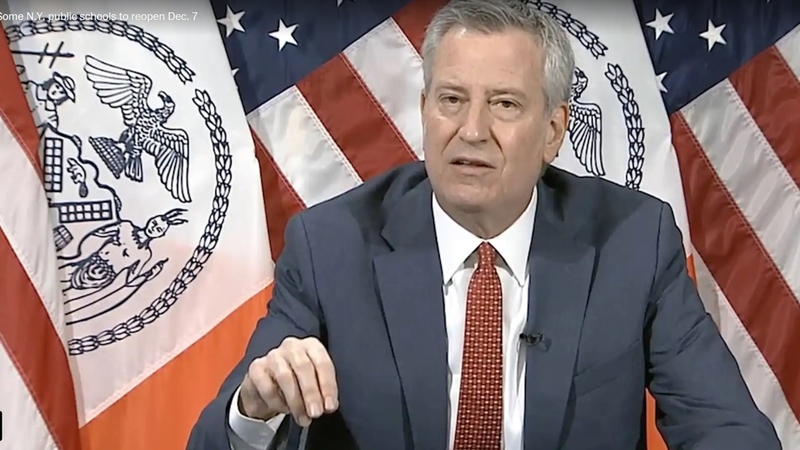
New York Mayor Bill de Blasio announced Sunday that he would begin to allow the city’s youngest students and those with special needs to return to classrooms beginning next week, abandoning a previous plan that forced the entire school system to close 10 days ago and marking another disruption in an already challenging school year.

https://www.washingtonpost.com/video/c/embed/90cf514c-52cc-4b00-a661-090193e0f39d?ptvads=block&playthrough=false

The move, which will be accompanied by ramped-up coronavirus testing, affects a small fraction of the more than 1 million public school students in New York City, home to by far the largest school system in the nation. About two-thirds of families there have opted for full-time virtual learning. Of those who have chosen the city’s hybrid option, only pre-kindergarten through fifth-grade students, and special-education (District 75) students will be permitted to return. The mayor said he is pushing schools that have sufficient space to reopen five days a week.

“The need levels for District 75 and for younger kids – the need is even more intense to be there in school,” said de Blasio, a Democrat. “We know that the health realities for the youngest kids are the most favorable.”

Schools across the country are facing several competing pressures as they weigh whether to reopen schools or keep them closed. Besides New York City, the entire state of Kentucky has ordered school closures amid rising coronavirus infection numbers. But there is also a growing body of evidence that young people can safely return to classrooms without increasing community spread if they wear masks, maintain social distance and have good ventilation, among other things. Concerns abound, too, about the danger to the health, welfare and academic progress school closures pose for vulnerable students.

De Blasio’s announcement comes 10 days after he closed city schools in response to seven-day average positivity rates rising to 3%, the threshold he had set to shutter the school system. The move angered some parents, who were frustrated that bars, restaurants and gyms remained open.

The mayor said the first couple of months of in-person school had been instructive, and that even with weekly positivity rates at 3%, he was confident that he could keep schools open for younger students – who appear less likely to contract and spread the virus. The city’s randomized testing program, which tested a sample of students and staffers in each school building, found a small number of cases – less than one-half of 1% of in-person students and staffers in the city.

“We proved that schools could be extraordinarily safe because we put tremendous health and safety measures in place,” de Blasio said. “It’s a new approach because we have so much proof now of how safe schools can be and this has come from real life experience in the biggest school system in America.”

Under the new plan, preschoolers and students up to fifth grade will return to classrooms Dec. 7. Special-education students will return Dec. 10. Middle and high school students will remain remote.

Gov. Andrew Cuomo, a Democrat who has sparred with the mayor over school closures, said in a teleconference Sunday that he supported de Blasio’s move. Given the low rates of coronavirus found in schools, he said, “it’s literally safer for a child and a teacher to be in the school than in the community.”

The city once was the epicenter of the pandemic, the disease covid-19 spreading quickly through densely populated working-class neighborhoods. It has killed more than 24,000 New Yorkers and left many more traumatized. At the start of the school year, about half of families chose the city’s hybrid-learning option, in which children would learn in classrooms some days and would take online classes the rest of the time. The other half opted for the fully remote option, with disproportionate numbers of students from Black and Latino neighborhoods – where the virus hit hardest – steering clear of in-person schools.

The city allowed families to opt out of in-person learning at any time, and many families have since taken advantage of that option. Miranda Barbot, a spokeswoman for the mayor, said the number of students in remote learning remains in flux, and estimated that about 300,000 students had chosen the hybrid model before school closed in mid-November. About 35,000 have opted into hybrid learning for December.

The mayor also announced Sunday that the city would adjust its approach to keeping the virus at bay in city schools. He said he plans to deploy weekly, instead of monthly, randomized testing, and he said children who did not have consent forms to be tested would not be permitted to return to class. While he would no longer shut down the city’s school system when positivity rates reached 3%, he planned to continue to abide by the state’s testing requirements, which require increased monitoring for schools that reopen in areas of the city where positivity rates are especially high.

The city’s teachers’ union supported that approach.

“We are supportive of a phased reopening of schools in other neighborhoods as long as stringent testing is in place. This strategy – properly implemented – will allow us to offer safe in-person instruction to the maximum number of students until we beat the pandemic,” said Michael Mulgrew, president of the United Federation of Teachers

Mysterious metal object vanishes from Utah desert #SootinClaimon.Com

#SootinClaimon.Com : ขอบคุณแหล่งข้อมูล : หนังสือพิมพ์ The Nation.

Mysterious metal object vanishes from Utah desert (nationthailand.com)

Mysterious metal object vanishes from Utah desert

InternationalNov 30. 2020

By The Washington Post · Hannah Knowles · NATIONAL

Stumbled upon by bighorn sheep-counters, the tall metal object in the Utah desert baffled officials – and delighted the public, which began speculating on a scene straight out of a science fiction movie.

There were theories – the work of an artist? Aliens? – but no one seemed to know who put it there or why.

Now the object has vanished, leaving the curious with even more questions. The Bureau of Land Management said this weekend that it has heard of “a person or group” having removed the object Friday night.

“We have received credible reports that the illegally installed structure, referred to as the ‘monolith’ has been removed from Bureau of Land Management (BLM) public lands by an unknown party,” the bureau said in a statement, adding that it does not investigate “crimes involving private property” such as the monolith.

Utah Highway Patrol Cpl. Andy Battenfield confirmed to The Washington Post on Sunday that the structure is gone but said he could not speak to who took it or when.

So people are left to wonder.

“The space aliens returned to remove it,” one person commented on Facebook beneath the Bureau of Land Management’s update. “The structure had gathered the needed data. That’s what they told me, anyway.”

“I liked it!” another person wrote. “Maybe it will appear in another place.”

The Utah Department of Public Safety was surveying sheep by helicopter on Nov. 18 when workers discovered the monolith “installed in the ground in a remote area of red rock,” authorities said.

Pilot Bret Hutchings recounted the excitement of the find to KSL-TV.

“There’s this thing! There’s this thing back there! We got to go look at it!” Hutchings recalled a crew member saying.

“We were kind of joking around that if one of us just suddenly disappears, I guess the rest of us make a run for it,” he said.

The hunk of metal quickly generated online buzz. The New York Times investigated whether the deceased sculptor John McCracken, a science fiction aficionado, might be responsible for it. (“His dealer says yes. His son says maybe. His artist buddies . . . say, no way,” the Times summarized).

The Department of Public Safety refused to disclose the object’s exact location, warning that people who try to visit it might end up stranded. But some went searching anyway. The Salt Lake Tribune, which confirmed the object’s disappearance Saturday, spoke with disappointed visitors who drove hours to catch a glimpse.

All that remained Saturday, according to The Tribune: a metal triangle and a hole where the monolith used to stand, surrounded by the tracks of those who came to check it out.

Colorado resident Riccardo Marino told the newspaper that he saw a truck driving away from the area with a big rectangular object.

Then he realized the object was gone.

It was a “very eerie feeling, arriving in the moonlight to nothing there,” Marino told The Tribune.

Health experts urge Americans to take restrictive measures even if their states will not #SootinClaimon.Com

#SootinClaimon.Com : ขอบคุณแหล่งข้อมูล : หนังสือพิมพ์ The Nation.

Health experts urge Americans to take restrictive measures even if their states will not (nationthailand.com)

Health experts urge Americans to take restrictive measures even if their states will not

InternationalNov 30. 2020Anthony Fauci, director of the National Institute of Allergy and Infectious Diseases, participates in a coronavirus briefing at the White House on Nov. 19, 2020. MUST CREDIT: Washington Post photo by Jabin BotsfordAnthony Fauci, director of the National Institute of Allergy and Infectious Diseases, participates in a coronavirus briefing at the White House on Nov. 19, 2020. MUST CREDIT: Washington Post photo by Jabin Botsford 

By The Washington Post · Jacqueline Alemany · NATIONAL, HEALTH, HEALTH-NEWS

WASHINGTON – The United States’ top infectious-disease expert sounded the alarm Sunday, warning of a “surge superimposed upon” a surge of coronavirus cases over the coming weeks due to Thanksgiving travel and celebrations.

Anthony Fauci and other experts urged Americans to take aggressive action as the December holidays loom to mitigate the surge overwhelming hospitals across the country. As the number of coronavirus-related deaths per day rose to its highest point since April, Fauci and others highlighted the importance of complying with mask mandates and physical distancing.

“It’s going to get worse over the next several weeks, but the actions that we take in the next several days will determine how bad it is or whether or not we continue to flatten our curve,” U.S. Surgeon General Jerome Adams said on Fox News on Sunday.

Deborah Birx, coordinator of the White House coronavirus task force, warned that the number of coronavirus cases is “three, four, and 10 times” as high as it was during the second surge after Memorial Day weekend.

“It looked like things were starting to improve in our northern plain states, and now with Thanksgiving, we’re worried that all of that will be reversed,” Birx said on CBS News’s “Face the Nation,” adding that people should “take it upon yourself to be restrictive” even in states that do not have regulations in place to curb the spread of the virus.

The number of coronavirus-related deaths are nearing record levels in the United States not seen since the spring. About 95,000 people are hospitalized with the coronavirus-caused disease covid-19, according to Adm. Brett Giroir, assistant secretary of health and human services. About 20% of all hospitalized people have covid-19, he added.

Giroir said he could not project how much travel during Thanksgiving weekend may have exacerbated spread of the virus. “We really have to see what this weekend looks like. I can’t really project that,” Giroir said on CNN’s State of the Union. But he called this moment “a really dangerous time.”

“But, remember, we’re not passive bystanders,” he added. “If we do the right thing – universal mask-wearing, avoiding indoor spaces, crowded bars, restaurants, indoors, all those [sorts] of things – we can still flatten this.”

The first wave of vaccinations is expected to commence for prioritized groups in a matter of weeks, which Fauci on “Meet the Press” called a “light at the end of the tunnel” to the pandemic that’s killed more than 266,000 Americans this year.

The Centers for Disease Control and Prevention advisory committee on immunization practices will meet Tuesday to vote on coronavirus vaccine priority rankings. Health-care workers probably will be the first to receive the vaccine once it has been approved, though Fauci said states will receive vaccines and ultimately make final distribution decisions “with strong recommendations from the CDC.”

Staffers and residents in nursing homes probably will come next, followed by other high-risk and vulnerable populations. Giroir predicted that the United States should have enough vaccine to immunize 20 million Americans by the end of the year.

“We have to immunize for impact,” he said. “The rest of America will get it in the second quarter, third quarter of 2021, but we can maximize our impact right now.”

In the meantime, Fauci implored Americans to restrict their holiday activities to “blunt” the surge’s effect and alleviate “significant stresses” on hospital and health-care systems. Adams echoed those sentiments, begging people to “hang on just a little bit longer.”

“The science out there has never been stronger to support the wearing of masks,” said Adams, who later lamented the politicization of the virus and called wearing a mask “an instrument of freedom.”

“You shouldn’t have to have a mandate to do the right thing to protect your neighbor, to keep schools open. Make sure you’re watching your distance and make sure, again, if you’ve been in a gathering of more than 10 people without your mask on over the last several days, please get tested in the next three to five days,” he said.

Jurisdictions are unevenly navigating the current surge, with some clamping down while others are resisting measures that could prevent further spread of the virus. Los Angeles County, for example, on Friday reinstated a temporary stay-home order that prohibits all public and private gatherings with people who are not in their household.

“We know we are asking a lot from so many who have been sacrificing for months on end and we hope that L.A. County residents continue following Public Health safety measures that we know can slow the spread,” Barbara Ferrer, director of the Los Angeles County Department of Public Health, said in a statement.

California and Texas broke the U.S. record for most new coronavirus infections reported in a single day last week;h Texas Gov. Greg Abbott, a Republican, ruled out any further shutdowns in the state earlier this month.

New York Mayor Bill de Blasio, a Democrat, announced on Sunday a reopening of the nation’s largest public school system, starting with elementary schools, a reversal of his decision to shutter New York City public schools less than two weeks ago. The Supreme Court’s conservative majority struck down temporary pandemic-related restrictions on religious organizations last week imposed by New York Gov. Andrew Cuomo, a Democrat, in hot spots where the virus is raging.