Trump tweets string of falsehoods about Wisconsin absentee voters #SootinClaimon.Com

#SootinClaimon.Com : ขอบคุณแหล่งข้อมูล : หนังสือพิมพ์ The Nation.

Trump tweets string of falsehoods about Wisconsin absentee voters (nationthailand.com)

Trump tweets string of falsehoods about Wisconsin absentee voters

InternationalNov 26. 2020

By The Washington Post · Salvador Rizzo · NATIONAL, POLITICS

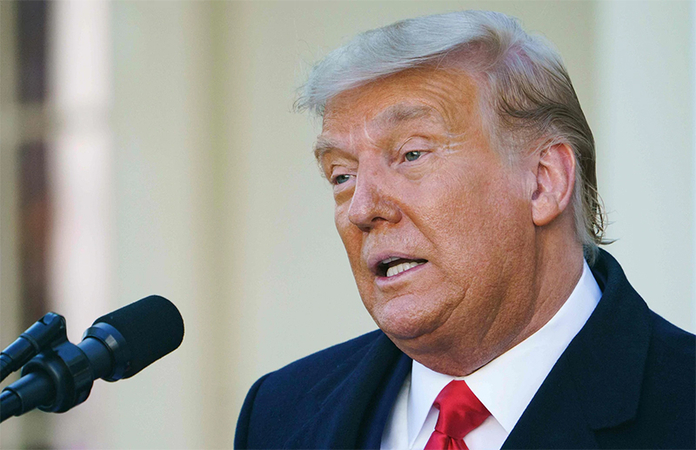
” ‘In Wisconsin, somebody has to be indefinitely confined in order to vote absentee. In the past there were 20,000 people. This past election there were 120,000…and Republicans were locked out of the vote counting process.’ @VicToensing @newsmax” – President Trump, in a tweet, Nov. 24, 2020

https://www.washingtonpost.com/video/c/embed/5d8a6a71-d8e8-4201-88ff-918f5beed8ad?ptvads=block&playthrough=false

Every part of this is false, proving once again why none of President Donald Trump’s claims about election fraud should be given any credence.

As we’ve documented in recent fact checks, the statements from Trump and his lawyers are all absurd and easily debunked. Last week, it was Sidney Powell alleging with no evidence that an algorithm from Venezuela had changed millions of Trump votes to votes for President-elect Joe Biden. This week, Rudy Giuliani is mixing up Michigan and Minnesota to peddle a false claim about “phantom voters.”

Here, we have Victoria Toensing mangling pretty much everything about Wisconsin in a Newsmax interview and Trump repeating the disinformation to more than 88 million Twitter followers. (Twitter quickly flagged the tweet as misleading.)

Biden won Wisconsin by more than 20,000 votes. The Trump campaign is paying for an ongoing recount in Dane and Milwaukee counties, the most heavily Democratic in the state. The campaign is expected to file a lawsuit after the recount, challenging thousands of ballots.

Trump already is seeking to throw out thousands of votes in Wisconsin, including any absentee ballots from “indefinitely confined” voters, roughly 69,000 absentee ballots cast in person during the two weeks before Election Day and more.

Let’s debunk these claims one by one.

– “In Wisconsin, somebody has to be indefinitely confined in order to vote absentee.”

False. Wisconsin law allows any registered voter to request an absentee ballot, and no excuse has been required since 2000.

– “Under Wisconsin law, voters do not need a reason or excuse, such as being out of town on Election Day, to vote absentee,” the state’s election website says. “Any voter who prefers to vote by absentee ballot may request one.”

“In the past there were 20,000 people. This past election there were 120,000.”

– Under Wisconsin law: “Voters who are indefinitely confined due to age, illness, infirmity, or disability may request that a ballot be automatically sent to them for each election. Indefinitely confined voters do not need to provide a photo ID with their absentee ballot request.”

This is an accommodation for voters who cannot physically go to the polls. They have the option of receiving mail ballots automatically for each election and don’t need to provide a photo ID with their request. The requirements are stricter for other Wisconsin absentee voters, who must request ballots for specific elections or years.

The suggestion here is that the number of indefinitely confined voters in Wisconsin grew suspiciously this year. But these numbers from Trump and Toensing are inaccurate, contradicted by the state’s official statistics. The real numbers tell a different story, and Reid Magney, a spokesman for the Wisconsin Elections Commission, told us “we have seen no evidence of fraud.”

Magney said that in November 2016, the state recorded 56,978 indefinitely confined absentee voters out of 144,802 absentee-by-mail voters. (That’s 39 percent.)

For November 2020, Wisconsin’s preliminary figures show 215,713 indefinitely confined absentee voters out of approximately 1.32 million absentee-by-mail voters, or 16 percent. (Final figures will not be available until mid-December.)

“Republicans were locked out of the vote counting process.”

Republican observers have been present throughout Wisconsin’s counting process, during the initial count and now during the recount. In fact, local election officials say that Trump’s observers are seeking to gum up the works, “in some instances by objecting to every ballot tabulators pulled to count,” according to the Associated Press.

No recount in Wisconsin history has overturned a vote margin as large as Biden’s. Trump and his lawyers also have falsely claimed that Republican observers were not allowed inside the room as votes were counted in Philadelphia and Detroit, among other cities.

A spokesman for the Trump campaign did not respond to a request for comment.

In case anyone needed a reminder that Trump simply cannot be believed on the election, this is it. He is casting doubt on Wisconsin’s results, but every part of his claim is demonstrably false. Trump earns Four Pinocchios.

U.S. closes Texas facility for migrants #SootinClaimon.Com

#SootinClaimon.Com : ขอบคุณแหล่งข้อมูล : หนังสือพิมพ์ The Nation.

U.S. closes Texas facility for migrants (nationthailand.com)

U.S. closes Texas facility for migrants

InternationalNov 26. 2020A young child holds onto a fence at the U.S. Border Patrol Central Processing Center in McAllen, Tex., in August 2019. MUST CREDIT: Washington Post photo by Carolyn Van Houten.A young child holds onto a fence at the U.S. Border Patrol Central Processing Center in McAllen, Tex., in August 2019. MUST CREDIT: Washington Post photo by Carolyn Van Houten. 

By The Washington Post · Nick Miroff · NATIONAL, COURTSLAW

WASHINGTON – U.S. Customs and Border Protection officials have shut down the South Texas warehouse where chain-link enclosures were deplored as “cages” during the Trump administration’s crackdown on migrant families and children. The facility will undergo renovations until 2022, CBP officials said.

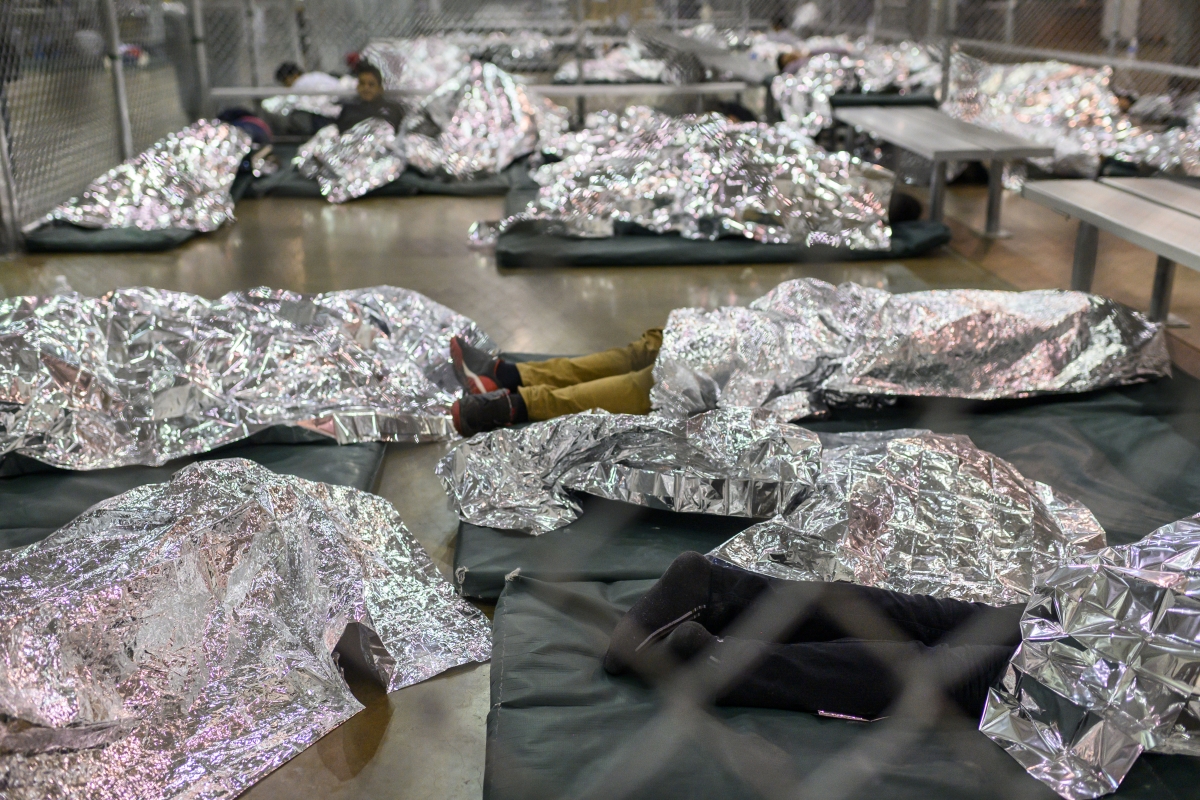
Male minors rest under Mylar blankets in the Border Patrol Central Processing Center in McAllen, Texas., in August 2019. MUST CREDIT: Washington Post photo by Carolyn Van Houten.

Male minors rest under Mylar blankets in the Border Patrol Central Processing Center in McAllen, Texas., in August 2019. MUST CREDIT: Washington Post photo by Carolyn Van Houten.

The chain-link partitions will be removed, and the warehouse will be redesigned to provide detained migrants with more humane conditions, CBP officials said. The renovations will take 18 months or longer, leaving border agents without a large-volume facility if a new migration surge occurs next year.

“The new design will allow for updated accommodations, which will greatly improve the operating efficiency of the center as well as the welfare of individuals being processed,” Thomas Gresback, a spokesman for the Border Patrol’s Rio Grande Valley sector, told The Washington Post.

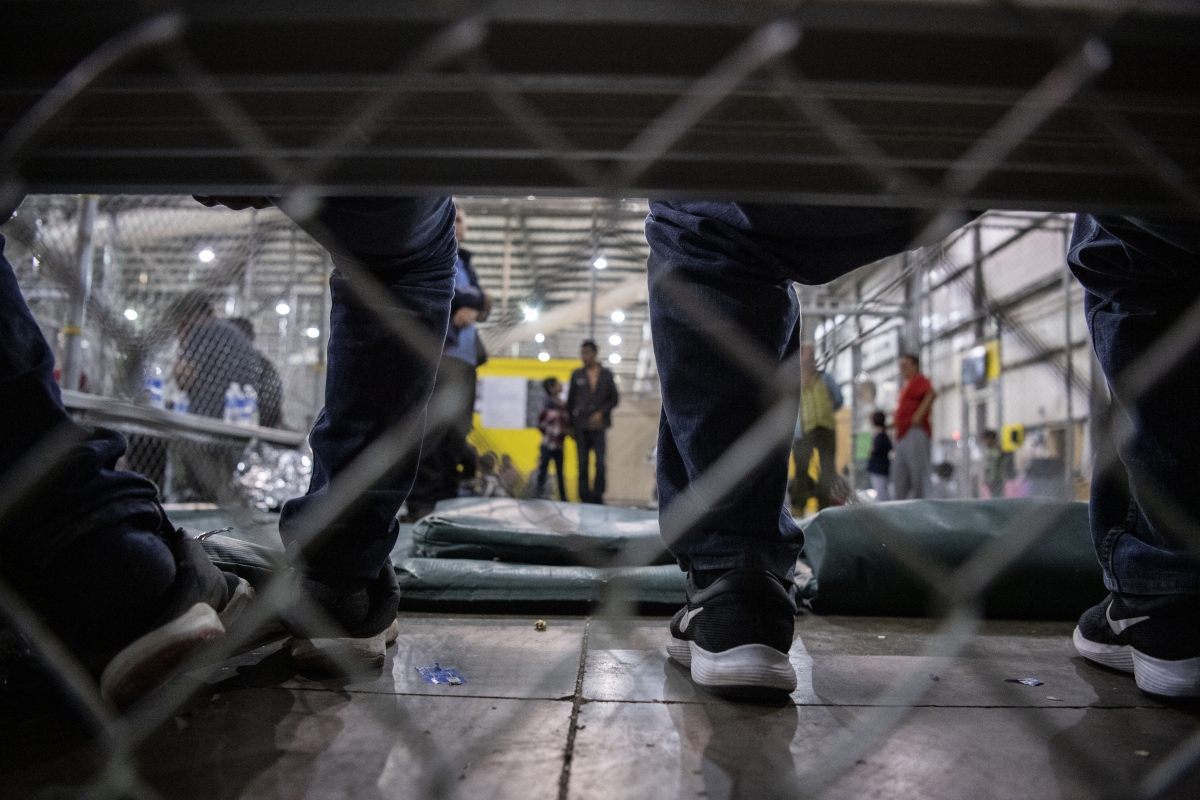
The Obama administration opened the facility in 2014 after a record number of Central American families and children began streaming into South Texas, leaving U.S. agents and border stations dangerously overcrowded. CBP obtained a large warehouse and hastily converted it into a clean, air-conditioned processing center to accommodate the surge. Inexpensive chain-link fencing was used to create partitions in the cavernous space, but its grim appearance came to symbolize the dehumanizing treatment of migrants in U.S. custody.

The warehouse has been mostly empty this year, as CBP implemented emergency public health measures in March that allow agents to quickly “expel” more than 90% of border crossers back to Mexico. Last week, a federal judge ordered the Trump administration to halt the practice of expelling underage migrants.

During pre-pandemic times, migrant families and children who were taken into custody in the Rio Grande Valley after crossing illegally into the United States typically were taken to the CPC warehouse. Their personal and biometric information was recorded into government databases, and they would sometimes spend several days or more inside the facility, sleeping on mats as they waited for authorities to determine whether they would be transferred to a longer-term detention facility, returned to Mexico or released into the United States.

The partitions were used to separate different demographic groups – such as keeping teenage boys apart from mothers with infants. The renovation is likely to replace the chain link with clear plastic dividers, and officials said the new facility will provide more recreation and play areas for children, as well as more permanent kitchen, infirmary and shower facilities.

The CPC’s capacity will be reduced from 1,500 to 1,100, Gresback said.

Men sit on a bench with other fathers of young children in the McAllen, Texas, facility. MUST CREDIT: Washington Post photo by Carolyn Van Houten.

Men sit on a bench with other fathers of young children in the McAllen, Texas, facility. MUST CREDIT: Washington Post photo by Carolyn Van Houten.

Department of Homeland Security officials and migration experts have warned that the incoming Biden administration risks facing a new migration crisis next year. Mexico and Central America have been battered by the economic squeeze of the coronavirus pandemic, and catastrophic flooding and crop damage this fall from multiple hurricanes.

Last month, the number of migrants taken into custody along the Mexico border jumped to 69,237, up 21 percent from September. It was the highest one-month total since February 2019.

President-elect Joe Biden’s campaign promises to reverse the Trump administration’s restrictive approach to immigration enforcement have also raised fears that smuggling organizations will use the anticipation of weaker enforcement to recruit clients.

The Rio Grande Valley remains the busiest area for illegal migration along the entire U.S. southern border, but the bare-bones detention cells of its Border Patrol stations were designed to hold adults, not families and children. Those stations became so overcrowded during the 2014 surge that families were left for hours in the sweltering exterior garages of the stations, in conditions so poor that the Obama administration was forced to look for an indoor, climate-controlled facility, settling on the warehouse.

“It was the best solution at the time,” said Rodolfo Karisch, who retired in January as the Border Patrol chief of the Rio Grande Valley sector. Karisch said the decision to remove the chain link and renovate the facility was a sign that the Border Patrol had heeded the public outcry and asked “What else can we do to make it better?”

When the families and children began crossing the border in large numbers again in 2018, the Trump administration responded with a “Zero Tolerance” crackdown that intentionally separated thousands of migrant children from their parents. The children were sent to shelter facilities and dormitories that the Department of Health and Human Services oversaw, while the adults were kept in immigration jails.

When CBP officials allowed television crews inside the Central Processing Center during the surge to draw attention to the humanitarian crisis, the facility’s chain-link fencing triggered an immediate uproar. Opponents of the Trump administration’s immigration and border policies latched onto the phrase “kids in cages” as a way to attack what they saw as inhumane treatment of people seeking refuge in the United States.

During the second presidential debate in October, then-candidate Biden denounced the president’s family separations as “criminal,” to which Trump responded: “Who built the cages, Joe?” – blaming the Obama administration.

In 2018, CBP Commissioner Kevin McAleenan pushed for the removal of the chain-link fencing, and he advocated for the creation of new border facilities that would be more appropriate for families and children. Congress blocked proposals for a processing center in the El Paso area, but lawmakers in 2019 approved a $4.5 billion emergency spending bill to set up temporary migrant shelter facilities, during a year when the Border Patrol made nearly 1 million arrests and detentions.

CBP likely would need to set up short-term tent facilities again in the event of a new migration wave, officials said. “CBP consistently revaluates future operational requirements to support the safe and legal processing of aliens who have entered the United States illegally,” Gresback said.

600 civilians were killed in massacre in Tigray, Ethiopia’s rights commission says #SootinClaimon.Com

#SootinClaimon.Com : ขอบคุณแหล่งข้อมูล : หนังสือพิมพ์ The Nation.

600 civilians were killed in massacre in Tigray, Ethiopia’s rights commission says (nationthailand.com)

600 civilians were killed in massacre in Tigray, Ethiopia’s rights commission says

InternationalNov 25. 2020

By The Washington Post · Lesley Wroughton · WORLD, AFRICA 
Hundreds of people in a town in Ethiopia’s northern Tigray region were stabbed, strangled and hacked to death in an apparent ethnically based attack that may amount to crimes against humanity and war crimes, Ethiopia’s human rights watchdog said Tuesday.

The commission said at least 600 people were killed in the town of Mai Kadra in western Tigray on Nov. 9 when local youths known as Samri, aided by the then-local administration, went door to door killing those they identified as from the minority Amhara and Wolkait ethnic groups.

The killings took place throughout the night of Nov. 9 as security forces of the region’s ruling Tigray People’s Liberation Front, or TPLF, were retreating from the advance of federal government troops, the commission said.

The victims were beaten to death with sticks, stabbed with knives, machetes and hatchets, and strangled with ropes, according to the report. Many others were severely injured and property looted or destroyed, the commission said.

“The killings, bodily and mental injury, as well as the destruction that went on throughout the night . . . indicate the commission of grave human rights violations which may amount to crimes against humanity and war crimes,” the commission said.

The Ethiopian Human Rights Commission’s findings could not be independently verified, but they echo similar accounts reported earlier by Amnesty International, which cited witness statements, photos and videos as evidence.

The commission’s findings, the result of a week-long investigation in the town, are the first evidence of possible war crimes being committed in Tigray, where government troops and TPLF forces have been fighting since Nov. 4 in a conflict many fear could destabilize the Horn of Africa.

Ethiopian Prime Minister Abiy Ahmed in a statement called the commission’s findings “heart-wrenching” and urged the international community “to condemn these atrocious acts of crimes against humanity.”

There was no immediate response to the commission’s report from the TPLF. The regional government and refugees fleeing the fighting have accused government forces of targeting ethnic Tigrayans.

The commission warned that the death toll from the massacre could be much higher, as many people were still missing and bodies were hidden in fields outside the town.

Survivors told investigators that some residents in the town hid people in their homes, in churches and in farm fields as the Samri gangs raided the town.

“The unimaginably atrocious crime committed against civilians for no reason other than their ethnicity is heartbreaking,” the commission’s chief, Daniel Bekele, said in a statement, calling for the perpetrators of the attacks to be brought to justice.

Abiy, who comes from the Oromo, the largest ethnic group in Ethiopia, on Sunday issued a 72-hour ultimatum to Tigray’s leaders and combatants to surrender before government forces attack the capital Mekele, with a population of about half a million. The deadline is Wednesday.

The conflict erupted when Abiy sent troops to Tigray after the TPLF army and local militia attacked government military bases in the region and tried to steal artillery and other military equipment. The conflict spread across the border to Eritrea when Tigrayan forces fired several rockets at its capital and sent at least 40,000 refugees fleeing into Sudan.

Biden’s national security rollout doesn’t include a Pentagon pick #SootinClaimon.Com

#SootinClaimon.Com : ขอบคุณแหล่งข้อมูล : หนังสือพิมพ์ The Nation.

Biden’s national security rollout doesn’t include a Pentagon pick (nationthailand.com)

Biden’s national security rollout doesn’t include a Pentagon pick

InternationalNov 25. 2020

By The Washington Post · Anne Gearan · NATIONAL, POLITICS, NATIONAL-SECURITY 
WASHINGTON – President-elect Joe Biden has introduced the bulk of his national security Cabinet, but did not include the Defense Department in his rollout this week amid questions about whether he has settled on longtime defense expert Michèle Flournoy as his Pentagon chief.

Flournoy’s name has been considered at the top of Biden’s list to run the nation’s largest security agency, with frequent mention that she would be the first female secretary of defense.

Her prominence served to highlight the absence of a Pentagon nominee during an event in Delaware on Tuesday that included Biden’s picks for secretary of state, intelligence director, chief of homeland security and United Nations ambassador, as well as White House national security adviser.

Biden has not yet made a decision and Flournoy remains very much in the running for the job, people familiar with the process said. Those people, who requested anonymity to talk about pending personnel decisions, cautioned against reading too much into the absence of Pentagon and CIA nominees in the initial round of Cabinet announcements. Biden’s choice for the U.S. Agency for International Development is also pending.

Tuesday’s focus was on diplomacy and a shift away from Trump administration policies that Biden says have alienated allies and punished immigrants and refugees. But it was still notable that Biden didn’t mention the Pentagon, or the ongoing wars in Afghanistan and Iraq.

“It’s a team that will keep our country and our people safe and secure, and it’s a team that reflects the fact that America is back,” Biden said. “Ready to lead the world, not retreat from it. Ready to confront our adversaries, not reject our allies. And ready to stand up for our values.”

A Biden transition official brushed off the notion that the Pentagon pick was delayed or that the campaign risked a perception problem by not including a defense secretary now.

“This team has moved quickly across the board, and that includes in terms of the nominations and senior appointments we have put forward,” a Biden transition official said. 

The official, who requested anonymity to discuss internal decision-making, noted that before Monday the Trump administration had refused to free up federal resources for the Biden transition.

Despite that obstacle, “we have, so far, outpaced the last two administrations in terms of announcing key Cabinet officials,” the official said.

According to a report in Politico, another contender for the Pentagon slot is Jeh Johnson, former homeland security secretary under Obama, who would become the first Black defense secretary if named to the position.

Tuesday’s announcement included the return of the U.N. job to Cabinet rank and creation of a new Cabinet-rank post focused on climate change.

Flournoy holds centrist policy views that align with most of Biden’s national security platform, although the two disagreed over aspects of the Afghanistan war when she was a senior Pentagon official in the Obama administration and Biden was vice president.

Officials close to Flournoy have preached patience about the selection process, citing Biden’s desire for expertise and diversity. But they also have acknowledged that no decision has been made yet.

Flournoy comes from the same cadre of professionals with credentials from the Obama administration and Washington think tanks as the nominees who were announced Tuesday. She also co-founded a security consultant firm with Antony Blinken, Biden’s choice to be secretary of state.

Flournoy has ties to the defense industry, making her suspect to some liberal Democrats, but it is not clear if Biden shares that concern. Blinken will face the same scrutiny that Flournoy would about the secretive client list at their WestExec Advisors firm. Biden also bypassed liberal complaints about his choice for director of national intelligence, Avril Haines, as being too hawkish. 

“Obviously we have concerns. We also recognize the reasons for the nomination and we would expect those concerns to be worked through in the nomination process as it would be with anybody,” said Stephen Miles, executive director of Win Without War, a liberal security coalition.

But Miles said it does not appear that liberal skepticism alone would derail Flournoy, whose positions and affiliations are well known.

“It’s pretty clear there’s something else going on here,” that is unrelated to liberal views on Flournoy’s candidacy, Miles said. 

Mark Jacobson, a former Pentagon official who is now assistant dean at Syracuse University’s Maxwell School of Citizenship and Public Affairs, compared Tuesday’s rollout with George W. Bush’s Cabinet announcements.

The national security team of Defense Secretary Donald H. Rumsfeld, Secretary of State Colin Powell and national security adviser Condoleezza Rice was considered a unit for weeks, though Rumsfeld and Powell were formally announced 12 days apart in December, 2000.

“When the Bush administration did their famous rollout of ‘the Vulcans’ ” as the group was nicknamed, “it was part of an electoral campaign promise and meant to show competence and experience,” a message similar to Biden’s, Jacobson said.

“I wouldn’t read too much into the fact that it’s State, NSC and the U.N. ambassador as Biden’s big three,” omitting the Pentagon, Jacobson said. “It’s still designed to instill a feeling among Americans that there is a competent team in there.”

Trump’s election assault bodes lingering damage #SootinClaimon.Com

#SootinClaimon.Com : ขอบคุณแหล่งข้อมูล : หนังสือพิมพ์ The Nation.

Trump’s election assault bodes lingering damage (nationthailand.com)

Trump’s election assault bodes lingering damage

InternationalNov 25. 2020President Trump arrives to speak in the James S. Brady Press Briefing Room at the White House on Tuesday, Nov. 24, 2020. MUST CREDIT: Washington Post photo by Jabin BotsfordPresident Trump arrives to speak in the James S. Brady Press Briefing Room at the White House on Tuesday, Nov. 24, 2020. MUST CREDIT: Washington Post photo by Jabin Botsford 

By The Washington Post · Toluse Olorunnipa, Michelle Ye Hee Lee, Rosalind S. Helderman · NATIONAL, POLITICS, WHITEHOUSE

WASHINGTON – When President-elect Joe Biden is sworn in on Jan. 20, he will face a fundamental challenge unlike any incoming president before him: Tens of millions of Americans who doubt his legitimacy and question the stability of the country’s democratic traditions – in part because of his predecessor’s unprecedented attempt to set both ablaze before leaving office.

For the past three weeks, as President Donald Trump has refused to concede the election, the federal government, the Trump campaign legal team and whole swaths of the Republican Party have worked in tandem to interfere with the peaceful transition of power.

By lodging baseless claims of voter fraud and embracing – or declining to reject – outlandish conspiracy theories about the electoral process, Trump and his allies have normalized the kind of post-election assault on institutions typically seen in less-developed democracies, according to historians, former administration officials, and lawmakers and diplomats from across the political spectrum.

Lingering damage to the U.S. electoral system could be among the most consequential legacies of the Trump presidency, said Michael Chertoff, a homeland security secretary under President George W. Bush

Trump’s effort to overturn the election results in the days after the race has so far proved unsuccessful, as Biden has moved ahead with hallmarks of a presidential transition such as building a Cabinet. But Chertoff and others said the harm inflicted on the democratic process since Nov. 3 should not be underestimated.

“We’ve now seen a blueprint, which has been road-tested in other parts of the world, being adopted by Donald Trump here in the U.S.,” he said, adding that Trump’s attempts have been ineffective in part because of their clumsiness. “But a more effective and a more skillful want-to-be autocrat could use the same playbook.”

Trump has continued to declare himself the winner of the election, even as several key swing states have moved forward with certifying Biden’s victory and the federal government has ascertained that a new administration is likely to take over in two months. Trump’s GOP allies, despite multiple losses in court, have continued to press their case with the public – making an ever-growing list of specious allegations about fraud involving mail-in ballots, voting machines, signature-matching, late-arriving votes, poll workers in heavily minority cities, foreign interference, dead people voting, unbalanced voter rolls, nonresident voters, Sharpie-stained ballots and the traditional tabulation process.

But as Trump has tried unsuccessfully to win over judges and state lawmakers, Biden’s lead has remained secure – and has grown nationally as more ballots have been processed. As of Tuesday, Biden’s popular vote total had surpassed 80 million, the largest in the country’s history.

Still, Trump’s repeated claims of election rigging have led many of the 74 million people who cast ballots for him to doubt the reliability of the voting process. Even as the transition proceeds – with the General Services Administration announcing late Monday that the administration could begin coordinating with Biden’s incoming team – Trump has continued his onslaught.

“What does GSA being allowed to preliminarily work with the Dems have to do with continuing to pursue our various cases on what will go down as the most corrupt election in American political history?” Trump tweeted Tuesday morning. “We are moving full speed ahead. Will never concede to fake ballots & ‘Dominion,’ ” the latter reference being about a company that supplies voting equipment.

The claims about vote-changing machines and fraudulent ballots have been repeatedly rejected by judges, local officials and even the president’s own administration. Last week, Trump fired a top Department of Homeland Security official who had vocally dismissed allegations of widespread fraud in the Nov. 3 election.

The White House did not respond to a request for comment.

The lack of pushback from Republican lawmakers signaled a willingness by them to accept Trump’s post-election denial despite the danger it poses, said Julian Zelizer, a presidential historian at Princeton University.

“This is the story of the Trump presidency,” he said. “The GOP not only stood behind the president, regardless of what he did, but even as he used his power to attack the basic element of the democratic process, very few took action.”

While a growing number of Republicans have publicly acknowledged Biden’s victory, more have remained silent or echoed Trump’s allegations of fraud. Some local Republicans have challenged the results of their own races as Trump has done, making post-election allegations about rigged voting a more mainstream proposition up and down the ballot.

Kimberly Klacik, a Republican who lost a Baltimore-area congressional race by 72% to 28%, claimed on social media that the result had been rigged.

“Luckily, we raised enough money to investigate,” she wrote earlier this month, in a tweet that referred to the president’s allegations of fraud.

Trump’s campaign has also been soliciting donations to continue the president’s quest to overturn his defeat.

“We cannot let the Democrats STEAL this Election from your all-time favorite President,” Trump said Tuesday in a fundraising pitch. “I’m calling on YOU to FIGHT BACK. We need to bolster our critical Election Defense Fund if we’re going to keep going. We can’t do this without you.”

Gene Rechtzigel, a Minnesota Republican who ran for the U.S. House, filed a lawsuit Tuesday against the Office of the Minnesota Secretary of State, the Minnesota State Canvassing Board and the Ramsey County Elections Office. He lost to Democrat Betty McCollum by more than 30 points – 133,086 votes – but claimed that the state should delay certification of the results because of allegations of election irregularities.

Other Republicans have taken up the Trump campaign’s push to delay the certification of vote totals in other states ahead of the electoral college’s formal vote electing Biden in mid-December.

Georgia lawyer Lin Wood, a Trump ally, is appealing a federal judge’s rejection of Wood’s attempt to block the certification of Biden’s victory in the state, according to a new filing Tuesday.

Wood had challenged the way Georgia election officials check signatures submitted with absentee ballots and raised questions about the rate of rejection of ballots on the basis of mismatched signatures.

U.S. District Court Steven Grimberg, a Trump appointee, on Friday denied Wood’s request for a temporary restraining order on Georgia’s certification of election results. Grimberg wrote that doing so “at literally the eleventh hour would breed confusion and potential disenfranchisement that, I find, has no basis in fact or in law.”

Georgia Secretary of State Brad Raffensperger and Gov. Brian Kemp, both Republicans, certified the state’s election results on Friday. The Trump campaign has said it will file a separate lawsuit challenging Biden’s win in Georgia, where a second recount is underway at the president’s request.

Republican lawmakers in Pennsylvania and Michigan plan to hold hearings over the next week on the election – elevating fraud claims even as their states move forward to certify Biden’s victory. Trump’s campaign celebrated the events Tuesday, announcing that the president’s personal lawyer, Rudy Giuliani, will make a presentation Wednesday before Republicans in the Pennsylvania state Senate.

“It’s in everyone’s interest to have a full vetting of election irregularities and fraud,” Giuliani said in a statement. “And the only way to do this is with public hearings, complete with witnesses, videos, pictures and other evidence of illegalities from the November 3rd election.”

In a scathing ruling Saturday, a judge in Pennsylvania dismissed Giuliani’s allegations as meritless and blasted what he said was the Trump campaign’s attempt to disenfranchise millions of the state’s voters.

Trump has been undeterred by the cascade of court losses, and his allies have continued to make the case that the election was stolen from him. Unable to change the results with lawsuits or by persuading state lawmakers to overturn the will of voters, Trump has resorted to pressing the last avenues of protest that remain open to him. His advisers expect him to continue fighting reality as long as possible and do not expect him ever to formally concede to Biden or invite him to the White House in line with tradition stretching back decades.

Biden, who has said Trump’s denial of the election results is “embarrassing,” said Tuesday that he is willing to meet with the president.

“Of course I would, if he asked,” Biden told reporters.

That seems unlikely to happen soon, as Trump and much of his party remain focused on continuing the effort to cast doubt on the election results.

Recounts continued Tuesday in Wisconsin’s two most populous and Democratic-leaning counties, Dane and Milwaukee.

Under Wisconsin law, the Trump campaign had the right to request the recount – provided it agreed to foot the bill – given that Biden’s margin of victory was under 1%. But Biden leads Trump in the state by about 20,000 votes, a gap even many Republicans agree is extremely unlikely to be closed by a recount. In 2016, when Green Party candidate Jill Stein requested a more extensive statewide recount in Wisconsin, it resulted in Trump’s margin growing in the state by just 131 votes.

“Trump representatives saw the process four years ago. They saw how accurate it was – they complimented us on it. Given that, it was really irresponsible to ask for another recount,” said Scott McDonell, the clerk of Dane County, where 80 workers have been staffing the recount for hours each day. “It’s a public health threat.”

Wisconsin Attorney Geneneral Josh Kaul, a Democrat, noted that Trump observers have also slowed the process by objecting to large numbers of ballots. He noted that one Trump observer in Milwaukee objected because a poll worker was placing ballots in a pile – a normal part of the process. Another objected to all absentee ballots that had been folded, as was necessary for voters to place the ballot in an envelope and submit it by mail.

The campaign also formally objected to tens of thousands of ballots that were cast using rules the campaign argued were improper, though the same rules were in place statewide. The challenges were rejected by local officials, but the campaign could still try to sue over its objections and delay Wisconsin’s scheduled certification on Dec. 1.

“What seems to be happening is that representatives of the president are using the recount as a vehicle for challenging certain election practices,” Kaul said.

Kaul said he was confident the challenges would fail, but he said they were obscuring the fact that the voting actually ran very smoothly, with few lines even amid record turnout.

“The real untold story of this election is how efficiently the democratic process worked,” he said.

In the short term, Trump’s efforts could backfire in Georgia, where two runoff races for the Senate could be affected by the president’s continued claims that his loss resulted from fraud.

Georgia’s voting systems manager Gabriel Sterling said during a Monday news conference that he is concerned that “there are going to be some Republicans who don’t trust the outcomes of the system at all” and therefore don’t vote.

“Now, am I concerned that it’s going to end up suppressing the vote, to a degree? Absolutely,” he said. “Whether you’re on the left or the right, anytime you end up questioning the fundamental fairness without any real evidence of there being an issue, you’re undermining the confidence of your voters and everybody else.”

Mysterious metal obelisk is found in a remote part of Utah #SootinClaimon.Com

#SootinClaimon.Com : ขอบคุณแหล่งข้อมูล : หนังสือพิมพ์ The Nation.

Mysterious metal obelisk is found in a remote part of Utah (nationthailand.com)

Mysterious metal obelisk is found in a remote part of Utah

InternationalNov 25. 2020

By The Washington Post · Marisa Iati · NATIONAL

The monolith’s mysterious appearance amid the rocky desert sparked excitement among the hominids who circled it, intrigued and perplexed.

But unlike the alien structure made famous by the epic film “2001: A Space Odyssey,” the metal monolith discovered Wednesday by public safety workers in southeastern Utah is real. The workers were scouring the redrock region by helicopter for bighorn sheep when a crew member spotted the object, pilot Bret Hutchings told KSL-TV.

“He’s like: ‘There’s this thing! There’s this thing back there! We got to go look at it!'” Hutchings said.

Joking that they were intrepid explorers investigating an alien life form, the crew members determined that the monolith was 10 to 12 feet tall and planted firmly in the ground. It seemed to them like more of an artistic expression than part of a scientific experiment.

But mostly, it looked like something out of a science-fiction novel.

“We were kind of joking around that if one of us just suddenly disappears, I guess the rest of us make a run for it,” Hutchings told KSL, chuckling.

It was not clear who installed the monolith, which Hutchings designated the strangest discovery he’s made in years of flying over Utah desert. The Utah Department of Public Safety will not disclose its exact location, warning that people who try to visit it might end up stranded amid the rocky terrain.

Officials noted that installing unauthorized structures on federally managed public lands is illegal, “no matter what planet you’re from.” The Bureau of Land Management is determining whether to investigate further.

For now, the monolith is delighting science-fiction fans all over the Internet, who noted the uncanny resemblance to the mysterious structure in “2001” that came from aliens and sped up human evolution.

Some people also posited that the discovery of a monolith in the wilderness was a fitting end to the wild ride of the past year.

“2001: A Space Odyssey in #2020,” one Twitter user wrote. “What a long strange year it’s been.”

Coronavirus vaccine will likely be required for international flights, Qantas CEO says #SootinClaimon.Com

#SootinClaimon.Com : ขอบคุณแหล่งข้อมูล : หนังสือพิมพ์ The Nation.

Coronavirus vaccine will likely be required for international flights, Qantas CEO says (nationthailand.com)

Coronavirus vaccine will likely be required for international flights, Qantas CEO says

InternationalNov 25. 2020

By The Washington Post · Antonia Noori Farzan · NATIONAL, BUSINESS, FEATURES, TRANSPORTATION, TRAVEL

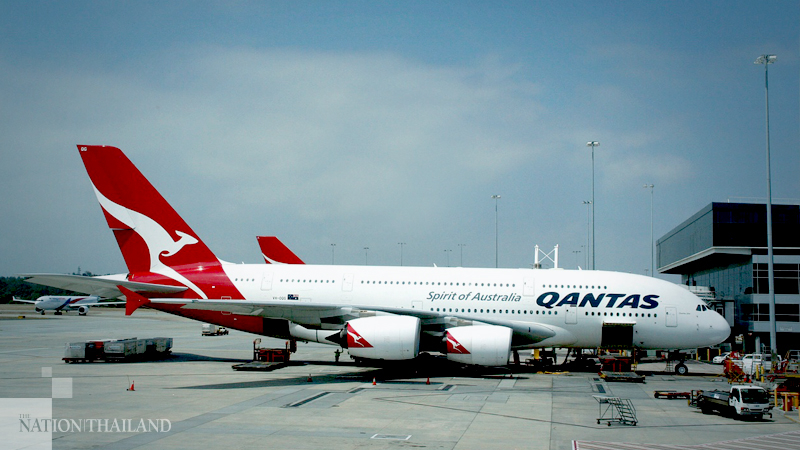
Australian air carrier Qantas anticipates asking all international travelers to prove they’ve been immunized against the coronavirus once a vaccine is widely available – a requirement that is likely to be adopted throughout the industry, CEO Alan Joyce said Monday.

“I think it will be a common theme, talking to my colleagues in other airlines across the world,” Joyce told Australia’s Nine News.

Travelers entering or leaving Australia could be required to show an electronic “vaccination passport” that shows which vaccine they received, Joyce said. He acknowledged that the government would probably need to provide input, though Australian officials have said that they are primarily focused on orchestrating the rollout of a vaccine once one is available, and have yet to decide if border restrictions will be changing. Australia requires two weeks of supervised quarantine for all new arrivals, except for New Zealanders who are exempt under the terms of the two countries’ “travel bubble.”

The International Air Transport Association has been working to build an app that can serve as a “digital passport” like the one that Joyce described, with the goal of making it safe for countries to reopen their borders so that travel can safely resume. On Monday, the organization announced that its app was in the final stage of development and a pilot program would begin later this year.

Rich Americans increasingly are looking for second passports #SootinClaimon.Com

#SootinClaimon.Com : ขอบคุณแหล่งข้อมูล : หนังสือพิมพ์ The Nation.

Rich Americans increasingly are looking for second passports (nationthailand.com)

Rich Americans increasingly are looking for second passports

InternationalNov 25. 2020Billionaire Eric Schmidt, Alphabet's former CEO, who reportedly applied to become a citizen of Cyprus, joins a growing club of individuals participating in government programs enabling foreigners to acquire passports. MUST CREDIT: Bloomberg photo by David Paul MorrisBillionaire Eric Schmidt, Alphabet’s former CEO, who reportedly applied to become a citizen of Cyprus, joins a growing club of individuals participating in government programs enabling foreigners to acquire passports. MUST CREDIT: Bloomberg photo by David Paul Morris 

By Syndication Washington Post, Bloomberg · Ben Stupples, Devon Pendleton · BUSINESS

Eric Schmidt acquired all the typical trappings of a mega-rich U.S. citizen: a superyacht, a Gulfstream jet, a Manhattan penthouse.

One of his newest assets is far less conventional: a second passport.

Alphabet Inc.’s former chief executive officer applied to become a citizen of Cyprus, according to an announcement last month in a Cypriot newspaper that was first reported by the website Recode. Schmidt, 65, joins a growing club of individuals participating in government programs enabling foreigners to acquire passports.

In previous years, U.S. citizens rarely sought to buy so-called golden passports. The business mainly thrived targeting people from countries with fewer travel freedoms than the U.S., like China, Nigeria or Pakistan.

But that’s changing. People close to the industry say they’ve been inundated with inquiries from citizens of the world’s richest country.

“We haven’t seen the likes of this before,” said Paddy Blewer, a London-based director at citizenship and residency-advisory firm Henley & Partners, referring to queries from U.S. individuals. “The dam actually burst — and we didn’t realize it — at the end of last year, and it’s just continued getting stronger.”

A spokeswoman for Cyprus’ government declined to comment. Representatives for Schmidt — who is worth $19 billion according to the Bloomberg Billionaires Index — didn’t respond to requests for comment.

The benefits of owning a second passport, which range from potentially lower taxes, to more investing freedoms and less hassle traveling, can be had for as little as $100,000. The so-called citizenship-by-investment programs historically haven’t been as popular with Americans since one of their main draws — the favorable tax regimes of adopted countries — has been of little benefit to citizens of the U.S., one of the few nations to tax its people regardless of where they live.

The current heightened interest among U.S. citizens predates the coronavirus pandemic, but the crisis has helped turbocharge demand as they plan for how to maintain some freedom of movement with lockdown measures increasing amid a swelling second wave of covid-19 cases.

“Americans are thinking: ‘I want to have that ability to move as quickly as possible and not be stuck,'” said Nestor Alfred, chief executive officer of St. Lucia’s citizenship-by-investment unit.

The U.S. elections have also stoked interest. While Joe Biden has rejected the wealth tax pushed by some of his Democratic primary rivals, his proposals could disrupt the ways that many Americans minimize — or altogether avoid — taxes on their investment gains. Some have also looked to get an additional passport due to fears of social unrest, according to citizenship advisory firm Apex Capital Partners, which said inquiries from clients — typically about five a year — have increased 650% since this month’s vote.

“We’re seeing this interest from Americans who are all saying the same things that Chinese, or Middle Eastern or Russian clients are saying,” Apex founder Nuri Katz said in an interview. “They’re saying, ‘We’re not leaving the U.S. right now, but we’re concerned and we want to have something else, just in case.'”

St. Kitts and Nevis was the first country to introduce a citizenship-by-investment program in the early 1980s, and more than half-a-dozen nations have since done the same. In many cases, they’ve proved lucrative. Malta raised almost $1 billion through June 2019 after launching its program last decade, while the Caribbean territory of Dominica has raised more than $350 million in the past five years.

The industry has generated plenty of consternation for effectively turning citizenship — usually obtained from birthplace or heritage — into something that can be purchased.

It has also attracted scandal. Fugitive Malaysian financier Jho Low was among 26 individuals to lose their Cyprus citizenship last year. The speaker of the Cypriot House of Parliament, Demetris Syllouris, resigned last month after offering to help a Chinese businessman with a criminal record get citizenship.

“European values are not for sale,” European Union Justice Commissioner Didier Reynders tweeted last month.

Following the scandal, Cyprus said it would end its current passport-for-investment program on Nov. 1. The European Union, meanwhile, issued legal ultimatums to Malta and Cyprus about their citizenship-by-investment programs, claiming they may have violated the E.U. law. Representatives for Malta’s government, which announced plans to revise its program before the EU’s action, didn’t respond to requests for comment.

It’s unclear whether interest among Americans in reducing exposure to their home country will endure when the pandemic and post-election uncertainty have abated.

After an election, “we always have an uptick in emotion,” said Sherwin Simmons, principal at tax advisory firm Asgard Worldwide, adding he’s recently fielded increased inquiries from wealthy clients about renouncing U.S. citizenship, a complex process that involves a steep exit tax.

He reminds clients that politicians “have talking points. Once they’re elected, let’s wait and see before we make an immediate or emotional reaction.”

Airlines stir doubts among health experts with claims of safe flying #SootinClaimon.Com

#SootinClaimon.Com : ขอบคุณแหล่งข้อมูล : หนังสือพิมพ์ The Nation.

Airlines stir doubts among health experts with claims of safe flying (nationthailand.com)

Airlines stir doubts among health experts with claims of safe flying

InternationalNov 25. 2020Passengers wear protective masks on an American Airlines flight departing from Los Angeles International Airport on June 13, 2020. MUST CREDIT: Bloomberg photo by Patrick T. FallonPassengers wear protective masks on an American Airlines flight departing from Los Angeles International Airport on June 13, 2020. MUST CREDIT: Bloomberg photo by Patrick T. Fallon 

By Syndication Washington Post, Bloomberg · Alan Levin · NATIONAL, BUSINESS, HEALTH, HEALTH-NEWS

Airlines have loudly insisted that it’s safe to fly during the coronavirus pandemic, and U.S. travel is surging before the Thanksgiving holiday despite a nationwide spike in virus cases.

Yet top U.S. infectious-disease experts say the findings underpinning the carriers’ safety claims aren’t that conclusive.

Concerned about the “misinterpretation” of their findings, researchers on a Defense Department study that has been widely cited by the industry added a cautionary revision. A senior expert in travel-health issues declined to participate in an airline trade group’s news conference, citing what he called their “bad math.”

“The airline industry got a little ahead of itself trying to say the risk is zero,” said David Freedman, a University of Alabama at Birmingham professor emeritus who balked at appearing with an International Air Transport Association event that cited his work.

U.S. airlines, hit with an unprecedented drop in demand since the virus began spreading widely in March, are enjoying their strongest week since then. Even as health officials warn against travel during the Thanksgiving holiday because of a surge in covid-19 cases, more than 4 million people traversed airports between Friday and Monday.

The risk of being infected with the novel coronavirus on planes, which have highly effective filters that remove virus from the air and where mask usage is required, is probably fairly low, scientists say.

But the research is far from clear and some recent cases have documented transmission on flights even when passengers wore masks and sat far apart, according to a review of recent cases and interviews with academics and disease specialists.

“I definitely can say it’s premature to say that air travel is very safe,” said Qingyan Chen, an engineering professor at Purdue University in Indiana who’s written extensively on disease transmission on planes.

Airline officials, responding to the historic drop in passengers, repeatedly have defended the protections against infection on flights.

“Flying is safe,” Nicholas Calio, president of Airlines for America, a trade group for large carriers, said at a Nov. 12 briefing. “I will state that categorically.”

A4A declined to add additional comments. It has highlighted the efforts to force passengers to wear masks and to remain apart during boarding and exiting, and to disinfect aircraft. Montreal-based IATA defended its use of Freedman’s data on confirmed in-flight transmissions, saying it never characterized the results as definitive.

A4A frequently has cited a study by the Harvard T.H. Chan School of Public Health, which was funded by the trade group and other aviation industry sources, that concluded the risk of transmission on an airliner was “very low.” But authors cautioned that their projections depended on adherence to mask usage and they also urged airlines to improve ventilation while planes are parked at the gate.

Another study airlines point to was conducted by the Defense Department with the assistance of United Airlines Holdings Inc. and Boeing Co. It attempted to measure how aerosol virus particles were exhaled by a simulated masked passenger.

United said in promotional materials released Oct. 15 the study “determined the risk is almost nonexistent.”

However, after news coverage of the study, the authors added a revision, saying they were “concerned about the potential misinterpretation of the findings.” They also acknowledged they based their results on a person exhaling relatively few virus particles, an amount well below levels documented in some cases.

The airplane filters and mask usage “significantly reduces” exposure to infectious aerosols, they wrote. “However, the current established scientific understanding of SARS-CoV-2 transmission dynamics is not sufficient to calculate definitive SARS-CoV-2 transmission risk from these measurements of aerosol transport.”

United spokeswoman Leslie Scott responded in an email that “Throughout the pandemic, our top priority has been the health and safety of our customers and crew.”

“It’s why we supported military officials, medical experts and aviation engineers in their work demonstrating that aircraft cabins are among the safest of public indoor environments thanks to advanced air filtration systems, required mask-wearing and diligent cleaning protocols,” she added.

Overall, there are few confirmed reports of infections linked to flights. However, because of limited contact tracing in the U.S. and the difficulty of finding transmission cases, it’s hard to say for sure what that means, researchers said.

“I haven’t seen any studies come out and say it’s highly risky,” said Byron Jones, an engineering professor at Kansas State University who has studied airliner cabin-air safety. “But I haven’t seen the study that says it’s definitively safe either.”

The U.S. Centers for Disease Control summarizes the risks from air travel this way on its website: “Most viruses and other germs do not spread easily on flights because of how air circulates and is filtered on airplanes. However, keeping your distance is difficult on crowded flights, and sitting within six feet of others, sometimes for hours, may increase your risk of getting covid-19.”

While some studies have shown cases in which no one on a flight became infected despite the presence of contagious passengers, other data have documented in-flight transmissions.

Purdue’s Chen said he’s been following news reports in China of possible infection between passengers on a Nov. 9 Air China flight from Los Angeles to Tianjin.

Ten people who weren’t connected to one another and resided in different parts of the U.S. tested positive for the coronavirus after arrival. All the passengers had tested negative for the disease before the flight, suggesting at least some of the transmission occurred on the plane, he said.

Such incidents are confounding because they seem to contradict Chen’s own earlier research showing mask usage can dramatically lower risks of infection, he said.

“That’s why I’m having doubts about what’s going on in airplanes,” he said.

Government researchers in Ireland documented as many as 13 cases linked to a single flight last summer, according to a paper published in October. The infections in five of the cases were genetically linked, “strongly suggesting a single point source of infection,” the authors said.

The widebody jet was largely empty, people were spaced out on the plane and almost everyone whose activity could be documented said they wore masks. Nevertheless, the authors estimated that 10-18% of passengers became infected.

“It is interesting that four of the flight cases were not seated next to any other positive case, had no contact in the transit lounge, wore face masks in-flight and would not be deemed close contacts under current guidance from the European Centre for Disease Prevention and Control,” the authors said.

IMF rejected new tool to loosen conditions for pandemic loans, sources say #SootinClaimon.Com

#SootinClaimon.Com : ขอบคุณแหล่งข้อมูล : หนังสือพิมพ์ The Nation.

IMF rejected new tool to loosen conditions for pandemic loans, sources say (nationthailand.com)

IMF rejected new tool to loosen conditions for pandemic loans, sources say

InternationalNov 25. 2020

IMF spokesman Gerry Rice

IMF spokesman Gerry Rice

By Syndication Washington Post, Bloomberg · Eric Martin · BUSINESS

The International Monetary Fund recently rejected a proposed new tool that would have offered countries pandemic loans with looser conditions than usual, choosing instead to work within the flexibility of existing programs, according to people familiar with the talks.

The discussion of the Pandemic Support Facility took place in the weeks leading up to the IMF’s annual meetings in mid-October as the Fund was preparing announcements of new initiatives, said the people, who asked not to be named because the talks were private.

The consensus among the IMF board, which represents the finance ministries of member nations, was that current tools can perform necessary lending, and that it shouldn’t create new ones without an obvious demand or need, the people said. Such a move would require the approval of board members representing 85% of the IMF’s voting power.

IMF spokesman Gerry Rice declined to comment directly on the proposal.

“We continue to apply flexibility available in existing IMF lending tools — as approved by our executive board — to support our member countries, calibrated to their pandemic-related needs,” he said in an emailed statement. “This has enabled the IMF to respond to this crisis as never before in our history and help our member countries on an unprecedented scale and at unprecedented speed.”

The IMF has made more than $100 billion in new financing available to 80-plus countries since the start of the pandemic — mostly with limited or no conditions — and in April doubled the annual access limit that countries have to emergency financing.

Creating the new tool was a further option prepared by staff in the Strategy, Policy and Review Department. They said that given the virus’s unprecedented impact, the fund could allow cash-strapped countries longer repayment periods and also let them make policy changes toward the end of the loan once the pandemic’s path is clearer, rather than immediately, the people said.

IMF loans are typically disbursed over a period of one to three years.

The IMF has generally been facing requests for help from two kinds of countries: One group was on sounder footing before the pandemic and is encountering a liquidity crisis as a result of the virus. Others face tougher solvency challenges from the virus but were seen as needing policy changes even before the pandemic.

So-called conditionality has made the IMF a lightning rod for criticism over the years. But the fund has traditionally operated on the idea that requiring countries to commit to fundamental reforms — such as narrowing budget deficits via spending reductions, controlling inflation and tackling corruption — is necessary for creating the self-sustaining growth that weans them off reliance on multilateral lenders like the IMF and World Bank.

The IMF also has considered another move that would effectively increase the capital available to countries without conditions: a new allocation of its reserves, known as special drawing rights. A proposal to issue $500 billion of the assets has been blocked by Donald Trump’s administration, which criticized the idea for failing to target poor countries, but it could gain new life under President-elect Joe Biden.

Some IMF board members who opposed the new pandemic facility didn’t want it to finance nations that need reforms to deal with underlying and preexisting weakness, the people said. Another concern was that lending to countries without conditions could result in failure to repay the fund and therefore put IMF resources at risk.

A similar mechanism was proposed in July by two former IMF officials: Adnan Mazarei, a nonresident senior fellow at the Peterson Institute for International Economics in Washington, and Matthew Fisher.

Mazarei and Fisher argued that absent a new facility, the IMF might need to loosen the conditionality in some of its traditional lending tools. Should that happen, it would be difficult to restore the standards when the pandemic ends, they said.

“We proposed there be a sunset clause on this facility, that it only be used until the pandemic is over,” Mazarei said in an interview. “Then, you bring back the old workhorse facilities. If you loosen standards now on those facilities, you won’t be able to raise them back to where they were.”

France’s finance minister, Bruno Le Maire, also urged the consideration of the Pandemic Support Facility last month during the IMF’s annual meetings.

The IMF’s decision to forgo the new instrument follows its creation in April of the Short-term Liquidity Line, a tool to help countries ease moderate liquidity problems before they intensify. The fund predicted when launching the instrument that demand might be as much as $50 billion, but it’s had no takers so far.