Pro-democracy activist Joshua Wong held after guilty plea in protest case
InternationalNov 24. 2020Pro-democracy activist Joshua Wong leaves Central Police Station in Hong Kong on Sept. 24, 2020. MUST CREDIT: Bloomberg photo by Paul Yeung
By Syndication Washington Post, Bloomberg · Natalie Lung, Rebecca Choong Wilkins, Iain Marlow · WORLD, ASIA-PACIFIC
Prominent Hong Kong activist Joshua Wong was taken into custody on Monday after he pleaded guilty to inciting and organizing an unauthorized assembly for his part in a dramatic siege of police headquarters last year during the city’s mass protests.
Wong entered a not-guilty plea to the charge of knowingly taking part in an unauthorized assembly, according to a statement, saying the prosecution had offered no evidence for the last charge. He’s set to be sentenced on Dec. 2, RTHK reported, adding that he faces a maximum punishment of three years in jail.
In a Twitter message marked as being sent while he was in custody, Wong said his current predicament was less deserving of attention than the fate of a dozen Hong Kong activists who’ve been detained by mainland Chinese authorities after fleeing the city for Taiwan by boat. The former leader of Hong Kong’s 2014 Umbrella movement protests was the subject of the Netflix documentary “Joshua: Teenager vs. Superpower.”
“I wish to pay tributes to our fellow activists who are about to face trials and prison, or to whom in distress for not being able to return home: We’re not fearless, but you are the braver ones,” he wrote. “We must fight on, raise enough awareness and put more pressure on China to set them free and allow them to return to Hong Kong.”
Wong was taken into custody on Monday after pleading guilty alongside Agnes Chow and Ivan Lam, who were all members of the since-disbanded political party Demosisto, RTHK reported. In a Facebook post late Sunday, Wong said that all three planned to plead guilty to all charges related to the siege of the police headquarters in June 2019.
The U.S.-based Hong Kong Democracy Council condemned the detention of the trio as a violation of the right to protest guaranteed under the Basic Law, the city’s mini constitution.
“Make no mistake, when they pled guilty in court today, it was not a judgment on them, but rather a judgment against a poisoned Hong Kong judiciary system no longer independent or capable of rendering justice,” Samuel Chu, the group’s managing director, said in a statement.
Wong has faced a slew of charges related to the many months of protests that ravaged the city before China enacted sweeping national security legislation this summer.
InternationalNov 24. 2020Miu Manaka learns to design her furisode kimono from yuzen master Takayuki Kato in Sumida Ward, Tokyo, in October. MUST CREDIT: Japan News-Yomiuri
By Syndication Washington Post, The Japan News-Yomiuri · Miho Tamura · WORLD, ASIA-PACIFIC
A 20-year-old Tokyo woman’s quest to make her own furisode long-sleeved kimono for her Coming-of-Age Day ceremony next year started through a chance meeting.
Miu Manaka’s furisode kimono. MUST CREDIT: Japan News-Yomiuri
Miu Manaka’s father, Haruyuki, 52, custom-makes furniture and during a craftwork exhibition last year, he became acquainted with fellow Sumida Ward resident and yuzen master Takayuki Kato.
The 57-year-old specializes in Tokyo-yuzen, one of the three major styles of resist dyeing to decorate kimono fabric, alongside Kyo-yuzen from Kyoto and Kaga-yuzen from Ishikawa Prefecture.
On hearing that Manaka would be attending her coming-of-age ceremony in 18 months, another artisan at the exhibition suggested that she learn the yuzen technique from Kato, who readily accepted the idea.
Tokyo-yuzen developed during the Edo period (1603-1867) in Edo, present-day Tokyo, when kimono shops opened in the Nihombashi district. There were believed to have been more than 600 Tokyo-yuzen artisans about 50 years ago, but their numbers have fallen to less than 10% of that figure today.
Kato is usually busy making kabuki and stage costumes, but he had received almost no orders since March after many events were cancelled due to the novel coronavirus pandemic. As he felt he had plenty of time to teach yuzen culture, Kato started to work with Manaka in mid-September.
Kato designed the pattern after receiving Manaka’s input. He used dahlias, which symbolize “gratitude,” as the main motif. He also arranged forget-me-nots and butterflies, which are Manaka’s favorite motifs, to complete the beautiful design for her furisode.
To mark her coming-of-age celebration taking place amid the pandemic, the lining of the kimono’s bottom is decorated with the motif of Amabie, a yokai supernatural being said to ward off epidemics.
Beginning in October, Manaka went to the studio every day to work on her celebration kimono. Each time, she spent three hours working on coloring the entire fabric with a brush and decorating the outline of the patterns with gold powder.
“Because we are all facing a difficult time, I want people to feel more cheerful through such gorgeous kimono,” Kato said.
During a visit to Kato’s studio Ishiyama Senko in Sumida Ward on Oct. 12, Manaka was observed learning one of the yuzen processes called noribuse.
“You need to apply it steadily so that the patterns underneath don’t show through,” Kato said to Manaka.
Noribuse involves applying a rice glue to brightly colored floral patterns previously depicted on a kimono fabric. Using this method can prevent the patterns from disappearing when the fabric is dyed. This is an important process because the uneven application of the rice glue can result in making the patterns unclear.
To help expand yuzen culture, Kato has continued giving yuzen workshops twice a month at Sasaya Cafe in the ward. Painting designs on tenugui cloth costs ¥1,500 and on yukata summer kimono costs from ¥8,000 to ¥20,000, for example. Kato will also accept people who want to make furisode for their coming-of-age ceremonies for the year after next or later.
Manaka’s coming-of-age ceremony in Sumida Ward is scheduled to take place in January. Depending on the spread of the novel coronavirus, however, it may be held online or even canceled.
“Even if the ceremony is canceled, I want to wear the furisode I made and say, ‘Thank you,’ to my parents,” a smiling Manaka said.
“I hope this will get young people interested in the beauty of the craftwork produced in their neighborhood,” Kato said.
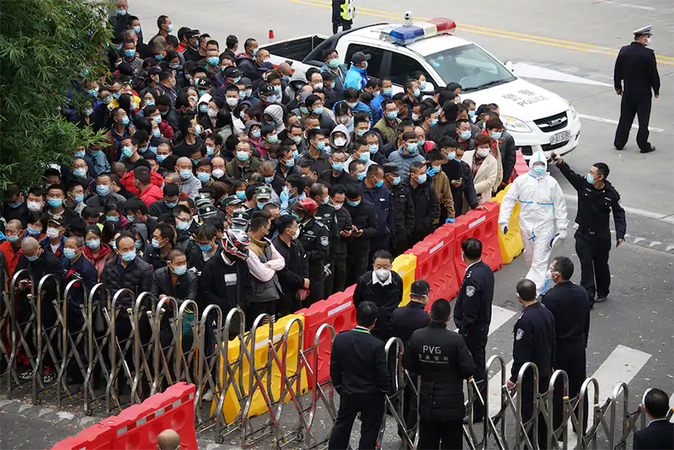
Airport workers wait for coronavirus tests at the Shanghai Pudong International Airport on Monday. (AP)
By The Washington Post · Eva Dou · WORLD, ASIA-PACIFIC
SEOUL – The blurry smartphone videos from Sunday night in China look like something out of a science-fiction movie: hundreds of workers in an airport parking structure surge against guards in white hazmat suits who block the exit. The workers yell. The security officers yell back through megaphones.
“Just let me go,” shouts one man in the crowd. “I don’t want to die here,” cries out another.
The reason that more than 17,000 employees were sealed inside Shanghai’s main airport on Sunday? Seven cases of the novel coronavirus were linked to the cargo unit.
By Monday morning, Shanghai was back on message, with local officials announcing that 17,719 airport cargo workers had been tested for the virus in one night. All of the 11,544 results received so far came back negative, they said. Official videos showed workers waiting in orderly lines for testing, set to soothing piano music.
Left unanswered was where the workers are now. An airport spokesman declined to say on Monday if they were still in the airport, taken to quarantine or allowed to go home.
Earlier at a news conference, officials blamed a cargo flight from North America as the possible source of the outbreak, while promising cargo workers access to a vaccine.
“Arrangements will be made for high-risk workers to get a coronavirus vaccine for emergency use, under an informed consent basis,” said Zhou Junlong, vice chairman of Shanghai Airport Group.
Hundreds of flights into the Shanghai Pudong International Airport on Monday were canceled, according to the flight-tracking app UmeTrip.
China has kept its coronavirus case counts enviably low by cracking down hard on new clusters – harder, perhaps, than any other country. Earlier this fall, the cities of Qingdao and Kashgar each tested millions of residents in a matter of days to guarantee that small clusters had been snuffed out. Photos showed long lines in the streets after dark.
The Shanghai case on Sunday gave a rare glimpse into the human toll of these testing blitzes. Smartphone videos circulating on Chinese social media showed thousands of cargo workers packed into an airport parking facility as they waited their turn for testing. People screamed as they were jostled back and forth.
“Oh my god, they are fighting,” one woman yelled, as a crowd pushed against the hazmat-suited workers blocking an exit. “They are fighting.”
One person was carried limply away, with someone on video saying the person fainted. The Washington Post was unable to reach airport employees to confirm this.
Shanghai officials decided on action on Sunday when two new positive coronavirus cases were detected, bringing the airport cluster to seven. The new patients were a 49-year-old cargo worker whose colleague tested positive on Friday, and the 31-year-old wife of a cargo worker who tested positive on Saturday, Shanghai’s Municipal Health Commission said.
The overnight testing drive appeared partly an effort by Shanghai officials to show they were doing their utmost to contain the outbreak, after cases continued to pop up at the airport cargo unit weeks after the first one.
On Nov. 8, a 51-year-old cargo worker at the airport – identified by authorities by only his surname, Wang – checked into a hospital with fever, fatigue and a stuffy nose, and he tested positive the next day.
His co-worker, identified as Lan, returned to his home province of Anhui and tested positive there on Nov. 10.
Last Friday, a 39-year-old cargo screening handler, named Wu, tested positive, as did his wife and two co-workers. The seventh patient was the wife of one of Wu’s co-workers.
At a news conference Monday, local officials blamed the cluster on a cargo container shipped from North America, saying Wang and Lan had cleaned it together on Oct. 30 before developing symptoms a week later.
“There was a lot of foam cushioning inside, and it was damp,” said Sun Xiaodong, vice director of the city’s pandemic control center. “Research has shown the coronavirus can survive in sealed, damp conditions, and neither of the two was wearing a face mask while cleaning it.”
The officials promised stricter virus prevention measures at the airport cargo unit, but first, the goal was testing everyone within a day – and getting everyone to cooperate.
One video circulating online showed people climbing down a fire escape on Sunday night and trampling across a garden, as they tried to escape the stifling crowds of thousands. Part of the fear appeared to be rooted in the uncertainty over if and when they could leave.
In one of the videos, an announcement blares on a loop: “Please queue for the nucleic acid testing. Don’t push, and be careful of your safety.”
By The Washington Post · Felicia Sonmez, Lisa Rein · NATIONAL, POLITICS
WASHINGTON – Emily Murphy, the embattled Trump appointee who held off declaring a winner in the presidential race for 20 days while her boss tried to subvert the election results, declared Joe Biden the victor of the election Monday.
In a one-page letter to Biden, the head of the General Services Administration addressed head-on the controversy that engulfed the country over her decision to not release more than $6 million in taxpayer-funded transition funding and to deny crucial access to federal agencies. She used unusually personal language to describe the predicament she faced as Trump has not conceded the election and declared fraud in the results in battleground states, writing that she has “always strived to do what is right.”
“Please know that I came to my decision independently, based on the law and available facts,” she wrote. “I was never directly or indirectly pressured by any Executive Branch official – including those who work at the White House or GSA – with regard to the substance or timing of my decision.”
Murphy said she did not receive “any direction to delay my determination” – but did receive threats online, by phone, and by mail directed at my safety, my family, my staff, and even my pets in an effort to coerce me into making this determination prematurely.”
“Even in the face of thousands of threats, I always remained committed to upholding the law,” the letter said.
News of the letter was soon followed by tweets in which Trump thanked Murphy and said he had recommended initial protocols for the transition.
“I want to thank Emily Murphy at GSA for her steadfast dedication and loyalty to our Country,” Trump tweeted Monday night. “She has been harassed, threatened, and abused – and I do not want to see this happen to her, her family, or employees of GSA.”
He added: “Our case STRONGLY continues, we will keep up the good fight, and I believe we will prevail! Nevertheless, in the best interest of our Country, I am recommending that Emily and her team do what needs to be done with regard to initial protocols, and have told my team to do the same.”
Biden’s transition team welcomed the GSA’s move as “a needed step to begin tackling the challenges facing our nation, including getting the pandemic under control and our economy back on track.”
“This final decision is a definitive administrative action to formally begin the transition process with federal agencies,” Yohannes Abraham, executive director of the Biden-Harris transition team, said in a statement. “In the days ahead, transition officials will begin meeting with federal officials to discuss the pandemic response, have a full accounting of our national security, and gain complete understanding of the Trump administration efforts to hollow out government agencies.”
A Republican appointed by Trump in 2017, Murphy lamented vagueness in a law called the President Transition Act of 1963, which was to guide her to making a declaration of the winner.
“Unfortunately, the statute provides no procedures or standards for this process, so I looked to precedent from prior elections involving legal challenges and incomplete counts,” Murphy wrote. “GSA does not dictate the outcome of legal disputes and recounts, nor does it determine whether such proceedings are reasonable or justified.”
And she said bluntly that she regretted that “an agency charged with improving federal procurement and property management should place itself above the constitutionally-based election process. I strongly urge Congress to consider amendments to the Act.”
More than 100 GOP security experts urge congressional Republicans to repudiate Trump’s election claims
InternationalNov 24. 2020President Donald Trump, right, meets with Republican leadership, including Senate Majority Leader Mitch McConnell of Kentucky, center, and House Minority Leader Kevin McCarthy of California in 2017. MUST CREDIT: Washington Post photo by Bill O’Leary
By The Washington Post · Tom Hamburger, Ellen Nakashima · NATIONAL, POLITICS, COURTSLAW, CONGRESS
WASHINGTON – A group of leading GOP national security experts — including former homeland security secretary Tom Ridge — urged congressional Republicans on Monday to demand President Donald Trump concede the election and immediately begin the transition to the incoming Biden administration.
“President Trump’s refusal to permit the presidential transition poses significant risks to our national security, at a time when the U.S. confronts a global pandemic and faces serious threats from global adversaries, terrorist groups, and other forces,” said a statement signed by more than 100 GOP luminaries.
The signers included Ridge, the former Pennsylvania governor who served as homeland security secretary under President George W. Bush, former CIA Director Michael Hayden and John Negroponte, who served as director of national intelligence.
The message called on “Republican leaders – especially those in Congress – to publicly demand that President Trump cease his anti-democratic assault on the integrity of the presidential election.”
Trump has refused to acknowledge his defeat to Democrat Joe Biden, and continues to wage a clamorous, unsuccessful bid to overturn the election’s outcome in several key states that turned the race in Biden’s favor. In the popular vote, Biden is projected to best Trump by a margin of approximately 6 million.
In a nod to these developments, the statement’s signers urged Republican leaders to “strongly oppose” Trump’s “dangerous and extra-legal efforts to threaten and intimidate state officials in order to prevent a vote by the Electoral College.”
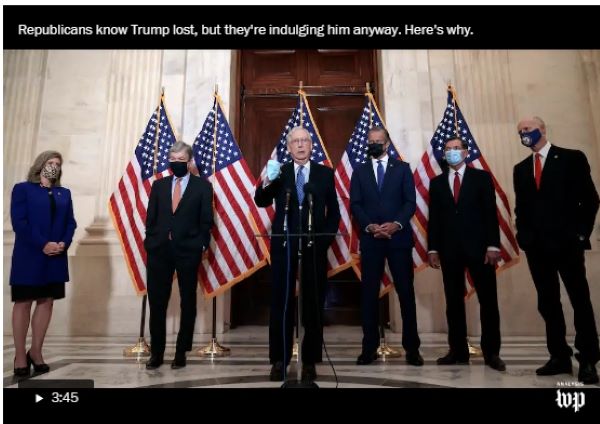
Senate Majority Leader Mitch McConnell’s office on Monday referred to comments he made last week, dismissing requests to speak out. “In all of these presidential elections we go through this process. What we all say about it is frankly irrelevant,” McConnell, R-Ky., told reporters Tuesday. “All of it will happen right on time, and we will swear in the next administration on January 20.”
A spokesperson for House Minority Leader Kevin McCarthy, R-Calif., did not immediately respond to a request for comment, nor did the White House.
The national security officials’ statement was released hours before officials in Michigan certified the election results in that state showing Biden defeated Trump by more than 155,000 votes. Last week the president personally called a county canvass board official in Wayne County, Mich., home to Detroit. That official subsequently tried to rescind her vote to certify results there.
“President Trump’s continued efforts to cast doubt on the validity of the election and to interfere in state electoral processes undermines our democracy and risks long-term damage to our institutions,” the statement says.
The White House did not immediately respond to a request for comment.
The organizers of Monday’s statement led previous efforts before the election to get Republican national security experts and others to support Biden over Trump. Among other initiatives, they published a newspaper ad signed by many of the same names that appeared on Monday’s statement. The organizers said they were motivated by concern that so many Republican leaders have declined to repudiate Trump’s unfounded election claims.
“It was a sense of both alarm that the President of the United States is trying to undermine our election . . . and disappointment that so many Republican leaders are abetting that effort either with active support or with their silence,” said Ken Wainstein, a former U.S. attorney for Washington, D.C., who later served during the George W. Bush administration as assistant attorney general for national security.
Another organizer of the effort, John Bellinger, said that he encouraged the statement out of dismay that many congressional Republicans have remained silent. Bellinger served as legal adviser to the National Security Council and the State Department during the George W. Bush era.
“It is shocking to me and other senior national security officials, who have dedicated much of our careers to protecting the country, that congressional Republicans are allowing Trump to impugn the integrity of our elections,” Bellinger said, adding that elections are “the very core of American democracy.”
Negroponte, who served nine successive presidents, said of the Trump team: “They’re in denial about the loss and therefore not allowing the transition to go forward.” It takes time to identify and vet nominees for core jobs within the new government, including the roughly 1,000 or so people who need Senate confirmation, he said. “Every day that’s lost is not only unfair to the new administration, it’s harmful to the country and our national security.”
Blocking the transition, he said, “is wrongheaded. It’s just immature.”
Hayden, who as CIA director briefed then-President-elect Barack Obama in 2008 on covert action programs, said that the agency “very much” wants to brief Biden, but is being prevented from doing so. “That,” he said, “is very concerning.”
The statement added to complaints from a small but growing number of Republicans who describe Trump’s election response as a threat to the nation’s security.
“The Republican Party is not going to be saved by hiding in a spider hole,” said Trump’s former national security adviser, John Bolton, during an appearance Sunday on CNN’s “State of the Union.” Bolton is not among those who signed the statement. “We need all of our leaders to come out and say, ‘The election is over.’ We’re not talking about an abstract right for Trump to use his legal remedies. We’ve passed that.”
Link to meatpacking found in up to 8% of early U.S. covid cases
InternationalNov 24. 2020An employee handles sides of pork on a conveyor at a Smithfield Foods pork processing facility in Milan, Mo., on April 12, 2017. MUST CREDIT: Bloomberg photo by Daniel Acker
By Syndication Washington Post, Bloomberg · Mike Dorning · NATIONAL, BUSINESS, HEALTH, HEALTH-NEWS
A new study ties 6% to 8% of U.S. covid-19 cases through late July to outbreaks at meatpacking plants and subsequent spread in surrounding communities.
The findings show “a strong positive relationship” between meatpacking plants and “local community transmission,” suggesting the plants act as “transmission vectors” and “accelerate the spread of the virus,” according to a peer-reviewed study published last week in the Proceedings of the National Academy of Sciences of the U.S.
The conclusions are sure to further inflame controversy over the role of the meatpacking industry in the pandemic and the Trump administration’s enforcement of workplace safety laws as outbreaks at slaughterhouses emerged. Trump issued an executive order on April 28 directing meatpackers to reopen closed facilities.
Researchers at Columbia University’s School of International and Public Affairs and the University of Chicago’s Booth School of Business found that the risk of excess death primarily came from large meatpacking plants operated by industry giants. Communities that acted to shut down slaughterhouses reduced spread, according to the researchers.
Overall, the researchers found 236,000 to 310,000 covid-19 cases through July 21 associated with “proximity to livestock plants,” comprising 6% to 8% of virus cases at the time. Between 4,300 and 5,200 covid-19 deaths were tied to being near meatpacking plants, representing about 3% to 4% of U.S. deaths in that time period.
“The vast majority” of those cases were “likely related to community spread outside these plants,” the researchers wrote.
The researchers also found plants that received waivers from the U.S. Department of Agriculture to increase their production-line speeds had relatively more countywide cases. Earlier this month, the U.S. Department of Agriculture submitted a proposal to raise maximum line speeds nationwide for chicken-processing plants.
“Ensuring both public health and robust essential supply chains may require an increase in meatpacking oversight and potentially a shift toward more decentralized, smaller-scale meat production,” the study concluded.
Press representatives from the USDA and the North American Meat Institute didn’t immediately respond to requests for comment.
Detroit had more vote errors in 2016 when Trump won Michigan by a narrow margin. He didn’t object then.
InternationalNov 24. 2020Election workers processes absentee ballots Nov. 4 at the TFC Center in Detroit. MUST CREDIT: Washington Post photo by Salwan Georges
By The Washington Post · Kayla Ruble · NATIONAL, POLITICS, WHITEHOUSE
DETROIT – Republican Party leaders who are urging Michigan’s state canvassing board to hold off certifying the Nov. 3 election results when it meets Monday have cited what they described as “significant problems and irregularities” in Wayne County, home of Detroit.
The GOP officials have pointed to the number of “unbalanced” precincts, where there were small discrepancies between the number of ballots cast and the number of voters logged by election workers in the poll books. Party officials are calling on the board to conduct an audit before it certifies President-elect Joe Biden’s victory in the state.
“To simply gloss over those irregularities now without a thorough audit would only foster feelings of distrust among Michigan’s electorate,” Republican National Committee Chairwoman Ronna McDaniel and state GOP Chair Laura Cox wrote in a letter Saturday.
But state and county election data show that four years ago – when Donald Trump carried the state by a much narrower margin – twice as many Detroit precincts were out of balance.
At the time, the problems were widely condemned by Democratic leaders, including Garlin Gilchrist, now the state’s lieutenant governor, who called the city’s handling of the election “a complete catastrophe.”
But neither Trump nor the Republican Party questioned the validity of the election results – or demanded an audit to verify the vote tally.
In the fall of 2016, 392 Detroit precincts, or 59% of the total, had discrepancies of at least one ballot, accounting for at least 916 votes, the data show.
This fall, 179 Detroit precincts, or 28% of the total, had discrepancies of at least one ballot, accounting for at least 433 votes.
Democrats say that the GOP’s focus now on Detroit’s voting errors is simply an effort to undermine Biden’s victory.
“All of this ruckus that they’re raising, none of these issues are in a worse state than they were in 2016 when Hillary Clinton lost by a much smaller margin,” said Jonathan Kinloch, a Democratic member of the Wayne County Board of Canvassers.
“From Day 1, it has been their intention to try to discredit and try to remove the Black vote from this election,” Kinloch added. “They know that removing the Black vote in this election would change the outcome.”
President Trump attacked the voting process in key states around the country as corrupt and rigged in an unprecedented attempt to overturn the results.
He and his legal advisers have fixated on the predominantly Black city of Detroit, where 94% of the roughly 250,000 votes went for Biden. “It changes the result of the election in Michigan if you take out Wayne County,” Rudolph Giuliani, Trump’s personal attorney, said last week at a news conference in Washington.
GOP consultant Stu Sandler, who serves as legal counsel to the Michigan state Republican Party, acknowledged that Republicans did not request an audit in 2016. But he said what is at issue is not whether the GOP complained in the past, but chronic issues with the management of Detroit’s elections.
“There is no clear evidence that things have improved,” Sandler said.
Out-of-balance precincts can occur for several reasons. A machine may fail to scan the name of a voter on an absentee ballot envelope. A voter can make a mistake on a ballot and request a new one, or sign into the poll book but leave before casting a ballot.
After the high number of Detroit precincts that were out of balance in 2016, then-Republican Secretary of State Ruth Johnson and her Bureau of Elections conducted a post-election audit in the city of Detroit. The bureau concluded that almost half of the out-of-balance precincts could have been rectified if staff had taken prompt actions to address the imbalanced numbers on election night, or if the county canvassing board had been given more time to dig into the problems and reconcile the differences.
“[The Bureau of Elections] found no evidence of pervasive voter fraud, yet an abundance of human errors,” the bureau said in a 2017 report.
At the time, local officials, including Detroit Mayor Mike Duggan, D, acknowledged the need for improvements.
“We can’t have that happen again,” Duggan told the Detroit News at the time. “Everybody in the city knows it was terrible, and the good news was Michigan didn’t decide the national election because it would have shown a real spotlight.”
Trump, however, did not note the issue when he celebrated his win in the state.
“The Great State of Michigan was just certified as a Trump WIN giving all of our MAKE AMERICA GREAT AGAIN supporters another victory,” he tweeted in late November 2016.
The Trump campaign did not respond to a request for comment about why he did not object to the vote certification at the time.
In the run-up to this fall’s election, Wayne County officials vowed to reduce the number of errors. After Election Day, county Elections Director Gregory Mahar said that the number of votes that did not match the poll books amounted to 0.001% of the roughly 250,000 ballots cast in Detroit.
“Our canvassers really did a heck of a job,” Mahar said as he addressed the Wayne County Board of Canvassers meeting last week.
State officials agreed that the city’s error rate had improved.
“A review of data from the November 2020 Wayne County Canvass showed a substantial improvement in the percentage of [Detroit] precincts that were in balance and recountable as compared both to the August 2020 Primary and the November 2016 General Election,” the Michigan Bureau of Elections wrote in a memo on Friday.
However, Republican officials have continued to press the issue, focusing on an even narrower category: the percentage of unbalanced absentee counting boards – jurisdictions set up by the city election commission to count absentee ballots separately from Election Day precincts.
This month, 94 of those boards – 70% of the total – could not reconcile their numbers, affecting at least 263 votes. That is a similar rate found during the August primary, when 363 absentee counting boards – about 72% of the total – were unbalanced, affecting at least 914 votes.
The number of errors in the August primary drew bipartisan condemnation from state officials. “I find this whole thing appalling,” Julie Matuzak, a Democratic member of the state canvassing board said at a meeting after the primary.
Republican Senate candidate John James, who lost his challenge to Sen. Gary Peters, D, by more than 95,000 votes, cited the error rate at absentee counting boards in a letter he sent to the state board of canvassers last week requesting that they hold off certifying the vote for two weeks to conduct an audit.
“A 30% accuracy rate in any industry, whether its business, education, healthcare or manufacturing scores as failure,” James wrote. “While I don’t doubt that many of our poll workers and volunteers worked hard, we need to do better for our elections.”
Charles Spies, an attorney for the James campaign, said the absentee ballot board figures show Wayne County has not improved since August. He acknowledged, however, that the audit James is seeking will likely not change the results of either the Senate or presidential race. “That’s very unlikely,” he said.
Former Michigan GOP chair Jeff Timmer, who previously served as a member of the state canvassing board, said Republicans are failing to give an accurate picture of the election process – and Wayne County’s progress since 2016.
“They’re cherry picking and feeding into a public relations narrative, not exercising any analysis or judgment related to the conduct of elections,” said Timmer, who now serves as an adviser to the anti-Trump group the Lincoln Project.
Kinloch said the GOP is trying to “drive a false narrative that could jeopardize citizens’ faith in our elections.”
“They will not win in the end. Whether this election is certified on time or not, I know for sure that it will be certified,” he added. “We are a country of laws and we’re governed by them, whether we like it or not, whether we win or whether we lose.”
Taiwan and Iceland have won praise for their effective responses to the coronavirus pandemic. They are among a group of countries that adopted a cooperative strategy early on in the pandemic, bringing together multiple organizations to tackle the challenges in containing COVID-19.
A cooperative strategy is when organizations try to achieve their goals through cooperation with other organizations. Our own recent synthesis of research explains the attraction of this approach. It can allow public authorities or companies to speed up their response to new challenges by partnering with other organizations that have complementary resources and expertise.
While other countries, including South Korea and Germany, have deployed a cooperative approach, it’s been a key part of both Taiwan and Iceland’s response to the pandemic.
Taiwan’s handling of COVID-19 has been exemplary. As of June 29, Taiwan, with a population of 23.8 million, had recorded only seven deaths linked to the virus, with 447 confirmed cases – 435 of which had fully recovered.
The Taiwanese government acted quickly to control its borders. It activated a Central Epidemic Command Centre (CECC) on Jan. 20 to coordinate cooperation across different government ministries and agencies, and between government and businesses. The CECC also coordinates big data analytics, testing, quarantine and contact tracing.
Taiwan’s National Health Insurance Administration and National Immigration Agency worked together to identify suspected cases for COVID-19 testing, integrating their databases of citizens’ medical and travel history. Since late March, all new arrivals have had to quarantine for 14 days.
The CECC also partnered with police agencies, local officials and telecom companies to enforce quarantine with the support of mobile phone tracking. Local officials would call quarantined citizens to ask about their health and bring them basic daily supplies if required. Along with a 24-hour helpline, Taiwan’s Center for Disease Control collaborated with two tech companies – HTC and LINE – to create a chatbot that allowed people to report their health status and get advice about the virus.
Taiwan can now test about 5,800 samples a day through a cooperative network of public and private testing centers and certified laboratories.
To avoid the panic buying of face masks, the government rationed their distribution and ramped up production. In February, the government partnered with the Machine Tool & Accessory Builders’ Association and manufacturers, investing in new machinery to produce surgical face masks. In return, manufacturers have to sell the masks back to the government at an agreed price.
This effective government-led cooperative strategy resulted in the establishment of 60 production lines in 25 days, something that would normally have taken several months. More production lines have been added, and Taiwan can now produce about 20 million masks a day.
The public can interact with the government on vTaiwan, a virtual democracy platform for open discussion to build consensus on policy solutions. A face mask map app grew out of a suggestion on vTaiwan and now provides real-time information on stock availability. The app was developed through collaboration between the Digital Ministry and a group of entrepreneurs and hacktivists.
Iceland provides another example of a country that used a cooperative strategy to manage the pandemic. As of June 29, Iceland had recorded 10 deaths and 1,838 confirmed COVID-19 infections, of which 1,816 had fully recovered. Its success can be explained by the government’s quick action in activating the National Crisis Coordination Center on Jan. 31 to coordinate the country’s response to COVID-19 through mass testing, quarantine and tracing close contacts of infected citizens.
A public-private partnership between the National University Hospital of Iceland and deCODE Genetics enabled Iceland to carry out aggressive testing from February.
Testing in Iceland was recorded by NUHI (National University Hospital of Iceland, The Department of Microbiology) and private firm deCODE Genetics.
Similar to Taiwan, cooperation and coordination between Iceland’s government ministries and agencies have played a key role in quarantine and contact tracing.
The Directorate of Health worked with the Department of Civil Protection and Emergency Management to create a team of 60 contact tracers in February, drawn from police investigators and healthcare workers. In this collaboration, the police contributed their expertise in traditional detective methods and enforced quarantine rules.
These two departments also partnered with a group of companies to create the Rakning C-19 tracing app in consultation with Iceland’s Data Protection Authority.
The governments of both Taiwan and Iceland have secured high levels of public trust in their responses to coronavirus. In Taiwan, YouGov polls in May showed that public trust in the government and healthcare professionals on COVID-19 was very high – at over 80 percent. A combination of transparency and effectiveness may explain polling in April which suggested that 84% of Icelanders were willing to sacrifice some human rights if it helped to prevent the spread of the virus.
The example of these two countries shows how trust can be promoted by speedy government action to activate a crisis management and command center which is headed by medical experts rather than politicians. Its purpose should be to coordinate cooperation between government and business and to communicate transparently with the public. This fits with a general lesson from cooperative strategies: openness between all parties is crucial and is a foundation for collaborative trust.
———-
Linda Hsieh is a reader in Strategy and International Business, University of Birmingham
John Child is a professor of Commerce, University of Birmingham
This article is republished from The Conversation under a Creative Commons license. Read the original article here.
Chris Christie calls the conduct of Trump’s legal team a ‘national embarrassment’
InternationalNov 23. 2020Former New York City mayor Rudy Giuliani, center, and former New Jersey governor Chris Christie, left, listen as President Donald Trump speaks during a news briefing Sept. 27 at the White House. MUST CREDIT: Washington Post photo by Salwan Georges
By The Washington Post · Paul Kane, Felicia Sonmez · NATIONAL, POLITICS, CONGRESS
WASHINGTON – Several prominent Republicans said President Donald Trump’s legal arguments had run their course, and called on him to allow the presidential transition process to begin.
Chris Christie, a Trump confidant who helped prepare the president for the debates, called the conduct of Trump’s legal team a “national embarrassment.” Sen. Pat Toomey, R-Pa., said Trump had “exhausted all plausible legal options,” and urged him to concede. Sen. Kevin Cramer, R-N.D., said it’s time to begin the transition.
The comments are the latest signs of dissent from within the president’s party, with increasingly more Republicans urging Trump to accept the results of the election and move on.
And they come as President-elect Joe Biden moved forward with his selection of key members of his administration, with incoming chief of staff Ronald Klain saying Biden’s first Cabinet picks will be revealed Tuesday.
Klain and other Biden transition team members declined to say which positions will be announced.”If you want to know what Cabinet agencies they are and who’s going to be in those Cabinet agencies, you’ll have to wait for the president-elect to say that himself,” he said Sunday morning.
In an interview on ABC News’s “This Week,” Christie said the president should give up his legal strategy. “Elections have consequences, and we cannot continue to act as if something happened here that didn’t happen,” he said.
“The conduct of the president’s legal team has been a national embarrassment,” Christie added, noting that Trump’s lawyers have made a flurry of fraud allegations but have offered no evidence to back them up in court.
Christie criticized Trump’s lawyers for proffering false conspiracy theories at news conferences and other media appearances.
“They don’t do it in the courtroom,” the 2016 Republican presidential candidate said, suggesting that attorneys are fearful of making baseless arguments under oath before federal judges.
“It must mean the evidence doesn’t exist,” Christie said.
Christie said the Republican Party should focus on trying to win Georgia’s two runoff elections Jan. 5 to secure the Senate majority, rather than continuing with its unsuccessful legal challenges of the presidential election results.
“The rearview mirror should be ripped off,” Christie said.
Late Saturday night, after a federal judge threw out Trump’s legal attempt to invalidate millions of votes, Toomey congratulated Biden and Vice President-elect Kamala Harris on their victory and encouraged the president to accept that result.
“President Trump has exhausted all plausible legal options to challenge the result of the presidential race in Pennsylvania,” Toomey said in a statement, noting that the deciding judge, Matthew Brann, is a “longtime conservative Republican.”
This result, Toomey noted, followed Georgia’s certification Friday of Biden’s victory there and Michigan’s GOP legislative leaders rejecting efforts to block the certification of Biden’s clear victory in that state.
“I congratulate President-elect Biden and Vice President-elect Kamala Harris on their victory. They are both dedicated public servants and I will be praying for them and for our country,” Toomey said.
Senate Republicans have by and large avoided commenting on Trump’s actions, with more than 40 not responding to requests for comment Thursday and Friday about the president’s effort to have Michigan legislators reject the Biden victory there of more than 150,000 votes.
Republicans are aware that any perceived lack of loyalty to the president could prompt him to attack the defectors – just as Trump did Saturday night when he called Brann a “product of Senator Pat ‘No Tarriffs’ Toomey.”
“No friend of mine,” Trump tweeted.
Even some Trump backers who support pushing ahead with legal challenges said that Biden probably will take office and that the General Services Administration should allow the Democratic transition team access to the federal agencies and key briefings, as well as office space and millions of dollars in funding, so the administration can begin work Jan. 20.
“I just think that you have to begin that process, give the incoming administration all the time they need,” Cramer said Sunday on NBC’s “Meet the Press.”
Cramer said that transition process should have begun at least a week ago. But he added that the transition could begin even as Trump’s legal team continued to press its cases in the states.
This is, Cramer said, “just a simple legal process.”
The president-elect, meanwhile, has gone ahead with assembling his administration.
Biden last week announced several senior White House staff appointments and told reporters that he has decided on his choice to lead the Treasury Department, though he did not reveal the person’s name. Among the top candidates for the post is Federal Reserve Governor Lael Brainard, who served as a senior Treasury Department official in the Obama administration.
Klain said the Biden transition was “beating, in fact, the pace that was set by the Obama-Biden transition, beating the pace set by the Trump transition.”
Klain also echoed Biden’s recent comment that Trump’s efforts to hinder the transition have put American lives at risk by making it harder for the Biden team to coordinate with the current administration on pandemic planning.
“The president-elect, the vice president-elect are not getting the kind of intelligence briefings they’re entitled to,” Klain said. “Our transition isn’t getting access to agency officials to develop our plans, so there’s a lot of focus on that vaccine rollout plan that’s going to be critical in the early days of a Biden presidency. We have no access to that.”
Trump, meanwhile, is refusing to concede the election and continues to make false accusations of widespread voter fraud.
The president and his campaign legal team have largely failed in their efforts to challenge the election in the courts. Trump weighed in on the Pennsylvania decision in a Sunday morning tweet shortly before he arrived at his golf club in Sterling, Va., for the second day in a row.
“Other than politics, how do you lose a case where large numbers of voters, far more than you need to flip Pennsylvania, are disenfranchised? Vote Observers thrown out of counting rooms,” he tweeted, even though his campaign’s attorneys have acknowledged that Republican observers were granted access to polling locations.
Trump and some of his defenders have argued that Democrats sought to delegitimize his 2016 election by investigating his business interests and his campaign’s ties to Russia and voting to impeach him last year. Trump was later acquitted by the Senate.
Kate Bedingfield, Biden’s deputy campaign manager, on Sunday pushed back against that comparison, calling it “absurd” and “an apples-and-oranges comparison at best.”
“I don’t think that when a president gets elected that he is no longer held accountable as he moves through his administration,” Bedingfield said on “Fox News Sunday.” “I think that’s an incredibly different thing.”
Trump’s efforts to “overturn the will of the American people” will fail, she added, “because, again, Joe Biden overwhelmingly won this election – 306 electoral college votes.”
“The American people voted for Joe Biden to be sworn in on January 20, 2021, and he will be,” she said.
The president also on Sunday lashed out at Maryland Gov. Larry Hogan, a Republican who said earlier in an appearance on CNN’s “State of the Union” that he was “embarrassed that more people in the party aren’t speaking up” against Trump.
“Well, I just don’t think there are a lot of profiles in courage, frankly,” Hogan said. “I mean, we all know how vindictive the president can be, how powerful his Twitter account is, and how he can really pressure Republicans and go after them. Very few of us are willing to stand up.”
Soon after, Trump shared a link to a report on how Hogan spent $9.46 million on coronavirus tests from South Korea that turned out to be flawed. “This RINO will never make the grade,” the president tweeted. “Hogan is just as bad as the flawed tests he paid big money for!”
Later Sunday afternoon, Hogan took to the president’s favorite medium to return fire.
“If you had done your job, America’s governors wouldn’t have been forced to fend for themselves to find tests in the middle of a pandemic, as we successfully did in Maryland,” he tweeted at Trump. “Stop golfing and concede.”
InternationalNov 23. 2020Election worker Marion Fields, 86, sorts ballots on the first day of the recount in Milwaukee County on Friday. MUST CREDIT: Photo for The Washington Post by Taylor Glascock
By The Washington Post · Rosalind S. Helderman, Dan Simmons · NATIONAL, POLITICS
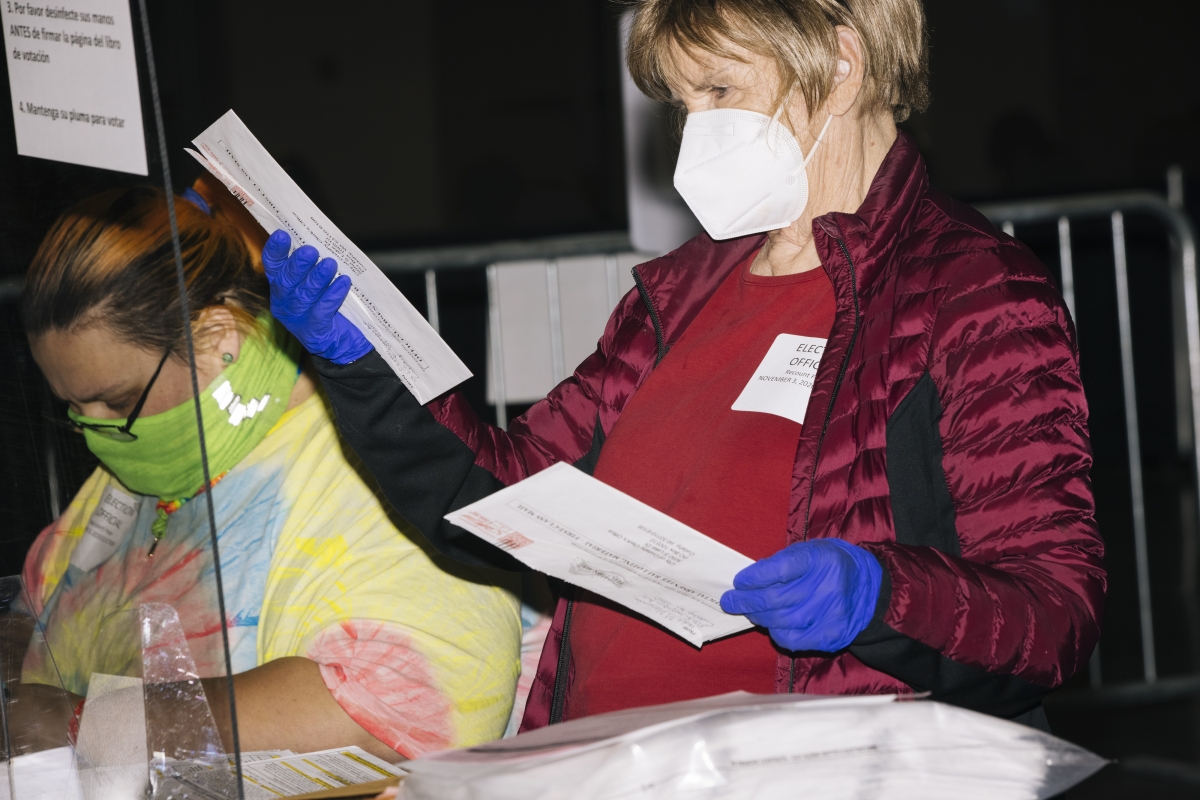
President Donald Trump’s campaign is seeking to use a recount of the presidential election in Wisconsin to attempt to invalidate tens of thousands of votes in the state, making sweeping challenges to whole categories of ballots cast in the state’s two Democratic-leaning counties in his last-gasp effort to reverse President-elect Joe Biden’s win.
Counting at the Wisconsin Center in Milwaukee was temporarily put on hold Friday after objections from President Donald Trump’s team about the distance of legal observers. MUST CREDIT: Photo for The Washington Post by Taylor Glascock
As a recount began on Friday in Dane and Milwaukee counties – home to the cities of Madison and Milwaukee – Trump lawyers argued that officials should not merely retabulate all the votes cast in the Nov. 3 election to reconfirm they’d been counted properly.
Instead, they argued that large batches of ballots had been improperly accepted and counted in the first place. In both Dane and Milwaukee, they sought to disqualify all absentee ballots that had been cast before Election Day in person, rather than by mail.
Election workers in Milwaukee examine ballots on Friday. MUST CREDIT: Photo for The Washington Post by Taylor Glascock
So far, their efforts have been rejected by the Democratic-majority boards of canvasses in both counties, which have denied attempts to set aside large categories of ballots and instead proceeded to a slow-moving process to retabulate all the votes.
The recount must conclude no later than Dec. 1, when the election is scheduled to be certified. At that point, the president’s campaign could file a lawsuit over its rejected challenges – potentially delaying certification.
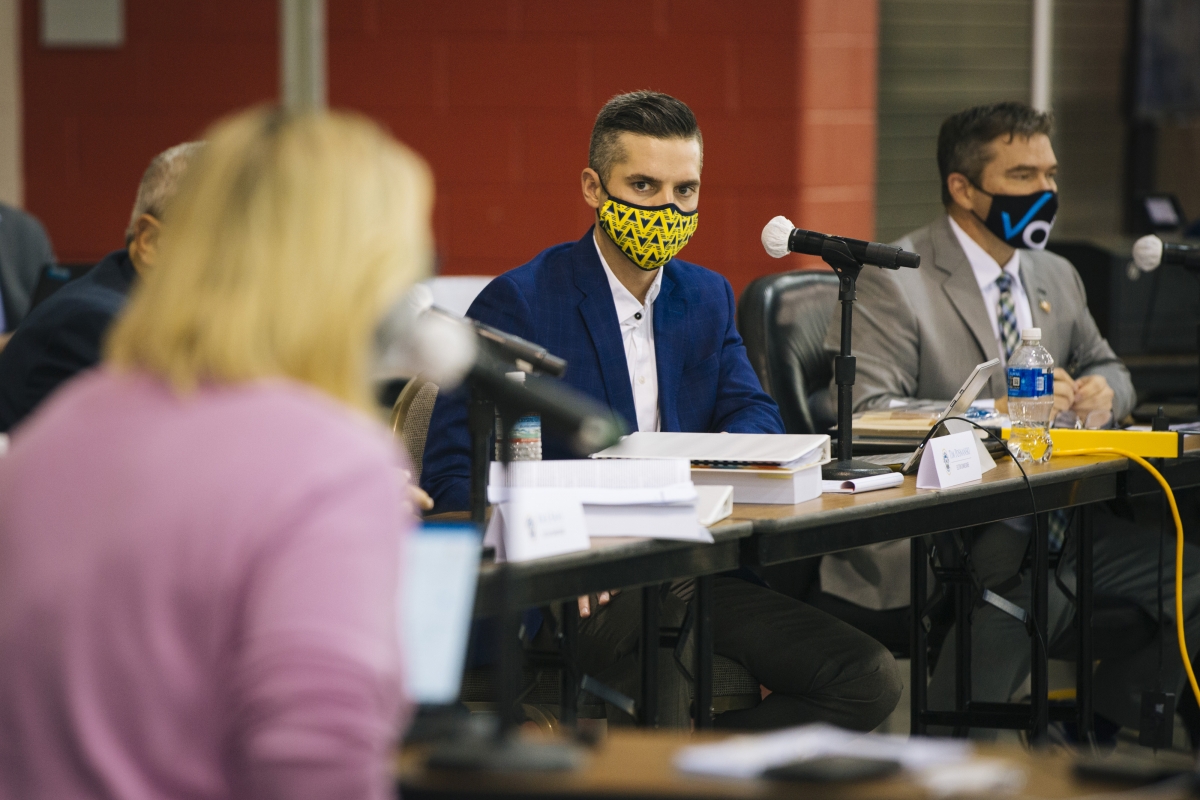
Milwaukee Election Commissioner Tim Posnanski, center, listens to a question during recount proceedings. MUST CREDIT: Photo for The Washington Post by Taylor Glascock
Trump’s aggressive posture in Wisconsin comes as his efforts to undo Biden’s national victory with false claims of widespread fraud have met with defeat after defeat, including in a ruling Saturday by a federal judge in Pennsylvania, who rejected the campaign’s efforts to stop that state from certifying its election results. The Trump campaign filed an appeal Sunday.
The president’s team is scrambling to try to head off other states from finalizing their vote tallies, filing a request late Saturday for another recount in Georgia and calling on Michigan’s state board of canvassing not to certify the vote when it meets Monday.
In Wisconsin, as in other states, Trump’s effort appears futile. The unofficial tally shows Biden defeated Trump there by about 20,600 votes – a margin unlikely to change substantially in an ordinary recount. In 2016, when Green Party candidate Jill Stein requested a more extensive statewide recount, it resulted in Trump widening his victory in Wisconsin by a mere 131 votes.
This year, Democrats said the Trump campaign appears to be using the recount process to cynically target urban voters, particularly in Milwaukee. At one point on Friday, some of the tables where Milwaukee city ballots were being processed inside the city’s convention center were surrounded by multiple Trump campaign observers – forcing the Milwaukee County board of canvassers to clarify that the campaigns could have just one representative per table.
Milwaukee County Executive David Crowley said in an interview last week that he believed the Trump campaign’s decision to target for a recount only two counties – including Milwaukee, which has a large Black population – was no coincidence.
“It looks like he’s looking to pretty much everything he can to disenfranchise voters of color,” said Crowley, the first African American elected to the county post.
In a statement, Trump campaign legal adviser Jenna Ellis said, “Every American deserves to know that our elections are conducted in a legal manner, no matter who they are or where they live. That’s our only goal: to ensure safe, secure, and fair elections. That’s what our Constitution requires.”
The recounts are taking place in vast convention halls in Madison and Milwaukee to provide more room for large numbers of election workers, observers and media to crowd together indoors for hours on end amid the pandemic.
The process began on Friday, as hundreds of workers raised their right hands, most of them covered in blue surgical gloves, and recited their oath.
Trump campaign lawyer Stewart Karge almost immediately accused the newly sworn-in Milwaukee election workers of starting to open and look at ballot applications before the board of canvassers authorized it. “I’m just telling you what I’ve been informed,” he said to the board, citing no evidence.
Twice, Trump supporters erupted in cheers as he spoke, prompting an angry response from the board’s only Republican member.
“Ladies and gentlemen, we need this to be an orderly process,” thundered Rick Baas, staring down a group of Trump observers. “We will not be those other states!”
Other GOP officials in the state have pushed back against the president’s sweeping claims of fraud in cities.
Trump tweeted on Wednesday that Biden had received in Milwaukee a “dump of 143,379 votes at 3:42AM, when they learned he was losing badly. This is unbelievable!”
In fact, the late-reported batch of ballots that broke for Biden were absentee ballots cast by mail or in person before Election Day that election officials had long said would not be counted until after the polls closed.
The Republican majority leader of the Wisconsin State Assembly, Jim Steineke, posted a message on Facebook on Nov. 4 that the early-morning report was “NOT a surprise.”
“Them being reported late is NOT an indication of fraud,” he added.
Steineke did not respond to requests for comment.
On Sunday, Republican Robin Vos, speaker of the Wisconsin State Assembly, defended Trump’s right to seek a recount but noted that Biden’s margin was a “lot to overcome.”
“I assume Joe Biden is going to win, because I think it’s very unlikely that we’re going to find 20,000 cases of fraud,” he told Madison’s WKOW television station.
The count in Milwaukee proceeded slowly Saturday as county officials complained that Trump campaign observers appeared to be trying to stall the process.
“The Trump campaign is continually revisiting issues the commission has ruled on,” County Clerk George Christenson told reporters.
Christenson also complained about the behavior of Trump campaign inspectors, who fanned out at about 150 ballot-processing tables across the vast convention hall.
“The observers are disruptive, asking question after question” of the workers sorting and processing the ballots, he said. “It needs to stop.”
Trump representatives countered that they were not able to see every ballot adequately from the mandated three-foot distance and through the plexiglass shields that had been erected as a precaution because of the coronavirus pandemic.
Michael Maistelman, a Wisconsin election lawyer who has worked with Democratic candidates, said he believed the Trump campaign was issuing “frivolous, irrational objections” in Milwaukee to drag out the process.
Despite the president’s drumbeat of fraud claims, the Trump campaign has not alleged fraud was committed in Wisconsin.
Instead, the campaign has argued that election clerks statewide have adopted practices in soliciting and accepting absentee ballots that violate state law.
The largest category of ballots the Trump campaign has targeted were cast by voters who cast absentee ballots in person rather than by mail. Nearly 70,000 people cast absentee ballots in person in Dane County and another 108,000 in Milwaukee.
The campaign said that the paperwork filled out by people who voted in person did not constitute a proper application for a ballot, as required by state law.
“Wisconsin law expressly requires that absentee ballots may not be issued without receiving a written application requesting the ballot,” the campaign said in a statement, indicating that “despite this clear mandatory requirement, clerks uniformly issued absentee ballots without collecting a written application” from people who voted in person during a two-week period leading up to the election.
State officials have said voters who cast absentee ballots in person sign a document to certify their vote that also constitutes an application.
Such ballots were cast in the same way across much of Wisconsin – including counties that the president won.
But the Trump campaign is seeking only a recount in the two counties where Biden performed best: He won 75 percent of the vote in Dane and 69 percent of the vote in Milwaukee.
Trump was allowed to request a recount statewide, since Biden’s margin of victory – about 0.6 percent – is less than 1 percent. However, state law required that Trump pay for the recount upfront, and officials estimated a complete recount would cost $7.9 million. Instead, the Trump campaign opted to pay $3 million to recount the ballots only in two counties.
When the campaign filed a petition seeking the recount Wednesday, Jim Troupis, a lawyer for the Trump campaign in Wisconsin, said in a statement that the campaign believed the Wisconsin Elections Commission had provided “unlawful advice” and “repeatedly failed to follow the law” about how to conduct the election and as a result “disenfranchised voters and undermined the integrity of this election.”
He wrote that the campaign was confident that “when all of the legal ballots are counted and illegal ballots are not counted, President Trump will be proven the winner.”
A lawyer for the Biden campaign countered that the recount would only reaffirm Biden’s victory in Wisconsin and expressed confidence that the Trump campaign’s 11th-hour bid to toss tens of thousands of ballots would fail.
“They are not actually interested in recounting the votes,” Danielle Friedman, a lawyer for Biden’s campaign, told reporters. “They’re interested in changing the way the election was conducted – after the votes were already cast and counted.”
Even if courts agreed with the campaign’s interpretation of the law, they would likely be loathe to throw out tens of thousands of otherwise legally valid ballots cast by voters in good faith, legal experts said.
Jeffrey Mandell, an election lawyer and founder of the Law Forward, a nonprofit liberal law firm that focuses on election issues, said he believed courts would view the challenges “very skeptically.”
“The timing alone is hugely problematic,” he said, arguing that if the Trump campaign did not like Wisconsin’s practices, it should have challenged them before the election.
Even if a court agreed with the campaign’s legal argument, he said it was unlikely a judge would agree the proper remedy would be to ditch tens of thousands of ballots from voters who did nothing other than follow the instructions they’d been given.
“To hold that against the voter and take their vote away from them, when they’ve done nothing wrong, I think it’s contrary to fundamental principles of justice, to how most courts see their role and to Wisconsin law,” he said.
The campaign also objected to two other processes that have been more controversial in the state – but have also been in place since before the 2016 presidential election, which Trump won and did not contest.
In one, clerks are allowed to fix some mail-in ballots that arrive with a tiny error. In Wisconsin, mail-in ballots require a certification that is signed by both the voter and a witness. Both people must include their address. If the witness fails to include or complete his or her address and that information is readily available to election workers via voter rolls or other information, election officials are allowed to add it to the document. The process was established in mid-October 2016.
Likewise, the Trump campaign has challenged a process in place since 2011 in which voters who declare themselves “indefinitely confined” due to age or disability and do not have to submit a photo identification, a requirement for others.
While the number of people who took advantage of the provision rose this year due to the pandemic, the rules have not otherwise changed. In all, more than 68,000 people sought the status in the two counties in which the Trump campaign has requested a recount – out of 215,000 who did so statewide.
“Absentee voting is a privilege – it should not be abused,” Karge told the Milwaukee board Saturday in seeking to question the validity of the ballots. He added that the distinction created “a separate class of voters.”
Biden lawyer Stacie Rosenzweig replied that the effort amounted to a “bald attempt to disenfranchise” hundreds of thousands of voters. She said the increase in voters unable for health reasons to leave home was understandable during a pandemic and called Karge’s arguments “simply meritless.”
The board agreed. Both Democratic members voted to reject the challenge, and Baas, the Republican, voted present. “I don’t believe this to be the appropriate body” to decide the matter, he said.
Rick Esenberg, a conservative election law expert and president of the Wisconsin Institute for Law and Liberty, said he did not believe the Trump campaign would fare better on the issue in court.
While he said there are “legitimate” questions about the state’s rules for people to declare themselves indefinitely confined that the state might examine in the future, he did not believe a court would be inclined to throw out the ballots given that it would be difficult to determine quickly whether any specific voters had unfairly taken advantage of the provision.
“I think it’s highly unlikely that the issue could result in a change in the outcome,” he said.

 Pro-democracy activist Joshua Wong leaves Central Police Station in Hong Kong on Sept. 24, 2020. MUST CREDIT: Bloomberg photo by Paul Yeung
  Miu Manaka learns to design her furisode kimono from yuzen master Takayuki Kato in Sumida Ward, Tokyo, in October. MUST CREDIT: Japan News-Yomiuri
 President-elect Joe Biden
  President Donald Trump, right, meets with Republican leadership, including Senate Majority Leader Mitch McConnell of Kentucky, center, and House Minority Leader Kevin McCarthy of California in 2017. MUST CREDIT: Washington Post photo by Bill O’Leary
  An employee handles sides of pork on a conveyor at a Smithfield Foods pork processing facility in Milan, Mo., on April 12, 2017. MUST CREDIT: Bloomberg photo by Daniel Acker
  Election workers processes absentee ballots Nov. 4 at the TFC Center in Detroit. MUST CREDIT: Washington Post photo by Salwan Georges
 Former New York City mayor Rudy Giuliani, center, and former New Jersey governor Chris Christie, left, listen as President Donald Trump speaks during a news briefing Sept. 27 at the White House. MUST CREDIT: Washington Post photo by Salwan Georges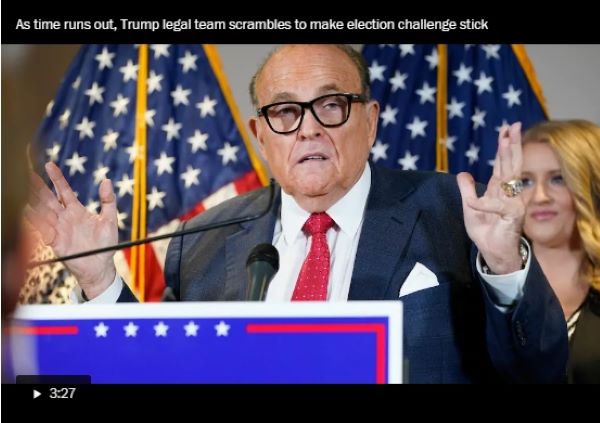
 Election worker Marion Fields, 86, sorts ballots on the first day of the recount in Milwaukee County on Friday. MUST CREDIT: Photo for The Washington Post by Taylor Glascock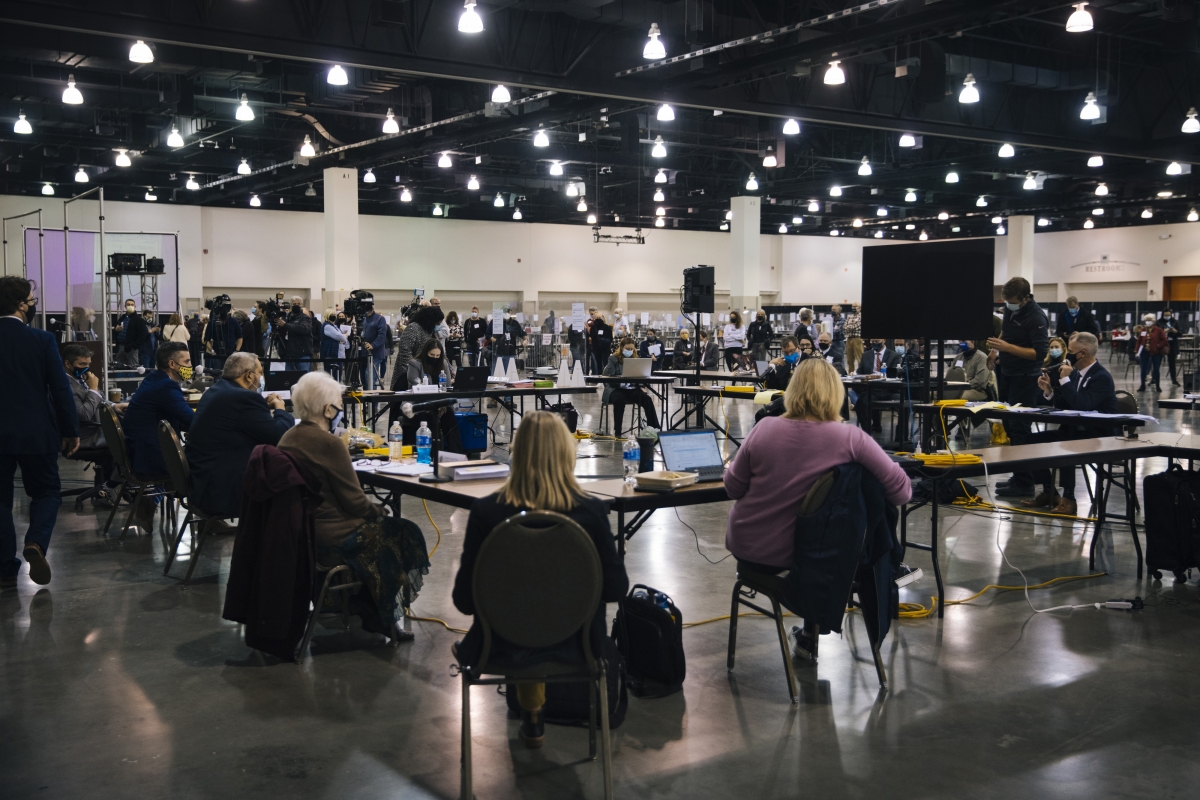
 SootinClaimon.Com