Commerce chief: New initiatives to revive HK tourism sector
InternationalOct 25. 2020A woman poses for photos in from of Victoria Harbour while attending the opening ceremony of Hong Kong Wine and Dine Festival at Central Harbourfront, Hong Kong, Jan 4, 2019. Photo Credit: China Daily
By China Daily
HONG KONG – In launching new tourism initiatives, the Hong Kong government shows its determination in overcoming the difficulties brought about by the epidemic, said the city’s commerce chief.
Secretary for Commerce and Economic Development Edward Yau Tang-wah made the remarks on Friday after attending a press conference of the 2020 Wine and Dine Festival. The exemption for licensed travel agents to organize local group tours of not more than 30 people under the group gathering restrictions also came into effect on Friday.
We cannot have a total lockdown. It will bring a detrimental effect to the economy both locally and globally. But at the same time, we cannot open our gate indiscriminately.
Edward Yau, Secretary for Commerce and Economic Development, HKSAR govt
He expected this year’s Wine and Dine Festival will reach out to more people as it will be conducted in a hybrid online and offline mode.
He said the launch of the festival amid the epidemic this year would be a good demonstration that Hong Kong can retain this brand name, “Wine and Dine – Best in Hong Kong”, Tang said.
On easing restrictions on local tours, he said the government aimed to strike a balance for all.
“As regards the local tourism arrangement, we are finding all ways and means to bring back the space and opportunity for business to resume under the premise of safe and healthy arrangements, as well as to allow some normalcy in business,” Tang said.
“We cannot have a total lockdown. It will bring a detrimental effect to the economy both locally and globally. But at the same time, we cannot open our gate indiscriminately.”
In addition to the local tour arrangement, Hong Kong has reached an agreement with Singapore to establish a travel bubble with a view to reviving air travel between the two places in a safe and progressive way.
“We emphasize a very strong COVID-19 polymerase chain reaction test to be conducted before and after departure. In place of that, we hope that we can do away with the more restrictive quarantine arrangements, allowing people to have more freedom in going around the city in a safe manner,” Tang said.
He added that in launching the new initiatives, the government shows Hong Kong’s determination in overcoming the difficulties brought about by the epidemic.
“We will build on these travel bubbles, local tour exemptions and events like this (2020 Wine & Dine Festival) to demonstrate to the world that if there is a will, there is a way,” he said.
“In that regard, we need cooperation from both people in the trade, like the travel trade as well as the public who will continue to observe social distancing and maintain public health.”
The US said it welcomes increased Indian involvement in Southeast Asia including its military presence in the South China Sea.
A day after the US President Donald Trump’s “filthy” remark on India accusing it to be a major contributor in air pollution, the country delivers a friendly statement by saying that it is watching the India-China standoff in Ladakh closely
The US is sharing information with New Delhi and wants to ensure the situation does not escalate, senior officials of the Trump administration said on Saturday.
The US said it welcomes increased Indian involvement in Southeast Asia including its military presence in the South China Sea and has been working with like-minded partners to counter “China’s aggressive behaviour” from the Himalayas to the disputed oceanic region.
‘We have had an ongoing dialogue with the Indians about the increased cooperation in Southeast Asia, not just the South China Sea. And we encourage their involvement and that cuts across development investments, that cuts across security cooperation and that also involves presence and so, we welcome greater Indian participation across Southeast Asia in all three of those areas,” US officials said in an online news briefing.
“Given China’s increasingly aggressive behaviour across the Indo-Pacific from the Himalayas to the South China Sea, it is more important than ever that we work with like-minded partners such as India. We were pleased to see India’s recent announcement regarding Australia joining the Malabar Naval exercise,” they said.
Trump’s remarks had come at a time when he was explaining his move to withdrew from the Paris climate accord. He had said that the move would have made America a non-competitive nation.
“Look at China, how filthy it is. Look at Russia. Look at India. The air is filthy. I walked out of the Paris Accord as we had to take out trillions of dollars and we were treated very unfairly,” he said during a debate with Democratic White House challenger Joe Biden.
The relations between US and India have been strengthening in last few months as the Quadrilateral grouping of US, Japan, India and Australia are sending their warships for the Malabar Exercise next month.
Quadrilateral grouping, which experts say is to be mirroring NATO, has already been criticized by China many times.
In another major development in direction of strengthening the ties, New Delhi and Washington are also stepping up efforts to conclude the Basic Exchange and Cooperation Agreement (BECA) ahead of the Indo-US 2+2 ministerial meeting on October 26-27.
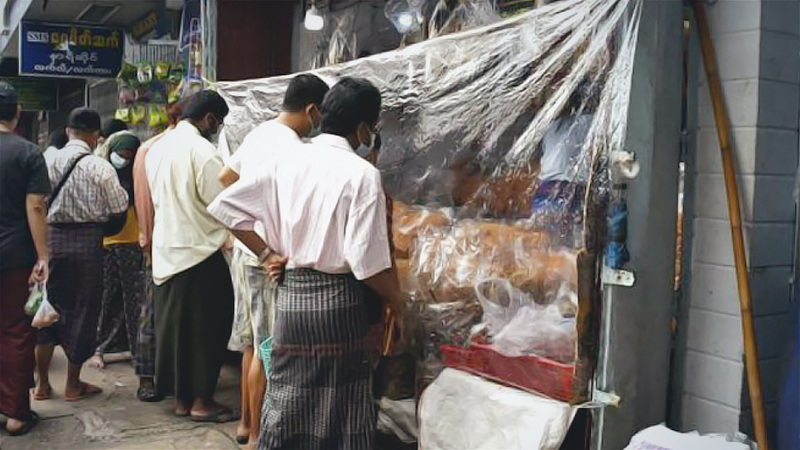
Yangon Region is currently seeing clusters of Covid-19 cases in monasteries, homes for the aged and factories, said Dr Than Naing Soe, spokesperson of the Ministry of Health and Sports.
“Each and every number has their background history. Looking back to the number of cases, we have found clusters. Speaking epidemiologically, it is a cluster. As we have found clusters here and there, the World Health Organization has recognized that our country is seeing clusters of cases rather than seeing cases across the country. We conduct contact tracing. If we found a confirmed case, we traced contacts with that patient. Then we found many contacts. There were about 30 or 40. In some cluster cases, there were up to 70 or 80 contacts,” Dr Than Naing Soe said.
More than half of the number of Covid-19 cases are contact persons, and Yangon has around 40,000 people in quarantine including overseas returnees, according to the Yangon Region Public Health Department.
“Reviewing positive cases, we came to know the point. First, it is markets. We have found many infections coming from markets. Second is monasteries and third is places like homes for the aged. By nature, those places have clusters of people living together. People from those places need to take care of themselves and follow the prevention guidelines,” the spokesperson commented.
Lower House MP Dr Saw Naing from South Oakkalapa Township said 14 monks and three laypersons from Ngwekyaryan Pariyatti Monastery in the township had tested positive for Covid-19.
“Eighty monks and 25 laypersons from the monastery had Covid tests under the arrangement of the township health department. Then, 14 monks and 3 laypersons were infected,” the parliamentarian said.
Recently also, over 300 student monks from a monastery in Insein Township tested positive for the coronavirus. They have now reportedly recovered from the illness.
Labor union plans more protests against omnibus Indonesian law, to prepare legal challenge
InternationalOct 25. 2020Dissent: Workers rally in opposition to the Job Creation Law in Jakarta on Oct. 16, part of a series of protests that began after the House of Representatives and the government enacted the law on Oct. 5. Critics say the law favors investors at the expense of workers and the environment. (JP/Wendra Ajistyatama)
By The Jakarta Post
The Confederation of Indonesian Trade Unions (KSPI) is planning to stage more protests against the recently passed Job Creation Law, or omnibus law, throughout November if President Joko “Jokowi” Widodo decides to sign the law.
KSPI chairman Said Iqbal said on Saturday that members of the union, which are estimated to exceed 800,000 across the nation, would hit the streets on Nov. 1 if President Jokowi decided to sign the law on Oct. 28.
The House of Representatives passed the bill on Oct. 5, giving the President 30 days until at least Nov. 5 to give his approval. The State Palace said on Friday that the State Secretariat had completed the review on the law and it was ready to be signed by Jokowi.
Said added that the union would also file a judicial review against the omnibus law to the Constitutional Court should the President went on to sign the law.
“We will [focus] our protests on the State Palace and the Constitutional Court building [in Central Jakarta], and at the same time, submit a petition for a judicial review,” he said during a press briefing on Saturday.
“[We will continue] our protests until we win and the Constitutional Court issues its ruling,” Said went on to say.
The KSPI will also urge the House to conduct a legislative review on the recently passed law by sending letters to every party faction at the legislative body. The union pinned its hopes on the Democratic Party and the Prosperous Justice Party (PKS) to initiate the review during the House’s plenary meeting on Nov. 9, according to Said.
The two parties opposed the bill in a House plenary session on Oct. 5. The former walked out of the session after engaging in a verbal squabble with House leadership.
The PKS, however, seems pessimistic about the prospects of a legislative review because of its lengthy process.
In order to increase pressure on the House, KSPI members will stage protests on Nov. 9 at the Senayan Parliament Complex in Jakarta as well as in 10 other provinces.
According to the KSPI, several provisions in the Job Creation Law pertaining to labor issues were problematic. They argued that the new regulation, among other issues, removed the previously regulated maximum term for contract-based employment of five years, diminishing hopes for contract workers to be promoted as permanent employees.
Officials stress security of election systems after U.S. reveals new Iranian and Russian operations
InternationalOct 25. 2020Deputy clerk Rachel Quayle tests a voter assist terminal device at a polling station inside Marquette City Hall in Michigan on Tuesday. MUST CREDIT: Washington Post photo by Salwan Georges
By The Washington Post · Amy Gardner, Isaac Stanley-Becker, Elise Viebeck · NATIONAL, POLITICS
WASHINGTON – State and local officials hastened to reassure Americans this week that the nation’s election systems are secure after the country’s top intelligence official accused Iran of sending threatening emails to voters in several states and the United States said Russia obtained voter information from at least one county.
U.S. officials and cybersecurity experts said the activity did not appear to include penetration of voting systems or access to voter registration databases, or the hacking of equipment that could be tampered with to alter election results.
“Arizona’s voter registration database remains secure,” said Murphy Hebert, a spokeswoman for the secretary of state’s office in Arizona, one of the states where Democratic voters reported receiving the threatening emails. “Some information in the voter record is publicly available in Arizona through a public record request, including party registration and, up until recently, emails. We are vigilantly monitoring all election systems.”
Federal and state officials said they have fortified election systems since 2016, when Russian hackers scanned election-related websites and software nationwide for vulnerabilities.
Multiple investigations found that no votes or voting machines were compromised by the Russians four years ago, and election administrators said that even more safeguards are in place now to prevent such an occurrence.
In addition, the threat has further declined this year with the surge of mail voting brought on by the coronavirus pandemic, because the vast majority of Americans are expected to cast paper ballots, which are harder to tamper with and easier to audit and recount, cybersecurity experts said.
Some experts and security advocates, however, said measures implemented since 2016 are insufficient and point to lingering risks such as poorly secured voting equipment and, in some states, the reporting of results from precincts and counties over phone lines. Congressional Democrats have called for hundreds of millions of dollars more for election security, but Senate Republicans have refused.
Election officials also worry that the recent interference by Iran and Russia could create a perception that U.S. elections are not secure, shaking the public’s faith in the outcome, even though no voting systems have been compromised.
In recent days, officials have sought to dispel that notion by publicly detailing descriptions of how votes are counted, how registration lists are maintained, and how federal, state and local officials are on constant alert for attempted intrusions.
“There are groups that are trying to confuse and mislead voters, to sow doubt about the process, and we all have a duty to check our facts,” Meagan Wolf, the Wisconsin elections chief, said during a virtual news conference Thursday.
Fake, menacing emails claiming to be from the Proud Boys, a far-right group in support of President Donald Trump, reached hundreds of Democrats this week, with the bulk of the reports concentrated in Florida and Alaska. They instructed voters to cast their ballots for Trump or “we will come after you.”
U.S. officials quickly attributed the activity to Iran, saying the messages were part of a bid to shake confidence in American democracy, while a spokesman for the Iranian mission to the United Nations called the U.S. allegations “malign and dangerous.”
Jennifer Edwards, supervisor of elections in Collier County, Fla., said her office received about 100 reports from voters about the threatening emails starting Tuesday afternoon, prompting her to contact the FBI. But she emphasized that the senders “did not get into any of our systems.”
“We have done everything that we’ve been advised to do to protect our security infrastructure” since 2016, Edwards said, adding that the Department of Homeland Security as well as state officials have helped inspect the county’s technology.
In addition, federal security officials warned this week that a Russian hacking group known as Berserk Bear, which works for the KGB successor agency FSB, compromised the networks of two U.S. counties. One county was in California and one in Indiana, officials told The Washington Post.
At the same time, federal law enforcement officials urged state and local officials to remain vigilant to the risk of real data breaches.
“We have multiple state and federal partners monitoring our website and all of the voting systems on a routine basis,” said Patrick Gannon, spokesman for the State Board of Elections in North Carolina.
The activity by Iran and Russia pales in comparison with 2016, when Russia spectacularly hacked and leaked Democratic emails, disrupting the party’s national convention and Hillary Clinton’s presidential campaign, and mounted an ambitious effort on social media to try to stoke discord in the United States. In this year’s campaign, major technology companies say they have stopped similar activity emanating from Russia and other countries before the efforts gained significant traction.
The Senate Intelligence Committee concluded last year that Russia probably targeted election systems in all 50 states in 2016, identifying malicious activity more extensive than officials originally acknowledged. The closest hackers came in many states, investigators found, was in probing voter registration databases.
For instance, the FBI investigated a hack of the Illinois Board of Elections in which up to 200,000 personal voter records were compromised, as well as an instance in which a credible threat prompted the Arizona Department of Administration to take its statewide voter registration system offline.
Also in 2016, Logan Lamb, a security researcher in Georgia, claimed to have conducted a so-called do-gooder hack, identifying a vulnerability that enabled him to download the state’s entire voter database and potentially alter registration information. Lamb said in an interview this week that the specific server he identified has since been taken offline.
Intelligence officials and security experts remain concerned that the Kremlin poses the greatest threat of election interference this year, and they fear that Moscow may still try to pull off a surprise.
A breach of voter databases could sow significant chaos, said Theodore Allen, an associate professor of integrated systems engineering at Ohio State University. Changing registration details could throw hurdles in front of certain voters, possibly forcing them to cast provisional ballots.
Still, safeguards are in place to ensure that such ballots are ultimately counted, he said, a point stressed by U.S. officials, who sought to reassure the public that the Nov. 3 vote will not been compromised.
“We’ve been working for years as a community to build resilience in our election infrastructure – and today that infrastructure remains resilient,” FBI Director Christopher A. Wray said at a news conference on Wednesday evening announcing Iran’s and Russia’s activity. “You should be confident that your vote counts. Early, unverified claims to the contrary should be viewed with a healthy dose of skepticism.”
Election administrators also emphasized the many layers of security in place to prevent the ultimate breach of an election system – an attempt to tamper with results.
In North Carolina, all voters will cast ballots on paper, and those ballots will be fed into scanners that are not connected to the Internet, Gannon said.
Once polls are closed on Election Day, memory cards in the scanners are physically transported to county election headquarters, where tabulation results are uploaded to a computer that is also not connected to the Internet. The results are then transferred to another memory card, and uploaded to a different computer that is connected to the county and state systems.
In addition, voting machines and scanners are tested ahead of the election to make sure they have been programmed to record voters’ choices correctly, he said. Poll books used to check voters in at polling locations are not connected to the Internet while in use.
Vote tallies will be audited after the election in several ways, Gannon said. For instance, the number of voters who check into a particular voting location will be matched against the number of votes tallied at that location. In addition, election officials in every county must hand-count the ballots in two randomly selected precincts to ensure that vote totals match the tabulation results from the digital scanners. Any irregularities would prompt an investigation and a delay in election certification.
Similar procedures are in place in Georgia, said Gabriel Sterling, the statewide voting system implementation manager for the Georgia secretary of state’s office. Unofficial results are compiled at counties’ election headquarters and then sent to the state’s election night reporting – via Internet connection – but official results are hand-delivered in a padlocked bag via a memory card that has never been connected to the Internet, he said. “We have chain of custody on all this stuff,” he said.
Experts say that the biggest vulnerability lies in paperless voting machines, which are used in a handful of states. Jurisdictions that use hand-marked paper ballots have the greatest level of protection against malicious activity, said David Jefferson, a computer scientist at the Lawrence Livermore National Laboratory and a board chairman for Verified Voting.
“Wherever there are machines in the system, we worry about the software, even if it’s not hooked up to the Internet during the election,” he said, noting that some states, including South Carolina, have shunned paper ballots in favor of voting machines.
Some government websites that display public information lack sufficient security, some experts say.
For instance, recent research by McAfee, a cybersecurity company, found that “significant majorities” of county government websites use web addresses that do not use the “.gov” domain-naming system, which adds an extra layer of protection against efforts to trick voters into visiting inauthentic sites.
In addition, at least nine states, including battleground Michigan, do not conduct post-election audits, according to the National Conference of State Legislatures.
“Unfortunately, we did not adopt much-needed minimum election safeguards nationwide following the revelations of 2016,” said Susan Greenhalgh, a senior adviser on election security for Free Speech for People, a nonprofit organization that advocates against special interests in politics and has been critical of the voting-machine industry. “Significant gaps remain in the security of our election infrastructure, largely because many election officials may not have a clear understanding of the inherent security risks of the technology and the threats we face.”
An additional factor this year is the diversion of millions of federal dollars directed to states to shore up election security. With the onset of the coronavirus pandemic, the U.S. Election Assistance Commission (EAC) authorized states to spend some of that money on measures meant to prevent the spread of the virus, such as protective equipment and sanitizing supplies.
It’s not known how much of the $800 million in election-security funding was diverted to coronavirus protections, said Benjamin Hovland, a member of the EAC.
Election officials as well as cybersecurity experts said the greater risk this year is disinformation involving claims of a hack, rather than a hack itself. “Telling people votes can be hacked is a disinformation tactic we saw from the Russians in 2016 and feeds into its own type of election hack,” said Maggie MacAlpine, co-founder of Nordic Innovation Labs, a cybersecurity consultancy.
Although one in five voters in 2016 used paperless machines to cast their ballots, Larry Norden, director of the Election Reform Program at the Brennan Center for Justice, estimated that 96 percent of people this year will use paper ballots, whether by mail or in person.
Online systems for registering to vote, as well as requesting and tracking mail ballots, also give voters a chance to monitor their own records. And election officials are creating more regular offline backups of voter registration data and public information websites, he said.
“There may well be more intense efforts over the next couple of weeks to push disinformation, to sow doubt about the system,” Norden said. “My best advice to the public and to voters is to tune it out.”
Joanna Lydgate, the national director of the Voter Protection Program, said during an online panel discussion on Thursday: “We want to be really clear that voting is safe. It’s secure. Your vote is private. No one, not even election officials, can see who you vote for. And the best way to defeat misinformation like this is to vote.”
By The Washington Post · Andrew Freedman · NATIONAL, SCIENCE-ENVIRONMENT
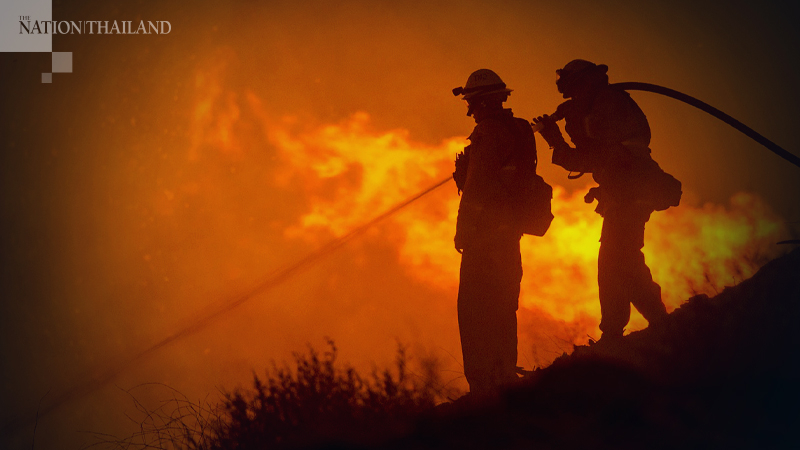
Colorado’s East Troublesome Fire, the second-largest fire in state history, is roaring amid high winds Saturday through timber stands and rugged terrain in Rocky Mountain National Park, threatening the community of Estes Park to the east. The fire has killed two, with the confirmation that an elderly couple was killed while trying to ride out the blaze at their home near Grand Lake.
The fate of Estes Park is now a race between fire and ice, as a snowstorm is due to hit Saturday night and last into Sunday, and is likely to halt the fire’s spread. In anticipation of continued fire growth before then, however, eastern areas of Estes Park have been added to mandatory evacuation orders – the western side of town had been evacuated Thursday – and firefighters were taking steps to defend the town.
Some reports show the fire may have moved significantly closer to Estes Park overnight – perhaps as close as one mile, with firefighters calling in more resources Saturday. In a morning video briefing Saturday, Paul Delmerico, operations section chief on the fire, said the fire is “just west” of the Bear Lake area in Estes Park.
The high winds are preventing fire suppression aircraft from flying, and firefighters are using satellite imagery to locate the blaze. He cited “Very dynamic extreme conditions that we’re working with” as a reason for concern.
“We’ve got a heck of a day ahead of us,” Delmerico said. “We’re going to do everything we can with our folks to try to deflect the fire from Estes Park.”
Winds in Estes Park on Saturday morning were gusting to about 50 mph out of the west, with temperatures that are expected to climb into the 60s with extremely low relative humidity. Even stronger winds are in the vicinity of the fire at higher altitudes.
Red flag warnings are in effect for the Rockies as low humidity combines with high winds to create “critical” fire weather, the second-most severe category on the fire risk scale. The Cameron Peak blaze, located just a few miles from the East Troublesome fire and the state’s largest on record, is also expanding Saturday, satellite heat detections show. There is even a possibility the two fires could merge before the cold front settles the blazes Saturday night.
At higher elevations where the fire is especially active, snowfall amounts later this weekend are forecast to exceed a foot, which will lead to the odd juxtaposition of a flame-filled surface and snow-covered trees and ground areas.
“Imagine a foot of snow over those hot fires!” wrote the National Weather Service forecast office in Denver in a forecast discussion posted Saturday morning. By Monday, temperatures in the fire area are expected to be in the single digits to below zero Fahrenheit, though it’s not clear if this will be enough to completely extinguish the blaze.
The dual threats from fire and snow point to the rarity of high altitude blazes at this time of year in Colorado, when winter typically settles in. No fire on record in Colorado that has started this late in the season has become nearly as large, putting the blaze in uncharted territory and showing all the signs of climate change.
The fire has been so severe it jumped the continental divide, a span of two miles that contains mainly rocky terrain. The fire grew an astonishing 140,000 acres in size between Wednesday afternoon and Thursday.
According to Nick Nauslar, a predictive services meteorologist with the National Interagency Fire Center (NIFC) in Boise, Idaho, having a wildfire jump the divide has happened in other fires before but is an extremely rare occurrence.
The fire is largely burning at an elevation of 9,000 feet at a time of year when snow should be falling. The fire is raging during a severe drought, aggravated by record heat, through stands of trees killed or weakened by a years of a bark beetle infestation. The harmful beetles are a phenomena linked to climate change that is occurring across vast stretches of the West and into Canada.
As temperatures have increased in Colorado, it has given once-scarce pests, formerly held in check by extremely cold winter temperatures, an opportunity to spread and damage or destroy trees. Studies have shown that in some ecosystems, these dead or weakened trees can accelerate blazes, while in others they may actually slow down some wildfires.
In 2020, the Colorado fire season has been especially severe and has stretched longer than in modern memory. The three largest fires on record in Colorado have all occurred this year, with the top two, East Troublesome and the Cameron Peak Fire, still burning.
Biden rises in popularity despite doubt and attacks
InternationalOct 25. 2020Supporters listen to former vice president Joe Biden during a drive-in event at Dallas High School in Dallas, Pa. MUST CREDIT: Washington Post photo by Demetrius Freeman
By The Washington Post · Matt Viser · NATIONAL, POLITICS
Democratic presidential nominee Joe Biden has endured a long and bruising campaign, with repeated attacks on his policies, his family, his mental faculties – and, often, sustained doubts even from those inside his own party.
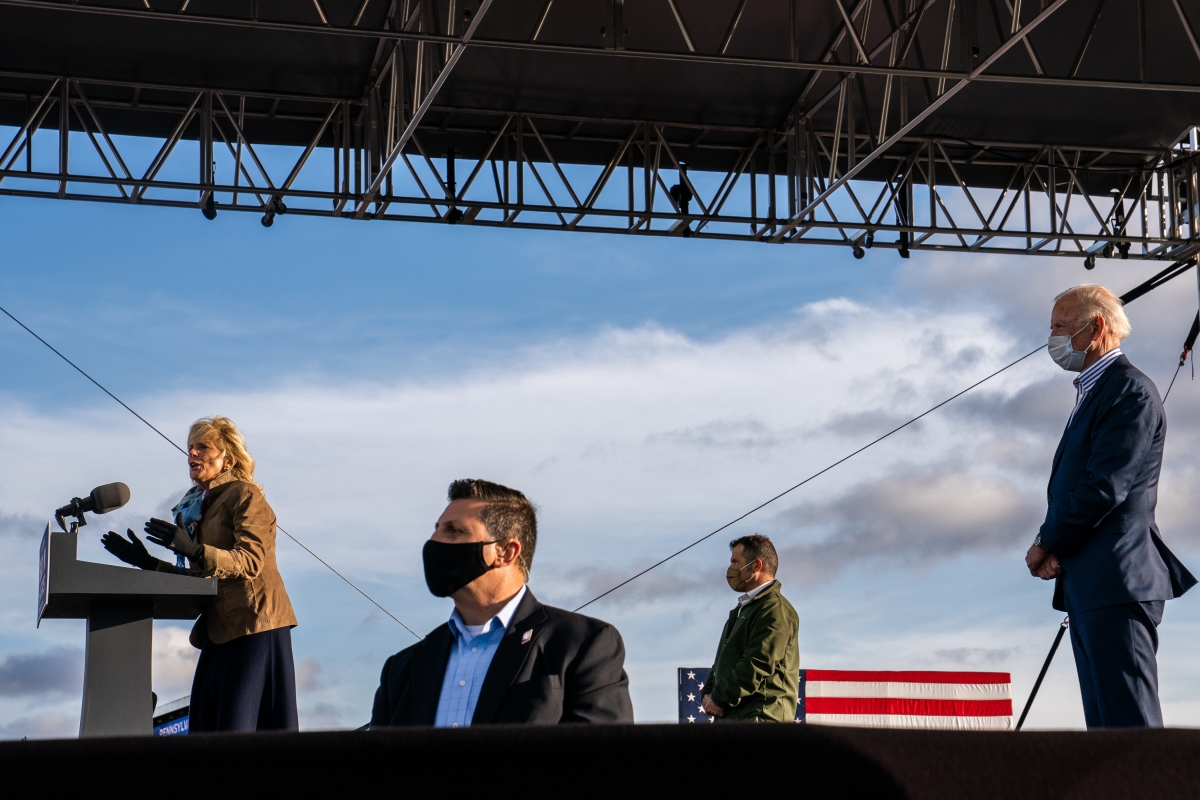
Jill Biden delivers remarks during a drive-in event for her husband, presidential nominee Joe Biden, at Dallas High School in Dallas, Pa. Jon Bon Jovi took part in the event. MUST CREDIT: Washington Post photo by Demetrius Freeman
Democrats spurned him in the early primary season contests and worried throughout the fall in a general election that began with Biden under fire for campaigning mostly from his basement. Party factions feared Biden would fail to shore up the Democratic base or that he had lost a step due to his age. Allies fretted he would stumble in debates with President Donald Trump and his gaffes would give ample material to his tenacious opponent.
But the circumstances of this campaign – a pandemic and an economic collapse costing millions of jobs and making even the still-employed feel vulnerable – have pushed the race in the direction of Biden’s strong suits and against his deficits, shining a bright light on his empathy and sober experience and casting his flaws into the shadows.
He has emerged with more Americans viewing him favorably now than at this time last year, the opposite of the usual trajectory of a campaign and far different from the circumstances that faced Hillary Clinton in 2016. He holds a national lead approaching double digits and narrower but stable leads in many battleground states. He enters the final stretch with far more money to spend than Trump as he reaches for the pinnacle of a political career, one that has eluded him twice before.
The closing days of one of the most unusual presidential campaigns in history conclude years of Democratic anger and angst over how to defeat the man they view as a historically damaging figure in American politics. Biden’s approach, however, has relied on the same traits and tactics he has utilized over the past half-century in politics.
He has tried to exude hope and optimism despite the raw and painful circumstances enveloping the country. He has clung to bipartisanship despite the country’s deep polarization, ignoring raised Democratic eyebrows when he tells his donors, as he did two weeks ago, “For those of you who are Republicans, I promise I’m not going to embarrass you.”
The remarkably consistent approach has gotten Biden to the cusp of election, but with almost a week until Election Day, even some of his closest allies remain deeply anxious about a single question: Can he actually pull it off?
“I was always in love with the guy, but I don’t know that it was clear this was the match for who this guy is – the character, personal tragedies . . . his inclination to find common ground – even when folks in his own party pooh-poohed that,” said Gov. Phil Murphy, D-N.J. “But you could not construct a better candidate, a better match for this country.”
“I think we underestimated him. As a party, we underestimated him,” Murphy said. “There was just a maturity, a moment when our party – for better or worse – looked in the mirror and said, ‘Wait a minute. We must come together at all costs; we must nominate a responsible leader who will be professional, who will put partisanship aside when need be.'”
Biden has brought into public view an existing chip on his shoulder but always directed it at Trump. He has contrasted his lack of relative wealth when compared to the president as “Scranton versus Park Avenue.” He has touted his degree from a public college, saying those with Ivy League degrees have looked down on people like him. But he has not let slip any consternation toward members of his own party, save for noting when attacked by Trump as a socialist that he defeated the more liberal elements of the Democratic coalition.
“People working on this campaign two years ago said the party had passed Biden by,” said one person close to Biden, speaking on the condition of anonymity to be candid. “He will never say this, but there’s got to be some, ‘I told you so.’ People say he’s this blue-collar, retail politician. But he also got 100 percent exactly where the country was and the party was.”
Biden has tinkered with some surface factors. In Thursday’s final debate, he seemed to smile and laugh more often than previously, attempting a more dramatic contrast with the often dour Trump. But Biden’s message was the same as when he was finishing in a distant fifth place in February’s New Hampshire primary, before a predominantly Black electorate in South Carolina resurrected his candidacy.
“He feels good,” said Christopher Dodd, the former Connecticut senator and one of Biden’s veteran confidants. “He’s not overconfident. But he feels he has done what he needs to do against an extraordinary opponent – and extraordinary is meant negatively.”
“Joe believes, and his staff does, that it’s going to be close. That’s not just campaign hype,” he added. “They’re worried because they see the country divided. I think he’s spending as much time thinking about that and how do we solve that problem than he is anything else. But he’s cautiously optimistic.”
Biden’s closing message has centered on unity as much as it has a rejection of the incumbent. His campaign aired, during the World Series and elsewhere, a 60-second ad featuring iconic images of America as deep-voiced Sam Elliott, the actor known for gunslinging roles as the quintessential cowboy, talked about dignity, a fresh start and common agreement.
“This is an overused term, but he’s a happy warrior. He’s always been the same. He feels comfortable who he is and doesn’t try to be anybody he’s not,” said Harry Reid, the former Senate majority leader. “He tries really hard, works hard. And you don’t find him often depressed or disgruntled or angry. That’s not who he is.”
If campaigns draw out generalizations, Biden has been steady and plodding to Trump’s erratic and sensational. Trump can feel like a speedy train on the verge of flying off the tracks; Biden is a less remarkable ride in the quiet car. While Trump refuses to cede the spotlight, Biden has grown comfortable at times fading to the background and yielding to others in his party.
Biden has placed a big bet that most of the country shares his optimism and will cast aside a president whose first speech in office centered on “American carnage,” who tried to fan fears of minorities, cast urban centers as hellscapes and called his political opponents criminals.
Biden’s positioning carried risk, not the least in the Democratic primaries. He was not the candidate riding the left’s energy and vowing to start a revolution like his chief rival, Sen. Bernie Sanders, I-Vt., or the one who would make history like his former partner, Barack Obama, or the several female candidates Biden vanquished this year, including eventual running mate Sen. Kamala Harris, D-Calif. His wife, Jill Biden, regularly pitches her husband’s ticket by promising that under a Biden administration Americans will be able to read the newspaper and not get upset.
As the campaign reaches its final stretch, Biden’s campaign and his allies have cast him more and more as an empathetic grandfatherly figure, one who his opponents derisively compared to Mister Rogers. When a Trump campaign official made the comparison during a Biden town hall, Biden and his campaign welcomed it.
“A few weeks ago, I spoke to Mr. Rogers’ wife Joanne when I was in her neighborhood in Pittsburgh. It was a great conversation,” Biden wrote on Twitter. “Friendship, empathy, kindness, and compassion – I think we could all learn a thing or two from her and her husband’s example.”
Biden has benefited from his upswing in personal popularity. A Fox News survey this month had Biden with a net positive favorability rating of 16 points – with 57 viewing him favorability and 41 viewing him unfavorably – compared with negative 10 points for Trump.
By any number of polls, that made him far more popular than Clinton was four years ago – giving Biden a cushion Democrats did not have in 2016. At the end of the 2016 campaign, Clinton was viewed unfavorably by 52% of Americans, according to a Gallup survey, which was the second worst in history behind Trump, who was viewed unfavorably by 61%.
“I didn’t realize until after the votes were counted that a lot of people did not like her,” said former North Carolina governor Jim Hunt, a Democrat who supports Biden. “They just didn’t like her. A lot of women. A lot of White women. And Blacks weren’t enthusiastic about the ticket.”
“That’s different now,” Hunt continued. “There’s not anybody who doesn’t like ol’ Biden . . . Maybe they don’t love him, but they like him.”
The contrast with Trump has fueled another necessity – keeping his party united around him or at least united around opposition to the president. The major intraparty fights that were on full display four years ago have receded, which his campaign credits in part to Biden’s personal relationship with Sanders.
“They say in life timing is everything. This is the perfect time for Joe Biden to be running for president, as himself,” said Ted Kaufman, who has been one of Biden’s closest advisers dating back to his first Senate race in 1972. “That’s what wins people over. That’s who he is. What makes it more powerful in this race is it happens to be the total opposite of President Trump. So the contrast is really, really stark.”
“He is the total opposite of President Trump. That’s his message,” Kaufman said. “All the things he’s been known as for years – concern about family, concern about religion, about being honest with people reaching out to people – all go back to 1972. He’s had this constant optimism.”
But while shared animosity toward Trump has allowed Democrats to paper over very real policy differences between the party’s wings, those disputes are likely to flare anew, should he win. All sides expect fights over health care and climate policy, and disagreements over court restructuring and infrastructure spending.
“We have got to win this election,” Murphy said. “Let’s worry about differences after the election; let’s not litigate them before the election. There are proud factions, folks proud of their principals in our party. But everybody – everybody – is checking that at the door right now. They are doing everything they can to get this guy elected . . . Will there be debates post-election? Yes.”
As the election verdict nears, this campaign increasingly echoes Biden’s past efforts, whether his seven successful Senate races or his two failed presidential attempts. The sons who defined Biden’s first entry into big time politics – he was sworn in as a senator at their hospital beds, after a car crash that killed his first wife and daughter – are still central to his campaign nearly half a century later. His late son Beau, who died of brain cancer in 2015, remains his father’s stated inspiration. His son Hunter has made almost no public appearances on behalf of his father but has become the face of Trump’s attempt to cast the Bidens as a family willing to trade political influence for personal profit. Biden’s emotional response to Trump’s mockery of his son made it one of the key moments of the first debate.
The Trump campaign has pointed to emails Hunter Biden purportedly exchanged with business partners at a Ukrainian gas company, including one in which a colleague thanked Hunter for “an opportunity” to meet his father. The Biden campaign said the vice president’s schedule indicated no such meeting took place.
The Washington Post has not been able to independently verify the emails. The Post has on multiple occasions asked presidential attorney Rudy Giuliani and former adviser Stephen Bannon, who helped make the materials public, for copies of what they allege is Hunter Biden’s hard drive but has received no response.
Biden allies say he expected such criticism from Trump and it weighed on him before entering the race.
“I looked him in the eyes and said, ‘You’ve got to be prepared for the near certainty that Donald Trump will make stuff up and throw it at you over and over and over. And it will be unpleasant and it will be difficult,'” said Sen. Christopher Coons, D-Del. “‘But you can bring us together. This guy is dividing us and pouring fuels on the fires.’ And he ended up saying, ‘You’re right. I’m the person who can beat this guy. And he can be beaten.'”
During an ABC town hall, Biden was asked what it would say about the country if he were to lose.
“Well, it could say that I’m a lousy candidate, and I didn’t do a good job,” Biden said. Then he continued on.
“But I think – I hope that it doesn’t say that we are as racially, ethnically and religiously at odds with one another as it appears the president wants us to be. Usually, you know, the president, in my view, with all due respect, it’s been divide and conquer, the way he does better if he splits us and where there’s division. And I think people need hope.”
Trump bets on a 2016 replay, but faces a changed landscape
InternationalOct 25. 2020Supporters of President Trump were on hand for a rally on Friday in Florida. MUST CREDIT: Photo by Evelyn Hockstein for The Washington Post
By The Washington Post · Michael Scherer, Josh Dawsey · NATIONAL, POLITICS
WASHINGTON – President Donald Trump and his advisers are betting on a high-octane replay of the closing two weeks of his 2016 campaign, with nonstop travel for packed rallies filled with attacks on alleged Democratic corruption in a bid to reignite the outsider spirit that defied the polls once before.
Despite health authorities discouraging his largely maskless outdoor events and an opponent who has maintained strong favorability ratings, Trump is urgently trying to reassemble the core elements of his 2016 upset win: news coverage of red-hatted spectacles, calls for a criminal investigation of his rival and the mischaracterization of allegedly leaked documents in the final stretch of the campaign.
A Trump rally in Ohio on Saturday showed how much he is reaching back to 2016. He told the crowd, apparently referring to wrongdoing by his opponents, “there’s something going on. It happened this time four years ago. This time more.”
The crowd began a “lock him up” chant – an echo of the “lock her up” calls against Hillary Clinton – after Trump described alleged spying on his campaign by Joe Biden and former president Barack Obama. Trump then pretended to tell the crowd to stop, saying mockingly: “It’s much better if I say, ‘No, no, no, please.’ “
Trump advisers say data from the rallies and fundraising indicate a late surge in support is again possible, despite polls that show the president trailing. “There are striking similarities to the president’s campaign in 2016 – a tight race, an enthusiasm advantage and clear momentum down the stretch for Donald Trump,” campaign manager Bill Stepien said between stops Saturday, as Trump attended three events. “It just feels right again.”
Democrats dismiss the narrative that conditions are coalescing for a repeat of 2016 as wishful thinking on the part of a president who is clearly losing. Beyond the specter of a devastating pandemic that he has failed to contain, they say, Trump is now the incumbent, with a record that has energized Democrats in an almost unprecedented way.
Voters four years ago may have been unsure what a Trump presidency would look like, and many were willing to gamble. This time, the Biden team argues, voters are looking for calm and competence, not braggadocio and chaos.
Indeed, for most of this year, Trump’s attempts to draw parallels to his first campaign ran headlong into harsh epidemiological realities. The coronavirus pandemic forced him to scale back and cancel events, including two versions of his nominating convention, and his handling of the issue has alienated key segments of the electorate. Most strikingly, Trump’s own bout with the novel coronavirus forced him off the campaign trail for several days.
Trump continues to dismiss coverage of the health crisis as a political tactic by his opponents to scare the American people.
“Turn on television, ‘covid-19, covid-19, covid-19, covid-19, covid-19, covid-19.’ A plane goes down, 500 people dead, they don’t talk about it,” Trump said at an event in Lumberton, N.C., on Saturday. “By the way, on November 4th, you won’t hear about it anymore. It’s true.”
Federal officials announced Friday that more than 80,000 Americans had tested positive for the coronavirus, the highest daily number this year of positive tests in a pandemic that has already killed at least 224,000 people in the United States and at least 1.15 million people worldwide. The airplane crash Trump described was apocryphal.
In Trump’s tight circle, the priority is re-creating the campaign spirit that won Trump the White House in the first place. Large gatherings give Trump a personal morale boost; his aides have been joking on Air Force One about the relatively quiet optics of Biden’s drive-in events.
They also point to a $26 million fundraising haul this past week in a 24-hour period after the debate.
“In 2016, we saw a similar surge in grass-roots donations after the last debate,” said Trump campaign spokesman Tim Murtaugh. “The surge in grass-roots support has now happened, and last time was followed by movement in the polls.”
Trump is one of the few political figures to reach the presidency without having run any previous political races. Most presidents have not only won several earlier campaigns, but have also generally lost at least one, giving them a sense of how a shifting political landscape can dictate varying tactics and different strategies.
Beyond that, Trump’s first run was marked by improbable events and repeated warnings that he could not win, only to have him score one of the biggest upsets in presidential history, a dynamic that gives his allies hope this time around.
Yet Trump is facing a very different kind of opponent than Clinton, who was broadly unpopular. Biden’s favorability has increased slightly since his August convention, according to multiple polls, while Trump’s lower favorability remains basically unchanged. Biden is viewed far more positively than Clinton, despite the tens of millions of dollars that have recently been spent to sully his reputation.
“In 2016, you had the unprecedented situation with both major-party nominees having a favorable rating that was significantly underwater,” said Democratic pollster Joel Benenson. “You also had an open seat. This is a referendum on Trump.”
Yet nostalgia for the last campaign remains a throughline of Trump’s stump speech. As he did with Clinton in 2016, Trump has argued that his opponent should be investigated and imprisoned. He compares the alleged laptop of Biden’s son Hunter to a laptop owned by the husband of a Clinton 2016 aide, which led to a late-campaign announcement by the FBI that some emails of the Democratic candidate had been uncovered.
“This is called the laptop from hell,” Trump said in a riff at a recent event in Arizona, discussing the device allegedly owned by Hunter, a fact that has not been confirmed by The Washington Post. “The only laptop that was almost as good, maybe worse, was the laptop of Anthony Weiner. Do you remember that? Ding, ding, ding, ding.”
Aides even sought to replicate the 2016 surprise of bringing accusers of Bill Clinton to meet the press before one of his debates with Hillary Clinton. But this time, the guest, Hunter Biden’s former business partner, did not attract as much attention, and Trump himself did not join the business partner for the appearance.
The Trump campaign is being run and advised almost entirely by people who went through the 2016 campaign with him. They say they have the same sense of a scrappy underdog campaign, with a money disadvantage, an overconfident opponent who travels less and polls that say they are going to lose.
But those same aides express frustration at the seismic shift in press coverage. In smaller local media, Trump’s rallies continue to get enormous attention, amounting to tens of millions of free advertising a week, according to internal campaign analyses.
But the national media has shifted its approach to both Trump’s rallies and his accusations of corruption against the Biden family, treating documents that allegedly surfaced on a laptop once owned by Biden’s son with marked skepticism.
“The biggest difference between ’16 and ’20 is the coverage of what I will call corruption; other people might call it something else,” said a campaign official who spoke on the condition of anonymity to speak more frankly. “People paid attention to it in 2016. People reported on it. But they are not this time around.”
Cable news networks in 2016 carried Trump rallies with a certain breathlessness, sometimes showing the empty stage as the crowd awaited the candidate’s arrival. This time, they often decline to cover the spectacles live, while interviews, a key way for Trump to broadcast his message in 2016, have become far more confrontational as journalists pick through his record. Trump prematurely ended an interview this past week for CBS News’s “60 Minutes” after objecting to questions from reporter Lesley Stahl.
More broadly, Democratic voters in 2016 were badly divided, and many were complacent, with little doubt that Clinton would prevail. In contrast, Trump’s first term has largely unified the American left.
Aides have pushed Trump to return to the 2016 outsider theme, and the president himself has said he fares better as an “outsider.” In recent days, several aides have said he’s in the best mood in months now that he’s going on the road and basking in the adulation of crowds. In addition, some of the president’s closest advisers work to show him positive polls to keep him happy.
Trump’s political advisers met two weeks ago to reassess their advertising strategy, worried about viewing the election as an up-or-down question about Trump’s performance. They recently shifted their advertising spending away from defending Trump’s record toward attempts to scare people about Biden’s policy priorities.
A new Trump ad this past week – which was run more than any other spot during the week, according to Advertising Analytics – makes no mention of Trump’s record, the coronavirus or crime. It asks instead what a Biden victory would “mean for you,” and it then predicts higher taxes, higher gas prices, higher utility bills, lower income and fewer jobs.
A concurrent new $25 million television push by the Republican National Committee features a direct-to-camera ad not from the president, but from a gray-haired actor playing a senior concerned about Biden changing Medicare in a way that would purportedly close hospitals and separate voters from their doctors.
The campaign has also begun playing a video at the start of rallies that cuts between a tense Democratic primary debate exchange that Biden had about cutting entitlements such as Social Security and Medicare, as well as decades-old comments he made when he was open to entitlement cuts as part of larger budget revision. Biden’s campaign has promised not to cut either program if he is elected.
The overall goal is to argue to traditional Republicans who may have doubts about Trump that whatever the president’s flaws, Biden is a tax-and-spend liberal who would make life worse for many Americans.
The Biden campaign argues that Biden has been a moderate for a half-century in politics, and that voters will not buy into Trump’s portrait of him as a socialist.
“He has been forced to divest from making a case for himself and is instead resorting to even more wild-eyed, projection-based lies about Joe Biden that have failed him for months and that fact-checkers have already carved to pieces,” Biden campaign spokesman Andrew Bates said in response to the ads.
The Trump campaign is also in an even weaker relative position than in 2016 when it comes to money available for television ads. Over the four weeks ending Oct. 24, 2016, the Trump and Clinton campaigns were evenly matched on television, with Clinton spending about 8% more in total, according to Advertising Analytics.
This time, the two campaigns are much farther apart, with Biden’s campaign spending 2.3 times what Trump has spent over the past four weeks.
None of this has stopped Trump from claiming that he’s in a stronger position than he was in 2016, an assertion that has been encouraged by Trump’s advisers who believe he is a more effective salesman for himself when his spirits are high.
At a private fundraiser in Nashville before Thursday’s debate, Trump said he felt like he could drive a golf ball 50 yards farther than retired golfer John Daly, who was known in his day as one of the longest drivers in the game.
“We have the strongest base, probably ever in politics. Our people are coming out. Whether it’s rain or snow or sleet, our people are coming out,” Trump said, predicting record turnout.
He returned repeatedly to reliving the glory of the 2016 campaign, recounting at one point watching CNN’s John King narrate election returns with a digital map.
“Everything’s red, the whole thing is red,” Trump said, recalling the moment. “And I would say – and it’s very early yet – and I would say we are much stronger right now than four years ago.”
Home tests could help in the fight against the coronavirus. So where are they?
InternationalOct 25. 2020Adm. Brett Giroir, assistant secretary of Health and Human Services, swabs his nose to demonstrate a rapid-result covid-19 test at the White House Rose Garden on Sept. 28, 2020 in Washington, D.C. MUST CREDIT: Photo for The Washington Post by Oliver Contreras
By The Washington Post · William Wan · NATIONAL, HEALTH, SCIENCE-ENVIRONMENT, HEALTH-NEWS
WASHINGTON – Ten months into the coronavirus pandemic, the promise of a rapid and inexpensive at-home test for the virus remains unfulfilled as companies struggle to overcome final regulatory hurdles.
The technology for such tests exists, and early versions are being used in nursing homes and schools. But companies racing to bring the tests to the wider U.S. market must make them more accurate and easier to use before they can meet federal guidelines that would allow sales directly to consumers.
Although no single test will end the pandemic in the United States, experts say the ability for people to take a test at home and know within minutes whether they’re infected could be an important component in stanching the spread of the virus.
Such a test could be taken several days ahead of a visit with grandparents, for example. Or before heading into work. And if a local outbreak occurs, officials could hand out hundreds of at-home rapid tests to find and stop viral transmission.
“At a time when so many people feel like they’ve lost control of so much of their lives, it would put power back in their hands,” said Mara Aspinall, a biomedical diagnostics professor at Arizona State University “That’s no small thing.”
Some retailers, including Costco, have begun selling home tests to consumers, but they are costly – about $130 – and require people to mail their sample to a lab and wait 24 to 48 hours for results. The rapid tests now being developed could cost as little as $5 and take 15 minutes for results.
At least two dozen companies are trying to develop home tests, most of them antigen tests that detect proteins on the surface of the virus. Some companies are tantalizingly close to clearing final barriers.
In July, the Food and Drug Administration issued guidelines making clear that any home test needs to be accurate and easy enough for untrained people to use without confusion.
Since then, the agency has not received any applications from companies for home tests, the agency said.
“It is hard to do. There’s a reason no one has gotten FDA approval yet,” said James Li, founder and chief executive of Cellex, a biotechnology company that has been working for months on an at-home test. The FDA is requiring that antigen tests sold directly to consumers be more accurate than most antigen tests to date, because consumers at home will be left to interpret the results on their own.
Li said the challenges to developing home tests are significant but not insurmountable. He would not say how close his company is to meeting those requirements but said his firm and others recognize that with cases rising, such a test could prove useful this winter.
“You don’t want people who are possibly infected going into clinics and hospitals to get tested,” Li said. “A home test addresses that problem.”
Fearing their stringent guidelines may seem onerous to companies, FDA officials wrote an op-ed last month clarifying their expectations.
The officials said that if some home tests fall short on accuracy, one option might be to sell them but require a doctor’s prescription or consultation. Or they could be sold in packs of two or three, using multiple tests to compensate for loss of accuracy.
“Our recommendations are just that — recommendations,” the officials wrote. “We welcome developers with alternative proposals to come talk with us.”
Experts, however, have expressed skepticism and concern about widespread use of such tests. More evidence is needed, they say, pointing to the false results that rapid antigen tests sometimes generate and the logistical problems associated with collecting data on their results — data that are invaluable to public-health officials responsible for tracking the pandemic and attempting to slow it.
Because antigen tests are less sensitive, they can produce false negatives – causing people to think they’re fine when they are in fact infectious. In recent weeks, there also have been increasing incidences of false positives – when people are identified as being infected but aren’t.
Health officials in Nevada ordered nursing homes to stop using antigen tests but reversed course when Trump administration officials threatened to take action against them. Officials in Maine and Vermont and National Football League teams also have encountered recent instances of false positives.
“We don’t want to overpromise. Home tests are not going to solve all the problems. They are just one piece of the puzzle,” Li said.
People screening positive on the home antigen tests could have their status confirmed with polymerase chain reaction (PCR) tests – a molecular process that is more precise but more expensive and takes longer.
Experts said home tests could make an outsize difference in areas at high risk for outbreaks and in rural areas.
“Imagine at the very beginning of an outbreak if you could arm contact tracers with these rapid antigen tests,” said Yuka Manabe, an expert in infectious-disease diagnostics at the Johns Hopkins Bloomberg School of Public Health.
One of the newest antigen tests, the Abbott BinaxNOW, uses a small paper card, costs $5 and can yield results in 15 minutes. Using a shallow nasal swab, the test yields results that can be read from the card like a pregnancy test – a color-coded line indicates testing positive. The test has been deployed mainly in nursing homes and schools, and administered by health professionals.
Some experts argue that the less sensitive nature of antigen tests could actually be an advantage, because they could be effective at catching those with the most viral load when they are most contagious.
The main advantage, however, is their speed and low cost, making them easier to scale up to meet the demand for more testing. The molecular PCR tests that are most commonly used can cost upward of $100 each. It remains unclear whether home tests would be covered by private health insurance plans and the nation’s major government health plans, Medicare and Medicaid, because they would often be used to test people who do not have symptoms.
About 30 million coronavirus tests a month are being conducted in the United States, according to the Covid Tracking Project, a volunteer initiative chronicling the pandemic. But the country needs about 193 million tests a month just to address outbreaks in nursing homes and to reopen schools, according to a recent Rockefeller Foundation report. Other experts have argued that even larger-scale testing is needed.
One reason antigen tests are a powerful tool for screening large numbers of people is they don’t require a large lab to produce results. They can be performed wherever needed at points of care, including nursing homes, schools and clinics.
By January, U.S. companies may be able to produce almost 200 million such point-of-care tests a month, said Aspinall, who researched industry production capacity for the recent Rockefeller Foundation report. By April, they may be able produce almost 230 million a month.
Increasing U.S. testing on such a scale could bring a sea change to the country’s pandemic response. “But it all depends how we use them,” Manabe said.
One significant problem looms with home tests: collecting the results.
Because labs are not involved in such tests, there is no way to report the results. Without that data, the country would be flying blind as it navigates later stages of the pandemic, experts fear.
“It’s not an insurmountable problem, but we need to think big to tackle it,” said Michael Mina, an infectious-disease expert at the Harvard School of Public Health. “The federal government should be working with companies like AT&T, Apple and Verizon to tackle it. Why not make it reportable via a text message? ‘Did you take a rapid test? If positive, press 1.’ “
Another fear is that rapid home tests could give people a false sense of security.
“There’s a misperception that one negative test means you’re not at risk,” said Mark McClellan, FDA commissioner during the George W. Bush administration and now director of the Duke-Margolis Center for Health Policy.
Although many have compared the design and ease of future home tests to pregnancy tests, he said, “the difference is you can test negative in the morning and be positive by night. It’s likely to work best when done on a repeated, ongoing basis. We don’t have the capacity quite yet to do that.”
It also remains unclear how willing people will be to adopt frequent, widespread home testing.
“It can’t be the only thing we’re doing,” said Gigi Kwik Gronvall, a testing expert at the Johns Hopkins Center for Health Security. “Because it depends on collective planning and action. We can’t even get our act together on masks. It’s unclear whether we would be able to do so on home testing.”
Polish President Andrzej Duda tests positive for coronavirus
InternationalOct 25. 2020Polish President Andrzej Duda speaks as exit polls are announced near Pultusk Castle in Pultusk, Poland, on July 12, 2020. MUST CREDIT: Bloomberg photo by Piotr Malecki
By Syndication Washington Post, Bloomberg · Adrian Krajewski · WORLD, HEALTH, EUROPE, HEALTH-NEWS
Polish President Andrzej Duda tested positive for coronavirus, his spokesman Blazej Spychalski wrote on Twitter on Saturday, as the chancellery goes into quarantine.
The president, who on Friday visited the National Stadium in Warsaw, where Poland is putting together a special covid-19 hospital, and also met with French Open winner Iga Swiatek, is feeling well, the spokesman said.
The news came as Poland registered a record number of covid-19 cases in four of the last seven days, prompting the government to announce new limits on gatherings, closures of bars and restaurants, mandatory online classes for some elementary school students and restrictions on movements.
Poland reported 13,628 new coronavirus cases on Saturday, slightly less than Friday’s record. The number of deaths hit a record 179, and almost 479,000 people are now in quarantine in the country.

 A woman poses for photos in from of Victoria Harbour while attending the opening ceremony of Hong Kong Wine and Dine Festival at Central Harbourfront, Hong Kong, Jan 4, 2019. Photo Credit: China Daily

 Dissent: Workers rally in opposition to the Job Creation Law in Jakarta on Oct. 16, part of a series of protests that began after the House of Representatives and the government enacted the law on Oct. 5. Critics say the law favors investors at the expense of workers and the environment. (JP/Wendra Ajistyatama)
 Deputy clerk Rachel Quayle tests a voter assist terminal device at a polling station inside Marquette City Hall in Michigan on Tuesday. MUST CREDIT: Washington Post photo by Salwan Georges
 Supporters listen to former vice president Joe Biden during a drive-in event at Dallas High School in Dallas, Pa. MUST CREDIT: Washington Post photo by Demetrius Freeman
 Supporters of President Trump were on hand for a rally on Friday in Florida. MUST CREDIT: Photo by Evelyn Hockstein for The Washington Post
 Adm. Brett Giroir, assistant secretary of Health and Human Services, swabs his nose to demonstrate a rapid-result covid-19 test at the White House Rose Garden on Sept. 28, 2020 in Washington, D.C. MUST CREDIT: Photo for The Washington Post by Oliver Contreras
 Polish President Andrzej Duda speaks as exit polls are announced near Pultusk Castle in Pultusk, Poland, on July 12, 2020. MUST CREDIT: Bloomberg photo by Piotr Malecki

