By The Washington Post · Ellen Nakashima · NATIONAL, WORLD, TECHNOLOGY, POLITICS, NATIONAL-SECURITY WASHINGTON – The United States on Friday sanctioned a Russian government lab that built what experts say is potentially the world’s deadliest hacking tool – malware designed to disrupt industrial control safety systems that protect human life.
The Treasury Department’s designation of an institute of the State Research Center of the Russian Federation marks the first time the United States has sanctioned hackers for targeting industrial control systems, analysts said.
“The Russian Government continues to engage in dangerous cyber activities aimed at the United States and our allies,” Treasury Secretary Steven Mnuchin said in a statement. “This Administration will continue to aggressively defend the critical infrastructure of the United States from anyone attempting to disrupt it.”
The lab – the Central Scientific Research Institute of Chemistry and Mechanics in Moscow – created the Triton malware, also known as Trisis and HatMan, used in an attack on a Saudi petrochemical facility in 2017 that resulted in tens of millions of dollars in lost production. Dozens of people could have been killed, but a coding error prevented the malware from working as intended, and a potential catastrophe was averted, experts said.
The lab is believed to have links to the Russian military spy agency the GRU.
The hackers who attacked the Saudi plant also have scanned and probed U.S. energy facilities, as well as oil and gas companies in Europe and the Persian Gulf, experts said. The Saudi plant was identified by E & E News in 2017 as Petro Rabigh.
The malware at Petro Rabigh was found almost by accident, said John Hultquist, senior director of intelligence analysis at the cybersecurity company Mandiant, which was among the firms called in to investigate the incident. The hackers tripped the system, causing the plant to shut down, which led to the cyber investigation, he said.
“This malware is a threat to human life,” Hultquist said. Mandiant in 2018 linked the malware to the Russian lab.
The sanctions are “a very significant move by the U.S. government,” said Robert Lee, a co-founder of Dragos, a cybersecurity firm that, like Mandiant, identified the malware. “It’s a good norm-setting moment. It’s a signal to say, ‘Hands off’ of industrial control equipment.”
The sanctions freeze any assets the institute holds in the United States, and Americans are barred from engaging in transactions with the lab.
It remains unclear why Russia targeted the Saudi plant.
The Treasury Department said in a news release that the use of the Triton malware “against our partners is particularly troubling given the Russian government’s involvement in malicious and dangerous cyber-enabled activities.”
Just this week, the United States unsealed charges against GRU operatives in connection with the NotPetya cyberattack, the costliest cyber intrusion in history, which damaged institutions across the globe. Russian hackers also have targeted the U.S. energy grid, potentially to enable future offensive operations, as well as the Organization for the Prohibition of Chemical Weapons and the World Anti-Doping Agency.
Four years ago, the GRU hacked and leaked Democratic emails, disrupting the presidential election. Russian hackers also probed state and local election systems in 2016, penetrating several, though they did not alter votes or manipulate information.
As Obama stumps for Biden, another chance to vanquish Trump and protect his own legacy
InternationalOct 24. 2020Former President Barack Obama speaks in support of Joe Biden during a drive-in rally in Philadelphia on Wednesday. MUST CREDIT: Washington Post photo by Bonnie Jo Mount
By The Washington Post · David Nakamura, Sean Sullivan · NATIONAL, POLITICS WASHINGTON – In the final weeks of the 2016 campaign, then-president Barack Obama was a ubiquitous presence stumping for Democratic nominee Hillary Clinton, making her case as a worthy successor but also emphasizing that his own legacy was on the ballot.
Obama is back in the role of surrogate-in-chief for Joe Biden with 10 days left in the 2020 cycle, and though his message is not as pointed, the fate of the 44th president’s enduring impact on the nation is again in the balance.
President Donald Trump has systemically sought to dismantle Obama’s policies and degrade his broad popularity, repeatedly leveling false attacks that the previous administration spied on his campaign. Last week, Trump promoted a baseless conspiracy theory that Obama and Biden had faked the killing of Osama bin Laden.
Limited by public safety concerns amid the coronavirus pandemic, Obama had until recently confined his activism to virtual fundraisers and targeted media hits. But he debuted on the campaign trail with a passion this week, delivering a punishing takedown of Trump’s presidency and personal character at a drive-in rally in Philadelphia on Wednesday.
Biden campaign aides said Obama will play a key role until voters go to the polls Nov. 3, with his tour continuing Saturday at a drive-in rally in Miami.
For Biden, the former president’s presence puts the Democratic Party’s most popular figure on the trail to rally key constituencies. Although Biden has made inroads with suburban voters, seniors and other moderates, he has struggled at times to energize young people, African Americans and Latinos.
Obama also feels fewer inhibitions than Biden to impugn Trump with red-meat attacks that appeal to the liberal base, as Biden aims his closing pitch at centrists and swing voters, people familiar with the campaign’s playbook said.
For Obama, another campaign against Trump offers an opportunity to settle the score by helping his former vice president topple him. Biden has pledged to quickly undo many of Trump’s policies and strengthen projects started under Obama, such as the Affordable Care Act, which Trump has sought to undermine.
Rep. Cedric Richmond, D-La., national co-chair of the Biden campaign, said Obama is “reminding Democrats what’s at stake, reminding them of what he and Joe Biden accomplished.”
But he added that Obama’s forcefulness reflects a former president who will not be shy about “getting some things off his chest” about Trump in the waning days of the campaign.
Obama has plenty riding on the outcome. The first installment of his long-awaited autobiography of his White House tenure is set to be published next month, shortly after the election. The results of the 2020 race could go a long way to determine the extent to which his legacy is tied to Trump’s.
Obama aides said it was a mistake to frame his view of the election in such personal terms, suggesting that his urgency was based on a broader fear of what a second Trump term could do to the country’s basic foundations. Obama has pushed back on attempts from Trump to discredit voting by mail and has attempted to tie the mass social justice protests to the election, urging demonstrators to turn their anger and energy into power in the voting booth.
“He’s not focused on legacy. He wants to help make sure we save democracy,” said Eric Schultz, a senior adviser to the former president. “The stakes of this election are historic, given everything that’s on the line.”
The difference this year from 2016, Schultz added, “is that nobody needs to take our word for what a Trump presidency would look like. We are living it every day. We can look back at people’s experiences over the last four years.”
Trump has sought to appeal to younger Black and Latino men, whom his campaign believes could be attracted to the president’s tough talk and some policies he has pursued. At his debate with Biden in Nashville on Thursday, Trump touted his work on criminal justice reform and criticized Biden’s support of a crime bill in the 1990s that established harsh penalties for nonviolent drug crimes, which the former vice president has recently called a mistake.
“Nobody has done more for the Black community than Donald Trump,” the president said, prompting Biden to call him “one of the most racist presidents” in modern U.S. history.
Trump also took broad aim at Obama’s tenure, saying their administration had failed to produce results. “I ran because of Barack Obama, because you did a poor job,” he told Biden.
In a statement this week, Trump campaign communications director Tim Murtaugh suggested that Obama’s decision to wait until late in the Democratic primaries to formally endorse Biden was a sign of lackluster support of his former vice president.
In 2016, Obama bashed Trump in a stump speech that included hits that Trump’s critics still deploy – denouncing him for not releasing his tax records, puncturing his record as a business executive, mocking his Twitter beefs with pop culture figures.
In a speech in Miami five days before that year’s election, Obama took aim at Trump over the unearthed audio recording from a taping of “Access Hollywood” in which he spoke lewdly about assaulting women. “You want a voice who’s bragging about how being famous lets you get away with what would qualify as sexual assault, and calls women pigs, and dogs, and slobs?” Obama asked.
But Obama’s barnstorming of the country that fall often took on the feel of a farewell tour for his own nearly eight years in office – he drew large, adoring crowds and took to casting a Clinton presidency as, effectively, a third term of his own. Imploring African Americans to rally around her, Obama cast it in personal terms, telling the Congressional Black Caucus he would consider it a “personal insult” if they failed to turn out constituents at the polls.
“You want to give me a good send-off?” Obama told the group in September 2016. “Go vote.”
Former Pennsylvania governor Ed Rendell, a Democrat, said he senses a greater urgency among Democrats than four years ago, when Trump carried his state, which had voted for Obama in 2008 and 2012.
“The Obama people had the same problem the Democrats did and that is they were overconfident,” he said.
Despite Obama’s exhortations, turnout among Black voters in 2016 fell for the first time in 20 years, dropping to 59.6% after reaching a record-high 66.6% in 2012, according to a Pew Research Center study.
“No single politician has the ability to fully transfer what they can do when their name is on the ballot to somebody else,” said Brian Fallon, executive director of Demand Justice who worked as a spokesman on Clinton’s campaign.
Fallon called Obama an “extremely gifted communicator” and a major asset for any Democratic campaign. But he emphasized that “endorsements get excess credit when they work out. The idea that he couldn’t deliver Pennsylvania just shows his support is not 100 percent transferrable. That was true for Hillary and it will be true for Biden, too.”
Obama remains broadly popular. An NBC News/Wall Street Journal poll in August found 54% of Americans rated the former president positively and 34% negatively – far better numbers than Trump or Biden.
Aides said the former president has had to reassess the best ways to reach voters this year, given the restrictions imposed by the pandemic. Although Trump is continuing to hold large-scale rallies at airport hangars, Biden and his surrogates, including Obama, have opted for smaller-scale and virtual events.
In 2016, the Clinton campaign asked the Obama team to focus on six swing states – Ohio, Florida, Pennsylvania, North Carolina, Iowa and New Hampshire. But he also traveled to Michigan on the eve of Election Day, a sign that the Clinton team was nervous about Trump’s appeal in the Upper Midwest. Trump swept Michigan, Wisconsin and Pennsylvania en route to his upset victory.
This cycle, Obama has focused on get-out-the-vote efforts among more marginalized communities. He posted a video to social media demonstrating how to vote by mail by filling out his absentee ballot from Chicago on camera.
Four years ago, the night before the election, Obama and Clinton met up in Philadelphia for a mega-rally with Bruce Springsteen. Aides to Obama and Biden declined to disclose plans for the next 10 days, but they emphasized that the threat of the pandemic has made that kind of event unrealistic.
Former first lady Michelle Obama, who delivered an impassioned videotaped endorsement of Biden during the Democratic National Convention in August, has continued to promote him in video messages. But she is not planning the kind of in-person rallies she did in 2016 at the request of the Clinton campaign.
“We always talked in the White House that it’s not about the number or quantity of events,” said Jen Psaki, who served as communications director in the Obama White House. “It’s about the impact of the moment. That’s even more the case with [the virus]. If we were in a different universe where Trump was doing six events a day, maybe former president Obama and Michelle Obama would be doing more. But that’s not what’s happening.”
InternationalOct 23. 2020A user in Osaka edits a news article on a website that features user-generated content. (This photo image has been partially modified. – The Yomiuri Shimbun)
By The Yomiuri Shimbun The Japan News/ANN
The number of incidents of fake news being posted on websites with user-generated content is continuing to increase. Because the revenue of such sites is dependent upon the number of viewers they receive, many of these sites will post information that is either inaccurate or unconfirmed if it means the number of viewers will increase.
Back in July 2017, a man in his 40s, who once was employed part-time, was described on such a website as “an extremely biased person” and “a left-wing activist.” The article also made it seem as though he was urging others to take part in an anti-war demonstration in front of the Diet Building.
In reality, however, the source was a post from a different person on social media. Even though none of the article’s information had been fact-checked, his real name had been posted and he was defamed as someone who “has been unable to get married or become a regular employee mostly because of his eccentric personality and social activism.”
At that time, that particular website was estimated to have gotten as many as 2 million views a month, and the article was quickly spread around on social media. Not only was his home address posted online, but the location of his office was as well, leading to his employer receiving a barrage of emails demanding that he be dismissed. Since this incident, the man has become afraid of being recognized when out on the street and no longer feels safe enough to leave his home except when going to work.
Why was such information about an ordinary man posted on such a website in the first place? Along with that particular article, a video clip of the man making an appearance under his real name on a special TV program on the subject of non-regular employment was also posted. Therefore, there is a possibility that someone who watched the program posted false information with the aim of “flaming” him, or purposefully spreading false or malicious information.
The victim requested that the website operator delete the article, but he said that he received no reply. As a result, in April 2019, the victim, together with four others who were the victims of defamation on the same website, brought a suit before the Tokyo District Court against the operator and other entities for a combined total of ¥16.5 million in damages. Meanwhile, the operator has made clear its intention of fully fighting back against the claim, saying that the article in question “does not constitute defamation.”
■ Operator’s request
“I was asked by the website’s operator to write articles with content that was as extreme as possible,” said a former writer for the website. A few years prior, the writer had undergone a job interview for the website that took place over the phone, lasted only a few minutes and concluded with the writer agreeing to an outsourcing contract with the operator.
The assigned task was to write two articles a day. According to the editing manual used at that time, the amount writers were paid for an article was decided based on the number of times their piece was shared on Facebook. If that number was less than 500, there was no pay. The pay scale increased gradually: If the number of shares surpassed 10,000, writers would be paid between ¥3,000 and ¥6,700. The former writer recalls there also being a topic category specifically for flaming on that particular website.
“I found that my articles became rather extreme the more I tried to gain a higher number of views.”
There has also been an increase in the number of individuals establishing their own websites in a similar style. An Osaka man in his 20s launched his own website around autumn last year, wanting to earn income outside of his regular job and hoping to earn revenue from advertisements. He decides the subject of his articles by watching TV programs, YouTube videos, and browsing social media.
Writing an article only takes a few hours.
“It would be an inefficient use of time to check whether the news is accurate or not. In order to get as many page views as possible, I don’t really have a choice but to include information that may not be true.”
■ Experts caution govt intervention
Misinformation and infringement of copyright related to such websites have long been an issue.
In 2016, IT firm DeNA Co. suspended all 10 of its websites — including those related to medical care — for reasons including misinformation and the use of information without permission. Last month, a website called “Naver Matome,” operated by the LINE group and the subject of a controversy related to the unauthorized use of photographs and videos, was shut down.
This February, an expert panel at the Internal Affairs and Communications Ministry presented measures for dealing with fake news. While cautioning the government over its intervention methods, citing freedom of expression, the panel urged each social media operator to take voluntary preventative action as well.
Singapore private home prices rise by faster 0.8% in Q3 amid Covid-19 recession
InternationalOct 23. 2020Private home prices have edged up 0.1 per cent to date in 2020. ST PHOTO: KUA CHEE SIONG
By Grace Leong The Straits Times/ANN
SINGAPORE – Private home prices in Singapore rose 0.8 per cent in the third quarter from the previous three months, defying a Covid-19 recession, according to final data from the Urban Redevelopment Authority (URA) on Friday (Oct 23).
The 0.8 per cent gain in the third quarter of 2020 was unchanged from URA’s flash estimate released on Oct 1.
It comes after a 0.3 per cent increase in the second quarter of this year and a 1 per cent drop in the first quarter, the first quarterly decline in a year.
This means private home prices have edged up 0.1 per cent to date this year.
The price increase was driven by landed homes and a burst of buying in the city fringes and suburbs after the two-month circuit breaker ended on June 1, said Ms Christine Sun, OrangeTee & Tie’s head of research & consultancy.
“Many long-term investors and wealthy buyers are on the prowl for properties as many are repositioning their wealth from riskier assets,” Ms Sun said.
According to URA’s final data, the total number of residential transactions excluding ECs spiked by 164.5 per cent from 2,664 units in the second quarter to 7,047 units in Q3, she noted.
Developers sold 3,517 units (excluding executive condominums or ECs), up 105 per cent from the 1,713 units taken up in the second quarter. They launched 3,791 units (excluding ECs), compared with 1,852 units in the previous quarter.
Ms Sun noted that: “Investor exuberance for real estate properties seemed to have spilt over from the primary market to the secondary market.”
The resale market registered a steeper quarter-on-quarter increase of 271.6 per cent from 933 units to 3,467 units in Q3. Resale homes also accounted for a bigger proportion of total sales at 49.2 per cent, when compared to 35.0 per cent in the preceding quarter, Ms Sun said.
For the third quarter, prices of non-landed properties rose 0.1 per cent from the previous three months, compared with the 0.4 per cent increase in the previous quarter.
Analysts said that although a Covid-19 recession has hit Singapore, with aviation and tourism worst off, other segments of the economy like technology, precision manufacturing, healthcare and biomed are holding up. Those not affected may still have the confidence to buy, they said.
Further, in the years preceding the pandemic, private home price increases have been somewhat marginal, due largely to the slew of cooling measures. This is unlike the years preceding the global financial crisis, where there was a sharper increase in prices and therefore a sharper correction following the crisis, said analysts.
Giving a breakdown by region, the URA said that prices of non-landed properties in the prime or core central region fell 3.8 per cent in Q3, compared with the 2.7 per cent drop in the previous quarter. Prices of non-landed properties in the city fringe or rest of central region jumped 2.5 per cent, compared with the 1.7 per cent fall in the previous quarter.
Prices in the suburbs or outside central region jumped 1.7 per cent, compared with the 0.1 per cent gain in the previous quarter.
The URA also said that prices of landed properties jumped 3.7 per cent in the third quarter this year, after remaining unchanged in the second quarter.
Unlike prices, rents of private residential properties continued to weaken in the third quarter. Rents dipped 0.5 per cent from the previous three months, easing from a drop of 1.2 per cent in the second quarter.
Just like in the second quarter, developers did not launch any EC units for sale in the third quarter, and sold 164 EC units in the quarter. In comparison, they sold 71 EC units in the previous quarter.
As at the end of Q3, there was a total supply of 50,369 uncompleted private residential units (excluding ECs) in the pipeline with planning approvals, compared with 49,090 units in the previous quarter.
Of this number, 26,483 units or more than half remained unsold as at the end of Q3, compared with the 27,977 units in the previous quarter.
After adding the supply of 4,104 EC units in the pipeline, there were 54,473 units in the pipeline with planning approvals. Of the EC units in the pipeline, 2,244 remain unsold.
In total, 28,727 units with planning approvals (including ECs) remain unsold, down from 29,876 units in the previous quarter.
InternationalOct 23. 2020Delegates pose for a group photo. —VNS Photo
By Viet Nam News/ANN
HÀ NỘI — The international Franconomics forum, a multidisciplinary dialogue on important socio-economic topics of countries in the French-speaking community, kicked off on Thursday in Hà Nội under the theme ‘From Start-up to Smart-up’.
The forum was connected with more than 50 other locations across five continents and served as a platform for delegates to discuss innovative start-up (smart-up) in the Fourth Industrial Revolution, which is a trend in a number of economic sectors around the world.
Delegates to the forum agreed that smart-up not only meant establishing a business which offered new products and services, but also operating the business in a smart way. Smart-ups should create high economic profits with low risks based on the application of information technology combined with modern management methods, along with with digital transformation and the application of new technology.
Using digital transformation, start-ups had a lot of opportunities but also faced challenges. The Fourth Industrial Revolution increased competitiveness inside and outside the country. In that context, how should we help start-ups reduce risks, optimise sources and develop sustainably? How should we promote the growth of a national innovative smart-up system?, Phạm Bảo Sơn, deputy director of the Vietnam National University, Hanoi, asked.
Being one of the leading research and training institutes in technology in Việt Nam, the Vietnam National University, Hanoi always focused on research and training co-operation with localities and enterprises, he said.
Louise Mushikiwabo, secretary general of the International Organisation of La Francophonie (OIF), said the organisation was moving towards digital transformation.
Students in the OIF had been equipped with digital transformation skills as well as knowledge about start-ups to better adapt to the labour market. The OIF would hold more training on digital transformation for the youth and women, especially those living in disadvantaged areas, she said.
Đinh Toàn Thắng, head of the European Department at the Vietnamese Ministry of Foreign Affairs, said since Việt Nam had become an official member of the French-speaking community, the country had affirmed its role as a key member of the community in Asia-Pacific, and actively taken part in the community’s activities. Those contributions had been highly appreciated by other partners inside and outside the community.
“Việt Nam is ready to promote co-operation in the French-speaking community in sectors that Việt Nam has experience in such as economic development, agriculture, education, health, information technology and communications,” he said.
Việt Nam attached importance to its partnership with the French-speaking community and was making practical contributions to the community’s summit in Tunisia next year, he added.
Franconomics has been co-organised by the International Francophone Institute (IFI), the Organisation Internationale de la Francophonie (OIF) and the Vietnam National University, Hanoi, and will wrap up on Friday.
Other activities include the second national anthem singing festival, a pitching day for start-ups, and a launch ceremony for Hưng Yên Digital Museum, as well as introductions to other digitalisation projects.
Franconomics is a multidisciplinary dialogue on important socio-economic topics for scientists, businesses, investors, and policymakers both inside and outside the French-speaking community with its 88 members and observers.
Each year it is organised in a different location in Việt Nam to create opportunities for connecting and promoting co-operation, accessing and supplying technology, creating a high-quality workforce, and expanding the Partner Network for Development. — VNS
Prime Minister Chung Sye-kyun on Friday called for a thorough probe into the deaths of people after being vaccinated against seasonal influenza.
As of midnight Thursday, 30 people have died after inoculation, but health authorities found no direct links between the vaccine and fatalities.
“I offer my deep condolences to the bereaved families,” Chung said at a meeting of the Central Disaster and Safety Countermeasure Headquarters.
“The authorities should thoroughly investigate the causal relationship between vaccinations and the deaths, and make public the development transparently.”
He noted the public remains nervous despite experts’ denial of the connection between the deaths and flu shots.
“I call on the Korea Disease Control and Prevention Agency (KDCA) to closely consult experts and do its best to take sufficient measures and explain swiftly so that people can receive vaccinations without anxiety,” he added.
On Thursday, the government affirmed the immunization program will continue despite suspected deaths.
The country has been pushing for the free flu shot scheme for some 19 million people, including teenagers and senior citizens, to curb the possible “twindemic.”
Fears over flu vaccines first emerged last Friday after a 17-year-old boy in the western port city of Incheon died two days after receiving a flu shot.
Similar fatalities have been reported, mostly among senior citizens with underlying diseases. (Yonhap)
[China] Outbound investment limits to be eased further
InternationalOct 23. 2020Aerial photo taken on March 18, 2020 shows a container dock of Yangshan Port of Shanghai, East China. [Photo/Xinhua]
By CHEN JIA China Daily/ANN
China will further ease outbound investment limits and allow more domestic institutional investors to purchase financial assets in the global market as part of its financial market reform and opening-up, according to an official announcement.
A senior official from the State Administration of Foreign Exchange said on Wednesday that fresh quotas worth $10 billion will be issued in several batches under the outbound Qualified Domestic Institutional Investor or QDII scheme.
China will also expand the outbound schemes Qualified Domestic Limited Partner or QDLP and Qualified Domestic Investment Enterprise or QDIE, which are being piloted in Beijing, Shanghai and Shenzhen.
The measures, which will be announced in a short period, will better satisfy the demands of domestic investors for financial assets in the global market, according to the SAFE.
The above three schemes are designed for outbound investment as China has yet to fully liberalize its capital account, which records the cross-border capital flows mainly for investing in financial assets. These programs provide financial institutions with quotas to invest in bonds and stocks overseas, which come at a time when the country is stepping up efforts to open its financial market.
Experts said that increasing the quota and expanding the pilot programs show the regulator’s confidence in further opening the capital account, which will help raise demand for foreign exchange and make the renminbi exchange rate regime more balanced and market-oriented.
Recently, financial experts stressed that the opening up of the financial sector should go hand in hand with reforms in exchange rate formation mechanism and the process of advancing capital account convertibility.
Wang Yiming, former deputy director of the Development Research Center of the State Council, said that with the continuous improvement in China’s opening-up, RMB capital account convertibility is inevitable, and China has made significant progress in promoting the convertibility of capital and financial accounts.
“Considering the rising financial risks in the post-COVID period, it is not a good time to fully open the RMB capital account,” said Wang.”The financial derivatives market for risk prevention is imperfect. Risks in the international financial market may be exposed in the future given the impact of the pandemic.”
Wang said that China will promote RMB capital account convertibility in some pilot areas, including Shanghai, Shenzhen and Hainan province, and strengthen the interaction between the pilot free trade zones and offshore RMB centers.
Data from the SAFE indicated that, by Sept 23, the foreign exchange regulator had approved $107.34 billion total quota of QDII, and $3.36 billion quota was already allocated to 18 institutions, including fund management, securities and wealth management companies.
The QDLP program was launched in Shanghai in 2013 while QDIE was launched in Shenzhen in 2014. Both schemes offer channels for qualified domestic institutions to invest overseas. The quota for the QDLP program in Shanghai and the quota for the QDIE program in Shenzhen were expanded to $5 billion each in April 2018, according to the SAFE.
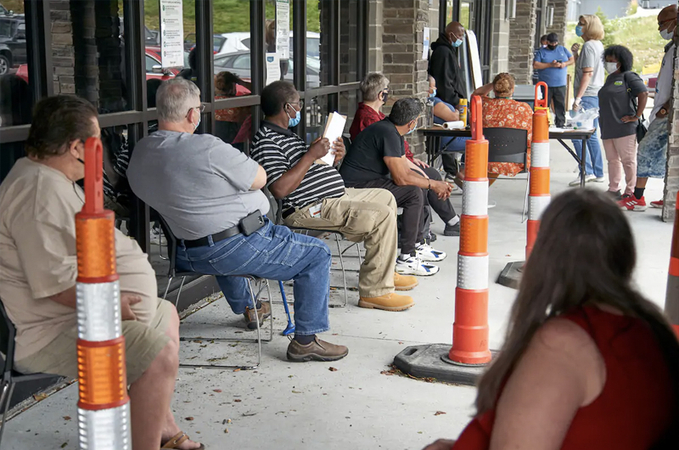
Job seekers wait to be called into a workforce office in Omaha in July- (Nati Harnik/ AP)
By The Washington Post · Eli Rosenberg · NATIONAL, BUSINESS, US-GLOBAL-MARKETS
WASHINGTON – Another 787,000 people filed new unemployment claims last week, according to data released Thursday from the Department of Labor, as the number remains stubbornly high more than six months into the pandemic.
Claims for Pandemic Unemployment Assistance, for gig and self-employed workers, also fell slightly, to 345,440.
The total number of people on all unemployment programs dropped by about 1 million to 23.1 million by early October.
The data is being watched closely with the presidential election less than two weeks away. Economists say they have been concerned by the continued high level of new unemployment claims so far into the pandemic, saying that these layoffs are more likely to be permanent than those that occurred early in the crisis.
The length and severity of the crisis can be measured in the growing number of people who have been on unemployment insurance for more than 26 weeks.
“The ranks of people applying for extended unemployment are starting to [make] it look like a traditional recession,” said Diane Swonk, chief economist at Grant Thornton. “This leaves scars in the labor force, is demoralizing and increases health risks for workers. . . . We’re not calling people back fast enough at a time that we know many households are running on fumes, unable to pay for food for the week and rent.”
Benefits for the unemployed have fallen sharply since the $600 benefit expired at the end of July. About 32% of Americans reported difficulty paying for basic expenses, according to a recent Census Bureau survey.
And the new rise in coronavirus cases remains another threat to the recovery.
The weekly number of new initial claims, considered a bellwether for the health of the labor market, has remained above the pre-pandemic record of 695,000 for more than 30 weeks.
The unemployment rate has dropped from its peak in April but remains at nearly 8%. Due to the date of the election, that monthly data, released the first Friday of every month, will not be released for the month of October until after the contest.
Still there have been a few encouraging signs. Retail sales grew 1.6% in September, powered in part by purchases of cars, outdoor gear and exercise equipment. The third-quarter gross domestic product is supposed to show significant growth when the statistics are released next week.
But it’s not enough to get us out of what remains a very deep hole, Swonk said.
“It bolsters the case for stimulus and aid, now,” she said. “I feel like a broken record.”
House Democrats, Senate Republicans and the White House continue to wrangle over a package of financial stimulus that would boost weekly unemployment checks once again.
Amid economic downturn, Biden sticks by proposed tax hikes on businesses and wealthy Americans
InternationalOct 23. 2020Democratic presidential nominee Joe Biden speaks at the Little Haiti Cultural Complex in Florida on Oct. 5. MUST CREDIT: Washington Post photo by Demetrius Freeman
By The Washington Post · Jeff Stein · NATIONAL, POLITICS, COURTSLAW
Democratic presidential nominee Joe Biden is sticking by his campaign proposals to raise taxes on certain groups despite the economic crisis caused by the coronavirus, breaking with some economists’ aversion toward increasing government revenue during a downturn.
Biden has faced fierce criticism from President Donald Trump and conservative economists over his proposals to raise trillions in new taxes on investors, businesses and wealthy Americans. Larry Kudlow, the president’s chief economist, has repeatedly asserted that even Democratic economists are often wary of raising taxes in a recession. “A self-respecting Keynesian would say: ‘Spend more, and tax less,'” Kudlow said in August.
Biden is not likely to pursue tax hikes as part of short-term stimulus programs designed to help the nation’s economic recovery, according to two people familiar with the campaign’s thinking. However, the former vice president would likely aim to include his tax increases if Congress approves his proposed permanent spending plans, such as expansions in child care, health care or education, these people said. The people, who spoke on the condition of anonymity to share internal deliberations, stressed that planning was fluid and subject to changes based on economic conditions, as well as the makeup of Congress should Biden win. A Biden campaign aide confirmed that his commitment to paying for spending priorities did not include short-term stimulus measures.
Asked during an ABC town hall last week about whether it was appropriate to raise taxes despite the struggling economy, Biden said: “Absolutely.”
Biden has proposed increasing the corporate tax rate from 21% to 28%; taxing investors’ capital gains at normal income rates for those earning more than $1 million; raising the top rate from 37% to 39.6%; and lifting the cap on Social Security payroll taxes, among other changes his campaign says are designed to insulate Americans earning less than $400,000 a year from new tax hikes.
The proposals mark a stark contrast with Trump, who slashed federal taxes by more than $2 trillion in 2017 and is vowing a second round of tax cuts if elected. The president has overseen a massive increase in debt, with the federal government recording a record-high $3.1 trillion deficit in fiscal 2020 because of the government’s extraordinary response to the coronavirus pandemic. Biden’s proposals, however, do not go nearly as far as the approximately $30 trillion in taxes pushed by Sen. Bernie Sanders, I-Vt., and liberal Democrats to fund universal health care and other social programs.
Biden’s allies maintain his tax plans are targeted at affluent Americans and businesses that have quickly rebounded from the coronavirus downturn, arguing they can absorb the impact of a bigger tax burden without hurting economic growth. The current recovery is the most uneven in U.S. history, with the fortunes of the top 25% largely recovering to precrisis levels despite ongoing economic devastation at the bottom of the distribution – a disparity Biden has taken pains to emphasize on the campaign trail.
“In previous recessions, the investor class got hit along with the working class. But if you’re in the investor class, there’s no recession at all right now,” said Jim Kessler, executive vice president for policy at Third Way, a Democratic-leaning centrist think tank. “Raising taxes on very wealthy people will not have any negative effect on this particular recovery.”
This spring, Biden’s tax proposals were estimated to bring as much as $4 trillion into federal coffers, according to the Tax Policy Center, a nonpartisan think tank. Earlier this month, the Tax Policy Center significantly revised that estimate downward to $2.4 trillion, as Biden incorporated Democratic calls for expanding low-income tax credits and the think tank accounted for other changes due to the pandemic.
Several nonpartisan think tanks have found that Biden’s tax cuts would be overwhelmingly paid by wealthier Americans. About 80 to 90% of the total proposed increases would fall on the richest 5%, according to the Committee for a Responsible Federal Budget, a nonpartisan think tank.
Conservatives have argued that Biden’s tax plan would lead to lower investment and drive firms out of business, which would lead to lower wages because of a decrease in labor demand for poorer workers as well. Kevin Hassett and Casey Mulligan, who served as senior economists in the Trump White House, released a study last week that found Biden’s agenda would cost America roughly 5 million jobs and about $2.6 trillion in gross domestic product. They also found it would cost the median family about $6,500 by 2030. The paper included Biden’s tax policies as well as his health and climate plans. Senate Finance Committee Chairman Chuck Grassley, R-Iowa, pointed Wednesday to a study by the nonpartisan Joint Committee on Taxation finding that as much as 25% of corporate tax increases fall on workers.
“Remember, BIDEN is going to raise your taxes at a level never seen before. This will not only be very costly for you, it will destroy our economy, which is coming back very rapidly,” Trump tweeted Wednesday.
Budget experts and Wall Street analysts have disputed that line of attack. Biden’s proposed corporate tax rate of 28% would still be far below the 35% it was before the 2017 GOP tax law. His proposed 39.6% tax rate on top earners would still be well below the top marginal rate from 1932 to 1986. Moody’s Analytics estimated stronger GDP growth under Biden’s economic plans than Trump’s.
Also, the parts of the 2017 Trump tax cuts for households and many small businesses are scheduled to expire in a few years. If Biden is elected, that could give him an opportunity to make changes because Congress will likely look to act in some way ahead of the expiration. Biden has not said whether he would seek the extend the expiring tax cuts, though he could try to extend the cuts for middle-class households and let them lapse for upper-income earners.
Sen. Ron Wyden, D-Ore., who would become chairman of the Finance Committee if Democrats flip the Senate, said in an interview that his staff has begun sharing their ideas on tax and other economic policy matters. There is broad overlap between the Biden and Wyden tax proposals, and Wyden said cracking down on wealthy tax cheats would be a top priority of his in a Democratic-controlled Congress.
“If I have the opportunity as chairman of the Finance Committee, I’m going to be focused on immediate economic relief and building a recovery that works for workers and the middle class and that makes it clear for the wealthiest that the tax system isn’t voluntary,” Wyden said. “Joe Biden and I are very much on the same page on taxes – there cannot be one tax code for the firefighter, and one for the wealthy person with an accountant.”
Although broadly popular among congressional Democrats, Biden may still face significant political obstacles in securing passage of his various tax hike proposals even if his party controls both the House and the Senate.
Biden’s plan to raise the corporate tax rate flies against the last 60 years of U.S. history, throughout which that levy has fallen steadily, alongside a broader international trend of plummeting corporate taxes.
The vice president’s plan to crack down on foreign tax evasion relies on a complicated design that some tax experts and firms warn will encourage corporations to move their headquarters abroad, said Kyle Pomerleau, a tax expert formerly at the conservative-leaning Tax Foundation and now at the American Enterprise Institute. Some congressional Democrats have voiced concerns over similar designs in the past.
Most of Biden’s tax plans can be approved with 51 votes in the Senate through a budget procedure known as reconciliation. But one of his plans that would raise the most revenue – lifting the cap on Social Security payroll taxes on high earners – could require 60 votes in the Senate because it involves federal entitlement programs, creating a steep hurdle to passage of that provision.
“Biden has taken strong positions on raising taxes on corporations and the wealthy. If he wins, he will have a mandate,” said Frank Clemente, executive director of Americans for Tax Fairness, a left-leaning tax group. “Moderate Democrats on the Hill will need to follow his lead and not cower from corporate lobbyists.”
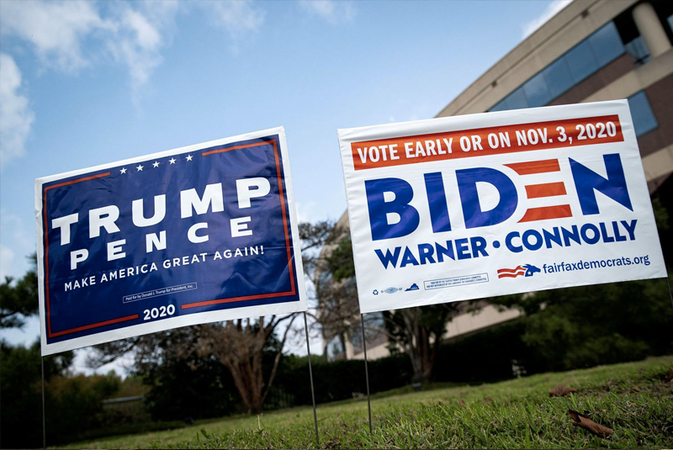
Signs for President Trump and former vice president Joe Biden stand outside the Fairfax County Government Center, an early-voting site. Polling shows likely voters in Virginia favoring Biden over Trump. (Alexander Drago/ Reuters)
By The Washington Post · Gregory S. Schneider, Laura Vozzella, Scott Clement · NATIONAL, POLITICS
RICHMOND, Va. – Former vice president Joe Biden leads President Donald Trump 52% to 41% among likely Virginia voters, according to a new Washington Post-Schar School poll – roughly double Hillary Clinton’s margin of victory in the state in 2016.
Biden’s advantage cuts across most demographic groups, with regional strength in the northern Virginia suburbs and the Richmond area.
Even many of the bright spots for Trump are dimmer this time around. The president’s 10 percentage-point lead in the solidly red southwest portion of the state is down from the 33-point advantage he held there over Clinton in 2016. White women are split almost evenly between Trump and Biden; four years ago, exit polls showed they favored Trump by 13 points.
And one of Trump’s strongest groups – White men – favor him by 21 points, compared with 36 points in his race against Clinton.
Virginia voters are roughly split on which candidate can better manage the economy, but Biden holds an 18-point lead on trust to handle the coronavirus outbreak, 54% to 36%.
“It looks like Biden is running away with it,” said Mark Rozell, dean of the Schar School of Policy and Government at George Mason University, adding that the Democrat’s strength in this former swing state could be a harbinger of the national race.
“If Biden can win by double digits in Virginia, I think this election is over,” Rozell said.
Democratic U.S. Sen. Mark Warner outperforms the top of the ticket, with likely voters favoring him 57% to 39% over Republican challenger Daniel Gade. Warner’s bigger margin than Biden’s owes principally to his 25-point lead with political independents, more than twice as large as Biden’s 11-point edge with this group.
When asked about congressional races, 50% of likely voters say they prefer the Democratic candidate in their district, while 42% prefer the Republican. In three competitive congressional districts – the 2nd, 5th and 7th – the split is closer, at 50% for Democrats and 45% for Republicans, which is not statistically significant, given the four-percentage-point margin of sampling error that applies to each party’s support.
But until recently, all three of those districts were solidly Republican.
Suburban swing voter Susan Cortese mostly favors Democrats but has been open to Republican candidates at times. Socially liberal but fiscally moderate, Cortese said she has become increasingly turned off by the GOP.
“My dissatisfaction started before Trump,” said Cortese, 60, a sales and marketing professional who lives outside Charlottesville and cast her ballot early for Biden. “It just accelerated and amplified once he got there. And I haven’t seen many profiles in courage . . . in terms of standing up to the more egregious activities and policies of the Trump administration.”
The survey was conducted Oct. 13 through Monday, and it found that more than 1 in 5 likely voters said they had already cast their ballot, or 22%. Of that group, 69% say they voted for Biden, compared with 24% who voted for Trump. Biden also leads among Virginians who still plan to vote early, by 65% to 25%.
Trump leads by 24 points among likely voters who plan to vote on Election Day (59% to 35%).
Despite his deficit to Biden, Trump’s 41% approval rating among Virginia registered voters is his best standing in Washington Post-Schar School polls since he took office. In his first year, Trump ranged from 34% to 36% approval, which grew to 40% in late 2019.
Strong disapproval of Trump has stayed fairly consistent, though – 50% of Virginia voters say they strongly disapprove of Trump’s performance, and that has ranged from 50% to 53% since 2017. A larger 57% majority currently either strongly or somewhat disapprove.
Regionally, the northern Virginia suburbs of D.C. continue to be the biggest blue stronghold in the state, with Biden leading there by 44 points among likely voters, similar to Clinton’s 41-point margin in 2016. Biden’s 23-point lead in the Richmond area and Central Virginia is up sharply from Clinton’s six-point margin there.
Biden has a slightly smaller edge in the Tidewater region than Clinton had four years ago – a statistically insignificant three points, compared with 11 for Clinton. And the northern Virginia exurbs could be a significant battleground, splitting 50 to 47 for Trump after backing Clinton by two points in 2016.
Beth Povlsen said she will cast her ballot for Trump in person on Nov. 3 in Bealeton, a northern Virginia exurb in Fauquier County.
“I’m waiting to vote on the day. I’m a die-hard,” said Povlsen, 54, who works as a personal shopper at Harris Teeter. “There’s no reason to vote early. We’re going to grocery stores, we’re going to Walmarts, we’re going everywhere.”
She thinks both parties have “mishandled the pandemic tremendously.”
“They’re using it as a political pawn,” she said. “I don’t think the pandemic is political. It’s a virus just like anything else, and you’re either going to get it or you’re not. . . . Is it going to kill people? Yes, but the flu does, too. Get over it and move on.”
She voted for Trump four years ago and says Biden would push the country too far to the left.
“I’m not a communist or a socialist,” she said. “I work too hard for my money. The government doesn’t need to give it to somebody else.”
In the foothills of the Blue Ridge Mountains in Henry County, on the North Carolina line, Sabrina Brooks voted for Trump four years ago and will do so again.
“He did everything he promised,” said Brooks, a 36-year-old computer processor. “The only time we had downfalls was once the coronavirus hit.”
But Brooks does not blame Trump for the virus’s spread, saying calls for greater mask usage are misplaced and contrary to personal liberty.
“If you’re sick, you need to wear a mask if you go out,” she said. “I don’t care what you have. But if you’re not sick, you shouldn’t be restricted.”
She likes Trump’s efforts to roll back the Affordable Care Act, saying the changes eased restrictions on businesses in ways that allowed them to do more hiring. She also says Trump has strengthened the military and taken a strong stand against domestic terrorism, which she linked to vandalism that erupted over the summer at some racial-justice protests.
“I’m all for protesting,” she said. “When you bring violence into it, you’ve crossed the line, and no one should protect criminals.”
Black voters heavily favor Biden, by 84% to 8% for Trump, though that’s down slightly from the 88% who preferred Clinton in 2016 exit polls, with 9% for Trump that year.
“If you’re going to be my president, then represent all people, not just some people,” said Emma White, 73, an African American homemaker in Hampton who added that she believes Trump has been dismissive of racial equity issues.
“I think Biden is more for the people of all races,” she said. “I’ve seen him reach out to us when he was with President Obama.”
White said she likes Trump’s position on some issues, such as his opposition to abortion. But she voted early for Biden because she finds him more trustworthy.
“I feel good about Biden as a candidate, because he has proven himself to be so far a man of his word,” she said. “I’ve seen him be a father, I’ve seen him be a husband – I just like who he is.”
Ambrosio Daniel, 40, a systems analyst who lives in the Burke area of Fairfax County, voted four years ago for Green Party nominee Jill Stein. This time he intends to cast his ballot on Election Day for Biden.
“I don’t like the way that this administration has been handling the covid-19 response,” he said, adding that he also opposes Trump’s efforts to undermine the ACA.
Daniel called Trump “idiotic” for his resistance to wearing face masks and holding “superspreader” political rallies during the pandemic. Instead of conveying the advice of his own scientific advisers, Trump is modeling bad behavior, Daniel said.
“It’s sad for him to do the things he does,” Daniel said. “It’s unfortunate, and it’s a lack of leadership.”
Voters for both major candidates expressed concern about the outcome of the election. Roughly two-thirds of Trump and Biden supporters are willing to accept the result as legitimate, even if their candidate loses. But 26% of Trump supporters and 31% of Biden supporters say they would not be willing to accept the other candidate winning.
“I’m nervous about the election,” said James Cauthen, 63, a college professor in Charlottesville. “I’m concerned about the direction the country is going in now and extremely concerned . . . about the future of the country as a republic under President Trump.”
But Cauthen, who plans to vote early for Biden, said he has faith that the outcome will be legitimate, no matter who wins.
“I think overall most states and localities are doing a good job in trying to get the vote in,” he said. “They could do better, but I think I could accept the results if [Trump] wins.”
Or as Trump-supporter Brooks put it: “I’m not a crybaby liberal, so, yeah, I’ll accept it no matter who they are. I mean, it’s your president.”
The Post-Schar School poll was conducted Oct. 13 to 19 among a random sample of 1,001 registered voters in Virginia, including 908 likely voters. The error margin among registered voters is plus or minus 3.5 percentage points, and among likely voters it is four points. Overall, 71% of respondents were reached on cellphones and 29% on landlines.


 Former President Barack Obama speaks in support of Joe Biden during a drive-in rally in Philadelphia on Wednesday. MUST CREDIT: Washington Post photo by Bonnie Jo Mount
 A user in Osaka edits a news article on a website that features user-generated content. (This photo image has been partially modified. – The Yomiuri Shimbun)
 Private home prices have edged up 0.1 per cent to date in 2020. ST PHOTO: KUA CHEE SIONG
 Delegates pose for a group photo. —VNS Photo
 (Yonhap)
 Aerial photo taken on March 18, 2020 shows a container dock of Yangshan Port of Shanghai, East China. [Photo/Xinhua]
 Democratic presidential nominee Joe Biden speaks at the Little Haiti Cultural Complex in Florida on Oct. 5. MUST CREDIT: Washington Post photo by Demetrius Freeman