UN watchdog to inspect 2 Ukraine sites over Russia’s ‘dirty bomb’ claims
FRIDAY, OCTOBER 28, 2022
The head of the UN nuclear watchdog confirmed on Thursday (October 27) that it plans to send inspectors soon to two sites at Kyiv’s request in response to Russian claims that Ukraine could deploy a so-called dirty bomb. Ukraine denies the claim.
“Inspections are on the way,” International Atomic Energy Agency (IAEA) director General Rafael Mariano Grossi told reporters after a closed-door meeting with members of the UN Security Council.
“In this case, there has been a very clear indication from a very high official of the Russian Federation about work that, clandestine work, in fact, to divert nuclear material,” he added.
The move to send inspectors follows statement by a senior Russian officer that institutes in Ukraine linked to the nuclear industry were engaged in preparations to produce such a bomb. “Dirty bombs” are laced with nuclear material.
Russia’s state news agency RIA had earlier identified what it said were the two sites involved in the operation – the Eastern Mineral Enrichment Plant in the central Dnipropetrovsk region and the Institute for Nuclear Research in Kyiv.
Grossi said the inspectors would reach a conclusion on the accusations within “days” of undertaking their work.
Earlier on Thursday, the United States and allies slammed Russia for wasting the UN Security Council’s time and spreading conspiracy theories by raising its accusation that the United States has a “military biological program” in Ukraine.
Russia has raised at least twice at the Security Council the issue of a biological weapons program in Ukraine. The United States and Ukraine have said they do not have biological weapons programs.
Russia is now pushing for a formal inquiry. It has drafted a Security Council resolution to set up a commission, comprising all 15 council members, to investigate its claims. Such a move is possible – but has never been invoked – under the Biological Weapons Convention, which took effect in 1975.
Russia’s ambassador to the UN said all of its accusations regarding possible biological or radiological weapons in Ukraine should be taken seriously.
“I don’t think that what we had today, this is a waste of time, raising an issue of potential and radiological contamination due to the use of, say, a dirty bomb is not a waste of time. This is a serious issue which should be dealt with seriously,” Vasily Alekseyevich Nebenzya told reporters.
UN disarmament officials have long said they are not aware of any biological weapons programs in Ukraine
Manga is good for the young, say 85% in Japan-wide survey
FRIDAY, OCTOBER 28, 2022
Those who believe reading manga among children is good accounted for more than 70 per cent of all age groups, and more than 90 per cent of respondents are 49 or younger. The most common response to a question about the effects of reading manga on children, with multiple responses allowed, was “enriches sensitivity and expressiveness” at 63 per cent, followed by “gives children something to talk about with their friends” at 53 per cent and “increases knowledge” at 44 per cent.
On the other hand, when respondents were asked about the effects of non-manga reading, “enriches sensitivity and expressiveness” and “increases knowledge” were the most common responses at 77 per cent each, with “makes children more aware of others’ feelings” coming in third at 44 per cent. “Gives children something to talk about with their friends” was chosen by 18 per cent of respondents.
According to the Research Institute for Publications, total estimated sales for the comics market, including paper and e-books, came to ¥675.9 billion in 2021, a record high for the second consecutive year.
The survey was conducted from August 22 to September 27 with 2,104 respondents. It had a 70 per cent response rate.
S Korea to subsidise kimchi-making fest by releasing vegetable, salt stocks
FRIDAY, OCTOBER 28, 2022
South Korea plans to release its stockpile of vegetables and salt to cope with the lingering inflation for the annual kimchi-making period ahead of winter, the government said on Friday.
Under the plan, South Korea will release 5,000 tonnes of garlic, 1.4 tonnes of peppers and 3.6 tonnes of onions from next week, according to the finance and agricultural ministries. It plans to supply 500 tonnes of salt reserves to traditional markets as well.
“For a considerable period, prices are expected to stay higher than in the past, amid the internal and external risk factors,” Finance Minister Choo Kyung-ho said at a meeting in Seoul.
Local prices of agricultural goods have risen 8.7 per cent year-on-year in September, narrowing their growth from the 10.4 per cent hike tallied in August.
Kimchi is a popular Korean fermented side dish, eaten with almost every meal. While a growing number of people purchase ready-made products nowadays, many households still make their own kimchi, making the price of ingredients one of the key gauges of inflation.
Around 65 per cent of consumers plan to make their own kimchi this year, according to a survey by the Korea Rural Economic Institute.
The ministries said that while the output of key ingredients, such as napa cabbage and white radish, is expected to remain stable, the country needs to brace for a sudden change in the harvest following changes in the climate.
South Korea also plans to offer coupons worth 17.1 billion won ($12 million) to offer discounts of up to 20 per cent, the ministries added.
The country has been grappling with inflation, with its consumer prices soaring 5.6 per cent year-on-year in September. The Bank of Korea forecasts inflation could stay in the 5-6 per cent range for a considerable period.
Choo said South Korea’s inflationary pressure may be eased following lower energy prices observed in October.
Asean reaffirms commitment to Five-Point Consensus peace plan for Myanmar
FRIDAY, OCTOBER 28, 2022
THE NATION
Foreign ministers of nine Southeast Asian countries met in Jakarta on Thursday and reaffirmed their commitment to a peace deal for the crisis in Myanmar.
The ministers met to discuss the strife-torn neighbour ahead of next month’s Asean leaders’ summit, which Myanmar’s junta is barred from attending.
The Asean ministers reaffirmed their backing for time-bound implementation of the Five-Point Consensus agreed with the Myanmar military regime in April last year.
The meeting took place against the backdrop of Sunday’s deadly airstrike by junta warplanes on civilians at a concert celebrating the 62nd anniversary of the Kachin Independence Organization (KIO), reportedly killing 80.
In a statement after Thursday’s meeting, Asean chair Cambodia said the ministers “reaffirmed the importance and relevance” of the consensus, “and underscored the need to further strengthen its implementation through concrete, practical and time-bound actions”.
The Five-Point Consensus calls for an immediate end to violence and dialogue among all parties, mediation of dialogue by Asean’s special envoy, provision of Asean humanitarian aid, and a visit by the bloc’s special envoy to meet all parties in the conflict. However, junta violence has been escalating across the country in response to a nationwide uprising against military rule.
Indonesia’s Foreign Minister Retno Marsudi acknowledged that Asean foreign ministers were disappointed with the lack of significant progress in implementing the five-point consensus, with some expressing their frustration.
Marsudi also condemned Myanmar military junta Sunday’s concert airstrike.
She urged all parties to work together to stop violence in Myanmar as soon as possible.
N Korea builds ice-cream factory on Kim Jong-un’s orders
THURSDAY, OCTOBER 27, 2022
North Korea has completed building an ice-cream factory in Pyongyang as instructed by leader Kim Jong-un, its state media reported on Thursday, amid an economy faltering under global sanctions.
A ceremony was held the previous day to celebrate the construction of a “modern” ice cream production base in the centre of Taesongsan, according to the official Korean Central News Agency.
Jon Hyon-chol, the North’s vice premier and head of the economic policy office of the ruling Workers’ Party, delivered a speech at the ceremony, stressing that the “project for improving the welfare of the people cannot be delayed regardless of how severe the hardships are”.
He added that the construction was completed within a short period of time thanks to “special measures” taken by Kim to speed up the project.
Taesongsan is a mountain at the edge of Pyongyang with major attraction sites, including amusement parks, swimming pools and a zoo.
North Korea has recently been dialling up efforts to improve its people’s livelihoods amid chronic food shortages and prolonged global sanctions.
The US Navy and Army blasted off a rocket from a seaside launch pad in Virginia to test nearly a dozen hypersonic weapons on Wednesday, the Pentagon said, calling the test successful.
Sandia National Laboratories ran the test from Nasa’s Wallops Flight Facility in Virginia, which evaluated hypersonic weapon communications and navigation equipment as well as advanced materials that can withstand the heat in a “realistic hypersonic environment”, according to a Navy statement.
Hypersonic glide vehicles are launched from a rocket in the upper atmosphere before gliding to a target at speeds of more than five times the speed of sound, or about 6,200 km per hour.
The United States and its global rivals have quickened their pace in building hypersonic weapons, the next generation of arms that rob adversaries of reaction time and defeat traditional mechanisms.
To speed up the development, the Pentagon launched these experiments and prototypes using a sounding rocket, a smaller and therefore more affordable test vehicle, to fill a critical gap between ground testing and full-system flight testing.
Wednesday’s test was intended to validate future aspects of the Navy’s Conventional Prompt Strike system and the Army’s Long Range Hypersonic Weapon.
Glide bodies are different from their air-breathing hypersonic weapon cousins, which use scramjet engine technology and the vehicle’s high speed to forcibly compress incoming air before combustion to enable sustained flight at hypersonic speeds.
Companies such as Lockheed Martin and Raytheon Technologies are working to develop the US’s hypersonic weapons capability.
Thailand, Laos, Myanmar and China kicked off another joint round of patrols on the Mekong on Wednesday to prevent illegal activities along the international river.
Law enforcers from the riparian counties are taking part in the four-day patrol, which will cover a distance of more than 600 kilometres, China Radio International (CRI) reported.
Four patrol vessels are taking part in the latest security mission. Two Chinese vessels departed Yunnan’s Xishuangbanna Dai Autonomous Prefecture on Wednesday morning to join two other vessels from Laos and Myanmar downstream.
Prior to the patrol, law enforcers from these countries held online talks to analyse criminal movements and the Covid-19 situation along the Mekong.
So far, the Mekong countries have conducted at least 120 joint patrols on the river that runs through their territories.
The Mekong River, or Lancang River as it is known in China, is a vital waterway for cross-border shipping and trading.
Thailand, Laos, Myanmar and China have been conducting joint patrols on the river since December 2011.
Over the decade, the security situation in the Mekong River basin has improved significantly and remains largely stable, Xinhua reported, citing the Yunnan provincial public security department.
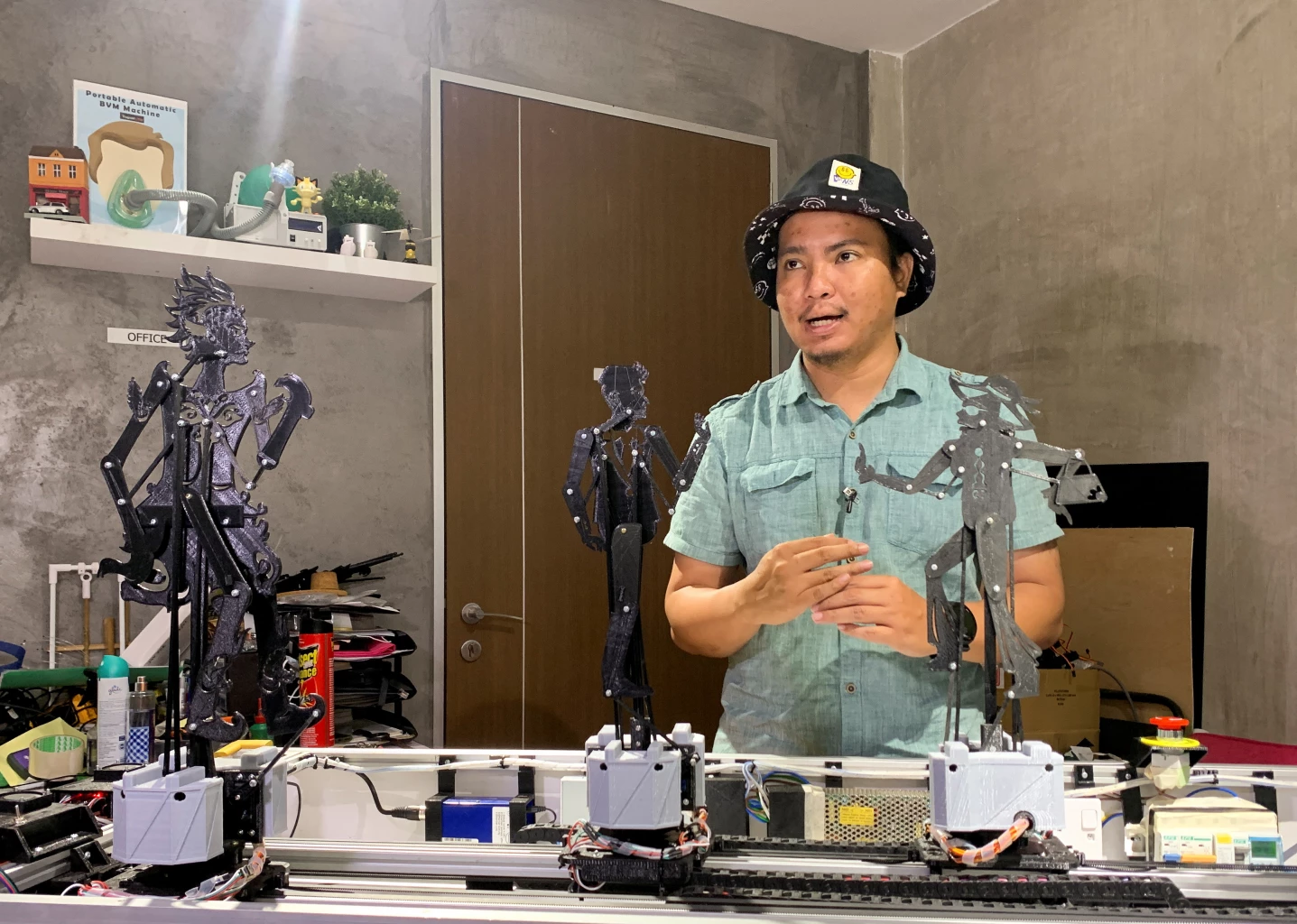
Robotic technology gives a new lease of life to dying Malaysian shadow puppetry
THURSDAY, OCTOBER 27, 2022
At a large mall on Malaysia’s Penang Island, curious shoppers stop in front of a makeshift stall to watch black, shadowy figures move and dance across a white screen.
It is the performance of “wayang kulit“, or shadow puppetry, a theatrical art form once popular across Southeast Asia, particularly Malaysia and Indonesia.
Unlike traditional shadow puppetry, which includes meticulous efforts to craft puppet figurines out of buffalo skin and lengthy rehearsals among dozens of artists, this modern animatronic show uses 3D-printed characters controlled by robotics with their movements choreographed and programmed by one person — its young creator, Ahnaf Hakimi Ahmad.
The love for shadow puppets’ ability to tell stories of ordinary people through dialogue, music and visuals prompted the 33-year-old to start the project in July 2021 to “save” the heritage with a government grant of Malaysian ringgit 20,000 (160,000 baht).
In the face of fading heritage due to film, television and social media, the multimedia lecturer said he hoped robotic technology can help shadow puppets to be seen more often “whenever and wherever”.
Efforts to preserve the art form have been hampered in recent years not just by a lack of public interest, but also by criticism in the Muslim-majority country that the stories and characters surrounding shadow puppet performances, often based on Hindu gods and epics like the Ramayana, were “un-Islamic”.
The number of active shadow puppet troupes in Malaysia have dwindled to around eight, following a ban on shadow puppetry in the 1990s in its home state of Kelantan.
The animatronic puppet show has drawn some criticism from the traditionalists, said Ahnaf Hakimi. But he aims to keep it as original as possible by using music from traditional performances and designing the characters based on traditional puppets.
Back in the Penang mall, shoppers were impressed by the puppets with a modern twist, that tell contemporary stories that resonate with modern viewers.
Mohd Jufry Yusoff, a puppet master with over 40 years of experience who advised on the robotic show, was optimistic that with new technology the culture of shadow puppetry can grow.
Moving forward, Ahnaf Hakimi said he would like to tell more stories of ordinary people while making the show mobile for more people to access.
Samsung Electronics vice chairman Lee Jae-yong was promoted to chairman on Thursday, taking the top post of the world’s largest chipmaker held by his father, who died two years ago.
The company said in an announcement that the board of directors approved the appointment of Lee as executive chairman.
Samsung Electronics Board chairman Kim Han-jo recommended the appointment, which was followed by the board’s approval, it added.
The board cited the “current uncertain global business environment” and “the pressing need for stronger accountability and business stability” in approving the recommendation.
Samsung added that the 54-year-old’s inauguration ceremony is not scheduled for Thursday.
Lee appeared at a district court on Thursday morning for a trial surrounding his alleged involvement in the controversial 2015 merger of Samsung C&T and Cheil Industries into a de facto holding company of the Samsung conglomerate.
Lee, who joined Samsung in 1991, has held the vice chairman post for a decade.
‘Disinformation can be a hurdle to achieving economic goals’
WEDNESDAY, OCTOBER 26, 2022
Fake news affects more than holiday discussions over dinner. It can even hamper regional economic goals.
In November 2020, the Apec Policy Support Unit published a report which served as a recap of what would turn out to be the first year of the still ongoing Covid-19 crisis.
Assessing the then-raging pandemic, a section of that instalment of the Apec Regional Trends Analysis was headlined, “New virus, old challenges”. That is, the strain of coronavirus may be novel, but it has exposed and amplified old issues which have been inadequately addressed by policymakers up and until they faced the perfect storm that was the last three years.
The virus called our attention to gaps in environmental protection, for example, and to faltering cooperation between governments which would have helped stymie the virus before it swelled to pandemic proportions. The crisis has shown the fragility of some supply chains among economies and exposed the dangers of growing economic and social inequalities within them.
And, for better or worse, it has amplified the already speedy trend of digitalization, seeing as in-person interaction and travel were halted for months at a time. Failure to go online was basically a death sentence for most businesses—especially micro, small and medium enterprises—and almost every office had to mutate into a hybrid online-offline version of itself to keep operations going. This evolution cannot be reversed, and so society will have to live with and adapt to both the advantages and pitfalls of the accelerated digitalization of everything, including an explosion in and, daresay, normalization of information disorder.
Information disorder is a catch-all phrase for the spread of false information which may cause negative societal and even economic harm—whether or not the harm was the intent of the creators and spreaders. It can be divvied into three categories: misinformation, or the sharing of falsities but with no intent to harm anyone; disinformation, or the sharing of false information with the intent to do harm; and misinformation, or the repurposing or recontextualization of facts, also with harmful intent. All three are reliant on how fast stories can be spread online to dangerous effect.
False information, online or off, has been prevalent before 2020, but as with other things, the pandemic has made its consequences both more immediate and deeply concerning. Misinformation, disinformation, and various conspiracy theories alleged that Covid-19 vaccines were ineffective, harmful, or contaminated—with microprocessors, poisons, or pork products—and were promoted for the purpose of any number of shadowy interests, from the profit-oriented to the perverted. A false rumour about the dangers of vaccination, if gone viral, can contribute to the spread of illness into multiple communities, and many possible preventable deaths. It can erode trust in the prevailing authorities, which may result in delinquencies in following prescribed safety measures.
The virus should be seen as an eye opener to how much attention policymakers should pay to online information disorder. Even after Covid-19 eases, the dangers of erosion of trust will continue, and possibly worsen with beefed-up post-pandemic digital platforms. This will be true not just for each economy, but also at the regional level.
Any policy, specifically those that are reform-oriented and inclusive, needs community-level trust to be effective. When people have a high degree of institutional trust, they are more inclined to believe policymakers have their interests as the highest priority, and to agree that these institutions are performing effectively and ethically.
On the other hand, a lack of trust in institutions, coupled with other factors, such as growing inequality and fraying social cohesion, can hinder the effectiveness of reform policies, and in some cases even of cooperation among economies, by fueling protectionist and anti-globalization sentiments.
During crises that require interlinked efforts across multiple governments—such as during the pandemic, or, in the broader scope, climate change—information disorder can erode domestic support for the pertinent policies, thus creating weak links.
Long-term regional goals—such as the Apec vision for “quality growth that brings palpable benefits and greater health and wellbeing to all” within the next 20 years—will meet speedbumps, A lack of trust in authorities can proliferate, in underserved communities for example, which would cripple the ability of Apec economies to achieve inclusion goals. More generally, the same could apply to climate goals, education rates, income gaps and stability.
While every government must approach the problem of information disorder according to their respective domestic situations, they must also come together to begin a process of examining its challenges to develop a concerted strategy. This would be a long-term and wide-scope endeavour; a policy brief published by the Apec Policy Support Unit gives three recommendations for how to start.
First, as it is a relatively new and complex subject, Apec economies must seek to understand information disorder. This would entail a multidisciplinary effort to which the Apec forum, with its many workstreams, would be suited. Most research on the subject takes place in silos; economies should bring them together to take a broader perspective and engage experts who can best assess their impact on the most vulnerable sectors, such as the poor, seniors, and even the youth. Best of all, governments will have the ability to engage with the companies that have created the digital environments where information disorder thrives. They can foster relationships and get access to data essential to forming countermeasure policies at the local and regional levels.
Secondly, governments must build their capacity to address the issue in the long term and in anticipation of the changing environment of information disorder. This may involve the need for major organizational changes within government, to enhance coordination and information—sharing among agencies and with the private sector—regarding online threats, rapid response, as well as the need for domain-specific monitoring of the information space during crises.
And third, governments should take active steps to strengthen institutional trust—in government institutions, yes, but equally important, in unbiased third-party sectors that can corroborate and fact-check information. This includes the media and research institutes, as well as multilateral groupings like Apec, which could bring different players together and engage them, and their own membership, in dialogue. As a compliment to organizational-level action, economies should also invest in digital literacy, to ensure citizens are aware of the threat and nuances of information disorder and appreciate the institutional ecosystems that keep it at bay.
On a final note, a crucial aspect of trust building is not adding to the problem. People look to their governments as sources of authoritative, reliable, and truthful information. It should be assumed that governments will not knowingly spread falsehoods to their own people, but mistakes in the form of misinformation disseminated by official sources can and do happen. Governments and intergovernmental bodies should establish clear mechanisms to not only rectify the misinformation but also to minimize its occurrence by establishing clear frameworks for transparency and accountability. Because information disorder can generate unpredictable and often chaotic outcomes, a focus on information consistency, stability, and trust is needed to ensure the achievement of quality growth priorities.
Emmanuel A. San Andres is a Senior Analyst in the Apec Policy Support Unit. He is a co-author of the policy brief, “Putrajaya Vision 2040, COVID-19 and Information Disorder.”












 SootinClaimon.Com