World’s largest waterfall surges back to life after drought
MONDAY, OCTOBER 17, 2022
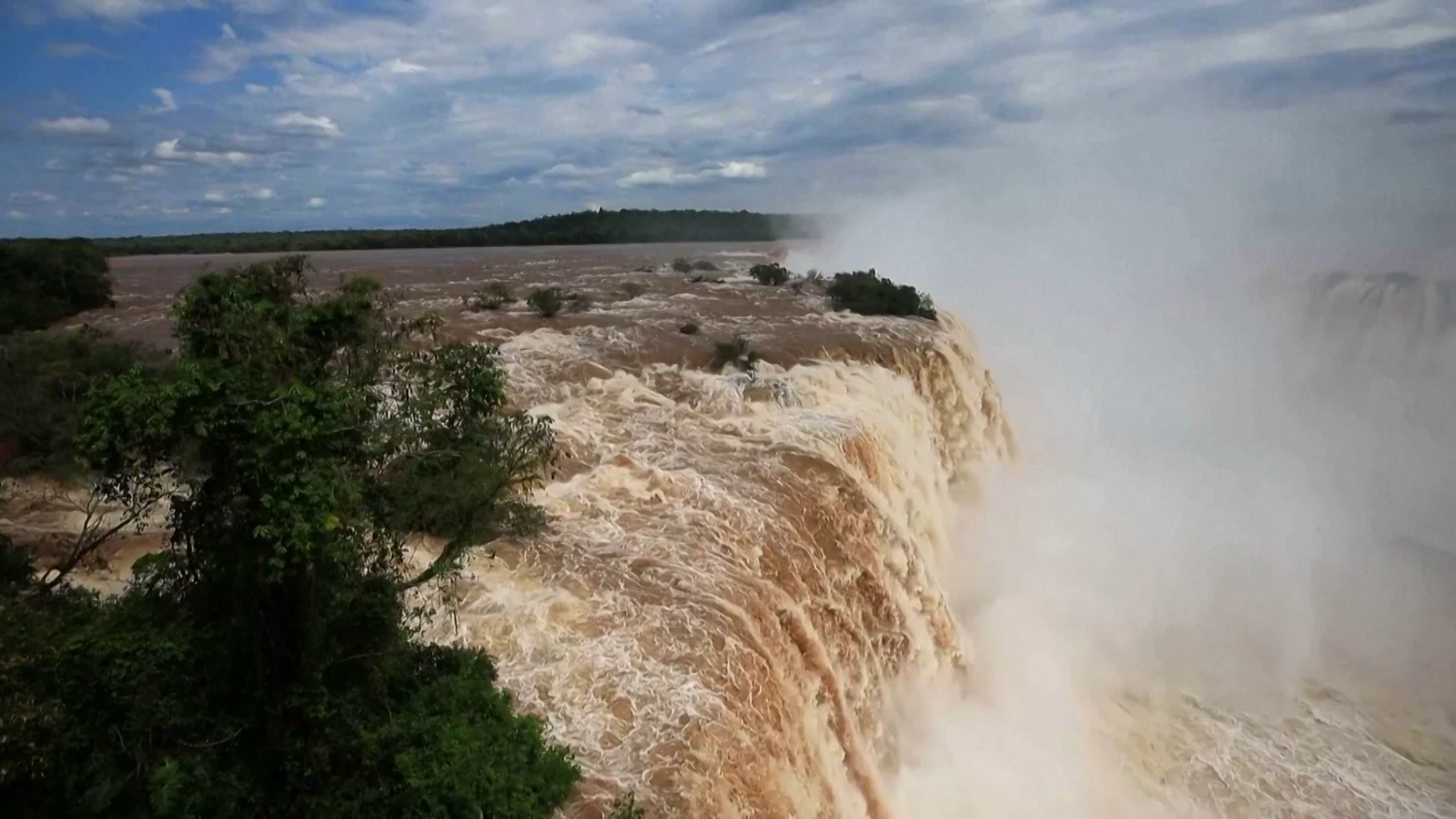
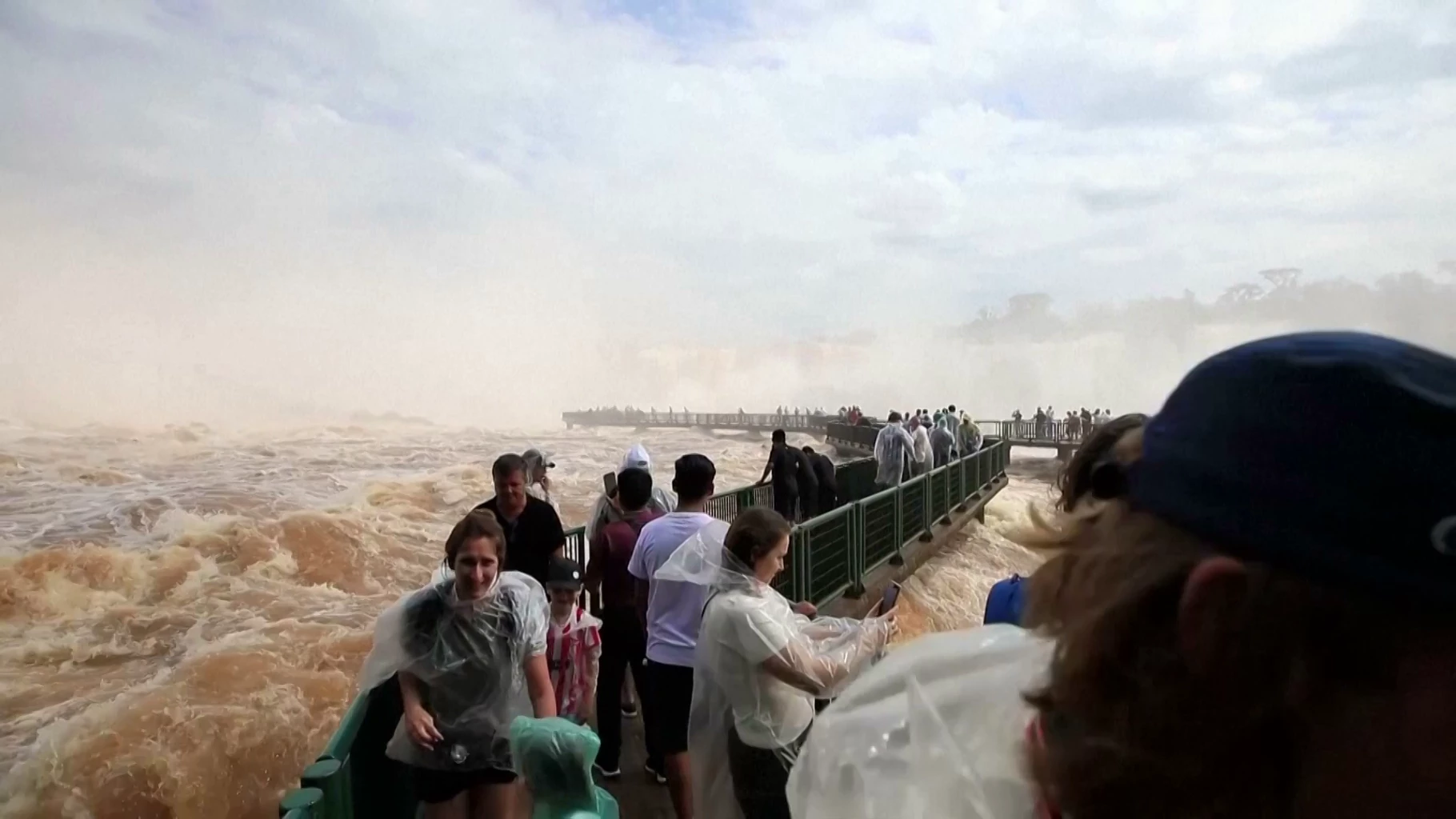
The world’s largest waterfall system is roaring once again after a week of heavy rain in southern Brazil.
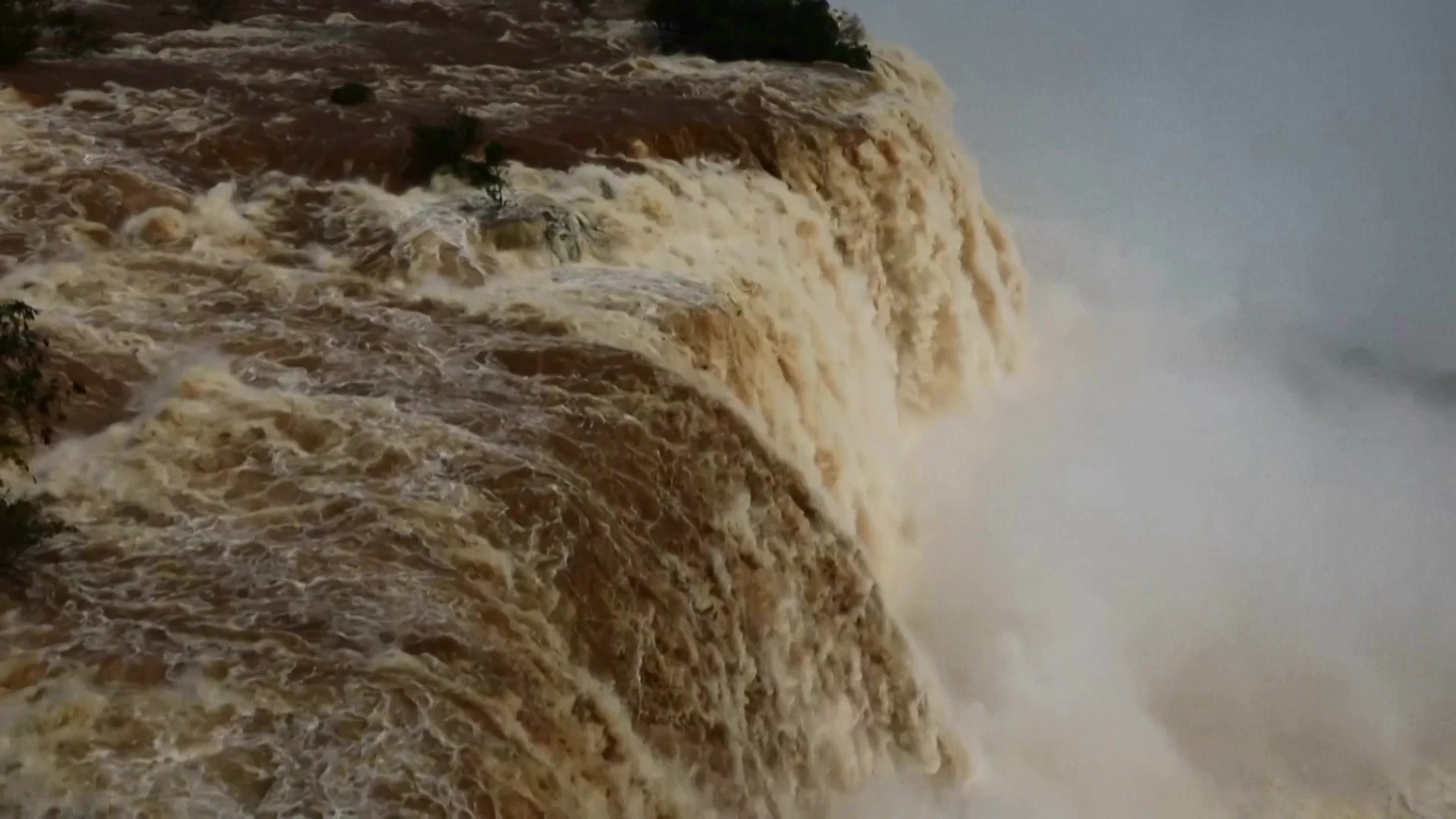
Water flowing over the mighty Iguazu Falls on the Brazil-Argentina border has surged to 10 times the usual level, according to local media.
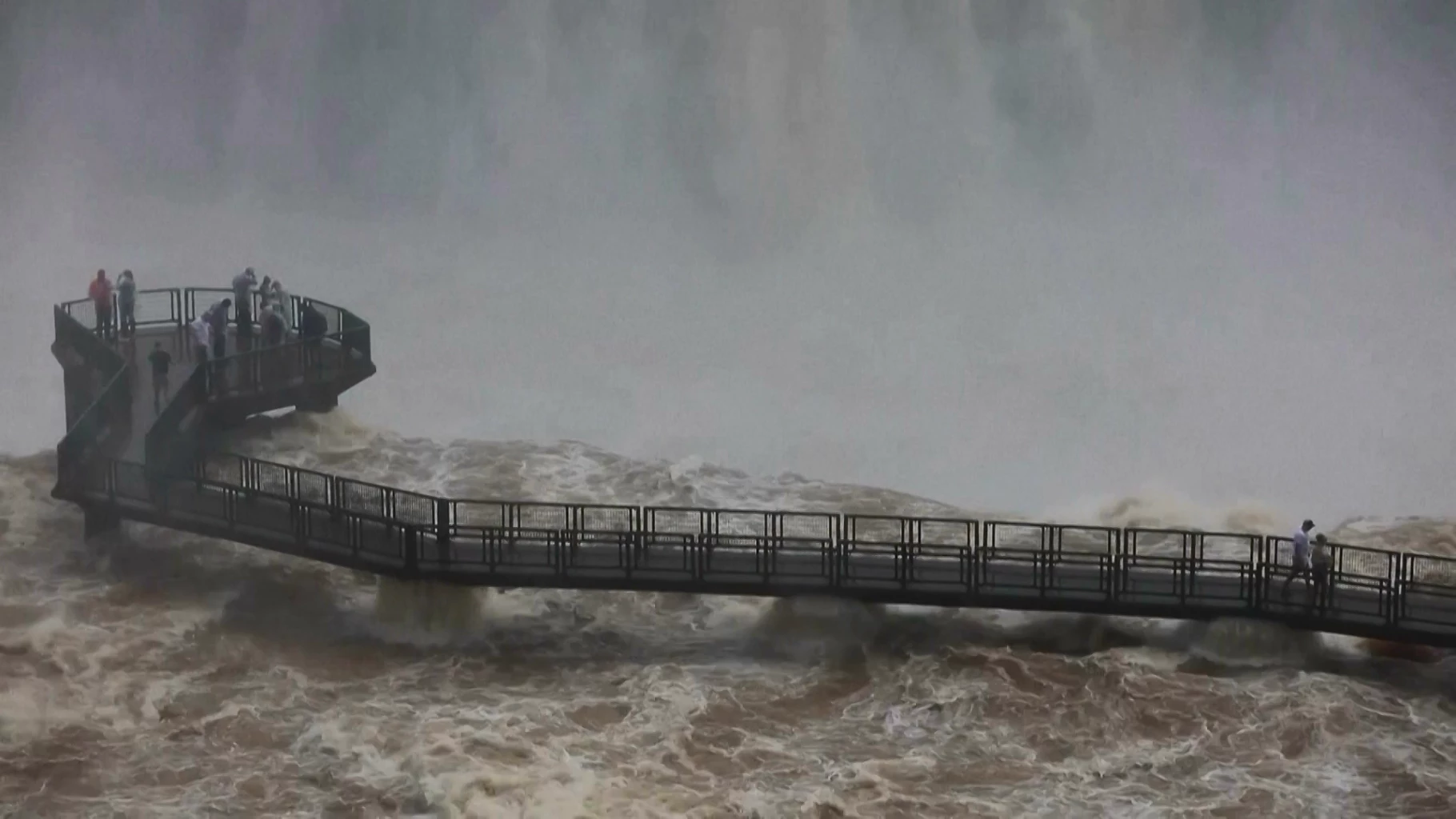
Heavy rain in the Brazilian state of Parana has seen water levels swell, forcing park authorities to close the main footbridges on the Brazilian side of the river for a week. However, tourists are back marvelling at the natural wonder after the bridges were reopened this weekend.
Typically, about 1.5 million litres per second flow through the falls but that figure soared to 16 million litres on Thursday as unseasonal rain flooded Iguaza.
Hydroelectric dams have opened their gates to relieve the water load and ease flooding.
The massive overflow of the river comes after a severe drought which emptied the Iguazu river.
In 1986 the waterfalls and the surrounding area were declared a Unesco World Heritage Site, and since 2011 they have also been considered one of the “seven new natural wonders” of the world.
South Korea’s Bibong the bottlenose dolphin sees freedom after 17 years
MONDAY, OCTOBER 17, 2022
The last Indo-Pacific bottlenose dolphin kept in a South Korean aquarium has been released into the wild after 17 years, the oceans ministry said on Monday.
Bibong was set free on Sunday from a pen in the sea off the southern resort island of Jeju, where he had stayed for about 70 days for training to adapt to the new environment, the Oceans and Fisheries Ministry said.
Experts said Bibong, a male dolphin believed to be 23 years old, was believed to have been fully ready to return to the wild.
The dolphin had been kept in a marine mammal park on the island after being illegally caught in waters off the island in 2005.
He was the last marine mammal of his kind in captivity, as the country had released seven Indo-Pacific bottlenose dolphins into the sea since 2013 after designating the species as a priority marine life the previous year.
The ministry said it attached a positioning device to Bibong’s body for regular monitoring at least for about six months.
“Bibong was finally able to return home after 17 years. The government will continue seeking measures to improve the welfare of marine animals,” Minister Cho Seung-hwan said.
Other than Bibong, 21 belugas and other kinds of dolphins are currently at domestic aquariums, all of which have been kept after going through legal procedures for research or other purposes, the ministry said.
Xi’s zero-Covid is elephant in room blocking China’s economic recovery: Chula expert
MONDAY, OCTOBER 17, 2022
President Xi Jinping’s zero-Covid policy is derailing China’s economic recovery, according to a Chinese history professor at Chulalongkorn University.
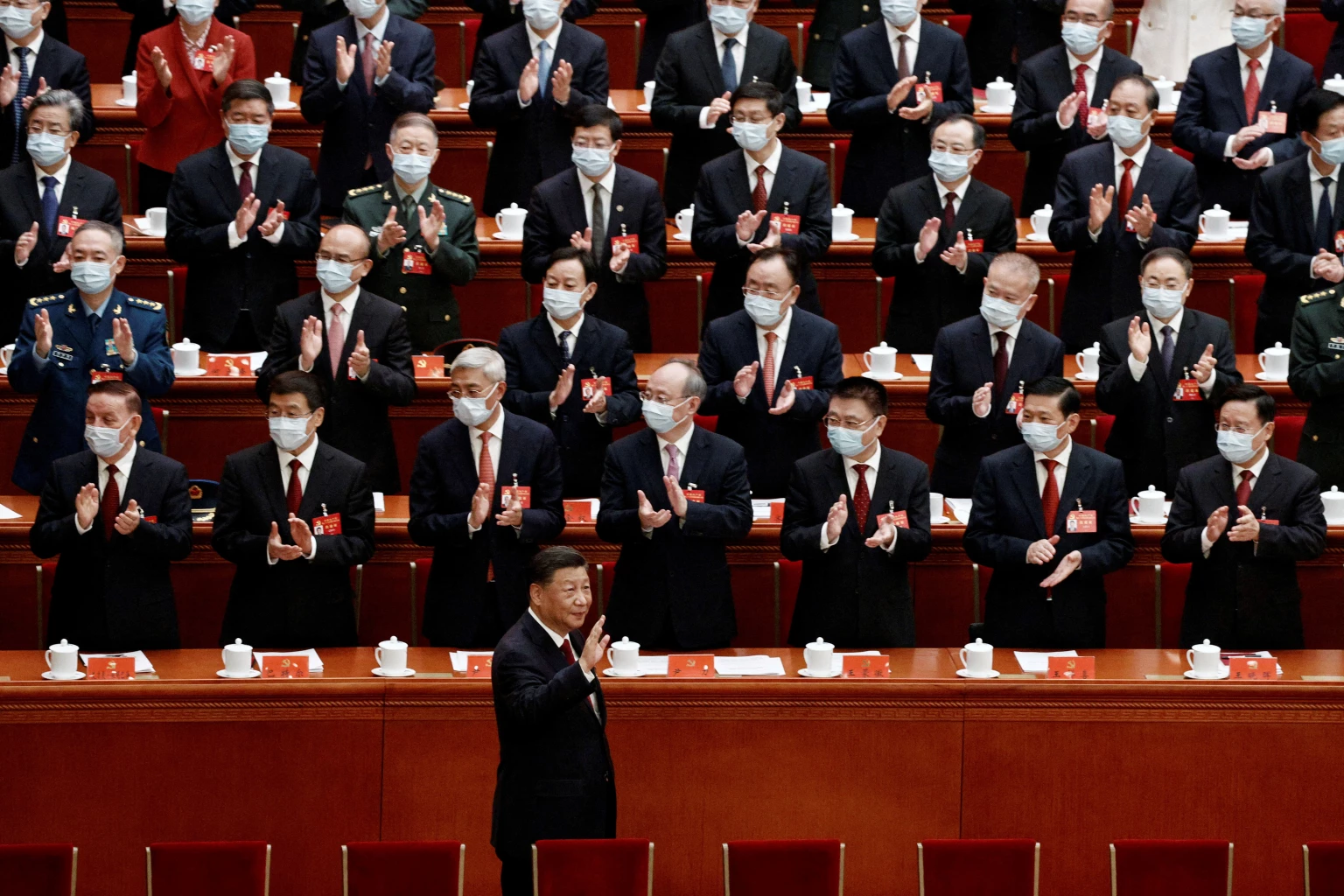
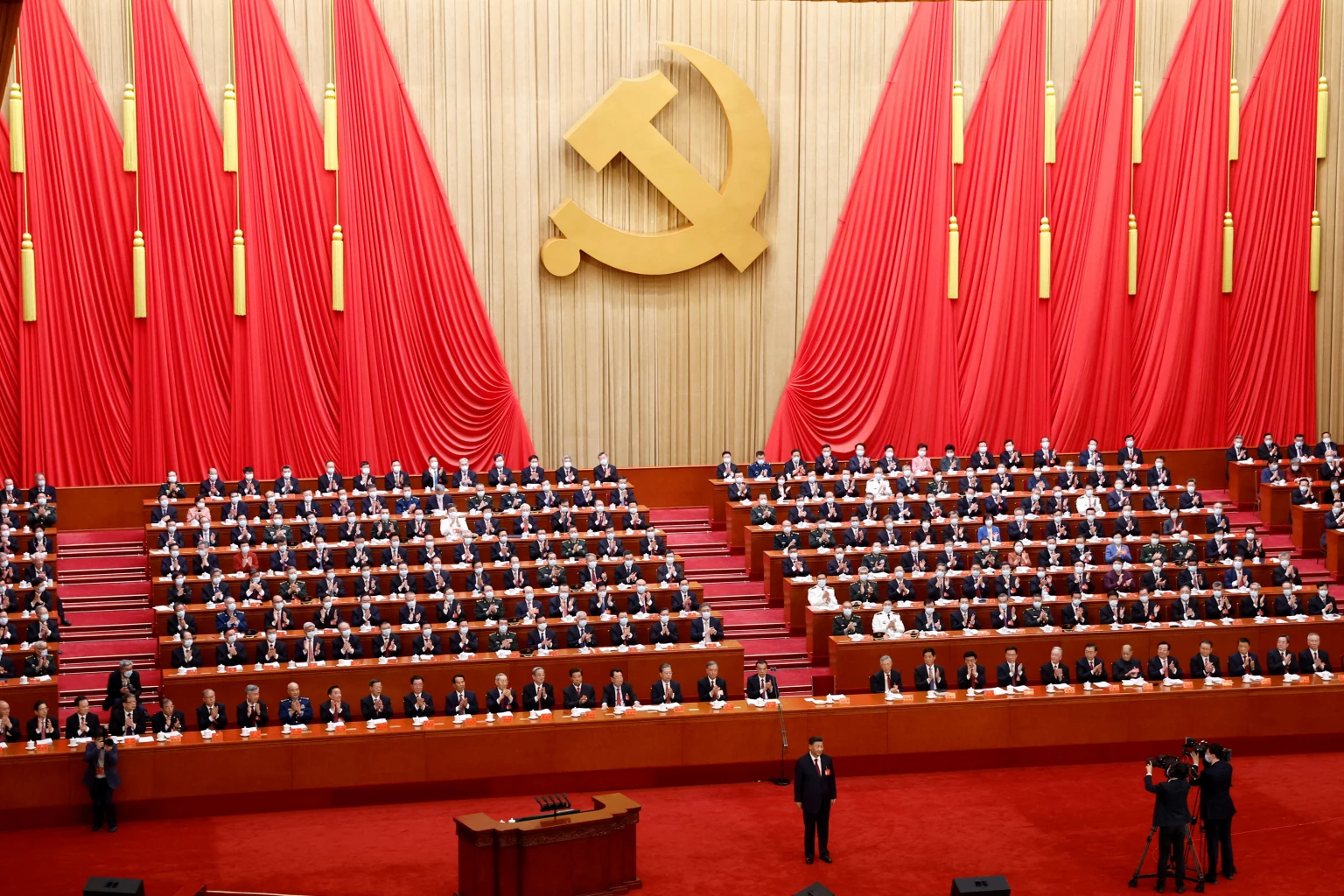
Xi kicked off the 20th Chinese Communist Party (CCP) National Congress in Beijing on Sunday.
In his opening speech, XI emphasised “safety” and “security”, mentioning the words 73 times compared with just 53 times at the previous congress in 2017. According to Reuters, analysts viewed the speech as an affirmation of Xi’s increasingly authoritarian path that has prioritised security, state control of the economy, more assertive diplomacy, a stronger military and pressure to seize democratically governed Taiwan.
Although he made little reference to Covid-19, China has in recent days repeatedly emphasised its commitment to Xi’s zero-Covid strategy, “dashing hopes among countless Chinese citizens as well as investors that Beijing might begin exiting anytime soon a policy that has caused widespread frustration and economic damage”, said Reuters.
Xi is expected to be elected for a third term at the congress, cementing his status as the most powerful Chinese leader since Mao Zedong.
But Wasana Wongsurawat, an associate professor of modern Chinese history at Chulalongkorn University, said the highlight of the congress is not whether Xi will be elected to lead the country again.
“The biggest problem facing China now is that its economy cannot fully recover under Xi’s zero-Covid policy,” she said.
Wasana added that Xi will never backtrack on his own policy, since this would show he had been wrong and he would lose legitimacy as the country’s ruler.
She said Xi would instead keep the zero-Covid policy and China would face the same dilemma as in the early 1970s, when everyone agreed that Chairman Mao’s Cultural Revolution was a mistake but it could not be stopped as this would only prove that Mao was wrong.
“Xi is doing a lot of things to strengthen China’s political role on the global scale, such as expanding the Shanghai Cooperation Organisation and increasing military cooperation with Russia,” said Wasana. “However, none of these will matter if China cannot solve its economic problems at the foundation.”
“If Xi remains the leader, his policy will be here to stay. If the CCP wants to abandon his policy, then he must go.”
Wasana added that it was nearly impossible for the CCP to find a solution for the zero-Covid policy, such as declaring victory over Covid or easing restrictions. If the CCP chose to do so, it would face hard questions as to why the policy was in place for so long but then suddenly considered unnecessary, she said.
Meanwhile, Thailand would have to wait before welcoming back visitors from China, its biggest tourism market, as the country will not open anytime soon, she said.
Xi focuses on China’s security, zero-Covid policy as he kicks off Communist Party Congress
SUNDAY, OCTOBER 16, 2022
Chinese President Xi Jinping called for accelerating the building of a world-class military while touting the fight against Covid-19 as he kicked off a Communist Party Congress on Sunday morning.
Xi, 69, is widely expected to win a third leadership term at the conclusion of the week-long congress, cementing his place as China’s most powerful ruler since Mao Zedong.
Roughly 2,300 delegates from around the country gathered in the vast Great Hall of the People on the west side of Tiananmen Square amid tight security and under blue skies after several smoggy days in the Chinese capital.
Xi described the five years since the last party congress as “extremely uncommon and abnormal” in a speech that lasted less than two hours – far shorter than the nearly three-and-a-half-hour-long address in the 2017 congress.
“We must strengthen our sense of hardship, adhere to the bottom-line thinking, be prepared for danger in times of peace, prepare for a rainy day, and be ready to withstand major tests of high winds and high waves,” he said.
Xi mentioned the words “safety” or “security” 73 times, compared with 55 times in 2017, and said China will strengthen its ability to build a strategic deterrent capability.
In comparison, Xi only said the word “reforms” 16 times in the televised speech, far fewer than the 70 mentions five years ago.
Xi called for strengthening the ability to maintain national security, ensuring food and energy supplies, securing supply chains, improving the ability to deal with disasters and protecting personal information.
The biggest applause came when Xi restated opposition to Taiwan’s independence.
In his decade in power, Xi has set China on an increasingly authoritarian path that has prioritised security, state control of the economy in the name of “common prosperity”, a more assertive diplomacy, a stronger military and intensifying pressure to seize democratically governed Taiwan.
Analysts generally do not expect a significant change in policy direction in a third Xi term.
In recent days, China has repeatedly emphasised its commitment to Xi’s zero-Covid strategy, dashing hopes among countless Chinese citizens as well as investors that Beijing might begin exiting anytime soon a policy that has caused widespread frustration and economic damage.
Xi said little about Covid other than to reiterate the validity of a policy that has made China a global outlier as much of the world tries to coexist with the coronavirus, which emerged in central China in late 2019.
“We have adhered to the supremacy of the people and the supremacy of life, adhered to dynamic zero-Covid … and achieved major positive results in the overall prevention and control of the epidemic, and economic and social development,” Xi said.
On the economy, he restated support for the private sector and allowing markets to play a key role, even as China fine-tunes a “socialist economic system” and promotes “common prosperity”.
“We must build a high-level socialist market economic system … unswervingly consolidate and develop the public ownership system, unswervingly encourage and support the development of the private economy, give full play to the decisive role of the market in the allocation of resources, and give better play to the role of the government,” he said.
Xi’s power appears undiminished by the tumult of a year that has seen China’s economy slow dramatically, dragged down by the Covid policy’s frequent lockdowns, a crisis in the property sector and the impact of his 2021 crackdown on the once-freewheeling “platform economy”, as well as global headwinds.
China’s relations with the West have deteriorated sharply, worsened by Xi’s support of Russia’s Vladimir Putin.
The son of a Communist Party revolutionary, Xi has reinvigorated a party that had grown deeply corrupt and increasingly irrelevant, expanding its presence across all aspects of China, with Xi officially its “core”.
Xi did away with presidential term limits in 2018, clearing the way for him to break with the precedent of recent decades and rule for a third five-year term, or longer.
“We have comprehensively strengthened the party’s leadership … and ensured that the party plays the role of leadership core in overseeing the overall situation,” he said.
“Through continuous struggle, we have realised the thousand-year-old dream of a Chinese nation of moderate prosperity.”
The congress is expected to reconfirm Xi as party general secretary, China’s most powerful post, as well as chairman of the Central Military Commission. Xi’s presidency is up for renewal in March at the annual session of China’s parliament.
In the run-up to the congress, the Chinese capital stepped up security and Covid curbs, while steel mills in nearby Hebei province were instructed to cut back on operations to improve air quality, an industry source said.
The day after the congress ends on Saturday, Xi is expected to introduce his new Politburo Standing Committee, a seven-person leadership team. It will include the person who will replace Li Keqiang as premier when Li steps down from that post in March after serving the maximum two terms.
Open-air film festival brings romance back to Tokyo after 2-year hiatus
SUNDAY, OCTOBER 16, 2022
The open-air film festival that is held every year in Tokyo’s Shinjuku Ward is returning for the first time since 2019. The Shinjuku Park Cinema Festival will be held at Shinjuku Chuo Park from Wednesday to Friday next week.
“This is a rare opportunity for people to watch films against the backdrop of skyscrapers at night,” a public relations official said.
The annual outdoor event was launched in 2017 by Shinjuku Convention & Visitors Bureau, so people could enjoy watching films in the cool autumn temperatures.
However, the Covid-19 pandemic forced the festival to be cancelled for the last two years.
Featured in this year’s fest are three romantic local films, namely “Hanataba mitaina Koi o shita” (“We Made a Beautiful Bouquet”) directed by Nobuhiro Doi, which will be shown on Wednesday; “Ai ga nanda” (“Just Only Love”) directed by Rikiya Imaizumi on Thursday; and “Eiga: Yozora wa itsudemo Saiko-mitsudo no Aoiro da” (“The Tokyo Night Sky is Always the Densest Shade of Blue”) directed by Yuya Ishii on Friday.
Shows start at 6pm and admission is free. People will have access to 140 chairs plus 60 seats at tables and can also rent picnic mats at the site. Trucks will be positioned around the area selling snacks, craft beer and other beverages.
Andes ‘cannibal’ tragedy survivors play tribute match on 50th anniversary of plane crash
SUNDAY, OCTOBER 16, 2022
Rugby players who survived the Andes plane crash played a tribute match in Montevideo on Saturday (October 15) to mark 50 years since the fateful accident.
Surviving players from the Uruguayan club Old Christians and the Chilean club Old Boys played a friendly match which every year brings together the survivors of the plane crash that left 29 people dead.
Uruguay’s president Luis Lacalle Pou attended the tribute match, greeted the former players, and gave a speech to pay tribute to the survivors.
On October 13, 1972, a Uruguayan Air Force plane carrying a youth rugby team and their family and friends crashed in the middle of the Andes Mountains.
They were forced to dig up some of their dead colleagues they had buried in the snow nearby and eat them just to survive. The story of the crash – in which just 16 of the 45 passengers survived – was retold in the 1993 movie “Alive”.
Pakistan summons US ambassador over Biden’s nuclear remarks
SUNDAY, OCTOBER 16, 2022
Pakistan has summoned the US ambassador after President Joe Biden called Pakistan “maybe one of the most dangerous nations in the world”. Referring to the South Asian nation’s nuclear programme in a speech on Thursday, Biden said Pakistan “has “nuclear weapons without any cohesion”.
Pakistan Foreign Minister Bilawal Bhutto-Zardari said he was surprised by the comments.
“As far as the question of the safety and security of Pakistan’s nuclear assets are concerned, we meet all – each and every – international standard in accordance with the IAEA,” he said at a press conference on Saturday.
A transcript of Biden’s speech was published by the White House on its website.
Bhutto-Zardari said he didn’t think the decision to summon the US ambassador would negatively affect relations with the United States and said officials could address any specific concerns Washington had on the nuclear programme.
Ties between Islamabad and Washington, once close allies, have just started to warm after some years of frosty relations, mostly due to concerns about Pakistan’s alleged support of the Taliban in Afghanistan. Pakistan denies this support.
The foreign minister said worries about Pakistan’s nuclear programme were not raised on his recent trip to Washington, where he held extensive meetings, including at the State Department.
Pakistan has fought four wars with its nuclear-armed neighbour India.
UK’s central bank says stronger rates response needed to fight inflation
SUNDAY, OCTOBER 16, 2022
Bank of England Governor Andrew Bailey said on Saturday that inflationary pressures may need “stronger response than we perhaps thought in August” and hinted at a big interest rate rise by the central bank next month.
Bailey said the UK’s central bank might raise interest rates by more than it previously thought because of the government’s huge energy bill support – which could lower inflation in the short term but push it up further ahead – and whatever it decides to do on tax cuts and spending. He said the bank’s MPC (Monetary Policy Committee) would respond in around three weeks’ time.
Bailey said he and Britain’s new finance minister Jeremy Hunt had agreed on the need to repair the country’s public finances after the tax cut plans announced by Hunt’s predecessor triggered bond market turmoil.
Speaking in Washington where British officials attending International Monetary Fund meetings have been put on the spot about the crisis engulfing the country, Bailey said he had spoken to Hunt on Friday after he replaced Kwasi Kwarteng.
“I can tell you that there was a very clear and immediate meeting of minds between us about the importance of fiscal sustainability and the importance of taking measures to do that,” Bailey said.
Prime Minister Liz Truss, seeking to save her term in office, which is barely a month old, said on Friday that Britain’s corporation tax rate would increase, reversing a key pledge made during her bid for Downing Street.
Hunt said earlier on Saturday that some taxes might have to rise, and others might not fall as much as planned, signalling a further shift away from Truss’s original plans.
Bailey spoke at an event organised by the Group of Thirty, which comprises financiers and academics.
Truss criticised the central bank during her leadership campaign, saying she wanted to set a “clear direction of travel” for the central bank. Bank of England officials pushed back at those comments saying their independence was key to managing the economy.
In the shorter term, the BoE will be keeping a close eye on how financial markets behave on Monday after it ended its emergency bond-buying programme on Friday.
UK climate change protesters throw soup at van Gogh’s ‘Sunflowers’
FRIDAY, OCTOBER 14, 2022
Climate change protesters from the Just Stop Oil campaign group threw soup over Vincent van Gogh’s painting “Sunflowers” at London’s National Gallery on Friday, causing minor damage to the frame.
A video showed two women throwing two tins of Heinz tomato soup over the painting, one of five versions on display in museums and galleries around the world.
They then glued themselves to a wall.
“There is some minor damage to the frame but the painting is unharmed,” the gallery said in a statement.
Police said both women had been arrested for criminal damage and aggravated trespass.
“Specialist officers have now un-glued them and they have been taken into custody at a central London police station,” a statement on Twitter said.
The National Gallery, which says it houses one of the greatest collections of paintings in the world, said the ‘Sunflowers’, which dates to 1888, was one of its most popular.
“It is the painting that is most often reproduced on cards, posters, mugs, tea-towels and stationery. It was also the picture that Van Gogh was most proud of,” the gallery says on its website.
Just Stop Oil said the painting has an estimated value of more than $84 million.
The protest is the latest by the group’s activists and comes after days in which they blocked roads around parliament and government departments to Britain halts all new oil and gas projects.
Three patients travelling from Thailand test positive in Hong Kong for XBB variant of Covid-19
FRIDAY, OCTOBER 14, 2022
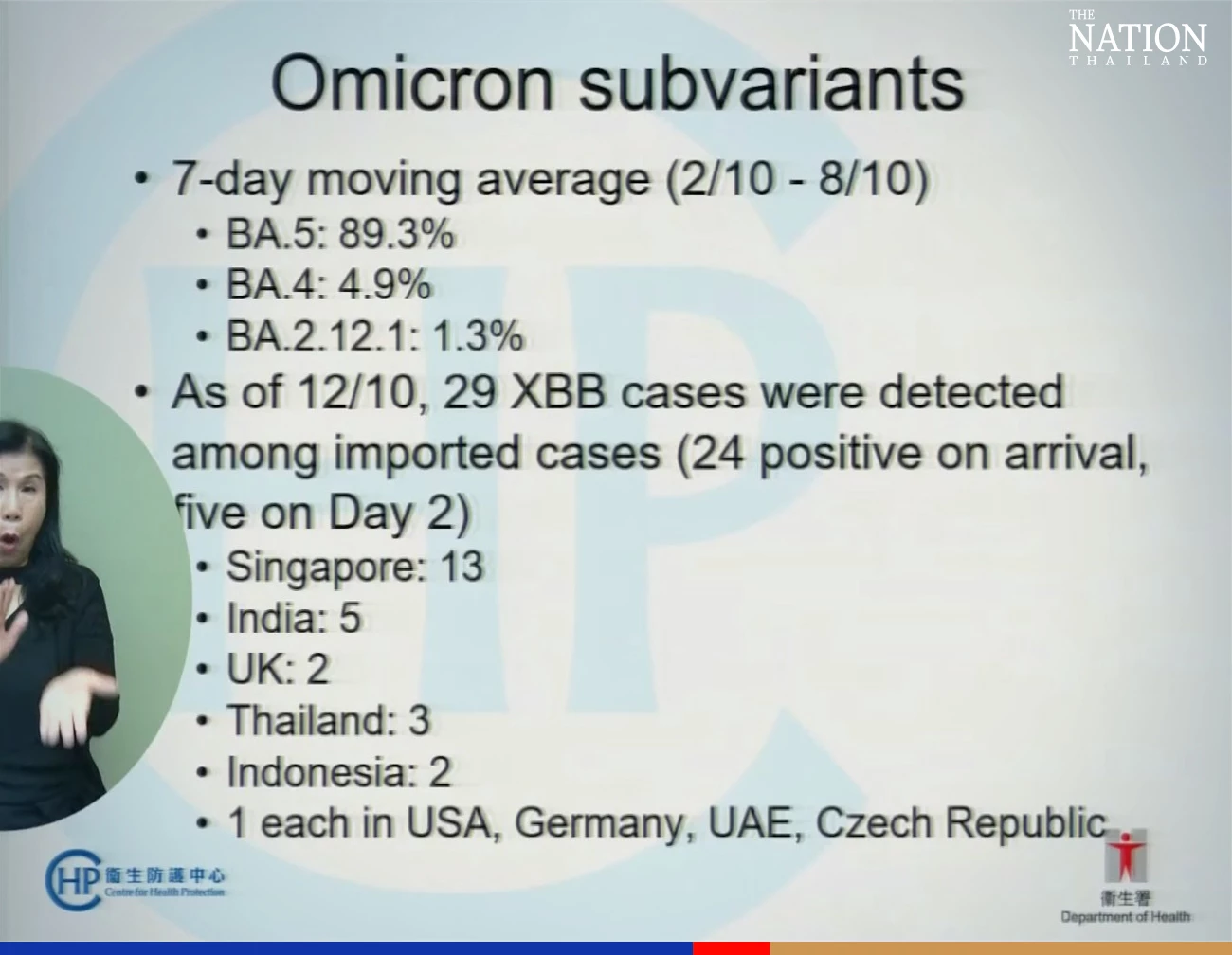
Hong Kong has reported that three people who had travelled from Thailand were found to be infected with the XBB variant of Covid-19.
Virologist Dr Anan Jongkaewwattana posted on his Facebook on Thursday the report from Hong Kong’s health department.
The report said that 29 imported XBB cases were detected in Hong Kong on Wednesday — 24 tested positive on arrival while five cases were detected on the second day. Of the 29 cases, three patients had travelled from Thailand, 13 patients had travelled from Singapore, five from India, two from both the UK and Indonesia, while one case each was from the US, Germany, the United Arab Emirates, and Czech Republic.
Anan said that it was likely the XBB virus had been mixed up with Covid-19 patients in Thailand but was not detected yet.
However, he said that it was also possible that these three patients had travelled from other places and had transited Thailand before heading to Hong Kong.
Thailand’s Disease Control Department (DDC) had confirmed on Wednesday that the BQ.1.1 and XBB variants have not spread in Thailand, and most new cases were infected with the Omicron variant.












 SootinClaimon.Com