Adapting to the digital age

ศาสตร์เกษตรดินปุ๋ย : ขอบคุณแหล่งข้อมูล : หนังสือพิมพ์ The Nation

http://www.nationmultimedia.com/detail/lifestyle/30368118

Adapting to the digital age

lifestyle April 22, 2019 13:40

By The Nation

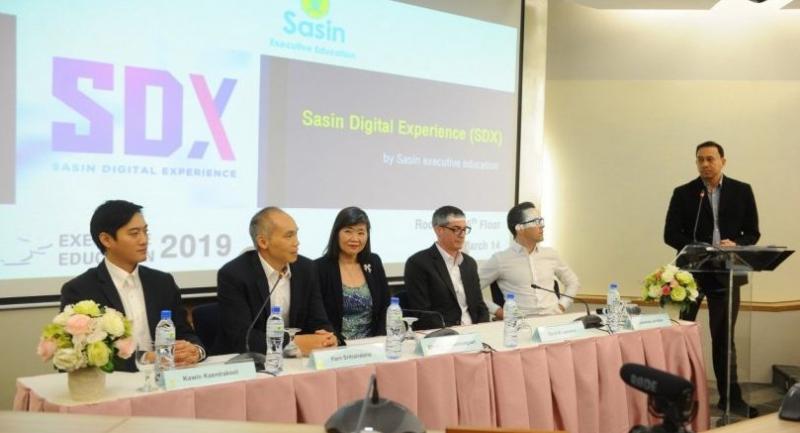
Sasin Graduate Institute of Business Administration (Chulalongkorn University) presents SDX (Sasin Digital Experience), the first-ever Sasin networking short course designed to help executives and management relearn the landscape of technology.

technology. The course allows for a better understanding of how technologies apply to business, thus making participants capable of aligning the correct stakeholder and successfully transforming the business to digital.

Sasin Digital Experience (SDX) is run in cooperation with the Sasin Alumni Association and open to entrepreneurs, businessman as well as alumni.

It is the first-ever Sasin Executive Education programme to focus on the Digital Transformation Experience. The 12-week course takes place on Saturdays and includes international (4 days in Tokyo) and domestic (3 days Hua-Hin) residential sessions. SDX aims to provide a deep insight into the digital world by learning from leading experts in the digital transformation to equip participants with practical skills and strategic knowledge on how to drive themselves and their organisations to success in the digital world.

Speakers are Alvin Ng (General Electric Digital), Chutima Sribumrungsart (Microsoft Thailand), David Lawrence (Pisut & Partners), Johannes Rohr (Rabbit Finance), Kent Wertime (Ogilvy Asia), Assistant Professor Piyachart Phiromswad (Sasin School of Management),Professor Ravi Aron (Johns Hopkins Carey Business School), Rujikorn Pavasuthipaisit (TMB Bank), Siwat Chawareewong (Group M) and Siavash Hosseinbor (Syndacast)

The tuition fee is Bt220,000 covering 12 weeks of full Saturday classes as well as the Tokyo residential and Hua-Hin residential programmes. The first class starts this Saturday (April 27), the Tokyo residential is on May 23-26 and Hua Hin residential is during August 2-4.

Discounts are available. Find out more by emailing apply@exed-sdx.com and executiveeducation@sasin.ed or visit http://www.ExEd-sdx.com and http://execed.sasin.edu/event/sasin-digital-experience/.

Korean heartthrob comes to town

ศาสตร์เกษตรดินปุ๋ย : ขอบคุณแหล่งข้อมูล : หนังสือพิมพ์ The Nation

http://www.nationmultimedia.com/detail/lifestyle/30368116

Korean heartthrob comes to town

lifestyle April 22, 2019 13:30

By The Nation

Actor Park HaeJin, star of this year’s romantic drama “Secret”, is back in Thailand for his “Fanmeeting A Secret Day” at Chaeng Wattana Hall on the fifth floor of Central Chaeng Wattana this Sunday (April 28) at 6pm.

“Secret”, directed by Oh Jong Rok of “Piano” and “Style” fame, is a new drama about people with realistic desires, each of whom harbours emotional scars from their own unhappy memories, who gather in a special space called the “forest.” Their scars slowly begin to heal as they discover the true meaning of happiness and learn to love themselves and others.

Park HaeJin plays Kang San Hyuk, a special rescue task force member who is blessed with looks, sharp instincts, and a brilliant mind, but who has lost his memories of childhood.

The 36yearold heartthrob made his acting debut in the 2006 television drama “Famous Chil Princesses.” He has since starred in films, variety shows and dramas, including “East of Eden” in 2008, “My Daughter Seo Young” in 2012, “My Love From the Star” in 2013, “Doctor Stranger” in 2014, “Bad Guys” in 2014 and “Cheese in the Trap” in 2016.

Tickets cost from Bt2,800 to Bt4,800 at Thai Ticket Major. Call (02) 262 3456 or visit http://www.ThaiTicketMajor.com.

Diminutive Korean ‘Kids Creators’ inject fresh perspective into YouTube

ศาสตร์เกษตรดินปุ๋ย : ขอบคุณแหล่งข้อมูล : หนังสือพิมพ์ The Nation

http://www.nationmultimedia.com/detail/lifestyle/30368057

Son Esther (left) and Lee Chae-yoon Photo/The Korea Herald

Diminutive Korean ‘Kids Creators’ inject fresh perspective into YouTube

lifestyle April 21, 2019 16:24

By Yoon Min-sik
The Korea Herald
Asia News Network

2,860 Viewed

Twenty years ago, celebrity and K-pop idol crept up the list of dream jobs for children in Korea – a list formerly occupied by doctor, scholar, politician or government official. What followed were a flood of TV talent shows and reality programs on youth aspiring for the limelight.

Recent surveys suggest the times are changing once more, as children are opting to perform in front of the much smaller camera of a personal computer as a YouTuber, or as it is more commonly known here, “YouTube Creator.”

“When I first started YouTube, a lot of the older kids came up to me and left me gifts in my bag. It was a bit overwhelming at first, but I’ve gotten used to talking to strangers,” said Son Esther, or “Pretty Esther,” one of the more popular kid creators in Korea.

Uploading videos about her everyday life, ongoing fads and regular stuff kids her age — third graders — can relate to, she has on a path toward the most coveted career among children here. That is at least according to a survey by local publishing company Chunjae Gyoyuk, which found that “online content creator” ranked No. 1 (15.3 percent) on the list of elementary and middle school students’ dream jobs.

Child actor Lee Chae-yoon said she did not get a ton of recognition for her acting career, but this changed with the launch of her YouTube channel a little over a year ago. While she is not yet among the leaders among her peers with some 55,000 subscribers, her channel has been seeing rapid growth.

“One of the good things about YouTube is the way of communication is always open. I sometimes hold Q&A sessions and write comments to them,” 13-year-old Lee said.

Esther, in her third year as a YouTuber, also noted open communication as one of the best things about YouTube.

“Sometimes when I’m sick or taking a day off, people would write comments of concern and look to cheer me up. This is among the things most memorable (about being a YouTuber),” she said.

Being a pint-sized celebrity has touched upon both of their lives, as Esther is more comfortable talking to strangers and Lee feels more at home communicating with anyone at all.

“I used to never talk to people, being shy and not really hanging out with friends. But now I’m much more social and open to talking in front of people,” Lee said.

Being on YouTube can also be tough, she noted.

“As a child actor I would do just what I’ve memorized, but here, I have to create my own lines and edit my own videos. It’s more demanding but more fun at the same time,” she said.

Lee hopes to continue both her acting and YouTube careers, much like her idol Shin Se-kyung, one of the most popular actors in Korea and a budding YouTuber. She recently branched out to reviews of aesthetic products and clothes, but can cover any topic people can relate to.

Esther said she gets many of the ideas from YouTube itself, picking up on what is trending.

“My channel is mostly about the subjects that elementary school students can relate to, which is one of the best things about being a kid creator,” she said.

Relating to viewers is widely considered key in being a successful YouTuber, particularly among child YouTubers. Channels run by children deal mostly with topics that children can relate to, like US YouTuber Ryan of “Ryan ToysReview” who is estimated to have made about $21 million in the span of 12 months — while still 7 years old.

Dia TV, a branch of CJ ENM that supports online content creators, recently created the “Seeds of Happiness” music video series, jointly created by the kid creators based on their actual stories.

Esther’s story is about how she started creating YouTube content as a way to spend more time with her father, who is now deeply involved in her work as a YouTuber. As with the content of Lee and Esther, the content of the video is something most children their age can relate to.

Both are hoping YouTube will be a part of their future.

“I want to upload videos in between my acting jobs, like Shin Se-kyung does. I wish to keep communicating with the people through YouTube,” Lee said.

Strictly for the girls

ศาสตร์เกษตรดินปุ๋ย : ขอบคุณแหล่งข้อมูล : หนังสือพิมพ์ The Nation

http://www.nationmultimedia.com/detail/lifestyle/30367976

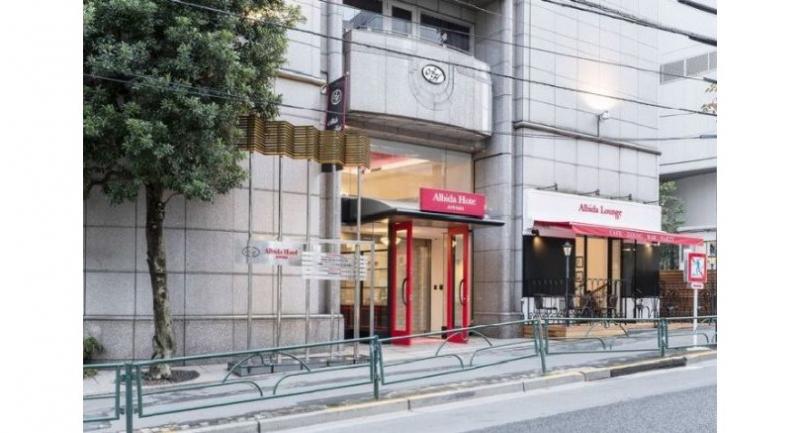
The exterior of Albida Hotel Aoyama in Minato Ward, Tokyo/ Photo courtesy of Abiste Co

Strictly for the girls

lifestyle April 20, 2019 01:00

By Akira Miura
Special to the Japan News
Asia News Network

3,206 Viewed

With the Tokyo Games coming up next year, an accessory firm opens a women-only capsule hotel in the Japanese capital

JAPANESE PEOPLE used to be mocked overseas for “living in rabbit hutches”. When the first capsule hotel opened in central Osaka in 1979, it caused ripples of surprise across the world.

The hotel was designed by the late Kisho Kurokawa, one of the greatest architects Japan has ever produced. He had previously exhibited capsule houses during the 1970 Japan World Exposition in Osaka Prefecture and designed the famous Nakagin Capsule Tower in Tokyo’s Ginza area in 1972.

The exterior of Albida Hotel Aoyama in Minato Ward, Tokyo/ Photo courtesy of Abiste Co

Fast forward to December 15 last year, when a new women-only capsule hotel opened in the Gaienmae district of Tokyo. Albida Hotel Aoyama is in an excellent location, close to the intersection of Aoyamadori and Gaien-Nishidori avenues, and a five-minute walk from Gaienmae Station on the Ginza subway line.

The hotel was opened by Abiste Corp, which imports and sells accessories and trinkets at its 170 wholly owned outlets in Japan, and about 20 overseas. Most of the Abiste outlets are located inside hotels. This is a quite unusual sales strategy, as department stores are the main marketing channel for other Japanese accessory companies, such as Yondoshi Holdings and Star Jewellery Boutiques.

Abiste opts for hotels because although department stores have the advantage in sales revenue and drawing a large number of customers, hotel outlets have a much higher profit rate. The company has thus established a one-of-a-kind status in the accessory industry.

The company is naturally familiar with hotels, and had waited a long time for a good opportunity to operate one itself.

Albida Hotel Aoyama is the long-awaited realisation of that dream. With five stories above ground and one storey below, the building has a reception desk and a cafe-restaurant on the first floor. Shower rooms, a laundry and a relaxation room are in the basement.

A deluxe cabin room 

The hotel’s 102 guestrooms are composed of three types, from capsule-type units to completely private rooms, on the second to fifth floors. The guestrooms are reasonably priced from 6,900 yen (Bt1,960) plus tax to 8,900 yen plus tax. The prices increase by 500 yen when breakfast is included and by 1,000 yen on Fridays, Saturdays and days before national holidays.

Albida Hotel Aoyama also has a meticulously designed interior, and the powder rooms on each floor are equipped with latest beauty devices, massagers and natural, hypoallergenic cosmetics.

“I hope people will stay at our hotel like they would visit an aesthetic salon or the cosmetics section of a department store,” an Abiste employee said.

The hotel is close to fashionable areas such as Aoyama and Harajuku, so it’s an excellent facility for people in the fashion business who come to Tokyo from other areas.

Ahead of the Tokyo Olympic and Paralympic Games, new hotels are opening one after another in central Tokyo. Many feature unprecedented concepts or styles. Strictly speaking, Albida Hotel is categorised as an inexpensive lodging house, which means the guestrooms cannot be locked due to the Fire Service Law.

Considering the good location, it might have seemed more natural to open a fashionable boutique hotel. But this means more restrictions and enormous costs. The company therefore came up with the idea of opening a capsule hotel for women.

Guests seem to like the fact that the rooms cost less than 10,000 yen and they can stay there as casually as they would go to an aesthetic salon. It seems like a success story that only this unique company, with its expert knowledge of hotels and female customers’ preferences, could achieve.

The hotel reportedly aims to clear an occupancy rate of 75 per cent by the end of this year, and to shoot for 90 per cent next year, the year of the Tokyo Games.

A very ambitious property indeed!

Smart, speedy and easy on the wallet

ศาสตร์เกษตรดินปุ๋ย : ขอบคุณแหล่งข้อมูล : หนังสือพิมพ์ The Nation

http://www.nationmultimedia.com/detail/lifestyle/30367975

Smart, speedy and easy on the wallet

lifestyle April 20, 2019 01:00

By Paisal Chuenprasaeng
The Nation Weekend

2,021 Viewed

The new Nokia 8.1 does everything a smartphone should do and more besides

A MID-RANGE smartphone with good performance and no sluggishness, the Nokia 8.1 is powered by Qualcomm Snapdragon 710 octa-core processor running at 2.2 GHZ. It’s equipped with 4 gigabytes of working memory or RAM and 64 GB of internal storage, which is expandable with a microSD card by up to 400GB. It uses the Android 9 operating system without add-out user interface.

Released by HMD Global, the smartphone has a good quality main rear camera that uses Zeiss Optics and a dual camera system for bokeh effects. The main rear camera has 12-megapixel resolution using a sensor with a large pixel of 1.4 microns for capturing precise light conditions, as well as optical image stabilisation.

The second rear camera is 13-megapixels and provides depth data to achieve the bokeh effect. The Nokia 8.1 even comes with Live Bokeh mode that provides a slide bar for you to adjust the level of blurred background. You can see the results of your adjustment in real time.

The camera’s auto mode is called Photo and uses AI to recognise various scenes and adjusts shooting parameters for you automatically.

If you are an advanced photographer, you can use the Pro mode that allows you to adjust various shooting parameters on your own, such as white balance, shutter speed, focus mode and exposure compensation.

I tried shooting with the Photo mode and I found that Nokia 8.1 captured beautiful and clean shots in most lighting environments. The Live Bokeh mode allowed me to achieve the blurred background effect easily and made the subjects of my photos more prominent.

The phone also comes with 20MP front camera for selfie shooting.

Nokia 8.1 comes in a two-tone design with the second colour at the edges to add a unique look. The phone is strong with a metal frame and its back is covered with strong glass that doesn’t get smudged by fingerprints.

Its 6.18-inch Full HD+ edge-to-edge PureDisplay looks beautiful in 18.7:9 ratio. It’s bright too, with 500 nits of brightness and boasts 81-per-cent display-to-body area.

The display supports HDR10 technology so watching movies on Nokia 8.1 is enjoyable. I caught HD movies streamed via TrueID TV and iflix on the phone during the test.

The phone can play High-Resolution Audio music files in FLAC 24bit/192kHz format. I tried using the phone to play Hi-Res files and I found that the large music files played smoothly with good quality sound in details and strong bass. I also tested the phone with Sony’s MDR-1ABT Hi-Res Audio headphones.

Nokia 8.1 has fast Internet connection, scoring a data connection speed on the Ookla Speedtest app of 64 Mbps for downloads and 38.2 Mbps for uploads.

The smartphone has a fingerprint sensor at its back below the camera’s lens for securely unlocking it. I found the fingerprint worked effectively.

The Nokia 8.1 has a 3,500 mAh battery which supports fast charging. I could survive a day with one charge.

The Nokia 8.1 is available at Shopee for Bt9,900.


Key specs:

Networks: 4G: LTE CAT6, 3G: HSPA, 2G: GSM

OS: Android 9 Pie

CPU: Qualcomm Snapdragon 710 2.2GHz

Memory: 4 GB LPDDR4 RAM

Storage: 64GB, expandable with microSD by up to 400GB

Display: 6.18inch Full HD+ PureDisplay in 18.7:9 view ratio

Cameras: Main rear: 12MP 1.4micron sensor with Zeiss lens; second rear: 13MP depth camera; Front: 20MP

Wireless connectivity: WiFi 802.11ac; Bluetooth 5.0

Location: GPS/AGPS, GLONASS, Beidou

Sensors: Ambient light sensor, Proximity sensor, Accelerometer (Gsensor), Ecompass, Gyroscope, Fingerprint sensor (rear), NFC

Battery: 3,500 mAh, 18W fast charging

Dimensions: 154.8 x 75.76 x 7.97 mm

Weight: 189g

Colour options: Blue/Silver, Steel/Copper, Iron/Steel

With his bare hands

ศาสตร์เกษตรดินปุ๋ย : ขอบคุณแหล่งข้อมูล : หนังสือพิมพ์ The Nation

http://www.nationmultimedia.com/detail/lifestyle/30367974

Beekeeper Yip Kihok, 62, blows bees off a honeycomb after removing their honey-filled nest on a hillside in Hong Kong./AFP

With his bare hands

lifestyle April 20, 2019 01:00

By Agence France-Presse

How a Hong Kong beekeeper harvests hives in the wild

HIGH UP in the hills above Hong Kong, Yip Ki-hok uses nothing but his bare hands to remove a honey-filled nest of swarming bees – a remarkable skill he learned after the hardship of China’s famine years.

While most new beekeepers buy insects from those with already established colonies, Yip prefers a more organic method, trekking into the hills and catching wild bees using skills he developed through trial and error from the age of seven.

Beekeeper Yip Kihok, 62, blows bees off a honeycomb after removing their honey-filled nest on a hillside in Hong Kong./AFP

The 62-year-old effortlessly moves through bush and dense thickets, far from the official hiking trails, and pauses at a hole in the hillside he knows will contain a bee colony.

Lighting five incense sticks to placate the bees, he waits for the smoke to take effect and then reaches into the hole, removing chunks of the hive along with handfuls of bees.

Remarkably he is only stung twice. The trick, he explains, is to remove as much of the hive as possible without killing or losing the vital queen.

“If you wear gloves, then you don’t know how much strength you’re using,” he explains. “If you use too much strength and accidentally kill the queen, it’s very troublesome, it’ll be very hard to take the hive back.”

Moving slowly and carefully, he blows on the hive to herd the bees into a wire cage covered with a white drawstring bag.

He searches for the queen as stragglers buzz around him – a crucial part of the operation as the other bees in the hive are fiercely attracted to her.

Bees and larvae, centre left, on honeycombs at Yip’s apiary in Hong Kong, after he removed the honey-filled nest from a hillside using his bare hands./AFP

“Without the queen, they will get angry and go looking for her everywhere. If they can’t find her they will fly right back out of the cage. They’ll fly around everywhere to find her and start stinging like crazy,” he said.

Although he was once stung more than 200 times when he lost the queen during an extraction, Yip says he has no need for gloves or other protective gear.

“Why would I need those things? I know their nature like I know my own hand. No matter how mean they are I still have a way to tame them,” he explained.

Back at his farm, Yip uses wire to attach the honeycomb to wooden frames, which are then slotted into wooden crates. Then he pulls out handfuls of bees from the drawstring bag and places them gently in their new home.

Yip generally collects honey three times a year from over 200 hives, extracting the golden liquid by spinning each frame in a metal drum.

It was on the Chinese mainland Yip learned his skills, in the wake of Mao’s famine when millions starved and people took whatever steps they could to survive.

Yip worked as a teacher in Guangdong province, supplementing his meagre income by trading honey for food coupons.

He switched to full-time beekeeping after economic reforms under Deng Xiaoping in the late 1970s allowed private businesses to flourish.

Yip pours freshly extracted honey from a honeycomb spinner drum as his son Hugo, right, filters it into a plastic jug at their apiary in Hong Kong./AFP

After his wife’s family successfully relocated to Hong Kong in 1983, Yip followed – although it took him some five years as he was caught each time he tried to smuggle himself across the border before eventually making it through legally.

He had to start his beekeeping from scratch, building boxes for the colonies out of scraps of discarded wood.

Within a year he had 150 healthy hives, laying the foundations of a business which has since grown into one of the city’s biggest local honey producers.

But as the global climate warms and fuels bigger storms, his livelihood – and Hong Kong’s bee population – face increasing challenges to their survival.

Ever expanding urban developments in the densely populated city already threaten wild bees and their food supply. And ever stronger tropical storms are exacerbating the damage.

Last year Typhoon Mangkhut – the most intense storm on record in Hong Kong – tore through the city, knocking down tens of thousands of trees and flattening huge swathes of pollinating flowers.

“Last year this hole was full to bursting, but it wasn’t like that this year,” he says, referencing the hillside where he had just plucked out the hive.

Another colony he visited earlier that day had also fared badly.

“That first hive I picked up has not recovered at all,” he laments. “Typhoon Mangkhut was too strong, it felled over half of the trees and flowers… without the plants, the bees naturally reproduced more slowly.”

Scientists warn rising temperatures will increase the frequency of more powerful storms like Mangkhut.

While Yip plans to continue trekking into the hills as long as he can, he hopes the typhoons of the future will give Hong Kong and his favourite bee colonies a miss.

Moving to the beat

ศาสตร์เกษตรดินปุ๋ย : ขอบคุณแหล่งข้อมูล : หนังสือพิมพ์ The Nation

http://www.nationmultimedia.com/detail/lifestyle/30367977

Moving to the beat

lifestyle April 20, 2019 01:00

By Paisal Chuenprasaeng
The Nation Weekend

Bang & Olufsen’s upgraded ear buds allow you to listen to your favourite sounds no matter what you are doing

IDEAL FOR music-lovers who simply cannot bear to be away from their favourite sounds even when on the go, the Beoplay E8 2.0 guarantees a top-of-the-range listening experience.

Like its predecessor, the E8, the Beoplay E8 2.0 has Bang & Olufsen Signature Sound that can be easily adjusted and adapted to your activity via the Bang & Olufsen (B&O) app.

The major improvements to these second-generation earbuds lie in the wireless charging capacity and longer battery life.

Now, the charging cradle of the earbuds can be simply placed on the wireless charger that supports the open Qi interface standard without any need for a cable.

The power bank of the charging cradle has been improved to provide three full charges for the earbuds, compared to the two full charges offered by the previous model. And since the E8 2.0 earbuds have four hours of battery life, the power bank of the cradle extends the battery life of the new version to 16 hours.

The package also comes with a USB-C cable that can recharge the earbuds via the cradle as well as recharging the internal power bank of the cradle.

It takes about two hours to fully charge the earbuds and the cradle. When the power bank of the cradle is fully charged along with the earbuds, three LED lights on the cradle will appear.

The charging cradle has also gone through a complete redesign and now boasts a beautiful brushed aluminium insert. Four colours of earbuds and charging case are available: Black, Natural, Indigo Blue and Limestone. The E8 2.0 looks sleek as it is designed by Jakob Wagner, a well-known industry designer.

The earbuds are also designed for sportsmen and women with extra secure fit design and a SweatGuard membrane that prevents humidity and wax from entering the sound port.

Beoplay E8 2.0 has impressive sound quality. Although the earbuds are tiny in size, I found that when they were seated properly in my ear canals, the E8 2.0 reproduced big bass and the mids and highs were outstanding. I enjoyed listening to rock music for hours on end.

I found the earbuds light and comfortable to wear. Four sizes of silicone tips are provided for you to choose to fit your ears for optimised sounds. The four sizes are XS, S, M and L and users can also choose to add Comply foam (in M size only) ear tips.

The earbuds use 5.7mm electro-dynamic speakers, which are tuned by acclaimed Bang & Olufsen acoustic engineers. The drivers support frequency response from 20 to 20,000 Hz with 16 ohms of impedance and the earbuds have a high sensitivity of 107 dB.

Thanks to the built-in omnidirectional microphone, you can also use the E8 2.0 as your smartphone headset.

Connecting the E8 2.0 to your smartphone and operating it is easy. Using the first setting, when you remove the earbuds from the charging case, the two earbuds are turned on automatically. And for the first use, the E8 2.0 will be automatically ready for Bluetooth connection. You simply use your smartphone’s Bluetooth to find and connect to the earbuds.

The earbuds come with one multi-function button on each side, both touch sensitive. If the earbuds are not turned on when removed from the charging case, just tap on the right earphone.

If your smartphone has trouble pairing with the E8 2.0, you must keep a distance of less than 20 centimetres between the left and the right earphones and then touch and hold both multi-function buttons for five seconds to initiate Bluetooth pairing. When the E8 2.0 is ready for pairing, its LED indicator will start flashing blue and the sound prompt is heard.

While playing music, you can touch the right button once to play or pause the music. Touch the left button twice to go back to the previous track. To forward to the next track, do the same but with the right button. To decrease the volume, touch and hold the left button; increase volume with the right.

If a call comes in, touch either button to answer it or touch and hold briefly to reject the call. You can touch either button twice to hang up.

For your safety, the E8 2.0 allows you to hear ambient sounds or sounds in the environment when you are walking or outside. You can use the B&O app to select four transparency modes, which are Commute, Clear, Workout and Podcast. The app also provides a slide bar for adjusting the level of sounds of the surroundings from 0 to 100 per cent. At 0 per cent, you hear almost nothing of the surroundings while at the 100 per cent, you can’t hear the music at all. You can also use the left button to cycle through the transparency mode by tapping it once.

Beoplay E8 2.0 is distributed by RTB Technology for Bt14,500 and is available at Munkong Gadget, Dotlife, iStudio by Copperwire and Spvi, Studio7, Digital Lab Siam Discovery, Power Mall, Power Buy and King Power or online channels including Gadetthai.net, Lazada, Shopee, JD.com and Mercular.

Key spec

>> Frequency: 20 – 20,000 Hz

>> Microphone: Omnidirectional

>> Speakers: Electro-dynamic, 5.7 mm

>> Sensitivity: 107 dB SPL +/-3 dB, ref 1 mW @ 1 kHz

>> Impedance: 16 Ohm

>> Bluetooth: Bluetooth 4.2 AAC codecs

>> B&O App: Yes

>> Battery: Rechargeable Lithium-Ion Batteries; Earphones: Right – 85 mAh, Left – 60 mAh; Up to 4 hours playtime at moderate volume

>> Charging case: 530 mAh – 3x charges for earphones; Charging time: approximately 2 hours

>> Dimensions: Earphones: 23 mm x 20 mm x 25 mm; Charger: 73 mm x 47 mm x 33 mm

>> Weight: Earphones: Right 7 g, Left 6 g; Charger: 45 g
Strictly for the girls

ศาสตร์เกษตรดินปุ๋ย : ขอบคุณแหล่งข้อมูล : หนังสือพิมพ์ The Nation

http://www.nationmultimedia.com/detail/lifestyle/30367976

The exterior of Albida Hotel Aoyama in Minato Ward, Tokyo/ Photo courtesy of Abiste Co

Strictly for the girls

lifestyle April 20, 2019 01:00

By Akira Miura
Special to the Japan News
Asia News Network

2,608 Viewed

With the Tokyo Games coming up next year, an accessory firm opens a women-only capsule hotel in the Japanese capital

JAPANESE PEOPLE used to be mocked overseas for “living in rabbit hutches”. When the first capsule hotel opened in central Osaka in 1979, it caused ripples of surprise across the world.

The hotel was designed by the late Kisho Kurokawa, one of the greatest architects Japan has ever produced. He had previously exhibited capsule houses during the 1970 Japan World Exposition in Osaka Prefecture and designed the famous Nakagin Capsule Tower in Tokyo’s Ginza area in 1972.

The exterior of Albida Hotel Aoyama in Minato Ward, Tokyo/ Photo courtesy of Abiste Co

Fast forward to December 15 last year, when a new women-only capsule hotel opened in the Gaienmae district of Tokyo. Albida Hotel Aoyama is in an excellent location, close to the intersection of Aoyamadori and Gaien-Nishidori avenues, and a five-minute walk from Gaienmae Station on the Ginza subway line.

The hotel was opened by Abiste Corp, which imports and sells accessories and trinkets at its 170 wholly owned outlets in Japan, and about 20 overseas. Most of the Abiste outlets are located inside hotels. This is a quite unusual sales strategy, as department stores are the main marketing channel for other Japanese accessory companies, such as Yondoshi Holdings and Star Jewellery Boutiques.

Abiste opts for hotels because although department stores have the advantage in sales revenue and drawing a large number of customers, hotel outlets have a much higher profit rate. The company has thus established a one-of-a-kind status in the accessory industry.

The company is naturally familiar with hotels, and had waited a long time for a good opportunity to operate one itself.

Albida Hotel Aoyama is the long-awaited realisation of that dream. With five stories above ground and one storey below, the building has a reception desk and a cafe-restaurant on the first floor. Shower rooms, a laundry and a relaxation room are in the basement.

A deluxe cabin room 

The hotel’s 102 guestrooms are composed of three types, from capsule-type units to completely private rooms, on the second to fifth floors. The guestrooms are reasonably priced from 6,900 yen (Bt1,960) plus tax to 8,900 yen plus tax. The prices increase by 500 yen when breakfast is included and by 1,000 yen on Fridays, Saturdays and days before national holidays.

Albida Hotel Aoyama also has a meticulously designed interior, and the powder rooms on each floor are equipped with latest beauty devices, massagers and natural, hypoallergenic cosmetics.

“I hope people will stay at our hotel like they would visit an aesthetic salon or the cosmetics section of a department store,” an Abiste employee said.

The hotel is close to fashionable areas such as Aoyama and Harajuku, so it’s an excellent facility for people in the fashion business who come to Tokyo from other areas.

Ahead of the Tokyo Olympic and Paralympic Games, new hotels are opening one after another in central Tokyo. Many feature unprecedented concepts or styles. Strictly speaking, Albida Hotel is categorised as an inexpensive lodging house, which means the guestrooms cannot be locked due to the Fire Service Law.

Considering the good location, it might have seemed more natural to open a fashionable boutique hotel. But this means more restrictions and enormous costs. The company therefore came up with the idea of opening a capsule hotel for women.

Guests seem to like the fact that the rooms cost less than 10,000 yen and they can stay there as casually as they would go to an aesthetic salon. It seems like a success story that only this unique company, with its expert knowledge of hotels and female customers’ preferences, could achieve.

The hotel reportedly aims to clear an occupancy rate of 75 per cent by the end of this year, and to shoot for 90 per cent next year, the year of the Tokyo Games.

A very ambitious property indeed!

Smart, speedy and easy on the wallet

ศาสตร์เกษตรดินปุ๋ย : ขอบคุณแหล่งข้อมูล : หนังสือพิมพ์ The Nation

http://www.nationmultimedia.com/detail/lifestyle/30367975

Smart, speedy and easy on the wallet

lifestyle April 20, 2019 01:00

By Paisal Chuenprasaeng
The Nation Weekend

The new Nokia 8.1 does everything a smartphone should do and more besides

A MID-RANGE smartphone with good performance and no sluggishness, the Nokia 8.1 is powered by Qualcomm Snapdragon 710 octa-core processor running at 2.2 GHZ. It’s equipped with 4 gigabytes of working memory or RAM and 64 GB of internal storage, which is expandable with a microSD card by up to 400GB. It uses the Android 9 operating system without add-out user interface.

Released by HMD Global, the smartphone has a good quality main rear camera that uses Zeiss Optics and a dual camera system for bokeh effects. The main rear camera has 12-megapixel resolution using a sensor with a large pixel of 1.4 microns for capturing precise light conditions, as well as optical image stabilisation.


The second rear camera is 13-megapixels and provides depth data to achieve the bokeh effect. The Nokia 8.1 even comes with Live Bokeh mode that provides a slide bar for you to adjust the level of blurred background. You can see the results of your adjustment in real time.

The camera’s auto mode is called Photo and uses AI to recognise various scenes and adjusts shooting parameters for you automatically.

If you are an advanced photographer, you can use the Pro mode that allows you to adjust various shooting parameters on your own, such as white balance, shutter speed, focus mode and exposure compensation.

I tried shooting with the Photo mode and I found that Nokia 8.1 captured beautiful and clean shots in most lighting environments. The Live Bokeh mode allowed me to achieve the blurred background effect easily and made the subjects of my photos more prominent.

The phone also comes with 20MP front camera for selfie shooting.

Nokia 8.1 comes in a two-tone design with the second colour at the edges to add a unique look. The phone is strong with a metal frame and its back is covered with strong glass that doesn’t get smudged by fingerprints.

Its 6.18-inch Full HD+ edge-to-edge PureDisplay looks beautiful in 18.7:9 ratio. It’s bright too, with 500 nits of brightness and boasts 81-per-cent display-to-body area.

The display supports HDR10 technology so watching movies on Nokia 8.1 is enjoyable. I caught HD movies streamed via TrueID TV and iflix on the phone during the test.

The phone can play High-Resolution Audio music files in FLAC 24bit/192kHz format. I tried using the phone to play Hi-Res files and I found that the large music files played smoothly with good quality sound in details and strong bass. I also tested the phone with Sony’s MDR-1ABT Hi-Res Audio headphones.

Nokia 8.1 has fast Internet connection, scoring a data connection speed on the Ookla Speedtest app of 64 Mbps for downloads and 38.2 Mbps for uploads.

The smartphone has a fingerprint sensor at its back below the camera’s lens for securely unlocking it. I found the fingerprint worked effectively.

The Nokia 8.1 has a 3,500 mAh battery which supports fast charging. I could survive a day with one charge.

The Nokia 8.1 is available at Shopee for Bt9,900.


Key specs:

Networks: 4G: LTE CAT6, 3G: HSPA, 2G: GSM

OS: Android 9 Pie

CPU: Qualcomm Snapdragon 710 2.2GHz

Memory: 4 GB LPDDR4 RAM

Storage: 64GB, expandable with microSD by up to 400GB

Display: 6.18inch Full HD+ PureDisplay in 18.7:9 view ratio

Cameras: Main rear: 12MP 1.4micron sensor with Zeiss lens; second rear: 13MP depth camera; Front: 20MP

Wireless connectivity: WiFi 802.11ac; Bluetooth 5.0

Location: GPS/AGPS, GLONASS, Beidou

Sensors: Ambient light sensor, Proximity sensor, Accelerometer (Gsensor), Ecompass, Gyroscope, Fingerprint sensor (rear), NFC

Battery: 3,500 mAh, 18W fast charging

Dimensions: 154.8 x 75.76 x 7.97 mm

Weight: 189g

Colour options: Blue/Silver, Steel/Copper, Iron/Steel

Uniqlo partners with Alexander Wang

ศาสตร์เกษตรดินปุ๋ย : ขอบคุณแหล่งข้อมูล : หนังสือพิมพ์ The Nation

http://www.nationmultimedia.com/detail/lifestyle/30367956

Uniqlo partners with Alexander Wang

lifestyle April 19, 2019 13:51

By The Nation

Uniqlo is launching a Spring/Summer 2019 collaboration collection with the Alexander Wang brand.

This second partnership with the top New York brand builds on the LifeWear commitment to bring together the exceptional functionality of Uniqlo’s innovative AIRism fabric with the designer’s sleek styling.

“Working with Uniqlo on the second season of the collaboration, it felt like there was a mutual understanding of not only aesthetics but of each other’s work ethic. It was easier coming together this time around to accomplish a similar goal from various touch-points. Innovation has always been at the forefront of our design and creative process, and functionality serves a huge purpose in the way I and our customers dress. Therefore, through the influence of innovation, technology and functionality, the special AIRism collection was born,” Wang said.

The collection adds new value to LifeWear by combining the year-round comfort of functional AIRism apparel with the signature Alexander Wang look. Five of the 10 women’s items employ the sheerest-ever AIRism fabric, developed to feel like a “second skin”. During summer, women can enjoy camisoles and slips featuring a fabric so smooth, light and comfortable that they almost forget they are wearing them. Another fabric used in the women’s collection is a proprietary, new, seamless type of AIRism that is designed for both indoor and outdoor use. This new AIRism fabric is supportive but not constrictive, and is a perfect material for bras and even shorts to maintain comfort.

 Men’s items include T-shirts and tank tops that incorporate a new fabric comprising a premium cotton finish and an AIRism interior. The fabric feels smooth and comfortable and is sufficiently thick to allow these innerwear items can also serve as regular outerwear. The men’s boxer briefs and briefs also employ this fabric to enhance comfort on hot summer days. As in the previous season, the waistband is adorned with a logo that wearers will want to casually show.

Learn more at http://www.Uniqlo.com/alexanderwang