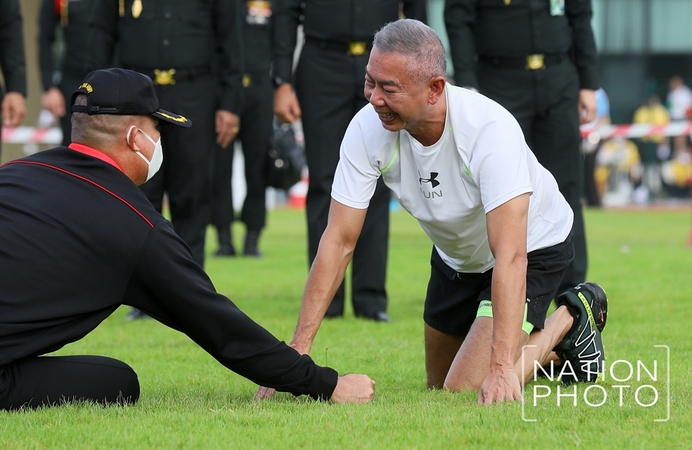
Army chief Apirat Kongsompong swapped his uniform for shorts and T-shirt today (August 14) to put soldiers through their paces in the fitness test at the Command and General Staff College in Bangkok’s Dusit district.
The second physical examination of 2020 featured the usual challenges of push-ups, sit-ups and a 2-kilometre run – but also included the more rigorous Army combat readiness physical test (ACRPT).
The Army chief joined in as soldiers undertook the gruelling ACRPT course of weightlifting, pull-ups and running with weights.
The test was conducted under measures to combat Covid-19.
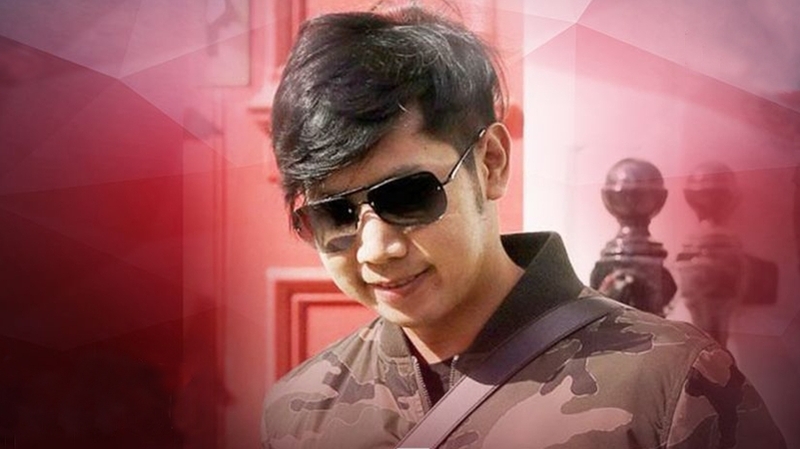
Sattawat Hiranburana, adviser to the National Police chief, on Thursday (August 13) released a timeline of the investigation into the fatal hit-and-run case involving Vorayuth “Boss” Yoovidhya.
The sequence of events from September 3, 2012 to March 4, 2013 are detailed as follows:
September 3, 2012
5.30am: Investigation officer on duty receives a report about a police officer being killed in an accident. Police go to the scene and find the motorbike, body of police officer Wichian Klanprasert and traces of oil. The supervising officer and doctor arrive at the scene for examination.
6.20am: Investigation officers and the doctor oversee initial autopsy of the corpse.
7am: Engine oil on the street is tracked to the home of Chalerm Yoovidhya in Sukhumvit Soi 53. The supervisor orders the investigation officer to seek a search warrant to enter the said house. Then-police chief Kumronvit Thoopkrachang inspects the crime scene.
9.15am: Investigation officers along with evidence collectors inspect the vehicle parked at the accused’s house and acknowledge that the father Chalerm has his son Vorayuth surrender.
9.30am: The investigation officer charges Vorayuth of reckless driving causing death and not stopping to help the victim as well as not reporting the incident to a competent official. Vorayuth denies all charges. Police do not have him undergo a urine test for drugs as per Section 131, and do not collect all the evidence pertinent to the offence.
1pm: Inquiry official confiscates the vehicle and sends it to the forensic office for inspection. Police make an announcement calling for witnesses.
3.10pm: The accused is released temporarily with a guarantee of Bt500,000 in cash. (This step was incorrect as in the case of surrender without an arrest warrant, police must call on the court to issue a warrant as per Section 134 of the Criminal Code.)
4.30pm: The suspect is sent to Bumrungrad Hospital for a blood test to check on traces of alcohol and drugs.
September 4: An investigation team led by Pol Colonel Sukun Phommaryon is set up. Inquiry staff calls on the police commission to have vehicle inspection specialists sent to the Forensic Science Institute.
September 5: The investigation team receives a report from the Traffic Police on the condition of both vehicles involved in the accident. According to Pol Lt-Colonel Somyot Abniam’s testimony the two vehicles were being driven at a speed of no more than 80 kilometres per hour. The blood test at Bamrungrad Hospital reveals 64.68mcg of alcohol per 100ml of blood.
September 6: CCTV footage is collected about 150 metres away from the accident site and sent to the forensic office to detect the speed Vorayuth’s Ferrari was being driven at.
September 8: Jaruchart Maadthong, a key witness who recently died in a motorbike accident, meets the investigation officer to say he was driving a pick-up truck when he saw a motorbike switching from lane one to two. Jaruchart said he then shifted to lane one, and heard a loud crash behind him, but did not turn to look.
September 13: Police receive the results of Vorayuth’s second blood test from Ramathibodhi Hospital, which lists the presence of alprazolam, benzoylecgonine, cocaethylene and caffeine in the blood.
September 16: Assoc Prof Dr Wisoot Kongcharoensomba who tested the suspect’s blood and found foreign substances is questioned by police.
September 17: Police receive test results on soil on the soles of the suspect’s shoes, mats on the floor of his car and driver’s seat etc.
September 18: Police writes to Ramathibodhi Hospital asking for the names of the foreign substances found in the suspect’s blood to be checked.
September 26: Police receives a DVD of the CCTV test result, which determines that the car was being driven at 177kmph.
October 9: Police write to the Institute of Forensic Medicine asking for a check on the names of foreign substances found in the suspect’s blood.
October 11: The investigation team receives a response from Ramathibodhi Hospital saying that alprazolam may be a sleeping pill or an antidepressant, benzoylecgonine is created from cocaine use, cocaethylene is produced after cocaine is mixed with alcohol and caffeine is found in tea, coffee or energy drinks.
October 28: The Institute of Forensic Medicine responds saying benzoylecgonline and cocaethylene are derived from cocaine that is not mixed with food.
November 20: Vorayuth’s lawyer asks to question the doctor who tested the suspect’s blood as well as a maid at the suspect’s house.
December 2: The doctor who examined Vorayuth’s blood alcohol content at 4.30pm on September 3, testified that he had found 64.48mcg alcohol in 100ml of blood. He also said that if the suspect had consumed alcohol from 6am, the blood to alcohol level would be 328.11 per cent, resulting in the drinker being unconscious and unable to drive. The investigation team did not consider the views of other experts, as this doctor was a witness brought forward by the accused. The investigation into this is incomplete.
December 15: Police interrogate a maid at the suspect’s home, who said the accused had started drinking at 7am, after the incident.
December 19: A new investigation team is set up.
January 10, 2013: Vorayuth’s lawyer asks for the testimonies of the suspect’s dentist Dr Narong Potiket as well as Ramathibodi Hospital’s medical chief Dr Vichan Peonim to be examined in relation to evidence of cocaine found in the suspect’s blood.
January 16: Dr Vichan’s testimony, who said that the presence of foreign substances in Vorayuth’s blood may have been caused by medical treatment or false results from antibiotics as well as dentist Dr Narong, who claimed he had prescribed Amoxicillin 500mg to the suspect is examined. The antibiotic prescribed by Dr Narong was not tested to see if it would create benzoylecgonine and cocaethylene in the blood.
February 14: Pol Lt-Colonel Suraphol Detrattanavinai, expert witness and police specialist in mechanical and automotive accessories, said Vorayuth’s Ferrari had sustained moderate damage, which means it was going at no more than 70 to 80kmph when it hit the motorbike.
February 26: Charges filed against the accused include reckless driving causing damage to others or death, and not stopping to help the victim.
Police decided not to pursue the charges of driving recklessly under the influence resulting in damages or death and speeding because the person who could have made the accusation is dead and speeding charges do not apply as the accused had had a drink after the accident and could not have been speeding.
March 1: Police delivers a report to the public prosecutor, who receives it officially on March 4.
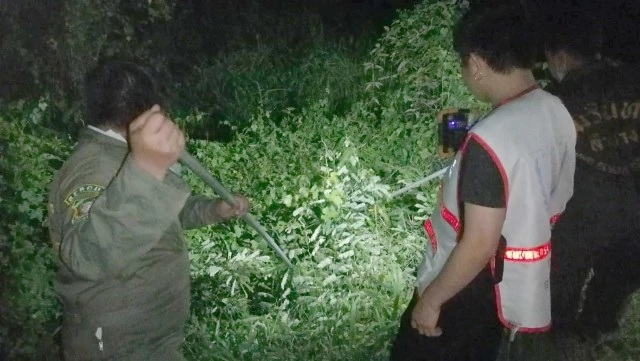
A motorist heading for Muang district in Lampang from Mae Tha district on Thursday (August 13) night called the 191 emergency hotline to report he had seen an injured leopard cat on the side of the road.
“After I realised it was a leopard cat, I decided to call the police immediately,” the motorist said.
Leopard cats are a protected species in Thailand.
The Amarin Lampang rescue team was instructed to rescue the animal, and arrived to find the obviously injured leopard cat lying on the road. However, when officials tried to catch it, it escaped into the wilderness.
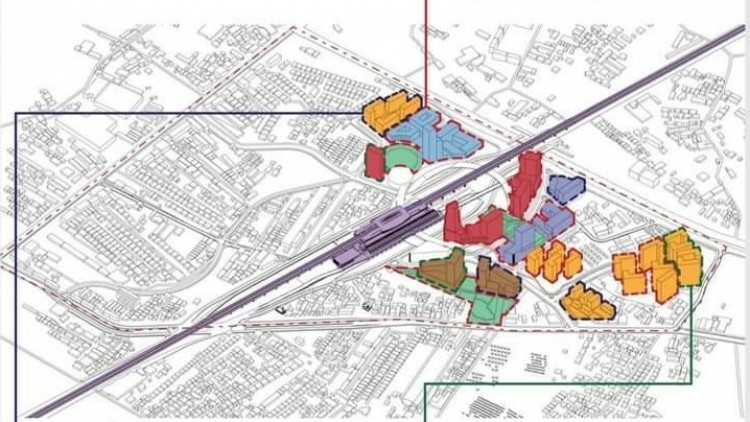
A seminar was held on Friday (August 14) to publicise information on the Transit-Oriented Development (TOD) project around the Pattaya railway station among the people of Chonburi province.
The seminar, held by the Office of Transport and Traffic Policy and Planning (OTP), aimed to discuss with the public on the design of community, mass transit system, and infrastructure, as well as investment plan, development period and impact on environment and society.
Initially, the project aims to connect Pattaya and Nong Prue areas to expand economic activity and public areas, connect with the high-speed train and increase public transport.
Construction of Pattaya station’s TOD project is divided into four phases as follows, the seminar revealed:
The first phase (2021-2022) is the preparation of the area to support the project infrastructure by preparing land acquisition and creating awareness among the public.
The second phase (2023-2027) is short-term, with the development of 686,000 square metres area into office buildings, residences, condominiums, hotels, plaza, transport hubs, convention centres and retail centres.
The third phase (2028-2032) is medium-term, involving the development of 595,000 square metres of area into office buildings, hotels, residences, retail centres, convention centres and public areas.
The long-term fourth phase (2033-2037) will focus on the development of 322,000 square metres area to be office buildings, hotels, residences, retail centres and public areas.
Pheu Thai Party MP and chief strategist Sudarat Keyuraphan expressed her support to pro-democracy youth and demanded that the government desist from using its authority to threaten or intimidate the protesters.
She posted a supporting message on her Twitter account, saying that she agreed with the three demands they have voiced; of ending the intimidation of people who voiced their opinion, dissolve Parliament, and rewrite the Constitution.
The only way to resolve the conflict was to comply with the protesters’ demands and rewrite the charter for a better future.
Sudarat also expressed her concern for the safety of the students since some people might want to exercise dictatorial powers to create violence.
Chaturon Chaisang, former deputy prime minister and chief strategist of the defunct Thai Raksa Chart, said that Prime Minister Prayut Chan-o-cha was trying to use his tongue to get out of hot waters by offering words of compromise to the protesters while his government continued to threaten them.
Meanwhile, Pheu Thai spokesperson Anusorn Eiamsaard said that the government’s time was running out and Prayut had to decide carefully when he should step down.
A group of artists going by the name of “Arts and Culture Network for Democracy” issued a statement on Thursday (August 13) saying that they fully supported young protesters’ fight for democracy.
In the statement, the group demanded that the government be open minded when it comes to facing facts about the monarchy, a subject that has long been taboo in the country.
The artists also urged the government to consider the manifesto the students have come up for the monarchy, adding that the protesters should not be intimidated for proposing reforms to the institution or exercising their freedom of expression. The group has also called on the government to accept the fact that different opinions are the foundation of democracy.
The group said all sides should speak to each other in a civilised manner and demanded that the Army not exercise physical violence or launch another coup d’état.
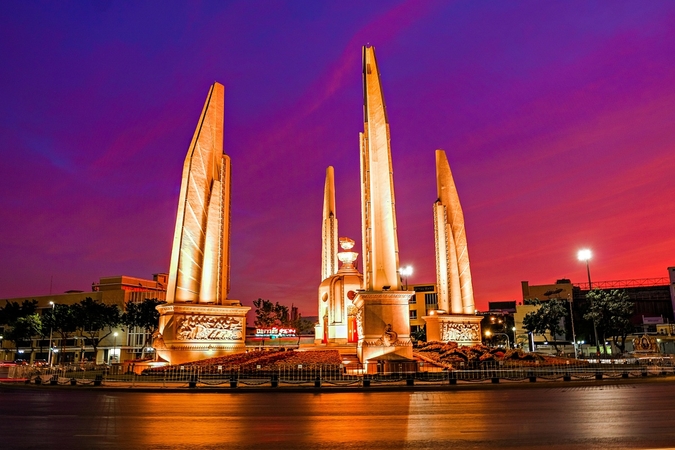
In the statement, the group praised the students of being brave enough to talk about reforming the monarchy in their protest at Thammasat University’s Rangsit campus on Monday. The protesters have announced they will hold another rally on Sunday (August 16) near Bangkok’s Democracy Monument.
Meanwhile, more than 350 Thai academics both in Thailand and overseas issued a statement on Thursday calling on universities to allow students to ask questions freely and find solutions for society peacefully.
This is similar to another statement that was signed by more than 100 academics and released on Wednesday. Academics are worried about the safety of the protesters after their 10-point manifesto for the monarchy drew sharp criticism from other groups.
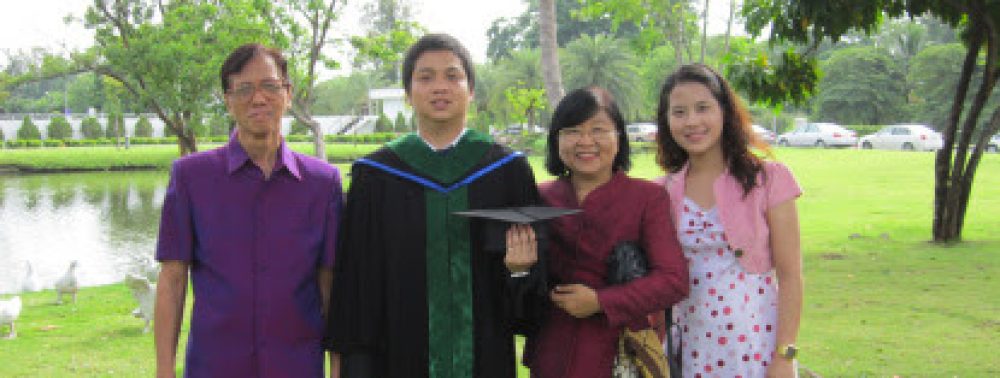
Dr Supat Hasuwannakit, director of Chana Hospital in Songkhla province who is also a social activist and blogger, issued an apology to the people of Thailand for helping the military seize power.
In a Facebook post, Supat said that for the last six years he has been haunted by the words “National Council for Peace and Order” or NCPO, as he was one of the people who helped push it to the front row of Thai politics with the hope of seeing an improvement in democracy.
However, he said, this decision allowed the military regime to rise in power and the younger generation has had to suffer from this mistake.
After the recent student protest at Thammasat University’s Rangsit campus, he said it was time to apologise to the people, because he now knows that there are no shortcuts in the route to democracy.
Hence, he said, changes will need to start from the root of the system and that he would like to be part of a pro-democratic movement, which will change the country forever.
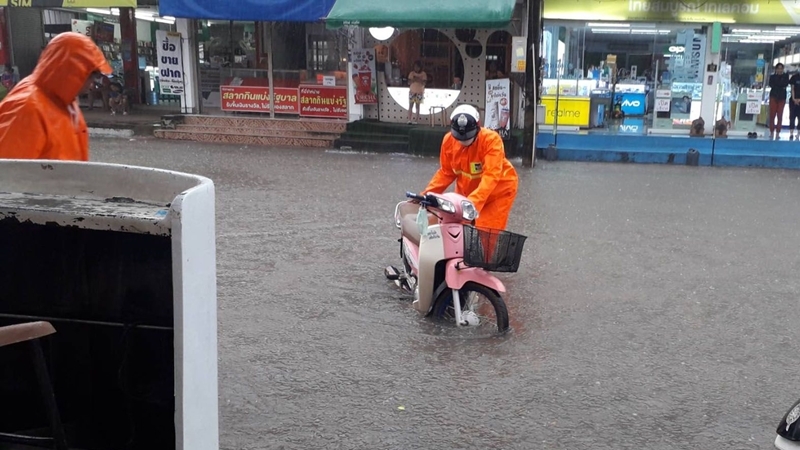
Heavy and continuous rainfall from 4pm on Thursday (August 13) has left all eight districts of Bueng Kan province flooded, with waters as high as 50 metres in some places.
The province is located in a low area, which usually leads to flooding.
Governor Korakot Thamrongwongsawad said he has instructed related agencies to immediately work on improving the situation.
Officials have been sent to help people stranded due to the flooding, while some routes were closed to allow for the floods to drain out.
Access to schools and hospitals was limited due to the high floods.
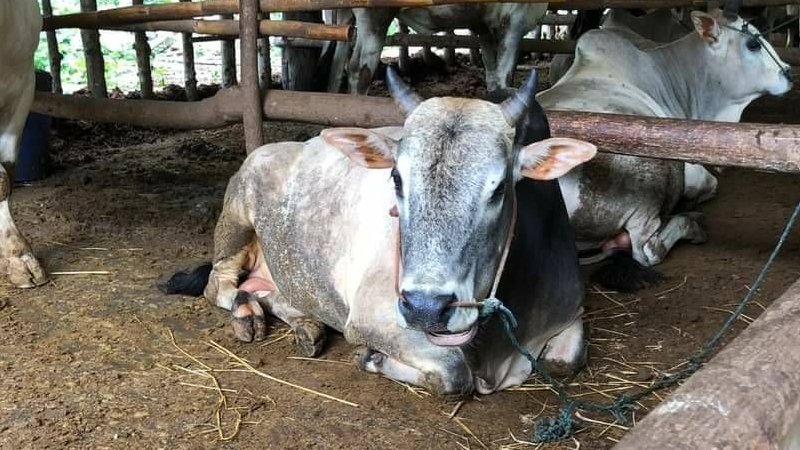
Chiang Rai province has announced Chiang Saen district as a livestock disease infected zone and temporarily prohibited the transportation of cattle.
On Wednesday (August 12), local officials went to examine the situation after several cows and buffalos in the district got sick and died.
An autopsy showed that the cattle were killed by haemorrhagic septicemia, a highly fatal infectious disease.
The villages in Chiang Saen district that have the infection have been declared a dangerous zone for livestock.
The restriction will be effective until September while officials from the Department of Livestock Development have collaborated with the locals to help resolve the situation.
They initially informed farmers about the disease and warned them to strictly follow the measures prescribed by the department.
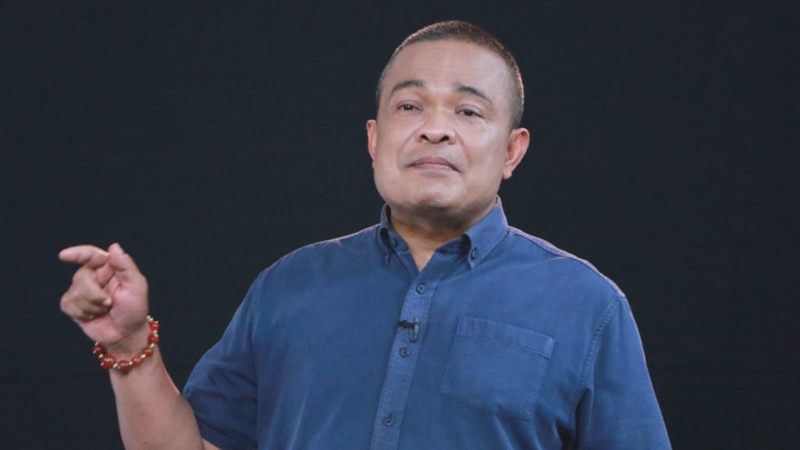
Jatuporn Prompan, the leader of Democracy against Dictatorship, said on Thursday (August 13) that the student activists should stick to their three demands, explaining that other demands would cause severe problems in the future.
The demands he backed were: amending the Constitution, dissolving Parliament, and an immediate halt to intimidating people who hold different opinions to the government.
On Monday (August 10), Thammasat University students launched an anti-government rally under the theme “Thammasat will not tolerate” at their Rangsit campus.
Proposals for reform of the monarchy by youth-led protests have met with both praise for their bravery and fierce criticism for touching on a topic taboo in Thai society.
Jatuporn said that their demands should be safe for protesters. Their three key demands would draw over 100,000 attendees, but those related to the key institution would cause disaster.
The extreme actions of both protesters and the other side could cause a tragedy like October 6, 1976, he warned.




 Sudarat Keyuraphan
 Supat Hasuwannakit