Red shirts reconciled to grim future

ศาสตร์เกษตรดินปุ๋ย : ขอบคุณแหล่งข้อมูล : หนังสือพิมพ์ The Nation

http://www.nationmultimedia.com/detail/politics/30321528

Red shirts reconciled to grim future

politics July 23, 2017 01:00

By THE SUNDAY NATION

JATUPORN PROMPAN has become the latest – and most senior – red-shirt leader to be sent to jail, and this seems to be further weakening the movement.

Earlier, at least 12 leaders of the United Front for Democracy against Dictatorship (UDD) had been sentenced to imprisonment in separate cases. Some of them are serving time in prison while others have appealed the court verdicts against them and have been released on bail.

The Supreme Court last Thursday sentenced Jatuporn, the UDD chairman and a key Pheu Thai Party politician, to a year in jail for defaming former prime minister Abhisit Vejjajiva.

Shortly after the verdict was reported, his Facebook fan page posted Jatuporn’s photo with a message thanking “all the democracy lovers” for their support.

“Till we meet again,” said the message, which stated that Jatuporn was at the Bangkok Remand Prison.

This was the fourth time he has been put behind bars over the past decade. In 2007, he and some other red-shirt leaders were detained after they surrendered on charges of inciting public disorder and opted not to seek bail.

In 2011, a court cancelled bail for Jatuporn in a terrorism case after finding that he broke some of the conditions for temporary release. Last year, his bail was revoked again after another violation of bail conditions. He was released temporarily early this year due to health reasons and his “show of remorse”, according to court.

The UDD was first formed in 2006 to oppose the military coup earlier that year which overthrew the government of Thaksin Shinawatra. It later also opposed the post-coup government, but stopped protesting after the 2007 general elections when Thaksin’s proxy People’s Power Party won.

In 2009, after a Democrat-led government headed by Abhisit was formed, the red shirts held anti-government rallies in April, alleging that the coalition was formed undemocratically as one faction included defectors from Thaksin’s party.

Some red-shirt leaders claimed protesters were killed during clashes with security forces, but authorities dismissed the allegation. Jatuporn called Abhisit a “tyrant whose hands were stained with blood”, an accusation that led to the Democrat leader launching a defamation case against him and eventually the high court verdict last week.

The red shirts took to the streets once again in March 2010 – just over a week after the Supreme Court’s Criminal Division for Political Office Holders ordered that Bt46 billion in Thaksin’s assets be seized, on the grounds that he had made financial gain from abusing his power while in office.

For more than two months the street protests continued and, this time, deaths of protesters actually occurred. More than 90 people were killed and some 2,000 others were injured during the political unrest. In addition to many protesters, military and police officers, foreign journalists and local residents were among the fatalities.

During the two-year duration of the Abhisit government’s tenure, the red-shirt movement was at its peak, becoming a highly powerful political group and leading a controversial campaign to “overthrow the elite”.

At the Asean Summit in 2009, which Thailand hosted in Pattaya, UDD leaders led a large group of red-shirt protesters who stormed the meeting venue. The incident forced an embarrassed government to cancel the meeting involving leaders from all 10 Asean member countries and “dialogue partner” states.

Thirteen protesters, including nine red-shirt leaders, were each sentenced to four years in jail in connection with the incident. The Appeal Court in March rejected their requests for bail, resulting in them being sent to jail. However, they have appealed the imprisonment verdict in the Supreme Court.

When UDD secretary-general Nattawut Saikua visited Jatuporn at the Bangkok Remand Prison, he said that people involved in any fight would inevitably suffer from pain and wounds.

The red shirts movement would continue to be active, although its top leader “has lost his freedom today”, Nattawut said.

“The red shirts have suffered repeatedly. Today there has been more suffering for us. But the pains will power us to stay strong,” he added.

After being granted bail early this year, Jatuporn told the media that his life in detention was like getting ordained as a monk, with strict daily routines and schedules.

“Prison is a graveyard for living people. You need to make your everyday life happy,” he said.

And when he visited the red-shirt leaders jailed at a Chon Buri prison for the Asean Summit incident, Jatuporn said the UDD figures were well aware of their destiny after a decade of political fight.

“We have only two choices – death or jail,” he said.

Judging from their recent remarks after they and their colleagues were sent behind bars, it appears some key red-shirt leaders have conceded to their fate.

PM blames lack of spirituality for country’s political turmoil

ศาสตร์เกษตรดินปุ๋ย : ขอบคุณแหล่งข้อมูล : หนังสือพิมพ์ The Nation

http://www.nationmultimedia.com/detail/politics/30321524

PM blames lack of spirituality for country’s political turmoil

politics July 23, 2017 01:00

By THE SUNDAY NATION

THAILAND’S democracy has never been fully fledged because the country has lacked spirituality, especially during the past 20 years of political turbulence, Prime Minister Prayut Chan-o-cha says.

Addressing his weekly TV programme on Friday night, General Prayut said the country had faced a number of problems because of the absence of spirituality, which provides what he calls “a moral blanket” against ill practices.

The premier said he did not want to blame anyone, but was reminding everyone about this point so people would come to help one another and get out of this sticky situation.

Dharma-based democracy, he said, was something that people did not talk about much, but it was actually crucial because it is rational. Democracy without dharma, he said, would find no peace and stability. To achieve moral society, this principle should be taken into consideration. It was also the starting point for reconciliation, he said.

“I just want you to be thoughtful about the country a bit and have conscience enough to be able to think of some religious principles that we can apply to our present political problems,” he said.

Junta-initiated road to reconciliation long and full of hurdles

ศาสตร์เกษตรดินปุ๋ย : ขอบคุณแหล่งข้อมูล : หนังสือพิมพ์ The Nation

http://www.nationmultimedia.com/detail/politics/30321527

Junta-initiated road to reconciliation long and full of hurdles

politics July 23, 2017 01:00

By KASAMAKORN CHANWANPEN
THE SUNDAY NATION

SEVERAL KEY political factions have shown support for, or given way to, the junta-initiated reconciliation effort that came in the form of a national harmony pact revealed last week. But does this non-hostile position mean that reconciliation will be achieved? Critics remain sceptical that this will be the case.

The final public hearings to introduce the draft of the so-called social contract, and seek opinions on it, were held at four regional military barracks around the country from Monday to Thursday last week. Hundreds of people joined in, but the significance of that remains questionable.

First, seats were reserved mostly for those enlisted or invited. Most participants were civil servants called up by Interior agencies. Although NGO workers and political camps had been invited, it is unclear how many actually showed up at the forums.

Despite it being a top national agenda item, only one well-known figure, red-shirt leader Jatuporn Prompan, attended the seminar on Monday at the First Army Area command in Bangkok.

Of the two-hour long presentation by the military, less than 30 minutes were spent on the introduction of the draft social contract – the very highly anticipated end results of the reconciliation attempts that have been ongoing for the past six months. The rest of the time involved officers emphasising the military’s dedication to recreating national harmony and the inclusive, non-dictatorial approach they had adopted in the scheme.

The question-and-answer session after the presentation was broadly welcomed, as some dozen active citizens took to the stage and expressed their thoughts on every issue except those relevant to the topic of reconciliation. Each and every time a person finished making a point, the operating officers had to repeat and remind speakers to stay focused on national harmony before they finally gave in and called it off.

Despite the awkwardness, Jatuporn welcomed the harmony pact, showing his support and promising that the red shirts would not stand in the way.

The political-turned-charity group People’s Democratic Reform Foundation and the Democrat Party, too, gave way to the scheme and said they would provide full co-operation.

But the previously ruling Pheu Thai Party made an official announcement against the contract plan, saying it was problematic and would not be effective.

Political critic Sukhum Nualsakul pointed out that although key political groups said they would cooperate, this did not guarantee the scheme’s success.

Success would depend more on the draft’s content and its practice than what people said about it. If the contract could not result in changes, it would not mean anything, the critic said.

“Plus, I’m not sure about the stances of the political groups. I think it is understandable that they come in support of the contract. Opposing it will only make them look bad,” Sukhum remarked.

Ekachai Srivilas, director of Peace and Governance at the King Prajadhipok’s Institute, too, said that the contract was “just a piece of paper”. There was so much left to do if harmony was really to be achieved, he said.

The scholar, who also sits on the junta-backed reconciliation committee, admitted that the contract remained the main goal of the whole harmonisation attempt. The committee currently had no further plan to put anything into practice to achieve concrete results, he said.

“They will have final meetings in the upcoming weeks. And I’ll see what comes next, if anything,” Ekachai said.

Another scholar, Chamnan Chanruang, thought the social contract was joke, saying the effort did not work from the beginning, and it was never going to.

“It will do nothing to create harmony. How are you supposed to unite people using a contract?” he asked.

Chamnan said the scheme was just another ritual. He cited its process, saying it had been selective and its clear purpose was to serve the 20-year national strategy. He referred to the two last points in the pact that asked all Thai people to support reform and the national strategy.

Reconciliation in other countries, the scholar pointed out, had been achieved rather through “transitional justice” that proposed, for instance, finding the truth and compensating those who had been affected by conflict. These aspects were nowhere to be found in the junta’s reconciliation scheme.

“So, I suggest that the junta learn about this transitional justice which has worked in many countries and try to apply it with our country,” Chamnan said.

Likewise, Chaturon Chaisang, a key Pheu Thai Party politician, said the NCPO had not been sincere in bringing about reconciliation, and had only used the scheme to show it had fulfilled the job it said it would do when seizing power three years ago.

The whole process, he told The Sunday Nation, was apparently another propaganda effort to show that it has attempted to create national harmony. But, in reality, it was a matter of setting up questions that they answer themselves, while ignoring the real problems and their causes.

Chaturon said the points addressed in the pact were good, but they were irrelevant to reconciliation.

“It is like to telling people to exercise or eat healthy. It is nice but irrelevant,” he said. “This social contract will be useless.”

To achieve harmony, Chaturon suggested the NCPO open up a stage for all sides to talk equally, and address the problems and the causes.

Most importantly, the NCPO must accept that it was part of the conflict, too, the veteran politician said.

PM turns to verse again

ศาสตร์เกษตรดินปุ๋ย : ขอบคุณแหล่งข้อมูล : หนังสือพิมพ์ The Nation

http://www.nationmultimedia.com/detail/politics/30321514

PM turns to verse again

Breaking News July 22, 2017 18:02

By The Nation

THE COMPLEX concept of Pracha Rath (people’s state), a tripartite cooperation between the state, private sector and the people, has once again been penned into verse by the talent of Prime Minister Prayut Chan-o-cha in an attempt to show people the right approach to lead their lives.

The latest poem, the fifth by the premier, has touched upon the principle of Pracha Rath, initiated by his government to support the grassroots economy.

Maj-General Sansern Kaewkamnerd, the government’s spokesperson, said Prayut wished to see people – particularly those in farming areas –embrace the right approaches, especially the King’s science and Pracha Rath.

He urged them to ponder the principles and embrace them in their farm practices to sustain their living as well as the nation’s stability.

“Sometimes, it’s quite boring for us to keep telling people the same stories, and via verse, the stories might get more interesting somehow,” said Sansern, urging the public and young generations to disseminate the premier’s poems.

This is not the first time that Prayut has written a poem for farmers. Early this month, he wrote a piece designed to cheer up farmers with such verses as, “You are strong, tolerant, and have high integrity worth respecting.”

The poem, “Farmers’ Soul Soothing Poem”, urged farmers to not lose their morale or leave their homes as the government has been trying to solve their problems with the Pracha Rath policy and trusted that this was the way to get them out of trouble.

Before this, Prayut penned poems for his officials, including the Cabinet, encouraging them to remain focused and work tirelessly for the people.

The poem urged them not to give up if they encountered struggles along the way when working for the people, and to use their wisdom instead to overcome problems.

Prayut continues to write despite the fact that he had earlier said he would “rather keep his mouth shut” after his first poems sparked a brief verbal tussle among established poets. The poets were split over the PM’s verse, and some appended new stanzas to his efforts.

Constitutional Court to consider EC petition

ศาสตร์เกษตรดินปุ๋ย : ขอบคุณแหล่งข้อมูล : หนังสือพิมพ์ The Nation

http://www.nationmultimedia.com/detail/politics/30321510

Deputy Prime Minister Wissanu Krea-ngam

Deputy Prime Minister Wissanu Krea-ngam

Constitutional Court to consider EC petition

Breaking News July 22, 2017 16:16

By The Nation

The Constitutional Court will convene on Wednesday to consider whether it will accept the Election Commission’s petition against the new EC draft law.

The EC bill is the first of the organic laws to pass through the National Legislative Assembly (NLA) and the tripartite law review committee. Prior to the EC’s decision to petition the Constitutional Court, the EC bill was close to promulgation, pending only royal endorsement. The EC, however, made a last-ditch attempt to get a ruling on the law’s constitutionality.

There are some six points in the bill that the EC has objected to, including the total reset of the current commission.

However, it has decided not to petition the reset question, as the optics of this could lead some people to conclude that it was fighting for the personal interests of EC members. Instead, said Election Commissioner Somchai Srisutthiyakorn on Thursday, it will petition the court over the constitutionality of two controversial points.

The first concerns the removal of the EC’s authority to organise local elections. The second is the removal of the power of EC members to suspend elections if fraud is found.

Deputy Prime Minister Wissanu Krea-ngam said yesterday that the EC’s petition would affect the process of royal endorsement of the government’s final submission.

However, he added, it would be unlikely to affect the election roadmap. That’s because lawmakers have ensured sufficient time to enact the 10 organic laws required by the new charter, he said.

Democracy can’t be strong if spirituality is weak, says PM

ศาสตร์เกษตรดินปุ๋ย : ขอบคุณแหล่งข้อมูล : หนังสือพิมพ์ The Nation

http://www.nationmultimedia.com/detail/politics/30321509

Democracy can’t be strong if spirituality is weak, says PM

Breaking News July 22, 2017 16:13

By The Nation

Thailand’s democracy has never been fully fledged because the country has lacked spirituality, especially during the past 20 years of political turbulence, Prime Minister Prayut Chan-o-cha said in his weekly TV programme on Friday.

Prayut said the country had faced a number of problems because of the absence of spirituality, which provides what he calls “a moral blanket” against ill practices.

The premier said he did not want to blame anyone, but was reminding everyone about this point so people would come to help one another and get out of this sticky situation.

Dharma-based democracy, he said, was something that people did not talk about much, but it was actually crucial because it’s based on rationale. Democracy without dharma, he said, would find no peace and stability. To achieve moral society, this principle should be taken into consideration. It was also the starting point for reconciliation, he said.

“I just want you to be thoughtful about the country a bit and have conscience enough to be able to think of some religious principles that we can apply to our present political problems,” he said.

Yingluck backers came hours before hearing began

ศาสตร์เกษตรดินปุ๋ย : ขอบคุณแหล่งข้อมูล : หนังสือพิมพ์ The Nation

http://www.nationmultimedia.com/detail/politics/30321454

Yingluck backers came hours before hearing began

politics July 22, 2017 01:00

By KASAMAKORN CHANWANPEN
THE NATION

HUNDREDS OF people from across the country yesterday crowded outside the Supreme Court building to show their support for former prime minister Yingluck Shinawatra on the final day of testimony in her rice pledging scheme trial.

Many people waited patiently for hours before she arrived. Some supporters had been waiting since 5am, although she did not show up until 8.30am.

Several people told The Nation they were at the court for the first time, travelling great distances from the capital’s outskirts, western Ratchaburi, northern Chiang Mai, Chiang Rai and northeastern Khon Kaen provinces, which are major strongholds of the Phue Thai Party.

They said they wanted to give Yingluck moral support ahead of the significant court appearance.

Key red-shirt and Pheu Thai members were also present. Among them were Nuttawut Saikua, Weng Tojirakarn, Watana Muangsook, and Khattiya Sawasdipol.

Police estimated there were about 900 supporters, and security agencies deployed 450 policemen and troops.

When Yingluck appeared, she was quickly engulfed by the media and fans who offered her flowers, souvenirs and kind words. They also tried to reach out to her for a handshake and a hug.

Overwhelmed by the tremendous support, Yingluck was moved to tears as she greeted supporters.

Those who could not get near her waved their hands and cried out loudly, telling the ex-premier they loved her and to keep fighting. It took more than half-an-hour for Yingluck to walk just 20 metres, to get past supporters and enter the court building.

Yingluck has been accused of negligence in preventing corruption and irregularities in the controversial rice-pledging scheme. If found guilty, she could face a heavy fine and a jail term up to 10 years.

Girls from minority groups in Chiang Rai, who asked to remain anonymous, were among those showing support. “[We] will be very disappointed if [the court] rules that she is guilty,” one of the girls said. “It’s a shame that someone who does so much for people, the poor people, has to suffer this. I really wish that it won’t turn out that way.”

Holding Yingluck’s portrait, Phra Somchai, a Buddhist monk from Samutprakarn province, said: “I always come to support her if I can or I send some followers here if I can’t.

“I don’t think she should be punished. She did good for the poor people, the farmers. If the court says she is guilty, no one will dare to formulate such policies to help the poor any more.”

Bangkok resident Pornchai Khunkongsatien, 46, said: “I will be very sorry if she is ruled guilty. Everything she did, she did it for the people. I still have hope though that we haven’t reached the point of no justice in Thai society. So, I hope that she will be alright in the end.”

August 25: Judgement day

ศาสตร์เกษตรดินปุ๋ย : ขอบคุณแหล่งข้อมูล : หนังสือพิมพ์ The Nation

http://www.nationmultimedia.com/detail/politics/30321448

August 25: Judgement day

politics July 22, 2017 01:00

By POLITICAL DESK
THE NATION

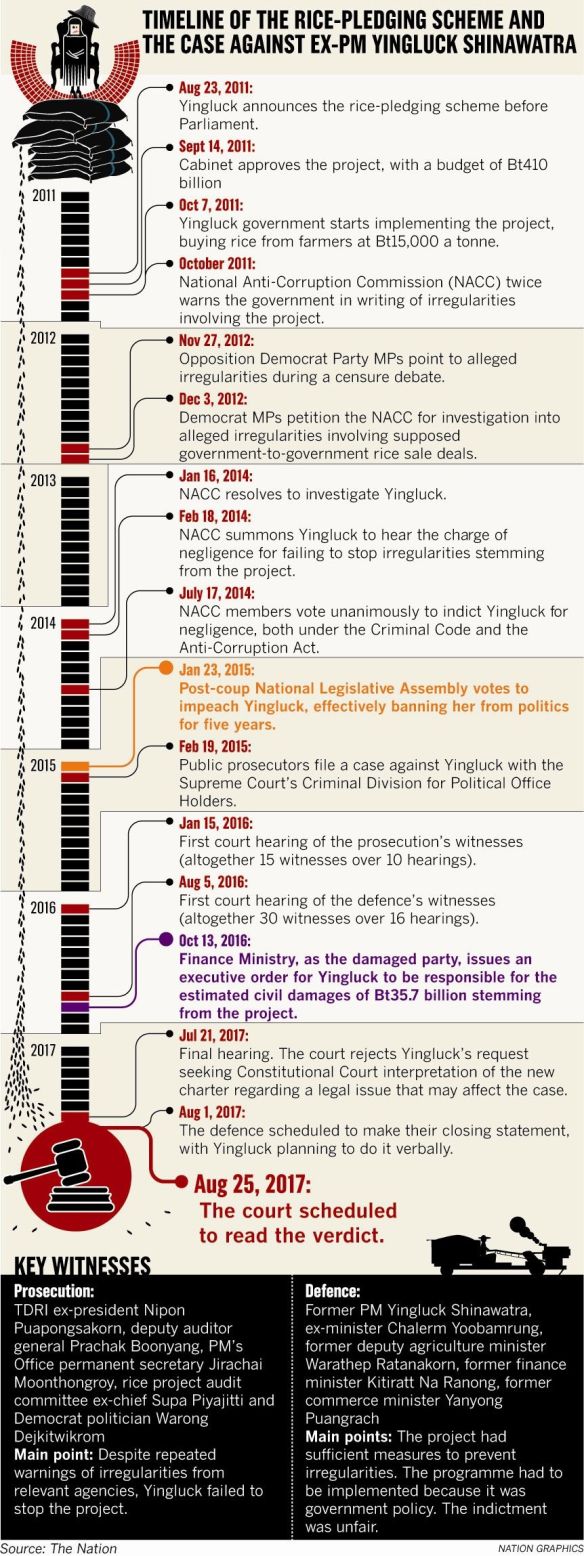
THE high court has set August 25 to deliver its verdict in the criminal negligence case against former premier Yingluck Shinawatra stemming from her government’s corruption-plagued rice-pledging scheme.

Yingluck, the country’s first female prime minister, could face imprisonment of up to 10 years if a guilty verdict is delivered by the Supreme Court’s Criminal Division for Political Office Holders.

On the same date, the court is also scheduled to deliver its verdict in the related case of former commerce minister Boonsong Teruyapirom and 27 others who are charged with malfeasance in alleged bogus government-to-government deals to sell 6.2 million tonnes of rice to China, worth more than Bt20 billion.

As she arrived at court, Yingluck wiped away tears while embracing supporters and posing for pictures with a crowd of about 500 people, many holding roses and balloons.

“I want to thank all of the media and people who came here to support me,” she said.

However, the ex-PM declined to give an interview to reporters after the last day of testimony in her trial yesterday.

“Forgive me for not giving you any interviews today. People may already have drawn conclusions in their minds,” she said, adding that she will give her own closing statement to the Supreme Court on August 1.

As she left the court, her supporters shouted: “Fight on, fight on, Yingluck.”

The court yesterday also rejected a request by Yingluck to seek a Constitutional Court review on the legal validity of her case under the new Constitution, which came into effect in April.


In her last-ditch attempt to delay a high-court judgement, Yingluck said in her petition that Article 235 of the new charter requires the court to base its consideration upon the inquiry file of the National Anti-Corruption Commission (NACC). The court said it allowed both parties to produce additional witnesses and evidence.

There are three likely scenarios on the outcome of the high court verdict, but political sources said any outcome would have significant political ramifications that would negatively affect the national reconciliation efforts.

The first and most serious scenario is a guilty verdict for Yinglick with no suspended jail term. This outcome will cause huge dissatisfaction among her supporters with a possibility of social chaos as well as short- and longer-term political consequences. The military may intervene again if the situation is not under control and those causing the unrest will be accused of failing to accept the justice system.

The second scenario is a guilty verdict with a suspended jail term for Yingluck on the grounds that the former premier could not be held directly responsible for the alleged wrongdoing. This outcome is in the middle path but will cause dissatisfaction for both supporters and opponents of the former premier.

Dissatisfaction will be acute among those believing that Yingluck should be accountable for the massive financial damage caused by the rice-pledging scheme, while Yingluck’s supporters would be upset as they believed the case against Yingluck was politically motivated.

The third scenario is a not guilty verdict for Yingluck. The consequence could negatively affect the Prayut government as the Pheu Thai Party would take the verdict as a judicial victory and build the momentum to demand an early election leading to possible social unrest and military intervention to restore law and order.

Petition of EC law to Constitutional Court won’t affect election call, says Deputy PM

ศาสตร์เกษตรดินปุ๋ย : ขอบคุณแหล่งข้อมูล : หนังสือพิมพ์ The Nation

http://www.nationmultimedia.com/detail/politics/30321428

EC Somchai.

EC Somchai.

Petition of EC law to Constitutional Court won’t affect election call, says Deputy PM

politics July 21, 2017 16:59

By The Nation

Deputy Prime Minister Wissanu Krea-ngam said on Friday that the Election Commission’s petition to the Constitutional Court against the new NLA endorsed EC draft bill would affect the process of royal endorsement of the government’s final submission.

However, he added, it would be unlikely to affect the election roadmap. That’s because lawmakers have ensured sufficient time to enact the 10 organic laws required by the new charter, he said.

The EC is the first of the organic laws to pass through the National Legislative Assembly (NLA) and the tripartite law review committee. Prior to the EC’s decision to petition the Constitutional Court, the EC bill was close to promulgation, pending only a royal endorsement.

The EC, however, made a last ditch attempt to get a ruling on the law’s constitutionality.

It said it would submit a petition to the court Friday.

There are some six points in the bill that the EC has objected to, including the total reset of the current EC.

However, it has decided not petition the reset question to the court, as the optics of this could lead some people to conclude that it was fighting for the personal interests of EC members. Instead, said Election Commissioner Somchai Srisutthiyakorn on Thursday, it will petition the court over the constitutionality of two controversial points.

The first concerns the removal of the EC’s authority to organise local elections. The second is the removal of the power of EC members to suspend elections if fraud is found.

Somchai insisted that the petition would not derail the planned election as there is still plenty of time to revise the bill.

Wissanu did not confirm whether the NLA has yet forwarded the draft law to the Cabinet Secretariat or not. The government could hold the bill for up to five days before submitting it for royal endorsement.

Names needed for new Government House reception building, rooms

ศาสตร์เกษตรดินปุ๋ย : ขอบคุณแหล่งข้อมูล : หนังสือพิมพ์ The Nation

http://www.nationmultimedia.com/detail/politics/30321425

Names needed for new Government House reception building, rooms

politics July 21, 2017 16:44

By The Nation

The government is sorting through suggestions for names for the new reception building of Government House. The building was commissioned by Prime Minister General Prayut Chan-o-cha himself to receive foreign dignitaries.

General Wilas Arunsri, secretary-general to the Prime Minister, said on Friday that over 100 names have been submitted for consideration so far, and he would also like to invite the media to propose more names for consideration.

The Bt137 million structure takes its architectural cues from Thai Ku Fah and has been under construction since last year under the supervision of the Post Engineer Department.

The National News Bureau of Thailand has reported that the new building will likely be opened for use in August or September with a name for the structure to be chosen soon.

The Fine Arts Department has submitted a list of over 20 potential names to the Prime Minister for his consideration, it said.

The list includes suggestions such as Pairojdhammarat and Pitakdhammadhorn, for the building’s two reception rooms, the news bureau said.

Gen Wilas said during an inspection Friday that there has been ongoing decoration work, as well as gardening work around the compound.