PHOOWADON DUANGMEE
THE NATION September 14, 2016 1:00 am
Sun-dried salted threadfins hang upside down in the sun in Tak Bai, Narathiwat province. The Nation/Phoowadon Duangmee
A package of salted threadfin is a great gift to take back home. The Nation/Phoowadon Duangmee
The sun-dried threadfin is sealed with piece of paper in order to keep the fish safe and free from the flies. The Nation/Phoowadon Duangmee
A package of salted threadfin is a great gift to take back home. The Nation/Phoowadon Duangmee
Despite the violence in the deep South, Tak Bai in Narathiwat is well worth a visit if only to taste its threadfin
But then the threadfin is way more delicate than the seer fish.
Known as pla ku lao among fishmongers in Thailand, the threadfin can only be found in the Gulf of Thailand. The Andaman Sea side is out of luck. The fish is silvery grey and lives in brackish water. It was once found just south of Bangkok where Chao Phraya River flows into the Gulf but pollution in the estuary chased it away. Today you can find the threadfin along the East coast from Phetchaburi down to Songkhla and Narathiwat.
The threadfin has a firm flesh and a mild flavour. Westerners would almost certainly halve the fish and fillet it before pan-frying in olive oil and butter. The Chinese, on the other hand, leave the fish to dry in the sun.
Like Pattani, Yala and other parts of Narathiwat provinces, Tak Bai is home to a sizeable Chinese community, who made their home among the local and aboriginal Muslim people several hundred years ago. When the Hakka Chinese left their ancestral “circular houses” in Southern China in the 16th Century, and braved the South China Sea to start new lives in Southern Thailand, they brought their recipes along with them.
Tak Bai’s salted threadfins, though, are more of the Cantonese school of cooking. The fish is kept whole and the guts and entrails are removed delicately through the mouth using hooks. The fish is then stuffed with a handful of salt and left hanging upside down to dry in the sun for a week or two. And they look surprisingly beautiful.
“It’s not every threadfin that can be made into a salted fish as aesthetics play a part too,” says Manthana Phoothararak, director of the Tourism Authority of Thailand’s Narathiwat Office. “The locals sort out the fish and select only threadfins whose skin has been neither cut nor broken. Makes sense as otherwise the flies would find their ways into the fish.”
Families in Tak Bai have their own recipes and many of them are well-kept secrets.
“Usually they give threadfins a “massage” by rolling the fish with a bottle and sprinkling them with a condiment made of honey and other ingredients,” adds the director. “That makes Tak Bai’s salted threadfin more special than those found in other parts of Thailand.”
Nat Phop Yung Thong restaurant is the best place to enjoy the authentic sun-dried salted threadfins.
The restaurant is famous for Southern cuisine, boasting dishes like hot-and-sour “yellow curry”, pan-fried liang leaves with egg and young coconut shoots and shrimp in salty coconut soup. For the sun-dried salted threadfins, the cooks cut the fish into thin perpendicular strips before deep-frying. The brownish deep-fried threadfin is served with sliced shallot, bird’s eye chilli and half a lime. The fish is flavourful with a unique combination of salt, sweet and fermented insanely good! And as the fans of Southern food will know, fresh vegetables, fried egg and “boo doo” paste are the perfect accompaniment to the deep-fried salted threadfins.
“Threadfin is Tak Bai’s real delicacy,” says Manthana.
Buyers of salted threadfins don’t usually eat the fish themselves, say the folks in Tak Bai, and eaters of salted threadfins don’t usually pay for themselves. The salted threadfins are too delicate – and much too expensive.
IF YOU GO
< Thai Smile and AirAsia operate flights between Bangkok and Narathiwat. The southern province is noted for 300-year-old Taloh Manoh Mosque, Wat Cholthara Singhe, Chao Mae Tomo Chinese Shrine and the |pristine beach of Ao Manao.
CHULARAT SAENGPASSA
THE NATION September 14, 2016 1:00 am
Japanese folklore and legend are told through the Namahage cultural show in Akita Prefecture.
Tourists relax in the Kuroyu Onsen facility near a hot spring in Oyasu Valley.
A path leads through a hot spring in the lush mountains surrounding Oyasu Valley.
Tourists can join an udon-making workshop at a famous restaurant in Akita town.
The golden Tatsuko statue next to Lake Tazawa was created by Tokyo National University of Fine Arts and Yasutake Funakoshi in 1968. It is dedicated to the legend who once lived on these shores.
Namahage, a demon-like creature in Japanese folklore, is portrayed by men wearing hefty ogre masks and traditional straw capes during a New Year’s ritual in the Oga Peninsula area of Akita Prefecture.
Home to hot springs, crater and caldera lakes and wooden samurai mansions, Akita Prefecture is the perfect place to spend a holiday
An hour’s flight north of Tokyo, Akita Prefecture in Japan’s Tohoku region is a quiet mountainous area that’s full of charm.
Famous for rice farming and sake breweries, its impressive landscape and rich history more than compensate for the lack of bustling shopping areas and nightlife, making it an ideal destination for anyone wanting to escape the madding crowd.
The prefecture is home to the ancient town of Kakunodate. Dating back to 1620, Kakunodate is famous for its samurai architecture and weeping cherry trees. Although the castle is long gone, today’s Kakunodate has retained many of the old samurai manses and visitors feel like they have travelled back in time as they stroll past the old buildings that line Samurai village.
Some of these samurai houses have been converted into souvenir shops and restaurants, with one of the largest, Aoyagi House, transformed into an open-air samurai museum. Now known as the Aoyagi Samurai Manor Museum, it displays samurai tools and household utensils as well as toys from the Edo Period.
Exhibits here have their roots in the original Aoyagi House and many of them were collected and used by members of the Aoyagi family during their lifetime.
The grand estate is also home to a shady garden boasting hundreds of rare plants. Among them is the aoyagi Yae Beni Shidare Zakura, an eight-petal red weeping cherry that’s magnificent when it’s in full bloom.
Not all the old samurai houses are open to the public though it is possible to admire them up close from the comparative comfort of a rickshaw.
From Kakunodate, tourists can take a train to other beauty spots in the prefecture. Many visitors, and particularly fans of the South Korean TV series “Iris”, opt to travel by road to the crater lake of Tazawa, where Choi Seunghee and Kim Hyuenjun embraced by the golden statue of a local girl called Tatsuko.
But even without its connection to the popular series, Tazawa is worth a visit. The deepest lake in Japan at 423 metres, it cannot freeze over even when the temperatures drop well below zero. According to legend, Tatsuko was a beautiful girl who prayed to retain her beauty forever but was instead cursed and turned into a dragon and eventually sunk to the bottom of Lake Tazawa. She now stands with her back to the clear blue waters, a figure of purity and beauty.
A short drive away is Oyasu Valley, its hot spring evident to the nose the moment we step down from the bus. But while the sulphur odour is less than pleasant, the landscape is amazing and it is easy to understand why even emperors once frequented the valley.
The beautiful landscape continues all the way to Oga city, which lies within the boundaries of the Oga Quasi-National Park, and is a popular destination for both birdwatchers and paragliders. Surrounded by steep cliffs and volcanic crater lakes, the Oga region is best known for its Namahage shows. Taking their name from the strange deity resembling a demon, these powerful drum performances were traditionally staged over the New Year period to offer blessings and dispel bad luck but are today regularly put on for tourists and performed by young locals who have refused to move to big cities in search of better-paying jobs.
Akita, which is believed to have given its name to the popular breed of dog, is also justifiably famous for its udon noodles and udon-making classes are available for those who would like to learn the technique.
Held at Sato Yosuke restaurant in Akita town, which can trace its origins back more than 150 years, the workshop teaches participants how to produce Japan’s famous Nihon Sandai Udon through the fermentation of the flour to drying, stretching and boiling.
The best part comes right at the end of the class when participants sit down to tuck into the tasty udon at this famous restaurant.
IF YOU GO
< Akita is about three hours by trains from Sendai Station and an hour’s flight from Haneda Airport.
< Visitors coming from Osaka should expect to spend six hours on the train.
< Thai tourists are allowed to enter the country without a visa for stays not exceeding 15 days.
CHUSRI NGAMPRASERT
THE NATION
September 14, 2016 1:00 am
MONGOLIA: Nomad’s Day is, as the name suggests, the most important day in the lives of the Mongolian nomads.
From wrestling in Mongolia through performance art in Malaysia and tennis in China, there’s plenty to do in the region this month and next
NOMAD’S DAY
September 17 to 18, Gun Galuut Reserve, Mongolia
Nomad’s Day is, as the name suggests, the most important day in the lives of the Mongolian nomads. The major customs of nomadic life including horsemanship, wrestling and folkloric music and dance are demonstrated on these special days, groups then competing with visitors to load gers, the Mongolian tent, on yak carts, assemble the gers in the shortest time, make milk-tea, catch and tame horses and much more. The best of nomadic traditional cuisine is served on the evening of September 18.
DIVERSECITY
Until October 2, Kuala Lumpur, Malaysia
DiverseCity is also known as the Kuala Lumpur International Arts Festival. An ambitious programme of performing and visual arts, it showcases the rich and nuanced diversity of Malaysia and also explores the close ties and deep relationships with the other counries in the Asean bloc. Visit http://www.Diversecity.my.
FESTIVAL OF THE DEAD (BOUN KHAO SALAK)
September 16, Nationwide, Laos
During the festival of the dead, offerings are presented to Buddhist monks. On the last day, which is always the full moon, every family goes to the temple to make offerings to the deceased, especially to those who have passed away over the last year. It is believed that if the spirits do not receive offerings, the living will suffer from bad luck. In Luang Prabang during the festival, the Mekong is jammed with beautifully carved boats with snake-heads for prows. The serpent, or naga, appears in Buddhist literature as the protector of Lord Buddha and that’s the reason why the boats are sacred and kept inside the temple precincts. Every year, 40 men from each temple parish volunteer to race in their temple’s boats.
SEOUL PERFORMING ARTS FESTIVAL
September 30 to October 30, Seoul, South Korea
Contemporary drama, dance, musical theatre and interdisciplinary arts are at leading cultural spaces throughout Seoul next month. The festival features some 40 breathtaking performances from Korean and international companies, which highlight the fundamental elements of performing arts from the past as well as draw attention to the possibilities of the present and the future. Visit Spaf.or.kr.
CHINA OPEN TENNIS TOURNAMENT
September 25 to October 9, Beijing, China
The China Open was launched in 2004, and is held in Beijing over the National Day holidays. Hosted by the Beijing Olympic Green Tennis Centre, this elite ATP tour event attracts many of the world’s best tennis players.
NATIONAL DAY RACE DAY
October 1, Hong Kong
The National Day Race on October 1 has long been one of the highlights of Hong Kong’s horse racing calendar. Every year, the Hong Kong Jockey Club presents various spectacular cultural performances at Sha Tin racecourse to commemorate the founding of the People’s Republic of China, attracting thousands of racing fans and visitors.
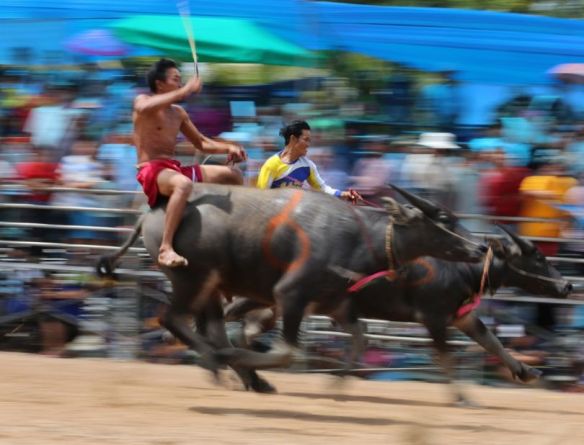
RAGING BULLS: Chon Buri province, about an hour’s drive east of Bangkok, is hosting Buffalo Racing on October 15.
Chon Buri province, about an hour’s drive east of Bangkok, is hosting Buffalo Racing on October 15.
Raging bulls
Thai water buffaloes might not be as aggressive as Spanish bulls but they can certainly give the bulls a good run for their money and they’re a lot more fun. Chon Buri province, about an hour’s drive east of Bangkok, is hosting Buffalo Racing on October 15. Beefy buffaloes, skinny buffaloes and white buffaloes will race against each other over a 100-metre-long grassy strip, leaving a huge cloud of dust in the air. You’ll be surprised – and terrified – at the beasts’ terrific speed but poor sense of direction.
Bangkok Airways joins up with the Tourism Authority of Thailand, Samui Municipality and theSamui Travel Association for the “Samui Discovery Travel Fair”, which runs from Friday through Sunday at Siam Paragon’s Fashion Hall. As part of the activities to promote tourism on the island during the so-called green season, the airline is offering all-inclusive fares on its Bangkok-Samui,Chiang Mai–Samui, Phuket-Samui, Krabi-Samui and Pattaya–Samui routes starting at Bt3,310 round trip. Tickets must be purchased and issued during the event and are valid for travel from Friday until the end of November.
Khao Yai for “U”
Surrounded by the rolling hills and lush valleys of Khao Yai National Park, the new U Khao Yai will be opening its doors to travellers on November 15. Located in Pak Chong’s Moosi subdistrict, the resort draws on the traditional architecture of the French countryside and boasts a modern and eclectic interior design providing both comfort and relaxation with landscaped gardens, ponds and a large free form swimming pool. Find out more at http://www.UKhaoYai.com or Facebook.com/ukhaoyai.
The sky’s the limit
VietJet Air, a budget airline from Vietnam, spread its wings across Thailand, offering three new routes – Bangkok-Chiang Mai, Bangkok-Phuket and Phuket-Chiang Rai – as well as flights between Bangkok and Haiphong in Vietnam. The airline, which owns a fast-growing fleet of Airbus A320s, is based in Ho Chi Minh City. For tickets and booking, visit http://www.VietJetAir.com.
Dawn
Asia News Network September 10, 2016 10:01 am
In the heart of the Karakoram mountains lies the fabled Lukpe Lawo
Hopping on the large boulders of Biafo glacier, I was drenched in sweat and panting.
As I paused to catch my breath, my eyes moved towards the path that led to Baltoro glacier, reminding me of the ordeals I faced a few years ago after stepping on the glacial moraine and the boulders of Baltoro glacier.
It was my first encounter with glaciers and that too with Baltoro, [often termed ‘Bal-Toro’ in Urdu, meaning bone breaker].
googletag.display(‘div-gpt-ad-1458203125906-0’);
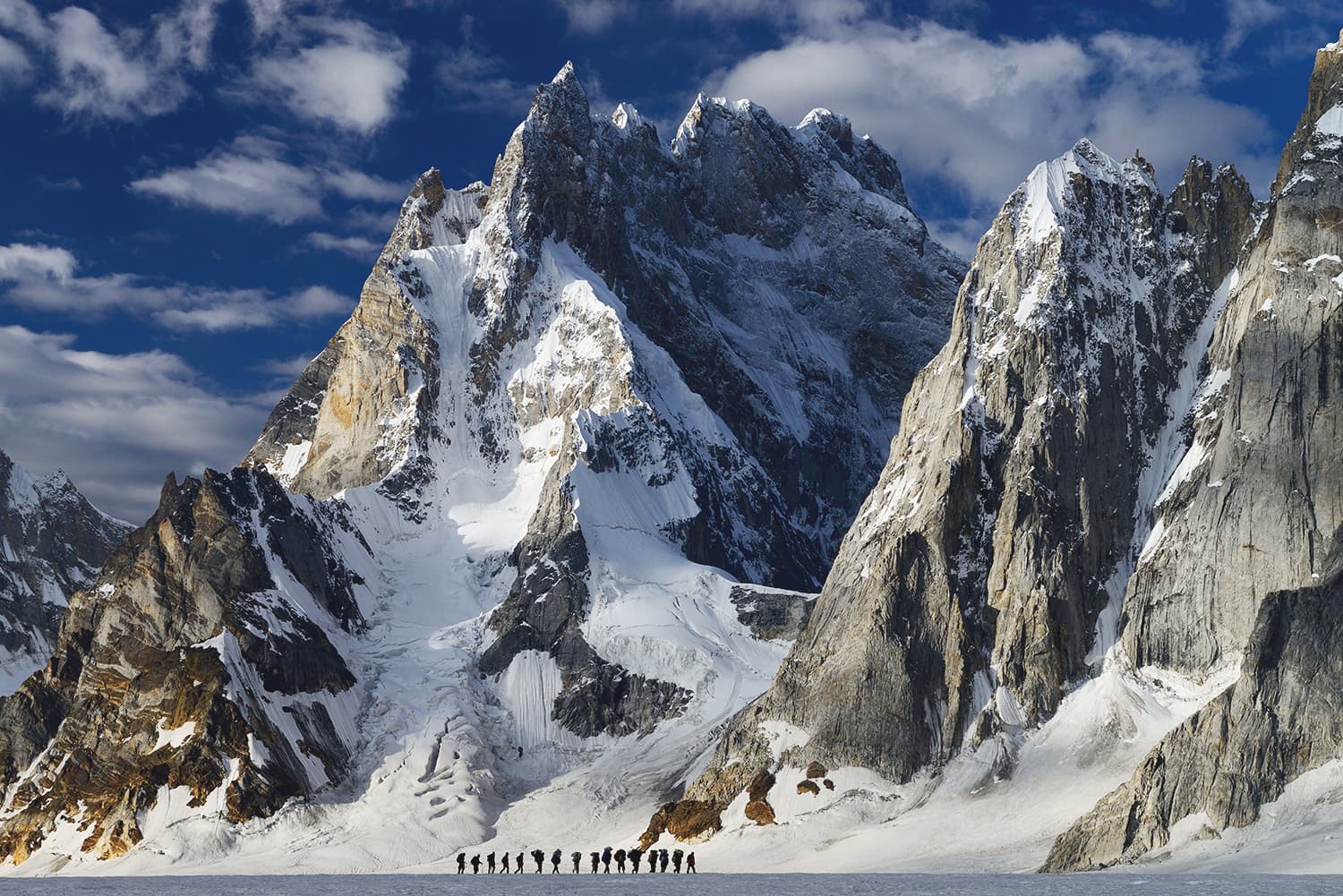
Solu Towers (5947m) in the vicinity of Snow Lake and Hispar La. ─ Photo by author
I remembered all the group members, including myself, using all sorts of nasty names from our personal vocabularies to describe the terrain and varied moraines of Baltoro.
Having left Askole and stepping on Biafo’s boulders, Baltoro’s brutalities seemed like silly little pranks of a mischievous child.
All those words that I had given to Baltoro in 2010, were passed on to ‘honour’ the ‘glory’ of Biafo’s crusts and turfs; most of them starting with B [whether in English, Urdu or Punjabi!].
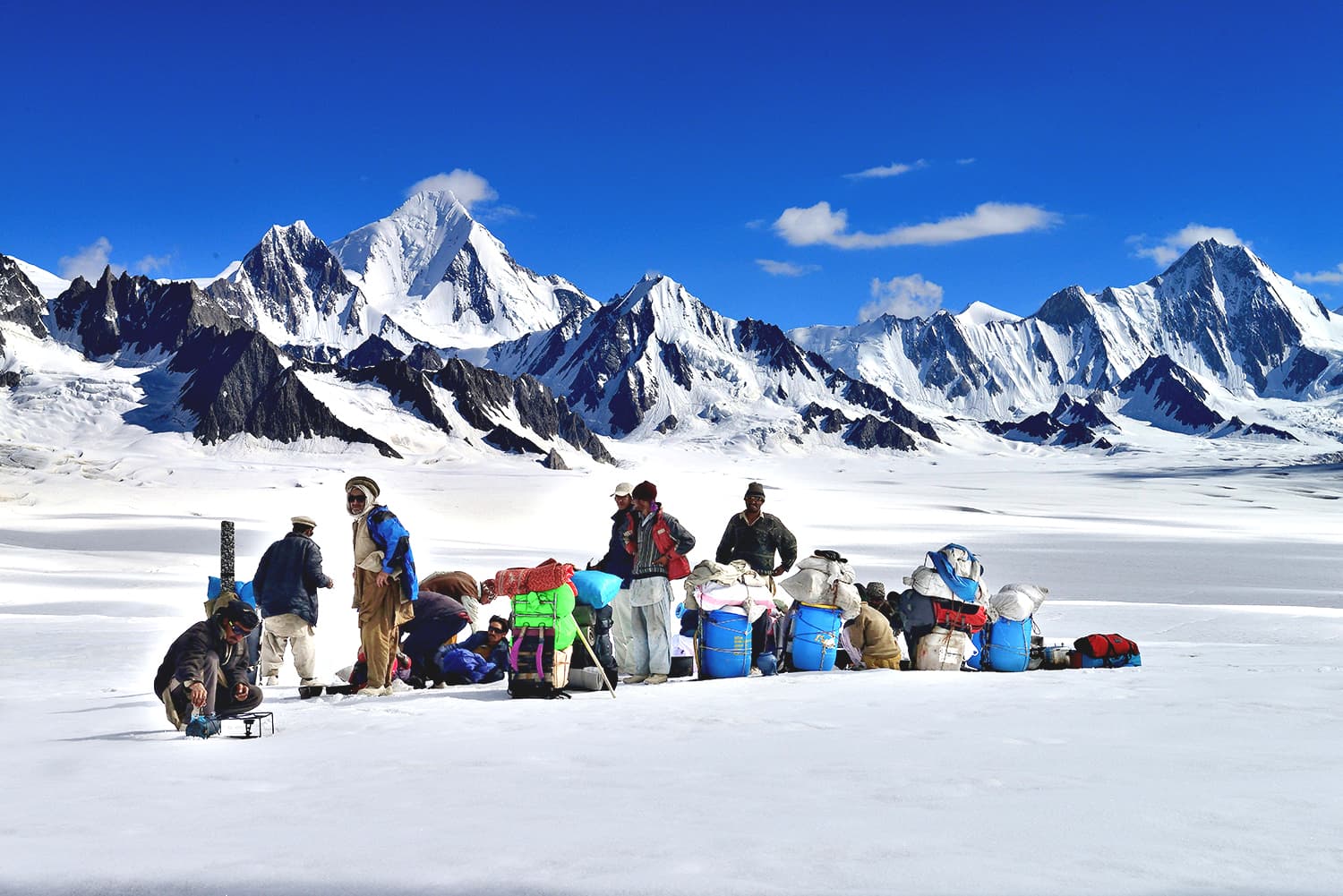
An Australian expedition lead by porters is moving towards snowlake while crossing Sosbun Brakk (6413m). ─ Photo by author
My mind was set before embarking on this journey, termed as the most difficult trek of Pakistan’s north.
Where I was going had a reputation well above that of word of mouth. The terrain was the most terrifying and tormenting ‘mettle tester’ in every way. But then the destination too was not ordinary.
In the heart of the Karakoram mountains lies the fabled and fabulous Snow Lake
Lakes are often called the mirrors of mountains, but a lake exists that does not reflect anything because its water is frozen.
Lukpe Lawo, famously known as Snow Lake, lies in the heart of Panmah Muztagh range which is a sub-range of the Karakoram mountains. Actually it’s a high altitude glacial basin which was discovered by a British mountaineer, Martin Conway, in 1892.
View of Snow Lake from Hispar Pass’s summit. ─ Photo by author
Only a few lucky souls have seen this 16 km-wide frozen lake located 4,877 metres above sea level on the convergence point of the Hispar and Biafo glaciers.
Both glaciers together form the world’s longest glacial system (100 km) outside the polar regions — 67 km long Biafo alone is the world’s third longest glacier, whereas the Hispar glacier is 49 km long. The Snow Lake traverse uses all of Hispar glacier’s length and 51 km of Biafo glacier’s length.
The ancient kingdoms of Baltistan and Nagar are located in the opposite direction of Snow Lake. We started our journey from Skardu which falls in Baltistan, and after crossing Biafo glacier and scaling the Hispar Pass (5,128m) and its glacier, we would have reached Hunza.
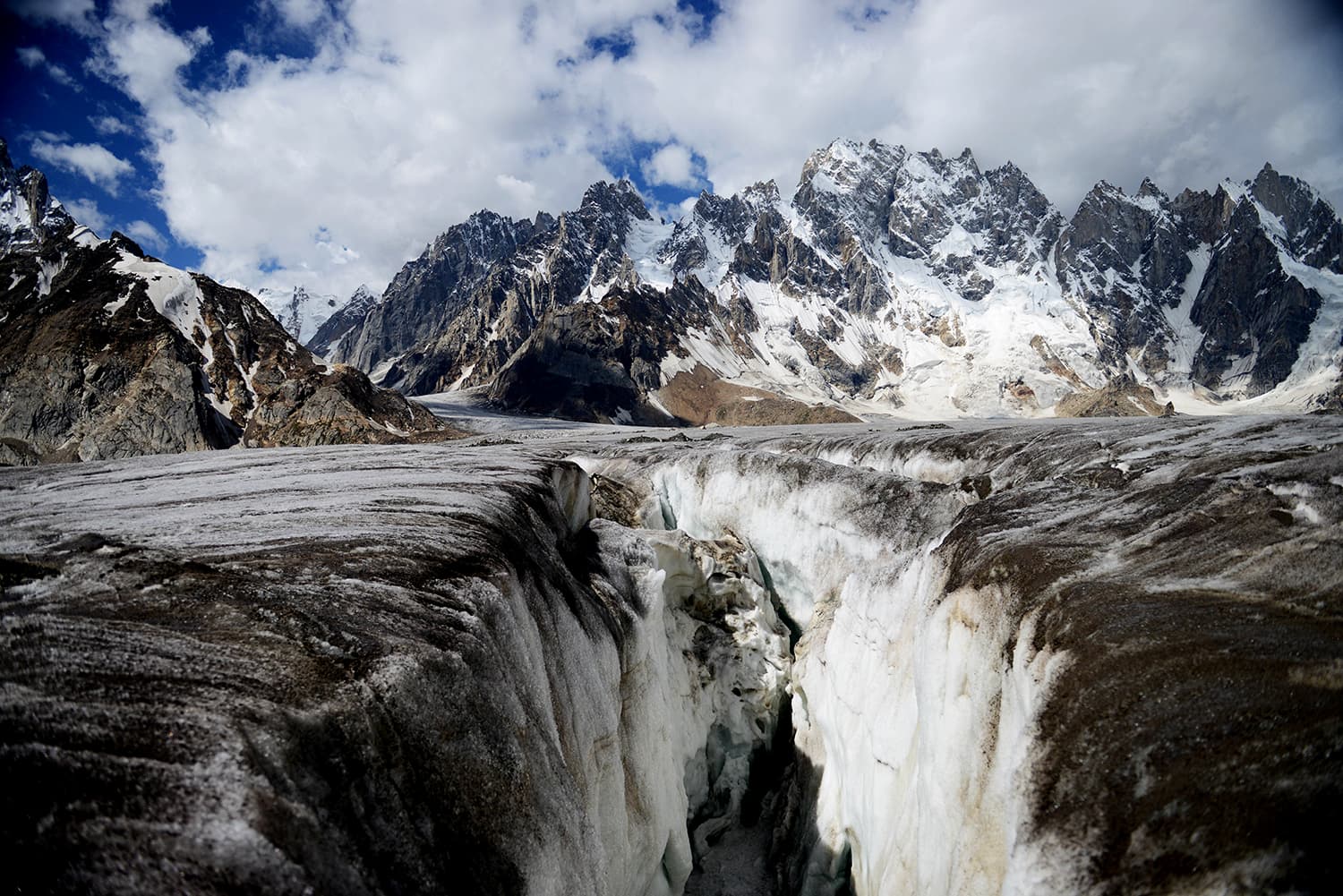
Crevasses of Biafo Glacier. ─ Photo by author
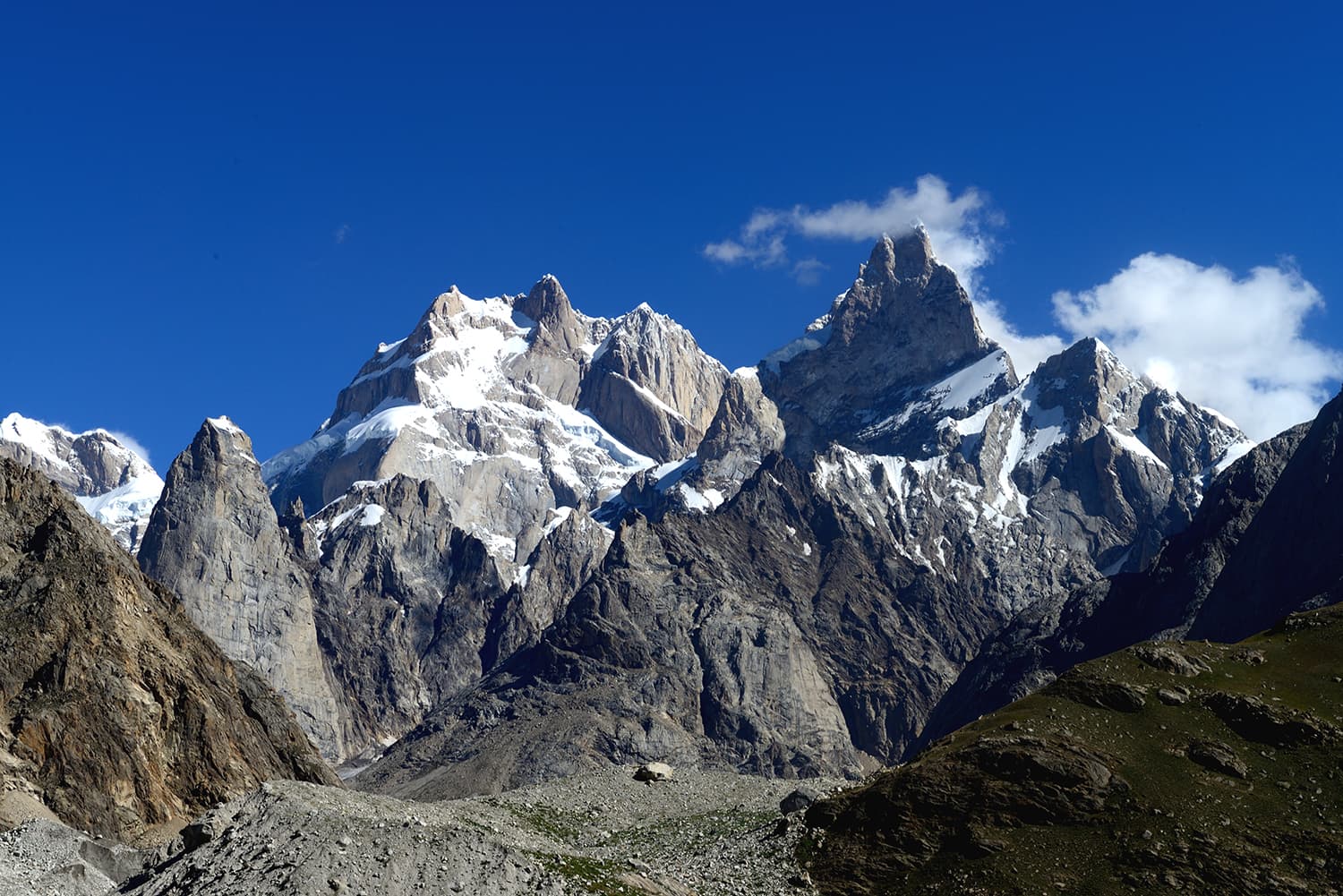
Being a sub-range of the Karakoram mountains the Panmah Muztagh too has some prominent peaks for climbing, such as Baintha Brakk or The Ogre (7,285m), Latok Group (7,145m), Sosbun Brakk (6,413m) and Solu Towers (5,947m). Different features distinguish them from the rest of the Karakoram — Panmah Muztagh range is much rockier and steeper with complex granite formations.
Scaling the height of Hispar Pass. ─ Photo by author
At Namla, the first campsite on the Biafo glacier, a sign board describing Namla as a sighting place for snow-leopards greeted us. Our porters and a very talkative guide told us that markhor too can be seen on the surrounding cliffs.
We were further informed that various hunters come to Biafo to try their luck, and the presence of hunter posts on the way to the Biantha campsite confirmed this.
A pause for soup at Snow Lake. ─ Photo by author
Hunters come to the posts in summer and stay for several days in quest of their bounty. A few hunt for hobby while the rest hunt for selling and often sell markhor meat for 7,000 rupees per kilo.
We had a rest day at the Baintha campsite to relax our stiff and cramped muscles. Around noon we heard gunshots; somebody whispered “Markhors are being hunted.”
After some time a hunter came and offered markhor meat to us. He had sold almost all the meat and was left with just 5kg which he did not want to carry the entire length of the Biafo.
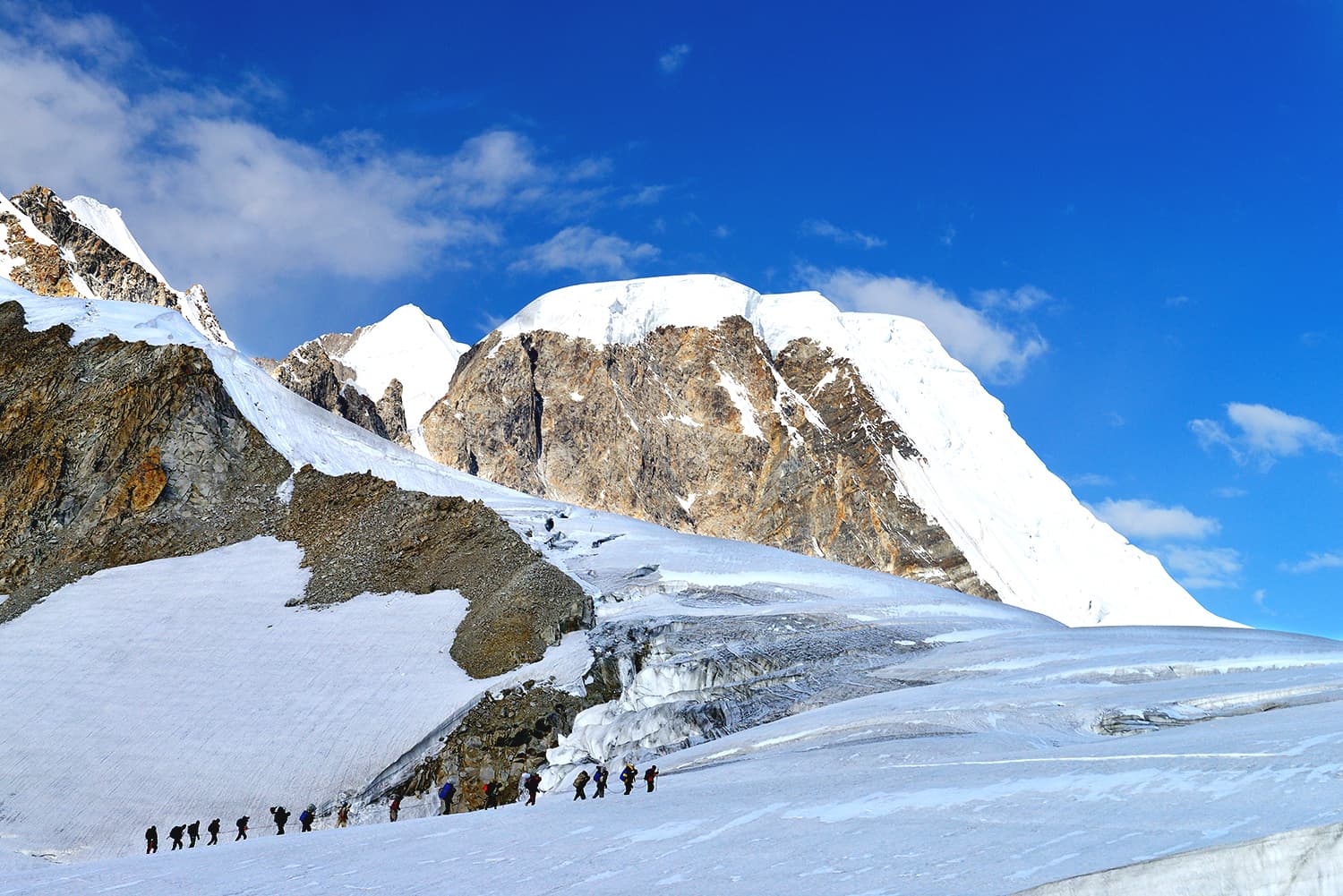
Almost there – among the crevasses of Hispar pass. ─ Photo by author
All of us knew that markhor is one of the ‘near threatened’ species so nobody was interested but the hunter knew all the tricks of marketing and managed to convince most of the expedition members to ‘taste’ the most expensive meat of our lives.
The markhor had been killed and we had no involvement in his cold-blooded murder, so the top management decided to enjoy the ‘God sent’ opportunity.
The meat was handed over to our expert cook who told us that, since we were in the wilderness of mountains with no proper kitchen facility, we should not expect the feast to be ready before two hours.
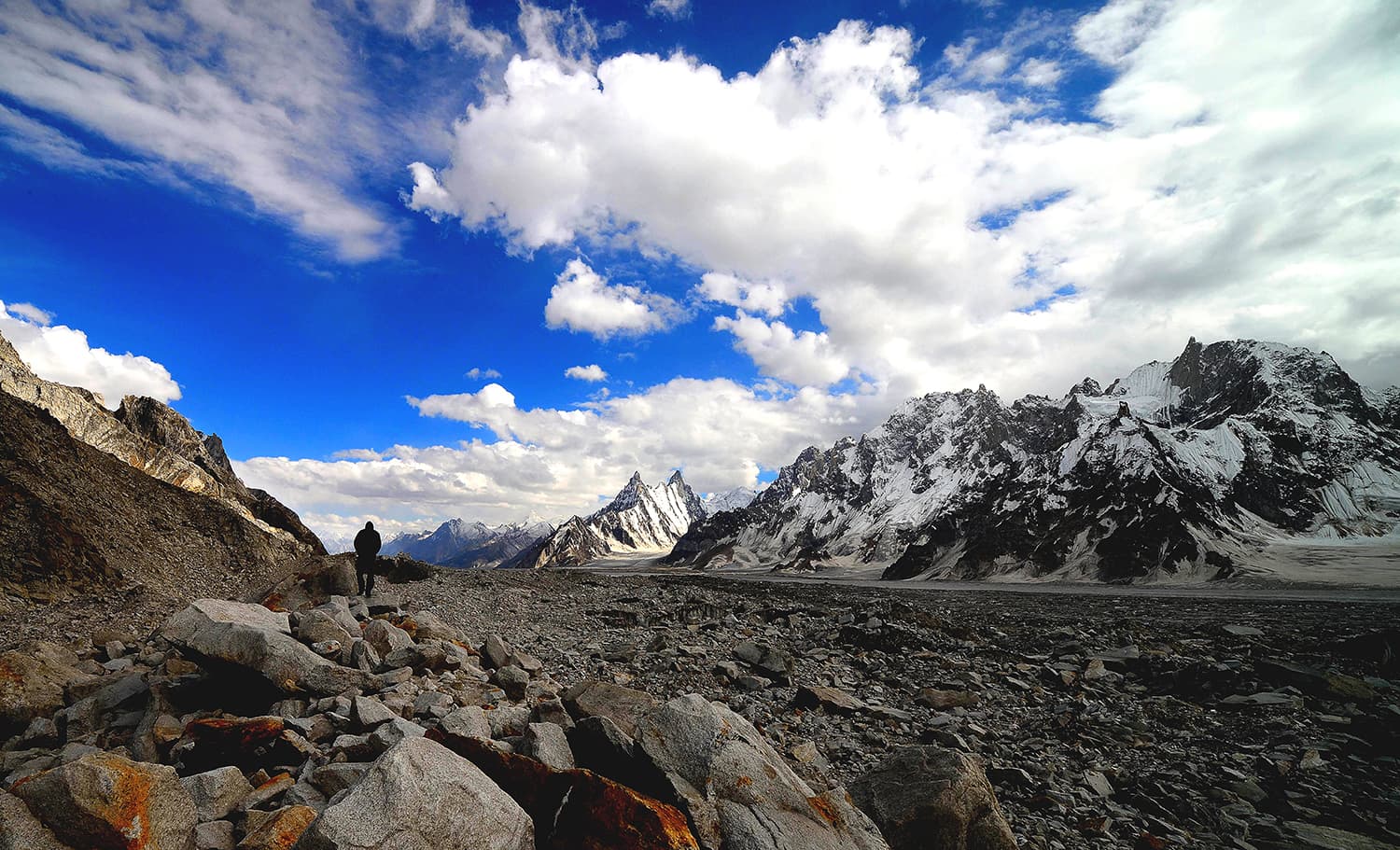
A wanderer enjoying the solitude of Biafo. ─ Photo by author
We spent the long wait relaxing and inhaling the aroma of the food being cooked.
After battling with the kerosene stove for more than two hours, our cook served lunch.
It took me quite some time to chew the first bite; even after being cooked for over two hours the meat was still like rubber.
It tasted good (thanks to the chef’s culinary skills) but climbing on cliffs gave the markhor tough meat. I left the rest in my plate and finished the rice as did a few others.
A night spent at the brink of Hispar glacier. ─ Photo by author
After coming back from this expedition, I learnt that the Gilgit Baltistan government auctioned off the markhor hunting license for 6.2 million rupees.
The next campsite that we reached was on the upper surface of the glacier which was cluttered with stones of all sizes eroded from the mountain cliffs.
Biafo is notorious for being cluttered with time and energy consuming lethal crevasses and to avoid these we took the longer route.
Almost there – among the crevasses of Hispar pass. ─ Photo by author
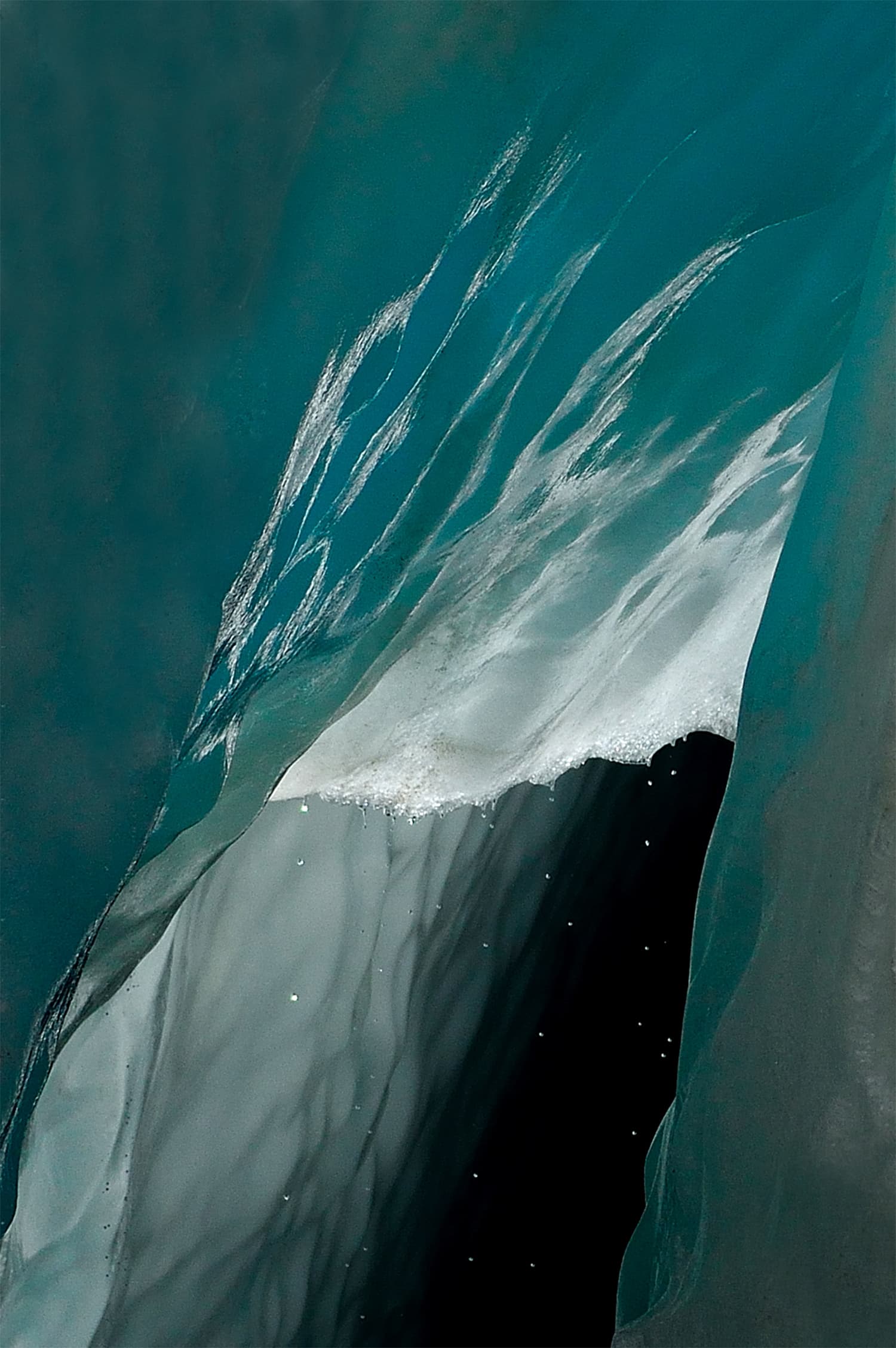
A melting green glacier. ─ Photo by author
Fresh snowfall covers crevasses and makes them deadlier. Since it was summer, the centuries-old glacial ice and snow was melting and the water was going deep into the maze of hidden and deep crevasses.
It seemed as though this entire orchestra of nature was perhaps crooning the last couplet of Rumi’s poem,
‘Be melting snow. Wash yourself of yourself.’
Dancing around crevasses and jumping on the boulders, somehow we crossed two more stages and reached the mouth of Snow Lake.
Here we rested for a while, while the porters served us soup in the majestic span of Snow Lake.
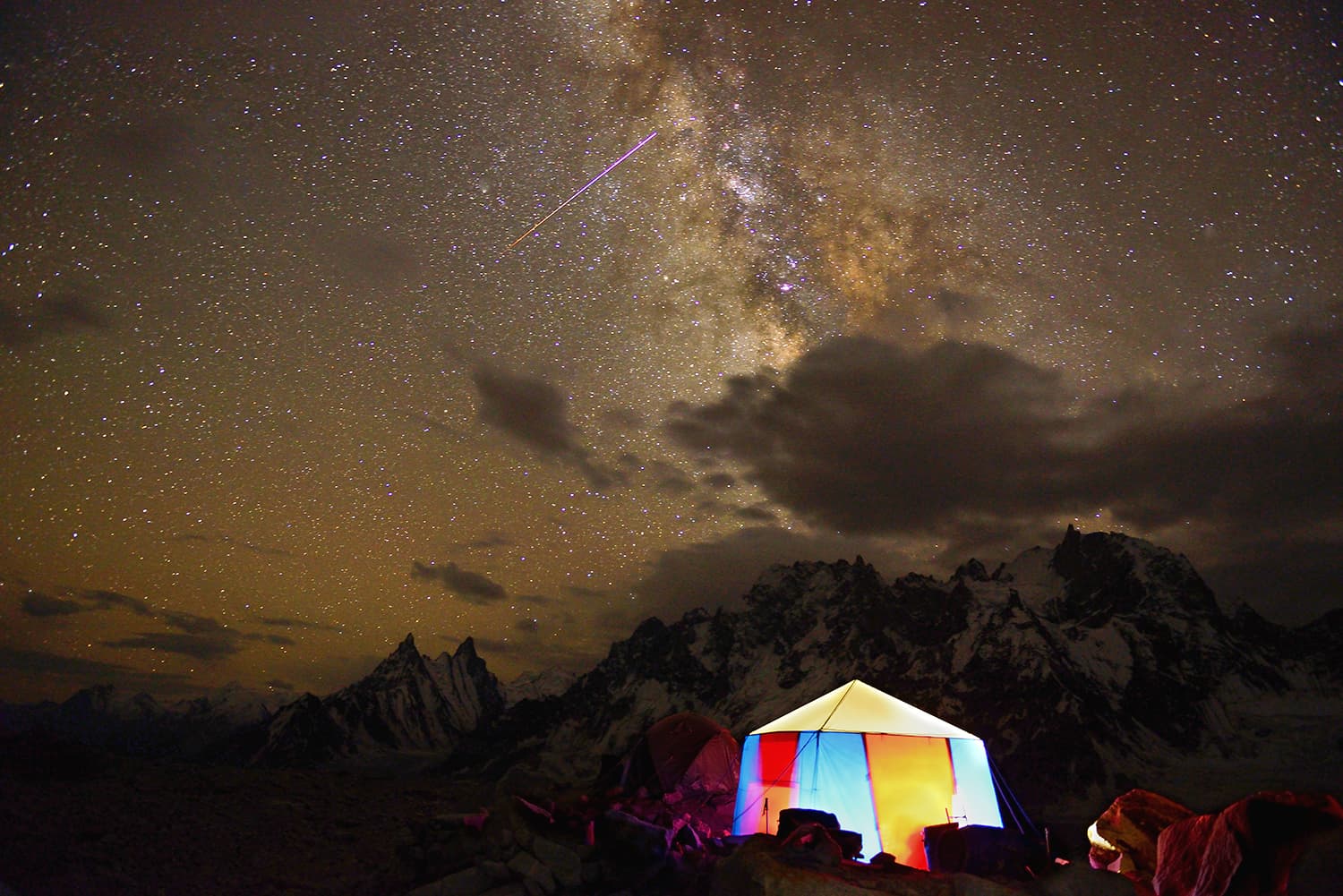
A long exposure shot of milky way and a shooting star near Snow Lake. ─ Photo by author
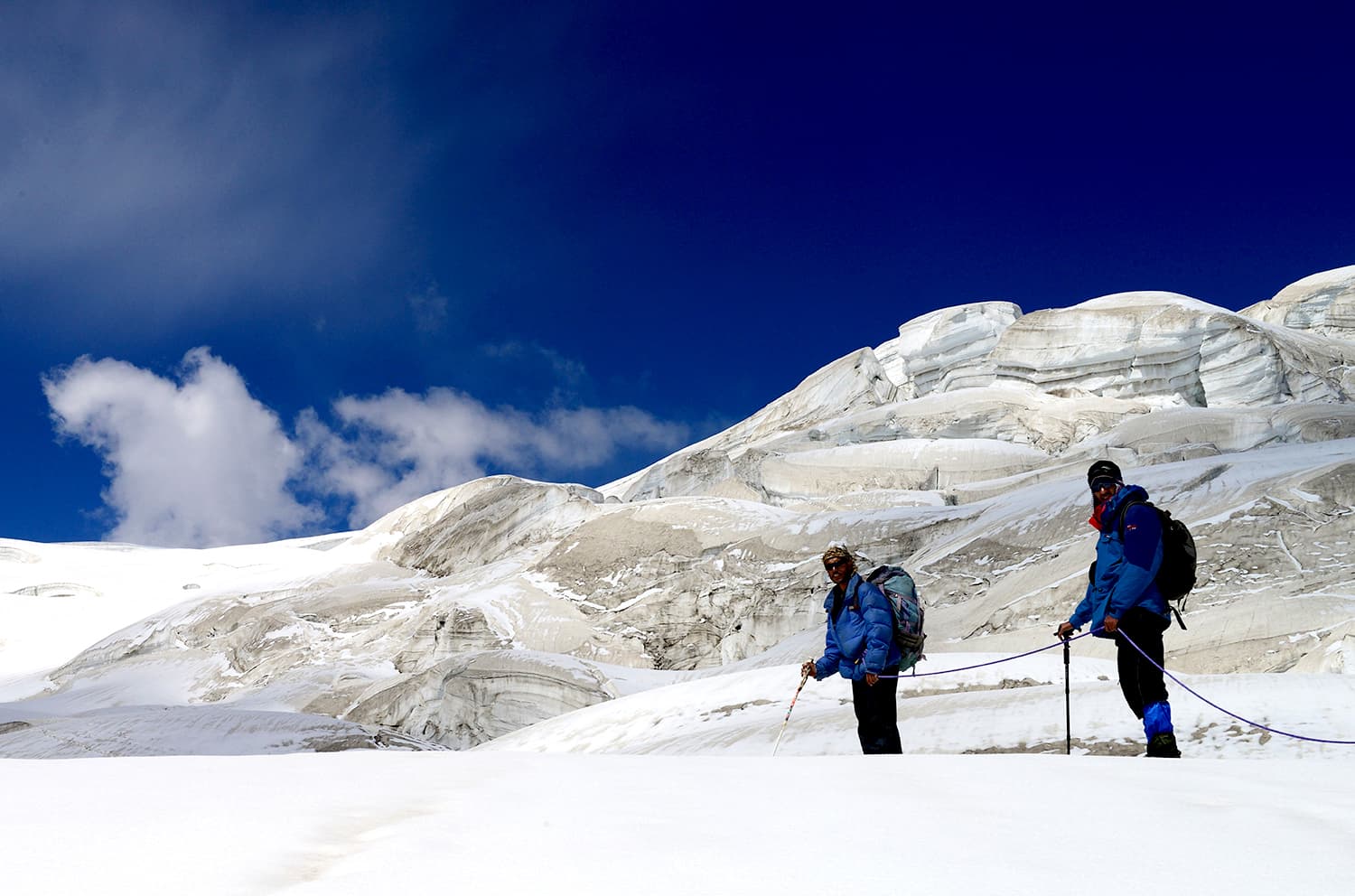
Then we started to ascend the Hispar La; the climb was way more toilsome than it appeared, a couple of times the ice cracked beneath the feet and one or the other group member came close to falling down the bottomless deep crevasses but thankfully we were prepared — tied up with rope and group formation, and the expertise of the guides came to our rescue.
By afternoon we were on top of the Hispar La. The view from 5,128m above sea level was spectacular.
The famous Italian climber and mountain guide Hervé Barmasse has won nine international awards for climbing and opening new routes on various unclimbed peaks. He has climbed more than 30 peaks, most of which were ‘first ascents’.
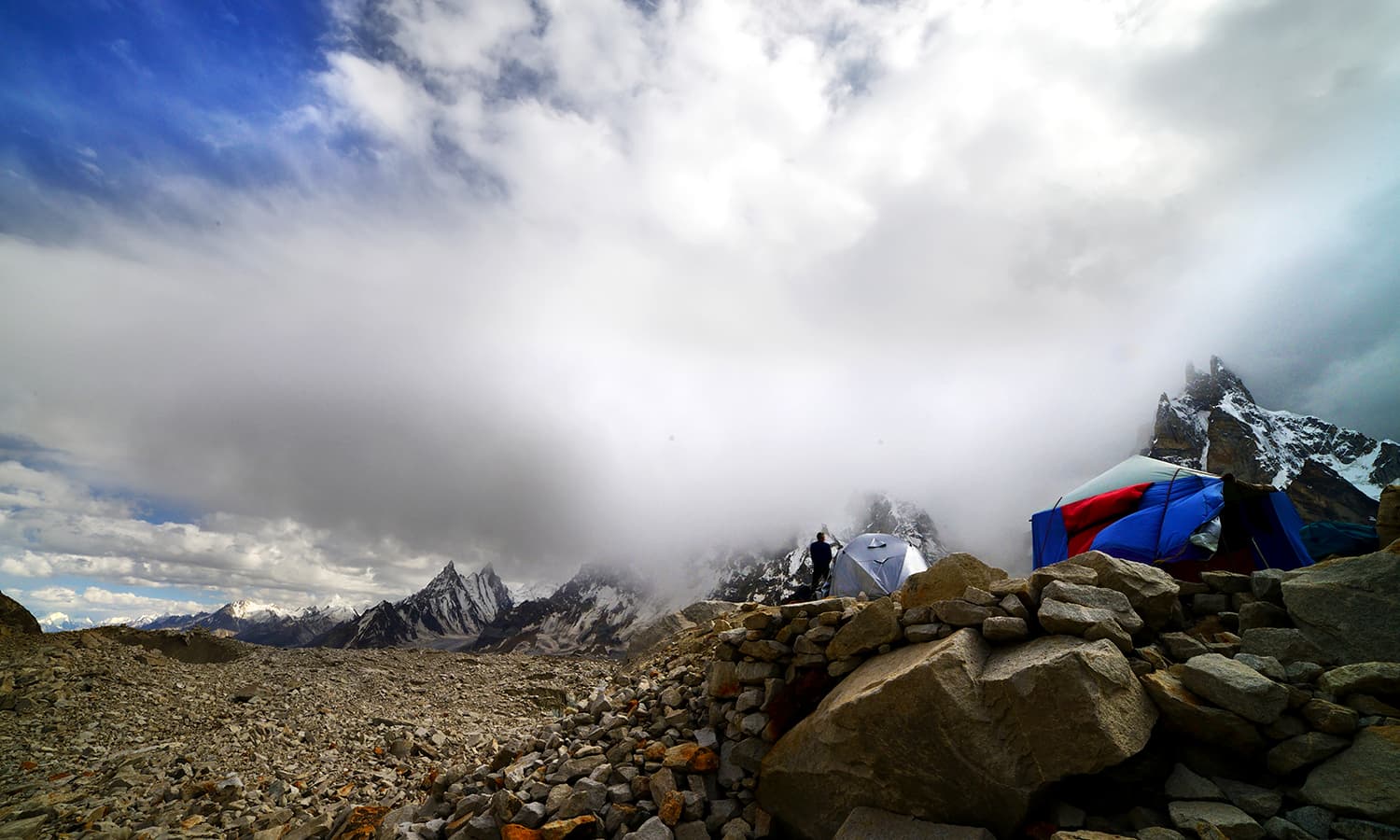
An Australian trekker gazing the approaching storm. ─ Photo by author
In an article about peaks around Biafo glacier and Snow Lake, published in 2013 in American Alpine Journal, a prestigious publication of the world of climbing, he states, “In five expeditions to different areas of the Karakoram, I’ve climbed virgin peaks and new routes up to 7,000m, but never seen a place like Snow Lake, its particular features making it so aptly named.”
The panoramic view from the top of Hispar La substantiated his words.
Stones and frozen snow: An abstract composition of nature at the canvas of Biafo. ─ Photo by author
This corner of Karakoram is almost unexplored; unlike the Baltoro or main Karakoram, very few climbers turn to this side.
Peaks around Snow Lake are more challenging, but yet to be explored and ascended.
Some of them are not even touched and named; in the language of climbing such peaks are called ‘Virgin Peaks’. Aspiring climbers can try their luck and give their names to unnamed peaks, and enrich the history of climbing.
MANTA KLANGBOONKRONG
THE NATION September 7, 2016 1:00 am
PAWS FOR THOUGHT: Small dogs or cats get a warm welcome at the pet-friendly Double Tree by Hilton Sukhumvit Hotel
PAWS FOR THOUGHT: Small dogs or cats get a warm welcome at the pet-friendly Double Tree by Hilton Sukhumvit Hotel
PAWS FOR THOUGHT: Small dogs or cats get a warm welcome at the pet-friendly Double Tree by Hilton Sukhumvit Hotel
PAWS FOR THOUGHT: Small dogs or cats get a warm welcome at the pet-friendly Double Tree by Hilton Sukhumvit Hotel
Small dogs or cats get a warm welcome at the pet-friendly Double Tree by Hilton Sukhumvit Hotel
Why leave your beloved pet at home when you can take Fido or Fluffy (or both) with you? Jetsetters with pets now have Double Tree by Hilton Sukhumvit Hotel as a second home thanks to an all-too-rare policy that allows small dogs or cats to stay with their owners in the guestrooms.
Opened in 2013, Double Tree by Hilton Sukhumvit Hotel took the structure of an old hotel and revamped the simple property with chic and vintage flair. This small city hotel is all about simplicity, functionality and convenience. All 177 guestrooms are compact, but fully equipped for easy-going travellers who want nothing more than a plush bed and lots of pillows, big screen TV with local and satellite channels and a spacious and sparkling clean bathroom. There are also five suites that offer more space and extra amenities. There’s free wireless Internet both in the rooms and throughout the public areas and the signal is good, a rarity in hotels where the slow connection forces many to pay extra for a higher speed.
Centrally located, Double Tree by Hilton Sukhumvit is a great starting point wherever you want to go in the city with Phrom Phong BTS station an easy stroll. And there are plenty of eateries, spas and nightspots in the area to suit every pocket as well as in the two nearby shopping malls.
But the biggest attraction for many is that the hotel is pet friendly. If you travel with a cat or a dog weighing less than five kilograms, you can have him stay with you at Bt1,500 extra charge per pet per stay. And up to two pets are allowed in one guestroom. You and your pet can stay in any room type you like, but the hotel tends to put you in a room at the end of the hall or in the corner unless you specify otherwise. We checked in with Panda, our two-year old cat who had never spent a night away from home. Large and fluffy but under the five kg limit, we quite expected him to be weighed at the front desk. That didn’t happen and we were not asked for vaccination records either.
You would think a pet-friendly hotel would have a pet toilet or perhaps a designated corner in the bathroom for the animal to use, but you still need to bring your own litter box and cat grit, although the room did have a small food bowl. We unpacked and let the cat out of his hamper to explore, hoping he wouldn’t start scratching the fabric armchair or the leather ergonomic chair – guests pay for any damage. Fortunately he seemed content to enjoy the view of bustling Sukhumvit at dusk through the floor-to-ceiling glass window.
The next morning we came down to breakfast at Dee Lite, one of the two F&B outlets of the hotel, leaving Panda in the room. No matter how well-behaved your pets are, they need to be in a carrier when going through the public areas and they are strictly not allowed in restaurants.
You also need to be careful when the maid comes in to make up the room. Make sure you are present to tend to your furry friend. The maid will not clean your pet’s toilet, though. That duty is still yours, even on holiday! And be careful when opening the door – some pets will see that as an opportunity to escape and could hurt themselves or other guests.
Once you check out, that room will be sealed for two days before accepting the next guest. Housekeeping will “deep clean” it thoroughly and call in a pest control service to spray the room. So if you’re checking in to a room, which has previously had a canine or feline guest, rest assured: it will be completely cleaned and safe to stay in.
AT A GLANCE
High point: Convenient location with BTS, malls, shops and restaurants within walking distance. The rooms are simple and clean. The hotel is pet-friendly.
Low point: Not much choice for entertainment or pampering within the hotel.
Pay for it: Visit the hotel’s website for the best deal.
Find it: 18/1 Sukhumvit Soi 26 Khlong Ton, Bangkok, 10110, Thailand
PHOOWADON DUANGMEE
THE NATION September 7, 2016 1:00 am
A boat loaded of food is towed into the water where it begins its slow journey to the spiritual world. Photos/Thanisorn Luckchai
The Mon tow the boat from the temple to the river in Sangkhla Buri. Photos/Thanisorn Luckchai
Mon women light candles for the departed souls as they celebrate the Boat of Offerings Festival. Photos/Thanisorn Luckchai
A plate bearing sweets for the dead brings together banana, sugar stick, popcorn and rice. Photos/Thanisorn Luckchai
A Mon woman carries a tray of offering on her head during the Boat of Offerings Festival. Photos/Thanisorn Luckchai
Monks pray for the departed during the Boat of Offerings Festival in Kanchanaburi. Photos/Thanisorn Luckchai
The Mon Floating Boat Festival takes place around the Phutthakhaya Chedi at Wat Wang Wiwekaram in Sangkhla Buri. Photos/Thanisorn Luckchai
Sangkhla Buri’s Mon community pays respect to its ancestors with a boat laden with food
The Mon communities in Sangkhla Buri, a small town on Thailand’s western border with Myanmar, will once again be remembering their ancestors next week with a spiritual festival that sees the whole town come alive. A fascinating event that for the past few years has drawn thousands to the area, the Mon Floating Boat Festival, as it is known, reunites the departed with the living.
This year’s festival is being held from September 15 to 17 and is expected to again draw both Mon-speaking people from all over Thailand for family reunions as well as curious tourists.
“The ritual is known to the Mon as ‘Pohamord’, which roughly translates as the Boat of Offerings,” says Mon resident Arunya Chareonhongsa.
The festival not only commemorates departed Mon pilgrims but also banishes evil and brings luck to those still living. It’s a ritual that dates back to the Mon Hanthawaddy Kingdom (1369-1539) and marks the journey of a high-ranking monk and several Buddhist pilgrims across the Bay of Bengal to fetch a set of Buddhist scriptures in Sri Lanka. On their return trip, one boat capsized in rough seas and the pilgrims inside it drowned. On hearing the news, the king sent another boat, this time unmanned and made of bamboo, which was laden with food.
“The boat of food means to appease the hungry souls of the priests,” Arunya explains. “Once the departed priests are happy with the offering, they might send us the Buddha’s teachings and scriptures.”
Like many Asian cultures, the Mon believe their ancestors are lurking somewhere beyond this world, and they can roam around and even return to their homes at this time of year. Chinese and Khmer communities hold true to the same belief and kill chickens and set up the altars for the departed. What makes the Mon different is that they send a boatload of food into the open water.
On the first day (September 15) locals and visitors surround the Phutthakhaya Chedi at Wat Wang Wiwekaram to watch as the men shape long bamboo poles into a boat, a process that usually takes a full day.
While the men are building the bamboo boat, the women busy themselves cooking and preparing the offerings, which mostly consist of popcorn, ripe bananas and boiled rice in banana leaves, candles, honey, water and sticks of sugarcane.
When the boat is ready and decorated with colourful paper flags, it is moved to the front of the huge pagoda where it serves as the centrepiece for the celebrations that follow on the next two nights.
The highlight is the series of cultural shows that showcase the distinctive ways of the Mon. Both old and young dress in beautiful traditional attire – red sarongs and white shirts – and move towards the boat holding trays. Young men, with mouthfuls of chewy betel nut and winning smiles, try to lure the girls who are carrying baskets of food on their heads.
“In the olden days, we also made a lantern and would load it with yellow string and the necessities for entering the monkhood before releasing it into the sky,” Arunya explains.
“Whoever found the monk’s set would be ordained. If a woman found it, she would make a great contribution to the Buddhist temple.”
The ceremony culminates in the boat being towed to the riverbank and pushed out to the water where it begins its slow journey to the spiritual world.
IF YOU GO
< Sangkhla Buri is a home to one of Thailand’s largest Mon communities as well as to Karenni and Bangladeshi populations that add to its ethnic diversity.
AirAsia is giving away free seats from now until Sunday to several destinations across its extensive network.
Fly for free with AirAsia
AirAsia is giving away free seats from now until Sunday to several destinations across its extensive network. Travellers can book seats at Bt0 through the AirAsia mobile phone application to Krabi, Hat Yai, Udon Thani, Buriram, Khon Kaen, Nakhon Si Thammarat, Sakon Nakhon, Narathiwat, Roi Et, Nan, Phitsanulok, Chiang Mai, Chiang Rai, Ubon Ratchathani, Surat Thani and Trang. Tickets at attractively low prices are also being offered to Hong Kong, Macao, Singapore, Bali, Luang Prabang, Vientiane, Yangon, Ho Chi Minh City, Mandalay, Phnom Penh, Siem Reap, Shantou, Guangzhou, Shenzhen, Chongqing, Wuhan and Hangzhou. This promotion is valid for travel February 6 and October 28.
Offerings for the departed
Si Sa Ket province in Thailand northeast is gearing up for the Saen Donta Festival on September 27 and 28. Best described as “dinner with the departed”, Saen Donta has been practised by the province’s Khmer-speaking communities since time immemorial and honours ancestors and hungry ghosts. The local people dressed in their unique tribal |costumes carry baskets full of roasted chicken, barbecued fish, fried meats, mainly pork, vegetables, cigarettes and jars of rice wine to the public park in front of the town hall where the offerings are made.
New Airbus delivery for THAI
Thailand’s national flag carrier Thai Airways International recently took delivery of 12 Airbus A350 XWB craft to boost its increasingly modern fleet. The planes are configured in a premium two-class layout with a total of 321 seats, 32 of which are in Royal Silk Class and convertible to fully lie-flat beds, and 289 in the main cabin. After an initial period flying on regional services between Bangkok and Chiang Mai, the aircraft will be deployed on long-haul flights, starting with the Bangkok-Melbourne route. The A350 XWB features the latest in aerodynamic design, carbon fibre fuselage and wings, plus new fuel-efficient Rolls-Royce engines.
Island in the sun
Santiburi Beach Resort & Spa on Samui Island introduces its new “Beach Butler” service to ensure guests make the most of tropical paradise. The staff are on hand to make sure there is always a sun lounger available for guests along the resort’s 300-metre beach frontage and they also provide |two clean beach towels per person, plus complimentary iced bottled mineral water and daily servings of tropical fruit and ice cream, all to be enjoyed by the water’s edge. Santiburi beach butlers are also trained to keep a discreet eye out for how much sun guests have been exposed to and offer informed recommendations on sun protection. They can also be called upon to take orders for food and drink, which can be served on the beach.
CHUSRI NGAMPRASERT
THE NATION
September 7, 2016 1:00 am
The Nai Harn Phuket is offering“Stay 3 Pay 2 promotion.”
Hotels in Bangkok and the provinces wind up the high season with great-value stays
Luxury U Hotels & Resorts chain is welcoming the last two months of |the so-called green season with a “Ur Autumn” deal that gives guests a full 25-per-cent discount on all room types as well as a US$25 restaurant or spa credit per room per stay. Available at all properties in the chain, the “Ur Autumn” packages can be booked from now until September 30 for stays before October 31. A minimum of two nights is required. Book through http://www.UHotelsResorts.com or email reserve@uhotelsresorts.com.
From now until October 31, The Nai Harn, a beachside resort on the southern tip of Phuket, is offering a third night free with its “Stay 3 Pay 2 promotion”. The package starts at Bt6,400 per room per night in a Deluxe Ocean View Room. Guests can enjoy signature cocktails created by Salim Khoury, former head barman at The Savoy in London, delicious Thai dishes at Cosmo Ocean Bistro with chef Ann and end the day with hand-made chocolates from Fiona Sciolti. Another benefits include the revamped menu at The Spa and a choice of Classical Thai Cooking Class (Bt3,800 per person) and an Organic Chocolate & Pastry Class (Bt2,800 per person). |Visit http://www.TheNaiHarn.com or email reservations@TheNaiHarn.com.
Discover the beauty of Krabi with Sofitel Krabi Phokeethra Golf & Spa Resort’s new “Super Advance Saver” package under which rates start at Bt3,200 per room per night. Occupying a spectacular beachfront location overlooking the Andaman Sea, the resort offers timeless French elegance, luxurious rooms and suites, unparalleled facilities, and engaging activities for the whole family plus renowned Thai hospitality. |Visit http://www.Sofitel.com/1684 or call (075) 627 800. |Email H6184-RE@sofitel.com.
Upgrade your stay with the “Urban Retreat” package at Dream Bangkok, a boutique hotel in the heart of Sukhumvit. The package is priced at Bt3,999 per night and features one night in a Premier Suite, daily international breakfast buffet at Flava Restaurant, one spa treatment, in-room Wi-Fi and wired internet access and late check out until 4pm. The deal is good until October 31. Email reservations@dreambkk.com to enjoy this special package.
Movenpick Siam Hotel Pattaya is offering an exclusive promotion for corporate movers-and-shakers who like business and pleasure to work together. Confirm a booking 30 days before check-in and enjoy the benefits of the “Early Bird Business Package” from now until December 21. The offer includes complimentary Wi-Fi in all guest rooms, a choice of Thai or international lunch, full day usage of the meeting rooms and a choice of an early morning coffee break, themed coffee break or pre-dinner cocktails. Weekday room rates for the package start from Bt4,000. |Visit http://www.Movenpick.com/pattaya. Call (033) 078 888 or |email hotel.pattaya@movenpick.com.