‘Burnout’ crisis threatens post-pandemic workplaces, study finds #SootinClaimon.Com

#SootinClaimon.Com : ขอบคุณแหล่งข้อมูล : หนังสือพิมพ์ The Nation.

https://www.nationthailand.com/life/40001360

‘Burnout’ crisis threatens post-pandemic workplaces, study finds


A recent global survey found that 92 per cent of workers say they are experiencing burnout from stress related to their workplace and the impact Covid-19 is having on their work and their personal lives.

‘Burnout’ crisis threatens post-pandemic workplaces, study finds

Asolution to improve employees’ well-being, as well as productivity, innovation, retention and inclusion, researchers say, is access to remote work.

For women, who have been disproportionately impacted by job losses during the pandemic, these findings are very important.

The study, “Remote-Work Options can Boost Productivity and Curb Burnout”, surveyed nearly 7,500 employees across the globe and defines burnout as “the physical and psychological exhaustion that comes from prolonged stress with negative consequences, including mental distance from one’s job and feelings of professional inefficacy”. It is the first instalment of Catalyst’s “Equity in the Future of Work” research series.

Catalyst is a global non-profit organisation working with top firms to build better workplaces for women.

In the analysis, author Tara Van Bommel identifies three types of burnout: work burnout, Covid-19 work burnout and personal burnout.

Remote-work access curbed all three types of burnout regardless of group differences such as gender or child-caregiving status.

The data showed that when companies offer remote-work options –

including a flexible work location, distributed teams, and/or virtual work/telework/working from home – employees report a 26 per cent drop in workplace burnout compared to those who do not have access to remote work. Workplace burnout drops 43 per cent when employees have remote-work access and their managers demonstrate empathy, compared to people without remote-work access or empathic managers.

The study also found that people with remote-work access are 30 per cent less likely to look for another job in the next year compared to people who do not have remote-work access. Women with childcare responsibilities are 32 per cent less likely to leave their job when they have remote work access, compared to women with childcare responsibilities who do not have access to remote work.

Unsurprisingly, the report observes current, “always-on” expectations at work are unsustainable, and recommends the following solutions for organisations to help combat burnout:

• Create remote-work policies that detail expectations for employees, managers, and teams.

• Upskill managers on managing remote teams inclusively.

• Invest in schemes and stipends for employees who need additional childcare options.

• Normalise empathic listening through regular check-ins and other opportunities to share life and work experiences.

“Burnout leads to turnover, but that can be mitigated by intentional remote work policies and inclusive, empathic leadership,” said Lorraine Hariton, Catalyst president and CEO. “Effectively implemented, remote and flexible work options for employees ultimately help organisations have access to more talent and less turnover as well as increased innovation and productivity.”

Published : May 27, 2021

By : The Nation

ViMUT Hospital ready to provide jabs for 20,000 Chinese expats #SootinClaimon.Com

#SootinClaimon.Com : ขอบคุณแหล่งข้อมูล : หนังสือพิมพ์ The Nation.

https://www.nationthailand.com/life/40001320

ViMUT Hospital ready to provide jabs for 20,000 Chinese expats


Bangkok’s ViMUT Hospital is collaborating with the Chinese embassy to provide Covid-19 jabs for Chinese nationals living in Thailand.

ViMUT Hospital ready to provide jabs for 20,000 Chinese expats

The hospital said it delivered jabs to people working for Huawei Technologies (Thailand) on May 21 and aims to vaccinate at least 20,000 Chinese nationals as part of the inoculation drive.

It will also work with other embassies interested in providing vaccinations for their nationals from June 7 onwards.

The hospital is also getting ready to provide the second jab for medical personnel in the Bangkok metropolitan area. Senior citizens and those with chronic conditions as well as the general public will receive their first dose in line with the schedule set up by the government.

People can book their vaccination via the “Mor Prom” Line account, while those wishing to have a health check-up to assess their readiness for the jab or related medical advice can visit the hospital in person.

ViMUT Hospital is on Phaholyothin road and can be accessed via the Saphan Khwai or Ari BTS stations.

People can also call (02) 079 0000 or direct their queries to ViMUT Hospital’s Facebook page or official Line account.

Published : May 26, 2021

By : The Nation

CDC probes rare cases of heart inflammation in vaccinated teens, young adults #SootinClaimon.Com

#SootinClaimon.Com : ขอบคุณแหล่งข้อมูล : หนังสือพิมพ์ The Nation.

https://www.nationthailand.com/life/40001252

CDC probes rare cases of heart inflammation in vaccinated teens, young adults


Vaccine safety experts are studying a small number of cases of heart muscle inflammation that have been reported in multiple countries among young people who had recently received their second dose of one of the coronavirus vaccines.

CDC probes rare cases of heart inflammation in vaccinated teens, young adults

Investigators have not established that the condition, known as myocarditis, was caused by the shots. Most cases have been mild, according to the Centers for Disease Control and Prevention, which continues to strongly urge people to get vaccinated.

“Reported cases appear to be mild and often go away without requiring treatment,” CDC spokesman Benjamin Haynes said. He said that the reports are “rare given the number of vaccine doses administered.”

As of Monday afternoon, nearly 164 million people in the United States had received at least one dose of a coronavirus vaccine, according to the CDC. That is 49.4% of the total population and 61.5% of adults.

The first reports of myocarditis following vaccinations emerged in Israel. Some 62 people, mostly young adults, were diagnosed with the heart inflammation after receiving the Pfizer-BioNTech vaccine, according to the Times of Israel, which cited a leaked report from the Israeli Health Ministry. More than 5 million people in Israel had been vaccinated by that point.

Regulators in Europe said this month that some cases had been reported there as well following vaccination with an mRNA vaccine known as Comirnaty, but they did not attribute the cases to the vaccine. That vaccine has not been authorized in the United States.

The Covid-19 Vaccines Safety Technical Work Group (VaST), a panel of experts that advises the CDC, heard multiple presentations last week about myocarditis and the vaccines, according to a summary posted online by the agency. The CDC said there had been “several dozen” cases in the United States among adolescents and young adults, most of them males, and usually after the second dose of either the Pfizer-BioNTech or Moderna vaccine. Typically the condition is seen about four days after the second dose.

“Within CDC safety monitoring systems, rates of myocarditis reports in the window following COVID-19 vaccination have not differed from expected baseline rates,” the CDC summary stated. “However, [advisory panel] members felt that information about reports of myocarditis should be communicated to providers.”

The vaccine safety panel met again Monday and addressed the issue, according to a person present who was not authorized to disclose the private discussion and spoke on the condition of anonymity.

Public health officials are telling people to continue to seek vaccination, because the health risks posed by covid-19, the disease caused by the virus, exceed those from vaccine side effects, which tend to go away on their own.

But they also urge health care providers to report unusual side effects among their patients.

Such heart muscle inflammation can be caused by viruses themselves, and potentially by the vaccinations, with most people recovering with no long-term effects, said Mitchell Elkind, president of the American Heart Association.

Covid-19 poses a greater threat than mild heart inflammation, even for young people who typically do not become severely ill or die of the disease, Elkind said Monday.

“Most of the time, myocarditis is a transient condition that people recover from without any long-term problems,” he said.

Myocarditis and a similar condition, pericarditis, which is an inflammation of tissue surrounding the heart, can be caused by the coronavirus. It is unclear whether the condition is caused by the virus invading the cells or the immune system’s inflammatory response, Elkind said.

The two vaccines involved in these cases in the United States, from Pfizer and its partner BioNTech, and from Moderna, use an injected scrap of messenger RNA to incite cells to manufacture a protein that matches the structure of the spike protein on the surface of the coronavirus. The vaccines do not contain the coronavirus itself, the heart association noted in a statement released Sunday night.

“The recommendation for vaccination specifically includes people with cardiovascular risk factors such as high blood pressure, obesity and type 2 diabetes, those with heart disease, and heart attack and stroke survivors, because they are at much greater risk of an adverse outcome from the COVID-19 virus than they are from the vaccine,” the association said.

People should be on alert for any of the following symptoms in the weeks following vaccination, the heart association said:

– Chest pain, including sharp, sudden, stabbing pains

– Difficulty breathing

– Abnormal heartbeat

– Severe headache

– Blurry vision

– Fainting

– Weakness or sensory changes

– Confusion or trouble speaking

– Seizures

– Unexplained abdominal pain

– New leg pain or swelling

Published : May 25, 2021

By : The Washington Post · Joel Achenbach, Lena H. Sun

Preparing for your Covid-19 jab #SootinClaimon.Com

#SootinClaimon.Com : ขอบคุณแหล่งข้อมูล : หนังสือพิมพ์ The Nation.

https://www.nationthailand.com/life/40001225

Preparing for your Covid-19 jab


Many people have been wondering about what they can or cannot consume before they get their Covid-19 shot.

Preparing for your Covid-19 jab

Here’s some advice from the Health Department:

What you CAN take before the shot:

• Prescribed medication for chronic diseases like respiratory disorder, heart and blood vessels, kidney disease, stroke, cancer, diabetes and weight-loss drugs.

• Blood thinners

• Paracetamol (can only be taken after the vaccine for pain)

What you CANNOT take before the shot:

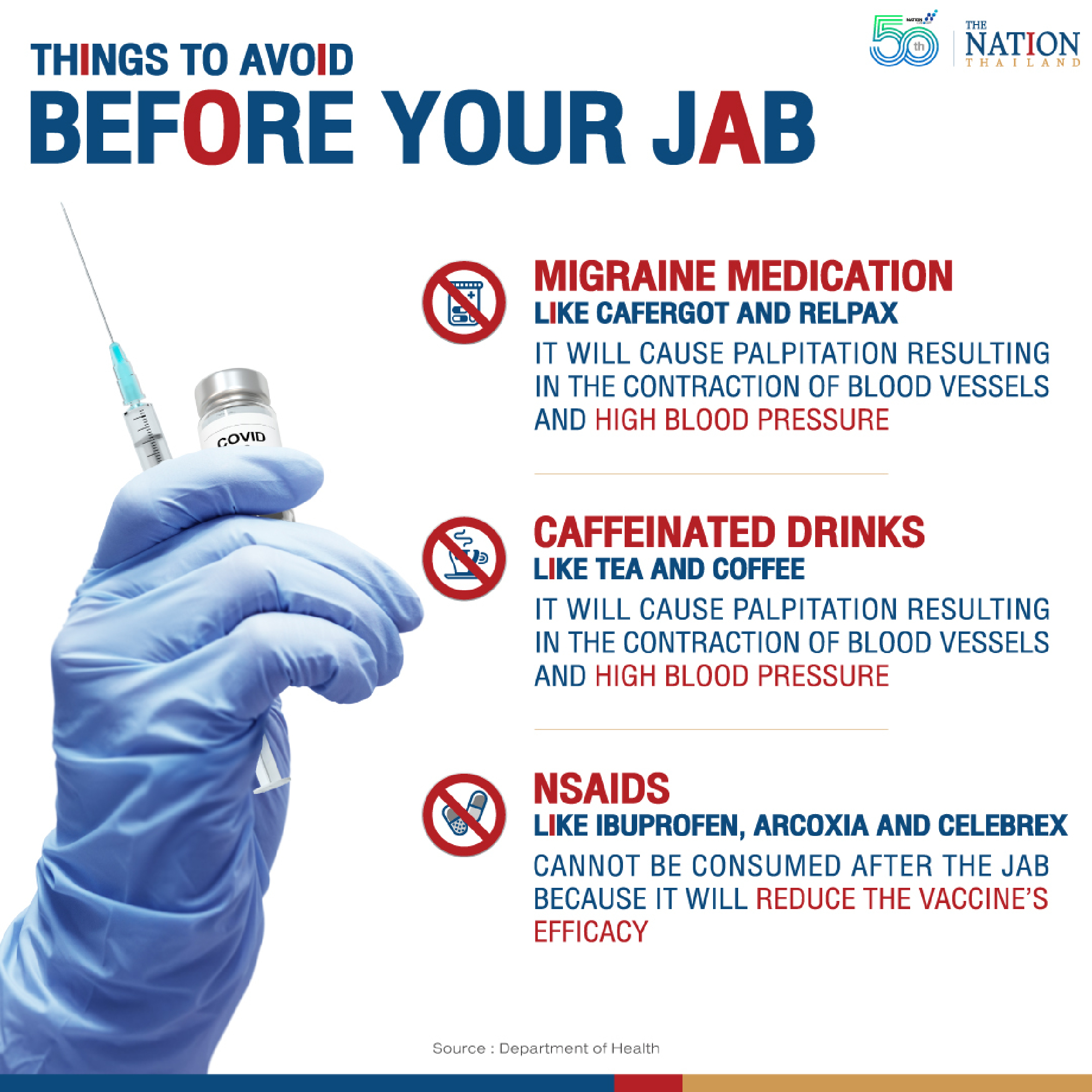
• Cafergot or Relpax for migraine: It will make the heart palpitate, resulting in the contraction of blood vessels and a rise in blood pressure.

• Caffeinated drinks such as tea and coffee: Caffeine will cause the same symptoms as above.

• Non-steroidal anti-inflammatory drugs (NSAIDs) such as Ibuprofen, Arcoxia and Celebrex: Taking these drugs after the jab will reduce the efficacy of the vaccine.

Precautions

• Inform the medic if you have a fever before you get your jab

• The second jab should be taken at least a month later

• People with immune system disorders should consult a doctor before getting a jab

• Do not refrain from eating or drinking fluids before the jab

Preparing for your Covid-19 jabPreparing for your Covid-19 jab

Published : May 24, 2021

By : The Nation

G20 leaders pledge support for Access to Covid-19 Tools Accelerator as crisis grows #SootinClaimon.Com

#SootinClaimon.Com : ขอบคุณแหล่งข้อมูล : หนังสือพิมพ์ The Nation.

https://www.nationthailand.com/life/40001188

G20 leaders pledge support for Access to Covid-19 Tools Accelerator as crisis grows


World leaders on Saturday met at the Global Health Summit, co-hosted by the European Commission and Italy as part of its G20 presidency, to adopt an agenda to overcome the Covid-19 pandemic, and develop and endorse a Rome Declaration of principles.

G20 leaders pledge support for Access to Covid-19 Tools Accelerator as crisis grows

The meeting came at a time when the virus is surging and spreading uncontrollably in many parts of the world.

With nine people losing their lives to Covid-19 every minute on average, and as the risk of even more transmissible and dangerous variants increases, the Global Health Summit comes at a critical juncture. The future of the pandemic is in the hands of the G20 leaders.

The Access to Covid-19 Tools Accelerator (ACT-Accelerator) was launched just over a year ago in response to the G20’s call for a global mechanism to accelerate the development of tests, treatments and vaccines and to ensure their equitable distribution.

Hosted by the World Health Organization, the ACT-Accelerator offers the only end-to-end multilateral solution to speeding up an end to the acute phase of the Covid-19 pandemic.

The ACT-Accelerator welcomes the commitments made at the Global Health Summit and will work with countries to operationalise rapidly these pledges, both financial and – crucially – for over 100 million doses of scarce vaccine, the WHO said.

Current financial commitments are reflected in the ACT-Accelerator interactive funding tracker. However, a significant funding gap remains.

Speeding up an end to the pandemic through the ACT-Accelerator would cost less than 1 per cent of what governments are spending on stimulus packages to treat the consequences of the pandemic.

As the economic and social costs of the pandemic continue to escalate, the case for global solidarity grows even stronger.

The Rome Declaration, released at the end of the summit, reaffirmed leaders’ support for the ACT-Accelerator and underlined the necessity to share the financial burden and close the funding gap, in order for the ACT-Accelerator to fulfil its mandate for the equitable allocation and delivery of tests, treatments and vaccines to defeat the pandemic.

The group also emphasised its support for global sharing of vaccine doses approved for emergency use by the WHO and through Covax.

Carl Bildt, special envoy for the ACT-Accelerator and former prime minister of Sweden, said: “Today’s commitments are welcome – but more action is needed now, not in weeks or months, to change the course of the pandemic. While some countries have moved beyond just words, by donating vaccines and pledging to fully finance the ACT-Accelerator, further action is needed from G20 and G7 leaders if we are to stop this virus from spreading and mutating further. We all have substantial work ahead of us.”

Published : May 23, 2021

By : The Nation

Covid vaccines approved in Thailand explained #SootinClaimon.Com
#SootinClaimon.Com : ขอบคุณแหล่งข้อมูล : หนังสือพิมพ์ The Nation.

https://www.nationthailand.com/life/40001145

Covid vaccines approved in Thailand explained


People across the world are hoping the vaccines will help reduce fatalities and finally bring the Covid-19 crisis to an end.

Covid vaccines approved in Thailand explained

Like other countries, Thailand has also been working on inoculating 70 per cent of its population to achieve herd immunity. To get a jab in Thailand, people can either register through the “Mor Phrom” (Doctors Ready) application or at medical facilities nationwide. However, people are still concerned about which brand of vaccine they will get.

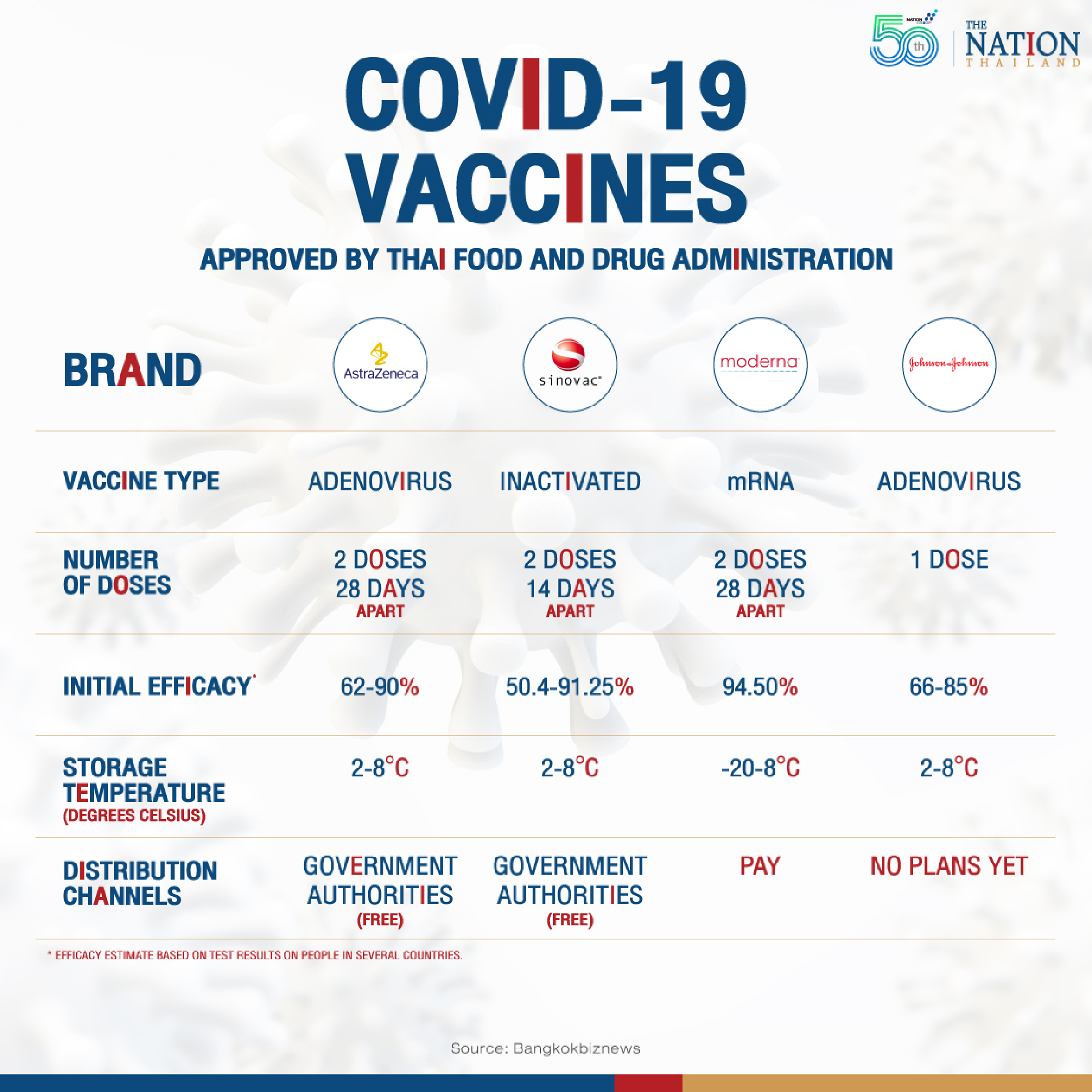
As of May 14, the Thai Food and Drug Administration (FDA) had approved four vaccines:

Sinovac

The inactivated vaccine, manufactured by a private Chinese company, was approved by the Thai FDA on February 22.

According to the World Health Organisation, this vaccine effectively protects people below the age of 60.

Dr Nakhon Premsri, director of the National Vaccine Institute, said the vaccine offers 50.7 per cent protection against infection and cuts down the chance of developing moderate symptoms by 83.7 per cent and severe symptoms by 100 per cent. This is a two-dose vaccine.

AstraZeneca

This adenovirus type vaccine, developed jointly by the Swedish firm AstraZeneca and UK’s Oxford University, was approved in Thailand in late January.

This vaccine has been found to offer 54.1 per cent protection against infection and cuts down the chance of developing moderate symptoms by 70.4 per cent and 100 per cent against severe symptoms.

Recent studies show that the vaccine is more effective if the second dose is delivered within an eight to 12-week interval.

Johnson & Johnson

This adenovirus type vaccine was approved by the Thai FDA on March 25.

It offers 66.9 to 85.4 per cent protection against moderate and severe infection through just one dose of the vaccine.

Moderna

This mRNA type vaccine was approved on May 13 and has been categorised as an alternative vaccine that can be procured by the private sector.

Dr Norraphat Pisirikarn, acting director at the Government Pharmaceutical Organisation, said this vaccine can stimulate immunity against Covid-19 3.4 times higher than plasma therapy.

“Fourteen days after the second jab, the vaccine offers 94.1 per cent protection to people below 65 and 86.4 per cent to those older than 65,” Norraphat said. “It reduces the severity of infections and mortality by 100 per cent.”

Recent tests show that it is effective against the UK B117 and South African B1351 mutations, he said.

Covid vaccines approved in Thailand explainedCovid vaccines approved in Thailand explained

Published : May 21, 2021

By : The Nation

Tests at Chula vouch for efficacy of Sinovac, AstraZeneca vaccines #SootinClaimon.Com

#SootinClaimon.Com : ขอบคุณแหล่งข้อมูล : หนังสือพิมพ์ The Nation.

https://www.nationthailand.com/life/40000687

Tests at Chula vouch for efficacy of Sinovac, AstraZeneca vaccines


The Sinovac and AstraZeneca vaccines are both helpful in stimulating peoples immunity against Covid-19, Dr Yong Poovorawan, a senior virologist at Chulalongkorn University, said on Sunday.

Tests at Chula vouch for efficacy of Sinovac, AstraZeneca vaccines

Citing a study by Chulalongkorn’s Centre of Excellence in Clinical Virology, he explained that people who got the first AstraZeneca jab had a 98.3 per cent immunity against Covid-19 compared to 99.4 per cent in people who had received the second Sinovac jab and 92.4 per cent in people who had been infected with Covid-19.

He also emphasised that people who had been infected with Covid-19 could get re-infected.

“We still do not know what level of immunity can prevent people from infection, but we already know that the severity of the disease would be reduced as long as we have immunity,” he said.

He added that the centre is currently studying people’s immunity against the Covid-19 in the long term.

“As Covid-19 has a short incubation period, it may be necessary to administer more doses to ensure people’s immunity is at the highest level,” he added.

Published : May 09, 2021

By : The Nation

Chulalongkorn University releases film on how its innovations helped fight pandemic #SootinClaimon.Com

#SootinClaimon.Com : ขอบคุณแหล่งข้อมูล : หนังสือพิมพ์ The Nation.

https://www.nationthailand.com/life/40000593

Chulalongkorn University releases film on how its innovations helped fight pandemic


Chulalongkorn University, which recently launched the “Innovations for Society” campaign, has released a short film to show the different innovations Chula has successfully developed to fight Covid-19.

Chulalongkorn University releases film on how its innovations helped fight pandemic

This campaign is part of the university’s mission to play a leading role in “Creating Knowledge and Innovation to Promote Sustainable Development for Society”.

The film, “Innovations for Society: Innovations against Covid”, uses a storytelling technique from the point of view of an ad agency person who has to dig deep into her creative arsenal to come up with a pitch for her client to approve.

Chula’s target is “to communicate a myriad of innovations against Covid-19 that are full of technical and complicated jargon in a fun and engaging way in three minutes”.

The film director ties all the information into a coherent, cute and funny storyline that is divided into three parts.

First, it starts with “preventive innovations” such as a face-mask spray to protect us from viruses and dust, and CU-RoboCovid – the medical-support robot.

Then, it describes “screening innovations” such as the Chula Covid-19 Strip Test, Chula Express Analysis Mobile Unit (EAMU) and Covid-19 data incubator website that’s developed with other partners.

Finally, the story concludes with “remedy innovations” such as Covid-19 mRNA vaccine, tobacco vaccine, Chula MOOC (massive open online course), and Quick MBA from home that provides cutting-edge professional knowledge to Thai people with novel ways to earn a living during the Covid-19 crisis.

Chula’s innovations against Covid-19 are part of the university’s mission to serve the society with technological breakthroughs as well as to be a driving force for Thai society to continue along the path of robust growth.

Published : May 06, 2021

By : The Nation

First shot of AstraZeneca gives 96.7% immunity against Covid-19, study shows #SootinClaimon.Com

#SootinClaimon.Com : ขอบคุณแหล่งข้อมูล : หนังสือพิมพ์ The Nation.

https://www.nationthailand.com/life/40000492

First shot of AstraZeneca gives 96.7% immunity against Covid-19, study shows


A senior virologist at Chulalongkorn University said on Monday that after receiving the first jab of the AstraZeneca vaccine, people develop a 96.7 per cent immunity against Covid-19.

First shot of AstraZeneca gives 96.7% immunity against Covid-19, study shows

He was citing a study on 61 people conducted by Chulalongkorn’s Centre of Excellence in Clinical Virology.

The centre’s chief Dr Yong Poovorawan said the study also showed that those who had already been infected with the virus and spent four to eight weeks fighting it, developed a 92.4 per cent immunity.

“Women have been found to have greater immunity than men, while those below the age of 60 are more resistant to the virus than those over 60,” he said.

He added that the centre will conduct another study on people after they get their second AstraZeneca jab.

“However, we have not conducted a study based on different vaccines and would ask those who have been vaccinated to contact us so we can study their immunity levels and side effects,” he said.

So far, 1,486,907 Covid shots have been administered in Thailand, 1,099,460 of whom were given their first shot, while 387,447 were given their second shot.

So far Thailand has taken delivery of China’s Sinovac and the AstraZeneca vaccines and is reportedly receiving another 3.5 million doses of the Sinovac shots this month.

Yong said the government should aim to vaccinate at least 10 million people per month to reach the target of vaccinating at least 70 per cent of the population by the end of the year to create herd immunity.

“If we get vaccines from other manufacturers, a mass vaccination rollout can be completed quickly,” he added.

Published : May 03, 2021

By : The Nation

Both doses of Sinovac vaccine essential to protect against Covid-19 #SootinClaimon.Com

#SootinClaimon.Com : ขอบคุณแหล่งข้อมูล : หนังสือพิมพ์ The Nation.

https://www.nationthailand.com/life/40000468

Both doses of Sinovac vaccine essential to protect against Covid-19


The Sinovac vaccine will help protect people from Covid-19 after receiving the second jab, the Faculty of Medicine at Siriraj Hospital said on Saturday.

Both doses of Sinovac vaccine essential to protect against Covid-19

Earlier, a Covid-infected medical staffer at the hospital’s Kanchanaphisek Medical Centre had said on social media that the Sinovac vaccine could not protect him from getting infected.

In a bid to prevent confusion on the vaccine’s efficacy among people, Assistant Professor Dr Naris Kitnarong, the hospital’s deputy dean of corporate communication and social responsibility, said the medical staffer had received the first dose on April 7.

He suspected that the staffer had tested positive for Covid-19 on April 17 because he had dined at a crowded place on April 12, five days after receiving the first dose.

“The medical staffer had contracted Covid-19 because the staffer had gone to a place at risk of infection. Meanwhile, the staffer had not received the second jab yet,” he said

He added that the medical staffer had posted a message apologising for the misunderstanding on April 25.

He asked people to get their Covid-19 vaccine jab.

“Many studies have shown that getting a vaccine is necessary because it can protect people from infection, as well as reduce the severity of the disease if infected,” he added.

Published : May 02, 2021

By : The Nation