White House hit with fresh outbreak of coronavirus cases
Health & BeautyNov 08. 2020White House Chief of Staff Mark Meadows greets supporters during a Nov. 1 rally in Michigan. MUST CREDIT: Washington Post photo by Jabin Botsford
By The Washington Post · Anne Gearan, Josh Dawsey · NATIONAL, HEALTH, WHITEHOUSE, HEALTH-NEWS WASHINGTON – The White House has been hit with a fresh wave of coronavirus infections, an administration official said Saturday, with Chief of Staff Mark Meadows and five other Trump aides having received positive test results in the period around Election Day.
Meadows, who tested positive Wednesday, at first told others not to disclose his condition. But after his diagnosis became public late Friday, the official confirmed that a broader outbreak threatens to create a new crisis in the West Wing just as Meadows and other top aides are trying to help President Donald Trump navigate a bitter loss at the polls to Democrat Joe Biden.
The official, who spoke on the condition of anonymity because they were not authorized to discuss the matter on the record, declined to name the affected aides or provide information about their conditions. In addition to the six White House staffers, a Trump campaign official said campaign adviser Nick Trainer has also tested positive.
The outbreak comes as coronavirus cases are spiking across the nation: Saturday brought more than 134,000 new cases – setting a record for the fourth day in a row – and deaths and hospitalizations are also on the rise. Biden may have won the presidency by relentlessly attacking Trump’s decision to downplay the severity of the virus and disregard basic advice from public health experts for combating a pandemic that so far has killed more than 237,000 Americans.
Meadows, for instance, has rarely worn a mask in public, has ridiculed Democratic governors for locking down bars, restaurants and other businesses. and has fought with federal science advisers about the administration’s response to the pandemic.
The influence of health professionals such as Anthony Fauci, the nation’s top infectious-disease specialist, has steadily waned under Meadows’s management. And Meadows has supported Trump’s strategy of pressing to reopen schools and send people back to work, arguing last month on CNN’s “State of the Union” that “we’re not going to control the pandemic.”
A majority of Americans have disapproved of the president’s handling of the coronavirus almost from the start. As Election Day neared with the outbreak raging, some older voters, politically moderate women and other constituencies, blamed Trump for doing too little to blunt it.
Declared the winner on Saturday, Biden has promised that, as president, he will listen to public health experts and try to bring the pandemic under control. Trump has not conceded the election, however, and his campaign issued a statement Saturday accusing Biden of “falsely posing” as the victor.
The White House outbreak is at least the third wave of infections to strike White House employees and residents. The first erupted in the days after a Sept. 26 Rose Garden ceremony honoring Trump’s most recent appointee to the U.S. Supreme Court, Justice Amy Coney Barrett, which Fauci called a “superspreader event.”
Trump, first lady Melania Trump and their son Barron Trump all tested positive, and Trump was briefly hospitalized. Senior adviser Hope Hicks and White House press secretary Kayleigh McEnany also were infected.
Two weeks later, at least five aides or advisers to Vice President Mike Pence tested positive, including Pence Chief of Staff Marc Short.
Despite the repeated infections, Trump, Meadows and their allies have continued to flout public health guidelines, holding large indoor gatherings where few people wear masks or follow advice for social distancing. On election night, for instance, Trump hosted an event at the White House billed as a victory party where people mingled close together and few wore masks.
“The contrast is really disheartening between what we’re seeing at the White House and what we know to be critical to controlling the virus. As a scientist – and a parent – it’s particularly exasperating,” said Ben Sommers, a doctor who teaches at the Harvard T.H. Chan School of Public Health.
“Kids are wearing masks for soccer outside and for hours a day in schools, and millions of children gave up trick-or-treating this year to avoid large crowds. Meanwhile, key White House leaders can’t bring themselves to follow those same guidelines,” Sommers said.
It is not clear when or how Meadows became infected. But it often takes several days after exposure to the virus before an infection can be detected through testing. Though Meadows tested positive on Wednesday, his diagnosis did not become widely known until late Friday, when it was first reported by Bloomberg News.
Many White House staffers are angry with Meadows for not disclosing his infection sooner, according to the administration official who confirmed the new infections. The official said top White House officials and Cabinet officers who had close contact with Meadows in the days around Election Day had been kept in the dark.
Meadows had traveled with Trump for whirlwind election rallies in several states during the week before his diagnosis. The stops included Wisconsin and Michigan, states where coronavirus cases are spiking.
Last Sunday, Meadows was photographed greeting supporters lined up along a barricade at a Trump rally in Opa-Locka, Fla. Meadows was a yard or so away from the crowd. Neither he nor many in the tightly packed group of supporters wore masks.
On Election Day, Meadows visited the campaign office with Trump, where he was photographed standing close to campaign and White House staffers. Later, he watched election returns with Trump in the family’s residence quarters and the Map Room. And in the wee hours after midnight, he was at the White House as Trump addressed supporters during an election night party in the East Room.
The event included a buffet where people could load their own plates with chicken wings and sliders, according to one person who attended. “It was basically like a large cocktail party,” the attendee said.
Those milling about included Cabinet officials, allies and donors. Meadows was in and out of the room but walked in with the Trump family just before the president spoke. He meandered toward the back of the room, speaking to a handful of reporters and standing amid the throng, the attendee said.
Later Wednesday, Meadows worked from campaign headquarters, but did not notify campaign staff that he had tested positive, officials said. Instead, he told only the president and Jared Kushner, officials said.
Meadows did not respond to calls seeking information about his diagnosis, symptoms and whereabouts. He was not seen at the White House on Saturday, as huge crowds gathered outside the gates to celebrate Biden’s victory.
The pain sneaked up on me – my shoulder hurt though I didn’t remember doing anything to injure it. I would reach behind my back to rearrange a throw pillow and feel a painful twinge in my shoulder.
I had to turn my whole body around to plump that pillow.
Over time, my pain-free arm movement became more limited and my repertoire of workarounds increased. I switched arms to back the car out of the driveway.
I did my best to rest the shoulder and let it recover. But then I’d do something and be met with a jolt of pain that brought tears to my eyes. Eventually, I went to the doctor.
My doctor sent me to a physical therapist, who diagnosed me within minutes. I couldn’t raise my arm over my head and she couldn’t either. It’s the classic test for frozen shoulder. (If I’d had a rotator cuff injury, which is more common, she’d have been able to move my arm all the way.)
Frozen shoulder is painful, aggravating and inscrutable. Sometimes it occurs after a shoulder injury, but more often, “It just happens,” says Todd Schmidt, an orthopedic surgeon in Atlanta.
An inflammatory process causes the ligaments that hold the shoulder together to contract and tighten up. “It’s like a shrink wrap around the joint,” Schmidt says.
The condition affects women more often than men, and tends to occur between the ages of 40 and 60. People with diabetes, hypothyroidism or lipid disorders have elevated odds of getting frozen shoulder. These characteristics hint at some hormonal contribution, but precisely what triggers frozen shoulder is unknown. It can happen to someone who’s physically active and it can happen to someone who is sedentary.
Here’s another curiosity: The shoulder freezes, and then it thaws. That’s the natural course of the condition, even without treatment. “It might take two years,” Schmidt says. “But it will resolve on its own.”
Still, treatment helps. Physical therapy and corticosteroid injection into the shoulder are typical first-line treatments for frozen shoulder.
My physical therapy sessions began with 10 minutes of transcutaneous electrical nerve stimulation, or TENS, and a very warm heating pad. Next, the therapist would stretch me, moving my arm to the point of resistance repeatedly. After that, I’d head out to the gym for a customized series of stretches and exercises with various pieces of equipment.
Being stretched by another person was painful – there’s no other way to say it. But by the end of the hour-long session, I always felt better – I gained more range of movement and more confidence. Some of that confidence came from an unexpected place: Learning that inadvertently triggering pain with an unwise reach was not reinjuring myself, it was not going to set me back.
My physical therapist also advised me how to stretch at home, and she measured my progress.
“Physical therapy is all about function – increasing mobility and managing pain,” says Brian Eckenrode, associate professor of physical therapy at Arcadia University near Philadelphia. In addition to monitoring your progress, therapists alter stretches and exercises as needed and they can help you find a more comfortable position for sleep. “They can fine-tune everything.”
The evidence for physical therapy alone tends to be scientifically wanting in that studies often don’t have a placebo group. And because physical therapy sessions are multidimensional and customized, it’s hard to pinpoint precisely what is most helpful.
In the clinic, Eckenrode says, success is measured by “reduced pain, improved function, increased motion and satisfied patients.”
Steroid injections into the shoulder joint may improve both pain and mobility. A 2014 review of studies found more improvement when steroid injections were combined with physical therapy compared with physical therapy alone.
Although, Eckenrode points out, the improvements were measured over the course of weeks. “It’s not clear that it improves long-term outcomes,” he says.
A 2020 review of studies reported that steroid injection may be more effective as the shoulder is in the freezing stage, while physical therapy manipulation may be more effective once the joint is frozen.
If you don’t see progress after three to six months of physical therapy and steroid injections, the orthopedic surgeon can offer more invasive treatments, Schmidt says. One puts the patient under general anesthesia while the doctor forces the arm beyond the frozen position. Another option is arthroscopic surgery to cut through the tightened joint capsule. Both of these treatments would typically be followed with more physical therapy.
How do you know what doctor to see first? A general practitioner, a physical therapist or an orthopedic surgeon?
“If you have a good relationship with your primary care provider, that’s a good place to start,” says Schmidt, the orthopedic surgeon. “But we’re here when needed.”
A final note. Most people recover from frozen shoulder, although recovery may not be complete. A 2013 paper highlighted several studies in which researchers could measure less-than-full arm mobility while at the same time noting that subjects were satisfied with their recovery. That means, my left arm’s range of movement may never match my right arm’s, but if I can do everything I could do before, I’ll be happy.
By The Washington Post · Lenny Bernstein, Joel Achenbach, Frances Stead Sellers, William Wan · NATIONAL, HEALTH, POLITICS, SCIENCE-ENVIRONMENT, HEALTH-NEWS The coronavirus pandemic reached a dire milestone Wednesday when the number of new U.S. infections topped 100,000 a day for the first time, continuing a resurgence that showed no sign of slowing.
The pandemic is roaring across the Midwest and Plains states. Seven states set records for hospitalizations for covid-19, the disease caused by the virus. And Connecticut, Iowa, Maine, Michigan, Minnesota, Nebraska and North Dakota saw jumps of more than 45 percent in their seven-day rolling average of new infections, considered the best measure of the spread of the virus.
The record 104,004 cases was reached a day after the deeply divided nation went to the polls to choose between President Donald Trump and Democratic nominee Joe Biden, an election widely seen as a choice between fully reopening the economy and aggressively quelling the outbreak.
Just as they split almost down the middle on the two candidates, voters broke into almost equal camps on how to address the pandemic that has killed more than 233,000 people and infected nearly 9.5 million people in the United States.
“It’s clear we’re heading into a period where we’re going to see increasing hospitalization and deaths in the U.S. And it worries me how little we’re doing about it,” said Tom Frieden, director of the Centers for Disease Control and Prevention during the Obama administration. “We know by now how fast this virus can move. You have to get ahead of it.”
After more than nine months of restrictions, some state leaders are hesitant to risk further pandemic fatigue, Frieden said.
But if case counts continue rising at the current rate and strong action isn’t taken, viral transmission may soon reach a point in some areas where nothing will stop the virus except another shutdown, he said.
“The numbers keep going up, and we’re only getting closer and closer to Thanksgiving and Christmas,” when some families are expected to congregate indoors and risk spreading the virus further, said Eleanor Murray, an assistant professor of epidemiology at Boston University. “For so many reasons, the next few weeks are going to be bad for us and good for covid.”
With Trump and his aides fighting to hold on to the White House, the federal response to the pandemic, which already leaves major responsibilities to the states, may be even more fractured, Murray said.
“Something that deeply worries me is either way this election goes, Trump will still be in charge the next few weeks, when cases are higher than they’ve ever been,” she said. “And he’s made clear there will be no top-down, coordinated action coming from the federal government.”
Despite months of surveys that clearly indicated strong voter disapproval of the president’s response to the pandemic could weigh heavily against his reelection effort, more voters chose the economy as the primary issue in casting their ballots, exit polling showed.
Even if Biden captures the White House, the results appear to signal that, for many people, covid-19 disease is not as daunting as the prospect of being unable to pay their bills or send their children to school.
“I got news for you, pal. Covid-19 is over. It’s done,” said Nick Arnone, owner of HLSM, a software company for the power sports industry, in Plains, Pa. “We have therapeutics, so deaths are way down; we are very close to a vaccine. We’ve got to ride it out now.
“But if we don’t have a strong economy, there is no way we can do anything. Trump is correct. Without a good economy, there is no way to dig our way out of this.”
About 35% of voters said the economy was the most important issue for them, while about 17% cited the pandemic and roughly 2 in 10 were motivated most by racial inequality.
At the same time, however, just over half the voters said it is more important to contain the virus, even if that hurts the economy, while slightly more than 4 in 10 said rebuilding the economy is most critical, even if that impairs work to quell the virus.
Those more concerned with the virus broke heavily for Biden. But they were matched by the proportion of Trump voters who supported his persistent call for a return to normalcy and a revived economy.
In El Paso, Texas, where the pandemic is surging, James Clark said he voted for Biden because of the uncontrolled outbreak.
“Covid was the main reason . . . and the things he was saying specifically about it,” Clark said. “I mean there were some things Trump was doing well, too, but overall it was covid.”
Some analysts were surprised and concerned that voters appeared to view the decision before them as a choice between the virus and their livelihoods, rather than as intertwined problems that could be solved together.
“That was shocking to me, that Trump could convince so many people it was a choice between the economy and pandemic,” said Eric Topol, a cardiologist and head of the Scripps Research Translational Institute in San Diego. “I’m amazed the extent he pulled that off, because it’s so obviously a false dichotomy. There’s no way for the economy to thrive unless we get control of the pandemic.”
On the campaign trail, Biden warned voters of a “dark winter” and invoked empty chairs in homes where families grieved the death of a loved one. He suggested he would follow science and tighten restrictions in places where that was necessary.
Trump repeatedly declared that the country was “rounding the turn” on the pandemic and said a vaccine was almost ready to be distributed. “You know what we want? We want normal,” Trump said this past weekend in Butler, Pa.
The two political messages were consistent with the viewpoints of each candidate’s base, said Kathleen Hall Jamieson, director of the Annenberg Public Policy Center at the University of Pennsylvania.
Biden has much more support among urban voters and people of color who, until recently, have been hit harder by the pandemic. Trump’s base is more White and rural, constituencies that have been slammed by the virus only in recent weeks, as the number of infections soared in the Upper Midwest and Plains states, she said.
“Who’s more likely to know someone’s who’s died? People who are already more likely to be Democrats than Republicans,” Jamieson said. “The lived experience of the two constituencies, the base vote for each side, is different.”
In Florida, which Trump carried more easily than expected, Biden’s emphasis on the pandemic hampered grass-roots campaigning, said Susan MacManus, an emerita professor of political science at the University of South Florida. With Biden emphasizing social distancing, the Democratic campaign there followed his lead.
“The Republicans never let their foot off the pedal in terms of continuing to register [voters] and going door to door, all through the covid,” she said. “The Democrats, once covid hit, they made a conscious effort, not going door to door.”
Rep. Donna Shalala, D-Fla., who appeared to be headed to losing her seat to television newscaster Maria Elvira Salazar, a Republican, in Miami, campaigned heavily on Trump’s response to the virus.
Stefan Baral, a physician and epidemiologist at Johns Hopkins School of Public Health, Wednesday faulted Democrats’ pandemic messaging, saying Biden did not adequately express empathy for the economic hardships caused by the pandemic-related shutdowns.
“This is a terrible virus. But empathy for all the folks who have lost their jobs and lost their opportunities and kids who are out of school – I just never felt that message of empathy come across at all,” Baral said.
When some people heard Biden talk about the dark winter ahead, they thought, “The first thing he’s going to do is close my business,” Baral said.
Voters also had to make up their minds amid a torrent of misinformation and purposeful distortion about the pandemic, said Matthew Seeger, a risk communication expert at Wayne State University, who helped the CDC develop its past communications plans.
“The messaging around the pandemic has been deliberately confused and strategically manipulated to downplay its significance,” Seeger said. “You combine that with the fact that this is a slow-moving crisis with risk fatigue starting to settle in, and you can see why public perception is what it is.”
In Chandler, Ariz., a suburb southeast of Phoenix last week, Al Fandick said he considers the pandemic wildly overblown and masks largely pointless. Fandick, 53, who runs a transport company, said he found it absurd that he was required to don a mask to enter a restaurant but could remove the face covering once he sat down.
“Having a face mask on while I walk into that restaurant, but then I can take that face mask off, that’s like having a peeing section in a pool,” Fandick said.
Aside from trips to visit people in the hospital, he never wore a mask until Maricopa County began mandating it for public spaces, a policy he vehemently opposes, he said.
“Don’t need the hassle,” he said.
On the other side of the gulf are those who see the accelerating pandemic and a possibly very deadly period ahead.
“It is demoralizing to feel like: Here we are in November. A third surge is not just underway, but has already surpassed past surges. And people still don’t understand what’s happening and what’s at stake,” Murray, of Boston University, said.
“We are in the middle of an emergency. We have cases higher than they have ever been since this pandemic started, and yet you will have people paying less attention than ever to covid,” Murray said. “We as a country are not in a place right now where it’s safe to do that.”
By Syndication Washington Post, Bloomberg · Morten Buttler · WORLD, EUROPE Denmark says it’s found a new strain of covid-19 that might hamper efforts to develop a vaccine, after an outbreak in the country’s mink population triggered a mutation of the virus.
Prime Minister Mette Frederiksen told reporters that, because of developments in Denmark, there is now “a risk that the effect of a future vaccine will be weakened or, in a worst case scenario, be undermined,” during a virtual press briefing on Wednesday.
Her government has passed on the information to the World Health Organization, and now plans to cull Denmark’s entire mink population. According to Kopenhagen Fur, an auction house owned by Denmark’s mink breeders, some 16 million animals are raised each year.
As the new coronavirus has spread from person to person, it has changed thousands of times. The vast majority of these changes are incremental, without what’s known as a functionally significant mutation, though there’s been previous debate over research showing that it may have evolved to become more contagious.
The mutation of the virus that’s now been identified in Denmark “can have serious negative consequences for the global handling of the pandemic,” Frederiksen said. There are 12 known cases in which humans have contracted the new form of the virus from mink, she said.
Denmark has already culled thousands of mink in recent months due to outbreaks of the virus. According to Wednesday’s briefing, cases of Covid-19 were found in 217 out of 1,139 Danish mink farms.
Speaking at the same briefing, Kare Molbak, Denmark’s top epidemiologist, said that in a “worst-case scenario, the pandemic will restart, this time in Denmark.” He said the WHO would have to make the final call on whether the mutation found in Danish mink farms warrants a new classification.
The Danish prime minister and other government members and health officials who participated in Wednesday’s briefing spoke via TV screens, after an outbreak of Covid in the parliament forced Frederiksen and more than half her cabinet to self-isolate.
By Syndication Washington Post, Bloomberg · Suzi Ring · NATIONAL, BUSINESS, HEALTH, SCIENCE-ENVIRONMENT, HEALTH-NEWS A coronavirus vaccine under development from CureVac NV showed a good immune response in early trials, validating the biotech company’s 20 years of research into messenger RNA’s ability to train the body’s defenses.
The vaccine’s strongest dose produced an immune response comparable to that found in recovered patients in an early-stage test on more than 250 volunteers, the German company said in a statement Monday. Chief Executive Officer Franz-Werner Haas said advanced clinical trials are on track to start by year-end. CureVac shares rose as much as 5% in Frankfurt trading.
CureVac was thrust into the spotlight earlier this year amid reports that the U.S. government had tried to buy it or persuade it to move its research work there. The company has spent two decades investigating the potential of messenger RNA, in which a vaccine or drug teaches the body’s cells to identify and create its own substances to ward off disease.
Before the pandemic, CureVac studied mRNA therapies and vaccines for diseases such as cancer and rabies. If the covid-19 shot is successful, it will be the company’s first product.
Two other front-runner vaccine developers are also betting on mRNA — Pfizer Inc. and its German partner BioNTech SE, and the U.S. biotech Moderna Inc. Given that no such vaccine has ever been approved, Haas said a win for rivals can only be good for CureVac too.
This technology is “not only for the covid-19,” Haas said in a telephone interview. “In five years it’s for the Covid-25, or whatever it is.” The approach, he said, could “revolutionize the entire prophylactic vaccine field.”
Haas said the company held lengthy discussions in January to decide whether to repurpose its research, using some of it to develop a coronavirus jab.
“It was certainly a big stretch for a company like ours,” Haas said. We decided “not to do it would not be an option.”
The phase 1 trial data showed a strong induction of binding and neutralizing antibodies as well as the first signs that T cells — a type of white blood cell that helps destroy infection — had been activated, CureVac said. The full test results will be published in more detail after peer review in the coming weeks.
The trial included as many as 10 people who had previously tested positive for the coronavirus. CureVac has started some middle-stage trials in Peru and Panama in September with adults over 60.
Haas reiterated the company’s denial that the U.S. tried to buy the company. “There was no formal or informal or oral or written offer,” he said. “At least not that I know.”
In June, the German government agreed to acquire a 23% stake in the company $350 million (300 million euros) and CureVac listed in the U.S. in August.
Global professional make-up brand NYX will cease operations in Thailand from November 30.
The company posted the message on its Facebook page on Monday regarding the closure of its stores.
The brand expressed its gratitude to its fans who have “always given love and inspiration” to the brand.
NYX Professional Makeup is a famous make-up brand from LA, USA founded in 1999, which is known as a make-up artist.
The NYX brand launched in Thailand in 2016, with a large opening in the heart of Siam Square One as Asia’s first and only flagship store that brought the concept of “Digitised Destination of Beauty Junkie” to enable girls to have fun with buying products and get a fiesta make-up experience through VR technology.
Health & BeautyNov 01. 2020An employee shows an assortment of masks to be included in a “lucky bag” at the Matsuya Ginza department store in Tokyo. MUST CREDIT: Japan News/Yomiuri.
By Syndication Washington Post, The Japan News-Yomiuri · No Author · WORLD, ASIA-PACIFIC
TOKYO – An assortment of masks has appeared as one of the items included in the “lucky bags” available for the New Year’s Day sale traditionally held at major Japanese department stores.
The Matsuya Ginza department store in Chuo Ward, Tokyo, unveiled their New Year’s lucky bags for the press on Wednesday. They include a variety of masks made of high-quality toweling from Imabari, Ehime Prefecture, and special accessories that can be attached to the masks worth 20,000 yen, yet can be purchased at almost half the price.
The Tobu department store in the Ikebukuro area of Tokyo has prepared lucky bags that allow customers to receive seasonal fruits for a year. After it is purchased, the buyer will have high-end fruits, such as muskmelons and Amaou brand strawberries, delivered every month. The department store expects that people will continue to spend more time at home.
In addition to the sale of products that suit new lifestyles amid the pandemic, department stores are also offering online reservations in which customers can pick up reserved items at a specific date and time to avoid the crowds at the New Year’s Day sale.
A health worker injects a volunteer during clinical trials for a coronavirus vaccine in Hollywood, Fla., in September. (Eva Marie Uzcategui/Bloomberg News)
By The Washington Post · Lena H. Sun · NATIONAL, HEALTH, HEALTH-NEWS State health officials are expressing frustration about a lack of federal financial support as they face orders to prepare to receive and distribute the first doses of a coronavirus vaccine by Nov. 15, even though one is not likely to be approved until later this year. The officials say they don’t have enough money to pay for the enormous and complicated undertaking.
State officials have been planning in earnest in recent weeks to get shots into arms even though no one knows which vaccine will be authorized by the Food and Drug Administration, what special storage and handling may be required and how many doses each state will receive.
Despite those uncertainties, the Centers for Disease Control and Prevention is asking states to be prepared to “preposition” doses in key locations throughout the country. Officials want to move quickly once the FDA authorizes a vaccine and a CDC advisory panel issues recommendations on which populations should be vaccinated, according to a letter the CDC sent Monday to state preparedness and immunization officials.
As part of that effort, the CDC is asking states to provide by Tuesday critical information, including a list of each jurisdiction’s top five sites capable of receiving and administering a vaccine that must be stored at ultracold temperatures of minus-70 Celsius (minus-94 Fahrenheit). The letter refers to the vaccine only as Vaccine A, but industry and health officials have identified it as Pfizer’s candidate.
Pfizer chief executive Albert Bourla said Tuesday that “hundreds of thousands” of doses had already been produced and that a first look at the data would occur soon. Pfizer will not apply for any authorization of its vaccine sooner than the third week of November, when it will have sufficient safety data.
“We acknowledge that you are being asked to do unprecedented work,” wrote Nancy Messonnier, director of the CDC’s National Center for Immunization and Respiratory Diseases, which is leading the CDC’s role in vaccine distribution. She added: “This is a new planning ask.”
State officials say they have been trying to raise the issue with federal officials but have received little response.
“It is absolutely ridiculous that the administration, after spending $10 billion for a Warp Speed effort to develop a vaccine, has no interest in a similar investment in a Warp Speed campaign to get the vaccine to every American as quickly as possible after it is approved,” said Michael Fraser, executive director of the Association of State and Territorial Health Officials.
Operation Warp Speed is the federal initiative, funded by more than $10 billion of taxpayer money, to fast-track development of coronavirus countermeasures.
“The now accelerated timeline underscores the need to address the issue of funding for state and territorial health agencies to make this all work,” Fraser said. “There are many other costs that have no clear way to be paid for at this point.”
Local officials still need to recruit thousands of people to staff vaccine clinics and enroll and train providers. They also have to ramp up information technology and data systems to track vaccine inventory and ordering to ensure people get the correct doses at the right times – most vaccines will require two shots – and to monitor for adverse events. They will need to develop locally tailored vaccination communications campaigns, too.
“States have received some funding, but it’s not nearly enough” to support the scale, scope and speed that is needed, said Claire Hannan, executive director of the Association of Immunization Managers, whose members direct public health immunization programs throughout the country.
States and territories have received $200 million from the CDC to do planning, they said. In the next emergency supplemental funding package, they are asking Congress for at least $8 billion for coronavirus vaccination and $500 million for seasonal influenza vaccine operations, they said in a recent letter to congressional leaders.
Recruiting and training workers for coronavirus vaccination campaigns will cost at least $3 billion. Another $1.2 billion will be needed for cold supply chain management, $1 billion for arranging additional vaccination sites and $500 million for data information system upgrades.
Last month, CDC Director Robert Redfield testified before a congressional committee that roughly $6 billion is needed for the CDC to support states for coronavirus vaccine distribution, which will take place in phases, well into next year.
Natalie Baldassarre, a spokeswoman for the Department of Health and Human Services, CDC’s parent agency, said the CDC has already sent $340 million to states to support flu and coronavirus vaccine planning and distribution. She said the most significant costs of delivering and administering a vaccine will be covered by the federal government and other sources. McKesson Corp., under contract with CDC, will ship vaccines and related supplies to sites where shots will be administered. Pharmacy and insurance reimbursement will cover additional costs, she said.
The CDC plans to send states an additional $140 million before the end of the year, said an HHS official who spoke on the condition of anonymity Thursday because an announcement is pending.
Without additional federal money, “it’s kind of like setting up tent poles without having the tent,” Nirav Shah, director of Maine’s Center for Disease Control and Prevention, said during a recent call with reporters.
Even officials in conservative states say they can’t distribute vaccines without federal help, especially as tens of millions of doses are expected to become widely available next spring and summer.
“As far as trying to reach all populations with an effective vaccine, that’s going to be a real challenge,” Thomas Dobbs, state health director for Mississippi, said on the same call.
The nation’s governors, who are scheduled to speak Friday with HHS Secretary Alex Azar, have been seeking more federal dollars for months. The bipartisan National Governors Association sent a letter to the White House on Oct. 18 with questions about funding.
“Before you hand the baton to the governors, called ‘administer the vaccine,’ the governors need to know what resources? What funding? What is the timetable? What can they expect?” New York’s Democratic governor, Andrew Cuomo, said during a conference call with reporters last week.
“We sent 35 questions to the president,” said Cuomo, chairman of the governors group. “We have gotten no answer.”
Michael Bars, a White House spokesman, said Thursday evening Cuomo has missed the White House’s last 17 governors-only briefings, including a 75-minute vaccine briefing joined by nearly 50 governors and senior officials overseeing the vaccine development process. “It’s unfortunate that the governor would engage in politically-motivated attacks that obstruct the federal planning process than meaningful collaboration to save lives,” Bars said.
At the request of President Donald Trump, Bars said HHS Secretary Alex Azar and the Warp Speed leadership offered a meeting or call with Cuomo on Sunday but that Cuomo declined.
Cuomo’s office did not immediately respond Thursday evening to a request for comment.
HHS officials said senior leaders of Warp Speed also briefed New York State Health Commissioner Howard A. Zucker last month. HHS is also working with the CDC to respond to the governors’ questions. The CDC has already provided assistance to each jurisdiction, including near daily check-ins, weekly conference calls and, in some cases, on-site support, Baldassarre said. The CDC has also answered nearly 400 questions from jurisdictions, she said.
Administration officials have been seeking additional money from Congress, but bipartisan talks aimed at getting a deal on broad coronavirus relief have fallen apart. Prospects for reviving them are uncertain.
If Congress does not provide more funding, HHS is able to transfer money designated for other uses, such as hospital and small-provider relief, to help with vaccine distribution at the state level, according to a health-care industry source familiar with HHS funding decisions who spoke on the condition of anonymity to share internal discussions.
Health & BeautyOct 29. 2020Carlton Coates Jr. and his wife, Juanette Long-Coates, hold a photo of his sister, Carol, 46, and his mother, Dale, 66. MUST CREDIT: Photo by Amanda Andrade-Rhoades for The Washington Post
By The Washington Post · Michael E. Miller · NATIONAL, HEALTH, POLITICS Marine One landed on the White House lawn just before dusk. As its rotors came to a halt, the helicopter’s door swung open and out stepped Donald Trump.
Carlton Coates Jr. and Juanette Long-Coates sort out condolence cards after his sister, Carol, and his mother, Dale, died of covid-19 just days apart. MUST CREDIT: Photo by Amanda Andrade-Rhoades for The Washington Post
The president had just spent three days in Walter Reed National Military Medical Center recovering from covid-19, the disease caused by the novel coronavirus. And in a scene that would be set to dramatic music and tweeted to his 87 million followers, he climbed the steps to a White House balcony, took off his face mask and recorded a video urging the country not to fear the deadly disease.
“Don’t let it dominate you,” he said into a camera on the evening of Oct. 5. ” . . . We have the best medical equipment. We have the best medicines. All developed recently. And you’re gonna beat it.”
Thirty miles away, Carlton Coates Jr. sat in an Annapolis, Md., funeral home, staring at the casket that contained the body of his older sister.
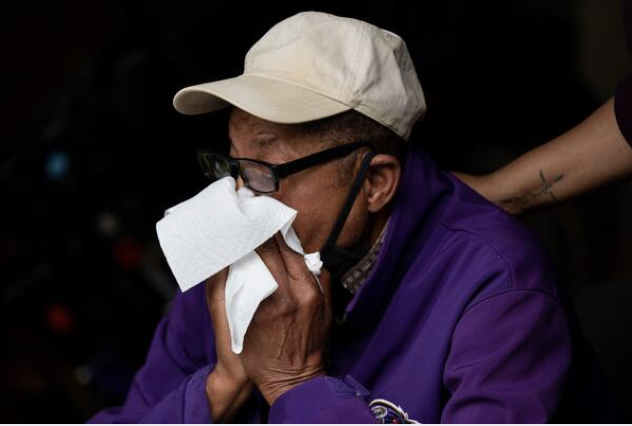
Juanette Long-Coates comforts Ernest Davis, 74, over the loss of Dale, his fiancee. She was “a very jolly person, always smiling,” said a former co-worker. MUST CREDIT: Photo by Amanda Andrade-Rhoades for The Washington Post
Carol Coates had battled covid-19 at the same time as the president. But instead of a suite at Walter Reed, the 46-year-old Black teacher self-isolated in the basement of her family’s home. And instead of the experimental cocktail of antibodies that Trump was given, she received get-well cards from her fifth-grade students.
Carol had taught nine miles from the White House. But her illness unfolded in what seemed like a different universe than the one the president described.
The virus has killed more than 227,000 people in the United States, but it has hit some communities harder than others. Blacks and Hispanics are nearly three times as likely as Whites to contract the disease, according to the Centers for Disease Control. And African Americans are more than twice as likely to die of it.
“Don’t let it take over your lives,” Trump said during his triumphal homecoming video.
Yet for many people of color in the United States, the coronavirus has already taken the life of someone they loved.
It would take even more from Carlton Coates.
His phone buzzed during his sister’s funeral, but the 43-year-old truck driver ignored it. It was only when he returned home and saw people gathered in the driveway that he knew something else had gone wrong. As they stepped out of the car, his fiancee pulled him aside.
“I hate to tell you this,” she said, “but your mom passed away.”
– – –
Carol Coates and her mother, Dale, could hardly have been closer. They lived in the same house outside of Annapolis, along with Carlton and his fiancee. They loved the same music and colorful clothes.
Carol draped her mother in jewelry. Dale talked about her daughter so much that colleagues who’d never met Carol felt like they knew her.
“They were inseparable,” Carlton said.
It’s not clear how the coronavirus crept into the pretty house with blue shutters in Anne Arundel County. But when it did, it was little surprise that both mother and daughter got sick.
The family had been vigilant ever since Maryland Gov. Larry Hogan, a Republican, had shut down much of the state on March 12 – the same day Trump insisted the pandemic was “going to go away,” a claim he has made dozens of times.
By then, a member of Carol and Carlton’s congregation was already sick with covid-19 and would soon be put on a ventilator. Within a few weeks, a couple connected to Dale’s church would die of the disease.
“As the saying goes, ‘When White folks catch a cold, Black folks catch pneumonia,’ ” said the Rev. Stephen Tillett, Dale’s pastor at Asbury Broadneck United Methodist Church.
The Coates family feared the virus, especially because Dale’s 74-year-old fiance and her 84-year-old mother also lived with them. But with four members of the household going to work throughout the pandemic, they wouldn’t be able to escape it.
Dale was one of two Black receptionists at a predominantly White retirement home called Sunrise Senior Living in Annapolis, where the 66-year-old was known for having a personality as bright as her outfits.
“She was a very jolly person, always smiling,” recalled Carolyn Muir, who left Sunrise in 2018 to return to her native England, but not before Dale introduced her to the wonders of go-go and gospel.
As the pandemic deepened – hitting one nursing home after another and eventually infecting four residents and nine employees at Sunrise – Dale kept working despite her worries over falling ill. Sunrise Senior Living said in a statement that it has been vigilant in preventing the spread of the coronavirus, giving employees masks and other personal protective equipment and testing them weekly.
“Thank you, God, I had a negative test,” Dale would say when she returned home from work, Carlton recalled.
He was still working, too, hauling construction materials and machine parts for projects that never stopped. And so was his fiancee, who worked in a dental office that remained open.
Carol hadn’t gone into Adelphi Elementary School in Prince George’s County since mid-March. But she still spent hours each day in front of her computermaking sure her fifth-graders – many of whom were English language learners or in special education – had access to the Internet and course materials.
Carol also kept her part-time job selling costume jewelry. She called the side business Carol’s Sassy Accessories, posting photos or videos on social media and, when the pandemic ebbed, setting up a display table in parks on weekends. She sent her mother to Sunrise in rhinestone-covered necklaces and matching earrings.
“She loved to make people look good,” said her boyfriend, Anthony Wilson. The $5 pieces of jewelry were never going to make her rich. But Carol enjoyed when friends came to the park or tuned in online for “Wear It Well Wednesdays” and “Sassy Sundays.”
She brought the same energy to her classes when they resumed online in August. She could no longer hug her students or play music while they worked. But she could still coax them into opening up with “Figure Me Out Friday” puzzles and songs where students rapped about their weekend plans.
“I’ve been teaching for 16 years,” said her co-teacher, Alan Konlande. “She had different tricks that I had never seen before.”
Carol was careful to wear a mask and sanitize her hands, Wilson said. But one day in mid-September she called him to say she wasn’t feeling well and was going to get tested for the coronavirus.
She was shocked when it came back positive, he said.
Carol told Konlande she had the virus but kept teaching, even as she coughed and sniffled through class.
“Our last day working together on Zoom, I just noticed when she turned her head, she didn’t look well,” Konlande recalled.
After he repeatedly urged her to take time off, she reluctantly agreed.
On Sept. 24, her students emailed her get-well cards.
“Dear Ms. Coates, I hope you feel better!” one girl wrote next to a cartoon drawing of a teacher in front of a chalkboard. “We miss you and hope to see you next monday.”
“I am so glad i took your advice and took off,” she wrote Konlande that night. “I slept for like 3 days straight. Fever, aches and chills no appetite.”
“Keep resting,” he replied. “This is no joke.”
“I realize now how serious it is,” she answered, adding that she felt “a little better” and was hoping to return the next week.
Friends and family members left food at the top of the basement stairs, including bottles of her favorite orange juice, Florida’s Natural.
Two floors up, Dale was also struggling. She had long suffered from arthritis and carpal tunnel syndrome, her son said. But now she was so exhausted she could hardly get out of bed. She, too, had tested positive and stayed home from work. Her fiance, Ernest Davis, brought her food and slept on the floor next to her bed.
On Sunday, Sept. 27, Dale was so weak that Davis called 911.
Her family watched from a distance as she was loaded into an ambulance and taken to Anne Arundel Medical Center. Stuck in the basement, Carol couldn’t even say goodbye.
“Is mom back yet?” she texted her brother a few hours later.
Doctors were going to keep her at the hospital on fluids and oxygen before releasing her, he replied.
“Wow,” she wrote.
When Wilson chatted with Carol on FaceTime that evening, she looked as healthy as she had in a couple of days. She was sorting jewelry and watching football. She was worried about her mother but she said she felt fine.
The couple had made plans to celebrate her birthday the following weekend in Virginia Beach, and Carol was determined to recover in time. What she didn’t know was that Wilson was planning to propose.
But when Wilson texted her “good morning pooh” the next day, she didn’t reply.
He called her but she didn’t answer.
“Just checking in on you,” texted her co-teacher, Konlande. “How are you feeling?”
He also heard nothing.
Carlton was at work that afternoon when he received a worried call from Wilson, who still hadn’t reached Carol.
Carlton dialed his 15-year-old daughter and asked her to check on her auntie. But when the teenager shouted down into the basement, there was only silence.
Carlton told her to put on a mask and gloves, and then watched on FaceTime as his daughter descended into the basement and looked into Carol’s bedroom.
“I just saw my daughter’s face,” he recalled. “She just peeked in there and then ran back upstairs, kind of traumatized.”
For the second time in as many days, an ambulance pulled up to the house with blue shutters. But this time, there would be no trip to the hospital.
Carlton was driving when he received a call from his fiancee, Juanette Long, who had come home after the final fitting for her wedding dress to find her future sister-in-law wasn’t breathing.
“She’s gone,” she told him.
That night, the couple went to see Dale at the hospital, where she had been moved to the intensive care unit. Her son said she was being given convalescent plasma and remdesivir, an antiviral drug that the president would also receive, but not the experimental antibody cocktail made by Regeneron, which Trump would credit with his recovery.
Relatives had warned Carlton not to tell his mother that her firstborn child was dead for fear she would have a heart attack. But doctors said it was better for that to happen at the hospital than after she left.
And so, after asking how she was feeling, they broke the bad news.
“Oh no. Oh, my God. My baby girl,” Dale replied, according to her son.
For three days, Carlton struggled to sleep and eat while making funeral arrangements for Carol. When he and Juanette went back to visit Dale on the evening of Oct. 1, they found her oxygen tube had been replaced by an oxygen mask. A doctor warned them that her blood oxygen levels were still dangerously low.
When Dale spoke, however, she seemed upbeat.
“She was praising and worshiping God, lifting up her hands,” Carlton recalled.
At one point, he and his mother sang Carol’s favorite gospel songs through their masks.
But when he called to check on her the next day, a nurse told him that Dale was being put on a ventilator.
“I love you,” he told her over the phone. “Be strong. Hang in there. I need you.”
“OK,” she replied before slipping into sedation.
Within a few hours, Trump would be whisked to Walter Reed.
By the time the president was released three days later – feeling, he said, “better than 20 years ago” – Dale and her daughter were both dead.
– – –
“There is a time for everything,” Tillett said on Oct. 13 as he stood behind Dale’s silver casket, which had just been closed to the sound of wailing. “A time to be born and a time to die; a time to plant and a time to uproot; a time to weep and a time to laugh; a time to mourn and a time to dance.”
Again and again, the pandemic had brought his community pain, Tillett said. Including members of his congregation and their relatives, Dale was the seventh person connected to his church to die of covid-19.
But amid the mourning there had been moments ofmuch-neededjoy, he noted.
Two days earlier, Carlton had stood at the front of his church, holding a microphone as Juanette walked down the aisle in her white dress.
“The stars have all aligned,” he crooned as around 100 guests looked on in masks. “And right now is the perfect time to say I love you.”
The last time he had sung had been at his mother’s hospital bed, when she had made him promise he wouldn’t cancel the wedding.
“Make sure you have a memorial table for Carol,” she had said.
Instead, the memorial table had been for her, too.
As he finished his eulogy, Tillett told a few dozen mourners at the William Reese & Sons Mortuary to turn to their faith.
“The enemy doesn’t get the final say,” he said. “Covid doesn’t get the final say.”
Sitting in the front row, Juanette squeezed her new husband’s hand.
The virus had taken so much from them. And yet, a week after his release from Walter Reed, the president was already back on the campaign trail. The day before Dale’s funeral, Trump had held his first rally since his hospitalization.
“Now they say I’m immune,” he told the crowd of more than 2,000, most of whom did not wear masks. “I feel so powerful. I’ll walk into that audience. I’ll walk in there. I’ll kiss everyone in that audience.”
Carlton and Juanette had danced just once at their abbreviated wedding. But after touting coronavirus “cures” and promising 100 million vaccine doses by year’s end, the president walked to the end of the stage and began to shimmy.
Gloom settles over Europe as days darken and coronavirus surges
Health & BeautyOct 29. 2020Sunset in Frankfurt, Germany, on Tuesday. The country announced a new partial lockdown Wednesday.( Ronald Wittek/ EPA-EFE/Shutterstock)
By The Washington Post · William Booth, Chico Harlan, Loveday Morris, Michael Birnbaum · WORLD, HEALTH, EUROPE, HEALTH-NEWS
LONDON – The clocks were dialed back an hour across Europe this week, and the long nights come early. The hospitals are filling up as the cafes are shutting down. Governments are threatening to cancel Christmas gatherings.
As new coronavirus infections surge again in Europe, breaking daily records, the mood is growing dark on the continent – and it’s not even November.
Summer’s reprieve feels like a long time ago, and the continent is entering a serious funk.
Germany and France on Wednesday joined those announcing shutdowns to try to get the virus under control. The new measures are less restrictive than in the spring, and yet they are facing more pushback.
People are no longer so willing to hunker down in their little apartments, stepping out in the evenings to applaud courageous nurses. Nobody is singing arias from their balconies anymore. Europeans remain scared of covid-19, but they are just as scared about jobs. They’re fried – and growing angry and belligerent, too.
Caterina Gramaglia, 42, a theater actress in Rome, said that compared with in the spring, she feels more unmoored, less certain what to do. The first time theaters closed in Italy, it was for her a chance for stillness, for reflection. Now that theaters have shuttered again, she said, “it’s a time of great dread and fear.”
“We are generally used to seek-and-find solutions,” Gramaglia said. “But now we don’t know where to go. There is a sort of general desperation.”
Police in Italy this week fired tear gas to disperse rioting crowds in Turin and Milan after protests against the latest round of anti-coronavirus orders flared into violence.
In Germany, the streets swelled with protesters from the hospitality industry, while Chancellor Angela Merkel met with regional leaders to debate the partial lockdown, in which restaurants are closed but schools are staying open.
In Liverpool, England, which is dealing with regional restrictions, gym owners defied police orders to shut down, saying the facilities needed to stay open – not just for the money but for their member’s mental health. In London, the sun set at 4:40 p.m.
Sensing the zeitgeist, Tedros Adhanom Ghebreyesus, the head of the World Health Organization, recognized the “pandemic fatigue that people are feeling” but urged, “We must not give up.”
Smugness in Europe about having bested the Americans under President Donald Trump is fading with the record-breaking daily counts in a dozen countries.
“We had predicted there would be this second wave, but we ourselves are surprised by the brutality of what’s been happening over the past 10 days,” Jean-François Delfraissy, an immunologist and the chair of the French government’s scientific advisory board on the coronavirus response, told France’s RTL radio.
In Paris, the mood was almost funereal Wednesday ahead of the announcement of a second national shutdown, to begin Friday. Traffic backed up on the roads out of the capital, with Parisians appearing to flee from an advancing cataclysm.
The weather in Europe this week hasn’t helped. A low-wattage dingy gray settled over Belgium as public health officials predicted 1% of the population could soon be sick with covid-19 on any given day.
Many Belgians this time of year are usually packing their bags ahead of school holidays that begin Monday. They board bargain airline flights to Turkey and the south of France and the Azores. They grab a final dose of foreign sunshine before settling in for their drizzly winter.
This year, though, Belgian leaders are telling citizens the fall break is a perfect time to sit inside at home and not spread the virus.
One prominent doctor this week even advocated postponing Christmas celebrations until next summer.
“To slow down the curve, we have to imagine different holidays,” Frédérique Jacobs, the head of the infectious-diseases department at the Erasme hospital in Brussels, told the Belgian broadcaster RTBF on Monday.
“Or even postponing those end-of-the-year and Christmas parties to July or August when it is sunny,” he said.
Social media responded with a groan.
In Spain, the government declared a new state of emergency this week that enabled a raft of restrictions to be put in place nationwide, including an 11 p.m. curfew.
“I think the main feeling when I think about this lasting over the next few months is loneliness,” said Isabella D’Ambrosio, 24, who works for the United Way’s Spain communications office in Madrid.
“The less we can do with friends, the more time we have to stay at home,” she said. “Winter is already a little bit sadder and more nostalgic.”
In Italy, the massive first wave of the virus provoked a sense of unity that surprised even Italians.
They sang from apartment balconies during the lockdown. They adhered to the rigid rules. Signs saying “Andrà tutto bene” – “Everything will be all right” – went up across the country, remaining there into the summer as the infection rate plummeted and Italians grew prideful of their worst-to-first response.
But that feeling has been replaced by discontent, and by anger toward political leaders who had assured Italians they would not fall back into emergency.
Prime Minister Giuseppe Conte pledged in August that Italians could face an autumn “without limiting economic activities.” That promise has crumbled.
When the governor of Campania proposed a shutdown last week, blowback – and violent street protests – prompted him to back away.
With bars and restaurants across Italy ordered to shutter at 6 p.m., piazzas in major cities have turned into nighttime theaters for far-right groups and agitators who have thrown homemade explosives, set garbage cans on fire and been repelled by water cannons from police.
“Freedom! Freedom! Freedom!” protesters chanted in Rome on Tuesday night.
Coronavirus restrictions have transformed Berlin, known for its 24-hour nightlife, thumping techno clubs and vibrant arts scene. As the government tries to keep schools open, it has urged young people to stop the parties.
“So many people here depend on the nightlife, mentally and financially,” said Agnieszka Krzyzanska, 27, as she ate brunch at Allan’s Breakfast Club, a cafe in Berlin’s eastern Prenzlauer Berg neighborhood that serves eggs Benedict and cocktails to an international crowd.
The restrictions, Krzyzanska said, are “too much.”
But the proprietor, Allan Bourbon, 46, wasn’t so sure. “Go to France and then say it’s too much,” he said, sipping on an early-afternoon Pernod, referring to the rocketing cases. “It’s living la vida loca when you have lockdown here.”
Bourbon expected to have to close completely for the duration of Germany’s new shutdowns – the restaurant’s food is not well suited for delivery. He hopes things will open up again before Christmas.
In Belfast, food-bank manager Sinead McKinley and her colleagues are helping hundreds of families in some of the most deprived areas of the city access hot meals and food parcels.
“People are so fatigued,” she said. “The weather is crap, they don’t have the Internet they need to educate at home, and they are going hungry.”
“During the first lockdown it felt different,” McKinley said. “This time it really is despair.”

 White House Chief of Staff Mark Meadows greets supporters during a Nov. 1 rally in Michigan. MUST CREDIT: Washington Post photo by Jabin Botsford

 Prime Minister Mette Frederiksen

 An employee shows an assortment of masks to be included in a “lucky bag” at the Matsuya Ginza department store in Tokyo. MUST CREDIT: Japan News/Yomiuri.
 Carlton Coates Jr. and his wife, Juanette Long-Coates, hold a photo of his sister, Carol, 46, and his mother, Dale, 66. MUST CREDIT: Photo by Amanda Andrade-Rhoades for The Washington Post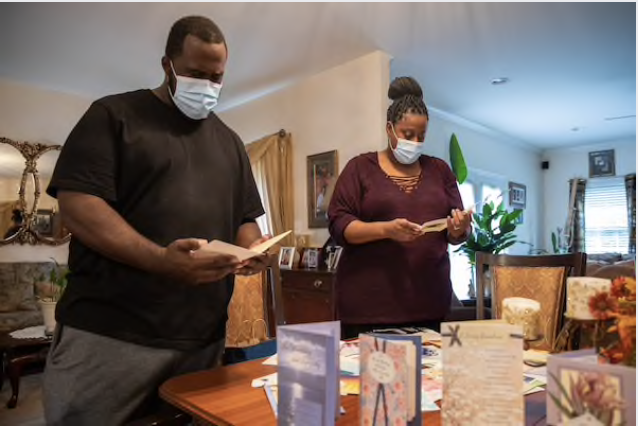
 Sunset in Frankfurt, Germany, on Tuesday. The country announced a new partial lockdown Wednesday.( Ronald Wittek/ EPA-EFE/Shutterstock)
