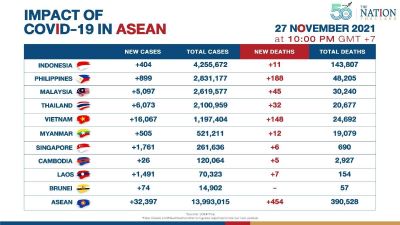
The number of Covid-19 cases crossed 13.54 million across Southeast Asia, with 26,786 new cases reported on Sunday (November 28), lower than Saturday’s tally at 32,379. New deaths are at 448, decreasing from Saturday’s number of 454. Total Covid-19 deaths in Asean are now at 290,969.
The Philippines temporarily suspended testing and quarantine protocols for countries/jurisdictions/territories classified as “green” starting Monday until December 15. The Inter-Agency Task Force for the Management of Emerging Infectious Diseases (IATF-EID) approved the revised guidelines, which include three-day quarantine for fully vaccinated travelers even with a negative Covid-19 test result and five days for the unvaccinated, with incomplete doses or without a negative Covid-19 test result.
Singapore is watching the new coronavirus variant Omicron closely and may be forced to roll back the easing up of safety measures as it moves forward to tackle the disease, said Prime Minister Lee Hsien Loong.
Speaking at the People’s Action Party (PAP) convention on Sunday, Lee said he is confident the country will be able to live with the virus, and held up how its people have made a lot of progress in dealing with the disease over the past two years.
MOSCOW – One of the most popular memes in Russia is, fittingly, an ode to Elon Musk – the Tesla chief executive, SpaceX founder, aspiring Mars colonizer and arguably Russians favorite international figure.
“How do you like that, Elon Musk?” said captions in a digital satire of Russia’s technological savvy. Examples include potholes covered up by grass or an old car driving in reverse on the highway.
Musk, also a lover of memes, responded to one in Russian: “haha how cool.”
As if Russians needed another reason to adore him.
Musk is rare figure who holds near-universal appeal in a country not easily impressed, especially by outsiders. But why?
Some say it’s his adventures in space exploration, a topic enveloped in Soviet-era nostalgia for Russians.
But others suggest that the Musk fandom is a commentary on Russian society, where big opportunities and entrepreneurial risk-taking are uncommon. Or maybe it’s a reaction against wealthy and state-protected oligarchs often accused of corruption – and lacking Musk’s eccentric and eclectic online persona.
And many Russians consider Musk’s story – immigrating to the United States from South Africa and finding success – an inspiration.
“He became a bright antithesis to Russian capitalism, a guide on how you can get rich in the right way and how you can spend the money you earned in the right way,” said Alexey Firsov, who founded the Platforma sociological research and consulting firm and authored a report on Musk’s mass popularity in Russia.
“The Russian environment could not produce this cultlike figure,” Firsov added. “And it is an easy import because Musk is not associated with some Wall Street billionaire, he is not a native American and he engages with Russia. So he is not perceived as a stranger, and this image is important to a stratum of people who are in need of one.”
While the mega-rich Musk has his critics in the United States and elsewhere – in large part because of tax issues and his hard-charging style – his fan club in Russia extends all the way to the Kremlin.
In February, Musk tagged the Kremlin on Twitter to ask for a meeting with President Vladimir Putin on the Clubhouse social media app. Though a face-to-face between Putin and Musk isn’t currently being prepared – and it certainly wouldn’t happen via Clubhouse – Kremlin spokesman Dmitry Peskov told The Washington Post that Moscow is genuinely interested.
“Putin shows great interest in the topic of technology, innovation and visionary ideas and we are convinced that in this area, there are many extremely interesting topics for him to talk about with Musk,” Peskov said. “The president very much appreciates the opportunity to communicate with such visionaries.”
A few months after Musk asked Putin to chat on Clubhouse, the Kremlin made its own request to Musk. Peskov, the Kremlin spokesman, invited Musk to address a student forum via video link.
Musk agreed, shocking budding rocket scientists who got to ask Musk questions during a 45-minute session in May.
“Now my friends introduce me to people as a person who talked to Elon Musk,” said 19-year-old Danil Gavrilov, a second-year student at Samara National Research University and member of RocketLAV, a student group that builds models of rockets.
“He’s been an inspiration to me since I was a child,” Gavrilov said of Musk. “To me, he’s a person who sets impossible goals and then achieves them – and not only in rocket-building.”
During his appearance, Musk praised Russian scientists Konstantin Tsiolkovsky and Sergei Korolev, the architect of the Soviet space program. He also said that “we’re close to establishing a Tesla presence in Russia, and I think that would be great.”
“There’s a lot of talent and energy and Russia,” Musk told the attendees. “Hopefully that energy continues into the future, and I would just like to strongly encourage people to strive to make the future better than the past and to be optimistic about the future.”
In 2001, Musk visited Moscow on a hunt for repurposed intercontinental ballistic missiles, or ICBMs. He was just starting his space endeavors and wanted to send something – anything – to Mars.
The Russians didn’t offer Musk as good a deal as he’d hoped. That experience, which his partners described as insulting in a 2012 interview with Esquire magazine, fueled Musk to build his own rockets. He founded SpaceX the next year.
Since then, Musk has been a perpetual thorn for Russia’s space agency, Roscosmos.
Musk and Dmitry Rogozin, the director of Roscosmos, have engaged in several public spats. After Rogozin was sanctioned by the United States in 2014 for his role in the annexation of Crimea from Ukraine, he suggested that U.S. astronauts – who at the time depended on Russian rockets to get to the International Space Station – should get there by jumping on trampolines.
After SpaceX broke Russia’s nine-year monopoly on ferrying crew to the space station last May, sending two U.S. astronauts into orbit, Musk quipped: “The trampoline is working.”
The feud only boosted Musk’s popularity among Russians. Firsov, the sociologist, said Musk “contrasts with the stereotypes Russians have regarding space programs that are mostly bureaucratic, lacking leaps of imagination unlike Musk with his Mars plans.”
Even Rogozin appears to be an admirer – albeit a begrudging one.
In comments to Russian state television in August, Rogozin said he would extend three special invites for the launch of Russia’s Soyuz MS-19 spacecraft: to Musk “whom we respect in Russia” … and also fellow space adventurers Jeff Bezos and Richard Branson. Rogozin has also offered to have Musk over for tea at his home. (Bezos owns The Washington Post.)
“I hope that someday our billionaire oligarchs will start spending their money not on the usual yachts and vanity fairs, but on the development of space technologies and expanding knowledge about space,” Rogozin said on Twitter in July.
Musk responded with two clapping emoji.
Pavel Antonov’s life goal can be traced back to the 2016 movie “Passengers,” a sci-fi romance that takes place on a luxury spaceship. One character in the movie is Arthur, an android bartender played by Michael Sheen. Arthur provides smiling relief amid the chaos.
“I immediately thought Musk will definitely need such a person who would distract from all problems,” Antonov said. “For at least one hour, you can sit at the bar, forget about everything and talk about neutral topics. From then on, I decided that I want to be the first bartender on Mars.”
To get Musk’s attention, Antonov, a 29-year-old bartender at Moscow’s The Bix, started a social media campaign in April. He tried tweeting at Musk, both in Russian and English. In one of his Instagram posts, an astronaut in a spacesuit has a (photoshopped) cocktail shaker in his hand.
It didn’t get a response from Musk. But Antonov did get some validation. In August, SpaceX posted a position for a “Spaceport Mixologist.”
Since then, Antonov has acquired a “Martian Deed” with his name on it – a novelty gift from a friend.
Antonov also has perfected a signature cocktail for Mars. It’s bright blue, representing space, Antonov said, with a red cherry dropped in like the Red Planet.
“Probably the decisive thing that inspired me to follow Musk is when he said that you shouldn’t be afraid of failure,” Antonov said. “I think, here in Russia, if you make one mistake, it follows you. His view seems to be that if you make a mistake, you get experience and learn from it and won’t make it again. I think it’s unique for people in Russia.”
Musk merchandise can easily be found online. One specialty retailer sells a sweatshirt with Musk as a Russian Orthodox icon. Another, founded by designer Kirill Karavaev, seizes on Musk’s viral moments with well-timed designs. A T-shirt with a cartoonlike Musk bouncing on a trampoline was released earlier this year – a reference to Musk’s trampoline jab at Rogozin.
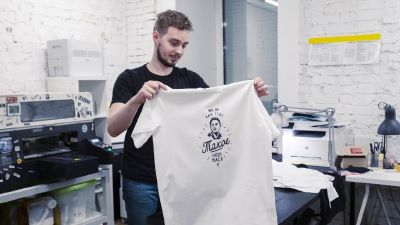
One of Karavaev’s best-selling shirts was a sketch of Musk’s face and the words, “How do you like that, Elon Musk?” – the popular Russian meme.
“I wore it myself,” said Karavaev, who drives a Tesla. “You can feel that people here really like Musk and want to wear something with his image.” (Despite no official sales or charging stations in the country, about 200 Teslas are estimated to be on Russia’s streets.)
“I think Russians love him because he turns rules and institutions upside down to make something new,” Karavaev added. “Maybe in Russia, we just like those kinds of people.”
South Africas announcement Thursday that it had identified a new, possibly highly contagious coronavirus variant sent shock waves worldwide. Stock markets fell as the United States, among other countries, imposed a travel ban on southern Africa.
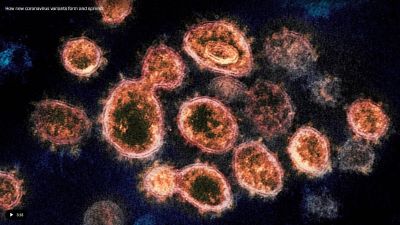
Much remains unknown about the mutations that make up the new omicron variant. But what scientists do know that is two years and several variants into the coronavirus pandemic, one tool to stem the spread of infection – sequencing the virus to catch significant genetic changes – remains only patchily used.
The United States is sequencing and sharing 3.6 percent of its coronavirus samples, according to a Washington Post analysis of data from the GISAID tracking initiative, which provides a global database of coronavirus genomes. That means the United States ranks 20th among countries sequencing 5,000 or more samples. It’s a sizable rise from 0.3 percent in December and 1 percent in April but is still below the rate that scientists say is needed to stay on top of major changes to the virus.
South Africa, in contrast, is sequencing 0.8 percent of its virus samples and ranks 37th worldwide. About 35 percent of its population is vaccinated, according to South Africa’s Department of Health. (Other trackers have lower numbers.) No other country in Africa has surpassed the threshold of sequencing 5,000 samples: Kenya, however, is close to doing so and is one of several African countries with an overall higher percentage of sequencing than South Africa.
India, which this spring was the center of a devastating outbreak, is sequencing 0.2 percent of samples, up from 0.06 percent in April.
The countries with the highest sequencing rates are largely European ones with comparatively high vaccination rates. Iceland tops the chart, with 56.2 percent of its virus samples sequenced and more than 88 percent of its population fully vaccinated, according to a Reuters tracker.
Since the vaccine rollout began nearly one year ago, scientists have warned rich, mainly Western countries against monopolizing vaccine stocks at the expense of a more equitable global distribution. The longer the virus circulates among unvaccinated populations, the more chances there are for highly transmissible variants to develop.
Just 6 percent of Africa’s 1.2 billion people are vaccinated, compared with about 59 percent of people in the United States. While the United States and some countries in Europe are providing their populations with booster shots, only around 3 percent of people in low-income countries are fully vaccinated, according to Gordon Brown, the World Health Organization’s ambassador for global health financing and a former British prime minister.
“Until we vaccinate enough people, we’re going to have this happen over and over again,” Glenda Gray, head of the South African Medical Research Council, told The Washington Post.
South African officials have criticized the travel bans imposed on their country over the weekend after the new variant was announced, saying that such moves could deter other nations from reporting new variants. For weeks, Europe has been battling a surge in coronavirus cases.
The travel restrictions are “akin to punishing South Africa for its advanced genomic sequencing and the ability to detect new variants quicker,” South Africa’s Ministry of International Relations and Cooperation said in a statement. “Excellent science should be applauded and not punished.”
The Biden administration is focusing on booster shots as a key weapon in efforts to protect the nation against a potentially dangerous coronavirus variant even as the extent of the threat remains unclear, according to three senior administration officials familiar with the plans.
Agroup of senior health officials had a call with South African scientists Sunday to understand the latest about the new variant and to help inform next steps, according to two of the senior administration officials, who, like the third official, spoke on the condition of anonymity to describe internal discussions.
In an update on Sunday, the World Health Organization said it is still too early to know whether the new variant, dubbed omicron, is more transmissible than the delta variant. There remains little understanding about the severity of illness caused by the variant and the rate of hospitalization. Scientists in South Africa, where the variant was first identified, said they expect more breakthrough cases in people vaccinated against the coronavirus.
In about a week, researchers could have a better indication of how well vaccines protect against the new variant. But the Biden administration is already moving to urge as many Americans as possible to receive booster shots in coming days as the best means to protect against omicron.
That campaign is likely to involve messages urging people to get boosters and efforts to make sure the shots are available in as many locations as possible.
“The vaccinated people, the thing that we know for sure is that when you boost someone who’s been vaccinated with two doses of Pfizer or Moderna, you increase the level of neutralizing antibodies extraordinarily high – many fold higher than even the peak following the first two doses,” Anthony Fauci, President Joe Biden’s chief medical adviser, said in an interview with The Washington Post.
Fauci said that “it is quite conceivable if not likely” that booster shots will provide at least a partial shield of protection against the new variant.
Omicron has a high number of mutations that could make it more easily transmissible, though that remains unclear. In South Africa, cases are rising but it is not yet clear whether the rise is fueled by omicron or other factors, according to WHO.
Experts, including Fauci, have said it is highly unlikely that the vaccines offer no protection against the new variant. WHO said it was working with “a large number of researchers around the world” to understand the impact omicron would have on existing vaccines and antivirals. Even if there is diminished protection compared with other variants, there is a benefit to increasing the number of virus neutralizing antibodies by getting a booster shot, senior health officials and experts said.
“If you’re worried about omicron, do the same things as if you’re worried about delta. Get your boost and get fully vaccinated,” said Peter Hotez, dean of the National School of Tropical Medicine at Baylor College of Medicine.
The Centers for Disease Control and Prevention increased communication with state public health officials in recent days as federal disease trackers learned more from South African counterparts, according to a U.S. Health and Human Services official. That has included daily calls with state-level officials, including epidemiologists, lab directors and city and county authorities.
The White House is also organizing meetings with state health officials, members of Congress and governors during the coming days, a White House official said.
While experts said boosters could be helpful in protecting against the omicron variant, some cautioned against using the additional shots at the expense of providing doses to countries where vaccination rates remain low.
Celine Gounder, an epidemiologist and infectious-diseases specialist who advised the Biden administration’s transition team on covid-19 response, said boosters should be part of the response to the omicron variant if it is “truly immune-evading” because the additional shots significantly boost antibody levels.
But Gounder said the downside to a booster-heavy approach is that it could mean much of the developing world remains unvaccinated, creating conditions for other variants to emerge.
“You have one approach that has a likely short-term benefit versus another approach that has a very likely long-term benefit, and how do you weigh one versus the other?” Gounder said.
But Fauci and others said millions of vaccine doses shipped to lower-income nations have gone unused, demonstrating the complexity of the global challenge. South African officials recently asked vaccine manufacturers to slow shipments so the country could maximize its existing stock.
U.S. officials asked South African officials over the weekend whether they needed more doses but were told vaccine uptake, and not supply, was the issue, a senior administration official said.
There was more blowback on the international front for the United States and European countries after nations closed their borders to travelers from southern African as a shield against omicron. They also faced words of caution from experts that the travel bans may be too late, with confirmed and suspected cases emerging as far away as Asia and Australia.
“By the time we have enough information to institute a travel ban, the cat’s already out of the bag, so to speak,” Nicole Errett, a professor at the University of Washington who has done research on public health emergency preparedness, said in an email. “Omicron has already been detected in other continents. A travel ban could in theory buy some time by reducing the spread of new seed cases, but we are talking on the order of days to weeks.”
Confirmed and suspected covid-19 cases caused by the new variant have been detected in a growing number of regions, including Britain, Belgium, Botswana, Germany, Italy, Hong Kong, Israel and the Czech Republic. Most of the cases outside of Africa appear to involve people who had traveled to the continent.
Austria also joined the growing list of countries where the variant has been reported, detecting its first suspected case in the Tirol region, Reuters reported Sunday, citing Austrian officials.
Two planes carrying about 600 passengers from South Africa landed Saturday in the Netherlands with 61 people infected with the coronavirus – including 13 cases of the new omicron variant – Dutch health authorities said Sunday.
Health officials in Australia on Sunday confirmed two fully vaccinated, asymptomatic passengers on a flight into Sydney tested positive for the new variant and are in government isolation.
“This clearly demonstrates the pandemic is not over,” Dominic Perrottet, the premier of New South Wales state, home to Sydney, told reporters on Sunday. “There are limits to what the state and federal government can do: These variants will get into the country. It is inevitable.”
The emergence of a new and potentially more menacing variant raises questions about what lessons officials have learned in the two years since the novel coronavirus emerged, and whether they’re prepared for worrisome mutations that could evade vaccines.
On Sunday, Britain’s health secretary, Sajid Javid, said vaccines may be less effective against omicron, acknowledging “we just don’t know enough” about the new variant to understand the risk.
Starting Tuesday, face masks will be compulsory in shops and on public transport in England. The U.K. will also require all international travelers to take a PCR test, which can detect the new variant, and to self-quarantine until results are returned.
Europe is in the grips of an increasingly deadly outbreak of the fast-spreading delta variant that has prompted officials in some countries to revert to measures such as shutdowns used to control the virus in the early days of the pandemic.
White House officials said the world’s failure to contain the rapid spread of delta this spring demonstrated the need to be vigilant in staving off omicron, which public health experts fear could sicken vaccinated people and spread more rapidly than delta.
In designating omicron a “variant of concern,” WHO said Friday that preliminary evidence suggests an increased risk of reinfection with this variant for people who have previously had the virus, compared with other variants. However, there are high rates of people living with HIV and AIDS in southern Africa, which experts said makes it harder to interpret the effectiveness of vaccine-induced or natural immunity against infection.
Only about 24% of South Africans are fully vaccinated, according to Johns Hopkins University data, compared with nearly 60% of Americans.
U.S. officials said they jumped into action after learning that the new variant contained long-feared mutations and appeared to descend from a different genetic lineage than delta. Senior officials such as Fauci, Centers for Disease Control and Prevention Director Rochelle Walensky and others began discussions with government scientists, South African officials and vaccine manufacturers that intensified on Thanksgiving Day.
The world’s major manufacturers of coronavirus vaccines, including Pfizer and BioNTech, Johnson & Johnson, Moderna and Chinese vaccine maker Sinovac said they are working to investigate the new variant and adapt their shots if needed.
Experts cautioned that the flurry of activity to fight omicron may turn out to be largely unnecessary, as researchers learn in the coming days whether current vaccines can ward off the variant or successfully limit symptoms.
“Not all covid-19 variants cause trouble. For example, lambda and mu have not taken off globally. So it is possible that the new variant, omicron, could hopefully fizzle out,” said Sanjaya Senanayake, an infectious diseases expert at the Australian National University.
LONDON – In a bid to halt the spread of the omicron variant of the coronavirus, British Prime Minister Boris Johnson announced new measures on Saturday evening, ranging from mandatory self-quarantine for anyone arriving in the United Kingdom to tougher rules on mask-wearing.
The initiatives, including significant entry-rule changes made in response to the new variant, are a sign of how countries are reintroducing rules that many had thought were left behind.
Earlier in the day, Britain announced that two cases of the new variant, first identified in South Africa, had been detected in the U.K. The cases are linked and connected with travel to southern Africa.
Speaking at an evening news conference at 10 Downing Street, Johnson said that anyone entering the country will be asked to take a PCR test on their second day and that they must self-isolate until they provide a negative coronavirus test. He also said that those who do come into contact with someone testing positive for omicron will have to self-isolate for 10 days, regardless of their vaccine status.
Face coverings on public transport and in shops will now be mandatory in England after they were controversially scrapped in July. They have remained mandatory on public transport and in many indoor spaces in Scotland, Wales and Northern Ireland.
Chris Whitty, England’s chief medical officer, who was also at the briefing, said Britain is moving quickly because the risks posed by omicron seemed different from those of the delta variant.
“Delta was primarily driven by the ability to spread really rapidly, but less concern about vaccination escape,” he said, referring to fears that current vaccines may be less effective against omicron. The push to move quickly on omicron is driven by “at least strong theoretical reasons for thinking that some degree of vaccine escape is likely,” he said.
The new omicron variant may, “at least, in part, reduce the protection of our vaccines over time,” the prime minister said. The new rules, which will be reviewed in three weeks, will help to “buy time” for scientists to better understand the variant, he said.
The U.K. also added four new African countries to its travel “red list” on Saturday, meaning that travel is now restricted from a total of 10 African countries: Malawi, Mozambique, Zambia, Angola, Botswana, Eswatini, Lesotho, Namibia, South Africa and Zimbabwe. Travelers from those countries will be denied entry into the U.K., unless they are British or Irish citizens or residents, in which case they will have to quarantine at a government-approved hotel for 10 days.
It was clear that Johnson was placing faith in the current vaccine program as he urged a faster rollout of booster shots. “We don’t yet, exactly, know how effective our vaccines will be against omicron, but we have good reasons for believing they will provide at least some measure of protection,” he said.
He was asked at the news conference if Britons should consider rearranging their plans for Christmas.
Johnson said he was “confident” that Christmas would be “considerably better than last Christmas.” Given the severe restrictions on many Britons last December, that’s not a particularly high bar.
Two planes carrying some 600 passengers from South Africa landed in the Netherlands with 61 people infected with the coronavirus – including some cases believed to be the new omicron variant – Dutch health authorities said Saturday after halting flights from several southern African countries over fears of the new omicron variant of the virus.
Passengers were tested at the airport, and those with infections will be isolated at a hotel, a regional Dutch health agency said.
“In a number of the tested persons the omicron variant is presumed to have been found,” the Netherlands Institute for Health said in a statement. An institute spokesperson said it was “almost certain” the cases were of the omicron variant, but only additional testing would allow for complete certainty, Reuters reported.
Omicron, a variant of the novel coronavirus that some scientists fear could be more transmissible than the delta variant, was labeled a “variant of concern” by the World Health Organization on Friday. It was first detected in the southern region of Africa, where cases have started rising again in recent days.
A new round of countries on Saturday rushed to ban or curb travel from there in a bid to stem the spread of the just-discovered variant, which has raised concern about the global trajectory of the pandemic. The United States, the European Union and Britain swiftly imposed travel restrictions on South Africa and its neighbors including Zimbabwe and Botswana, though the variant has also been identified in Belgium, Hong Kong and Israel.
Amsterdam’s Schiphol Airport, where the two Friday flights landed, saw over 71 million passengers in 2019, making it one of the busiest and most connected travel hubs in the world.
Despite a mask mandate by the Dutch airline KLM, which operated the flights from South Africa, many passengers did not wear face coverings, said New York Times reporter Stephanie Nolen, who was aboard one of the planes. Passengers were stuck on the airport tarmac for about four hours before being sent to be swabbed, tweeted Nolen, who later said she tested negative.
A KLM spokesperson told Reuters that passengers had shown proof of vaccination or a pre-flight negative test before boarding flights in Cape Town or Johannesburg.
“It goes too far to say we are surprised” by the high number of cases, the airline spokesperson said. “But we don’t have an explanation.”
News of the omicron variant emerged as the Dutch government was preparing to begin stricter partial lockdown measures beginning this weekend. On Thursday, the country of some 17.5 million reported a seven-day rolling average of more than 20,000 infections.
Starting Sunday, many businesses have been ordered closed between 5 p.m. and 5 a.m., a move that Dutch Prime Minister Mark Rutte said means the country will be “effectively closed” from the evening through the early morning.
The Dutch government was the first in Western Europe to return to partial lockdown when it announced restrictions on shops and restaurants earlier this month. Rutte said Friday that his government was tightening measures because there had been minimal change in people’s behavior, citing traffic data.
A dozen protesters demonstrated peacefully in The Hague after Friday’s announcement, Agence France-Presse reported. But other recent anti-lockdown rallies in the Netherlands involved what the mayor of Rotterdam called an “orgy of violence,” with protesters throwing stones and police firing warning shots.
About 74% of the Dutch population has been fully vaccinated, and booster shots are being offered to vulnerable people, including the elderly and care workers.
CALAIS, France – If everything goes according to Ashkan Rahmonis plan, someday soon the 21-year old Iranian will crawl out of his tent near an abandoned railway track and put on a life jacket.
He will climb across the dunes carrying an inflatable dinghy with dozens of others. They will rush toward the French shores of the English Channel near Dunkirk in the cover of darkness.
If they succeed, the next time they touch land will be in England.
More than 30,000 migrants have attempted to cross the Channel by sea this year, around three times more than 2020, as authorities have clamped down on other routes, including crossings by train and cargo trucks. Successful crossings have encouraged a growing number of migrants to attempt the journey via the Dover Strait.
But with temperatures now near the freezing point on many nights, Rahmoni and others in migrant encampments along the Channel sense they could be stuck all winter unless they attempt to cross soon.
Rahmoni has spent the last days trying to imagine it – and trying to forget about the two men who slept in his tent before he moved in. On Wednesday morning, the pair had embarked on the perilous journey from France to England. Their phones have been dead since.
Later that day, a fisherman spotted lifeless bodies and a capsized inflatable boat in the Dover Strait. Over the next hours, rescuers pulled 27 dead or dying people out of the water – 17 men, seven women and three minors.
It was the worst migrant tragedy in the English Channel in years. Only one victim, a 24-year old Kurdish woman from Iraq who wanted to join her husband-to-be in Britain, has so far been identified.
Rahmoni said he is certain the men who slept in his tent were on the boat, too. Yet he said he has no doubts that he will attempt the same – the last leg of a journey for which his uncle has already paid around $3,400 to smugglers.
“I’m afraid,” he said, speaking at a migrant camp near Dunkirk on Saturday. “What can I do?”
The last time he spoke to his family was about 20 days ago. Without a phone, he may not get another chance to talk them before he attempts to cross.
In the wake of Wednesday’s tragedy, France and Britain have sparred over who is to blame and how more deaths can be prevented. The British want joint police patrols on French soil and the immediate return of migrants who make it across the Channel.
On Sunday, European interior ministers plan to meet in Calais to discuss options. But notably absent will be British Home Secretary Priti Patel, whose invitation was pulled by the French after Prime Minister Boris Johnson tweeted a letter to French President Emmanuel Macron that rehashed many of the proposals the French had already rejected.
The French say they are fighting Britain’s battles, and they say other countries need to take responsibility for having allowed smuggling networks fester for too long.
“When you have two police officers in a car and 30, 40 or 50 migrants who are leaving, the balance of power isn’t in the police’s favor,” agreed François Guennoc, president of L’Auberge des Migrants aid group in Calais. “They have no other choice than to let the boat go.”
– – –
Across the Channel in the English port of Dover, the skies Saturday were the same battleship gray, the sea state queasy with chop. Locals on the dockside said it was a quiet day. Few would attempt the crossing from France, because of strong winds and sea height.
At Tug Haven in the Dover port, where the migrants rescued by Britain’s Border Force or Royal Lifeboats are first taken, the pontoons were quiet – though there was evidence of the deflated rafts gathered in past operations.
The lights of Calais – 25 miles across the Channel – are visible at night.
But looks are deceiving. Currents are always there, and wind and waves can kick up in minutes, in one of the busiest shipping lanes in the world.
Kim Bryan, a member of the activist group Channel Rescue, said the threat by the British home secretary to deploy U.K. Border Force patrol boats to “push back” migrant rafts would be challenged in the courts as a violation of maritime law and human rights protections.
Bryan’s group and news organizations have posted video of the Border Force in the Channel practicing to deploy jet skies to encircle a raft and stop its voyage.
Activists point out that the number of asylum applications are down in Britain – even as the number of people detained in the Channel crossing has tripled.
They say fewer migrants try to illegally board trucks that arrive via ferry or tunnel – the traditional route for illegal crossings – but now take to the sea.
Maddie Harris, a member of the group Humans for Rights Network, said the migrants have often described “an absolutely terrifying journey” across the Channel.
A few miles away from Dover on the English coast, Juliette Walford also looked out to sea, alert to illegal crossings.
She told Sky News, “I think we feel slightly invaded, I think we feel quite scared because there is no regulations.
“I would like to see a proper secure process; if these people are running from war, then we need to help them, but there are a lot of migrants that are not running from war.”
On the French side, French police officers on Saturday patrolled the Escardines Beach near a World War II-era military installation. After 30 minutes, the French police patrol had already moved on.
A 67-year-old local resident, Marie Mikolajczak, has seen large groups of migrants in swimming vests pass by her little village.
“What really breaks my heart is to see the women and children,” she said, describing one moment when she spotted a child wearing two different kinds of shoes on each foot.
French and British aid groups claim the French government has worsened migrants’ living conditions in and around Calais. Every few days, officers confiscate migrants’ belongings, including sleeping bags and tents. There are no toilets, and no showers.
That strategy has so far failed to deter migrants. In some cases, the police tactics have made migrants only more determined to cross to England.
– – –
Rahmoni, the 21-year old Iranian student, said Britain was always his final destination. He traveled overland to France. In Iran, Rahmoni said he faced persecution as a member of the Kurdish minority.
He arrived at the camp near Dunkirk in mid-November. While most migrants here are young men and many have a Kurdish background, there are some families, too.
Near Rahmoni’s tent, a family from Iraq was walking down a muddy road on Saturday, uncertain about where to go next.
The couple had come to France with their sons, 7 and 12 years old. They are uncertain if or when they would be able to try the Channel crossing. The father soon asked questions about other places in Europe the family could go to.
Guennoc, of L’Auberge des Migrants, said many migrants are in Calais because their asylum applications in Europe have been rejected, or because they may risk being deported back to the country where they first entered the European Union if they do apply for asylum in France.
“People aren’t in Calais because they are dreaming of the El Dorado,” said Guennoc, referring to remarks by France’s interior minister who spoke of the “El Dorado of England.”
“They’re here because it’s in a way their last chance,” Guennoc said.
One day after they had mourned the deaths of at least 27 people in the English Channel, locals, activists and migrants assembled in central Calais to mourn another victim on Friday night.
Authorities had discovered a decomposing body at a nearby beach.
About 100 people stood silently in a circle, as the wind extinguished the memorial candles and tore at a banner that listed more than 300 migrants who are believed to have died trying to cross the English Channel over the past two decades. Some people cried. Others stared at the banner with blank eyes and exhaustion.
Masmos, a 30-year-old Sudanese migrant who gave only one name, said he had come to the commemoration because he would like others to be there for him, too, if he dies trying to reach England.
CAPE TOWN, South Africa – Across a world of vaccine haves and have-nots, the omicron variant sends a warning on how the virus can evolve and spread without more aggressive measures to expand vaccinations, a top South African scientist said Saturday.
“Until we vaccinate enough people we’re going to have this happen over and over again,” said Glenda Gray, head the South African Medical Research Council, as global health agencies rushed to understand more about the new variant just days after it was first identified in South Africa.
Her comments underscored one of the major challenges facing global efforts to curb the pandemic: the contrasts between wealthy nations with plentiful vaccines – and even booster shots – and many poorer regions struggling to get vaccines and unable to fully distribute them.
In an opinion piece in the Guardian, former British prime minister Gordon Brown – now an ambassador with the World Health Organization – took aim at the developed world for failing to deliver donated doses it had promised.
“Despite the repeated warnings of health leaders, our failure to put vaccines into the arms of people in the developing world is now coming back to haunt us,” Brown wrote.
The Geneva-based WHO has led a program to help distribute vaccines to nations in need, but significant hurdles remain in transporting the vaccines and having them reach remote areas.
Just 6% of Africa’s 1.2 billion people are vaccinated – compared with about 59% in the United States – largely because many places in Africa have struggled to find supplies snatched up by Western governments.
South Africa’s slowing vaccination program also is largely due to a reluctance by its population to get the jab, driven by apathy and the feeling that “things aren’t so bad,” said Gray.
More than 35% of the country is vaccinated, according to South Africa’s Department of Health. That’s roughly half of the 67% target the country set for 2021. (Data from Johns Hopkins University puts South Africa’s vaccine rate at about 29% with at least one dose.)Earlier this month, the South African government said it would delay the delivery of Pfizer and Johnson & Johnson vaccines because fewer people were being vaccinated.
“Our problem in South Africa is that until we tackle the elephant in the room, which is the low vaccine coverage, we are never going to get ahead of the variants,” said Gray.
She noted, too, it was hard to know where the variant might have first emerged.
“These cases could start anywhere, especially in areas with low vaccine coverage. We know that Africa has low vaccine coverage, so it will start in countries in the world where there is no vaccine coverage,” she said in an interview with The Washington Post. “That said, there are a lot of countries that are having huge outbreaks at the moment.”
“Wherever it came from, it started to propagate here, so people were alerted to it,” she added.
The WHO said the first confirmed omicron infection came from a specimen collected Nov. 9. As a result, the travel measures have probably come too late to stop the international spread, said Jeffrey V. Lazarus, a health systems and policy professor at the Barcelona Institute for Global Health.
“Travel restrictions give a false sense of security,” he said, adding that it would be wiser to include strong safeguards for those traveling by air.
Gray also slammed the decision by a growing number of nations, including the United States and the European Union, to close their borders to travel from southern Africa.
“It doesn’t stop transmission,” Gray said. “The problem is what we are not saying: thatSouth Africa does not have good vaccine coverage, and the reason we have this problem is because we have not vaccinated enough people in the country.”
South Africa’s International Relations and Cooperation Ministry urged countries to reconsider travel bans, pointing out the damage caused to families and the travel and tourism industries.
The bans are “akin to punishing South Africa for its advanced genomic sequencing and the ability to detect new variants quicker,” the ministry said in a statement. “Excellent science should be applauded and not punished.”
Among the eight countries that have been targeted with travel restrictions, none has vaccinated even one-third of its population – and in Malawi, the immunization rate is in the single digits, according to Our World in Data.
Kristalina Georgieva, the managing director of the International Monetary Fund, said on Twitter that the failure to help vaccinate southern Africa “left us all exposed to risk.”
“Omicron is an urgent reminder of why we need to do even more to vaccinate the world,” she said.
On social media, some public health experts were quick to point out connections between variants and vaccine inequities.
Kizzmekia Corbett, a viral immunologist at the Harvard T.H. Chan School of Public Health, tweeted: “By the time you detect one variant another is already circulating under the radar.” And with “low vaccine uptake, inequitable vaccine access we will be chasing variants endlessly.”
Madhukar Pai, an epidemiologist at McGill University in Montreal, wrote: “If you are double or triple vaccinated and are worried about #Omicron, spare a thought for the 3+ billion people who are still waiting for their first dose. Do more than spare a thought. Advocate for vaccine equity!”
When President Joe Biden came into office, he had three overriding priorities: The first was to tame the coronavirus pandemic and deal with its effects on the economy.
The second was to persuade Congress to enact the most sweeping domestic policy initiatives in generations. The third was to unify the country the best he could.
The first was a challenge, the second a gamble, and the third, given a recalcitrant Republican Party, always a long shot. As December approaches, none of these goals has been fully accomplished, and that shapes the political environment heading into next year’s midterm elections, which could dramatically affect his presidency.
The pandemic continues, with new infections rising again, nearing 100,000 per day. A few months ago, Southern states were the hot spots. Today, the northern tier of the country is being hit hardest. Vaccines continue to reduce the number of hospitalizations and deaths, but that is little comfort. More Americans have died of covid-19 so far in 2021 than in the entirety of 2020.
Now a new variant, named omicron, has been discovered in South Africa. Its transmissibility and potency are not yet known, but the World Health Organization described it Friday as a “variant of concern.” News of its existence badly rattled the stock markets Friday (leading to the biggest one-day drop this year), amid fears of another setback to economies around the world. As the variant is studied, the Biden administration announced new restrictions on flights to the United States from South Africa and seven other countries, and New York Gov. Kathy Hochul, a Democrat, declared a state of emergency in her state.
Biden’s hope to vaccinate the overwhelming majority of the population has fallen short, leaving a patchwork of vaccinated and unvaccinated states and regions within states. Political divisions over the president’s policies, particularly his vaccine requirement for many companies, are worse than ever.
Biden’s team has not been able to overcome this resistance, other than doggedly repeating the value of the vaccines, which, given the political divisions, might be the best hope he has of getting the message through. But it leaves holes in the protective shield that vaccines were supposed to create. The administration also wobbled on who should receive booster shots, although many Americans who wanted them decided they would seek them even without formal authorization.
After a premature claim by the president in July that the pandemic was mostly behind us and that people would soon have their freedom back, the delta variant struck hard. Now reality has taken hold.
People are having to learn to live with the pandemic and all the uncertainty that comes with it; so, too, is the Biden administration. As a result, there will be no mission-accomplished statements coming from the White House any time soon, and 2022 will become the third year of dealing with this pandemic.
Given the fact that Democrats hold power in the House and Senate by the narrowest of margins, Biden has made notable progress on his legislative agenda, having persuaded Congress to pass the $1.9 trillion stimulus package and the $1.2 trillion bipartisan infrastructure bill. But one last, big piece, the nearly $2 trillion initiative that includes spending on social programs and climate action is in the balance, still being held hostage principally by Sen. Joe Manchin III, D-W.Va.
Biden’s gamble, that he could leverage slender majorities in Congress to enact transformative legislation and that passage in turn would produce political benefits, has not yet paid off. So far, he has received little political credit from voters for what he’s managed to do. The programs are popular, but perceptions of his leadership nonetheless have taken a hit.
The stimulus package poured money into the economy and in some cases directly into the bank accounts of millions of Americans. The spending has aided in the overall recovery, with unemployment dropping to 4.6% and many small businesses posting “help wanted” signs in a search for adequate staffing. Labor force participation is up. Many states and cities are flush with cash.
But the recovery has triggered a rise in inflation – the worst in three decades. Gasoline, home-heating oil and natural gas prices are up, as are prices for many goods. The price hikes are driven by rising demand among consumers, supply chain issues that have made some products scarce and the demand for energy around the world as nations try to bring their economies back after the shutdowns of 2020.
It is this inflation that is costing Biden politically at this moment, and just as the president was premature in his claims about the pandemic, his administration was slow to acknowledge what people were feeling and therefore begin to act. He has since moved to unjam the ports and to open the spigot on the Strategic Petroleum Reserve. Some economic statistics continue to show positive signs. But the shocks to the global economy from the pandemic could continue if one country after another is forced to impose new restrictions to deal with the latest wave of cases or the new variant.
Money from the infrastructure package will help to modernize the country, but the spending will not be felt immediately. Most of that money will be spent after next year’s elections. For 2022, Biden will have to hope that voters see signs announcing construction coming soon on a bridge or airport or road near them.
Passage of the infrastructure bill fulfilled a pledge by the president to seek cross-party support whenever possible, which is part of his political DNA. But he has not been able to do much beyond that to narrow the gulf between the parties in Congress. Republicans have shown no interest in working with him.
But it’s worse than just that. Many Republicans, including former president Donald Trump, are calling for the House Republicans who dared to vote for an infrastructure bill to be punished, claiming they had helped give the president a victory. It is one more measure of the state of the GOP.
Biden has become almost as polarizing a president as Trump, at least in how he is seen by those who identify with either of the two major parties. The Gallup organization’s tracking of presidential approval shows Biden with the approval of 90% of Democrats but just 6% of Republicans – a gap of 84 points. That’s only a few points better than the peak of Trump’s polarization in the fall of 2020.
Many Democrats claim the big problem for the White House is the absence of clear and effective messaging. There is truth in that assertion: Biden and his advisers have not found the best ways to explain and sell what they are doing. This might be a solvable problem, particularly if the social and climate bill is approved. The administration will need to move quickly to build back the president’s standing as the Republicans have found for now their talking points for next year: immigration, crime, education and inflation.
Beyond that, however, is the likely reality that there is no imminent return to pre-pandemic normalcy. There are efforts to do so, with in-classroom teaching, sports stadiums filled with spectators, and families and friends reunited for Thanksgiving this past week. But insecurities continue, and the spillover affects all politicians, starting with the president.
Southeast Asia saw an increase in new Covid-19 cases and related deaths on Saturday (November 27), collated data showed.
Asean countries reported 32,397 infections and 454 deaths on Saturday compared to 29,185 and 425 respectively on Friday.
– Malaysia has banned travel to and from seven African countries in order to prevent the spread of new omicron coronavirus variant. Malaysian who have returned from such countries must undergo quarantine once arriving in the country.
– Philippines has banned the entry of people travelling from South Africa, Botswana, Namibia, and their neighbouring countries immediately until December 15.