นักวิทยาศาสตร์ชาวเยอรมนีจากสถาบัน Planck Institute of Molecular Cell Biology and Genetics และนักวิจัยชาวญี่ปุ่นจาก Central Institute for Experimental Animals ตีพิมพ์ผลการวิจัยในวารสาร Science ในเดือนมิถุนายนโดยทำให้สมองลิงให้มีขนาดเพิ่มขึ้นเป็นสองเท่าโดยการเชื่อมต่อกับยีนของมนุษย์ ทำให้บางคนเกิดความตื่นตระหนกว่าจะทำให้ลิงมีความเฉลียวฉลาดเกินคน
รายงานชิ้นนี้ทำให้เกิดกระแสกล่าวขวัญถึงในวงกว้างว่าเหมือนในภาพยนต์เรื่อง Planet of the Apes หรือ พิภพวานร และภาคก่อนหน้าคือ Rise of the Planet of the Apes ซึ่งเล่าเรื่องราวของลิงที่ถูกดัดแปลงพันธุกรรมจนฉลาดและไล่ล่ามนุษย์และยึดครองโลก
For interracial couples, Kamala Harris and Doug Emhoff are a ‘monumental’ symbol
InternationalNov 24. 2020Sen. Kamala Harris leans on husband Doug Emhoff after being introduced by Joe Biden as his running mate during an event in Wilmington, Del., on Aug. 12, 2020. MUST CREDIT: Washington Post photo by Toni L. Sandys.
By The Washington Post · Sydney Trent · NATIONAL, FEATURES, POLITICS, RACE, RELATIONSHIPS
On the last night of the Democratic National Convention, Aisha Cozad watched on television as Joe Biden and his vice-presidential choice Kamala Harris held their clasped hands triumphantly aloft. But her eyes were also on Doug Emhoff, Harris’s husband, who was standing off to one side clapping adoringly. It was clear who was in the spotlight and who was the cheerleader.
Cozad was moved because Emhoff was a man so publicly supporting his powerful, ambitious wife. And she was moved because Emhoff is White and Harris is Black.
“Given the current state of race relations, it’s a powerful thing to say that we don’t have to accept these roles as society would have us play them out,” said Cozad, a 46-year-old African American whose husband, Scott, 44, is White. “We don’t have to accept what society says it’s comfortable with. We can, in fact, determine our own path.”
When Harris takes office in January, she will make history as the country’s first female vice president, first Black vice president and first vice president of Asian heritage. But together Harris, the daughter of Jamaican and Indian immigrants who identifies as Black, and Emhoff, a Jewish entertainment lawyer, represent yet another less-heralded first: the first interracial couple at the highest reaches of the U.S. government.
Their union is being celebrated by a small but growing segment of the U.S. population: intermarried couples, who now make up about 17 percent of new marriages and about 10 percent of all marriages, according to a 2017 Pew Research report.
The Harris-Emhoff marriage is “really monumental” in its symbolism, said Amanda Brown Lierman, 35, who lives with her husband, Kyle, in Takoma Park, Md. “It’s good for everyone to see that on a national level and normalize it.”
Dana Tofig echoes the word “normalize,” and then takes it another step. “Not only is it the first time you have had an interracial couple at the highest levels of power, but it’s a White male who is saying my Black wife’s job is so important that I’m willing as a White man to give up my job in service of that,” said Tofig, 53, who lives with his wife, Cindy Murphy-Tofig, in Rockville, Md. He was referring to Emhoff’s post-election announcement that he would leave his law firm.
Like the Cozads, the Liermans and the Tofigs, the vice president-elect and her soon-to-be second gentleman are part of a rare demographic among intermarried couples – those between Black women and White men.
These marriages make up just 3 percent of all newlywed heterosexual intermarriages in the United States, according to Pew. The most notable example is of Richard and Mildred Loving, whose lawsuit against the state of Virginia led the Supreme Court to legalize interracial marriage nationally in 1967. (The largest group of newlywed intermarriages, at 42 percent, consists of Hispanics married to non-Hispanic whites).
Popular culture has since raced ahead of reality. The 1970s television show “The Jeffersons” debuted the first prime-time marriage between a Black woman and a White man: Helen and Tom Willis. (Roxie Roker, who played Helen Willis, was married to a White man in real life, Sy Kravitz, and the couple gave birth to a son, musician Lenny Kravitz.)
The past decade saw an explosion of interracial couples on television, including many on shows by African American producer Shonda Rimes. Her hit show “Scandal” featured Kerry Washington as Olivia Pope, the Black risk-taking crisis manager hopelessly in love with the president of the United States, a White man.
The envelope that was pushed by “The Jeffersons” “has since been licked, sealed and delivered,” said Bob Thompson, professor of television and popular culture at Syracuse University.
White men and Black women who marry tend to be older than their same race counterparts and are more likely to have been previously married. Emhoff and Harris, who are both 56, married in 2014, and Harris is Emhoff’s second wife.
While such couples can face some challenges related to race, they are substantially less likely to divorce by the 10th year of marriage than those in White marriages, Black marriages and marriages in which the husband is Black and the wife is White, according to a 2008 study. The reasons are unclear, but experts speculate the barriers that keep White men and Black women from marrying at higher rates may mean that those who do are especially committed.
Black women and men must contend with sexual stereotypes dating to slavery – that Black women are promiscuous (a myth created as White slaveowners were raping enslaved women) and that Black men are sexual beasts who rape vulnerable White women (used in part to keep Black men from voting and gaining power).
But the historic burdens carried by Black-White couples belie the fact that the vast majority of interracial marriages are loving and boringly normal, said Cheryl Judice, a sociologist and adjunct professor at Northwestern University. Judice, who researches interracial relationships, interviewed 50 couples for her 2018 book “Interracial Relationships Between Black Women and White Men.”
Judice said she hoped her research would persuade more Black women to consider dating and marrying outside of their race.
“Black women are the only women in this country who can’t take finding a partner within their own race for granted,” she said. Even so, they are the least likely group of women to marry outside of their race, Judice notes. Often, she said, they prefer Black men because of attraction and upbringing, a desire to keep resources within the race or to lend their support to Black men. But too frequently, the numbers don’t work in their favor.
Black women are more likely than Black men to be college-educated professionals, which can prove an obstacle to marrying, and a disproportionate number of Black men are imprisoned or unemployed. Black men are more than twice as likely as Black women to marry interracially, with 8.6% marrying outside their race. Another reason Black women may intermarry at lower rates include stereotypes that hold that Black women are less attractive and feminine than White women.
White men who marry Black women do not subscribe to such notions.
Dana Tofig met Cindy at work, typical for people in interracial marriages, Judice said. Both were journalists in their 20s, employed by the Hartford Courant. He was the night police reporter; she was a copy editor. “Not to be shallow, but I thought she was really beautiful,” Dana said.
Cindy was a quiet and a thoughtful listener, while Dana was coursing with energy and almost always up for fun. The couple had both been raised to study hard and hold themselves to high standards. They married in 1996 and have two sons, Will and Daniel, ages 17 and 14. Dana works in communications for a nonprofit organization, while Cindy, 51, is an editor at a nonprofit.
They talk about race as they navigate a country where racism remains deeply embedded.
“I I do try to check myself if I have an initial reaction” that might be based on a racial stereotype, Dana said. Cindy agrees that Dana is very self-aware, although she notes “he’s not had the experience of being followed around at the 7-Eleven because the clerk thinks that you’re going to steal something.”
In other words, he is not Black.
“Where these relationships work,” said Judice “there is a willingness to try and see life how the other person views it.”
Interracial couples are more apt to live in racially integrated neighborhoods, according to a 2013 study published in the journal Demography.
Cindy said she and her husband mostly socialize with White people, but that she nurtures relationships with her Black friends and relatives so she does not feel racially isolated.
The Liermans decided to buy a house in the famously leftie neighborhood of Takoma Park because they liked its racial and ethnic diversity. Even so, Amanda is careful to make sure that daughters, Belle, 3, and Leia, 1, are well exposed to Black culture. She ensures they spend time with Black relatives and friends, and she and Kyle keep their shelves stocked with books that have Black characters. Belle just started lessons at a Black-owned dance school. The girls’ nanny is Ethiopian.
“I want my kids to know that they’re Black and to be proud of the fact that they’re Black,” Amanda, 35, said.
Amanda and Kyle, 33, decided to raise their children to identify as Black since society will probably view them that way. Yet Amanda said she sometimes struggles to help Kyle see race the way she does. During the nation’s racial reckoning, Amanda said, “I found myself asking Kyle, are you understanding this the same way I understand it?”
She suggests articles and movies to “create opportunities for us to have some of those conversations.” As they watched the character playing Black Panther leader Bobby Seale being bound and gagged in a courtroom during “The Chicago Seven” on Netflix, Amanda said she turned to Kyle and said “Are you seeing this? This is the kind of stuff that actually happens.”
As a White man married to a Black woman, “You’re in a constant state of learning,” Kyle said, “and it’s a blessing to be able to see through your partner’s eyes and understand how they experience life differently.”
Amanda said her husband’s openheartedness was part of the attraction. They started dating two years after meeting in 2011, when he was an Obama staffer helping to run the White House Office of Public Engagement, and she held a similar role at the Department of Energy. They said they share a devotion to public service and creating a more equitable society. (They also prayed at their 2015 wedding that Biden would run for president.)
“She is just fierce,” Kyle, CEO of nonpartisan voting organization When We All Vote, said of Amanda, managing director of Supermajority, a women’s activism group. “She’s smart and strong and she didn’t put up with any of my s—.”
When Scott Cozad came upon wife Aisha’s online dating profile, he was impressed by her forthrightness.
“She seemed to know exactly what she wanted,” he said – a serious relationship for a serious woman, race unimportant. Aisha liked that Scott wasn’t intimidated by her PhD.
“He loves me for my brain,” Aisha, a senior research adviser at AARP and an adjunct professor, said half-jokingly.
Scott, who is a systems engineer for a defense contractor, said he is a “super nerd, too.” Scott had been married before and so had Aisha, whose son, Brandon, by her first husband, is now 17. The couple married in 2015 and live in a mostly White neighborhood in Woodbridge, Va.
“The things we have trouble with as a couple aren’t about race, but the ordinary things like ‘These dishes still haven’t been put up,” Aisha said. “I think that White men who genuinely fall in love with and marry Black women – I’m not talking fetishes – have a different perspective, a more open mind or self-awareness.”
The Cozads are eager to watch Harris and Emhoff live out their interracial marriage on the national stage.
Watching the way Harris and Emhoff tease each other and show affection “visually reminds me of my wife and I together,” Scott said. “It doesn’t look contrived to me. It looks very, very natural.”
Aisha agrees. “The way he looks at her reminds me of how my husband looks at me.”
By The Washington Post · Dana Hedgpeth · NATIONAL, FEATURES, ANIMALS
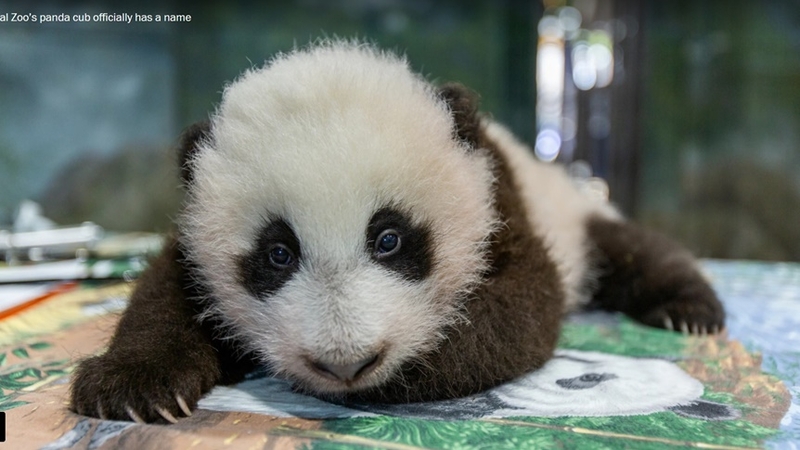
WASHINGTON – The National Zoo’s baby giant panda finally has a name. The cub’s name is Xiao Qi Ji, (SHIAU-chi-ji), which translates as “little miracle” in English.
The panda cub is now 3 months old. The zoo ran a contest in which the public could vote on a list of names. After five days, the zoo said nearly 135,000 votes came in, and Xiao Qi Ji was the winner. It was one of four Mandarin Chinese names that zoo officials put online for the public to pick.
In a statement Monday, zoo officials said, “giant pandas are an international symbol of endangered wildlife and hope, and Xiao Qi Ji’s birth offered the world a much-needed moment of joy amidst the COVID-19 pandemic.” It added, “His name reflects the extraordinary circumstances under which he was born and celebrates the collaboration between colleagues who strive to conserve this species.”
The zoo is closed due to the pandemic, but viewers can see the baby panda on the online panda camera.
All pandas at the zoo move to China when they are 4 years old as part of the zoo’s breeding agreement with China.
By The Washington Post · Siobhán O’Grady · NATIONAL, WORLD, SCIENCE-ENVIRONMENT, ASIA-PACIFIC
China launched a spacecraft without a crew aboard toward a previously unexplored part of the moon Tuesday in a bid to bring back material that could help scientists better understand the satellite and planets beyond Earth.
Only the United States and the Soviet Union have successfully brought lunar material back to Earth, in missions launched several decades ago.
Chang’e-5 launched from the Wenchang Space Launch Center in Hainan province Tuesday. The mission is named for the Chinese goddess of the moon.
The Long March-5 launch rocket carrying the Chang’e-5’s four modules – the lander, the ascent vehicle, the service capsule and the return capsule – began its fueling process Monday, Chinese state media reported.
The lander is scheduled to touch down in an area called Oceanus Procellarum and stay on the moon one lunar day – the equivalent of around two weeks on Earth.
Once there, it will attempt to dig about seven feet into the ground, then transfer the collected material to the ascender. According to NASA, the ascender will then dock with the service capsule, at which point the samples will be transferred to the return capsule. That capsule will then return to Earth, where it is expected to land in Inner Mongolia early next month. The mission’s goal is to collect about 4.5 pounds of material for research.
Jack Singal, an associate professor of physics at the University of Richmond, said that the mission, if successful, will allow scientists to directly date the rocks and volcanic activity from the collection site. Then calibrating the age to crater density, he said, could set the stage to “give us a better handle on dating rocks on the rest of the surface of the moon and other rocky bodies,” including Mercury and Mars.
The endeavor is the latest in China’s ambitious plans to expand its research in space, another rivalrous aspect of the U.S.-China relationship.
In July, China launched its Tianwen-1 mission, marking the country’s first attempt to land a rover on Mars. NASA launched a Mars mission, called Perseverance, the next week. The United Arab Emirates also launched an orbiter to Mars that month.
In January 2019, China became the first country to successfully land a spacecraft on the far side of the moon. On that mission, called Chang’e-4, the craft landed in the Von Kármán crater, in the South Pole-Aitken basin. The Chinese National Space Administration said the landing “marked a new chapter in the human race’s lunar and space exploration.”
NASA Administrator Jim Bridenstine called that landing “a first for humanity and an impressive accomplishment.”
China’s mission comes as NASA is pushing, under its Artemis program, to return astronauts to the lunar surface for the first time since 1972. The Trump administration had moved up NASA’s timeline from 2028 to 2024, saying it needed to move with a sense of urgency.
NASA is hoping to create a permanent presence on and around the moon by building a space station it calls Gateway that would stay in lunar orbit and be used as a way station for astronauts and cargo.
It seems unlikely, however, that NASA would be able to meet the White House’s ambitious schedule. And while it appears that under a Biden administration, NASA would maintain the Artemis program, the schedule would more closely adhere to the original 2028 date.
In the meantime, NASA is seeking to send a series of scientific missions to the lunar surface, including a rover that would hunt for water on the moon’s south pole by 2023.
China has dramatically accelerated its space missions in recent years, after first launching an astronaut into space in 2003, decades after American astronauts’ 1969 moon landing.
The latest mission, Singal said, is “an appropriate-scale mission for an emerging space power.”
The proximity of the moon, he added, means that if successful, China can “get some results and a triumph quickly.”
Hong Kong-Singapore bubble delay hits travel rebound hopes
InternationalNov 24. 2020Passengers wait for a train in the Central Station, Hong Kong, on Nov. 23, 2020. MUST CREDIT: Bloomberg photo by Chan Long Hei.
By Syndication Washington Post, Bloomberg · Will Davies · BUSINESS, WORLD, HEALTH, US-GLOBAL-MARKETS, ASIA-PACIFIC, HEALTH-NEWS
The shelving of the keenly anticipated Hong Kong-Singapore travel bubble shows just how delicate the process of reopening borders is — even for places that have largely contained the coronavirus.
The cities’ virus outbreaks are far less intense than in places such as the U.S. and Europe, but a recent uptick in cases in Hong Kong proved enough to delay the start of the air corridor between the two financial hubs by two weeks, dashing the plans of those who booked flights that were due to begin Sunday.
The bubble between Hong Kong and Singapore was heralded as a pandemic world-first, allowing people to travel to and from the two places without the need for quarantine. Authorities are reviewing a new launch date.
“This is a sober reminder that the Covid-19 virus is still with us, and even as we fight to regain our normal lives, the journey will be full of ups and downs,” Singapore Transport Minister Ong Ye Kung said Saturday.
The two sides agreed that the bubble would be suspended if local infections exceeded five on a rolling seven-day average. That wasn’t even met in Hong Kong before the decision, but the recent jump in infections there was enough for authorities to apply the brakes, handing another setback to the aviation and travel industries of the two cities, which had some of the region’s busiest airports before the pandemic.
“The travel bubble will eventually be resumed, although whether it will be in two weeks’ time is hard to say as it depends on how quickly the virus situation in Hong Kong improves,” Bloomberg Intelligence analyst James Teo said. “Even when it does happen, we should not expect plain sailing from then on.”
“Once more contact-tracing is done in Hong Kong and most cases become linked, even if new daily cases remain high, unlinked cases may start falling below five a day consistently, allowing the travel bubble to start,” Teo added.
Strict border curbs have helped Asia contain the coronavirus better than other parts of the world, with countries from China to New Zealand limiting the entry of travelers and imposing mandatory quarantines as a way of stopping the virus at their doors. But the approach — which has seen some all but eliminate Covid-19 — has come at a heavy cost, decimating tourism with cross-border travel basically paralyzed.
While in-country containment of the virus has resulted in the world’s 10 busiest domestic air travel routes now all being in Asia, according to OAG Aviation Worldwide, Hong Kong’s Cathay Pacific Airways and Singapore Airlines continue to struggle as they have no domestic travel market to fall back on.
Even if the Hong Kong-Singapore corridor opens, the boost to the two aviation hubs will be limited, said Rico Merkert, professor of transport at the University of Sydney’s business school. Singapore Airlines and Cathay will continue to struggle because they can’t funnel onto the route those travelers who would normally arrive from Europe and the U.S., he said.
“Without that feeder traffic, those bubbles will at best be limited to the local population,” Merkert said. “International travel is going to remain a tricky affair.”
Cathay had described the bubble as “a hugely encouraging development and an important first step in the return of regular international air travel to and from Hong Kong,” as well as a “milestone showcase” for other travel bubbles. Cathay’s traffic numbers for October slumped 98.6% from a year earlier to just 38,541 passengers. Singapore Airlines carried 35,500 passengers last month, down 98.2%.
“Bubbles provide a little bit of incremental additional international traffic in the interim period until the pandemic ends,” Sobie Aviation founder Brendan Sobie said on Bloomberg Television, adding that the impact of the bubble plan is mostly symbolic. A full recovery in air traffic will still take a few years, even with a vaccine, though bubbles will help get the process moving, he said.
An increase in cases in either Singapore or Hong Kong was always a risk for those who booked tickets when the bubble plan was announced on Nov. 11. It’s still possible to travel between the two cities, but a mandatory quarantine applies on both sides.
“That is the main deterrent, I have no interest in sitting in a hotel room for two weeks — it’s not healthy,” said Mungo Paterson, 42, a Briton living in Hong Kong who booked a Dec. 7 flight to Singapore shortly after the bubble plan was made public.
“I was excited when they announced it, I thought ‘here we go,'” said Paterson, who planned to go to Singapore for work and to see his sister and her family. “I’m now holding off confirming until Dec. 2. I think there’s a 50-50 chance the flight will happen.”
After a long lull with just a handful of cases a day, the deteriorating situation in Hong Kong prompted the government to impose tighter social-distancing rules and to close schools again. The city reported 68 new infections Saturday, with all but seven locally transmitted, a sign the virus is spreading in the community. To encourage people to take virus tests, the government plans to offer a payment of $645 (HK$5,000) to anyone who tests positive.
Cathay and Singapore Airlines were due to fly a return trip each on Sunday and then three or four a week until starting daily services next month. Passenger numbers were to be limited to 200 per flight. After the suspension, the carriers offered refunds or seats on non-travel bubble flights, which require passengers to undertake quarantine. The bubble would replace that with virus tests and a condition that arrivals can’t have traveled internationally in the previous 14 days.
Hong Kong and Singapore’s economies are heavily reliant on tourist and transit travel, and Transport Minister Ong has warned that the closing of borders puts Singapore’s very future at stake. The city-state has agreements with a handful of countries allowing business or essential travel under certain circumstances, but none reached the stage of the plan with Hong Kong. Singapore reported 12 new Covid-19 cases on Sunday, all of them in travelers coming from overseas.
Global coronavirus infections topped 58 million over the weekend, with daily increases in the U.S. nearing 200,000, yet it took fewer than 100 local cases in Hong Kong for the bubble plan to be put on ice.
Singapore and Hong Kong have said they hope their agreement can be a model for other nations trying to open up, but the delay further clouds the outlook for anyone with ambitions for travel, not just between those two cities, but everywhere else too. Air traffic globally is expected to be at just 33% of 2019 levels at the end of this year, and “hopefully” at 50% to 60% by the end of 2021, Alexandre de Juniac, director general of the International Air Transport Association, said Friday.
Pro-democracy activist Joshua Wong held after guilty plea in protest case
InternationalNov 24. 2020Pro-democracy activist Joshua Wong leaves Central Police Station in Hong Kong on Sept. 24, 2020. MUST CREDIT: Bloomberg photo by Paul Yeung
By Syndication Washington Post, Bloomberg · Natalie Lung, Rebecca Choong Wilkins, Iain Marlow · WORLD, ASIA-PACIFIC
Prominent Hong Kong activist Joshua Wong was taken into custody on Monday after he pleaded guilty to inciting and organizing an unauthorized assembly for his part in a dramatic siege of police headquarters last year during the city’s mass protests.
Wong entered a not-guilty plea to the charge of knowingly taking part in an unauthorized assembly, according to a statement, saying the prosecution had offered no evidence for the last charge. He’s set to be sentenced on Dec. 2, RTHK reported, adding that he faces a maximum punishment of three years in jail.
In a Twitter message marked as being sent while he was in custody, Wong said his current predicament was less deserving of attention than the fate of a dozen Hong Kong activists who’ve been detained by mainland Chinese authorities after fleeing the city for Taiwan by boat. The former leader of Hong Kong’s 2014 Umbrella movement protests was the subject of the Netflix documentary “Joshua: Teenager vs. Superpower.”
“I wish to pay tributes to our fellow activists who are about to face trials and prison, or to whom in distress for not being able to return home: We’re not fearless, but you are the braver ones,” he wrote. “We must fight on, raise enough awareness and put more pressure on China to set them free and allow them to return to Hong Kong.”
Wong was taken into custody on Monday after pleading guilty alongside Agnes Chow and Ivan Lam, who were all members of the since-disbanded political party Demosisto, RTHK reported. In a Facebook post late Sunday, Wong said that all three planned to plead guilty to all charges related to the siege of the police headquarters in June 2019.
The U.S.-based Hong Kong Democracy Council condemned the detention of the trio as a violation of the right to protest guaranteed under the Basic Law, the city’s mini constitution.
“Make no mistake, when they pled guilty in court today, it was not a judgment on them, but rather a judgment against a poisoned Hong Kong judiciary system no longer independent or capable of rendering justice,” Samuel Chu, the group’s managing director, said in a statement.
Wong has faced a slew of charges related to the many months of protests that ravaged the city before China enacted sweeping national security legislation this summer.
InternationalNov 24. 2020Miu Manaka learns to design her furisode kimono from yuzen master Takayuki Kato in Sumida Ward, Tokyo, in October. MUST CREDIT: Japan News-Yomiuri
By Syndication Washington Post, The Japan News-Yomiuri · Miho Tamura · WORLD, ASIA-PACIFIC
A 20-year-old Tokyo woman’s quest to make her own furisode long-sleeved kimono for her Coming-of-Age Day ceremony next year started through a chance meeting.
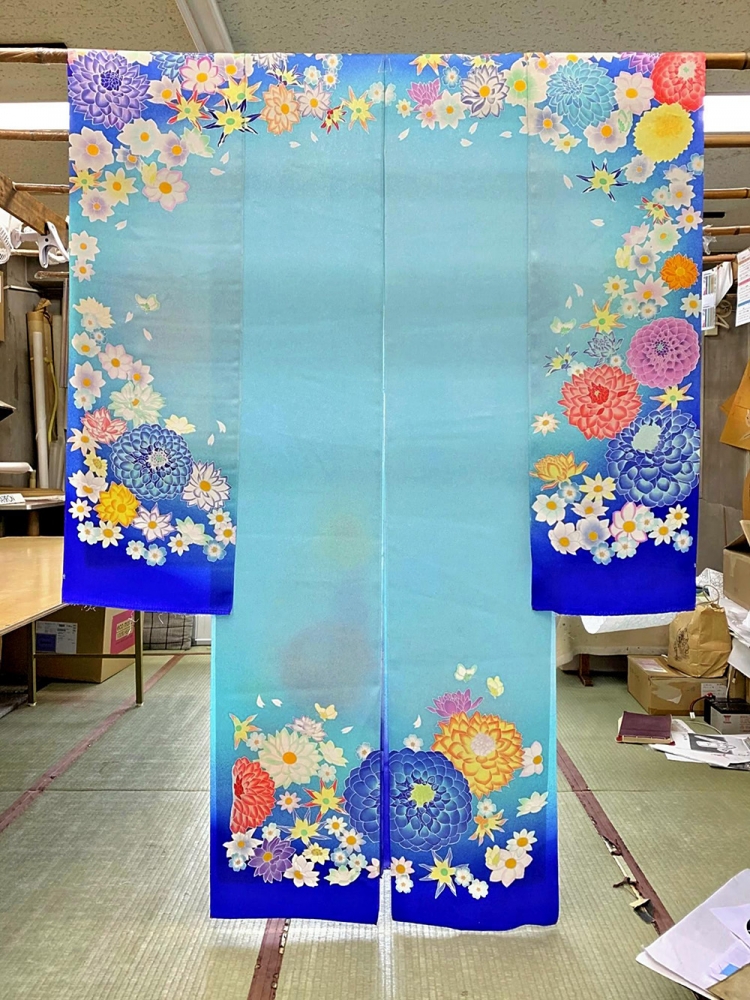
Miu Manaka’s furisode kimono. MUST CREDIT: Japan News-Yomiuri
Miu Manaka’s father, Haruyuki, 52, custom-makes furniture and during a craftwork exhibition last year, he became acquainted with fellow Sumida Ward resident and yuzen master Takayuki Kato.
The 57-year-old specializes in Tokyo-yuzen, one of the three major styles of resist dyeing to decorate kimono fabric, alongside Kyo-yuzen from Kyoto and Kaga-yuzen from Ishikawa Prefecture.
On hearing that Manaka would be attending her coming-of-age ceremony in 18 months, another artisan at the exhibition suggested that she learn the yuzen technique from Kato, who readily accepted the idea.
Tokyo-yuzen developed during the Edo period (1603-1867) in Edo, present-day Tokyo, when kimono shops opened in the Nihombashi district. There were believed to have been more than 600 Tokyo-yuzen artisans about 50 years ago, but their numbers have fallen to less than 10% of that figure today.
Kato is usually busy making kabuki and stage costumes, but he had received almost no orders since March after many events were cancelled due to the novel coronavirus pandemic. As he felt he had plenty of time to teach yuzen culture, Kato started to work with Manaka in mid-September.
Kato designed the pattern after receiving Manaka’s input. He used dahlias, which symbolize “gratitude,” as the main motif. He also arranged forget-me-nots and butterflies, which are Manaka’s favorite motifs, to complete the beautiful design for her furisode.
To mark her coming-of-age celebration taking place amid the pandemic, the lining of the kimono’s bottom is decorated with the motif of Amabie, a yokai supernatural being said to ward off epidemics.
Beginning in October, Manaka went to the studio every day to work on her celebration kimono. Each time, she spent three hours working on coloring the entire fabric with a brush and decorating the outline of the patterns with gold powder.
“Because we are all facing a difficult time, I want people to feel more cheerful through such gorgeous kimono,” Kato said.
During a visit to Kato’s studio Ishiyama Senko in Sumida Ward on Oct. 12, Manaka was observed learning one of the yuzen processes called noribuse.
“You need to apply it steadily so that the patterns underneath don’t show through,” Kato said to Manaka.
Noribuse involves applying a rice glue to brightly colored floral patterns previously depicted on a kimono fabric. Using this method can prevent the patterns from disappearing when the fabric is dyed. This is an important process because the uneven application of the rice glue can result in making the patterns unclear.
To help expand yuzen culture, Kato has continued giving yuzen workshops twice a month at Sasaya Cafe in the ward. Painting designs on tenugui cloth costs ¥1,500 and on yukata summer kimono costs from ¥8,000 to ¥20,000, for example. Kato will also accept people who want to make furisode for their coming-of-age ceremonies for the year after next or later.
Manaka’s coming-of-age ceremony in Sumida Ward is scheduled to take place in January. Depending on the spread of the novel coronavirus, however, it may be held online or even canceled.
“Even if the ceremony is canceled, I want to wear the furisode I made and say, ‘Thank you,’ to my parents,” a smiling Manaka said.
“I hope this will get young people interested in the beauty of the craftwork produced in their neighborhood,” Kato said.
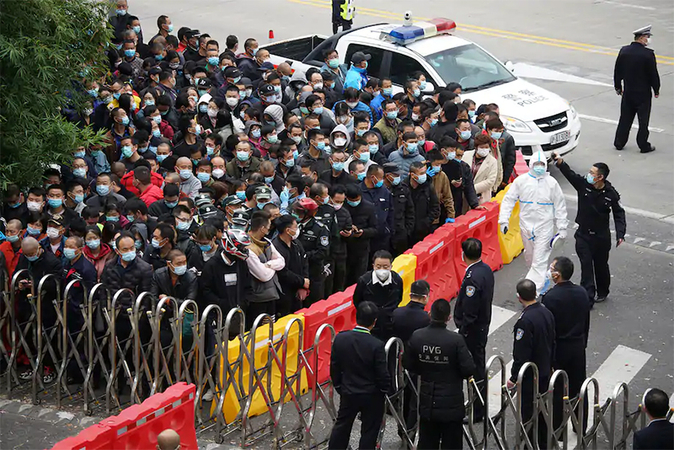
Airport workers wait for coronavirus tests at the Shanghai Pudong International Airport on Monday. (AP)
By The Washington Post · Eva Dou · WORLD, ASIA-PACIFIC
SEOUL – The blurry smartphone videos from Sunday night in China look like something out of a science-fiction movie: hundreds of workers in an airport parking structure surge against guards in white hazmat suits who block the exit. The workers yell. The security officers yell back through megaphones.
“Just let me go,” shouts one man in the crowd. “I don’t want to die here,” cries out another.
The reason that more than 17,000 employees were sealed inside Shanghai’s main airport on Sunday? Seven cases of the novel coronavirus were linked to the cargo unit.
By Monday morning, Shanghai was back on message, with local officials announcing that 17,719 airport cargo workers had been tested for the virus in one night. All of the 11,544 results received so far came back negative, they said. Official videos showed workers waiting in orderly lines for testing, set to soothing piano music.
Left unanswered was where the workers are now. An airport spokesman declined to say on Monday if they were still in the airport, taken to quarantine or allowed to go home.
Earlier at a news conference, officials blamed a cargo flight from North America as the possible source of the outbreak, while promising cargo workers access to a vaccine.
“Arrangements will be made for high-risk workers to get a coronavirus vaccine for emergency use, under an informed consent basis,” said Zhou Junlong, vice chairman of Shanghai Airport Group.
Hundreds of flights into the Shanghai Pudong International Airport on Monday were canceled, according to the flight-tracking app UmeTrip.
China has kept its coronavirus case counts enviably low by cracking down hard on new clusters – harder, perhaps, than any other country. Earlier this fall, the cities of Qingdao and Kashgar each tested millions of residents in a matter of days to guarantee that small clusters had been snuffed out. Photos showed long lines in the streets after dark.
The Shanghai case on Sunday gave a rare glimpse into the human toll of these testing blitzes. Smartphone videos circulating on Chinese social media showed thousands of cargo workers packed into an airport parking facility as they waited their turn for testing. People screamed as they were jostled back and forth.
“Oh my god, they are fighting,” one woman yelled, as a crowd pushed against the hazmat-suited workers blocking an exit. “They are fighting.”
One person was carried limply away, with someone on video saying the person fainted. The Washington Post was unable to reach airport employees to confirm this.
Shanghai officials decided on action on Sunday when two new positive coronavirus cases were detected, bringing the airport cluster to seven. The new patients were a 49-year-old cargo worker whose colleague tested positive on Friday, and the 31-year-old wife of a cargo worker who tested positive on Saturday, Shanghai’s Municipal Health Commission said.
The overnight testing drive appeared partly an effort by Shanghai officials to show they were doing their utmost to contain the outbreak, after cases continued to pop up at the airport cargo unit weeks after the first one.
On Nov. 8, a 51-year-old cargo worker at the airport – identified by authorities by only his surname, Wang – checked into a hospital with fever, fatigue and a stuffy nose, and he tested positive the next day.
His co-worker, identified as Lan, returned to his home province of Anhui and tested positive there on Nov. 10.
Last Friday, a 39-year-old cargo screening handler, named Wu, tested positive, as did his wife and two co-workers. The seventh patient was the wife of one of Wu’s co-workers.
At a news conference Monday, local officials blamed the cluster on a cargo container shipped from North America, saying Wang and Lan had cleaned it together on Oct. 30 before developing symptoms a week later.
“There was a lot of foam cushioning inside, and it was damp,” said Sun Xiaodong, vice director of the city’s pandemic control center. “Research has shown the coronavirus can survive in sealed, damp conditions, and neither of the two was wearing a face mask while cleaning it.”
The officials promised stricter virus prevention measures at the airport cargo unit, but first, the goal was testing everyone within a day – and getting everyone to cooperate.
One video circulating online showed people climbing down a fire escape on Sunday night and trampling across a garden, as they tried to escape the stifling crowds of thousands. Part of the fear appeared to be rooted in the uncertainty over if and when they could leave.
In one of the videos, an announcement blares on a loop: “Please queue for the nucleic acid testing. Don’t push, and be careful of your safety.”
By The Washington Post · Felicia Sonmez, Lisa Rein · NATIONAL, POLITICS
WASHINGTON – Emily Murphy, the embattled Trump appointee who held off declaring a winner in the presidential race for 20 days while her boss tried to subvert the election results, declared Joe Biden the victor of the election Monday.
In a one-page letter to Biden, the head of the General Services Administration addressed head-on the controversy that engulfed the country over her decision to not release more than $6 million in taxpayer-funded transition funding and to deny crucial access to federal agencies. She used unusually personal language to describe the predicament she faced as Trump has not conceded the election and declared fraud in the results in battleground states, writing that she has “always strived to do what is right.”
“Please know that I came to my decision independently, based on the law and available facts,” she wrote. “I was never directly or indirectly pressured by any Executive Branch official – including those who work at the White House or GSA – with regard to the substance or timing of my decision.”
Murphy said she did not receive “any direction to delay my determination” – but did receive threats online, by phone, and by mail directed at my safety, my family, my staff, and even my pets in an effort to coerce me into making this determination prematurely.”
“Even in the face of thousands of threats, I always remained committed to upholding the law,” the letter said.
News of the letter was soon followed by tweets in which Trump thanked Murphy and said he had recommended initial protocols for the transition.
“I want to thank Emily Murphy at GSA for her steadfast dedication and loyalty to our Country,” Trump tweeted Monday night. “She has been harassed, threatened, and abused – and I do not want to see this happen to her, her family, or employees of GSA.”
He added: “Our case STRONGLY continues, we will keep up the good fight, and I believe we will prevail! Nevertheless, in the best interest of our Country, I am recommending that Emily and her team do what needs to be done with regard to initial protocols, and have told my team to do the same.”
Biden’s transition team welcomed the GSA’s move as “a needed step to begin tackling the challenges facing our nation, including getting the pandemic under control and our economy back on track.”
“This final decision is a definitive administrative action to formally begin the transition process with federal agencies,” Yohannes Abraham, executive director of the Biden-Harris transition team, said in a statement. “In the days ahead, transition officials will begin meeting with federal officials to discuss the pandemic response, have a full accounting of our national security, and gain complete understanding of the Trump administration efforts to hollow out government agencies.”
A Republican appointed by Trump in 2017, Murphy lamented vagueness in a law called the President Transition Act of 1963, which was to guide her to making a declaration of the winner.
“Unfortunately, the statute provides no procedures or standards for this process, so I looked to precedent from prior elections involving legal challenges and incomplete counts,” Murphy wrote. “GSA does not dictate the outcome of legal disputes and recounts, nor does it determine whether such proceedings are reasonable or justified.”
And she said bluntly that she regretted that “an agency charged with improving federal procurement and property management should place itself above the constitutionally-based election process. I strongly urge Congress to consider amendments to the Act.”

 การปรับคาดการณ์ครั้งนี้เป็นการปรับการติดลบให้ลดลงจากที่เคยตั้งไว้สูงกกว่านี้
 การทดลองที่ทำให้หลายคนอดคิดไม่ได้ว่ามันคล้ายกับภาพยนต์อมตะเรื่อง “พิภพวานร”
 Sen. Kamala Harris leans on husband Doug Emhoff after being introduced by Joe Biden as his running mate during an event in Wilmington, Del., on Aug. 12, 2020. MUST CREDIT: Washington Post photo by Toni L. Sandys.
 Passengers wait for a train in the Central Station, Hong Kong, on Nov. 23, 2020. MUST CREDIT: Bloomberg photo by Chan Long Hei.
 Pro-democracy activist Joshua Wong leaves Central Police Station in Hong Kong on Sept. 24, 2020. MUST CREDIT: Bloomberg photo by Paul Yeung
 Miu Manaka learns to design her furisode kimono from yuzen master Takayuki Kato in Sumida Ward, Tokyo, in October. MUST CREDIT: Japan News-Yomiuri
 President-elect Joe Biden

